Refine listing
Actions for selected content:
Contents
Research Article
Flux and estimated spectra from a low-intensity laser-driven X-ray source
-
- Published online by Cambridge University Press:
- 02 April 2024, e1
-
- Article
-
- You have access
- Open access
- HTML
- Export citation
Hot electron emission characteristics from thin metal foil targets irradiated by terawatt laser
-
- Published online by Cambridge University Press:
- 17 April 2024, e2
-
- Article
-
- You have access
- Open access
- HTML
- Export citation
-
The interaction of focused high power laser beam with solid targets leads to acceleration of charged particles among other by non-linear effects in the plasma. In this experiment, the hot electrons are characterized from the interaction of sub-nanosecond and kilo-joule class laser pulse with thin metal foil targets (Cu, Ta, Ti, Sn, Pb). The energy distribution functions of electrons were measured by angularly resolved multichannel electron spectrometer. The hot electron temperatures were observed in range from 30 to 80 keV for laser intensities between ${\sim}10^{15}$ and $3 \times 10^{16}\ \mathrm{W\,cm^{-2}}$. The measured energy distribution and electron temperature were compared with published results and known scaling laws at higher laser intensities. For foil targets of different materials, the temperature and flux of hot electrons were scaled with target thickness in the range of 1–100 $\unicode{x03BC}\mathrm{m}$ from low Z to high Z materials where Z is the atomic number. The profile of conversion efficiency from laser energy to hot electrons is discussed in the energy range from 100 to 600 J. For the given laser and target parameters, the nonlinear behaviour of conversion efficiency and relevant physics are also described in detail.


Numerical analysis of X-ray multilayer Fresnel zone plates with high aspect ratios
-
- Published online by Cambridge University Press:
- 03 September 2024, e3
-
- Article
-
- You have access
- Open access
- HTML
- Export citation
Forward ion acceleration by laser-driven collisionless filamentary shocks in underdense plasmas
-
- Published online by Cambridge University Press:
- 22 November 2024, e4
-
- Article
-
- You have access
- Open access
- HTML
- Export citation
Proton–boron fusion in a hydrogen-doped-boron target
-
- Published online by Cambridge University Press:
- 18 November 2024, e5
-
- Article
-
- You have access
- Open access
- HTML
- Export citation
-
The proton–boron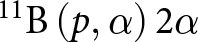 ${}^{11}{\text{B}}\left( {p,\alpha } \right)2\alpha $ reaction (p-11B) is an interesting alternative to the D-T reaction ${\text{D}}\left( {{\text{T}},{\text{n}}} \right)\alpha $ for fusion energy, since the primary reaction channel is aneutronic and all reaction partners are stable isotopes. We measured the α production yield using protons in the 120–260 keV energy range impinging onto a hydrogen–boron-mixed target, and for the first time present experimental evidence of an increase of α-particle yield relative to a pure boron target. The measured enhancement factor is approximately 30%. The experiment results indicate a higher reactivity, and that may lower the condition for p-11B fusion ignition.
