Hostname: page-component-74d7c59bfc-d7gsp Total loading time: 0 Render date: 2026-01-28T02:57:08.684Z Has data issue: false hasContentIssue false

Response of ecosystem structure to shrub encroachment varies with the degree of encroachment

Published online by Cambridge University Press:  19 November 2025

Jingyi Ding
Affiliation:
State Key Laboratory of Earth Surface Processes and Disaster Risk Reduction, Faculty of Geographical Science, Beijing Normal University, Beijing, China
Yi Han
Affiliation:
State Key Laboratory of Earth Surface Processes and Disaster Risk Reduction, Faculty of Geographical Science, Beijing Normal University, Beijing, China Key Laboratory of Poyang Lake Wetland and Watershed Research (Ministry of Education), School of Geography and Environment, Jiangxi Normal University, Nanchang, China
Wenwu Zhao*
Affiliation:
State Key Laboratory of Earth Surface Processes and Disaster Risk Reduction, Faculty of Geographical Science, Beijing Normal University, Beijing, China
Jian Hu
Affiliation:
Sichuan Zoige Alpine Wetland Ecosystem National Observation and Research Station, Southwest Minzu University, Chengdu, China
Xuan Gao
Affiliation:
State Key Laboratory of Earth Surface Processes and Disaster Risk Reduction, Faculty of Geographical Science, Beijing Normal University, Beijing, China
Yue Yan
Affiliation:
State Key Laboratory of Earth Surface Processes and Disaster Risk Reduction, Faculty of Geographical Science, Beijing Normal University, Beijing, China
Yijin Wang
Affiliation:
School of Natural Resources, Faculty of Geographical Science, Beijing Normal University, Beijing, China
David Eldridge
Affiliation:
Centre for Ecosystem Science, School of Biological, Earth and Environmental Sciences, University of New South Wales, Sydney, Australia
*
Corresponding author: Wenwu Zhao; Email: zhaoww@bnu.edu.cn
Rights & Permissions [Opens in a new window]

Abstract

Grasslands are one of the major ecosystem types in drylands. Encroachment of shrubs into grasslands affects the functioning of drylands by altering community structure, with impacts exacerbated under greater intensity of encroachment. Yet, we have a limited understanding of how ecosystem structure responds to the degree of shrub encroachment. Here, we describe a field-based study designed to examine changes in ecosystem structure beneath shrub patches (patch condition) and between patches (spatial distribution pattern of patches) along a gradient in encroachment in a semiarid grassland in Inner Mongolia, China. We found that greater encroachment was associated with wider and taller shrubs with more branches. As shrub encroachment intensified, the area beneath shrubs had more litter and was less exposed to grazing. The landscape was characterized by more discontinuous patches of vegetation and more bare ground as encroachment intensified. Either the patch condition or the patch spatial pattern was shaped mainly by the magnitude of shrub encroachment rather than by the structure of individual shrubs (e.g., height and canopy width). Our study highlights the idiosyncratic response of ecosystem structure (patch condition and patch spatial pattern) to intensifying encroachment, reinforcing the importance of considering the degree of shrub encroachment when managing encroached grasslands.

Information

Type
Research Article
Creative Commons
Creative Common License - CCCreative Common License - BY
This is an Open Access article, distributed under the terms of the Creative Commons Attribution licence (http://creativecommons.org/licenses/by/4.0), which permits unrestricted re-use, distribution and reproduction, provided the original article is properly cited.
Copyright
© The Author(s), 2025. Published by Cambridge University Press

Impact statement

Our study shows how ecosystem properties change along the encroachment gradient. As shrubs spread, individual patches become stronger “fertile islands” – the surface beneath them becomes rougher and collects more litter, and shrub size increases. However, increasing shrub cover simultaneously fragments the landscape, breaking connections between plant patches and creating a more disconnected environment. These opposing effects (better conditions beneath shrubs but reduced landscape connectivity) create significant trade-offs for the ecosystem and its inhabitants. This could include biota that operate at spatial scales consistent with the size of shrub patches. Conversely, animals needing larger open spaces (grassland specialists) or those forced to move longer distances between patches (such as mammals or some ground-nesting birds) are disadvantaged by the increased isolation and predation risk. Shrub encroachment is expected to intensify under drier, hotter conditions, amplifying this patchy landscape structure with fertile islands. Thus, the extent or encroachment is a critical consideration for managers. Moderate levels may present a balance for some benefits like biodiversity and carbon, while extensive encroachment favors shrubland species at the expense of grassland communities and overall landscape connectivity. Understanding the specific level of encroachment is therefore essential for predicting impacts and effectively managing these ecosystems under changing climates.

Introduction

Grasslands are a major biome in drylands, occupying 41% of the terrestrial area and accounting for 69% of global farmland (Suttie et al., Reference Suttie, Reynolds and Batello2005; O’Mara, Reference O’Mara2012). Grasslands support a large proportion of the world’s livestock and provide multiple ecosystem services such as climate regulation, soil conservation and biodiversity maintenance that are critical for human well-being (Bardgett et al., Reference Bardgett, Bullock, Lavorel, Manning and Shi2021). Yet, grasslands are threatened globally by increases in woody plants, largely a result of multiple interacting drivers including increasing land-use pressures, greater atmospheric carbon dioxide concentrations and more varied rainfall events (Archer et al., Reference Archer, Andersen, Predick, Schwinning and Woods2017; Stanton et al., Reference Stanton, Boone, Soto-Shoender, Fletcher, Blaum and Mccleery2017; Ding and Eldridge, Reference Ding and Eldridge2024). Encroachment of woody plants into grasslands is likely to reduce not only pastoral potential but also lead to the widespread loss of critical ecosystem goods and services (Anadón et al., Reference Anadón, Sala, Turner and Bennett2014; Archer et al., Reference Archer, Andersen, Predick, Schwinning and Woods2017). Encroachment by shrubs (shrub encroachment) is globally widespread, with current estimates of 5 million km2 affected (Eldridge et al., Reference Eldridge, Bowker, Maestre, Roger, Reynolds and Whitford2011; Deng et al., Reference Deng, Li, Shi and Hu2021). However, the functional effects of shrub encroachment are highly debated, with the encroachment enhancing the quality of soil and environmental conditions for plants but regarded as a sign of grassland degradation (e.g., Ward et al., Reference Ward, Trinogga, Wiegand, du Toit, Okubamichael, Reinsch and Schleicher2018; Eldridge et al., Reference Eldridge, Ding, Dorrough, Delgado-Baquerizo, Sala, Gross, le Bagousse-Pinguet, Mallen-Cooper, Saiz, Asensio, Ochoa, Gozalo, Guirado, García-Gómez, Valencia, Martínez-Valderrama, Plaza, Abedi, Ahmadian, Ahumada, Alcántara, Amghar, Azevedo, Ben Salem, Berdugo, Blaum, Boldgiv, Bowker, Bran, Bu, Canessa, Castillo-Monroy, Castro, Castro-Quezada, Cesarz, Chibani, Conceição, Darrouzet-Nardi, Davila, Deák, Díaz-Martínez, Donoso, Dougill, Durán, Eisenhauer, Ejtehadi, Espinosa, Fajardo, Farzam, Foronda, Franzese, Fraser, Gaitán, Geissler, Gonzalez, Gusman-Montalvan, Hernández, Hölzel, Hughes, Jadan, Jentsch, Ju, Kaseke, Köbel, Lehmann, Liancourt, Linstädter, Louw, Ma, Mabaso, Maggs-Kölling, Makhalanyane, Issa, Marais, McClaran, Mendoza, Mokoka, Mora, Moreno, Munson, Nunes, Oliva, Oñatibia, Osborne, Peter, Pierre, Pueyo, Emiliano Quiroga, Reed, Rey, Rey, Gómez, Rolo, Rillig, le Roux, Ruppert, Salah, Sebei, Sharkhuu, Stavi, Stephens, Teixido, Thomas, Tielbörger, Robles, Travers, Valkó, van den Brink, Velbert, von Heßberg, Wamiti, Wang, Wang, Wardle, Yahdjian, Zaady, Zhang, Zhou and Maestre2024). The effect of shrub encroachment also varies with its extent, with heavily encroached sites generally impossible to revert to grassland (Anadón et al., Reference Anadón, Sala, Turner and Bennett2014; Eldridge and Soliveres, Reference Eldridge and Soliveres2015). Predicted increases in climate variability are thought to stimulate shrub growth and therefore promote encroachment at the expense of grasslands (Bestelmeyer et al., Reference Bestelmeyer, Peters, Archer, Browning, Okin, Schooley and Webb2018; Deng et al., Reference Deng, Li, Shi and Hu2021). The impacts of shrub encroachment on ecosystem functions and services are intimately tied to changes in ecosystem structure. Thus, a better understanding of the response of ecosystem structure to intensifying shrub encroachment is essential if we are to effectively manage encroached grasslands under changing climates and land uses.

Despite the numerous studies of encroachment impacts on ecosystems, there is still considerable debate about the relative benefits or disbenefits of shrubs for ecosystem structure (Eldridge and Soliveres, Reference Eldridge and Soliveres2015). This uncertainty is due to the fact that their effects on ecosystem structure depend on the level of ecological processes over which they are assessed (e.g., Okin et al., Reference Okin, Heras, Saco, Throop, Vivoni, Parsons, Wainwright and Peters2015). For example, wide canopies, deep roots and branching stems of shrubs promote carbon and nutrient sequestration and hydrological function more effectively than herbaceous plants (Howard et al., Reference Howard, Eldridge and Soliveres2012; Ward et al., Reference Ward, Trinogga, Wiegand, du Toit, Okubamichael, Reinsch and Schleicher2018). The resource accumulation beneath shrub patches leads to the formation of fertile islands and biogeochemical hotspots (Eldridge et al., Reference Eldridge, Ding, Dorrough, Delgado-Baquerizo, Sala, Gross, le Bagousse-Pinguet, Mallen-Cooper, Saiz, Asensio, Ochoa, Gozalo, Guirado, García-Gómez, Valencia, Martínez-Valderrama, Plaza, Abedi, Ahmadian, Ahumada, Alcántara, Amghar, Azevedo, Ben Salem, Berdugo, Blaum, Boldgiv, Bowker, Bran, Bu, Canessa, Castillo-Monroy, Castro, Castro-Quezada, Cesarz, Chibani, Conceição, Darrouzet-Nardi, Davila, Deák, Díaz-Martínez, Donoso, Dougill, Durán, Eisenhauer, Ejtehadi, Espinosa, Fajardo, Farzam, Foronda, Franzese, Fraser, Gaitán, Geissler, Gonzalez, Gusman-Montalvan, Hernández, Hölzel, Hughes, Jadan, Jentsch, Ju, Kaseke, Köbel, Lehmann, Liancourt, Linstädter, Louw, Ma, Mabaso, Maggs-Kölling, Makhalanyane, Issa, Marais, McClaran, Mendoza, Mokoka, Mora, Moreno, Munson, Nunes, Oliva, Oñatibia, Osborne, Peter, Pierre, Pueyo, Emiliano Quiroga, Reed, Rey, Rey, Gómez, Rolo, Rillig, le Roux, Ruppert, Salah, Sebei, Sharkhuu, Stavi, Stephens, Teixido, Thomas, Tielbörger, Robles, Travers, Valkó, van den Brink, Velbert, von Heßberg, Wamiti, Wang, Wang, Wardle, Yahdjian, Zaady, Zhang, Zhou and Maestre2024) that provide refugia for plants and animals (Ochoa-Hueso et al., Reference Ochoa-Hueso, Eldridge, Delgado-Baquerizo, Soliveres, Bowker, Gross, le Bagousse-Pinguet, Quero, García-Gómez, Valencia, Arredondo, Beinticinco, Bran, Cea, Coaguila, Dougill, Espinosa, Gaitán, Guuroh, Guzman, Gutiérrez, Hernández, Huber-Sannwald, Jeffries, Linstädter, Mau, Monerris, Prina, Pucheta, Stavi, Thomas, Zaady, Singh and Maestre2018; Ding and Eldridge, Reference Ding and Eldridge2020). Such a heterogeneous distribution of resources beneath shrub patches would be expected to alter the spatial distribution of patches. For example, feedback between resource distribution and the development of shrub patches can lead to an acceleration of shrub encroachment, and a dwindling of resources in the interspaces, leading to the formation of self-perpetuating systems of resource-enriched islands within a resource-poor matrix (D’Odorico et al., Reference D’Odorico, Okin and Bestelmeyer2012). This would affect the spatial distribution of vegetation patches, which can alter the flows of energy and resources within the system, thus affecting ecosystem functions across the entire encroached system (Okin et al., Reference Okin, Parsons, Wainwright, Herrick and Fredrickson2008; Okin et al., Reference Okin, Heras, Saco, Throop, Vivoni, Parsons, Wainwright and Peters2015). However, current encroachment studies have tended to focus on finer-scale responses such as changes beneath patches (Maestre et al., Reference Maestre, Bowker, Puche, Hinojosa and Escudero2010; Eldridge and Soliveres, Reference Eldridge and Soliveres2015). The mechanisms by which ecosystem structure responds to shrub encroachment from finer (beneath patches) to coarser (between patches) levels remain poorly understood. Such a knowledge gap makes it more challenging to manage grassland functions more effectively by regulating different levels of ecosystem structure.

The response of ecosystem structure to encroachment also varies with the degree of encroachment (Eldridge and Soliveres, Reference Eldridge and Soliveres2015). When shrub cover is sparse, at a low degree of encroachment, forage production could potentially be greater under encroachment due to the addition of novel niches that support a larger range of plant species (Howard et al., Reference Howard, Eldridge and Soliveres2012). As shrub cover increases, the larger canopy cover and deeper root system of shrubs would increase resource competition on herbaceous species and therefore reduce grass biomass (Brown and Archer, Reference Brown and Archer1989; Anadón et al., Reference Anadón, Sala, Turner and Bennett2014). These changes in ecosystem attributes with the degree of encroachment are thought to reflect shifts in ecosystem status (Bestelmeyer et al., Reference Bestelmeyer, Peters, Archer, Browning, Okin, Schooley and Webb2018). For example, vegetation biomass and plant richness have been shown to decline from low to medium encroachment but increase from medium to heavy encroachment, suggesting a state change from grass dominance to shrub dominance (Peng et al., Reference Peng, Li, Li, Zhang, Zhang, Li, Zhao, Jiang and Ma2013). These changes in ecological attributes arise potentially from changes in shrub community characteristics (canopy, height and size distribution) as shrubs expand (Maestre et al., Reference Maestre, Eldridge, Soliveres, Kéfi, Delgado-Baquerizo, Bowker, García-Palacios, Gaitán, Gallardo, Lázaro and Berdugo2016). However, as most studies to date have tended to focus on a particular degree of encroachment (e.g., low, medium or heavy), empirical evidence for change across a wide spectrum of encroachment is lacking (Peng et al., Reference Peng, Li, Li, Zhang, Zhang, Li, Zhao, Jiang and Ma2013; Soliveres and Eldridge, Reference Soliveres and Eldridge2013), making it difficult to manage grasslands under different levels of encroachment, particularly during the early stages of encroachment when woody removal treatment is more effective (Ding and Eldridge, Reference Ding and Eldridge2024) and financially viable.

To address these issues, we analyzed the response of ecosystem structure beneath patches (patch condition) and between patches (spatial distribution pattern of patches) along an extensive shrub encroachment gradient covering low, medium and heavy encroachment sites across Inner Mongolia, China. Regression analyses, linear models and structural equation modeling (SEM) were used to address three predictions. First, we expected that for ecosystem structure beneath patches (Figure 1a), community structural characteristics (e.g., height and canopy) would vary with the degree of shrub encroachment, and soil and vegetation condition (e.g., litter, crust stability and exposure to grazing) would become more stable in the shrub patch as shrub encroachment intensifies due to the accumulation of resources beneath shrubs. Second, we predicted that for ecosystem structure between vegetation patches (i.e., spatial distribution patterns of vegetation patches), connectivity among vegetation patches would decline with increasing shrub encroachment (Figure 1b). This is because increasing shrub encroachment would result in the aggregation of shrubs, which strengthens resource redistribution from the grassy interspaces to the aggregated shrub patches, thus leading to a more discrete and broken landscape. Third, for those mechanisms promoting ecosystem structural changes under intensified shrub encroachment, we expected that an increasing degree of shrub encroachment would elicit changes in the spatial pattern of patches. This would be expected to occur either directly or indirectly, by altering ecosystem structure beneath patches (e.g., community characteristics of shrubs such as height, canopy width and patch condition). Such effects would be enhanced under drier and hotter climatic conditions (e.g., greater aridity and mean annual temperature). This is because changes in community- and patch-level structure would alter resource redistribution at the site or landscape level, thus regulating the organization of vegetation and the effect of encroachment is known to strengthen in drier and hotter environments.

Figure 1. Hypothetical relationships between the magnitude of shrub encroachment (indicated by shrub cover) and ecosystem structure. (a) Ecological condition of patches (e.g., herbaceous biomass beneath patches and soil surface properties); (b) spatial distribution pattern of vegetation patches (e.g., distance between patches and patch brokenness).

Methods

Study area

This study was conducted in Xilingol, Inner Mongolia, China, in the central part of the Eurasian steppe (Figure 2). We established an east–west transect (43.92°N ~ 46.56°N; 113.54°E ~ 119.29°E) of shrub-encroached grasslands across a typical steppe. The mean annual temperature of the study area ranges from 0 to 3 °C, and mean annual precipitation ranges from 150 to 500 mm. Soils in the area are dominated by chernozems and typical and sandy chestnut soils. The dominant grass species are Stipa baicalensis, Filifolium sibiricum, Stipa krylovii, Stipa grandis and Stipa klemenzii, and the dominant encroached shrub species is Caragana microphylla. To avoid the confounding effect from human disturbance and additional water resources, all the study sites were selected away from any towns, villages and rivers.

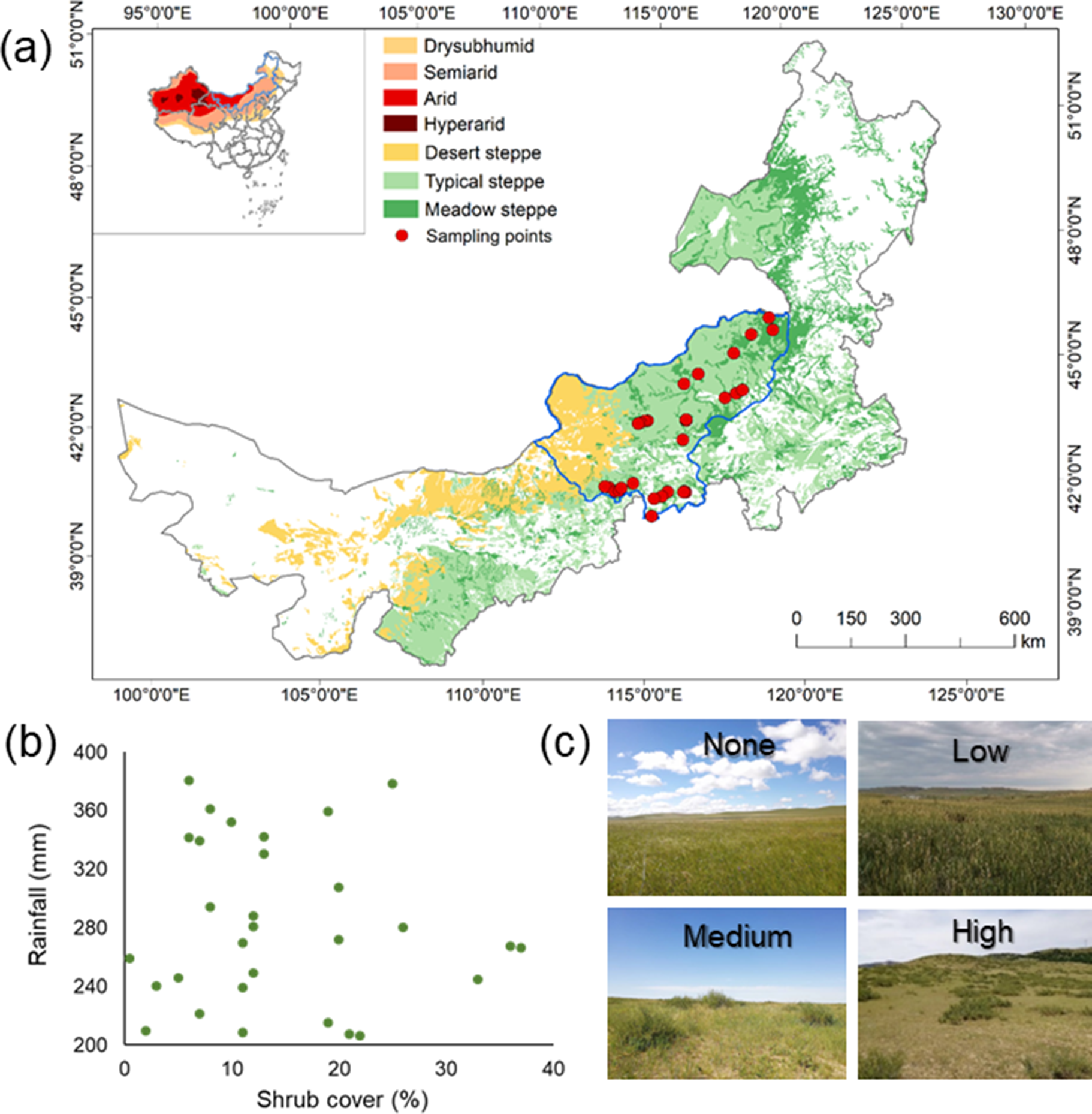
Figure 2. (a) Sampling sites across Xilingol, Inner Mongolia, China, and photos of different levels (none, low, medium and high) of encroachment; (b) shrub cover range of sampling sites across the rainfall gradient; and (c) the relationship between shrub abundance and shrub cover.

Field survey

Vegetation sampling

We surveyed 30 sites along the gradient of shrub encroachment across semiarid and arid areas in August 2022 (Figure 2).

In each site, we established a 30 m × 30 m sampling plot within which we measured four structural measures of 20 shrubs: 1) height (cm); 2) canopy width (cm); 3) stem diameter (cm); and 4) the number of branches. This allowed us to assess the community structural characteristics of shrubs (Hypothesis 1). Shrubs were selected randomly across the whole 30 m × 30 m plot. We counted the number of shrubs to derive a measure of shrub density and measured all shrubs at sites supporting fewer than 20 shrubs. To better capture the distribution of shrubs, shrub cover was estimated using a drone image from DJI Mavic 2 (resolution 1.4 cm; see 2.2.3 for details). In each site, we selected a 30 m × 30 m image corresponding with the field-based sampling plot and used a line intercept method to estimate shrub cover in each site. In the encroached grassland of Inner Mongolia, shrub cover peaked at ~40%, with Caragana spp. being the major encroached species (Chen et al., Reference Chen, Li, Zhang, Zhao, Zhou, Liu, Hu, Bai, Shen and Fang2015). In our study, shrub cover in the 30 sites ranged from 0.5% (low encroachment) to 37% (heavy encroachment), which spanned the entire range of encroachment in the region, covering low, medium and high degrees of encroachment. However, the range of encroachment may not be equivalent to that in other areas across the globe due to differences in woody species and ecosystem biomes (Eldridge and Soliveres, Reference Eldridge and Soliveres2015).

Soil surface condition assessment

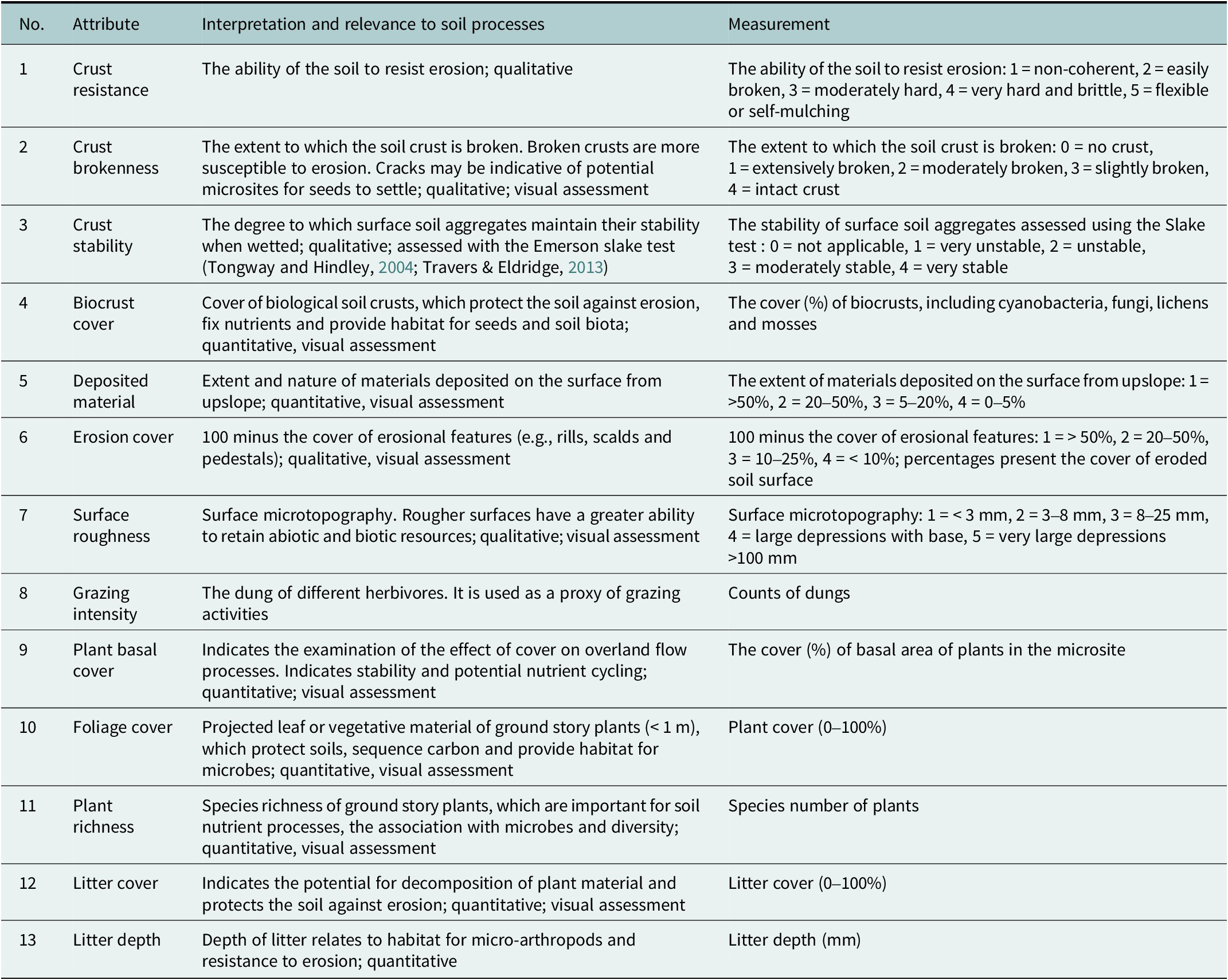
To assess patch condition beneath shrubs and grasses (Hypothesis 1), we measured 13 soil surface attributes within a 0.5 m × 0.5 m quadrat beneath five replicate shrubs and within their paired grassy interspace in each plot. Soil surface condition is strongly related to ecosystem functions (e.g., infiltration, nutrient and microbial activities; Ding and Eldridge, Reference Ding and Eldridge2022; Eldridge and Delgado-Baquerizo, Reference Eldridge and Delgado-Baquerizo2018). Within each quadrat, we assessed (1) crust resistance, (2) crust brokenness, (3) crust stability, (4) the cover of biocrusts, (5) cover of deposited material, (6) erosion cover, (7) surface roughness, (8) grazing intensity, by measuring the mass of dung of different herbivores, (9) basal cover, (10) foliage cover, (11) plant richness, (12) litter cover and (13) litter depth using a modified version of the soil surface condition protocols used in the landscape function analysis (LFA) procedure (Tongway and Hindley, Reference Tongway and Hindley2004, Eldridge et al., Reference Eldridge, Delgado-Baquerizo, Quero, Ochoa, Gozalo, García-Palacios, Escolar, García-Gómez, Prina and Bowker2020a; see details and measurements for each attribute in Table 1). After assessing soil and vegetation conditions, we clipped all of the understory plants in each 0.5 m × 0.5 m quadrat and oven-dried the material at 65 °C for 48 h to measure herbaceous biomass as a measure of forage production.

Table 1. Attributes used to assess the 13 soil surface condition (SSC) indices

Drone image processing

We used a drone to obtain high-resolution images of each site to assess the spatial distribution pattern of patches. A DJI Mavic 2 (Da-Jiang Innovations, Shenzhen, China) was used to capture high spatial resolution (1.4 cm pixels) visible color imagery in an 8-bit JPEG format of the site. Each site was flown in an area of 100*100 m in a series of parallel flight paths (designed by DJI GS Pro App) at a height of 15 m above ground level. The OpenDroneMap software program was used to process images from each field site into an 8-bit orthomosaic georeferenced GeoTiff image. OpenDroneMap is a free open-source unmanned aerial vehicle (UAV) photogrammetry software platform that is run in a virtualization with Docker container environment.

To assess landscape connectivity (among vegetation patches), we classified the whole site into two land-cover types, vegetation and bare ground, in ENVI 5.5 (https://envi.geoscene.cn/) using support vector machine classification based on the DJI Mavic 2 high spatial resolution image. We classified the image into vegetation and bare to assess the vegetation connectivity between patches.

Statistical analysis

Variation in the shrub community

To obtain the community characteristics of shrubs at each 30 m × 30 m plot, we calculated the mean, median, skewness (degree of asymmetry) and kurtosis (the tailedness) of the size distribution and the coefficient of variation (CV%) of canopy width, height, stem diameter and number of branches of each shrub at a site. We then fitted linear regressions between measures of community structure and the square root of shrub cover to explore how the shrub community changes with the degree of shrub encroachment.

Difference beneath patches

To assess the spatial distribution pattern of patches (Hypothesis 2), we used one-way analysis of variance (ANOVA) to compare the differences in soil surface condition between shrub patches and interspaces. We fitted linear regression and quantile regression (5th and 95th quantiles) between measures of soil surface condition and the square root of shrub cover to explore whether the conditions of the shrub and interspace grassy patch changed significantly with increasing shrub encroachment. Quantile regression is used widely in ecology to illustrate changes in linear relationships and to quantify the boundaries of scatter points against environmental gradients.

To assess the spatial variation in soil surface conditions at each 30 m × 30 m plot, we calculated a dissimilarity index (Bray–Curtis dissimilarity, unitless) between shrub patch and paired interspace based on the matrix of attributes (raw values) within different components of the soil surface: i) the surface crust (crust resistance, crust brokenness, crust stability and the cover of biocrusts), ii) other surface attributes (cover of deposited material, erosion cover, surface roughness and grazing intensity) and iii) plant attributes (basal cover, foliage cover, plant richness, litter cover and litter depth). We then used average dissimilarity as a measure of spatial variability at each site. The Bray–Curtis dissimilarity between vegetation patch types j and k at each site (Djk) is calculated as

(1) $$ {D}_{jk}=\sum \limits_{i=1}^n\mid {x}_{ij}-{x}_{ik}\mid /\sum \limits_{i=1}^n\left({x}_{ij}+{x}_{ik}\right) $$

where xij and xik are the raw values of soil attributes i in vegetation patch types j and k at each site. n is the number of soil surface attributes.

Vegetation distribution pattern assessment

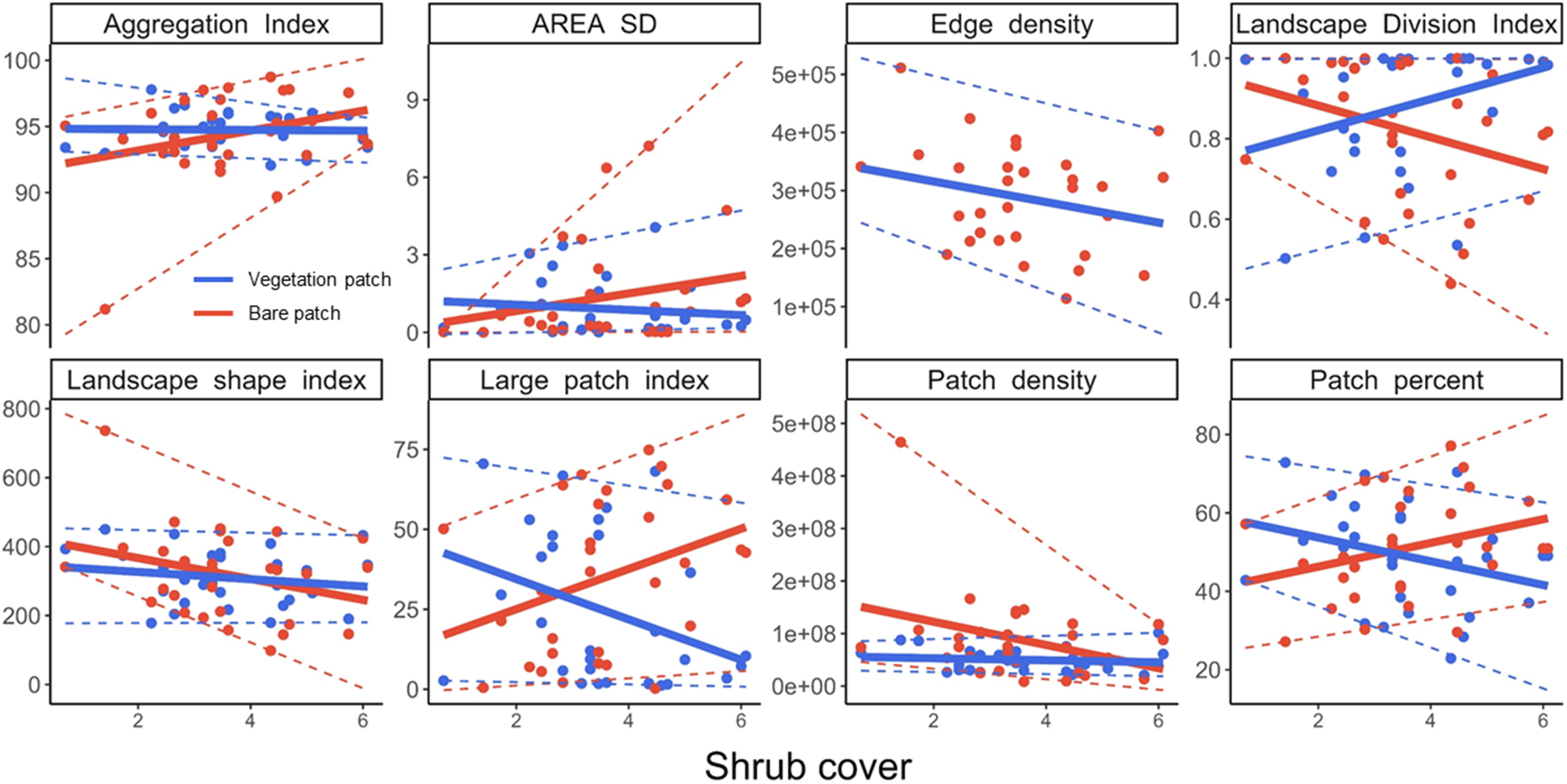
To assess the spatial distribution pattern of patches, we selected eight landscape pattern indices that describe the brokenness of connectivity of vegetation patches compared to the non-vegetated patches (ecological meaning and rationale of index selection are shown in Supplementary Table S1):

  1. (a) Aggregation Index (AI; %).

(2) $$ \mathrm{AI}=\left[\frac{g_{ii}}{\mathit{\max}\to {g}_{ii}}\right]\ast \left(100\%\right) $$

$ {g}_{ii} $ is the number of similar adjacencies (joins) between pixels of patch type (class, vegetated cf. bare) i based on the single-count method. $ \mathit{\max}\to {g}_{ii} $ is the maximum number of similar adjacencies (joins) between pixels of patch type (class) i (see below) based on the single-count method. The index ranges from 0 to 100, with a greater number indicating more aggregation of the patch type.

  1. (b) Standard Deviation of Patch Area (unitless). Standard deviation of the patch area. An index >0 indicates a more variable patch size.

  2. (c) Edge Density (m/m2). This is the sum of the lengths of all edge segments in the landscape, divided by the total landscape area. An index value >0 indicates greater patch brokenness.

  3. (d) Landscape Division Index (DIVISION; unitless).

(3) $$ \mathrm{DIVISION}=\left[1-\sum \limits_{j=1}^n{\left(\frac{a_{ij}}{A}\right)}^2\right] $$

$ {a}_{ij} $ is the size of patch $ ij $ . $ A $ is the total landscape area. The index ranges from 0 to 1, with a greater number indicating more patch brokenness and landscape complexity.

  1. (e) Landscape Shape Index (LSI; unitless).

(4) $$ \hskip0.48em \mathrm{LSI}=\frac{0.25E}{\sqrt{A}} $$

$ E $ is the total length (m) of edges in the landscape, and $ \mathrm{A} $ is the total landscape area. An index value >0 indicates a greater degree of regularity in patch shape.

  1. (f) Largest Patch Index (%). The percentage of the area of the largest patch in relation to the total landscape area. The index ranges from 0 to 100, with a greater number indicating that the landscape is dominated by larger patches.

  2. (g) Patch Density (m/m2). The number of patches of either vegetated or bare divided by the total landscape area. A greater value of the index indicates lower landscape heterogeneity.

  3. (h) Percentage of Landscape (%). The percentage of the area of a particular patch in relation to the total landscape area. The index ranges from 0 to 100, with a greater number indicating a greater dominance of that patch type in the landscape.

Landscape indices were calculated using Fragstats 4.2.1 (https://fragstats.org/). Skewness was calculated from the “moments” R package (Komsta and Novomestky, Reference Komsta and Novomestky2015). Figures were created using the “ggplot2” package (Wickham, Reference Wickham2016) in R 3.4.3 version (R Core Team, 2018).

Structural equation model

We used SEM (Grace, Reference Grace2006) to assess the mechanisms most highly related to ecosystem structure (Hypothesis 3). SEM is used to explore the direct and indirect effects of the degree of encroachment on ecosystem structure (patch condition and vegetation distribution pattern), with climate and shrub community characteristics acting as covariates to take into account other confounding factors. In the a priori model (Supplementary Figure S1), we predicted that climate would have direct effects on ecosystem structure, as well as indirect effects mediated by the degree of shrub encroachment and shrub community characteristics. We expected that the magnitude of encroachment would either directly affect ecosystem structure or exert indirect effects by altering shrub community characteristics. Overall, goodness-of-fit probability tests were performed to determine the absolute fit of the best models, using the χ 2 statistic. The best-fit model was selected with low χ 2 and root-mean-square error of approximation (RMSEA <0.05) and high goodness-of-fit index (GFI) and R 2. Analyses were performed using AMOS 22 (IBM, Chicago, IL, USA) software.

Results

Variation in the shrub community characteristics and patch condition with greater shrub encroachment

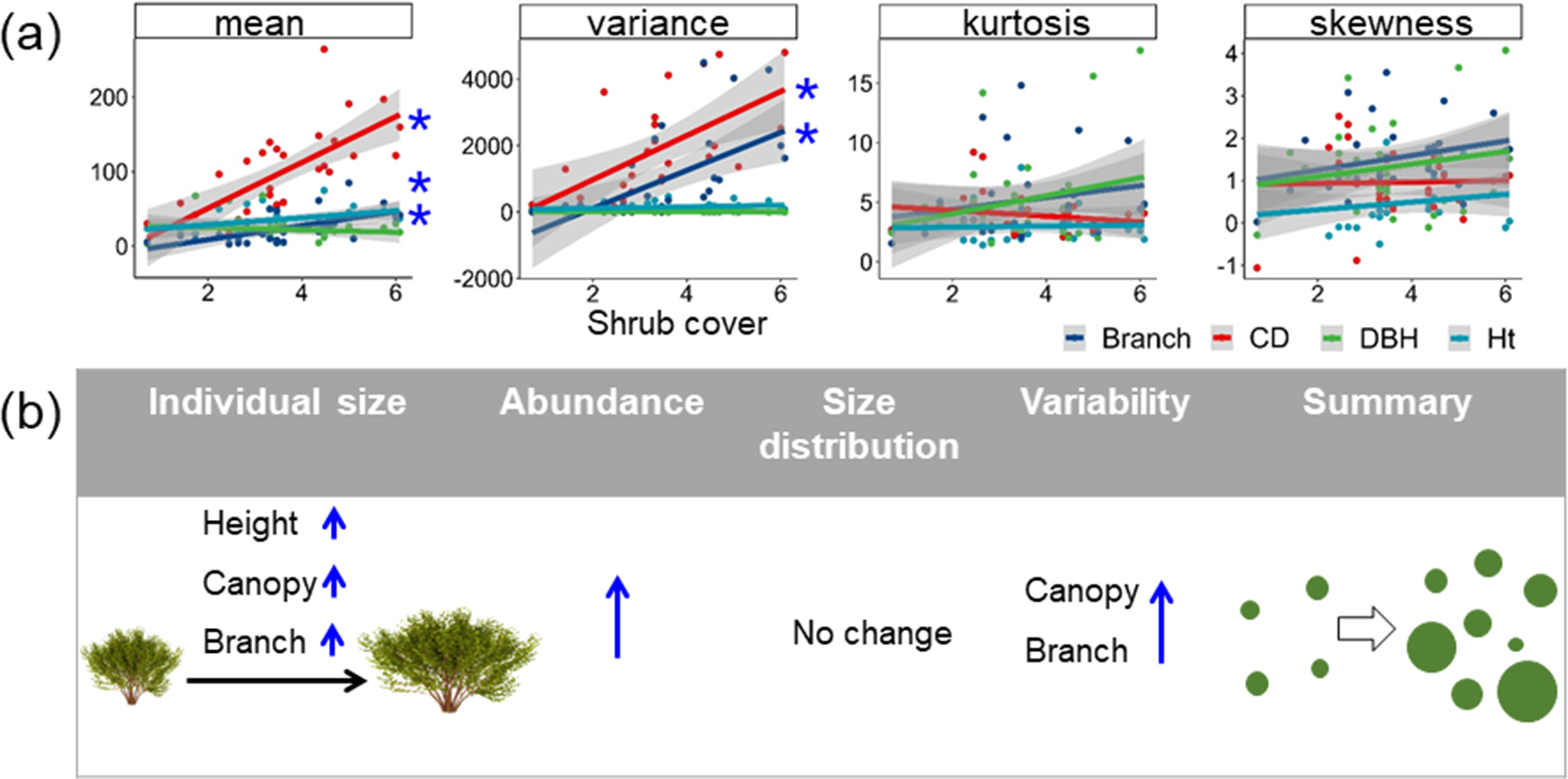
The structure and the size distribution of shrub communities varied markedly with increasing encroachment (Figure 3). Shrub abundance generally increased with shrub encroachment. Shrubs tended to be larger, characterized by taller stems, wider canopies and more branches as shrub encroachment increased (P < 0.05). Shrub size generally became more variable (canopy size and number of branches) in heavily encroached sites.

Figure 3. Variation in the shrub community characteristics (the mean, variance, kurtosis and skewness of shrub branch abundance, canopy cover [CD], DBH and shrub height [Ht]) of shrubs along shrub encroachment gradient (square root of shrub cover) and (b) the visualized summary diagram of variation in community characteristics with only significant results shown. * in (a and b) indicates significant (P < 0.05) linear relationships (Supplementary Table S2).

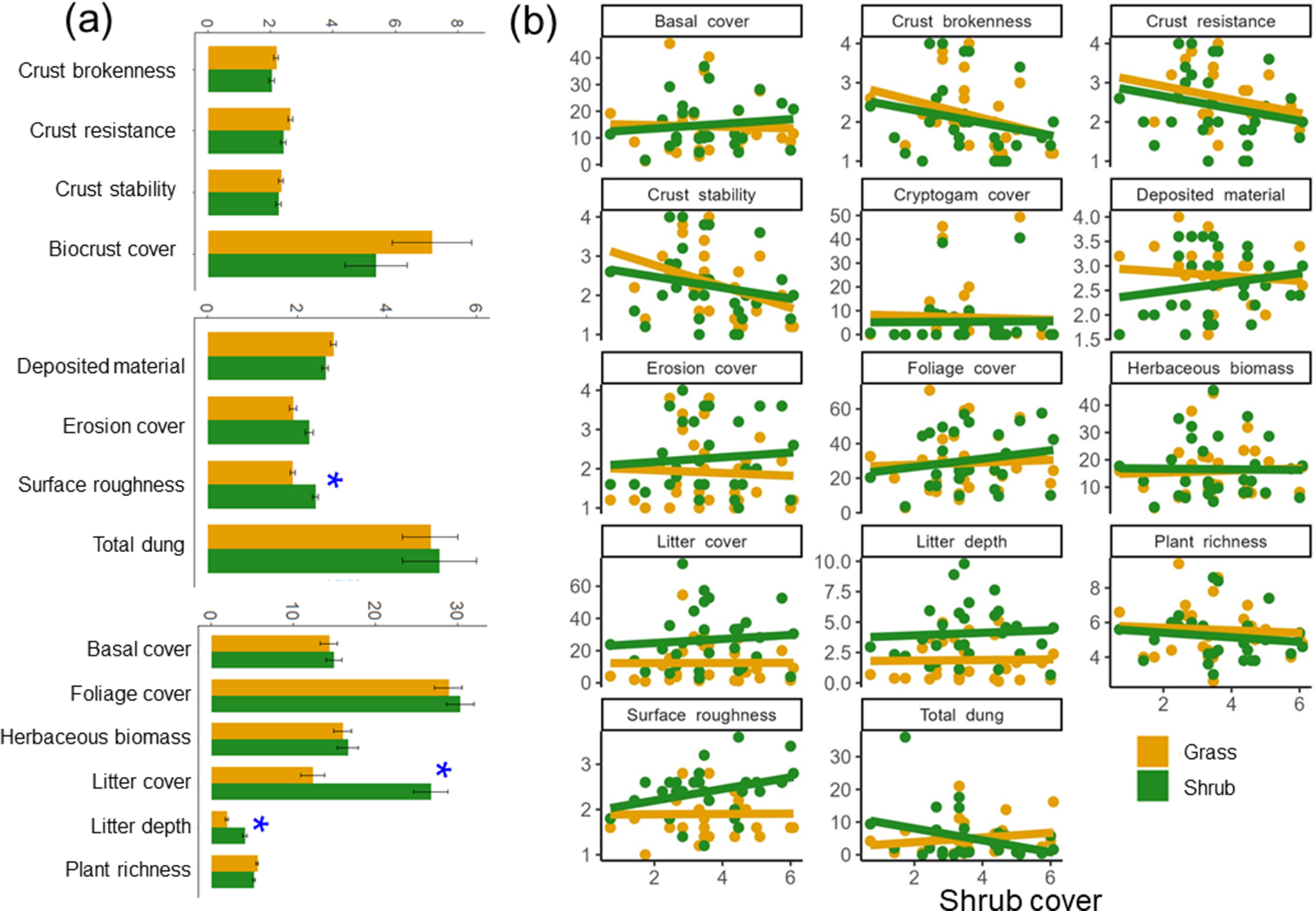
Across the encroachment gradient, the surface beneath shrubs had more and thicker litter than within grass patches (P < 0.05; Figure 4a). The soil surface was marginally rougher in shrub patches than in grass patches, which were less exposed to grazing and therefore had slightly less dung as encroachment intensified, though not significant (Figure 4b). Beneath the grass, crust stability declined markedly (P < 0.05) as encroachment intensified (Figure 4b). We found no evidence of significant dissimilarity in soil and vegetation attributes between shrub and grass patches in relation to intensifying encroachment (Supplementary Figure S2).

Figure 4. (a) Difference in patch condition between shrub patches (green) and interspaced grass patch (yellow) and (b) variation of patch condition in shrub patch (green) and the interspaced grass patch (yellow) along shrub encroachment gradient (square root of shrub cover) fitted with linear regression (solid line). * in (a and b) indicates significant (P < 0.05) linear relationships. Results of linear regression are shown in Supplementary Table S3.

Variation in spatial distribution patterns of patches with greater shrub encroachment

The spatial organization of vegetation and bare patch varied with increases in shrub cover (Figure 5). Increasing encroachment and therefore greater shrub cover were associated with more broken vegetation patches, with greater landscape division (P = 0.062, marginally significant). Conversely, the size of bare patches increased with increasing encroachment, with declines in patch density (P = 0.059) but increases in large patch index (P = 0.063, marginally significant).

Figure 5. Variation in the spatial distribution pattern of patches along the gradient in shrub encroachment (square root of shrub cover) fitted with linear regression (solid line) and quantile regression (dotted line, 5th and 95th) for vegetation patches (blue) and bare patches (red). AREA SD, standard deviation of patch area. Results of linear regression are shown in Supplementary Table S4.

Impact of shrub encroachment on patch condition and spatial distribution pattern of patches

We further explored the mechanisms of shrub encroachment on influencing patch condition and the spatial distribution of patches (Figure 6). We found that community structure and patch condition were both related to the degree of encroachment. Greater shrub abundance was associated with reduced shrub structure (shorter and narrower plants) but enhanced soil surface roughness beneath shrub patches. Conversely, greater shrub cover or abundance enhanced shrub structure (height and canopy) but reduced patch dissimilarity among shrubs and the interspaces. Although the spatial distribution pattern of patches was not significantly related to the factor, the degree of shrub encroachment (abundance and shrub cover) and shrub community structure (canopy) were major driving factors (Figure 6b). For climate variables, mean annual temperature played an important role in driving both patch condition and spatial pattern, with higher temperature enhancing surface roughness under shrub patches, intensifying landscape brokenness (higher landscape division value) and reducing the proportion of large patches (low large patch index value).

Figure 6. (a) Mechanisms associated with patch condition and spatial distribution pattern of patches and (b) the standardized total effect. Factors are climate (aridity [AI] and mean annual temperature [TEMP]), encroachment magnitude (shrub cover [COVR] and shrub abundance [ABUN]), shrub community (shrub height [HT] and shrub canopy [CANO]), patch condition (surface roughness of soil under shrubs [SURF], grazing intensity indicated by total livestock dung under shrubs [GRAZ] and niche dissimilarity between shrubs and grasses [DISSI]) and spatial distribution pattern of patches (large patch index and landscape division index). The detailed a priori model structure is shown in Supplementary Figure S1. Model fit: χ2 = 2.34, degrees of freedom (df) 10, P = 0.13, R2 = 0.26 (patch dissimilarity), 0.39 (grazing), 0.67 (surface roughness), 0.38 (large patch index) and 0.36 (landscape division index), RMSEA = 0.22, N = 30.

Discussion

Our study provides strong empirical evidence that the response of ecosystem structure to shrub encroachment varies with the degree of encroachment. As shrub encroachment intensified, the soil surface condition beneath shrub patch supported more litter and was exposed to less grazing, and the site comprised larger bare patches. Moreover, we found that both patch condition and spatial distribution pattern of patches were shaped mainly by the magnitude of shrub encroachment (cover) rather than through the changes in characteristics of shrub communities. Overall, our work reveals the response of ecosystem structure to intensifying shrub encroachment. Thus, studies of shrub encroachment and efforts to manage shrub encroachment need to be cognizant of the development stages of shrub encroachment.

Response of ecosystem structure depends on the degree of shrub encroachment

Our results indicate that the response of patch condition and spatial distribution pattern of patches significantly changes with the degree of shrub encroachment. For the condition beneath shrub patches, there are greater accumulation of litter, less exposure to grazing and dominance of a less stable soil crust as shrub encroachment intensifies. This can be explained by distinct plant traits. Shrubs are long-lived and have woody stems, wide canopies, relatively unpalatable leaves and deep roots that can make it difficult for herbivores to penetrate the clumps (Westoby, Reference Westoby1979). As encroachment intensifies, these shrubs form dense patches that are more resistant to grazing disturbance (Eldridge et al., Reference Eldridge, Soliveres, Bowker and Val2013). Moreover, shrubs have a competitive advantage over grasses as the climate becomes more variable (Knapp et al., Reference Knapp, Briggs, Collins, Archer, Bret-Harte and Ewers2008; Archer et al., Reference Archer, Andersen, Predick, Schwinning and Woods2017; Kühn et al., Reference Kühn, Tovar, Carretero, Vandvik, Enquist and Willis2021). The transfer of fine, nutrient-rich sediments from poorly vegetated grazed interspaces into shrub canopies through processes of wind and water erosion (Ravi et al., Reference Ravi, D’Odorico, Breshears, Field, Goudie, Huxman, Li, Okin, Swap, Thomas, van Pelt, Whicker and Zobeck2011; D’Odorico et al., Reference D’Odorico, Okin and Bestelmeyer2012) reinforces islands of fertility (fertile islands) beneath shrub. These biogeochemical hotspots (Eldridge et al., Reference Eldridge, Ding, Dorrough, Delgado-Baquerizo, Sala, Gross, le Bagousse-Pinguet, Mallen-Cooper, Saiz, Asensio, Ochoa, Gozalo, Guirado, García-Gómez, Valencia, Martínez-Valderrama, Plaza, Abedi, Ahmadian, Ahumada, Alcántara, Amghar, Azevedo, Ben Salem, Berdugo, Blaum, Boldgiv, Bowker, Bran, Bu, Canessa, Castillo-Monroy, Castro, Castro-Quezada, Cesarz, Chibani, Conceição, Darrouzet-Nardi, Davila, Deák, Díaz-Martínez, Donoso, Dougill, Durán, Eisenhauer, Ejtehadi, Espinosa, Fajardo, Farzam, Foronda, Franzese, Fraser, Gaitán, Geissler, Gonzalez, Gusman-Montalvan, Hernández, Hölzel, Hughes, Jadan, Jentsch, Ju, Kaseke, Köbel, Lehmann, Liancourt, Linstädter, Louw, Ma, Mabaso, Maggs-Kölling, Makhalanyane, Issa, Marais, McClaran, Mendoza, Mokoka, Mora, Moreno, Munson, Nunes, Oliva, Oñatibia, Osborne, Peter, Pierre, Pueyo, Emiliano Quiroga, Reed, Rey, Rey, Gómez, Rolo, Rillig, le Roux, Ruppert, Salah, Sebei, Sharkhuu, Stavi, Stephens, Teixido, Thomas, Tielbörger, Robles, Travers, Valkó, van den Brink, Velbert, von Heßberg, Wamiti, Wang, Wang, Wardle, Yahdjian, Zaady, Zhang, Zhou and Maestre2024) also act as refugia for plants and animals against climate extremes and physical disturbance (Dean et al., Reference Dean, Milton and Jeltsch1999; Ward et al., Reference Ward, Trinogga, Wiegand, du Toit, Okubamichael, Reinsch and Schleicher2018). Conversely, herbaceous plants in the interspaces are both grazed and abraded by aeolian sediments (Li et al., Reference Li, Ravi, Wang, Pelt, Gill and Sankey2022), thereby supporting both a less stable and more broken soil crust. These effects would likely intensify with increasing encroachment due to the lower availability of forage plants under conditions of greater shrub dominance.

Compared with the positive effect on ecosystem structure for patch condition, we found that increasing encroachment was associated with reduced landscape connectivity (i.e., the connectivity among vegetation patches) due to the heterogeneous distribution of resources that characterizes patchy landscapes. This can be explained by the self-sustaining cycling of resource redistribution driven by the interactions among hydrological and aeolian processes and fire regimes in drylands (Okin et al., Reference Okin, Heras, Saco, Throop, Vivoni, Parsons, Wainwright and Peters2015; Li et al., Reference Li, Ravi, Wang, Pelt, Gill and Sankey2022). In grasslands, erosion processes redistribute water and soil resources from grass to shrub patch, with the greater capacity of nutrient scavenging by shrubs further reinforcing such resource heterogeneity, thereby forming fertile islands beneath shrubs (D’Odorico et al., Reference D’Odorico, Fuentes, Pockman, Collins, He, Medeiros, DeWekker and Litvak2010). The dominance and coalescence of fertile islands lead to the development of a large “resource–sink” pattern (Chen et al., Reference Chen, Fu and Zhao2008). This pattern is maintained by processes of redistribution of resources driven by wind and water analogous to the fertile island phenomenon (Ying et al., Reference Ying, Haiping, Bojie and Cheng2017). Exacerbated by regional droughts, soil erosion, resource depletion and vegetation loss surrounding large woody aggregations reinforce the establishment and expansion of shrubs, forming self-sustaining cycles of resource redistribution, contributing to the irreversible transition from grass-dominated to shrub-dominated systems (Scheffer et al., Reference Scheffer, Carpenter, Lenton, Bascompte, Brock, Dakos, van de Koppel, van de Leemput, Levin, van Nes, Pascual and Vandermeer2012; Bestelmeyer et al., Reference Bestelmeyer, Peters, Archer, Browning, Okin, Schooley and Webb2018). A widely studied example of this phenomenon is embodied in the shrubland desertification paradigm of the southwestern United States (Schlesinger et al., Reference Schlesinger, Reynolds, Cunningham, Huenneke, Jarrell, Virginia and Whitford1990).

Contrary to our third hypothesis, we failed to detect any evidence of an impact of shrub encroachment on the spatial distribution pattern of patches via influencing patch condition. This could potentially be due to interactions with endogenous drivers between patches. For example, declines in forage availability can lead to more concentrated grazing of limited herbaceous material in an effort to compensate for the loss in livestock production (van de Koppel et al., Reference van de Koppel, Rietkerk, van Langevelde, Kumar, Klausmeier, Fryxell, Hearne, van Andel, de Ridder, Skidmore, Stroosnijder and Prins2002). Furthermore, reductions in grasses in the interspaces under grazing and drought would disconnect herbaceous fuel pathways, thus reducing fire frequency in grasslands and favoring the expansion of shrubs (Hodgkinson, Reference Hodgkinson1998). Consequently, a continuous grassland landscape is replaced by a mosaic of shrub patches, which reduce the structural connectivity of the landscape and therefore the transfer of material among landscape elements (Larsen et al., Reference Larsen, Choi, Nungesser and Harvey2012; Turnbull and Wainwright, Reference Turnbull and Wainwright2019). Such an effect would be strengthened under hotter climatic conditions, with higher mean annual temperature exacerbating the fragmentation of vegetation patches (higher landscape division value) and reducing the proportion of large patches. Hotter conditions would promote evapotranspiration and reduce water availability, which would give shrubs competitive advantages over grasses due to their deeper root systems (Deng et al., Reference Deng, Li, Shi and Hu2021). This would lead to an intensification of shrub expansion and produce a more fragmented landscape.

Management implications

Increasing shrub encroachment changed vegetation structure beneath patches (e.g., greater fertile island effect) but resulted in reduced landscape connectivity by increasing patch isolation. Such contrasting effects are likely to have important impacts on shrubland- and grassland-dependent biota. For example, arthropods such as spiders that move and feed beneath patches in mixed grassland–shrubland systems would benefit from the edge effects that produce distinct foraging habitats (Webb and Hopkins, Reference Webb and Hopkins1984; Daryanto and Eldridge, Reference Daryanto and Eldridge2012). Shrub consolidation into larger patches will likely disadvantage these taxa by reducing surface heterogeneity within vegetation patches. Community composition of spiders has also been shown to vary with broader changes in land-use change (e.g., forest converted to farmland; Major et al., Reference Major, Gowing, Christie, Gray and Colgan2006). Plant communities with diverse structures such as those with a greater variation in patch size or internal structure (height and configuration) provide a greater range of habitat, potentially favoring a wider species pool of spiders (Klimm et al., Reference Klimm, Bräu, König, Mandery, Sommer, Zhang and Krauss2024). These beneficial effects from shrub patches would ensue with increasing shrub cover, consistent with studies showing that ant and beetle diversity increases with increasing shrub encroachment to at least 20% shrub cover (Blaum et al., Reference Blaum, Seymour, Rossmanith, Schwager and Jeltsch2009, Eldridge and Soliveres, Reference Eldridge and Soliveres2015). Yet, shrub encroachment is unlikely to benefit biota that operate at intermediate scales greater than shrub-interspace distances, with higher predation costs for animals that need to move between shrubby and open habitats (Brown et al., Reference Brown, Kotler and Valone1994). Further, there are likely to be major trade-offs when evaluating the encroachment effect at the broader level, with encroachment sites favoring shrubland obligate at the expense of grassland-obligate taxa (Coffman et al., Reference Coffman, Bestelmeyer, Kelly, Wright and Schooley2014).

Moreover, the effect of encroachment on ecosystem structure depends highly on the degree of encroachment, with greater encroachment associated with healthier patch conditions but less connectivity among patches. The “regime shift hypothesis” suggests that as shrub encroachment intensifies, grassland ecosystems transition from a stable herb-dominated state to a shrub-dominated state, which alters ecosystem functions by altering ecosystem structure (Peng et al., Reference Peng, Li, Li, Zhang, Zhang, Li, Zhao, Jiang and Ma2013). Empirical studies reveal that moderate encroachment supports a greater species and functional diversity (Ding et al., Reference Ding and Eldridge2020). Furthermore, synthesis studies reveal that ecosystem productivity peaks at ~15% shrub cover, while carbon sequestration peaks at ~30% cover (Eldridge and Soliveres, Reference Eldridge and Soliveres2015). Thus, the extent of encroachment is critically important and will determine the options available for shrub removal and the likely impacts of shrubs on ecosystem functions.

Conclusion

Our study provides novel evidence that the response of ecosystem structure to shrub encroachment depends on the degree of encroachment. The soil surface beneath shrubs was rougher and had more litter, and the shrubs were typically larger as encroachment expanded. Conversely, connectivity collapses under shrub aggregation, resulting in a more fragmented landscape. Furthermore, our study demonstrates that either the patch condition or the spatial distribution pattern of patches is regulated by the magnitude of shrub encroachment rather than by shrub community changes. This indicates that the magnitude of encroachment is crucial in regulating changes in ecosystem structure and therefore needs to be taken into account when making decisions regarding shrub management. Under predicted drier climates, shrub encroachment is likely to intensify, resulting in a more heterogeneous landscape characterized by a shrub community forming a patchwork of fertile islands. Such structural changes will likely alter ecosystem services provided by woody plants and affect the well-being of biotic and abiotic systems.

Open peer review

For open peer review materials, please visit http://doi.org/10.1017/dry.2025.10010.

Supplementary material

The supplementary material for this article can be found at http://doi.org/10.1017/dry.2025.10010.

Author contribution

J.D. designed the research. J.D., Y.H., X.G. and Y. Y. collected the data. J.D., Y.H. and Y.W. performed the statistical analyses. J.D. wrote the first draft, and W.Z., J.H. and D.E. critically revised the manuscript.

Financial support

This study was supported by the National Natural Science Foundation of China Project (grant nos. 32201324 and 42571061 to J.D. and 42007057 to J.H.), the Young Elite Scientist Sponsorship Program by CAST (YESS2024005 to J.D.), the Outstanding Research Cultivation Project of the Fundamental Research Funds for the Central Universities, Beijing Normal University (2253200003 to J.D.) and the Sichuan Science and Technology Program (2024NSFSC0106 to J.H.). D.J.E. is supported by the Hermon Slade Foundation.

Competing interests

The authors declare no competing interests.

References

Anadón, JD, Sala, OE, Turner, BL and Bennett, EM (2014) Effect of woody-plant encroachment on livestock production in North and South America. Proceedings of the National Academy of Sciences of the United States of America 111, 1294812953.Google Scholar
Archer, SR, Andersen, EM, Predick, KI, Schwinning, S and Woods, SR (2017) Woody Plant Encroachment: Causes and Consequences. Springer International Publishing, Berlin.Google Scholar
Bardgett, RD, Bullock, JM, Lavorel, S, Manning, P and Shi, H (2021) Combatting global grassland degradation. Nature Reviews Earth and Environment 2, 720735.Google Scholar
Bestelmeyer, BT, Peters, DPC, Archer, SR, Browning, DM, Okin, GS, Schooley, RL and Webb, NP (2018) The grassland-shrubland regime shift in the Southwestern United States: Misconceptions and their implications for management. BioScience 68, 678690.Google Scholar
Blaum, N, Seymour, C, Rossmanith, E, Schwager, M and Jeltsch, F (2009) Changes in arthropod diversity along a land use driven gradient of shrub cover in savanna rangelands: Identification of suitable indicators. Biodiversity and Conservation 18, 11871199.Google Scholar
Brown, J and Archer, S (1989) Woody plant invasion of grasslands: Establishment of honey mesquite (Prosopis glandulosa var. glandulosa) on sites differing in herbaceous biomass and grazing history. Oecologia 80, 1926.Google Scholar
Brown, JS, Kotler, BP and Valone, TJ (1994) Foraging under predation – A comparison of energetic and predation costs in rodent communities of the Negev and Sonoran deserts. Australian Journal of Zoology 42, 435448.Google Scholar
Chen, L, Fu, B and Zhao, W (2008) Source-sink landscape theory and its ecological significance. Frontiers of Biology in China 3, 131136.Google Scholar
Chen, L, Li, H, Zhang, P, Zhao, X, Zhou, L, Liu, T, Hu, H, Bai, Y, Shen, H and Fang, J (2015) Climate and native grassland vegetation as drivers of the community structures of shrub-encroached grasslands in Inner Mongolia, China. Landscape Ecology 30, 16271641.Google Scholar
Coffman, JM, Bestelmeyer, BT, Kelly, JF, Wright, TF and Schooley, RL (2014) Restoration practices have positive effects on breeding bird species of concern in the Chihuahuan Desert. Restoration Ecology 22, 336344.Google Scholar
Daryanto, S and Eldridge, DJ (2012) Shrub hummocks as foci for small animal disturbances in an encroached shrubland. Journal of Arid Environments 80, 3539.Google Scholar
Dean, M, Milton, SJ and Jeltsch, F (1999) Large trees, fertile islands, and birds in arid savanna. Journal of Arid Environments 41, 6178.Google Scholar
Deng, Y, Li, X, Shi, F and Hu, X (2021) Woody plant encroachment enhanced global vegetation greening and ecosystem water-use efficiency. Global Ecology and Biogeography 30, 23372353.Google Scholar
Ding, J and Eldridge, DJ (2020) The fertile island effect varies with aridity and plant patch type across an extensive continental gradient. Plant and Soil 459, 173183.Google Scholar
Ding, J and Eldridge, DJ (2022) Drivers of soil biodiversity vary with organism type along an extensive aridity gradient. Applied Soil Ecology 170, 104271.Google Scholar
Ding, J., Eldridge, D.J. (2024). Woody encroachment: social–ecological impacts and sustainable management biological reviews. Biological Reviews 99(6), 19091926.Google Scholar
D’Odorico, P, Fuentes, JD, Pockman, WT, Collins, SL, He, Y, Medeiros, JS, DeWekker, S and Litvak, ME (2010) Positive feedback between microclimate and shrub encroachment in the northern Chihuahuan desert. Ecosphere 1, 111.Google Scholar
D’Odorico, P, Okin, GS and Bestelmeyer, BT (2012) A synthetic review of feedbacks and drivers of shrub encroachment in arid grasslands. Ecohydrology 5, 520530.Google Scholar
Eldridge, DJ and Soliveres, S (2015) Are shrubs really a sign of declining ecosystem function? Disentangling the myths and truths of woody encroachment in Australia. Australian Journal of Botany 62, 594608.Google Scholar
Eldridge, DJ, Bowker, MA, Maestre, FT, Roger, E, Reynolds, JF and Whitford, WG (2011) Impacts of shrub encroachment on ecosystem structure and functioning: Towards a global synthesis. Ecology Letters 14, 709722.Google Scholar
Eldridge, DJ and Delgado-Baquerizo, M (2018) Grazing reduces the capacity of landscape function analysis to predict regional-scale nutrient availability or decomposition, but not total nutrient pools. Ecological Indicators 90, 494501.Google Scholar
Eldridge, DJ, Delgado-Baquerizo, M, Quero, JL, Ochoa, V, Gozalo, B, García-Palacios, P, Escolar, C, García-Gómez, M, Prina, A, Bowker, MA, et al. (2020a) Surface indicators are correlated with soil multifunctionality in global drylands. Journal of Applied Ecology 57, 424435.Google Scholar
Eldridge, DJ, Ding, J, Dorrough, J, Delgado-Baquerizo, M, Sala, O, Gross, N, le Bagousse-Pinguet, Y, Mallen-Cooper, M, Saiz, H, Asensio, S, Ochoa, V, Gozalo, B, Guirado, E, García-Gómez, M, Valencia, E, Martínez-Valderrama, J, Plaza, C, Abedi, M, Ahmadian, N, Ahumada, RJ, Alcántara, JM, Amghar, F, Azevedo, L, Ben Salem, F, Berdugo, M, Blaum, N, Boldgiv, B, Bowker, M, Bran, D, Bu, C, Canessa, R, Castillo-Monroy, AP, Castro, I, Castro-Quezada, P, Cesarz, S, Chibani, R, Conceição, AA, Darrouzet-Nardi, A, Davila, YC, Deák, B, Díaz-Martínez, P, Donoso, DA, Dougill, AD, Durán, J, Eisenhauer, N, Ejtehadi, H, Espinosa, CI, Fajardo, A, Farzam, M, Foronda, A, Franzese, J, Fraser, LH, Gaitán, J, Geissler, K, Gonzalez, SL, Gusman-Montalvan, E, Hernández, RM, Hölzel, N, Hughes, FM, Jadan, O, Jentsch, A, Ju, M, Kaseke, KF, Köbel, M, Lehmann, A, Liancourt, P, Linstädter, A, Louw, MA, Ma, Q, Mabaso, M, Maggs-Kölling, G, Makhalanyane, TP, Issa, OM, Marais, E, McClaran, M, Mendoza, B, Mokoka, V, Mora, JP, Moreno, G, Munson, S, Nunes, A, Oliva, G, Oñatibia, GR, Osborne, B, Peter, G, Pierre, M, Pueyo, Y, Emiliano Quiroga, R, Reed, S, Rey, A, Rey, P, Gómez, VMR, Rolo, V, Rillig, MC, le Roux, PC, Ruppert, JC, Salah, A, Sebei, PJ, Sharkhuu, A, Stavi, I, Stephens, C, Teixido, AL, Thomas, AD, Tielbörger, K, Robles, ST, Travers, S, Valkó, O, van den Brink, L, Velbert, F, von Heßberg, A, Wamiti, W, Wang, D, Wang, L, Wardle, GM, Yahdjian, L, Zaady, E, Zhang, Y, Zhou, X and Maestre, FT (2024) Hotspots of biogeochemical activity linked to aridity and plant traits across global drylands. Nature Plants 10, 760770.Google Scholar
Eldridge, DJ, Soliveres, S, Bowker, MA and Val, J (2013) Grazing dampens the positive effects of shrub encroachment on ecosystem functions in a semi-arid woodland. Journal of Applied Ecology 50, 10281038.Google Scholar
Grace, JB (2006) Structural Equation Modeling and Natural Systems. Cambridge, United Kingdom: Cambridge University Press.Google Scholar
Hodgkinson, KC (1998) Sprouting success of shrubs after fire: Height-dependent relationships for different strategies. Oecologia 115, 6472.Google Scholar
Howard, KS, Eldridge, DJ and Soliveres, S (2012) Positive effects of shrubs on plant species diversity do not change along a gradient in grazing pressure in an arid shrubland. Basic and Applied Ecology 13, 159168.Google Scholar
Klimm, FS, Bräu, M, König, S, Mandery, K, Sommer, C, Zhang, J and Krauss, J (2024) Importance of habitat area, quality and landscape context for heteropteran diversity in shrub ecotones. Landscape Ecology 39(3), 112.Google Scholar
Knapp, AK, Briggs, JM, Collins, SL, Archer, SR, Bret-Harte, M, Ewers, BE, et al. (2008) Shrub encroachment in North American grasslands: Shifts in growth form dominance rapidly alters control of ecosystem carbon inputs. Global Change Biology 14, 615623.Google Scholar
Komsta, L and Novomestky, F (2015) Moments, Cumulants, Skewness, Kurtosis and Related Tests. R Package Version, 14. Available at http://www.r-project.org.Google Scholar
Kühn, N, Tovar, C, Carretero, J, Vandvik, V, Enquist, B and Willis, K (2021) Globally important plant functional traits for coping with climate change. Frontiers of Biogeography 13, 118.Google Scholar
Larsen, LG, Choi, J, Nungesser, MK and Harvey, JW (2012) Directional connectivity in hydrology and ecology. Ecological Applications: A Publication of the Ecological Society of America 22, 22042220.Google Scholar
Li, J, Ravi, S, Wang, G, Pelt, RVV, Gill, T and Sankey, J (2022) Woody plant encroachment of grassland and the reversibility of shrub dominance: Erosion, fire, and feedback processes. Ecosphere 13(3), e3949.Google Scholar
Maestre, FT, Bowker, MA, Puche, M, Hinojosa, MB and Escudero, A (2010) Shrub encroachment can reverse desertification in semi-arid Mediterranean grasslands. Ecology Letters 12, 930941.Google Scholar
Maestre, FT, Eldridge, DJ, Soliveres, S, Kéfi, S, Delgado-Baquerizo, M, Bowker, MA, García-Palacios, P, Gaitán, J, Gallardo, A, Lázaro, R and Berdugo, M (2016) Structure and functioning of dryland ecosystems in a changing world. Annual Review of Ecology, Evolution, Systematics 47, 215237.Google Scholar
Major, RE, Gowing, G, Christie, FJ, Gray, M and Colgan, D (2006) Variation in wolf spider (Araneae: Lycosidae) distribution and abundance in response to the size and shape of woodland fragments. Biological Conservation 132, 98108.Google Scholar
Ochoa-Hueso, R, Eldridge, DJ, Delgado-Baquerizo, M, Soliveres, S, Bowker, MA, Gross, N, le Bagousse-Pinguet, Y, Quero, JL, García-Gómez, M, Valencia, E, Arredondo, T, Beinticinco, L, Bran, D, Cea, A, Coaguila, D, Dougill, AJ, Espinosa, CI, Gaitán, J, Guuroh, RT, Guzman, E, Gutiérrez, JR, Hernández, RM, Huber-Sannwald, E, Jeffries, T, Linstädter, A, Mau, RL, Monerris, J, Prina, A, Pucheta, E, Stavi, I, Thomas, AD, Zaady, E, Singh, BK and Maestre, FT (2018) Soil fungal abundance and plant functional traits drive fertile island formation in global drylands. Journal of Ecology 106, 242253.Google Scholar
Okin, GS, Heras, MM-dl, Saco, PM, Throop, HL, Vivoni, ER, Parsons, AJ, Wainwright, J and Peters, DPC (2015) Connectivity in dryland landscapes: Shifting concepts of spatial interactions. Frontiers in Ecology and the Environment 13, 2027.Google Scholar
Okin, GS, Parsons, AJ, Wainwright, J, Herrick, JE and Fredrickson, EL (2008) Do changes in connectivity explain desertification? Bioscience 1, 1012.Google Scholar
O’Mara, FP (2012) The role of grasslands in food security and climate change. Annuals of Botany 110, 12631270.Google Scholar
Peng, HY, Li, XY, Li, GY, Zhang, ZH, Zhang, SY, Li, L, Zhao, GQ, Jiang, ZY and Ma, YJ (2013) Shrub encroachment with increasing anthropogenic disturbance in the semiarid inner Mongolian grasslands of China. Catena 109, 3948.Google Scholar
R Core Team (2018) R: A Language and Environment for Statistical Computing. R Foundation for Statistical Computing.Google Scholar
Ravi, S, D’Odorico, P, Breshears, DD, Field, JP, Goudie, AS, Huxman, TE, Li, J, Okin, GS, Swap, RJ, Thomas, AD, van Pelt, S, Whicker, JJ and Zobeck, TM (2011) Aeolian processes and the biosphere. Reviews of Geophysics 49, 2010RG000328.Google Scholar
Scheffer, M, Carpenter, SR, Lenton, TM, Bascompte, J, Brock, W, Dakos, V, van de Koppel, J, van de Leemput, IA, Levin, SA, van Nes, EH, Pascual, M and Vandermeer, J (2012) Anticipating critical transitions. Science 338, 344348.Google Scholar
Schlesinger, WH, Reynolds, JF, Cunningham, GL, Huenneke, LF, Jarrell, WM, Virginia, RA and Whitford, WG (1990) Biological feedbacks in global desertification. Science 247, 10431048.Google Scholar
Soliveres, S and Eldridge, DJ (2013) Do changes in grazing pressure and the degree of shrub encroachment alter the effects of individual shrubs on understorey plant communities and soil function? Functional Ecology 28(2), 530537.Google Scholar
Stanton, RA, Boone, WW, Soto-Shoender, J, Fletcher, RJ, Blaum, N and Mccleery, RA (2017) Shrub encroachment and vertebrate diversity: A global meta-analysis. Global Ecology and Biogeography 27, 368379.Google Scholar
Suttie, JM, Reynolds, SG and Batello, C (2005) Grasslands of the world. Food and Agriculture Organization of the United Nations, 34, 514.Google Scholar
Tongway, DJ and Hindley, N (2004) Landscape Function Analysis: Procedures for Monitoring and Assessing Landscapes with Special Reference to Mine Sites and Rangelands. Canberra: CSIRO Sustainable Ecosystems.Google Scholar
Travers, SK and Eldridge, DJ (2013) Increased rainfall frequency.Google Scholar
Turnbull, L and Wainwright, J (2019) From structure to function: Understanding shrub encroachment in drylands using hydrological and sediment connectivity. Ecological Indicators 98, 608618.Google Scholar
van de Koppel, J, Rietkerk, M, van Langevelde, F, Kumar, L, Klausmeier, CA, Fryxell, JM, Hearne, JW, van Andel, J, de Ridder, N, Skidmore, A, Stroosnijder, L and Prins, HHT (2002) Spatial heterogeneity and irreversible vegetation change in semiarid grazing systems. American Naturalist 159, 209218.Google Scholar
Ward, D, Trinogga, J, Wiegand, K, du Toit, J, Okubamichael, D, Reinsch, S and Schleicher, J (2018) Large shrubs increase soil nutrients in a semi-arid savanna. Geoderma 310, 153162.Google Scholar
Webb, NR and Hopkins, PJ (1984) Invertebrate diversity on fragmented Calluna heathland. Journal of Applied Ecology 21, 921933.Google Scholar
Westoby, M (1979) Elements of a theory of vegetation dynamics in arid rangelands. Israel Journal of Botany 28, 169194.Google Scholar
Wickham, H (2016) ggplot2: Elegant Graphics for Data Analysis. Berlin: Springer.Google Scholar
Ying, X, Haiping, T, Bojie, W, Cheng, J (2017) Effects of landscape patterns on soil erosion processes in a mountain–basin system in the North China. Natural Hazards 87, 15671585.Google Scholar
Zheng, Y, Zhou, G, Zhuang, Q and Shimizu, H (2020) Long-term elimination of grazing reverses the effects of shrub encroachment on soil and vegetation on the Ordos plateau. Journal of Geophysical Research: Biogeosciences 125, e2019JG005439.Google Scholar
Figure 0

Figure 1. Hypothetical relationships between the magnitude of shrub encroachment (indicated by shrub cover) and ecosystem structure. (a) Ecological condition of patches (e.g., herbaceous biomass beneath patches and soil surface properties); (b) spatial distribution pattern of vegetation patches (e.g., distance between patches and patch brokenness).

Figure 1

Figure 2. (a) Sampling sites across Xilingol, Inner Mongolia, China, and photos of different levels (none, low, medium and high) of encroachment; (b) shrub cover range of sampling sites across the rainfall gradient; and (c) the relationship between shrub abundance and shrub cover.

Figure 2

Table 1. Attributes used to assess the 13 soil surface condition (SSC) indices

Figure 3

Figure 3. Variation in the shrub community characteristics (the mean, variance, kurtosis and skewness of shrub branch abundance, canopy cover [CD], DBH and shrub height [Ht]) of shrubs along shrub encroachment gradient (square root of shrub cover) and (b) the visualized summary diagram of variation in community characteristics with only significant results shown. * in (a and b) indicates significant (P < 0.05) linear relationships (Supplementary Table S2).

Figure 4

Figure 4. (a) Difference in patch condition between shrub patches (green) and interspaced grass patch (yellow) and (b) variation of patch condition in shrub patch (green) and the interspaced grass patch (yellow) along shrub encroachment gradient (square root of shrub cover) fitted with linear regression (solid line). * in (a and b) indicates significant (P < 0.05) linear relationships. Results of linear regression are shown in Supplementary Table S3.

Figure 5

Figure 5. Variation in the spatial distribution pattern of patches along the gradient in shrub encroachment (square root of shrub cover) fitted with linear regression (solid line) and quantile regression (dotted line, 5th and 95th) for vegetation patches (blue) and bare patches (red). AREA SD, standard deviation of patch area. Results of linear regression are shown in Supplementary Table S4.

Figure 6

Figure 6. (a) Mechanisms associated with patch condition and spatial distribution pattern of patches and (b) the standardized total effect. Factors are climate (aridity [AI] and mean annual temperature [TEMP]), encroachment magnitude (shrub cover [COVR] and shrub abundance [ABUN]), shrub community (shrub height [HT] and shrub canopy [CANO]), patch condition (surface roughness of soil under shrubs [SURF], grazing intensity indicated by total livestock dung under shrubs [GRAZ] and niche dissimilarity between shrubs and grasses [DISSI]) and spatial distribution pattern of patches (large patch index and landscape division index). The detailed a priori model structure is shown in Supplementary Figure S1. Model fit: χ2 = 2.34, degrees of freedom (df) 10, P = 0.13, R2 = 0.26 (patch dissimilarity), 0.39 (grazing), 0.67 (surface roughness), 0.38 (large patch index) and 0.36 (landscape division index), RMSEA = 0.22, N = 30.

Supplementary material: File

Ding et al. supplementary material

Ding et al. supplementary material
Download Ding et al. supplementary material(File)
File 439.7 KB

Author comment: Response of ecosystem structure to shrub encroachment varies with the degree of encroachment — R0/PR1

Comments

Cambridge Prisms: Drylands

Dear Editor

We would like you to consider the manuscript “Does scale matter: the response of ecosystem structure to shrub encroachment varies with spatial scale in a semiarid grassland” as a Research paper contribution to Cambridge Prisms: Drylands.

Grasslands are a major biome in drylands, supporting forage production and multiple ecosystem functions. However, under global climate change and intensified human activities, expansion in shrubs are encroaching grasslands worldwide. Shrub encroachment can largely alter ecosystem structure from multiple scales such as the structure of plants, communities and landscape patterns, which will change the function and services of grassland. However, the mechanisms by which ecosystem structure responds to shrub encroachment from finer to coarser scales remain poorly understood. Such a knowledge gap makes it more challenging to manage grasslands under different levels of encroachment, particularly during the early stages of encroachment when treatment is more effective.

To solve this issue, we sampled niche conditions beneath individual shrubs (plant scale) and the size distribution of shrubs (community scale) and extracted landscape indices (landscape scale) using drone data along an extensive shrub encroachment gradient in a semiarid grassland in Inner Mongolia, China. Our results show that as shrub encroachment intensifies, the soil surface beneath shrubs supported more litter, was exposed to less grazing, the shrub community became more variable in size, and the landscape comprised larger bare patches. Moreover, landscape pattern was shaped mainly by the magnitude of shrub encroachment (cover, abundance) rather than either community structure or the condition of the soil surface beneath shrubs.

Together, these data provide novel evidence that the response of ecosystem structure to shrub encroachment depends on the spatial scale under consideration, indicating that shrub management need to be cognizant of the scale at which encroachment is operating. This makes our work highly appealing to ecologists, land managers and policy makers involved in the management of shrub encroachment and restoration of drylands, and therefore readers of Cambridge Prisms: Drylands.

All authors have read and agree with the contents of the manuscript, and there are no any actual or potential conflict of interest among all authors. We certify that this submission is an original work, and it is not under review at any other publication.

Yours sincerely

Jingyi Ding

August, 31th 2024

Review: Response of ecosystem structure to shrub encroachment varies with the degree of encroachment — R0/PR2

Conflict of interest statement

Reviewer declares none.

Comments

This is an interesting and potentially useful paper. It is clear that the data were carefully collected and that the results were chosen with care and are ecologically and logically relevant. However, there are important problems which render the results and conclusions difficult to accept and which I list below:

The authors state (from title and results to discussion) that the response of ecosystem structure to encroachment varies with spatial scale. Therefore, scale matters. There is some confusion with what they exactly mean with “spatial scale”: hierarchical levels of organization (individuals, population, community, ecosystem levels) or spatial extent (local or landscape levels)?. To understand changes in ecological processes related with spatial scale, there is a need to evaluate key components of scale, i.e. grain and extend, and how they can create context dependent results. And sometimes measuring the same variables at different scales. However, I do not see that this is the case in this manuscript because all the data collection and analysis are framed in a very similar level of grain and extent.

I suggest they can better define what spatial scale means in the context of the manuscript and what are the potential caveats of their framework. For example, they state: “Our study highlights the idiosyncratic response of plant-, community-, and landscape-scale structure to intensifying shrub encroachment, reinforcing the importance of considering scale effects …” (lines 21-24). However, the variables used to evaluate each of these scale (?) levels are completely different and therefore explain different ecological processes.

The authors claim they evaluate the structural responses of drylands from finer to coarser scales (from a point level to landscape level). However, the variables obtained from the landscape level is restricted to data from 30 areas of 100*100 m. All the landscape metrics are calculated within this very small extent and this does not seems a significant change from the plots of 30*30 m. Perhaps this spatial extent seems too restrict and it does not shed light on how encroachment drives structural responses at “coarser” scales. Is 100*100 m really coarse? Do the authors expect changes on the relative importance of landscape metrics when changing from 100*100 m to landscapes with 1,000*1,000 m? Would the effects of encroachment on vegetation structure change by increasing spatial extent? To address these caveats, the authors could include some additional analysis on larger spatial extents or deeply discuss its implications.

Other comments:

Line 165: Shrub cover at the 30 study sites ranged from 0.5% (grassland) to 37% (high encroachment). 37% of shrub cover is more likely to be an intermediate level of encroachment instead of a high level of encroachment. The authors should discuss the representativeness of this cover range for the study system and for other regions in the globe.

Lines 52-55: double check the message of this phrase because it is not always the case that drier climates and more intensive livestock grazing lead to encroachment.

Review: Response of ecosystem structure to shrub encroachment varies with the degree of encroachment — R0/PR3

Conflict of interest statement

Reviewer declares none.

Comments

Ding et al. analyzed the variation in ecosystem structure of Inner Mongolia grassland at three spatial scales: 1) plant (individual shrubs), 2) community (aggregations of shrubs), and 3) landscape (10,000 m2 site) along an extensive shrub encroachment gradient representing low, medium and high encroachment across different steppe types (temperate, meadow, desert).

To me that is a tough job. They revealed that response of ecosystem structure to shrub encroachment depends on the spatial scale. At finer scales, the soil surface beneath shrubs is rougher, has more litter, and the shrubs are typically larger as encroachment expands. Conversely, aggregations of shrubs patches break down the connectivity among vegetation, leading to a more broken landscape at larger scale. Overall, this manuscript is well written, careful tight, and strict in logic, which is interesting and give us lots of information about how shrubs encroachment changes the structure of grassland ecosystems and thus has potential effects on ecosystem functions and services.

I don’t have any major revision suggestions. However, other small suggestions are as follows:

Line 11 I think niche conditions are not appropriate,please correct it as abiotic and biotic conditions.

Line 22 reinforcing the importance of considering scale effects when evaluating the role of encroachment as encroachment increases---->reinforcing the importance of scale effects of encroachment processes.

Line 63 relative ecosystem benefits or disbenefits of shrublands ---->relative benefits or disbenefits of shrublands for ecosystems.

Line 65 soil and environmental conditions for plants.

Line 76 the formation of fertile islands and biogeochemical hotspots

Line 86 coarser ---->larger

Line 89 when treatment is more effective---->What are the treatments? Please make it as clear as possible.

Line 97 a larger canopy cover and deeper root system of shrubs

Line 118 We used landscape indices, shrub size distribution, and the condition of the soil surface

Line 357 Grazing could be the driver of shrub encroachment.

Line 360 community structure ---->structure of shrub communities

Line 372 dominance of a less stable soil crust as shrubs encroachment intensifies

Line 390 vector ---->driver

Line 391 giving ---->benefitting

Line 397 for seedlings survival

Line 408-Line 420 What is the self-sustaining cycling ? Please give more information about how shrub encroachment reduce landscape

connectivity at larger scale.

Line 437 increased---->changed

Line 441 operate---->move and feed

Line 447 Plant communities with diverse structures

Line 450 wider species pool of spiders

Line 468 Please remove “under consideration”.

Recommendation: Response of ecosystem structure to shrub encroachment varies with the degree of encroachment — R0/PR4

Comments

I have now received two reviews of the ms DRY-2024-0021. Whereas one is fairly positive, other reviewer raises critical concerns that I agree with.

The authors have overall collected a relevant dataset on encroachment attributes based on field work, and covering a climatic and encroachment (shrub cover) gradient. With that data the authors claim to address the scale-dependency of vegetation structure patterns in encroachment. However the analyses hardly do that. I see two major issues.

First, as the reviewer 1 points out, the authors do not show how a number of patterns varies with scale, but they select different patterns at different scales. That study design makes very difficult to address scale-dependency. If the authors want to study scale-dependency they could for example analyse how patterns at the smallest scale (i.e. soil properties) change when observed at the three scales considered in this work.

Second, even if the authors aim to explore and relate different patterns observed at different scales, the patterns selected at each scale do not follow a clear rationale and give the impression to be arbitrarily selected, without much relationship among them. Why were soil properties selected at the shrub scale, but shrub size distribution at the “community scale”? Similarly, the landscape metrics selected at the landscape scale suffer from the same problem (which is very common when using landscape metrics): why were these nine metrics chosen, and what is the ecological meaning or the hypotheses behind them? The lack of a clear rationale behind the selected patterns is also reflected in the SEMs, which lack a proper overarching hypothesis, and are the result of simply juxtaposing variables and relationships. To address this overall weakness of the design, the authors should find clear links among patterns occurring at the three different scales (likely ecological processes) and, if necessary, redefine some of the patterns examined (e.g. those at the landscape scale), so that the study tells a more cohesive story.

Decision: Response of ecosystem structure to shrub encroachment varies with the degree of encroachment — R0/PR5

Comments

No accompanying comment.

Author comment: Response of ecosystem structure to shrub encroachment varies with the degree of encroachment — R1/PR6

Comments

Cambridge Prisms: Drylands

Dear Editor

We would like you to consider the manuscript “Does scale matter: the response of ecosystem structure to shrub encroachment varies with spatial scale in a semiarid grassland” as a Research paper contribution to Cambridge Prisms: Drylands.

Grasslands are a major biome in drylands, supporting forage production and multiple ecosystem functions. However, under global climate change and intensified human activities, expansion in shrubs are encroaching grasslands worldwide. Shrub encroachment can largely alter ecosystem structure from multiple scales such as the structure of plants, communities and landscape patterns, which will change the function and services of grassland. However, the mechanisms by which ecosystem structure responds to shrub encroachment from finer to coarser scales remain poorly understood. Such a knowledge gap makes it more challenging to manage grasslands under different levels of encroachment, particularly during the early stages of encroachment when treatment is more effective.

To solve this issue, we sampled niche conditions beneath individual shrubs (plant scale) and the size distribution of shrubs (community scale) and extracted landscape indices (landscape scale) using drone data along an extensive shrub encroachment gradient in a semiarid grassland in Inner Mongolia, China. Our results show that as shrub encroachment intensifies, the soil surface beneath shrubs supported more litter, was exposed to less grazing, the shrub community became more variable in size, and the landscape comprised larger bare patches. Moreover, landscape pattern was shaped mainly by the magnitude of shrub encroachment (cover, abundance) rather than either community structure or the condition of the soil surface beneath shrubs.

Together, these data provide novel evidence that the response of ecosystem structure to shrub encroachment depends on the spatial scale under consideration, indicating that shrub management need to be cognizant of the scale at which encroachment is operating. This makes our work highly appealing to ecologists, land managers and policy makers involved in the management of shrub encroachment and restoration of drylands, and therefore readers of Cambridge Prisms: Drylands.

All authors have read and agree with the contents of the manuscript, and there are no any actual or potential conflict of interest among all authors. We certify that this submission is an original work, and it is not under review at any other publication.

Yours sincerely

Jingyi Ding

August, 31th 2024

Review: Response of ecosystem structure to shrub encroachment varies with the degree of encroachment — R1/PR7

Conflict of interest statement

Reviewer declares none.

Comments

The authors made a great effort to redefine the main concepts used in the manuscript, making a more cohesive story. In addition, they reanalyzed part of the data. This new version of the manuscript seems to have a more straightforward message.

A few minor comments:

Lines 10-11: However, we have a limited understanding of how ecosystem structure respond to the degree of shrub encroachment.

Lines 304-311: In these lines, the text refers to Figure 3. However, the correct figures are Figure 4a and 4b.

Line 361: missing parenthesis

Recommendation: Response of ecosystem structure to shrub encroachment varies with the degree of encroachment — R1/PR8

Comments

Dear Jingyi Ding,

I have received the review of one of the former reviewers and I have also reviewed the revised manuscript myself. While the reviewer acknowledges the improvement of the work, I have identified some aspects that needs to be improved.

Overall, the authors have made a commendable effort to revise the manuscript and address the key comments raised by the reviewers. In my view, their approach—shifting the focus of the study from how properties change with scale to how they vary along the encroachment gradient—is appropriate. This change has resulted in a much more solid and coherent manuscript.

This revision represents a major overhaul, but there are still aspects that require further refinement. In particular, the authors should improve the alignment between the objectives and hypotheses stated in the Introduction and the analyses conducted, as well as the content of the Discussion. At present, the objectives—and especially the hypotheses—only partially encompass the results presented. Notably, the structural equation modelling (SEM) includes variables such as “climate” and “community characteristics,” which are not explicitly mentioned in the stated objectives or hypotheses. Similarly, the current formulation of the objectives and hypotheses does not adequately address the direct and indirect effects among the various factors considered, which are central to the SEM approach. I therefore encourage the authors to revise the manuscript accordingly, ensuring that the objectives and hypotheses reflect the full scope of the patterns examined in the analyses.

There is a second reflection on the objectives and hypothesis of the work. Increasing Increasing shrub encroachment will, by definition, alter patch size and spatial distribution. Therefore, the second and third hypotheses may be somewhat trivial. The relevant question is not whether these patterns change, but how they change. One could, for instance, construct a null model simulating increased encroachment through random assignment of new shrub locations, or another model where cover increases concentrically from existing shrubs, and then assess whether the observed patterns align with, or deviate from, these expectations. While I understand that the authors do not intend to explore this direction, this reflection might help them interpret and discuss their results more critically, and possibly adopt a more cautious or nuanced interpretation.

Other comments:

L10. Correct “structural”

L14. “We found that greater encroachment was associated…” It would be good to indicate how the degree of encroachment is measured, because it is not trivial, it can be cover but also biomass, and it can also vary with scale itself. So I would say We found that greater shrub cover at 30x30m ….

L19. This means “more” discontinuous patches

L22: cover is also a characteristic of shrub communities, here one could be more precise and indicate for example composition

L49: “Predicted more varied climates are supposed to….” Please rephrase like “Predicted increases in climate variability are expected to …”

L76-77. “However, current encroachment studies have focused mainly on finer level of responses, such as changes beneath patches.” This needs supporting references.

L97-102. “However, as most studies to date have tended to focus on a particular degree of encroachment (e.g., low, medium, or heavy).” This sentence needs supporting references.

L108-111. In this first hypothesis is not clear that you are addressing how ecosystem structure varies along an encroachment gradient. It gives the impression that you are comparing beneath and outside shrubs. (In L218-219 it is clearer but it is buried in the methods)

L113-114 The second hypothesis is very clearly worded regarding testing along an encroachment gradient. However, the explanation after L115-117 is difficult to understand.

L117. Add “level” or any indication of encroachment gradient. “We expect that the level of shrub encroachment would…”. Break the sentence in two, one for the expectation, and another for the underlying process. The expectation is also not clearly articulated, as spatial distribution of patches is very vague. You should be some more precise with what pattern you expect to change.

L294-300. Is the variation of the community characteristics part of any hypothesis or objective? It looks like it comes out of the blue. It might be informative but it should be better integrated in the rationale of the work.

L313-321. Present the results according to your three hypotheses (or another set of hypotheses if you change them). In this paragraph you present the results for Hypothesis 2 and 3 , but it is not stated as such, which makes it confusing.

L393-395. As this result is presented, there is no mention to the encroachment gradient, but on the effect of patch condition on the spatial distribution of patches.

Decision: Response of ecosystem structure to shrub encroachment varies with the degree of encroachment — R1/PR9

Comments

No accompanying comment.

Author comment: Response of ecosystem structure to shrub encroachment varies with the degree of encroachment — R2/PR10

Comments

Cambridge Prisms: Drylands

Dear Editor

We would like you to consider the manuscript “Does scale matter: the response of ecosystem structure to shrub encroachment varies with spatial scale in a semiarid grassland” as a Research paper contribution to Cambridge Prisms: Drylands.

Grasslands are a major biome in drylands, supporting forage production and multiple ecosystem functions. However, under global climate change and intensified human activities, expansion in shrubs are encroaching grasslands worldwide. Shrub encroachment can largely alter ecosystem structure from multiple scales such as the structure of plants, communities and landscape patterns, which will change the function and services of grassland. However, the mechanisms by which ecosystem structure responds to shrub encroachment from finer to coarser scales remain poorly understood. Such a knowledge gap makes it more challenging to manage grasslands under different levels of encroachment, particularly during the early stages of encroachment when treatment is more effective.

To solve this issue, we sampled niche conditions beneath individual shrubs (plant scale) and the size distribution of shrubs (community scale) and extracted landscape indices (landscape scale) using drone data along an extensive shrub encroachment gradient in a semiarid grassland in Inner Mongolia, China. Our results show that as shrub encroachment intensifies, the soil surface beneath shrubs supported more litter, was exposed to less grazing, the shrub community became more variable in size, and the landscape comprised larger bare patches. Moreover, landscape pattern was shaped mainly by the magnitude of shrub encroachment (cover, abundance) rather than either community structure or the condition of the soil surface beneath shrubs.

Together, these data provide novel evidence that the response of ecosystem structure to shrub encroachment depends on the spatial scale under consideration, indicating that shrub management need to be cognizant of the scale at which encroachment is operating. This makes our work highly appealing to ecologists, land managers and policy makers involved in the management of shrub encroachment and restoration of drylands, and therefore readers of Cambridge Prisms: Drylands.

All authors have read and agree with the contents of the manuscript, and there are no any actual or potential conflict of interest among all authors. We certify that this submission is an original work, and it is not under review at any other publication.

Yours sincerely

Jingyi Ding

August, 31th 2024

Recommendation: Response of ecosystem structure to shrub encroachment varies with the degree of encroachment — R2/PR11

Comments

After a major and very well-executed revision of the manuscript in the first round of review, which completely changed the direction of the work, in the second round the authors were asked to ensure proper alignment between objectives/hypotheses, methods, and results. In the submitted version, the authors have implemented some of the requested adjustments, but there remain substantial issues that require attention. For instance, soil properties are not mentioned in Hypothesis 1, yet they play a highly relevant role in the methods, results, and discussion. Conversely, climate is central to Hypothesis 3 (and its associated SEM), but it is not discussed in the results or discussion sections. I therefore ask the authors to revise the manuscript again, with the main specific aim of achieving consistency between the questions formulated and the answers provided. Every question raised must be addressed, and every answer reported must correspond to a previously stated question. On a positive note, all necessary elements are already present in the manuscript, but adjustments are required to ensure coherence throughout the text.

A more detailed list of comments and suggestions is provided below.

Abstract

Check english language, eg. L 17:” The degree of shrub encroachment had contrast effect on ecosystem structure.” This is worded wrong.

L15-17, “found that ….” This results refers to patch condition or spatial distribution pattern of patches? After this sentence you address both, so this previous result is not clear where its fits within the objectives described previously.

L19, “The spatial distribution of patches …” It is not clear along what gradient you are referring.

L23 ”structure of individual shrub(s)” I guess it needs an “s”.

Introduction

L69-70 Drivers of encroachment are highly debated and complex. Instead of indicating just two, I would rather say that is due multiple interacting drivers including ….. and include two or three references.

L136-159. The authors have make a great effort in identifying hypotheses or expected patterns, but there are misalignments with the abstract.

For example in the abstract it says “As shrub encroachment intensified, conditions beneath shrubs were characterized by more litter and lower exposure to grazing” however in L141 142 only height and canopy are indicated, and nothing is said on litter or exposure to grazing. The factors addressed on each Hypothesis should be more explicitly described, particularly if they yield relevant results (that are indicated in the Abstract).

So, the patch condition is addressed by means of one hypothesis and spatial distribution by means of two hypotheses (2 and 3). This is a little confusing and could be described more clearly.

L155. It would be good to have an expectation on the climate modulation regarding the climatic factor (i.e. is it temperature or precipitation) and the direction of the effect. Do you expect more or less change in height or canopy along the considered climatic gradient?

L154. In H3, it is confusing that you use height an canopy as variables to address changes in spatial distribution of patches (L153-154) because these variables has been used to describe ecosystem structure beneath patches on H1.

Methods

L202. You devote a section to soil characterization but “soil” does not appear on the Objectives. This has to be fixed and include it in the Objectives accordingly.

L239. In the Statistical Analysis section, it woudlbe good if you link the different analyses to the Hypotheses. (In order to test our fist hypothesis …). Or for example in L278: To assess the spatial distribution pattern of patches (Hypothesis 2)…

Results

Merge sections 3.1 and 3.2 so that there are as many section as Hypotheses (i.e. 3). Please relate explicitly each one of the results sections to their hypotheses.

Section 3.1. Figure3: * are very difficult to see. Maybe you can use continuous and dashed lines for significant and not significant linear relationships.

L343-345. Is p<0.09 significant (on so many variables)?. Obviously depends on the decision of the researcher, but needs a little explanation. The same for L355-360 where all responses are above 0.05

L365-374 This objective or hypothesis is suppose to explore how responses in patch distribution is modulated by climate, but climate does not appear son the test. Please be sure that in the manuscript, Hypotheses, Methods and Results are completely aligned.

Discusion

L412-415. To what extent does a greater number of smaller, fragmented and widely-spaced vegetation patches lead to reduced landscape connectivity. Bare/grass patches will be more connected. I would clarify that landscape connectivity refers to connectivity of the shrub cover at the landscape scale.

L421-422. The dominance and coalescence of fertile islands is opposite to “smaller, fragmented and widely-spaced vegetation patches”, that is what you are trying to discuss. If I understood it right. Needs clarification.

L432-444. Again, there is no reference here to climate, that was of the third question or hypothesis.

Fig. 1. This figure is probably necessary but needs some more information. Fo example, it is not known what means patch condition, or that connectivity refers to shrubs.

Plots in Figs 3 and 4 are very small and difficult to see. The plots could be arranged in a different form. For example, in Fig 3 plots could be arranged 2x3 instead of 5x1 (single row) or alternatively only show the three plots where there are significant differences (mean, median and variance). Or I would suggest to show just two, mean and variance since mean and median are very similar. Same for Figure 4. You can show only where there are significant differences.

Decision: Response of ecosystem structure to shrub encroachment varies with the degree of encroachment — R2/PR12

Comments

No accompanying comment.

Author comment: Response of ecosystem structure to shrub encroachment varies with the degree of encroachment — R3/PR13

Comments

No accompanying comment.

Recommendation: Response of ecosystem structure to shrub encroachment varies with the degree of encroachment — R3/PR14

Comments

The authors have made a great effort in addressing the comments made in the previous round. They were mostly related to make the manuscript coherent between Introduction, Objetives, Methods and Results. In this last version there are only a few issues that remain to be solved in this regard.

L121. Hypothesis 1 now includes soil surface condition, but it actually means the 13 variables described in Section 2.2.2. This is not soil surface condition, but rather something much more broad, that includes, soil, crust and vegetation. The authors should look for a name describing this. Maybe Soil-Vegetation condition.

L126. Structure of what? species composition, size, etc

L127. The reference to Island Biogeography is unexpected and obscure. It is not clear what points out, since the argument is not developed. I would suggest expanding or, better, removing it.

L186. This is the first time you name productivity as part of the work, but I t is not clear what you measure it for, since it was not included as a target process in the objectives or introduction. I see it used for the landscape scale, but it is not described in section 2.3.3. In the Methods it is meant that response variables for this scale are those resulting from landscape metrics.

L289. What is “plant niche condition”? It needs an explanation, particularly if it is related to measures made for Objetive 1.

L289. Because in the objective the only driver addressed is encroachment level, in the text I would frame or introduce the other factors (climate, etc.) in the SEM as covariates included in the SEM to take into account other confounding factors.

L326. Productivity is unexpected here as a response variable. See also comment for L186

L335. This section 3.4. is interesting but needs some reframing so it fits with the structure of the work. I would merge it with section 3.3. and name it Landscape scale patterns and processes, or something along these lines. The objectives should also make at least some reference to this analysis (that comes from including in the SEM different explanatory co-variables, not only encroachment).

L354. The authors start their Discussion with the old idea of the first version of the manuscript: how responses change with scale. But in the first round of reviews, both reviewers agreed that this could not be the main goal of the manuscript because the work does not study the same pattern across different scales. Rather different patterns on different scales. Please, I would urge the authors to update the Discussion with the results obtained in the present version of the work.

L368-370. How—and where—do the authors compare the responses across different scales to determine which ones are “greater”? Any claim about the magnitude of responses across scales requires a much more nuanced analysis and explicit data support. In contrast, the authors remain on safer ground when discussing patterns within each scale, which is what they have actually done.

L422-424. This objective should be more explicitly described in Objective 3. See also comment for L335.

L435. Implications, with s.

L467. See comment for L354. I would suggest not focusing on the scale dependency. Rather on how at different scales, one can observe different patterns that all vary along encroachment levels

Decision: Response of ecosystem structure to shrub encroachment varies with the degree of encroachment — R3/PR15

Comments

No accompanying comment.

Author comment: Response of ecosystem structure to shrub encroachment varies with the degree of encroachment — R4/PR16

Comments

Editor-in-Chief

Prisms: Drylands

Dear Prof. Maestre

Thank you for the opportunity to address the comments of the Editor and we really appreciated the effort of the editor in improving our manuscript.

Below we address each of the comments and indicate in the manuscript where changes have been made. We have also re-done the figures to make it clearer. Some of the comment were not exist for our last version (R3) and we think the Editor might refer to an old version. However, we are more than happy to further change if the Editor have more nuanced comments on our latest version.

To make it easier for you to see where we have made changes in the manuscript, we have used red text to show where major changes have been made.

Yours sincerely

Jingyi Ding

for the authors

October 02, 2025

Recommendation: Response of ecosystem structure to shrub encroachment varies with the degree of encroachment — R4/PR17

Comments

The authors have addressed most of the comments raised in previous review rounds, and the manuscript presents a more coherent narrative. Only a few minor comments, mostly related to language, have been added. The authors are advised to carefully proofread the text, review the overall English flow, and use the Word language tool (spelling and grammar check) to correct minor errors throughout the manuscript.

L6. Check English in: Grassland is the major ecosystem that supports multiple ecosystem functions and human livelihood in drylands. I would suggest “Grassland supports multiple ....”

L34. The first sentence of the Plain Summary sounds circular. I would suggest changing it for something like: Our study shows how ecosystem properties change along the encroachment gradient.

L41-47. If animals have not been studied in the work, it is misleading to include them here.

L62. Is “grazing livestock” better than “pastoral industry”? Industry does not correctly describe most of livestock production globally.

L144. “Accumulation of resources” instead of “the resource accumulation”?

L150-160. This third objective can be explained in a less convoluted way. Something like: Third, we aimed to assess whether increasing shrub encroachment modifies the spatial organization of vegetation patches, either directly or through changes in patch-level structure (e.g., shrub height, canopy width, or patch condition), and whether these effects intensify under drier and warmer climatic conditions. Just a check anyway if some points are missing, and complete it if needed.

L709. Figure 1. There is something missing in the first two lines around the (a). Is a colon “:” missing before “(a)”? Check, please.

Figure 4. Legend. L732. Should be between shrub patches, in plural. L736. Results “are” shown, plural.

Decision: Response of ecosystem structure to shrub encroachment varies with the degree of encroachment — R4/PR18

Comments

No accompanying comment.

Author comment: Response of ecosystem structure to shrub encroachment varies with the degree of encroachment — R5/PR19

Comments

No accompanying comment.

Recommendation: Response of ecosystem structure to shrub encroachment varies with the degree of encroachment — R5/PR20

Comments

Please label the Plain Summary as the Impact Statement section, as requested by the journal. The first sentence of the Impact Statement remains somewhat circular and should be refined for clarity. I refer the authors to my previous comments, where I suggested an alternative phrasing that they may use if they find it helpful. In addition, as requested in the previous comment, references to animals should be minimized, as they now occupy a substantial part of the Plain Summary-Impact Statement despite not being included in the study, which could be misleading.

Once this revision has been addressed, I would be pleased to recommend the manuscript for acceptance.

Decision: Response of ecosystem structure to shrub encroachment varies with the degree of encroachment — R5/PR21

Comments

No accompanying comment.

Author comment: Response of ecosystem structure to shrub encroachment varies with the degree of encroachment — R6/PR22

Comments

No accompanying comment.

Recommendation: Response of ecosystem structure to shrub encroachment varies with the degree of encroachment — R6/PR23

Comments

No accompanying comment.

Decision: Response of ecosystem structure to shrub encroachment varies with the degree of encroachment — R6/PR24

Comments

No accompanying comment.