


Introduction
Decentralisation has been one of the most important political developments of the past few decades as many developing and advanced democracies have delegated authority to subnational governments (Falleti Reference Falleti2010; Hooghe et al. Reference Hooghe, Marks, Schakel, Osterkatz, Niedzwiecki and Shair‐Rosenfield2016; Marks et al. Reference Marks, Hooghe and Schakel2008; Rodden Reference Rodden2004; Wibbels Reference Wibbels2006). Despite the political salience of this phenomenon, the micro‐foundations of public preferences for decentralisation have received scarce scholarly attention. This research gap is particularly pressing given the unexpected polarisation of some centre‐periphery conflicts in Europe, and the recent role of regional inequalities fuelling the success of nationalist and populist parties (Colantone & Stanig Reference Colantone and Stanig2018; Golder Reference Golder2016). Understanding the mechanisms behind centre–periphery conflicts has become a particularly relevant endeavour.
In this paper, we argue that corruption and quality of governance at different geographical levels are a key determinant of preferences for more or less decentralisation. More specifically, we show that information on central‐level corruption directly increases public support for decentralisation, and indirectly increases support for decentralisation and self‐determination through dissatisfaction with the national government. Similarly, information on corruption at regional levels can trigger more support for recentralisation in highly corrupt regions. This compensation hypothesis builds on the benchmarking argument which is used to explain support for European integration (Bauhr & Charron Reference Bauhr and Charron2018; De Vries Reference De Vries2018; Sánchez‐Cuenca Reference Sánchez‐Cuenca2000), and proves to be an important mechanism to understand sub‐national centre‐periphery conflicts. More importantly, the effects of corruption awareness cut across different partisan loyalties and national identities and transcend the opposition between economic and cultural explanations found in the literature so far.
We test our argument in a vignette design using a large‐scale representative survey experiment in Spain. To study the causal effect of corruption on preferences for decentralisation, we randomise a set of national and regional corruption primes. We scrutinise the external validity of our findings by analysing the relationship between corruption perception and support for decentralisation using cross‐national survey data from the European Values Study (EVS).
This paper contributes to existing research on support for decentralisation in three ways. Firstly, it provides a new theoretical framework by highlighting the importance of low quality of governance at different geographical levels of government. With the exception of Guinjoan & Rodon (Reference Guinjoan and Rodon2014) who see support for decentralisation as endogenous to the political system, extant research has almost exclusively focused on collective identity (Liñeira & Cetra Reference Liñeira and Cetra2015, Maio et al. Reference Maio, Willis, Hewstone and Esses2003; Serrano Reference Serrano2013), economic considerations (Balcells et al. Reference Balcells, Fernandez‐Albertos and Kuo2015; Beramendi Reference Beramendi2012; Muñoz & Tormos Reference Muñoz and Tormos2015) and party politics (Amat Reference Amat2012; Brancati Reference Brancati2006; Torcal & Mota Reference Torcal and Mota2013; Toubeau & Wagner Reference Toubeau and Wagner2016) as main explanations for decentralisation preferences. Our approach brings political factors back in, and it challenges the conventional view that claims for decentralisation and independence are limited to regions that are economic and/or cultural outliers vis‐à‐vis the rest of the state.
Secondly, our paper also speaks to the literature on how corruption affects public opinion. While the effect of corruption on voting behaviour seems to be moderated by ideological priors and a number of utility calculations (Anduiza et al. Reference Anduiza, Gallego and Muñoz2013; De Vries & Solaz Reference De Vries and Solaz2017; Fernández‐Vázquez et al. Reference Fernández‐Vázquez, Barberá and Rivero2016), the effect on support for decentralisation seems more pervasive. Our mediation and moderation analyses show that corruption affects decentralisation preferences mainly through governmental satisfaction (Anderson & Tverdova Reference Anderson and Tverdova2003; Hakhverdian & Mayne Reference Hakhverdian and Mayne2012), and not via nationalism nor partisan identities. This implies that the polarisation of centre–periphery conflicts is not only caused by economic utilitarianism or competing collective identities, but also seems to be a reaction to a poor quality of governance.
Thirdly, this paper brings the scholarly discussion on support for decentralisation a step further by shedding light on causality. Existing studies mainly rely on observational data, which is vulnerable to unobserved and reciprocal relationships between preferences and institutions. In contrast, our methodological strategy combining a survey experiment, mediation analysis and cross‐national survey analysis helps us to maximise both external and internal validity.
Public support for decentralisation: The state of the art
Existing research on attitudes towards decentralisation has emphasised three aspects: economic inequality, collective identity, and party politics. We shortly discuss these approaches before introducing corruption as an additional explanatory factor.
Support for decentralisation is often explained by redistributive conflicts in the context of pronounced interregional economic inequality (Beramendi Reference Beramendi2012). Under the assumption of progressive taxation, net transfers of resources and income‐maximising motivations, citizens in wealthy regions are expected to support decentralisation to keep taxpayers’ money at home. In contrast, regions that do not fare well economically rely on interregional fiscal transfers, and therefore, their residents are expected to be more reserved about decentralisation. In a survey experiment in Spain, Balcells et al. (Reference Balcells, Fernandez‐Albertos and Kuo2015) find that regional income positions influence citizen support for interregional redistribution, especially if voters are informed about the true income of their region. Focusing on individual differences, a study on public support for Catalan secession from Spain (Muñoz & Tormos Reference Muñoz and Tormos2015) shows that exposure to information highlighting either the economic costs or benefits of independence significantly influence attitudes towards secession, especially among individuals with dual identifications with Catalonia and Spain.
The other key explanation of support for decentralisation refers to collective identity (Forsyth Reference Forsyth1989; Keating Reference Keating2001; Liñeira & Cetra Reference Liñeira and Cetra2015; Maio et al. Reference Maio, Willis, Hewstone and Esses2003; Marks et al. Reference Marks, Hooghe and Schakel2008; Serrano Reference Serrano2013; Henderson et al. Reference Henderson, Jeffery and Liñeira2015). Culturally and/or ethnically distinct regions develop competing subnational identities, which lead to public demands for sovereignty. As Marks et al. (Reference Marks, Hooghe and Schakel2008: 175) argue, ‘individuals prefer rulers who share their ethno‐cultural norms’. Hence, strong subnational identities drive public support for decentralisation. In the words of Brancati (Reference Brancati2006: 658), ‘strong regional identities are the basis for all forms of secessionism’. Central states use decentralisation and federalism as ‘an antidote to nationalism’ (Smith Reference Smith1995: 3): by granting more rights and independence to subnational units, central institutions hope to appease regional upsurges. The examples of Quebec, Catalonia, the Basque Country and Flanders are a case in point. More generally, Hooghe & Marks (Reference Hooghe and Marks2009: Reference Hooghe and Marks2013) argue that government structures are a result of the tension between efficiency of governance and community.
Empirical research finds some support for these expectations. Using field and laboratory experiments prior to a referendum on the devolution from Britain to Wales, Maio et al. (Reference Maio, Willis, Hewstone and Esses2003) find that intergroup attitudes are significantly related to support for devolution. Analysing survey data from Catalonia, Serrano (Reference Serrano2013) finds that Catalan identifiers are more likely to support Catalan independence. However, challenging the identity hypothesis, his analyses also show that Catalan independence receives widespread support across the entire Catalan society, not only among voters with strong Catalan identifications. Using experiments in Spain, Balcells et al. (Reference Balcells, Fernandez‐Albertos and Kuo2015) find that out‐group concerns regarding ethnically and culturally distinct regions structure support for redistribution across Spanish regions.
Finally, previous research has also highlighted the role of party politics (Amat Reference Amat2012; Brancati Reference Brancati2006; Guinjoan & Rodon Reference Guinjoan and Rodon2014; Torcal & Mota Reference Torcal and Mota2013; Toubeau & Wagner Reference Toubeau and Wagner2016). Political parties, both at the central and at the regional level, can structure public opinion by putting issues of decentralisation on the political agenda, by making decentralisation salient and by framing and reinterpreting it (Riker Reference Riker1990). According to Brancati (Reference Brancati2006), regional parties play a crucial role in promoting claims for secessionism, and in extreme cases, in fuelling ethnic conflict. They do so by ‘reinforcing ethnic and regional identities, producing legislation that causes certain groups to feel threatened in a country, and mobilising groups to engage in ethnic conflict and secessionism or supporting terrorist organisations that participate in these activities’ (Brancati Reference Brancati2006: 656). Using representative survey data from Spain, Torcal & Mota (Reference Torcal and Mota2013) find that both national and regional parties influence preferences for the territorial organisation of the state. Guinjoan & Rodon (Reference Guinjoan and Rodon2014) show that in Spanish regions without a different subnational identity, political parties can effectively stir support for decentralisation among voters. Also focusing on Spain, Amat (Reference Amat2012: 450) shows that ‘the rhetoric of political parties can influence the nature of inter‐regional redistributive preferences by affecting the saliency of nationalism’.
Theory and hypotheses
While we do not question the relevance of collective identity, economic considerations, or party politics, we argue that existing research has largely ignored a highly relevant piece in the puzzle of support for decentralisation: concern about the quality of governance – a very prominent aspect of which is political corruption (Holmberg et al. Reference Holmberg, Rothstein and Nasiritousi2009). We define corruption as ‘the misuse of an official position for one's own private benefit or the benefit of a certain group in society’ (Neudorfer & Neudorfer Reference Neudorfer and Neudorfer2015: 3; see also De Vries & Solaz Reference De Vries and Solaz2017; Rose‐Ackerman Reference Rose‐Ackerman1999; Sandholtz & Koetzle Reference Sandholtz and Koetzle2000). We therefore focus on political performance and governance, and not on the merits of different institutional designs.
We argue that citizens follow a compensation mechanism whereby information on corruption at one geographical level increases dissatisfaction with that very same tier, and subsequently increases preferences for an alternative level of government. The compensation hypothesis has been developed in the literature analysing support for European integration but has not been applied to the study of sub‐national politics. Sánchez‐Cuenca (Reference Sánchez‐Cuenca2000) developed and tested a model based on a political cost‐benefit analysis with the following prediction: poor performance and corruption in national institutions, coupled with positive evaluations of supranational ones, will trigger support for European levels of government. This argument has been subsequently incorporated into a more general benchmarking theory of support for European integration (De Vries Reference De Vries2018). According to this framework, citizens rely on informational shortcuts and express political support for supranational integration depending on how national institutions are performing. The compensation hypothesis has received notable empirical support in the previous literature (Bauhr & Charron Reference Bauhr and Charron2018; De Vries Reference De Vries2018; Kritzinger Reference Kritzinger2003; Muñoz et al. Reference Muñoz, Torcal and Bonet2011).
There are good reasons to expect similar mechanisms with respect to preferences for sub‐national decentralisation. The implication for corruption at the central government level is clear: when citizens are exposed to information on corruption at the central level, preferences for regional levels of government should increase. Macro‐level perspectives in the literature have focused on higher quality of governance as the main motivation for decentralisation (Escobar‐Lemmon & Ross Reference Escobar‐Lemmon and Ross2014; Fisman & Gatti Reference Fisman and Gatti2002; Lederman et al. Reference Lederman, Loayza and Soares2005; Riker Reference Riker, Greenstein and Polsby1975; Rose‐Ackerman Reference Rose‐Ackerman1999; Weingast Reference Weingast1995; Wibbels Reference Wibbels2006). The link between these macro‐approaches and the study of public attitudes, however, remains surprisingly underexplored. This leads to the first hypothesis:
H1: Information on corruption at the central level of government will increase support for decentralisation.
When corruption is present in regional governments, the compensation hypothesis would expect an increased opportunity for recentralisation. However, while in the scenario described in H1, there is only one central government to benchmark, corruption at the regional level involves different regions with varying levels of performance. If benchmarking is indeed a heuristic, the effect of information on widespread regional corruption should be conditional on the level of corruption in that region compared to other regions. Information on regional corruption among regions that are themselves more corrupt than average should increase preferences for recentralisation. The benefits of delegating power to the central state to get rid of particularistic and local corruption practices could outweigh the costs of doing so.
But the cost‐benefit analysis is not the same for a low corruption region in a context of generalised regional corruption. Centralising power in that context could increase the cost of redistribution to poorly performing regions in cases where there is a centralised authority, and hence increase the burden of coordinating with corrupt regions. This benchmarking logic thus provides a novel conditional expectation between general corruption levels and the relative performance of the region:
H2: Information on corruption at the regional level of government will increase (decrease) support for centralisation in regions with relatively high (low) levels of corruption.
If corruption awareness indeed influences support for decentralisation, it is theoretically and empirically relevant to investigate the underlying mechanism of this relationship. There are good reasons to expect that corruption awareness decreases satisfaction with politicians at that particular level. H1 and H2 imply a political performance mechanism. Stokes (Reference Stokes1963: 372) referred to corruption as a typical valence issue: voters should generally perceive corruption as an undesirable political outcome and favour the politician that is least associated with it. Moreover, corruption decreases the government's ability of public goods provision and distorts the outcome of political processes (Mauro Reference Mauro1995; Rose‐Ackerman Reference Rose‐Ackerman1999). A large body of research shows that awareness of corruption indeed decreases citizen satisfaction with, and trust in, political leaders (Anderson & Goodyear‐Grant Reference Anderson and Goodyear‐Grant2010; Bowler et al. Reference Bowler, Donovan and Karp2007; Hakhverdian & Mayne Reference Hakhverdian and Mayne2012; Rothstein & Eek Reference Rothstein and Eek2009; Seligson, Reference Seligson2002; Wagner et al. Reference Wagner, Schneider and Halla2009). In a similar vein, Guinjoan & Rodon (Reference Guinjoan and Rodon2014) show that satisfaction with the regional government is linked to support for decentralisation. Therefore, we expect the following indirect causal mechanism:
H3: Information on corruption at the central (regional) level of government should decrease satisfaction with that level of government, and subsequently increase (decrease) support for decentralisation.
It is important to note that the benchmarking argument presented here is not contradictory with standard accountability theories expecting voters to punish corrupt incumbents (De Vries & Solaz Reference De Vries and Solaz2017). On the basis of classical approaches to institutional design, it is reasonable to assume that the division of power between parties and in parliaments is independent from federal and territorial dimensions of competition (Lijphart Reference Lijphart2012). This means that in a context of national corruption, for instance, it is not contradictory to expect both an electoral punishment of the national incumbent, and an increased preference for proximal forms of government. The key for the validity of our argument is to show an exogenous impact of corruption on territorial preferences, and independently from partisan considerations and unobserved accountability dynamics that may also be at play.
Empirical strategy
We harness a unique online survey experiment conducted in Spain in 2015 to test our hypotheses empirically. We show the cross‐national generalisability of our findings using EVS data. Spain lends itself well to the study of our question because debates on decentralisation and Catalan independence have frequently dominated the political agenda. Since Spain's transition to democracy in 1978, its Autonomous CommunitiesFootnote 1 have increasingly received more rights (Hooghe et al. Reference Hooghe, Marks, Schakel, Osterkatz, Niedzwiecki and Shair‐Rosenfield2016: 495). Moreover, in the past few years, accounts of political corruption among politicians of the central and of the regional governments have made headlines (The Economist 2015). Therefore, we do not fear that respondents might not believe the information on corruption. In fact, the most prominent scandal of illegal party funding that has been salient in recent years (Gürtel case) implicated both national and regional politicians, so corruption at both levels is highly credible. Levels of corruption in Spain can be compared to other Western democracies. In the corruption perception index 2014 (Transparency International 2014), Spain ranked 37 out of 174 countries; on par with Israel, and close to other EU member states such as Poland. Its corruption index score of 60 is slightly below the EU‐28 average (65), indicating that it is somewhat more corrupt than the average EU member state.
Survey experiment
The online survey experiment was conducted among 1,920 respondents in Spain in spring 2015Footnote 2 (for descriptive statistics, see Table A1 in the online Appendix). Respondents were randomly assigned to one of the following conditions: (1) no corruption prime at all (control group), (2) a prime on corruption among Spanish politicians in general (general corruption prime), (3) a prime on corruption among politicians of the Spanish central government (central corruption prime) and (4) a prime on corruption among politicians of the governments of the Autonomous Communities (regional corruption prime). Hence, our experiment focuses on the (short‐term) quality of government performance when a negative shock occurs and not on the (long‐term) quality of the institutional design. Table A2 in the online Appendix presents the wording of our treatment conditions.Footnote 3 Table A3 in the online Appendix provides balance tests, confirming that the likelihood of belonging to one or another treatment group did not depend on any observable included in the models below. Table A7 and Figures A1 and A2 in the online Appendix provide the distribution of cases, treatments and outcomes across regions, indicating that sampling and randomisation worked well across the Spanish geography.
Decentralisation can entail shifts of authority to the subnational level in the administrative, political, fiscal and constitutional realm (Falleti Reference Falleti2010; Hooghe et al. Reference Hooghe, Marks, Schakel, Osterkatz, Niedzwiecki and Shair‐Rosenfield2016). We report results concerning political decentralisation in the paper; Table A4 in the online Appendix replicates our main models using preferences for fiscal decentralisation. After being exposed to the relevant vignette, all respondents were asked the following question, which serves as dependent variable:
We will now present some alternative forms of territorial organization in Spain. Which one do you agree with most: (1) A state with one central government without autonomous communities; (2) A state with autonomous communities as at present; (3) A state in which the autonomous communities have more autonomy than today; (4) A state in which the autonomous communities have the possibility of becoming independent states; Don't know.
Following Hypothesis 1, we expect that information on corruption at the central level triggers support for decentralisation. Hence, respondents in the treatment group (3) should be significantly more supportive of decentralisation than respondents in the control group (1).
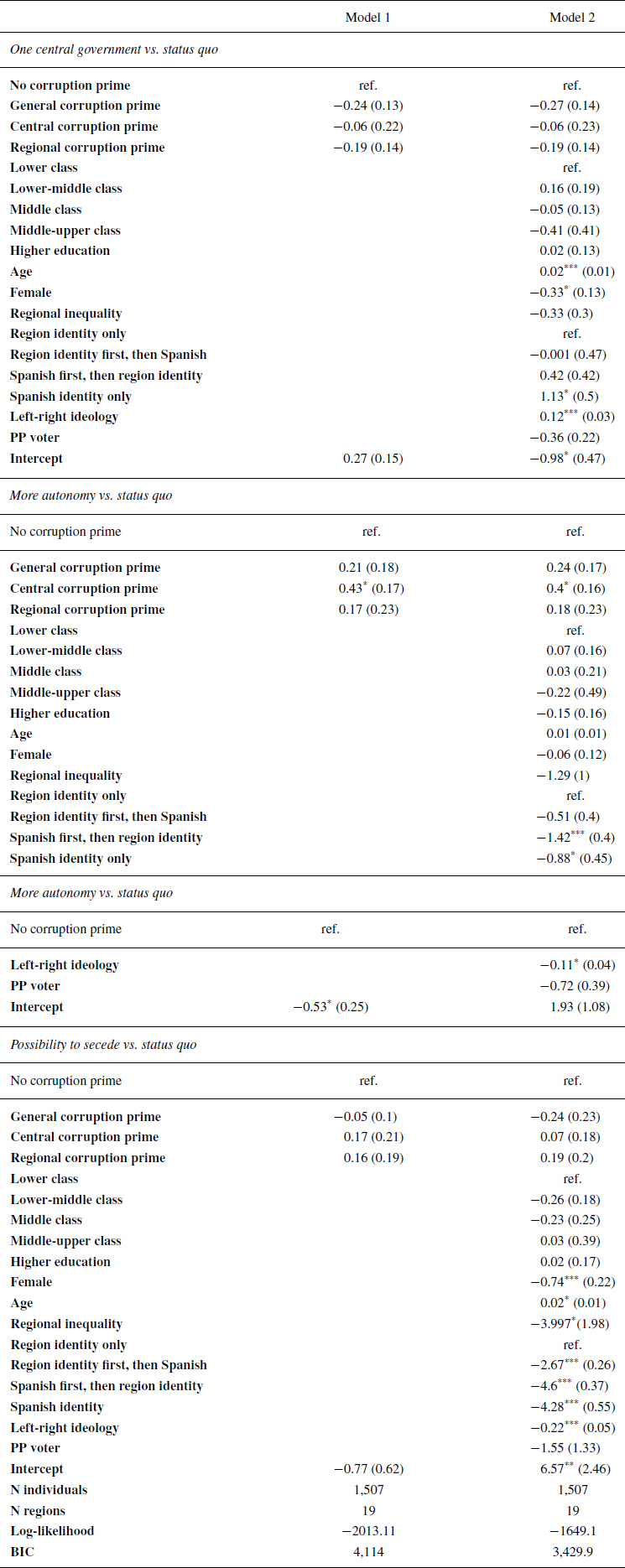
Table 1 reports two multinomial logistic models with clustered standard errors at the regional level. The first model shows the unconditional effect of our corruption primes, and the second adds a number of potential confounders. Preference for the status quo serves as the reference category of the dependent variable. The control variables included are: subjective social class (working class, lower‐middle class, middle class, upper‐middle class); having completed higher education; left‐right ideology (operationalised in a 0–10 scale where 0 is extreme left); national identity (where feeling attached only to one's region serves as the reference category); feeling close to Partido Popular (PP, Spanish conservative party in power during data collection) versus all other parties; and regional inequality (ratio between average regional per‐capita GDP in Spain and each region's per capita GDP, where higher values correspond to poorer regions).
Table 1. Multinomial logit models predicting support for decentralisation

Source: Own survey experiment. Multinomial logit coefficients and standard errors clustered at the regional level between parentheses. ***p ≤ 0.001, **p ≤ 0.01, *p ≤ 0.05.
As expected by H1, the central government corruption prime consistently and significantly increases support for granting regions more autonomy over keeping the current system in both model specifications. In contrast, neither the general nor the regional corruption primes have significant average effects. In terms of control variables, people living in regions with a GDP per capita that is significantly below the Spanish average regional‐per‐capita GDP (i.e. our regional inequality variable) are less likely to support granting regions the possibility to secede over the status quo. Right‐wing respondents are more favourable to a unitary state, and less favourable to decentralisation and self‐determination. In comparison to people with exclusive regional attachments, individuals with strong Spanish national identity are more favourable to a unitary state, and less favourable to a decentralised state and secession. Individual social class and voting for the central incumbent (PP) do not have significant effects. Overall, these results confirm the importance of theoretical frameworks based on regional economic inequality and national identity.
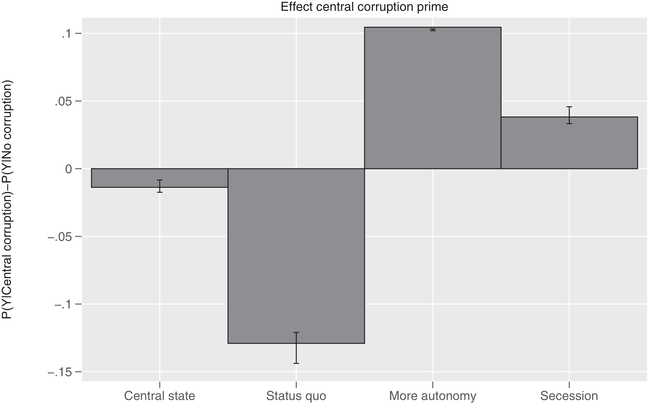
Figure 1Footnote 4 depicts probability simulations illustrating the main finding in Table 1, namely, the effect of the central corruption prime on decentralisation preferences. On the basis of 10,000 random draws of Model 1 in Table 1, and compared to being in the control group, receiving our central corruption prime increases the probability of preferring more regional autonomy by 10 percentage points and increases the probability to support secession by about 5 per cent. In contrast, it decreases the probability of preferring the status quo by 15 per cent, and somewhat decreases the probability of opting for a central state.

Figure 1. Probability simulations for preferences for political decentralisation.
Source: Own survey experiment. Bars refer to change in probability of having one or another preference when being exposed to central treatment condition versus control conditions, with 95 per cent confidence interval. Estimations based on 10,000 random draws of the coefficients of Model 1 in Table 1.
According to Table 1, the regional corruption prime has no significant direct effect on preferences for decentralisation. However, H2 expected that information on a generalised corruption environment at the regional level (Treatment 4) should have different effects depending on the relative standing of the region. For citizens of regions above average corruption levels, it would be rational to transfer sovereignty to a central authority. But for people living in relatively low‐corruption regions, it is more rational to keep the status quo rather than to share political burdens in a unified government.
To empirically test H2, we measure regional corruption levels in Spain with data from the 2013 European regional quality of government index constructed by the Quality of Government Institute (Charron et al. Reference Charron, Dijkstra and Lapuente2015). This index focuses on the quality of public services, impartiality and corruption at the regional level. We focus on the normalised indicator of corruption (from 0 to 100), which we recode from lower to higher corruption values. To construct a region's relative corruption position within Spain, we calculate the ratio between the corruption values of each region over the Spanish regional corruption mean. Higher values correspond to regions that are more corrupt than the average.
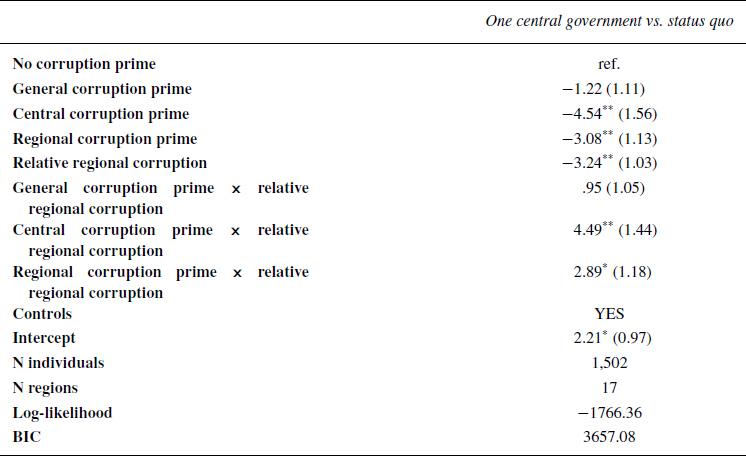
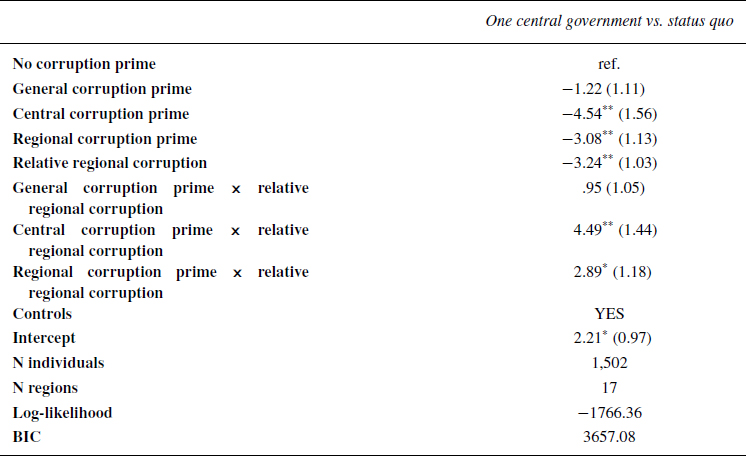
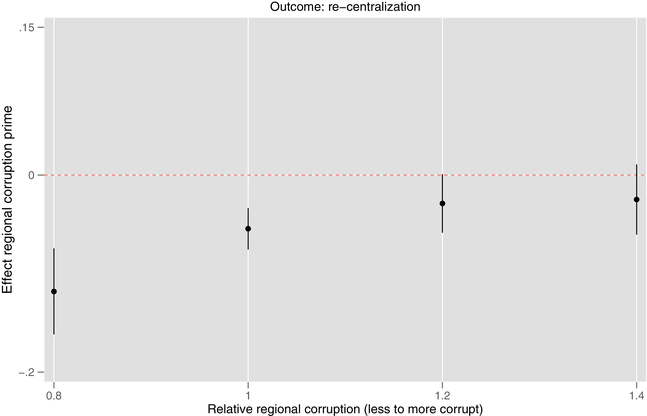
Table 2 reports the interactions between our experimental corruption primes and the relative corruption variable predicting preferences for recentralisation over the status quo.Footnote 5 As expected, the regional corruption prime increases support for recentralisation especially among citizens of highly corrupt regions. Since it is difficult to interpret the magnitude, sign and significance of log odds and interaction terms in multinomial models, Figure 2 reports the average marginal effects of our regional corruption prime on the probability to prefer a single unitary state over the status quo. In an environment where regional corruption is primed, citizens of clearly over‐performing regions (i.e. with low values in the X‐axis) prefer recentralisation significantly less than people living in high‐corruption regions. The effects of regional corruption on the probability to prefer a single unitary state over the status quo become statistically indistinguishable from zero at higher levels of the regional corruption prime. The figure shows that the conditional effects are mainly driven by lower values in the relative corruption variable, since the effects of regional corruption become statistically indistinguishable from zero at higher levels of regional corruption.
Table 2. Interactions between corruption primes and relative regional corruption
Source: Own survey experiment. Multinomial logit coefficients and standard errors clustered at the regional level between parentheses. ***p ≤ 0.001, **p ≤ 0.01, *p ≤ 0.05.

Figure 2. Average marginal effects of regional corruption prime on preferences for a single centralised state over keeping the status quo. [Color figure can be viewed at wileyonlinelibrary.com]
Source: Own survey experiment. Dots refer to the average marginal effect of the regional corruption prime in a fully specified model, with 95 per cent confidence intervals. The conditioning variable (X‐axis) is the relative corruption position of the respondent's region, with higher values indicating regions more corrupt than average.
The results in Table 2 also unveil an unexpected significant interaction between the central corruption prime and regional corruption. In the context of double corruption pressure both at the central and regional levels, citizens also want to significantly depart from the status quo and favour a strongly centralised state. While this finding does not directly derive from a compensation framework, it is relevant to see that low government quality at all geographical levels strengthens national retrenchment and support for strong unitary states.
Our findings are in line with the compensation and benchmarking‐theoretical rationales that guided H1 and H2 above. These results are at odds with theoretical frameworks based on congruence, whereby information on corruption at one level should decrease support for all levels of government (Bauhr & Charron Reference Bauhr and Charron2018; Kritzinger Reference Kritzinger2003; Muñoz et al. Reference Muñoz, Torcal and Bonet2011). Figures A3 and A4 in the online Appendix show that the marginal effects of our central and regional corruption treatments are broadly equivalent across different forms of national identity and partisan identification. The lack of clear heterogeneous treatment effects suggests that corruption can have pervasive effects on territorial preferences across the population and across levels of national and partisan identification. Tables A8 and A9 in the online Appendix replicate the same findings reported in this section, but include regional fixed effects. This means that our results are not driven by different conceptions and intensities of national identity in specific regions (i.e. Catalonia or the Basque Country), or by any other unobserved regional specificity.
Causal mechanisms
The previous section has shown that central corruption increases support for decentralisation, and that regional corruption decreases support for the status quo in favour of unitary forms of government among citizens of highly corrupt regions. The results also suggest that the effects of our experimental manipulations are largely comparable across national or partisan identities, and that corruption can have consistent direct effects.
Following Hypothesis 3, corruption perception shapes decentralisation preferences due to dissatisfaction with the government rather than by changing national identity. When analysing the indirect mechanism behind our central and regional corruption primes, we conduct a mediation analysis where dissatisfaction with the national and regional government serves as mediating variables, respectively. In this section, we show that our central government corruption prime increases dissatisfaction towards that same level of government, and that this, in turn, increases preferences for political decentralisation.
We test the indirect causal mechanism using the mediation analysis method proposed by Imai et al. (Reference Imai, Keele, Tingley and Yamamoto2011). This method consists of three steps. Firstly, there needs to be evidence that the exogenous treatment T ∈ (0,1) affects the mediating variable (M), while controlling for a range of exogenous pre‐treatment covariates. Secondly, there needs to be evidence that M affects the outcome (Y), still controlling for the same range of covariates. Thirdly, there should be a significant difference in the expected outcome when regressing it on the predicted values of M when T = 1, and when T = 0. The latter step is quantified through the average causal mediation effect (ACME), which is formalised as follows (Imai & Yamamoto Reference Imai and Yamamoto2010; Imai et al. Reference Imai, Keele, Tingley and Yamamoto2011):

The quantity expressed in equation (1) can be interpreted as the indirect treatment effect on the outcome through the mediating variable, where Y is the outcome, T is the treatment, M(1) is the predicted value of the mediator under the treatment condition 1 and M(0) is the predicted value of the mediator under the control condition 0.
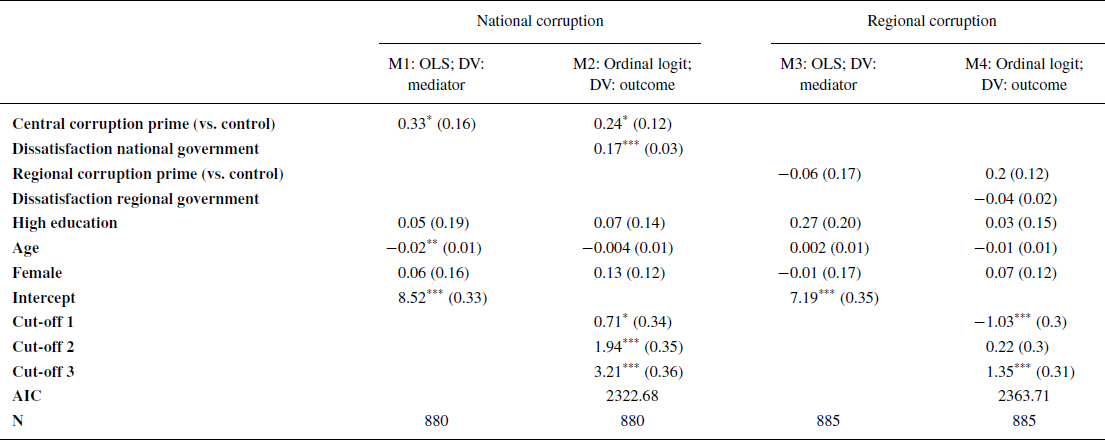
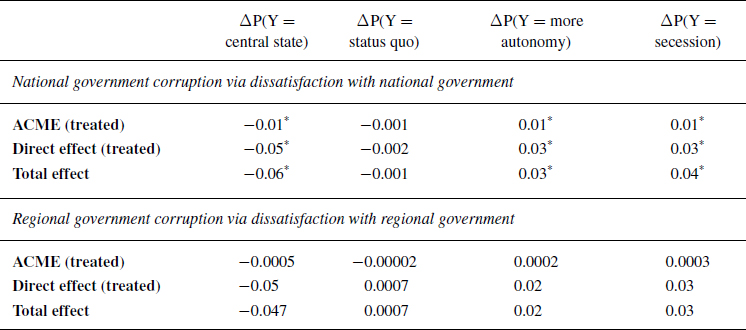
Tables 3 and 4 report the results of mediation models predicting preferences for political decentralisation. Table 3 reports the first two steps of the mediation sequence described above: the first model tests whether the treatment affects the mediator, and the second model tests whether the mediator affects the outcome. This is done for both central corruption (first two columns) and regional corruption (last two columns). Table 4 reports the last step of the mediation analysis, namely the ACME.
Table 3. Mediation effects on preferences for decentralisation
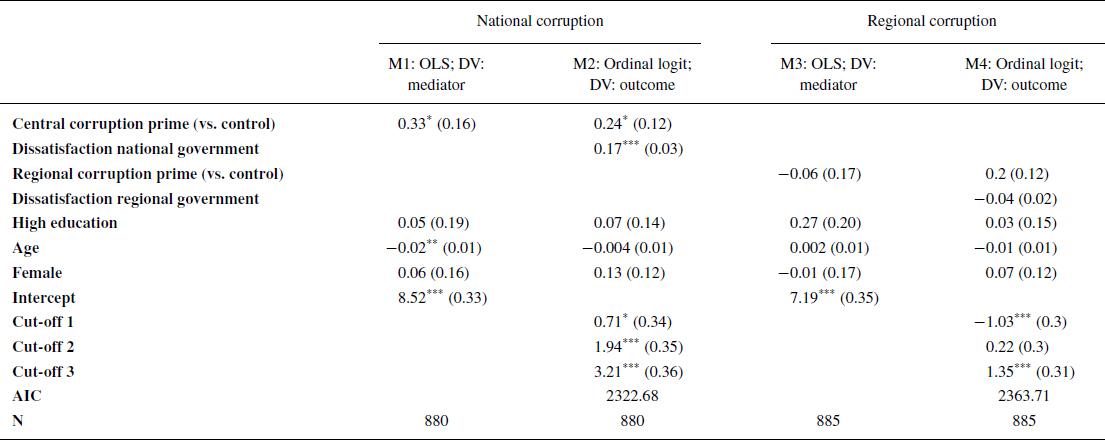
Source: Own survey experiment. Models 1 and 3 predict mediating variables (government dissatisfaction). Models 2 and 4 predict support for political decentralisation. OLS and ordinal logit coefficients, standard errors between parentheses. ***p ≤ 0.001; **p ≤ 0.01; *p ≤ 0.05.
Table 4. Average causal mediation effects predicting support for decentralisation
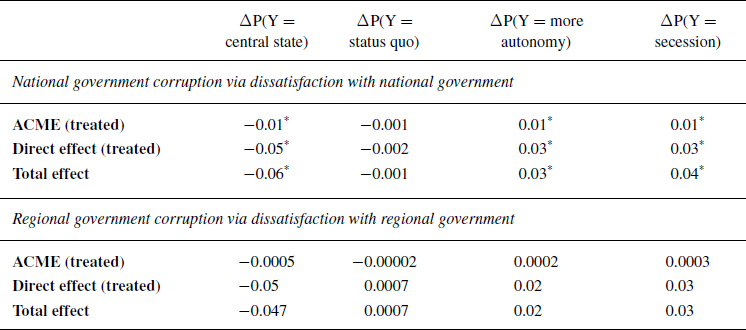
Source: Own survey experiment. ***p ≤ 0.001; **p ≤ 0.01; *p ≤ 0.05. Significance levels estimated via nonparametric bootstrapped methods (1,000 simulations).
The first ordinary least squares (OLS) model of Table 3 shows a significant effect (p < 0.05) of central‐level corruption (a binary variable where 1 represents the central government corruption prime, and 0 represents our control group) on the mediating variable, namely dissatisfaction with the national government's performance (‘Now thinking about the Spanish government, how satisfied are you with the way it is doing its job?’ 0–10 scale from extremely satisfied to extremely dissatisfied).Footnote 6 The second model of Table 3 validates the next step in the causal sequence, by showing a positive and highly significant effect (p < 0.001) of dissatisfaction with the national government on preferences for decentralisation (ordered from less to more decentralisation).
The first panel of Table 4 reports the last step of the causal mediation analysis of the effects of central government corruption. The ACME statistics show significant effects in the expected direction. The central corruption prime significantly increases the probability of preferring more autonomy and the possibility for regions to secede via political dissatisfaction. By contrast, it decreases the probability of preferring a single centralised state. The indirect effects of corruption via dissatisfaction with the national government account for a third and a quarter of the total effect of corruption on preferences for decentralisation and self‐determination, respectively. It is important to note that while the direct effects of central corruption on the possibility of self‐determination were not significant in the previous section, the indirect effects are significant. Perceptions of bad national government performance are thus partly responsible for recent pushes in favour of regional self‐determination. Table A5 in the online Appendix shows the sensitivity of our findings to the assumption of sequential ignorability.
The last two models of Table 3 test the effect of the regional corruption prime (vs. our control group) on dissatisfaction with the regional government, and the effect of dissatisfaction with the regional government on preferences for decentralisation. The bottom panel of Table 4 reports the ACME statistics concerning the indirect effects of regional corruption. As opposed to the analysis of national‐level corruption above, Tables 3 and 4 reveal that the effect of our treatment on regional government dissatisfaction and the ACME are always far from reaching conventional levels of significance. While our analyses fully confirm H2 above by showing that information on regional corruption is moderated by relative corruption levels between regions, they cannot confirm that the mechanism goes only through dissatisfaction with the regional government (H3).
Tables A10 and A11 in the online Appendix report the same causal mediation analyses shown in this section, but using national identity as a mediator. The purpose of this exercise is to test whether the performance‐based mechanism shown here is a genuinely distinctive driver of territorial preferences, or whether corruption can also shape territorial preferences via collective identities and nationalism. Interestingly, Tables A10 and A11 in the online Appendix show insignificant effects of central or regional corruption on national identity, and insignificant indirect effects on territorial preferences via national identity. Identity is naturally a very significant driver of decentralisation preferences on its own, but not as a result of corruption perceptions. This means that the effects of corruption documented here are a rational and performance‐based reaction, and not driven or filtered by nationalism.
Cross‐national generalisability
So far, we have presented findings from Spain, which could be a unique case in the link between corruption and decentralisation debates. We therefore use cross‐national survey data of the 1999 EVS (see descriptive statistics in Table B1 in the online Appendix) to show that Spain is not an outlier in corruption and decentralisation, and that support for decentralisation is higher in more corrupt countries. This analysis does not aim at causally identifying the effect of any of the hypotheses above, but at showing that the main findings of our experiment can be generalised beyond our specific case study.
To the best of our knowledge, the EVS is the only survey with a high number of countries that covers support for decentralisation. The wording of our dependent variable is: ‘Please tell me whether you think it would be a good thing, a bad thing, or don't you mind [to give] more power to local authorities’. We recoded this variable into a dummy where 1 = good thing and 0 = anything else. The EVS defines local authorities as the most salient administrative unit below the national level (i.e. regions in Spain).Footnote 7
We test whether the findings of our survey experiment in Spain are externally valid by analysing to what extent corruption at the regional and national level correlates with individual support for decentralisation. To capture national corruption, we rely on the corruption perception index constructed by Transparency International,Footnote 8 which is measured at the country level and recoded from less to more corruption.Footnote 9 To proxy regional corruption, we rely again on the European Regional Quality of Government index constructed by the Quality of Government Institute (Charron et al. Reference Charron, Dijkstra and Lapuente2015). This index is available for 206 regions in 24 European countries.
For our main experimental results to be externally valid, we should validate two findings. Firstly, national corruption should be significantly related to support for decentralisation. Secondly, regional corruption should depress preferences for decentralisation, especially among regions with relatively high corruption levels within a given country. We thus interact the raw corruption level of each region (since the argument should apply to highly corrupt regions in Europe) with its relative standing within its own country (operationalised as in the experiment above, with the ratio of regional corruption over the country average). Given that respondents are nested in regions and countries, and considering the dichotomous character of our dependent variable, we use hierarchical logit random intercept models to correct for heteroscedasticity and obtain accurate standard errors (Hox Reference Hox2010).
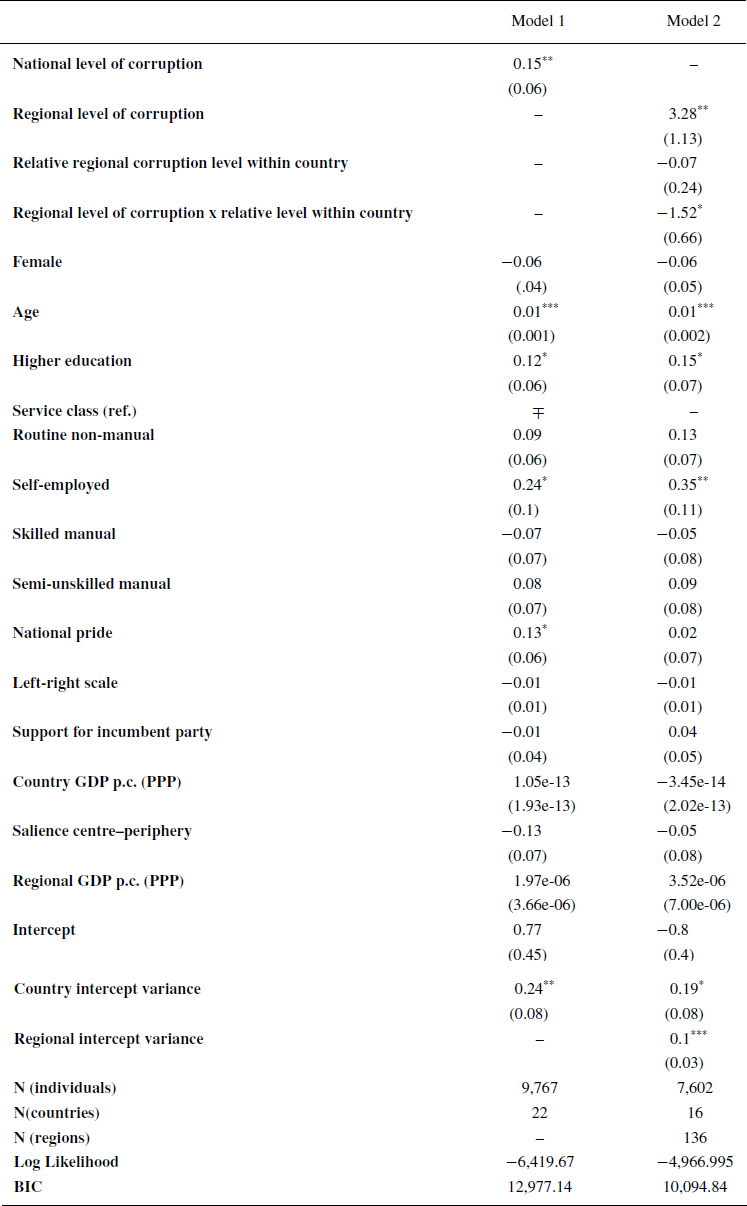
The first model in Table 5 shows a fully specified model testing the effect of national corruption. The second model tests the effect of regional corruption. Both models control for higher education, the Erikson et al.’s (Reference Erikson, Goldthorpe and Portocarero1979) social class scheme, gender and age. It also controls for national pride, political orientation (measured on a 1–10 left–right ideology scale) and a dummy variable capturing whether the respondent would vote for a party in the national government (vs. any other party) as documented by the ParlGov dataset (Döring & Manow Reference Döring and Manow2019).Footnote 10 In terms of macro‐level covariates, we control for national and regional GDP per capita,Footnote 11 and the political saliency of centre–periphery and territorial conflicts from the Comparative Manifesto DatasetFootnote 12 (Volkens et al. Reference Volkens, Krause, Lehmann, Matthieß, Merz, Regel and Weßels2019). These covariates aim at controlling for alternative explanations identified in the previous literature, including economic, partisan and identity determinants of decentralisation preferences. Regional GDP and individual vote intention have a significant number of missing values, substantially reducing the sample size. Hence, Table B3 in the online Appendix replicates the models in Table 5 on a larger sample excluding regional GDP and vote intention. The results remain unchanged.
Table 5. Hierarchical logit models on support for sub‐national government
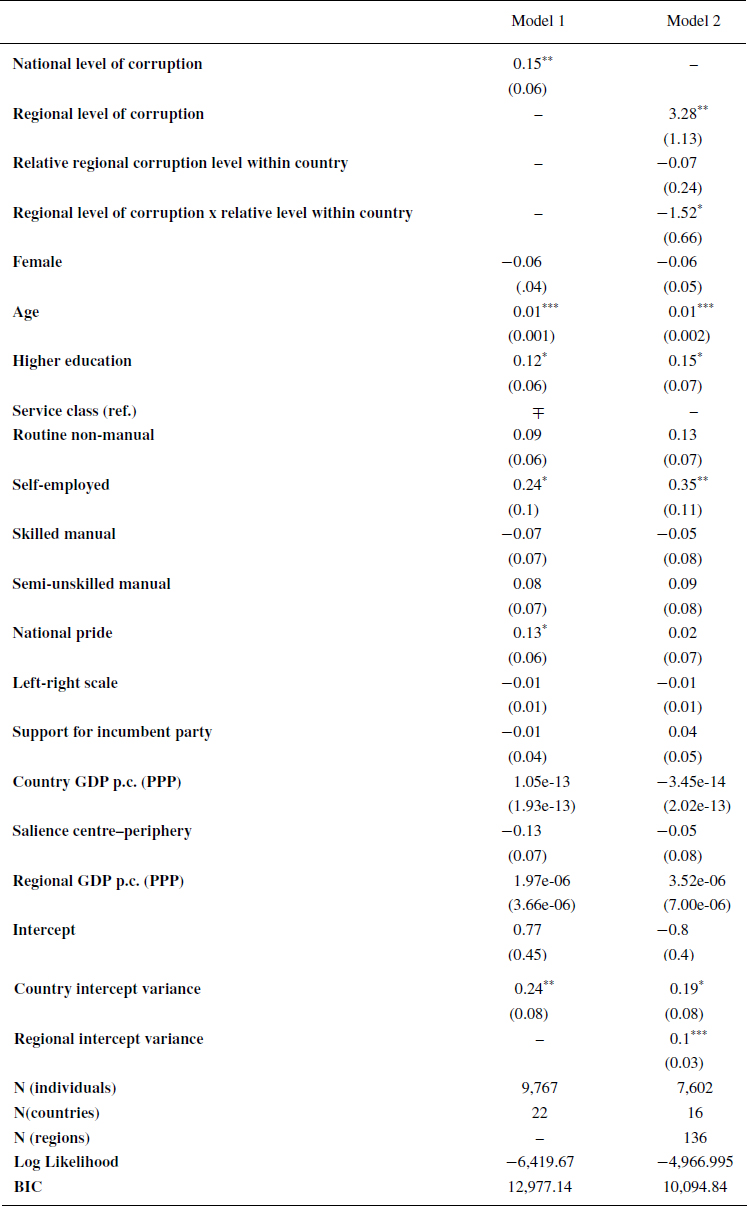
Source: EVS 1999, regional Quality of Government dataset, Transparency International, ParlGov, CMP, World Bank, Eurostat, OECD. Coefficients of hierarchical logit random intercept models; standard errors between parentheses. ***p ≤ 0.001, **p ≤ 0.01, *p ≤ 0.05.
In line with our previous findings, the first model in Table 5 shows that national corruption is consistently associated with higher preferences for subnational power, with a highly significant (p < 0.01) and positive coefficient. The second model shows a negative and significant interaction term (p < 0.05), indicating that decentralisation preferences decrease in regions with high corruption levels and that are relatively corrupt within their own country.
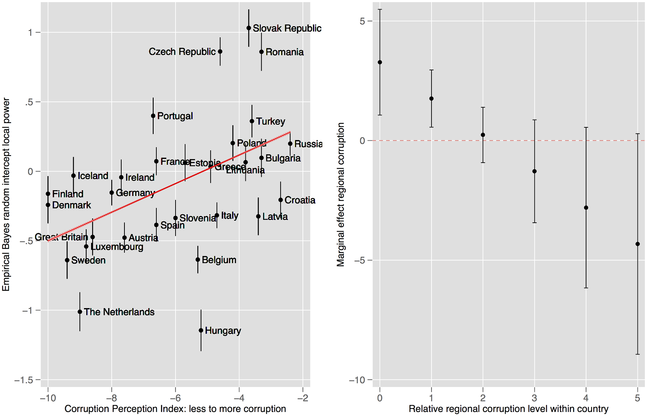
To visualise the key findings in Table 5, Figure 3 plots the correlation between the Empirical Bayes estimations of country interceptsFootnote 13 (i.e. predicted average support for local power) and national corruption. The relationship is strong and significant. Importantly, Spain is around average on the distribution of our dependent and independent variables, which suggests that our experimental evidence is not based on an outlier. Figure 3 also plots the marginal effects of regional corruption (Y‐axis) conditional on the relative position of the region vis‐à‐vis its country average (X‐axis), on the basis of the second model in Table 5. As shown in the right graph, regional corruption levels significantly depress preferences for decentralisation especially for regions that are highly corrupt within their country. When regions over‐perform in their national context even if they are corrupt, it is more rational to prefer strong local power.

Figure 3. Corruption predicting average support for subnational power. [Color figure can be viewed at wileyonlinelibrary.com]
Source: EVS 1999, Transparency International, QoG, ParlGov, CMP, World Bank, Eurostat, OECD.
Conclusion
Recent developments towards decentralisation, and in some cases, attempts of secession have sparked scholarly interest in the factors explaining individual support for decentralisation and secession. Scholars are puzzled by the reactivation of regionalism and centre–periphery conflicts. As the complexities of multilevel governance increase and as regional disparities fuel anti‐globalisation backlash, the geographical locus of power has become highly disputed.
When studying sub‐national regional conflicts, most studies have focused on ‘extreme cases’ – regions with striking cultural and socio‐economic differences vis‐à‐vis the rest of the country such as Catalonia, Quebec or Flanders. By concentrating on these cases and by emphasising economic and cultural differences, extant literature has largely ignored political performance as a cause of claims for decentralisation and independence. A notable exception is the study by Guinjoan & Rodon (Reference Guinjoan and Rodon2014) who argue that support for decentralisation is endogenous to the quality of governance. This study uses observational data and shows that satisfaction with regional government is related to support for decentralisation.
This paper further sheds light on this understudied aspect by analysing the effect of citizens’ awareness of corruption at national and regional levels of government. We have tested the internal validity of our claims via an original survey experiment in Spain, and we have confirmed their external validity using cross‐national data. We find that central‐level corruption directly increases support for decentralisation, and indirectly increases support for decentralisation and self‐determination through dissatisfaction towards the national government. We also find that the effects of regional‐level corruption depend on how high regional corruption is, and on the relative position of the region within its own country. Even in a context of regional corruption, relatively well‐performing regions prefer the status quo over the potential costs of centralising power and sharing responsibility with under‐performing regions. By contrast, the benefits of unitary states appear more evident in highly corrupt regions that underperform relative to their country average.
Our findings have important implications for research and policy making. Firstly, corruption of the central government spurs demand for decentralisation and even self‐determination, independently from economic considerations, collective identity and partisan attachments. This sheds light on rapid increases of secessionist movements that have been able to mobilise citizens with different forms and intensities of national identification (Serrano Reference Serrano2013). This finding also shifts the analytical level from economically and culturally distinct regions to the central state that provides poor political outputs.
Secondly, we extend and confirm the compensation model of political support to sub‐national conflicts (Bauhr & Charron Reference Bauhr and Charron2018; De Vries Reference De Vries2018; Kritzinger Reference Kritzinger2003; Muñoz et al. Reference Muñoz, Torcal and Bonet2011; Rohrschneider Reference Rohrschneider2002; Sánchez‐Cuenca Reference Sánchez‐Cuenca2000). Rational benchmarking is a relevant heuristic to assess the competing advantages of proximal and salient institutional contexts like the national and the regional ones. The compensation mechanism becomes useful to understand why nationalistic backlashes occur in some regions and not in others, even in the absence of major ethnic differences. While relatively underperforming regions within their national context prefer to transfer sovereignty, relatively over‐performing regions see less cost in decentralisation.
Finally, while classical macro‐perspectives on decentralisation have regarded the provision of public goods as a mechanism for the emergence of modern federations (Riker Reference Riker, Greenstein and Polsby1975; Ziblatt Reference Ziblatt2004), the link had never been tested at the micro‐level. From a normative perspective, this finding somewhat challenges efforts of central governments to retain power in centre–periphery conflicts: claims for decentralisation are not merely caused by utilitarianism or competing collective identities, but also seem to be a reaction to poor quality of governance at the central level.
Acknowledgements
Previous versions of this paper have been presented at the Annual Meeting of the European Political Science Association 2015, the Council for European Studies Conference 2015, the Annual Meeting of the American Political Science Association 2015 and at seminars at the Universities of Amsterdam, Manchester, Oxford, Gothenburg and ETH Zürich. We thank the anonymous reviewers for this journal for useful comments and feedback. Ander Díez, Laia Esquerrà, Isabella Rebasso and Manuel Wagner provided excellent research assistance. All remaining errors are our own.
Funding
Theresa Kuhn gratefully acknowledges funding from the Netherlands Organization for Scientific Research (VENI Grant No. 451–13‐029).
Supporting Information
Additional supporting information may be found in the Online Appendix section at the end of the article.
Table A1‐ Descriptive statistics survey experiment
Table A2‐ Wording of treatment conditions
Table A3‐ Balance tests
Table A4‐ Ordinal logistic models predicting support for fiscal decentralisation
Table A5‐ Sensitivity analysis for average causal mediation effects
Table A6‐ Interactions between corruption primes and relative regional corruption
Table A7‐ Frequency of cases across regions
Table A8‐ Replication of Table 1 with region fixed effects
Table A9‐ Replication of Table 2 with region fixed effects
Table A10‐ National identity mediating preferences for decentralisation
Table A11‐ Average causal mediation effects of national identity
Table B1‐ Descriptive statistics
Table B2‐ National Quality of Government predicting support for sub‐national government
Table B3‐ Hierarchical logit models predicting preferences for sub‐national government excluding vote intention and regional GDP
Figure A1‐ Distribution of treatment per region
Figure A2‐ Distribution of decentralisation preferences per region
Figure A3‐ Average marginal effects of corruption primes across collective identity
Figure A4‐ Average marginal effects of corruption primes across party identification





 Open access

