


Social enterprises are an increasingly common organization type (Social Enterprise, 2016) that combines elements from different institutional logics, pursuing social goals using business approaches (Besharov & Smith, Reference Besharov and Smith2014; Kerlin, Reference Kerlin2009). Social enterprises come in a number of organizational forms and manifestations, for example, for-profit organizations with social missions (Polak & Warwick, Reference Polak and Warwick2013), commercial revenue-generating nonprofits (Child, Reference Child2010), cooperatives in the UK, community development corporations in the USA, microfinance institutions, and low-profit limited-liability companies (Young et al., Reference Young, Searing and Brewer2016).
In recent years, social enterprises have gained attention among scholars and practitioners (Dacin et al., Reference Dacin, Dacin and Tracey2011; Shepherd, Reference Shepherd2015), perhaps because they can help to address complex social problems such as alleviating poverty (Ghauri et al., Reference Ghauri, Tasavori and Zaefarian2014), empowering women (Datta & Gailey, Reference Datta and Gailey2012), and catalyzing social transformation (Alvord et al., Reference Alvord, Brown and Letts2004). Social enterprises can also generate sustainable revenues, which may address the frequent funding problems experienced by nonprofits (Dees, Reference Dees1998). Social enterprises include any “organization or a venture that integrates social mission with pursuit of financial sufficiency” (Young & Lecy, Reference Young and Lecy2014), and thus, they encompass a wide range of organizations, including commercial revenue-generating nonprofits or for-profit companies with a social mission. Indeed, they may be seen as a “hybrid ideal” where social outreach simultaneously generates revenues to assure an organization’s growth (Battilana et al., Reference Battilana, Lee, Walker and Dorsey2012).
Despite such enthusiasm, social enterprises face a variety of pressures in terms of surviving and thriving (Lounsbury & Strang, Reference Lounsbury, Strang, Heydemann and Hammack2009; Pache & Santos, Reference Pache and Santos2013). One essential factor that contributes to a new venture’s resilience during the start-up phase is the procurement of financial resources (Zhao et al., Reference Zhao, Williams and Wiklund2016). Important factors for resource acquisition among social enterprises include the legal status (i.e., nonprofit or for-profit; Addae, Reference Addae2018), human capital (Ko & McKelvie, Reference Ko and McKelvie2018), social capital (Maguire et al., Reference Maguire, Hardy and Lawrence2004), storytelling (Lounsbury & Glynn, Reference Lounsbury and Glynn2001), and identities (Lee et al., Reference Lee, Bolton and Winterich2017; Wry & York, Reference Wry and York2017).
Despite extensive prior research on resource acquisition among social enterprises, two main areas need development. First, although many believe that social enterprises can be financially sustainable while solving social problems, evidence supporting this remains sparse and inconsistent (Battilana et al., Reference Battilana, Lee, Walker and Dorsey2012; Dacin et al., Reference Dacin, Dacin and Tracey2011; Santos et al., Reference Santos, Pache and Birkholz2015). Moreover, previous research has relied on case studies, and thus, conclusions cannot be generalized to broader populations (Saebi et al., Reference Saebi, Foss and Linder2019). As will be discussed in the next section, social enterprises’ hybrid identities may be a blessing or a curse when it comes to attracting external funders.
Second, past research extensively examines the resource acquisition of social enterprises, finding that as resource seekers, they attempt to actively construct and enhance their organizational identity to attract resources from external funders (Kirsch et al., Reference Kirsch, Goldfarb and Gera2009; Lounsbury & Glynn, Reference Lounsbury and Glynn2001; Navis & Glynn, Reference Navis and Glynn2011). Yet, it neglects the fact that resource acquisition implies exchange and interaction between two parties—resource seekers and providers (Zhao & Lounsbury, Reference Zhao and Lounsbury2016). In fact, the heterogeneity of social enterprises is mirrored by a corresponding heterogeneity in resource providers (Fisher & Kotha, Reference Fisher, Kotha, Shalley, Hitt and Zhou2015). Different attributes of resource seekers and resource providers may interact and in turn shape the result of resource allocation (Cobb et al., Reference Cobb, Wry and Zhao2016; Shepherd, Reference Shepherd2015; Zhao et al., Reference Zhao, Williams and Wiklund2016).
Recognizing these literature gaps and the lack of large-scale, cross-national quantitative studies, in this paper, we explore how social enterprises’ and resource providers’ identity attributes are associated with financial acquisition outcomes. Our paper aims to contribute to a more comprehensive understanding of how and why resource seekers’ (e.g., pure nonprofits, pure for-profits, and social enterprises) resource acquisition outcomes may vary when they seek financial support from different resource providers (e.g., philanthropic donors, equity investors) in a cross-national context. We do so by analyzing an international social entrepreneurship database with six years of data (2014–2019).
The Complexity of Resource Acquisition in Hybrid Organizations
Resource acquisition is one of the most critical aspects of an organization’s performance, and hybridity may matter. Embedded in a diverse field where a set of heterogeneous stakeholders are involved (Hehenberger et al., Reference Hehenberger, Mair and Metz2019), one frequent discussion regarding social enterprise is the tension between “dual missions” (Defourny & Nyssens, Reference Defourny, Nyssens and Nyssens2006; Russell & Scott, Reference Russell and Scott2007) resulting from the organization’s hybridity. By definition, social enterprises combine business and charity forms, and scholars have argued that they could satisfy financial returns and have a social impact (Santos et al., Reference Santos, Pache and Birkholz2015; Smith & Tracey, Reference Smith and Tracey2016). Yet, is their hybrid organizational status likely to attract or repel funders?
On the one hand, there might be an additive effect such that the hybrid nature of the organization attracts more financial resources and types of funders (Aaker et al., Reference Aaker, Garbinsky and Vohs2012; Witesman et al., Reference Witesman, Child and Wightman2019). Specifically, this hybridity may make them more appealing to resource providers from both the business and charity sectors. First, social enterprises are well aware of the potential benefits of having blended income streams to ensure their financial sustainability (Staicu, Reference Staicu2018), and their ability in sustaining financial stability has the potential to encourage efficiency and innovation (Dees & Anderson, Reference Dees and Anderson2003). Philanthropic funders have high aspirations in supporting and building partnerships with organizations that are financially sustainable (Buechel & Handy, Reference Buechel and Handy2007) and innovative (McDonald, Reference McDonald2007; Simon & Silard, Reference Simon and Silard2018). Second, some consumer research has argued that a profit orientation portrays competence (Aaker et al., Reference Aaker, Vohs and Mogilner2010), while socially responsible behavior can enhance organizational warmth (Lee et al., Reference Lee, Bolton and Winterich2017). Indeed, prior studies have found that a combination of for-profits’ competence and the warmth of a social purpose may land organizations in the “golden quadrant” of high admiration (Aaker et al., Reference Aaker, Garbinsky and Vohs2012). As such, the “hybrid ideal” has become an appealing aspiration where social enterprises could have an intensive social mission while also obtaining financial resources for sustainable growth (Battilana et al., Reference Battilana, Lee, Walker and Dorsey2012), thereby driving enhanced financial support from the business side for social enterprises. In combination, a hybrid identity may place the social enterprises in a win–win situation, with the potential to attract donors who value the organizations’ financial sustainability (Griffith & Evans, Reference Griffith and Evans2012) and also investors that aspire to “do good” with their investments (BlueOrchard, 2015).
Yet, on the other hand, this hybridity may backfire at times. One reason is that these dual goals are not necessarily aligned and are oftentimes competing (Ebrahim et al., Reference Ebrahim, Battilana and Mair2014). Adopting elements prescribed by a given logic often requires trading off the other logics, therefore social enterprises may potentially hurt their legitimacy by combining the two (D’Aunno et al., Reference D'Aunno, Sutton and Price1991). Several studies have shown that institutional conflict may arise from the different approaches that hybrid organizations adopt to deal with these competing logics (Glynn, Reference Glynn2000; Zilber, Reference Zilber2002). For example, Jay (Reference Jay2013) analyzed Cambridge Energy Alliance, finding that outcomes that are considered successes for the organization’s social mission simultaneously reflect failure for their financial goals and vice versa.
Hybridity can also complicate the acquisition of external financial resources as it may lead external stakeholders to perceive social enterprises as riskier. Philanthropic funders may be concerned about possible mission drift (Battilana & Lee, Reference Battilana and Lee2014) and equity investors may wonder if an enterprise’s social mission pursuit might affect its financial sustainability. This is reasonable, since engaging in more intensive social value activities is more costly (Armendariz & Morduch, Reference Armendáriz and Morduch2010; Marquis & Partk, Reference Marquis and Park2014), and increased social value outreach may also reduce operational efficiency (Battilana et al., Reference Battilana, Sengul, Pache and Model2015).
Overall, social enterprises’ hybridity may lead to different outcomes in acquiring financial resources, since external resource providers may have different perceptions about social enterprises with hybrid identities relative to organizations with non-hybrid identities (e.g., pure nonprofits or pure for-profit organizations). More importantly, resource providers are also specifically heterogeneous in the field and social enterprises receive funding ranging from philanthropic sources to commercial sources like debt and equity (Bosma et al., Reference Bosma, Schøtt, Terjesen and Kew2016; Dees, Reference Dees2008; Lall & Park, Reference Lall and Park2022). However, few scholars have stepped further and explored whether and how hybridity may lead to different resource acquisition outcomes under the scenarios when seeking funding from different resource providers (e.g., philanthropic donors, equity investors). The current study can address this question.
Social Enterprises’ Identity Configurations
Traditional categories bring well-known assumptions for organizations that carry generic structural features that are distinct and recognizable within their respective sector/legal status (Billis, Reference Billis2010; Somerville & McElwee, Reference Somerville and McElwee2011). Specifically, a nonprofit form is aligned with social welfare logics, whereas a for-profit form is associated with commercial logics (Battilana et al., Reference Battilana, Lee, Walker and Dorsey2012; Pache & Santos, Reference Pache and Santos2010). However, social enterprise, a hybrid organization that combines the organizational forms of both business and charity, may face unique challenges to its sustainability. As reviewed above, by combining multiple forms, they deviate from each, leading to internal and external tensions between the forms they combine (Greenwood et al., Reference Greenwood, Raynard, Kodeih, Micelotta and Lounsbury2011).
Most literature posits two defining characteristics of social enterprises: revenue generation and social motives (Laville & Nyssens, Reference Laville, Nyssens, Borzaga and Defourny2001; Peredo & McLean, Reference Peredo and McLean2006). Based on these, we argue that social organizations’ identities can be shaped by their legal status (nonprofit or for-profit) and social motive claims (present or absent), which represent the financial and social dimensions of their identity, respectively (see Table 1).
Table 1 Organizational categorization and observation numbers

Financial attributes: Self-identification of legal status |
|||
|---|---|---|---|
Nonprofit |
For-profit |
||
Social attributes: Self-claimed explicit social motives |
Social motives present |
Pure nonprofit organizations (2215) |
Social enterprise (14,292) |
Social motives absent |
Social clubs (43) |
Pure For-profit organizations (1381) |
|
In our categorization, pure nonprofit organizations are those that have nonprofit orientations and reported that they had explicit social motives. Conversely, pure for-profit organizations are profit-oriented and have no explicit social motives. We specifically define social enterprises as organizations that have both for-profit legal status and social motives, as shown in Table 1. Note that organizations themselves did not self-identify as social enterprises. Instead, we classified them based on their legal identity and self-reported social motives; thus they “integrate[d] social mission with pursuit of financial sufficiency” (Young & Lecy, Reference Young and Lecy2014). Legal status is a reasonable proxy for organizations’ financial dimension identity because organizations with nonprofit legal status may not distribute net assets to stakeholders (the non-distribution constraint), thus lowering potential financial motivations, and for-profit organizations aim to earn profit through their operations, which increases potential financial motivations. Social clubs are not profit-oriented and have no explicit social motives, and thus they align with neither social nor financial identities. As a result, we use them as the reference group for all analyses.
Matched, Mismatched Identity Attributes, and Venture Identification
The context for creating new ventures is inherently novel and uncertain (McMullen & Shepherd, Reference McMullen and Shepherd2006), and the nature of social entrepreneurship and hybridity contexts adds other layers of ambiguity (Pache & Santos, Reference Pache and Santos2013). Thus, a greater overlap of prominent identities between resource seekers and resource providers can reduce such uncertainty, and this is referred to as venture identification. A stronger level of venture identification likely leads to a higher possibility of resource providers’ financial support (Fisher & Kotha, Reference Fisher, Kotha, Shalley, Hitt and Zhou2015).
There are both cognitive and affective potential explanations for this. In terms of cognitive explanations, resource providers and seekers may be easier to generate a stronger bonding because familiar information is easier to process and understand, and the overlap of identity may generate a sense of unity (Dutton et al., Reference Dutton, Dukerich and Harquail1994; Weick et al., Reference Weick, Sutcliffe and Obstfeld2005). The concept of homophily is relevant to the affective explanations. Social identity theory suggests that people tend to be biased toward their own group (Scheepers & Ellemers, Reference Scheepers and Ellemers2019). Therefore, even relatively superficial similarities can influence attraction, especially in the uncertainty of the entrepreneurial process.
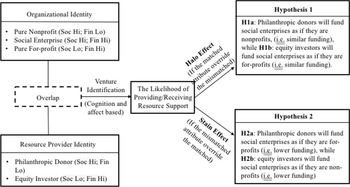
Regarding resource seekers, as shown in Fig. 1, pure for-profit and pure nonprofit organizations have identity attributes that are either financial or social, respectively, whereas social enterprises have hybrid identities that include both financial and social dimensions. Regarding resource providers, philanthropic donors’ identity is likely more aligned with the social dimension whereas equity investors’ identity is likely more aligned with the financial dimension.

Fig. 1 Theoretical framework and hypotheses
Thus, there may be more overlap between the identity attributes of pure nonprofits and philanthropic donors (high in social dimension, low in financial dimension), and between for-profit organizations and equity investors (low in social dimension, high in financial dimension). If so, they have matched identity attributes. Yet the situation with social enterprises is more complex. For philanthropic donors, social enterprises match on the social dimension but are mismatched on the financial dimension. For equity investors, social enterprises match on the financial dimension but are mismatched on the social one.
This leads to an interesting puzzle, and it is unclear how social enterprises’ resource acquisition may differ, given their hybrid identities. Some studies find that adding a social purpose by engaging in corporate social responsibility initiatives can have positive effects on consumer support of for-profit organizations (Chernev & Blair, Reference Chernev and Blair2015; Luo & Bhattacharya, Reference Luo and Bhattacharya2006). In contrast, other studies find the converse: When consumers learn that an organization with a social mission also has a for-profit orientation, consumer support declines (Lee et al., Reference Lee, Bolton and Winterich2017). Consumers perceive for-profits as more competent (though less warm) than nonprofits and vice versa (Aaker et al., Reference Aaker, Vohs and Mogilner2010). Based on these considerations, we propose competing hypotheses, testing two contrasting theories (see Fig. 1).
The first theory, which we call the “halo effect,” suggests that when the matched identity attributes override the mismatched, the hybrid identity may generate benefits, like a halo. In this scenario, funders believe that a win–win situation exists—social enterprises have the potential to provide meaningful and self-sustaining solutions to social problems (Dacin et al., Reference Dacin, Dacin and Tracey2011). If so, philanthropic donors will fund social enterprises as if they are pure nonprofits (i.e., similar funding), and equity investors will fund social enterprises as if they are for-profits (i.e., similar funding). Therefore, social enterprises may be able to attain financial resources from both funding channels.
The second theory, which we call the “stain effect,” suggests that when the mismatched identity attributes override the matched, the hybrid identity may generate costs, like a stain. In this situation, trade-offs between the mismatched identity attributes (i.e., social versus financial) may be salient. Philanthropic donors may believe that the financial attribute of social enterprises could reduce social enterprises’ commitment to social missions (Eikenberry & Kluver, Reference Eikenberry and Kluver2004), and thereby thwart their intentions as donors to create social impact. If so, social enterprises would receive less from philanthropic donors. As for equity investors, they may believe that the social attribute of social enterprises could motivate organizations to sacrifice financial returns to achieve their social missions (Santos et al., Reference Santos, Pache and Birkholz2015), and thereby thwart equity investors’ expectation of receiving a satisfying financial return. If so, social enterprises would receive less from equity investors.
The current study examines how different types of organizations’ (pure nonprofit, pure for-profit, social enterprise) resource acquisition outcomes may differ under two scenarios: when seeking funding from philanthropic donors and from equity investors. In doing so, it can help to answer important questions with practical relevance for social enterprises’ financial sustainability.
Data and Methods
In this study, we use Global Accelerator Learning Initiative (GALI) dataset developed by the Entrepreneurship Database Program (EDP) at the @Goizueta Center at Emory University. Between 2013 and 2019, the EDP partnered with a range of accelerators and entrepreneur support programs from over 170 countries to collect detailed data from entrepreneurs from various organization types during their application process. We used data from 2014 to 2019 because it included all variables (including covariates) of interest to this analysis. Published research from this database examines grant funding to entrepreneurs born in developed and developing countries (Lall et al., Reference Lall, Chen and Davidson2019), performance measurement practices (Lall, Reference Lall2017), and institutional intermediaries’ functions (Kerlin et al., Reference Kerlin, Lall, Peng and Cui2021). However, to our knowledge, no one has yet asked how social enterprises’ resource acquisition from philanthropic donations and equity investment is different, compared to pure nonprofit or for-profit organizations. This database includes all the ventures that have applied to the acceleration programs, not only the ones that were accepted, which reduces the potential problem of selection bias. The organizations that apply to these programs include different legal statuses (i.e., nonprofit or for-profit), social motives, and financial goals (Gali, 2020; Guttentag et al., Reference Guttentag, Davidson and Hume2021; Roberts & Lall, Reference Roberts and Lall2019).
Our pooled cross-sectional dataset contains 19,903 ventures operating globally during the application years of 2014–2019. Given that they applied to accelerator programs, we assume the organizations in the dataset have growth aspirations and financing needs. This rules out one alternative interpretation of not receiving any funds, namely, that the focal organizations don’t need them. About 63% reported having received some form of funding since they were founded.
Independent Variables
We classify the organizational forms based on two identity dimensions: financial (legal status of nonprofit versus for-profit) and social (with or without explicit social motives). These created four binary categories of organizations (see Table 1): Pure nonprofit organization: nonprofit legal status and explicit social motives (N = 2215); Pure for-profit organization: for-profit legal status, without social motives (N = 1381). Social enterprise: for-profit legal status and explicit social motives (N = 14,292); Social club: nonprofit legal status, without social motives (N = 43).
This study compares the probability of resource acquisition in two different funding scenarios: philanthropic funding received by pure nonprofits versus social enterprises and equity funding received by pure for-profits versus social enterprises. We choose social club as the reference category since our main focus is on the other three categories, and thus, it functions like a “control” category for the purpose of analyses.
Dependent Variables
The binary variable Any philanthropic funding was coded as 1 if the organization reported receiving philanthropic donation from any source. The survey asked: “From which sources has your venture received these donations? from other companies, government agencies, foundations or other nonprofits, accelerators or fellowship programs, friends or family members, business plan competitions, crowd-fund campaigns, employees that are not owners, other individuals, another source.” If no sources were mentioned, the organization was coded as 0.
The numeric variable Amount of philanthropic donations comes from another survey question: “how much philanthropic support did your venture receive from all outside sources since founding?”.
The binary variable Any equity investment was coded as 1 if the organization reported receiving any equity investment from any source. The survey asked: “From which sources has your venture received this outside equity? from angel investors, other companies, government agencies, venture capitalists, another source.” If no sources were mentioned, the organization was coded as 0.
The numeric variable Amount of equity investments comes from another survey question: “how much equity financing did your venture obtain from all outside sources since founding?” Note that there was no information about how much came from each source, for either philanthropic or equity funding.
Covariates
We include several potential covariates, to isolate the effect of the independent variables. Prior research shows that past professional experiences can be strong indicators of founders’ human capital (Cohen & Dean, Reference Cohen and Dean2005) because their skills and perspectives are derived and shaped by the experiences (Tsoukas, Reference Tsoukas1996), which may further demonstrate the legitimacy and promise of new organizations to external stakeholders and funders (Ko & McKelvie, Reference Ko and McKelvie2018). To rule out possible influence from founders’ characteristics, first, we control the team size of the founding team, and founders’ prior founding experience, prior nonprofit and for-profit founding experience, and prior leadership experience. Prior leadership experience is a binary variable indicating whether at least one founder in the team has served as CEO or senior manager in other organizations before.
We also control for the organizational age and innovation level, which indicates whether the organization is invention based, has patents, copyrights, or trademarks. We included revenue and full-time employees in the covariates. In line with previous research (e.g., Hung & Wang, Reference Hung and Wang2021), we first bottom-code the two negative revenue numbers to 0 and then transform these variables (revenue, number of employees) using their natural logs, due to skewed distributions. Innovation level, revenue, and the number of employees are important indicators of the organization’s financial performance, stage of maturity, and competence.
We control for prior accelerator experience of organizations and social media to control for organizations’ possible online presence that might increase potential funders’ attention (Guo & Saxton, Reference Guo and Saxton2018). Prior accelerator experience measures whether the organization has been accepted into at least one accelerator program. However, this question does not give information about whether the organization has obtained any funding from the accelerator program. Social media measures whether the organization has official website, Facebook page, LinkedIn page, or Twitter page. We code it as 1 if an organization has any website, Facebook page, LinkedIn page, or Twitter page, 0 if not. Studies also find that impact measurement is positively related to seeking grant funding (Lall, Reference Lall2017), so this is also included as a covariate.
Data Analyses
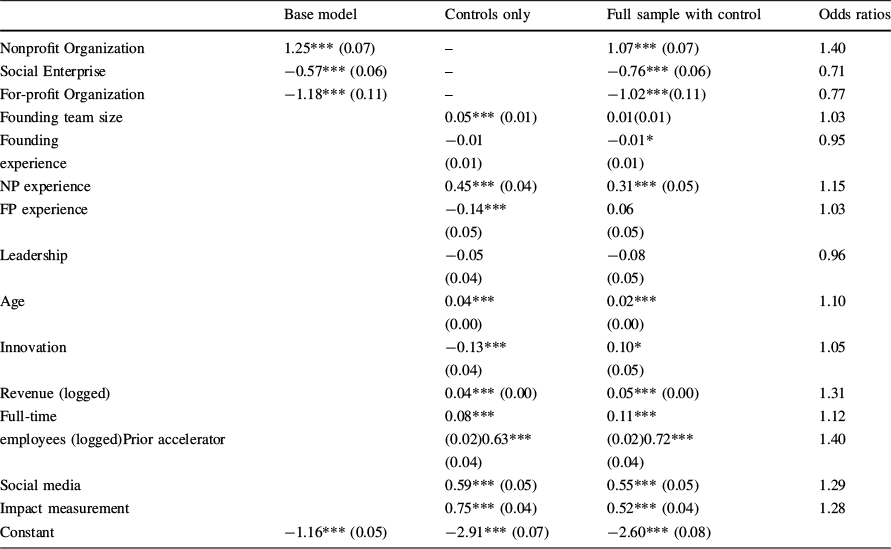
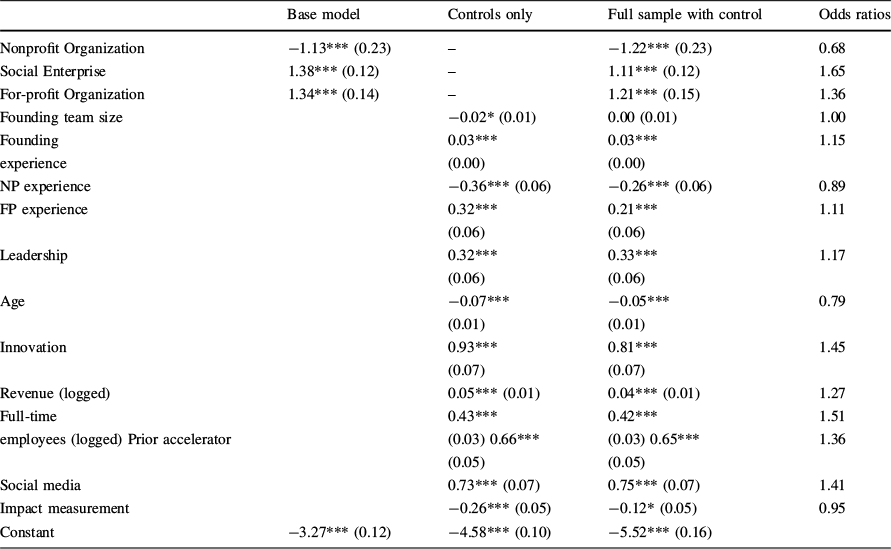
We use logistic regressions to examine how organizational identity (pure nonprofit, pure for-profit, social enterprise) is associated with the probability of receiving any philanthropic funding (Table 3) or equity funding (Table 5), examining base (raw) versus adjusted (with covariates) models.
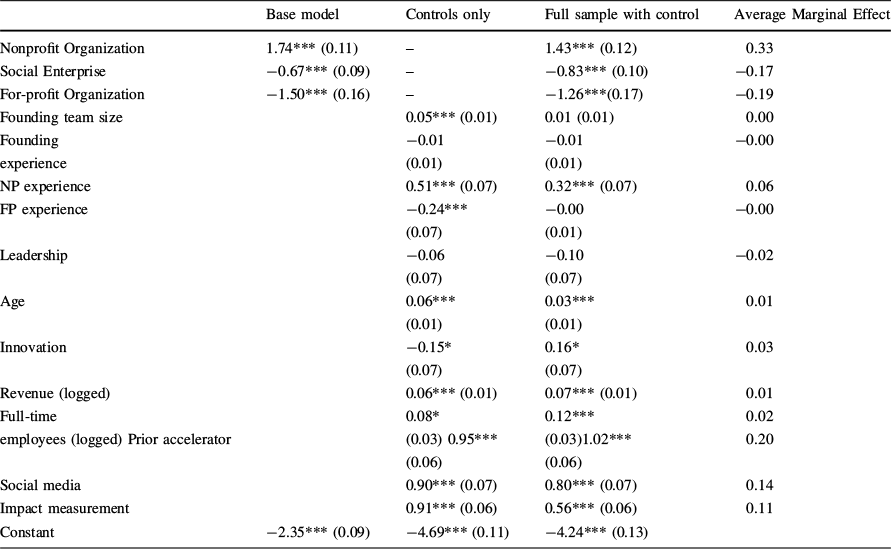
We use Tobit regression to examine how organizational identity (pure nonprofit, pure for-profit, social enterprise) is associated with the amount of philanthropic (Table 4) or equity funding (Table 6), again comparing between base and adjusted models.
For robustness checking, we check the sensitivity of the results to the estimation model. We use the logged dollar amount of investment and donation received as the dependent variables and replicated the analysis using the Tobit model to account for the left censoring because many organizations in the sample reported a zero amount of funding. The results on the Tobit regression align with the Logit regression, which affirms the results.
Results
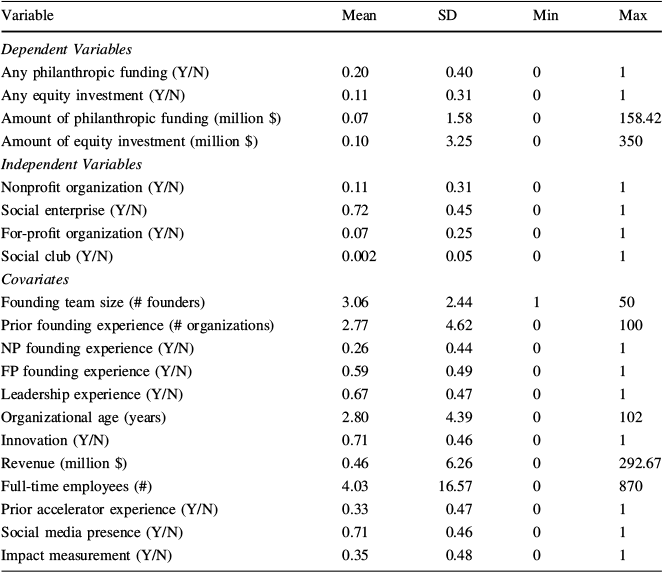
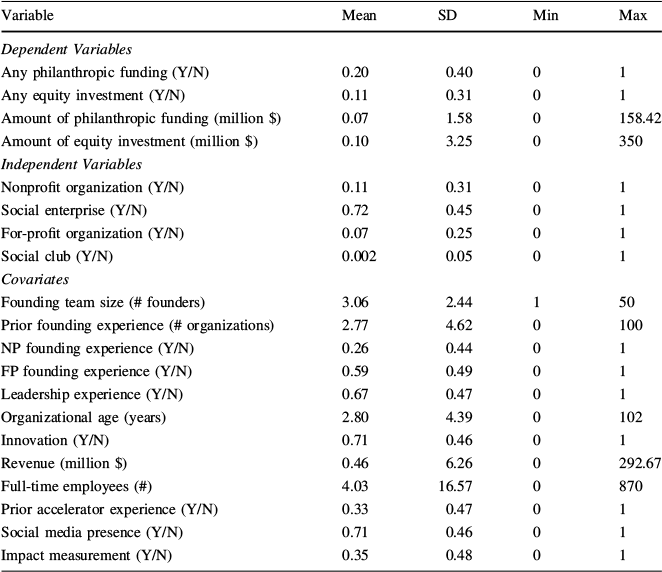
We present descriptive statistics in Table 2.
Table 2 Descriptive statistics for variables in all models (N = 19,903)
Variable |
Mean |
SD |
Min |
Max |
|---|---|---|---|---|
Dependent Variables |
||||
Any philanthropic funding (Y/N) |
0.20 |
0.40 |
0 |
1 |
Any equity investment (Y/N) |
0.11 |
0.31 |
0 |
1 |
Amount of philanthropic funding (million $) |
0.07 |
1.58 |
0 |
158.42 |
Amount of equity investment (million $) |
0.10 |
3.25 |
0 |
350 |
Independent Variables |
||||
Nonprofit organization (Y/N) |
0.11 |
0.31 |
0 |
1 |
Social enterprise (Y/N) |
0.72 |
0.45 |
0 |
1 |
For-profit organization (Y/N) |
0.07 |
0.25 |
0 |
1 |
Social club (Y/N) |
0.002 |
0.05 |
0 |
1 |
Covariates |
||||
Founding team size (# founders) |
3.06 |
2.44 |
1 |
50 |
Prior founding experience (# organizations) |
2.77 |
4.62 |
0 |
100 |
NP founding experience (Y/N) |
0.26 |
0.44 |
0 |
1 |
FP founding experience (Y/N) |
0.59 |
0.49 |
0 |
1 |
Leadership experience (Y/N) |
0.67 |
0.47 |
0 |
1 |
Organizational age (years) |
2.80 |
4.39 |
0 |
102 |
Innovation (Y/N) |
0.71 |
0.46 |
0 |
1 |
Revenue (million $) |
0.46 |
6.26 |
0 |
292.67 |
Full-time employees (#) |
4.03 |
16.57 |
0 |
870 |
Prior accelerator experience (Y/N) |
0.33 |
0.47 |
0 |
1 |
Social media presence (Y/N) |
0.71 |
0.46 |
0 |
1 |
Impact measurement (Y/N) |
0.35 |
0.48 |
0 |
1 |
Two negative values in Revenue were bottom coded to 0. Results remain consistent with or without this bottom coding
Philanthropic Funding Probability and Amount
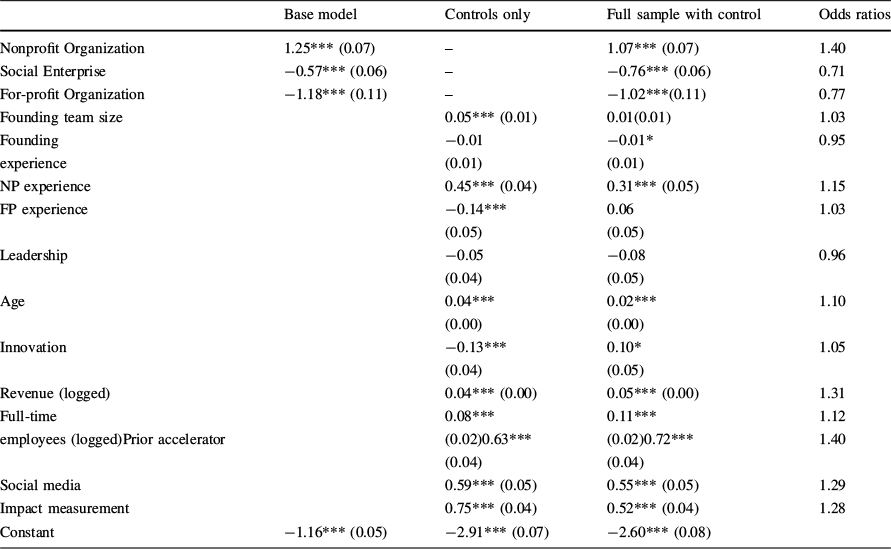
In Table 3, we report the results of logistic regressions examining the probability of receiving philanthropic funding by organizational identity. The reference category is “social club.” Column 1 is our baseline model that includes only the independent variables. It shows that pure nonprofit organizations are more likely to receive financial resources from philanthropic donors, while social enterprises and pure for-profit organizations are less likely to receive philanthropic donations.
Table 3 Probability of acquiring philanthropic donation by organizational identity
Base model |
Controls only |
Full sample with control |
Odds ratios |
|
|---|---|---|---|---|
Nonprofit Organization |
1.25*** (0.07) |
– |
1.07*** (0.07) |
1.40 |
Social Enterprise |
−0.57*** (0.06) |
– |
−0.76*** (0.06) |
0.71 |
For-profit Organization |
−1.18*** (0.11) |
– |
−1.02***(0.11) |
0.77 |
Founding team size |
0.05*** (0.01) |
0.01(0.01) |
1.03 |
|
Founding |
−0.01 |
−0.01* |
0.95 |
|
experience |
(0.01) |
(0.01) |
||
NP experience |
0.45*** (0.04) |
0.31*** (0.05) |
1.15 |
|
FP experience |
−0.14*** |
0.06 |
1.03 |
|
(0.05) |
(0.05) |
|||
Leadership |
−0.05 |
−0.08 |
0.96 |
|
(0.04) |
(0.05) |
|||
Age |
0.04*** |
0.02*** |
1.10 |
|
(0.00) |
(0.00) |
|||
Innovation |
−0.13*** |
0.10* |
1.05 |
|
(0.04) |
(0.05) |
|||
Revenue (logged) |
0.04*** (0.00) |
0.05*** (0.00) |
1.31 |
|
Full-time |
0.08*** |
0.11*** |
1.12 |
|
employees (logged)Prior accelerator |
(0.02)0.63*** |
(0.02)0.72*** |
1.40 |
|
(0.04) |
(0.04) |
|||
Social media |
0.59*** (0.05) |
0.55*** (0.05) |
1.29 |
|
Impact measurement |
0.75*** (0.04) |
0.52*** (0.04) |
1.28 |
|
Constant |
−1.16*** (0.05) |
−2.91*** (0.07) |
−2.60*** (0.08) |
Reference category: social club. Standard errors in parentheses, *p < 0.05, **p < 0.01, ***p < 0.001
Although not the main purpose of this study, in Column 2 we review how covariates are associated with philanthropic funding. Philanthropic donations are more likely to go to organizations with larger founding team sizes, founders with nonprofit founding experience, older organizations, those with more employees, with prior accelerator experience, with more social media presence, and those that measure their social impact. Philanthropic donations are less likely to go to organizations that had founders with leadership experience (especially for-profit founding experience), and those that are innovative. Revenue is unrelated to the probability of philanthropic funding.
In Column 3, we examine the full model with all covariates. When adding all covariates to the model, the main results remain consistent: Pure nonprofit organizations have a higher probability of receiving philanthropic donations, while social enterprises and for-profit organizations have a lower probability of receiving philanthropic funding.
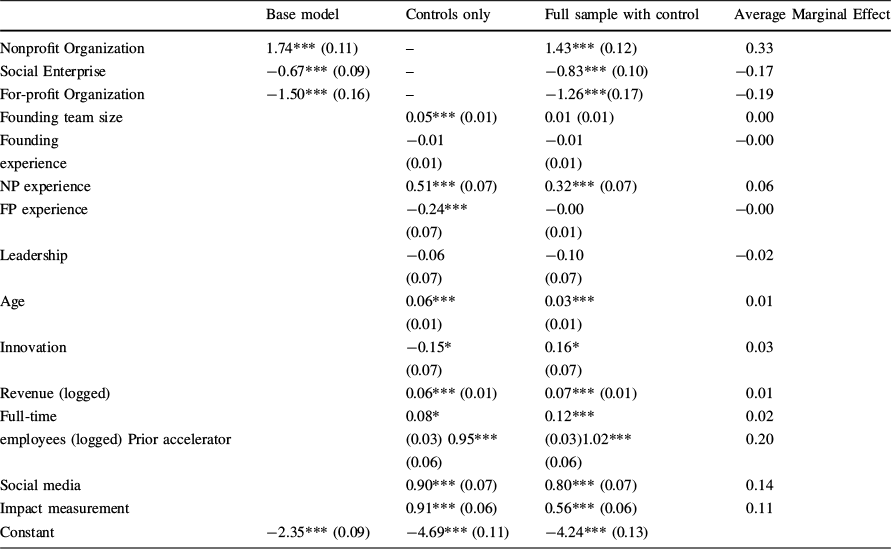
We also conduct Tobit regression on the same variables using the amount of philanthropic donation as a dependent variable (see Table 4). In Column 1, we test the relationship between the independent variables and the dependent variable. Conceptually replicating the logistic regression, we find that pure nonprofit organizations receive more philanthropic donations, while social enterprises and for-profit organizations receive less philanthropic donations.
Table 4 Amount of philanthropic donations by organizational identity
Base model |
Controls only |
Full sample with control |
Average Marginal Effect |
|
|---|---|---|---|---|
Nonprofit Organization |
1.74*** (0.11) |
– |
1.43*** (0.12) |
0.33 |
Social Enterprise |
−0.67*** (0.09) |
– |
−0.83*** (0.10) |
−0.17 |
For-profit Organization |
−1.50*** (0.16) |
– |
−1.26***(0.17) |
−0.19 |
Founding team size |
0.05*** (0.01) |
0.01 (0.01) |
0.00 |
|
Founding |
−0.01 |
−0.01 |
−0.00 |
|
experience |
(0.01) |
(0.01) |
||
NP experience |
0.51*** (0.07) |
0.32*** (0.07) |
0.06 |
|
FP experience |
−0.24*** |
−0.00 |
−0.00 |
|
(0.07) |
(0.01) |
|||
Leadership |
−0.06 |
−0.10 |
−0.02 |
|
(0.07) |
(0.07) |
|||
Age |
0.06*** |
0.03*** |
0.01 |
|
(0.01) |
(0.01) |
|||
Innovation |
−0.15* |
0.16* |
0.03 |
|
(0.07) |
(0.07) |
|||
Revenue (logged) |
0.06*** (0.01) |
0.07*** (0.01) |
0.01 |
|
Full-time |
0.08* |
0.12*** |
0.02 |
|
employees (logged) Prior accelerator |
(0.03) 0.95*** |
(0.03)1.02*** |
0.20 |
|
(0.06) |
(0.06) |
|||
Social media |
0.90*** (0.07) |
0.80*** (0.07) |
0.14 |
|
Impact measurement |
0.91*** (0.06) |
0.56*** (0.06) |
0.11 |
|
Constant |
−2.35*** (0.09) |
−4.69*** (0.11) |
−4.24*** (0.13) |
Tobit regression used logged dollar amount of received philanthropic donation. Standard errors in parentheses, *p < 0.05, **p < 0.01, ***p < 0.001
In Column 2, we include only covariates and find that organizations with prior nonprofit experience, older organizations, those with more revenue and more full-time employees, those with acceleration experience, a social media presence, and who used impact measurement receive more philanthropic donations. Organizations with founders that prior for-profit founding experience and innovative organizations receive less philanthropic donations.
In the full model with covariates included (Column 3), we find that the main pattern of results remains consistent. Pure nonprofit organizations received more philanthropic funding, and social enterprises and pure for-profit organizations received less philanthropic funding.
Since our main goal is to compare the probability and amount of pure nonprofit organizations versus social enterprises receiving philanthropic funding, we add two additional analyses (Table S1 and Table S2 in online appendix) that only included pure nonprofit organizations and social enterprises as independent variables (with pure for-profits as the reference group; excluding social clubs), and the results remain consistent. Taken together the results from Table S1 and Table S2 in online appendix are consistent with a “stain effect,” since philanthropic donors funded social enterprises similarly to for-profits. This suggests that the financial identity mismatch between resource seekers and providers matters more than the social motivation match under the scenario when seeking philanthropic funding.
Equity Funding Probability and Amount
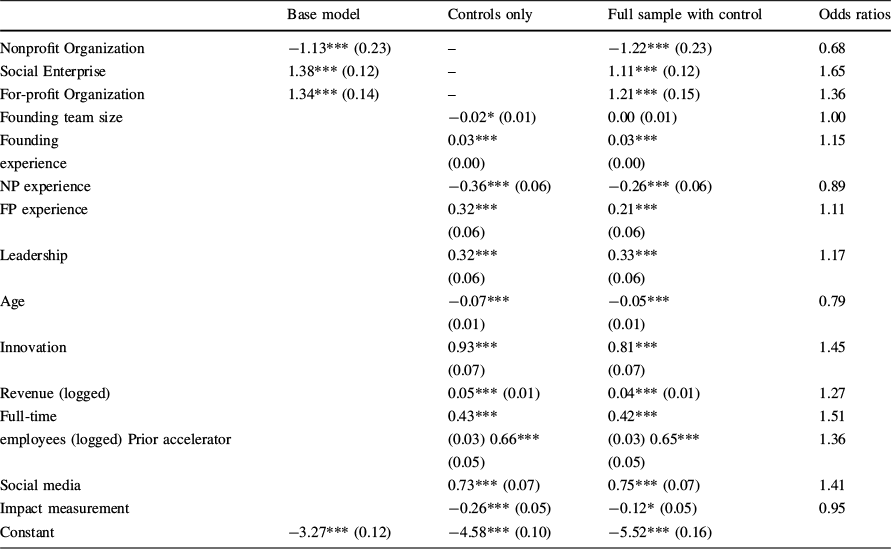
Table 5 reports the logistic regression examining whether the probability of receiving equity investment depends upon organizational identity. Column 1 finds that pure for-profit organizations and social enterprises are more likely to receive equity investment, at similar rates, while pure nonprofit organizations are less likely to receive equity investment.
Table 5 Probability of acquiring equity investment by organizational identity
Base model |
Controls only |
Full sample with control |
Odds ratios |
|
|---|---|---|---|---|
Nonprofit Organization |
−1.13*** (0.23) |
– |
−1.22*** (0.23) |
0.68 |
Social Enterprise |
1.38*** (0.12) |
– |
1.11*** (0.12) |
1.65 |
For-profit Organization |
1.34*** (0.14) |
– |
1.21*** (0.15) |
1.36 |
Founding team size |
−0.02* (0.01) |
0.00 (0.01) |
1.00 |
|
Founding |
0.03*** |
0.03*** |
1.15 |
|
experience |
(0.00) |
(0.00) |
||
NP experience |
−0.36*** (0.06) |
−0.26*** (0.06) |
0.89 |
|
FP experience |
0.32*** |
0.21*** |
1.11 |
|
(0.06) |
(0.06) |
|||
Leadership |
0.32*** |
0.33*** |
1.17 |
|
(0.06) |
(0.06) |
|||
Age |
−0.07*** |
−0.05*** |
0.79 |
|
(0.01) |
(0.01) |
|||
Innovation |
0.93*** |
0.81*** |
1.45 |
|
(0.07) |
(0.07) |
|||
Revenue (logged) |
0.05*** (0.01) |
0.04*** (0.01) |
1.27 |
|
Full-time |
0.43*** |
0.42*** |
1.51 |
|
employees (logged) Prior accelerator |
(0.03) 0.66*** |
(0.03) 0.65*** |
1.36 |
|
(0.05) |
(0.05) |
|||
Social media |
0.73*** (0.07) |
0.75*** (0.07) |
1.41 |
|
Impact measurement |
−0.26*** (0.05) |
−0.12* (0.05) |
0.95 |
|
Constant |
−3.27*** (0.12) |
−4.58*** (0.10) |
−5.52*** (0.16) |
Reference category: social club. Standard errors in parentheses, *p < 0.05, **p < 0.01, ***p < 0.001
Column 2 includes only covariates. Equity investment are more likely to go to organizations with founding experience, for-profit experience, leadership experience, innovation present, higher revenue, more full-time employees, accelerator experience, and a social media presence. Equity investment are less likely to flow to organizations with smaller founding teams, with nonprofit experience, younger organizations, and those that measure impact.
In Column 3, we examine the full model with all covariates. When holding these variables constant, the main results remain consistent: for-profit organizations (1.4 times more) and social enterprises (1.7 times more) are more likely to be funded by equity investors, while pure nonprofit organizations are 32% less likely to be funded by them.
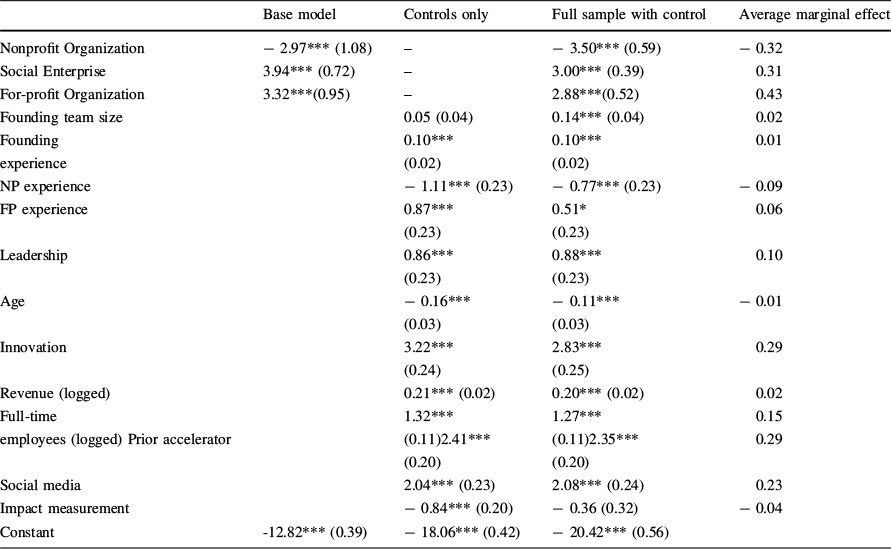
Table 6 examines whether the amount of equity investment received depends upon organizational identity. Column 1 finds that both for-profit organizations and social enterprises receive more funding from equity investors, while pure nonprofit organizations receive less funding.
Table 6 Amount of equity investment by organizational identity

Base model |
Controls only |
Full sample with control |
Average marginal effect |
|
|---|---|---|---|---|
Nonprofit Organization |
− 2.97*** (1.08) |
– |
− 3.50*** (0.59) |
− 0.32 |
Social Enterprise |
3.94*** (0.72) |
– |
3.00*** (0.39) |
0.31 |
For-profit Organization |
3.32***(0.95) |
– |
2.88***(0.52) |
0.43 |
Founding team size |
0.05 (0.04) |
0.14*** (0.04) |
0.02 |
|
Founding |
0.10*** |
0.10*** |
0.01 |
|
experience |
(0.02) |
(0.02) |
||
NP experience |
− 1.11*** (0.23) |
− 0.77*** (0.23) |
− 0.09 |
|
FP experience |
0.87*** |
0.51* |
0.06 |
|
(0.23) |
(0.23) |
|||
Leadership |
0.86*** |
0.88*** |
0.10 |
|
(0.23) |
(0.23) |
|||
Age |
− 0.16*** |
− 0.11*** |
− 0.01 |
|
(0.03) |
(0.03) |
|||
Innovation |
3.22*** |
2.83*** |
0.29 |
|
(0.24) |
(0.25) |
|||
Revenue (logged) |
0.21*** (0.02) |
0.20*** (0.02) |
0.02 |
|
Full-time |
1.32*** |
1.27*** |
0.15 |
|
employees (logged) Prior accelerator |
(0.11)2.41*** |
(0.11)2.35*** |
0.29 |
|
(0.20) |
(0.20) |
|||
Social media |
2.04*** (0.23) |
2.08*** (0.24) |
0.23 |
|
Impact measurement |
− 0.84*** (0.20) |
− 0.36 (0.32) |
− 0.04 |
|
Constant |
-12.82*** (0.39) |
− 18.06*** (0.42) |
− 20.42*** (0.56) |
Tobit regression used logged dollar amount of received equity investment. Standard errors in parentheses, *p < 0.05, **p < 0.01, ***p < 0.001
Column 2 includes only covariates and finds that when organizations have founding experience, for-profit experience, leadership experience, innovation, higher revenue, more employees, accelerator experience, and a social media presence, they receive more equity investment while organizations that have nonprofit experience, are younger, and measure impact receive less.
In the full model with covariates included (Column 3), we find that the main pattern of results remains consistent. For-profit organizations and social enterprises receive more equity investments, and pure nonprofit organizations receive less equity investments.
Since our main goal is to compare the probability and amount of for-profit organizations versus social enterprises receiving equity investment, we added two additional analyses (as shown in Table S3 and Table S4 in online appendix) only including pure for-profit organizations and social enterprises as independent variables, (with pure nonprofits as the reference group; excluding social clubs), and the results remain consistent.
Taken together the results from Table S3 and Table S4 in online appendix are consistent with a “halo effect,” since equity investors funded social enterprises similarly to pure for-profits. This suggests that the financial identity match between resource seekers and providers matters more than the social motivation mismatch under the scenario when seeking equity investment.
Discussion
Social enterprises have emerged as an important tool for combatting the world’s most complex social issues. However, resource constraints represent one key barrier to their sustainability. Characterized by a hybrid identity in contrast to pure nonprofit or for-profit organizations, social enterprises may face more salient challenges than their counterparts in resource acquisition. The present research investigates whether hybrid organizational identity is associated with penalty or reward in financial resource acquisition from philanthropic donors and equity investors. It specifically focuses on the comparison between social enterprises that have hybrid organizational identities with pure nonprofit organizations and pure for-profit organizations that have non-hybrid organizational identities respectively. It further provides implications for organizations that have social motives to recognize their niche market and comparative advantages when acquiring financial resources from heterogeneous funders.
We found that whether there is a penalty or reward of social enterprises’ hybrid status depends upon the type of funding sources the social enterprises interact with. Penalty exists when the organizations that are not purely focused on some social benefit (i.e., pure for-profits and social enterprises) seek funding from philanthropic sources. For philanthropic funders, financial motivation is a stain on social enterprises that cannot be erased by social motives, thus, social enterprises are less likely to acquire philanthropic resources than pure nonprofit organizations. Our data cannot determine why, but we can speculate. First, it is possible that philanthropic donors have higher moral expectations of recipient organizations and thus may see profit-seeking as a violation of the moral purity of doing good without financial gain. Second, philanthropic donors may perceive less financial need in organizations that have access to other forms of financial resources and give less as a result.
Reward emerges when social enterprises seek funding from equity funding sources. As for equity resource providers, their primary identity involves making financial profit, and we find that adding a social attribute to their identity (i.e., pure for-profits and social enterprises) makes them rewarded. Thus, hybridity appears to act as a halo that may encourage investment from equity funders.
Overall, the mismatch in identity affects social enterprises’ resource acquisition in philanthropic donation more, while the matched identity attributes affect social enterprises’ resource acquisition in equity investment more. Therefore, hybridity may generate halo effect or stain effect under different situations, and it is extremely important for social enterprises to identify the financial resource providers they are targeting and communicate their identities in a proper way.
Theoretical and Applied Implications
We shed light on the topic of social enterprises’ resource acquisition, by applying insights from identity theory to make predictions about funding differences among equity and philanthropic funders. Our results directly speak to long-term discussions on the “hybrid ideal,” that social enterprises should make an intensive social impact while simultaneously acquiring sustainable financial resources (Battilana et al., Reference Battilana, Lee, Walker and Dorsey2012) and the “golden quadrant,” and that the combination of a for-profit orientation and a social purpose may lead to high admiration (Aaker et al., Reference Aaker, Garbinsky and Vohs2012). Our findings suggest that hybridity does not always benefit social enterprises, at least in terms of financial resource acquisition.
In addition, this study empirically examines theoretical frameworks positing the two-sided venture identification process, specifically, those suggesting that funders’ heterogeneous identities may relate to recipient organizations’ identities. Our results imply that hybrid identity may posit different effects on social enterprises’ resource acquisition from philanthropic donors and equity investors respectively. Specifically, we find that the mismatch in identity may affect social enterprises’ resource acquisition in philanthropic donation more, while the matched identity attributes may affect that in equity investment more. Overall, the financial dimension of hybrid identities may be more salient than the social dimension for all funders. This is worth exploring in future research.
Finally, our results have implications for how organizations might strategically communicate with various stakeholders who may prefer social or for-profit (or hybrid) organizational structures. Considering the recent marketization climate in the nonprofit sector, this study can help to uncover practical implications for organizations on how they choose their legal status, and how they present their social and financial identities. For social enterprises who choose a hybrid identity, perhaps they should consider highlighting their social mission and minimizing the financial aspects of their organization to philanthropic funders.
Strengths, Limitations, and Future Directions
By leveraging a comprehensive social entrepreneurship database compiled to date, we are among the first to analyze the cross-national funding patterns of social enterprises (also see Cobb et al., Reference Cobb, Wry and Zhao2016). Moreover, financial resource acquisition is a critical issue in securing organizations’ survival and success, but is challenging (Brush et al., Reference Brush, Greene and Hart2001). Although academic and public discourse has emphasized potential benefits of hybridity (Dees & Anderson, Reference Dees and Anderson2003; Harrison, Reference Harrison2006) and “hybrid ideal” is an appealing aspiration (Battilana et al., Reference Battilana, Lee, Walker and Dorsey2012), most research has focused on nonprofit organizations’ financial acquisition (Andersson, Reference Andersson2019; Lecy et al., Reference Lecy, Van Slyke and Yoon2016; Young & Grinsfelder, Reference Young and Grinsfelder2011), with mixed findings on hybridity’s financial benefits. We address this gap by proposing and testing two contrasting theories: halo effect and stain effect.
In addition, studies on social enterprises’ resource acquisition mainly focus on the perspectives of social entrepreneurs themselves (e.g., Witesman et al., Reference Witesman, Child and Wightman2019) or consumers (e.g., Lee et al., Reference Lee, Bolton and Winterich2017; Xu, Reference Xu2020). Few take funders’ identities into account, which is important to understand, given the complexity of social enterprises’ identities (Galaskiewicz & Barringer, Reference Galaskiewicz and Barringer2012). Using the venture identification concept moves beyond the one-sided perspective of fundraising by taking funder’s identities into consideration. The identity matching process is especially critical in the social entrepreneurship context because the organizational identities are ambiguous and may not carry generic structural features that are distinct and recognizable (Billis, Reference Billis2010; Somerville & McElwee, Reference Somerville and McElwee2011). Most research assumes that funders are homogenous in how they react to organizational identities (Fisher & Kotha, Reference Fisher, Kotha, Shalley, Hitt and Zhou2015), but we demonstrate the importance of examining how different types of funders’ allocate financial resources to different organizational types.
One possible limitation in the current study is that we now use legal status as a proxy for financial motives and define social enterprise as an organization with a for-profit legal status and explicit social motive in our sample; however, nonprofit organizations with profit aspirations are also social enterprises (Brewer, Reference Brewer2016; Poon, Reference Poon2011). We were unable to examine the possibility of receiving external funding for this type of social enterprise. We recommend that future researchers examine whether there are differences in resource acquisition for different kinds of social enterprises (i.e., for-profit organizations with social motives; nonprofit organizations with financial motives).
It is also difficult to disentangle the legal restrictions’ influence from venture identification. For example, in the USA, although many innovative funding tools (e.g., program-related investment) allow foundations to finance for-profit organizations, there still may be barriers for some philanthropic donors to financially support for-profit social enterprises which are not due to identity mismatch. There may be different legal restrictions in other countries. Thus, future research could explore cross-national policies in more depth to examine whether results are consistent with what we report here. For now, given that there were a variety of sources of philanthropic funding besides foundations, our study still makes a contribution in terms of social enterprises’ resource acquisition from philanthropic sources, compared to pure nonprofit and for-profit organizations.
In addition, since the data were collected from the social enterprise’s side, we have limited information of the resource providers, beyond their financial support itself. This may lead to some incomplete information, such as their evaluations of the organizations, and their motivations for donating (Bekkers & Wiepking, Reference Bekkers and Wiepking2011; Konrath & Handy, Reference Konrath and Handy2018) or investing (Bauer & Smeets, Reference Bauer and Smeets2015; Døskeland & Pedersen, Reference Døskeland and Pedersen2016). Although our findings demonstrate the associations between hybrid organizational identities and resource acquisition outcomes, we have a limited understanding of the actual mechanisms for them. For example, with the current dataset, we cannot be sure if the findings are due to identity, incentives, or some other explanation. We encourage researchers to collect survey or interview data from resource providers and use experimental methods to further explore the match and mismatch between funders and ventures by more deeply examining the potential causal mechanisms.
This study mainly focuses on the total acquisition of different financial resources, but the temporal dimension in obtaining resources from different funding sources also worth noticing (Lall & Park, Reference Lall and Park2022). Future studies could explore the signaling effect of receiving a certain type funding (Howell, Reference Howell2017; Islam et al., Reference Islam, Fremeth and Marcus2018) on attracting other funding sources in the following fundraising stages. Furthermore, we did not include the institutional environment as a critical factor into the analysis. In fact, organizations may behave in systematically different ways in different contexts. To this end, future studies can explore how social enterprises behave differently in different cultural contexts, by adding more data points regarding institutional context such as socioeconomic status, funding-related policy, and cultural psychological variables (e.g., individualism).
Although common wisdom suggests that social enterprises are appealing to philanthropic donors, we find that the reality is more complex than this. Until we better understand the reasons, we recommend that social enterprises not assume that all funder types will reward their hybrid status: Indeed, philanthropic funders may penalize it.
Funding
Open access funding provided by SCELC, Statewide California Electronic Library Consortium. This study was not funded by any organization.
Declarations
Conflict of interest
The authors declare that they have no conflict of interest.
Human and Animal Rights
This study does not involve human participants and/or animals.



 Open access

