

1. Introduction
The Indigenous people of Sri Lanka, known as VeddasFootnote 1 (also referred to as Vanniyalaththo, people of the forest, or forest dwellers), foster profound relationships with nature.Footnote 2 However, their worldviews and cosmovisions rarely find their way into Sri Lanka’s Western-influenced legal framework, which is shaped directly by historical and contemporary colonizing processes.Footnote 3 Indeed, this absence resulted in several government decisions that allowed the destruction and exploitation of Vedda communities’ ancestral lands, as described later in this article. Sri Lankan law and policy have failed to acknowledge and protect the deep relational values that Vedda communities maintain.Footnote 4
This article answers the overarching question of how the gap between the relational ontologies of Vedda law and state-based law in Sri Lanka can be bridged. By engaging with the relational ontologies of Vedda law, the article advocates broader recognition of Vedda worldviews within Sri Lanka’s state-based law and highlights the role of Indigenous communities as non-state actors in shaping more-than-human governance.
It does this by taking inspiration from legal personhoodFootnote 5 and Rights of Nature (RoN) approaches which are developing as alternatives to conventional legal frameworks that aim to protect the environment for instrumental reasons. At present, legal personhood and RoN are acknowledged in at least 24 jurisdictions across the globe through various constitutional, legislative, and judicial mechanisms, municipal ordinances, and legally unenforceable community declarations.Footnote 6 Kauffman and Martin hold that the concept of RoN is no longer confined to the fringes and has entered the mainstream.Footnote 7
Critical for this recognition of legal personhood and RoN in a substantial number of nations is its connection with Indigenous communities, their worldviews, and ways of life. According to O’Donnell, some of the most transformative examples of rights of nature come from Indigenous leadership.Footnote 8 A similar view is shared by Tănăsescu who, citing Kauffman and Martin, asserts that the recognition of rights of nature is a codification of ‘the Indigenous cosmovision that nature is sacred, possesses its own rights, and is part of a living community in which humans exist’ for Western legal purposes.Footnote 9 Thus, the recognition of the concepts of legal personhood and RoN can facilitate the incorporation of plural understandings of human–nature relationships within Western-influenced legal systems. In a similar vein, this approach can offer a valuable mechanism for bridging the divide between the relational ontologies of Vedda law and the state-based legal system in Sri Lanka. As a decolonizing mechanism, such an approach would need to engage directly with Vedda communities and their leadership, respecting the deep communion, affinity, and fellowship they share with the land, while also acknowledging the rights of nature to exist and thrive.
This article has seven sections. Section 2 provides an account of the methodology used in the research. Section 3 analyzes the concept of Indigeneity, the dichotomy between colonial-Western and Indigenous legal systems, and how this distinction applies in the context of Sri Lanka’s colonial history. Section 4 introduces the Vedda communities in Sri Lanka and respectfully engages with their worldviews and deep relational values. Section 5 examines the legal recognition of Vedda worldviews and values within Sri Lanka’s state-based law. Section 6 argues that legal personhood and RoN can serve as a bridge between Western legal concepts and the plural, relational worldviews of Indigenous communities. Section 7 concludes.
2. Methodology
This article draws on the doctrinal approach and socio-legal research methodology. The doctrinal approach was used to build a sound foundation for the research, verifying the authority and status of the legal doctrines being examined;Footnote 10 the relational legal systems of Indigenous peoples, anthropocentric laws, and the role of legal personhood and RoN in bridging the dissonance between them. It draws on constitutions, legislation, case law, and policy documents as primary sources, and books, peer-reviewed journal articles, conference proceedings, and research studies as secondary sources.
Socio-legal research methodology was used to explore the relationships between Vedda communities and nature, a topic that has received limited scholarly attention. For this purpose, Edirisinghe conducted primary research and gathered data through key informant interviews with 32 stakeholders in Sri Lanka in 2023. The data pertinent to this research is derived from 19 of these interviews with Vedda community members (6), law- and policy-makers (2), officials of the relevant government authorities (6), environmental lawyers and activists (3), and academics, researchers, and scholars with expertise in the Indigenous Vedda community (2). The Vedda community members interviewed for this study reside in the Vedda Village in Kotabakiniya, Dambana (see Figure 1).

Figure 1. Location of Vedda Communities in Sri Lanka.
Note: Map created using the information on Vedda settlements in Silva & Punchihewa, n. 2 above, p. XIII.
The authors of this article are not members of the Vedda community. Edirisinghe, a legal scholar originating from Sri Lanka, is a member of the Sinhalese Buddhist community, and Suchet-Pearson is an Australian non-Indigenous human geographer whose research and advocacy focus on Indigenous rights and environmental management predominantly in Australia. Neither researcher, despite taking great care and effort to understand and be respectful towards the Vedda community and their worldviews, can fully appreciate the relational values of the Indigenous Vedda people, nor their efforts to preserve their identity and pass their values on to future generations amidst the dispossession of their lands.
Interviews with the Vedda were conducted in Sinhala, which is Edirisinghe’s mother tongue. The younger members of the Vedda community primarily used Sinhala-influenced vocabulary. When they used words or terminologies unique to the Vedda language, they explained their meanings to Edirisinghe in Sinhala. The vocabulary of the elders was less influenced by Sinhala and contained more terms unique to the Vedda language.Footnote 11 The younger members translated these terms in the elders’ responses into Sinhala in a manner that Edirisinghe could understand. Edirisinghe then translated all responses into English. We aimed to preserve the original meaning of the ideas in the translations. When we could not find an exact English equivalent – because the words encapsulate concepts, emotions or experiences that are specific to the Vedda culture and context – we use the original Vedda term and provide an explanation.
3. Indigeneity and Colonial-Western Legal Systems in Sri Lanka
The concept of Indigeneity is subject to much debate.Footnote 12 While, in European settler colonies, it can be relatively clear who should be considered Indigenous, in many parts of the world it can be challenging to distinguish clearly between Indigenous communities and the rest of the population.Footnote 13 Consequently, national governments often argue that the concept of Indigeneity does not apply to them – a phenomenon known as the ‘salt-water theory’ or the ‘Asian controversy’.Footnote 14 Sri Lanka falls into this latter category.
Nevertheless, we embrace the Indigeneity of the Vedda communities for two reasons. Firstly, Article 33 of the United Nations Declaration on the Rights of Indigenous Peoples (UNDRIP)Footnote 15 states: ‘Indigenous peoples have the right to determine their own identity or membership in accordance with their customs and traditions’. Secondly, it is a common feature of communities classified as ‘Indigenous’ to hold deep relational values and to place significant emphasis on relationships – not only among human members, but also with non-human entities.Footnote 16 In Section 4, we demonstrate that the Vedda communities satisfy both criteria, which aligns with the definition provided in the Martínez Cobo study.Footnote 17
Indigenous peoples’ relationships with nature are central to this article. These relationships often differ significantly from those of Western cultures. While it is important to avoid oversimplification and homogenization of Western or Indigenous conceptualizations, for many Indigenous peoples humans are not seen as separate from nature, but as an integral and inseparable part of it, with all beings deeply interconnected.Footnote 18
In contrast, Western cultures are grounded in anthropocentric worldviews that perceive nature as ‘inert, material, mechanical … [and] devoid of spirit’.Footnote 19 According to Burdon, anthropocentrism has roots in Stoic philosophy and Christian theology.Footnote 20 It was further reinforced by the Enlightenment, the emergence of Western sciences, and the rise of capitalism. European concepts of ownership – such as dominion, private property, serfdom, and mercantilism – stand in stark contrast to the communal tenure systems of many Indigenous peoples.Footnote 21 Western worldviews consistently frame nature as a resource to be exploited, casting it as an object in human–nature relationships.
Law evolves in accordance with society’s understanding of the world, and thus tends to reflect the specific worldviews held within society.Footnote 22 The dichotomy between Western and Indigenous perspectives is mirrored in their legal systems. Traditional Western legal theory views law as an exclusively human enterprise – centred on human interests, interactions, and the human good – often excluding nature and non-human beings.Footnote 23 It typically assumes a hierarchical structure that elevates humans to subjects with legal power, while relegating nature to the status of objects.Footnote 24
Berry argues that Western law consequently supports exploiting rather than protecting the natural world.Footnote 25 Grear similarly contends that this entrenched hierarchy upholds a ‘systemically privileged juridical “human” subject’, undermining meaningful responses to environmental crises.Footnote 26
By comparison, Indigenous legal systems are rooted in relational worldviews that emphasize deep connections between communities and their lands.Footnote 27 These systems reflect cultural, spiritual, and social principles passed down through generations, and are expressed through everyday practices, governance structures, and the collective wisdom of the community. Drawing on Australia, Martuwarra RiverOfLife and co-authors assert that the First Law represents a way of living on CountryFootnote 28 that has been handed down through countless generations. This law maintains a complex web of relationships between human and non-human worlds, creating a pattern that embodies life itself.Footnote 29 Tynan asserts that ‘Country sits at the heart of coming to know and understand relationality as it is the web that connects humans to a system of Lore/Law and knowledge that can never be human-centric’.Footnote 30 Watson summarizes Indigenous laws: ‘Knowledge of the law comes through the living of it. Law is lived, sung, danced, painted, eaten, walked upon, loved, all of these things’.Footnote 31
When Edirisinghe asked a Vedda community elder about what prevents them from harming nature and if there is a specific law against it, he expressed: ‘Such acts are wrong and go against the values that me aththo [this person/this community]Footnote 32 cherish … These woods provide me aththo with life, and as long as these woods thrive, me aththo shall thrive’. He pointed to the traditional axe he carries on his shoulder, known as keteriya, and stated:
This resembles the pride of me aththan’s parampara [this term encompasses their community past, present, and future with their values, identities, etc.]. Me aththo would bring harm upon me aththan’s own self, even death, should me aththo ever betray these woods. These woods bear the legacy of me aththan’s parampara and me aththo will never bring shame to me aththan’s forefathers.Footnote 33
Accordingly, from a Vedda worldview, their well-being is inseparable from the thriving of nature – a relational principle that functions as an unwritten law, deeply embedded in their way of life. Passed down through generations, it has never required formal codification or external enforcement, as it remains integral to their lived existence.
Many Indigenous legal systems do not perceive nature as separate from humans. These legal systems place human beings within the natural world and are centred on relational values.Footnote 34 ‘The separation between the physical and metaphysical, between place and people, is almost antithetical to Indigenous jurisprudence’.Footnote 35 As Tănăsescu puts it, ‘Indigenous philosophies … focus on the development of situated relationships with natural beings that are always in flux. … they do not posit a nature that is prior to its relationships’.Footnote 36 Thus, Indigenous legal systems often stand in direct contrast to Western legal systems.
Over the last 500 years or so, Western legal notions regarding human–nature relationships have become dominant and globally pervasive as a result of colonialism, imperialism, and the uneven distribution of sovereign power between nation-states and Indigenous peoples. These influences often stereotype non-Western legal systems as ‘uncivilized’ and in need of ‘modernization’ and ‘development’.Footnote 37 The situation has been exacerbated by the pervasive influence of Western concepts within international law in global environmental governance.Footnote 38 Ikejiaku asserts that ‘international environmental law is nothing but a global law made by the Westerners for the purpose of directing and controlling global undertakings’.Footnote 39
This hegemonic dominance established the notion that certain truths or knowledge are universally applicable, regardless of the local context, culture, or traditions. Escobar asserts: ‘Modernity created the idea that we live in a world that has room for only one world, the [One-World world], now globalized. … the West has managed to universalize its own idea of the world, which only modern science can know and thoroughly study’.Footnote 40 This exerts enormous pressure on the ontological plurality of non-colonial worldviews, including those held by Indigenous communities.Footnote 41 O’Donnell and others hold that the result of this pressure is:
a plethora of often unquestioned ontological and epistemological assumptions about the very concept of ‘nature’ on the part of all interlocutors (sometimes including Indigenous peoples who lack the necessary sovereign power to counter such assumptions), with the ontologically violent result of reducing Indigenous ideas about nature and human interactions with the non-human world to a globally familiar, yet extremely reductive, dominant paradigm.Footnote 42
In Sri Lanka, which had its own legal systems, values, and governance mechanisms, the human–nature division became pertinent as a result of the colonizing processes and the imposition of European legal systems – Roman-Dutch law and English law – which now dominate the legal system of the country. The first European colonizers, the Portuguese, arrived on the island in 1505, and the last colonizers, the English, left the island in 1948. During these 443 years, the legal system underwent enormous changes.Footnote 43 As discussed later in this article, the colonial imposition and influence of these legal systems disregarded and marginalized Indigenous legal systems.
Even though the colonial rulers did not permanently settle in Sri Lanka, the influence of coloniality created enduring structures that continue to shape present-day norms and practices, becoming the standard operating procedure of the nation-state. As Natarajan states: ‘Along with sovereign statehood, postcolonial states also inherited Western understandings about nature, including the role of the sovereign in disciplining the natural environment through law and making it optimally productive’.Footnote 44 Similarly, Sri Lanka continues to follow colonial legal systems, building environmental laws and legal structures upon them, and seeking legitimacy of environmental governance through established Western legal principles. It is also consistently influenced by international environmental standards, which, as previously explained, often reflect Western notions of environmental governance. Consequently, Western legal ideals continue to dominate human–nature relationships in Sri Lanka. This, coupled with the Aryan and Dravidian colonizationsFootnote 45 of the island originating from India, places great pressure on the visibility and efficacy of Vedda worldviews, relationships, and values.Footnote 46
Decoloniality is integral to local and transnational movements, resisting and rejecting the enduring legacies of external and internal colonialism, as well as the global frameworks of the modern/colonial/Western world.Footnote 47 Similarly, many scholars emphasize the need to overcome Western influences on human–nature relationships through decolonizing environmental governance.Footnote 48 Recognising and empowering Indigenous Vedda communities and their relational ties is a crucial aspect of Sri Lanka’s decolonization process. Unfortunately, this issue has received little attention from law- and policy-makers, or academic literature. To address it meaningfully, it is essential to understand the relational worldviews, ontologies, and legal traditions upheld by Vedda communities for generations. The following section explores who the Indigenous Vedda are, their deep relationship with nature, and the ways in which recent policy decisions have affected their way of life.
4. Vedda Communities and Nature
Understanding Vedda communities in their historical context is essential for respecting their status as Indigenous peoples. While some scholarship addresses their language, culture, and lifestyle, little attention has been paid to their relational values or representation in Sri Lanka’s legal systems. The reasons are complex: their small population, historical marginalization, and entrenched cultural biases are likely to have played a role. The focus on Sinhalese–Tamil ethnic tensions, culminating in a 30-year civil war, may have overshadowed Indigenous issues. Furthermore, the racist and colonizing perception of Veddas as ‘primitive’ by some European writers may have influenced academic perspectives. For instance, Wijemanna brings a serious claim that Seligmann, a British pioneer of modern anthropology, asked a Vedda, who was dressed in his everyday attire, to adorn himself with leaves. This model of the Vedda was created to portray them as uncivilized and to fit the colonial stereotype of what a Vedda should look like.Footnote 49 This racial discourse is further exacerbated by political decision makers who, as discussed later in this article, perceive Veddas as needing to be civilized. Kahandagamage asserts that ‘[t]hanks to the hegemonic mentality inherent in the modern political context, “Vedda” is still a backward, underdeveloped, dressed in leaves, long-haired metaphor’.Footnote 50 These factors contribute to the lack of appreciation of Vedda culture, values, and worldviews in academic research and public discourse. As such, we go on to explain how Vedda communities are recognized as the Indigenous community in Sri Lanka, and then elucidate on their profound relationships with nature, drawing on Edirisinghe’s field research to fill this gap and gain a deeper understanding of Vedda relationships, values, and emotions.
4.1. Veddas as the Indigenous Community in Sri Lanka
The island currently called Sri Lanka is historically considered to be the native land of two tribes: Yakkha and Naga. According to their oral histories, Veddas consider themselves to be the direct descendants of the Yakkha tribe and hence the original inhabitants of the island.Footnote 51 One of their songs confirms these oral histories: ‘Me aththo belong to the parampara of Yakkha in Sri Lanka’.Footnote 52 The Veddas’ claim is supported by scientific studies that link the lineage of the Veddas to prehistoric skeletons found in Sri Lanka, dating back to approximately 28,000 BCE.Footnote 53
However, Sri Lanka’s written history presents a different narrative, linking the ancestry of the Veddas to an Indian prince named Vijaya who arrived in Thambapanni, now Sri Lanka, in the 5th century BCE, and a Yakkha woman named Kuveni.Footnote 54 Written sources trace the lineage of the Vedda community to an incestuous relationship between Vijaya and Kuveni’s two children.Footnote 55 However, Veddas reject this written history and claim:
Vijaya is an outcast who was expelled from his own land. We have no connection to him. We have never practised incestuous relationships … what a shameful thing to do. We don’t accept those [written] histories. We are Yakkhas and will remain so.Footnote 56
Scholars with expertise in the Vedda community have also expressed their scepticism regarding these written accounts. Many of these scholars link the lineage of Veddas through Western understandings of time and archaeology to a time when the first human migrations are believed to have occurred. It is suggested that Vedda ancestors may have originated in Africa, with some groups settling in Sri Lanka and others eventually migrating to Australia.Footnote 57
To fully grasp the Indigenous status of the Vedda people, it is essential to understand Sri Lanka’s complex history and ethnicity. Sri Lanka is composed of an ethnic majority of Sinhalese followed by Tamils, Muslims, and Burghers. Sinhalese are said to have descended from Prince Vijaya and his Indo-Aryan followers.Footnote 58 The Tamil community settled on the island through Dravidian influences, primarily as a result of migration and trade with South India, particularly from the Chola Kingdom. This interaction began as early as the 2nd century BCE during the times of the ancient kings of Sri Lanka, and included periods of both peaceful settlement and conflict.Footnote 59 Another set of Tamil communities were brought by the British colonial rulers in the 1800s from South India as tea and rubber plantation workers.Footnote 60 Muslim traders came to the island from various parts of the world, including Arabia and India, since arguably the 4th century BCE.Footnote 61 The Burghers are a Eurasian community descended from the Europeans, particularly the Portuguese and Dutch,Footnote 62 who colonized the island from 1505 to 1948. While there is no exact census of the Vedda population among official records as the classification ‘Vedda’ was removed from the ethnic groups list in population censuses conducted after 1963,Footnote 63 unofficial reports estimate that they form less than 1% of the national population.Footnote 64
As stated in Section 3, we draw on the definition of Indigenous communities provided in the Martínez Cobo report to establish the Indigenous status of the Veddas. This is based on historical continuity, distinction, minority status, and a determination to ‘preserve, develop and transmit to future generations their ancestral territories, and their ethnic identity, as the basis of their continued existence as peoples, in accordance with their own cultural patterns, social institutions, and legal systems’.Footnote 65
In any version of history stated above, the Vedda communities, or at least their maternal lineage, arrived on the island before the ethnic groups now considered dominant. Despite pressure from these dominant groups, the Veddas have mostly maintained their distinct and unique way of life.Footnote 66 Also, as discussed in Sections 4.3 and 5, notwithstanding this pressure, they are determined to ensure that future generations can inherit their territories and identity. Therefore, they qualify as Indigenous, according to the Martínez Cobo definition. Above all, we argue that the self-identification of the Veddas as Indigenous people for generations serves as a potent and unequivocal affirmation of their identity.
However, this Indigenous status is contested in Sri Lanka, including by law- and policy-makers. For instance, Premachandra cites a letter by a former Minister of Environment and Natural Resources, which states: ‘[t]he Veddas are not an Indigenous community as recognized by international definitions, rather they are an inseparable part of the Sinhalese civilization. Historically, they have been entrusted with the protection of forests by ancient kings’.Footnote 67 He cites many other scholars, experts, and law- and policy-makers, who argue that Veddas are not the Indigenous community of Sri Lanka but rather a part of, or an underdeveloped sector within, the Sinhalese community.Footnote 68 Sri Lanka has also not ratified the International Labour Organization (ILO) Convention No. 169 concerning Indigenous and Tribal Peoples in Independent Countries,Footnote 69 which demonstrates that the state is not yet willing to recognize the community’s Indigenous status and undertake international responsibilities towards it.
Vedda communities today are located in different parts of Sri Lanka and are considered to belong to different subcommunities.Footnote 70 Rituals and values vary between groups, yet all maintain profound connections with nature. Among these diverse groups, the Veddas in Dambana, who are the focus of the socio-legal research conducted for this study, have experienced the most significant upheaval in their way of life as a result of relatively recent development projects.
4.2. The Dispossession of Veddas in Dambana
The Vedda communities in Dambana had to undergo a drastic change in their accustomed way of life owing to the Mahaweli Project – a project aimed to harness the potential of the Mahaweli River for the nation-state by constructing 15 reservoirs, including 11 with power stations, and by developing 360,000 hectares of land for irrigation purposes.Footnote 71 Phase 1 of the project, which began in 1970, involved the construction of two diversion dams to supplement the irrigation of 50,000 hectares of existing partially irrigated lands.Footnote 72 Following a change in government in 1977, a new development programme, known as the Accelerated Mahaweli Program (AMP), was launched.Footnote 73 This programme aimed to complete the Mahaweli Project at an accelerated pace, with a focus on addressing issues such as unemployment, achieving food self-sufficiency, and resolving shortages of electric power at the national level. The AMP included the construction of five new dams and the development of an additional 80,000 hectares of new lands for agriculture.Footnote 74
As a result of the waterworks construction and other human-made modifications to the ecosystem under the AMP, an area of an estimated 27,000 hectares of prime wildlife habitat was expected to be destroyed.Footnote 75 Anthropocentric concerns by government authorities and foreign donors regarding conflict between wildlife and settler farmers,Footnote 76 and the important role that wildlife plays in fostering national pride and promoting tourism,Footnote 77 underscored the perceived necessity for wildlife protection. In response to these challenges, in 1980, the United States Agency for International Development (USAID) sponsored an environmental assessment study of the AMP; this recommended the establishment of National Parks, which included 40,000 hectares of forest in Maduru Oya.Footnote 78 Consequently, in 1983, under the Fauna and Flora Protection Ordinance (FFPO),Footnote 79 the Maduru Oya National Park was created, encompassing 58,850 hectares,Footnote 80 including the ancestral lands of the Dambana Vedda communities.
Under section 5 of the FFPO, individuals are prohibited from entering or remaining within any National Park unless they possess a permit issued by the designated officer.Footnote 81 This permit, which requires payment of the prescribed fee, is intended exclusively for the purpose of facilitating the study or observation of the park’s fauna and flora.Footnote 82 The Ordinance further stipulates that any person who contravenes these provisions will be guilty of an offence punishable by a fine, imprisonment, or both.Footnote 83 Thus, the law of the country has deemed it illegal for the Vedda people to live their traditional way of life on their ancestral lands. As a result, the community was evicted from its lands and resettled in the segmented Mahaweli colonies: the new towns and settlements created under the Mahaweli Development Project for the purpose of ‘rehabilitation’, ‘to learn to become agriculturalists and live in a “civilized” way, have a “civilized” language and religion’.Footnote 84
In 1990, as a result of many pleas made to the governments in power, the Minister for Lands, Irrigation and Mahaweli Development recommended the declaration of approximately 1,500 acres, including the village of Kotabakiniya, as a sanctuary under the FFPO, separate from the Maduru Oya National Park. This was soon approved by the Cabinet of Ministers. While the cabinet paper allows Vedda communities to carry out some traditional activities within limited areas redesignated as sanctuaries, it does not address the potential return of Vedda families to their ancestral lands situated inside the National Park.Footnote 85 Consequently, such return has never been permitted. Addressing the United Nations Working Group on Indigenous People in 1996, the current leader of the Vedda community, Uruwarige Vannilaththo, claimed that ‘the central government of Sri Lanka turned the last of our forest territory into a National Park … and thereby transformed us from being hunters and gatherers into poachers’.Footnote 86 Consequently, Vedda communities have been forcefully and physically separated from the profound, intimate relationships that they maintained with nature because their way of life was not recognized by state authorities and was perceived by law- and policy-makers to be undesirable or uncivilized.
The next subsection of the article delves into how Indigenous Vedda communities connect as part of the more-than-human world in the context of the restrictions imposed upon them by state-sanctioned legal and policy frameworks.
4.3. The Veddas’ Relationships with Nature
Vedda understandings of nature differ markedly from common Westernized, colonized, and commodifying ideas that perceive nature as a resource. For Veddas, nature encompasses many things, including the sun, moon, trees, blowing wind, rivers, wild animals, their ancestral forefathers, gods and goddesses, forest spirits, and they themselves. This Vedda anthem beautifully encapsulates the deep interconnection between Veddas and nature:
Our forearms possess the strength of a steady rock,
our minds are filled with the beauty of a jungle,
our hearts contain the chill of the running water,
we are the men of the jungle.Footnote 87
Despite substantial external pressures, these relational values persist in Vedda worldviews. The relational values that Vedda communities hold are deep and complex and many would be beyond the authors’ right or ability to access. We briefly introduce some of them below, together with the ways in which they have been affected by Sri Lankan law.
Nature as the dwelling place of ancestral beings and the divine
Notwithstanding the significant influence of religions like Buddhism and Hinduism on the island, Vedda people continue to understand their world as alive with spirits. They believe in the world around them, their intimate environment rather than distant heavens, and see and feel powerful forces at work in their everyday lives.Footnote 88 These forces shape their actions, influence their thoughts, and provide a basis for their worldviews.Footnote 89
For Vedda communities, these forces are some of their powerful ancestors who died and became spirits. Accordingly, they worship the spirits of their ancestral forefathers and foremothers, known respectively as Naa Yakku and Kiri Amma, who, upon their passing, transformed into spirits.Footnote 90 These spirits live in different parts of nature, safeguarding Vedda communities from calamities and malevolence while bestowing prosperity upon them. However, they may also inflict illness and misfortune if provoked.
A Vedda elder opined: ‘Whenever me aththo steps into the jungle, me aththo sense the presence of the spirits: “Naa Yakku”’. He emphasized the word, widening his eyes to stress the power and significance of these spirits. He paused to ensure that the interviewer comprehended the significance of these spirits and continued:
They reside in rocks, stone caves, mountains, streams, trees, and vines, and watch over me aththo, aid me aththo in finding food, honey, and assist in hunts. If me aththo enter the jungle after invoking their memory and seeking their permission, they protect me aththo from all the perils within the forest. … But me aththo should never anger them. Hunted more than me aththo need? Naa Yakku get angry. Harmed their dwelling? Naa Yakku get angry.Footnote 91
He concluded: ‘This existence at least in this condition is owed to their help and power’.Footnote 92
However, government-imposed restrictions have deprived the Veddas of the ability to connect physically with many of these forest spirits.
Nature as themselves
For Vedda communities, nature is not a separate entity but an intrinsic extension of their very existence. Premachandra cites the leader of the Vedda community in explaining how deeply connected they are with nature: ‘For me aththo, the forest and me aththan’s parampara are one and the same. Without the forest, there is no parampara. The forest must survive for me aththan’s parampara to survive’.Footnote 93
During fieldwork, Vedda elders powerfully expressed how the expulsion from their forest home has had an impact on their sense of identity. Their sense of self is intricately entwined with the forest and the forceful eviction stripped away a significant part of who they are. One Vedda elder stated:
The forest is the temple, the school, the hospital and the life of me aththan. Me aththo are unfamiliar with an existence devoid of the forest and the trees, the rocks, the animals and the streams in the forest. Me aththo are intimately intertwined with the wilderness, and it, in turn, is an inseparable part of me aththo and their identity.Footnote 94
[…]
me aththo has lived in two worlds: the one within the woods, where me aththo found comfort and understanding, and the world me aththo live in now, beyond the forest, which feels foreign and strange. Me aththo is in an ongoing battle to comprehend the world that surrounds me aththo, to define me aththan’s role within it, and to discover me aththan’s identity in this new world. The very name VanniyalaththoFootnote 95 means ‘forest-beings’ and who are they without the forest?Footnote 96
Another elder expressed his profound confusion thus:
The government officials say that the forest is no longer me aththan’s, but it belongs to the government. Me aththo does not understand that idea. … The forest and everything in there are a part of who me aththo is and to say that it now belongs to the government leaves me aththo very confused.Footnote 97
Conveying a powerful message through his actions, the elder forcefully struck his chest using both hands, with a resounding thud, and said: ‘The memories of me aththan’s childhood spent in the jungle ignite a fervent flame within me aththan’s heart’; he questioned the researcher: ‘Would oya aththo [a courteous term used to refer to others] ever understand living like someone else? Not knowing who you are?’. He continued to express his emotions: ‘When the government snatched away me aththan’s forest, it felt like they cut the neck of me aththan’s parampara. It’s like they’ve taken a piece of me aththo that me aththo may never get back’.Footnote 98
When asked whether he discussed this matter with the government, in a symbolic gesture he grasped a handful of sand, allowing it to fall onto the ground, and passionately exclaimed:
[m]e aththo have asked the government, demanded, requested, pleaded, and begged countless times – more than the grains of sand in this hand – hoping to convey the magnitude of the appeals of me aththo, but for no avail. … They never understood that the forest is me aththo.Footnote 99
He pointed his hand toward the distance and asked, ‘Did Kekuli [young girl] see that electric elephant fence on your way here? It symbolizes how they separated us’. Describing the electric fence as a symbol of their separation from the forest is profoundly compelling. This fence transcends mere physical barriers; it carries life-altering consequences. Crossing it enables a return to their ancestral lands, to their very roots. However, they dare not, for the law imposes dire consequences: fines and imprisonment. Therefore, they remain confined to the periphery of the forest. Once a part of the same wider earth community, they now stand on the outside, looking at their counterparts on the other side of the forest, longing to reclaim their lost identity and regain their former sense of belonging and connection with the more-than-human world.
Premachandra has written about a Vedda member’s account of how they lost everything when they were forced out of the forest. This Vedda recounted that his father passed away on the doorstep of their home, gazing tearfully at the forest. He claims that his grandfather had implored the governor of Mahiyanganaya to release the forest for them; otherwise, he would die and return as Reeri the demon to seek retribution on those responsible for the injustice inflicted upon them. He said his grandfather claimed: ‘Release the forest so that I can die’.Footnote 100
Thus, paradoxically, in its effort to protect the forest, the government overlooked one of its most vital elements: the Vedda communities, who do not merely live in nature but are nature. The Vedda elders who participated in the interviews foresaw, with great fear and deep sorrow, that consequently their entire community would become assimilated into mainstream society, referred to as maha samājaya (the great society), within the next two generations, marking the extinction of a once-great community and everything they held dear.Footnote 101
Nature as sentient, agentic, and rational
Vedda communities understand nature as sentient, and an agentic being. This is closely intertwined with their conviction that powerful spirits dwell within nature and their understanding of nature as an extension of their very existence. As an elder stated, everything in nature can feel and perceive: ‘Me aththo can feel the forest, and in turn, the forest can feel me aththo. That is why me aththo worship the tree, the river, the mountain, or the rock before me aththo use them to obtain their permission’.Footnote 102
Accordingly, they hang a tree branch at the boundary of the forest before venturing into the woods. Joining their hands together with their palms touching, fingers pointing upward, they place their hands above their forehead and bow in a gesture of respect and reverence before making use of any part of nature. A Vedda member explained the rationale behind this ritual:
People may label us as primitive because we worship the sky, land, water, and fire. We revere them because they willingly sustain us. When they provide for us, they make a selfless sacrifice for our benefit. So, we should worship them, obtain their permission before using them, and pay our gratitude for everything that they do for us.Footnote 103
The interviews for this study were conducted during a period of political crisis and economic instability in Sri Lanka.Footnote 104 Many of the Vedda community members who participated argued that the troubles faced by the rulers of the country are a form of retribution from powerful more-than-human forces. This retribution was a consequence of everything that had been done to their community, including eviction, suppression, and the erosion of their cultural identity. As one Vedda member put it, ‘[i]t is what they did to this parampara that comes back to haunt them’.Footnote 105 They argue that more-than-human forces possess rationality; they are conscious entities that perceive and experience, and punish those who suppress the innocent.
Veddas as custodians of the forest
Vedda communities consider themselves custodians of the forest lands that have provided them with homes for generations. For them, it is their duty to protect the land that they share with other beings and their ancestral forefathers, gods and goddesses, and forest spirits. However, for Dambana Veddas, their expulsion from the forest has challenged their ability to meet their responsibilities as custodians of the forest. According to a Vedda leader, ‘[o]ur relationship with our environment is changing. … Now the jungle is no longer ours and we do not feel responsible for its maintenance’.Footnote 106 As explained by a Vedda elder, in place of the rocks where they cherished their childhood, sang songs, and danced to the rhythms of the forest, now loom vast, gaping pits. He complained that they were forcibly expelled from their ancestral lands in the name of conservation, only to witness outsiders recklessly despoiling the very forest they hold dear.Footnote 107 Emphasizing how this continues today, he exclaimed:
Me aththan’s forest is being despoiled right before me aththan’s eyes, yet me aththo is powerless to stop it. When me aththo attempt to access the jungle for me aththan’s most essential needs, the authorities arrest me aththo. Meanwhile, those who ravage the forest continue their destructive actions with impunity. Me aththo have failed as the custodians of the forest.Footnote 108
The same grievances were explained in a letter cited by Premachandra, which was sent by the leader of the Vedda community to the president of Sri Lanka. The letter states that large-scale timber smuggling, treasure hunting, gem mining, and other illicit activities have been ongoing for some time within the Maduru Oya National Park, with the assistance of some officials from the wildlife department.Footnote 109 These statements underscore the significance that Vedda people attach to their role as forest custodians and the emotional difficulty they experience in not being able to meet these responsibilities while witnessing the forest’s degradation.
This section highlighted a few of the many ways in which Vedda communities relate to the more-than-human world. The discussion so far has established that there is a significant dissonance between the values of the Vedda communities and the Sri Lankan legal system.
5. Recognition of Indigenous Worldviews in the Sri Lankan Legal System
Vedda peoples’ worldviews and profound relational values have never been integrated into Sri Lanka’s state-based legal system. There is no legal recognition, including in the Sri Lankan constitution, of the rights of Indigenous communities or their interconnectedness with nature. Premachandra claims that the country’s legal and judicial systems were intentionally built upon the disregard and neglect of Indigenous communities.Footnote 110 This section analyzes the reasons behind this exclusion.
Sinhalese history before the arrival of the Europeans arguably lacks evidence that supports the marginalization of the Veddas. On the contrary, there is evidence to suggest that their interests and opinions were actively sought and respected, even by the kings themselves, especially regarding the lands on which they dwell. For instance, Dharmadasa and Thundeniya reveal that King Mahasen (274–301 CE) sought permission from the Veddas before utilizing the lands they possessed to construct a tank.Footnote 111 Historically, the exclusion of Vedda ontologies from the legal system in Sri Lanka can be attributed to the significant colonial influence of Western jurisprudence on Sri Lankan law.
Sri Lanka’s maritime provinces were under Portuguese rule from 1505 to 1656 and Dutch rule from 1656 to 1796.Footnote 112 The Portuguese did not directly introduce their legal system into Sri Lanka, although they had a significant influence on the customs and Sinhalese laws in the maritime provinces.Footnote 113 The Dutch ruled certain parts of Sri Lanka from 1656 to 1796 and directly introduced their laws into the Sri Lankan legal system. Cooray opines that the extent to which Dutch law was applied during Dutch rule is not certain.Footnote 114 He argues that Dutch law was applied to Dutch settlers, their native servants, Sinhalese living within the forts, and those who embraced Christianity.Footnote 115 The laws and customs of the Tamils of Jaffna, the Muslims, the Mukkuvars, and Chetties continued to apply, while there is uncertainty regarding the application of Sinhalese laws in the areas under their control.Footnote 116 Nevertheless, Dutch law was considered the residuary law of the country and it was resorted to whenever the local customary laws were silent or the Dutch considered them to be unsuitable.Footnote 117 English law was introduced into Sri Lanka by the British, who ruled the maritime provinces from 1796 and the entire island from 1885 until 1948. According to Cooray, although the influence of English law in Sri Lanka is not as far reaching as in some other former British colonies, English law was incorporated into the Sri Lankan legal system by statute and through judicial activism.Footnote 118
In theory, both of these systems allow for local laws and customs, including those of Vedda communities, to continue to operate; in reality, however, Vedda laws or customs do not appear to have played any role in the legal system. We identify three reasons for this.
Firstly, the European rulers struggled to comprehend who the Vedda communities were. Premachandra suggests that this may be as a result of the Veddas’ relatively small population and their isolation within forests.Footnote 119
Secondly, the colonial rulers had a limited understanding of Vedda community laws. None of the Vedda laws originated from a centralized authority; nor were they codified; similar to many other Indigenous communities, their laws were rooted in their relationships. The Veddas engage in the practice of addressing clan issues through dialogue and arriving at decisions through mutual consensus. This process, known as Varigasabha, is facilitated under the guidance of the clan chief and the involved elders. It appears that the colonial rulers failed to apprehend this system of laws. Many scholars note that the British perceived the Veddas as a primitive and impoverished society,Footnote 120 failing to grasp the profound relational and holistic philosophies embodied within the customs and laws of Vedda communities.
Thirdly, Western colonial lawmakers regarded nature primarily as a resource for the benefit of humans. Consequently, they found no rational basis to respect Indigenous ways of life that held nature as an intrinsic part of themselves. Accordingly, as in other parts of the world – such as the country now called Australia, Abya Yala (the American continent), or Aotearoa New Zealand – it is possible that they perceived Veddas’ relational values as irrational or as in conflict with the colonial pursuit of discovering and exploiting resources.Footnote 121 As a result, Vedda laws, worldviews and their way of life eventually came under tremendous pressure.
The failure of law- and policy-makers to comprehend Indigenous relational values and systems did not end with colonial rule. Even as environmental laws in the country were developed during and after the colonial period, they continued to reflect conventional Western dualisms between humanity and nature. These laws often assumed that the Vedda way of life was incorrect or uncivilized, necessitating immediate change. Premachandra cites a 2009 interview with the Minister of Culture and National Heritage at the time, which exemplifies the narrow-minded and restricted perspective of the country’s law- and policy-makers regarding Vedda relational values:
There is no requirement for Indigenous people to remain in the forest. The notion that they should stay in the forest poses a challenge when transitioning to the new world. They need not be treated like wildlife. Instead, efforts should be made to familiarize them with agriculture. This transition does not necessitate the extinction of their culture. Culture is about more than just hunting; it involves integration into our society and coexisting with us.Footnote 122
In this context, when he refers to ‘our society’ and ‘us’, he means mainstream society, which the Veddas refer to as the maha samājaya (great society) – one that exists outside their realm and understanding.
Nonetheless, Vedda communities do not regard the laws of the state as their own. Premachandra cites a letter penned by the leader of the Vedda community in 2007, addressed to the Minister of Environment. This letter was written following the arrest of Vedda community members who had entered the forest to collect honey for an offering to the relic of Lord Buddha in Kandy as part of their rituals. In the letter, the leader expressed profound disappointment with the government’s actions, highlighting the stark conflict between state-based law and the laws of the Vedda communities. He lamented that government officials had repeatedly made false promises, leading to the complete loss of confidence in both the rulers and their legal framework. He claimed:
If entering the forest to collect bees’ honey for offerings to Lord Buddha is considered an offence according to your law book, then go ahead and penalize us. We are willing to bear any punishment you impose. But understand that this will mark the end of our respect for your law book. I will authorize all our members to enter the forest. We cannot engage with those who do not comprehend our ancestral laws. Even if you were to imprison our entire community, we would prefer to die in jail than to live under a law like yours.Footnote 123
Today, Veddas continue to consider their law as separate from the state-based law of the country. None of the Vedda members who participated in the interviews referred to state-based law as their own law, or even simply as law. Instead, they used terms like ‘law of the officials of the Department of Wildlife’, ‘president’s law’ or ‘law of the people who govern from Colombo’. This shows how the Vedda distance themselves from the state-based law. Nonetheless, these laws are highly influential as a result of unequal bargaining power and fear of punishment.
While the concept of a uniform legal system may hold importance in the context of a nation-state, it becomes profoundly problematic when that system fails to acknowledge and respect the diverse cultures, identities, and unique relationships that coexist within that space.Footnote 124 Sri Lanka’s legal framework not only lacks due recognition of the Veddas and their profound relationships, but actively impedes and restricts them. This vividly illustrates how a legal system can fall short in acknowledging and nurturing pluralistic understandings of human–nature relationships and force different worldviews to conform to a single colonizing, dominant paradigm. As the leader of the Vedda community, Uruwarige Vannilaththo, aptly stated, ‘[o]ur traditional way of life became a criminal offence in the eyes of English Common Law, a foreign law we do not comprehend’.Footnote 125
This complex situation demands law reform to ensure that the country’s environmental protection ideals are not based solely on instrumental values as espoused by colonial Western understandings of the world but coexist with pluralistic worldviews regarding human–nature relationships, including those held by Indigenous Vedda communities. In an article written in 2023, the leader of the Vedda communities claimed:
I believe that there should be a separate committee within the parliament to discuss our issues. There should be separate legislation about our community. … What they tell us today does not apply tomorrow. This is so difficult for us. I have the responsibility to seek solutions to the problems that my people are facing as long as I live. In order to solve them, a law should be passed in the parliament. When there is no law, things can change according to the whims and fancies of people.Footnote 126
Consequently, there is an urgent need for broader recognition of Vedda laws. While we fully support recognizing Vedda laws within a pluralistic legal framework, this seems unrealistic given current legal realities. A more feasible approach for Sri Lanka to begin to bridge the gap between state-based law and Indigenous worldviews, and to incorporate relational values within the existing Western-influenced legal framework, would be to follow the rapidly emerging trend of the recognition of legal personhood and RoN. These approaches attempt to address the tensions between Indigenous and Western legal systems, while challenging anthropocentrism in environmental law. Countries around the world are recognizing legal personhood and RoN as mechanisms for Indigenous communities to protect their relational values.Footnote 127 Such recognition could be a first step towards more ambitious, comprehensive legal reforms that address the specific needs and issues faced by Vedda communities, ensuring that their voices are heard and their rights are respected.
The Vedda participants interviewed in this research were unfamiliar with the concepts of legal personhood or RoN, but called for a way to protect their deep ties to the forest, be included in decisions about their lands, and pass on their knowledge. Put simply, they wanted their forest back – because it is part of who they are. Legal personhood and RoN offer tools to recognize this connection and challenge the false separation imposed by Western legal systems.
The next section examines how the concepts of legal personhood and RoN can bridge the gap between relational values and anthropocentric laws. It explores opportunities in Sri Lanka for recognizing these approaches and outlines proposals for establishing a legal framework that incorporates both concepts.
6. Bridging the Gap through Legal Personhood and Rights of Nature
Legal personhood of nature aims to recognize natural entities as legal persons. This transforms nature’s status in the eyes of law from an object to a subject. The legal person is the primary focus of the law and represents the highest level of legal recognition.Footnote 128 Naffine believes that legal personification both gauges and enforces societal values, giving them legal authority.Footnote 129 Thus, granting legal personhood to nature within Western legal frameworks signals that nature has intrinsic value, an understanding long upheld by Indigenous communities. It also offers a practical way to enforce this recognition through legal systems, allowing for the protection and acknowledgement of nature’s significance beyond instrumental value. The concept of RoN recognizes that nature holds its own rights, designed to serve and protect its intrinsic and relational interests as a more-than-human community. This shifts the legal status of nature from being a resource subject for human use, to an entity with independent rights that must be safeguarded – rights that are not always aligned with or contingent upon human desires.
Legal initiatives that recognize nature as a legal person or having rights have been classified into two categories: the RoN model and the legal personhood model. The RoN model recognizes unique rights held by all of nature without a specific conferment of legal personhood status upon them.Footnote 130 The legal personhood model recognizes natural entities as persons before the law and extends rights to specific natural entities or ecosystems.Footnote 131 The RoN model is exemplified in Ecuador, which grants rights to all of nature without specifically defining nature as a legal person. In contrast, Aotearoa New Zealand recognizes specific natural entities, such as rivers and forests, as legal persons but without a detailed articulation of their substantive rights. We propose a hybrid model that integrates the key characteristics of both frameworks as a starting point for granting broader recognition to the relational Vedda worldviews, ontologies, and laws.
Both ‘legal persons’ and ‘rights’ are Western legal constructs. Because of their Western framing, many Indigenous communities find these approaches at odds with their own worldviews and political projects. For instance, Martuwarra RiverOfLife and co-authors claim that ‘Indigenous scholars and communities are rightfully wary of the “rights revolution for Nature” given their historical experience with Western liberal legal constructs’.Footnote 132 Rawson and Mansfield argue that the rights of nature are not only connected to the ideas of nature and law that Indigenous cosmologies reject, but also serve to universalize colonial modes of existence as natural.Footnote 133 O’Donnell and others emphasize that advocates for the rights of nature might ‘romanticize Indigenous interests in and responsibility for environmental management’.Footnote 134 In addition, it is argued that activism focused on legal personhood or RoN may divert attention and energy away from radical Indigenous social and political agendas, including the struggle for Indigenous sovereignty, control, and ownership.Footnote 135 Thus, the RoN movement, including the declaration of natural entities as legal persons, is seen by some as an attempt to confine Indigenous relationalities within narrow Western legal constructs and a veiled effort to extend coloniality.
In this context, it is essential to justify why we suggest legal personhood and RoN to help in building a bridge between Indigenous Vedda laws and state-based law in Sri Lanka. We argue that the expansion of personhood and rights to include nature reveals the potential of Western legal systems to transcend their conventional anthropocentric approach, thereby aligning more closely with relational understandings of the world. Recognizing natural entities as legal persons and rights holders resonates with the relational ontologies of many Indigenous communities, including Veddas, where nature is seen as alive, sentient, and intimately linked with themselves.Footnote 136
O’Donnell and others assert that this shift away from viewing nature as a singular entity, distinct from human culture, represents a significant reframing, which helps to break away from the Western concept of nature and creates room for a more pluralistic legal paradigm that prioritizes Indigenous worldviews.Footnote 137 This approach is also grounded in the real-world strategic activism of many Indigenous communities.Footnote 138 Thus, legally recognizing nature as a rights holder and/or legal person has the potential to impact and transform the legal relationships between people and places.Footnote 139 For Indigenous communities, they offer pathways to legally defend the relationships they maintain with their lands and territories, influence law and policy, and revive and protect their stewardship responsibilities. In this context, legal personhood and RoN can play two roles. Firstly, they can translate Indigenous values into law. Secondly, even when these concepts are not influenced directly by Indigenous perspectives, they can still empower Indigenous communities and help them to protect their relational values. This is particularly crucial in Sri Lanka, where Indigeneity itself is contested.
There are three promising developments currently under way regarding wider recognition of Vedda worldviews and legal personhood and RoN in Sri Lanka. Firstly, a significant opportunity emerged in 2020 for the judiciary to determine its stance on protecting the traditional lands and relational values of Vedda communities. A writ petition was filed in the Court of Appeal by the leader of the Vedda community, in conjunction with the Centre for Environmental Justice and its executive director, Hemantha Vithanage.Footnote 140 The petition called for the suspension of a maize cultivation project in Pollebedda-Rambaken Oya, adversely affecting the traditional lands of the Veddas, until a comprehensive environmental impact assessment was conducted.Footnote 141 The case, which is currently pending before the Court, represents a critical juncture to evaluate the judiciary’s commitment to safeguarding the lands of the Vedda communities, while also drawing from international precedents recognizing the legal personhood and rights of the traditional lands of Indigenous communities.
Secondly, a writ petition has been filed in the Court of Appeal challenging the construction of a road through the Sinharaja forest reserve – a United Nations Educational, Scientific and Cultural Organization (UNESCO) World Heritage siteFootnote 142 and the country’s last viable area of primary tropical rainforest.Footnote 143 In this writ petition the petitioners are pleading that the Sinharaja rainforest be declared a legal person.Footnote 144 Given the significant role that the judiciary plays in environmental litigation in Sri Lanka, along with their efforts to integrate international developments into domestic law, there is hope that the Court will support the petitioners and recognize the legal personhood of this biodiversity hotspot. Such a decision could set a significant precedent for future cases, including demands for the declaration of the ancestral lands of the Veddas as legal persons.
However, in both instances the judiciary is operating within an inherently anthropocentric legal framework. Notwithstanding the prominent role of the judiciary in environmental protection in Sri Lanka, there is a limit to which it can stretch the existing legal provisions.Footnote 145
Thirdly, Sri Lankan authorities are currently in the process of drafting legislation and a policy affirming the recognition of nature as a living entity under the directions of the former president.Footnote 146 While it is too early to determine the exact contents of these legal changes, and predict their future under the new president and the government who assumed office in September 2024, this development points to the willingness of state parties to embrace profound legal shifts, moving away from instrumental, anthropocentric legal frameworks.
Notwithstanding these potential legal developments, the crucial significance of implementing a legally enforceable approach to recognize the concepts of legal personhood and RoN within Sri Lankan law for the protection of the relationships, ontologies, and worldviews of the Vedda community remains relevant. Accordingly, we lay down some suggestions for law reform to strengthen the legal recognition of relational realities of the Veddas through legal personhood and RoN. We recognize that these two notions could be the starting point in bridging systemic differences in Sri Lanka. This sits as part of a bigger project to recognize the colonizing processes which are still at play within Sri Lanka and which enable epistemic violence that marginalizes and disempowers the Vedda.
We suggest that Sri Lanka could establish legal personhood and rights specifically for the ancestral territories of Vedda. This must be done through recognition of, and negotiation with, Vedda communities. These negotiations should situate legal personhood and RoN within the specific context of Sri Lanka and consider issues that include recognizing the Vedda communities as an inseparable part of their lands and emplacing them within the definition of legal personhood of Vedda lands. It is equally significant to delineate clearly the rights of these lands and specifically exclude the rights, duties, and liabilities associated with the conventional concept of legal personhood, which may be at odds with nature persons.
For example, we suggest that the following provisions – raised by the Dambana Veddas in this research – serve as a basis for discussion and negotiation between Vedda leaders and Sri Lankan law- and policy-makers, and be considered in future legislation with the Veddas’ full and informed agreement. In particular, the ancestral territory of the Dambana Vedda communities – within which Indigenous Veddas are relationally situated – can be recognized as a legal person. These lands can be declared to possess their own substantive rights to (i) exist, (ii) habitat, (iii) maintain and regenerate their natural processes, (iv) restoration, (v) have respect for their own consciousness, reason, and capacity for awareness, (vi) be acknowledged and protected as sacred places, (vii) connect with Vedda communities through various relationships, including religious, cultural, and stewardship roles. Procedurally, these lands can be recognized as having the rights (a) to legal standing, and (b) to enter into contracts.Footnote 147 It is also important to declare that they do not owe liabilities to humans and cannot be sued for money. The legal personhood and rights of ancestral lands of the Veddas should be grounded in relationality, guardianship, and stewardship responsibilities rather than human–property relationships. This framework could create a unique personhood for the lands of the Veddas, transforming the conventional Western concept of personhood by incorporating Vedda legal systems and values.
Negotiations could consider that a council be established as guardian of the ancestral lands of the Veddas, represented by Vedda community members and officials from relevant government authorities, to play a proactive role in protecting the rights of these lands. This mechanism could empower the Veddas to fulfil their traditional stewardship responsibilities towards their lands.
Nevertheless, the fact that the Vedda communities have been unable to influence governance changes over their ancestral lands despite their activism and requests for over 40 years, and the opinion of many legislators that they should be ‘civilized’ and integrated into the mainstream society, cast significant doubt on the real-world implementation of these suggestions. Therefore, any legal reform towards wider recognition of the relational ontologies of Vedda law requires a change in the attitude of government members towards the Veddas, along with a greater respect, collaboration, and willingness to appreciate their wisdom and deep understanding of relational living.
7. Conclusion
Much like Indigenous communities worldwide, the Veddas in Sri Lanka cherish deep relational more-than-human values, which go beyond conventional Western understandings of a separate-from-human environment. However, these profound ontologies have yet to be recognized or find their place within the country’s legal framework. This omission can be traced back to the enduring influence of colonialism, which perpetuates a divisive separation between humans and nature, and the attempts of subsequent governments to modernize and ‘civilize’ the Vedda way of life.
A growing number of countries have come to recognize the inherent anthropocentrism of their Western legal systems, often influenced directly by colonizing processes, and the limited scope of the worldviews on which they are based. They are supplementing Western legal paradigms by acknowledging the legal personhood and rights of nature, often inspired by Indigenous communities and their relationships with the more-than-human world. The concepts of legal personhood and RoN can serve as a bridge between anthropocentric Western laws and the deeply relational worldviews of Indigenous cultures. This article, therefore, suggests that the incorporation of legal personhood and RoN concepts into Sri Lanka’s legal systems could start to bridge the gap between the relational realities of Veddas and the state-based law.
Acknowledgements
We extend our sincere gratitude to the four anonymous TEL reviewers for their thoughtful and invaluable feedback. We are especially grateful to the Indigenous Vedda people and all other participants who generously shared their time, wisdom, experiences, and perspectives during the interviews. We also acknowledge unceded Darug Ngurra (Country), which was the land on which we both lived while writing this article, and Darug custodians who care for this place for all time.
Funding statement
This research was undertaken while Asanka Edirisinghe was holding the International Macquarie University Research Excellence Scholarship (iMQRES). The fieldwork related to this research was funded by the Macquarie University, Faculty of Arts, Graduate Research Essential Funding Scholarship. Sandie Suchet-Pearson’s research was supported by an Australian Research Council Future Fellowship (FT210100320).
Competing interests
The authors declare none.
 (Sarasavi, 2019), pp. 108–10; N. Wijesekera, Veddas in Transition (MD Gunasena, 1964), p. 104.
 : Centre for Environmental Justice, ‘Veddas Language’, 2021, p. 8.
 (Buddhist Cultural Centre, 2020), pp. 35–7.
 (S. Godage & Brothers, 2015), p. 81.
 n. 54 above; W.M.K. Wijetunga, ‘The Rise and Decline of Chola Power in Ceylon’ (PhD thesis, University of London (United Kingdom), 1962), p. 42.
 n. 54 above; Wijetunga, n. 58 above, p. 44.
 (S. Godage & Brothers, 2018), pp. 255–6.
 : Centre for Environmental Justice, n. 52 above, p. 8.
 (S. Godage & Brothers, 2015), pp. 166–78; S. Lokuhewa,
 (S. Godage & Brothers, 2014), p. 25.
 (Government Publication Bureau, 1994), p. 357.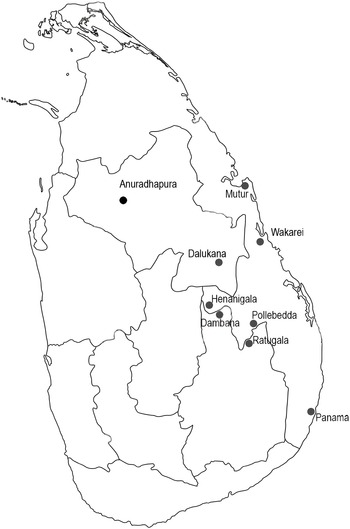

 Open access

