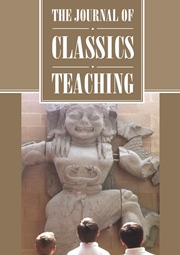


Erictho, Tartarorum Terror is a welcome and imaginative addition to the landscape of Latin learning materials. Designed for students transitioning from textbook Latin to unadapted Roman literature, this tiered reader provides a creative and accessible bridge into the world of authentic texts – without sacrificing linguistic or literary depth.
Focussing on excerpts from Book 6 of Lucan’s De Bello Civili (or Pharsalia), the volume spotlights one of antiquity’s most intriguing and unsettling characters: the necromantic witch Erictho. It is a bold choice, and certainly a unique one. Too often, Latin curricula lean heavily on historical prose or familiar epic passages, sidelining the eerie and mythological in favour of ‘safer’ subject matter. Here, though, students are invited into the dark corners of Roman imagination, where grotesque rituals and the supernatural reign.
The reader is thoughtfully structured: each passage is presented in three progressively complex versions, allowing students to move at their own pace while staying immersed in Latin throughout. This format gives learners both support and challenge, and avoids the common pitfall of oversimplifying content to the point of losing its literary soul.
Supporting materials are equally well considered. A Latin–Latin glossary and detailed notes accompany each passage, encouraging students to think in Latin rather than falling back on English translations. The inclusion of an introduction to prosody and metre is another valuable touch – especially for students new to poetry, for whom scansion can often seem impenetrable.
What is particularly commendable is the authors’ sensitivity to classroom realities. While some teachers might worry about tiered readers diluting the experience of reading Latin ‘authentically’, Kaplun and McCormack strike an admirable balance. Their reworkings are never reductive; they open doors without dumbing anything down. I would have no hesitation in using the ‘gradus primus’ level with first-year learners, and I suspect they would relish the dark drama of Erictho in a way they may not with other readers, or indeed while studying other language.
This reader makes a strong case for diversifying the Latin canon in schools. By bringing witches, magic, and the macabre to the fore, Erictho, Tartarorum Terror challenges the idea that classical literature is the preserve of statesmen and battles. It shows students that Latin can be strange, vivid, and thrilling. In addition to this, it shows that texts are worth revisiting. It is unlikely that you would go through all three stages of each section in a single school year: you are more likely to bring the book out year-on-year and allow your learners to see how they are progressing. This is where Erictho’s story once again comes into its own, because it can easily be re-read year after year without becoming stale.
This review focusses on the book as a classroom text, because I think this is where it is best suited. As a text for distance learners and self-studiers, I worry they may be tempted to skip the ‘graded’ aspect entirely and go straight for Lucan’s words, which would do a disservice to the work the authors have done to simplify his poetry. This book seems best suited to a classroom, where a teacher can guide students through the word choices and keep them focussed on the stage that is right for them.
Ultimately, this is an innovative and pedagogically sound resource, full of personality and promise. It deserves a place in any Latin teacher’s toolkit, particularly for those looking to move beyond the predictable and help students see the full imaginative range of the ancient world.

 Open access

