


Introduction
Recent years have witnessed a proliferation of high-profile corporate scandals where prominent companies, such as BP, Volkswagen, Tesco, and IAG/British Airways, to mention a few, have gone through turbulent times and incurred serious reputational damage. Regardless of the nature of their misconduct, be it environmental, accounting fraud, or cyber-attack related, these companies have suffered incalculable reputational losses, including legal fines as well as significant sanctions imposed by the market. Reputation is a valuable intangible asset that can take decades to build, but scandals or controversies have the potential to tarnish it easily and permanently. In addition, restoring a firm’s good name can be a long, painful, and costly process (Buck & McGee, Reference Buck and McGee2018).
This raises the question of whether any remedial actions can be undertaken by the media-shamed companies to mitigate the devastating effects of controversies. Practitioners and journalists argue that following severe crises, affected companies adopt certain reputation-building strategies, such as recalling a dangerous product, cleaning up the polluted natural environment, appointing new management and board members, restructuring operations, launching new brands, and giving charitable donations (BBC, 2016). Recent literature examining primarily the consequences of accounting irregularities and restatements for US companies finds that firms taking corrective actions improve their relationship with stakeholders and recover their good reputation faster than those that do not make any changes (Chakravarthy, DeHaan & Rajgopal, Reference Chakravarthy, DeHaan and Rajgopal2014; Marciukaityte, Szewczyk, Uzun & Varma, Reference Marciukaityte, Szewczyk, Uzun and Varma2006; Wilson, Reference Wilson2008). However, there is only scant and largely anecdotal evidence that, following a non-financial event that causes reputational damage, embattled companies can take similar corrective strategies, including philanthropy, to rebuild their good name and restore trust among stakeholders (e.g., Cai, Raghunandan, Rajgopal & Wang, Reference Cai, Raghunandan, Rajgopal and Wang2024). This is an important research question with implications for managers and other stakeholders, such as investors, regulators, and beneficiaries of corporate donations. To date, the existence of potential bolstering strategies adopted by firms following non-financial crises, as well as their effectiveness in rebuilding a tarnished reputation have not been rigorously examined in literature. In this paper, we provide empirical evidence on these issues.
In its first part, this paper seeks to test the hypothesis that controversies surfacing in media tarnish corporate reputation. Our empirical results reveal that an escalation in controversies related to alleged or documented corporate misconduct leads to damage of reputation, which is in line with the findings of prior studies showing that companies that face crisis events experience severe reputational penalties imposed by regulators and market forces (Alexander, Reference Alexander1999; Armour, Mayer & Polo, Reference Armour, Mayer and Polo2017; Johnson, Xie & Yi, Reference Johnson, Xie and Yi2014). Such a result is consistent with the group attribution error theory (Allison & Messick, Reference Allison and Messick1985; Ross, Reference Ross1977) in that people tend to assume that corporate failures reflect the characteristics of the management team rather than any external factors.
A natural question that arises in this context is whether any remedial actions can be undertaken by the shamed companies to mitigate the devastating effects of negative media reportage. According to the image repair theory propounded by Benoit (Reference Benoit1995) and the situational crisis communication theory advanced by Coombs (Reference Coombs2007), one such action could be bolstering, which amounts to offsetting the crisis-generated turmoil by highlighting the company’s positive traits and its good deeds. Consequently, firms may attempt to repair their tainted reputation by engaging in philanthropic activities, as these would be considered by most as principled and virtuous. We explicitly investigate whether, in the aftermath of media controversies, companies increase their charitable donations. Our empirical evidence lends credence to this second hypothesis, revealing a strategic application of the bolstering tactic. The last and related research question we ask is whether this strategy is efficacious in terms of rebuilding corporate reputation. The evidence on the performance of this tactic, however, is rather discouraging. This is because philanthropy in times of media outcry could be interpreted as a self-interested attempt at ingratiation, rather than an expression of genuine altruism.
This paper contributes to the literature on reputation in several ways. First, we examine a broad range of corporate crisis events in the UK context. Most prior studies have examined US corporations and provided evidence that a specific type of reputation-damaging event has a substantial impact on stakeholders’ behavior and wealth (Johnson et al., Reference Johnson, Xie and Yi2014; Karpoff, Lee & Martin, Reference Karpoff, Lee and Martin2008; Karpoff & Lott, Reference Karpoff and Lott1993; Zou, Zeng, Zeng & Shi, Reference Zou, Zeng, Zeng and Shi2015). However, despite the similarities between the US and UK in terms of capital market infrastructure and the institutional environment (e.g., La Porta, Lopez-de-silanes, Shleifer & Vishny, Reference La Porta, Lopez-de-silanes, Shleifer and Vishny1997), evidence on corporate financial crime provided by the anti-corruption watchdog and parliamentary committee highlights significant differences between these countries (Corruption Watch UK Report, 2019; UK House of Commons Treasury Committee’s Report, 2019). By drawing comparisons to the US, these reports question the effectiveness of the UK legal framework and enforcement system for corporate wrongdoing in helping to ensure a “hostile” environment for economic crime. Therefore, looking at the UK allows us to infer whether it is the possibility of legal prosecutions and criminal fines that drives corporate behavior, or whether it is the desire to protect and uphold reputation itself that motivates the strategic choices.
Second, our methodological approach departs from the setup frequently encountered in previous studies examining the impact of a specific reputation-impairing event on shareholder wealth (see, for instance, Alexander, Reference Alexander1999; Karpoff et al., Reference Karpoff, Lee and Martin2008; Palmrose, Richardson & Scholz, Reference Palmrose, Richardson and Scholz2004). Instead of focusing on one form of wrongdoing, our data on corporate controversies aggregates 23 types of blameworthy events falling into the categories of community, human rights, management, product responsibility, resource use, shareholders, and workforce. Furthermore, we dispense with the convention of considering court rulings and base our investigation on information pertaining to corporate scandals surfacing in the media. This is a sensible approach, given that widely publicized allegations can potentially be as reputation-damaging as a guilty verdict. It is worth noting that we are not interested exclusively in punishable offences but also consider reprehensible acts that could potentially fall within the limits defined by the law. By capturing the number of negative concerns picked up by the media, we can measure controversy as a continuous rank-based index rather than conceive it as a singular event.
Third, we decided to adopt a holistic measure of reputation that embraces different perspectives on how a firm is perceived. More specifically, we use the ranking of Britain’s Most Admired Companies (BMAC) that aggregates responses from a comprehensive peer-review survey of corporate reputation. The convention in prior studies was to concentrate on changes in reputational capital, which was proxied by the fluctuations in the market value of equity. However, corporate reputation is not necessarily synonymous with financial performance or market valuation (Deephouse, Reference Deephouse2000; Roberts & Dowling, Reference Roberts and Dowling2002). Furthermore, stock prices are excessively volatile (Shiller, Reference Shiller1981) and provide, at best, a very noisy measure of reputational status. For this reason, gauging the reputation directly is an appealing alternative that we choose to pursue.
Fourth, this study evaluates the efficacy of charitable giving in restoring reputation following a scandal. Brammer and Millington (Reference Brammer and Millington2005) argue that these actions tend to be reputation-enhancing under a normal set of circumstances. However, following a controversy, the same strategies could be simply viewed as a “moral window-dressing” (Koehn & Ueng, Reference Koehn and Ueng2010), which would undermine their positive impact. By focusing specifically on companies that have experienced media controversies and on their charitable giving in the five-year post-scandal period, we contribute to the emerging literature on “ESG pledges” and the ineffectiveness of indirect reputation-building actions (such as philanthropy) undertaken in response to adverse events (Cai et al., Reference Cai, Raghunandan, Rajgopal and Wang2024; Chakravarthy et al., Reference Chakravarthy, DeHaan and Rajgopal2014; Gupta, Misra & Shi, Reference Gupta, Misra and Shi2018; Raghunandan & Rajgopal, Reference Raghunandan and Rajgopal2024; Zhang et al., Reference Zhang, Shan and Chang2021). From a practical managerial perspective, our findings highlight that, following controversies, corporations cannot rely on symbolic gestures such as charitable donations to repair their harmed reputation. Instead, companies should pursue substantive and targeted actions that address the underlying causes of the misconduct and demonstrate a fundamental shift in a company’s ethical stance. These insights can guide practitioners in designing more effective reputation crisis management strategies and rebuilding stakeholder trust.
Literature review and theoretical framework
Corporate reputation has been widely recognized in the management and communication literature as a valuable intangible asset that provides sustainable competitive advantage by signaling stakeholders about the attractiveness of good image companies (Fombrun & Shanley, Reference Fombrun and Shanley1990). A positive reputation confers substantial strategic benefits, such as better access to resources, the ability to employ and retain high-quality workforce, and the ability to charge price premium for firms’ goods and services, which results in better financial performance (Deephouse, Reference Deephouse2000; Rindova, Williamson, Petkova & Sever, Reference Rindova, Williamson, Petkova and Sever2005). Given these advantages of a good image, most studies have focused on reputation formation and management (e.g., Ravasi, Rindova, Etter & Cornelissen, Reference Ravasi, Rindova, Etter and Cornelissen2018).
Recent research has examined the impact of corporate crises on reputation and has documented a severe financial and valuation impact (Akyildirim, Corbet, Ongena & Staunton, Reference Akyildirim, Corbet, Ongena and Staunton2025; Alexander, Reference Alexander1999; Bhagat, Bizjak & Coles, Reference Bhagat, Bizjak and Coles1998; Johnson et al., Reference Johnson, Xie and Yi2014; Karpoff et al., Reference Karpoff, Lee and Martin2008; Rahat & Nguyen, Reference Rahat and Nguyen2024), as well as a broader range of stakeholders’ emotive reactions to irresponsible behavior (e.g., Branco & Rodrigues, Reference Branco and Rodrigues2006; Gatzert, Reference Gatzert2015). Stakeholders thoroughly monitor and attend to prominent firms’ actions (Mishina, Block & Mannor, Reference Mishina, Block and Mannor2012), and when negative corporate behavior is revealed and perceived to be irresponsible (Lange & Washburn, Reference Lange and Washburn2012), they revise their perceptions in light of controversies to the detriment of firm’s reputation. Taken together, these studies show that negative events destroy the trust relationships of a company with its stakeholders and alter their perceptions and attitudes due to the uncertainty about a firm’s future behavior and its ability to deliver on obligations towards stakeholders and society (Coombs, Reference Coombs2007).
Following prior management studies, we define reputation as public knowledge about and recognition of a company (Deephouse, Reference Deephouse2000; Fombrun & Shanley, Reference Fombrun and Shanley1990; Rindova et al., Reference Rindova, Williamson, Petkova and Sever2005). These scholars tend to characterize reputation as collective, stakeholders’ group-specific perceptions about a firm’s ability to create value relative to competitors (Mishina et al., Reference Mishina, Block and Mannor2012; Rindova et al., Reference Rindova, Williamson, Petkova and Sever2005). Our conceptualization of reputation aligns closely with that of Rindova et al. (Reference Rindova, Williamson, Petkova and Sever2005), in that it integrates the concept of prominence, which can be defined as the collective perception and recognition of the firm, with the notion of delivering high-quality products. The importance of providing quality goods and services has been emphasized in the economics literature (Milgrom & Roberts, Reference Milgrom and Roberts1986; Shapiro, Reference Shapiro1983) and is directly measured in the BMAC survey utilized here. More specifically, the survey questions explicitly relate to the quality of output and ability to innovate. Even more importantly, the survey is designed to capture prominence by questioning competitors, financial influencers, analysts, and journalists about their assessment of the firm. Literature indicates that these influential parties can exert a great degree of impact on the society-wide prominence (Deephouse, Reference Deephouse2000; Stuart, Hoang & Hybels, Reference Stuart, Hoang and Hybels1999). It is also important to note that the categories being probed in the survey are relevant to a wide range of stakeholders. They capture, amongst others, financial soundness, contribution to society, environmental impact, commitment to diversity, equity and inclusion, or corporate governance.
Hypothesis development
Legal sanctions are commonly viewed as a relatively powerful deterrent of corporate misconduct. However, the extant literature reveals that reputational penalties arising from society-wide condemnation could have much graver repercussions for the offending companies. Karpoff and Lott (Reference Karpoff and Lott1993) examine the cases of detected corporate fraud and conclude that only 6.5% of the resultant loss in market capitalization was attributable to legal fees and penalties. For firms that underwent an enforcement action for financial misrepresentation, the reputational penalty was shown to be over seven times higher than the class-action lawsuits settlements and the SEC and Department of Justice fines combined (Karpoff et al., Reference Karpoff, Lee and Martin2008). In a similar study conducted in the UK context, reputational losses arising from breaches of financial regulations and listing rules amounted to nine times the fines imposed (Armour et al., Reference Armour, Mayer and Polo2017). Compared to offences against broader society, wrongdoing against related parties (such as customers or investors) involves larger reputational sanctions (Armour et al., Reference Armour, Mayer and Polo2017; Karpoff & Lott, Reference Karpoff and Lott1993; Murphy, Shrieves & Tibbs, Reference Murphy, Shrieves and Tibbs2009). Wrongs to third parties are typically reputationally less injurious, which is illustrated in the case of environmental violations by Karpoff, Lott, John, and Wehrly (Reference Karpoff, Lott, John and Wehrly2005).
Reputation is clearly a valuable intangible asset for a company. An initial investment is required to establish it and, should this investment be successful, the company will be able to extract quasi-rents in the market. Customers will be willing to pay premium prices for the credible promise to deliver high-quality goods and services (Klein & Leffler, Reference Klein and Leffler1981; Shapiro, Reference Shapiro1983). Not only does this premium price incentivize firms to maintain high standards, perform on their contracts, and adhere to social norms, but it also allows them to recover the resources expended on reputation-building exercises. While cheating on quality could generate short-term cost savings, it will also undermine reputation, leading thereby to loss of sales and reduction in profitability (Johnson et al., Reference Johnson, Xie and Yi2014). Reputation-destroying events also inflate the cost of sales, as many of the existing customer relationships get suspended, creating new challenges for the sales and marketing teams (Johnson et al., Reference Johnson, Xie and Yi2014). An offending corporation is also likely to experience an increased employee turnover (Alexander, Reference Alexander1999) and raised cost of inputs. Similarly, financing becomes more problematic in the face of a scandal, as the cost of equity is likely to go up (Bang, Ryu & Webb, Reference Bang, Ryu and Webb2023; Becchetti, Cucinelli, Ielasi & Rossolini, Reference Becchetti, Cucinelli, Ielasi and Rossolini2023; Cao, Myers, Myers & Omer, Reference Cao, Myers, Myers and Omer2015) and trade credit may be lost (Gong & Yang, Reference Gong and Yang2025).
In wake of a corporate scandal, reputation can be damaged particularly badly due to the prevalence of the fundamental attribution error (Ross, Reference Ross1977). When evaluating the behaviors of others, people have the tendency to overstress dispositional or personality factors, while underplaying external factors. A group attribution error operates in the same manner but relates to members of groups (or specific companies in this case), rather than individuals (Allison & Messick, Reference Allison and Messick1985). Given this cognitive bias, individuals may form particularly unforgiving opinions about the companies that found themselves in the middle of the media storm. More specifically, they are likely to attribute the source of controversy to the moral bankruptcy of the management team, rather than to situational and environmental factors. Serious reputational injury is likely to transpire as a result, which leads us to the development of our first hypothesis:
H1. Increases in media-captured controversies result in a loss of corporate reputation.
The image repair theory formulated by Benoit (Reference Benoit1995) provides a potential link between reputation risk management and strategies or actions taken because of corporate wrongdoing (Bebbington, Larrinaga & Moneva, Reference Bebbington, Larrinaga and Moneva2008). This theory allows us to understand the companies’ responses to situational crises when their reputation has been damaged. Since reputation is a valuable intangible asset, companies are strongly motivated to take defensive actions whenever controversies come to light. Benoit (Reference Benoit2014) claims that there are other motivations why companies may undertake strategies to repair their reputation, such as avoidance of significant reputational losses due to criminal or civil action.
The image repair theory suggests that there are five broad types of post-crisis reputation-building strategies, namely denial, evasion of responsibility, reducing offensiveness, corrective action, and mortification. Within the third category (reducing offensiveness), bolstering is defined by the author as a useful approach to mitigate the negative effects of the misconduct “by strengthening the audience’s positive affect for the actor (sin firms), yielding a relative improvement in the actor’s reputation” (Benoit, Reference Benoit2014, p. 24). Since the key characteristic of the bolstering strategies is to “stress good traits” (Benoit, Reference Benoit1997, p. 179), we expect that by reducing the offensiveness of the wrongdoing (as opposed to denial and evasion of responsibility), the bolstering technique could potentially result in beneficial societal outcomes and attract more positive responses from various stakeholders. Consequently, to assuage their guilt and alleviate public embarrassment, managers of the affected company may be motivated to make grand philanthropic gestures. By this, we mean making voluntary nonreciprocal transfers to causes that would be widely regarded as noble.
The importance of philanthropic actions in the face of a corporate crisis is also emphasized by another theoretical framework called the situational crisis communication theory (Coombs, Reference Coombs2007). This is perhaps unsurprising, considering that Coombs relies on Benoit’s image repair theory for his conceptualizations. Coombs (Reference Coombs2007) argues that crisis responses should depend on the perceived responsibility of the company as well as the reputational threats posed. These circumstances and perceptions are largely shaped by how the media frames the crisis, which is essential for reputation management (Carroll, Reference Carroll2004; Coombs, Reference Coombs2007). Within the possible panoply of responses, bolstering is proposed as one of the feasible options. As with image repair theory, bolstering is defined as stressing the good deeds of the company to assuage the emotional impact of the new incriminating information. Charitable giving could provide an obvious opportunity to highlight the positive traits of a corporation.
In academic discourse, corporate philanthropy is viewed as a highly controversial issue. At one end of the ideological spectrum, Friedman (Reference Friedman1970) argues that such acts of generosity represent no more than plain expropriation of shareholders’ funds by managers who have been appointed to act as agents. Despite this initial condemnation, subsequent scholarship has coalesced around the view that charitable corporate donations, when made strategically, are not necessarily inconsistent with the profit-maximization objective.Footnote 1 Such a conclusion is motivated by several observations. To start with, consumers may exhibit a more positive attitude towards donating firms (Cha & Rajadhyaksha, Reference Cha and Rajadhyaksha2021; Luo, Reference Luo2005) which, in turn, translates into higher sales growth (Lev, Petrovits & Radhakrishnan, Reference Lev, Petrovits and Radhakrishnan2010). Corporate philanthropy may also boost employees’ morale by imbuing the workforce with a greater sense of pride (Breeze & Wiepking, Reference Breeze and Wiepking2020; Lewin & Sabater, Reference Lewin, Sabater, Burlingame and Young1996). Furthermore, companies could utilize charitable contributions to broaden the scope of their political legitimacy and ingratiate themselves with politicians and regulators alike (Sánchez, Reference Sánchez2000). Given the abovementioned considerations, it should come as no surprise that several authors have found that donations increase shareholders’ wealth (e.g., Omar, Wisniewski & Yekini, Reference Omar, Wisniewski and Yekini2019; Patten, Reference Patten2008).
The positive moral perceptions created through altruism can be viewed as beneficial from the risk management perspective because they provide insurance for relationship-based intangible assets. Acts of kindness to the less fortunate augment the reputational capital of the firm (Brammer & Millington, Reference Brammer and Millington2005), which provides a shield against adverse stakeholders’ reactions when information about corporate wrongdoing comes to light. Williams and Barrett (Reference Williams and Barrett2000) show that the reputation of companies receiving a citation for legal violations is impaired, but the extent of this reputational injury is diminished by charitable giving. Koehn and Ueng (Reference Koehn and Ueng2010) document empirically that, to distract and win over stakeholders, firms forced to restate their suspect earnings intensify their philanthropic efforts. In a similar vein, it has been demonstrated that polluting companies use charitable giving to respond to changing regulations (Zhang & Li, Reference Zhang and Li2024) or to camouflage their environmental misconduct (Du, Reference Du2015). Hedge funds also seem to deploy donations strategically to successfully mitigate fund outflows following periods of poor performance (Agarwal et al., Reference Agarwal, Lu and Ray2021). Since corporate giving is often used as a risk management tool, it is likely to reduce the cost of equity capital (Bhuiyan and Hu, Reference Bhuiyan and Huin press).
Clearly, rather than being a genuine expression of altruism, many donations are strategically motivated. This type of atonement for corporate sins may be viewed, to a large extent, as morally suspect. Be it as it may, both the image repair theory and the situational crisis communication theory suggest that companies embroiled in controversies may resort to using CSR activities such as philanthropy to improve their reputation. This motivates our second hypothesis:
H2. An escalation in media-captured controversies will cause an increase in corporate donations.
As has been mentioned before, activities pertaining to corporate social responsibility are often undertaken for strategic reasons. The intention behind them would be to divert attention from corporate misdeeds, avoid retribution or to manage public perception (Bae, Choi & Lim, Reference Bae, Choi and Lim2020; Gargouri, Shabou & Francoeur, Reference Gargouri, Shabou and Francoeur2010; Martínez-Ferrero, Banerjee & García-Sánchez, Reference Martínez-Ferrero, Banerjee and García-Sánchez2016; Zhang, Shan & Chang, Reference Zhang, Shan and Chang2021). Prior, Surroca and Tribó (Reference Prior, Surroca and Tribó2008) argue that a socially friendly image is a powerful tool that could be deployed to appease regulators and allay concerns among stakeholders. Moreover, CSR practices are frequently utilized by managers to entrench themselves and reduce the probability of being fired. Perhaps unsurprisingly, Koehn and Ueng (Reference Koehn and Ueng2010) report that firms forced to restate their earnings become more engaged in corporate philanthropy.
While, generally speaking, charitable donations could enhance reputation of firms (Brammer & Millington, Reference Brammer and Millington2005), several authors argue that this effect is context-specific. Godfrey (Reference Godfrey2005) postulates that stakeholders will attach positive moral evaluation to philanthropic gestures only if they are recognized as a genuine representation of the firm’s intentions following crises. If, on the other hand, donations are perceived as an attempt at ingratiation, the reaction of stakeholders will be unfavorable and, therefore, generate negative moral capital for the irresponsible companies (Godfrey, Reference Godfrey2005). This theoretical idea was validated experimentally by Bae and Cameron (Reference Bae and Cameron2006) who show that charitable giving by a company with a bad reputation is viewed as a self-interested activity and elicited negative attitudes from stakeholders. Conversely, philanthropic undertakings of a company with a stellar reputation are deemed altruistic and evoke positive attitudes and reactions from the public. In a similar vein, Patten (Reference Patten2008) demonstrates empirically that ingratiation attempts by corporate givers do not lead to an increase in reputational capital, while the findings of Hogarth, Hutchinson and Scaife (Reference Hogarth, Hutchinson and Scaife2018) echo this point by suggesting that it is imperative for donating firms to simultaneously manage their reputation. Failure to do so will result in charitable giving being viewed as disingenuous and, consequently, having a destructive effect on reputation.
From a purely theoretical perspective, one could expect that due to the fundamental attribution error, people may invariably associate corporate giving with the positive personality traits of managers. However, the attribution process becomes more complex in the presence of skepticism (Fein, Reference Fein1996). Clearly, charitable actions are inconsistent with the shareholder wealth maximization objective, which raises questions about the firm’s true intentions. Suspicion that philanthropy is driven by ulterior motives effectively moderates or even eliminates the fundamental attribution errors (Bae & Cameron, Reference Bae and Cameron2006). Instead, people’s attention is riveted at the context of giving, which is dominated by bad press.
Our study seeks to examine whether companies entangled in media controversies can use donations to successfully rebuild their reputation. We hypothesize that this will be, in effect, difficult to achieve. In the heat of a scandal, stakeholders become suspicious of sin companies’ motives for charitable giving (Bae & Cameron, Reference Bae and Cameron2006) and are likely to view acts of charity as motivated by self-interested behavior. Instead of being driven by altruism, they are clearly prompted by the desire to manipulate public perception. This leads us to putting forward the following hypothesis:
H3. In the immediate aftermath of media-captured controversies, the offending company will be unable to successfully rebuild its reputation by increasing charitable donations.
If H3 holds, shareholders’ wealth will be maximized by not pursuing charitable giving in this context. However, this simple recommendation needs to be tempered by consideration of another motive. A failure to make philanthropic gestures in face of media-instigated accusations may give rise to a perception that the management team lacks empathy and remorse. Such behavior is characteristic of individuals with psychopathic personality disorder (Paulhus & Williams, Reference Paulhus and Williams2002; Schmidt, Roessig, Ruth & Flatten, Reference Schmidt, Roessig, Ruth and Flatten2025) and could potentially endanger future career prospects of the managers in question. To avoid this perception, managers may therefore be inclined to initiate acts of corporate generosity, even if the company stands to gain little from such acts. In other words, an agency problem could arise in this scenario, where the agents do not act in the best interest of the principal (Jensen & Meckling, Reference Jensen and Meckling1976). The atmosphere of a scandal, therefore, creates a paradox, wherein donations are perceived as moral window dressing, and lack of them can be viewed as managerial callousness.
Research methods
Sample and variable measurement
We drew our initial sample from the Thomson Reuters Eikon (Datastream and the Worldscope database), which provides financial data including charitable corporate donations. All live and dead companies are included in our sample to mitigate a potential survivorship bias issue. However, financial firms (companies with SIC codes 60–69) are excluded from the analysis due to their different disclosure requirements. We also excluded firms with insufficient financial information, which was needed to construct our variables. Furthermore, a small number of companies with abnormal financial statement figures, such as zero cash and sales, which are considered to be “shelf” or “shell” firms in the literature, were also eliminated to avoid any potential measurement bias due to an extremely low level of operational activity. Thus, applying all the above-mentioned filters resulted in an initial sample of 1,753 non-financial companies with all the necessary accounting data for the period 2000–2017.
Building on this dataset, we obtained information on corporate controversies from the Thomson Reuters ESG scores database. The existing Thomson Reuters ESG scores replaced the previous CSR platform named ASSET4 which initially focused mainly on measuring CSR disclosure quality rather than CSR concerns. Currently, the data about CSR strengths and weaknesses is identical in terms of the content, structure, and scoring methodology across the whole 2002–2017 period, which facilitates comparability across the years. Importantly, this database includes information on ESG controversies scores, which we extracted for the UK-listed firms for the entirety of the available period. However, the ESG scores data are not available for many UK publicly listed companies during the period 2000–2017 (starting only since 2002), and as a result, after matching the non-financial companies from the Thomson Reuters Eikon database with companies with ESG scores from the Thomson Reuters ESG scores database, the size of our sample dropped substantially from 1,753 to 259 firms.
Similarly, the data regarding the Britain’s Most Admired Companies (BMAC) reputation score was then retrieved from the Management Today’s website which provides information about companies’ reputation rankings for the 2009–2017 period. The data for the remaining years, specifically 2002–2008, was manually searched and collected from other public sources. It is noteworthy that the total number of British firms for which the Management Today’s survey provides a reputation score is 235, many of which, but not all, are public companies. As we examine only listed non-financial firms, the limited number of UK companies for which the reputation score was available further reduced the size of our sample from 259 to 226 firms.
When considering the sample size in each of the regressions that follow, we need to bear in mind that three sources of information were employed to obtain data for our study, namely the Thomson Reuters Eikon database, Thomson Reuters ESG scores database and Management Today’s website. We matched the non-financial companies from the Thomson Reuters Eikon database with firms obtained from Thomson Reuters ESG scores database and companies with the BMAC reputation scores. This generated a final sample consisting of 226 companies and 2,261 firm-year observations. The data on corporate donations was missing for some firms, which led to a further reduction in the sample size (1,814 firm-year observations). Similarly, by construction, the BMAC reputation scores are only available for certain public companies, which limits the sample size for regressions utilizing this measure (1,003 firm-year observations). Finally, as the focus of our last regression analysis is only on companies with media controversies and a 5-year post scandal period, the sample is restricted to 77 companies and 228 observations.Footnote 2
As observed in Table 1, our main dependent variable used for testing H1 is BMAC (Britain’s Most Admired Companies) score which was obtained from the Management Today’s website. The BMAC reputation score is an outcome of a comprehensive peer-review survey of corporate reputation conducted in the UK by Echo Research. Their methodology is similar to that employed by Fortune in the US (Brammer & Millington, Reference Brammer and Millington2005). In particular, financial analysts and board representatives of the largest 10 companies in each of the 25 sectors are asked to evaluate their industry peers on a scale ranging from 0 to 10 using a set of 12 criteria (quality of management; financial soundness; quality of goods and services; ability to attract, retain and develop top talent; long-term value potential; capacity to innovate; quality of marketing; community and environmental responsibility; effective use of corporate assets; inspirational leadership; global competitiveness; and corporate governance).
Table 1. Definition and measurement of the main variables and controls

Note:
* Further information about the methodology used to evaluate the corporate reputational score is provided on the Management Today’s website.
** This definition of the ESG controversies score is adopted from the Thomson Reuters Eikon database.
The overall reputation score provided by the Management Today’s survey is calculated as an average of all the individual scores across all criteria as well as participants and is measured as a percentage rank (out of 100%). They offer a reputation score for each of the 235 largest British companies, both private and public, many of which are constituents of the FTSE 100 index. These firms are drawn from a variety of industries and sectors. This suggests that the BMAC reputation data can be regarded as representative for the UK economy due to its widespread coverage, which justifies our choice of using the BMAC score as a valid reputation proxy in this study. The BMAC reputation metric is very similar to the Fortune’s reputation measure, which has been used by many empirical studies especially in the US (Roberts & Dowling, Reference Roberts and Dowling2002; Stuebs & Sun, Reference Stuebs and Sun2010), and represents the most commonly used survey-based measure of reputation in prior literature (Walker, Reference Walker2010).
The second dependent variable employed to test H2 is  $Donratio\,$or Donrati_eq, which measures corporate charitable donations. ${\textit{Donratio}}$ is computed as the ratio of a firm’s charitable donations to its market capitalization, while ${\textit{Donrati}}{{\textit{o}} {{\textit{\_eq}}}}$ scales donations by the book value of equity. Scaling by size is intended to account for the fact that large companies have more resources at their disposal and consequently are more likely to engage in large-scale philanthropic giving. $Donratio\,($or $Donratio\_eq)$ is also employed as an independent variable when testing H3.
Our main independent variable is Controversies which measures the company’s negative media exposure to environmental, social and governance controversies. It has been derived from the ESG controversies score provided by the Thomson Reuters ESG scores database for UK-listed firms for the entirety of the available period. The ESG controversies score is calculated based on 23 CSR concern topics, which are grouped into seven broader categories of human rights, management, product responsibility, resource use, shareholders, workforce, and community. The individual score for each category gauges the number of negative events or concerns captured by all media news. The overall ESG controversies score, however, is expressed as a percentage rank (out of 100%). To ensure broad comparability, the scores for companies are normalized according to the relevant industry grouping. Thomson Reuters reports their ESG controversies score on an inverted scale, meaning that the higher the score value, the fewer CSR scandals came to light. A company with no CSR weaknesses has the highest percentile rank among its industry peers, while a firm with several controversies has a lower percentile rank. Since our preference is for a measure that increases in line with the number of controversies, we need to invert this scale. To this end, we created a variable labelled Controversies that is equal to 100 minus the Thomson Reuters ESG controversies score. These scores can be construed as an objective measure of a company’s CSR effectiveness (or lack thereof) and are based on negative media stories captured by independent information sources, such as newspapers, internet, press releases, legislation disputes, lawsuits, and NGO websites.
We selected a range of control variables to assess firm characteristics when testing H1 and H3, such as size, profitability, book-to-market ratio and leverage (see Table 1). According to prior studies, larger firms that have a longer history enjoy a better reputation than their smaller counterparts (Fombrun & Shanley, Reference Fombrun and Shanley1990; Williams & Barrett, Reference Williams and Barrett2000). Fombrun and Shanley (Reference Fombrun and Shanley1990) analyze the order of importance of the main factors affecting reputation and find that accounting measures of profitability and risk are amongst the most significant ones. Guided by these considerations, we use return-on-assets (ROA), defined as the ratio of earnings before interest and taxes (EBIT) to total assets, as our proxy for profitability. The extant literature also documents an inverse relation between reputation and risk (Brammer & Millington, Reference Brammer and Millington2005; Fombrun & Shanley, Reference Fombrun and Shanley1990). We include financial leverage expressed as the ratio of total liabilities to total assets as a proxy for risk. We follow Brammer and Millington (Reference Brammer and Millington2005) and utilize book-to-market ratio (BM) as a measure of market growth.
Consistent with prior literature on corporate philanthropy, firm size, profitability, and leverage are among the main determinants of corporate charitable activities (Du, Chang, Zeng, Du & Pei, Reference Du, Chang, Zeng, Du and Pei2016; Liang & Renneboog, Reference Liang and Renneboog2017). Therefore, we also employed them as key control variables when examining H2. Larger firms are held to higher ethical standards and draw greater attention from government bodies and the general public, which incentivizes them to make more generous donations (Gautier & Pache, Reference Gautier and Pache2015). Since profitable companies have more resources to engage in philanthropy, we control for ROA to avoid the possibility of omitted variable bias (Gautier & Pache, Reference Gautier and Pache2015). In addition, one could reasonably expect that growth opportunities would influence the amount of corporate giving, which motivates us to incorporate BM as a control factor. All the variables, their definitions, and measurements are presented in Table 1.
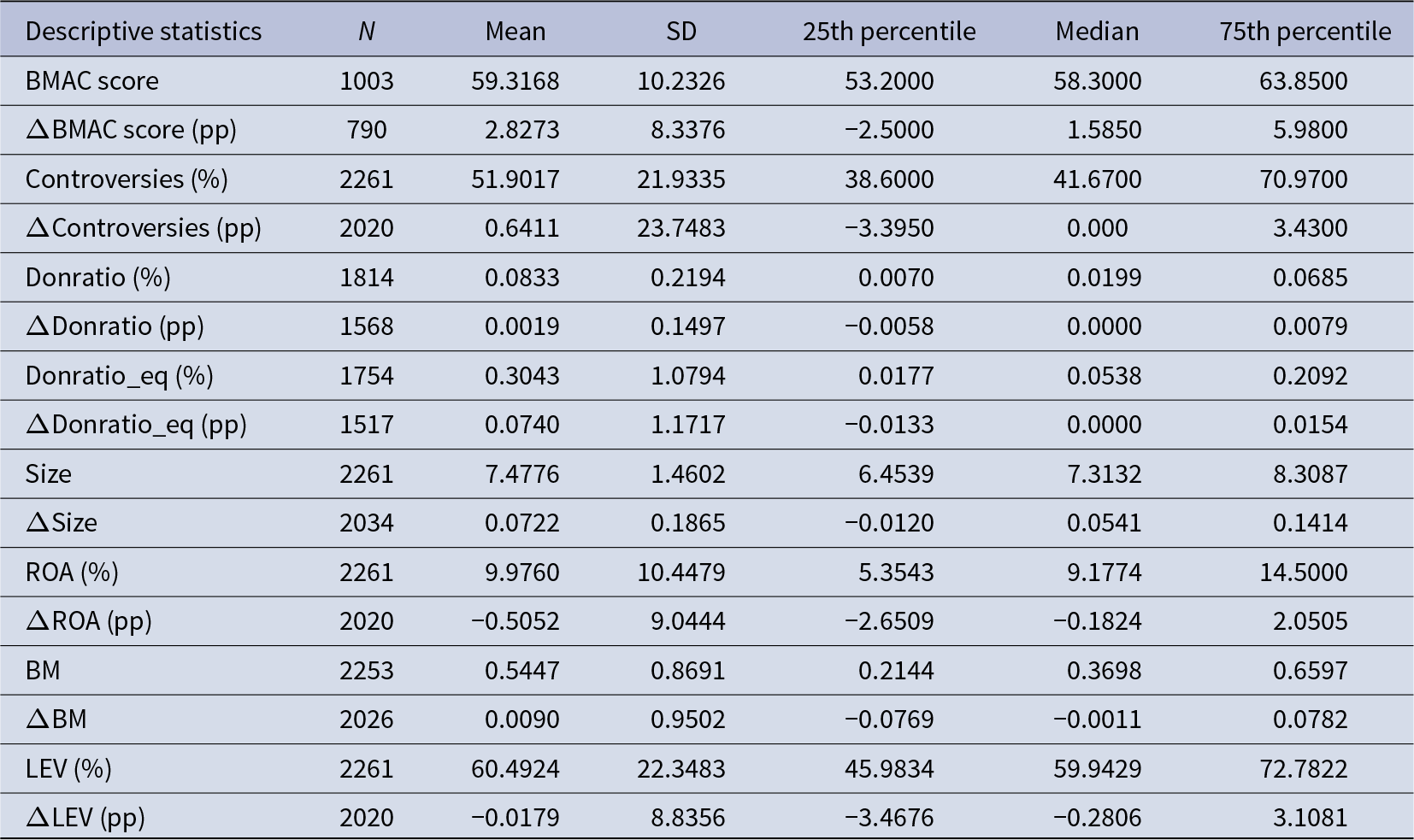
Table 2 presents summary statistics on the BMAC reputational score, controversies, and donations ratios, as well as the control variables employed in our regression models. The means of both the BMAC reputation score and Controversies are close to 50, which would be expected, as both measures represent percentile ranks. On average, annual donations amount to 0.083% of the market capitalization or 0.304% of the book value of equity, which is largely consistent with figures reported in prior studies. For example, Liang and Renneboog (Reference Liang and Renneboog2017) show that UK publicly listed companies donated, on average, 0.093% of sales during the period 2004–2013. Not surprisingly, the average firm in our sample is profitable with a ROA of 9.97% and has a leverage of 60.49%. We tested the nonstationarity of each variable and the untabulated results of the Maddala and Wu (Reference Maddala and Wu1999) tests based on Fisher approach with Augmented Dickey-Fuller tests show that all first-differenced variables are stationary.
Table 2. Summary statistics

Notes: BMAC score (%) represents the Britain’s Most Admired Companies reputation ranking for a company as provided by the Management Today’s website and other public sources;  ${\Delta }$BMAC score (pp) denotes the change in BMAC score relative to the previous year expressed in percentage points; Controversies (%) is the environmental, social, and governance controversies company’s score derived from a percentage ranking. ${\Delta }$Controversies (pp) denotes the change in Controversies compared to the previous year expressed in percentage points; Donratio (%) is the company’s donation ratio calculated based on market capitalization; ${\Delta }$Donratio (pp) denotes the change in Donratio relative to the previous year expressed in percentage points; Donratio_eq (%) is the company’s donation ratio calculated based on shareholders’ equity; ${\Delta }$Donratio_eq (pp) denotes the change in Donratio_eq relative to the previous year expressed in percentage points; Size is the natural logarithmic of total assets; ${\Delta }$Size denotes the change in size relative to the previous year; ROA (%) is the company’s return on assets ratio expressed in percentage; ${\Delta }$ROA (pp) denotes the change in ROA relative to the previous year; BM represents the company’s book to market ratio; ${\Delta }$BM (pp) represents the change in BM relative to the previous year; LEV (%) is the company’s leverage ratio expressed in percentage; ${\Delta }$LEV (pp) represents the change in LEV relative to the previous year. Detailed definitions of the variables mentioned above are provided in Table 1.
Regression and model specification
Our empirical inquiry begins by examining whether an escalation in media-captured corporate controversies leads to a reputational damage that is clearly detectable and significant from a statistical point of view (H1). We use panel regression analysis, which allows us to accurately estimate the relationship between the changes in BMAC reputation scores and the changes in Controversies, while controlling for unobserved heterogeneity. Specifically, we estimate the following random effect panel model:
 \begin{equation}\Delta BMAC\,scor{e_{i,t}} = {\beta _0} + {\beta _1}*\Delta Controversie{s_{i,t}} + \mathop \sum \limits_{j = 1}^k {\beta _{j + 1}}*\Delta Control_{i,t}^j + \,{\mu _i} + {\varepsilon _{i,t}}\end{equation}
 where  ${\mu _i}$ is a firm-specific error that captures the effects of unobservable characteristics and ${\varepsilon _{i,t}}$ is the idiosyncratic error term. The selection of the random effects panel data model is motivated by the results of the Hausman (Reference Hausman1978) specification test which indicates that residuals from model (1) are uncorrelated with the regressors. This means that consistent estimators can be obtained, and that the estimation is more efficient compared to the fixed effect alternative.
The variables in the equation are differenced in order to eliminate stochastic trends and circumvent the problem of spurious regressions. Under the assumption of static expectations, the first differencing is equivalent to computing an unexpected increase in a variable transpiring at time t. This is an interesting realization, as only unexpected factors are likely to motivate a change in human behavior and affect financial markets (Fama, Reference Fama1970). When evaluated from this perspective, regression equation (1) is strongly preferred to its analogue specified in levels.
Most importantly, we would like to note that a negative coefficient on  ${\Delta {\text{Controversies}}}$ in equation (1) will support our hypothesis H1 stating that controversies are a source of reputational impairment for listed corporations. This hypothesis is tested by holding other factors constant, which is achieved by including a range of controls such as size, profitability, book-to market ratio and leverage.
Similarly, in the next step of our empirical inquiry, we use panel regression analysis to test hypothesis H2, which investigates the impact of controversies on corporate charitable donations. More specifically, we test the relation between the change in our donation ratios (either  $Donratio\,{\text{or}}\,Donratio\_eq)$ and the lagged change in Controversies, while controlling for other influences. ${Donratio}$ is measured as the ratio of a firm’s charitable donations to its market capitalization, while $Donratio\_eq$ scales donations by the book value of equity. Scaling by size is intended to account for the fact that large companies have more resources at their disposal and consequently are more likely to engage in large-scale philanthropic giving. The caveat with Donratio is that it could potentially be influenced not only by the extent of charitable effort but also by the dropping stock prices in face of media censure. The denominator of Donratio_eq, on the other hand, will be less sensitive to controversies, as reputation is an intangible asset that is often not fully visible on the balance sheet. Based on these two donation ratios, two versions of first-difference random effect model are considered:
 \begin{equation}\Delta Donrati{o_{i,t}} = {\beta _0} + {\beta _1}*\Delta Controversie{s_{i,t - 1}} + \mathop \sum \limits_{j = 1}^k {\beta _{1 + j}}*\Delta Controls_{i,t - 1}^{\,j} + \,{\mu _i} + {\varepsilon _{i,t}}\end{equation}
 \begin{equation}\Delta Donratio\_e{q_{i,t}} = {\beta _0} + {\beta _1}*\Delta Controversie{s_{i,t - 1}} + \mathop \sum \limits_{j = 1}^k {\beta _{1 + j}}*\Delta Controls_{i,t - 1}^{\,j} + \,{\mu _i} + {\varepsilon _{i,t}}\end{equation}
If H2 holds true, we would expect to find a positive and significant association between our differenced donation ratios and ΔControversies. A key set of control variables, including measures of differenced size, ROA, BM, and leverage have been included in equations 2 and 3.
Finally, we proceed to examine the last hypothesis (H3), which relates to the reputation-rebuilding ineffectiveness of philanthropic giving. To this end, we estimate the following random effect panel models:
 \begin{equation}\begin{gathered}
\Delta BMAC\,scor{e_{i,t}} = \,{\beta _0} + \,{\beta _1}*\Delta Donrati{o_{i,t - 1}} + \,{\beta _2}*\Delta Controversie{s_{i,t - 1}} + \,\ \\
\mathop \sum \limits_{j = 1}^k {\beta _{j + 2}}*\Delta Control_{i,t - 1}^j + {\mu _i} + {\varepsilon _{i,t}} \\
\end{gathered} \end{equation}
\begin{equation}\begin{gathered}
\Delta BMAC\,scor{e_{i,t}} = \,{\beta _0} + \,{\beta _1}*\Delta Donrati{o_{i,t - 1}} + \,{\beta _2}*\Delta Controversie{s_{i,t - 1}} + \,\ \\
\mathop \sum \limits_{j = 1}^k {\beta _{j + 2}}*\Delta Control_{i,t - 1}^j + {\mu _i} + {\varepsilon _{i,t}} \\
\end{gathered} \end{equation} \begin{equation}\begin{gathered}
\Delta BMAC\,scor{e_{i,t}} = \,{\beta _0} + \,{\beta _1}*\Delta Donratio\_e{q_{i,t - 1}} + \,{\beta _2}*\Delta Controversie{s_{i,t - 1}} \,+ \ \\
\mathop \sum \limits_{j = 1}^k {\beta _{j + 2}}*\Delta Control_{i,t - 1}^j + {\mu _i} + {\varepsilon _{i,t}} \\
\end{gathered} \end{equation}
\begin{equation}\begin{gathered}
\Delta BMAC\,scor{e_{i,t}} = \,{\beta _0} + \,{\beta _1}*\Delta Donratio\_e{q_{i,t - 1}} + \,{\beta _2}*\Delta Controversie{s_{i,t - 1}} \,+ \ \\
\mathop \sum \limits_{j = 1}^k {\beta _{j + 2}}*\Delta Control_{i,t - 1}^j + {\mu _i} + {\varepsilon _{i,t}} \\
\end{gathered} \end{equation}Several important notes on the estimation process are in order here. Firstly, the overriding objective is to verify whether the strategy yields the desired results in the aftermath of a publicized scandal. For this reason, we focus only on companies that have experienced media controversies. The time frame considered is also restricted and embraces a five-year period following the controversy year. Secondly, the explanatory variables in the equation are lagged. This is because the total amount donated may be disclosed only at the year’s end. This may delay the reputational response to instituted corporate practices. By employing this approach, our study contributes to the literature on corporate donations by providing rigorous empirical evidence on the effectiveness of charitable actions in rebuilding corporate reputation following negative events.
Empirical results
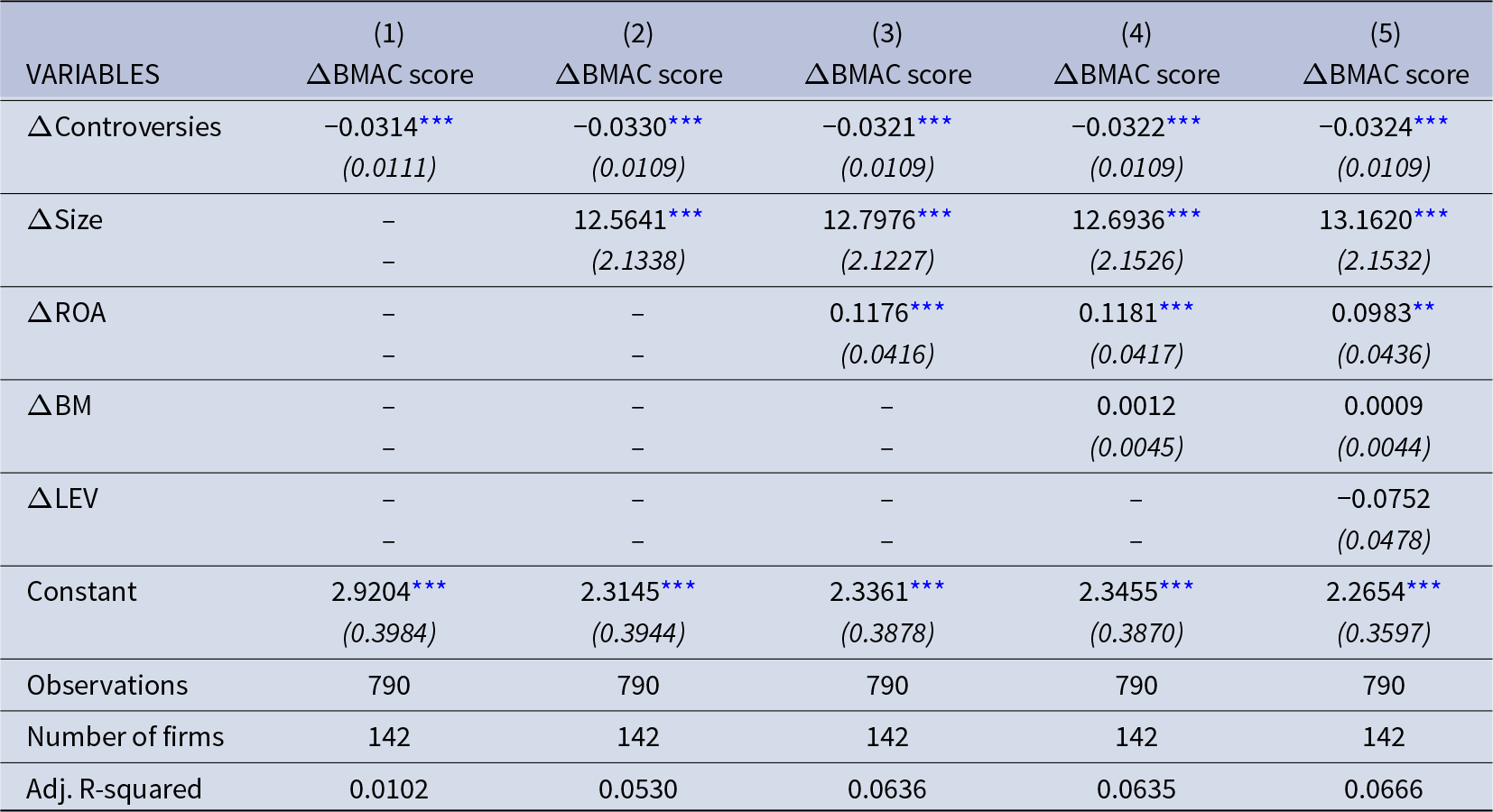
We begin our empirical exploration by verifying the validity of hypothesis H1. Table 3 presents the results of the random-effects panel data regression analysis. Model 1 provides a point of departure where the change in the BMAC reputation score is a function of the variation in the ΔControversies variable. In view of the multiplicity of reputational determinants mentioned in the previous studies (Fombrun & Shanley, Reference Fombrun and Shanley1990; Williams & Barrett, Reference Williams and Barrett2000), models 2 through 5 proceed to extend this basic specification by introducing a set of controls, such as differenced size, ROA, BM, and leverage. Regardless of the specification we consider, the key explanatory variable always bears a negative coefficient and is statistically significant at 1% level. This implies that an escalation in negative media coverage related to alleged or documented corporate misconduct leads to damage to reputation, which is consistent with hypothesis H1.
Table 3. Random-effects regression results for the change in BMAC reputation score and change in ESG controversies

Notes: This table presents the RE regression estimates where the dependent variable is the change in BMAC score (ΔBMAC score), and the key independent variable is the change in ESG controversies ( $\Delta {\text{Controversies}}$). Control variables are defined in Table 1 and notes to Table 2. All the models include an intercept and random effects. The value of standard errors is reported in parentheses.
***, **, * indicate that the parameter estimate is significantly different from zero at the 1%, 5%, or 10% level, respectively.
With respect to our control variables, we find that reputation appears to be positively related to ΔSize, ΔROA, ΔBM, and negatively associated with ΔLEV, which confirms earlier findings of Fombrun and Shanley (Reference Fombrun and Shanley1990) and Williams and Barrett (Reference Williams and Barrett2000). The last two variables, however, fail to reach statistical significance in our regressions. We note in passing that multicollinearity tests have been performed for all the models reported in this paper. The variance inflation factor (VIF) always remained below 10, reassuring us that no multicollinearity issues are present.Footnote 3
We turn now to the bolstering strategy of charitable giving that the media-reprimanded companies might adopt. The results of our tests for Hypothesis 2, presented in Table 4, show that negative media exposure is followed by an increase in corporate donations. The dependent variable in Panel A of the table is the contemporaneous change in Donratio, while Panel B models ΔDonratio_eq. The main independent variable of interest is the prior change in Controversies, which invariably carries a positive coefficient regardless of the specification. This relationship appears to be statistically significant in all models, although more convincingly so in Panel A.
Table 4. Random-effects regression results for the change in donation ratio and lagged change in controversies

Notes: This table presents the RE regression estimates where the dependent variable is ΔDonratio and ΔDonratio_eq and the key independent variable is the change in ESG controversies ( $\Delta {\text{Controversies}}$). Control variables are defined in Table 1 and notes to Table 2. All the models include an intercept and random effects. The value of standard errors is reported in parentheses.
***, **, * indicate that the parameter estimate is significantly different from zero at the 1%, 5%, or 10% level, respectively.
While the results reported thus far have clearly identified a strategy through which listed companies attempt to mitigate reputationally destructive media exposure, the question remains as to whether their efforts are successful. Godfrey (Reference Godfrey2005) claims that only charitable activities that are perceived to be a genuine manifestation of the underlying firm’s social performance will generate moral capital. Such a perception would be undoubtedly difficult to create in the immediate aftershock of a corporate scandal, which in turn would undermine the reputation-enhancing potency of donations. The estimation results for post-controversy period reported in Table 5 confirm this basic intuition. Although ΔDonratio and ΔDonratio_eq are positively signed in all the differenced reputation models, these variables lack statistically significant explanatory power, which is consistent with our hypothesis H3.
Table 5. Random-effects regression results for the change in BMAC reputation score and lagged change in donations ratio

Notes: This table presents the RE regression estimates where the dependent variable is the change in the BMAC score (ΔBMAC). The key independent variable is the lagged ΔDonratio in Panel A and lagged ΔDonratio_eq in Panel B. Control variables are defined in Table 1 and notes to Table 2. All the models include an intercept and random effects. The value of standard errors is given in parentheses.
***, **, * indicate that the parameter estimate is significantly different from zero at the 1%, 5%, or 10% level, respectively.
Finally, it is questionable whether the random effects methodology employed here addresses the possibility of a potential omitted variable bias. One could be concerned that the potential existence of unobserved heterogeneity of firm-specific or time-invariant factors could undermine our statistical inferences. Therefore, as robustness tests, we re-estimate all models using the fixed effects panel methodology. Notably, fixed effects models can help to mitigate the omitted variable bias by capturing unobservable firm characteristics, such as managers’ abilities or firms’ accounting policies (Wooldridge, Reference Wooldridge2002). The untabulated results of these additional tests demonstrate that the estimated coefficients for the fixed effects models have similar signs and are statistically consistent with our previous results, thereby fortifying our earlier conclusions.
Summary and conclusions
This paper examines the direct impact of controversies on reputation and identifies a bolstering strategy that UK companies employ in the aftermath of public condemnation. More specifically, we find that a higher level of controversies leads to a loss of reputation, which is consistent with the fundamental attribution error theory (Ross, Reference Ross1977) in that the failure is attributed to managerial proclivities rather than external factors. We also document that media-shamed firms attempt to restore their trust relationships with stakeholders by increasing their charitable donations. Such behavior is consistent with the image repair theory (Benoit, Reference Benoit1995) and situational crisis communication theory (Coombs, Reference Coombs2007). Wrongdoer companies strive to rebuild their reputation following negative news because it provides them with significant competitive advantage. This is important to all the key stakeholders including investors, customers, suppliers, financial analysts, and community, because, along with penalties imposed by regulators, reputational losses driven by market forces might play a crucial role as a disciplinary mechanism.
Reputation building works reasonably well when applied proactively (Brammer & Millington, Reference Brammer and Millington2005), but its impact will be significantly reduced when it is used as a strategic tactic in face of publicized misconduct. As controversies reverberate through the media, actions taken by corporations could be viewed as insincere. Philanthropic efforts are likely to be perceived as self-interested attempts to placate outraged stakeholders and manipulate public perception, rather than genuine remedial actions targeting directly stakeholders harmed by misconduct. Stakeholders are not easily swayed by what they perceive as superficial, decoupled actions motivated by reputational concerns rather than by a sense of obligation to those who have been harmed (Cai et al., Reference Cai, Raghunandan, Rajgopal and Wang2024; Raghunandan & Rajgopal, Reference Raghunandan and Rajgopal2024). This suggests that stakeholders are instead likely looking for substantive operational and strategic CSR changes that directly address the root cause of the wrongdoing.
Our finding that charitable donations are not a particularly effective reputation rebuilding tool following negative publicity is in line with recent research on environmental and social violations, which shows that indirect attempts to rebuild reputation that do not benefit the aggrieved stakeholders are less likely to lead to future improvements in firm’s regulatory compliance (Cai et al., Reference Cai, Raghunandan, Rajgopal and Wang2024). While these and our findings underscore the skepticism about purely symbolic acts undertaken by companies in response to adverse events, other studies indicate that more direct and targeted actions may prove effective in rebuilding a stained reputation. These include corporate governance reforms and organizational restructuring (Chakravarthy et al., Reference Chakravarthy, DeHaan and Rajgopal2014; Gupta et al., Reference Gupta, Misra and Shi2018), as well as strategic CSR investment in areas directly relevant to aggrieved stakeholder groups, such as the environment, customers, employees, and other stakeholders (e.g., Cai et al., Reference Cai, Raghunandan, Rajgopal and Wang2024). Additionally, recent evidence on CSR voluntary disclosure emphasizes the importance of firms’ improvements in CSR disclosure quality (not quantity) during a crisis period. Enhancing the credibility and transparency of CSR reporting can mitigate reputational damage and provide insurance-like value-protection (Zhang et al., Reference Zhang, Shan and Chang2021). However, any post-controversy investment in reputational capital must reflect a sincere and demonstrable commitment to all stakeholders’ welfare and a fundamental shift in the firm’s ethical stance. Only through consistent stakeholder-oriented CSR practices can companies effectively rebuild trust and regain the reputation that has been lost.
It is also worth noting that, from the point of view of non-profit organizations and charities, fundraising could be made more effective by targeting shamed companies. In the process of atonement for their sins, they are more likely to make grand philanthropic gestures. Journalists who are regarded as a credible channel of news disclosure (Kothari, Li & Short, Reference Kothari, Li and Short2009), are encouraged to shed as much light on corporate misdeeds as possible because this seems to improve societal outcomes. The negative publicity seems to mobilize greater funding for worthy causes.
It needs to be stressed that our study relied on the BMAC ranking, which amalgamates the responses of senior executives who sit on the board, financial analysts, and City commentators. It is likely that these highly informed individuals are more capable of recognizing virtuous corporate gestures that lack a genuine ethical commitment. Consequently, our findings are particularly relevant to reputation within the confines of the finance and business community. Our conclusions, however, should not be automatically generalized to the entire consumer base or the population at large. This realization defines a clear interpretational boundary and opens interesting avenues for further investigation. More specifically, it would be interesting to see whether members of the general public are more inclined to be positively swayed by corporate philanthropy in face of controversies.
Like other studies, our inquiry suffers from several limitations that may be addressed in future research. First, there are some limitations induced mainly by data availability. Our study might suffer from a selection bias induced by using the BMAC reputation score which is publicly available only for large companies. Second, while we know that giving charitable donations (in cash) represents an attempt to restore a harmed reputation, companies might use in-kind donations or indirect donations through corporate foundations. Regrettably, we do not have information on this split and cannot probe this issue any further. Similarly, it would be interesting to know the main beneficiaries of corporate donations (educational institutions, health, and human services organizations) to assess the effectiveness of specific charitable giving strategies in rebuilding a good name.



 Open access

