

Introduction
In 2022, Israel underwent yet another parliamentary election, the fifth in three years. The coalition government's fragile majority prevented it, yet again, from finishing its term. On 6 April 2022, the Member of the Knesset (MK) Idit Silman, of the Yemina party, left the coalition, leaving it with only 60 members. This action led to several voting defeats that led, on June 20, to the dissolvent of the 24th Knesset. In accordance with the coalition agreement, Prime Minister Naftali Bennet left his office, and the alternate Prime Minister, Yesh Atid leader Yair Lapid, was appointed as acting Prime Minister until the election for the 25th Knesset.
Election report
Election for the 25th Knesset
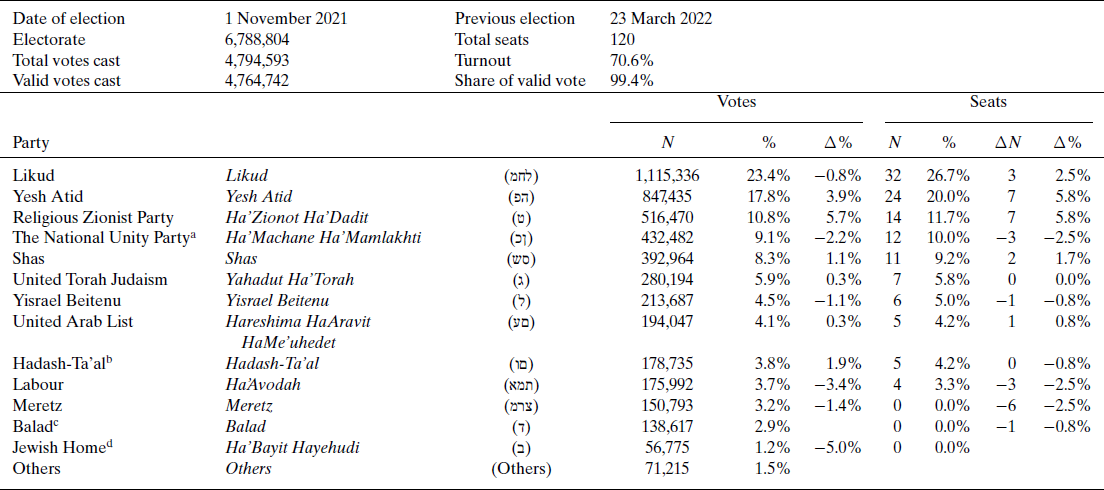
Contrary to the previous four elections, the election for the 25th Knesset, which was held on 1 November 2022, had a clear result (Table 1). The right bloc gained a clear victory over the centre-left parties, and former Prime Minister Netanyahu returned to office after just one year of absence.
Table 1. Elections to the Parliament (25th Knesset) in Israel in 2022

Notes: aThe National Unity Party was established in the run-up to the 2022 elections. It included candidates from Benny Gantz's Blue and White and Gideon Saar's New Hope as well as Gadi Eizenkot and Matan Kahana.
b The Joint List broke up and Hadash-Ta'al competed on one list, and Balad competed independently.
c Compared to one MP in the joint list from the 2021 election.
d The Yamina list disintegrated: Former Prime Minister Naftali Bennett retired, and Ayelet Shaked ran under The Jewish Home.
Sources: Central Election Commission website (2022) (https://votes25.bechirot.gov.il/); Knesset website (2022) (https://main.knesset.gov.il/About/History/Pages/KnessetHistory.aspx?kns = 25#).
The Likud party increased its number of seats in the Knesset from 30 (de facto 29—see Ganel 2022) to 32 and remained the largest party in the Parliament. Contrary to the previous election, in this election, the party managed to form a right-wing coalition government without the need for centre parties to join. The Likud ‘natural Partners' got more seats, while the centre-left bloc did not manage to maintain their minimal majority.
The two Orthodox parties enlarged their power in the Knesset, as the number of seats they gained increased from 16 to 18. Shas gained 11 seats, two more than in the previous elections, whilst United Torah Judaism retained its seven seats. The last list on the right wing was established just before the elections—the Religious Zionist Party. It was a joint list of three parties: Religious Zionist, Otzma Yehudit and Noam. The joint right-wing list won 14 seats and enlarged the power of the right-wing bloc. As Yemina, the former Prime Minister's party, dissolved (see Political Party Report), it enabled the right bloc of parties to strengthen their power in the Knesset.
At the centre of the political map, a new list was formed. The National Unity Party was established in the run-up to the elections (see Political Party Report). The new list got 12 seats, yet it did not manage to get a pivotal position like the one centrist parties got in the previous election. Yisrael Beitenu, the Russian immigrants party, lost one seat in the Knesset, having only six remaining seats, and Yesh Atid increased its number of seats from 17 to 24.
On the left side of the political map, the Arab-oriented parties increased their number of seats from nine to 10, yet they lost almost three optional seats because one of them, Balad, did not pass the threshold for entering the Knesset. Another major change was that the Meretz party also did not pass the threshold, which involved many wasted votes for the left-wing bloc. They got 3.2 per cent of the votes but needed 3.3 per cent to enter the Knesset. Therefore, they lost all the six seats they had in the previous Knesset. The Labor Party also lost support, ending up with only four seats, compared to six in the previous round (Ganel Reference Ganel2022; Central Election Commission 2023).
A total of 64 Knesset members recommended the president, Isaac Herzog, to give Netanyahu the mandate to form a government; only 28 recommended Yair Lapid (head of Yesh Atid).
Cabinet report
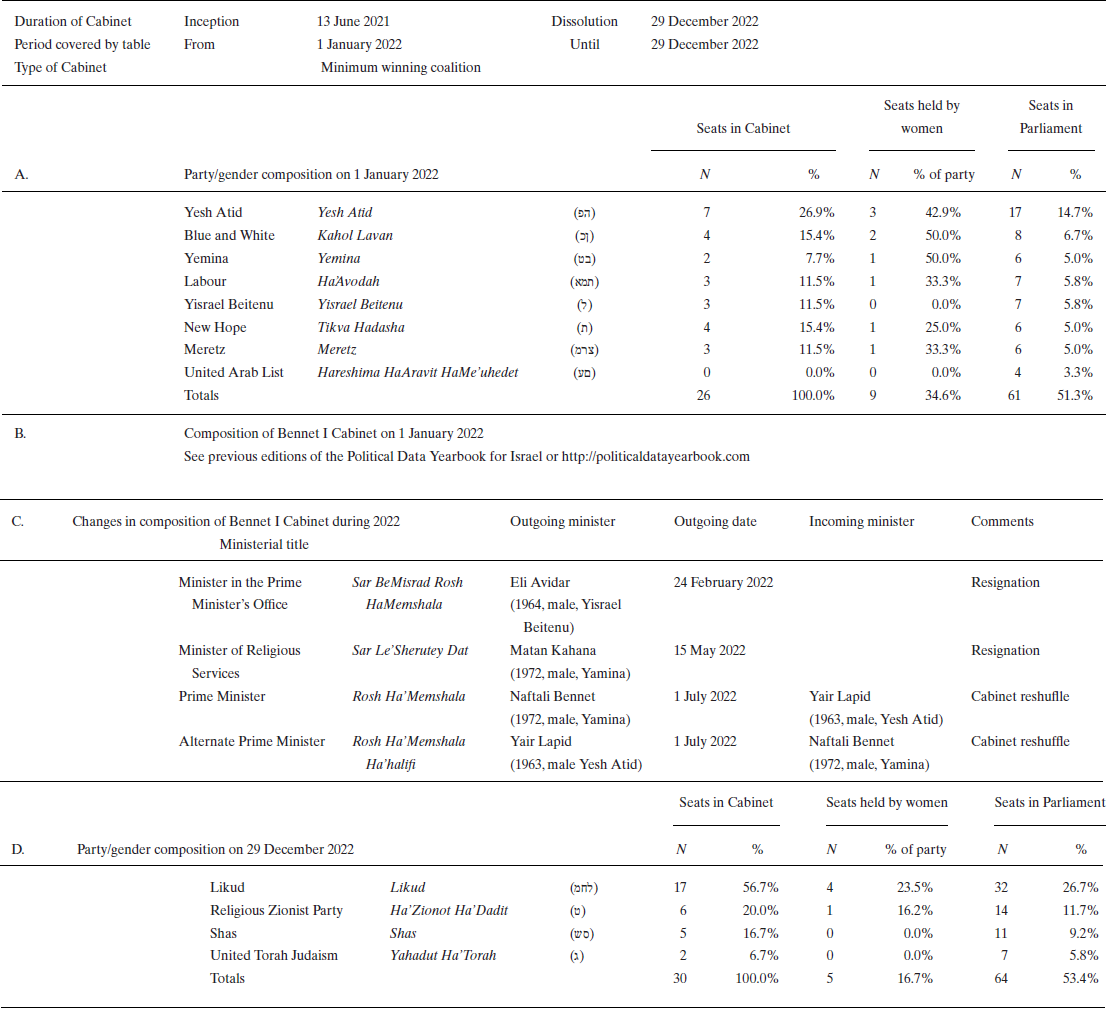
In April 2022, the MK Idit Silman, of the Yemina party, left the coalition, leaving it with only 60 members. The fragile coalition suffered from instabilities with some members withdrawing and coming back to the coalition. On 13 June 2022, Yamina MK Nir Orbach also withdrew from the coalition, which now had only 59 members. Those actions left Prime Minister Bennet and the alternate Prime Minister Lapid with no other options, and on June 20, they decided to dissolve the 24th Knesset. In accordance with the coalition agreement, Prime Minister Naftali Bennet left his office. On 1 July 2022, the alternate Prime Minister, Yesh Atid leader Yair Lapid, was appointed as acting Prime Minister until the election for the 25th Knesset and the declaration of the new Cabinet (see Table 2).
Table 2. Cabinet composition of Bennet I in Israel in 2022

Note: The ‘Lapid I Cabinet’ (see changes in composition in 2022) is a continuation of Bennet's one (according to the rotation agreement). Lapid held the prime ministership until the new Netanyahu Cabinet establishment.
Source: Knesset website (2022) (https://main.knesset.gov.il/EN/mk/government/Pages/governments.aspx?govId = 36).
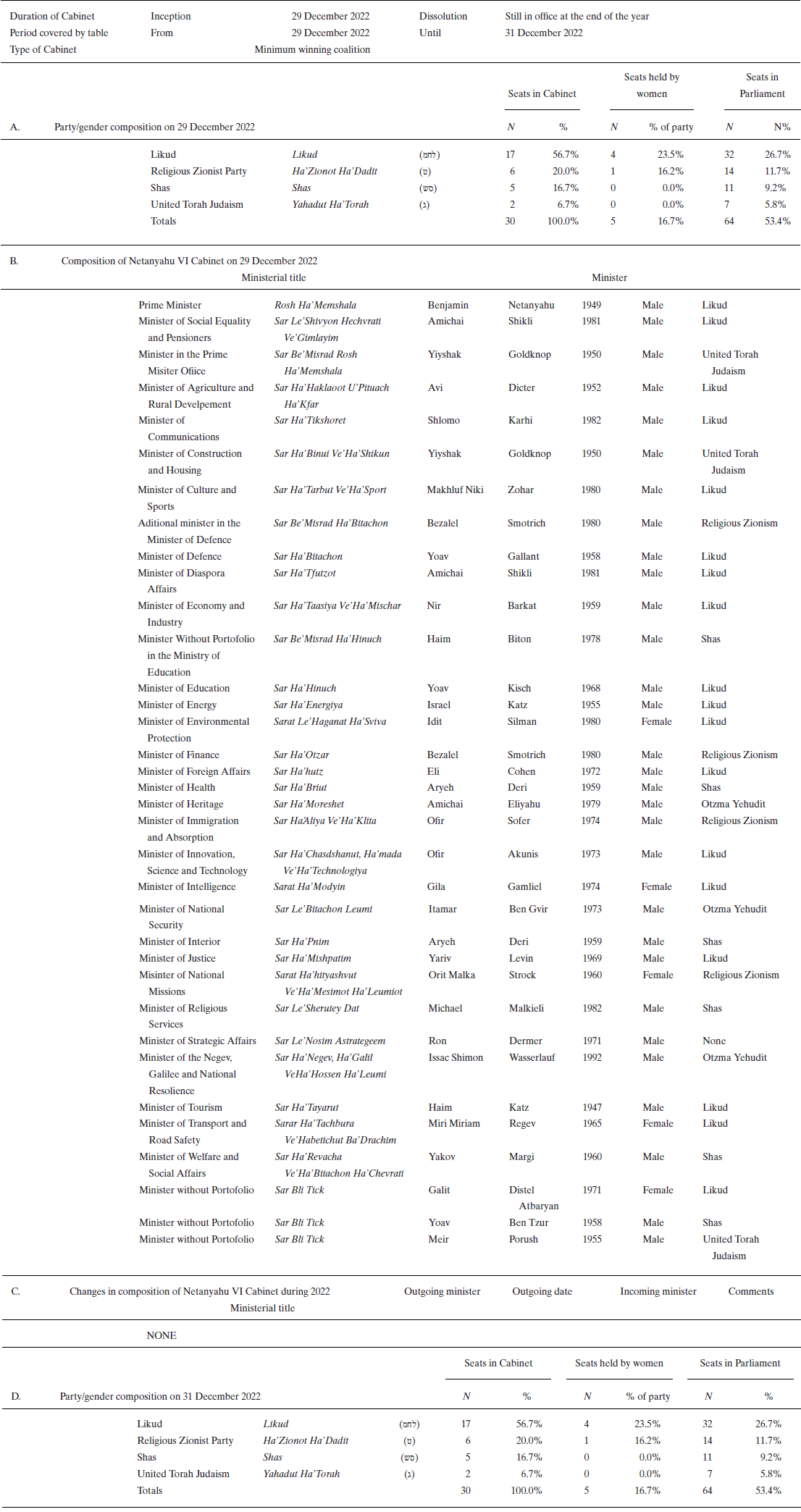
On 21 December 2022, Netanyahu declared to the president that he would manage to form a coalition government, and on 29 December 2022, the new government was sworn in by the Knesset. The new government was an ‘all right-wing’ one. For the first time after five elections, there was no need to have a mixed coalition of right and centre-left parties. Although any of the parties involved could dissolve the coalition, the new government had a stable majority of 64 seats in the Knesset.
The new Cabinet comprised 30 ministers (up to the end of 2022; there was an increase in the number of ministers thereafter). This means that almost 47 per cent of the MKs from coalition government parties got a ministerial position. With 17 members, the Likud party got the majority of Cabinet members (see Table 3). Only five ministers (almost one-third of the Cabinet) were women, a sharp decrease from the previous Cabinet, with nine female ministers (Kenig Reference Kenig2023).
Table 3. Cabinet composition of Netanyahu VI in Israel in 2022

Notes:
1. Religious Zionist Party is a list made up of Religious Zionism, Otzma Yehudit and Noam.
2. The three Ministers without Portfolio were to be appointed in January 2023.
Sources: Knesset website (2022) (https://main.knesset.gov.il/en/mk/government/pages/governments.aspx?govid = 37 and https://knesset.gov.il/mk/eng/MKIndex_Current_eng.asp?view = 2).
Parliament report
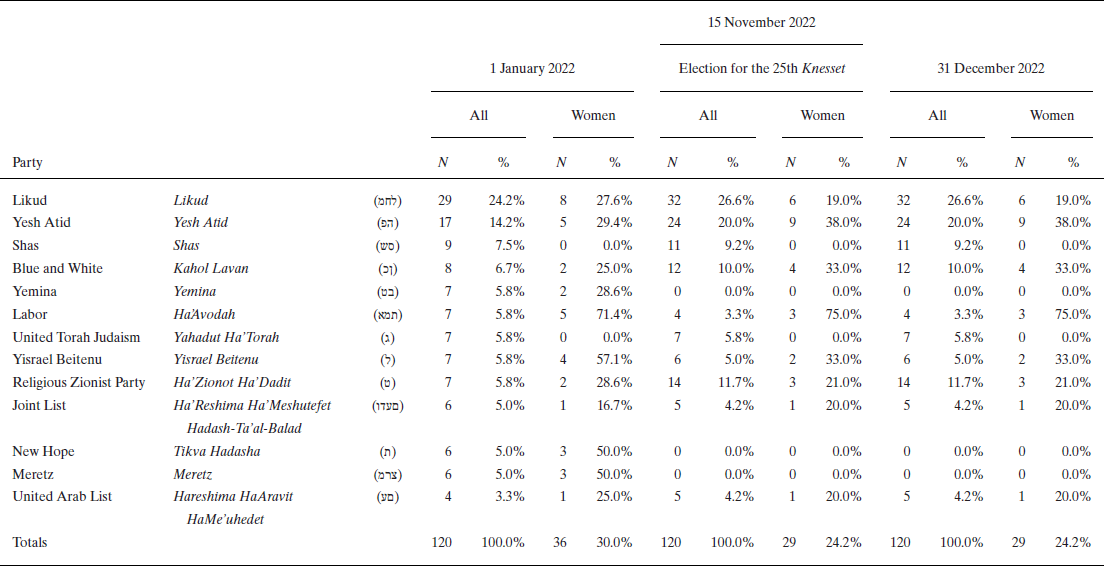
Knesset terms are dictated by the date on which a new Knesset is convened (and not by election dates). Hence, the term of the 25th Knesset started on 15 November 2022. The 25th Knesset presented 37 first-time MKs. The number of women in the Knesset almost held steady at 29 (compared to 30 in the previous election), representing 24.2 per cent of the members of Parliament. The number of non-Jewish MKs decreased from 14 to 10 (Knesset 2023). Details on the composition of the Knesset can be found in Table 4.
Table 4. Party and gender composition of the Parliament (Knesset) in Israel in 2022

Note: The National Unity Party established in the run-up to the 2022 elections. It included candidates from Benny Gantz's Blue and White and Gideon Saar's New Hope as well as Gadi Eizenkot and Matan Kahana.
Sources: Central Election Commission website (2022) (https://votes25.bechirot.gov.il/); Knesset Research and Information Center (https://fs.knesset.gov.il/globaldocs/MMM/0cf2203e-a05e-ed11-814f-005056aac6c3/2_0cf2203e-a05e-ed11-814f-005056aac6c3_11_19639.pdf); Knesset website (2022) (https://main.knesset.gov.il/About/History/Pages/KnessetHistory.aspx?kns = 25#).
Political party report
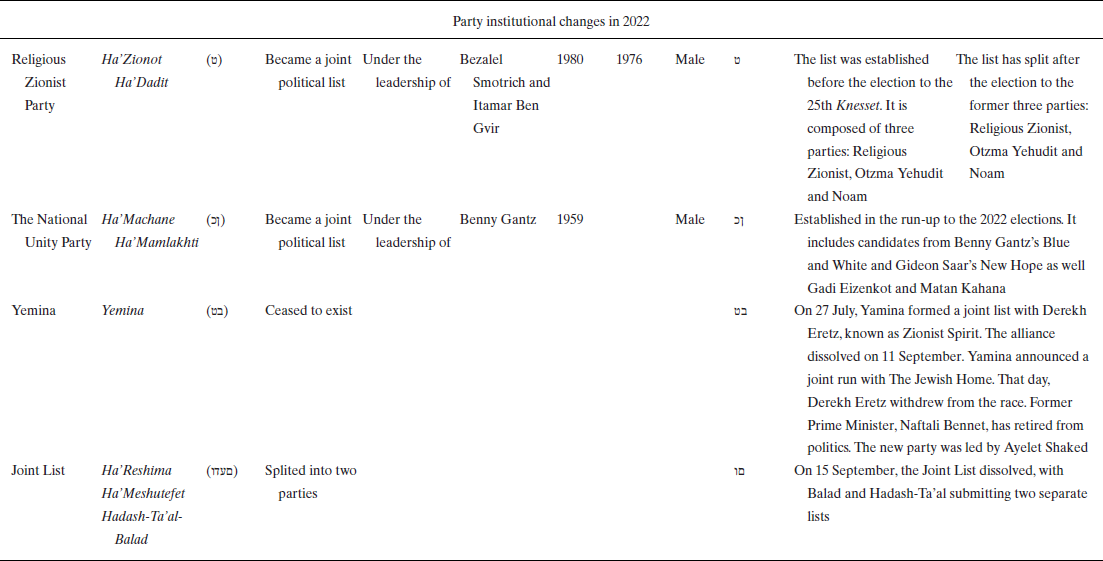
During 2022, there were some significant changes in the composition of parties that influenced the election results of the Knesset (see Table 5). After long negotiations and the involvement of the Likud leader, Netanyahu, the Religious Zionist Party was formed. The list was established before the election to the 25th Knesset. It is composed of three parties: Religious Zionist, led by Bezalel Smotrich; Otzma Yehudit, led by Itamar Ben Gvir; and Noam, led by Avi Maoz. After the election, the list split back to the former parties.
Table 5. Changes in political parties in Israel in 2022

Source: Israeli Democratic Institute (2023) (https://en.idi.org.il/israeli-elections-and-parties).
On July 27, Yamina formed a joint list with the Derekh Eretz party known as Zionist Spirit. The alliance dissolved on 11 September. Yamina announced a joint run with The Jewish Home. That day, Derekh Eretz withdrew from the race. Former Prime Minister and Yamina member, Naftali Bennet, retired from politics, and the party dissolved. Ayelet Shaked, a former member of Yamina, ran in the election as leader of The Jewish Home party, but the list did not pass the electoral threshold.
On the centre-left, there were two major changes. On 15 September, the Joint List dissolved, with Balad and Hadash-Ta'al submitting two separate lists. Eventually, Balad did not manage to enter the Knesset. The National Unity list was established in the run-up to the 2022 elections. It includes candidates from Benny Gantz's Blue and White and Gideon Saar's New Hope as well as other political figures such as Gadi Eisenkot and Matan Kahana (Israeli Democratic Institute, Election and Parties 2023).
Institutional change report
No major changes were adopted in 2022. The only change in basic law was made by the newly elected Knesset. They changed the basic law: the government. This change, called also ‘Deri Law’, after the Shas leader, Arie Deri, changed the eligibility criteria to become a minister, allowing individuals on parole to serve as ministers in the Israeli government. The change was made to enable Prime Minister Netanyahu to appoint Deri as a minister (Fuchs Reference Fuchs2023).
Issues in national politics
The year 2022 witnessed the exit from the COVID-19 measures, which were the focus of the political and civilian sphere in the previous two years. Other developments affecting Israeli politics focused on national security threats, a military operation in the Gaza Strip and ongoing terrorist attacks in the West Bank as well as Israeli cities that caused many casualties. Israel strengthened its ties with the friendly Arab countries and the United States.
COVID-19 pandemic
On 1 March, the Israeli government relaxed almost all prior restrictions related to the COVID-19 pandemic, ending more than two years of harsh restrictions on civilians (Times of Israel 2022a).
The economy
In 2022, Israel's economic performance was influenced by the end of the COVID-19 pandemic restrictions. Two main trends continued from 2021, a rapid increase in gross domestic product (GDP) and, at the same time, a sharp increase in inflation, both mainly because of the COVID-19 effect and the war in Ukraine (Bank of Israel 2022). The country's GDP rose by 6.5 per cent, and the GDP per capita rose by 4.4 per cent. The unemployment rate decreased even more during 2022, from about 6.1 per cent at the end of 2021 to 3.3 per cent by the end of the year.
There were inflationary pressures that led to a 5.3 per cent increase in prices, which forced the central bank to increase interest rates from 0.1 per cent to 3.3 per cent by the end of the year. The government tried to ease the cost of living by issuing an economic plan that included tax benefits to working parents and enlarging the negative income tax for low-income earners (Keller-Lynn Reference Keller-Lynn2022). The indicators of the Israeli government were also positive in 2022, showing a budget surplus of 0.6 per cent (compared to a deficit of 4.4 per cent in 2021). The debt-GDP ratio decreased to 60.3 per cent from a level of 69 per cent at the end of 2021. Compared to similar economies, Israel had higher-than-average economic growth (Bank of Israel 2022; Central Bureau of Statistics 2022).
Ongoing terrorism and security threats
During 2022, Israel experienced many terrorist incidents and a major military operation. Five major terrorist attacks that occurred in Israeli cities during March, with deadly casualties, led to the launch of ‘Operation Breakwater’. This was a long-term military operation inside Palestinian cities in the West Bank to prevent further Israeli casualties (Lapin Reference Lapin2022). The operation lasted several months. During one of those operations, Israeli forces arrested the leader of the Islamic Jihad in Jenin. This action caused tension with the Islamic Jihad in Gaza. The aftermath led the IDF, that is, Israeli Defence Force, to launch Operation ‘Breaking Dawn’, a three-day operation against Islamic Jihad terrorists and infostructure targets. This operation was also claimed to be a political achievement for acting Prime Minister Lapid, who did not have any military background (Israeli Policy Forum 2022). There was also security tension on the northern border of Israel.
The tensions on the Lebanese and Syrian borders continued in 2022, as Hizballah tried to launch several attacks on Israel, unsuccessfully. As of 2021, Iranian forces established their holding in Syria, while Israel launched numerous attacks on Iranian military targets to prevent the spillover of weapons to Hizballah in Lebanon. The Iranian pursuit of nuclear weapons continued to be one of the main threats to Israeli security (Trajtenberg & Shalom Reference Trajtenberg and Shalom2022).
Foreign affairs
In 2022, Israel strengthened its foreign relations with newly established diplomatic ties with Arab countries. Two main events reflect this process. First, the ‘Sde Boker Summit’ held on 27–28 March 2022, where Israeli foreign affairs minister, Lapid, hosted the foreign ministers of Egypt, Bahrain, Morrocco and UAE as well as the US secretary of state. The second major conference occurred during US President, Joe Biden, visit to Israel on 14–15 July, as the presidents of the US, UAE and India held a virtual conference together with Israeli Prime Minister Lapid. Those conferences and other diplomatic and economic agreements strengthened Israel and placed it as a main actor in the Middle East region. Another major agreement was signed between Israel and Lebanon on the long-time dispute over the water line borders between both countries (Gebeily & Lubell Reference Gebeily and Lubell2022).
The war in Ukraine also affected the political agenda. Israel's government had pressure from Western countries to give military aid to Ukraine. Yet because of security interests in Syria involving Russian military forces, Israel avoided giving direct military aid to Ukraine, focusing on humanitarian aid instead. Prime Minister Bennet also tried to mediate, unsuccessfully, between the two fighting sides and met with Russian President Putin and Western leaders in March (Times of Israel 2022b).

 Open access

