


Introduction
In liberal democracies, protests serve as the heartbeat of civic activism, amplifying diverse voices that often challenge the political status quo. As such, protests can be a powerful stimulus for political re-evaluation and policy reform, ensuring that democratic institutions remain responsive to citizens’ evolving policy preferences. However, protests can also be used as a means for a loud minority to advocate policy goals that are contrary to the majority's stance. This study examines the extent to which elected politicians respond to such protest dynamics, shedding light on the interplay between vocal activism and representative governance. We focus on one of the most controversial protest movements in recent times: the Covid-19 protests.
Many European countries witnessed massive protests after their governments adopted measures to combat the Covid-19 pandemic. While the number of participants remained low in some countries, the number of protest events and participants increased dramatically in others (Kriesi & Oana, Reference Kriesi and Oana2023; Neumayer et al., Reference Neumayer, Pfaff and Plümper2023). We leverage several advantages offered by Covid-19 protests to address effects that have received little attention in the rapidly growing literature on protests: the geospatial dynamics of protests, especially in multilevel systems. Previous studies show that protest events can shape the opinions of elected politicians (Wouters & Walgrave, Reference Wouters and Walgrave2017) and their communication (Barrie et al., Reference Barrie, Fleming and Rowan2024; Schürmann, Reference Schürmann2023b). However, the responses of individual politicians in relation to specific protest locations remain understudied. To address this gap, we combine existing protest research with the literature on political representation and focus on protest location as a crucial institutional factor in multilevel party systems. Analyzing politicians’ responses to protests is particularly relevant for two reasons. First, politicians’ reactions provide insight into the success factors of protests and illustrate which voices make it into the political discourse. Second, the political discourse among members of parliament (MPs) directly influences policy decisions and, in this specific case, the further course of the pandemic. In the following, we address the following research question: How does the geographical location of protest events affect the likelihood of politicians’ engagement with the protests in a multilevel system?
To answer this question, we analyze the reactions of German federal and state MPs to the Covid-19 protests from the beginning of the pandemic until the German federal elections in September 2021. Studying these protests is particularly well suited to our research question for several reasons. First, the protests have a clear starting point, as opposed to protest movements that have developed over the years. Second, the protests were accompanied by protest-related legislation that restricted the freedom to protest in order to prevent the spread of the pandemic. Finally, the German case is particularly interesting because of the increasing radicalization of the Covid-19 protests in terms of activity and ideology (Grande et al., Reference Grande, Hutter, Hunger and Kanol2021) and because of the institutional multilevel electoral system. We use MPs’ posts on the social media network Twitter (currently known as ‘X’) to obtain daily updated reactions at the individual level. To quantify politicians’ responses, we measure rhetorical responsiveness using dictionary-based quantitative text analysis. Applying multilevel regression analysis and difference-in-differences, we show that MPs are most responsive to protests within the geographic area they represent. Furthermore, the position of the MP in the multilevel electoral system influences their responsiveness: MPs elected at lower levels of an electoral system are more responsive to local protests than MPs elected at higher levels. These findings are important for the social movement literature as they illustrate that the location of protests is a decisive factor in attracting the attention of political elites. The results lead to a more comprehensive understanding of the dynamics of protest and political representation.
Rhetorical responsiveness in political communication
Our interest lies in the issue attention of MPs and the related political communication. We imply that MPs are rational actors, who focus on re-election, and consequently vote-seeking, as their primary goals (Strøm, Reference Strøm1997, Reference Strøm2012). When and why MPs become active and publicly address an issue depends on multiple factors, such as electoral security (Eggers & Spirling, Reference Eggers and Spirling2014) or the electoral system (André et al., Reference André, Depauw, Shugart, Martin, Saalfeld and Strøm2014; Schürmann & Stier, Reference Schürmann and Stier2023). Here, we move away from merely institutional factors and focus on the effect of the geographical location of the constituency of an MP (De Rosa, Reference De Rosa, Ceccarini, De Rosa and Newell2022; Schürmann, Reference Schürmann2023a). First, however, we describe our conceptualization of issue attention. Politicians are confronted with a vast number of policy issues, but the attention of politicians is a limited resource. Consequently, politicians have to decide which issues are important to them and devote their attention accordingly. On the party level, the study of issue attention often relies on manifesto data (e.g., Klüver & Spoon, Reference Klüver and Spoon2016; Volkens et al., Reference Volkens, Burst, Krause, Lehmann, Matthieß, Merz, Regel, Weßels and Zehnter2020) or legislative output (e.g., Breunig & Schnatterer, Reference Breunig, Schnatterer, Baumgartner, Breunig and Grossman2019). Another way to analyze issue attention is to look at the political communication of individual MPs. On the one hand, MPs speak or write about issues that are of interest to their constituents. On the other hand, politicians initiate debates about issues, and the political communication of politicians influences the issue attention of voters (Barberá et al., Reference Barberá, Casas, Nagler, Egan, Bonneau, Jost and Tucker2019). Therefore, individual communication by politicians can serve as both a proxy for changes in the interests of the general public and as an initiator and a proxy for the issue attention in the broader public debate.
Conceptually, we focus on responsiveness to specific major protest events as opposed to general issue attention (towards the Covid-19 protests). Issue attention describes the relative importance of an issue for an individual (or a party) (Klüver & Sagarzazu, Reference Klüver and Sagarzazu2016). It is the proportion of time that this individual dedicates to an issue. Responsiveness, in contrast, refers to the issue attention that an actor is dedicating to an issue as a response to other actors or circumstances. As rational actors, politicians monitor public opinion carefully to evaluate whether they have to adapt their policy position on certain issues to align with their constituencies’ position. Hence, at the core, responsiveness as used in this context describes how political actors react to changes in public opinion. This responsiveness is intended to suggest to voters that they are heard and that their concerns are valued and taken into account. Thus, our conceptualization is close to what Hobolt and Klemmensen (Reference Hobolt and Klemmensen2008) call rhetorical responsiveness.
We consider the analysis of MP reaction to be important for two reasons: First, voters evaluate what MPs communicate and will consider it for their choice of (re-)election (Martin & Vanberg, Reference Martin and Vanberg2008). These electoral choices will consequently influence policy decisions in the long term. Second, the ‘talk culture’ between MPs themselves as well as between MPs and citizens does affect the democratic stability of a country (Steiner et al., Reference Steiner, Bächtiger, Spröndli and Steenbergen2004).
Local protest and individual responsiveness
When are politicians rhetorically responsive to protests? We consider protests a crucial factor for the politicization of issues (Hutter et al., Reference Hutter, Grande and Kriesi2016). Grievance theory predicts that people choose to protest to express their miseries and distress. In doing so, the protesters let the authorities know about their dissatisfaction with the current political situation or governmental decisions (Kern et al., Reference Kern, Marien and Hooghe2015; Kriesi et al., Reference Kriesi, Wang, Kurer, Häusermann, Kriesi, Lorenzini, Wüest and Häusermann2020; Kurer et al., Reference Kurer, Häusermann, Wüest and Enggist2019). Hence, public protests can signal public opinion shifts of parts of the population to political elites (Wouters & Walgrave, Reference Wouters and Walgrave2017). Moreover, local protest events cannot only indicate preceding shifts in public opinion but also be the driver of change in the latter. By disrupting the public discourse, local protest events can have an agenda seeding effect, framing news, directing elite discourse and affecting public opinion and expressed partisanship among individuals (Eady et al., Reference Eady, Hjorth and Dinesen2023; Wasow, Reference Wasow2020). The resulting politicization does not necessarily have to correlate with the characteristics of the contextual factors against which the protest is directed (Hopkins, Reference Hopkins2010).
Different factors of protests are drivers for the positive evaluation of protests. Tarrow and Tilly (Reference Tarrow, Tilly, Boix and Stokes2009) emphasize worthiness, unity, numbers and commitment as the crucial factors for the positive evaluation of protest. Wouters and Walgrave (Reference Wouters and Walgrave2017) show that commitment and numbers are indeed the factors that convince elected politicians. The effect of protest on legislation is the strongest in the early stages of the agenda-setting process (King et al., Reference King, Bentele and Soule2007; McAdam & Su, Reference McAdam and Su2002) and for particular policy areas (Bernardi et al., Reference Bernardi, Bischof and Wouters2021). We assume that the geographic location of protests is another crucial factor that influences political elite attention. Protests arise on the local level with frequent and sizable protest events affecting the political attitudes of people residing in a region (Wallace et al., Reference Wallace, Zepeda‐Millán and Jones‐Correa2014). The interest of the general public in protests can largely be explained by spatial proximity (He et al., Reference He, Hong, Frias‐Martinez and Torrens2015). This expectation is further amplified by a media focus on local protest events. Citizens and politicians learn about protest events from media such as newspaper articles, but local and/or regional newspapers report more on protest events in their geographical vicinity (Kilgo & Harlow, Reference Kilgo and Harlow2019; Kilgo et al., Reference Kilgo, Harlow, García‐Perdomo and Salaverría2018; Oliver & Maney, Reference Oliver and Maney2000). Furthermore, violent protests can change support for policy toward the protesters’ position. This effect is, however, strongly correlated with the distance to the riot, which further amplifies the focus on geographically close protest events (Enos et al., Reference Enos, Kaufman and Sands2019). In sum, we expect protest frequency and size to be the two main indicators to raise the politicians’ attention, moderated by an important factor – the protest location.
How does this local focus translate into MPs’ representative behaviour? In the German polity, parties are organized in regional party groups (Landesverbände) representing one of the 16 states (Bundesländer). MPs are elected in one of these states with geographically defined borders and an electorate strictly defined by residentship within these borders. Voters from other states do not matter for the election results of an MP, as they are not eligible to cast a vote in the respective district. Therefore, we assume politicians to focus on protest events in the state they represent. Yet, members of their electorate can travel to protest events, which is why protest events in other states might raise the interest of politicians not directly representing that state. However, we expect politicians to be more responsive to protests of their own (geographically defined) electorate. This rationale leads to our first hypothesis:
H1 - Protest location hypothesis: MPs are more responsive to protests within the state they represent compared to protests in other states.
Vertical differences in responsiveness
The proximity of protests and electorate considerations are not the only factors that affect MPs’ responsiveness to these events. A characterizing element of multilevel systems is the vertical structure of institutions and jurisdictions that affects elites’ and citizens’ behaviour. For the latter, previous studies have analyzed to what extent voting patterns, such as electoral turnout, vary on the different electoral levels (Henderson & McEwen, Reference Henderson and McEwen2010; Jeffery & Hough, Reference Jeffery and Hough2003). Regarding political elites, parties adapt their strategies and the degree of local structures’ autonomy based on the specific electoral designs they find themselves in (Detterbeck & Hepburn, Reference Detterbeck and Hepburn2010; Thorlakson, Reference Thorlakson2009).
Beyond political parties, multilevel democracies strongly affect politicians’ behaviour. MPs on a more regional level tend to be more constituency-oriented and spend more time on constituency-related work (Russell & Bradbury, Reference Russell and Bradbury2007). The same is true for the German case, in which state-level MPs are ‘clearly closer to citizens than members of the Bundestag‘ (Patzelt, Reference Patzelt2007, p. 66). Another reason for regional MPs to engage more with their constituencies than federal MPs is that regional jurisdictions typically include domains closer to the citizens’ day-to-day concerns, which shapes MPs’ responsiveness (André et al., Reference André, Bradbury and Depauw2014). In sum, we expect MPs on lower levels of the electoral system to have a narrower representational focus that is centred on their geographic region.
In that sense, protest events can play an ambivalent role. As mentioned above, citizens use protest to express dissatisfaction with some policies, such as measures to combat the Covid-19 pandemic. In the German multilevel system for instance, the policy response to the pandemic was characterized by strong coordination between federal- and state-level politicians, where the heads of state met regularly with federal policymakers, which makes the Covid-19 case a good test case to study as we further elaborate on below. Therefore, the subject of the protest falls partly under federal jurisdiction and only partly under state jurisdiction. However, the protest event and all surrounding security and police issues fall under state jurisdiction. Hence, state MPs do not only have the incentive to respond to the protests on a substantive level but also because the events themselves fall under their jurisdiction. This leads to our second hypothesis:
H2 - Multilevel hypothesis: State-level MPs are more responsive to protests than federal-level MPs.
We expect MPs to be more reactive to protests within their home state compared to other states and we also theorize that state-level MPs are more responsive to local protests than federal-level MPs. To empirically test these assumptions, we focus on the case of protests against measures to combat the Covid-19 pandemic in Germany as we mentioned before. Below, we present the case in greater detail.
German Covid-19 protests: The Querdenker-movement
Starting in early March 2020, the German federal government implemented measures to combat the Covid-19 pandemic. These measures included restrictions on the free movement of persons and the freedom of assembly to prevent the spread of the virus. Opposition quickly formed against this restriction of fundamental rights. In the beginning, various individuals and groups started to protest federal and state measures. These protests began in April 2020 and took place in multiple German cities. Initially, the protest focused on governmental measures to combat the pandemic. Over time, the protests radicalized, including attacks on police officers and journalists covering the events (Hunger et al., Reference Hunger, Völker and Gonzatti2021).
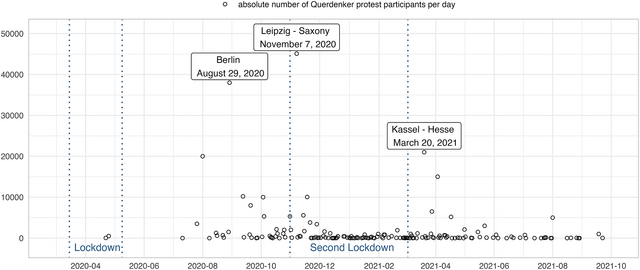
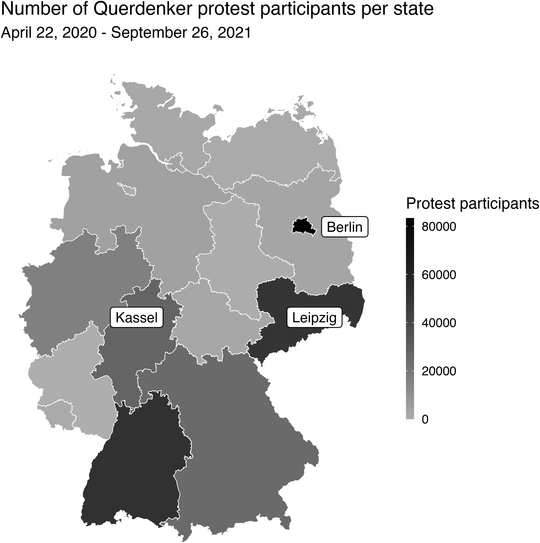
This radicalization was accompanied by the rise of the so-called Querdenker (’lateral thinker’) group that originated in the greater Stuttgart area in Southern Germany (Plümper et al., Reference Plümper, Neumayer and Pfaff2021). Over the summer of 2020, it stood out among the many individuals organizing demonstrations. Querdenken managed to mobilize several thousands of protesters on multiple occasions (see Figure 1), initially focusing on the capital Berlin and the city of Stuttgart, but soon bringing people onto the streets throughout Germany (Koos, Reference Koos2021). The movement's main activity shifted to the Eastern German state of Saxony during the autumn months. More than 312 protest events organized by the Querdenker movement against the federal measures occurred in Germany until the German federal election in September 2021.
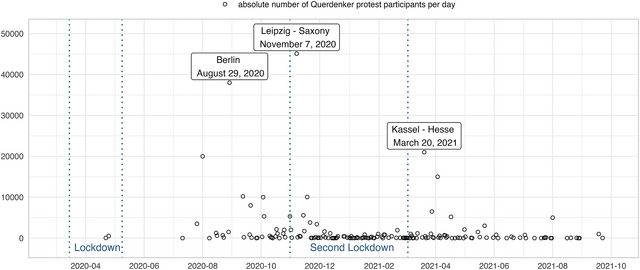
Figure 1. The temporal distribution of daily Querdenker protest participants. [Colour figure can be viewed at wileyonlinelibrary.com]
Note: Weblink to data: https://acleddata.com/analysis/covid-19-disorder-tracker/
Scholars have explored the socio-demographic composition of the protest participants. The movement did not consist of a specific socio-economic group but attracted people from different socio-cultural contexts. Empirical studies show that the mobilization potential of the Querdenker protests changed over time (Grande et al., Reference Grande, Hutter, Hunger and Kanol2021), which makes it difficult to differentiate between social groups. However, two groups tended to be over-represented at the protest events: first, right-wing extremists, and second, voters from the middle of the political spectrum who did not feel represented by existing mainstream parties (Grande et al., Reference Grande, Hutter, Hunger and Kanol2021). This participant shift co-occurred with an ideological shift towards the right, manifesting itself in more violent protests. The radicalization of the Querdenker protests led to an increasing polarization regarding the demonstrations’ assessment among the German population. While the protests initially gained broader popular support, large parts of the general public later rejected the events as they turned more violent (Grande et al., Reference Grande, Hutter, Hunger and Kanol2021; Koos, Reference Koos2021). In December 2020, the German domestic intelligence service (Bundesamt für Verfassungsschutz) announced that due to the radicalization of the protests, it classified parts of the Querdenker movement as right-wing extremists. The entire Querdenker movement was classified as potentially threatening democracy and public security in April 2021 (Bundesamt für Verfassungsschutz, 2020; Wiedmann-Schmidt, Reference Wiedmann‐Schmidt2021, p. 80). The Querdenker movement and their Covid-19 protests are the cases on which we test our theoretical hypotheses. Three individual protest events of the Querdenker movement are of particular importance for this study, as they serve as case studies in which we narrow our analytical focus and study explicit protest events in greater detail. The first event that received far-reaching attention in the media was the so-called ‘Sturm auf den Reichstag’ (‘Storming of the Reichstag’) on 29 August 2020. Tens of thousands of people protested in Berlin against Covid-19 measures during the entire day. The regional government tried to ban these protest activities. The escalation culminated in an attempt by protesters to storm the Reichstag building, where the German federal parliament resides. Some protesters managed to climb the stairs in front of the building, waving flags of the German Reich and other far-right emblems. More than 38,000 people protested in Berlin that day, and national and international media outlets covered the events (Bundesamt für Verfassungsschutz, 2020; Dambeck, Reference Dambeck2020, p. 60, 114).
Another notable event occurred on 7 November 2020, in the East German city of Leipzig. In one of the biggest protests of all Querdenker events, people were on the streets in over 25 separately registered events. The main protest took place in the city centre, where at some point, officials decided to restrict entrance due to too many people attending. In the afternoon, the local government ended the entire event, as most participants did not comply with measures against the Coronavirus and the requirements of the police. Over the day, several clashes occurred between protesters and police forces. Various attacks on journalists covering the events were also registered. The event in Leipzig had more than 45,000 protest participants and received wide-ranging coverage in national and international news (Maxwill & Lopez, Reference Maxwill and Lopez2020).
The third biggest protest occurred roughly half a year after the events in Berlin, in the Hessian city of Kassel in central Germany. On 20 March 2021, around 20,000 people were on the streets in multiple events which the police had previously banned. During the day, there were repeated clashes between police and demonstrators. Participants of the demonstration also attacked journalists and counter-demonstrators. The police failed to ensure compliance with anti-Covid-19 measures and rules concerning the protests. In particular, the clashes between police forces and Querdenker demonstrators made national headlines and led to a (political) debate about how the state should react to such demonstrations (Bundesamt für Verfassungsschutz, 2021; Siemens, Reference Siemens2021, p. 115).
We consider the Querdenker's Covid-19 protests a relevant case to study for several reasons. First, the issue salience for Covid-19-related measures had a relatively clear take-off point in early 2020. In contrast to many other protest-provoking issues, a worldwide pandemic of this magnitude was never an issue for (German) politicians or citizens. Second, to combat the pandemic, movement restrictions and restrictions on demonstrations and gatherings were passed. Although the Federal Constitutional Court rapidly overturned the restrictions on demonstrations, protest-related legislation discriminates the case against other types of demonstrations.
Germany, as the selected case, is especially interesting because of the increasing radicalization of the protests regarding activity and ideology (Hunger et al., Reference Hunger, Hutter and Kanol2023). Major protest movements did not emerge in many other Western European countries until later in the course of the pandemic. Therefore, we can consider the German case a blueprint to study protest movements against Covid-19 measures in other countries where protest radicalization occurred later. Since protests take place locally, we look at the political communication of the national parliament (‘Bundestag’) and the members of the state parliaments (‘Landtage’). All in all, the selected case proves advantageous to test our empirical considerations.
Research design
Data: MP communication on Twitter
To test our hypotheses, we analyze the political communication of individual MPs on Twitter. Twitter is one of the most prominently used social media platforms. Unlike newspapers, politicians can publish content without the interference of gatekeepers (Stier et al., Reference Stier, Bleier, Lietz and Strohmaier2018). Therefore, politicians have a direct connection to their electorate and can adjust the content immediately on their pages according to their preferences. As an unmediated channel, Twitter is an informative data source for the political communication of individual politicians. Moreover, there is no time delay in publishing messages, which the MPs can send immediately at any time. Recent research shows that if politicians post more about a particular topic on Twitter, newspapers follow this lead by publishing articles on that topic as well (Gilardi et al., Reference Gilardi, Gessler, Kubli and Müller2022). Most MPs use Twitter to amplify their partisan message, but some MPs also use this medium to circumvent party constraints, making Twitter a suitable substitute channel (Castanho Silva & Proksch, Reference Castanho Silva and Proksch2021).
Our research period covers the time from the beginning of the pandemic until the end of the 19th legislative period of the German Bundestag in September 2021.Footnote 1 We start before the beginning of the pandemic and cover the first wave of infections, including the first lockdown in Germany. Furthermore, we cover the relatively low-incidence period of the summer months, leading to the second wave and the following lockdown starting in November 2020 in Germany, as well as the third wave in spring 2021. Our data end with the general election just before the fourth wave arrived and incidence numbers increased massively in Germany.
We manually collected the Twitter handles of all German MPs in the federal parliament (Bundestag) and the state parliaments (Landtage). This procedure leaves us with a total number of 16 state parliaments and the federal one. During our investigation period, four state elections took place (Baden-Württemberg, Hamburg, Rhineland-Palatinate and Saxony-Anhalt, see Supporting Information Appendix A). The total number of politicians with active Twitter accounts (at least one Tweet) in our dataset is 1,219. We collected the Twitter data via the Twitter API for Academic Research. As facilitation, we used the R package academictwitteR (Barrie & Ho, Reference Barrie and Ho2021).
To validate our findings and to make our data source Twitter comparable, we additionally analyze the issue attention of MPs in parliamentary debates. This includes the analysis of more than 70,000 speeches in the German Bundestag and four selected state parliaments. With the recently greater availability of parliamentary speech data, legislative debates have been used increasingly to study issue attention and competition (Green-Pedersen & Mortensen, Reference Green‐Pedersen and Mortensen2010; Schwalbach, Reference Schwalbach2023; Sebők et al., Reference Sebők, Proksch, Rauh, Péter and Schwalbach2023). However, both arenas - social media and parliamentary debates - follow a different logic, including a different audience. On social media, politicians can immediately respond to current daily developments. In contrast, parliamentary debates are scheduled in advance. Individual MPs only have a limited influence on the daily agenda and need to stick more closely to the party line. Comparing the two arenas therefore gives us insight into how MPs distribute their attention differently and which medium is better suited to analyze the reaction to local protests.
Method
We apply regression analyses that rely on dictionary-based quantitative text analysis. To filter the relevant tweets, we work with a dictionary-based identification strategy. The dictionary relies on an initial collection of Querdenker-related terms, which we further improved with a machine-learning-based topic modelling strategy to pinpoint important missing terms. This procedure resulted in approximately 10,000 tweets referring to the Querdenker protests in the analyzed time frameFootnote 2. We analyze the proportion of MPs’ posts concerning the Covid-19 protests as the dependent variable.
To model the data, we use a longitudinal multilevel model in which the lowest unit of observation is an MP day. We use random intercepts that vary the levels of MP and party group (Landesverband). The models allow the slope of time to be varied across MPs. Moreover, we include an autoregressive covariate structure to account for temporal autocorrelation in the residuals. This procedure is necessary because we observe multiple observations per MP in a time series setting, where we would expect observations that are close in time to share more similarities. We use an AR1 structure to specify that the correlations between the repeated measurements of each MP decrease with the time distance between the measurementsFootnote 3. We run the models separately for state and federal MPs.
To test the hypotheses, we use four independent variables. First, we consider the number of Querdenker protest events in the state of the respective MP and the number of Querdenker protests in other states. For state-level MPs, this is the state where they are parliamentarians, while for federal-level MPs, this refers to the state where they were elected and which they represent on the federal level. Furthermore, we test the same hypotheses with the number of protest participants as an alternative specification. The two variables are strongly related - the presence of a protest event is a necessary condition for the presence of protest participants. Even though the number of protest participants is subject to missing data, we calculate the regression with the number of events or the number of participants separately as alternative specifications of the same underlying concept. Following our hypotheses derived in the theoretical section, we expect that MPs respond more to protest events and participants from the state they represent.
Furthermore, we run different models with the independent variable aggregating the protest data on different periods. To create the independent variables, we aggregated the protest data (1) during the same day and (2) during the previous week. We expect these models to yield the same results. However, the MPs’ rhetorical responsiveness to protests should be higher to protests happening on the same day than the previous weekFootnote 4. The data for Querdenker protest events as well as participants come from a protest event analysis by the Covid-19 Disorder Tracker of the Armed Conflict Location and Event Data Project (ACLED) (Raleigh et al., Reference Raleigh, Linke, Hegre and Karlsen2010). This dataset is based on hand-coding of national, regional and local news sources. It provides information about contentious politics events that are directly related to the Covid-19 pandemic. We subset the data for the Querdenken movement as an explicitly mentioned protesting actor.
Beyond analyzing the general pattern of how MPs respond to Querdenker protests, we further focus on the three most prominent Querdenker protests as case studies. First, we analyze the Querdenker event in Berlin on 29 August 2020, second, the event in Leipzig on 7 November 2020 and finally, the event in Kassel on 20 March 2021. To assess these events, we use a difference-in-differences design, in which the respective protest event functions as an external intervention in a quasi-experimental setting. MPs representing the respective state (Bundesland) are the treatment group, while MPs from other states are the control group. In general, the difference-in-differences approach tests whether the difference in the change between the pre- and post-assignment is different for the treated group compared to the control group. In this case, the difference-in-differences design tests whether MPs who are representatives of the state where these protests took place were afterward more responsive to the Covid-19 protest than MPs without protests. This approach considers that the responsiveness to the Covid-19 protests might have generally changed for all MPs. However, the MPs with protests in the region they represent might have been affected beyond the general trend. This approach allows us to control for potential confounders (Angrist & Pischke, Reference Angrist and Pischke2009). For this reason, we need to create two new binary variables. The first variable Treatment dummy splits all observations into a treatment group and a control group to check for differences between these groups. Post-assignment treatment on the other hand, accounts for the secular trend that exists in both groups between the post- and pre-treatment period. By interacting these two terms, we can identify the change in the treated group that is a response to the treatment. As such, the interaction gives the average treatment effect on the treated (ATT).
Results
General rhetorical responsiveness to local Querdenker protests
Before presenting the results, we briefly discuss some descriptives of the dataFootnote 5. First, federal MPs are generally more active on Twitter than state MPs, especially with regard to Covid-19 protest-related tweets. Second, concerning party affiliation, AfD - Alternative für Deutschland and DIE LINKE party members stand out for their higher engagement with the protests. Third, in states with particularly strong mobilization, such as Saxony (SN) and Berlin (BE), MPs have been more vocal in their tweets regarding the protests. Finally, the mean of 0.64 per cent in the dependent variable indicates that, on most days, MPs do not reference to the protests extensively. However, the standard deviation is relatively high with 6.11 per cent, which suggests that when MPs do choose to reference the protests, they tend to focus on the topic quite intensively.
The effect of Covid-19 protest events on politicians’ issue attention
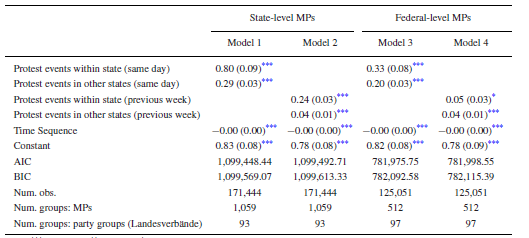
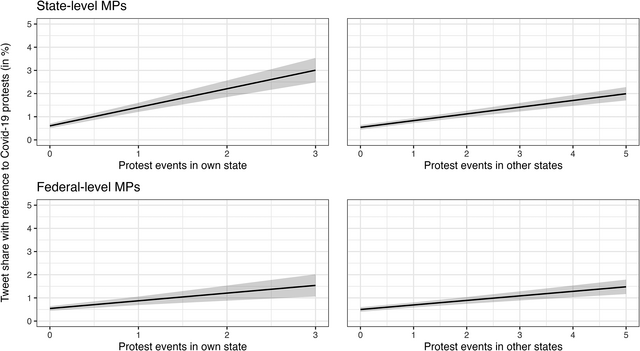
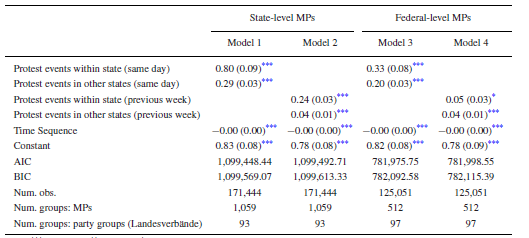
In the next step, we analyze the general rhetorical responsiveness toward the Covid-19 protests. Table 1 shows the results for the number of protest events. Models 1 and 2 present results for state-level legislators, in which we analyze 171,444 observations (day-MP combination) by 1,059 state-level legislators embedded in 93 party groups (Landesverbände). Models 3 and 4 present the respective results for federal-level legislators. Here, we analyze 125,051 observations (day-MP combination) by 512 federal-level legislators embedded in 97 party groups (Landesverbände)Footnote 6. All models include a time sequence variable to test whether there is a general time trend. Models (1) and (3) aggregate the number of protest events during the same day as the independent variable, whereas models (2) and (4) aggregate the numbers during the previous week including the same day. In short, the first models show the immediate responses of MPs, while the subsequent models serve as additional checks on whether these findings are robust if we analyze longer periods. Other aggregation levels can be found in Supporting Information Appendix C. Our interpretation focuses on the models showing rhetorical responsiveness during the same day. These models are visualized in Figure 3.
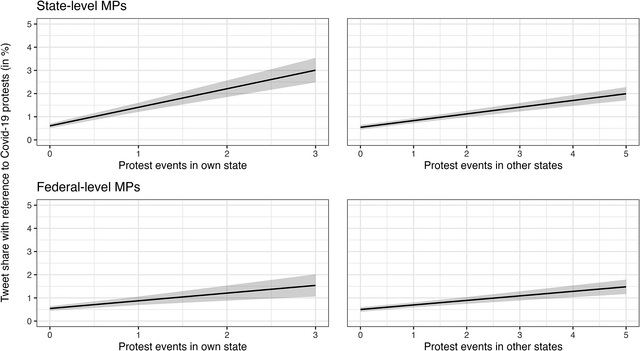
Figure 3. Predicted effect of protest events (same day) on Covid-19 protest tweet share.
Table 1. Multilevel-models: Effect of Covid-19 protest events on Covid-19 protest-related tweet share (in percent)
Note: ***p < 0.001; **p < 0.01; *p < 0.05.
Our first hypothesis (protest location hypothesis) expects MPs to be more responsive to Covid-19 protests within the state they represent than to Covid-19 protests in other states. We can test this hypothesis by comparing the effect sizes of the protest events within state with the effect sizes of the protest events in other states, respectively. In model (1), we see that an increase in Covid-19 protest events changes the state MPs’ Covid-19 protest tweet share by 0.8 per cent, while a rise in Covid-19 protest events in other states changes the state MPs’ tweets share only by 0.29 per cent. The three stars indicate that these effects are highly significant. Here we can find evidence that state MPs respond almost three times more strongly to protest events in their state than in other states.
Yet do we find similar effects for federal-level MPs who are not responsible for just their state but for the entire federal republic? The respective models in Table 1 show that protest events also have a significant effect on the federal-level MPs, albeit with a different ratio. While protests within the state the federal MP represents affect their attention with a 0.32 per cent increase, protest events in other German states lead to a lower increase of 0.2 per cent. Federal MPs also respond more to protests of their geographically defined electorate. Yet, the ratio is smaller, with just 1.5-2 times more responsiveness to protests in their state compared to protests in other states. Nevertheless, for MPs of both levels, we find evidence that they are more responsive to protests from their electorate. Thus, the analyses provide support for hypothesis 1.
Our second hypothesis expects state-level MPs to respond more to COVID-19 protests than federal-level MPs. Our analyses provide mixed evidence. On the one hand, we can show that this is true for within-state protests. State legislators’ responsiveness is substantially stronger than federal legislators’ responsiveness. On the other hand, the difference in responsiveness between state and federal MPs regarding protests in other states is much smaller or not different. Hence, while state legislators respond more to within-state protests than their federal counterparts, the responsiveness of protests in other states is similar for legislators on both levels. In sum, we find support for hypothesis 2, however, only for within-state protest.
The effect of Covid-19 protest participants on politicians’ issue attention
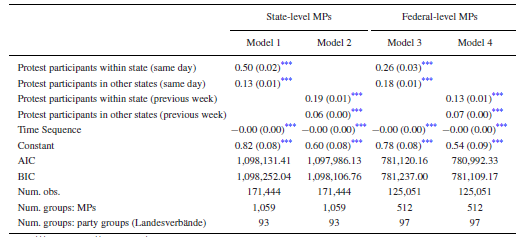
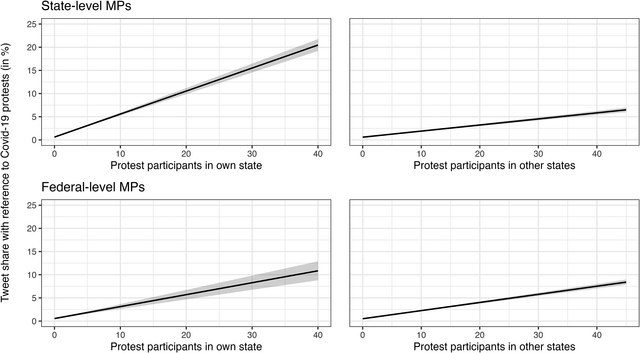
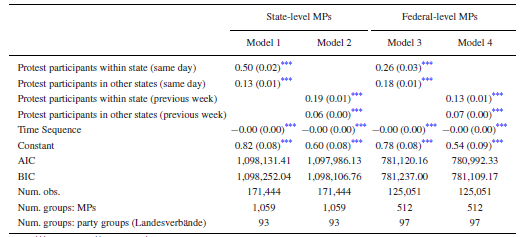
In addition to the number of Covid-19 protest events, we also analyze the number of protest participants. The analysis of participation is important because protest participants are the electorate of politicians. Therefore, having more people protesting sends a stronger signal to politicians. However, these two variables are not independent, as the presence of a protest event is the necessary condition for the presence of protest participants. Therefore, we treat the number of protest participants as an alternative independent variable to see if our results are robust. Table 2 presents these results in a similar manner as previously done for protest events. Furthermore, Figure 4 similarly visualizes these results.
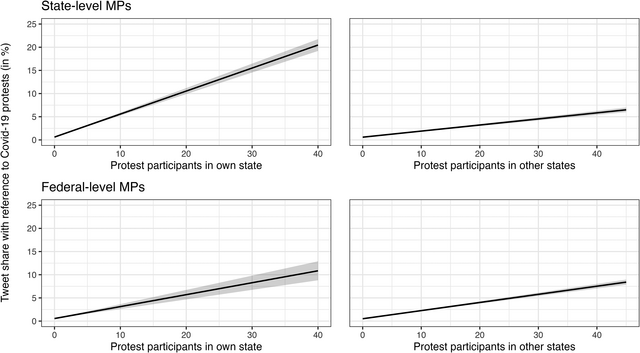
Figure 4. Predicted effect of protest participants (same day) on Covid-19 protest tweet share.
Table 2. Multilevel-models: Effect of Covid-19 protest participants (in thousands) on Covid-19 protest-related tweet share (in percent)
Note: ***p < 0.001; **p < 0.01; *p < 0.05.
We find similar results when we look at the number of protest participants instead of protest events in Table 2. For state-level legislators, the effect is 0.5 per cent for protest participants within state and 0.13 per cent for protest participants in other states. These effects are also highly significant, as indicated by the three stars. For state-level legislators, the ratio of the effect size of in-state participants to out-of-state participants is almost 4. At first glance, these effects appear to be relatively small; however, as we observe protest events with more than 40,000 participants, these effects become quite substantial. Figure 4 illustrates these effects. A day with 40,000 Covid-19 protest participants within the MP's state leads to a predicted tweet share concerning such events of almost 30 per cent.
Federal MPs also respond more strongly to protesters from their own state. However, the ratio between in-state protesters and out-of-state protesters is much smaller compared to state-level legislators. Compared to legislators from lower electoral levels, we observe that legislators from higher electoral levels also respond more strongly to protesters from geographic regions they do not represent. MPs on lower electoral levels focus their attention more on their own constituents and thus have a narrower representational focus than MPs on a higher electoral level. In summary, we find partial evidence for H2. Compared to higher-level legislators, lower-level legislators are more responsive to protesters in the geographic area they represent, while they are less responsive to protesters in other geographic areasFootnote 7.
Case studies: Major protest events in Berlin, Leipzig and Kassel
To consolidate our findings, we look at three of the largest Covid-19 protest events in Germany. We focus on the rhetorical responsiveness of German MPs to particular protest events. As explained in the section on the Querdenker movement, there are three major protest events on which we will focus: First, the Berlin protest on 29 August 2020, second, the Leipzig protest on 07 November 2020 and finally the Kassel event on 20 March 2021. All three events were unique concerning the number of protest participants and media coverage. Yet, while one protest event took place in the capital Berlin, in close vicinity to the federal parliament, the other events took place in Leipzig and Kassel, two mid-size and rather peripheral cities in the states of Saxony and Hesse.
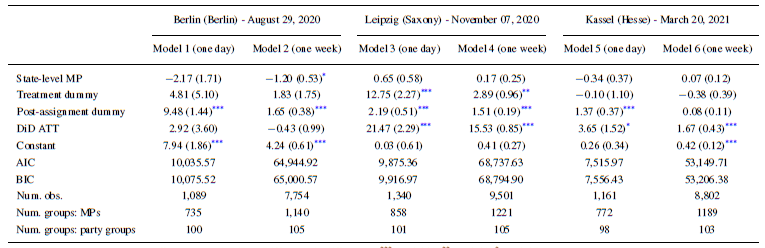
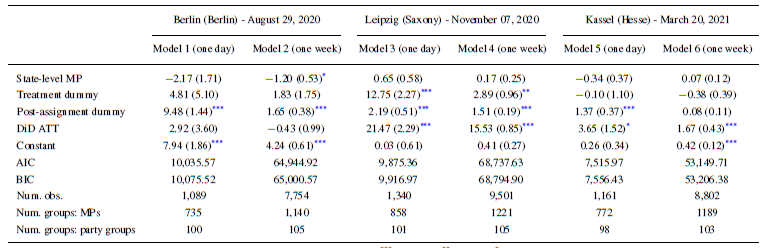
Table 3 presents the results for the difference-in-differences in rhetorical responsiveness to these particular Querdenker protest events. Besides the treatment dummy (MP representing the state where the protest happened) and the post-assignment dummy, the table displays the DiD ATT (difference-in-differences average treatment effect on the treated), our variable of interest. It indicates whether MPs representing the state where the protest happened responded stronger to the protest than other MPs. In Table 3 we show the results for a one-day comparison and a 1-week comparison. Reactions on Twitter occur primarily in real-time, so the 1-day comparison is our primary reference model.
Table 3. Difference-in-differences: Effect of major protest events in Leipzig and Kassel on Covid-19 protest-related tweet share (in percent)
Note: ATT = Average treatment effect on treated, DiD = Difference-in-differences, ***p < 0.001; **p < 0.01; *p < 0.05.
However, protests follow a cyclical pattern, usually occurring on weekends and rarely during weekdays. This cyclical pattern is also true for the three protest events under review, which all took place on Saturdays. MPs, therefore, have one week to engage with a particular protest until the next event occurs, which is why we also present the one-week comparison in this section. Yet, to show that our results remain robust, we calculated similar models with different periods, which are presented in Supporting Information Appendix D. The number of MPs and party groups (Landesverbände) in the models is flexible as we observe different periods. Only those MPs who actively tweeted during this period are included in our models. Furthermore, we included state MPs and federal MPs in these models, which is why the number of party groups is higher compared to the models in Tables 1 and 2.
The DiD ATT is a crucial value to assess the validity of our theoretical argument. Concerning the Leipzig and the Kassel protest events, we have a positive and significant average treatment effect on the treated, both for the 1-day and 1-week models. These findings support the claim that MPs respond more to protest events in their electoral districts. However, these findings do not hold for the Berlin protest. Regarding the Berlin protest, just the post-assignment dummy is significant, meaning all MPs, regardless of which state they represent, responded more to the Covid-19 protests after the protest.
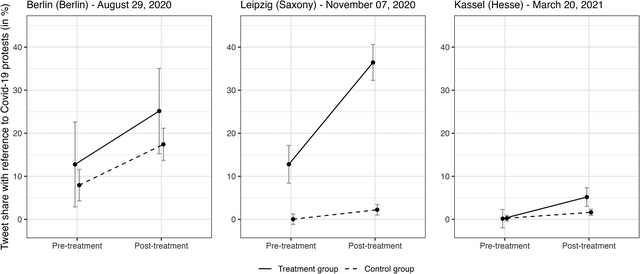
Figure 5 visualizes these effects. All three panels show the predicted tweet shares with references to Covid-19 protests before and after the treatment of the respective protest event. The treatment groups are the representatives of the state (Bundesland) where the protest took place, whereas the control groups are the MPs representing other states. The vertical grey lines indicate 95 per cent confidence intervalsFootnote 8.
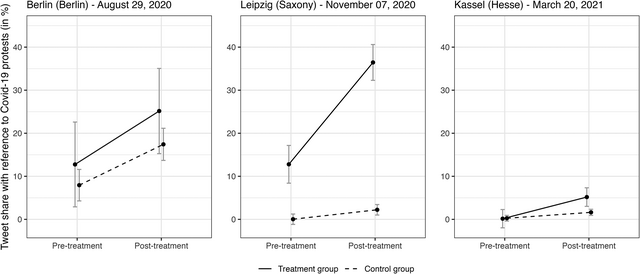
Figure 5. Rhetorical responsiveness to the protest events with highest numbers of participants.
First, we take a closer look at the treatment group. In all three panels, we can see a significant difference between the pre-treatment and the post-treatment periods for the treatment group. This effect is quite visible for the protest in Kassel, but its magnitude is even more substantial if we look at the Berlin and Leipzig protest events. Furthermore, the pre-treatment issue attention to the Covid-19 protests is greater for the treated group in Berlin and Leipzig, while it is close to zero before the Kassel protest. One possible explanation for this initial difference is that Berlin and Saxony already had more salient Covid-19 protest events before the particular protest in this study.
If we take a closer look at the control group, we see a positive effect of the treatment in all three panels. We can also see this significant positive effect as the post-treatment dummy in Table 3. Concerning the Berlin protest, the difference between the pre-treatment and post-treatment is similar for the control group compared to the treatment group. Here, the ATT is insignificant, yet this differs from the peripheral Leipzig and Kassel protests, where the treated MPs are substantially more responsive than the control group. Concluding, our cases show that we find evidence that our results hold if we take a closer look at single events. Yet, we see a difference between the protest event in the capital, which received more attention from all MPs, and those events that took place in peripheral regions.
Additional analyses: Issue attention in parliament
The results of our analysis of MP behaviour on Twitter show support for our hypotheses. However, the question remains whether Twitter is the most appropriate medium to study the reactions of MPs to protest. An alternative approach is to analyze how MPs behave in their actual political environment, namely in parliament. To address this other arena, we collected speeches by MPs from the federal parliament as well as selected state parliaments. We scraped the respective webpages from the parliaments and split the documents to merge them into one dataset with corresponding meta-variables using R (R Core Team, 2020; Schwalbach & Rauh, Reference Schwalbach, Rauh, Bäck, Debus and Fernandes2021; Wickham, Reference Wickham2016). We focused on four selected states where protest activity was particularly strong (Berlin, Baden-Württemberg, North Rhine-Westphalia and Saxony, see Figure 2). The entire dataset includes more than 71,000 speeches and contains all speeches between the beginning of the pandemic and September 2021.
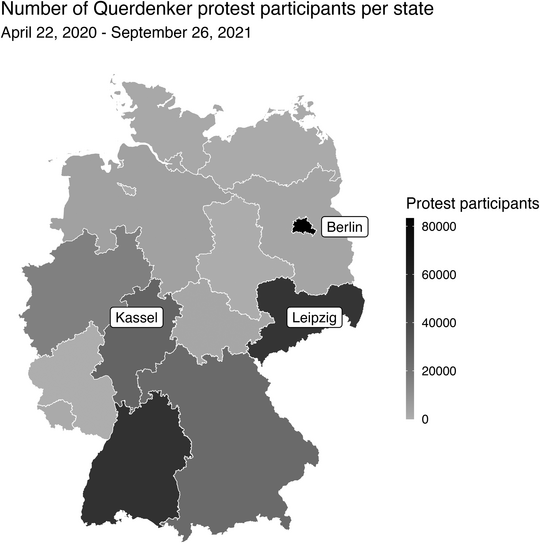
Figure 2. The spatial distribution of Querdenker protests in Germany.
Note: Weblink to data: https://acleddata.com/analysis/covid-19-disorder-tracker/
The issue attention in the Bundestag and the four regional parliaments is very low compared to the overall attention to the pandemicFootnote 9. In terms of the total number of mentions, we see 158 mentions in the four state parliaments and 89 in the Bundestag. In relation to the overall number of speeches, MPs from Berlin and Saxony show the highest level of issue attentionFootnote 10. These results show tentative evidence that MPs in states that had the largest protests also address these more often. However, the very small number of mentions is not sufficient for definitive conclusions.
Despite the very small proportion of speeches that contain mentions of the protests, we can also identify tentative clustering around months with more protests. However, we conclude that parliaments are not an ideal arena to study protest reactions: First, the pandemic had the effect that parliamentary sessions were held only with a limited number of MPs, and thus, not all MPs had the opportunity to be present all the time. Moreover, regarding the protests, some important events, such as the storming of the Reichstag, coincided with the parliamentary summer break. In these cases, MPs could not react directly to the events in parliament.
In addition, general institutional circumstances in parliaments also contribute to why a reaction is observed here only to a very limited extent. First, this includes agenda-setting rights (Rasch, Reference Rasch, Martin, Saalfeld and Strøm2014). Although it may seem rational to address protests in a session, MPs only have limited influence on whether the issue makes it on the agenda. Furthermore, in many session formats, such as discussions of specific bills, it is rather difficult to address the broad concerns of protest groups. All in all, this leads to the fact that only a very small part of the speeches contains mentions of the protests, although a very large part deals with the pandemic. Looking at the content of the speeches, they hardly address specific protests. This makes sense as these events might have happened long before a speaker could put it on the agenda. Overall, the results confirm our assumption that responses on Twitter are better suited for analyzing MPs’ reactions to protests than parliamentary speeches. In this arena, politicians are neither constrained by plenary schedules nor party constraints to react immediately to events like protests.
Conclusion
This study sheds light on politicians’ issue attention toward local protests in multilevel systems. Protest movements are important political actors that raise the attention of specific political issues, yet they are not the ones who ultimately decide on policies. It is the elected politician who decides, while protesters are rather ‘beggars at the policy gate’ (Bernardi et al., Reference Bernardi, Bischof and Wouters2021). Consequently, it is essential to understand when, how and why protest movements can actually affect politicians’ behaviour. Following recent studies on the causal effects of protest on policy support (Enos et al., Reference Enos, Kaufman and Sands2019) and public opinion (Wasow, Reference Wasow2020), this study addresses protests’ effects on elite behaviour. Focusing on the Covid-19 protests in Germany, it addresses the research question: How do protest events’ locations affect the likelihood of politicians’ engagement with the protests in a multilevel system?
First and foremost, we find that more protest leads to more attention. Higher numbers of Covid-19 protest events and higher numbers of protest participants led to more Covid-19 protest-related tweets by German MPs. This finding shows that even though protests oftentimes “represent those lacking in power” (Amenta et al., Reference Amenta, Andrews and Caren2019), politicians are attentive and (at least rhetorically) responsive to protesters. Furthermore, our results confirm that strategic incentives matter if we want to understand when and why politicians respond to protests. We see consistently higher responsiveness of MPs to protests within the state they represent, meaning that MPs pay more attention to the protest of their electorate. Furthermore, the politician's position in a multilevel electoral structure has a strong influence on their responsiveness to protests. We find the effects to be more substantial for state-level MPs than for federal MPs. MPs on lower levels in an electoral system have a narrower but intensified representational focus with regard to geography.
Moreover, analyzing the three participant-wise and media-attention-wise most striking Covid-19 protests in Germany as case studies, we can confirm that MPs who represent the state where the protest event took place are more responsive than MPs who do not represent these districts. This finding, however, does only apply to protests in peripheral regions. Regarding the Berlin-based protest, all MPs are equally responsive. This finding shows the higher importance of the capital vis-à-vis the periphery protests. All in all, these results indicate that it is of utmost importance to consider the protest location to understand politicians’ responses to protests.
Finally, our results show that social media is a useful tool to study politicians’ issue attention towards protests. As our additional analyses show, the responsiveness to the protesters did not carry over to the political arena of parliamentary debates. This is reflected in significantly less engagement with the protests in total and less responsiveness regarding timing. This difference between the two arenas is an important finding as it emphasizes that they follow a different logic regarding the responsiveness to protest. Thus, social media enables MPs to react promptly to events that do not make it onto the parliamentary agenda. However, future studies should assess the extent to which responsiveness in the two arenas has different effects on political discourse and policy making.
The findings are, however, characterized by a number of shortcomings that limit their generalizability. First, the Covid-19 pandemic was unprecedented in modern medical (and political) history. Salience on the issue was already very high, possibly presenting MPs with particular incentives to react to local protest events. Second, while the mix of state- and federal-level policies concerning Covid-19 makes it an interesting case to study, it limits our expectations of how well the findings would travel to other cases. Elites’ political behaviour might be structured differently in cases where protests are concerned only with state- or federal-level policies, although recent studies have found similar effects for the issue of climate change (Barrie et al., Reference Barrie, Fleming and Rowan2024; Schürmann, Reference Schürmann2023b). Following our argument in hypothesis 2, we would still expect state-level elites to be responsive to federal-level protests as they are juridically responsible for these events. We can say little, however, about the role of protest event location in non-multilevel settings. Nevertheless, our findings can be seen as a starting point for analyzing the implications for research on political responsiveness and democracy more generally. Future research should focus in particular on the effects of geographic representation on accountability and trust of citizens.
Different paths to proceed in this vein are conceivable. The first is to analyze not only whether but also how MPs talk about the Covid-19 protest, for example by focusing on emotive language. Another way would be to go beyond responsiveness to the Covid-19 protests and analyze responsiveness to specific policy issues relevant to these protesters. This approach would make it possible to see whether the protests actually affected specific policies. Finally, studying cases other than the Covid-19 case and studying the case within other (party) systems could provide interesting insights into the role that the location of protest events plays in the behaviour of political elites.
Acknowledgements
The authors would like to thank the reviewers of the European Journal of Political Research and the journal editors for their valuable and thoughtful feedback. Earlier versions of this paper were presented at the European Political Science Association Conference 2021, the European Consortium of Political Research General Conference 2021, the International and Interdisciplinary Conference on the Quantitative and Computational Analysis of Textual Data 2022 in Dublin and the Colloquium on Center for Civil Society Research at the WZB Berlin Social Science Center. We thank the participants of these conferences and seminars as well as Sven-Oliver Proksch, Bruno Castanho Silva, Teresa Völker, Jacob Gunderson, Swen Hutter and Frederik Hjorth for their valuable feedback. We also thank our research assistants Jasmin Spekkers, Valerie Voskamp, Frank Tabert, Okan Sarioglu, Clara Weller, Michael Diesenhof and Meret Stephan for their assistance during the writing process.
Open access funding enabled and organized by Projekt DEAL.
Data Availability Statement
To access replication files for this article, please visit: https://osf.io/wun48/?view_only=5a5e058a209e4e1db26ceb9f08267ae6
Funding
Lennart Schürmann benefitted from funding made available by the German Federal Ministry of Education and Research (BMBF) and the German Federal Ministry of the Interior and Community (BMI) within the top research cluster ‘Monitoring System and Transfer Platform Radicalisation’ (MOTRA).
Online Appendix
Additional supporting information may be found in the Online Appendix section at the end of the article:


 Open access

