


Introduction
The overrepresentation of Indigenous peoples in Canada’s criminal legal system has been identified as a growing and critical issue for well over two decades (Mitchell and Webster Reference Mitchell, Webster, Campbell and Wellman2023; Robinson et al. Reference Robinson, Small, Chen and Irving2023). In 2022/2023, Indigenous adults accounted for 30 percent of admissions to provincial/territorial correctional services and 33 percent of admissions to federal custody, despite accounting for only 4 percent of the adult population in Canada (Department of Justice Canada 2024). This overrepresentation is particularly stark in the context of pretrial detention, where Indigenous accused are more likely to be denied bail, enter a guilty plea, be detained in remand custody for extended periods and face heightened risk of custodial deaths compared with their non-Indigenous counterparts (Clark Reference Clark2019; Razack Reference Razack2015; Rudin Reference Rudin2022). In cases in which Indigenous accused are granted pretrial release, they are disproportionately subjected to behavioural conditions—such as abstention from alcohol, treatment or counselling—as well as to surety requirementsFootnote 1 (Department of Justice Canada 2017; Rudin Reference Rudin2022). These practices contribute to the high prevalence of administration of justice offences (AOJOs) among Indigenous peoples (Coady Reference Coady2018), further exacerbating their over-incarceration (Mitchell and Webster Reference Mitchell, Webster, Campbell and Wellman2023; Rogin Reference Rogin2017). In doing so, such practices have been criticized for reinforcing settler-colonial legal structures, undermining the presumption of innocence and perpetuating systemic cycles of criminalization (Mitchell and Webster Reference Mitchell, Webster, Campbell and Wellman2023).
Indigenous over-incarceration has persisted against a backdrop of sentencing reforms mandating that judges should consider all available sanctions other than imprisonment and give particular attention to the circumstances of Indigenous individuals (Mitchell and Webster Reference Mitchell, Webster, Campbell and Wellman2023). Notably, the Supreme Court of Canada (SCC) in R v Gladue (1999) established what are now known as Gladue principles, which require courts to consider the impact of colonialism, discrimination and historical trauma in sentencing decisions (Mitchell and Webster Reference Mitchell, Webster, Campbell and Wellman2023). Although Gladue was initially intended to guide sentencing, subsequent case law and legislation affirms Gladue factors as being relevant at the bail stage.Footnote 2 Evidence suggests justices increasingly consider Gladue factors in bail court, yet confusion and variation remain on how to interpret and apply these principles in practice (Berger et al. Reference Berger, Myers and Deshman2024; Knazan Reference Knazan2008).
Given the significant consequences of pretrial detention and the systemic inequities that Indigenous peoples face at this stage, it is important to understand whether, and how, Gladue principles are implemented during bail hearings. This study poses the question: To what extent do Gladue factors shape bail decision-making? Drawing on forty-six interviews with Indigenous and non-Indigenous criminal defence lawyers across Ontario, our findings reveal promise that Gladue principles are recognized by judicial actors, with encouraging outcomes for Indigenous accused, yet it is evident that in some instances its application remains superficial and is undermined by the risk-averse culture that is prevalent in many bail courts. Furthermore, although examining bail as a means of addressing the over-incarceration of Indigenous peoples is necessary, without broader systemic reform—such as increased access to community-based alternatives to detention, culturally integrative supports and the dismantling of structural biases within the justice system—bail reform alone is unlikely to produce substantive change.
Literature review of risk and racial disparities: The experience of Indigenous accused
The principle of reasonable bail has long been a cornerstone of Canadian criminal legal policy. Constitutionally guaranteed in section 11(e) of the Canadian Charter of Rights and Freedoms (1982), no one shall be denied “reasonable bail without just cause.” Additionally, the Criminal Code of Canada states that bail can only be denied in order to: (1) ensure the accused will appear in court; (2) protect the safety of the public, witnesses or victims and/or prevent the accused from committing an offence; or (3) maintain public confidence in the administration of justice (Criminal Code 1985, s 515(10)(a)(b)(c)). When determining whether an accused person can be released into the community and under what conditions, the legislative framework directs justices to apply the ladder principle, ensuring that the fewest and least onerous conditions necessary are imposed (Criminal Code 1985, s 515(2.01)). As such, an accused must be released on their own recognizance and without conditions unless the Crown can show cause for why a more restrictive form of release is necessary.Footnote 3 Accused persons are to be presumed innocent and the principle of restraint guides judicial decision-making in a manner that protects them against unreasonable detention or overly restrictive bail conditions (Canadian Charter of Rights and Freedoms 1982; Criminal Code 1985, s 515(10)).
Bail decisions are inherently discretionary and rely on forward-looking risk predictions formed by the Crown and justice’s assessment of the accused that are often based on incomplete information, meaning that risk assessments are imperfect.Footnote 4 A growing body of empirical evidence shows that a risk-averse organizational culture characterizes the bail process, in which court actors tend to err on the side of detention (Yule and Schumann Reference Yule and Schumann2019). Consequently, a greater number of accused persons are held by police for a bail hearing, spend longer periods in remand custody and receive numerous restrictive conditions upon release. These conditions, in turn, increase the risk of breaches and ultimately pretrial detention (Mitchell and Webster Reference Mitchell, Webster, Campbell and Wellman2023; Webster Reference Webster2022).
Scholars attribute this culture of risk aversion to criminal legal actors’ overemphasis of public safety at the expense of accused rights (Hucklesby and Sarre Reference Hucklesby and Sarre2009; Nixon et al. Reference Nixon, Yule and Baker2024; Webster Reference Webster2023). For example, Webster (Reference Webster2023) argues that Canada is manufacturing crime by filling correctional institutions with legally innocent individuals, often in the name of risk aversion rather than any demonstrated increase in public safety. Courts and lawmakers have likewise expressed serious concerns about the practice of bail (R v Antic 2017; R v Tunney 2018; Wyant Reference Wyant2016), warning that bail decisions are not always “sufficiently connected to a risk” (Canadian Charter of Rights and Freedoms 1982, s 11(e)). In part, this may reflect the reality that “it is impossible to predict those rare cases in which an accused who is legitimately released on bail commits a heinous crime” (Webster Reference Webster2023, para 10). Some scholars argue that concerns about reputational damage and hyper-awareness of uncertainty have made risk “the modelling ideology of organizations, where a good organization has come to be equated with being a good risk manager” (Myers Reference Myers2009, 129).
Assessments of who is deemed to be “high-risk” and the assumptions underpinning these predictions can be particularly damaging for racialized accused and other marginalized populations (Myers and Ireland Reference Myers and Ireland2021; Berger et al. Reference Berger, Myers and Deshman2024). For instance, Hannah-Moffat (Reference Hannah-Moffat2005) contends that Western risk knowledge is often based on highly racialized and gendered middle-class norms (see also Monture-Angus Reference Monture-Angus1999). According to Mitchell and Webster (Reference Mitchell, Webster, Campbell and Wellman2023, 134–35), “the bail system’s fundamental grounding in considerations of risk appears to interact with the low socioeconomic standing and difficult life experiences of many Indigenous peoples in ways that render them more vulnerable to detention.” For example, generalized risk assessments—often conflated with markers of structural marginalization—may lead criminal legal professionals to interpret the following as justification for detention or restrictive release: low incomes; overcrowded, disorganized and substandard living conditions; low educational attainment; unemployment; addictions; social exclusion and marginalization; lack of cultural identity; and dysfunctional, disorganized and disconnected families (Scott-Hayward and Fradella Reference Scott-Hayward and Fradella2019; Goddard Reference Goddard2021). Ultimately, being deemed “risky” equates to requiring more intensive conditioning and monitoring, placing accused who experience intersections of marginalization at a disadvantage when determining bail outcomes (Myers Reference Myers2025).
A recent report by the Canadian Civil Liberties Association (CCLA) confirms that “securing bail for clients who do not have resources, stable housing or social supports remains exceptionally challenging” (Berger et al. Reference Berger, Myers and Deshman2024, 45). More specifically, these individuals are unlikely to have a support network that can assist in preparing a bail release plan or friends or relatives who can serve as sureties. Without financial resources to retain private counsel and often feeling alienated from the legal system, many individuals are vulnerable to pleading guilty (Kicknosway Reference Kicknosway2015; Webster Reference Webster2022). This combination of factors frequently leads to “non-compliance with the dictates of the justice system, regardless of whether bail conditions and court hearings are seen on the surface to be fair and reasonable” (Clark Reference Clark2019, 38). In this way, the risk-oriented culture of the bail system reinforces systemic discrimination, with the most severe impacts on those with limited social support who are already grappling with health issues, substance use, poverty and structural marginalization (Myers Reference Myers2025; Webster Reference Webster2022).
The inherent racialized bias of the risk-averse analysis has been attributed to the overly individualized assessment of an accused’s risk factors, which is rooted in a settler-colonial worldview (Mitchell and Webster Reference Mitchell, Webster, Campbell and Wellman2023). In a settler-centric criminal legal system, policies and practices are developed to benefit the settler society; such a system “assumes the singularity of the settler approach to justice and that all Canadians share, or should share, the same general experiences, culture and values as the dominant settler society” (Mitchell and Webster Reference Mitchell, Webster, Campbell and Wellman2023, 132). Risk knowledge tends to characterize life circumstances as a reflection of individual choices or deficits and places the responsibility for change entirely with the individual. But this perspective ignores the role played by broader societal forces—such as settler-colonial histories involving centuries of traumatic group experiences that have placed Indigenous peoples at heightened risk of living socioeconomically disadvantaged lives—in producing these perceived risks (Gallop Reference Gallop2021; Mitchell Reference Mitchell2023). Indeed, many of the areas of “risk” identified in Indigenous accused lives reflect their experiences as part of an oppressed group (Mitchell, Reference Mitchell2023 p. 22). Adopting a settler-colonial perspective thus underscores the importance of contextualizing notions of risk within a discussion of broader structural, racial and historical processes to challenge systemic biases that frame Indigenous peoples as inherently risky.
Applying Gladue in bail court: Legal challenges and practical limitations
Section 718.2(e) of the Criminal Code (1985) and the Supreme Court’s decision in R v Gladue marked a significant shift in Canadian law by mandating a distinct approach to the treatment of Indigenous peoples, grounded in recognition of the systemic impacts of colonialism. In doing so, sentencing courts are to consider “all other sanctions other than imprisonment” while giving particular attention to the circumstances of Indigenous peoples (Rogin Reference Rogin2017; McCleery Reference McCleery2021). In 1999, the SCC interpreted section 718.2(e) for the first time in the case of R v Gladue, establishing a framework for sentencing judges to consider, contextualizing the negative impact of Canada’s settler-colonial history in the context of criminal behaviour (Department of Justice Canada 2017; Mitchell and Webster Reference Mitchell, Webster, Campbell and Wellman2023). This includes consideration of alternatives to sentencing such as restorative justice and other non-carceral options, with the aim of decreasing the use of incarceration, by taking judicial notice of the unique systemic or background factors that have played a part in bringing the accused before the court (Rogin Reference Rogin2014). The SCC further reinforced this position in R v Ipeelee—citing a lack of understanding of Gladue principles and their inconsistent application in lower courts—clarifying what was meant by systemic or background factors, including colonialism, displacement and residential schools, as well as how that history continues to translate into lower educational attainment, lower incomes, higher unemployment, higher rates of substance abuse and suicide, and higher levels of incarceration (Department of Justice Canada 2017).
The application of Gladue to bail has been affirmed by appellate courts across Canada, including in Ontario, Alberta and British Columbia. In an Ontario court, for instance, R v Robinson (2009, para 13) noted that “the principles enunciated in R. v Gladue have application to the question of bail,” as well as in the case of R v Papequash (2021), which acknowledged that some Indigenous accused may not have friends or family able to act as sureties due to the ongoing impacts of colonialism and systemic discrimination (Berger et al. Reference Berger, Myers and Deshman2024). More recently, the Criminal Code (1985) has codified the application of Gladue principles in the context of bail hearings by directing judges and justices to “give particular attention to the circumstances of Aboriginal accused” and “accused who belong to a vulnerable population” that are overrepresented in the justice system (Criminal Code 1985, s 493.2(a)(b)); Berger et al. Reference Berger, Myers and Deshman2024).
Despite jurisprudence acknowledging the applicability of Gladue at bail, confusion over how to apply it appropriately, as well as variation in how it is applied, remains (Knazan Reference Knazan2008; Pfefferle Reference Pfefferle2008). In a review of Canadian case law, Rogin (Reference Rogin2017) found that the courts seldom consider how conditions attached to release orders contribute to the over-incarceration of Indigenous peoples, while others have raised concern that inherent biases and discriminatory attitudes continue to prioritize the seriousness of an offence over Gladue considerations (Clark Reference Clark2019; Roach Reference Roach2009). In a review of 118 case-law decisions in various Canadian courts, Clark (Reference Clark2019) found disagreement among judges as to whether Gladue principles should apply to bail, evidenced by the fact that some judges continue to rely heavily on bail plans that require a surety without consideration of how systemic factors impact access to sureties.
Moreover, practical barriers, including time constraints, have been found to affect the ways in which Gladue principles are implemented in bail courts (Mitchell and Webster Reference Mitchell, Webster, Campbell and Wellman2023). As identified by Berger et al. (Reference Berger, Myers and Deshman2024), while courts are increasingly taking Gladue factors into consideration, eliciting information about an accused’s Indigenous heritage and background as well as a lack of meaningful resources and alternatives to detention create barriers. Rogin (Reference Rogin2014) has also raised concerns about the “non-application of Gladue” whereby jurisdictions are “merely mentioning issues such as substance abuse or trauma” and not connecting them to broader systemic or structural realities of colonialism in any meaningful way (Rogin Reference Rogin2017, 339). In other instances, inquiring into what brings the individual accused before the courts—common in sentencing decisions—may contradict the presumption of innocence at the pretrial stage (Rogin Reference Rogin2014; Reference Rogin2017). Rogin (Reference Rogin2017, 325) points out how interim release is improperly being used as a “diagnostic tool” whereby Indigenous accused may be subject to treatment conditions and the overuse of sureties, thereby exacerbating systemic disadvantage through multiple and onerous conditions of release. In this way, Rogin (Reference Rogin2017, 338–39) warns that Indigeneity risks becoming equated with “suffering a tragic life,” divorced from the context of colonialism.
Criminal records are routinely relied upon to determine bail, yet recognition of how they contribute to systemic discrimination remains peripheral to bail decision-making (Rogin Reference Rogin2023; Mitchell and Webster Reference Mitchell, Webster, Campbell and Wellman2023; Rudin Reference Rudin2007). Early decisions made by police, for instance, can influence subsequent bail decisions, creating a cumulative disadvantage (Menefee Reference Menefee2018; Wooldredge et al. Reference Wooldredge, Frank, Goulette and Travis2015). Further, denial of bail, court delays and bail conditions have been cited as contributing to pressures to plead guilty, thereby inflating criminal records (Bressan and Coady Reference Bressan and Coady2017; Rogin Reference Rogin2023; Webster Reference Webster2022). Indeed, Indigenous accused have more prior convictions in comparison with non-Indigenous accused, which increases the likelihood of disproportionate contact with the criminal legal system and denial of bail (Pedneault et al. Reference Pedneault, Lee and Jones2024; Cotter Reference Cotter2022). While some courts have contextualized the intergenerational impact of the residential school system, substance abuse, poverty, inadequate housing and unemployment when determining the weight to place on prior criminal record, a more nuanced analysis of how criminal history contributes to over-incarceration, in line with consideration of Gladue factors, is lacking (Rudin Reference Rudin2022).
Various programmes and resources have been developed with the aim of implementing Gladue principles. Gladue courts in particular specialize in Indigenous matters and foster the time and environment necessary to meaningfully apply the principles set out in R v Gladue (Clark Reference Clark2016; Knazan, Reference Knazan2008; Rudin Reference Rudin2009). These courts involve justice professionals—including judges, Crowns and court workers—who receive Gladue-related training and have greater access to culturally appropriate programming (Mitchell and Webster Reference Mitchell, Webster, Campbell and Wellman2023; Rudin Reference Rudin2009). Gladue Court at Old City Hall in Toronto, Canada is one example that is open to all self-identifying Indigenous persons and operates as both a sentencing and a bail hearing court (Department of Justice 2017).
Gladue reports are another tool that provides judges with information detailing the systemic and background factors affecting Indigenous accused and outlining culturally appropriate, community-based alternatives (Department of Justice 2017). While Gladue reports have traditionally been used at sentencing, they are also applicable at bail (Kicknosway Reference Kicknosway2015; Ndegwa et al. Reference Ndegwa, Gallant and Evans2023). In some jurisdictions, Gladue letters are used to identify immediate challenges and connect individuals with support services (Aboriginal Legal Services 2022). These letters are particularly valuable at the bail stage, where decisions are made quickly and the turnaround time for a more comprehensive report is impractical (Kicknosway Reference Kicknosway2015). However, even the use of abbreviated Gladue materials at bail remains contested, given concerns about their relevance to the statutory grounds for detention, the time required to prepare them—while the accused remains in detention—and limited judicial guidance on their application (Berger et al. Reference Berger, Myers and Deshman2024; Rogin Reference Rogin2014).
In sum, existing scholarship reveals mixed findings, with concerns that Gladue principles are inconsistently applied or undermined in bail court, thereby limiting meaningful implementation. The current study builds on this existing research by focusing specifically on how Gladue is implemented at the pretrial stage, contributing to a deeper understanding of how bail practices may impact the over-incarceration of Indigenous peoples as well as opportunities to strengthen its application pre-conviction.
Data and methods
Data collection
The data used in this analysis were collected as part of a broader study that investigated how defence lawyers prepare bail hearings for their racialized and non-racialized clients.Footnote 5 Data were collected between February and September 2024 with criminal defence lawyers currently practising in Ontario, Canada. The defence lawyers were all working in the Ontario Court of Justice and were well positioned to assess similarities and differences in the opportunities and challenges they face when representing racialized clients, including Indigenous clients, at the bail stage given their central role in preparing and presenting bail plans in court.
We recruited criminal defence lawyers by using a two-pronged, non-probability sampling strategy. First, a recruitment email was sent on our behalf by a provincial association for criminal lawyers in Ontario to their Listserv members, inviting interested lawyers to contact us. Second, we sent recruitment emails to approximately 1,600 email addresses that we located by conducting an online search of criminal defence lawyers in Ontario.
After screening to ensure participants met the study’s eligibility criteria of having (1) practised as a defence lawyer in Ontario for five or more years and (2) experience representing both racialized and non-racialized accused, the authors conducted forty-six virtual interviews. Sample interview questions were emailed to the participants in advance to encourage pre-interview reflection. The data used in this study are derived from two questions that asked participants: (1) To what extent are Gladue principles important at bail? and (2) In your experience, how do Gladue principles work in practice? The interviews were audio-recorded and transcribed by using Microsoft Teams’ automated transcription feature. Defence lawyers provided thorough, high-quality data and, by the end of the total interviews completed, we identified repetition among responses and little new information was provided—indicating thematic saturation (Bowen Reference Bowen2008; Gill Reference Gill, Järvinen and Mik-Meyer2020).
Sample
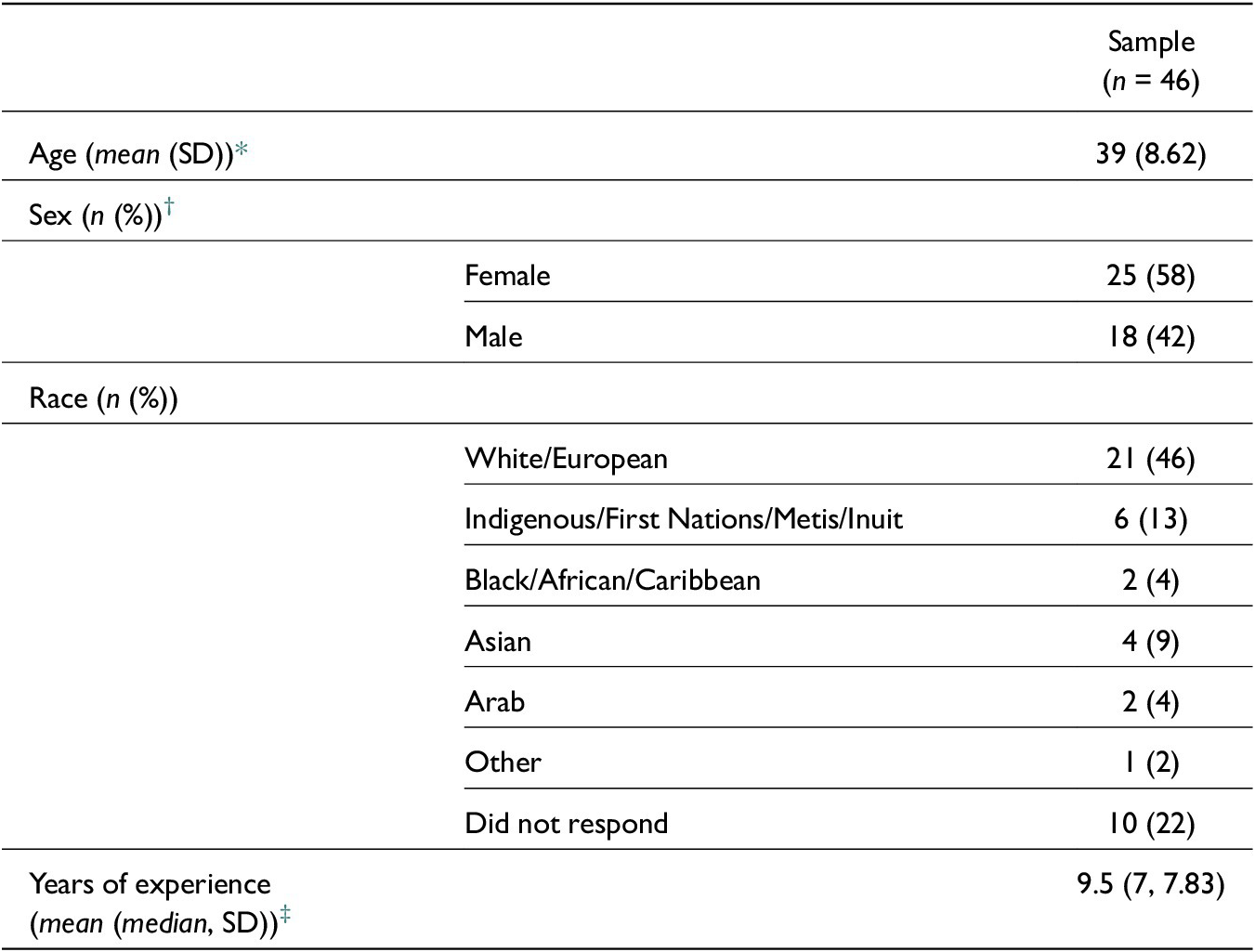
As Table 1 shows, the sample were 42 percent male (n = 18) and 58 percent female (n = 25). Most participants were of White/European background (n = 21, 46%) and had at least seven years of work experience in their role (mean = 9.5, median = 7).
Table 1. Sample Demographics

* One missing case.
† Three missing cases.
‡ Two missing cases.
Analytic strategy
This study employed an approach to thematic analysis that is informed by literature on Canadian bail and risk, as well as Indigenous overrepresentation in the justice system (Braun and Clarke Reference Braun and Clarke2006). According to Braun and Clarke (Reference Braun and Clarke2006), thematic analysis is a theoretical approach in which researchers actively engage with the literature prior to and during their analysis. We alternated between considering both existing theories and emerging themes in the qualitative data. As recommended by Braun and Clarke (Reference Braun and Clarke2006), we began the analysis by familiarizing ourselves with the data and reading over the responses. Next, we created detailed preliminary codes based on specific references made by participants, before reviewing the codes and collating them into potential overarching themes with consideration of our knowledge gained from existing literature. Finally, we refined the themes and recoded the data by combining codes we deemed too closely overlapped after rereading responses, ultimately generating our master themes.
We performed the thematic analysis described above in two phases: Phase One included data from all participants (n = 46) and Phase Two only included data from Indigenous lawyers (n = 6). We adopted this layered approach to data analysis for two reasons. First, given the historical marginalization and silencing of Indigenous voices within criminal legal scholarship (Cunneen and Tauri Reference Cunneen and Tauri2016), we contend that there is empirical value in analyzing the data provided by Indigenous lawyers as a distinct analytic category. Second, the Indigenous lawyers in our sample reported having a higher caseload of Indigenous clients than their non-Indigenous counterparts and thus more experience in representing them at bail.Footnote 6
Results
Four themes emerged from our interviews with criminal defence lawyers about whether and how Gladue factors shape bail hearings. Importantly, responses from non-Indigenous and Indigenous lawyers alike coalesced around three themes, including: (1) “Informing the court: An ‘imperfect’ process,” (2) “From ‘lip service’ to ‘tipping the balance’,” and (3) “Is Gladue enough? Institutional barriers and resource limitations.” An additional fourth theme, “Indigenous Representation ‘In This Colonial Space’” captures a perspective provided exclusively by Indigenous lawyers.
Informing the court: An “imperfect” process
The way in which lawyers discussed implementing Gladue principles in bail court varied considerably, depending on the offence severity, consent or contested release and courtroom culture and actors. This ranged from providing evidence of a client’s unique circumstances to connecting with culturally relevant resources to satisfy the court’s conditions for release. While some explained that simply alerting the court that their client identified as Indigenous was sufficient to prompt consideration of systemic factors when determining reasonable bail, others describe submitting legal decisions—such as R v Ipeelee (2012) and R v Morris (2021)—to ensure that judicial notice was taken. ID 26 explains that, while researching case-law precedent can be time-consuming, it is sometimes necessary to “pump justices full of the issues” (ID 26) or to remind the Crowns how risk can be mitigated in a culturally relevant way. Similarly, another respondent explained:
I think the Crown is generally inclined to detain, and I think that we really have to, you know, remind the judge of the principles in the section […] that, you know, you must take into account the accused person as a vulnerable member. (ID 21)
Ensuring recognition of unique circumstances also included submitting Gladue reports from recidivist clients (ID 6, ID 14) or having an accused, or their support person, take the stand “to get some of those factors out” (ID 14). While useful in securing release in some instances, in others, such practices were described as a point of contention. For instance, while ID 32 expressed that having their client take the stand in a bail hearing can feel “exploitive” at times, it is sometimes necessary to provide the courts with case-specific information to increase the likelihood of release. As they explained:
[There can be] that feeling of reverse disclosure. Like, my client is guilty before they have been found guilty. But you kind of throw all your cards on the table and hope for the best, right? You know, you’re looking out for their best interest at the time to get them out of jail essentially. (ID 23)
While “imperfect” (ID 16), or arguably “reverse disclosure” (ID 23), defence counsel affirmed that delving into the accused individual’s past may help to establish connections to trauma or hardships, thereby allowing justices to impose more appropriate conditions.
In contrast, others emphasized that, as the accused is presumed innocent, there should be no need to explain their behaviour before it has been established in court. It is inappropriate, in other words, to argue that a client should receive leniency because they “were abused or had a parent in a residential school” (ID 08) before sentencing. Using Gladue factors in this way was defined as counterproductive, as it could lead the court to view the accused as a higher risk for release.
Coordination with Indigenous-specific court workers and community resources was another approach employed when representing Indigenous clients at bail. For instance, ID 38 explained that emphasizing the cultural appropriateness of a release plan, including access to culturally integrative and responsive counselling, can address the perceived risk associated with release. Additionally, instead of reusing Gladue reports prepared for sentencing decisions, some defence counsel referenced the use of Gladue letters—documents prepared specifically for bail hearings—to acknowledge the accused’s Indigeneity and offer tailored recommendations regarding release conditions and available community supports (ID 7, ID 10). Defence lawyers also described seeking a transfer for their client to a Gladue court, in which court actors look at files differently by accounting for systemic background factors due to the specialized training they receive (ID 15).
From “lip service” to “tipping the balance”
The extent to which efforts made to encourage consideration of Gladue factors shaped outcomes at bail ranged from superficial notice on behalf of justices that made little to no difference to meaningful recognition in light of systemic and background factors. Most lawyers, however, discussed a disconnect between what the law on bail directs justices to consider and how Gladue principles are applied in practice, suggesting that Gladue considerations are imposed superficially and with limited impact. ID 24 suggests, for example, that, while justices take judicial notice of Gladue, it often translates into “lip service.” Similarly, ID 39 explains that making Gladue submissions at bail can sometimes feel like you are “saying it into the void” because there is no meaningful discussion on behalf of judicial actors thereafter. ID 44 expresses a similar idea:
When I look at the [court] transcript and I see I’ve given all of this information about the unique background and the only thing they [justice] say in their decision is “I’ve considered Gladue and nevertheless I am detaining” I think that really falls short. That’s the lip service we’re getting at. (ID 44)
It can be frustrating, for example, when a justice states that they have considered Gladue without articulating how it has been considered.
In some instances, the risk-averse culture emblematic of bail court was discussed as taking priority over a client’s unique circumstances, especially if a weak release plan is presented. This can be particularly challenging when Indigenous clients lack “access to things like sureties” due to the ongoing legacy of colonization, as ID 8 describes:
The impacts of colonialism mean that this person [accused] doesn’t have sureties. They don’t have sureties because some of their family members don’t trust the police, or because a number of their family members have been repeatedly incarcerated by the police so they have long criminal records and so they wouldn’t make good sureties because the court won’t trust them. Others are on reservation, and they don’t have access to transportation to bring a person to and from court […] there’s just so many hurdles […]. How do you expect someone to come forward with a surety when you’ve pretty much guaranteed that that’s not going to be available to them?
In other words, the systemic impacts of colonialism continue to create significant barriers for Indigenous accused that become especially apparent when they are required to meet bail conditions such as securing a surety.
Importantly, Gladue factors are not a “get out of jail free card,” but rather one part of a broader “constellation of factors” (ID 08) considered in the decision-making process. ID 1 explains that “the race card doesn’t just get thrown down and then [the accused] gets out”, likewise ID 9 states “you couldn’t have a weak release plan and just say, we have Gladue factors and have that be the foundation.”
At the high end of things [more serious offences], all these [Gladue] considerations, they really don’t enter into it because the fundamental purpose of bail is that it’s a risk assessment, right? And if your risk is off the charts, you’re not getting out. But you know, the less severe end of the spectrum, or the lower end, all kinds of stuff can happen. (ID 1)
In this sense, although Gladue considerations offer essential context in bail decisions, the management of perceived risk remains the overriding priority. Furthermore, while acknowledging the overrepresentation of Indigenous accused in the criminal legal system can be “helpful to secure releases” (ID 10) or “make it easier to achieve bail” (ID 16), it does not mean that the courts are being more lenient, but instead are recognizing how to apply the law more equitably, which can help some clients who would otherwise be detained to get “over the hump” (ID 4):
It makes the justice or the judge or the Crown consider release for this person in [a specific] context. But it only helps them get to the point where it should be. So, it works well in that it sort of changes the playing field. (ID 13)
Said differently, Gladue factors do not simply substitute or mitigate a weak release plan, as defence counsel are still required to meet the high bar set by the courts (ID 31).
Defence lawyers discussed the most meaningful examples of Gladue considerations in Gladue courts due to the varied resources available and specialized knowledge on behalf of judicial actors. For instance, Gladue courts were noted as being very effective in helping to connect clients to counselling and remedial programmes that make a significant difference, not only when seeking to mitigate risk when developing release plans, but also in the well-being of Indigenous accused. ID 10 recounts how Indigenous clients have “fared better” when they have access to the programming and resources available in Gladue courts, as opposed to conventional courts in which such resources are not as readily available.
Is Gladue enough? Institutional barriers and resource limitations
Despite the promise of Gladue in providing crucial context for pretrial decision-making, defence counsel identified challenges in overcoming systemic barriers, such as jurisdictional variation, judicial bias and limited resources, making access to equitable bail for their Indigenous clients difficult in practice. ID 13 explains, for instance, that while legislation “is working, it’s not enough.” The differences in practice largely depend on the decision-maker or “who’s sitting where” (ID 24), highlighting how access to justice is shaped by geographical variation and court culture (ID 35). ID 5 notes that some justices are “better than others,” especially when they acknowledge that certain bail conditions proposed by the Crown “don’t make sense” or will impose barriers, while others, as ID 2 suggests, simply do not care:
Basically, the [justice] just told me that because there was not a Gladue report in front of him at the bail hearing, he could not consider Gladue on bail, which is contrary to a whole bunch of case law which I had submitted to him. But he did not care.
Variation in practice was also attributed to the level of training, years of experience and age of the court actors. ID 6 recounts having had more positive experiences with newer or well-trained justices, but explains facing difficulties with more recently appointed Crowns due to a lack of experience. Further, ID 11 notes having more success in larger as opposed to more rural communities, attributing this difference to a lack of diversity and experience in implementing Gladue principles in some rural areas:
It depends on where you are, too. Cause if you’re in the major cities, you’re usually fine. But I’ve had very interesting bail experiences in [smaller city]. In those jurisdictions, if you’re running a bail hearing, you basically bring a case book. Because you’re like, I might have to educate this justice. (ID 11)
Another important barrier discussed when preparing a bail plan for Indigenous clients was a lack of time and resources. As previously noted, gathering relevant case law, connecting with community or court-specific resources, opposing unrealistic conditions proposed by Crowns and retrieving information related to historical and ongoing trauma require both time and access to resources. In bail court, however, a reliance on efficiency, where the culture is “haphazard and ad hoc” (ID 32) and where accused may agree to onerous conditions to be released more immediately, poses constraints for defence counsel, particularly those reliant on legal aid, which is “woefully underfunded” (ID 5). ID 6 explains, for instance:
For people who are on legal aid certifications, they don’t pay particularly well for hearings to begin with. So, a lot of lawyers are not particularly well-motivated to do the extra leg work to get [any extra] materials. And even if we advise clients to wait a couple of days to get some supporting materials from an Indigenous support worker, they just want to go ahead.
Put differently, even when a defence counsel recognizes the need for culturally appropriate and well-supported bail plans, they are often constrained by the time pressures, inadequate funding and clients’ understandable desire for immediate release, thereby undermining how Gladue principles are considered in practice.
Disparities in the availability of resources across jurisdictions were also referenced as creating inequities for Indigenous accused. ID 36 discusses how a lack of access to bail beds in their community disproportionately impacts Indigenous accused who “don’t have extra resources,” such as access to a surety. Further, ID 16 states that reducing pretrial incarceration requires integrating support services directly within courthouses so that counsel are not forced to “run around and spend half of their day trying to find” resources. To address these barriers, some defence counsel envisioned opportunities to develop Indigenous bail courts or spaces for Indigenous decision-making within the adversarial system.
Lastly, the capacity to access bail-specific case law and decisions that account for the unique circumstances of Indigenous clients was described as limited. ID 24 explains, for instance, that there is a lack of accessibility to good bail decisions because of the costs associated with affording the transcript, as well as limited case law or guidance on how to apply Gladue principles at bail. Similarly, ID 24 suggests that, while there may be “great decisions in terms of how Gladue factors are taken into consideration” at bail, the pressure on time may limit the capacity of defence lawyers to do “the leg work” or of judges or justices in articulating these factors to produce a public record, causing recognition to fall short in practice.
Valuing Indigenous representation “in this colonial space”
Indigenous lawyers offered meaningful insights into the Gladue factors, informed by their lived experiences and unique positionality. ID 46 laments, for example, how Indigenous peoples working within the system are often able to recognize systemic barriers and articulate unique circumstances to the courts, especially if they are from the same community as the accused, as opposed to simply telling the courts that this person is Indigenous, which can be a more common practice with non-Indigenous lawyers:
It’s things that I just know [about the accused] on the fly that other [non-Indigenous lawyers] wouldn’t unless somebody sat them down to explain it. Because most of them [accused] I’ve known my entire life. I’ve grown up with them. I know their families. So, even though I sit with them and ask specific background circumstances and information, a lot of it I already know just from being in those communities, and from knowing their families. So, I typically can provide more background information at the bail stage. (ID 46)
This quotation highlights the value of Indigenous representation within the justice system by allowing a more informed understanding and presentation of context at bail related to Gladue factors. Further, while expanding training or education on how systemic factors are pertinent to bail decisions is of crucial importance for court actors, Indigenous defence counsel also affirmed the value of lived experience:
You just can’t teach that lived experience, in my jurisdiction, none of them [justices] are racialized, so they don’t understand the background. They have no idea. And I’m not saying they don’t have hardships in their lives, but it’s hard to teach that. You can’t teach that. (ID 44)
Indigenous representation, particularly behind the bench, was also described as shaping procedural dynamics during bail court, moving beyond outcome decisions to detain or release. ID 46 explains that, in Gladue courts, there is an opportunity to “push the boundaries” in an otherwise “colonial space.” As an example, ID 46 recounts an Indigenous justice who demonstrated respect for a surety by simply recognizing her presence in the courtroom:
The respect of, you know, when she [the surety] came into the courtroom and sat down […] she [the justice] just looked at her and said “Boozhoo [hello], nice to see you”. Even just that, right? Because it feels so often like, in this colonial space, there’s not space for how we would commonly respect and greet each other in our own communities. (ID 46)
Likewise, ID 45 describes the important work completed by an Indigenous court worker in a remote community who was able to provide invaluable support for Indigenous clients and the courts:
She [court worker] would go up in the bush and find sureties but could also give the background [to the courts] because these were all community members from her community […]. And so when I went into bail court, I’d be able to give this story and this information. (ID 45)
Indigenous representation, in other words, in both support roles and judicial actors, can meaningfully shift the culture of bail court by creating space for culturally grounded practices that may be absent in other legal settings.
In many instances, Indigenous lawyers also described their work as deeply personal, rooted in a sense of duty to support and give back to their communities:
My community has put so much into me that you know I’m part of this community. Everybody who is coming before the court, they’re my, you know, cousins. They’re my extended relatives, my brother, my aunts and uncles. So, it’s a different motivation when you’re putting together a bail plan, you’re not thinking like, legal aid is only going to cover me for x number of hours. You end up just putting in whatever you need, to put it right. (ID 46)
The work involved in developing a strong bail plan and guiding non-Indigenous court actors to “take off their colonial glasses” (ID 44), however, was flagged as also being tiring and onerous. For instance, justices were described at times as relying too heavily on Indigenous lawyers to bridge the gap on how systemic circumstances shape bail decisions, while, in other cases, the complex nature of the work was felt to be indicative of high rates of staff turnover and burnout among Indigenous lawyers and court workers:
Not only are we coming with our own bag of systemic issues and background, but we are also dealing with our people in a very vulnerable sense, and then we’re trying to educate the bench, and also trying to argue these really important pieces. And we’re also relied on more as Indigenous lawyers. (ID 44)
As this quote demonstrates, the expectation to both support accused and educate the courts can contribute to burnout and high turnover in the absence of broader responsibility and support.
Despite their best efforts, Indigenous lawyers perceived that context surrounding their clients’ lived realities pertinent to applying a Gladue lens is still missed in practice. For example, the fast-paced culture of bail court was juxtaposed with the expectation to provide information related to historical and ongoing trauma. ID 24 explains that it can be “hard to articulate that trauma when I only have 20 minutes of submissions, without seeming really cold” towards the client. To address this challenge, adopting a trauma-informed approach, underscoring the importance of communication and consent when documenting and presenting clients’ personal circumstances, was discussed:
So, I usually talk to my client and try to get as much information in the beginning. And explain to them, this is what I am going to go over, or what would you like me to focus on? So, it’s really important to spend that time with the client beforehand and communicate why I’m going to be making this submission. Because if I don’t, I don’t know how my client is going to take that. (ID 24)
Ultimately, while Gladue factors were described as undeniably important in bail processes, Indigenous lawyers emphasized the amount of care and effort required to ensure that “things are fair” (ID 46), which, in many cases, is still not enough.
Discussion
This paper seeks to better understand whether and how the principles outlined in R v Gladue are implemented from day to day in bail hearings. While the lawyers in our sample unanimously agree that Gladue factors are important and effective in achieving equitable release, they also report that implementation is varied and flawed. By highlighting both the promise and the limitations of the application of Gladue pretrial, the study offers valuable insights into the factors that help and hinder its full realization, such as a risk-averse court culture, systemic bias and access to social-legal services. The findings provide insight into the extent to which the goals of lawmakers and the potential of Gladue are achieved, as well as avenues for bail reform.
On the one hand, Gladue principles offer a critical tool to advance recognition of how dominant risk narratives can disadvantage Indigenous accused, demonstrating their relevance beyond sentencing (Pfefferle Reference Pfefferle2008; Rogin Reference Rogin2017). In practice, the specialized knowledge considered through a Gladue lens has the capacity to contextualize risk within a broader framework of settler-colonial histories, thereby disrupting overly individualized assessments. In this sense, greater understanding of systemic barriers—such as poverty, discrimination, intergenerational trauma and social exclusion—that have been found to create obstacles in meeting the often-high thresholds set for interim release are considered (Berger et al. Reference Berger, Myers and Deshman2024; Maurutto and Hannah-Moffat Reference Maurutto and Hannah-Moffat2016; Mitchell and Webster Reference Mitchell, Webster, Campbell and Wellman2023). Our findings also affirm previous literature that underscores the importance of Gladue courts in providing access to culturally integrative resources, including specialized Indigenous knowledge (Knazan Reference Knazan2008; Rudin Reference Rudin2009). In short, while not a “get out of jail free card,” the meaningful application of Gladue principles has the potential to re-situate risk within a broader structural and historical context or to “tip the balance” towards more equitable justice pretrial.
On the other hand, our results show that the consistent use of Gladue principles during pretrial processes is far from guaranteed. This is perhaps not surprising, as “Supreme Court decisions are only as effective as the way they are interpreted and applied in practice” (Canon and Johnson Reference Canon and Johnson1999; Gorman Reference Gorman2018; Schumann and Yule Reference Schumann and Yule2022, 2). There are at least three plausible explanations that account for the uneven application of Gladue in bail hearings. First, on-the-ground implementation is complicated by the fact that it was a precedent-setting case that outlined factors, including the impact of colonialism, discrimination and historical trauma, for sentencing courts—not bail courts—to consider. While subsequent case law and legislation have affirmed the relevance of Gladue principles to bail, our participants emphasized that the context is fundamentally different due to the presumption of innocence pretrial. Indeed, the task of giving “particular attention to the circumstances” of Indigenous accused is arguably more challenging at bail, as defence lawyers feel compelled to outline background circumstances and contextualize patterns of offending but do so at the risk of suggesting that their clients are guilty. Thus, even if members of the courtroom workgroup understand that the standard “one-size-fits-all” legal approach does not treat all accused equitably, they may struggle to implement Gladue without compromising their client’s presumption of innocence (Nixon et al. Reference Nixon, Yule and Baker2024). Our findings underscore other scholarship that reviews Gladue bail jurisprudence and cautions that Indigenous peoples may disproportionately experience punishment before conviction via the application of inappropriate or onerous conditions of release (Rogin Reference Rogin2017; Mitchell and Webster Reference Mitchell, Webster, Campbell and Wellman2023).
Second, local court culture likely influences how judicial actors interpret and apply higher court decisions. Several participants who routinely represented clients in different locations commented on jurisdictional differences in the court’s understanding and acceptance of Gladue. This concept of justice by geography—which underscores how the administration of bail is a matter not only of law, but also of place—is documented in other research on bail (e.g., reliance of sureties (Schumann Reference Schumann2018; Myers and Ireland Reference Myers and Ireland2021) and in context of Antic (Schumann and Yule Reference Schumann and Yule2022)). Our participants commented that, in some jurisdictions, there was more recognition of Gladue principles or availability of resources, while, in others, a more punitive or risk-averse approach dominated. More specifically, justices in smaller jurisdictions or with less experience were characterized as needing “additional training” on how Gladue is relevant than their counterparts in larger jurisdictions or those with more extensive experience. Third, it is evident that counsel face various challenges when seeking to translate Gladue principles into practice that reflect systemic issues embedded in Canadian bail courts: pressure on time and efficiency, lack of adequate funding for legal aid and the availability of community resources (Berger et al. Reference Berger, Myers and Deshman2024; Webster Reference Webster2022; Yule and MacDiarmid Reference Yule and MacDiarmid2024).
Notwithstanding their enthusiasm for the potential of Gladue to foster equitable bail, the participants in our sample recognized that legal decisions and bail law are important but ultimately insufficient to address the structural inequalities that Indigenous peoples face in navigating a settler-colonial justice system. Community and legal supports—such as Indigenous court workers, Indigenous People’s Court, and culturally grounded bail supervision programmes—play a critical role in actualizing the principles of Gladue by offsetting the risk-averse culture of the bail court. Yet, these supports alone are not enough to shift the high incarceration rates of Indigenous accused (Mitchell Reference Mitchell2023). Interestingly, many lawyers in our sample did not discuss the need to contextualize the criminal record, such as over-policing and false guilty pleas, despite the relevance of these factors in the bail context concerning Indigenous accused (Rogin Reference Rogin2017). As such, there is a continued need to ensure that judicial actors are informed of the explicit ways in which Gladue factors can and should shape decision-making during bail processes that move beyond judicial notice to also recognize how criminal records disproportionately penalize Indigenous accused (Clark Reference Clark2019; Mitchell and Webster Reference Mitchell, Webster, Campbell and Wellman2023).
An important contribution of this study is the inclusion and prioritization of Indigenous lawyers whose insights highlight both the significance of racial diversity among judicial actors as well as the onerous work required in guiding non-Indigenous legal professionals to “take off their colonial glasses.” Indigenous voices are necessary for the meaningful critique and transformation of a colonial-settler criminal legal system (Monture-Angus Reference Monture-Angus1999; Smith Reference Smith2012; TRC 2015), honouring the principle of nothing about us without us. The importance of lived experience and representation uniquely positioned Indigenous lawyers, justices and court workers to recognize and articulate the relevance of Gladue factors during bail hearings, supporting more equitable processes and outcomes (Mitchell Reference Mitchell2023). It is also evident, however, that Indigenous lawyers occupy a complex space—working within a colonial legal system while striving to resist or transform it (Lawrence and Shanks Reference Lawrence and Shanks2015; Martin Reference Martin2020). This dual role, combined with a feeling of intrinsic responsibility to their communities and their perception of being relied on to “bridge the gap” between systemic factors and reasonable bail, increased their emotional labour and heightened risks of burnout (Cadieux et al. Reference Cadieux, Cadieux and Gouin2022; Hochschild Reference Hochschild1979; Mohamed and Beagan Reference Mohamed and Beagan2019).
While our study offers important insights into the extent to which Gladue factors shape the bail process to promote equity, it has several limitations. First, the study relied on a volunteer sample and it is reasonable to assume that lawyers with stronger opinions about the experiences of racialized accused at bail were more likely to self-select into the study. This comparatively small, non-random sampling limits the generalizability of our findings. Second, our interviews suggest that Indigenous lawyers—due to higher caseloads involving Indigenous clients and their own lived experiences—offer unique insights into the role of Gladue at bail. Future research should continue to prioritize this important perspective while working in collaboration with Indigenous communities. Third, our findings are based on lawyers’ perceptions of the importance and impact of Gladue factors at bail, but perceptions are imperfect proxies for behaviour. Research involving courtroom observations would help to triangulate our data. Finally, our data were derived exclusively from criminal defence lawyers. Future studies examining Crown perspectives would provide a valuable comparison, shedding light on how different legal actors may approach bail decisions with Gladue factors in mind.
Conclusion
The overrepresentation of Indigenous peoples in Canada’s criminal legal system has persisted for decades, despite legislative reforms and appellate guidance aimed at addressing systemic inequality and reserving incarceration as a last resort. Pretrial decision-making plays a pivotal role in either reproducing or resisting the ongoing impacts of settler colonialism. Gladue factors are intended to guide judicial discretion by contextualizing risk within the broader legacy of colonial harm and the unique social, economic and cultural realities of Indigenous peoples. Our study suggests that the extent to which Gladue principles inform bail decisions varies widely, shaped by localized court cultures, systemic constraints and judicial orientation. Despite this variability, Indigenous lawyers emphasize how lived experience, community knowledge and Indigenous-led supports can help translate Gladue into a more meaningful legal principle. Yet, even the most skilled and committed counsel face barriers when representing Indigenous clients. These findings point to the limitations of relying on legal principles to address over-incarceration in the absence of structural reform—including increased accountability, access to sociolegal resources and sustained investment in culturally appropriate services.
Legislation
Canadian Charter of Rights and Freedoms, 1982. https://www.justice.gc.ca/eng/csj-sjc/rfc-dlc/ccrf-ccdl/
Criminal Code of Canada, R.S.C., 1985. c. C-46. https://laws-lois.justice.gc.ca/eng/acts/c-46/
Case law
R v Antic, 2017 SCC 27, [2017] 1 SCR 509.
R v Gladue, [1999] 1 SCR 688.
R v Ipeelee, 2012 SCC 13, [2012] 1 SCR 433.
R v Morris, 2021 ONCA 680.
R v Papequash, 2021 ONSC 727.
R v Robinson, 2009 ONCA 205, 95 OR (3d) 309.
R v Tunney, 2018 ONSC 961.
R v Zora 2020 SCC 14, [2020] 2 SCR 3.

 Open access

