


Introduction
Wildfires in the summer of 2023 generated significant public attention and were identified as the top political story for 2023 (Tutton Reference Tutton2023). This obviously focused attention on climate change, but government efforts to respond to climate change generated significant political pushback. The Conservative opposition launched a major “Axe the Tax” campaign in opposition to a carbon tax, and Liberal backbenchers from Atlantic Canada voiced unhappiness, resulting in the government approving “a temporary, three-year pause from the carbon price for people who use heating oil” (Taylor & Rabson Reference Taylor and Rabson2023). Canada's population reached 40 million for the first time, with much of the population gain coming from immigration and an indication that it “was adding pressure to a housing market riddled with challenges” (CBC News 2023). In addition to the housing concerns, the government faced issues surrounding affordability, with concerns over the cost of groceries resulting in the heads of major grocery chains coming to Ottawa to explain the price hikes and changes announced in competition policy (Galea & Kirby Reference Galea and Kirby2023).
Concerns over Chinese interference in Canadian elections led the government to launch an investigation, but opposition resistance to the individual named to head this investigation eventually forced him out (Major Reference Major2023). Indications that the Indian government may have been involved in the assassination of a Sikh leader in Canada damaged bilateral relations while the controversy over Gaza and the Israeli response to the Hamas attack in October led to major public protests (Zura & Marchesan Reference Zura and Marchesan2023).
By the summer, the Conservatives had taken a huge lead in the public opinion polls and seemed capable of winning the next election scheduled for 2025. The confidence and supply agreement between the Liberals and New Democrats remained in force and, in December, action on a key component of that agreement emerged, with the government announcing a new pharmacare policy. Liberal MPs seemed restive, as the pushback from Atlantic MPs indicated (Stefanovich Reference Stefanovich2023). Further indications of this restiveness could be seen in public discussions about the government's response on the Middle Eastern issue, as well as some actual indication that it might be time for the government to respond more forcefully to the Conservative rise in the polls.
Elections
Regional elections
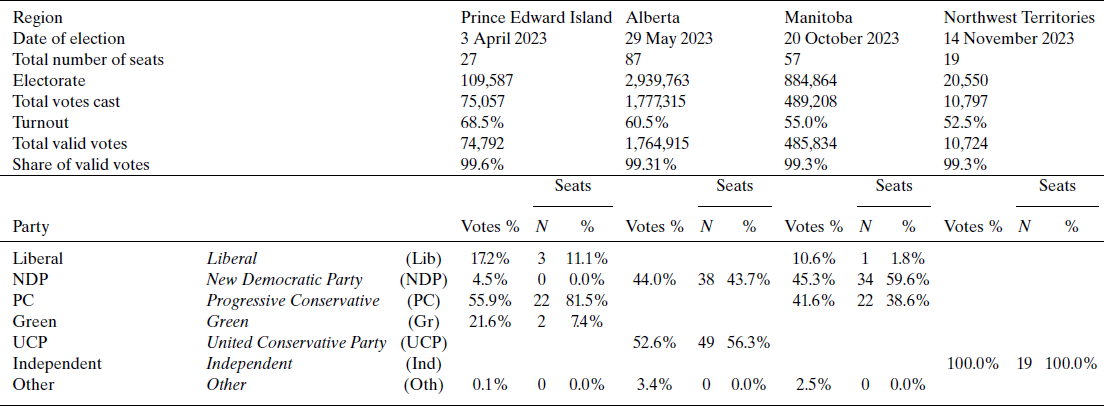
Three provinces and one territory held elections in 2023. In each of the provinces, a “Conservative” government was in office, and two of those governments were re-elected: in the western province of Alberta with a reduced majority, but an increased desire to attack the federal government, and in the smallest province of Prince Edward Island, with a substantially increased majority. In Manitoba, a two-term Progressive Conservative government was defeated, and the New Democratic Party (NDP) came to power. The new NDP Premier, Wab Kinew, became “the first provincial premier in Canada to be from a First Nation” (Taylor Reference Taylor2023). The lone territorial election in the Northwest Territories involved no political parties but saw many incumbents defeated and eventually a new premier appointed by the legislature (Cohen Reference Cohen2023).
In Alberta, the legislature was divided between only two parties, with the opposition New Democrats winning most seats in the two largest cities and a number of Cabinet ministers defeated. In Manitoba, the Liberal third party saw their popular vote and representation in the legislature decline, and by the end of the year, only one Liberal member sat in a provincial legislature in the four western provinces, as the Liberal party in British Columbia changed their name to BC United to indicate more clearly a lack of association with the federal Liberals. In Prince Edward Island, the Green party, which formed the official opposition after the last election, saw that position taken by the Liberals despite the Greens managing a higher share of the popular vote (Table 1).
Table 1. Results of regional (Prince Edward Island, Alberta, Manitoba, Northwest Territories) elections in Canada in 2023

Note: No parties in the Northwest Territories elections.
Cabinet report
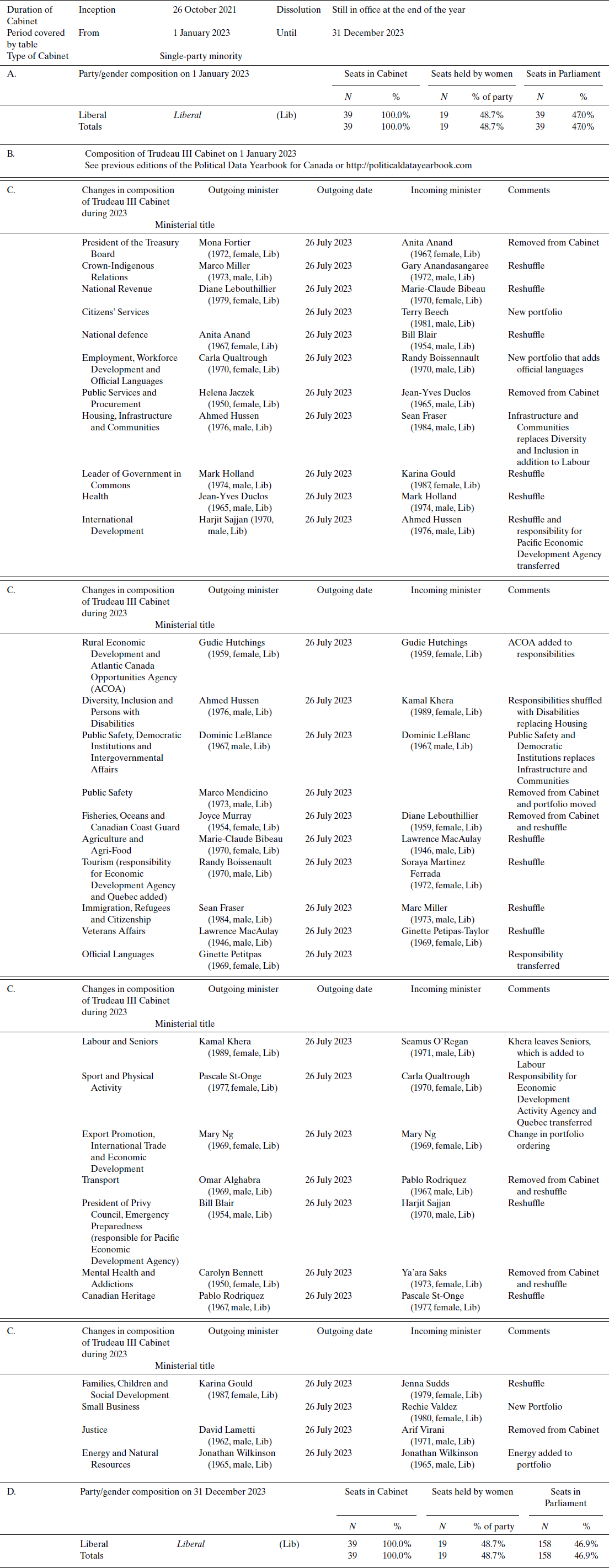
This was a year of major changes in the federal Cabinet (Table 2). A shuffle in June saw seven ministers replaced in Cabinet and most other members changing portfolios (Tunney Reference Tunney2023b). Four of those leaving Cabinet had indicated that they would not seek re-election, while three were simply removed. Only eight Cabinet ministers remained in the positions they occupied in 2022. These, however, included the Deputy Prime Minister and Minister of Finance, as well as the ministers of Foreign Affairs and the Environment. The overall number of Cabinet ministers was unchanged, and the Prime Minister continued to draw attention to the even divide between men and women in his appointments (Prime Minister of Canada 2023). The new Cabinet was expected to put a new face on the government as a new election period neared and the Conservative opposition grew in popularity.

Parliament report
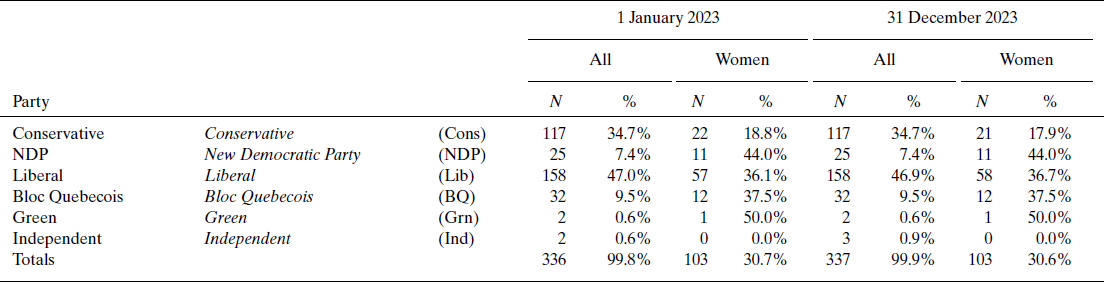
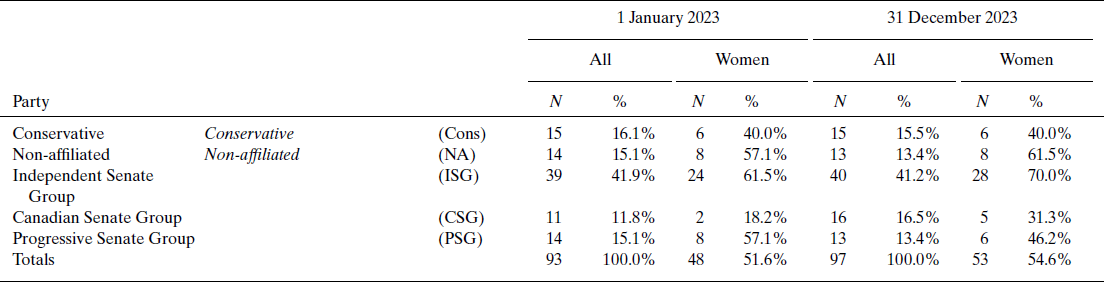
Unlike the Cabinet, there were no major changes in Canada's Parliament (Tables 3 and 4). As always, there were some minor personnel changes in the upper house, with some members reaching the age of 75, which requires them to retire, and with the Conservative caucus continuing to be the only partisan group connected to the parties in the lower house. The year ended with eight of the 105 seats in the chamber vacant.
Table 3. Party and gender composition of the House of Commons in Canada in 2023

Sources: See previous editions of the Political Data Yearbook for Canada and www.ourcommons.ca/members/en/.
Table 4. Party and gender composition of the Senate in Canada in 2023

Sources: See previous editions of the Political Data Yearbook for Canada and https://sencanada.ca/en/senators/.
By-elections resulted in no changes to the partisan composition of the elected House of Commons chamber. The Liberal and Conservative parties were successful in retaining the seats vacated. The Liberals won the two seats they previously held, and the Conservatives were again successful in three ridings they held. The leader of the populist People's Party, which won about 5 per cent of the vote in the 2021 election but elected no members (see 2021 edition of Political Data Yearbook for Canada), attempted to win a seat in one of the by-elections, but the party's vote actually fell and a Conservative member was again returned to Ottawa. The ranks of independent members grew by one, as a Liberal member from Ontario left the party caucus after allegations emerged of providing advice to the Chinese government on Canadians detained in that country (Burke Reference Burke2023). When that allegation was not verified, he indicated a desire to return to the Liberal caucus, but that had not occurred by the end of the year. Indeed, as Burke points out, “Since Trudeau became Liberal leader, almost a dozen other Liberal MPs have left or been dropped from caucus to sit as Independent MPs for various reasons […] None have returned to caucus” (Burke Reference Burke2023). The Conservative numbers were down by one, as their former leader resigned in August and no by-election was held.
Controversy attended the position of House Speaker with Speaker, Anthony Rota, stepping down after he “failed to exercise due diligence about a guest invited to watch the Ukrainian President's address to Parliament” (Wherry Reference Wherry2023). His successor, Greg Fergus, was also heavily criticized for providing what was seen as a partisan tribute to a provincial member in Ontario.
Political party report
The year 2023 was a quiet year in terms of political party changes. The new Conservative leader, Pierre Poilievre, made extensive efforts to introduce himself to the Canadian public. These results were largely successful, and his efforts resulted in him being named by the Canadian Press as the Newsmaker of the Year amidst suggestions that “He's the clear favourite to be the next prime minister” (Taylor Reference Taylor2023).
Green party co-leader, Jonathan Pednault, was unsuccessful in his attempt to win a seat in a Montreal area by-election. People's Party leader, Maxine Bernier, also failed to win a by-election and saw his party's support actually decline. The party did take 17 per cent of the vote in the riding and “In an e-mail to supporters, Bernier said: ‘We're not going away!’” (Djuric & Taylor Reference Djuric and Taylor2023).
Issues in national politics
The introduction touched on the issues surrounding the wildfires and the response to controversy around the Carbon Tax and broader affordability issues. These issues spilled over into federal–provincial disputes and resulted in the NDP and Conservatives jointly voting for a motion calling for the Carbon Tax to be paused on all forms of home heating. The motion was defeated as the Bloc supported the Liberals (Aiello Reference Aiello2023).
Foreign policy issues were uncharacteristically important in 2023. In response to allegations surrounding Chinese interference in Canadian elections, the government appointed former Governor General David Johnston to conduct an investigation. Johnston was heavily criticized by the Conservatives because of ties to the Prime Minister and recommended against a public inquiry. He eventually resigned after the House of Commons passed a motion calling on him to step down (Major Reference Major2023). In September, the government announced a public inquiry led by a former Quebec Justice and with terms of reference agreed to by all parties with reports to be issued in 2024.
Relations with India also generated headlines as Prime Minister Justin Trudeau announced in the House of Commons in September that “Canadian security agencies have been actively pursuing credible allegations of a potential link between agents of the Government of India and the killing of a Canadian citizen, Hardeep Singh Nijjar” (Tasker Reference Tasker2023). The Indian government expelled a number of Canadian diplomats over the issue, but the American government also raised concerns, and as the year ended, bilateral relations seemed to be improving (Panetta Reference Panetta2023).
Canada's foreign relations were further complicated by the issues relating to the Hamas attack in Israel and the Israeli government's actions in Gaza. Canada broke new ground in a series of votes in the UN in terms of calling for a ceasefire and the issue inspired a series of public protests in Canada that continued through to the end of 2023 and seemed likely to continue further (Robertson Reference Robertson2023).
Finally, a report on the government's use of the Emergencies Act in 2022 was released, and the Commissioner indicated “that the federal government met the ‘very high’ threshold needed to invoke […] citing ‘a failure in policing and federalism.’ ‘Lawful protest descended into lawlessness, culminating in a national emergency’ […] ‘Invocation of the Emergencies Act is a drastic move, but it is not a dictatorial one’ […] ‘I do not come to this conclusion easily, as I do not consider the factual basis for it to be overwhelming’ […] ‘Reasonable and informed people could reach a different conclusion than the one I have arrived at.’” (Tunney Reference Tunney2023a). Court cases on this controversial issue continued to wind their way through the legal system.

 Open access

