


Introduction
After the elimination policy, which previously shielded Aotearoa New Zealand from the worst consequences of the pandemic, 2022 was a more unsettled year. COVID-19 spread rapidly in the community, citizens’ acceptance of pandemic measures waned and the government faced the difficult task of unwinding border protections. A three-week occupation of the parliamentary precinct set the scene for growing polarisation, misinformation and conflict. The exit from pandemic politics back to some kind of ‘politics as normal’ proved difficult for Prime Minister Jacinda Ardern and her government.
Election report
There were no parliamentary elections in 2022.
By-elections
In 2022 there were two by-elections. After former National Party leader Simon Bridges retired from politics, a June by-election was held and won comfortably by National candidate Sam Uffindell (55.9 per cent) in the safe electorate of Tauranga (Electoral Commission 2022b).
A second, unexpected by-election came later in the year. On 11 August, first-term Labour MP for Hamilton West, Gaurav Sharma, began airing grievances in lengthy social media posts that alleged bullying and Official Information Act avoidance in the party. He was suspended from Labour's caucus on 16 August and expelled from the party a week later. Sitting for a time as an independent, Sharma eventually resigned to recontest his seat (RNZ 2022b). The National Party's Tama Potaka (46.2 per cent) won the bellwether electorate in the 10 December by-election, defeating both Sharma (8.2 per cent) and Labour's candidate (30.1 per cent) (Electoral Commission 2022a).
Local elections
Issues around water, co-governance with Māori, housing densification and the future of transport infrastructure all featured prominently in local elections in October. Perhaps reflecting broader voter discontent, incumbents struggled, and a shift to the right was evident in local councils and mayoral offices nationwide. Wellington bucked this trend by electing as its mayor a former chief of staff for the Green Party, also the city's first mayor of Māori descent. However, turnout was low everywhere—39 per cent for city council elections and 41 per cent for mayoral races (Department of Internal Affairs 2023).
Cabinet report
A major Cabinet reshuffle occurred in June, after Senior Minister Kris Faafoi announced he would soon retire. His portfolios were distributed amongst existing Cabinet members: Willie Jackson took on Broadcasting and Media, Michael Wood the Immigration portfolio and Kiri Allan became Minister of Justice and Associate Minister of Finance. With Faafoi's departure, Priyanca Radhakrishnan, previously outside Cabinet, entered Cabinet and added Associate Minister for Workplace Relations to her responsibilities. Another MP from Labour's Class of 2017, Kieran McAnulty, was promoted to Ministerial ranks outside Cabinet and made Minister of Racing, Minister of Emergency Management and Associate Minister of both Local Government and Transport.
At the same time, following sustained criticism from the opposition about her handling of youth crime and gang issues (Witton Reference Witton2022), Poto Williams was removed as Minister of Police and Minister for Building and Construction, with her portfolios transferred to high-performing Cabinet members, Chris Hipkins (Police) and Megan Woods (Building and Construction). In exchange, Williams received Conservation from Allan and Disability Issues from Carmel Sepuloni. During this reshuffle, Ayesha Verrall, still a first-term MP, received another major promotion. Having been made Associate Minister for COVID-19 Response in February 2022, she now assumed the full COVID-19 Response portfolio from Hipkins and Research, Science and Innovation from Woods.
In her reshuffles, Prime Minister Ardern tended to load additional responsibilities onto existing Cabinet colleagues rather than appoint new ministers. The additional workload and stress took its toll on several ministers as the term wore on.
Details of Cabinet composition and changes can be found in Table 1.
Table 1. Cabinet composition of Ardern II in New Zealand in 2022

Source: Department of the Prime Minister and Cabinet (2022) (https://dpmc.govt.nz/our-business-units/cabinet-office/ministers-and-their-portfolios/ministerial-list).
Parliament report
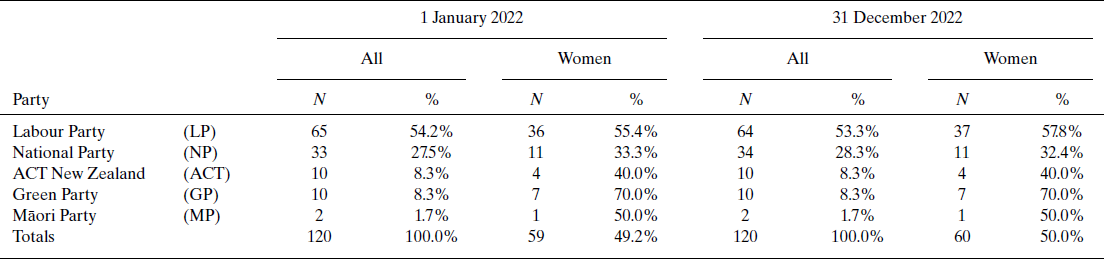
The party composition of Parliament changed slightly in 2022 with the Hamilton West by-election, which saw National retake one seat from Labour (see Election Report). Other changes occurred within party ranks (Table 2). On 1 May, Labour List MP Louisa Wall resigned and was replaced from Labour's list by Lemauga Lydia Sosene. On 23 July, List MP and former Cabinet Minister Kris Faafoi ended his 12-year political career, replaced by Dan Rosewarne. Not long afterwards, Faafoi began work in a public relations and lobbying company, reviving debate about the ‘revolving door’ between politics and the world of lobbying. Another high-profile exit came in October. Trevor Mallard, one of few remaining MPs to have been elected under the previous First-Past-the-Post electoral system, resigned after almost 35 years in Parliament. Mallard had also served as Speaker of the House (2017–2022), notably introducing changes to make Parliament more family-friendly. Mallard was replaced as Speaker by Labour's Adrian Rurawhe and as List MP by Soraya Peke-Mason. He was subsequently appointed Ambassador to the Republic of Ireland.
Table 2. Party and gender composition of the Parliament in New Zealand in 2022

Source: Parliament website (2022) (www.parliament.nz/en/mps-and-electorates/members-of-parliament/).
Political party report
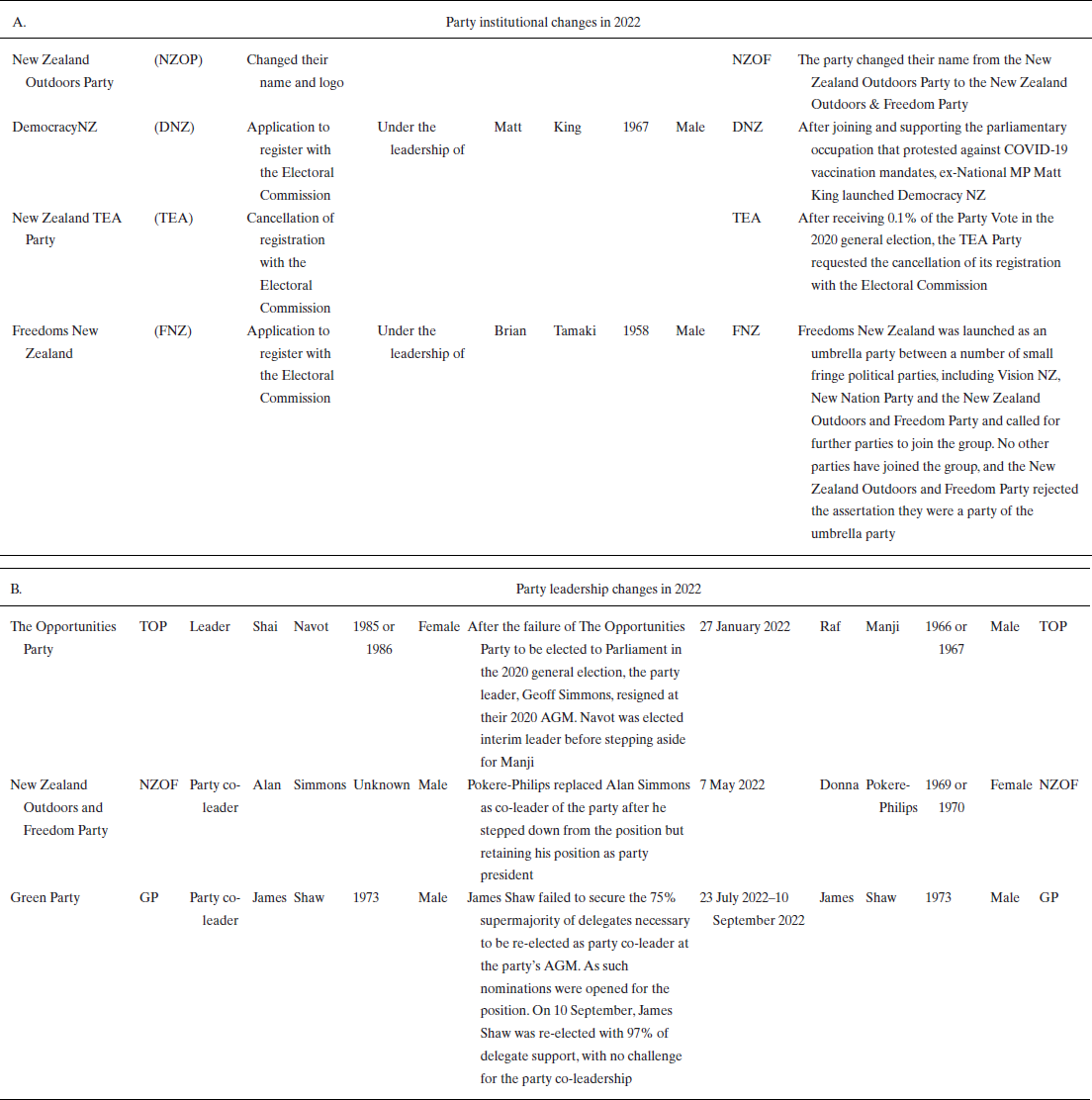
The Green Party experienced some turbulence when James Shaw, co-leader since 2015, failed to secure the necessary 75 per cent of delegates in the annual leader re-election required by the party's constitution, causing nominations to be re-opened (Sherman Reference Sherman2022). Despite dissatisfaction with his leadership among some party factions, no other candidates emerged, and Shaw was confirmed as party co-leader in September.
During 2022, some fringe movements associated with anti-lockdown and anti-vaccine protests consolidated into new parties and around existing parties. Although none has yet gained representation, the increase in party activity from the conspiracy fringes is noteworthy.
Details of changes in political parties can be found in Table 3.
Table 3. Changes in political parties in New Zealand in 2022

Sources: 1. Electoral Commission (2022c) (https://www.elections.nz/media-and-news/2022/change-to-nz-outdoors-and-freedom-party-name-and-logo/); Electoral Commission (2022d) (www.elections.nz/democracy-in-nz/political-parties-in-new-zealand/register-of-political-parties/); Outdoors and Freedom Party (2022) (www.outdoorsparty.co.nz/very-successful-agm-held-at-mount-maunganui-sat-7th-may-2022); Radio New Zealand (2022c) (www.rnz.co.nz/news/political/460349/former-christchurch-councillor-raf-manji-to-lead-top-party); Radio New Zealand (2022d) (www.rnz.co.nz/news/political/474500/james-shaw-re-elected-as-green-party-co-leader-by-delegates).
Institutional change report
A significant law passed in 2022 addressed the relationship between the country's judiciary and legislature. In 2018, the Supreme Court ruled in a case about prisoner voting (Attorney-General v. Taylor) that the higher courts could make ‘declarations of inconsistency’ where legislation appeared to breach a right or freedom protected by the New Zealand Bill of Rights Act 1990. While courts cannot annul or override legislation in New Zealand's model of parliamentary supremacy, a declaration of inconsistency allowed the judicial branch to formally express its view that legislation is inconsistent with the Bill of Rights Act, although the legislature was not obliged to act or even respond (Palmer & Knight Reference Palmer and Knight2022: 190–198). Given these developments, the government introduced the New Zealand Bill of Rights (Declarations of Inconsistency) Amendment Act 2022 to create formal processes for the executive and legislature to respond to declarations of inconsistency. The Act requires the Attorney-General to notify Parliament about a declaration, so that it (via select committee) can consider the breach of rights identified, and also requires the relevant minister to present a government response within six months.
Modest changes were made to the political financing regime after court cases against donors and officials of several parties had highlighted deficiencies. The Electoral Amendment Act reduced from NZD 15,000 to NZD 5000, the threshold above which donations to a party (and thus donor identities) must be disclosed, redefined a ‘political donation’ as any donation intended to benefit a political party, and changed how in-kind donations to parties were reported (Manch Reference Manch2022; RNZ 2022a). Separately, the Act included a one-off measure to avoid the potential loss of voting rights by overseas New Zealanders due to the lengthy COVID-19 border restrictions. Whereas citizens abroad are generally required to return to the country once every three years (and permanent residents every 12 months) to retain voter eligibility, the Electoral Amendment Act extended this to six years (and four years for permanent residents) for the 2023 general election.
In December, the Minister of Justice established an Independent Electoral Review Panel to undertake a broad review of electoral law (including political donations, party financing, voter eligibility, electoral thresholds and other features of the mixed-member proportional electoral rules). The Panel was asked to consider the voting age, which was the subject of a declaration of inconsistency by the Supreme Court in November in Make it 16 Inc. v. Attorney-General. The court agreed with the ‘Make it 16’ movement's claim that the Electoral Act is inconsistent with the Bill of Rights Act on the basis of age discrimination in setting the voting age at 18 years and concluded the Crown had not yet justified this age limit (Rawhiti-Connell Reference Rawhiti-Connell2022).
Issues in national politics
In early 2022, the highly transmissible Omicron variant of COVID-19 started circulating in the community. With over 90 per cent of those 12 years and older already double vaccinated, and public support for restrictions waning, in late February, the government decided to start reopening the border. First, vaccinated New Zealanders could return without entering Mandatory Isolation and Quarantine (MIQ) and instead self-isolate at home (Ardern Reference Ardern2022a). From mid-March, some skilled workers were allowed to enter the country, and, eventually, the border was fully opened on 31 July. All visa holders and visitors could now travel freely to New Zealand without isolation requirements (Ardern Reference Ardern2022b). In parallel, the government started easing other restrictions. It relaxed gathering size limits, shortened isolation periods and phased out the use of vaccine passes and other contact tracing measures. This formal loosening of pandemic rules acknowledged the reality that non-compliance had increased markedly. The COVID-19 Protection Framework (‘traffic light’ system), which had replaced the original Alert Level Framework in December 2021, was officially dispensed with in September 2022, but its application had become patchy much earlier. In December, and signalling the end of the main pandemic response, Ardern announced a Royal Commission of Inquiry into the country's COVID-19 response to draw lessons for future pandemics.
Despite the move away from an elimination strategy, in early 2022, a small but intense movement continued protesting the government's COVID-19 response. Inspired by the Canadian Freedom Convoy, on 6 February, groups began travelling the length of the country and arrived at Parliament two days later (O'Brien & Huntington Reference O'Brien and Huntington2022). That Convoy 2022 would morph into a 23-day-long occupation of the parliamentary precinct was unexpected. Drawn from disparate causes, but united through Telegram and opposition to the government, leadership amongst the protesters was decentralised and included members of the Freedom and Rights Coalition, Voices for Freedom, Counterspin Media, New Zealand Doctors Speaking Out with Science, the neo-Nazi Action Zealandia, extra-parliamentary conservative and fringe parties, tino rangatiratanga advocates and ‘sovereign citizen’ activists (Clark Reference Clark2022: 132–134). On 10 February, the Speaker of the House closed Parliament grounds. Police moved in to expel protesters but were unsuccessful. The Speaker inflamed tensions by activating the sprinklers on Parliament's lawn and playing loud music; this attempt at deterrence instead appeared to galvanise those in the self-proclaimed ‘Freedom Village’. At its peak, the occupation comprised 3000 people (including children) living in vehicles and tents on Parliament grounds and surrounding streets, shutting down a university campus, forcing businesses to close and limiting access to Ministries, the Court of Appeal and the High Court (Cornish & O'Dwyer Reference Cornish and O'Dwyer2022; O'Dwyer Reference O'Dwyer2022).
While some protestors sought discussion with politicians, others advocated and pursued ‘militant tactics’ (Clark Reference Clark2022), including attempts to break into Parliament to issue a ‘citizen's arrest’ of the Minister of Health, regular verbal abuse of local residents and schoolchildren, and threats to lynch politicians. Parliamentary parties agreed not to meet with protesters (Cooke Reference Cooke2022), but former Deputy Prime Minister, Winston Peters, whose NZ First party had failed to be re-elected in 2020, did visit the occupation on 22 February, signalling a willingness to court votes other parties refused. As time wore on, many protesters drifted away. On 2 March, hundreds of police moved in to expel the remaining occupants. They responded by lighting fires and attacking police with vehicles, bricks and other projectiles. In all, 95 arrests were made (IPCA 2023: 10–11). While the occupation was successfully shut down, the networks of misinformation and opposition built there remained (Clark Reference Clark2022: 131). That the occupation and its violent end occurred whilst Aotearoa faced soaring community transmission of COVID-19 (seven-day rolling averages of daily cases peaked at 20,520 on 7 March) (Health New Zealand 2022) demonstrated the intensity of political division and loss of common realities among New Zealanders.
Opposition to the government's pandemic response continued in other ways. During 2022, the courts heard judicial review cases that challenged, with mixed success, vaccination mandates in the public sector (e.g., in the Defence Force, health and education) and the MIQ system. In Grounded Kiwis Group Inc v. Minister of Health, some overseas New Zealanders argued that COVID-19 orders, including MIQ, had breached citizens’ right of return protected in the New Zealand Bill of Rights Act 1990. The judgement found that border quarantine was not an ‘unjustified limitation’ on citizens’ right to return, given the government's collective health and protection goals, but it did agree that some aspects of MIQ operations (e.g., a ‘virtual lobby’, a lottery booking system and insufficient spaces allocated for emergencies) may have disproportionately infringed on citizens’ rights for a time in late 2021 (Knight & Norton Reference Knight and Norton2022). By the time the Court handed down its judgement, the MIQ requirement had been lifted for most New Zealanders.
As the pandemic response was dismantled, political attention shifted to other issues, such as crime, low school attendance and the cost of living. By June, annual inflation (CPI) had increased to 7.3 per cent, the highest rate since 1990 (Statistics New Zealand Reference Stats2023). In response, the Reserve Bank began increasing the Official Cash Rate, reaching 4.3 per cent by November (RBNZ 2022). Cost pressures squeezed New Zealanders, and the government responded with increases to minimum wage and benefit levels, measures to increase competition in the grocery sector, a modest Cost of Living payment to most people earning less than NZD 70,000 per year, half-price public transport and cuts to fuel excise duties (Robertson et al. Reference Robertson2022).
The government pressed on with its ambitious policy programme. The legislation included the Fair Pay Agreements Act, which facilitated sector-wide bargaining between unions and employer associations on minimum terms for all employees in an industry, and the Pae Ora (Healthy Futures) Act 2022, which centralised District Health Boards into Health New Zealand (Te Whatu Ora) and a parallel Māori Health Authority (Te Aka Whai Ora) that would be responsible for a nationwide system of planning, coordination and delivery of health services. Record numbers of homes were consented and built, the country celebrated the first Matariki (Māori New Year) public holiday on 24 June, and a bill banning Conversion Therapy was passed.
The government also published the country's first three emissions budgets (up until 2035), a legal requirement under its Climate Change Response (Zero Carbon) Amendment Act 2019 (Shaw Reference Shaw2022).
With borders re-opening, ministers resumed travel to pursue foreign policy agendas, including signing the United Kingdom Free Trade Agreement (FTA) and progressing the EU FTA. After Russia's invasion of Ukraine, the New Zealand Government provided humanitarian support, deployed Defence Force personnel to assist with training Ukrainian armed forces, imposed sanctions on Russia and created a temporary visa for Ukrainians with family in New Zealand. While the war did not dominate domestic politics, in November, the Minister of Defence visited his counterpart in Kyiv, and President Zelensky addressed the New Zealand Parliament in December.
Domestically, the government failed to effectively communicate, and persuade the public about, several big-ticket policy items, including changes to how agriculture would be incorporated in the climate change response (He Waka Eke Noa), reforms to governance of water (Three Waters), organisation of public broadcasting (Radio NZ-TVNZ merger) and a proposed Income Insurance scheme. In many areas, there was agreement that problems existed, but there was disagreement about the solution. Some opponents argued the Labour Government was centralising power in ways that undermined local control; others criticised reforms that afforded Māori increased participation in governance structures and self-determination in policy implementation. Water reforms attracted further controversy when the government initially supported a Green Party amendment to require a supermajority in Parliament for any future privatisation of the water governance entities. Entrenchment provisions in New Zealand have historically required bi-partisan accord and have been used only to secure constitutionally significant electoral provisions. Constitutional experts warned their use here would risk politicisation of entrenchment in future Parliaments (Neilson Reference Neilson2022).
The main opposition National Party, led by Christopher Luxon, grew in effectiveness, as it attacked the government on issues such as the cost of living and a perceived rise in crime, including a spate of ‘ram raids’ that hit the headlines. It was not all smooth sailing, however, as National faced scandals of its own—newly elected MP Sam Uffindell was revealed to have assaulted a fellow student while at boarding school as a teenager (Hendry-Tennett Reference Hendry-Tennent2022), and MP Barbara Kuriger was forced to resign as spokesperson for Agriculture, Biosecurity and Food Safety after it emerged she had used National Party letterhead to correspond with Ministry officials and lay complaints about the prosecution of her son on animal welfare offences (RNZ 2023).
By the end of 2022, the impact of protests, continued debate about pandemic measures, growing misinformation and the weight of (global) issues, such as the cost of living, all contributed to declining support for the government. In December, both the Labour Party (33 per cent support in party vote intentions) and Jacinda Ardern (29 per cent support as preferred Prime Minister) reached their lowest polling since 2017 when Labour first took office (1News 2022). With Ardern's and Labour's popularity in the early days of the pandemic now a distant memory, the unsettled political year of 2022 prompted questions about the future of the governing party and its leadership.
Acknowledgment
Open access publishing facilitated by Victoria University of Wellington, as part of the Wiley - Victoria University of Wellington agreement via the Council of Australian University Librarians.


 Open access

