

Introduction
Nobody can say that 2021 was a dull year in Bulgarian politics. Only one country previously – Denmark in 1920 (Casal Bertoa Reference Casal Bértoa2022) – had also managed to hold three rounds of legislative elections in a calendar year. The final outcome of the electoral process was the replacement of the Citizens for a European Development of Bulgaria/Grazhdani za evropeysko razvitie na Bulgaria (GERB) as the leading governing party, a process that started with the protests of the summer of 2020 (Spirova Reference Spirova2021). The Borissov III coalition Cabinet was replaced by an even more diverse four-party coalition; the Bulgarian Socialists/BSP za Balgariya (BSP) returned as a legitimate partner to (shared) power in the country, and the image of the country abroad was reinvigorated as Prime Minister Petkov, a Harvard graduate, replaced Prime Minister Borissov in the international political arena.
Election report
Elections was the name of the political game in the country in 2021. Three rounds of legislative elections were held on 4 April, 11 July and 14 November, with presidential elections coinciding with the last legislative round.
Parliamentary elections
Elections were very much a continuation of the political year 2020, which had been – just as everywhere else – the year of the COVID-19 crisis, but also the year of the longest and most persistent protests against the long-standing Prime Minister and GERB leader Borissov. Protests blocked Sofia and other big cities in the summer of 2020, and Borissov responded with promises for institutional and constitutional changes (Spirova Reference Spirova2021).
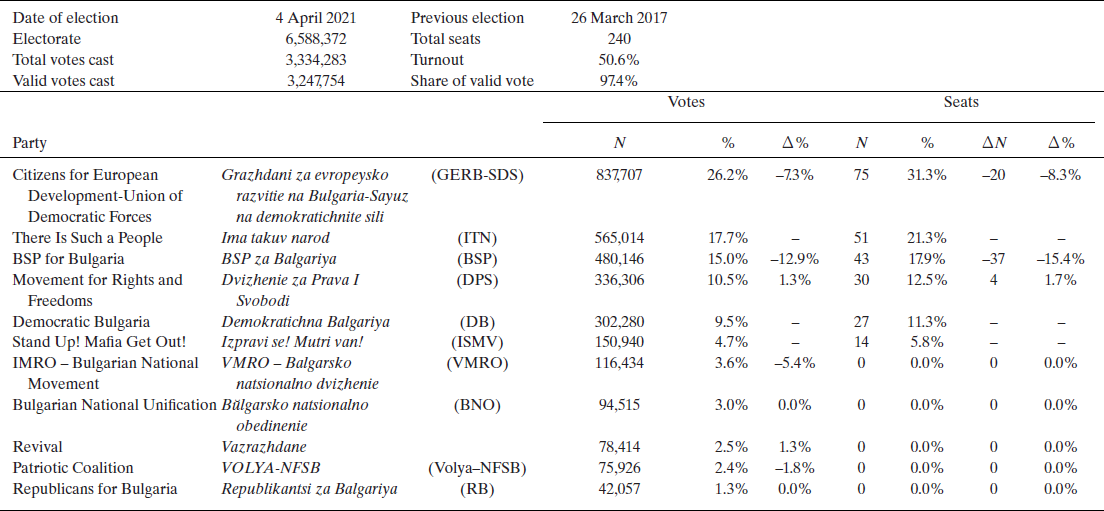
Regularly scheduled elections came in April 2021 (Table 1). A total of 31 parties and electoral coalitions competed for the public vote, mostly on the issues of the previous year's protests, and six made it into Parliament, an increase by one since the previous elections (2017). At 50.6 per cent voter turnout was slightly lower than in 2017 (54.1 per cent); given that this was supposed to be a massive anti-GERB vote of the electorate, the low participation rate is troublesome. GERB's win of the plurality of votes surprised some, but was to be expected given the long GERB dominance of politics in Bulgaria. The runner up was a newcomer to Bulgarian party politics: There Is Such a People/Ima takuv narod (ITN), which campaigned on strong anti-establishment platform. The party emerged as a social movement in the early 2010s focused on limiting the party–state linkages in the country led by the extremely popular talk show host Slavi Trifonov. The movement initiated the one and only Bulgarian referendum based on a citizens’ initiative in 2016 (Kolarova & Spirova 2017). Тhe referendum itself barely missed the electoral threshold to have an immediate impact on legislation, but it was a clear signal that a new political force was in the making. Further refusal by the establishment to deal with the issues brought up by the movement appeared to only strengthen the political ambition of Trifonov and energize his followers. By 2020, the party was registered and ready for battle as a challenger to the incumbent.
Table 1. Elections to Parliament (Narodno sabranie) in Bulgaria in April 2021

Notes: There is an option in the ballot ‘I don't support any of the nominated’, which received 47,749 votes.
GERB and SDS are two independent party organizations, but they participated and were voted for as a coalition. Therefore, we consider them as one ‘party’.
Democratic Bulgaria is an electoral alliance in Bulgaria formed by three political parties: Yes, Bulgaria!, Democrats for a Strong Bulgaria and The Greens.
ITN, DB and ISMV were not previously in Parliament, therefore the percentage differences are not calculated.
Source: Central Election Commission website, 2021 Parliamentary Elections, http://results.cik.bg/pi2021/rezultati/index.html.
Trifonov and his followers were among the most active protesters against Borissov in 2020 and emerged as one of the ‘protest parties’ by the end of 2020. Campaigning for the elections took the form of concerts-turned-political rallies, campaigning mostly on an anti-GERB platform and using various digital media techniques.
Another four parties made it into Parliament at the elections: the BSP, the Turkish minority-dominated Movement for Rights and Freedoms/Dvizhenie za Prava I Svobodi (DPS), the centre-right Democratic Bulgaria/Demokratichna Balgariya (DB), and a brand new ‘party of the protest’ Stand Up! Mafia Get Out!/Izpravi se! Mutri van! (ISMV). For the first time since 2005, no nationalist or extreme right party made it to Parliament in April 2021. With GERB winning plurality and not able to attract any coalition partners, Parliament was very short-lived. On 12 May, the President dissolved the National Assembly, called early parliamentary elections on 11 July and appointed a caretaker government.
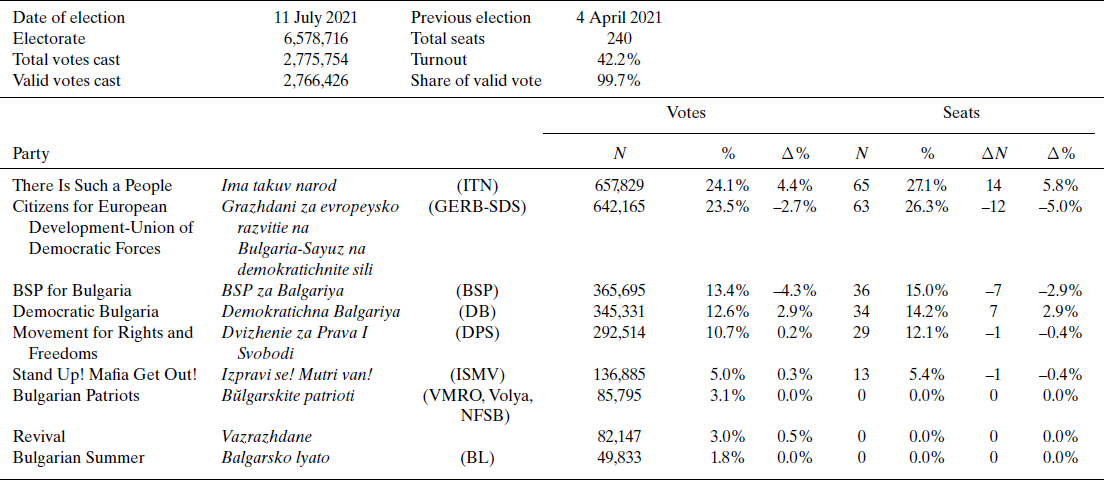
The July 2021 elections saw the same six parties enter Parliament, but this time ITN emerged as the plurality winner with a slight lead over GERB (Table 2). Remarkably, while turnout decreased by 8 percentage points and the total number of votes cast decreased by almost 0.5 million, the number of votes at home and abroad for ITN increased (CIK 2021). Parliament was highly fragmented, and the three ‘parties of the protest’ (ITN, Democratic Bulgaria and Stand Up!) could not gather enough seats to form a majority. At the same time, the socialists and the party of the Turkish minority were considered tacit supporters of the GERB status quo and, as such, as uncoalitionable as GERB itself. As plurality winner, ITN declared its ambition to appoint a minority Cabinet and work with floating majorities in Parliament, as had been the will of the ‘sovereign’, the people. Mutual accusations of personal betrayal, lack of desire for dialogue and giving up the ideals of the protests were exchanged among the three parties of the protest.
Table 2. Elections to Parliament (Narodno sabranie) in Bulgaria in July 2021

Notes: There is an option in the ballot ‘I don't support any of the nominated’, which received 35,201 votes.
GERB and SDS are two independent party organizations, but they participated and were voted for as a coalition. Therefore, we consider them as one ‘party’.
Democratic Bulgaria is an electoral alliance in Bulgaria formed by three political parties: Yes, Bulgaria!, Democrats for a Strong Bulgaria and The Greens.
Source: Central Election Commission website, 2021 Parliamentary Elections, https://results.cik.bg/pi2021_07/rezultati/index.html.
ITN initiated two separate proposals for a Cabinet, but no widespread political or social support emerged. Ultimately, Trifonov withdrew ITN's Cabinet proposal, and in mid-September the National Assembly was dissolved, a new caretaker Cabinet was appointed and new legislative elections were scheduled for November by the President.
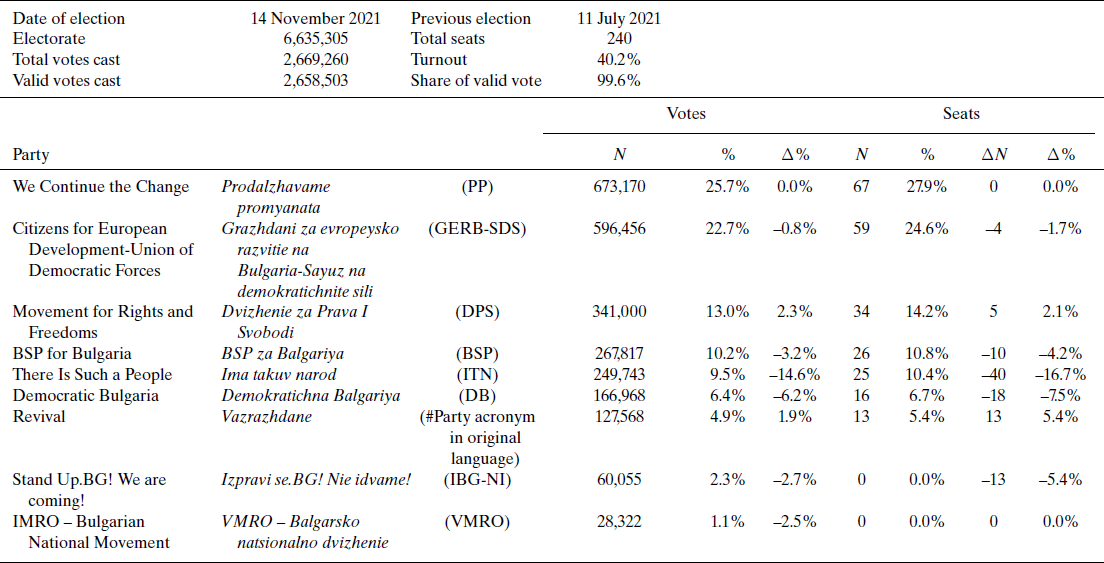
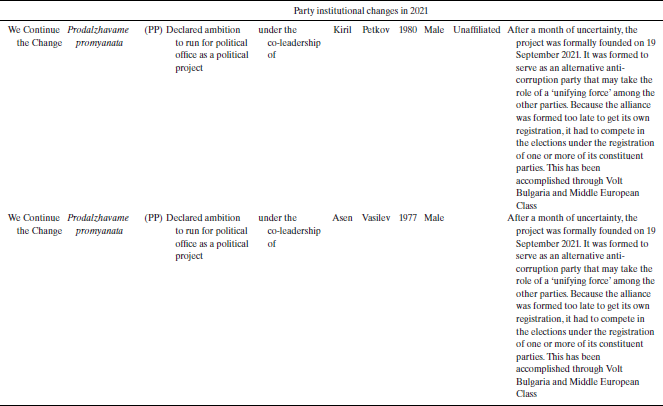
The November elections saw a completely different outcome: a new party, We Continue the Change/Prodalzhavame promyanata (PP), won the elections with an unexpected lead over GERB (Table 3). Until the day before the elections, Borissov and GERB had been predicted to be the plurality winner again. PP had declared its political ambition only in September 2021, and ran on the electoral ticket of two other parties that had managed to register for the elections. The party (officially registered in 2022) was centered around and chaired by two men: Kiril Petkov and Asen Vasilev. They had been, respectively, caretaker Economy and Finance ministers in the first Yanev caretaker Cabinet (in power as of 12 May 2021), but were then left out of the second Yanev caretaker Cabinet in order to be able to run for office. ITN itself lost more than 60 per cent of the votes it had in July 2021 and a lot of its momentum for change.
Table 3. Elections to Parliament (Narodno sabranie) in Bulgaria in November 2021

Notes: There is an option in the ballot ‘I don't support any of the nominated’, which received 35,745 votes.
GERB and SDS are two independent party organizations, but they participated and were voted for as a coalition. Therefore, we consider them as one ‘party’.
Democratic Bulgaria is an electoral alliance in Bulgaria formed by three political parties: Yes, Bulgaria!, Democrats for a Strong Bulgaria and The Greens.
On 20 July 2021, Stand Up! Mafia Get Out! party changed its name to ‘Stand Up.BG! We are coming!’.
Source: Central Election Commission website, 2021 Parliamentary Elections, https://results.cik.bg/pvrns2021/tur1/rezultati/index.html.
These last elections solidified clearly several significant lessons from the summer of 2021. During that time, it became clear that the ‘parties of the protests’ were too insecure and weak to bring about serious political change and end the dominance of GERB. All three ‘protest parties’ lost votes and vote share, with Stand Up! not clearing the 4 per cent threshold for parliamentary representation at all. This empowered the President of the country to urge his own lobby, the Harvard-educated Petkov and Vassilev, to bank on their popularity as ministers and pursue political careers.
In addition, over the summer it also became clear that to have a working majority coalition, the Socialists had to be accepted as a legitimate player with governmental potential. The BSP had been discredited as viable opposition to GERB in 2013, when its links with DPS and questionable practices of clientelism and patronage led to months-long protests and the resignation of the BSP government and the return of GERB and Borissov in a triumphant manner (Spirova & Sharenkova-Toshkova Reference Spirova and Sharenkova-Toshkova2021). However, during the summer of 2021, the party re-emerged as one with coalition potential for the pro-reform minded actors. The BSP itself broke some of its old associations with the DPS, making this move more palatable. Coming out as the third more popular party in November further gave it new energy to seek back a place in the power configuration.
Finally, the lower turnout (down to 40 per cent from over 50 per cent in April), but also increased popular support, allowed a new nationalist party, Revival/Vazrazhdane, to enter Parliament. The party is anti-European Union (EU), populist, openly pro-Russian and nationalist, and had actively taken and anti-vaxxer position on the coronavirus debate.
Presidential elections
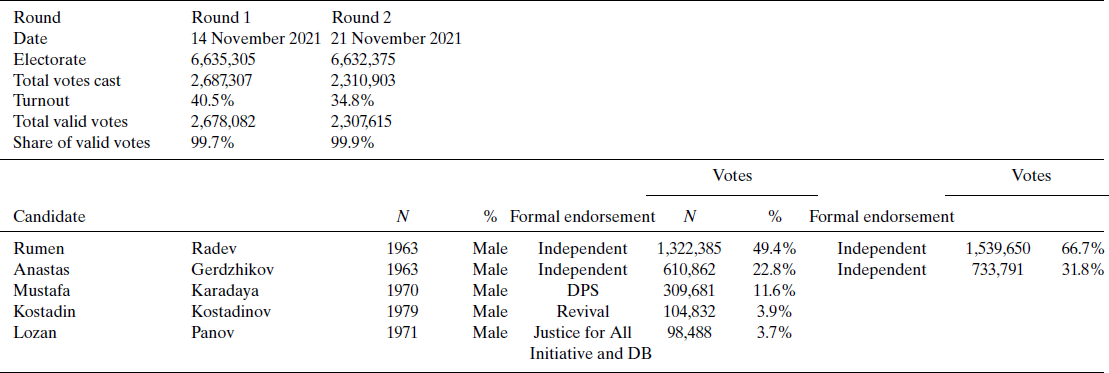
Presidential elections were scheduled for the fall of 2021. Incumbent President Radev had been in an open institutional battle with the GERB-dominated Parliament and with GERB itself since the summer of 2020, if not before. Radev had preserved high popularity among the Bulgarian people, in fact growing out of the image of a pro-Russian general he had been presented as in the beginning of his mandate in 2017. Radev came to strongly oppose GERB and its political practices and was an open supporter of the anti-GERB public protests in 2020. As a result, the presidential campaign saw a clear favorite in him, while his opponent Gerdzikov – supported by GERB as well as by the rector of Sofia University – could only challenge him at the first round (Table 4). In the second round, Radev emerged as clear winner. Radev had proven instrumental also in the creation of the new political party PP and in bringing his ‘Harvard lobby’ to power. In the immediate term, this was seen as the only manner to end the clearly problematic tenure of GERB in national power, but in the longer run, it can raise questions about the institutional balance in the political system of the country, a parliamentary republic.
Table 4. Elections for President in Bulgaria in 2021

Notes: There is an option in the ballot ‘I don't support any of the nominated’, which received 60,786 votes during round 1.
There is an option in the ballot ‘I don't support any of the nominated’, which received 34,169 votes during round 2.
Sources: Central Election Commission website, 2021 Presidential Elections, https://results.cik.bg/pvrns2021/tur1/rezultati/index.html, https://results.cik.bg/pvrns2021/tur2/rezultati/index.html
Cabinet report
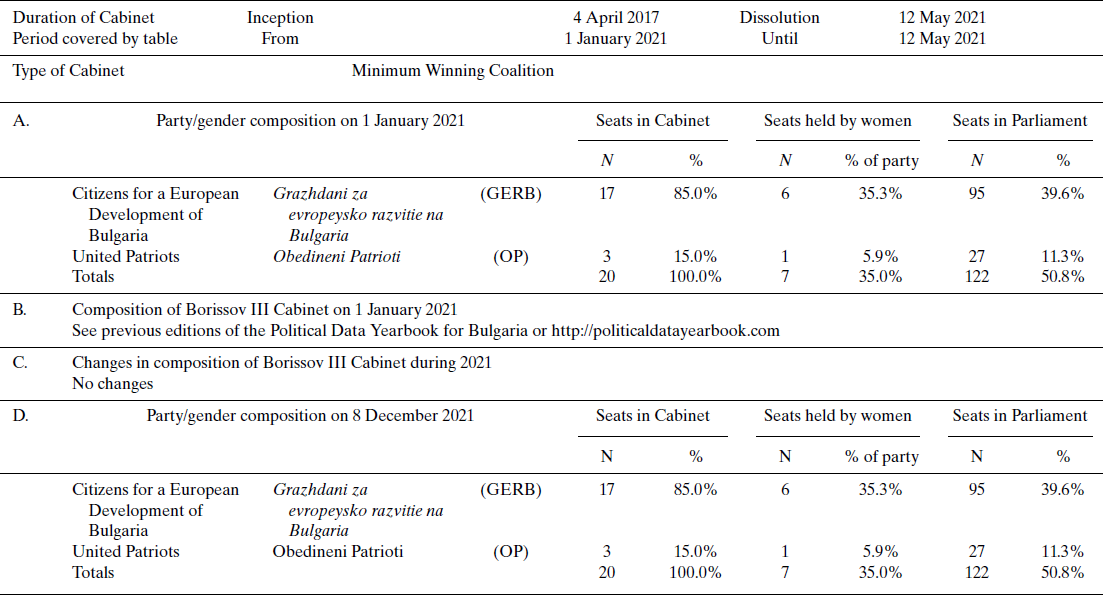
During 2021 four separate cabinets governed the country. The Minimum winning coalition (MWC) Borissov III was in power until 12 May 2021 when Borissov submitted its resignation to Parliament (Table 5). The Cabinet had been reshuffled several times in 2020 under public pressure and the first months of 2021 only saw it finish up business and pack up with no major new policies implemented. Covid-19 vaccination proceeded slowly and painfully and the Cabinet was criticised for its slow and disorganized approach. In a typical Borissov fashion, ‘green corridors’ – walk-in vaccination posts – were set up to satisfy demand with little consideration for the general public health rules.
Table 5. Cabinet composition of Borissov III in Bulgaria in 2021

Note: United Patriots is a coalition of the VMRO-NFSB-ATAKA alliance of the Internal Macedonian Revolutionary Organisation/Vatreshna Makedosnka Revolucionna Organizacia (VMRO), National Front for the Salvation of Bulgaria/Natzionalen Front za Spasenie na Bulgaria (NFSB) and Party Attack/ATAKA. ATAKA was excluded from the alliance on 25 July 2019.
Source: Council of Ministers (2022), http://www.gov.bg/en/Cabinet.
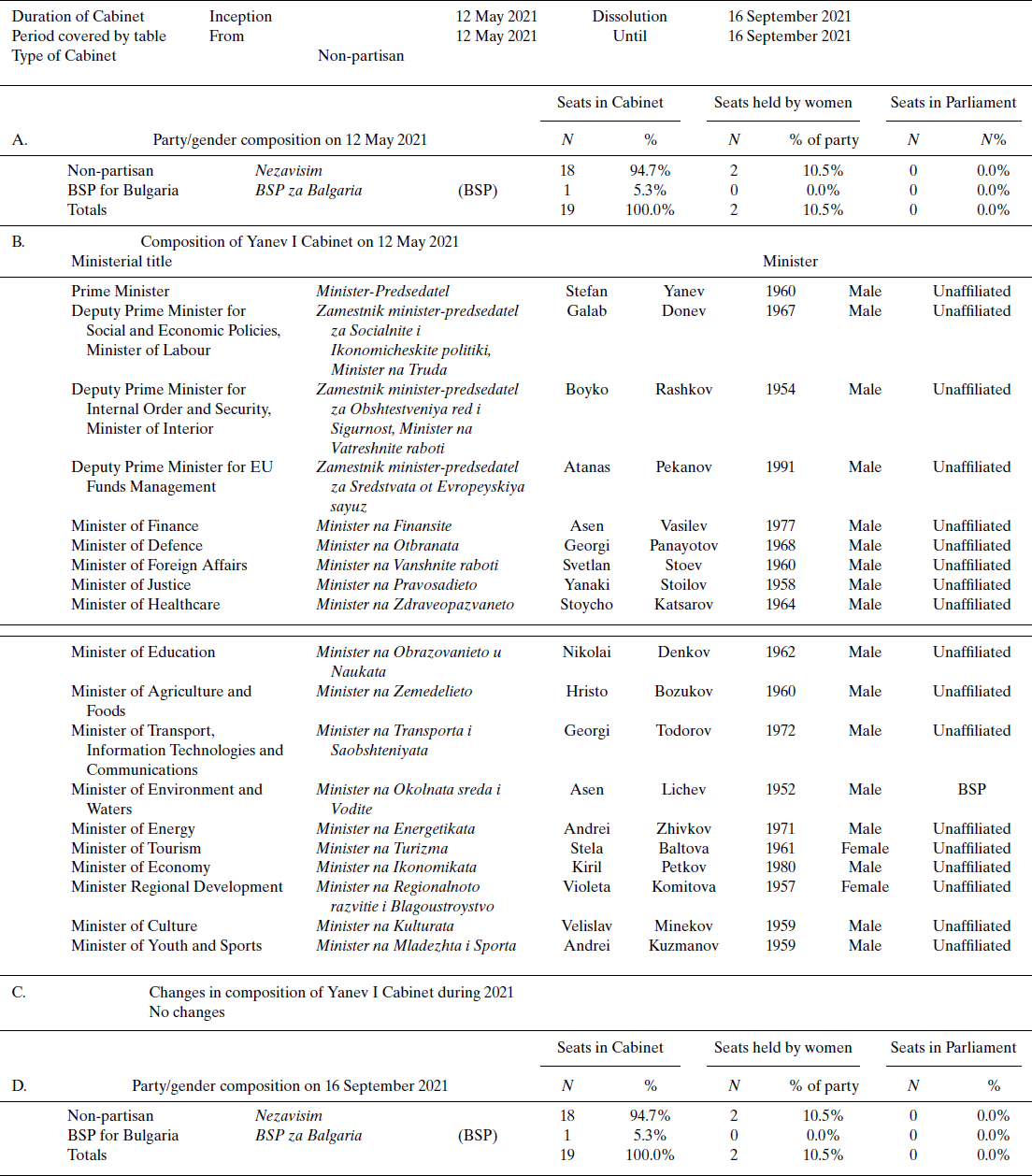
Following the failure of the April Parliament to produce a Cabinet, a caretaker Cabinet was appointed by the President to take care of the new elections and ‘manage the country in the interest of the people’ (Investor.bg 2021). Yanev I (Table 6) became the longest lasting caretaker Cabinet in the country and engaged in much more than keeping the ship afloat. In the words of its maker, President Radev himself, the Cabinet engaged in ‘increasing state capacity, dismantling the oligarchic model of government and clarifying a number of corrupt practices and irregularities’. In addition, pensions were adjusted, healthcare policies adapted and other socially relevant decisions made, helping the political support for the care taker Cabinet reach high levels.
Table 6. Cabinet composition of Yanev I (caretaker) in Bulgaria in 2021

Source: Council of Ministers (2022), http://www.gov.bg/en/Cabinet.
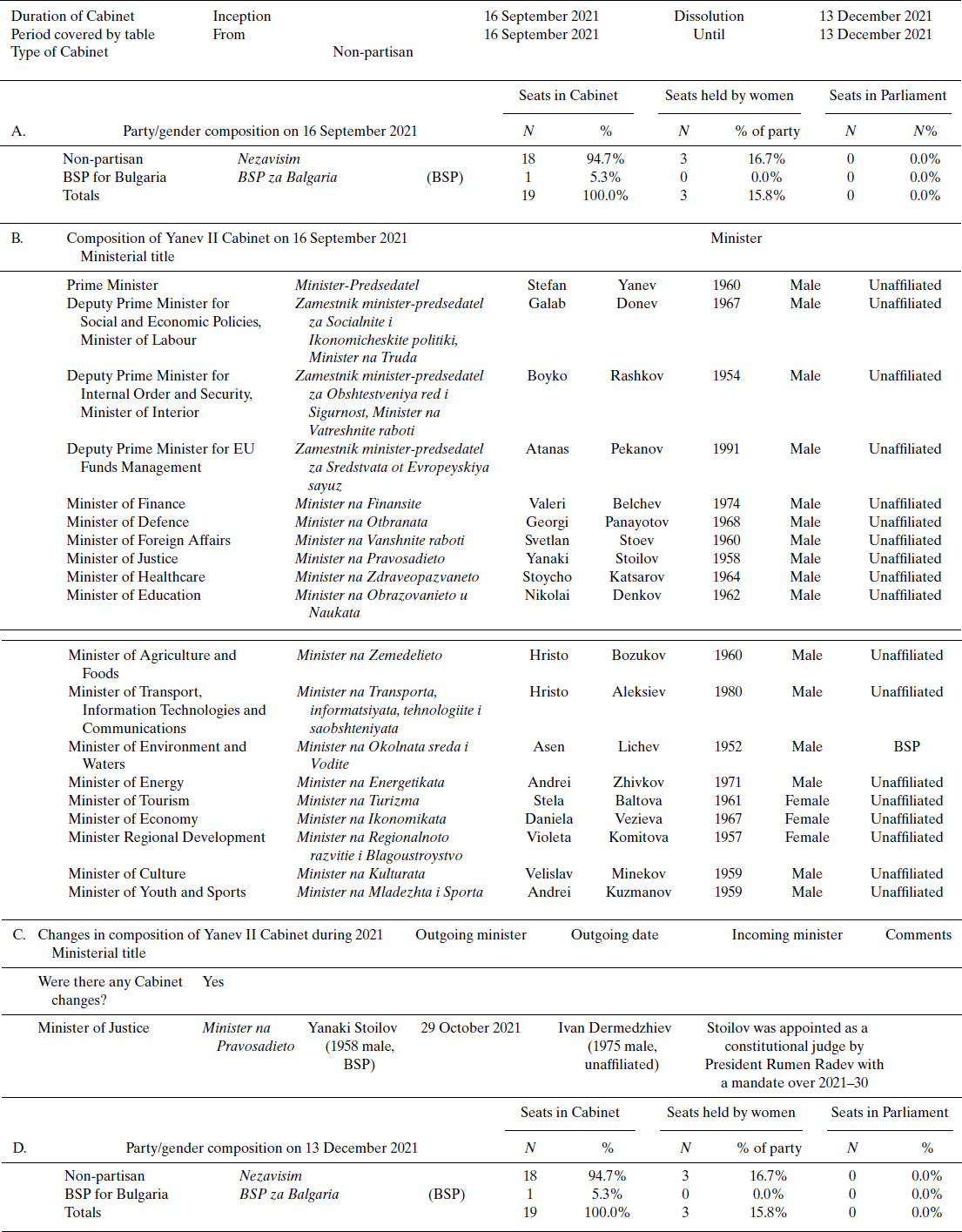
When the July Parliament also failed to produce a politically viable coalition Cabinet, President Radev reappointed Yanev to lead a second caretaker Cabinet with one major change: ministers Petkov and Vassilev were relieved in order to be able to engage in political campaigning. The second Yanev Cabinet (Table 7) continued within the tracks set by Yanev I, but also engaged in budget preparation and exposed some financial malfeasance by the previous cabinets. It also was the first Cabinet to take on a strict position on vaccination and introduced a mandatory vaccination certificate for all public places. Yanev II resigned on 13 December and was followed by Petkov I.
Table 7. Cabinet composition of Yanev II (caretaker) in Bulgaria in 2021

Source: Council of Ministers (2022), http://www.gov.bg/en/Cabinet.
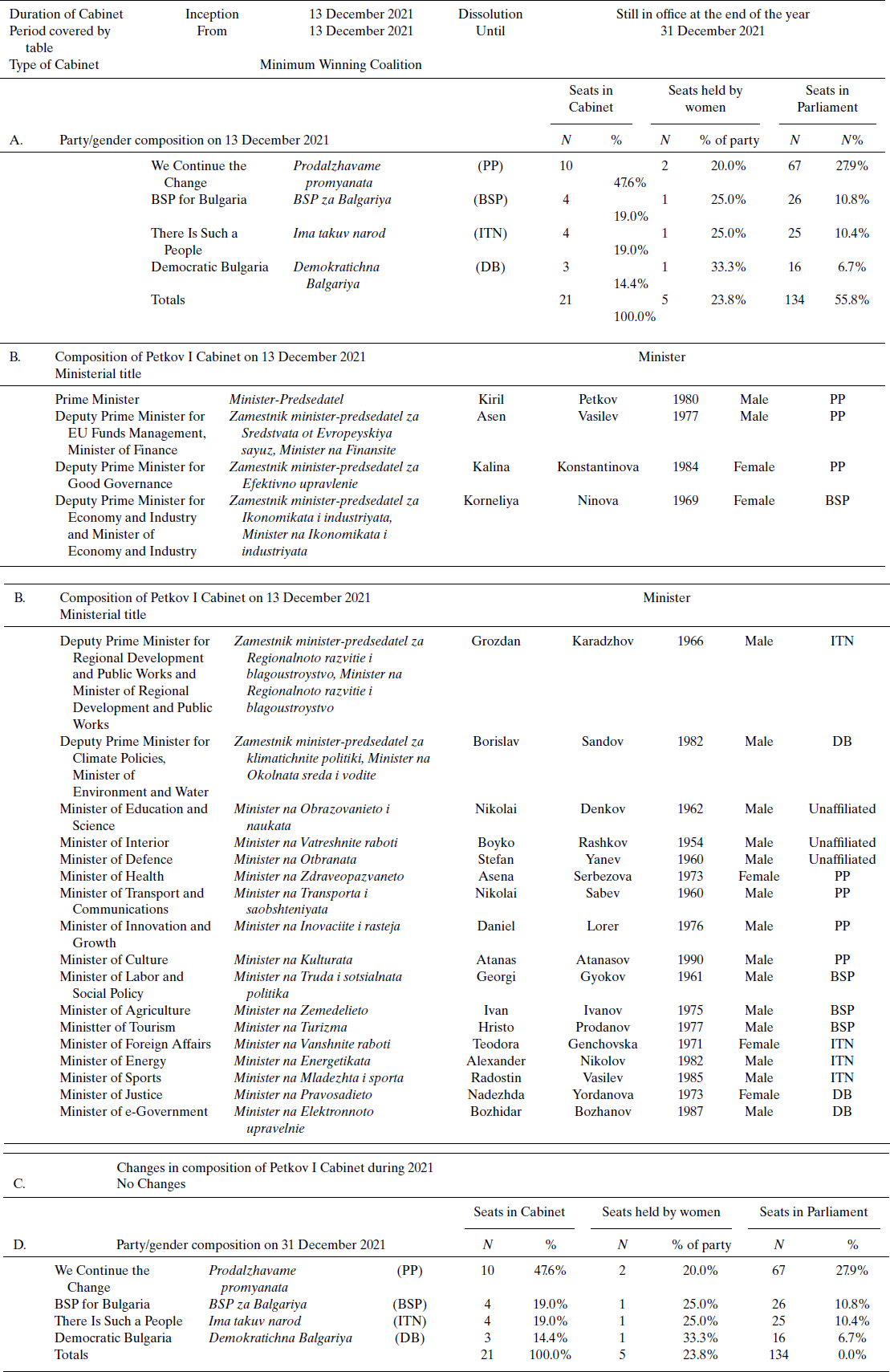
Plurality winner PP was quick to hold coalition negotiations, most of which were broadcast over Bulgarian national radio. It managed to form a coalition and sign a coalition agreement with two of the protest parties – ITN and Democratic Bulgaria – and the returnee to power politics in the country – the Bulgarian socialists. A 140-page coalition agreement was signed by all four and ministries were distributed on a 10:4:4:3 basis, putting ITN and BSP on equal ground. The priorities of Petkov I (Table 8), which came to power officially on 13 December, were а team approach to government, zero tolerance for corruption, reform in both the judiciary and the constitutional set-up, managing the energy prices at reasonable price levels, and encouraging voluntary vaccination.
Table 8. Cabinet composition of Petkov I in Bulgaria in 2021

Notes: Nikolai Denkov was unaffiliated, but as a minister he is part of the PP ministers quota.
Boyko Rashkov was unaffiliated, but as a minister he is part of the PP ministers quota.
Stefan Yanev was unaffiliated, but as a minister he is part of the PP ministers quota.
Source: Council of Ministers (2022), http://www.gov.bg/en/Cabinet.
Parliament report
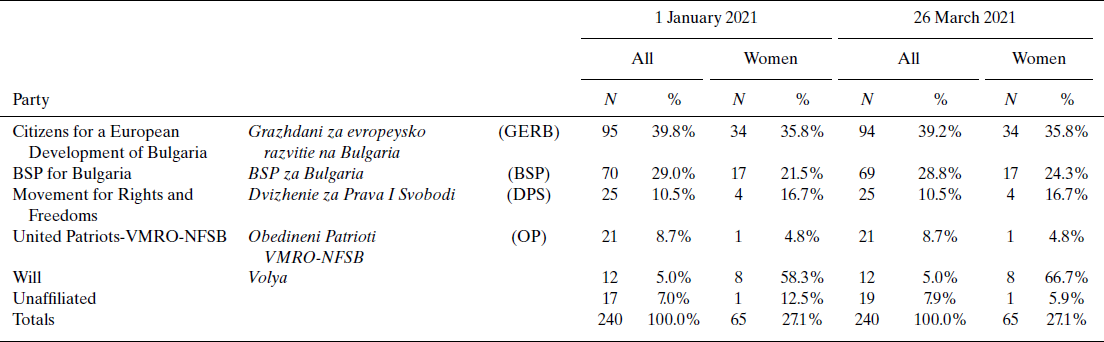
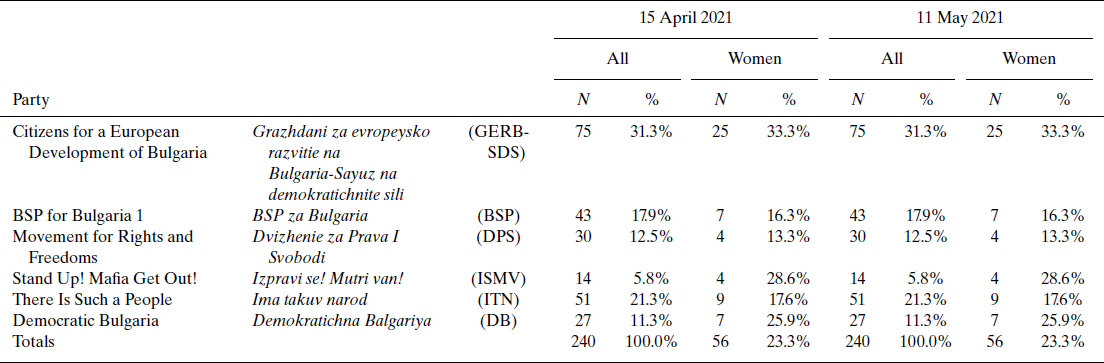
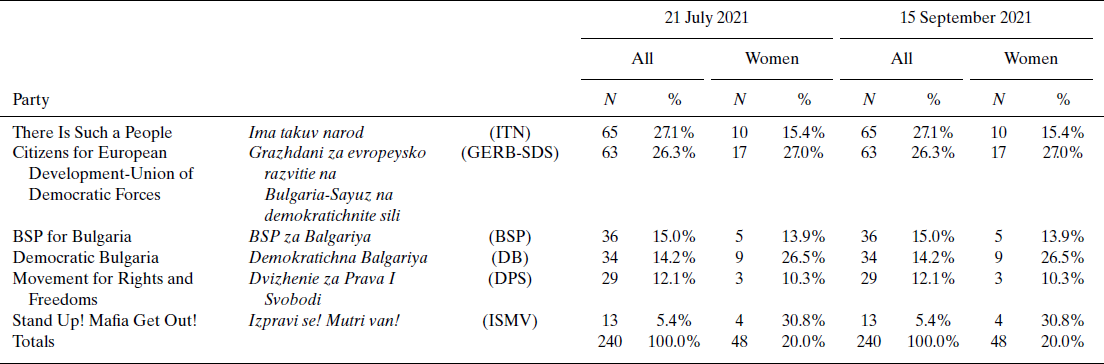
Given the number and turbulence of elections, the legislatures were mostly busy convening and disbanding. The 44th National Assembly ended its tenure as planned and disbanded on 25 March 2021. The 45th was convened on 15 April and disbanded on 11 May 2021. The 46th convened on 21 July and disbanded on 15 September 2021. There was little control over the executive as the last months of Borissov III were peaceful, and the caretaker cabinets were not politically linked to Parliament.
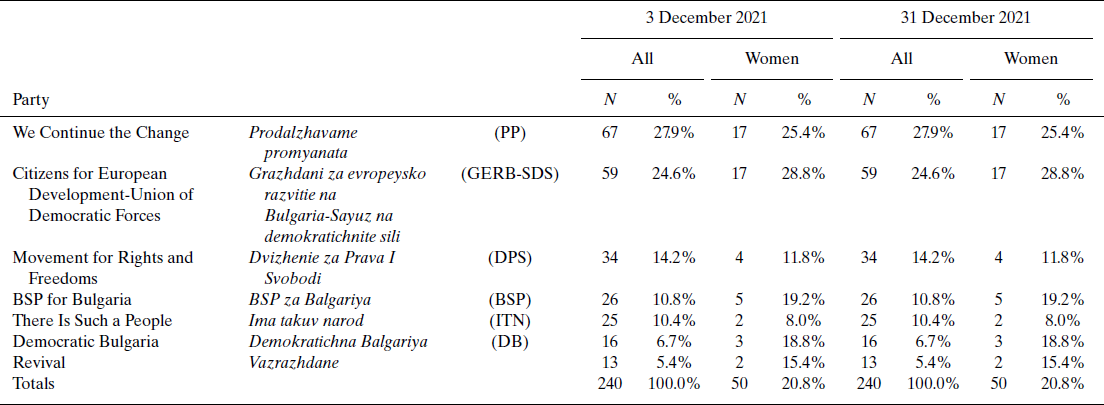
As a result of the three elections, the final make-up of the Bulgarian legislature included fewer women than before: the percentage of female MPs dropped from 27.1 per cent to 20.1 per cent. Interestingly, the decrease of women elected to Parliament was across the board: all political parties report lower levels of female MPs at the end of the year.
Data on the composition of Parliament can be found in Tables 9–12.
Table 9. Party and gender composition of the 44th National Assembly (Narodno Sabranie) in Bulgaria in 2021

Source: Central Election Commission website (2022), https://www.cik.bg.
Table 10. Party and gender composition of the 45th National Assembly (Narodno Sabranie) in Bulgaria in 2021

Source: Central Election Commission website (2022), https://www.cik.bg.
Table 11. Party and gender composition of the 46th National Assembly (Narodno Sabranie) in Bulgaria in 2021

Source: Central Election Commission website (2022), https://www.cik.bg.
Table 12. Party and gender composition of the 47th National Assembly (Narodno Sabranie) in Bulgaria in 2021

Source: Central Election Commission website (2022), https://www.cik.bg.
Most remarkable in the work of the four different parliaments that were in existence in the country in 2021 were the changes made to the electoral code (see Institutional change report). Institutional battles also continued the pattern of 2020: the GERB-dominated Parliament challenged the President, and vice versa, early in the year, while later in the year protest parties dominated and the parliaments challenged the office of the prosecutor general, seen as a close ally of Borissov.
Political party report
The year also saw significant developments in the party system (Table 13). Most importantly, a brand new party, PP was initiated in September 2021 and won legislative elections in November, albeit using the ticket of other, registered parties. As already discussed, the party is centred around the personalities of its leaders Petkov and Vassilev. Its programme is liberal and pro-European, with a strong anti-corruption message and focus on education and equality of opportunity in is social aspects. Petkov and Vassilev made the news by campaigning extensively for the November elections by travelling around the country by bus and meeting people everywhere.
Table 13. Changes in political parties in Bulgaria in 2021

Note: The new party was co-founded by Kiril Petkov and Asen Vasilev.
Source: Dnevnik (2022).
Institutional change report
During the short lived 45th National Assembly (April–May 2021), ITN pushed the agenda as promised to its supporters for years: electoral and party law change became the most important legislative goal. Together with the other ‘parties of the protest’ in Parliament (DB and Stand Up!), it introduced a bill to make changes in the Electoral law and in the Law on Political Parties. More ambitious changes such as moving to a plurality system, the biggest issue of the 2016 referendum, were postponed once it became clear that new early elections were coming, but ITN pushed some of its other long-standing points: bigger opportunities for Bulgarians abroad to vote by allowing more polling sections to be opened, a decrease in the subsidy received by political parties to 1 lev (€0.50) per vote, and machine voting to limit potential vote manipulations. Ultimately, only the removal of the limit on polling stations abroad and mandatory machine voting were supported. This meant that in the next elections voting among the Bulgarian diaspora, a big supporter of ITN, became easier. This move had been controversial before because it makes it easier for Bulgarian Turks in Turkey to support the DPS.
Issues in national politics
Politics was clearly dominated by one major issue: the position of GERB in the political system. For over 11 years, GERB and the three Borissov cabinets had dominated politics in Bulgaria, building extensive networks of influence intertwined with the economic sphere and allowing questionable practices in the judiciary (Spirova 2019, 2020). Bulgaria had come under criticism for corruption and abuse of EU funds; what saved Borissov from further interventions from Brussels was probably the worse democratic development in countries such as Hungary and Poland. By the summer of 2020, however, there seemed to be enough political will, represented by the President and various civil society and proto-political groups, to end GERB's dominance. Naturally, achieving this became the most important issue in politics over the course of the three legislative cycles in 2021. Building up to the elections, President Radev challenged the Cabinet and the parliamentary majority whenever he could, and international pressure was put on the country to remove some questionable economic figures from prominent positions. The ‘parties of the protest’ mobilized strongly on issues of cleaning up politics and ending corruption of the GERB machine, and by November 2021 they seemed to have achieved their goal.
In return, GERB did not give up without a major fight. It had built a loyal supporters’ network bolstered by a loyal clientele and, even in the last elections in November, the party barely missed coming out ahead of anybody else again. However, it had already become clear in April that what it could no longer count on was political allies among the other parties. GERB thus continued to campaign actively accusing the others of misrepresenting the achievements of GERB over the years.
Another issue that continued to dominate the public debate and the image of the country abroad was the coronavirus crisis. Bulgaria had had an inconsistent policy since the beginning, imposing severe restrictions before it was necessary and then failing to implement meaningful ones when the situation worsened in the winter of 2020–21 and through 2021. By the end of 2021, the country had one of the highest death-to-cases ratio. At the same time, no meaningful campaign for vaccination was mounted and a strong anti-vax movement developed. As a result, by the end of 2021, no more than 27 per cent of the adult population was fully vaccinated. Within this context, when the Yanev II Cabinet changed policy and introduced stricter measures, including the requirement of a vaccination certificate to enter public buildings, universities and non-essential shops, life in the country suffered substantially, leading to more mistrust and lack of support for the vaccinations process.
A final issue anticipating the further political developments in 2022 is the political heterogeneity of the ruling coalition. Among the four parties that signed the coalition agreement in November 2021, two are the longest-lasting rivals in Bulgarian politics: the Socialists and the successor of the centre right opposition of the last 30 years. That the Cabinet will be able to deliver what it has promised remains to be seen.

 Open access

