







1 Introduction
Nilmanifolds and nilsequences have been studied extensively in the last decade. They play a fundamental role in combinatorial number theory, ergodic theory, additive combinatorics, and higher order Fourier analysis (see for example [Reference Green and Tao3, Reference Green and Tao4, Reference Green, Tao and Ziegler7–Reference Host and Kra9]). We begin with recalling some standard terminologies in this area.
Definition 1.1. (Filtered group)
Let G be a group. An $\mathbb {N}$
-filtration on G is a collection
$\mathbb {N}$
-filtration on G is a collection $G_{\mathbb {N}}=(G_{i})_{i\in \mathbb {N}}$
of subgroups of G indexed by
$G_{\mathbb {N}}=(G_{i})_{i\in \mathbb {N}}$
of subgroups of G indexed by $\mathbb {N}$
such that the following holds:
$\mathbb {N}$
such that the following holds:
-
(i) for all $i,j\in \mathbb {N}$
with
$i\leq j$
, we have that
$G_{i}\supseteq G_{j}$
;
$i,j\in \mathbb {N}$
with
$i\leq j$
, we have that
$G_{i}\supseteq G_{j}$
; -
(ii) for all
$i,j\in \mathbb {N}$
, we have
$[G_{i},G_{j}]\subseteq G_{i+j}$
.



For $s\in \mathbb {N}$
, we say that G is an (
$s\in \mathbb {N}$
, we say that G is an ( $\mathbb {N}$
-filtered) nilpotent group of degree at most s (or of degree
$\mathbb {N}$
-filtered) nilpotent group of degree at most s (or of degree $\leq s$
) with respect to some
$\leq s$
) with respect to some $\mathbb {N}$
-filtration
$\mathbb {N}$
-filtration $(G_{i})_{i\in \mathbb {N}}$
if
$(G_{i})_{i\in \mathbb {N}}$
if $G_{i}$
is trivial whenever
$G_{i}$
is trivial whenever $i>s$
.
$i>s$
.
Definition 1.2. (Nilmanifold)
Let $\Gamma $
be a discrete and cocompact subgroup of a connected, simply connected nilpotent Lie group G with filtration
$\Gamma $
be a discrete and cocompact subgroup of a connected, simply connected nilpotent Lie group G with filtration $G_{\mathbb {N}}=(G_{i})_{i\in \mathbb {N}}$
such that
$G_{\mathbb {N}}=(G_{i})_{i\in \mathbb {N}}$
such that ${\Gamma _{i}:=\Gamma \cap G_{i}}$
is a cocompact subgroup of
${\Gamma _{i}:=\Gamma \cap G_{i}}$
is a cocompact subgroup of $G_{i}$
for all
$G_{i}$
for all $i\in \mathbb {N}$
. Then, we say that
$i\in \mathbb {N}$
. Then, we say that $G/\Gamma $
is an (
$G/\Gamma $
is an ( $\mathbb {N}$
-filtered) nilmanifold, and we use
$\mathbb {N}$
-filtered) nilmanifold, and we use $(G/\Gamma )_{\mathbb {N}}$
to denote the collection
$(G/\Gamma )_{\mathbb {N}}$
to denote the collection $(G_{i}/\Gamma _{i})_{i\in \mathbb {N}}$
(which is called the
$(G_{i}/\Gamma _{i})_{i\in \mathbb {N}}$
(which is called the $\mathbb {N}$
-filtration of
$\mathbb {N}$
-filtration of $G/\Gamma $
). We say that
$G/\Gamma $
). We say that $G/\Gamma $
has degree
$G/\Gamma $
has degree $\leq s$
with respect to
$\leq s$
with respect to $(G/\Gamma )_{\mathbb {N}}$
if G has degree
$(G/\Gamma )_{\mathbb {N}}$
if G has degree $\leq s$
with respect to
$\leq s$
with respect to $G_{\mathbb {N}}$
.
$G_{\mathbb {N}}$
.
Definition 1.3. (Polynomial sequences)
Let $d,\in \mathbb {N}_{+}$
and G be a connected simply connected nilpotent Lie group and
$d,\in \mathbb {N}_{+}$
and G be a connected simply connected nilpotent Lie group and $(G_{i})_{i\in \mathbb {N}}$
be an
$(G_{i})_{i\in \mathbb {N}}$
be an $\mathbb {N}$
-filtration of G. Denote
$\mathbb {N}$
-filtration of G. Denote $\Delta _{h}g(n):= g(n+h)g(n)^{-1}$
for all
$\Delta _{h}g(n):= g(n+h)g(n)^{-1}$
for all $n, h\in G$
. A map
$n, h\in G$
. A map $g\colon \mathbb {Z}^{d}\!\to G$
is an (
$g\colon \mathbb {Z}^{d}\!\to G$
is an ( $\mathbb {N}$
-filtered) polynomial sequence if
$\mathbb {N}$
-filtered) polynomial sequence if
 $$ \begin{align*} \Delta_{h_{m}}\cdots \Delta_{h_{1}} g(n)\in G_{m} \end{align*} $$
for all $m\in \mathbb {N}$
and
$m\in \mathbb {N}$
and $n,h_{1},\ldots ,h_{m}\in \mathbb {Z}^{d}$
. The set of all
$n,h_{1},\ldots ,h_{m}\in \mathbb {Z}^{d}$
. The set of all $\mathbb {N}$
-filtered polynomial sequences is denoted by
$\mathbb {N}$
-filtered polynomial sequences is denoted by $\text {poly}(\mathbb {Z}^{d}\to G_{\mathbb {N}})$
.
$\text {poly}(\mathbb {Z}^{d}\to G_{\mathbb {N}})$
.
A fundamental question in higher order Fourier analysis is to study the equidistribution property of polynomial sequences. Let $\Omega $
be a non-empty subset of
$\Omega $
be a non-empty subset of $\mathbb {Z}^{d}$
and
$\mathbb {Z}^{d}$
and $G/\Gamma $
be an
$G/\Gamma $
be an $\mathbb {N}$
-filtered nilmanifold. A sequence
$\mathbb {N}$
-filtered nilmanifold. A sequence $a\colon \Omega \to G/\Gamma $
is
$a\colon \Omega \to G/\Gamma $
is $\delta $
-equidistributed on
$\delta $
-equidistributed on $G/\Gamma $
if for all Lipschitz function
$G/\Gamma $
if for all Lipschitz function $F\colon G/\Gamma \to \mathbb {C}$
(with respect to the metric
$F\colon G/\Gamma \to \mathbb {C}$
(with respect to the metric $d_{G/\Gamma }$
to be defined in §3), we have that
$d_{G/\Gamma }$
to be defined in §3), we have that
 $$ \begin{align*} \limsup_{N\to\infty}\bigg\vert\frac{1}{\vert \Omega\cap [N]^{d}\vert}\sum_{n\in\Omega\cap [N]^{d}}F(a(n))-\int_{G/\Gamma}F\,dm_{G/\Gamma}\bigg\vert\!\leq \delta\Vert F\Vert_{\mathrm{Lip}}, \end{align*} $$
where $m_{G/\Gamma }$
is the Haar measure of
$m_{G/\Gamma }$
is the Haar measure of $G/\Gamma $
and the Lipschitz norm is defined as
$G/\Gamma $
and the Lipschitz norm is defined as
 $$ \begin{align*} \Vert F\Vert_{\mathrm{Lip}}:=\sup_{x\in G/\Gamma}\vert F(x)\vert+\sup_{x,y\in G/\Gamma, x\neq y}\frac{\vert F(x)-F(y)\vert}{d_{G/\Gamma}(x,y)}. \end{align*} $$
It is known that the equidistribution property of polynomial sequences is connected to the horizontal characters of $G/\Gamma $
, that is, group homomorphisms
$G/\Gamma $
, that is, group homomorphisms $\eta \colon G\to \mathbb {R}$
with
$\eta \colon G\to \mathbb {R}$
with $\eta (\Gamma )\subseteq \mathbb {Z}$
. It was proved by Green and Tao [Reference Green and Tao5, Reference Green and Tao6] that for any
$\eta (\Gamma )\subseteq \mathbb {Z}$
. It was proved by Green and Tao [Reference Green and Tao5, Reference Green and Tao6] that for any $\delta>0$
and any polynomial sequence
$\delta>0$
and any polynomial sequence $g\in \text {poly}(\mathbb {Z}^{d}\to G_{\mathbb {N}})$
, either
$g\in \text {poly}(\mathbb {Z}^{d}\to G_{\mathbb {N}})$
, either $(g(n)\Gamma )_{n\in \mathbb {Z}^{d}}$
is
$(g(n)\Gamma )_{n\in \mathbb {Z}^{d}}$
is $\delta $
-equidistributed on
$\delta $
-equidistributed on $G/\Gamma $
or there exists a non-trivial horizontal character
$G/\Gamma $
or there exists a non-trivial horizontal character $\eta $
of
$\eta $
of $G/\Gamma $
whose complexity is comparable with the complexity of
$G/\Gamma $
whose complexity is comparable with the complexity of $G/\Gamma $
(we will define complexity formally in §3) such that
$G/\Gamma $
(we will define complexity formally in §3) such that $\eta \circ g$
is a slowly varying function. This is a quantitative generalization of a result of Leibman [Reference Leibman12].
$\eta \circ g$
is a slowly varying function. This is a quantitative generalization of a result of Leibman [Reference Leibman12].
It is natural to ask about the equidistribution property of polynomial sequences where the average is taken over some algebraic curves $\Omega \subseteq \mathbb {Z}^{d}$
. In this paper, we initiate the study in this direction by showing a quantitative equidistribution property for sequences of the form
$\Omega \subseteq \mathbb {Z}^{d}$
. In this paper, we initiate the study in this direction by showing a quantitative equidistribution property for sequences of the form $(g(n)\Gamma )_{n\in \Omega }$
, where
$(g(n)\Gamma )_{n\in \Omega }$
, where $\Omega $
is the preimage of a sphere over a finite field
$\Omega $
is the preimage of a sphere over a finite field $\mathbb {F}_{p}^{d}$
under the natural embedding from
$\mathbb {F}_{p}^{d}$
under the natural embedding from $\mathbb {Z}^{d}$
to
$\mathbb {Z}^{d}$
to $\mathbb {F}_{p}^{d}$
(see [Reference Kra, Shah and Sun11, Reference Sun14] for the study of related averages). The following is the main result of this paper (we refer the readers to §3 for definitions).
$\mathbb {F}_{p}^{d}$
(see [Reference Kra, Shah and Sun11, Reference Sun14] for the study of related averages). The following is the main result of this paper (we refer the readers to §3 for definitions).
Theorem 1.4. (Equidistribution for polynomial sequence along spheres)
Let $0{\kern-1pt}<{\kern-1pt}\delta {\kern-1pt}<{\kern-1pt}1/2, C>0, d\in \mathbb {N}_{+},s\in \mathbb {N}$
with
$0{\kern-1pt}<{\kern-1pt}\delta {\kern-1pt}<{\kern-1pt}1/2, C>0, d\in \mathbb {N}_{+},s\in \mathbb {N}$
with $d\geq s+13$
, and
$d\geq s+13$
, and $p\gg _{C,d} \delta ^{-O_{C,d}(1)}$
be a prime. Denote
$p\gg _{C,d} \delta ^{-O_{C,d}(1)}$
be a prime. Denote $\Omega =\{n\in \mathbb {Z}^{d}\colon n\cdot n\equiv r\,\mod p\mathbb {Z}\}$
for some
$\Omega =\{n\in \mathbb {Z}^{d}\colon n\cdot n\equiv r\,\mod p\mathbb {Z}\}$
for some $r\in \mathbb {Z}$
(where
$r\in \mathbb {Z}$
(where $n\cdot n$
is the dot product of n and itself). Let
$n\cdot n$
is the dot product of n and itself). Let $G/\Gamma $
be an s-step
$G/\Gamma $
be an s-step $\mathbb {N}$
-filtered nilmanifold of complexity at most C and
$\mathbb {N}$
-filtered nilmanifold of complexity at most C and $g\in \mathrm {poly}(\mathbb {Z}^{d}\to G_{\mathbb {N}})$
be a rational polynomial sequence. Then, either
$g\in \mathrm {poly}(\mathbb {Z}^{d}\to G_{\mathbb {N}})$
be a rational polynomial sequence. Then, either $(g(n)\Gamma )_{n\in \Omega }$
is
$(g(n)\Gamma )_{n\in \Omega }$
is $\delta $
-equidistributed on
$\delta $
-equidistributed on $G/\Gamma $
or there exists a non-trivial horizontal character
$G/\Gamma $
or there exists a non-trivial horizontal character $\eta $
of complexity at most
$\eta $
of complexity at most $O_{\delta ,d}(1)$
such that
$O_{\delta ,d}(1)$
such that $\eta \circ g \,\mod \mathbb {Z}$
is a constant on
$\eta \circ g \,\mod \mathbb {Z}$
is a constant on $\Omega $
.
$\Omega $
.
In fact, we will prove a stronger version of Theorem 1.4, which is Theorem 5.1 in this paper.
Remark 1.5. Note that in Theorem 1.4, it is not possible to require $\eta \circ g\,\mod \mathbb {Z}$
to be constant on the entire space
$\eta \circ g\,\mod \mathbb {Z}$
to be constant on the entire space $\mathbb {Z}^{d}$
. For example, let
$\mathbb {Z}^{d}$
. For example, let $G/\Gamma =\mathbb {R}/\mathbb {Z}$
,
$G/\Gamma =\mathbb {R}/\mathbb {Z}$
, $g(n)=(n\cdot n)/p$
for all
$g(n)=(n\cdot n)/p$
for all $n\in \mathbb {Z}^{d}$
. Since
$n\in \mathbb {Z}^{d}$
. Since $g(n)\equiv r/p \,\mod \mathbb {Z}$
for all
$g(n)\equiv r/p \,\mod \mathbb {Z}$
for all $n\in \Omega $
, it is not hard to see that
$n\in \Omega $
, it is not hard to see that $(g(n)\Gamma )_{n\in \Omega }$
is not
$(g(n)\Gamma )_{n\in \Omega }$
is not $\delta $
-equidistributed on
$\delta $
-equidistributed on $G/\Gamma $
. However, since any non-trivial horizontal character of
$G/\Gamma $
. However, since any non-trivial horizontal character of $G/\Gamma $
is of the form
$G/\Gamma $
is of the form $\eta (x):=kx$
for some
$\eta (x):=kx$
for some $k\in \mathbb {Z}\backslash \{0\}$
, we have that
$k\in \mathbb {Z}\backslash \{0\}$
, we have that $\eta \circ g(n) \,\mod \mathbb {Z}=k(n\cdot n)/p \,\mod \mathbb {Z}$
cannot be constant on
$\eta \circ g(n) \,\mod \mathbb {Z}=k(n\cdot n)/p \,\mod \mathbb {Z}$
cannot be constant on $\mathbb {Z}$
(but is constant on
$\mathbb {Z}$
(but is constant on $\Omega $
).
$\Omega $
).
While our proof of Theorem 1.4 follows a framework similar to [Reference Green and Tao5], they have many significant differences. The first is that to run the Green–Tao argument [Reference Green and Tao5] in the spherical setting, we need to use a special property of hyperspheres called the inheriting principle, which says that many properties of hyperspheres are preserved under taking intersections (see §4 for a more precise statement). The second difference is that while in [Reference Green and Tao5], one can easily obtain information of the ‘leading coefficients’ of the polynomial sequence g by applying the Cauchy–Schwarz inequality and induction hypothesis (at least when G is abelian), in our setting, only partial information can be obtained. This reduces the problem to solving some polynomial equations of the form (5.4). While the solution to (5.4) was immediate in the setting of [Reference Green and Tao5], in our case, this is a difficulty question and it takes the bulk of the paper (§§6 and 7) to answer this question. We refer the readers to §5 for details.
It is natural to ask if a quantitative version of Theorem 1.4 holds for general (not necessarily rational) polynomial sequences. Nevertheless, the rational equidistribution theorem already has many applications in combinatorics and number theory. For example, as an immediate consequence of Theorem 1.4, we have the following immediate corollary for exponential sums along spheres, which is of independent interest in number theory.
Corollary 1.6. (Weyl’s equidistribution theorem along spheres over finite field)
Let $0<\delta <1/2, d\in \mathbb {N}_{+},s\in \mathbb {N}$
with
$0<\delta <1/2, d\in \mathbb {N}_{+},s\in \mathbb {N}$
with $d\geq s+13$
and p be a prime. Let
$d\geq s+13$
and p be a prime. Let $g\colon \mathbb {Z}^{d}\to \mathbb {Z}$
be an integer valued polynomial of degree s. Denote
$g\colon \mathbb {Z}^{d}\to \mathbb {Z}$
be an integer valued polynomial of degree s. Denote $\Omega =\{n\in \mathbb {F}_{p}^{d}\colon n\cdot n=r\}$
for some
$\Omega =\{n\in \mathbb {F}_{p}^{d}\colon n\cdot n=r\}$
for some $r\in \mathbb {F}_{p}$
. If
$r\in \mathbb {F}_{p}$
. If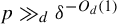 $p\gg _{d} \delta ^{-O_{d}(1)}$
, then either
$p\gg _{d} \delta ^{-O_{d}(1)}$
, then either
 $$ \begin{align*} \bigg\vert\frac{1}{\vert\Omega\vert}\sum_{n\in\Omega}\exp(g\circ\tau(n)/p)\bigg\vert<\delta \end{align*} $$
or $g\circ \tau (n)/p \,\mod \mathbb {Z}$
is a constant on
$g\circ \tau (n)/p \,\mod \mathbb {Z}$
is a constant on $\Omega $
, where
$\Omega $
, where $\tau \colon \mathbb {F}_{p}\to \{0,\ldots ,p-1\}$
is the natural bijective embedding. (By Corollary 7.3, we may further conclude that
$\tau \colon \mathbb {F}_{p}\to \{0,\ldots ,p-1\}$
is the natural bijective embedding. (By Corollary 7.3, we may further conclude that $g(n)=(n\cdot n -\tau (r))g_{1}(n)+pg_{2}(n)$
for some integer valued polynomials
$g(n)=(n\cdot n -\tau (r))g_{1}(n)+pg_{2}(n)$
for some integer valued polynomials $g_{1}$
and
$g_{1}$
and $g_{2}$
.)
$g_{2}$
.)
It is also worth noting that Theorem 1.4 is also the first step towards the geometric Ramsey conjecture over the finite fields. We refer the readers to [Reference Sun15–Reference Sun18] for details.
Motivated by [Reference Candela and Sisask1, Reference Green and Tao5, Reference Green and Tao6], it is natural to ask whether Theorem 1.4 implies a factorization theorem, that is, whether one can decompose g as the product of a constant $\epsilon $
, a polynomial sequence
$\epsilon $
, a polynomial sequence $g'$
being equidistributed on a subnilmanifold of
$g'$
being equidistributed on a subnilmanifold of $G/\Gamma $
, and a polynomial sequence
$G/\Gamma $
, and a polynomial sequence $\gamma $
having strong periodic properties. An affirmative answer to this question will be provided in the forthcoming paper [Reference Sun18]. For example, the following is a special case of [Reference Sun18, Theorem 1.4] (see §3 for definitions).
$\gamma $
having strong periodic properties. An affirmative answer to this question will be provided in the forthcoming paper [Reference Sun18]. For example, the following is a special case of [Reference Sun18, Theorem 1.4] (see §3 for definitions).
Theorem 1.7. Let $d\in \mathbb {N}_{+},s\in \mathbb {N}$
with
$d\in \mathbb {N}_{+},s\in \mathbb {N}$
with $d\gg _{s} 1$
,
$d\gg _{s} 1$
, $C>0$
,
$C>0$
, $\mathcal {F}\colon \mathbb {R}_{+}\to \mathbb {R}_{+}$
be a non-decreasing function with
$\mathcal {F}\colon \mathbb {R}_{+}\to \mathbb {R}_{+}$
be a non-decreasing function with $\mathcal {F}(n)\geq n$
, and
$\mathcal {F}(n)\geq n$
, and $p\gg _{C,d,\mathcal {F}} 1$
be a prime. Denote
$p\gg _{C,d,\mathcal {F}} 1$
be a prime. Denote $\Omega {\kern1pt}={\kern1pt}\{n{\kern1pt}\in{\kern1pt} \mathbb {Z}^{d}\colon n\cdot n\equiv r\,\mod p\mathbb {Z}\}$
for some
$\Omega {\kern1pt}={\kern1pt}\{n{\kern1pt}\in{\kern1pt} \mathbb {Z}^{d}\colon n\cdot n\equiv r\,\mod p\mathbb {Z}\}$
for some $r\in \mathbb {Z}$
. Let
$r\in \mathbb {Z}$
. Let $G/\Gamma $
be an s-step
$G/\Gamma $
be an s-step $\mathbb {N}$
-filtered nilmanifold of complexity at most C and let
$\mathbb {N}$
-filtered nilmanifold of complexity at most C and let $g\in \mathrm { poly}(\mathbb {Z}^{d}\to G_{\mathbb {N}})$
be a rational polynomial sequence on
$g\in \mathrm { poly}(\mathbb {Z}^{d}\to G_{\mathbb {N}})$
be a rational polynomial sequence on $\Omega $
. There exist some
$\Omega $
. There exist some $C\leq C'\leq O_{C,d,\mathcal {F}}(1)$
, a proper subgroup
$C\leq C'\leq O_{C,d,\mathcal {F}}(1)$
, a proper subgroup $G'$
of G which is
$G'$
of G which is $C'$
-rational relative to
$C'$
-rational relative to $\mathcal {X}$
, and a factorization
$\mathcal {X}$
, and a factorization
 $$ \begin{align*} g(n)=\epsilon g'(n)\gamma(n) \quad\text{for all } n\in \mathbb{Z}^{d} \end{align*} $$
such that $\epsilon \in G$
is of complexity
$\epsilon \in G$
is of complexity $O_{C'}(1)$
,
$O_{C'}(1)$
, $g'\in \mathrm {poly}(\mathbb {Z}^{d}\to G^{\prime }_{\mathbb {N}})$
is rational, and
$g'\in \mathrm {poly}(\mathbb {Z}^{d}\to G^{\prime }_{\mathbb {N}})$
is rational, and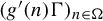 $(g'(n)\Gamma )_{n\in \Omega }$
is
$(g'(n)\Gamma )_{n\in \Omega }$
is $\mathcal {F}(C')^{-1}$
-totally equidistributed on
$\mathcal {F}(C')^{-1}$
-totally equidistributed on $G'/\Gamma '$
, where
$G'/\Gamma '$
, where $\Gamma ':=G'\cap \Gamma $
, and that
$\Gamma ':=G'\cap \Gamma $
, and that $\gamma \in \mathrm {poly}(\mathbb {Z}^{d}\to G_{\mathbb {N}})$
is such that
$\gamma \in \mathrm {poly}(\mathbb {Z}^{d}\to G_{\mathbb {N}})$
is such that $\gamma (n+rm)^{-1}\gamma (n)\in \Gamma $
for all
$\gamma (n+rm)^{-1}\gamma (n)\in \Gamma $
for all $m,n\in \mathbb {Z}^{d}$
with
$m,n\in \mathbb {Z}^{d}$
with $n,n+rm\in \Omega $
for some
$n,n+rm\in \Omega $
for some $r\leq O_{C,d,s}(C')$
.
$r\leq O_{C,d,s}(C')$
.
1.1 Organization of the paper
We first provide the background material for polynomials, nilmanifolds, and quadratic forms in §§2, 3, and 4, respectively. Then, in §5, we state the main equidistribution result of the paper (that is, Theorem 5.1, which is a generalization of Theorem 1.4) and explain the outline of its proof. We also explain in §5 the main challenges in adapting the Green–Tao approach to the quadratic setting.
Sections 6, 7, and 9 are devoted to the proof of Theorem 5.1. In §6, we provide the solutions to some relevant algebraic equations for polynomials over $\mathbb {F}_{p}$
. Among other results, we solve a polynomial equation of the form (6.25), which plays a central role in the proof of Theorem 1.4 for p-periodic polynomial sequences. Then, in §7, we extend the results in §6 to polynomials in
$\mathbb {F}_{p}$
. Among other results, we solve a polynomial equation of the form (6.25), which plays a central role in the proof of Theorem 1.4 for p-periodic polynomial sequences. Then, in §7, we extend the results in §6 to polynomials in $\mathbb {Q}$
. Finally, in §9, we combine the results from §§6 and 7 with the approach of Green and Tao [Reference Green and Tao5, Reference Green and Tao6] to complete the proof of Theorem 5.1.
$\mathbb {Q}$
. Finally, in §9, we combine the results from §§6 and 7 with the approach of Green and Tao [Reference Green and Tao5, Reference Green and Tao6] to complete the proof of Theorem 5.1.
1.2 Definitions and notation
Convention 1.8. Throughout this paper, we use $\tau \colon \mathbb {F}_{p}\to \{0,\ldots ,p-1\}$
to denote the natural bijective embedding, and use
$\tau \colon \mathbb {F}_{p}\to \{0,\ldots ,p-1\}$
to denote the natural bijective embedding, and use $\iota $
to denote the map from
$\iota $
to denote the map from $\mathbb {Z}$
(or
$\mathbb {Z}$
(or $\mathbb {Z}_{K}$
for any K divisible by p) to
$\mathbb {Z}_{K}$
for any K divisible by p) to $\mathbb {F}_{p}$
given by
$\mathbb {F}_{p}$
given by $\iota (n):=\tau ^{-1}(n \,\mod p\mathbb {Z})$
. We also use
$\iota (n):=\tau ^{-1}(n \,\mod p\mathbb {Z})$
. We also use $\tau $
to denote the map from
$\tau $
to denote the map from $\mathbb {F}_{p}^{k}$
to
$\mathbb {F}_{p}^{k}$
to $\mathbb {Z}^{k}$
(or
$\mathbb {Z}^{k}$
(or $\mathbb {Z}_{K}^{k}$
) given by
$\mathbb {Z}_{K}^{k}$
) given by $\tau (x_{1},\ldots ,x_{k}):=(\tau (x_{1}),\ldots ,\tau (x_{k}))$
, and
$\tau (x_{1},\ldots ,x_{k}):=(\tau (x_{1}),\ldots ,\tau (x_{k}))$
, and $\iota $
to denote the map from
$\iota $
to denote the map from $\mathbb {Z}^{k}$
(or
$\mathbb {Z}^{k}$
(or $\mathbb {Z}_{K}^{k}$
) to
$\mathbb {Z}_{K}^{k}$
) to $\mathbb {F}_{p}^{k}$
given by
$\mathbb {F}_{p}^{k}$
given by $\iota (x_{1},\ldots ,x_{k}):=(\iota (x_{1}),\ldots , \iota (x_{k}))$
. When there is no confusion, we will not state the domain and range of
$\iota (x_{1},\ldots ,x_{k}):=(\iota (x_{1}),\ldots , \iota (x_{k}))$
. When there is no confusion, we will not state the domain and range of $\tau $
and
$\tau $
and $\iota $
explicitly.
$\iota $
explicitly.
We may also extend the domain of $\iota $
to all the rational numbers of the form
$\iota $
to all the rational numbers of the form $x/y$
with
$x/y$
with $(x,y)=1, x\in \mathbb {Z}, y\in \mathbb {Z}\backslash p\mathbb {Z}$
by setting
$(x,y)=1, x\in \mathbb {Z}, y\in \mathbb {Z}\backslash p\mathbb {Z}$
by setting $\iota (x/y):=\iota (xy^{\ast })$
, where
$\iota (x/y):=\iota (xy^{\ast })$
, where $y^{\ast }$
is any integer with
$y^{\ast }$
is any integer with $yy^{\ast }\equiv 1 \,\mod {p}\mathbb {Z}$
.
$yy^{\ast }\equiv 1 \,\mod {p}\mathbb {Z}$
.
Below is the notation we use in this paper.
-
• Let
$\mathbb {N},\mathbb {N}_{+},\mathbb {Z},\mathbb {Q},\mathbb {R},\mathbb {R}_{+},\mathbb {C}$
denote the set of non-negative integers, positive integers, integers, rational numbers, real numbers, positive real numbers, and complex numbers, respectively. Denote
$\mathbb {T}:=\mathbb {R}/\mathbb {Z}$
. Let
$\mathbb {F}_{p}$
denote the finite field with p elements. Let
$\mathbb {Z}_{K}$
denote the cyclic group with K elements, and let
${1}/{K}\mathbb {Z},\mathbb {Z}/K$
denote the set of numbers of the from
$n/K$
for some
$n\in \mathbb {Z}$
. -
• Throughout this paper, d is a fixed positive integer and p is a prime number.
-
• Throughout this paper, unless otherwise stated, all vectors are assumed to be horizontal (row) vectors.
-
• Let
$\mathcal {C}$
be a collection of parameters and
$A,B,c\in \mathbb {R}$
. We write
$A\gg _{\mathcal {C}} B$
or
$A=O_{\mathcal {C}}(B)$
if
$\vert A\vert \geq K\vert B\vert $
for some
$K>0$
depending only on the parameters in
$\mathcal {C}$
. In the above definitions, we allow the set
$\mathcal {C}$
to be empty. In this case, K will be a universal constant. -
• Let
$[N]$
denote the set
$\{0,\ldots ,N-1\}$
. -
• We use
$\mathbf {0}$
to denote the zero vector in
$\mathbb {F}_{p}^{k}$
or
$\mathbb {R}^{k}$
, where the underlying space will be clear from the context. -
• For
$i=(i_{1},\ldots ,i_{k})\in \mathbb {Z}^{k}$
, denote
$\vert i\vert :=\vert i_{1}\vert +\cdots +\vert i_{k}\vert $
. For
${n=(n_{1},\ldots ,n_{k})\in \mathbb {Z}^{k}}$
and
$i=(i_{1},\ldots ,i_{k})\in \mathbb {N}^{k}$
, denote
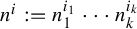
$n^{i}:=n_{1}^{i_{1}}\cdots n_{k}^{i_{k}}$
and
$i!:=i_{1}!\cdots i_{k}!$
. For
$n=(n_{1},\ldots ,n_{k})\in \mathbb {N}^{k}$
and
$i=(i_{1},\ldots ,i_{k})\in \mathbb {N}^{k}$
, denote
$\binom {n}{i}:=\binom {n_{1}}{i_{1}}\cdots \binom {n_{k}}{i_{k}}$
. -
• For any set F, let
$F[x_{1},\ldots ,x_{k}]$
denote the set of all polynomials in the variables
$x_{1},\ldots ,x_{k}$
whose coefficients are from F. -
• For
$x\in \mathbb {R}$
, let
$\lfloor x\rfloor $
denote the largest integer that is not larger than x and
$\lceil x\rceil $
denote the smallest integer that is not smaller than x. Denote
$\{x\}:=x-\lfloor x\rfloor $
. -
• Let X be a finite set and
$f\colon X\to \mathbb {C}$
be a function. Denote
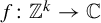
$\mathbb {E}_{x\in X}f(x):={1}/{\vert X\vert }\sum _{x\in X}f(x)$
, the average of f on X. -
• We say that a set
$\Omega \subseteq \mathbb {Z}^{k}$
is Q-periodic if
$\Omega =\Omega +Q\mathbb {Z}^{k}$
. -
• If
$\Omega \subseteq \mathbb {Z}^{k}$
is a Q-periodic set and
$f\colon \mathbb {Z}^{k}\to \mathbb {C}$
is such that
$f(n)=f(n+Qm)$
for all
$m,n\in \mathbb {Z}^{k}$
with
$n,n+Qm\in \Omega $
, then we denote
$\mathbb {E}_{x\in \Omega }f(x):=\mathbb {E}_{x\in \Omega \cap [Q]^{k}}f(x)$
. -
• For
$F=\mathbb {Z}^{k}$
or
$\mathbb {F}_{p}^{k}$
and
$x=(x_{1},\ldots ,x_{k}), y=(y_{1},\ldots ,y_{k})\in F$
, let
$x\cdot y\in \mathbb {Z}$
or
$\mathbb {F}_{p}$
denote the dot product given by
$x\cdot y:=x_{1}y_{1}+\cdots +x_{k}y_{k}.$
-
• Let
$\exp \colon \mathbb {R}\to \mathbb {C}$
denote the function
$\exp (x):=e^{2\pi i x}$
. -
• If G is a connected, simply connected Lie group, then we use
$\log G$
to denote its Lie algebra. Let
$\exp \colon \log G\to G$
be the exponential map and
$\log \colon G\to \log G$
be the logarithm map. For
$t\in \mathbb {R}$
and
$g\in G$
, denote
$g^{t}:=\exp (t\log g)$
. -
• If
$f\colon H\to G$
is a function from an abelian group
$H=(H,+)$
to some group
$(G,\cdot )$
, denote
$\Delta _{h} f(n):=f(n+h)\cdot f(n)^{-1}$
for all
$n,h\in H$
. -
• We write affine subspaces of
$\mathbb {F}_{p}^{d}$
as
$V+c$
, where V is a subspace of
$\mathbb {F}_{p}^{d}$
passing through
$\mathbf {0}$
, and
$c\in \mathbb {F}_{p}^{d}$
.



















































Let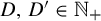 $D,D'\in \mathbb {N}_{+}$
and
$D,D'\in \mathbb {N}_{+}$
and $C>0$
. Here are some basic notions of complexities.
$C>0$
. Here are some basic notions of complexities.
-
• Real and complex numbers: a number
$r\in \mathbb {R}$
is of complexity at most C if
$r=a/b$
for some
$a,b\in \mathbb {Z}$
with
$-C\leq a,b\leq C$
. If
$r\notin \mathbb {Q}$
, then we say that the complexity of r is infinity. A complex number is of complexity at most C if both its real and imaginary parts are of complexity at most C. -
• Vectors and matrices: a vector or matrix is of complexity at most C if all of its entries are of complexity at most C.
-
• Subspaces: a subspace of
$\mathbb {R}^{D}$
is of complexity at most C if it is the null space of a matrix of complexity at most C. -
• Linear transformations: let
$L\colon \mathbb {C}^{D}\to \mathbb {C}^{D'}$
be a linear transformation. Then, L is associated with a
$D\times D'$
matrix A in
$\mathbb {C}$
. We say that L is of complexity at most C if A is of complexity at most C. -
• Lipschitz functions: a Lipschitz function is of complexity at most C if its Lipschitz norm is at most C.








2 Background material for polynomials
Definition 2.1. (Polynomials in finite field)
Let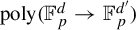 $\text {poly}(\mathbb {F}_{p}^{d}\to \mathbb {F}^{d'}_{p})$
be the collection of all functions
$\text {poly}(\mathbb {F}_{p}^{d}\to \mathbb {F}^{d'}_{p})$
be the collection of all functions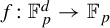 $f\colon \mathbb {F}_{p}^{d}\to \mathbb {F}_{p}$
of the form
$f\colon \mathbb {F}_{p}^{d}\to \mathbb {F}_{p}$
of the form
 $$ \begin{align} f(n_{1},\ldots,n_{d})=\sum_{0\leq a_{1},\ldots,a_{d}\leq p-1, a_{i}\in\mathbb{N}}C_{a_{1},\ldots,a_{d}}n^{a_{1}}_{1}\cdots n^{a_{d-1}}_{d} \end{align} $$
for some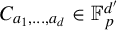 $C_{a_{1},\ldots ,a_{d}}\in \mathbb {F}_{p}^{d'}$
. Let
$C_{a_{1},\ldots ,a_{d}}\in \mathbb {F}_{p}^{d'}$
. Let $f\in \text {poly}(\mathbb {F}_{p}^{d}\to \mathbb {F}^{d'}_{p})$
be a function which is not constant zero. The degree of f (denoted as
$f\in \text {poly}(\mathbb {F}_{p}^{d}\to \mathbb {F}^{d'}_{p})$
be a function which is not constant zero. The degree of f (denoted as $\deg (f)$
) is the largest
$\deg (f)$
) is the largest $r\in \mathbb {N}$
such that
$r\in \mathbb {N}$
such that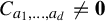 $C_{a_{1},\ldots ,a_{d}}\neq \mathbf {0}$
for some
$C_{a_{1},\ldots ,a_{d}}\neq \mathbf {0}$
for some $a_{1}+\cdots +a_{d}=r$
. We say that f is homogeneous of degree r if
$a_{1}+\cdots +a_{d}=r$
. We say that f is homogeneous of degree r if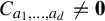 $C_{a_{1},\ldots ,a_{d}}\neq \mathbf {0}$
implies that
$C_{a_{1},\ldots ,a_{d}}\neq \mathbf {0}$
implies that $a_{1}+\cdots +a_{d}=r$
. We say that f is a linear transformation if f is homogeneous of degree 1.
$a_{1}+\cdots +a_{d}=r$
. We say that f is a linear transformation if f is homogeneous of degree 1.
Convention 2.2. For convenience, the degree of the constant zero function is allowed to take any integer value. For example, 0 can be regarded as a homogeneous polynomial of degree 10, as a linear transformation, or as a polynomial of degree -1. Here, we also adopt the convention that the only polynomial of negative degree is 0.
Definition 2.3. For any $R'\subseteq R\subseteq \mathbb {R}$
and
$R'\subseteq R\subseteq \mathbb {R}$
and $\Omega \subseteq \mathbb {Z}^{d}$
, let
$\Omega \subseteq \mathbb {Z}^{d}$
, let $\text {poly}(\mathbb {Z}^{d}\to R)$
be the collection of all polynomials in
$\text {poly}(\mathbb {Z}^{d}\to R)$
be the collection of all polynomials in $\mathbb {Z}^{d}$
taking values in R, and
$\mathbb {Z}^{d}$
taking values in R, and $\text {poly}(\Omega \to R\vert R')$
be the set of all
$\text {poly}(\Omega \to R\vert R')$
be the set of all ${f\in \text {poly}(\mathbb {Z}^{d}\to R)}$
such that
${f\in \text {poly}(\mathbb {Z}^{d}\to R)}$
such that $f(n)\in R'$
for all
$f(n)\in R'$
for all $n\in \Omega $
.
$n\in \Omega $
.
The following lemma is straightforward.
Lemma 2.4. Let $d\in \mathbb {N}_{+}$
, p be a prime, and
$d\in \mathbb {N}_{+}$
, p be a prime, and $f\in \mathrm {poly}(\mathbb {Z}^{d}\to \mathbb {Z})$
be an integer valued polynomial of degree smaller than p. There exist integer valued polynomial
$f\in \mathrm {poly}(\mathbb {Z}^{d}\to \mathbb {Z})$
be an integer valued polynomial of degree smaller than p. There exist integer valued polynomial ${f_{1}\in \mathrm {poly}(\mathbb {Z}^{d}\to \mathbb {Z})}$
and integer coefficient polynomial
${f_{1}\in \mathrm {poly}(\mathbb {Z}^{d}\to \mathbb {Z})}$
and integer coefficient polynomial $f_{2}\in \mathrm {poly}(\mathbb {Z}^{d}\to \mathbb {Z})$
, both having degrees at most
$f_{2}\in \mathrm {poly}(\mathbb {Z}^{d}\to \mathbb {Z})$
, both having degrees at most $\deg (f)$
such that
$\deg (f)$
such that $({1}/{p})f=f_{1}+({1}/{p})f_{2}$
.
$({1}/{p})f=f_{1}+({1}/{p})f_{2}$
.
Proof. Denote $s:=\deg (f)<p$
. By the multivariate polynomial interpolation, we may write
$s:=\deg (f)<p$
. By the multivariate polynomial interpolation, we may write
 $$ \begin{align*}f(n)=\sum_{i\in\mathbb{N}^{d},\vert i\vert\leq s}\frac{a_{i}}{Q}n^{i}\end{align*} $$
for some $a_{i}\in \mathbb {Z}$
and
$a_{i}\in \mathbb {Z}$
and $Q\in \mathbb {Z}, p\nmid Q$
(in fact, one can set
$Q\in \mathbb {Z}, p\nmid Q$
(in fact, one can set $Q=(\deg (f)!)^{d}$
). Let
$Q=(\deg (f)!)^{d}$
). Let $Q^{\ast }\in \mathbb {Z}$
be such that
$Q^{\ast }\in \mathbb {Z}$
be such that $Q^{\ast }Q\equiv 1 \,\mod p\mathbb {Z}$
and set
$Q^{\ast }Q\equiv 1 \,\mod p\mathbb {Z}$
and set
 $$ \begin{align*}f_{2}(n):=\sum_{i\in\mathbb{N}^{d},\vert i\vert\leq s}Q^{\ast}a_{i}n^{i}.\end{align*} $$
Then, $f_{2}$
is an integer coefficient polynomial of degree at most s. Note that for all
$f_{2}$
is an integer coefficient polynomial of degree at most s. Note that for all $n\in \mathbb {Z}^{d}$
,
$n\in \mathbb {Z}^{d}$
,
 $$ \begin{align*} \frac{1}{p}(f(n)-f_{2}(n))=\sum_{i\in\mathbb{N}^{d},\vert i\vert\leq s}\frac{a_{i}}{Q}\frac{1-Q^{\ast}Q}{p}n^{i}, \end{align*} $$
the left-hand side of which belongs to $\mathbb {Z}/p$
and the right-hand side of which belongs to
$\mathbb {Z}/p$
and the right-hand side of which belongs to $\mathbb {Z}/Q$
. So,
$\mathbb {Z}/Q$
. So, $f_{1}(n):=({1}/{p})(f(n)-f_{2}(n))$
takes values in
$f_{1}(n):=({1}/{p})(f(n)-f_{2}(n))$
takes values in $(\mathbb {Z}/Q)\cap (\mathbb {Z}/p)=\mathbb {Z}$
.
$(\mathbb {Z}/Q)\cap (\mathbb {Z}/p)=\mathbb {Z}$
.
There is a natural correspondence between polynomials taking values in $\mathbb {F}_{p}$
and polynomials taking values in
$\mathbb {F}_{p}$
and polynomials taking values in $\mathbb {Z}/p$
. Let
$\mathbb {Z}/p$
. Let $F\in \text {poly}(\mathbb {F}_{p}^{d}\to \mathbb {F}_{p}^{d'})$
and
$F\in \text {poly}(\mathbb {F}_{p}^{d}\to \mathbb {F}_{p}^{d'})$
and $f\in \text {poly}(\mathbb {Z}^{d}\to (\mathbb {Z}/p)^{d'})$
be polynomials of degree at most s for some
$f\in \text {poly}(\mathbb {Z}^{d}\to (\mathbb {Z}/p)^{d'})$
be polynomials of degree at most s for some $s<p$
. If
$s<p$
. If $F=\iota \circ (pf)\circ \tau $
, then we say that F is induced by f and f is a lifting of F. (Note that since
$F=\iota \circ (pf)\circ \tau $
, then we say that F is induced by f and f is a lifting of F. (Note that since $pf\circ \tau $
takes values in
$pf\circ \tau $
takes values in $\mathbb {Z}^{d'}$
, the coefficients of
$\mathbb {Z}^{d'}$
, the coefficients of $pf\circ \tau $
belong to
$pf\circ \tau $
belong to $\mathbb {Z}^{d'}/s!$
, and thus
$\mathbb {Z}^{d'}/s!$
, and thus $\iota \circ pf\circ \tau $
is well defined by Convention 1.8.) We say that f is a regular lifting of F if, in addition, f has the same degree as F and f has
$\iota \circ pf\circ \tau $
is well defined by Convention 1.8.) We say that f is a regular lifting of F if, in addition, f has the same degree as F and f has $\{0,({1}/{p}),\ldots ,{(p-1)}/{p}\}$
-coefficients.
$\{0,({1}/{p}),\ldots ,{(p-1)}/{p}\}$
-coefficients.
We provide some basic properties of lifting for later uses. Their proofs are simple and so we omit them.
Lemma 2.5. (Basic properties of lifting)
Let $d,d',d"\in \mathbb {N}_{+}$
and
$d,d',d"\in \mathbb {N}_{+}$
and $p>\max \{d,d',d"\}$
be a prime.
$p>\max \{d,d',d"\}$
be a prime.
-
(i) Every
$f\in \mathrm{poly}(\mathbb {Z}^{d}\to (\mathbb {Z}/p)^{d'})$
of degree less than p induces
$\iota \circ (pf)\circ \tau $
, which is a polynomial of degree at most
$\deg (f)$
. Moreover, if f is homogeneous, then so is
$\iota \circ (pf)\circ \tau $
. -
(ii) Every
$F\in \mathrm {poly}(\mathbb {F}_{p}^{d}\to \mathbb {F}^{d'}_{p})$
of degree less than p admits a regular lifting. Moreover, if F is homogeneous, we may further require the lifting to be homogeneous. -
(iii) If
$f\in \mathrm {poly}(\mathbb {Z}^{d}\to (\mathbb {Z}/p)^{d'})$
is a lifting of some
$F\in \mathrm { poly}(\mathbb {F}_{p}^{d}\to \mathbb {F}_{p}^{d'})$
with both f and F having degrees at most
$p-1$
, then for any
$f'\in \mathrm { poly}(\mathbb {Z}^{d}\to (\mathbb {Z}/p)^{d'})$
of degree less than p,
$f'$
is a lifting of F if and only if
$f-f'$
is integer valued. -
(iv) If
$f,f'\in \mathrm {poly}(\mathbb {Z}^{d}\to (\mathbb {Z}/p)^{d'})$
are liftings of
$F, F'\in \mathrm { poly}(\mathbb {F}_{p}^{d}\to \mathbb {F}_{p}^{d'})$
, respectively, with all of
$f,f',F$
, and
$F'$
having degrees at most
$(p-1)/2$
, then
$f+f'$
is a lifting of
$F+F'$
and
$pff'$
is a lifting of
$FF'$
. -
(v) If
$f\in \mathrm {poly}(\mathbb {Z}^{d}\to (\mathbb {Z}/p)^{d'})$
is a lifting of some
$F\in \mathrm { poly}(\mathbb {F}_{p}^{d}\to \mathbb {F}_{p}^{d'})$
with both f and F having degrees at most
$\sqrt {p}$
, and
$f\in \mathrm { poly}(\mathbb {Z}^{d'}\to (\mathbb {Z}/p)^{d"})$
is a lifting of some
$F\in \mathrm { poly}(\mathbb {F}_{p}^{d'}\to \mathbb {F}_{p}^{d"})$
with both f and F having degrees less than
$\sqrt {p}$
, then
$f'\circ (pf)$
is a lifting of
$F'\circ F$
. -
(vi) If
$f\in \mathrm {poly}(\mathbb {Z}^{d}\to (\mathbb {Z}/p)^{d'})$
is a lifting of some
$F\in \mathrm { poly}(\mathbb {F}_{p}^{d}\to \mathbb {F}_{p}^{d'})$
with both f and F having degrees less than p, then
$\tau \circ F\equiv (pf)\circ \tau \,\mod \mathbb {Z}^{d'}$
.























3 Background material for nilmanifolds
3.1 Nilmanifolds, filtrations, and polynomial sequences
We start with some basic definitions on nilmanifolds. Let G be a group and $g,h\in G$
. Denote
$g,h\in G$
. Denote $[g,h]:=g^{-1}h^{-1}gh$
. For subgroups
$[g,h]:=g^{-1}h^{-1}gh$
. For subgroups $H,H'$
of G, let
$H,H'$
of G, let $[H,H']$
denote the group generated by
$[H,H']$
denote the group generated by $[h,h']$
for all
$[h,h']$
for all $h\in H$
and
$h\in H$
and $h'\in H'$
.
$h'\in H'$
.
Definition 3.1. (Filtered group)
Let G be a group. An $\mathbb {N}$
-filtration on G is a collection
$\mathbb {N}$
-filtration on G is a collection $G_{\mathbb {N}}=(G_{i})_{i\in \mathbb {N}}$
of subgroups of G indexed by
$G_{\mathbb {N}}=(G_{i})_{i\in \mathbb {N}}$
of subgroups of G indexed by $\mathbb {N}$
with
$\mathbb {N}$
with $G_{0}=G$
such that the following hold:
$G_{0}=G$
such that the following hold:
-
(i) for all
$i,j\in \mathbb {N}$
with
$i\leq j$
, we have that
$G_{i}\supseteq G_{j}$
; -
(ii) for all
$i,j\in \mathbb {N}$
, we have
$[G_{i},G_{j}]\subseteq G_{i+j}$
.



For $s\in \mathbb {N}$
, we say that G is an (
$s\in \mathbb {N}$
, we say that G is an ( $\mathbb {N}$
-filtered) nilpotent group of degree at most s (or of degree
$\mathbb {N}$
-filtered) nilpotent group of degree at most s (or of degree $\leq s$
) with respect to some
$\leq s$
) with respect to some $\mathbb {N}$
-filtration
$\mathbb {N}$
-filtration $(G_{i})_{i\in \mathbb {N}}$
if
$(G_{i})_{i\in \mathbb {N}}$
if $G_{i}$
is trivial whenever
$G_{i}$
is trivial whenever $i>s$
.
$i>s$
.
Example 3.2. The lower central series of a group G is the $\mathbb {N}$
-filtration
$\mathbb {N}$
-filtration $(G^{i})_{i\in \mathbb {N}}$
given by
$(G^{i})_{i\in \mathbb {N}}$
given by $G^{0}:=G$
and
$G^{0}:=G$
and $G^{i+1}=[G^{i},G]$
for all
$G^{i+1}=[G^{i},G]$
for all $i\in \mathbb {N}$
. We say that G is a nilpotent group of step (or degree) at most s (with respect to the lower central series) if
$i\in \mathbb {N}$
. We say that G is a nilpotent group of step (or degree) at most s (with respect to the lower central series) if $G^{i}$
is trivial for all
$G^{i}$
is trivial for all $i\geq s+1$
.
$i\geq s+1$
.
Definition 3.3. (Nilmanifold)
Let $\Gamma $
be a discrete and cocompact subgroup of a connected, simply connected nilpotent Lie group G with filtration
$\Gamma $
be a discrete and cocompact subgroup of a connected, simply connected nilpotent Lie group G with filtration $G_{\mathbb {N}}=(G_{i})_{i\in \mathbb {N}}$
such that
$G_{\mathbb {N}}=(G_{i})_{i\in \mathbb {N}}$
such that ${\Gamma _{i}:=\Gamma \cap G_{i}}$
is a cocompact subgroup of
${\Gamma _{i}:=\Gamma \cap G_{i}}$
is a cocompact subgroup of $G_{i}$
for all
$G_{i}$
for all $i\in \mathbb {N}$
. (In some papers, such
$i\in \mathbb {N}$
. (In some papers, such $\Gamma _{i}$
is called a rational subgroup of G.) Then, we say that
$\Gamma _{i}$
is called a rational subgroup of G.) Then, we say that $G/\Gamma $
is an (
$G/\Gamma $
is an ( $\mathbb {N}$
-filtered) nilmanifold and we use
$\mathbb {N}$
-filtered) nilmanifold and we use $(G/\Gamma )_{\mathbb {N}}$
to denote the collection
$(G/\Gamma )_{\mathbb {N}}$
to denote the collection $(G_{i}/\Gamma _{i})_{i\in \mathbb {N}}$
(which is called the
$(G_{i}/\Gamma _{i})_{i\in \mathbb {N}}$
(which is called the $\mathbb {N}$
-filtration of
$\mathbb {N}$
-filtration of $G/\Gamma $
). We say that
$G/\Gamma $
). We say that $G/\Gamma $
has degree
$G/\Gamma $
has degree $\leq s$
with respect to
$\leq s$
with respect to $(G/\Gamma )_{\mathbb {N}}$
if G has degree
$(G/\Gamma )_{\mathbb {N}}$
if G has degree $\leq s$
with respect to
$\leq s$
with respect to $G_{\mathbb {N}}$
. (Unlike the convention in literature, for our convenience, we do not require
$G_{\mathbb {N}}$
. (Unlike the convention in literature, for our convenience, we do not require $G_{0}=G$
to be the same as
$G_{0}=G$
to be the same as $G_{1}$
.)
$G_{1}$
.)
We also need to define some special types of nilmanifolds.
Definition 3.4. (Sub-nilmanifold)
Let $G/\Gamma $
be an
$G/\Gamma $
be an $\mathbb {N}$
-filtered nilmanifold of degree
$\mathbb {N}$
-filtered nilmanifold of degree $\leq s$
with filtration
$\leq s$
with filtration $G_{\mathbb {N}}$
and H be a rational subgroup of G. Then,
$G_{\mathbb {N}}$
and H be a rational subgroup of G. Then, $H/(H\cap \Gamma )$
is also an
$H/(H\cap \Gamma )$
is also an $\mathbb {N}$
-filtered nilmanifold of degree
$\mathbb {N}$
-filtered nilmanifold of degree $\leq s$
with the filtration
$\leq s$
with the filtration $H_{\mathbb {N}}$
given by
$H_{\mathbb {N}}$
given by $H_{i}:=G_{i}\cap H$
for all
$H_{i}:=G_{i}\cap H$
for all $i\in \mathbb {N}$
(see [Reference Green, Tao and Ziegler8, Example 6.14]). We say that
$i\in \mathbb {N}$
(see [Reference Green, Tao and Ziegler8, Example 6.14]). We say that $H/(H\cap \Gamma )$
is a sub-nilmanifold of
$H/(H\cap \Gamma )$
is a sub-nilmanifold of $G/\Gamma $
,
$G/\Gamma $
, $H_{\mathbb {N}}$
(or
$H_{\mathbb {N}}$
(or $(H/(H\cap \Gamma ))_{\mathbb {N}}$
) is the filtration induced by
$(H/(H\cap \Gamma ))_{\mathbb {N}}$
) is the filtration induced by $G_{\mathbb {N}}$
(or
$G_{\mathbb {N}}$
(or $(G/\Gamma )_{\mathbb {N}}$
).
$(G/\Gamma )_{\mathbb {N}}$
).
Definition 3.5. (Quotient nilmanifold)
Let $G/\Gamma $
be an
$G/\Gamma $
be an $\mathbb {N}$
-filtered nilmanifold of degree
$\mathbb {N}$
-filtered nilmanifold of degree $\leq s$
with filtration
$\leq s$
with filtration $G_{\mathbb {N}}$
and H be a normal subgroup of G. Then,
$G_{\mathbb {N}}$
and H be a normal subgroup of G. Then, $(G/H)/(\Gamma /(\Gamma \cap H))$
is also an
$(G/H)/(\Gamma /(\Gamma \cap H))$
is also an $\mathbb {N}$
-filtered nilmanifold of most
$\mathbb {N}$
-filtered nilmanifold of most $\leq s$
with the filtration
$\leq s$
with the filtration $(G/H)_{\mathbb {N}}$
given by
$(G/H)_{\mathbb {N}}$
given by $(G/H)_{i}:=G_{i}/(H\cap G_{i})$
for all
$(G/H)_{i}:=G_{i}/(H\cap G_{i})$
for all $i\in \mathbb {N}$
. We say that
$i\in \mathbb {N}$
. We say that $(G/H)/(\Gamma /(\Gamma \cap H))$
is the quotient nilmanifold of
$(G/H)/(\Gamma /(\Gamma \cap H))$
is the quotient nilmanifold of $G/\Gamma $
by H and that
$G/\Gamma $
by H and that $(G/H)_{\mathbb {N}}$
is the filtration induced by
$(G/H)_{\mathbb {N}}$
is the filtration induced by $G_{\mathbb {N}}$
.
$G_{\mathbb {N}}$
.
Definition 3.6. (Product nilmanifold)
Let $G/\Gamma $
and
$G/\Gamma $
and $G'/\Gamma '$
be
$G'/\Gamma '$
be $\mathbb {N}$
-filtered nilmanifolds of degree
$\mathbb {N}$
-filtered nilmanifolds of degree $\leq s$
with filtration
$\leq s$
with filtration $G_{\mathbb {N}}$
and
$G_{\mathbb {N}}$
and $G^{\prime }_{\mathbb {N}}$
. Then,
$G^{\prime }_{\mathbb {N}}$
. Then, $(G\times G')/(\Gamma \times \Gamma ')$
is also an
$(G\times G')/(\Gamma \times \Gamma ')$
is also an $\mathbb {N}$
-filtered nilmanifold of most
$\mathbb {N}$
-filtered nilmanifold of most $\subseteq J$
with the filtration
$\subseteq J$
with the filtration $((G\times G')/(\Gamma \times \Gamma '))_{\mathbb {N}}$
given by
$((G\times G')/(\Gamma \times \Gamma '))_{\mathbb {N}}$
given by $((G\times G')/ (\Gamma \times \Gamma '))_{i}:=(G_{i}\times G^{\prime }_{i})/(\Gamma _{i}\times \Gamma ^{\prime }_{i})$
for all
$((G\times G')/ (\Gamma \times \Gamma '))_{i}:=(G_{i}\times G^{\prime }_{i})/(\Gamma _{i}\times \Gamma ^{\prime }_{i})$
for all $i\in \mathbb {N}$
. We say that
$i\in \mathbb {N}$
. We say that $(G\times G')/(\Gamma \times \Gamma ')$
is the product nilmanifold of
$(G\times G')/(\Gamma \times \Gamma ')$
is the product nilmanifold of $G/\Gamma $
and
$G/\Gamma $
and $G'/\Gamma '$
, and that
$G'/\Gamma '$
, and that $((G\times G')/(\Gamma \times \Gamma '))_{\mathbb {N}}$
is the filtration induced by
$((G\times G')/(\Gamma \times \Gamma '))_{\mathbb {N}}$
is the filtration induced by $G_{\mathbb {N}}$
and
$G_{\mathbb {N}}$
and $G^{\prime }_{\mathbb {N}}$
.
$G^{\prime }_{\mathbb {N}}$
.
We remark that although we used the same terminology ‘induce’ in Definitions 3.4, 3.5, and 3.6, this will not cause any confusion in the paper as the meaning of ‘induce’ will be clear from the context.
Definition 3.7. (Filtered homomorphism)
An ( $\mathbb {N}$
-filtered) homomorphism
$\mathbb {N}$
-filtered) homomorphism $\phi \colon G/\Gamma \to G'/\Gamma '$
between two
$\phi \colon G/\Gamma \to G'/\Gamma '$
between two $\mathbb {N}$
-filtered nilmanifolds is a group homomorphism
$\mathbb {N}$
-filtered nilmanifolds is a group homomorphism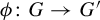 $\phi \colon G\to G'$
which maps
$\phi \colon G\to G'$
which maps $\Gamma $
to
$\Gamma $
to $\Gamma '$
and maps
$\Gamma '$
and maps $G_{i}$
to
$G_{i}$
to $G^{\prime }_{i}$
for all
$G^{\prime }_{i}$
for all $i\in \mathbb {N}$
.
$i\in \mathbb {N}$
.
Every nilmanifold has an explicit algebraic description by using the Mal’cev basis.
Definition 3.8. (Mal’cev basis)
Let $s\in \mathbb {N}_{+}$
,
$s\in \mathbb {N}_{+}$
, $G/\Gamma $
be a nilmanifold of step at most s with the
$G/\Gamma $
be a nilmanifold of step at most s with the $\mathbb {N}$
-filtration
$\mathbb {N}$
-filtration $(G_{i})_{i\in \mathbb {N}}$
. Let
$(G_{i})_{i\in \mathbb {N}}$
. Let $\dim (G)=m$
and
$\dim (G)=m$
and $\dim (G_{i})=m_{i}$
for all
$\dim (G_{i})=m_{i}$
for all $0\leq i\leq s$
. A basis
$0\leq i\leq s$
. A basis $\mathcal {X}:=\{X_{1},\ldots ,X_{m}\}$
for the Lie algebra
$\mathcal {X}:=\{X_{1},\ldots ,X_{m}\}$
for the Lie algebra $\log G$
of G (over
$\log G$
of G (over $\mathbb {R}$
) is a Mal’cev basis for
$\mathbb {R}$
) is a Mal’cev basis for $G/\Gamma $
adapted to the filtration
$G/\Gamma $
adapted to the filtration $G_{\mathbb {N}}$
if:
$G_{\mathbb {N}}$
if:
-
• for all
$0\leq j\leq m-1$
,
$\log H_{j}:=\text {Span}_{\mathbb {R}}\{\xi _{j+1},\ldots ,\xi _{m}\}$
is a Lie algebra ideal of
$\log G$
and so
$H_{j}:=\exp (\log H_{j})$
is a normal Lie subgroup of
$G;$
-
•
$G_{i}=H_{m-m_{i}}$
for all
$0\leq i\leq s$
; -
• the map
$\psi ^{-1}\colon \mathbb {R}^{m}\to G$
given by is a bijection;
$$ \begin{align*} \psi^{-1}(t_{1},\ldots,t_{m})=\exp(t_{1}X_{1})\cdots\exp(t_{m}X_{m}) \end{align*} $$
-
•
$\Gamma =\psi ^{-1}(\mathbb {Z}^{m})$
.










We call $\psi $
the Mal’cev coordinate map with respect to the Mal’cev basis
$\psi $
the Mal’cev coordinate map with respect to the Mal’cev basis $\mathcal {X}$
. If
$\mathcal {X}$
. If ${g=\psi ^{-1}(t_{1},\ldots ,t_{m})}$
, we say that
${g=\psi ^{-1}(t_{1},\ldots ,t_{m})}$
, we say that $(t_{1},\ldots ,t_{m})$
are the Mal’cev coordinates of g with respect to
$(t_{1},\ldots ,t_{m})$
are the Mal’cev coordinates of g with respect to $\mathcal {X}$
.
$\mathcal {X}$
.
We say that the Mal’cev basis $\mathcal {X}$
is C-rational (or of complexity at most C) if all the structure constants
$\mathcal {X}$
is C-rational (or of complexity at most C) if all the structure constants $c_{i,j,k}$
in the relations
$c_{i,j,k}$
in the relations
 $$ \begin{align*}[X_{i},X_{j}]=\sum_{k}c_{i,j,k}X_{k}\end{align*} $$
are rational with complexity at most C.
By [Reference Green and Tao5, Lemma A.14], for any $h\in G$
, there is a unique way to write h as
$h\in G$
, there is a unique way to write h as $h=\{h\}[h]$
such that
$h=\{h\}[h]$
such that $\psi (\{h\})\in [0,1)^{m}$
and
$\psi (\{h\})\in [0,1)^{m}$
and $[h]\in \Gamma $
. We adopt this notation throughout this paper.
$[h]\in \Gamma $
. We adopt this notation throughout this paper.
It is known that for every filtration $G_{\bullet }$
which is rational for
$G_{\bullet }$
which is rational for $\Gamma $
, there exists a Mal’cev basis adapted to it. See for example the discussion after [Reference Green and Tao5, Definition 2.1].
$\Gamma $
, there exists a Mal’cev basis adapted to it. See for example the discussion after [Reference Green and Tao5, Definition 2.1].
We use the following quantities to describe the complexities of the objects defined above.
Definition 3.9. (Notions of complexities for nilmanifolds)
Let $G/\Gamma $
be a nilmanifold with an
$G/\Gamma $
be a nilmanifold with an $\mathbb {N}$
-filtration
$\mathbb {N}$
-filtration $G_{\mathbb {N}}$
and a Mal’cev basis
$G_{\mathbb {N}}$
and a Mal’cev basis $\mathcal {X}=\{X_{1},\ldots ,X_{D}\}$
adapted to it. We say that
$\mathcal {X}=\{X_{1},\ldots ,X_{D}\}$
adapted to it. We say that $G/\Gamma $
is of complexity at most C if the Mal’cev basis
$G/\Gamma $
is of complexity at most C if the Mal’cev basis $\mathcal {X}$
is C-rational and
$\mathcal {X}$
is C-rational and $\dim (G)\leq C$
.
$\dim (G)\leq C$
.
An element $g\in G$
is of complexity at most C (with respect to the Mal’cev coordinate map
$g\in G$
is of complexity at most C (with respect to the Mal’cev coordinate map $\psi \colon G/\Gamma \to \mathbb {R}^{m}$
) if
$\psi \colon G/\Gamma \to \mathbb {R}^{m}$
) if $\psi (g)\in [-C,C]^{m}$
.
$\psi (g)\in [-C,C]^{m}$
.
Let $G'/\Gamma '$
be a nilmanifold endowed with the Mal’cev basis
$G'/\Gamma '$
be a nilmanifold endowed with the Mal’cev basis $\mathcal {X}'=\{X^{\prime }_{1},\ldots ,X^{\prime }_{D'}\}$
, respectively. Let
$\mathcal {X}'=\{X^{\prime }_{1},\ldots ,X^{\prime }_{D'}\}$
, respectively. Let $\phi \colon G/\Gamma \to G'/\Gamma '$
be a filtered homomorphism. We say that
$\phi \colon G/\Gamma \to G'/\Gamma '$
be a filtered homomorphism. We say that $\phi $
is of complexity at most C if the map
$\phi $
is of complexity at most C if the map $X_{i}\to \sum _{j}a_{i,j}X^{\prime }_{j}$
induced by
$X_{i}\to \sum _{j}a_{i,j}X^{\prime }_{j}$
induced by $\phi $
is such that all
$\phi $
is such that all $a_{i,j}$
are of complexity at most C.
$a_{i,j}$
are of complexity at most C.
Let $G'\subseteq G$
be a closed connected subgroup. We say that
$G'\subseteq G$
be a closed connected subgroup. We say that $G'$
is C-rational (or of complexity at most C) relative to
$G'$
is C-rational (or of complexity at most C) relative to $\mathcal {X}$
if the Lie algebra
$\mathcal {X}$
if the Lie algebra $\log G$
has a basis consisting of linear combinations
$\log G$
has a basis consisting of linear combinations $\sum _{i}a_{i}X_{i}$
such that
$\sum _{i}a_{i}X_{i}$
such that $a_{i}$
are rational numbers of complexity at most C.
$a_{i}$
are rational numbers of complexity at most C.
Convention 3.10. In the rest of the paper, all nilmanifolds are assumed to have a fixed filtration, Mal’cev basis, and a smooth Riemannian metric induced by the Mal’cev basis. Therefore, we will simply say that a nilmanifold, Lipschitz function, sub-nilmanifold, etc. are of complexity C without mentioning the reference filtration and Mal’cev basis.
Definition 3.11. (Polynomial sequences)
Let $k\in \mathbb {N}_{+}$
and G be a connected simply connected nilpotent Lie group. Let
$k\in \mathbb {N}_{+}$
and G be a connected simply connected nilpotent Lie group. Let $(G_{i})_{i\in \mathbb {N}}$
be an
$(G_{i})_{i\in \mathbb {N}}$
be an $\mathbb {N}$
-filtration of G. A map
$\mathbb {N}$
-filtration of G. A map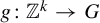 $g\colon \mathbb {Z}^{k}\to G$
is an (
$g\colon \mathbb {Z}^{k}\to G$
is an ( $\mathbb {N}$
-filtered) polynomial sequence if
$\mathbb {N}$
-filtered) polynomial sequence if
 $$ \begin{align*}\Delta_{h_{m}}\cdots \Delta_{h_{1}} g(n)\in G_{m}\end{align*} $$
for all $m\in \mathbb {N}$
and
$m\in \mathbb {N}$
and $n,h_{1},\ldots ,h_{m}\in \mathbb {Z}^{k}$
. (Recall that
$n,h_{1},\ldots ,h_{m}\in \mathbb {Z}^{k}$
. (Recall that $\Delta _{h}g(n):=g(n+h)g(n)^{-1}$
for all
$\Delta _{h}g(n):=g(n+h)g(n)^{-1}$
for all $n, h\in H$
.)
$n, h\in H$
.)
The set of all $\mathbb {N}$
-filtered polynomial sequences is denoted by
$\mathbb {N}$
-filtered polynomial sequences is denoted by $\text {poly}(\mathbb {Z}^{k}\to G_{\mathbb {N}})$
.
$\text {poly}(\mathbb {Z}^{k}\to G_{\mathbb {N}})$
.
By [Reference Green, Tao and Ziegler8, Corollary B.4], $\text {poly}(\mathbb {Z}^{k}\to G_{\mathbb {N}})$
is a group with respect to the pointwise multiplicative operation. We refer the readers to [Reference Green, Tao and Ziegler8, Appendix B] for more properties for polynomial sequences.
$\text {poly}(\mathbb {Z}^{k}\to G_{\mathbb {N}})$
is a group with respect to the pointwise multiplicative operation. We refer the readers to [Reference Green, Tao and Ziegler8, Appendix B] for more properties for polynomial sequences.
3.2 Different notions of polynomial sequences
We start with some conventional definitions for polynomial sequences.
Definition 3.12. (Null, rational, and periodic polynomial sequences)
Let $k\in \mathbb {N}_{+}$
,
$k\in \mathbb {N}_{+}$
, $G/\Gamma $
be a nilmanifold,
$G/\Gamma $
be a nilmanifold, $n_{\ast }\in \mathbb {Z}^{k}$
, and
$n_{\ast }\in \mathbb {Z}^{k}$
, and $g\in \text {poly}(\mathbb {Z}^{k}\to G_{\mathbb {N}})$
. We say that g is:
$g\in \text {poly}(\mathbb {Z}^{k}\to G_{\mathbb {N}})$
. We say that g is:
-
• null if
$g(n)\in \Gamma $
for all
$n\in \mathbb {Z}^{k}$
; -
• rational with base point
$n_{\ast }$
if
$g(Qn+n_{\ast })\in \Gamma $
for all
$n\in \mathbb {Z}^{k}$
for some
$Q\in \mathbb {N}_{+}$
, in which case, we also say that g is Q-rational with base point
$n_{\ast }$
. We simply say that g is rational or Q-rational when
$n_{\ast }=\mathbf {0}$
; -
• periodic if
$g(n+Qm)^{-1}g(n)\in \Gamma $
for all
$m,n\in \mathbb {Z}^{k}$
for some
$Q\in \mathbb {N}_{+}$
, in which case, we also say that g is Q-periodic.








We refer the readers to [Reference Green and Tao5, Appendix A] for properties of rational/periodic polynomial sequences.
In this paper, since we will work with polynomial sequences which are null, rational, or periodic on certain subsets of $\mathbb {Z}^{k}$
, we introduce the following notation.
$\mathbb {Z}^{k}$
, we introduce the following notation.
Definition 3.13. (Null, rational, and periodic polynomial sequences on subsets of
$\mathbb {Z}^{k}$
)

Let $k,Q\in \mathbb {N}_{+}$
,
$k,Q\in \mathbb {N}_{+}$
, $G/\Gamma $
be an
$G/\Gamma $
be an $\mathbb {N}$
-filtered nilmanifold,
$\mathbb {N}$
-filtered nilmanifold, $\Omega $
be a subset of
$\Omega $
be a subset of $\mathbb {Z}^{k}$
, and
$\mathbb {Z}^{k}$
, and $n_{\ast }\in \Omega $
.
$n_{\ast }\in \Omega $
.
-
• We use
$\text {poly}(\Omega \to G_{\mathbb {N}}\vert \Gamma )$
to denote the set of all
$g\in \text {poly}(\mathbb {Z}^{k}\to G_{\mathbb {N}})$
that is null on
$\Omega $
, meaning that
$g(n)\in \Gamma $
for all
$n\in \Omega $
. -
• We use
$\text {poly}_{\approx Q,n_{\ast }}(\Omega \to G_{\mathbb {N}}\vert \Gamma )$
to denote the set of all
$g\in \text {poly}(\mathbb {Z}^{k}\to G_{\mathbb {N}})$
that is Q-rational on
$\Omega $
with base point
$n_{\ast }$
meaning that
$g(n_{\ast }+Qm)\in \Gamma $
for all
$m\in \mathbb {Z}^{k}$
with
$n_{\ast }+Qm\in \Omega $
. -
• We use
$\text {poly}_{Q}(\Omega \to G_{\mathbb {N}}\vert \Gamma )$
to denote the set of all
$g\in \text {poly}(\mathbb {Z}^{k}\to G_{\mathbb {N}})$
that is Q-periodic on
$\Omega $
, meaning that
$g(n+Qm)^{-1}g(n)\in \Gamma $
for all
$m,n\in \mathbb {Z}^{k}$
with
$n,n+Qm\in \Omega $
.
















We informally say that a polynomial sequence is partially null if it is null on a subset of (instead of the entire) $\mathbb {Z}^{k}$
. We adopt similar conventions to rational and periodic sequences.
$\mathbb {Z}^{k}$
. We adopt similar conventions to rational and periodic sequences.
Example 3.14. The set $\text {poly}(\mathbb {Z}^{k}\to G_{\mathbb {N}}\vert \Gamma )$
is simply the set of all
$\text {poly}(\mathbb {Z}^{k}\to G_{\mathbb {N}}\vert \Gamma )$
is simply the set of all $\Gamma $
-valued (that is, null) polynomials. In other words,
$\Gamma $
-valued (that is, null) polynomials. In other words, $\text {poly}(\mathbb {Z}^{k}\to \Gamma _{\mathbb {N}})=\text {poly}(\mathbb {Z}^{k}\to G_{\mathbb {N}}\vert \Gamma )$
. The set
$\text {poly}(\mathbb {Z}^{k}\to \Gamma _{\mathbb {N}})=\text {poly}(\mathbb {Z}^{k}\to G_{\mathbb {N}}\vert \Gamma )$
. The set $\text {poly}_{\approx Q,\mathbf {0}}(\mathbb {Z}^{k}\to G_{\mathbb {N}}\vert \Gamma )$
is the set of Q-rational polynomial sequences in
$\text {poly}_{\approx Q,\mathbf {0}}(\mathbb {Z}^{k}\to G_{\mathbb {N}}\vert \Gamma )$
is the set of Q-rational polynomial sequences in ${\text {poly}(\mathbb {Z}^{k}\to G_{\mathbb {N}})}$
. The set
${\text {poly}(\mathbb {Z}^{k}\to G_{\mathbb {N}})}$
. The set $\text {poly}_{Q}(\mathbb {Z}^{k}\to G_{\mathbb {N}}\vert \Gamma )$
is the set of Q-periodic polynomial sequences in
$\text {poly}_{Q}(\mathbb {Z}^{k}\to G_{\mathbb {N}}\vert \Gamma )$
is the set of Q-periodic polynomial sequences in ${\text {poly}(\mathbb {Z}^{k}\to G_{\mathbb {N}})}$
.
${\text {poly}(\mathbb {Z}^{k}\to G_{\mathbb {N}})}$
.
Example 3.15. Let $(\mathbb {R}/\mathbb {Z})_{\mathbb {N}}$
be the nilmanifold with the filtration given by
$(\mathbb {R}/\mathbb {Z})_{\mathbb {N}}$
be the nilmanifold with the filtration given by $G_{0}=\cdots =G_{s}=\mathbb {R}$
and
$G_{0}=\cdots =G_{s}=\mathbb {R}$
and $G_{i}=\{\mathrm{id}_{G}\}$
for
$G_{i}=\{\mathrm{id}_{G}\}$
for $i>s$
. Then,
$i>s$
. Then, $\text {poly}(\Omega \to \mathbb {R}_{\mathbb {N}}\vert \mathbb {Z})$
is the collection of all polynomials in
$\text {poly}(\Omega \to \mathbb {R}_{\mathbb {N}}\vert \mathbb {Z})$
is the collection of all polynomials in $\text {poly}(\Omega \to \mathbb {R}\vert \mathbb {Z})$
(see in Definition 2.3) of degree at most s.
$\text {poly}(\Omega \to \mathbb {R}\vert \mathbb {Z})$
(see in Definition 2.3) of degree at most s.
Example 3.16. By [Reference Green, Tao and Ziegler8, Corollary B.4], it is not hard to see that $\text {poly}(\Omega \to G_{\mathbb {N}}\vert \Gamma )$
and
$\text {poly}(\Omega \to G_{\mathbb {N}}\vert \Gamma )$
and $\text {poly}_{\approx Q,n_{\ast }}(\mathbb {Z}^{k}\to G_{\mathbb {N}}\vert \Gamma )$
are groups. However, we caution the readers that
$\text {poly}_{\approx Q,n_{\ast }}(\mathbb {Z}^{k}\to G_{\mathbb {N}}\vert \Gamma )$
are groups. However, we caution the readers that $\text {poly}_{Q}(\mathbb {Z}^{k}\to G_{\mathbb {N}}\vert \Gamma )$
is not necessarily a group. Let
$\text {poly}_{Q}(\mathbb {Z}^{k}\to G_{\mathbb {N}}\vert \Gamma )$
is not necessarily a group. Let $k=1$
and
$k=1$
and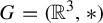 $G=(\mathbb {R}^{3},\ast )$
be the Heisenberg group with the group action given by
$G=(\mathbb {R}^{3},\ast )$
be the Heisenberg group with the group action given by
 $$ \begin{align*} (x,y,z)\ast(x',y',z'):=(x+x',y+y',z+z'+xy') \end{align*} $$
with the lower central series as its $\mathbb {N}$
-filtration, meaning that
$\mathbb {N}$
-filtration, meaning that $G_{0}=G_{1}=G$
,
$G_{0}=G_{1}=G$
, $G_{2}=\{0\}\times \{0\}\times \mathbb {R}$
, and
$G_{2}=\{0\}\times \{0\}\times \mathbb {R}$
, and $G_{s}=\{\mathbf {0}\}$
for
$G_{s}=\{\mathbf {0}\}$
for $s\geq 3$
. Indeed, let
$s\geq 3$
. Indeed, let $d=k=1$
,
$d=k=1$
, $\Gamma =\mathbb {Z}^{3}$
,
$\Gamma =\mathbb {Z}^{3}$
, $g_{1},g_{2}\in \Gamma $
, and
$g_{1},g_{2}\in \Gamma $
, and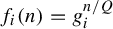 ${f_{i}(n)=g_{i}^{n/Q}}$
for all
${f_{i}(n)=g_{i}^{n/Q}}$
for all $n\in \mathbb {Z}$
and
$n\in \mathbb {Z}$
and $i=1,2$
. Then,
$i=1,2$
. Then, $f_{1},f_{2}\in \text {poly}_{Q}(\mathbb {Z}\to G_{\mathbb {N}}\vert \Gamma )$
. However,
$f_{1},f_{2}\in \text {poly}_{Q}(\mathbb {Z}\to G_{\mathbb {N}}\vert \Gamma )$
. However,
 $$ \begin{align*} & f_{2}(n+Q)^{-1}f_{1}(n+Q)^{-1}f_{1}(n)f_{2}(n)\\ & \quad=g_{2}^{-1-({n}/{Q})}g_{1}^{-1}g_{2}^{{n}/{Q}}=g_{2}^{-1}[g_{2}^{{n}/{Q}},g_{1}]g_{1}^{-1}=[g_{2},g_{1}]^{{n}/{Q}}g_{2}^{-1}g_{1}^{-1}. \end{align*} $$
In general, $[g_{2},g_{1}]^{{n}/{Q}}$
does not always belong to
$[g_{2},g_{1}]^{{n}/{Q}}$
does not always belong to $\Gamma $
if we choose
$\Gamma $
if we choose $g_{1}$
and
$g_{1}$
and $g_{2}$
properly. This means that
$g_{2}$
properly. This means that $f_{1}f_{2}$
does not need to belong to
$f_{1}f_{2}$
does not need to belong to $\text {poly}_{p}(\mathbb {Z}\to G_{\mathbb {N}}\vert \Gamma )$
.
$\text {poly}_{p}(\mathbb {Z}\to G_{\mathbb {N}}\vert \Gamma )$
.
The next proposition shows that partially Q-rational sequences are also partially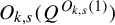 $O_{k,s}(Q^{O_{k,s}(1)})$
-periodic, the later characterization of which is typically more useful in applications.
$O_{k,s}(Q^{O_{k,s}(1)})$
-periodic, the later characterization of which is typically more useful in applications.
Proposition 3.17. Let $k,Q,s\in \mathbb {N}_{+}$
,
$k,Q,s\in \mathbb {N}_{+}$
, $p\gg _{k,Q,s} 1$
be a prime,
$p\gg _{k,Q,s} 1$
be a prime, $\Omega \subseteq \mathbb {Z}^{k}$
be a non-empty p-periodic set,
$\Omega \subseteq \mathbb {Z}^{k}$
be a non-empty p-periodic set, $n_{\ast }\in \Omega $
,
$n_{\ast }\in \Omega $
, $G/\Gamma $
be a nilmanifold of step at most s and complexity at most Q, and
$G/\Gamma $
be a nilmanifold of step at most s and complexity at most Q, and $g\in \mathrm {poly}_{\approx Q,n_{\ast }}(\Omega \to G_{\mathbb {N}}\vert \Gamma )$
. Then, there exists
$g\in \mathrm {poly}_{\approx Q,n_{\ast }}(\Omega \to G_{\mathbb {N}}\vert \Gamma )$
. Then, there exists $Q'\in \mathbb {N}_{+}$
with
$Q'\in \mathbb {N}_{+}$
with $Q'\ll _{k,s} Q^{O_{k,s}(1)}$
such that g belongs to
$Q'\ll _{k,s} Q^{O_{k,s}(1)}$
such that g belongs to $\mathrm {poly}_{Q'}(\Omega \to G_{\mathbb {N}}\vert \Gamma )$
.
$\mathrm {poly}_{Q'}(\Omega \to G_{\mathbb {N}}\vert \Gamma )$
.
To prove Proposition 3.17, we need the following result.
Proposition 3.18. Let $k,s\in \mathbb {N}_{+}$
,
$k,s\in \mathbb {N}_{+}$
, $\delta>0$
, and
$\delta>0$
, and $P\in \mathrm {poly}(\mathbb {Z}^{k}\to \mathbb {Q})$
be a rational polynomial of degree at most s. Suppose that P is K-periodic for some
$P\in \mathrm {poly}(\mathbb {Z}^{k}\to \mathbb {Q})$
be a rational polynomial of degree at most s. Suppose that P is K-periodic for some $K\in \mathbb {N}_{+}$
and suppose that there exists a subset W of
$K\in \mathbb {N}_{+}$
and suppose that there exists a subset W of $[K]^{k}$
of cardinality at least
$[K]^{k}$
of cardinality at least $\delta K^{k}$
such that
$\delta K^{k}$
such that $P(W)\subseteq \mathbb {Z}$
. Then, the coefficients of P belong to
$P(W)\subseteq \mathbb {Z}$
. Then, the coefficients of P belong to $\mathbb {Z}/r$
for some
$\mathbb {Z}/r$
for some $r\in \mathbb {N}_{+}$
with
$r\in \mathbb {N}_{+}$
with $r\ll _{k,s}\delta ^{-O_{k,s}(1)}$
.
$r\ll _{k,s}\delta ^{-O_{k,s}(1)}$
.
Proof. Let $F\colon \mathbb {T}\to [0,1]$
be a Lipschitz function supported on
$F\colon \mathbb {T}\to [0,1]$
be a Lipschitz function supported on $(-\delta /10,\delta /10)$
with
$(-\delta /10,\delta /10)$
with $F(0)=1$
and with Lipschitz norm at most
$F(0)=1$
and with Lipschitz norm at most $100\delta ^{-1}$
. Then,
$100\delta ^{-1}$
. Then, $\mathbb {E}_{n\in \mathbb {Z}^{k}} F(P(n) \,\mod \mathbb {Z})\geq \delta $
and
$\mathbb {E}_{n\in \mathbb {Z}^{k}} F(P(n) \,\mod \mathbb {Z})\geq \delta $
and $\int _{\mathbb {T}}F\,dm\leq \delta /2$
(where m is the Lebesgue measure on
$\int _{\mathbb {T}}F\,dm\leq \delta /2$
(where m is the Lebesgue measure on $\mathbb {T}$
). So,
$\mathbb {T}$
). So,
 $$ \begin{align*} \frac{\vert\mathbb{E}_{n\in\mathbb{Z}^{k}} F(P(n) \,\mod \mathbb{Z})-\int_{\mathbb{T}}F\,dm\vert}{\Vert F\Vert_{\mathrm{Lip}}}\geq \delta^{2}/200 \end{align*} $$
and thus, the sequence $(P(n) \,\mod \mathbb {Z})_{n\in \mathbb {Z}^{k}}$
is not
$(P(n) \,\mod \mathbb {Z})_{n\in \mathbb {Z}^{k}}$
is not $\delta ^{2}/200$
-equidistributed in
$\delta ^{2}/200$
-equidistributed in $\mathbb {T}$
. By [Reference Green and Tao5, Theorem 8.6], there exist
$\mathbb {T}$
. By [Reference Green and Tao5, Theorem 8.6], there exist $k\in \mathbb {Z}\backslash \{0\}$
with
$k\in \mathbb {Z}\backslash \{0\}$
with $0<\vert k\vert \ll _{k,s}\delta ^{-O_{k,s}(1)}$
and
$0<\vert k\vert \ll _{k,s}\delta ^{-O_{k,s}(1)}$
and $a\in \mathbb {R}$
such that
$a\in \mathbb {R}$
such that $kP(n)\equiv a\,\mod \mathbb {Z}$
for all
$kP(n)\equiv a\,\mod \mathbb {Z}$
for all $n\in \mathbb {Z}^{k}$
. Since W is non-empty, we may take
$n\in \mathbb {Z}^{k}$
. Since W is non-empty, we may take $a=0$
. So, by interpolation, the coefficients of P belong to
$a=0$
. So, by interpolation, the coefficients of P belong to $\mathbb {Z}/r$
for some
$\mathbb {Z}/r$
for some $r\in \mathbb {N}_{+}$
with
$r\in \mathbb {N}_{+}$
with $r\ll _{k,s}\delta ^{-O_{k,s}(1)}$
.
$r\ll _{k,s}\delta ^{-O_{k,s}(1)}$
.
Proof of Proposition 3.17
Let $\psi =(\psi _{1},\ldots ,\psi _{m})\colon G\to \mathbb {R}^{m}$
be the Mal’cev coordinate map. Then, each
$\psi =(\psi _{1},\ldots ,\psi _{m})\colon G\to \mathbb {R}^{m}$
be the Mal’cev coordinate map. Then, each $\psi _{i}(g(n))$
is a rational polynomial of degree at most s. For convenience, denote
$\psi _{i}(g(n))$
is a rational polynomial of degree at most s. For convenience, denote $f_{i}:=\psi _{i}\circ g$
. Since
$f_{i}:=\psi _{i}\circ g$
. Since $p\gg _{Q} 1$
, for any
$p\gg _{Q} 1$
, for any $x\in \Omega $
, there exists
$x\in \Omega $
, there exists $v_{x},u_{x}\in \mathbb {Z}^{k}$
such that
$v_{x},u_{x}\in \mathbb {Z}^{k}$
such that ${n_{\ast }+Qv_{x}+pu_{x}=x}$
. Then, for all
${n_{\ast }+Qv_{x}+pu_{x}=x}$
. Then, for all $y\in \mathbb {Z}^{k}$
, we have that
$y\in \mathbb {Z}^{k}$
, we have that $n_{\ast }+Qv_{x}+pQy=n_{\ast }+Q(v_{x}+py)\in \Omega $
and thus,
$n_{\ast }+Qv_{x}+pQy=n_{\ast }+Q(v_{x}+py)\in \Omega $
and thus, $f_{i}(n_{\ast }+Qv_{x}+pQy)\in \mathbb {Z}$
. By interpolation, all the coefficients of the polynomial
$f_{i}(n_{\ast }+Qv_{x}+pQy)\in \mathbb {Z}$
. By interpolation, all the coefficients of the polynomial $f_{i}(n_{\ast }+Qv_{x}+pQ\cdot )$
belong to
$f_{i}(n_{\ast }+Qv_{x}+pQ\cdot )$
belong to $\mathbb {Z}/(s!)^{k}$
and thus, all the coefficients of the polynomial
$\mathbb {Z}/(s!)^{k}$
and thus, all the coefficients of the polynomial $f_{i}(n_{\ast }+Qv_{x}+p\cdot )$
belong to
$f_{i}(n_{\ast }+Qv_{x}+p\cdot )$
belong to $\mathbb {Z}/Q^{s}(s!)^{k}$
. So, we have that
$\mathbb {Z}/Q^{s}(s!)^{k}$
. So, we have that
 $$ \begin{align} \begin{aligned} f_{i}(x)\in\mathbb{Z}/Q^{s}(s!)^{k} \quad\text{for all } x\in\Omega. \end{aligned} \end{align} $$
For $h=(h_{1},\ldots ,h_{m}), h'=(h^{\prime }_{1},\ldots ,h^{\prime }_{m})\in \mathbb {R}^{m}$
, and
$h=(h_{1},\ldots ,h_{m}), h'=(h^{\prime }_{1},\ldots ,h^{\prime }_{m})\in \mathbb {R}^{m}$
, and $1\leq i\leq m$
, by [Reference Green and Tao5, Lemma A.3], we may write
$1\leq i\leq m$
, by [Reference Green and Tao5, Lemma A.3], we may write $\psi _{i}(\psi ^{-1}(h)\psi ^{-1}(h'))$
as a polynomial of degree
$\psi _{i}(\psi ^{-1}(h)\psi ^{-1}(h'))$
as a polynomial of degree $O_{k,s}(1)$
with coefficients in
$O_{k,s}(1)$
with coefficients in $\mathbb {Z}/q_{1}$
for some
$\mathbb {Z}/q_{1}$
for some $q_{1}\ll _{k,s} Q^{O_{k,s}(1)}$
, and this polynomial depends only on the first i variables of h and
$q_{1}\ll _{k,s} Q^{O_{k,s}(1)}$
, and this polynomial depends only on the first i variables of h and $h'$
. Since
$h'$
. Since $\psi _{i}(\psi ^{-1}(h)\psi ^{-1}(h))=\mathbf {0}$
, we may write
$\psi _{i}(\psi ^{-1}(h)\psi ^{-1}(h))=\mathbf {0}$
, we may write $\psi _{i}(\psi ^{-1}(h)\psi ^{-1}(h'))=\psi _{i}(\psi ^{-1}(h)\psi ^{-1}(h'))-\psi _{i}(\psi ^{-1}(h)\psi ^{-1}(h))$
as
$\psi _{i}(\psi ^{-1}(h)\psi ^{-1}(h'))=\psi _{i}(\psi ^{-1}(h)\psi ^{-1}(h'))-\psi _{i}(\psi ^{-1}(h)\psi ^{-1}(h))$
as $\sum _{i'=1}^{i}(h_{i'}-h^{\prime }_{i'})P_{i,i'}(h,h')$
for some polynomials
$\sum _{i'=1}^{i}(h_{i'}-h^{\prime }_{i'})P_{i,i'}(h,h')$
for some polynomials $P_{i,i'}$
of degree
$P_{i,i'}$
of degree $O_{k,s}(1)$
with coefficients in
$O_{k,s}(1)$
with coefficients in $\mathbb {Z}/q_{1}$
for some
$\mathbb {Z}/q_{1}$
for some $q_{1}\in \mathbb {N}_{+}$
with
$q_{1}\in \mathbb {N}_{+}$
with ${q_{1}\ll _{k,s} Q^{O_{k,s}(1)}}$
. Therefore, we have that
${q_{1}\ll _{k,s} Q^{O_{k,s}(1)}}$
. Therefore, we have that
 $$ \begin{align} \begin{aligned} \psi_{i}(g(n'+qn)^{-1}g(n'))=\sum_{i'=1}^{i}(f_{i'}(n'+qn)-f_{i'}(n'))P_{i,i'}(\mathbf{f}(n'+qn),\mathbf{f}(n')) \end{aligned} \end{align} $$
for all $n,n'\in \mathbb {Z}^{k}$
and
$n,n'\in \mathbb {Z}^{k}$
and $q\in \mathbb {N}_{+}$
, where
$q\in \mathbb {N}_{+}$
, where $\mathbf {f}(n):=(f_{1}(n),\ldots ,f_{i}(n))$
.
$\mathbf {f}(n):=(f_{1}(n),\ldots ,f_{i}(n))$
.
Since g is Q-rational with base point $n_{\ast }$
on
$n_{\ast }$
on $\Omega $
, we have that
$\Omega $
, we have that $f_{i}(n_{\ast }+Qn)\in \mathbb {Z}$
whenever
$f_{i}(n_{\ast }+Qn)\in \mathbb {Z}$
whenever $n_{\ast }+Qn\in \Omega $
. Since
$n_{\ast }+Qn\in \Omega $
. Since $\Omega $
is p-periodic, we have that
$\Omega $
is p-periodic, we have that $f_{i}(n_{\ast }+pQn)\in \mathbb {Z}$
for all
$f_{i}(n_{\ast }+pQn)\in \mathbb {Z}$
for all $n\in \mathbb {Z}^{k}$
since
$n\in \mathbb {Z}^{k}$
since $\Omega $
is p-periodic.
$\Omega $
is p-periodic.
Since $f_{i}$
is rational, it is also
$f_{i}$
is rational, it is also $Q'$
-periodic for some
$Q'$
-periodic for some $Q'\in \mathbb {N}$
. We may assume without loss of generality that
$Q'\in \mathbb {N}$
. We may assume without loss of generality that $pQ\vert Q'$
. Note that the set W of
$pQ\vert Q'$
. Note that the set W of $m\in [Q']^{k}$
for which
$m\in [Q']^{k}$
for which $f_{i}(m)\in \mathbb {Z}$
contains vectors of the form
$f_{i}(m)\in \mathbb {Z}$
contains vectors of the form $m=n_{\ast }+pQn$
for any
$m=n_{\ast }+pQn$
for any $n\in \mathbb {Z}^{k}$
with
$n\in \mathbb {Z}^{k}$
with $n_{\ast }+pQn\in [Q']^{k}$
. So, the density of W in
$n_{\ast }+pQn\in [Q']^{k}$
. So, the density of W in $[Q']^{k}$
is at least
$[Q']^{k}$
is at least $(pQ)^{-k}$
. So, by Proposition 3.18, the coefficients of the polynomial
$(pQ)^{-k}$
. So, by Proposition 3.18, the coefficients of the polynomial $f_{i}(n_{\ast }+pQ\cdot )$
belong to
$f_{i}(n_{\ast }+pQ\cdot )$
belong to $\mathbb {Z}/rp^{O_{k,s}(1)}$
for some
$\mathbb {Z}/rp^{O_{k,s}(1)}$
for some $r\ll _{k,s} Q^{O_{k,s}(1)}$
. So, by interpolation, all the coefficients of the polynomial
$r\ll _{k,s} Q^{O_{k,s}(1)}$
. So, by interpolation, all the coefficients of the polynomial $f_{i}$
belong to
$f_{i}$
belong to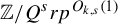 $\mathbb {Z}/Q^{s}rp^{O_{k,s}(1)}$
.
$\mathbb {Z}/Q^{s}rp^{O_{k,s}(1)}$
.
Moreover, for any $x,y\in \mathbb {Z}^{k}$
and
$x,y\in \mathbb {Z}^{k}$
and $Q'\in \mathbb {N}_{+}$
, since all the coefficients of the polynomial
$Q'\in \mathbb {N}_{+}$
, since all the coefficients of the polynomial $f_{i}$
belong to
$f_{i}$
belong to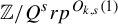 $\mathbb {Z}/Q^{s}rp^{O_{k,s}(1)}$
, we have that
$\mathbb {Z}/Q^{s}rp^{O_{k,s}(1)}$
, we have that $f_{i}(x+Q'Q^{s}ry)-f_{i}(x)\in Q'\mathbb {Z}/p^{O_{k,s}(1)}$
. If, in addition,
$f_{i}(x+Q'Q^{s}ry)-f_{i}(x)\in Q'\mathbb {Z}/p^{O_{k,s}(1)}$
. If, in addition, $x,x+Q'Q^{s}ry\in \Omega $
, then it follows from (3.1) that
$x,x+Q'Q^{s}ry\in \Omega $
, then it follows from (3.1) that
 $$ \begin{align*}f_{i}(x+Q'Q^{s}ry)-f_{i}(x)\in (\mathbb{Z}/Q^{s}(s!)^{k})\cap(Q'\mathbb{Z}/p^{O_{k,s}(1)})=Q'\mathbb{Z},\end{align*} $$
where the last equality follows from the fact that p is a prime with $p\gg _{k,Q,s} 1$
. Therefore, it follows from (3.2) that there exists some
$p\gg _{k,Q,s} 1$
. Therefore, it follows from (3.2) that there exists some $Q'\in \mathbb {N}_{+}$
with
$Q'\in \mathbb {N}_{+}$
with $Q'\ll _{k,s} Q^{O_{k,s}(1)}$
such that
$Q'\ll _{k,s} Q^{O_{k,s}(1)}$
such that $\psi _{i}(g(n'+Q'Q^{s}rn)^{-1}g(n'))\in \mathbb {Z}$
for all
$\psi _{i}(g(n'+Q'Q^{s}rn)^{-1}g(n'))\in \mathbb {Z}$
for all $n,n'\in \mathbb {Z}^{k}$
with
$n,n'\in \mathbb {Z}^{k}$
with $n',n'+Q'Q^{s}rn\in \Omega $
. This means that g is
$n',n'+Q'Q^{s}rn\in \Omega $
. This means that g is $Q'Q^{s}r$
-periodic on
$Q'Q^{s}r$
-periodic on $\Omega $
. This completes the proof.
$\Omega $
. This completes the proof.
Since $\mathbb {Z}^{k}$
is p-periodic, as a consequence of Proposition 3.17, we recover [Reference Green and Tao5, Lemma A.12].
$\mathbb {Z}^{k}$
is p-periodic, as a consequence of Proposition 3.17, we recover [Reference Green and Tao5, Lemma A.12].
Corollary 3.19. [Reference Green and Tao5, Lemma A.12]
Let $k,s\in \mathbb {N}_{+}$
and
$k,s\in \mathbb {N}_{+}$
and $G/\Gamma $
be a nilmanifold of step at most s. Then, every rational polynomial sequence in
$G/\Gamma $
be a nilmanifold of step at most s. Then, every rational polynomial sequence in $\mathrm {poly}(\mathbb {Z}^{k}\to G_{\mathbb {N}})$
is periodic.
$\mathrm {poly}(\mathbb {Z}^{k}\to G_{\mathbb {N}})$
is periodic.
3.3 Type-I horizontal torus and character
Horizontal torus and character are important notions which characterize the equidistribution properties of nilsequences. In the literature, there are at least three different types of horizontal torus and character. In this paper, as well as the series of work [Reference Sun15–Reference Sun17], we refer to them as type-I, type-II, and type-III. In this paper, we use the type-I horizontal torus and character defined next. (We will define the type-II horizontal torus and character in [Reference Sun16], and the type-III horizontal torus and character in [Reference Sun17].)
Definition 3.20. (Type-I horizontal torus and character)
Let $G/\Gamma $
be a nilmanifold endowed with a Mal’cev basis
$G/\Gamma $
be a nilmanifold endowed with a Mal’cev basis $\mathcal {X}$
. The type-I horizontal torus of
$\mathcal {X}$
. The type-I horizontal torus of $G/\Gamma $
is
$G/\Gamma $
is $G/[G,G]\Gamma $
. A type-I horizontal character is a continuous homomorphism
$G/[G,G]\Gamma $
. A type-I horizontal character is a continuous homomorphism $\eta \colon G\to \mathbb {R}$
such that
$\eta \colon G\to \mathbb {R}$
such that ${\eta (\Gamma )\subseteq \mathbb {Z}}$
. When written in the coordinates relative to
${\eta (\Gamma )\subseteq \mathbb {Z}}$
. When written in the coordinates relative to $\mathcal {X}$
, we may write
$\mathcal {X}$
, we may write $\eta (g)=k\cdot \psi (g)$
for some unique
$\eta (g)=k\cdot \psi (g)$
for some unique $k=(k_{1},\ldots ,k_{m})\in \mathbb {Z}^{m}$
, where
$k=(k_{1},\ldots ,k_{m})\in \mathbb {Z}^{m}$
, where $\psi \colon G\to \mathbb {R}^{m}$
is the coordinate map with respect to the Mal’cev basis
$\psi \colon G\to \mathbb {R}^{m}$
is the coordinate map with respect to the Mal’cev basis $\mathcal {X}$
. We call the quantity
$\mathcal {X}$
. We call the quantity $\Vert \eta \Vert :=\vert k\vert =\vert k_{1}\vert +\cdots +\vert k_{m}\vert $
the complexity of
$\Vert \eta \Vert :=\vert k\vert =\vert k_{1}\vert +\cdots +\vert k_{m}\vert $
the complexity of $\eta $
(with respect to
$\eta $
(with respect to $\mathcal {X}$
).
$\mathcal {X}$
).
It is not hard to see that any type-I horizontal character mod $\mathbb {Z}$
vanishes on
$\mathbb {Z}$
vanishes on $[G,G]\Gamma $
and thus descends to a continuous homomorphism between the type-I horizontal torus
$[G,G]\Gamma $
and thus descends to a continuous homomorphism between the type-I horizontal torus $G/[G,G]\Gamma $
and
$G/[G,G]\Gamma $
and $\mathbb {R}/\mathbb {Z}$
. Moreover,
$\mathbb {R}/\mathbb {Z}$
. Moreover, $\eta \,\mod \mathbb {Z}$
is a well-defined map from
$\eta \,\mod \mathbb {Z}$
is a well-defined map from $G/\Gamma $
to
$G/\Gamma $
to $\mathbb {R}/\mathbb {Z}$
.
$\mathbb {R}/\mathbb {Z}$
.
Type-I horizontal torus and character are used to characterize whether a nilsequence is equidistributed on a nilmanifold [Reference Green and Tao5, Reference Leibman12]. We provide some properties for later use. The proof of the following lemma is similar to that of [Reference Green and Tao5, Lemma 6.7], [Reference Green, Tao and Ziegler8, Lemma B.9], and [Reference Candela and Sisask1, Lemma 2.8]. We omit the details.
Lemma 3.21. Let $k\in \mathbb {N}_{+}$
,
$k\in \mathbb {N}_{+}$
, $s\in \mathbb {N}$
, and G be an
$s\in \mathbb {N}$
, and G be an $\mathbb {N}$
-filtered group of degree at most s. A function
$\mathbb {N}$
-filtered group of degree at most s. A function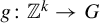 $g\colon \mathbb {Z}^{k}\to G$
belongs to
$g\colon \mathbb {Z}^{k}\to G$
belongs to $\mathrm { poly}(\mathbb {Z}^{k}\to G_{\mathbb {N}})$
if and only if for all
$\mathrm { poly}(\mathbb {Z}^{k}\to G_{\mathbb {N}})$
if and only if for all $i\in \mathbb {N}^{k}$
with
$i\in \mathbb {N}^{k}$
with $\vert i\vert \leq s$
, there exists
$\vert i\vert \leq s$
, there exists $X_{i}\in \log (G_{\vert i\vert })$
such that
$X_{i}\in \log (G_{\vert i\vert })$
such that
 $$ \begin{align*} g(n)=\prod_{i\in\mathbb{N}^{k}, \vert i\vert\leq s}\exp\bigg(\binom{n}{i}X_{i}\bigg). \end{align*} $$
Moreover, if $g\in \mathrm {poly}(\mathbb {Z}^{k}\to G_{\mathbb {N}})$
, then the choice of
$g\in \mathrm {poly}(\mathbb {Z}^{k}\to G_{\mathbb {N}})$
, then the choice of $X_{i}$
is unique.
$X_{i}$
is unique.
Furthermore, if $G'$
is a subgroup of G and g takes values in
$G'$
is a subgroup of G and g takes values in $G'$
, then
$G'$
, then $X_{i}\in \log (G')$
for all
$X_{i}\in \log (G')$
for all $i\in \mathbb {N}^{k}$
.
$i\in \mathbb {N}^{k}$
.
An equivalent way of saying that a function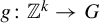 $g\colon \mathbb {Z}^{k}\to G$
belongs to
$g\colon \mathbb {Z}^{k}\to G$
belongs to $\text {poly}(\mathbb {Z}^{k}\to G_{\mathbb {N}})$
is that
$\text {poly}(\mathbb {Z}^{k}\to G_{\mathbb {N}})$
is that
 $$ \begin{align} g(n)=\prod_{i\in\mathbb{N}^{k}, \vert i\vert\leq s}g_{i}^{\binom{n}{i}} \end{align} $$
for some $g_{i}\in G_{\vert i\vert }$
(with any fixed order in
$g_{i}\in G_{\vert i\vert }$
(with any fixed order in $\mathbb {N}^{k}$
). We call
$\mathbb {N}^{k}$
). We call $g_{i}$
the (ith) type-I Taylor coefficient of g, and (3.3) the type-I Taylor expansion of g.
$g_{i}$
the (ith) type-I Taylor coefficient of g, and (3.3) the type-I Taylor expansion of g.
3.4 Vertical torus and character
The vertical torus is an important concept that allows us to do Fourier decompositions on nilmanifolds.
Definition 3.22. (Vertical torus and character)
Let $s\in \mathbb {N}$
,
$s\in \mathbb {N}$
, $G/\Gamma $
be a nilmanifold with an
$G/\Gamma $
be a nilmanifold with an $\mathbb {N}$
-filtration
$\mathbb {N}$
-filtration $(G_{i})_{i\in \mathbb {N}}$
of degree
$(G_{i})_{i\in \mathbb {N}}$
of degree $\leq s$
with a Mal’cev basis
$\leq s$
with a Mal’cev basis $\mathcal {X}$
adapted to it. Then,
$\mathcal {X}$
adapted to it. Then, $G_{s}$
lies in the center of G. The vertical torus of
$G_{s}$
lies in the center of G. The vertical torus of $G/\Gamma $
is the set
$G/\Gamma $
is the set $G_{s}/(\Gamma \cap G_{s})$
, which is a connected compact abelian Lip group isomorphic to
$G_{s}/(\Gamma \cap G_{s})$
, which is a connected compact abelian Lip group isomorphic to $\mathbb {T}^{\dim (G_{s})}$
. A vertical character of
$\mathbb {T}^{\dim (G_{s})}$
. A vertical character of $G/\Gamma $
(with respect to the filtration
$G/\Gamma $
(with respect to the filtration $(G_{i})_{i\in \mathbb {N}}$
) is a continuous homomorphism
$(G_{i})_{i\in \mathbb {N}}$
) is a continuous homomorphism $\xi \colon G_{s}\to \mathbb {R}$
such that
$\xi \colon G_{s}\to \mathbb {R}$
such that $\xi (\Gamma \cap G_{s})\subseteq \mathbb {Z}$
(in particular,
$\xi (\Gamma \cap G_{s})\subseteq \mathbb {Z}$
(in particular, $\xi $
descends to a continuous homomorphism from the vertical torus
$\xi $
descends to a continuous homomorphism from the vertical torus $G_{s}/(\Gamma \cap G_{s})$
to
$G_{s}/(\Gamma \cap G_{s})$
to $\mathbb {T}$
). Let
$\mathbb {T}$
). Let $\psi \colon G\to \mathbb {R}^{m}$
be the Mal’cev coordinate map and denote
$\psi \colon G\to \mathbb {R}^{m}$
be the Mal’cev coordinate map and denote $m_{s}=\dim (G_{s})$
. Then, there exists
$m_{s}=\dim (G_{s})$
. Then, there exists $k\in \mathbb {Z}^{m_{s}}$
such that
$k\in \mathbb {Z}^{m_{s}}$
such that $\xi (g_{s})=(\mathbf {0},k)\cdot \psi (g_{s})$
for all
$\xi (g_{s})=(\mathbf {0},k)\cdot \psi (g_{s})$
for all $g_{s}\in G_{s}$
(note that the first
$g_{s}\in G_{s}$
(note that the first $\dim (G)-m_{s}$
coordinates of
$\dim (G)-m_{s}$
coordinates of $\psi (g_{s})$
are all zero). We call the quantity
$\psi (g_{s})$
are all zero). We call the quantity $\Vert \xi \Vert :=\vert k\vert $
the complexity of
$\Vert \xi \Vert :=\vert k\vert $
the complexity of $\xi $
(with respect to
$\xi $
(with respect to $\mathcal {X}$
).
$\mathcal {X}$
).
The following lemma is useful in the study of equidistribution properties on nilmanifolds.
Lemma 3.23. Let $\Omega $
be a non-empty subset of
$\Omega $
be a non-empty subset of $\mathbb {Z}^{d}$
and
$\mathbb {Z}^{d}$
and $G/\Gamma $
be a nilmanifold with an
$G/\Gamma $
be a nilmanifold with an $\mathbb {N}$
-filtration
$\mathbb {N}$
-filtration $G_{\mathbb {N}}$
of degree s. Let
$G_{\mathbb {N}}$
of degree s. Let $m_{s}=\dim (G_{s})$
and
$m_{s}=\dim (G_{s})$
and $0<\delta <1/2$
. If a sequence
$0<\delta <1/2$
. If a sequence $a\colon \Omega \to G/\Gamma $
is not
$a\colon \Omega \to G/\Gamma $
is not $\delta $
-equidistributed on
$\delta $
-equidistributed on $G/\Gamma $
, then there exists a Lipschitz function
$G/\Gamma $
, then there exists a Lipschitz function $F\in \mathrm {Lip}(G/\Gamma \to \mathbb {C})$
with a vertical character of complexity at most
$F\in \mathrm {Lip}(G/\Gamma \to \mathbb {C})$
with a vertical character of complexity at most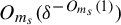 $O_{m_{s}}(\delta ^{-O_{m_{s}}(1)})$
such that
$O_{m_{s}}(\delta ^{-O_{m_{s}}(1)})$
such that
 $$ \begin{align*} \limsup_{N\to\infty}\bigg\vert\mathbb{E}_{n\in \Omega\cap [N]^{d}}F(a(n))-\int_{G/\Gamma} F\,dm_{G/\Gamma}\bigg\vert\gg_{m_{s}} \delta^{O_{m_{s}}(1)}\Vert F\Vert_{\mathrm{Lip}}, \end{align*} $$
where $m_{G/\Gamma }$
is the Haar measure of
$m_{G/\Gamma }$
is the Haar measure of $G/\Gamma $
.
$G/\Gamma $
.
The proof of Lemma 3.23 is a straightforward extension of [Reference Green and Tao5, Lemma 3.7], we omit the details.
4 Background materials for quadratic forms
4.1 Basic properties for quadratic forms
Definition 4.1. (Quadratic forms on
$\mathbb {F}_{p}^{d}$
)

We say that a function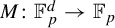 $M\colon \mathbb {F}_{p}^{d}\to \mathbb {F}_{p}$
is a quadratic form if
$M\colon \mathbb {F}_{p}^{d}\to \mathbb {F}_{p}$
is a quadratic form if
 $$ \begin{align*}M(n)=(nA)\cdot n+n\cdot u+v\end{align*} $$
for some $d\times d$
symmetric matrix A in
$d\times d$
symmetric matrix A in $\mathbb {F}_{p}$
, some
$\mathbb {F}_{p}$
, some $u\in \mathbb {F}_{p}^{d}$
, and some
$u\in \mathbb {F}_{p}^{d}$
, and some $v\in \mathbb {F}_{p}$
. We say that A is the matrix associated to M. (Sometimes in the literature, a quadratic form is defined to be a map
$v\in \mathbb {F}_{p}$
. We say that A is the matrix associated to M. (Sometimes in the literature, a quadratic form is defined to be a map $B\colon \mathbb {F}_{p}^{d}\times \mathbb {F}_{p}^{d}\to \mathbb {F}_{p}^{d}$
with
$B\colon \mathbb {F}_{p}^{d}\times \mathbb {F}_{p}^{d}\to \mathbb {F}_{p}^{d}$
with $B(x,y)=(xA)\cdot y$
for some symmetric matrix A. We define quadratic forms differently for the convenience of this paper.)
$B(x,y)=(xA)\cdot y$
for some symmetric matrix A. We define quadratic forms differently for the convenience of this paper.)
We say that M is pure if $u=\mathbf {0}$
. We say that M is homogeneous if
$u=\mathbf {0}$
. We say that M is homogeneous if $u=\mathbf {0}$
and
$u=\mathbf {0}$
and $v=0$
. We say that M is non-degenerate if
$v=0$
. We say that M is non-degenerate if $\det (A)\neq 0$
.
$\det (A)\neq 0$
.
A quadratic form in which we are particularly interested is the one induced by the dot product, namely $M(n):=n\cdot n$
, which is associated with the identity matrix.
$M(n):=n\cdot n$
, which is associated with the identity matrix.
Throughout this paper, we will crucially use the following philosophy.
Inheriting principle: the intersection of a hypersphere (that is, the set of zeros of a quadratic form) with a subspace or another hypersphere is a hypersphere inheriting properties of the original hypersphere.
One example of this principle is that the intersection inherits the rank of a quadratic form (Proposition 4.8). To make it precise, we need to define quadratic forms on affine subspaces of $\mathbb {F}_{p}^{d}$
. Let
$\mathbb {F}_{p}^{d}$
. Let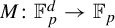 $M\colon \mathbb {F}_{p}^{d}\to \mathbb {F}_{p}$
be a quadratic form. We use
$M\colon \mathbb {F}_{p}^{d}\to \mathbb {F}_{p}$
be a quadratic form. We use $\mathrm {rank}(M):=\mathrm {rank}(A)$
to denote the rank of M. The M being non-degenerate is equivalent of having rank equal to d. Let
$\mathrm {rank}(M):=\mathrm {rank}(A)$
to denote the rank of M. The M being non-degenerate is equivalent of having rank equal to d. Let $V+c$
be an affine subspace of
$V+c$
be an affine subspace of $\mathbb {F}_{p}^{d}$
of dimension r. There exists a (not necessarily unique) bijective linear transformation
$\mathbb {F}_{p}^{d}$
of dimension r. There exists a (not necessarily unique) bijective linear transformation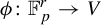 $\phi \colon \mathbb {F}_{p}^{r}\to V$
. We say that a function
$\phi \colon \mathbb {F}_{p}^{r}\to V$
. We say that a function $M\colon V+c\to \mathbb {F}_{p}$
is a quadratic form if there exists a quadratic form
$M\colon V+c\to \mathbb {F}_{p}$
is a quadratic form if there exists a quadratic form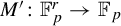 $M'\colon \mathbb {F}_{p}^{r}\to \mathbb {F}_{p}$
and a bijective linear transformation
$M'\colon \mathbb {F}_{p}^{r}\to \mathbb {F}_{p}$
and a bijective linear transformation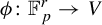 $\phi \colon \mathbb {F}_{p}^{r}\to V$
such that
$\phi \colon \mathbb {F}_{p}^{r}\to V$
such that $M(n)=M'(\phi ^{-1}(n-c))$
for all
$M(n)=M'(\phi ^{-1}(n-c))$
for all $n\in V+c$
(or equivalently,
$n\in V+c$
(or equivalently, $M'(m)=M(\phi (m)+c)$
for all
$M'(m)=M(\phi (m)+c)$
for all $m\in \mathbb {F}_{p}^{r}$
). We define the rank
$m\in \mathbb {F}_{p}^{r}$
). We define the rank $\mathrm {rank}(M\vert _{V+c})$
of M restricted to
$\mathrm {rank}(M\vert _{V+c})$
of M restricted to $V+c$
as the rank of
$V+c$
as the rank of $M'$
. Note that if
$M'$
. Note that if ${M(n)=M'(\phi ^{-1}(n-c))=M"({\phi '}^{-1}(n-c))}$
for some quadratic forms
${M(n)=M'(\phi ^{-1}(n-c))=M"({\phi '}^{-1}(n-c))}$
for some quadratic forms $M',M"$
associated to the matrices
$M',M"$
associated to the matrices $A',A"$
, then
$A',A"$
, then $A'=BA"{B}^{T}$
, where B is the unique
$A'=BA"{B}^{T}$
, where B is the unique $r\times r$
invertible matrix such that
$r\times r$
invertible matrix such that $\phi ^{-1}\circ \phi (m)=mB$
for all
$\phi ^{-1}\circ \phi (m)=mB$
for all $m\in \mathbb {F}_{p}^{r}$
. So,
$m\in \mathbb {F}_{p}^{r}$
. So, $\mathrm {rank}(M\vert _{V+c})$
is independent of the choice of
$\mathrm {rank}(M\vert _{V+c})$
is independent of the choice of $M'$
and
$M'$
and $\phi '$
.
$\phi '$
.
The following is a straightforward property for quadratic forms, which we record for later use.
Lemma 4.2. Let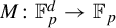 $M\colon \mathbb {F}_{p}^{d}\to \mathbb {F}_{p}$
be a quadratic form associated with the matrix A, and
$M\colon \mathbb {F}_{p}^{d}\to \mathbb {F}_{p}$
be a quadratic form associated with the matrix A, and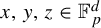 $x,y,z\in \mathbb {F}_{p}^{d}$
. Suppose that
$x,y,z\in \mathbb {F}_{p}^{d}$
. Suppose that $M(x)=M(x+y)=M(x+z)=0$
and that
$M(x)=M(x+y)=M(x+z)=0$
and that $p>2$
. Then,
$p>2$
. Then, $M(x+y+z)=0$
if and only if
$M(x+y+z)=0$
if and only if $(yA)\cdot z=0$
.
$(yA)\cdot z=0$
.
Proof. The conclusion follows from the equality
 $$ \begin{align*} M(x+y+z)-M(x+y)-M(x+z)+M(x)=2(yA)\cdot z. \\[-37pt] \end{align*} $$
The next lemma says that using translations and linear transformations, any quadratic form can be transformed into a ‘standard’ form.
Lemma 4.3. Let $d\in \mathbb {N}_{+}$
,
$d\in \mathbb {N}_{+}$
, $d'\in \mathbb {N}$
, and
$d'\in \mathbb {N}$
, and $p>2$
be a prime. For any quadratic form
$p>2$
be a prime. For any quadratic form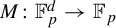 $M\colon \mathbb {F}_{p}^{d}\to \mathbb {F}_{p}$
of rank
$M\colon \mathbb {F}_{p}^{d}\to \mathbb {F}_{p}$
of rank $d'$
, there exist
$d'$
, there exist $c,c',\unicode{x3bb} \in \mathbb {F}_{p}$
and
$c,c',\unicode{x3bb} \in \mathbb {F}_{p}$
and $v\in \mathbb {F}_{p}^{d}$
with
$v\in \mathbb {F}_{p}^{d}$
with $c\neq 0$
and a
$c\neq 0$
and a $d\times d$
invertible matrix R in
$d\times d$
invertible matrix R in $\mathbb {F}_{p}$
such that writing
$\mathbb {F}_{p}$
such that writing $M'(n):=M(nR+v)$
, we have that
$M'(n):=M(nR+v)$
, we have that
 $$ \begin{align} M'(n_{1},\ldots,n_{d})=cn^{2}_{1}+n_{2}^{2}+\cdots+n^{2}_{d'}+c'n_{d'+1}-\unicode{x3bb}. \end{align} $$
Moreover, if M is homogeneous, then we may further require $c'=\unicode{x3bb} =0$
in (4.1); if M is pure, then we may further require
$c'=\unicode{x3bb} =0$
in (4.1); if M is pure, then we may further require $v=\mathbf {0}$
; if M is non-degenerate, then we may further require that
$v=\mathbf {0}$
; if M is non-degenerate, then we may further require that $d'=d$
.
$d'=d$
.
Remark 4.4. Throughout this paper, whenever we write a quadratic form $M'$
in the form (4.1), if
$M'$
in the form (4.1), if $d'=d$
, then we consider the term
$d'=d$
, then we consider the term $c'n_{d'+1}$
as non-existing.
$c'n_{d'+1}$
as non-existing.
Proof. Similar to the real valued quadratic forms, by a suitable substitution $n\mapsto nR$
for some upper triangular invertible matrix R and some
$n\mapsto nR$
for some upper triangular invertible matrix R and some $v\in \mathbb {F}_{p}^{d}$
, it suffices to consider the case when the matrix A associated to M is diagonal. Since
$v\in \mathbb {F}_{p}^{d}$
, it suffices to consider the case when the matrix A associated to M is diagonal. Since $\mathrm {rank}(M)=d'$
, we may assume without loss of generality that the first
$\mathrm {rank}(M)=d'$
, we may assume without loss of generality that the first $d'$
entry of the diagonal of A is non-zero. Let
$d'$
entry of the diagonal of A is non-zero. Let $c\in \{2,\ldots ,p-1\}$
be the smallest element such that
$c\in \{2,\ldots ,p-1\}$
be the smallest element such that $c\neq x^{2}$
for all
$c\neq x^{2}$
for all $x\in \mathbb {F}_{p}$
(such an element obviously exists). Under a suitable change of variables
$x\in \mathbb {F}_{p}$
(such an element obviously exists). Under a suitable change of variables $(n_{1},\ldots ,n_{d})\mapsto (c_{1}n_{1},\ldots ,c_{d'}n_{d'},n_{d'+1},\ldots ,n_{d})$
for some
$(n_{1},\ldots ,n_{d})\mapsto (c_{1}n_{1},\ldots ,c_{d'}n_{d'},n_{d'+1},\ldots ,n_{d})$
for some $c_{1},\ldots ,c_{d'}\in \mathbb {F}_{p}\backslash \{0\}$
and a change of the orders of
$c_{1},\ldots ,c_{d'}\in \mathbb {F}_{p}\backslash \{0\}$
and a change of the orders of $n_{1},\ldots ,n_{d'}$
, we may reduce the problem to the case when
$n_{1},\ldots ,n_{d'}$
, we may reduce the problem to the case when
 $$ \begin{align*}M(n_{1},\ldots,n_{d})=n_{1}^{2}+\cdots+n_{k}^{2}+cn_{k+1}^{2}+\cdots+cn_{d'}^{2}+a_{1}n_{1}+\cdots+a_{d}n_{d}-\unicode{x3bb}\end{align*} $$
for some $0\leq k\leq d'$
, where k is the number of non-zero diagonal entries in A that are quadratic residues. By a suitable substitution
$0\leq k\leq d'$
, where k is the number of non-zero diagonal entries in A that are quadratic residues. By a suitable substitution $n\mapsto n+m$
for some
$n\mapsto n+m$
for some $m\in \mathbb {F}_{p}^{d}$
, we may reduce the problem to the case when
$m\in \mathbb {F}_{p}^{d}$
, we may reduce the problem to the case when
 $$ \begin{align*}M(n_{1},\ldots,n_{d})=n_{1}^{2}+\cdots+n_{k}^{2}+cn_{k+1}^{2}+\cdots+cn_{d'}^{2}+a_{d'+1}n_{d'+1}+\cdots+a_{d}n_{d}-\unicode{x3bb}.\end{align*} $$
By another change of variables, we may reduce the problem to the case when
 $$ \begin{align*}M(n_{1},\ldots,n_{d})=n_{1}^{2}+\cdots+n_{k}^{2}+cn_{k+1}^{2}+\cdots+cn_{d'}^{2}+c'n_{d'+1}-\unicode{x3bb}.\end{align*} $$
By the minimality of c, we have that $a^{2}+1\equiv c \,\mod p\mathbb {Z}$
for some
$a^{2}+1\equiv c \,\mod p\mathbb {Z}$
for some $1\leq a\leq p-1$
. If
$1\leq a\leq p-1$
. If $k\leq d-2$
, then
$k\leq d-2$
, then
 $$ \begin{align*}cn_{k+1}^{2}+cn_{k+2}^{2}=(an_{k+1}+n_{k+2})^{2}+(n_{k+1}-an_{k+2})^{2}.\end{align*} $$
So, if $k+2\leq d'$
, then since
$k+2\leq d'$
, then since $a^{2}+1\not \equiv 0 \,\mod p$
, under another change of variables, we may use another change of variables to replace
$a^{2}+1\not \equiv 0 \,\mod p$
, under another change of variables, we may use another change of variables to replace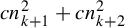 $cn_{k+1}^{2}+cn_{k+2}^{2}$
by
$cn_{k+1}^{2}+cn_{k+2}^{2}$
by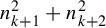 $n_{k+1}^{2}+n_{k+2}^{2}$
in the expression of M. Inductively, we are reduced to the case
$n_{k+1}^{2}+n_{k+2}^{2}$
in the expression of M. Inductively, we are reduced to the case $k=d'-1$
or
$k=d'-1$
or $d'$
. Therefore, (4.1) holds by switching the position of
$d'$
. Therefore, (4.1) holds by switching the position of $n_{1}$
and
$n_{1}$
and $n_{d'}$
.
$n_{d'}$
.
The ‘moreover’ part follows immediately through the proof.
4.2 M-isotropic subspaces
Let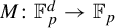 $M\colon \mathbb {F}_{p}^{d}\to \mathbb {F}_{p}$
be a quadratic form associated with the matrix A and V be a subspace of
$M\colon \mathbb {F}_{p}^{d}\to \mathbb {F}_{p}$
be a quadratic form associated with the matrix A and V be a subspace of $\mathbb {F}_{p}^{d}$
. Let
$\mathbb {F}_{p}^{d}$
. Let $V^{\perp {M}}$
denote the set of
$V^{\perp {M}}$
denote the set of $\{n\in \mathbb {F}_{p}^{d}\colon (mA)\cdot \text {n=0} \text { for all } m\in V\}$
.
$\{n\in \mathbb {F}_{p}^{d}\colon (mA)\cdot \text {n=0} \text { for all } m\in V\}$
.
Proposition 4.5. Let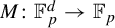 $M\colon \mathbb {F}_{p}^{d}\to \mathbb {F}_{p}$
be a quadratic form associated with the matrix A and V be a subspace of
$M\colon \mathbb {F}_{p}^{d}\to \mathbb {F}_{p}$
be a quadratic form associated with the matrix A and V be a subspace of $\mathbb {F}_{p}^{d}$
.
$\mathbb {F}_{p}^{d}$
.
-
(i)
$V^{\perp {M}}$
is a subspace of
$\mathbb {F}_{p}^{d}$
, and
$V\subseteq (V^{\perp {M}})^{\perp {M}}$
. Moreover,
$(V^{\perp {M}})^{\perp {M}}=V$
if M is non-degenerate. -
(ii) Let
$\phi \colon \mathbb {F}_{p}^{d}\to \mathbb {F}_{p}^{d}$
be a bijective linear transformation,
$v\in \mathbb {F}_{p}^{d}$
, and
$c\in \mathbb {F}_{p}$
. Let
$M'\colon \mathbb {F}_{p}^{d}\to \mathbb {F}_{p}$
be the quadratic form given by
$M'(n):=M(\phi (n)+v)+c$
. We have that
$\mathrm {rank}(M)=\mathrm {rank}(M')$
and
$\phi (V^{\perp {M'}})=(\phi (V))^{\perp {M}}$
. -
(iii)
$\mathrm {rank}(M)$
is equal to
$d-\dim ((\mathbb {F}_{p}^{d})^{\perp {M}})$
.




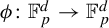


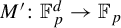





Proof. Part (i) is easy to check by definition and the symmetry of A. For part (ii), assume that $\phi (x)=xB$
for some
$\phi (x)=xB$
for some $d\times d$
invertible matrix B, then
$d\times d$
invertible matrix B, then $\mathrm {rank}(M)=\mathrm {rank}(A)=\mathrm { rank}(BAB^{T})=\mathrm {rank}(M\circ \phi )$
. So,
$\mathrm {rank}(M)=\mathrm {rank}(A)=\mathrm { rank}(BAB^{T})=\mathrm {rank}(M\circ \phi )$
. So, $\mathrm {rank}(M)= \mathrm {rank}(M\circ \phi )=\mathrm {rank}(M(\phi (n)+v))$
since shifting by v does not affect the rank of a quadratic form. The part
$\mathrm {rank}(M)= \mathrm {rank}(M\circ \phi )=\mathrm {rank}(M(\phi (n)+v))$
since shifting by v does not affect the rank of a quadratic form. The part $\phi (V^{\perp {M'}})=(\phi (V))^{\perp {M}}$
is easy to check by definition.
$\phi (V^{\perp {M'}})=(\phi (V))^{\perp {M}}$
is easy to check by definition.
We now prove part (iii). Let $r=\mathrm {rank}(M)$
. Then,
$r=\mathrm {rank}(M)$
. Then, $1\leq r\leq d$
. By Lemma 4.3, we may assume that
$1\leq r\leq d$
. By Lemma 4.3, we may assume that $M(n)=M'(\phi (n)+v)$
for some bijective linear transformation
$M(n)=M'(\phi (n)+v)$
for some bijective linear transformation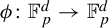 $\phi \colon \mathbb {F}_{p}^{d}\to \mathbb {F}_{p}^{d}$
,
$\phi \colon \mathbb {F}_{p}^{d}\to \mathbb {F}_{p}^{d}$
, $v\in \mathbb {F}_{p}^{d}$
,
$v\in \mathbb {F}_{p}^{d}$
, $c,c',\unicode{x3bb} \in \mathbb {F}_{p}, c\neq 0$
, and some quadratic form
$c,c',\unicode{x3bb} \in \mathbb {F}_{p}, c\neq 0$
, and some quadratic form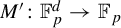 $M'\colon \mathbb {F}_{p}^{d}\to \mathbb {F}_{p}$
of the form
$M'\colon \mathbb {F}_{p}^{d}\to \mathbb {F}_{p}$
of the form
 $$ \begin{align*} M'(n_{1},\ldots,n_{d})=cn^{2}_{1}+n_{2}^{2}+\cdots+n^{2}_{r}+c'n_{r+1}-\unicode{x3bb}. \end{align*} $$
It is clear that $\mathrm {rank}(M')=d-\dim ((\mathbb {F}_{p}^{d})^{\perp {M'}})=r=\mathrm {rank}(M)$
. By part (iii),
$\mathrm {rank}(M')=d-\dim ((\mathbb {F}_{p}^{d})^{\perp {M'}})=r=\mathrm {rank}(M)$
. By part (iii), $(\mathbb {F}_{p}^{d})^{ \perp {M}}=\phi ^{-1}((\phi (\mathbb {F}_{p}^{d}))^{ \perp {M'}})=\phi ^{-1}((\mathbb {F}_{p}^{d})^{ \perp {M'}})$
. So,
$(\mathbb {F}_{p}^{d})^{ \perp {M}}=\phi ^{-1}((\phi (\mathbb {F}_{p}^{d}))^{ \perp {M'}})=\phi ^{-1}((\mathbb {F}_{p}^{d})^{ \perp {M'}})$
. So, $\dim ((\mathbb {F}_{p}^{d})^{ \perp {M}})=\dim ((\mathbb {F}_{p}^{d})^{ \perp {M'}})$
and thus,
$\dim ((\mathbb {F}_{p}^{d})^{ \perp {M}})=\dim ((\mathbb {F}_{p}^{d})^{ \perp {M'}})$
and thus, $\mathrm {rank} (M)=d-\dim ((\mathbb {F}_{p}^{d})^{\perp {M}})$
.
$\mathrm {rank} (M)=d-\dim ((\mathbb {F}_{p}^{d})^{\perp {M}})$
.
For $n\in \mathbb {R}^{d}$
, the dot product induces the Euclidean norm
$n\in \mathbb {R}^{d}$
, the dot product induces the Euclidean norm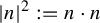 $\vert n\vert ^{2}:=n\cdot n$
. However, in
$\vert n\vert ^{2}:=n\cdot n$
. However, in $\mathbb {F}_{p}^{d}$
, the dot product (as well as general quadratic forms) does not induce a norm in
$\mathbb {F}_{p}^{d}$
, the dot product (as well as general quadratic forms) does not induce a norm in $\mathbb {F}_{p}^{d}$
, due to the existence of isotropic subspaces.
$\mathbb {F}_{p}^{d}$
, due to the existence of isotropic subspaces.
Definition 4.6. (M-isotropic subspaces)
Let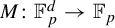 $M\colon \mathbb {F}_{p}^{d}\to \mathbb {F}_{p}$
be a quadratic form associated with the matrix A. A subspace V of
$M\colon \mathbb {F}_{p}^{d}\to \mathbb {F}_{p}$
be a quadratic form associated with the matrix A. A subspace V of $\mathbb {F}_{p}^{d}$
is M-isotropic if
$\mathbb {F}_{p}^{d}$
is M-isotropic if $V\cap V^{\perp {M}}\neq \{\mathbf {0}\}$
. We say that a tuple
$V\cap V^{\perp {M}}\neq \{\mathbf {0}\}$
. We say that a tuple $(h_{1},\ldots ,h_{k})$
of vectors in
$(h_{1},\ldots ,h_{k})$
of vectors in $\mathbb {F}_{p}^{d}$
is M-isotropic if the span of
$\mathbb {F}_{p}^{d}$
is M-isotropic if the span of $h_{1},\ldots ,h_{k}$
is an M-isotropic subspace. We say that a subspace or tuple of vectors is non- M-isotropic if it is not M-isotropic.
$h_{1},\ldots ,h_{k}$
is an M-isotropic subspace. We say that a subspace or tuple of vectors is non- M-isotropic if it is not M-isotropic.
For example, if $M(n)=n\cdot n$
and
$M(n)=n\cdot n$
and $V=\text {span}_{\mathbb {F}_{11}}\{(1,1,3),(1,2,-1)\}$
, then
$V=\text {span}_{\mathbb {F}_{11}}\{(1,1,3),(1,2,-1)\}$
, then $(1,1,3)\in V^{ \perp {M}}$
and so, V is M-isotropic. However, for
$(1,1,3)\in V^{ \perp {M}}$
and so, V is M-isotropic. However, for $V'=\text {span}_{\mathbb {F}_{11}}\{(1,1,3),(1,1,1)\}$
, if
$V'=\text {span}_{\mathbb {F}_{11}}\{(1,1,3),(1,1,1)\}$
, if $v\in V'\cap (V')^{ \perp {M}}$
, then since
$v\in V'\cap (V')^{ \perp {M}}$
, then since $v\in V$
, we may write
$v\in V$
, we may write $v=x(1,1,3)+y(1,1,1)$
for some
$v=x(1,1,3)+y(1,1,1)$
for some $x,y\in \mathbb {F}_{11}$
. Since v is orthogonal to
$x,y\in \mathbb {F}_{11}$
. Since v is orthogonal to $(1,1,3)$
and
$(1,1,3)$
and $(1,1,1)$
, we have that
$(1,1,1)$
, we have that $0x+5y= 5x+3y=0$
, which implies that
$0x+5y= 5x+3y=0$
, which implies that $x=y=0$
. So,
$x=y=0$
. So, $V'$
is not M-isotropic.
$V'$
is not M-isotropic.
Let $V=\text {span}_{\mathbb {F}_{p}}\{h_{1},\ldots ,h_{k}\}$
be a subspace of
$V=\text {span}_{\mathbb {F}_{p}}\{h_{1},\ldots ,h_{k}\}$
be a subspace of $\mathbb {F}_{p}^{d}$
and A be the matrix associated to M. Then, V is M-isotropic if and only if the determinant of the matrix
$\mathbb {F}_{p}^{d}$
and A be the matrix associated to M. Then, V is M-isotropic if and only if the determinant of the matrix $((h_{i}A)\cdot h_{j})_{1\leq i,j\leq k}$
is 0. To see this, suppose that
$((h_{i}A)\cdot h_{j})_{1\leq i,j\leq k}$
is 0. To see this, suppose that $v\in V\cap V^{ \perp {M}}$
. Since
$v\in V\cap V^{ \perp {M}}$
. Since $v\in V$
, we may write
$v\in V$
, we may write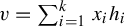 ${v=\sum _{i=1}^{k}x_{i}h_{i}}$
for some
${v=\sum _{i=1}^{k}x_{i}h_{i}}$
for some $x_{i}\in \mathbb {F}_{p}$
. Then,
$x_{i}\in \mathbb {F}_{p}$
. Then, $v\in V\cap V^{ \perp {M}}\Leftrightarrow (vA)\cdot h_{j}=\sum _{i=1}^{k}x_{i}(h_{i}A)\cdot h_{j}=0$
for
$v\in V\cap V^{ \perp {M}}\Leftrightarrow (vA)\cdot h_{j}=\sum _{i=1}^{k}x_{i}(h_{i}A)\cdot h_{j}=0$
for ${1\leq j\leq k}$
, the right-hand side of which is a
${1\leq j\leq k}$
, the right-hand side of which is a $k\times k$
linear equation system whose coefficient matrix is
$k\times k$
linear equation system whose coefficient matrix is $((h_{i}A)\cdot h_{j})_{1\leq i,j\leq k}$
.
$((h_{i}A)\cdot h_{j})_{1\leq i,j\leq k}$
.
The next lemma ensures the existence of non-M-isotropic subspaces.
Lemma 4.7. Let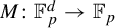 $M\colon \mathbb {F}_{p}^{d}\to \mathbb {F}_{p}$
be a non-degenerate quadratic form. Then, for all
$M\colon \mathbb {F}_{p}^{d}\to \mathbb {F}_{p}$
be a non-degenerate quadratic form. Then, for all ${0\leq k\leq \mathrm {rank}(M)}$
, there exists a non-M-isotropic subspace of
${0\leq k\leq \mathrm {rank}(M)}$
, there exists a non-M-isotropic subspace of $\mathbb {F}_{p}^{d}$
of dimension k.
$\mathbb {F}_{p}^{d}$
of dimension k.
Proof. Since $\{\mathbf {0}\}$
is non-M-isotropic, it suffices to consider the case
$\{\mathbf {0}\}$
is non-M-isotropic, it suffices to consider the case $k\geq 1$
. Let
$k\geq 1$
. Let ${d'=\mathrm {rank}(M)}$
. By Lemma 4.3, under a change of variables, it suffices to consider the case when the associated matrix A of M is a diagonal matrix whose diagonal can be written as
${d'=\mathrm {rank}(M)}$
. By Lemma 4.3, under a change of variables, it suffices to consider the case when the associated matrix A of M is a diagonal matrix whose diagonal can be written as $(a_{1},\ldots ,a_{d'},0,\ldots ,0)$
for some
$(a_{1},\ldots ,a_{d'},0,\ldots ,0)$
for some $a_{1},\ldots ,a_{d'}\neq 0$
. Let
$a_{1},\ldots ,a_{d'}\neq 0$
. Let $e_{1},\ldots ,e_{d}$
denote the standard unit vectors. Clearly, for
$e_{1},\ldots ,e_{d}$
denote the standard unit vectors. Clearly, for $1\leq k\leq d'$
, the matrix
$1\leq k\leq d'$
, the matrix $((e_{i}A)\cdot e_{j})_{1\leq i,j\leq k}$
is the upper left
$((e_{i}A)\cdot e_{j})_{1\leq i,j\leq k}$
is the upper left $k\times k$
block of A, which is of determinant
$k\times k$
block of A, which is of determinant $a_{1}\cdot \cdots \cdot a_{k}\neq 0$
. This implies that
$a_{1}\cdot \cdots \cdot a_{k}\neq 0$
. This implies that $\text {span}_{\mathbb {F}_{p}}\{e_{1},\ldots ,e_{k}\}$
is a non-M-isotropic subspace of
$\text {span}_{\mathbb {F}_{p}}\{e_{1},\ldots ,e_{k}\}$
is a non-M-isotropic subspace of $\mathbb {F}_{p}^{d}$
of dimension k.
$\mathbb {F}_{p}^{d}$
of dimension k.
We summarize some basic properties of M-isotropic subspaces for later use.
Proposition 4.8. Let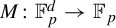 $M\colon \mathbb {F}_{p}^{d}\to \mathbb {F}_{p}$
be a quadratic form and V be a subspace of
$M\colon \mathbb {F}_{p}^{d}\to \mathbb {F}_{p}$
be a quadratic form and V be a subspace of $\mathbb {F}_{p}^{d}$
of co-dimension r, and
$\mathbb {F}_{p}^{d}$
of co-dimension r, and $c\in \mathbb {F}_{p}^{d}$
.
$c\in \mathbb {F}_{p}^{d}$
.
-
(i) We have
$\dim (V\cap V^{\perp {M}})\leq \min \{d-\mathrm {rank}(M)+r,d-r\}$
. -
(ii) The rank of
$M\vert _{V+c}$
is equal to
$d-r-\dim (V\cap V^{\perp {M}})$
(that is,
$\dim (V)-\dim (V\cap V^{\perp {M}})$
). -
(iii) The rank of
$M\vert _{V+c}$
is at most
$d-r$
and at least
$\mathrm {rank}(M)-2r$
. -
(iv)
$M\vert _{V+c}$
is non-degenerate (that is,
$\mathrm {rank}(M\vert _{V+c})=d-r$
) if and only if V is not an M-isotropic subspace.









Proof. Part (i). Let $v_{1},\ldots ,v_{d-r}$
be a basis of V. Let
$v_{1},\ldots ,v_{d-r}$
be a basis of V. Let $B=\Big [\!\begin {smallmatrix} v_{1}\\ \cdots \\ v_{d-r} \end {smallmatrix}\!\Big ]$
. The dimension of
$B=\Big [\!\begin {smallmatrix} v_{1}\\ \cdots \\ v_{d-r} \end {smallmatrix}\!\Big ]$
. The dimension of $\dim (V^{\perp {M}})$
is equal to d minus the rank of the matrix
$\dim (V^{\perp {M}})$
is equal to d minus the rank of the matrix $BA$
. Since
$BA$
. Since $\mathrm { rank}(BA)\geq \mathrm {rank}(B)+\mathrm {rank}(A)-d=\mathrm {rank}(M)-r$
, we have that
$\mathrm { rank}(BA)\geq \mathrm {rank}(B)+\mathrm {rank}(A)-d=\mathrm {rank}(M)-r$
, we have that $\dim (V^{\perp {M}})\leq d-\mathrm {rank}(M)+r$
. So, part (i) holds because
$\dim (V^{\perp {M}})\leq d-\mathrm {rank}(M)+r$
. So, part (i) holds because $\dim (V\cap V^{\perp {M}})\leq \min \{\dim (V),\dim (V^{\perp {M}})\}$
.
$\dim (V\cap V^{\perp {M}})\leq \min \{\dim (V),\dim (V^{\perp {M}})\}$
.
Part (ii). Let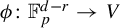 $\phi \colon \mathbb {F}_{p}^{d-r}\to V$
be a bijective linear transformation and denote
$\phi \colon \mathbb {F}_{p}^{d-r}\to V$
be a bijective linear transformation and denote ${M'(m):=M(\phi (m)+c)}$
. Then, the rank of
${M'(m):=M(\phi (m)+c)}$
. Then, the rank of $M\vert _{V+c}$
is equal to the rank of
$M\vert _{V+c}$
is equal to the rank of $M'$
. Assume that
$M'$
. Assume that $\phi (m)=mB$
for some
$\phi (m)=mB$
for some $(d-r)\times d$
matrix B of rank
$(d-r)\times d$
matrix B of rank $d-r$
. Then, the matrix associated to
$d-r$
. Then, the matrix associated to $M'$
is
$M'$
is $BAB^{T}$
. Note that for all
$BAB^{T}$
. Note that for all $m\in \mathbb {F}_{p}^{r}$
,
$m\in \mathbb {F}_{p}^{r}$
,
 $$ \begin{align*} \begin{aligned} & m\in (\mathbb{F}_{p}^{r})^{ \perp{M'}} \Leftrightarrow ((mB)A)\cdot (nB)=0 \quad\text{for all } n\in\mathbb{F}_{p}^{r}\\ &\Leftrightarrow ((mB)A)\cdot v=0 \quad\text{for all } v\in V \Leftrightarrow mB\in V\cap V^{\perp{M}}. \end{aligned} \end{align*} $$
By Proposition 4.5,
 $$ \begin{align*}\mathrm{rank}(M')=d-r-\dim(\mathbb{F}_{p}^{r})^{ \perp{M'}}=d-r-\dim(V\cap V^{\perp{M}}).\end{align*} $$
This proves part (ii).
Parts (iii) and (iv) follows directly from parts (i) and (ii).
An annoying issue when working with subspaces of $\mathbb {F}_{p}^{d}$
is that the restriction of a non-degenerate quadratic form M to an M-isotropic subspace V of
$\mathbb {F}_{p}^{d}$
is that the restriction of a non-degenerate quadratic form M to an M-isotropic subspace V of $\mathbb {F}_{p}^{d}$
is not necessarily non-degenerate. Fortunately, due to Proposition 4.8(iii), the nullity of M does not increase too much when restricted to V, provided that the co-dimension of V is small. This is why Proposition 4.8 can be viewed as the inheriting principle for the ranks of quadratic forms.
$\mathbb {F}_{p}^{d}$
is not necessarily non-degenerate. Fortunately, due to Proposition 4.8(iii), the nullity of M does not increase too much when restricted to V, provided that the co-dimension of V is small. This is why Proposition 4.8 can be viewed as the inheriting principle for the ranks of quadratic forms.
The following is a consequence of Proposition 4.8, which will be used in [Reference Sun15].
Lemma 4.9. Let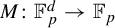 $M\colon \mathbb {F}_{p}^{d}\to \mathbb {F}_{p}$
be a non-degenerate quadratic form, V be a subspace of
$M\colon \mathbb {F}_{p}^{d}\to \mathbb {F}_{p}$
be a non-degenerate quadratic form, V be a subspace of $\mathbb {F}_{p}^{d}$
of dimension r, and
$\mathbb {F}_{p}^{d}$
of dimension r, and $V'$
be a subspace of
$V'$
be a subspace of $\mathbb {F}_{p}^{d}$
of dimension
$\mathbb {F}_{p}^{d}$
of dimension $r'$
. Suppose that
$r'$
. Suppose that $\mathrm { rank}(M\vert _{V^{\perp {M}}})=d-r$
. Then,
$\mathrm { rank}(M\vert _{V^{\perp {M}}})=d-r$
. Then, $\mathrm {rank}(M\vert _{(V+V')^{\perp {M}}})\geq d-r-2r'$
.
$\mathrm {rank}(M\vert _{(V+V')^{\perp {M}}})\geq d-r-2r'$
.
Proof. Since $V^{\perp {M}}$
is of co-dimension r, by Proposition 4.8(ii),
$V^{\perp {M}}$
is of co-dimension r, by Proposition 4.8(ii), $\mathrm {rank}(M\vert _{V^{\perp {M}}})=d-r$
implies that
$\mathrm {rank}(M\vert _{V^{\perp {M}}})=d-r$
implies that $\dim (V\cap V^{\perp {M}})=0$
. Since
$\dim (V\cap V^{\perp {M}})=0$
. Since $\dim (V+V')\leq r+r'$
and M is non-degenerate, we have that
$\dim (V+V')\leq r+r'$
and M is non-degenerate, we have that $\dim ((V+V')^{\perp {M}})\geq d-r-r'$
. By Proposition 4.8(ii),
$\dim ((V+V')^{\perp {M}})\geq d-r-r'$
. By Proposition 4.8(ii),
 $$ \begin{align*} \begin{aligned} \mathrm{rank}(M\vert_{(V+V')^{\perp{M}}}) & \geq d-r-r'-\dim((V+V')\cap(V+V')^{\perp{M}}) \\&\geq d-r-r'-\dim((V+V')\cap V^{\perp{M}}). \end{aligned} \end{align*} $$
So, it remains to show that $\dim ((V+V')\cap V^{\perp {M}})\leq r'$
. It suffices to show that for any
$\dim ((V+V')\cap V^{\perp {M}})\leq r'$
. It suffices to show that for any $v_{1},\ldots ,v_{r'+1}\in (V+V')\cap V^{\perp {M}}$
, these vectors are linearly dependent. Since
$v_{1},\ldots ,v_{r'+1}\in (V+V')\cap V^{\perp {M}}$
, these vectors are linearly dependent. Since $v_{1},\ldots ,v_{r'+1}\in V+V'$
, we may write
$v_{1},\ldots ,v_{r'+1}\in V+V'$
, we may write $v_{i}=u_{i}+w_{i}$
for some
$v_{i}=u_{i}+w_{i}$
for some $u_{i}\in V$
and
$u_{i}\in V$
and $w_{i}\in V'$
for all
$w_{i}\in V'$
for all $1\leq i\leq r'+1$
. Since
$1\leq i\leq r'+1$
. Since $\dim (V')=r'$
, there exist
$\dim (V')=r'$
, there exist $c_{1},\ldots ,c_{r'+1}$
not all equal to 0 such that
$c_{1},\ldots ,c_{r'+1}$
not all equal to 0 such that $c_{1}w_{1}+\cdots +c_{r'+1}w_{r'+1}=\mathbf {0}$
. Therefore, we have that
$c_{1}w_{1}+\cdots +c_{r'+1}w_{r'+1}=\mathbf {0}$
. Therefore, we have that $c_{1}v_{1}+\cdots +c_{r'+1}v_{r'+1}=c_{1}u_{1}+\cdots +c_{r'+1}u_{r'+1}\in V$
. Since
$c_{1}v_{1}+\cdots +c_{r'+1}v_{r'+1}=c_{1}u_{1}+\cdots +c_{r'+1}u_{r'+1}\in V$
. Since $c_{1}v_{1}+\cdots +c_{r'+1}v_{r'+1}\in V^{\perp {M}}$
and
$c_{1}v_{1}+\cdots +c_{r'+1}v_{r'+1}\in V^{\perp {M}}$
and $V\cap V^{\perp {M}}=\{\mathbf {0}\}$
, we have that
$V\cap V^{\perp {M}}=\{\mathbf {0}\}$
, we have that $c_{1}v_{1}+\cdots +c_{r'+1}v_{r'+1}=\mathbf {0}$
. This means that
$c_{1}v_{1}+\cdots +c_{r'+1}v_{r'+1}=\mathbf {0}$
. This means that $\dim ((V+V')\cap V^{\perp {M}})\leq r'$
and we are done.
$\dim ((V+V')\cap V^{\perp {M}})\leq r'$
and we are done.
4.3 Counting the zeros of quadratic forms
For a polynomial $P\in \text {poly}(\mathbb {F}_{p}^{k}\to \mathbb {F}_{p})$
, let
$P\in \text {poly}(\mathbb {F}_{p}^{k}\to \mathbb {F}_{p})$
, let $V(P)$
denote the set of
$V(P)$
denote the set of $n\in \mathbb {F}_{p}^{k}$
such that
$n\in \mathbb {F}_{p}^{k}$
such that $P(n)=0$
. For a family of polynomials
$P(n)=0$
. For a family of polynomials $\mathcal {J}=\{P_{1},\ldots ,P_{k}\}\subseteq \text {poly}(\mathbb {F}_{p}^{k}\to \mathbb {F}_{p})$
, denote
$\mathcal {J}=\{P_{1},\ldots ,P_{k}\}\subseteq \text {poly}(\mathbb {F}_{p}^{k}\to \mathbb {F}_{p})$
, denote $V(\mathcal {J}):=\bigcap _{i=1}^{k}V(P_{i})$
. The purpose of this section is to provide estimates on the cardinality of
$V(\mathcal {J}):=\bigcap _{i=1}^{k}V(P_{i})$
. The purpose of this section is to provide estimates on the cardinality of $V(\mathcal {J})$
for families of polynomials arising from quadratic forms.
$V(\mathcal {J})$
for families of polynomials arising from quadratic forms.
We start with some basic estimates.
Lemma 4.10. (Schwartz–Zippel lemma)
Let $P\in \mathrm {poly}(\mathbb {F}_{p}^{d}\to \mathbb {F}_{p})$
be of degree at most r. Then,
$P\in \mathrm {poly}(\mathbb {F}_{p}^{d}\to \mathbb {F}_{p})$
be of degree at most r. Then, $\vert V(P)\vert \leq O_{d,r}(p^{d-1})$
unless
$\vert V(P)\vert \leq O_{d,r}(p^{d-1})$
unless $P\equiv 0$
.
$P\equiv 0$
.
As an application of Lemma 4.10, we have the following lemma.
Lemma 4.11. Let $d,k\in \mathbb {N}_{+}$
, p be a prime, and
$d,k\in \mathbb {N}_{+}$
, p be a prime, and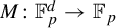 $M\colon \mathbb {F}_{p}^{d}\to \mathbb {F}_{p}$
be a non-degenerate quadratic form.
$M\colon \mathbb {F}_{p}^{d}\to \mathbb {F}_{p}$
be a non-degenerate quadratic form.
-
(i) The number of tuples
$(h_{1},\ldots ,h_{k})\in (\mathbb {F}_{p}^{d})^{k}$
such that
$h_{1},\ldots ,h_{k}$
are linearly dependent is at most
$kp^{(d+1)(k-1)}$
. -
(ii) The number of M-isotropic tuples
$(h_{1},\ldots ,h_{k})\in (\mathbb {F}_{p}^{d})^{k}$
is at most
$O_{d,k}(p^{kd-1})$
.


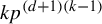

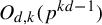
Proof. Part (i). If $h_{1},\ldots ,h_{k}$
are linearly dependent, then there exists
$h_{1},\ldots ,h_{k}$
are linearly dependent, then there exists $1\leq i\leq k$
such that
$1\leq i\leq k$
such that $h_{i}=\sum _{1\leq j\leq k, j\neq i}c_{j}h_{j}$
for some
$h_{i}=\sum _{1\leq j\leq k, j\neq i}c_{j}h_{j}$
for some $c_{j}\in \mathbb {F}_{p}$
. For each j, there are p choices of
$c_{j}\in \mathbb {F}_{p}$
. For each j, there are p choices of $c_{j}$
and
$c_{j}$
and $p^{d}$
choices of
$p^{d}$
choices of $h_{j}$
. Since there are k choices of i, in total, there are at most
$h_{j}$
. Since there are k choices of i, in total, there are at most $k\cdot (p\cdot p^{d})^{k-1}=kp^{(d+1)(k-1)}$
possibilities.
$k\cdot (p\cdot p^{d})^{k-1}=kp^{(d+1)(k-1)}$
possibilities.
Part (ii). By the discussion after Definition 4.6, $h_{1},\ldots ,h_{k}$
are M-isotropic if and only if the determinant of the matrix
$h_{1},\ldots ,h_{k}$
are M-isotropic if and only if the determinant of the matrix $((h_{i}A)\cdot h_{j})_{1\leq i,j\leq k}$
is zero. Viewing this matrix as a non-constant polynomial in
$((h_{i}A)\cdot h_{j})_{1\leq i,j\leq k}$
is zero. Viewing this matrix as a non-constant polynomial in $h_{1},\ldots ,h_{k}$
, we get the conclusion from Lemma 4.10.
$h_{1},\ldots ,h_{k}$
, we get the conclusion from Lemma 4.10.
A very useful application of Lemma 4.11 is as follows. Whenever we have a collection X of k-tuples $(h_{1},\ldots ,h_{k})\in (\mathbb {F}_{p}^{d})^{k}$
of positive density
$(h_{1},\ldots ,h_{k})\in (\mathbb {F}_{p}^{d})^{k}$
of positive density $\delta>0$
, if the dimension d is sufficiently large compared with k, and if p is sufficiently large compared with
$\delta>0$
, if the dimension d is sufficiently large compared with k, and if p is sufficiently large compared with $\delta ,d,k$
, then by passing to a subset of X, we may further require all the tuples in X to be linearly independent/non-M-isotropic with X still having a positive density.
$\delta ,d,k$
, then by passing to a subset of X, we may further require all the tuples in X to be linearly independent/non-M-isotropic with X still having a positive density.
The following lemma was proved in [Reference Iosevich and Rudnev10]. We provide its details for completeness.
Lemma 4.12. Let $d\in \mathbb {N}_{+}$
and p be a prime number. Let
$d\in \mathbb {N}_{+}$
and p be a prime number. Let $M\colon \mathbb {F}_{p}^{d}\to \mathbb {F}_{p}$
be a quadratic form of rank r. Suppose that
$M\colon \mathbb {F}_{p}^{d}\to \mathbb {F}_{p}$
be a quadratic form of rank r. Suppose that $r\geq 3$
. Then,
$r\geq 3$
. Then,
 $$ \begin{align*} \vert V(M)\vert=p^{d-1}(1+O(p^{-{(r-2)}/{2}})), \end{align*} $$
and for all $\xi =(\xi _{1},\ldots ,\xi _{d})\in \mathbb {Z}^{d}$
, we have that
$\xi =(\xi _{1},\ldots ,\xi _{d})\in \mathbb {Z}^{d}$
, we have that
 $$ \begin{align} \begin{aligned} \mathbb{E}_{n\in V(M)}\exp\bigg(\frac{\xi}{p}\cdot n\bigg)=\mathbf{1}_{\xi=\mathbf{0}}+O(p^{-{(r-2)}/{2}}). \end{aligned} \end{align} $$
Here, we slightly abuse the notation in ${\xi }/{p}\cdot n$
by identifying
${\xi }/{p}\cdot n$
by identifying $n\in \mathbb {F}_{p}^{d}$
with its embedding
$n\in \mathbb {F}_{p}^{d}$
with its embedding $\tau (n)\in \mathbb {Z}^{d}$
.
$\tau (n)\in \mathbb {Z}^{d}$
.
Proof. By Lemma 4.3, it is easy to see we only need to prove this lemma for the case when
 $$ \begin{align*} M(n_{1},\ldots,n_{d})=a_{1}n^{2}_{1}+\cdots+a_{r}n^{2}_{r}+a_{r+1}n_{r+1}+\cdots+a_{d}n_{d}-\unicode{x3bb} \end{align*} $$
for some $a_{1},\ldots ,a_{r}\in \mathbb {F}_{p}\backslash \{0\}, a_{r+1},\ldots ,a_{d}\in \mathbb {F}_{p}$
and
$a_{1},\ldots ,a_{r}\in \mathbb {F}_{p}\backslash \{0\}, a_{r+1},\ldots ,a_{d}\in \mathbb {F}_{p}$
and $\unicode{x3bb} \in \mathbb {F}_{p}$
. (Here, we do not need to use the full strength of Lemma 4.3.) Note that
$\unicode{x3bb} \in \mathbb {F}_{p}$
. (Here, we do not need to use the full strength of Lemma 4.3.) Note that
 $$ \begin{align*} \begin{aligned} &\sum_{n\in V(M)}\exp\bigg(\frac{\xi}{p}\cdot n\bigg)=\sum_{n\in \mathbb{F}_{p}^{d}}\mathbb{E}_{j\in\mathbb{F}_{p}}\exp\bigg(\frac{\xi}{p}\cdot n+\frac{j}{p}M(n)\bigg)\\&\quad=p^{d-1}\mathbf{1}_{\xi=\mathbf{0}}+\frac{1}{p}\sum_{j\in\mathbb{F}_{p}\backslash\{0\}}\exp(-j\unicode{x3bb})\sum_{n\in \mathbb{F}_{p}^{d}}\exp\bigg(\frac{\xi}{p}\cdot n+\frac{j}{p}\!\sum_{i=1}^{r}a_{i}n^{2}_{i}+\frac{j}{p}\sum_{i=r+1}^{d}a_{i}n_{i}\!\bigg). \end{aligned} \end{align*} $$
By a change of coordinate, we have that
 $$ \begin{align*} &\bigg\vert\frac{1}{p}\sum_{j\in\mathbb{F}_{p}\backslash\{0\}}\exp(-j\unicode{x3bb})\sum_{n\in \mathbb{F}_{p}^{d}}\exp\bigg(\frac{\xi}{p}\cdot n+\frac{j}{p}\sum_{i=1}^{r}a_{i}n^{2}_{i}+\frac{j}{p}\sum_{i=r+1}^{d}a_{i}n_{i}\bigg)\bigg\vert\\ &\quad\leq \frac{1}{p}\sum_{j\in\mathbb{F}_{p}\backslash\{0\}}\bigg\vert\!\sum_{n\in \mathbb{F}_{p}^{d}}\exp\bigg(\frac{\xi}{p}\cdot n+\frac{j}{p}\sum_{i=1}^{r}a_{i}n^{2}_{i}+\frac{j}{p}\sum_{i=r+1}^{d}a_{i}n_{i}\bigg)\bigg\vert\\ &\quad=\frac{1}{p}\sum_{j\in\mathbb{F}_{p}\backslash\{0\}}\bigg\vert\!\sum_{n\in \mathbb{F}_{p}^{d}}\exp\bigg(\frac{j}{p}\sum_{i=1}^{r}a_{i}n^{2}_{i}+\frac{j}{p}\sum_{i=r+1}^{d}a_{i}n_{i}\bigg)\bigg\vert\\ &\quad=\frac{1}{p}\sum_{j\in\mathbb{F}_{p}\backslash\{0\}}\prod_{i=1}^{r}\bigg\vert\!\sum_{n\in \mathbb{F}_{p}}\exp(ja_{i}n^{2}/p)\bigg\vert\cdot\prod_{i=r+1}^{d}\bigg\vert\!\sum_{n\in \mathbb{F}_{p}}\exp(ja_{i}n/p)\bigg\vert\\ &\quad\leq \frac{1}{p}\sum_{j\in\mathbb{F}_{p}\backslash\{0\}}p^{d-r}\prod_{i=1}^{r}\bigg\vert\!\sum_{n\in \mathbb{F}_{p}}\exp(ja_{i}n^{2}/p)\bigg\vert. \end{align*} $$
Since
 $$ \begin{align*} & \bigg\vert\!\sum_{n\in \mathbb{F}_{p}}\exp(ja_{i}n^{2}/p)\bigg\vert^{2}\\ & \quad=\bigg\vert\!\sum_{n,h\in \mathbb{F}_{p}}\exp(ja_{i}(2hn+h^{2})/p)\bigg\vert\leq \sum_{h\in\mathbb{F}_{p}}\bigg\vert\!\sum_{n\in\mathbb{F}_{p}}\exp(ja_{i}(2hn+h^{2})/p)\bigg\vert=p, \end{align*} $$
we have that
 $$ \begin{align} \begin{aligned} \sum_{n\in V(M)}\exp\bigg(\frac{\xi}{p}\cdot n\bigg)= p^{d-1}\mathbf{1}_{\xi=\mathbf{0}}+O(p^{d-({r}/{2})}). \end{aligned} \end{align} $$
Setting $\xi =\mathbf {0}$
, we have that
$\xi =\mathbf {0}$
, we have that $\vert V(M)\vert =p^{d-1}(1+O(p^{-{(r-2)}/{2}}))$
. Dividing both sides of (4.3) by
$\vert V(M)\vert =p^{d-1}(1+O(p^{-{(r-2)}/{2}}))$
. Dividing both sides of (4.3) by $\vert V(M)\vert $
, we get (4.2).
$\vert V(M)\vert $
, we get (4.2).
We remark that while the argument of Lemma 4.12 works for all $r\in \mathbb {N}$
, the term
$r\in \mathbb {N}$
, the term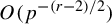 $O(p^{-{(r-2)}/{2}})$
may be dominant if
$O(p^{-{(r-2)}/{2}})$
may be dominant if $r\leq 2$
. For example, if
$r\leq 2$
. For example, if $M(n_{1},n_{2})=n_{1}^{2}+an_{2}^{2}$
for some
$M(n_{1},n_{2})=n_{1}^{2}+an_{2}^{2}$
for some $a\in \mathbb {F}_{p}$
such that
$a\in \mathbb {F}_{p}$
such that $x^{2}\neq -a$
for all
$x^{2}\neq -a$
for all $x\in \mathbb {F}_{p}$
, then
$x\in \mathbb {F}_{p}$
, then $V(M)$
is an empty set.
$V(M)$
is an empty set.
The following is an application of Lemma 4.12. We say that t is a quadratic residue of $\mathbb {F}_{p}$
if there exists
$\mathbb {F}_{p}$
if there exists $n\in \mathbb {F}_{p}$
such that
$n\in \mathbb {F}_{p}$
such that $n^{2}=t$
. It is clear that if
$n^{2}=t$
. It is clear that if $p>2$
, then the number of quadratic residues of
$p>2$
, then the number of quadratic residues of $\mathbb {F}_{p}$
is
$\mathbb {F}_{p}$
is ${(p+1)}/{2}$
. We have the following lemma.
${(p+1)}/{2}$
. We have the following lemma.
Lemma 4.13. Let $d,r\in \mathbb {N}_{+}$
, p be a prime number, and
$d,r\in \mathbb {N}_{+}$
, p be a prime number, and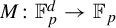 $M\colon \mathbb {F}_{p}^{d}\to \mathbb {F}_{p}$
be a quadratic form of rank r. Then, the number of
$M\colon \mathbb {F}_{p}^{d}\to \mathbb {F}_{p}$
be a quadratic form of rank r. Then, the number of $n\in \mathbb {F}_{p}^{d}$
such that
$n\in \mathbb {F}_{p}^{d}$
such that $M(n)$
is a quadratic residue is
$M(n)$
is a quadratic residue is $\frac {1}{2}p^{d}(1+O(p^{-{(r-2)}/{2}}))$
if
$\frac {1}{2}p^{d}(1+O(p^{-{(r-2)}/{2}}))$
if $r\geq 3$
, and
$r\geq 3$
, and $\frac {1}{2}p^{d}(1+O(p^{-(1/2)}))$
for
$\frac {1}{2}p^{d}(1+O(p^{-(1/2)}))$
for $r=2$
.
$r=2$
.
Proof. Let $S=\{s_{1},\ldots ,s_{(p+1)/2}\}$
be the set of quadratic residues of
$S=\{s_{1},\ldots ,s_{(p+1)/2}\}$
be the set of quadratic residues of $\mathbb {F}_{p}$
. We first consider the case
$\mathbb {F}_{p}$
. We first consider the case $r\geq 3$
. By Lemma 4.12, the number of
$r\geq 3$
. By Lemma 4.12, the number of $n\in \mathbb {F}_{p}^{d}$
such that
$n\in \mathbb {F}_{p}^{d}$
such that $M(n)\in S$
is
$M(n)\in S$
is
 $$ \begin{align*} \sum_{i=1}^{(p+1)/2}\vert V(M-s_{i})\vert=\frac{p+1}{2}\cdot p^{d-1}(1+O(p^{-(r-2)/2}))=\frac{1}{2}p^{d}(1+O(p^{-(1/2)})). \end{align*} $$
We now consider the case $r=2$
. By [Reference Schmidt13, Theorem 5A on p. 52], the number of
$r=2$
. By [Reference Schmidt13, Theorem 5A on p. 52], the number of $n\in \mathbb {F}_{p}^{2}$
such that
$n\in \mathbb {F}_{p}^{2}$
such that $M(n)=s_{i}$
is
$M(n)=s_{i}$
is $p(1+O(p^{-1/2}))$
. So, the total number of
$p(1+O(p^{-1/2}))$
. So, the total number of $n\in \mathbb {F}_{p}^{d}$
such that
$n\in \mathbb {F}_{p}^{d}$
such that $M(n)$
is a quadratic residue is
$M(n)$
is a quadratic residue is $\frac {1}{2}p(p+1)(1+O(p^{-1/2}))$
. We are done.
$\frac {1}{2}p(p+1)(1+O(p^{-1/2}))$
. We are done.
In the rest of this section, we provide some generalizations of Lemma 4.12. These results can be interpreted as the inheriting principle for the size of hyperspheres. First of all, as an immediate corollary of Lemma 4.12, we have the following estimate on the intersection of $V(M)$
with an affine subspace of
$V(M)$
with an affine subspace of $\mathbb {F}_{p}^{d}$
.
$\mathbb {F}_{p}^{d}$
.
Corollary 4.14. Let $d\in \mathbb {N}_{+},r\in \mathbb {N}$
, and p be a prime number. Let
$d\in \mathbb {N}_{+},r\in \mathbb {N}$
, and p be a prime number. Let $M\colon \mathbb {F}_{p}^{d}\to \mathbb {F}_{p}$
be a quadratic form and
$M\colon \mathbb {F}_{p}^{d}\to \mathbb {F}_{p}$
be a quadratic form and $V+c$
be an affine subspace of
$V+c$
be an affine subspace of $\mathbb {F}_{p}^{d}$
of co-dimension r. If either
$\mathbb {F}_{p}^{d}$
of co-dimension r. If either $\mathrm { rank}(M\vert _{V+c})\geq 3$
or
$\mathrm { rank}(M\vert _{V+c})\geq 3$
or $\mathrm {rank}(M)-2r\geq 3$
, then
$\mathrm {rank}(M)-2r\geq 3$
, then
 $$ \begin{align*} \vert V(M)\cap (V+c)\vert=p^{d-r-1}(1+O(p^{-(1/2)})). \end{align*} $$
Proof. If $\mathrm {rank}(M)-2r\geq 3$
, then
$\mathrm {rank}(M)-2r\geq 3$
, then $\mathrm {rank}(M\vert _{V+c})\geq 3$
by Proposition 4.8(iii). So, in both cases, we have that
$\mathrm {rank}(M\vert _{V+c})\geq 3$
by Proposition 4.8(iii). So, in both cases, we have that $\mathrm {rank}(M\vert _{V+c})\geq 3$
. Let
$\mathrm {rank}(M\vert _{V+c})\geq 3$
. Let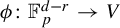 $\phi \colon \mathbb {F}_{p}^{d-r}\to V$
be a bijective linear transformation and denote
$\phi \colon \mathbb {F}_{p}^{d-r}\to V$
be a bijective linear transformation and denote $M'(m):=M(\phi (m)+c)$
for all
$M'(m):=M(\phi (m)+c)$
for all $m\in \mathbb {F}_{p}^{d-r}$
. Then,
$m\in \mathbb {F}_{p}^{d-r}$
. Then, $\mathrm {rank}(M')\geq 3$
. Note that
$\mathrm {rank}(M')\geq 3$
. Note that $n\in V(M)\cap (V+c)$
if and only if
$n\in V(M)\cap (V+c)$
if and only if $n=\phi (m)+c$
for some
$n=\phi (m)+c$
for some $m\in \mathbb {F}_{p}^{d-r}$
such that
$m\in \mathbb {F}_{p}^{d-r}$
such that $M'(m)=0$
. So, the conclusion follows from Lemma 4.12.
$M'(m)=0$
. So, the conclusion follows from Lemma 4.12.
The following sets are studied extensively in this paper.
Definition 4.15. Let $r\in \mathbb {N}_{+}$
,
$r\in \mathbb {N}_{+}$
, $h_{1},\ldots ,h_{r}\in \mathbb {F}_{p}^{d}$
, and
$h_{1},\ldots ,h_{r}\in \mathbb {F}_{p}^{d}$
, and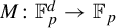 $M\colon \mathbb {F}_{p}^{d}\to \mathbb {F}_{p}$
be a quadratic form. Denote
$M\colon \mathbb {F}_{p}^{d}\to \mathbb {F}_{p}$
be a quadratic form. Denote
 $$ \begin{align*}V(M)^{h_{1},\ldots,h_{r}}:=\bigcap_{i=1}^{r}V(M(\cdot+h_{i}))\cap V(M).\end{align*} $$
Lemma 4.12 can also be used to study the cardinality of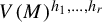 $V(M)^{h_{1},\ldots ,h_{r}}$
.
$V(M)^{h_{1},\ldots ,h_{r}}$
.
Corollary 4.16. Let $d,r\in \mathbb {N}_{+}$
and p be a prime number. Let
$d,r\in \mathbb {N}_{+}$
and p be a prime number. Let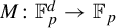 $M\colon \mathbb {F}_{p}^{d}\to \mathbb {F}_{p}$
be a non-degenerate quadratic form and
$M\colon \mathbb {F}_{p}^{d}\to \mathbb {F}_{p}$
be a non-degenerate quadratic form and $h_{1},\ldots ,h_{r}$
be linearly independent vectors. If
$h_{1},\ldots ,h_{r}$
be linearly independent vectors. If $d-2r\geq 3$
, then
$d-2r\geq 3$
, then
 $$ \begin{align*}\vert V(M)^{h_{1},\ldots,h_{r}}\!\vert=p^{d-r-1}(1+O(p^{-(1/2)})).\end{align*} $$
Proof. Since $h_{1},\ldots ,h_{r}$
are linearly independent and M is non-degenerate, it is not hard to see that
$h_{1},\ldots ,h_{r}$
are linearly independent and M is non-degenerate, it is not hard to see that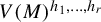 $V(M)^{h_{1},\ldots ,h_{r}}$
is the intersection of
$V(M)^{h_{1},\ldots ,h_{r}}$
is the intersection of $V(M)$
with an affine subspace
$V(M)$
with an affine subspace $V+c$
of
$V+c$
of $\mathbb {F}_{p}^{d}$
of co-dimension r. The conclusion follows from Corollary 4.14.
$\mathbb {F}_{p}^{d}$
of co-dimension r. The conclusion follows from Corollary 4.14.
We also need to study the following sets in this paper.
Definition 4.17. (Gowers set)
Let $\Omega $
be a subset of
$\Omega $
be a subset of $\mathbb {F}_{p}^{d}$
and
$\mathbb {F}_{p}^{d}$
and $s\in \mathbb {N}$
. Let
$s\in \mathbb {N}$
. Let $\Box _{s}(\Omega )$
denote the set of
$\Box _{s}(\Omega )$
denote the set of $(n,h_{1},\ldots ,h_{s})\in (\mathbb {F}_{p}^{d})^{s+1}$
such that
$(n,h_{1},\ldots ,h_{s})\in (\mathbb {F}_{p}^{d})^{s+1}$
such that $n+\epsilon _{1}h_{1}+\cdots +\epsilon _{s}h_{s}\in \Omega $
for all
$n+\epsilon _{1}h_{1}+\cdots +\epsilon _{s}h_{s}\in \Omega $
for all $(\epsilon _{1},\ldots ,\epsilon _{s})\in \{0,1\}^{s}$
. Here, we allow s to be 0, in which case,
$(\epsilon _{1},\ldots ,\epsilon _{s})\in \{0,1\}^{s}$
. Here, we allow s to be 0, in which case, $\Box _{0}(\Omega )=\Omega $
. We say that
$\Box _{0}(\Omega )=\Omega $
. We say that $\Box _{s}(\Omega )$
is the sth Gowers set of
$\Box _{s}(\Omega )$
is the sth Gowers set of $\Omega $
.
$\Omega $
.
It is worth noting that the Gowers set will also be used for the study of the spherical Gowers norms in [Reference Sun16]. We have the following description for Gowers sets.
Lemma 4.18. Let $s\in \mathbb {N}$
,
$s\in \mathbb {N}$
, $M\colon \mathbb {F}_{p}^{d}\to \mathbb {F}_{p}$
be a quadratic form associated with the matrix A, and
$M\colon \mathbb {F}_{p}^{d}\to \mathbb {F}_{p}$
be a quadratic form associated with the matrix A, and $V+c$
be an affine subspace of
$V+c$
be an affine subspace of $\mathbb {F}_{p}^{d}$
. For
$\mathbb {F}_{p}^{d}$
. For $n,h_{1},\ldots ,h_{s}\in \mathbb {F}_{p}^{d}$
, we have that
$n,h_{1},\ldots ,h_{s}\in \mathbb {F}_{p}^{d}$
, we have that $(n,h_{1},\ldots ,h_{s})\in \Box _{s}(V(M)\cap (V+c))$
if and only if:
$(n,h_{1},\ldots ,h_{s})\in \Box _{s}(V(M)\cap (V+c))$
if and only if:
-
•
$n\in V+c$
,
$h_{1},\ldots ,h_{s}\in V$
; -
•
$n\in V(M)^{h_{1},\ldots ,h_{s}}$
; -
•
$(h_{i}A)\cdot h_{j}=0$
for all
$1\leq i,j\leq s, i\neq j$
.





In particular, let $\phi \colon \mathbb {F}_{p}^{r}\to V$
be any bijective linear transformation,
$\phi \colon \mathbb {F}_{p}^{r}\to V$
be any bijective linear transformation, $M'(m):=M(\phi (m)+c)$
. We have that
$M'(m):=M(\phi (m)+c)$
. We have that $(n,h_{1},\ldots ,h_{s})\in \Box _{s}(V(M)\cap (V+c))$
if and only if
$(n,h_{1},\ldots ,h_{s})\in \Box _{s}(V(M)\cap (V+c))$
if and only if $(n,h_{1}, \ldots ,h_{s})=(\phi (n')+c,\phi (h^{\prime }_{1}),\ldots ,\phi (h^{\prime }_{s}))$
for some
$(n,h_{1}, \ldots ,h_{s})=(\phi (n')+c,\phi (h^{\prime }_{1}),\ldots ,\phi (h^{\prime }_{s}))$
for some $(n',h^{\prime }_{1},\ldots ,h^{\prime }_{s})\in \Box _{s}(V(M'))$
.
$(n',h^{\prime }_{1},\ldots ,h^{\prime }_{s})\in \Box _{s}(V(M'))$
.
Proof. If $(n,h_{1},\ldots ,h_{s})\in \Box _{s}(V(M)\cap (V+c))$
, then clearly,
$(n,h_{1},\ldots ,h_{s})\in \Box _{s}(V(M)\cap (V+c))$
, then clearly, $n\in V(M)^{h_{1},\ldots ,h_{s}}$
. Since
$n\in V(M)^{h_{1},\ldots ,h_{s}}$
. Since $n,n+h_{1},\ldots ,n+h_{s}\in V+c$
, we have that
$n,n+h_{1},\ldots ,n+h_{s}\in V+c$
, we have that $h_{1},\ldots ,h_{s}\in V$
. Finally, the fact that
$h_{1},\ldots ,h_{s}\in V$
. Finally, the fact that $(h_{i}A)\cdot h_{j}{\kern-1pt}={\kern-1pt}0$
for all
$(h_{i}A)\cdot h_{j}{\kern-1pt}={\kern-1pt}0$
for all $1{\kern-1pt}\leq{\kern-1pt} i,j{\kern-1pt}\leq{\kern-1pt} s, i{\kern-1pt}\neq{\kern-1pt} j$
follows from the definition of
$1{\kern-1pt}\leq{\kern-1pt} i,j{\kern-1pt}\leq{\kern-1pt} s, i{\kern-1pt}\neq{\kern-1pt} j$
follows from the definition of $\Box _{s}(V(M){\kern-1pt}\cap{\kern-1pt} (V{\kern-1pt}+{\kern-1pt}c))$
and Lemma 4.2.
$\Box _{s}(V(M){\kern-1pt}\cap{\kern-1pt} (V{\kern-1pt}+{\kern-1pt}c))$
and Lemma 4.2.
Conversely, if $n\in V+c$
,
$n\in V+c$
, $h_{1},\ldots ,h_{s}\in V$
, then
$h_{1},\ldots ,h_{s}\in V$
, then $n+\epsilon _{1}h_{1}+\cdots +\epsilon _{s}h_{s}\in V+c$
for all
$n+\epsilon _{1}h_{1}+\cdots +\epsilon _{s}h_{s}\in V+c$
for all $\epsilon _{1},\ldots ,\epsilon _{s}\in \{0,1\}$
. Since
$\epsilon _{1},\ldots ,\epsilon _{s}\in \{0,1\}$
. Since $n\in V(M)^{h_{1},\ldots ,h_{s}}$
, we have that
$n\in V(M)^{h_{1},\ldots ,h_{s}}$
, we have that $M(n+\epsilon _{1}h_{1}+\cdots +\epsilon _{s}h_{s})=0$
whenever
$M(n+\epsilon _{1}h_{1}+\cdots +\epsilon _{s}h_{s})=0$
whenever $\vert \epsilon \vert :=\epsilon _{1}+\cdots +\epsilon _{s}=0$
or 1. Suppose we have shown that
$\vert \epsilon \vert :=\epsilon _{1}+\cdots +\epsilon _{s}=0$
or 1. Suppose we have shown that $M(n+\epsilon _{1}h_{1}+\cdots +\epsilon _{s}h_{s})=0$
whenever
$M(n+\epsilon _{1}h_{1}+\cdots +\epsilon _{s}h_{s})=0$
whenever $\vert \epsilon \vert :=\epsilon _{1}+\cdots +\epsilon _{s}\leq i$
for some
$\vert \epsilon \vert :=\epsilon _{1}+\cdots +\epsilon _{s}\leq i$
for some $1\leq i\leq s-1$
, then it follows from Lemma 4.2 and the fact that
$1\leq i\leq s-1$
, then it follows from Lemma 4.2 and the fact that $(h_{i}A)\cdot h_{j}=0$
for all
$(h_{i}A)\cdot h_{j}=0$
for all $1\leq i,j\leq s, i\neq j$
that
$1\leq i,j\leq s, i\neq j$
that $M(n+\epsilon _{1}h_{1}+\cdots +\epsilon _{s}h_{s})=0$
whenever
$M(n+\epsilon _{1}h_{1}+\cdots +\epsilon _{s}h_{s})=0$
whenever $\vert \epsilon \vert :=\epsilon _{1}+\cdots +\epsilon _{s}\leq i+1$
. In conclusion, we have that
$\vert \epsilon \vert :=\epsilon _{1}+\cdots +\epsilon _{s}\leq i+1$
. In conclusion, we have that $(n,h_{1},\ldots ,h_{s})\in \Box _{s}(V(M)\cap (V+c))$
.
$(n,h_{1},\ldots ,h_{s})\in \Box _{s}(V(M)\cap (V+c))$
.
The proof of the ‘in particular’ part is left to the interested readers.
We summarize some basic properties of Gowers sets.
Proposition 4.19. (Some preliminary properties for Gowers sets)
Let $d\in \mathbb {N}_{+}, s\in \mathbb {N}$
and p be a prime. Let
$d\in \mathbb {N}_{+}, s\in \mathbb {N}$
and p be a prime. Let $M\colon \mathbb {F}_{p}^{d}\to \mathbb {F}_{p}$
be a quadratic form with
$M\colon \mathbb {F}_{p}^{d}\to \mathbb {F}_{p}$
be a quadratic form with $\mathrm {rank}(M)\geq s^{2}+s+3$
. Then:
$\mathrm {rank}(M)\geq s^{2}+s+3$
. Then:
-
(i) we have
$\vert \Box _{s}(V(M))\vert =p^{(s+1)d-((s(s+1)/2)+1)}(1+O_{s}(p^{-1/2}))$
; -
(ii) for all but at most
$s(s+1)p^{d+s-\mathrm {rank}(M)}$
many
$h_{s}\in \mathbb {F}_{p}^{d}$
, the set of
$(n,h_{1},\ldots , h_{s-1})\in (\mathbb {F}_{p}^{d})^{s}$
with
$(n,h_{1},\ldots ,h_{s})\in \Box _{s}(V(M))$
is at most
$p^{ds-((s(s+1)/2)+1)}$
; -
(iii) if
$s=1$
, then for any function
$f\colon \Box _{1}(V(M))\to \mathbb {C}$
with norm bounded by 1, we have that
$$ \begin{align*} \mathbb{E}_{(n,h)\in\Box_{1}(V(M))}f(n,h)=\mathbb{E}_{h\in\mathbb{F}_{p}^{d}}\mathbb{E}_{n\in V(M)^{h}}f(n,h)+O(p^{-1/2}). \end{align*} $$



It is worth mentioning that Proposition 4.19(iii) can be interpreted as Fubini’s theorem on $\Box _{1}(V(M))$
, which says the two-dimensional average of
$\Box _{1}(V(M))$
, which says the two-dimensional average of $(n,h)$
over
$(n,h)$
over $\Box _{1}(V(M))$
is approximately the same as the double average of n and h.
$\Box _{1}(V(M))$
is approximately the same as the double average of n and h.
Proposition 4.19 can either be proved by direct computation plus the counting properties developed in §4, or it can be derived from a more general framework using [Reference Sun18, Example 5.4 and Theorem 5.11]. So, we only provide a sketch of the proof.
Sketch of the proof.
Clearly, part (i) holds for $s=0$
by Lemma 4.12. Suppose that part (i) holds for s and now we prove it for
$s=0$
by Lemma 4.12. Suppose that part (i) holds for s and now we prove it for $s+1$
. By Lemma 4.18,
$s+1$
. By Lemma 4.18, $(n,h_{1},\ldots ,h_{s+1})\in \Box _{s+1}(V(M))$
if and only if
$(n,h_{1},\ldots ,h_{s+1})\in \Box _{s+1}(V(M))$
if and only if $(n,h_{1},\ldots ,h_{s})\in \Box _{s}(V(M))$
and
$(n,h_{1},\ldots ,h_{s})\in \Box _{s}(V(M))$
and $h_{s+1}$
belongs to the set
$h_{s+1}$
belongs to the set
 $$ \begin{align*}W(n,h_{1},\ldots,h_{s}):=\{m\in\mathbb{F}_{p}^{d}\colon M(n+m)=(h_{1}A)\cdot m=\cdots=(h_{s}A)\cdot m=0\}.\end{align*} $$
For most of the choices of $(n,h_{1},\ldots ,h_{s})$
,
$(n,h_{1},\ldots ,h_{s})$
, $W(n,h_{1},\ldots ,h_{s})$
is the intersection of a hypersphere with a hyperplane of codimension s, and so is of cardinality approximately
$W(n,h_{1},\ldots ,h_{s})$
is the intersection of a hypersphere with a hyperplane of codimension s, and so is of cardinality approximately $p^{d-s-1}$
by Corollary 4.14. So, by induction hypothesis,
$p^{d-s-1}$
by Corollary 4.14. So, by induction hypothesis,
 $$ \begin{align*} &\vert \Box_{s+1}(V(M))\vert\approx \vert \Box_{s}(V(M))\vert\cdot p^{d-s-1}\approx p^{(s+1)d-((s(s+1)/2)+1)}\cdot p^{d-s-1}\\ & \quad =p^{(s+2)d-(({(s+1)(s+2)}/{2})+1)}. \end{align*} $$
For part (ii), using Lemma 4.18, one can show that $(n,h_{1},\ldots ,h_{s})\in \Box _{s}(V(M))$
if and only if
$(n,h_{1},\ldots ,h_{s})\in \Box _{s}(V(M))$
if and only if $(n,h_{1},\ldots ,h_{s-1})\in \Box _{s-1}(V(M))$
,
$(n,h_{1},\ldots ,h_{s-1})\in \Box _{s-1}(V(M))$
, $n\in V+c$
, and
$n\in V+c$
, and $h_{1},\ldots ,h_{s-1}\in V$
, where
$h_{1},\ldots ,h_{s-1}\in V$
, where $V+c$
is the affine subspace of
$V+c$
is the affine subspace of $\mathbb {F}_{p}^{d}$
consisting of all h with
$\mathbb {F}_{p}^{d}$
consisting of all h with $M(h+h_{s})=M(h)$
, and V is the affine subspace of
$M(h+h_{s})=M(h)$
, and V is the affine subspace of $\mathbb {F}_{p}^{d}$
consisting of all h with
$\mathbb {F}_{p}^{d}$
consisting of all h with $(h_{s}A)\cdot h=0$
. This is equivalent of saying that
$(h_{s}A)\cdot h=0$
. This is equivalent of saying that $(n,h_{1},\ldots ,h_{s-1})\in \Box _{s-1}(V(M)\cap (V+c))$
. One can informally think of
$(n,h_{1},\ldots ,h_{s-1})\in \Box _{s-1}(V(M)\cap (V+c))$
. One can informally think of $V(M)\cap (V+c)$
as a hypersphere in a subspace of dimension
$V(M)\cap (V+c)$
as a hypersphere in a subspace of dimension $d-1$
(for most of
$d-1$
(for most of $h_{s}$
), and so the number of such
$h_{s}$
), and so the number of such $(n,h_{1},\ldots ,h_{s-1})$
by part (i) is approximately
$(n,h_{1},\ldots ,h_{s-1})$
by part (i) is approximately $p^{s(d-1)-(((s-1)s/2)+1)}=p^{sd-((s(s+1)/2)+1)}$
.
$p^{s(d-1)-(((s-1)s/2)+1)}=p^{sd-((s(s+1)/2)+1)}$
.
Part (iii) can be derived by combining parts (i) and (ii). We omit the details.
5 The main equidistribution theorem
With the help of the preparation in the previous sections, we are now ready to state the main result in this paper, which is a generalization of Theorem 1.4.
Theorem 5.1. (Equidistribution theorem on
$V(M)$
)

Let $0{\kern-1pt}<{\kern-1pt}\delta {\kern-1pt}<{\kern-1pt}1/2, d,m{\kern-1pt}\in{\kern-1pt} \mathbb {N}_{+},s,r{\kern-1pt}\in{\kern-1pt} \mathbb {N}$
with
$0{\kern-1pt}<{\kern-1pt}\delta {\kern-1pt}<{\kern-1pt}1/2, d,m{\kern-1pt}\in{\kern-1pt} \mathbb {N}_{+},s,r{\kern-1pt}\in{\kern-1pt} \mathbb {N}$
with $d\geq r$
, and p be a prime. Let
$d\geq r$
, and p be a prime. Let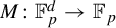 $M\colon \mathbb {F}_{p}^{d}\to \mathbb {F}_{p}$
be a quadratic form and
$M\colon \mathbb {F}_{p}^{d}\to \mathbb {F}_{p}$
be a quadratic form and $V+c$
be an affine subspace of
$V+c$
be an affine subspace of $\mathbb {F}_{p}^{d}$
of co-dimension r. Suppose that
$\mathbb {F}_{p}^{d}$
of co-dimension r. Suppose that $\mathrm {rank}(M\vert _{V+c})\geq s+13$
. Let
$\mathrm {rank}(M\vert _{V+c})\geq s+13$
. Let $G/\Gamma $
be an s-step
$G/\Gamma $
be an s-step $\mathbb {N}$
-filtered nilmanifold of dimension m, equipped with a
$\mathbb {N}$
-filtered nilmanifold of dimension m, equipped with a ${1}/{\delta }$
-rational Mal’cev basis
${1}/{\delta }$
-rational Mal’cev basis $\mathcal {X}$
, and let
$\mathcal {X}$
, and let $g\in \mathrm { poly}(\mathbb {Z}^{d}\to G_{\mathbb {N}})$
be a rational polynomial sequence. If
$g\in \mathrm { poly}(\mathbb {Z}^{d}\to G_{\mathbb {N}})$
be a rational polynomial sequence. If $p\gg _{d,m} \delta ^{-O_{d,m}(1)}$
and
$p\gg _{d,m} \delta ^{-O_{d,m}(1)}$
and $(g(n)\Gamma )_{n\in \iota ^{-1}(V(M)\cap (V+c))}$
is not
$(g(n)\Gamma )_{n\in \iota ^{-1}(V(M)\cap (V+c))}$
is not $\delta $
-equidistributed on
$\delta $
-equidistributed on $G/\Gamma $
, then there exists a non-trivial type-I horizontal character
$G/\Gamma $
, then there exists a non-trivial type-I horizontal character $\eta $
with
$\eta $
with $0<\Vert \eta \Vert \ll _{d,m} \delta ^{-O_{d,m}(1)}$
(independent of
$0<\Vert \eta \Vert \ll _{d,m} \delta ^{-O_{d,m}(1)}$
(independent of $k,M$
, and p) such that
$k,M$
, and p) such that $\eta \circ g \,\mod \mathbb {Z}$
is a constant on
$\eta \circ g \,\mod \mathbb {Z}$
is a constant on $\iota ^{-1}(V(M)\cap (V+c))$
. (It follows from Corollary 4.14 that
$\iota ^{-1}(V(M)\cap (V+c))$
. (It follows from Corollary 4.14 that $V(M)\cap (V+c)$
is non-empty since
$V(M)\cap (V+c)$
is non-empty since $d-r\geq s+13$
.)
$d-r\geq s+13$
.)
To illustrate the idea for the proof of Theorem 5.1, we first present an outline of the proof of Corollary 1.6 (which is a special case of Theorem 5.1). Assume for simplicity that g is p-periodic. Suppose we have proven Corollary 1.6 for the case $s-1$
. Denote
$s-1$
. Denote $\Omega =V(M)$
. Assume on the contrary that
$\Omega =V(M)$
. Assume on the contrary that
 $$ \begin{align} \bigg\vert\frac{1}{\vert\Omega\vert}\sum_{n\in\Omega}\exp(g\circ\tau(n)/p)\bigg\vert>\delta. \end{align} $$
Taking squares on both sides and performing a change of variables, we have that
 $$ \begin{align*} &\delta^{2}<\frac{1}{\vert\Omega\vert^{2}}\sum_{n,n+h\in\Omega}\exp((g\circ\tau(n+h)-g\circ\tau(n))/p)\\ & \quad =\frac{1}{\vert\Omega\vert^{2}}\sum_{h\in\mathbb{F}_{p}^{d}}\sum_{n\in \Omega\cap (\Omega-h)}\exp((g\circ\tau(n+h)-g\circ\tau(n))/p). \end{align*} $$
Since (by the inheriting principle) the sets $\Omega \cap (\Omega -h), h\in \mathbb {F}_{p}^{d}$
are hyperspheres whose cardinalities are comparable with each other for most of h, we have that
$\Omega \cap (\Omega -h), h\in \mathbb {F}_{p}^{d}$
are hyperspheres whose cardinalities are comparable with each other for most of h, we have that
 $$ \begin{align*} \frac{1}{p^{d}}\sum_{h\in\mathbb{F}_{p}^{d}}\bigg\vert\frac{1}{\vert\Omega\cap (\Omega-h)\vert}\sum_{n\in \Omega\cap (\Omega-h)}\exp((g\circ\tau(n+h)-g\circ\tau(n))/p)\bigg\vert\gg\delta^{2} \end{align*} $$
(this argument can be made precise by Proposition 4.19). By the pigeonhole principle, for ‘many’ $h\in \mathbb {F}_{p}^{d}$
, we have that
$h\in \mathbb {F}_{p}^{d}$
, we have that
 $$ \begin{align*} \bigg\vert\frac{1}{\vert\Omega\cap (\Omega-h)\vert}\sum_{n\in \Omega\cap (\Omega-h)}\exp((g\circ\tau(n+h)-g\circ\tau(n))/p)\bigg\vert\gg \delta^{2}. \end{align*} $$
Informally, one can view $\Omega \cap (\Omega -h)$
as a sphere whose dimension is lower than
$\Omega \cap (\Omega -h)$
as a sphere whose dimension is lower than $\Omega $
by 1. So, we may then apply the induction hypothesis to the degree
$\Omega $
by 1. So, we may then apply the induction hypothesis to the degree $(s-1)$
polynomial sequence
$(s-1)$
polynomial sequence $g\circ \tau (n+h)-g\circ \tau (n)$
to conclude that
$g\circ \tau (n+h)-g\circ \tau (n)$
to conclude that
 $$ \begin{align} (g\circ\tau(n+h)-g\circ\tau(n))/p \ \,\mod \mathbb{Z} \text{ is a constant on } \Omega\cap (\Omega-h)\quad \text{ for `many' } h\in \mathbb{F}_{p}^{d}. \end{align} $$
(For the case when g is a polynomial sequence on a nilmanifold, the conclusion becomes $(\eta _{h}\circ g\circ \tau (n+h)-\eta _{h}\circ g\circ \tau (n))/p \,\mod \mathbb {Z}$
is a constant on
$(\eta _{h}\circ g\circ \tau (n+h)-\eta _{h}\circ g\circ \tau (n))/p \,\mod \mathbb {Z}$
is a constant on $\Omega \cap (\Omega -h)$
for ‘many’
$\Omega \cap (\Omega -h)$
for ‘many’ $h\in \mathbb {F}_{p}^{d}$
for some horizontal character
$h\in \mathbb {F}_{p}^{d}$
for some horizontal character $\eta _{h}$
of low complexity. The dependence of
$\eta _{h}$
of low complexity. The dependence of $\eta _{h}$
on h can then be dropped by using the pigeonhole principle.)
$\eta _{h}$
on h can then be dropped by using the pigeonhole principle.)
For convenience, denote $Q:=\iota \circ pg\circ \tau $
, then
$Q:=\iota \circ pg\circ \tau $
, then $Q\in \text {poly}(\mathbb {F}_{p}^{d}\to \mathbb {F}_{p})$
is a polynomial of degree at most s. It then follows from (5.2) that
$Q\in \text {poly}(\mathbb {F}_{p}^{d}\to \mathbb {F}_{p})$
is a polynomial of degree at most s. It then follows from (5.2) that
 $$ \begin{align} \Delta_{h_{2}}\Delta_{h_{1}}Q(n)=0 \quad\text{for `many'} (n,h_{1},h_{2})\in \Box_{2}(\Omega), \end{align} $$
where $\Box _{2}(\Omega )$
is the second Gowers set of
$\Box _{2}(\Omega )$
is the second Gowers set of $\Omega $
defined in Definition 4.17.
$\Omega $
defined in Definition 4.17.
We have now reduced Corollary 1.6 to a problem of solving the polynomial equation (5.3). If $\Omega $
were the entire space
$\Omega $
were the entire space $\mathbb {F}_{p}^{d}$
, then using some basic knowledge for polynomials, it is not hard to show that (5.3) would imply that Q is of degree at most
$\mathbb {F}_{p}^{d}$
, then using some basic knowledge for polynomials, it is not hard to show that (5.3) would imply that Q is of degree at most $s-1$
, which would complete the proof of Corollary 1.6 by induction. When
$s-1$
, which would complete the proof of Corollary 1.6 by induction. When $\Omega $
is a sphere, the difficulty of the analysis of (5.3) increases significantly. Therefore, solving (5.3) (as well as its various generalizations) is a central topic in this paper and this is the main challenge in adapting the Green–Tao approach [Reference Green and Tao5] to the quadratic case.
$\Omega $
is a sphere, the difficulty of the analysis of (5.3) increases significantly. Therefore, solving (5.3) (as well as its various generalizations) is a central topic in this paper and this is the main challenge in adapting the Green–Tao approach [Reference Green and Tao5] to the quadratic case.
In Proposition 6.8, we show that (5.3) implies that Q can be written as $Q=MQ_{1}+Q_{2}$
for some
$Q=MQ_{1}+Q_{2}$
for some $Q_{1},Q_{2}\in \text {poly}(\mathbb {F}_{p}^{d}\to \mathbb {F}_{p})$
with
$Q_{1},Q_{2}\in \text {poly}(\mathbb {F}_{p}^{d}\to \mathbb {F}_{p})$
with $\deg (Q_{2})\leq 1$
. Then, (5.1) implies that
$\deg (Q_{2})\leq 1$
. Then, (5.1) implies that
 $$ \begin{align*} \bigg\vert\frac{1}{\vert\Omega\vert}\sum_{n\in\Omega}\exp\bigg(\frac{1}{p}\tau\circ Q(n)\bigg)\bigg\vert=\bigg\vert\frac{1}{\vert\Omega\vert}\sum_{n\in\Omega}\exp\bigg(\frac{1}{p}\tau\circ Q_{2}(n)\bigg)\bigg\vert>\delta. \end{align*} $$
Since $Q_{2}$
is linear, it forces
$Q_{2}$
is linear, it forces $Q_{2}(n)/p \,\mod Z$
to be a constant and therefore,
$Q_{2}(n)/p \,\mod Z$
to be a constant and therefore, $Q(n)/p\,\mod \mathbb {Z}$
is a constant on
$Q(n)/p\,\mod \mathbb {Z}$
is a constant on $\Omega $
. This implies that
$\Omega $
. This implies that $g\circ \tau (n)/p \,\mod \mathbb {Z}$
is a constant on
$g\circ \tau (n)/p \,\mod \mathbb {Z}$
is a constant on $\Omega $
, completing the (outline of the) proof of Corollary 1.6.
$\Omega $
, completing the (outline of the) proof of Corollary 1.6.
To prove Theorem 5.1, a more general version of Corollary 1.6, following the idea of Green and Tao [Reference Green and Tao5, Reference Green and Tao6], one can reduce the problem to solving the following generalized versions of (5.3) (see also (9.19)):
 $$ \begin{align} \Delta_{h_{3}}\Delta_{h_{2}}\Delta_{h_{1}}P(n)+\Delta_{h_{2}}\Delta_{h_{1}}Q(n)=0 \quad\text{for `many' } (n,h_{1},h_{2},h_{3})\in\Box_{3}(\Omega), \end{align} $$
where $Q\in \text {poly}(\mathbb {F}_{p}^{d}\to \mathbb {F}_{p})$
comes from the composition of g with some type-I horizontal character of
$Q\in \text {poly}(\mathbb {F}_{p}^{d}\to \mathbb {F}_{p})$
comes from the composition of g with some type-I horizontal character of $G/\Gamma $
(so
$G/\Gamma $
(so $\deg (Q)\leq s$
), and
$\deg (Q)\leq s$
), and $P\in \text {poly}(\mathbb {F}_{p}^{d}\to \mathbb {F}_{p})$
is a polynomial of degree at most
$P\in \text {poly}(\mathbb {F}_{p}^{d}\to \mathbb {F}_{p})$
is a polynomial of degree at most $s-1$
arising from the ‘nonlinear’ part of g.
$s-1$
arising from the ‘nonlinear’ part of g.
The bulk of §6 is devoted to solving the following generalized version of (5.4) (see also (6.25)):
 $$ \begin{align} \Delta_{h_{s-1}}\cdots\Delta_{h_{1}}P(n)+\Delta_{h_{s}}\cdots\Delta_{h_{1}}Q(n)=0 \quad\text{for `many' } (n,h_{1},\ldots,h_{s})\in\Box_{s}(\Omega). \end{align} $$
(We study (5.5) for any $s\in \mathbb {N}$
not just for
$s\in \mathbb {N}$
not just for $s=3$
for the purpose of future research.) We provide a solution to (5.5) in Proposition 6.6. In the same section, we also prove some other properties for polynomial equations in
$s=3$
for the purpose of future research.) We provide a solution to (5.5) in Proposition 6.6. In the same section, we also prove some other properties for polynomial equations in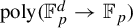 $\text {poly}(\mathbb {F}_{p}^{d}\to \mathbb {F}_{p})$
for later use.
$\text {poly}(\mathbb {F}_{p}^{d}\to \mathbb {F}_{p})$
for later use.
One can then combine the solution to (5.4) together with the machinery of Green and Tao [Reference Green and Tao5, Reference Green and Tao6] to prove Theorem 5.1 for the case when g is p-periodic. However, to deal with a partially p-periodic sequence g, we need to deal with the following even more general version of (5.5):
 $$ \begin{align} \Delta_{h_{s-1}}{\kern-1pt}\cdots\Delta_{h_{1}}P(n){\kern-1pt}+{\kern-1pt}\Delta_{h_{s}}\cdots\Delta_{h_{1}}Q(n)\in\mathbb{Z} \quad\text{for `many' } (n,h_{1},\ldots,h_{s}){\kern-1pt}\in {\kern-1pt}\iota^{-1}(\Box_{s}(\Omega)), \end{align} $$
where $P,Q\in \text {poly}(\mathbb {Z}^{d}\to \mathbb {Q})$
are partially p-periodic polynomials on
$P,Q\in \text {poly}(\mathbb {Z}^{d}\to \mathbb {Q})$
are partially p-periodic polynomials on $\iota ^{-1}(\Omega )$
. The bulk of §7 is devoted to solving (5.6) (and we eventually solve (5.6) in Proposition 7.6). To solve (5.6), we develop an approach called the p-expansion trick, which allows us to lift the solutions to (5.6) from
$\iota ^{-1}(\Omega )$
. The bulk of §7 is devoted to solving (5.6) (and we eventually solve (5.6) in Proposition 7.6). To solve (5.6), we develop an approach called the p-expansion trick, which allows us to lift the solutions to (5.6) from $\mathbb {Z}/p$
-valued polynomials to
$\mathbb {Z}/p$
-valued polynomials to $\mathbb {Z}/p^{s}$
-valued polynomials. In the same section, we also use the same trick to extend other results in §6 to the partially p-periodic case. We remark that §§6 and 7 are the essential deviation of our approach from the work of Green and Tao [Reference Green and Tao5].
$\mathbb {Z}/p^{s}$
-valued polynomials. In the same section, we also use the same trick to extend other results in §6 to the partially p-periodic case. We remark that §§6 and 7 are the essential deviation of our approach from the work of Green and Tao [Reference Green and Tao5].
Finally, in §9, we combine the algebraic preparations from §§6 and 7 with the approach of Green and Tao [Reference Green and Tao5, Reference Green and Tao6] to complete the proof of Theorem 5.1. While the outline of this section is similar to the approach of Green and Tao [Reference Green and Tao5], there are a couple of highly non-trivial challenges to overcome to adopt this method, including the treatment of (9.22), and Propositions 9.8 and 9.9.
6 Algebraic properties for quadratic forms in
$\mathbb {F}_{p}$

6.1 Irreducible properties for quadratic forms
We begin with a dichotomy on the intersection of the sets of solutions of a polynomial and a quadratic form.
Lemma 6.1. Let $d\in \mathbb {N}_{+},s\in \mathbb {N}$
and p be a prime such that
$d\in \mathbb {N}_{+},s\in \mathbb {N}$
and p be a prime such that $p\gg _{d,s} 1$
. Let
$p\gg _{d,s} 1$
. Let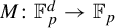 $M\colon \mathbb {F}_{p}^{d}\to \mathbb {F}_{p}$
be a quadratic form of rank at least 3. For any
$M\colon \mathbb {F}_{p}^{d}\to \mathbb {F}_{p}$
be a quadratic form of rank at least 3. For any $P\in \mathrm {poly}(\mathbb {F}_{p}^{d}\to \mathbb {F}_{p})$
of degree at most s, either
$P\in \mathrm {poly}(\mathbb {F}_{p}^{d}\to \mathbb {F}_{p})$
of degree at most s, either $\vert V(P)\cap V(M)\vert \leq O_{d,s}(p^{d-2})$
or
$\vert V(P)\cap V(M)\vert \leq O_{d,s}(p^{d-2})$
or $V(M)\subseteq V(P)$
.
$V(M)\subseteq V(P)$
.
Proof. Denote $r=\mathrm {rank}(M)$
. We first assume that M and P are homogeneous. By Lemma 4.3, it suffices to consider the special case when
$r=\mathrm {rank}(M)$
. We first assume that M and P are homogeneous. By Lemma 4.3, it suffices to consider the special case when
 $$ \begin{align*}M(n)=c_{1}n^{2}_{1}+\cdots+c_{r}n_{r}^{2}\end{align*} $$
for some $c_{1},\ldots ,c_{r}\in \mathbb {F}_{p}\backslash \{0\}$
. Let
$c_{1},\ldots ,c_{r}\in \mathbb {F}_{p}\backslash \{0\}$
. Let $U:=V(P)\cap V(M)$
. By the pigeonhole principle, there exists
$U:=V(P)\cap V(M)$
. By the pigeonhole principle, there exists $1\leq i\leq r$
such that the ith coordinate of at least
$1\leq i\leq r$
such that the ith coordinate of at least $(\vert U\vert -p^{d-r})/r$
many
$(\vert U\vert -p^{d-r})/r$
many $n\in U$
is non-zero. We may assume without loss of generality that
$n\in U$
is non-zero. We may assume without loss of generality that $i=1$
. Write
$i=1$
. Write $n=(t,y)$
, where
$n=(t,y)$
, where $t\in \mathbb {F}_{p}$
and
$t\in \mathbb {F}_{p}$
and $y\in \mathbb {F}_{p}^{d-1}$
. Since
$y\in \mathbb {F}_{p}^{d-1}$
. Since $\deg (P)=s\ll p$
, by the long division algorithm, we may write
$\deg (P)=s\ll p$
, by the long division algorithm, we may write
 $$ \begin{align} P(t,y)=M(t,y)R(t,y)+N_{1}(y)t+N_{0}(y) \end{align} $$
for some $R\in \text {poly}(\mathbb {F}_{p}^{d}\to \mathbb {F}_{p}), N_{1},N_{0}\in \text {poly}(\mathbb {F}_{p}^{d-1}\to \mathbb {F}_{p})$
such that the degrees of
$R\in \text {poly}(\mathbb {F}_{p}^{d}\to \mathbb {F}_{p}), N_{1},N_{0}\in \text {poly}(\mathbb {F}_{p}^{d-1}\to \mathbb {F}_{p})$
such that the degrees of $R, N_{1}$
, and
$R, N_{1}$
, and $N_{0}$
are at most
$N_{0}$
are at most $s-2$
,
$s-2$
, $s-1$
, and s, respectively. Then,
$s-1$
, and s, respectively. Then,
 $$ \begin{align} P(t,y)=M(t,y)=N_{1}(y)t+N_{0}(y)=0 \quad\text{for all } (t,y)\in U. \end{align} $$
Note that if $M(t,y)=N_{1}(y)t+N_{0}(y)=0$
, then we must have that
$M(t,y)=N_{1}(y)t+N_{0}(y)=0$
, then we must have that $t=-N_{0}(y)/N_{1}(y)$
(provided that
$t=-N_{0}(y)/N_{1}(y)$
(provided that $N_{1}(y)\neq 0$
). Substituting this expression back to
$N_{1}(y)\neq 0$
). Substituting this expression back to $M(t,y)=0$
, we have that
$M(t,y)=0$
, we have that $\Delta (y)N_{1}(y)^{-2}=0$
, where
$\Delta (y)N_{1}(y)^{-2}=0$
, where
 $$ \begin{align*}\Delta(y):=M(0,y)N_{1}(y)^{2}+c_{1}N^{2}_{0}(y).\end{align*} $$
So, $\Delta (y)$
is an important polynomial in the study of (6.2). We first assume that
$\Delta (y)$
is an important polynomial in the study of (6.2). We first assume that $\Delta (y)$
is not constant 0. Let
$\Delta (y)$
is not constant 0. Let $U'$
be the set of
$U'$
be the set of $(t,y)\in U$
such that
$(t,y)\in U$
such that $N_{1}(y)=0$
. Then, it follows from (6.2) that
$N_{1}(y)=0$
. Then, it follows from (6.2) that $N_{0}(y)=0$
and so
$N_{0}(y)=0$
and so $\Delta (y)=0$
. Since we assumed that
$\Delta (y)=0$
. Since we assumed that $\Delta (y)$
is not constant 0 and
$\Delta (y)$
is not constant 0 and $\deg (\Delta (y))\leq 2s$
, by Lemma 4.10, we have that
$\deg (\Delta (y))\leq 2s$
, by Lemma 4.10, we have that $\vert U'\vert \leq O_{d,s}(p^{d-2})$
.
$\vert U'\vert \leq O_{d,s}(p^{d-2})$
.
Suppose that $(t,y)\in U\backslash U'$
and
$(t,y)\in U\backslash U'$
and $t\neq 0$
. Then,
$t\neq 0$
. Then, $M(t,y)=N_{1}(y)t+N_{0}(y)=0$
by (6.2). So,
$M(t,y)=N_{1}(y)t+N_{0}(y)=0$
by (6.2). So, $t=-N_{0}(y)N_{1}(y)^{-1}$
and so,
$t=-N_{0}(y)N_{1}(y)^{-1}$
and so, $M(0,y)=M(t,y)-c_{1}t^{2}=-c_{1}t^{2}=-c_{1}N^{2}_{0}(y)N_{1}(y)^{-2}$
, or equivalently,
$M(0,y)=M(t,y)-c_{1}t^{2}=-c_{1}t^{2}=-c_{1}N^{2}_{0}(y)N_{1}(y)^{-2}$
, or equivalently, $\Delta (y)=0$
. Since
$\Delta (y)=0$
. Since $\Delta (y)$
is not constant 0, by Lemma 4.10, we have that
$\Delta (y)$
is not constant 0, by Lemma 4.10, we have that $\vert (U\backslash U')\cap \{(t,y)\colon t\neq \mathbf {0}\}\vert \leq O_{d,s}(p^{d-2})$
. Since we assumed that
$\vert (U\backslash U')\cap \{(t,y)\colon t\neq \mathbf {0}\}\vert \leq O_{d,s}(p^{d-2})$
. Since we assumed that $\vert U\cap \{(t,y)\colon t\neq \mathbf {0}\}\vert \geq {(\vert U\vert -p^{d-r})}/{r}$
, we deduce that
$\vert U\cap \{(t,y)\colon t\neq \mathbf {0}\}\vert \geq {(\vert U\vert -p^{d-r})}/{r}$
, we deduce that $\vert U\vert \leq O_{d,s}(p^{d-2})$
since
$\vert U\vert \leq O_{d,s}(p^{d-2})$
since $r\geq 3$
.
$r\geq 3$
.
We now consider the case that $\Delta (y)\equiv 0$
. Let W be the set of
$\Delta (y)\equiv 0$
. Let W be the set of $y\in \mathbb {F}_{p}^{d-1}$
such that
$y\in \mathbb {F}_{p}^{d-1}$
such that $-c_{1}M(0,y)$
is not a square residue in
$-c_{1}M(0,y)$
is not a square residue in $\mathbb {F}_{p}$
. Since
$\mathbb {F}_{p}$
. Since $\mathrm {rank}(M(0,\cdot ))\geq 2$
, by Lemma 4.13,
$\mathrm {rank}(M(0,\cdot ))\geq 2$
, by Lemma 4.13, $\vert W\vert =\frac {1}{2}p^{d-1}(1+O(p^{-1/2}))$
. Since
$\vert W\vert =\frac {1}{2}p^{d-1}(1+O(p^{-1/2}))$
. Since $\Delta (y)\equiv 0$
for all
$\Delta (y)\equiv 0$
for all $y\in W$
, we have that
$y\in W$
, we have that $N_{1}(y)=0$
. By Lemma 4.10,
$N_{1}(y)=0$
. By Lemma 4.10, $\vert W\vert \leq O_{s}(p^{d-2})$
unless
$\vert W\vert \leq O_{s}(p^{d-2})$
unless $N_{1}(y)\equiv 0$
. If
$N_{1}(y)\equiv 0$
. If $p\gg _{d,s} 1$
, then
$p\gg _{d,s} 1$
, then $\vert W\vert =\frac {1}{2}p^{d-1}(1+O(p^{-1/2}))\gg _{s}p^{d-2}$
and so we must have that
$\vert W\vert =\frac {1}{2}p^{d-1}(1+O(p^{-1/2}))\gg _{s}p^{d-2}$
and so we must have that $N_{1}(y)\equiv 0$
. Since
$N_{1}(y)\equiv 0$
. Since $\Delta (y)\equiv 0$
, we also have that
$\Delta (y)\equiv 0$
, we also have that $N_{0}(y)\equiv 0$
. So, (6.1) implies that
$N_{0}(y)\equiv 0$
. So, (6.1) implies that $P=MR$
, which implies that
$P=MR$
, which implies that $V(M)\subseteq V(P)$
.
$V(M)\subseteq V(P)$
.
Finally, we consider the general case when M and P are not necessarily homogeneous. Then, there exist homogeneous polynomials $\tilde {M},\tilde {P}\colon \mathbb {F}_{p}^{d+1}\to \mathbb {F}_{p}$
of degrees at most 2 and s, respectively, such that
$\tilde {M},\tilde {P}\colon \mathbb {F}_{p}^{d+1}\to \mathbb {F}_{p}$
of degrees at most 2 and s, respectively, such that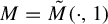 $M=\tilde {M}(\cdot ,1)$
and
$M=\tilde {M}(\cdot ,1)$
and $P=\tilde {P}(\cdot ,1)$
. Then,
$P=\tilde {P}(\cdot ,1)$
. Then, $\tilde {M}$
is a quadratic form of rank at least 3. By the previous case, either
$\tilde {M}$
is a quadratic form of rank at least 3. By the previous case, either $\vert V(\tilde {P})\cap V(\tilde {M})\vert \leq O_{d,s}(p^{d-1})$
or
$\vert V(\tilde {P})\cap V(\tilde {M})\vert \leq O_{d,s}(p^{d-1})$
or ${V(\tilde {M})\subseteq V(\tilde {P})}$
. In the former case, since
${V(\tilde {M})\subseteq V(\tilde {P})}$
. In the former case, since
 $$ \begin{align} \vert V(\tilde{P})\cap V(\tilde{M})\vert &\geq \sum_{i=1}^{p-1}\vert V(\tilde{P}(\cdot,i))\cap V(\tilde{M}(\cdot,i))\vert \nonumber\\ &=(p-1)\vert V(\tilde{P}(\cdot,1))\cap V(\tilde{M}(\cdot,1))\vert \text{(since } \tilde{P} \text{ and } \tilde{M} \text{ are homogeneous)}\nonumber\\ &=(p-1)\vert V(P)\cap V(M)\vert, \end{align} $$
we have that $\vert V(P)\cap V(M)\vert \leq O_{d,s}(p^{d-2})$
. In the latter case, we have that
$\vert V(P)\cap V(M)\vert \leq O_{d,s}(p^{d-2})$
. In the latter case, we have that $V(\tilde {M}(\cdot ,1))\subseteq V(\tilde {P}(\cdot ,1))$
, which implies that
$V(\tilde {M}(\cdot ,1))\subseteq V(\tilde {P}(\cdot ,1))$
, which implies that $V(M)\subseteq V(P)$
.
$V(M)\subseteq V(P)$
.
Let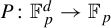 $P\colon \mathbb {F}_{p}^{d}\to \mathbb {F}_{p}$
be a polynomial of degree s for some
$P\colon \mathbb {F}_{p}^{d}\to \mathbb {F}_{p}$
be a polynomial of degree s for some $s<p$
and
$s<p$
and $M\colon \mathbb {F}_{p}^{d}\to \mathbb {F}_{p}$
be a quadratic form associated with matrix A. For the purpose of [Reference Sun18], we need a concrete algorithm to divide P by M. If the upper left entry of the matrix A is non-zero (that is, M contains a non-trivial
$M\colon \mathbb {F}_{p}^{d}\to \mathbb {F}_{p}$
be a quadratic form associated with matrix A. For the purpose of [Reference Sun18], we need a concrete algorithm to divide P by M. If the upper left entry of the matrix A is non-zero (that is, M contains a non-trivial $n_{1}^{2}$
term), we divide P by M as follows: whenever P has a term of the form
$n_{1}^{2}$
term), we divide P by M as follows: whenever P has a term of the form $n_{1}^{i_{1}}\cdots n_{d}^{i_{d}}$
with
$n_{1}^{i_{1}}\cdots n_{d}^{i_{d}}$
with $i_{1}\geq 2$
, by subtracting a suitable multiple of M, we may convert this term to several terms of the form
$i_{1}\geq 2$
, by subtracting a suitable multiple of M, we may convert this term to several terms of the form $n_{1}^{i^{\prime }_{1}}\cdots n_{d}^{i^{\prime }_{d}}$
with
$n_{1}^{i^{\prime }_{1}}\cdots n_{d}^{i^{\prime }_{d}}$
with $i^{\prime }_{1}<i_{1}$
. This eventually leads to a decomposition of the form
$i^{\prime }_{1}<i_{1}$
. This eventually leads to a decomposition of the form
 $$ \begin{align} P(n)=M(n)Q(n)+(n)_{1}R_{1}((n)_{2\sim d})+R_{0}((n)_{2\sim d}), \end{align} $$
where for $n\in \mathbb {F}_{p}^{d}$
, we use
$n\in \mathbb {F}_{p}^{d}$
, we use $(n)_{1}$
to denote the first coordinate of n and
$(n)_{1}$
to denote the first coordinate of n and $(n)_{2\sim d}$
to denote the last
$(n)_{2\sim d}$
to denote the last $d-1$
coordinate of n. We call this decomposition the standard long division algorithm.
$d-1$
coordinate of n. We call this decomposition the standard long division algorithm.
However, the above decomposition is non-valid if M does not have the $n_{1}^{2}$
term (one example is
$n_{1}^{2}$
term (one example is $M(n_{1},\ldots ,n_{d})=n_{1}n_{2}+n_{3}^{2}+\cdots +n_{d}^{2}$
). In this case, one has to do a change of variables before applying the standard long algorithm. Let B be a
$M(n_{1},\ldots ,n_{d})=n_{1}n_{2}+n_{3}^{2}+\cdots +n_{d}^{2}$
). In this case, one has to do a change of variables before applying the standard long algorithm. Let B be a $d\times d$
non-degenerate matrix such that the upper left entry of the matrix
$d\times d$
non-degenerate matrix such that the upper left entry of the matrix $BAB^{T}$
is non-zero. Then, we may use the standard long division algorithm to write
$BAB^{T}$
is non-zero. Then, we may use the standard long division algorithm to write
 $$ \begin{align*}P(nB)=M(nB)Q(n)+n_{1}R_{1}(n_{2\sim d})+R_{0}(n_{2\sim d}).\end{align*} $$
So,
 $$ \begin{align} P(n)=M(n)Q(nB^{-1})+(nB^{-1})_{1}R_{1}((nB^{-1})_{2\sim d})+R_{0}((nB^{-1})_{2\sim d}), \end{align} $$
where for $n\in \mathbb {F}_{p}^{d}$
, we use
$n\in \mathbb {F}_{p}^{d}$
, we use $n_{1}$
to denote the first coordinate of n and
$n_{1}$
to denote the first coordinate of n and $n_{2\sim d}$
to denote the last
$n_{2\sim d}$
to denote the last $d-1$
coordinates of n. We call this decomposition (6.5) of P the B-standard long division algorithm (in particular, the standard long division algorithm in (6.4) is the I-standard long division algorithm with I being the identity matrix).
$d-1$
coordinates of n. We call this decomposition (6.5) of P the B-standard long division algorithm (in particular, the standard long division algorithm in (6.4) is the I-standard long division algorithm with I being the identity matrix).
An advantage of this algorithm is that all the coefficients of $Q,R_{1}$
, and
$Q,R_{1}$
, and $R_{0}$
can be written in the form
$R_{0}$
can be written in the form $F/c_{1,1}^{s}$
with F being a polynomial function (dependent on B) with respect to the coefficients of P and M of degree at most s, where
$F/c_{1,1}^{s}$
with F being a polynomial function (dependent on B) with respect to the coefficients of P and M of degree at most s, where $c_{1,1}$
is the coefficient of the
$c_{1,1}$
is the coefficient of the $n_{1}^{2}$
term of
$n_{1}^{2}$
term of $M(nB)$
. This simple observation will be useful in [Reference Sun18].
$M(nB)$
. This simple observation will be useful in [Reference Sun18].
We say that M divides P with respect to the B-standard long division algorithm if ${R_{1}=R_{0}=0}$
in the B-standard long division algorithm (6.5). We have the following Hilbert Nullstellensatz type result for
${R_{1}=R_{0}=0}$
in the B-standard long division algorithm (6.5). We have the following Hilbert Nullstellensatz type result for $V(M)$
.
$V(M)$
.
Proposition 6.2. (Hilbert Nullstellensatz for
$V(M)$
)

Let $d\in \mathbb {N}_{+},s\in \mathbb {N}$
,
$d\in \mathbb {N}_{+},s\in \mathbb {N}$
, $p\gg _{d,s} 1$
be a prime number,
$p\gg _{d,s} 1$
be a prime number, $P\in \mathrm {poly}(\mathbb {F}_{p}^{d}\to \mathbb {F}_{p})$
be of degree at most s, and
$P\in \mathrm {poly}(\mathbb {F}_{p}^{d}\to \mathbb {F}_{p})$
be of degree at most s, and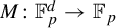 $M\colon \mathbb {F}_{p}^{d}\to \mathbb {F}_{p}$
be a quadratic form of rank at least 3 associated with the matrix A. If
$M\colon \mathbb {F}_{p}^{d}\to \mathbb {F}_{p}$
be a quadratic form of rank at least 3 associated with the matrix A. If $V(M)\subseteq V(P)$
, then for all
$V(M)\subseteq V(P)$
, then for all $d\times d$
non-degenerate matrix B with the upper left entry of the matrix
$d\times d$
non-degenerate matrix B with the upper left entry of the matrix $BAB^{T}$
being non-zero, M divides P with respect to the B-standard long division algorithm. In particular,
$BAB^{T}$
being non-zero, M divides P with respect to the B-standard long division algorithm. In particular, $P=MR$
for some
$P=MR$
for some $R\in \mathrm {poly}(\mathbb {F}_{p}^{d}\to \mathbb {F}_{p})$
of degree at most
$R\in \mathrm {poly}(\mathbb {F}_{p}^{d}\to \mathbb {F}_{p})$
of degree at most $s-2$
.
$s-2$
.
It is tempting to prove Proposition 6.2 by using Hilbert Nullstellensatz. Let $F_{i}(n_{1},\ldots ,n_{d}) :=n_{i}^{p}-n_{i}$
for all
$F_{i}(n_{1},\ldots ,n_{d}) :=n_{i}^{p}-n_{i}$
for all $1\leq i\leq d$
. By using Hilbert Nullstellensatz in the finite field (see [Reference Ghorpade2]), if
$1\leq i\leq d$
. By using Hilbert Nullstellensatz in the finite field (see [Reference Ghorpade2]), if $V(M)\subseteq V(P)$
, then one can show that
$V(M)\subseteq V(P)$
, then one can show that
 $$ \begin{align*}P=MR+\sum_{i=1}^{d}F_{i}R_{i}\end{align*} $$
for some polynomials $R,R_{1},\ldots ,R_{d}$
. Unfortunately, this is not helpful for Proposition 6.2, since there is no restriction on the degree of R, and it is unclear how to remove the polynomials
$R,R_{1},\ldots ,R_{d}$
. Unfortunately, this is not helpful for Proposition 6.2, since there is no restriction on the degree of R, and it is unclear how to remove the polynomials $R_{1},\ldots ,R_{d}$
. So, we have to prove Proposition 6.2 with a different method relying on the long division algorithm.
$R_{1},\ldots ,R_{d}$
. So, we have to prove Proposition 6.2 with a different method relying on the long division algorithm.
Proof of Proposition 6.2
Denote $r=\mathrm {rank}(M)$
. Under a change of variables, it suffices to show that for any
$r=\mathrm {rank}(M)$
. Under a change of variables, it suffices to show that for any $P\in \text {poly}(\mathbb {F}_{p}^{d}\to \mathbb {F}_{p})$
of degree at most s and any quadratic form,
$P\in \text {poly}(\mathbb {F}_{p}^{d}\to \mathbb {F}_{p})$
of degree at most s and any quadratic form,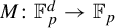 $M\colon \mathbb {F}_{p}^{d}\to \mathbb {F}_{p}$
of rank at least 3 associated with the matrix A whose upper left entry is non-zero. If
$M\colon \mathbb {F}_{p}^{d}\to \mathbb {F}_{p}$
of rank at least 3 associated with the matrix A whose upper left entry is non-zero. If $V(M)\subseteq V(P)$
, then M divides P with respect to the standard long division algorithm.
$V(M)\subseteq V(P)$
, then M divides P with respect to the standard long division algorithm.
We first assume that M and P are homogeneous. Write $n=(t,y)$
, where
$n=(t,y)$
, where $t\in \mathbb {F}_{p}$
and
$t\in \mathbb {F}_{p}$
and $y\in \mathbb {F}_{p}^{d-1}$
. Since the coefficient of the
$y\in \mathbb {F}_{p}^{d-1}$
. Since the coefficient of the $t^{2}$
term of
$t^{2}$
term of $M(t,y)$
is non-zero, we may apply the standard long division algorithm to write
$M(t,y)$
is non-zero, we may apply the standard long division algorithm to write
 $$ \begin{align} P(t,y)=M(t,y)R(t,y)+N_{1}(y)t+N_{0}(y) \end{align} $$
for some $R, N_{1},N_{0}\in \text {poly}(\mathbb {F}_{p}^{d}\to \mathbb {F}_{p})$
of degrees at most
$R, N_{1},N_{0}\in \text {poly}(\mathbb {F}_{p}^{d}\to \mathbb {F}_{p})$
of degrees at most $s-2,s-1$
, and s, respectively. Our goal is to show that
$s-2,s-1$
, and s, respectively. Our goal is to show that $N_{0}, N_{1}\equiv 0$
. By Lemma 4.3 and a change of variables, it suffices to show that if (6.6) holds for
$N_{0}, N_{1}\equiv 0$
. By Lemma 4.3 and a change of variables, it suffices to show that if (6.6) holds for
 $$ \begin{align*}M(n)=c_{1}n^{2}_{1}+\cdots+c_{r}n_{r}^{2}\end{align*} $$
for some $c_{1},\ldots ,c_{r}\in \mathbb {F}_{p}\backslash \{0\}$
, and that
$c_{1},\ldots ,c_{r}\in \mathbb {F}_{p}\backslash \{0\}$
, and that $V(M)\subseteq V(P)$
, then
$V(M)\subseteq V(P)$
, then $N_{0}, N_{1}\equiv 0$
.
$N_{0}, N_{1}\equiv 0$
.
Let
 $$ \begin{align*}\Delta(y):=M(0,y)N_{1}(y)^{2}+c_{1}N^{2}_{0}(y).\end{align*} $$
If $\Delta (y)$
is not constant 0, then by the proof of Lemma 6.1, the number of
$\Delta (y)$
is not constant 0, then by the proof of Lemma 6.1, the number of $n\in \mathbb {F}_{p}^{d}$
such that
$n\in \mathbb {F}_{p}^{d}$
such that $M(n)=P(n)=0$
is at most
$M(n)=P(n)=0$
is at most $O_{d,s}(p^{d-2})$
. However, since
$O_{d,s}(p^{d-2})$
. However, since $V(M)\subseteq V(P)$
, by Lemma 4.12, the number of
$V(M)\subseteq V(P)$
, by Lemma 4.12, the number of $n\in \mathbb {F}_{p}^{d}$
such that
$n\in \mathbb {F}_{p}^{d}$
such that $M(n)=P(n)=0$
is
$M(n)=P(n)=0$
is $p^{d-1}(1+O(p^{-({r-2}/{2})}))$
, which is a contradiction.
$p^{d-1}(1+O(p^{-({r-2}/{2})}))$
, which is a contradiction.
So, we must have that $\Delta (y)\equiv 0$
. Following the proof of Lemma 6.1, we have that
$\Delta (y)\equiv 0$
. Following the proof of Lemma 6.1, we have that $N_{0}(y)=N_{0}(y)\equiv 0$
and so
$N_{0}(y)=N_{0}(y)\equiv 0$
and so $P=MR$
. Since the degree of R is at most
$P=MR$
. Since the degree of R is at most $s-2$
, we are done.
$s-2$
, we are done.
We now consider the general case when M and P are not necessarily homogeneous. Then, there exist homogeneous polynomials $\tilde {M},\tilde {P}\colon \mathbb {F}_{p}^{d+1}\to \mathbb {F}_{p}$
of degrees at most 2 and s, respectively, such that
$\tilde {M},\tilde {P}\colon \mathbb {F}_{p}^{d+1}\to \mathbb {F}_{p}$
of degrees at most 2 and s, respectively, such that $M=\tilde {M}(\cdot ,1)$
and
$M=\tilde {M}(\cdot ,1)$
and $P=\tilde {P}(\cdot ,1)$
. Since
$P=\tilde {P}(\cdot ,1)$
. Since $\vert V(P)\cap V(M)\vert =\vert V(M)\vert =p^{d-1}(1+O(p^{-1/2}))$
by Lemma 4.12, it follows from (6.3) that
$\vert V(P)\cap V(M)\vert =\vert V(M)\vert =p^{d-1}(1+O(p^{-1/2}))$
by Lemma 4.12, it follows from (6.3) that $\vert V(\tilde {P})\cap V(\tilde {M})\vert =p^{d}(1+O(p^{-1/2}))$
. By Lemma 6.1, we have that
$\vert V(\tilde {P})\cap V(\tilde {M})\vert =p^{d}(1+O(p^{-1/2}))$
. By Lemma 6.1, we have that $V(\tilde {M})\subseteq V(\tilde {P})$
. So, by the previous case, we have that
$V(\tilde {M})\subseteq V(\tilde {P})$
. So, by the previous case, we have that $\tilde {M}$
divides
$\tilde {M}$
divides $\tilde {P}$
with respect to the standard long division algorithm. Since the
$\tilde {P}$
with respect to the standard long division algorithm. Since the $n_{1}^{2}$
term of M is non-zero, it is not hard to see that M also divides P with respect the standard long division algorithm.
$n_{1}^{2}$
term of M is non-zero, it is not hard to see that M also divides P with respect the standard long division algorithm.
6.2 A special anti-derivative property
For a polynomial
 $$ \begin{align*}Q(n_{1},\ldots,n_{d})=\sum_{0\leq a_{1},\ldots,a_{d}\leq p-1}C_{a_{1},\ldots,a_{d}}n_{1}^{a_{1}}\cdots n_{d}^{a_{d}},\end{align*} $$
denote the ith directional formal derivative of Q by
 $$ \begin{align*}\partial_{i}Q(n_{1},\ldots,n_{d}):=\sum_{0\leq a_{1},\ldots,a_{d}\leq p-1}a_{i}C_{a_{1},\ldots,a_{d}}n_{1}^{a_{1}}\cdots n_{i}^{a_{i}-1}\cdots n_{d}^{a_{d}}.\end{align*} $$
In many scenarios (such as in (5.5)), we need to recover information on Q from the information on its derivatives $\partial _{1}Q,\ldots ,\partial _{d}Q$
. In particular, a question we need to understand is: what is a characterization of the property that Q is a constant in
$\partial _{1}Q,\ldots ,\partial _{d}Q$
. In particular, a question we need to understand is: what is a characterization of the property that Q is a constant in $V(M)$
in terms of
$V(M)$
in terms of $\partial _{1}Q,\ldots ,\partial _{d}Q$
? If Q is constant zero in
$\partial _{1}Q,\ldots ,\partial _{d}Q$
? If Q is constant zero in $V(M)$
, then by Proposition 6.2, we have that
$V(M)$
, then by Proposition 6.2, we have that $Q=MQ'$
for some polynomial
$Q=MQ'$
for some polynomial $Q'$
. Then, it is not hard to see that
$Q'$
. Then, it is not hard to see that
 $$ \begin{align*}(\partial_{j}M)(\partial_{i}Q)-(\partial_{i}M)(\partial_{j}Q)=M((\partial_{j}M)(\partial_{i}Q')-(\partial_{i}M)(\partial_{j}Q')),\end{align*} $$
that is, $\partial _{j}M\partial _{i}Q$
is equal to
$\partial _{j}M\partial _{i}Q$
is equal to $\partial _{i}M\partial _{j}Q$
on
$\partial _{i}M\partial _{j}Q$
on $V(M)$
. We now show that the converse also holds.
$V(M)$
. We now show that the converse also holds.
Proposition 6.3. Let $d\in \mathbb {N}_{+},s\in \mathbb {N}$
with
$d\in \mathbb {N}_{+},s\in \mathbb {N}$
with $d\geq 3$
, p be a prime, and
$d\geq 3$
, p be a prime, and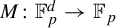 $M\colon \mathbb {F}_{p}^{d}\to \mathbb {F}_{p}$
be a quadratic form of rank at least 3. Let
$M\colon \mathbb {F}_{p}^{d}\to \mathbb {F}_{p}$
be a quadratic form of rank at least 3. Let $Q\in \mathrm {poly}(\mathbb {F}_{p}^{d}\to \mathbb {F}_{p})$
be a polynomial of degree at most s with
$Q\in \mathrm {poly}(\mathbb {F}_{p}^{d}\to \mathbb {F}_{p})$
be a polynomial of degree at most s with $Q(\mathbf {0})=0$
such that
$Q(\mathbf {0})=0$
such that
 $$ \begin{align*}\partial_{1}M(n)\partial_{i}Q(n)=\partial_{i}M(n)\partial_{1}Q(n)\end{align*} $$
for all $1{\kern-1pt}\leq{\kern-1pt} i{\kern-1pt}\leq{\kern-1pt} d$
and
$1{\kern-1pt}\leq{\kern-1pt} i{\kern-1pt}\leq{\kern-1pt} d$
and $n{\kern-1pt}\in{\kern-1pt} V(M)$
. If
$n{\kern-1pt}\in{\kern-1pt} V(M)$
. If $p{\kern-1pt}\gg _{d,s}{\kern-1pt} 1$
, then
$p{\kern-1pt}\gg _{d,s}{\kern-1pt} 1$
, then $Q{\kern-1pt}={\kern-1pt}MQ'$
for some
$Q{\kern-1pt}={\kern-1pt}MQ'$
for some ${Q'{\kern-1pt}\in{\kern-1pt} \mathrm {poly}(\mathbb {F}_{p}^{d}\to \mathbb {F}_{p})}$
of degree at most
${Q'{\kern-1pt}\in{\kern-1pt} \mathrm {poly}(\mathbb {F}_{p}^{d}\to \mathbb {F}_{p})}$
of degree at most $s-2$
.
$s-2$
.
To deduce Proposition 6.3, we consider its following variation.
Proposition 6.4. Let $d\in \mathbb {N}_{+},s\in \mathbb {N}$
with
$d\in \mathbb {N}_{+},s\in \mathbb {N}$
with $d\geq 3$
, p be a prime, and
$d\geq 3$
, p be a prime, and $M\colon \mathbb {F}_{p}^{d}\to \mathbb {F}_{p}$
be a quadratic form of rank at least 3. Let
$M\colon \mathbb {F}_{p}^{d}\to \mathbb {F}_{p}$
be a quadratic form of rank at least 3. Let $H_{1},\ldots ,H_{d}\in \mathrm {poly}(\mathbb {F}_{p}^{d}\to \mathbb {F}_{p})$
be polynomials of degree at most s such that
$H_{1},\ldots ,H_{d}\in \mathrm {poly}(\mathbb {F}_{p}^{d}\to \mathbb {F}_{p})$
be polynomials of degree at most s such that
 $$ \begin{align} \partial_{i}M(n)H_{j}(n)=\partial_{j}M(n)H_{i}(n) \end{align} $$
for all $1\leq i,j\leq d$
and
$1\leq i,j\leq d$
and $n\in V(M)$
. If
$n\in V(M)$
. If $p\gg _{d,s} 1$
, then there exist
$p\gg _{d,s} 1$
, then there exist $G,F_{1},\ldots , F_{d}\in \mathrm { poly}(\mathbb {F}_{p}^{d}\to \mathbb {F}_{p})$
with
$G,F_{1},\ldots , F_{d}\in \mathrm { poly}(\mathbb {F}_{p}^{d}\to \mathbb {F}_{p})$
with $\deg (G)\leq s-1$
and
$\deg (G)\leq s-1$
and $\deg (F_{i})\leq s-2$
such that
$\deg (F_{i})\leq s-2$
such that
 $$ \begin{align*}H_{i}=(\partial_{i}M)G+MF_{i} \quad\text{for all } 1\leq i\leq d.\end{align*} $$
Proof of Proposition 6.3 assuming Proposition 6.4
Our strategy is to apply Proposition 6.4 repeatedly. For $\ell \geq 1$
, we say that Property
$\ell \geq 1$
, we say that Property $\ell $
holds if there exist
$\ell $
holds if there exist $W,R_{1},\ldots , R_{d}\in \text {poly}(\mathbb {F}_{p}^{d}\to \mathbb {F}_{p})$
with
$W,R_{1},\ldots , R_{d}\in \text {poly}(\mathbb {F}_{p}^{d}\to \mathbb {F}_{p})$
with $\deg (W)\leq s-2, \deg (R_{i})\leq s-2\ell -1$
such that
$\deg (W)\leq s-2, \deg (R_{i})\leq s-2\ell -1$
such that
 $$ \begin{align} \partial_{i}(Q-MW)=M^{\ell}R_{i} \end{align} $$
for all $1\leq i\leq d$
. Setting
$1\leq i\leq d$
. Setting $N_{i}=\partial _{i}Q$
, it follows from Proposition 6.4 that there exist
$N_{i}=\partial _{i}Q$
, it follows from Proposition 6.4 that there exist $F,R_{1},\ldots ,R_{d}\in \text {poly}(\mathbb {F}_{p}^{d}\to \mathbb {F}_{p})$
with
$F,R_{1},\ldots ,R_{d}\in \text {poly}(\mathbb {F}_{p}^{d}\to \mathbb {F}_{p})$
with $\deg (F)\leq s-2, \deg (R_{i})\leq s-3$
such that
$\deg (F)\leq s-2, \deg (R_{i})\leq s-3$
such that
 $$ \begin{align*} \partial_{i}Q=(\partial_{i}M)F+MR_{i}. \end{align*} $$
This implies that Property 1 holds since for all $1\leq i\leq d$
, we have that
$1\leq i\leq d$
, we have that
 $$ \begin{align*} \partial_{i}(Q-MF)=M(R_{i}-\partial_{i}F). \end{align*} $$
Now, suppose that Property- $\ell $
holds for some
$\ell $
holds for some $1\leq \ell <p$
. Since
$1\leq \ell <p$
. Since $\deg (\partial _{i}Q')\leq p-1$
, for all
$\deg (\partial _{i}Q')\leq p-1$
, for all $1\leq j\leq d$
, it follows from (6.8) that
$1\leq j\leq d$
, it follows from (6.8) that
 $$ \begin{align} \partial_{j}\partial_{i}(Q-MW)=\partial_{j}(M^{\ell-1}R_{i})=M^{\ell-2}((\ell-1)(\partial_{j}M)R_{i}+M\partial_{j}R_{i}). \end{align} $$
By symmetry,
 $$ \begin{align} \partial_{i}\partial_{j}(Q-MW)=M^{\ell-2}((\ell-1)(\partial_{i}M)R_{j}+M\partial_{i}R_{j}). \end{align} $$
Combining (6.9) and (6.10), we have that for all $1\leq i,j\leq d$
, there exists a polynomial
$1\leq i,j\leq d$
, there exists a polynomial $N_{i,j}\in \text {poly}(\mathbb {F}_{p}^{d}\to \mathbb {F}_{p})$
such that
$N_{i,j}\in \text {poly}(\mathbb {F}_{p}^{d}\to \mathbb {F}_{p})$
such that
 $$ \begin{align*} (\partial_{i}M)R_{j}-(\partial_{j}M)R_{i}=MN_{i,j}. \end{align*} $$
By Proposition 6.4, we may write
 $$ \begin{align*}R_{i}=(\partial_{i}M)F'+MR^{\prime}_{i}\end{align*} $$
for some $F',R^{\prime }_{1},\ldots ,R^{\prime }_{d}\in \text {poly}(\mathbb {F}_{p}^{d}\to \mathbb {F}_{p})$
with
$F',R^{\prime }_{1},\ldots ,R^{\prime }_{d}\in \text {poly}(\mathbb {F}_{p}^{d}\to \mathbb {F}_{p})$
with $\deg (F')\leq s-2\ell -2, \deg (R_{i})\leq s-2\ell -3$
. Substituting this back to (6.8), we have that
$\deg (F')\leq s-2\ell -2, \deg (R_{i})\leq s-2\ell -3$
. Substituting this back to (6.8), we have that
 $$ \begin{align*} \partial_{i}(Q-M(W+F'))=M^{\ell+1}(R^{\prime}_{i}-\partial_{i} F') \end{align*} $$
for all $1\leq i\leq d$
. So Property
$1\leq i\leq d$
. So Property $(\ell +1)$
holds.
$(\ell +1)$
holds.
So, we may inductively conclude that Property $\ell $
holds when
$\ell $
holds when $\ell =[(s+1)/2]$
, in which case, the polynomials
$\ell =[(s+1)/2]$
, in which case, the polynomials $H_{i}$
in (6.8) are constant 0 and so all the formal derivatives of
$H_{i}$
in (6.8) are constant 0 and so all the formal derivatives of ${Q-MW}$
are zero for some polynomial W of degree at most
${Q-MW}$
are zero for some polynomial W of degree at most $s-2$
. Since
$s-2$
. Since $Q(\mathbf {0})=0$
, we must have that
$Q(\mathbf {0})=0$
, we must have that $Q=MW$
and we are done.
$Q=MW$
and we are done.
The rest of the section is devoted to the proof of Proposition 6.4. We first provide an outline of the proof. For convenience, assume that $M(n)=n\cdot n$
. Assume first that (6.7) holds for all
$M(n)=n\cdot n$
. Assume first that (6.7) holds for all $n\in \mathbb {F}_{p}^{d}$
(not just for
$n\in \mathbb {F}_{p}^{d}$
(not just for $n\in V(M)$
). Then, (6.7) implies that
$n\in V(M)$
). Then, (6.7) implies that $n_{i}H_{j}(n)$
is divisible by
$n_{i}H_{j}(n)$
is divisible by $n_{j}$
and so
$n_{j}$
and so $H_{j}(n)$
is divisible by
$H_{j}(n)$
is divisible by $n_{j}$
(by choosing
$n_{j}$
(by choosing $i\neq j$
). So, we may write
$i\neq j$
). So, we may write $H_{j}(n)=2n_{j}G_{j}(n)$
for some polynomial
$H_{j}(n)=2n_{j}G_{j}(n)$
for some polynomial $G_{j}$
. Substituting this back to (6.7), we have that all of
$G_{j}$
. Substituting this back to (6.7), we have that all of $G_{j}$
are equal to the same G. So,
$G_{j}$
are equal to the same G. So, $H_{j}(n)=2n_{j}G(n)=\partial _{i}M(n)G(n)$
and we are done.
$H_{j}(n)=2n_{j}G(n)=\partial _{i}M(n)G(n)$
and we are done.
For the general case, our goal is to show that each $H_{i}$
can be written as the sum of a multiple of
$H_{i}$
can be written as the sum of a multiple of $\partial _{i}M(n)$
(or
$\partial _{i}M(n)$
(or $n_{i}$
) and a multiple of M.
$n_{i}$
) and a multiple of M.
Step 1: factorization over $n_{i}$
. By Proposition 6.2, for all
$n_{i}$
. By Proposition 6.2, for all $1\leq i,j\leq d$
, there exist some polynomial
$1\leq i,j\leq d$
, there exist some polynomial $N_{i,j}$
such that
$N_{i,j}$
such that
 $$ \begin{align} n_{i}H_{j}(n)-n_{j}H_{i}(n)=M(n)N_{i,j}(n) \quad\text{for all } n\in \mathbb{F}_{p}^{d}. \end{align} $$
In this case, $n_{j}H_{i}(n)$
is no longer divisible by
$n_{j}H_{i}(n)$
is no longer divisible by $n_{i}$
because of the appearance of the term
$n_{i}$
because of the appearance of the term $MN_{i,j}$
. However, if we decompose
$MN_{i,j}$
. However, if we decompose $N_{i,j}$
as
$N_{i,j}$
as
 $$ \begin{align*}N_{i,j}(n)=n_{i}N_{1,i,j}(n)+n_{j}N_{2,i,j}(n)+n_{i}n_{j}N_{3,i,j}(n),\end{align*} $$
we can deduce from (6.11) that $n_{i}(H_{j}-MN_{1,i,j})$
is divisible by
$n_{i}(H_{j}-MN_{1,i,j})$
is divisible by $n_{j}$
and thus
$n_{j}$
and thus $H_{j}-MN_{1,i,j}$
is divisible by
$H_{j}-MN_{1,i,j}$
is divisible by $n_{j}$
. So, there exists some polynomial
$n_{j}$
. So, there exists some polynomial $G_{i,j}$
such that
$G_{i,j}$
such that
 $$ \begin{align} H_{j}(n)=2n_{j}G_{i,j}(n)+M(n)N_{1,i,j}(n)= \partial_{j}M(n)G_{i,j}(n)+M(n)N_{1,i,j}(n). \end{align} $$
Step 2: removing the dependence of $N_{1,i,j}$
on i. Let
$N_{1,i,j}$
on i. Let $E_{i,j}$
denote the left-hand side of (6.11). Then, we have that
$E_{i,j}$
denote the left-hand side of (6.11). Then, we have that $E_{i,j}+E_{j,i}=E_{i,j}+E_{j,k}+E_{k,i}=0$
. These symmetric properties provide extra information for
$E_{i,j}+E_{j,i}=E_{i,j}+E_{j,k}+E_{k,i}=0$
. These symmetric properties provide extra information for $N_{i,j}$
, and one can use them to show that the polynomials
$N_{i,j}$
, and one can use them to show that the polynomials $N_{1,i,j}$
and
$N_{1,i,j}$
and $G_{i,j}$
in (6.12) are independent of i. So,
$G_{i,j}$
in (6.12) are independent of i. So,
 $$ \begin{align} H_{j}(n)=2n_{j}G_{j}(n)+M(n)N_{j}(n) \end{align} $$
for some polynomials $G_{j}$
and
$G_{j}$
and $N_{j}$
. See the proof for details of this step.
$N_{j}$
. See the proof for details of this step.
Step 3: removing the dependence on j. Our final step is to show that the polynomial $G_{j}$
in (6.13) can be chosen to be independent of j. Substituting (6.13) back to (6.11), we have that
$G_{j}$
in (6.13) can be chosen to be independent of j. Substituting (6.13) back to (6.11), we have that $n_{i}n_{j}(G_{i}-G_{j})$
is divisible by M, which implies that
$n_{i}n_{j}(G_{i}-G_{j})$
is divisible by M, which implies that $G_{i}-G_{j}$
is divisible by M. We may then set
$G_{i}-G_{j}$
is divisible by M. We may then set $G_{i}=G_{j}$
for all
$G_{i}=G_{j}$
for all $1\leq i,j\leq d$
by absorbing the error term in
$1\leq i,j\leq d$
by absorbing the error term in $M(n)N_{j}(n)$
.
$M(n)N_{j}(n)$
.
We now provide the rigorous proof of Proposition 6.4.
Proof of Proposition 6.4
For convenience, write $n=(n_{1},\ldots ,n_{d})\in \mathbb {F}_{p}^{d}$
. By Lemma 4.3 and a change of variables, we may assume without loss of generality that
$n=(n_{1},\ldots ,n_{d})\in \mathbb {F}_{p}^{d}$
. By Lemma 4.3 and a change of variables, we may assume without loss of generality that
 $$ \begin{align*}M(n)=cn_{1}^{2}+n_{2}^{2}+\cdots+n_{d'}^{2}+c'n_{d'+1}-\unicode{x3bb}\end{align*} $$
for some $3\leq d'\leq d$
, and
$3\leq d'\leq d$
, and $\unicode{x3bb} ,c,c'\in \mathbb {F}_{p}$
with
$\unicode{x3bb} ,c,c'\in \mathbb {F}_{p}$
with $c\neq 0$
. Let A be the (diagonal) matrix associated to M with
$c\neq 0$
. Let A be the (diagonal) matrix associated to M with $a_{i}$
being the
$a_{i}$
being the $(i,i)$
th entry of A. Then,
$(i,i)$
th entry of A. Then, $a_{1}{\kern-1pt}={\kern-1pt}c{\kern-1pt}\neq{\kern-1pt} 0$
,
$a_{1}{\kern-1pt}={\kern-1pt}c{\kern-1pt}\neq{\kern-1pt} 0$
, ${a_{2}{\kern-1pt}=\cdots ={\kern-1pt}a_{d'}=1}$
, and
${a_{2}{\kern-1pt}=\cdots ={\kern-1pt}a_{d'}=1}$
, and $a_{d'+1}=\cdots =a_{d}=0$
. First-time readers are advised to focus on the case when
$a_{d'+1}=\cdots =a_{d}=0$
. First-time readers are advised to focus on the case when $M(n)=n\cdot n, c=1$
, and
$M(n)=n\cdot n, c=1$
, and $d'=d$
, which already captures the most essential part of the proof.
$d'=d$
, which already captures the most essential part of the proof.
Step 1: factorization over $\partial _{i}M$
. By assumption and Proposition 6.2, we have that for all
$\partial _{i}M$
. By assumption and Proposition 6.2, we have that for all $1\leq i,j\leq d$
, there exists a polynomial
$1\leq i,j\leq d$
, there exists a polynomial $N_{i,j}\in \text {poly}(\mathbb {F}_{p}^{d}\to \mathbb {F}_{p})$
such that
$N_{i,j}\in \text {poly}(\mathbb {F}_{p}^{d}\to \mathbb {F}_{p})$
such that
 $$ \begin{align} (\partial_{i}M)H_{j}-(\partial_{j}M)H_{i}=MN_{i,j}. \end{align} $$
By Proposition 6.2, $\deg (N_{i,j})\leq s-1$
. For all
$\deg (N_{i,j})\leq s-1$
. For all $1\leq i,j\leq d', i\neq j$
, there exist unique polynomials
$1\leq i,j\leq d', i\neq j$
, there exist unique polynomials $N_{1,i,j},N_{2,i,j},N_{3,i,j}\in \text {poly}(\mathbb {F}_{p}^{d}\to \mathbb {F}_{p})$
with
$N_{1,i,j},N_{2,i,j},N_{3,i,j}\in \text {poly}(\mathbb {F}_{p}^{d}\to \mathbb {F}_{p})$
with $\deg (N_{1,i,j}),\deg (N_{2,i,j})\leq s-2$
and
$\deg (N_{1,i,j}),\deg (N_{2,i,j})\leq s-2$
and $\deg (N_{3,i,j})\leq s-3$
such that
$\deg (N_{3,i,j})\leq s-3$
such that
 $$ \begin{align} N_{i,j}=(\partial_{i}M)N_{1,i,j}+(\partial_{j}M)N_{2,i,j}+\tfrac{1}{2}(\partial_{i}M)(\partial_{j}M)N_{3,i,j}, \end{align} $$
where $N_{1,i,j}$
is independent of
$N_{1,i,j}$
is independent of $n_{j}$
and
$n_{j}$
and $N_{2,i,j}$
is independent of
$N_{2,i,j}$
is independent of $n_{i}$
. We could derive from this a conclusion in analogous to (6.12). However, this is unnecessary and thus, we now directly move to Step 2.
$n_{i}$
. We could derive from this a conclusion in analogous to (6.12). However, this is unnecessary and thus, we now directly move to Step 2.
Step 2: removing the dependence of $N_{1,i,j}$
on i. We first use the property
$N_{1,i,j}$
on i. We first use the property ${E_{i,j}{\kern-1pt}+{\kern-1pt}E_{j,i}{\kern-1pt}={\kern-1pt}0}$
to show some anti-symmetric properties on the indices i and j in
${E_{i,j}{\kern-1pt}+{\kern-1pt}E_{j,i}{\kern-1pt}={\kern-1pt}0}$
to show some anti-symmetric properties on the indices i and j in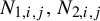 $N_{1,i,j},N_{2,i,j}$
and
$N_{1,i,j},N_{2,i,j}$
and $N_{3,i,j}$
(i.e., (6.18)). Since (6.14) implies that
$N_{3,i,j}$
(i.e., (6.18)). Since (6.14) implies that
 $$ \begin{align} a_{i}n_{i}H_{j}(n)-a_{j}n_{j}H_{i}(n)=M(n)N_{i,j}(n)/2 \end{align} $$
and thus
 $$ \begin{align} a_{j}n_{j}H_{i}(n)-a_{i}n_{i}H_{j}(n)=M(n)N_{j,i}(n)/2 \end{align} $$
by symmetry, it follows from (6.16) and (6.17) that $N_{i,j}+N_{j,i}=0$
. So,
$N_{i,j}+N_{j,i}=0$
. So,
 $$ \begin{align*}n_{i}(N_{1,i,j}(n)+N_{2,j,i}(n))+n_{j}(N_{1,j,i}(n)+N_{2,i,j}(n))+n_{i}n_{j}(N_{3,i,j}(n)+N_{3,j,i}(n))=0.\end{align*} $$
Since $N_{1,i,j}+N_{2,j,i}$
is independent of
$N_{1,i,j}+N_{2,j,i}$
is independent of $n_j$
and
$n_j$
and $N_{1,j,i}(n)+N_{2,i,j}(n)$
is independent of
$N_{1,j,i}(n)+N_{2,i,j}(n)$
is independent of $n_i$
, we have that
$n_i$
, we have that
 $$ \begin{align} N_{1,i,j}+N_{2,j,i}=N_{3,i,j}+N_{3,j,i}=0. \end{align} $$
Combining (6.15), (6.16), and (6.18), we have that
 $$ \begin{align} a_{i}n_{i}H_{j}(n)-a_{j}n_{j}H_{i}(n)=M(n)(n_{i}N_{1,i,j}(n)-n_{j}N_{1,j,i}(n)+n_{i}n_{j}N_{3,i,j}) \end{align} $$
for all distinct $1\leq i,j\leq d'$
.
$1\leq i,j\leq d'$
.
Next, we use the property $E_{i,j}+E_{j,k}+E_{k,i}=0$
to show that
$E_{i,j}+E_{j,k}+E_{k,i}=0$
to show that $N_{1,i,j}$
is independent of i. For all
$N_{1,i,j}$
is independent of i. For all $1\leq k\leq d', k\neq i,j$
, (6.19) implies that
$1\leq k\leq d', k\neq i,j$
, (6.19) implies that
 $$ \begin{align} & a_{i}n_{k}n_{i}H_{j}(n)-a_{j}n_{j}n_{k}H_{i}(n) =M(n)(n_{k}n_{i}N_{1,i,j}(n)-n_{j}n_{k}N_{1,j,i}(n)+n_{i}n_{j}n_{k}N_{3,i,j}). \end{align} $$
By symmetry,
 $$ \begin{align} & a_{j}n_{i}n_{j}H_{k}(n)-a_{k}n_{k}n_{i}H_{j}(n) =M(n)(n_{i}n_{j}N_{1,j,k}(n)-n_{k}n_{i}N_{1,k,j}(n)+n_{i}n_{j}n_{k}N_{3,j,k}) \end{align} $$
and
 $$ \begin{align} & a_{k}n_{j}n_{k}H_{i}(n)-a_{i}n_{i}n_{j}H_{k}(n) =M(n)(n_{j}n_{k}N_{1,k,i}(n)-n_{i}n_{j}N_{1,i,k}(n)+n_{i}n_{j}n_{k}N_{3,k,i}). \end{align} $$
To remove the term $N_{3,i,j}$
, we consider
$N_{3,i,j}$
, we consider $(6.20)\times a_{k}+(6.21)\times a_{i}+(6.22)\times a_{j}$
and get
$(6.20)\times a_{k}+(6.21)\times a_{i}+(6.22)\times a_{j}$
and get
 $$ \begin{align*}n_{k}n_{i}(a_{k}N_{1,i,j}-a_{i}N_{1,k,j})+n_{i}n_{j}(a_{i}N_{1,j,k}-a_{j}N_{1,i,k})+n_{j}n_{k}(a_{j}N_{1,k,i}-a_{k}N_{1,j,i})\end{align*} $$
is divisible by $n_{i}n_{j}n_{k}$
. In particular,
$n_{i}n_{j}n_{k}$
. In particular, $n_{k}n_{i}(a_{k}N_{1,i,j}(n)-a_{i}N_{1,k,j}(n))$
is divisible by
$n_{k}n_{i}(a_{k}N_{1,i,j}(n)-a_{i}N_{1,k,j}(n))$
is divisible by $n_{j}$
. Since
$n_{j}$
. Since $N_{1,i,j}-N_{1,k,j}$
is independent from
$N_{1,i,j}-N_{1,k,j}$
is independent from $n_{j}$
, we must have that
$n_{j}$
, we must have that $a_{k}N_{1,i,j}=a_{i}N_{1,k,j}$
for all distinct
$a_{k}N_{1,i,j}=a_{i}N_{1,k,j}$
for all distinct $1\leq i,j,k\leq d'$
. This implies that
$1\leq i,j,k\leq d'$
. This implies that $N_{1,i,j}=a_{i}N_{j}$
for some
$N_{1,i,j}=a_{i}N_{j}$
for some $N_{j}\in \text {poly}(\mathbb {F}_{p}^{d}\to \mathbb {F}_{p})$
of degree at most
$N_{j}\in \text {poly}(\mathbb {F}_{p}^{d}\to \mathbb {F}_{p})$
of degree at most $s-2$
for all
$s-2$
for all $1\leq i\leq d', i\neq j$
. This completes the second step.
$1\leq i\leq d', i\neq j$
. This completes the second step.
Step 3: removing the dependence on j. Let $H^{\prime }_{j}=H_{j}-MN_{j}$
. Substituting the conclusion that
$H^{\prime }_{j}=H_{j}-MN_{j}$
. Substituting the conclusion that $N_{1,i,j}=a_{i}N_{j}$
back to (6.19), we have that for all
$N_{1,i,j}=a_{i}N_{j}$
back to (6.19), we have that for all $1\leq i,j\leq d',i\neq j$
,
$1\leq i,j\leq d',i\neq j$
,
 $$ \begin{align} a_{i}n_{i}H^{\prime}_{j}(n)-a_{j}n_{j}H^{\prime}_{i}(n)=n_{i}n_{j}M(n)N_{3,i,j}. \end{align} $$
Setting $j=1$
and
$j=1$
and $i=2$
, (6.23) implies that
$i=2$
, (6.23) implies that
 $$ \begin{align} H^{\prime}_{1}(n)=2cn_{1}G(n)=\partial_{1}M(n)G(n) \end{align} $$
for some polynomial G of degree at most $s-1$
.
$s-1$
.
By (6.14) and (6.24), for all $1\leq j\leq d$
,
$1\leq j\leq d$
,
 $$ \begin{align*} \begin{aligned} (\partial_{1}M)H_{j}=MN_{1,j}+(\partial_{j}M)H_{1} =M(N_{1,j}+(\partial_{j}M)N_{1}) +(\partial_{j}M)(\partial_{1}M)G, \end{aligned} \end{align*} $$
which implies that
 $$ \begin{align*} \begin{aligned} 2cn_{1}H^{\prime}_{j}(n)=M(n)(N_{1,j}(n)+\partial_{j}M(n)N_{1}(n)). \end{aligned} \end{align*} $$
It is not hard to see that $N_{1,j}(n)+\partial _{j}M(n)N_{1}(n)=2cn_{1}F_{j}(n)$
for some polynomial
$N_{1,j}(n)+\partial _{j}M(n)N_{1}(n)=2cn_{1}F_{j}(n)$
for some polynomial $F_{j}$
of degree at most
$F_{j}$
of degree at most $s-2$
. Therefore,
$s-2$
. Therefore,
 $$ \begin{align*} \begin{aligned} H_{j}-(\partial_{j}M)G=MF_{j}. \end{aligned} \end{align*} $$
We are done.
6.3 Solution to a special polynomial equation
In this section, we study the solutions to polynomial equations of the form
 $$ \begin{align} \Delta_{h_{s-1}}\cdots\Delta_{h_{1}}P(n)+\Delta_{h_{s}}\cdots\Delta_{h_{1}}Q(n)=0 \!\quad\text{for all/many } (n,h_{1},\ldots,h_{s})\in\Box_{s}(V(M)) \end{align} $$
for some quadratic form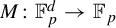 $M\colon \mathbb {F}_{p}^{d}\to \mathbb {F}_{p}$
, which will be used crucially later in the paper. We begin with a preparatory result.
$M\colon \mathbb {F}_{p}^{d}\to \mathbb {F}_{p}$
, which will be used crucially later in the paper. We begin with a preparatory result.
Proposition 6.5. Let $\delta>0$
,
$\delta>0$
, $d,d',s\in \mathbb {N}$
with
$d,d',s\in \mathbb {N}$
with $d\geq d'\geq 4$
,
$d\geq d'\geq 4$
, $p\gg _{d,s} \delta ^{-O_{d,s}(1)}$
be a prime number,
$p\gg _{d,s} \delta ^{-O_{d,s}(1)}$
be a prime number, $P,Q\in \mathrm {poly}(\mathbb {F}_{p}^{d}\to \mathbb {F}_{p})$
be polynomials of degrees at most s and
$P,Q\in \mathrm {poly}(\mathbb {F}_{p}^{d}\to \mathbb {F}_{p})$
be polynomials of degrees at most s and $s+1$
, respectively, with
$s+1$
, respectively, with $Q(\mathbf {0})=0$
,
$Q(\mathbf {0})=0$
, $c\in \mathbb {F}_{p}\backslash \{0\}$
, and
$c\in \mathbb {F}_{p}\backslash \{0\}$
, and $H\subseteq \mathbb {F}_{p}^{d}$
with
$H\subseteq \mathbb {F}_{p}^{d}$
with $\vert H\vert>\delta p^{d}$
. Let
$\vert H\vert>\delta p^{d}$
. Let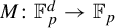 $M\colon \mathbb {F}_{p}^{d}\to \mathbb {F}_{p}$
be a non-degenerate quadratic form given by
$M\colon \mathbb {F}_{p}^{d}\to \mathbb {F}_{p}$
be a non-degenerate quadratic form given by
 $$ \begin{align*}M(n_{1},\ldots,n_{d}):=cn^{2}_{1}+n^{2}_{2}+\cdots+n_{d'}^{2}.\end{align*} $$
Suppose that for all $n\in \mathbb {F}_{p}^{d}$
and
$n\in \mathbb {F}_{p}^{d}$
and $h=(h_{1},\ldots ,h_{d})\in H$
with
$h=(h_{1},\ldots ,h_{d})\in H$
with $M(n)=(nA)\cdot h=0$
(where A is the matrix associated to M), we have that
$M(n)=(nA)\cdot h=0$
(where A is the matrix associated to M), we have that
 $$ \begin{align} P(n)+\sum_{i=1}^{d}h_{i}\partial_{i}Q(n)=0. \end{align} $$
Then, there exist $P',Q'\in \mathrm {poly}(\mathbb {F}_{p}^{d}\to \mathbb {F}_{p})$
of degrees at most
$P',Q'\in \mathrm {poly}(\mathbb {F}_{p}^{d}\to \mathbb {F}_{p})$
of degrees at most $s-2$
and
$s-2$
and $s-1$
, respectively, such that
$s-1$
, respectively, such that $P=MP'$
and
$P=MP'$
and $Q=MQ'$
.
$Q=MQ'$
.
We first explain why Proportion 6.5 is useful to study (6.25). For convenience, assume that $s=1$
, M is homogeneous,
$s=1$
, M is homogeneous, $\deg (P)=k$
, and
$\deg (P)=k$
, and $\deg (Q)=k+1$
. Intuitively, if (6.25) holds for all
$\deg (Q)=k+1$
. Intuitively, if (6.25) holds for all $(n,h)\in \Box _{1}(V(M))$
, then by the spirit of Hilbert Nullstenllensatz, we may expect to write
$(n,h)\in \Box _{1}(V(M))$
, then by the spirit of Hilbert Nullstenllensatz, we may expect to write $P(n)+\Delta _{h}Q(n)$
as a linear combination of
$P(n)+\Delta _{h}Q(n)$
as a linear combination of $M(n)$
and
$M(n)$
and $M(n+h)-M(n)$
. Considering h as a fixed vector, the leading terms of
$M(n+h)-M(n)$
. Considering h as a fixed vector, the leading terms of $P(n)+\Delta _{h}Q(n)$
must be a linear combination of the leading terms of
$P(n)+\Delta _{h}Q(n)$
must be a linear combination of the leading terms of $M(n)$
and
$M(n)$
and $M(n+h)-M(n)$
. It is not hard to see that the leading terms of
$M(n+h)-M(n)$
. It is not hard to see that the leading terms of $P(n)+\Delta _{h}Q(n)$
are
$P(n)+\Delta _{h}Q(n)$
are
 $$ \begin{align} P+h\cdot\nabla Q=P+\sum_{i=1}^{d}h_{i}\partial_{i}Q, \end{align} $$
where $h=(h_{1},\ldots ,h_{d})$
and
$h=(h_{1},\ldots ,h_{d})$
and $\nabla Q=(\partial _{1}Q,\ldots ,\partial _{d}Q)$
. However, the leading terms of
$\nabla Q=(\partial _{1}Q,\ldots ,\partial _{d}Q)$
. However, the leading terms of $M(n)$
and
$M(n)$
and $M(n+h)-M(n)$
are
$M(n+h)-M(n)$
are $M(n)$
and
$M(n)$
and $(nA)\cdot h$
, respectively. Therefore, we have that (6.27) is zero if
$(nA)\cdot h$
, respectively. Therefore, we have that (6.27) is zero if $M(n)=(nA)\cdot h=0$
. This is where Proposition 6.5 becomes useful.
$M(n)=(nA)\cdot h=0$
. This is where Proposition 6.5 becomes useful.
We now explain the outline of the proof of Proposition 6.5. Fix $n\in \mathbb {F}_{p}^{d}$
. The lower bound
$n\in \mathbb {F}_{p}^{d}$
. The lower bound $\vert H\vert>\delta p^{d}$
ensures that (6.26) holds for many h with
$\vert H\vert>\delta p^{d}$
ensures that (6.26) holds for many h with $(nA)\cdot h=0$
. By linearity, we must have that (6.26) holds for all
$(nA)\cdot h=0$
. By linearity, we must have that (6.26) holds for all $h\in \mathbb {F}_{p}^{d}$
with
$h\in \mathbb {F}_{p}^{d}$
with $(nA)\cdot h=0$
. This will force
$(nA)\cdot h=0$
. This will force $P(n)=0$
and
$P(n)=0$
and $(\partial _{1}Q(n),\ldots ,\partial _{d}Q(n))$
to be parallel to
$(\partial _{1}Q(n),\ldots ,\partial _{d}Q(n))$
to be parallel to $2nA=(\partial _{1}M(n),\ldots ,\partial _{d}M(n))$
. So,
$2nA=(\partial _{1}M(n),\ldots ,\partial _{d}M(n))$
. So, $\partial _{i}Q(n)/\partial _{i}M(n)$
is independent of the choice of i. If this is the case for many
$\partial _{i}Q(n)/\partial _{i}M(n)$
is independent of the choice of i. If this is the case for many $n\in V(M)$
, then it follows from Lemma 6.1 and Proposition 6.3 that P and Q are divisible by M.
$n\in V(M)$
, then it follows from Lemma 6.1 and Proposition 6.3 that P and Q are divisible by M.
Proof of Proposition 6.5
Throughout the proof, all the constants will depend implicitly on d and s. Since $d'\geq 3$
, by Lemma 4.12, the set of
$d'\geq 3$
, by Lemma 4.12, the set of $h\in \mathbb {F}_{p}^{d}$
with
$h\in \mathbb {F}_{p}^{d}$
with $M(h)=0$
is of cardinality
$M(h)=0$
is of cardinality $O_{d,s}(p^{d-1})$
. Passing to a subset if necessary, we may assume without loss of generality that
$O_{d,s}(p^{d-1})$
. Passing to a subset if necessary, we may assume without loss of generality that $M(h)\neq 0$
for all
$M(h)\neq 0$
for all $h\in H$
. Let A be the (diagonal) matrix associated to M and
$h\in H$
. Let A be the (diagonal) matrix associated to M and $a_{i}$
be the
$a_{i}$
be the $(i,i)$
th entry of A. To carry out the strategy described above, our first task is to identify those
$(i,i)$
th entry of A. To carry out the strategy described above, our first task is to identify those $n\in V(M)$
for which there are many
$n\in V(M)$
for which there are many $h\in \mathbb {F}_{p}^{d}$
with
$h\in \mathbb {F}_{p}^{d}$
with $(nA)\cdot h=0$
. Denote
$(nA)\cdot h=0$
. Denote
 $$ \begin{align*}V_{h}:=\{n\in\mathbb{F}_{p}^{d}\colon (nA)\cdot h=0\}=(\text{span}_{\mathbb{F}_{p}}\{h\})^{\perp{M}}.\end{align*} $$
Note that for most of the choices of h, the set $V_{h}$
is of cardinality
$V_{h}$
is of cardinality $\gg p^{d-2}$
. So, there are in total
$\gg p^{d-2}$
. So, there are in total $\gg _{\delta } p^{2d-2}$
number of pairs of
$\gg _{\delta } p^{2d-2}$
number of pairs of $(n,h)$
for which (6.26) holds. Since
$(n,h)$
for which (6.26) holds. Since $V(M)$
is of cardinality
$V(M)$
is of cardinality $\gg p^{d-1}$
, on average, there are
$\gg p^{d-1}$
, on average, there are $\gg _{\delta } p^{d-1}$
many ‘good’
$\gg _{\delta } p^{d-1}$
many ‘good’ $n\in V(M)$
for which (6.26) holds for at least
$n\in V(M)$
for which (6.26) holds for at least $\gg _{\delta } p^{d-1}$
many
$\gg _{\delta } p^{d-1}$
many $h\in H$
. Our first goal is to identify those ‘good’ n (as well as those h for which (6.26) holds for the pair
$h\in H$
. Our first goal is to identify those ‘good’ n (as well as those h for which (6.26) holds for the pair $(n,h)$
).
$(n,h)$
).
Let Z be the set of $n\in \mathbb {F}_{p}^{d}$
with
$n\in \mathbb {F}_{p}^{d}$
with $nA=\mathbf {0}$
. Then,
$nA=\mathbf {0}$
. Then, $\vert Z\vert =p^{d-d'}\leq p^{d-4}$
. We say that
$\vert Z\vert =p^{d-d'}\leq p^{d-4}$
. We say that $(n,h)\in \mathbb {F}_{p}^{d}\times \mathbb {F}_{p}^{d}$
is a good pair if
$(n,h)\in \mathbb {F}_{p}^{d}\times \mathbb {F}_{p}^{d}$
is a good pair if
 $$ \begin{align*} (nA)\cdot h=M(n)=0,\quad n\in\mathbb{F}_{p}^{d}\backslash Z \quad\text{and}\quad h\in H. \end{align*} $$
For each $h\in H$
,
$h\in H$
, $V_{h}$
is a subspace of
$V_{h}$
is a subspace of $\mathbb {F}_{p}^{d}$
of co-dimension 1 and
$\mathbb {F}_{p}^{d}$
of co-dimension 1 and $V_{h}\cap (V_{h})^{ \perp {M}}=\{\mathbf {0}\}$
(since
$V_{h}\cap (V_{h})^{ \perp {M}}=\{\mathbf {0}\}$
(since $M(h)\neq 0$
). By Proposition 4.8,
$M(h)\neq 0$
). By Proposition 4.8, $\mathrm {rank}(M\vert _{V_{h}})\geq d'-1\geq 3$
. By Corollary 4.14 and the fact that
$\mathrm {rank}(M\vert _{V_{h}})\geq d'-1\geq 3$
. By Corollary 4.14 and the fact that $\vert Z\vert \leq p^{d-4}$
, there exist
$\vert Z\vert \leq p^{d-4}$
, there exist $p^{d-2}(1+O(p^{-1/2}))$
many
$p^{d-2}(1+O(p^{-1/2}))$
many $n\in \mathbb {F}_{p}^{d}$
such that
$n\in \mathbb {F}_{p}^{d}$
such that $(n,h)$
is a good pair. So, there are in total at least
$(n,h)$
is a good pair. So, there are in total at least $\delta p^{2d-2}(1+O(p^{-1/2}))$
many good pairs. However, for each
$\delta p^{2d-2}(1+O(p^{-1/2}))$
many good pairs. However, for each $n\in \mathbb {F}_{p}^{d}\backslash Z$
with
$n\in \mathbb {F}_{p}^{d}\backslash Z$
with $M(n)=0$
, since
$M(n)=0$
, since $nA\neq \mathbf {0}$
, there exist
$nA\neq \mathbf {0}$
, there exist $p^{d-1}$
many
$p^{d-1}$
many $h\in \mathbb {F}_{p}^{d}$
such that
$h\in \mathbb {F}_{p}^{d}$
such that $(nA)\cdot h=0$
. By Lemma 6.1, the number of
$(nA)\cdot h=0$
. By Lemma 6.1, the number of $n\in \mathbb {F}_{p}^{d}\backslash Z$
with
$n\in \mathbb {F}_{p}^{d}\backslash Z$
with $M(n)=0$
is
$M(n)=0$
is $p^{d-1}(1+O(p^{-1/2}))$
. From this, it is easy to see that there exists a subset
$p^{d-1}(1+O(p^{-1/2}))$
. From this, it is easy to see that there exists a subset $X\subseteq \mathbb {F}_{p}^{d}\backslash Z$
with
$X\subseteq \mathbb {F}_{p}^{d}\backslash Z$
with
 $$ \begin{align*} \vert X\vert>\frac{\delta}{2}p^{d-1}(1+O(p^{-1/2})) \end{align*} $$
such that $M(n)=0$
for all
$M(n)=0$
for all $n\in X$
, and there exists a subset
$n\in X$
, and there exists a subset $H_{n}\subseteq H$
with
$H_{n}\subseteq H$
with
 $$ \begin{align*} \vert H_{n}\vert>\frac{\delta}{2}p^{d-1}(1+O(p^{-1/2})) \end{align*} $$
such that $(n,h)$
is a good pair for all
$(n,h)$
is a good pair for all $h\in H_{n}$
.
$h\in H_{n}$
.
Our next step is to show that for any $n\in X$
, (6.26) holds not only for
$n\in X$
, (6.26) holds not only for $h\in H_{n}$
, but also for all
$h\in H_{n}$
, but also for all $h\in V_{n}$
. To see this, we may view the left-hand side of (6.26) as the dot product
$h\in V_{n}$
. To see this, we may view the left-hand side of (6.26) as the dot product $(P(n),\partial _{1}Q(n),\ldots ,\partial _{d}Q(n))\cdot (1,h)$
. If the dot product is zero for all
$(P(n),\partial _{1}Q(n),\ldots ,\partial _{d}Q(n))\cdot (1,h)$
. If the dot product is zero for all $h\in H_{n}$
, then by linearity and the largeness of
$h\in H_{n}$
, then by linearity and the largeness of $H_{n}$
(this is where we need the lower bound
$H_{n}$
(this is where we need the lower bound $\vert H\vert>\delta p^{d}$
to ensure the largeness of
$\vert H\vert>\delta p^{d}$
to ensure the largeness of $H_{n}$
),
$H_{n}$
), $(P(n),\partial _{1}Q(n),\ldots ,\partial _{d}Q(n))$
is orthogonal to
$(P(n),\partial _{1}Q(n),\ldots ,\partial _{d}Q(n))$
is orthogonal to $W_{n}$
, the subspace of
$W_{n}$
, the subspace of $\mathbb {F}_{p}^{d+1}$
spanned by
$\mathbb {F}_{p}^{d+1}$
spanned by $(1,h), h\in H_{n}$
.
$(1,h), h\in H_{n}$
.
We claim that $W_{n}=\mathbb {F}_{p}\times V_{n}$
. Clearly,
$W_{n}=\mathbb {F}_{p}\times V_{n}$
. Clearly, $W_{n}\subseteq \mathbb {F}_{p}\times V_{n}$
, so it suffices to show that
$W_{n}\subseteq \mathbb {F}_{p}\times V_{n}$
, so it suffices to show that $W_{n}$
is of dimension d. Suppose in contrast that
$W_{n}$
is of dimension d. Suppose in contrast that $W_{n}$
is of dimension at most
$W_{n}$
is of dimension at most $d-1$
. Let
$d-1$
. Let $v_{i}=(v_{i,0},\ldots ,v_{i,d})\in \mathbb {F}_{p}^{d+1}, 1\leq i\leq L$
be a basis of
$v_{i}=(v_{i,0},\ldots ,v_{i,d})\in \mathbb {F}_{p}^{d+1}, 1\leq i\leq L$
be a basis of $W_{n}$
. If
$W_{n}$
. If $(1,h)=a_{1}v_{1}+\cdots +a_{L}v_{L}$
, we must have that
$(1,h)=a_{1}v_{1}+\cdots +a_{L}v_{L}$
, we must have that $a_{1}v_{i,0}+\cdots +a_{L}v_{L,0}=1$
. So, there are at most
$a_{1}v_{i,0}+\cdots +a_{L}v_{L,0}=1$
. So, there are at most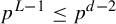 $p^{L-1}\leq p^{d-2}$
many
$p^{L-1}\leq p^{d-2}$
many $(1,h)$
belonging to
$(1,h)$
belonging to $W_{n}$
, meaning that
$W_{n}$
, meaning that $\vert H_{n}\vert \leq p^{d-2}$
, which is a contradiction since
$\vert H_{n}\vert \leq p^{d-2}$
, which is a contradiction since ${\vert H_{n}\vert>(\delta /2)p^{d-1}(1+O(p^{-1/2}))}$
and
${\vert H_{n}\vert>(\delta /2)p^{d-1}(1+O(p^{-1/2}))}$
and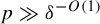 $p\gg \delta ^{-O(1)}$
. So,
$p\gg \delta ^{-O(1)}$
. So, $W_{n}=\mathbb {F}_{p}\times V_{n}$
. This proves the claim.
$W_{n}=\mathbb {F}_{p}\times V_{n}$
. This proves the claim.
We are now ready to complete the proof of the proposition. Since $P(n)+\sum _{i=1}^{d}h_{i}Q_{i}(n)=0$
for all
$P(n)+\sum _{i=1}^{d}h_{i}Q_{i}(n)=0$
for all $n\in X$
and
$n\in X$
and $h\in H_{n}$
, we have that
$h\in H_{n}$
, we have that
 $$ \begin{align*}(P(n),Q_{1}(n),\ldots,Q_{d}(n))\cdot (1,h)=0\end{align*} $$
for all $h\in H_{n}$
. By linearity,
$h\in H_{n}$
. By linearity,
 $$ \begin{align*} (P(n),Q_{1}(n),\ldots,Q_{d}(n))\cdot v=0 \end{align*} $$
for all $v\in W_{n}$
. Since by the claim
$v\in W_{n}$
. Since by the claim $W_{n}=\mathbb {F}_{p}\times V_{n}$
, we have that
$W_{n}=\mathbb {F}_{p}\times V_{n}$
, we have that $P(n)=0$
and that
$P(n)=0$
and that
 $$ \begin{align*} (nA)\cdot h=0 \Rightarrow (Q_{1}(n),\ldots,Q_{d}(n))\cdot h=0 \end{align*} $$
for all $h{\kern-1pt}\in{\kern-1pt} \mathbb {F}_{p}^{d}$
and
$h{\kern-1pt}\in{\kern-1pt} \mathbb {F}_{p}^{d}$
and $n{\kern-1pt}\in{\kern-1pt} X$
. This implies that the vector
$n{\kern-1pt}\in{\kern-1pt} X$
. This implies that the vector $nA$
is parallel to
$nA$
is parallel to $(Q_{1}(n),\ldots ,Q_{d}(n))$
, and so we may write
$(Q_{1}(n),\ldots ,Q_{d}(n))$
, and so we may write $(Q_{1}(n),\ldots ,Q_{d}(n))=F(n)(nA)=(cn_{1}F(n),n_{2}F(n),\ldots , n_{d}F(n))$
for some
$(Q_{1}(n),\ldots ,Q_{d}(n))=F(n)(nA)=(cn_{1}F(n),n_{2}F(n),\ldots , n_{d}F(n))$
for some $F(n)\in \mathbb {F}_{p}$
for all
$F(n)\in \mathbb {F}_{p}$
for all $n\in X$
. In other words, for all
$n\in X$
. In other words, for all $1\leq i,j\leq d$
and
$1\leq i,j\leq d$
and $n\in X$
,
$n\in X$
,
 $$ \begin{align*}\partial_{j}M(n)Q_{i}(n)=2c_{j}a_{j}Q_{i}(n)=2c_{j}c_{i}a_{j}a_{i}=\partial_{i}M(n)Q_{j}(n),\end{align*} $$
where $c_{1}=c$
and
$c_{1}=c$
and $c_{2}=\cdots =c_{d}=1$
.
$c_{2}=\cdots =c_{d}=1$
.
Finally, since $\vert X\vert{\kern-1pt}>{\kern-1pt}{(\delta /2)}p^{d-1}(1{\kern-1pt}+{\kern-1pt}O(p^{-1/2}))$
, by Lemma 6.1, for all
$\vert X\vert{\kern-1pt}>{\kern-1pt}{(\delta /2)}p^{d-1}(1{\kern-1pt}+{\kern-1pt}O(p^{-1/2}))$
, by Lemma 6.1, for all $n{\kern-1pt}\in{\kern-1pt} \mathbb {F}_{p}^{d}$
,
$n{\kern-1pt}\in{\kern-1pt} \mathbb {F}_{p}^{d}$
, ${M(n)=0}$
implies that
${M(n)=0}$
implies that $P(n)=0$
and
$P(n)=0$
and $\partial _{j}M(n)Q_{i}(n)=\partial _{i}M(n)Q_{j}(n)$
for all
$\partial _{j}M(n)Q_{i}(n)=\partial _{i}M(n)Q_{j}(n)$
for all $1\leq i,j\leq d$
. The conclusion then follows from Proposition 6.3.
$1\leq i,j\leq d$
. The conclusion then follows from Proposition 6.3.
We are now able provide a solution to (6.25).
Proposition 6.6. Let $d,s\in \mathbb {N}_{+}$
,
$d,s\in \mathbb {N}_{+}$
, $k\in \mathbb {N}$
,
$k\in \mathbb {N}$
, $\delta>0$
,
$\delta>0$
, $p\gg _{d,k} \delta ^{-O_{d,k}(1)}$
be a prime, and
$p\gg _{d,k} \delta ^{-O_{d,k}(1)}$
be a prime, and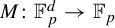 $M\colon \mathbb {F}_{p}^{d}\to \mathbb {F}_{p}$
be a quadratic form. Let W be a subset of
$M\colon \mathbb {F}_{p}^{d}\to \mathbb {F}_{p}$
be a quadratic form. Let W be a subset of $\Box _{s}(V(M))$
such that either:
$\Box _{s}(V(M))$
such that either:
-
•
$W=\Box _{s}(V(M))$
and
$\mathrm {rank}(M)\geq s+3$
; or -
•
$\vert W\vert \geq \delta \vert \Box _{s}(V(M))\vert $
and
$\mathrm {rank}(M)\geq s^{2}+s+3$
.




Let $P,Q\in \mathrm {poly}(\mathbb {F}_{p}^{d}\to \mathbb {F}_{p})$
with
$P,Q\in \mathrm {poly}(\mathbb {F}_{p}^{d}\to \mathbb {F}_{p})$
with $\deg (P)\leq k-1$
and
$\deg (P)\leq k-1$
and $\deg (Q)\leq k$
be such that for all
$\deg (Q)\leq k$
be such that for all $(n,h_{1},\ldots ,h_{s})\in W$
, we have that
$(n,h_{1},\ldots ,h_{s})\in W$
, we have that
 $$ \begin{align} \begin{aligned} \Delta_{h_{s-1}}\cdots\Delta_{h_{1}}P(n)+\Delta_{h_{s}}\cdots\Delta_{h_{1}}Q(n)=0 \end{aligned} \end{align} $$
(where $\Delta _{h_{s-1}}\cdots \Delta _{h_{1}}P(n)$
is understood as
$\Delta _{h_{s-1}}\cdots \Delta _{h_{1}}P(n)$
is understood as $P(n)$
when
$P(n)$
when $s=1$
). Then,
$s=1$
). Then,
 $$ \begin{align*} P=MP_{1}+P_{2} \quad\text{and}\quad Q=MQ_{1}+Q_{2} \end{align*} $$
for some $P_{1},P_{2},Q_{1},Q_{2}\in \mathrm {poly}(\mathbb {F}_{p}^{d}\to \mathbb {F}_{p})$
with
$P_{1},P_{2},Q_{1},Q_{2}\in \mathrm {poly}(\mathbb {F}_{p}^{d}\to \mathbb {F}_{p})$
with $\deg (P_{1})\leq k-3$
,
$\deg (P_{1})\leq k-3$
, $\deg (P_{2})\leq s-2$
,
$\deg (P_{2})\leq s-2$
, $\deg (Q_{1})\leq k-2$
,
$\deg (Q_{1})\leq k-2$
, $\deg (Q_{2})\leq s-1$
.
$\deg (Q_{2})\leq s-1$
.
Therefore, Proposition 6.6 provides solutions to (6.25) in two cases. The first case is when (6.25) holds for all $(n,h_{1},\ldots ,h_{s})\in \Box _{s}(V(M))$
, the second case is when (6.25) holds for a dense subset of
$(n,h_{1},\ldots ,h_{s})\in \Box _{s}(V(M))$
, the second case is when (6.25) holds for a dense subset of $(n,h_{1},\ldots ,h_{s})\in \Box _{s}(V(M))$
(in the latter case, we need to impose a stronger lower bound for the dimension d).
$(n,h_{1},\ldots ,h_{s})\in \Box _{s}(V(M))$
(in the latter case, we need to impose a stronger lower bound for the dimension d).
We remark that Proposition 6.6 is trivial if $k\leq s-1$
. We briefly explain the outline of the proof. Assume for convenience that
$k\leq s-1$
. We briefly explain the outline of the proof. Assume for convenience that $W=\Box _{s}(V(M))$
. We prove it by induction.
$W=\Box _{s}(V(M))$
. We prove it by induction.
Step 1. Fix $h_{s}\in \mathbb {F}_{p}^{d}$
and write
$h_{s}\in \mathbb {F}_{p}^{d}$
and write $h=h_{s}$
for convenience. Note that
$h=h_{s}$
for convenience. Note that
 $$ \begin{align*}\Delta_{h_{s-1}}\cdots\Delta_{h_{1}}P+\Delta_{h}\cdots\Delta_{h_{1}}Q=\Delta_{h_{s-1}}\cdots\Delta_{h_{1}}(P+\Delta_{h}Q)\end{align*} $$
and that $(n,h_{1},\ldots ,h_{s-1},h)\in \Box _{s}(V(M))\Leftrightarrow (n,h_{1},\ldots ,h_{s-1})\in \Box _{s-1}(V(M)^{h})$
. By the inheriting principle, we may informally think of
$(n,h_{1},\ldots ,h_{s-1},h)\in \Box _{s}(V(M))\Leftrightarrow (n,h_{1},\ldots ,h_{s-1})\in \Box _{s-1}(V(M)^{h})$
. By the inheriting principle, we may informally think of $V(M)^{h}$
as a lower degree hypersphere (which is the set of zeros of a lower dimensional quadratic form
$V(M)^{h}$
as a lower degree hypersphere (which is the set of zeros of a lower dimensional quadratic form $M_{h}$
and a subspace
$M_{h}$
and a subspace $V_{h}$
of
$V_{h}$
of $\mathbb {F}_{p}^{d}$
) and apply the induction hypothesis to conclude that the restriction of
$\mathbb {F}_{p}^{d}$
) and apply the induction hypothesis to conclude that the restriction of $P_{h}+\Delta _{h}Q_{h}$
on
$P_{h}+\Delta _{h}Q_{h}$
on $V_{h}$
can be written as
$V_{h}$
can be written as $M_{h}R_{h}+R^{\prime }_{h}$
for some lower degree polynomial
$M_{h}R_{h}+R^{\prime }_{h}$
for some lower degree polynomial $R^{\prime }_{h}$
, where
$R^{\prime }_{h}$
, where $P_{h}$
and
$P_{h}$
and $Q_{h}$
are the ‘restrictions’ of P and Q on
$Q_{h}$
are the ‘restrictions’ of P and Q on $V_{h}$
(this can be made precise by (6.31)).
$V_{h}$
(this can be made precise by (6.31)).
Step 2. For simplicity, assume that all of $M,P,Q$
are homogeneous. Then,
$M,P,Q$
are homogeneous. Then, $R^{\prime }_{h}$
vanishes and so the conclusion of Step 1 implies that
$R^{\prime }_{h}$
vanishes and so the conclusion of Step 1 implies that $P(n)+\Delta _{h}Q(n)=0$
for all
$P(n)+\Delta _{h}Q(n)=0$
for all $n\in V(M)^{h}$
, that is, whenever
$n\in V(M)^{h}$
, that is, whenever $(n,h)\in \Box _{1}(V(M))$
. Since
$(n,h)\in \Box _{1}(V(M))$
. Since $P,Q$
are homogeneous, similar to (6.27), the degree
$P,Q$
are homogeneous, similar to (6.27), the degree $k-1$
terms of
$k-1$
terms of $P(n)+Q(n+h)-Q(n)$
are equal to
$P(n)+Q(n+h)-Q(n)$
are equal to
 $$ \begin{align*}P+h\cdot\nabla Q=P+h_{s}\cdot\nabla Q=P+\sum_{i=1}^{d}h_{s,i}\partial_{i}Q,\end{align*} $$
where $h=h_{s}=(h_{s,1},\ldots ,h_{s,d})$
. Since (6.28) holds for all
$h=h_{s}=(h_{s,1},\ldots ,h_{s,d})$
. Since (6.28) holds for all $(n,h_{1})\in \Box _{1}(V(M))$
, we may invoke Proposition 6.5 to the degree
$(n,h_{1})\in \Box _{1}(V(M))$
, we may invoke Proposition 6.5 to the degree $k-1$
terms of the left-hand side of (6.28) to conclude that P and Q are divisible by M.
$k-1$
terms of the left-hand side of (6.28) to conclude that P and Q are divisible by M.
Proof of Proposition 6.6
Throughout the proof, we assume that $p\gg _{d,k} \delta ^{-O_{d,k}(1)}$
. Let A be the matrix associated with M and denote
$p\gg _{d,k} \delta ^{-O_{d,k}(1)}$
. Let A be the matrix associated with M and denote $d'=\mathrm {rank}(M)$
. By Lemmas 4.3 and 4.18, under a change of variables, it suffices to consider the case when A is a diagonal matrix with diagonal
$d'=\mathrm {rank}(M)$
. By Lemmas 4.3 and 4.18, under a change of variables, it suffices to consider the case when A is a diagonal matrix with diagonal $(c,1,\ldots ,1,0,\ldots ,0)$
for some
$(c,1,\ldots ,1,0,\ldots ,0)$
for some $c\in \mathbb {F}_{p}\backslash \{0\}$
, where there are
$c\in \mathbb {F}_{p}\backslash \{0\}$
, where there are $d-d'$
zeros on the diagonal.
$d-d'$
zeros on the diagonal.
To carry out Step 1 of the outline, it is convenient to work on the set $V(M)^{h}-h/2$
instead of
$V(M)^{h}-h/2$
instead of $V(M)^{h}$
. So, we need some definitions to describe such a set (this will make the notation of the proof slightly different from that used in the outline). For
$V(M)^{h}$
. So, we need some definitions to describe such a set (this will make the notation of the proof slightly different from that used in the outline). For $h\in \mathbb {F}_{p}^{d}$
, let
$h\in \mathbb {F}_{p}^{d}$
, let
 $$ \begin{align*} U_{h}:=V(M)^{h}-h/2=\{n\in\mathbb{F}_{p}^{d}\colon M(n+h/2)=M(n-h/2)\}. \end{align*} $$
Then, we may write $U_{h}=V_{h}+u_{h}$
for some
$U_{h}=V_{h}+u_{h}$
for some $u_{h}\in \mathbb {F}_{p}^{d}$
, where
$u_{h}\in \mathbb {F}_{p}^{d}$
, where
 $$ \begin{align*} V_{h}:=\{n\in\mathbb{F}_{p}^{d}\colon (nA)\cdot h=0\}. \end{align*} $$
Let $L_{h}\colon \mathbb {F}_{p}^{d-1}\to V_{h}$
be any bijective linear transformation and denote
$L_{h}\colon \mathbb {F}_{p}^{d-1}\to V_{h}$
be any bijective linear transformation and denote
 $$ \begin{align*} M_{h}(m):=M(L_{h}(m)+u_{h}-h/2). \end{align*} $$
By the definition of $U_{h}$
, we have that
$U_{h}$
, we have that $M(L_{h}(m)+u_{h}-h/2)=M(L_{h}(m)+u_{h}+h/2)$
for all
$M(L_{h}(m)+u_{h}-h/2)=M(L_{h}(m)+u_{h}+h/2)$
for all $m\in \mathbb {F}_{p}^{d-1}$
. From this, it is not hard to check that
$m\in \mathbb {F}_{p}^{d-1}$
. From this, it is not hard to check that
 $$ \begin{align} &(m,m_{1},\ldots,m_{s-1})\in \Box_{s-1}(M_{h})\Leftrightarrow (L_{h}(m)\nonumber\\ & \quad+u_{h}-h/2,L_{h}(m_{1}),\ldots,L_{h}(m_{s-1}),h)\in \Box_{s}(M). \end{align} $$
So, the assumption and (6.29) imply that
 $$ \begin{align} \begin{aligned} \Delta_{m_{s-1}}\cdots\Delta_{m_{1}}(P_{h}(m)+Q_{h}(m))=0 \end{aligned} \end{align} $$
for all $(m,m_{1},\ldots ,m_{s-1})\in \Box _{s-1}(M_{h})$
with
$(m,m_{1},\ldots ,m_{s-1})\in \Box _{s-1}(M_{h})$
with $(L_{h}(m)+u_{h}-h/2,L_{h}(m_{1}),\ldots , L_{h}(m_{s-1}),h)\in W$
, where
$(L_{h}(m)+u_{h}-h/2,L_{h}(m_{1}),\ldots , L_{h}(m_{s-1}),h)\in W$
, where
 $$ \begin{align*} P_{h}:=P(L_{h}(\cdot)+u_{h}-h/2) \!\quad\text{and}\quad\! Q_{h}:=Q(L_{h}(\cdot){\kern-1pt}+{\kern-1pt}u_{h}{\kern-1pt}+{\kern-1pt}h/2){\kern-1pt}-{\kern-1pt}Q(L_{h}(\cdot)+u_{h}-h/2). \end{align*} $$
We remark that (6.30) is also valid when $s=1$
, in which case, (6.30) is understood as
$s=1$
, in which case, (6.30) is understood as
 $$ \begin{align} P_{h}(m)+Q_{h}(m)=0. \end{align} $$
We introduce some further notation to describe the set of $(m,m_{1},\ldots ,m_{s-1})$
satisfying (6.29). For all
$(m,m_{1},\ldots ,m_{s-1})$
satisfying (6.29). For all $h\in \mathbb {F}_{p}^{d}$
, let
$h\in \mathbb {F}_{p}^{d}$
, let $W_{h}$
be the set of
$W_{h}$
be the set of $(n,h_{1},\ldots ,h_{s-1})\in (\mathbb {F}_{p}^{d})^{s}$
such that
$(n,h_{1},\ldots ,h_{s-1})\in (\mathbb {F}_{p}^{d})^{s}$
such that $(n,h_{1},\ldots ,h_{s-1},h)\in W$
(that is, we decompose W into fibers
$(n,h_{1},\ldots ,h_{s-1},h)\in W$
(that is, we decompose W into fibers $W_{h}$
with respect to the last variable). We now parameterize
$W_{h}$
with respect to the last variable). We now parameterize $W_{h}$
using
$W_{h}$
using $m,m_{1},\ldots ,m_{s-1}$
. For all
$m,m_{1},\ldots ,m_{s-1}$
. For all $h\in \mathbb {F}_{p}^{d}$
, let
$h\in \mathbb {F}_{p}^{d}$
, let $W^{\prime }_{h}$
be the set of
$W^{\prime }_{h}$
be the set of $(m,m_{1},\ldots ,m_{s-1})$
such that
$(m,m_{1},\ldots ,m_{s-1})$
such that
 $$ \begin{align*} (L_{h}(m)+u_{h}-h/2,L_{h}(m_{1}),\ldots,L_{h}(m_{s-1}))\in W_{h}. \end{align*} $$
Since $(n,h_{1},\ldots ,h_{s})\in \Box _{s}(V(M))$
for all
$(n,h_{1},\ldots ,h_{s})\in \Box _{s}(V(M))$
for all $(n,h_{1},\ldots ,h_{s-1})\in W_{h_{s}}$
, it follows from (6.29) that
$(n,h_{1},\ldots ,h_{s-1})\in W_{h_{s}}$
, it follows from (6.29) that
 $$ \begin{align} W^{\prime}_{h}\subseteq \Box_{s-1}(V(M_{h})) \quad\text{and}\quad \vert W^{\prime}_{h}\vert=\vert W_{h}\vert \quad\text{for all } h\in \mathbb{F}_{p}^{d}. \end{align} $$
Therefore, we have that (6.30) holds for all $h\in \mathbb {F}_{p}^{d}$
and
$h\in \mathbb {F}_{p}^{d}$
and $(m,m_{1},\ldots ,m_{s-1})\in W^{\prime }_{h}$
.
$(m,m_{1},\ldots ,m_{s-1})\in W^{\prime }_{h}$
.
Recall that Step 1 is to fix h and use the induction hypothesis or Proposition 6.2 on (6.30) to obtain a description for $P_{h}+Q_{h}$
. So, we need to choose h carefully so that the dimension of
$P_{h}+Q_{h}$
. So, we need to choose h carefully so that the dimension of $V_{h}$
is
$V_{h}$
is $d-1$
, the rank of
$d-1$
, the rank of $M_{h}$
is
$M_{h}$
is $d'-1$
, and the set
$d'-1$
, and the set $W^{\prime }_{h}$
is large. Let Z be the set of
$W^{\prime }_{h}$
is large. Let Z be the set of $h\in \mathbb {F}_{p}^{d}$
such that
$h\in \mathbb {F}_{p}^{d}$
such that $\dim (V_{h})\neq d-1$
or
$\dim (V_{h})\neq d-1$
or $\dim (V_{h}\cap V_{h}^{\perp {M}})\neq d-d'$
. Then, by Proposition 4.8(ii), for all
$\dim (V_{h}\cap V_{h}^{\perp {M}})\neq d-d'$
. Then, by Proposition 4.8(ii), for all $h\in \mathbb {F}_{p}^{d}\backslash Z$
, we have that
$h\in \mathbb {F}_{p}^{d}\backslash Z$
, we have that $\mathrm {rank}(M_{h})=d'-1$
. We now show that Z is a small set.
$\mathrm {rank}(M_{h})=d'-1$
. We now show that Z is a small set.
Claim 1. We have that $\vert Z\vert \leq O_{d}(p^{d-1})$
.
$\vert Z\vert \leq O_{d}(p^{d-1})$
.
Proof of Claim 1
Let $Z'$
be the set of
$Z'$
be the set of $h\in \mathbb {F}_{p}^{d}$
such that either
$h\in \mathbb {F}_{p}^{d}$
such that either $(hA)\cdot h=0$
or at least one of the coordinates of h is 0. Since
$(hA)\cdot h=0$
or at least one of the coordinates of h is 0. Since $\mathrm {rank}(A)=d'\geq 3$
, by Lemma 4.12, it is not hard to see that
$\mathrm {rank}(A)=d'\geq 3$
, by Lemma 4.12, it is not hard to see that $\vert Z'\vert =O_{d}(p^{d-1})$
. Now, fix any
$\vert Z'\vert =O_{d}(p^{d-1})$
. Now, fix any $h=(h_{1},\ldots ,h_{d})\in \mathbb {F}_{p}^{d}\backslash Z'$
. Then, since
$h=(h_{1},\ldots ,h_{d})\in \mathbb {F}_{p}^{d}\backslash Z'$
. Then, since $hA\neq \mathbf {0}$
, we have that
$hA\neq \mathbf {0}$
, we have that $\dim (V_{h})=d-1$
. Note that
$\dim (V_{h})=d-1$
. Note that
 $$ \begin{align*}\{-h_{i}e_{1}+ch_{1}e_{i}\colon 2\leq i\leq d'\}\cup\{e_{j}\colon d'+1\leq j\leq d\}\end{align*} $$
is a basis of $V_{h}$
, where
$V_{h}$
, where $e_{i}$
is the ith standard unit vector. From this, it is not hard to compute that
$e_{i}$
is the ith standard unit vector. From this, it is not hard to compute that
 $$ \begin{align*} (h_{1},\ldots,h_{d'},0,\ldots,0), e_{d'+1},\ldots,e_{d} \end{align*} $$
is a basis of $(V_{h})^{\perp {M}}$
. Therefore,
$(V_{h})^{\perp {M}}$
. Therefore, $\dim ((V_{h})^{\perp {M}})=d-d'+1$
. Finally, it is not hard to compute by induction that
$\dim ((V_{h})^{\perp {M}})=d-d'+1$
. Finally, it is not hard to compute by induction that
 $$ \begin{align*}\det\begin{bmatrix} -h_{2} & ch_{1} & & & \\ -h_{3} & & ch_{1} & & \\ \cdots & & & \cdots & \\ -h_{d'} & & & & ch_{1} \\ h_{1} & \cdots & \cdots & \cdots & h_{d'} \end{bmatrix}=(-1)^{d'+1}(ch_{1})^{d'-2}((hA)\cdot h)\neq 0.\end{align*} $$
This implies that $V_{h}+(V_{h})^{\perp {M}}=\mathbb {F}_{p}^{d}$
. So,
$V_{h}+(V_{h})^{\perp {M}}=\mathbb {F}_{p}^{d}$
. So,
 $$ \begin{align*} \dim(V_{h}\cap V_{h}^{\perp{M}})& = \dim(V_{h})+\dim(V_{h}^{\perp{M}})-\dim(V_{h}+(V_{h})^{\perp{M}})\\ & = (d-1)+(d-d'+1)-d=d-d'. \end{align*} $$
Therefore, $Z\subseteq Z'$
and thus,
$Z\subseteq Z'$
and thus, $\vert Z\vert \leq O_{d}(p^{d-1})$
. This proves Claim 1.
$\vert Z\vert \leq O_{d}(p^{d-1})$
. This proves Claim 1.
We still need to remove those h for which $\vert W^{\prime }_{h}\vert $
is small. This is done by the next claim.
$\vert W^{\prime }_{h}\vert $
is small. This is done by the next claim.
Claim 2. There exists $W_{\ast }\subseteq \mathbb {F}_{p}^{d}$
of cardinality at least
$W_{\ast }\subseteq \mathbb {F}_{p}^{d}$
of cardinality at least $\delta p^{d}/4$
such that for all
$\delta p^{d}/4$
such that for all $h\in W_{\ast }\backslash Z$
,
$h\in W_{\ast }\backslash Z$
,
 $$ \begin{align} \vert W^{\prime}_{h}\vert=\vert W_{h}\vert\geq O(\delta) \vert \Box_{s-1}(V(M_{h}))\vert. \end{align} $$
Proof of Claim 2
If $\vert W\vert \geq \delta \vert \Box _{s}(V(M))\vert $
and
$\vert W\vert \geq \delta \vert \Box _{s}(V(M))\vert $
and $\mathrm {rank}(M)\geq s^{2}+s+3$
, then by Proposition 4.19, we have that
$\mathrm {rank}(M)\geq s^{2}+s+3$
, then by Proposition 4.19, we have that
 $$ \begin{align*} \sum_{h\in\mathbb{F}_{p}^{d}}\vert W_{h}\vert=\vert W\vert>\delta\vert\Box_{s}(V(M))\vert=\delta p^{(s+1)d-(({s(s+1)}/2)+1)}(1+O_{s}(p^{-1/2})). \end{align*} $$
Moreover, for all but at most $s(s+1)p^{d+s-\mathrm {rank}(M)}$
many
$s(s+1)p^{d+s-\mathrm {rank}(M)}$
many $h_{s}\in \mathbb {F}_{p}^{d}$
, we have that
$h_{s}\in \mathbb {F}_{p}^{d}$
, we have that $\vert W_{h_{s}}\vert \leq p^{ds-((s(s+1)/2)+1)}$
. Also, the sum of
$\vert W_{h_{s}}\vert \leq p^{ds-((s(s+1)/2)+1)}$
. Also, the sum of $\vert W_{h_{s}}\vert $
over those at most
$\vert W_{h_{s}}\vert $
over those at most $s(s+1)p^{d+s-d'}$
exceptionally
$s(s+1)p^{d+s-d'}$
exceptionally $h_{s}\in \mathbb {F}_{p}^{d}$
is at most
$h_{s}\in \mathbb {F}_{p}^{d}$
is at most $s(s+1)p^{(s+1)d+s-d'}$
. It then follows from the pigeonhole principle that there exists
$s(s+1)p^{(s+1)d+s-d'}$
. It then follows from the pigeonhole principle that there exists $W_{\ast }\subseteq \mathbb {F}_{p}^{d}\backslash Z$
of cardinality at least
$W_{\ast }\subseteq \mathbb {F}_{p}^{d}\backslash Z$
of cardinality at least $\delta p^{d}/4$
such that
$\delta p^{d}/4$
such that $\vert W_{h}\vert \geq \delta p^{ds-((s(s+1)/2)+1)}/4$
for all
$\vert W_{h}\vert \geq \delta p^{ds-((s(s+1)/2)+1)}/4$
for all $h_{s}\in W_{\ast }$
. Since
$h_{s}\in W_{\ast }$
. Since $\mathrm {rank}(M_{h})\geq (s-1)^{2}+(s-1)+3$
, by Proposition 4.19 and (6.32), we have that
$\mathrm {rank}(M_{h})\geq (s-1)^{2}+(s-1)+3$
, by Proposition 4.19 and (6.32), we have that
 $$ \begin{align*} \vert W^{\prime}_{h}\vert=\vert W_{h}\vert\geq\delta p^{ds-((s(s+1)/2)+1)}/4=\delta p^{(d-1)s-((s(s-1)/2)+1)}/4=O(\delta) \vert \Box_{s-1}(V(M_{h}))\vert \end{align*} $$
for all $h\in W_{\ast }\backslash Z$
.
$h\in W_{\ast }\backslash Z$
.
However, if $W=\Box _{s}(V(M))$
and
$W=\Box _{s}(V(M))$
and $\mathrm {rank}(M)\geq s+3$
, then for all
$\mathrm {rank}(M)\geq s+3$
, then for all $h\in \mathbb {F}_{p}^{d}\backslash Z$
, it follows from (6.29) that
$h\in \mathbb {F}_{p}^{d}\backslash Z$
, it follows from (6.29) that $ W^{\prime }_{h}=\Box _{s-1}(V(M_{h}))$
. This completes the proof of Claim 2.
$ W^{\prime }_{h}=\Box _{s-1}(V(M_{h}))$
. This completes the proof of Claim 2.
Step 2 is summarized by the following claim.
Claim 3. Let $t\in \mathbb {N}$
. Suppose that for all
$t\in \mathbb {N}$
. Suppose that for all $h\in W_{\ast }\backslash Z$
, we may write
$h\in W_{\ast }\backslash Z$
, we may write
 $$ \begin{align} P_{h}+Q_{h}=M_{h}R_{h}+R^{\prime}_{h} \end{align} $$
for some $R_{h},R^{\prime }_{h}\in \text {poly}(\mathbb {F}_{p}^{d}\to \mathbb {F}_{p})$
with
$R_{h},R^{\prime }_{h}\in \text {poly}(\mathbb {F}_{p}^{d}\to \mathbb {F}_{p})$
with $\deg (R_{h})\leq k-3$
and
$\deg (R_{h})\leq k-3$
and $\deg (R^{\prime }_{h})\leq t-1$
. Then,
$\deg (R^{\prime }_{h})\leq t-1$
. Then,
 $$ \begin{align*}P=MP'+P" \quad\text{and}\quad Q=MQ'+Q" \end{align*} $$
for some $P',P",Q',Q"\in \text {poly}(\mathbb {F}_{p}^{d}\to \mathbb {F}_{p})$
with
$P',P",Q',Q"\in \text {poly}(\mathbb {F}_{p}^{d}\to \mathbb {F}_{p})$
with $\deg (P')\leq k-3$
,
$\deg (P')\leq k-3$
, $\deg (P")\leq t-1$
,
$\deg (P")\leq t-1$
, $\deg (Q')\leq k-2$
, and
$\deg (Q')\leq k-2$
, and $\deg (Q")\leq t$
.
$\deg (Q")\leq t$
.
We first show that Claim 3 implies the desired conclusion by following the two steps described in the outline. We prove by induction on s. If $s=1$
, then for all
$s=1$
, then for all $h\in W_{\ast }\backslash Z$
, since
$h\in W_{\ast }\backslash Z$
, since $\mathrm {rank}(M_{h})\geq 3$
and (6.31) holds for all
$\mathrm {rank}(M_{h})\geq 3$
and (6.31) holds for all $(m,m_{1},\ldots ,m_{s-1})\in W^{\prime }_{h}$
, it follows from Proposition 6.2 that
$(m,m_{1},\ldots ,m_{s-1})\in W^{\prime }_{h}$
, it follows from Proposition 6.2 that
 $$ \begin{align*} P_{h}+Q_{h}=M_{h}R_{h} \end{align*} $$
for some $R_{h}\in \text {poly}(\mathbb {F}_{p}^{d}\to \mathbb {F}_{p})$
with
$R_{h}\in \text {poly}(\mathbb {F}_{p}^{d}\to \mathbb {F}_{p})$
with $\deg (R_{h})\leq k-3$
. By Claim 3 (setting
$\deg (R_{h})\leq k-3$
. By Claim 3 (setting $t=0$
),
$t=0$
),
 $$ \begin{align*}P=MP_{1} \quad\text{and}\quad Q=MQ_{1}+C\end{align*} $$
for some $C\in \mathbb {F}_{p}$
and
$C\in \mathbb {F}_{p}$
and $P_{1},Q_{1}\in \text {poly}(\mathbb {F}_{p}^{d}\to \mathbb {F}_{p})$
with
$P_{1},Q_{1}\in \text {poly}(\mathbb {F}_{p}^{d}\to \mathbb {F}_{p})$
with $\deg (P_{1})\leq k-3$
,
$\deg (P_{1})\leq k-3$
, $\deg (Q_{1})\leq k-2$
.
$\deg (Q_{1})\leq k-2$
.
Suppose we have proved Proposition 6.6 for $s-1$
for some
$s-1$
for some $s\geq 2$
. We now prove it for s. For all
$s\geq 2$
. We now prove it for s. For all $h\in W_{\ast }\backslash Z$
, since
$h\in W_{\ast }\backslash Z$
, since $\mathrm {rank}(M_{h})=\mathrm {rank}(M)-1$
,
$\mathrm {rank}(M_{h})=\mathrm {rank}(M)-1$
, $\deg (P_{h}+\Delta _{h}Q_{h})\leq k-1$
, and since (6.30) holds for all
$\deg (P_{h}+\Delta _{h}Q_{h})\leq k-1$
, and since (6.30) holds for all $(m,m_{1},\ldots ,m_{s-1})\in W^{\prime }_{h}$
, by the induction hypothesis, we may write
$(m,m_{1},\ldots ,m_{s-1})\in W^{\prime }_{h}$
, by the induction hypothesis, we may write
 $$ \begin{align*}P_{h}+Q_{h}=M_{h}R_{h}+R^{\prime}_{h}\end{align*} $$
for some $R_{h},R^{\prime }_{h}\in \text {poly}(\mathbb {F}_{p}^{d}\to \mathbb {F}_{p})$
with
$R_{h},R^{\prime }_{h}\in \text {poly}(\mathbb {F}_{p}^{d}\to \mathbb {F}_{p})$
with $\deg (R_{h})\leq k-3$
and
$\deg (R_{h})\leq k-3$
and $\deg (R^{\prime }_{h})\leq s-2$
for all
$\deg (R^{\prime }_{h})\leq s-2$
for all $h\in W_{\ast }\backslash Z$
. By Claim 3 (setting
$h\in W_{\ast }\backslash Z$
. By Claim 3 (setting $t=s+1$
),
$t=s+1$
),
 $$ \begin{align*}P=MP'+P",\quad Q=MQ'+Q"\end{align*} $$
for some $P',P",Q',Q"\in \text {poly}(\mathbb {F}_{p}^{d}\to \mathbb {F}_{p})$
with
$P',P",Q',Q"\in \text {poly}(\mathbb {F}_{p}^{d}\to \mathbb {F}_{p})$
with $\deg (P')\leq k-3$
,
$\deg (P')\leq k-3$
, $\deg (P")\leq s-2$
,
$\deg (P")\leq s-2$
, $\deg (Q')\leq k-2$
, and
$\deg (Q')\leq k-2$
, and $\deg (Q")\leq s-1$
. This completes the induction step and we are done.
$\deg (Q")\leq s-1$
. This completes the induction step and we are done.
It remains to prove Claim 3.
Proof of Claim 3
The idea is to apply Proposition 6.5 to the leading terms of the polynomials. Unlike the special case discussed in the outline, here, the polynomials $M,P$
, and Q are not homogeneous. To overcome this difficulty, each time we apply Proposition 6.5 to the leading terms, we may factor out a multiple of M to lower the degrees of P and Q. Then, we apply Proposition 6.5 again to the leading terms of the new P and Q, until
$M,P$
, and Q are not homogeneous. To overcome this difficulty, each time we apply Proposition 6.5 to the leading terms, we may factor out a multiple of M to lower the degrees of P and Q. Then, we apply Proposition 6.5 again to the leading terms of the new P and Q, until $k\leq s-1$
. So, we prove Claim 3 by induction on k.
$k\leq s-1$
. So, we prove Claim 3 by induction on k.
If $\max \{\deg (P),\deg (Q)-1\}{\kern-1pt}\leq{\kern-1pt} s{\kern-1pt}-{\kern-1pt}1$
, then Claim 3 follows by setting
$\max \{\deg (P),\deg (Q)-1\}{\kern-1pt}\leq{\kern-1pt} s{\kern-1pt}-{\kern-1pt}1$
, then Claim 3 follows by setting $P{\kern-1pt}={\kern-1pt}P",Q{\kern-1pt}={\kern-1pt}Q"$
, and
$P{\kern-1pt}={\kern-1pt}P",Q{\kern-1pt}={\kern-1pt}Q"$
, and $P'{\kern-1pt}={\kern-1pt}Q'{\kern-1pt}={\kern-1pt}0$
. Assume now that Claim 3 holds when
$P'{\kern-1pt}={\kern-1pt}Q'{\kern-1pt}={\kern-1pt}0$
. Assume now that Claim 3 holds when $\max \{\deg (P),\deg (Q)-1\}{\kern-1pt}\leq k'{\kern-1pt}-{\kern-1pt}1$
for some
$\max \{\deg (P),\deg (Q)-1\}{\kern-1pt}\leq k'{\kern-1pt}-{\kern-1pt}1$
for some $s\leq k'\leq k-1$
and we prove that Claim 3 holds when
$s\leq k'\leq k-1$
and we prove that Claim 3 holds when $\max \{\deg (P), \deg (Q)-1\}\leq k'$
. Note that (6.34) implies that
$\max \{\deg (P), \deg (Q)-1\}\leq k'$
. Note that (6.34) implies that
 $$ \begin{align} &P(L_{h}(m)+u_{h}-h/2)+Q(L_{h}(m)+u_{h}+h/2)-Q(L_{h}(m)+u_{h}-h/2)\nonumber\\ & \quad =M(L_{h}(m)+u_{h}-h/2)R_{h}(m)+R^{\prime}_{h}(m) \end{align} $$
for all $h\in W_{\ast }\backslash Z$
. Since
$h\in W_{\ast }\backslash Z$
. Since $\deg (R^{\prime }_{h})\leq k'-1$
, it is not hard to see that
$\deg (R^{\prime }_{h})\leq k'-1$
, it is not hard to see that $\deg (R_{h})\leq k'-2$
. Let
$\deg (R_{h})\leq k'-2$
. Let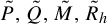 $\tilde {P},\tilde {Q},\tilde {M},\tilde {R}_{h}$
be the degree
$\tilde {P},\tilde {Q},\tilde {M},\tilde {R}_{h}$
be the degree $k',k'+1,2,k'-2$
terms of
$k',k'+1,2,k'-2$
terms of $P,Q,M,R_{h}$
, respectively. Write
$P,Q,M,R_{h}$
, respectively. Write $h=(h_{1},\ldots ,h_{d})$
. Comparing the degree
$h=(h_{1},\ldots ,h_{d})$
. Comparing the degree $k'$
terms of (6.35) and noticing that the degree
$k'$
terms of (6.35) and noticing that the degree $k'$
terms of
$k'$
terms of $Q(L_{h}(m)+u_{h}+h/2)-Q(L_{h}(m)+u_{h}-h/2)$
are
$Q(L_{h}(m)+u_{h}+h/2)-Q(L_{h}(m)+u_{h}-h/2)$
are $\sum _{i=1}^{d}h_{i}\partial _{i}\tilde {Q}(L_{h}(m))$
, we have that
$\sum _{i=1}^{d}h_{i}\partial _{i}\tilde {Q}(L_{h}(m))$
, we have that
 $$ \begin{align*} \tilde{P}(L_{h}(m))+\sum_{i=1}^{d}h_{i}\partial_{i}\tilde{Q}(L_{h}(m))=\tilde{M}(L_{h}(m))\tilde{R}_{h}(m). \end{align*} $$
Therefore, for all $n\in \mathbb {F}_{p}^{d}$
and
$n\in \mathbb {F}_{p}^{d}$
and $h\in W_{\ast }\backslash Z$
with
$h\in W_{\ast }\backslash Z$
with $(nA)\cdot h=M(n)=0$
, there exists
$(nA)\cdot h=M(n)=0$
, there exists $m\in \mathbb {F}_{p}^{d-1}$
with
$m\in \mathbb {F}_{p}^{d-1}$
with $L_{h}(m)=n$
and thus,
$L_{h}(m)=n$
and thus,
 $$ \begin{align*} \tilde{P}(n)+\sum_{i=1}^{d}h_{i}\partial_{i}\tilde{Q}(n)=\tilde{M}(n)\tilde{R}_{h}(m)=0. \end{align*} $$
Since $\vert Z\vert \leq O_{d}(p^{d-1})$
by Claim 1, we have that
$\vert Z\vert \leq O_{d}(p^{d-1})$
by Claim 1, we have that $\vert W_{\ast }\backslash Z\vert \geq p^{d}/8$
. Since
$\vert W_{\ast }\backslash Z\vert \geq p^{d}/8$
. Since $\mathrm {rank}(M)\geq s+3\geq 4$
, by Proposition 6.5, we have that
$\mathrm {rank}(M)\geq s+3\geq 4$
, by Proposition 6.5, we have that $\tilde {P}=\tilde {M}P'$
and
$\tilde {P}=\tilde {M}P'$
and $\tilde {Q}=\tilde {M}Q'$
for some
$\tilde {Q}=\tilde {M}Q'$
for some $P',Q'\in \text {poly}(\mathbb {F}_{p}^{d}\to \mathbb {F}_{p})$
with
$P',Q'\in \text {poly}(\mathbb {F}_{p}^{d}\to \mathbb {F}_{p})$
with $\deg (P')\leq k'-2\leq k-3$
and
$\deg (P')\leq k'-2\leq k-3$
and $\deg (Q')\leq k'-1\leq k-2$
. Since
$\deg (Q')\leq k'-1\leq k-2$
. Since $M-\tilde {M}$
is of degree at most 1, we may write
$M-\tilde {M}$
is of degree at most 1, we may write
 $$ \begin{align*}P=MP'+P",\quad Q=MQ'+Q"\end{align*} $$
for some $P",Q"\in \text {poly}(\mathbb {F}_{p}^{d}\to \mathbb {F}_{p})$
with
$P",Q"\in \text {poly}(\mathbb {F}_{p}^{d}\to \mathbb {F}_{p})$
with $\deg (P")\leq k'-1$
and
$\deg (P")\leq k'-1$
and $\deg (Q")\leq k'$
. Writing
$\deg (Q")\leq k'$
. Writing $P^{\prime \prime }_{h}:=P"(L_{h}(\cdot )+u_{h}-h/2)$
and
$P^{\prime \prime }_{h}:=P"(L_{h}(\cdot )+u_{h}-h/2)$
and $Q^{\prime \prime }_{h}:=Q"(L_{h}(\cdot )+u_{h}+h/2)-Q"(L_{h}(\cdot )+u_{h}-h/2)$
, it follows from (6.34) and the identity
$Q^{\prime \prime }_{h}:=Q"(L_{h}(\cdot )+u_{h}+h/2)-Q"(L_{h}(\cdot )+u_{h}-h/2)$
, it follows from (6.34) and the identity
 $$ \begin{align*}M_{h}=M(L_{h}(\cdot)+u_{h}-h/2)=M(L_{h}(\cdot)+u_{h}+h/2)\end{align*} $$
that for all $h\in W_{\ast }\backslash Z$
, we may write
$h\in W_{\ast }\backslash Z$
, we may write
 $$ \begin{align} P^{\prime\prime}_{h}+Q^{\prime\prime}_{h}=M_{h}R^{\prime\prime}_{h}+R^{\prime\prime\prime}_{h} \end{align} $$
for some $R^{\prime \prime }_{h},R^{\prime \prime }_{h}\in \text {poly}(\mathbb {F}_{p}^{d}\to \mathbb {F}_{p})$
with
$R^{\prime \prime }_{h},R^{\prime \prime }_{h}\in \text {poly}(\mathbb {F}_{p}^{d}\to \mathbb {F}_{p})$
with $\deg (R^{\prime \prime }_{h})\leq k-3$
and
$\deg (R^{\prime \prime }_{h})\leq k-3$
and $\deg (R^{\prime \prime \prime }_{h})\leq s-1$
. Since
$\deg (R^{\prime \prime \prime }_{h})\leq s-1$
. Since $\max \{\deg (P"),\deg (Q")-1\}\leq k'-1$
, by induction hypothesis, (6.36) implies that
$\max \{\deg (P"),\deg (Q")-1\}\leq k'-1$
, by induction hypothesis, (6.36) implies that
 $$ \begin{align*} P"=MP"'+P"",\quad Q"=MQ"'+Q"" \end{align*} $$
for some $P"',P"",Q"',Q""\in \text {poly}(\mathbb {F}_{p}^{d}\to \mathbb {F}_{p})$
with
$P"',P"",Q"',Q""\in \text {poly}(\mathbb {F}_{p}^{d}\to \mathbb {F}_{p})$
with $\deg (P"')\leq k-3, \deg (P"")\leq s-1$
,
$\deg (P"')\leq k-3, \deg (P"")\leq s-1$
, $\deg (Q"')\leq k-2$
, and
$\deg (Q"')\leq k-2$
, and $\deg (Q"")\leq s$
. Then,
$\deg (Q"")\leq s$
. Then,
 $$ \begin{align*} P=M(P'+P"')+P"" \quad\text{and}\quad Q=M(Q'+Q"')+Q"". \end{align*} $$
This completes the induction step and proves Claim 3.
This therefore completes the proof of Proposition 6.6.
6.4 Intrinsic definitions for polynomials on
$V(M)$

Let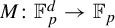 $M\colon \mathbb {F}_{p}^{d}\to \mathbb {F}_{p}$
be a quadratic form. Recall that we define a function
$M\colon \mathbb {F}_{p}^{d}\to \mathbb {F}_{p}$
be a quadratic form. Recall that we define a function $f\colon V(M)\to \mathbb {F}_{p}$
to be a polynomial if f is the restriction to
$f\colon V(M)\to \mathbb {F}_{p}$
to be a polynomial if f is the restriction to $V(M)$
of some polynomial
$V(M)$
of some polynomial $f'\colon \mathbb {F}_{p}^{d}\to \mathbb {F}_{p}$
defined in
$f'\colon \mathbb {F}_{p}^{d}\to \mathbb {F}_{p}$
defined in $\mathbb {F}_{p}^{d}$
. It is natural to ask if there is an intrinsic way to define polynomials on
$\mathbb {F}_{p}^{d}$
. It is natural to ask if there is an intrinsic way to define polynomials on $V(M)$
(that is, without looking at points outside
$V(M)$
(that is, without looking at points outside $V(M)$
). A natural way to do so is to use anti-derivative properties of polynomials. Let
$V(M)$
). A natural way to do so is to use anti-derivative properties of polynomials. Let $g\in \text {poly}(\mathbb {F}_{p}^{d}\to \mathbb {F}_{p})$
. It is not hard to see that g is of degree at most
$g\in \text {poly}(\mathbb {F}_{p}^{d}\to \mathbb {F}_{p})$
. It is not hard to see that g is of degree at most $s-1$
if and only if
$s-1$
if and only if $\Delta _{h_{s}}\cdots \Delta _{h_{1}}g(n)=0$
for all
$\Delta _{h_{s}}\cdots \Delta _{h_{1}}g(n)=0$
for all $n,h_{1},\ldots ,h_{s}\in \mathbb {F}_{p}^{d}$
. This observation provides us with a promising alternative way to define polynomials and leads to the following question.
$n,h_{1},\ldots ,h_{s}\in \mathbb {F}_{p}^{d}$
. This observation provides us with a promising alternative way to define polynomials and leads to the following question.
Conjecture 6.7. (Intrinsic definition for polynomials)
Let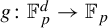 $g\colon \mathbb {F}_{p}^{d}\to \mathbb {F}_{p}$
be a function,
$g\colon \mathbb {F}_{p}^{d}\to \mathbb {F}_{p}$
be a function, $d,s\in \mathbb {N}_{+}$
, and
$d,s\in \mathbb {N}_{+}$
, and $p\gg _{d} 1$
be a prime. Let
$p\gg _{d} 1$
be a prime. Let $M\colon \mathbb {F}_{p}^{d}\to \mathbb {F}_{p}$
be a quadratic form with
$M\colon \mathbb {F}_{p}^{d}\to \mathbb {F}_{p}$
be a quadratic form with $\mathrm {rank}(M)\gg _{s} 1$
. Then, the following are equivalent:
$\mathrm {rank}(M)\gg _{s} 1$
. Then, the following are equivalent:
-
(i)
$\Delta _{h_{s}}\cdots \Delta _{h_{1}}g(n)=0$
for all
$(n,h_{1},\ldots ,h_{s})\in \Box _{s}(V(M))$
; -
(ii) there exists a polynomial
$g'\in \text {poly}(\mathbb {F}_{p}^{d}\to \mathbb {F}_{p})$
of degree at most
$s-1$
such that
$g(n)=g'(n)$
for all
$n\in V(M)$
.






If Conjecture 6.7 holds, then we may use part (i) of Conjecture 6.7 as an intrinsic definition for polynomials on $V(M)$
. In this paper, we were unable to prove Conjecture 6.7. Instead, we prove the following special case of Conjecture 6.7, which is good enough for the purpose of this paper.
$V(M)$
. In this paper, we were unable to prove Conjecture 6.7. Instead, we prove the following special case of Conjecture 6.7, which is good enough for the purpose of this paper.
Proposition 6.8. Let $d,s\in \mathbb {N}_{+}$
,
$d,s\in \mathbb {N}_{+}$
, $p\gg _{d} 1$
be a prime, and
$p\gg _{d} 1$
be a prime, and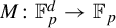 $M\colon \mathbb {F}_{p}^{d}\to \mathbb {F}_{p}$
be a quadratic form associated with the matrix A of rank at least
$M\colon \mathbb {F}_{p}^{d}\to \mathbb {F}_{p}$
be a quadratic form associated with the matrix A of rank at least $s+3$
. Then, for any
$s+3$
. Then, for any $g\in \mathrm {poly}(\mathbb {F}_{p}^{d}\to \mathbb {F}_{p})$
with
$g\in \mathrm {poly}(\mathbb {F}_{p}^{d}\to \mathbb {F}_{p})$
with $\deg (g)\leq s$
, the following are equivalent:
$\deg (g)\leq s$
, the following are equivalent:
-
(i) for all
$(n,h_{1},\ldots ,h_{s})\in \Box _{s}(V(M))$
, we have that
$\Delta _{h_{s}}\cdots \Delta _{h_{1}}g(n)=0;$
-
(ii) we have
for some
$$ \begin{align*}g=Mg_{1}+g_{2}\end{align*} $$
$g_{1},g_{2}\in \mathrm {poly}(\mathbb {F}_{p}^{d}\to \mathbb {F}_{p})$
with
$\deg (g_{1})\leq s-2$
,
$\deg (g_{2})\leq s-1$
;
-
(i) we have
for some
$$ \begin{align*}g(n)=((nA)\cdot n)g_{1}(n)+g_{2}(n)\end{align*} $$
$g_{1},g_{2}\in \mathrm {poly}(\mathbb {F}_{p}^{d}\to \mathbb {F}_{p})$
with
$\deg (g_{1})\leq s-2$
,
$\deg (g_{2})\leq s-1$
.










Proof. We first show that (ii) $\Rightarrow $
(i). For all
$\Rightarrow $
(i). For all $(n,h_{1},\ldots ,h_{s})\in \Box _{s}(V(M))$
, note that
$(n,h_{1},\ldots ,h_{s})\in \Box _{s}(V(M))$
, note that
 $$ \begin{align*} \Delta_{h_{s}}\cdots\Delta_{h_{1}}g(n)=\Delta_{h_{s}}\cdots\Delta_{h_{1}}(M(n)g_{1}(n)). \end{align*} $$
Since $M(n+\epsilon _{1}h_{1}+\cdots +\epsilon _{s}h_{s})=0$
for all
$M(n+\epsilon _{1}h_{1}+\cdots +\epsilon _{s}h_{s})=0$
for all $\epsilon _{1},\ldots ,\epsilon _{s}\in \{0,1\}$
, we have
$\epsilon _{1},\ldots ,\epsilon _{s}\in \{0,1\}$
, we have $\Delta _{h_{s}}\cdots \Delta _{h_{1}} (M(n)g_{1}(n))=0$
and we are done.
$\Delta _{h_{s}}\cdots \Delta _{h_{1}} (M(n)g_{1}(n))=0$
and we are done.
The part (i) $\Rightarrow $
(ii) follows from Proposition 6.6 (by setting
$\Rightarrow $
(ii) follows from Proposition 6.6 (by setting $k=s$
,
$k=s$
, $P\equiv 0$
, and
$P\equiv 0$
, and $Q=g$
). Finally, (ii)
$Q=g$
). Finally, (ii) $\Leftrightarrow $
(iii), since the degree of the polynomial
$\Leftrightarrow $
(iii), since the degree of the polynomial $M(n)-(nA)\cdot n$
is at most 1.
$M(n)-(nA)\cdot n$
is at most 1.
As a corollary of Proposition 6.8, we have the following.
Corollary 6.9. Let $d,k,s\in \mathbb {N}_{+}$
,
$d,k,s\in \mathbb {N}_{+}$
, $p\gg _{d} 1$
be a prime, and
$p\gg _{d} 1$
be a prime, and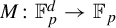 $M\colon \mathbb {F}_{p}^{d}\to \mathbb {F}_{p}$
be a non-degenerate quadratic form associated with the matrix A. Let
$M\colon \mathbb {F}_{p}^{d}\to \mathbb {F}_{p}$
be a non-degenerate quadratic form associated with the matrix A. Let $m_{1},\ldots ,m_{k}\in \mathbb {F}_{p}^{d}$
be linearly independent and non-M-isotropic vectors. If
$m_{1},\ldots ,m_{k}\in \mathbb {F}_{p}^{d}$
be linearly independent and non-M-isotropic vectors. If $d\geq k+s+3$
, then for any polynomial
$d\geq k+s+3$
, then for any polynomial $g\in \mathrm {poly}(\mathbb {F}_{p}^{d}\to \mathbb {F}_{p})$
of degree at most s, the following are equivalent:
$g\in \mathrm {poly}(\mathbb {F}_{p}^{d}\to \mathbb {F}_{p})$
of degree at most s, the following are equivalent:
-
(i) for all
$(n,h_{1},\ldots ,h_{s})\in \Box _{s}(V(M)^{m_{1},\ldots ,m_{k}})$
, we have that
$\Delta _{h_{s}}\cdots \Delta _{h_{1}}g(n)=0$
; -
(ii) we have
for some homogeneous
$$ \begin{align*} g(n)=M(n)g_{0}(n)+\sum_{i=1}^{k}(M(n+m_{i})-M(n))g_{i}(n)+g'(n) \end{align*} $$
$g_{0},\ldots ,g_{k}\in \mathrm {poly}(\mathbb {F}_{p}^{d}\to \mathbb {F}_{p})$
with
$\deg (g_{0})=s-2$
and
$\deg (g_{1})=\cdots =\deg (g_{k})=s-1$
, and some
$g'\in \mathrm {poly}(\mathbb {F}_{p}^{d}\to \mathbb {F}_{p})$
of degree at most
$s-1$
(recall that
$g_{0},\ldots ,g_{k}$
are allowed to be constant 0 by Convention 2.2);
-
(iii) we have
for some homogeneous
$$ \begin{align*} g(n)=((nA)\cdot n)g_{0}(n)+\sum_{i=1}^{k}((nA)\cdot m_{i})g_{i}(n)+g'(n) \end{align*} $$
$g_{0},\ldots ,g_{k}\in \mathrm {poly}(\mathbb {F}_{p}^{d}\to \mathbb {F}_{p})$
with
$\deg (g_{0})=s-2$
and
$\deg (g_{1})=\cdots =\deg (g_{k})=s-1$
, and some
$g'\in \mathrm {poly}(\mathbb {F}_{p}^{d}\to \mathbb {F}_{p})$
of degree at most
$s-1$
.












Proof. Let V be the span of $m_{1},\ldots ,m_{k}$
. Since
$m_{1},\ldots ,m_{k}$
. Since $m_{1},\ldots ,m_{k}$
are linearly independent and non-M-isotropic, and since A is invertible, we have that
$m_{1},\ldots ,m_{k}$
are linearly independent and non-M-isotropic, and since A is invertible, we have that $V^{\perp {M}}$
is a subspace of
$V^{\perp {M}}$
is a subspace of $\mathbb {F}_{p}^{d}$
of dimension
$\mathbb {F}_{p}^{d}$
of dimension $d-k$
with
$d-k$
with $V\cap V^{\perp {M}}=\{\mathbf {0}\}$
. Let
$V\cap V^{\perp {M}}=\{\mathbf {0}\}$
. Let
 $$ \begin{align*}W:=\{n\in\mathbb{F}_{p}^{d}\colon 2(nA)\cdot m_{i}+(m_{i}A)\cdot m_{i}=0, 1\leq i\leq k\}.\end{align*} $$
Since $m_{1},\ldots ,m_{k}$
are linearly independent and A is invertible, we may write
$m_{1},\ldots ,m_{k}$
are linearly independent and A is invertible, we may write ${W{\kern-1pt}={\kern-1pt}V^{\perp {M}}{\kern-1pt}+{\kern-1pt}w}$
for some
${W{\kern-1pt}={\kern-1pt}V^{\perp {M}}{\kern-1pt}+{\kern-1pt}w}$
for some $w\in \mathbb {F}_{p}^{d}$
.
$w\in \mathbb {F}_{p}^{d}$
.
Let $\phi \colon \mathbb {F}_{p}^{d-k}\to V^{\perp {M}}$
be any bijective linear transformation. Denote
$\phi \colon \mathbb {F}_{p}^{d-k}\to V^{\perp {M}}$
be any bijective linear transformation. Denote $M'(n'):=M(\phi (n')+w)$
and
$M'(n'):=M(\phi (n')+w)$
and $g'(n'):=g(\phi (n')+w)$
for all
$g'(n'):=g(\phi (n')+w)$
for all $n'\in \mathbb {F}_{p}^{d-k}$
. By Proposition 4.8(ii),
$n'\in \mathbb {F}_{p}^{d-k}$
. By Proposition 4.8(ii), $M'$
is a non-degenerate quadratic form and thus,
$M'$
is a non-degenerate quadratic form and thus, $\mathrm {rank}(M')=d-k\geq s+3$
. By Lemma 4.18, we have that
$\mathrm {rank}(M')=d-k\geq s+3$
. By Lemma 4.18, we have that $(n,h_{1},\ldots ,h_{s})\in \Box _{s}(V(M)^{m_{1},\ldots ,m_{k}})$
if and only if there exists
$(n,h_{1},\ldots ,h_{s})\in \Box _{s}(V(M)^{m_{1},\ldots ,m_{k}})$
if and only if there exists $(n',h^{\prime }_{1},\ldots ,h^{\prime }_{s})\in \Box _{s}(V(M'))$
with
$(n',h^{\prime }_{1},\ldots ,h^{\prime }_{s})\in \Box _{s}(V(M'))$
with $(n,h_{1},\ldots ,h_{s})=(\phi (n')+w,\phi (h^{\prime }_{1}),\ldots ,\phi (h^{\prime }_{s}))$
.
$(n,h_{1},\ldots ,h_{s})=(\phi (n')+w,\phi (h^{\prime }_{1}),\ldots ,\phi (h^{\prime }_{s}))$
.
We may then apply Proposition 6.8 to the polynomial $g'$
and the quadratic form
$g'$
and the quadratic form $M'$
, and then apply the change of variables
$M'$
, and then apply the change of variables $\phi $
to get to the conclusions. We leave the details to the interested readers.
$\phi $
to get to the conclusions. We leave the details to the interested readers.
6.5 A parallel matrix proposition
Let A and B be $\mathbb {F}_{p}$
-valued
$\mathbb {F}_{p}$
-valued $d\times d$
matrices. If B is a multiple of A, then clearly
$d\times d$
matrices. If B is a multiple of A, then clearly $nB=\mathbf {0}$
implies that
$nB=\mathbf {0}$
implies that $nA=\mathbf {0}$
. It is natural to ask if the converse is true, namely, if for many
$nA=\mathbf {0}$
. It is natural to ask if the converse is true, namely, if for many $n\in \mathbb {F}_{p}^{d}$
,
$n\in \mathbb {F}_{p}^{d}$
, $nB=\mathbf {0}$
implies that
$nB=\mathbf {0}$
implies that $nA=\mathbf {0}$
, then is it true that B must be a multiple of A. The next proposition answers this question.
$nA=\mathbf {0}$
, then is it true that B must be a multiple of A. The next proposition answers this question.
Proposition 6.10. Let $d\in \mathbb {N}_{+}$
,
$d\in \mathbb {N}_{+}$
, $\delta>0$
,
$\delta>0$
, $p\gg _{d}\delta ^{-O_{d}(1)}$
be a prime, and A be a
$p\gg _{d}\delta ^{-O_{d}(1)}$
be a prime, and A be a $\mathbb {F}_{p}$
-valued
$\mathbb {F}_{p}$
-valued $d\times d$
matrix of rank at least 3. Let B be an
$d\times d$
matrix of rank at least 3. Let B be an $\mathbb {F}_{p}$
-valued
$\mathbb {F}_{p}$
-valued $d\times d$
matrix and
$d\times d$
matrix and $v\in \mathbb {F}_{p}^{d}$
. Let W be a subset of
$v\in \mathbb {F}_{p}^{d}$
. Let W be a subset of $\mathbb {F}_{p}^{d}$
of cardinality at least
$\mathbb {F}_{p}^{d}$
of cardinality at least $\delta p^{d}$
. Suppose that for all
$\delta p^{d}$
. Suppose that for all $w\in W$
and
$w\in W$
and $n\in \mathbb {F}_{p}^{d}$
with
$n\in \mathbb {F}_{p}^{d}$
with $(nA)\cdot w=0$
, we have that
$(nA)\cdot w=0$
, we have that
 $$ \begin{align*}(nB+v)\cdot w=0.\end{align*} $$
Then, $v=\mathbf {0}$
and
$v=\mathbf {0}$
and $B=cA$
for some
$B=cA$
for some $c\in \mathbb {F}_{p}$
.
$c\in \mathbb {F}_{p}$
.
Proof. Throughout the proof, we assume that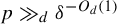 $p\gg _{d}\delta ^{-O_{d}(1)}$
. Since
$p\gg _{d}\delta ^{-O_{d}(1)}$
. Since $\mathrm {rank}(A)\geq 1$
, the set of
$\mathrm {rank}(A)\geq 1$
, the set of $w\in \mathbb {F}_{p}^{d}$
with
$w\in \mathbb {F}_{p}^{d}$
with $wA=\mathbf {0}$
is of cardinality at most
$wA=\mathbf {0}$
is of cardinality at most $p^{d-1}$
. So, shrinking
$p^{d-1}$
. So, shrinking $\delta $
to
$\delta $
to $\delta /2$
if necessary, we may assume without loss of generality that
$\delta /2$
if necessary, we may assume without loss of generality that $wA\neq \mathbf {0}$
for all
$wA\neq \mathbf {0}$
for all $w\in W$
. Fix any
$w\in W$
. Fix any $w\in W$
. Pick any
$w\in W$
. Pick any $n\in \mathbb {F}_{p}^{d}$
with
$n\in \mathbb {F}_{p}^{d}$
with $(nA)\cdot w=0$
, then also
$(nA)\cdot w=0$
, then also $(2nA)\cdot w=0$
. By assumption, we have
$(2nA)\cdot w=0$
. By assumption, we have ${(nB+v)\cdot w=(2nB+v)\cdot w=0}$
, which implies that
${(nB+v)\cdot w=(2nB+v)\cdot w=0}$
, which implies that $v\cdot w=0$
. Moreover, we have
$v\cdot w=0$
. Moreover, we have $(nA)\cdot w=0\Rightarrow (nB)\cdot w=0$
, or equivalently,
$(nA)\cdot w=0\Rightarrow (nB)\cdot w=0$
, or equivalently, $(wA)\cdot n=0\Rightarrow (wB)\cdot n=0$
for all
$(wA)\cdot n=0\Rightarrow (wB)\cdot n=0$
for all $n\in \mathbb {F}_{p}^{d}$
. So,
$n\in \mathbb {F}_{p}^{d}$
. So, $wA$
is parallel to
$wA$
is parallel to $wB$
. Since
$wB$
. Since $wA\neq \mathbf {0}$
, we have that
$wA\neq \mathbf {0}$
, we have that $wB=c_{w}wA$
for some
$wB=c_{w}wA$
for some $c_{w}\in \mathbb {F}_{p}$
.
$c_{w}\in \mathbb {F}_{p}$
.
Since W is of cardinality at least $\delta p^{d}$
, by Lemma 4.11, there exist linearly independent
$\delta p^{d}$
, by Lemma 4.11, there exist linearly independent $w_{1},\ldots ,w_{d}\in W$
. So,
$w_{1},\ldots ,w_{d}\in W$
. So, $v\cdot w_{i}=0$
for
$v\cdot w_{i}=0$
for $1\leq i\leq d$
. This implies that
$1\leq i\leq d$
. This implies that $v=\mathbf {0}$
.
$v=\mathbf {0}$
.
For $z\in \mathbb {F}_{p}^{d}$
, let
$z\in \mathbb {F}_{p}^{d}$
, let $M_{z}(n):=(nA)\cdot (n+z)$
. Then,
$M_{z}(n):=(nA)\cdot (n+z)$
. Then,
 $$ \begin{align} \sum_{z\in\mathbb{F}_{p}^{d}}\vert V(M_{z})\cap W\vert & =\sum_{z\in\mathbb{F}_{p}^{d}}\vert\{w\in W\colon (wA)\cdot (w+z)=0\}\vert \nonumber\\ &=\sum_{w\in W}\vert\{z\in \mathbb{F}_{p}^{d}\colon (wA)\cdot (w+z)=0\}\vert. \end{align} $$
Since $wA\neq \mathbf {0}$
, we have
$wA\neq \mathbf {0}$
, we have $\vert \{z\in \mathbb {F}_{p}^{d}\colon (wA)\cdot (w+z)=0\}\vert =p^{d-1}$
. So, (6.37) is at least
$\vert \{z\in \mathbb {F}_{p}^{d}\colon (wA)\cdot (w+z)=0\}\vert =p^{d-1}$
. So, (6.37) is at least $\vert W\vert \cdot p^{d-1}\geq \delta p^{2d-1}$
. By the pigeonhole principle, there exists
$\vert W\vert \cdot p^{d-1}\geq \delta p^{2d-1}$
. By the pigeonhole principle, there exists $z\in \mathbb {F}_{p}^{d}$
such that
$z\in \mathbb {F}_{p}^{d}$
such that ${\vert V(M_{z})\cap W\vert \gg \delta p^{d-1}}$
.
${\vert V(M_{z})\cap W\vert \gg \delta p^{d-1}}$
.
Since $wB=c_{w}wA$
for some
$wB=c_{w}wA$
for some $c_{w}\in \mathbb {F}_{p}$
for all
$c_{w}\in \mathbb {F}_{p}$
for all $w\in W$
, we have that
$w\in W$
, we have that
 $$ \begin{align*}(wB)\cdot (w+z)=c_{w}(wA)\cdot (w+z)=0\end{align*} $$
for all $w\in V(M_{z})\cap W$
. Since
$w\in V(M_{z})\cap W$
. Since $\vert V(M_{z})\cap W\vert \gg \delta p^{d-1}$
, by Lemma 6.1 and Proposition 6.2, we may write
$\vert V(M_{z})\cap W\vert \gg \delta p^{d-1}$
, by Lemma 6.1 and Proposition 6.2, we may write
 $$ \begin{align*}(wB)\cdot (w+z)=r_{z}M_{z}(w)=r_{z}(wA)\cdot (w+z)\end{align*} $$
for some $r_{z}\in \mathbb {F}_{p}$
for all
$r_{z}\in \mathbb {F}_{p}$
for all $w\in \mathbb {F}_{p}^{d}$
. Viewing both sides as polynomials in the variable w and comparing all of their degree 2 terms, we must have that
$w\in \mathbb {F}_{p}^{d}$
. Viewing both sides as polynomials in the variable w and comparing all of their degree 2 terms, we must have that $B=r_{z}A$
. We are done.
$B=r_{z}A$
. We are done.
7 Algebraic properties for quadratic forms in
$\mathbb {Z}/p$

In this section, we extend the results in §6 to $\mathbb {Q}$
-valued polynomials.
$\mathbb {Q}$
-valued polynomials.
7.1 Quadratic forms in
$\mathbb {Z}/p$

By using the correspondence between polynomials in $\mathbb {F}_{p}^{d}$
and in
$\mathbb {F}_{p}^{d}$
and in $\mathbb {Z}^{d}$
, we may lift all the definitions pertaining to quadratic forms in
$\mathbb {Z}^{d}$
, we may lift all the definitions pertaining to quadratic forms in $\mathbb {F}_{p}^{d}$
to the
$\mathbb {F}_{p}^{d}$
to the $\mathbb {Z}^{d}$
setting in the natural way.
$\mathbb {Z}^{d}$
setting in the natural way.
Definition 7.1. (Quadratic forms in
$\mathbb {Z}^{d}$
)

We say that a function $M\colon \mathbb {Z}^{d}\to \mathbb {Z}/p$
is a quadratic form if
$M\colon \mathbb {Z}^{d}\to \mathbb {Z}/p$
is a quadratic form if
 $$ \begin{align*}M(n)=\frac{1}{p}((nA)\cdot n+n\cdot u+v)\end{align*} $$
for some $d\times d$
symmetric matrix A in
$d\times d$
symmetric matrix A in $\mathbb {Z}$
, some
$\mathbb {Z}$
, some $u\in \mathbb {Z}^{d}$
, and some
$u\in \mathbb {Z}^{d}$
, and some $v\in \mathbb {Z}$
. We say that A is the matrix associated to M.
$v\in \mathbb {Z}$
. We say that A is the matrix associated to M.
It is more rigorous to name M as a p-quadratic form. However, since the quantity p is always clear in this paper, we simply call M to be a quadratic form for short. Whenever we define a quadratic form in this paper, we will write either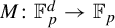 $M\colon \mathbb {F}_{p}^{d}\to \mathbb {F}_{p}$
or
$M\colon \mathbb {F}_{p}^{d}\to \mathbb {F}_{p}$
or $M\colon \mathbb {Z}^{d}\to \mathbb {Z}/p$
to specify the domain and range of M, so that the term quadratic form will not cause confusion.
$M\colon \mathbb {Z}^{d}\to \mathbb {Z}/p$
to specify the domain and range of M, so that the term quadratic form will not cause confusion.
By Lemma 2.5, any quadratic form $\tilde {M}\colon \mathbb {Z}^{d}\to \mathbb {Z}/p$
associated with the matrix
$\tilde {M}\colon \mathbb {Z}^{d}\to \mathbb {Z}/p$
associated with the matrix $\tilde {A}$
induces a quadratic form
$\tilde {A}$
induces a quadratic form $M:=\iota \circ (p\tilde {M})\circ \tau \colon \mathbb {F}_{p}^{d}\to \mathbb {F}_{p}$
associated with the matrix
$M:=\iota \circ (p\tilde {M})\circ \tau \colon \mathbb {F}_{p}^{d}\to \mathbb {F}_{p}$
associated with the matrix $\iota (\tilde {A})$
. Conversely, any quadratic form
$\iota (\tilde {A})$
. Conversely, any quadratic form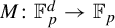 $M\colon \mathbb {F}_{p}^{d}\to \mathbb {F}_{p}$
associated with the matrix A admits a regular lifting
$M\colon \mathbb {F}_{p}^{d}\to \mathbb {F}_{p}$
associated with the matrix A admits a regular lifting $\tilde {M}\colon \mathbb {Z}^{d}\to \mathbb {Z}/p$
, which is a quadratic form associated with the matrix
$\tilde {M}\colon \mathbb {Z}^{d}\to \mathbb {Z}/p$
, which is a quadratic form associated with the matrix $\tau (A)$
.
$\tau (A)$
.
For a quadratic form $\tilde {M}\colon \mathbb {Z}^{d}\to \mathbb {Z}/p$
, we say that
$\tilde {M}\colon \mathbb {Z}^{d}\to \mathbb {Z}/p$
, we say that $\tilde {M}$
is pure/homogeneous/ p-non-degenerate if the quadratic form
$\tilde {M}$
is pure/homogeneous/ p-non-degenerate if the quadratic form $M:=\iota \circ (p\tilde {M})\circ \tau $
induced by
$M:=\iota \circ (p\tilde {M})\circ \tau $
induced by $\tilde {M}$
is pure/homogeneous/non-degenerate. The p-rank of
$\tilde {M}$
is pure/homogeneous/non-degenerate. The p-rank of $\tilde {M}$
, denoted by
$\tilde {M}$
, denoted by $\mathrm {rank}_{p}(\tilde {M})$
, is defined to be the rank of M.
$\mathrm {rank}_{p}(\tilde {M})$
, is defined to be the rank of M.
We say that $h_{1},\ldots ,h_{k}\in \mathbb {Z}^{d}$
are p-linearly independent if for all
$h_{1},\ldots ,h_{k}\in \mathbb {Z}^{d}$
are p-linearly independent if for all $c_{1},\ldots ,c_{k}\in \mathbb {Z}/p$
,
$c_{1},\ldots ,c_{k}\in \mathbb {Z}/p$
, $c_{1}h_{1}+\cdots +c_{k}h_{k}\in \mathbb {Z}$
implies that
$c_{1}h_{1}+\cdots +c_{k}h_{k}\in \mathbb {Z}$
implies that $c_{1},\ldots ,c_{k}\in \mathbb {Z}$
, or equivalently, if
$c_{1},\ldots ,c_{k}\in \mathbb {Z}$
, or equivalently, if $\iota (h_{1}),\ldots ,\iota (h_{k})$
are linearly independent.
$\iota (h_{1}),\ldots ,\iota (h_{k})$
are linearly independent.
We can also lift the definitions of sets of zeros and Gowers sets to the $\mathbb {Z}/p$
setting.
$\mathbb {Z}/p$
setting.
-
• For a polynomial
$P\in \text {poly}(\mathbb {Z}^{k}\to \mathbb {R})$
, let
$V_{p}(P)$
denote the set of
$n\in \mathbb {Z}^{k}$
such that
$P(n+pm)\in \mathbb {Z}$
for all
$m\in \mathbb {Z}^{k}$
. -
• For
$h_{1},\ldots ,h_{t}\in \mathbb {Z}^{k}$
, let
$V_{p}(P)^{h_{1},\ldots ,h_{t}}$
denote the set of
$n\in \mathbb {Z}^{k}$
such that
$P(n+pm), P(n+h_{1}+pm),\ldots ,P(n+h_{t}+pm)\in \mathbb {Z}$
for all
$m\in \mathbb {Z}^{k}$
. -
• For
$\Omega \subseteq \mathbb {Z}^{d}$
and
$s\in \mathbb {N}$
, let
$\Box _{p,s}(\Omega )$
denote the set of
$(n,h_{1},\ldots ,h_{s})\in (\mathbb {Z}^{d})^{s+1}$
such that
$n+\epsilon _{1}h_{1}+\cdots +\epsilon _{s}h_{s}\in \Omega +p\mathbb {Z}^{d}$
for all
$\epsilon _{1},\ldots ,\epsilon _{s}\in \{0,1\}$
. We say that
$\Box _{p,s}(\Omega )$
is the sth p-Gowers set of
$\Omega $
.






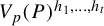








The following lemma is straightforward.
Lemma 7.2. For any p-periodic set $\Omega \subseteq \mathbb {Z}^{k}$
(recall the definition in §1.2) and
$\Omega \subseteq \mathbb {Z}^{k}$
(recall the definition in §1.2) and $K\in \mathbb {N}_{+}$
, we have that
$K\in \mathbb {N}_{+}$
, we have that
 $$ \begin{align*}\frac{1}{p^{k}}\vert \Omega \cap [p]^{k}\vert=\frac{1}{(pK)^{k}}\vert \Omega \cap [pK]^{k}\vert.\end{align*} $$
Using the connections between $\mathbb {F}_{p}$
-valued polynomials and
$\mathbb {F}_{p}$
-valued polynomials and $\mathbb {Z}/p$
-valued polynomials, one can easily extend many results in §6 to the
$\mathbb {Z}/p$
-valued polynomials, one can easily extend many results in §6 to the $\mathbb {Z}/p$
-setting. The following is an example.
$\mathbb {Z}/p$
-setting. The following is an example.
Corollary 7.3. (Lifting of Proposition 6.2)
Let $d\in \mathbb {N}_{+}$
,
$d\in \mathbb {N}_{+}$
, $s\in \mathbb {N}$
,
$s\in \mathbb {N}$
, $p\gg _{d,s} 1$
be a prime number,
$p\gg _{d,s} 1$
be a prime number, $P\in \mathrm {poly}(\mathbb {Z}^{d}\to \mathbb {Z}/p)$
be a polynomial of degree at most s, and
$P\in \mathrm {poly}(\mathbb {Z}^{d}\to \mathbb {Z}/p)$
be a polynomial of degree at most s, and ${M\colon \mathbb {Z}^{d}\to \mathbb {Z}/p}$
be a quadratic form of p-rank at least 3. Then, either
${M\colon \mathbb {Z}^{d}\to \mathbb {Z}/p}$
be a quadratic form of p-rank at least 3. Then, either $\vert V_{p}(M)\cap V_{p}(P)\cap [p]^{d}\vert \leq O_{d,s}(p^{d-2})$
or
$\vert V_{p}(M)\cap V_{p}(P)\cap [p]^{d}\vert \leq O_{d,s}(p^{d-2})$
or $V_{p}(M)\subseteq V_{p}(P)$
.
$V_{p}(M)\subseteq V_{p}(P)$
.
Moreover, if $V_{p}(M)\subseteq V_{p}(P)$
, then
$V_{p}(M)\subseteq V_{p}(P)$
, then $P=MP_{1}+P_{0}$
for some
$P=MP_{1}+P_{0}$
for some $P_{0}\in \mathrm {poly}(\mathbb {Z}^{d}\to \mathbb {Z})$
of degree at most s, and some integer coefficient polynomial
$P_{0}\in \mathrm {poly}(\mathbb {Z}^{d}\to \mathbb {Z})$
of degree at most s, and some integer coefficient polynomial $P_{1}\in \mathrm { poly}(\mathbb {Z}^{d}\to \mathbb {Z})$
of degree at most
$P_{1}\in \mathrm { poly}(\mathbb {Z}^{d}\to \mathbb {Z})$
of degree at most $s-2$
.
$s-2$
.
Proof. Let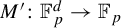 $M'\colon \mathbb {F}_{p}^{d}\to \mathbb {F}_{p}$
be the quadratic form of rank at least 3 induced by M,
$M'\colon \mathbb {F}_{p}^{d}\to \mathbb {F}_{p}$
be the quadratic form of rank at least 3 induced by M,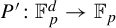 $P'\colon \mathbb {F}_{p}^{d}\to \mathbb {F}_{p}$
be the polynomial of degree at most s induced by P (whose existence is given by Lemma 2.5(i)). By Proposition 6.2, either
$P'\colon \mathbb {F}_{p}^{d}\to \mathbb {F}_{p}$
be the polynomial of degree at most s induced by P (whose existence is given by Lemma 2.5(i)). By Proposition 6.2, either $\vert V(M')\cap V(P')\vert \leq O_{d,s}(p^{d-2})$
or
$\vert V(M')\cap V(P')\vert \leq O_{d,s}(p^{d-2})$
or $V(M')\subseteq V(P')$
. By the definition of lifting, the form case implies that
$V(M')\subseteq V(P')$
. By the definition of lifting, the form case implies that $\vert V_{p}(M)\cap V_{p}(P)\cap [p]^{d}\vert =\vert V(M')\cap V(P')\vert \leq O_{d,s}(p^{d-2})$
, and the later case implies that
$\vert V_{p}(M)\cap V_{p}(P)\cap [p]^{d}\vert =\vert V(M')\cap V(P')\vert \leq O_{d,s}(p^{d-2})$
, and the later case implies that $V_{p}(M)\subseteq V_{p}(P)$
.
$V_{p}(M)\subseteq V_{p}(P)$
.
We now assume that $V_{p}(M)\subseteq V_{p}(P)$
. By the definition of lifting, we have that
$V_{p}(M)\subseteq V_{p}(P)$
. By the definition of lifting, we have that $V(M')\subseteq V(P')$
. By Proposition 6.2,
$V(M')\subseteq V(P')$
. By Proposition 6.2, $P'=M'Q'$
for some
$P'=M'Q'$
for some $Q'\in \text {poly}(\mathbb {F}_{p}^{d}\to \mathbb {F}_{p})$
of degree at most
$Q'\in \text {poly}(\mathbb {F}_{p}^{d}\to \mathbb {F}_{p})$
of degree at most $s-2$
. Let
$s-2$
. Let $Q\in \text {poly}(\mathbb {Z}^{d}\to \mathbb {Z}/p)$
be a regular lifting of
$Q\in \text {poly}(\mathbb {Z}^{d}\to \mathbb {Z}/p)$
be a regular lifting of $Q'$
of degree at most
$Q'$
of degree at most $s-2$
(whose existence is given by Lemma 2.5(ii)). By Lemma 2.5(iv) and (v),
$s-2$
(whose existence is given by Lemma 2.5(ii)). By Lemma 2.5(iv) and (v), $P-pMQ$
is a lifting of
$P-pMQ$
is a lifting of $P'-M'Q'\equiv 0$
. Then, by Lemma 2.5(iii), we have that
$P'-M'Q'\equiv 0$
. Then, by Lemma 2.5(iii), we have that $P-pMQ$
is integer valued and is of degree at most s. By Lemma 2.4, we may write
$P-pMQ$
is integer valued and is of degree at most s. By Lemma 2.4, we may write $Q=pQ_{1}+Q_{2}$
for some
$Q=pQ_{1}+Q_{2}$
for some $\mathbb {Z}$
-valued polynomial
$\mathbb {Z}$
-valued polynomial $Q_{1}$
and some integer coefficient polynomial
$Q_{1}$
and some integer coefficient polynomial $Q_{2}$
both having degrees at most
$Q_{2}$
both having degrees at most $s-2$
. Then,
$s-2$
. Then, $P=MQ_{2}+((P-pMQ)+pMQ_{1})$
with
$P=MQ_{2}+((P-pMQ)+pMQ_{1})$
with $(P-pMQ)+pMQ_{1}$
being an integer valued polynomial of degree at most s. We are done.
$(P-pMQ)+pMQ_{1}$
being an integer valued polynomial of degree at most s. We are done.
We remark that for factorization results, the $\mathbb {Z}/p$
setting differs from the
$\mathbb {Z}/p$
setting differs from the $\mathbb {F}_{p}$
setting in the appearances of integer valued polynomials. For example, the factorization in Corollary 7.3 is of the form
$\mathbb {F}_{p}$
setting in the appearances of integer valued polynomials. For example, the factorization in Corollary 7.3 is of the form $P=MP_{1}+P_{0}$
, while the factorization in Proposition 6.2 is of the form
$P=MP_{1}+P_{0}$
, while the factorization in Proposition 6.2 is of the form $P=MP_{1}$
(where
$P=MP_{1}$
(where $P_{1}$
is the R in the statement of Proposition 6.2). This extra integer valued polynomial
$P_{1}$
is the R in the statement of Proposition 6.2). This extra integer valued polynomial $P_{0}$
arises when passing from a factorization in the
$P_{0}$
arises when passing from a factorization in the $\mathbb {F}_{p}$
setting to that in the
$\mathbb {F}_{p}$
setting to that in the $\mathbb {Z}/p$
setting. The same comment applies to all the results in this section.
$\mathbb {Z}/p$
setting. The same comment applies to all the results in this section.
The approach in the proof of Corollary 7.3 can be adapted to lift many other results from the $\mathbb {F}_{p}$
-setting to the
$\mathbb {F}_{p}$
-setting to the $\mathbb {Z}/p$
-setting. Below are the liftings of some results from §6 that will be used in the future. We leave the proofs to the interested readers.
$\mathbb {Z}/p$
-setting. Below are the liftings of some results from §6 that will be used in the future. We leave the proofs to the interested readers.
Corollary 7.4. (Lifting of a special case of Proposition 6.6)
Let $d,s\in \mathbb {N}_{+}$
,
$d,s\in \mathbb {N}_{+}$
, $k\in \mathbb {N}$
,
$k\in \mathbb {N}$
, $\delta>0$
,
$\delta>0$
, $p\gg _{d,k} \delta ^{-O_{d,k}(1)}$
be a prime,
$p\gg _{d,k} \delta ^{-O_{d,k}(1)}$
be a prime, $M\colon \mathbb {Z}^{d}\to \mathbb {Z}/p$
be a quadratic form of p-rank at least
$M\colon \mathbb {Z}^{d}\to \mathbb {Z}/p$
be a quadratic form of p-rank at least $s^{2}+s+3$
, and W be a subset of
$s^{2}+s+3$
, and W be a subset of $\Box _{p,s}(V(M))\cap ([p]^{d})^{s+1}$
of cardinality at least
$\Box _{p,s}(V(M))\cap ([p]^{d})^{s+1}$
of cardinality at least $\delta \vert \Box _{p,s}(V(M))\cap ([p]^{d})^{s+1}\vert $
. Let
$\delta \vert \Box _{p,s}(V(M))\cap ([p]^{d})^{s+1}\vert $
. Let $P,Q\in \mathrm { poly}(\mathbb {Z}^{d}\to \mathbb {Z}/p)$
with
$P,Q\in \mathrm { poly}(\mathbb {Z}^{d}\to \mathbb {Z}/p)$
with $\deg (P)\leq k-1$
and
$\deg (P)\leq k-1$
and $\deg (Q)\leq k$
. Suppose that for all
$\deg (Q)\leq k$
. Suppose that for all $(n,h_{1},\ldots ,h_{s})\in W$
, we have that
$(n,h_{1},\ldots ,h_{s})\in W$
, we have that
 $$ \begin{align*}\Delta_{h_{s-1}}\cdots\Delta_{h_{1}}P(n)+\Delta_{h_{s}}\cdots\Delta_{h_{1}}Q(n)\in\mathbb{Z},\end{align*} $$
(where $\Delta _{h_{s}}\cdots \Delta _{h_{2}}P(n)$
is understood as
$\Delta _{h_{s}}\cdots \Delta _{h_{2}}P(n)$
is understood as $P(n)$
when
$P(n)$
when $s=1$
). Then,
$s=1$
). Then,
 $$ \begin{align} \begin{aligned} P=MP_{1}+P_{2}+P_{3} \quad\text{and}\quad Q=MQ_{1}+Q_{2}+Q_{3} \end{aligned} \end{align} $$
for some integer coefficient polynomials $P_{1}$
and
$P_{1}$
and $Q_{1}$
of degrees at most
$Q_{1}$
of degrees at most $k-3$
and
$k-3$
and $k-2$
, respectively, some integer valued polynomials
$k-2$
, respectively, some integer valued polynomials $P_{2}$
and
$P_{2}$
and $Q_{2}$
of degrees at most
$Q_{2}$
of degrees at most $k-1$
and k, respectively, and some
$k-1$
and k, respectively, and some $\mathbb {Z}/p$
-valued polynomials
$\mathbb {Z}/p$
-valued polynomials $P_{3}$
and
$P_{3}$
and $Q_{3}$
of degrees at most
$Q_{3}$
of degrees at most $s-2$
and
$s-2$
and $s-1$
, respectively.
$s-1$
, respectively.
Corollary 7.5. (Lifting of Proposition 6.10)
Let $d\in \mathbb {N}_{+}$
,
$d\in \mathbb {N}_{+}$
, $\delta>0$
,
$\delta>0$
,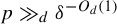 $p\gg _{d} \delta ^{-O_{d}(1)}$
be a prime, and A be a
$p\gg _{d} \delta ^{-O_{d}(1)}$
be a prime, and A be a $\mathbb {Z}$
-valued
$\mathbb {Z}$
-valued $d\times d$
matrix of p-rank at least 3. Let B be a
$d\times d$
matrix of p-rank at least 3. Let B be a $\mathbb {Z}$
-valued
$\mathbb {Z}$
-valued $d\times d$
matrix and
$d\times d$
matrix and $v\in \mathbb {Z}^{d}$
. Let W be a subset of
$v\in \mathbb {Z}^{d}$
. Let W be a subset of $[p]^{d}$
of cardinality at least
$[p]^{d}$
of cardinality at least $\delta p^{d}$
. Suppose that for all
$\delta p^{d}$
. Suppose that for all $w\in W$
and
$w\in W$
and $n\in \mathbb {Z}^{d}$
with
$n\in \mathbb {Z}^{d}$
with $(nA)\cdot w\in p\mathbb {Z}$
, we have that
$(nA)\cdot w\in p\mathbb {Z}$
, we have that
 $$ \begin{align*}(nB+v)\cdot w\in p\mathbb{Z}.\end{align*} $$
Then, $v\in p\mathbb {Z}$
and
$v\in p\mathbb {Z}$
and $B=cA+pB_{0}$
for some
$B=cA+pB_{0}$
for some $c\in \mathbb {Z}$
and some
$c\in \mathbb {Z}$
and some $d\times d$
integer valued matrix
$d\times d$
integer valued matrix $B_{0}$
.
$B_{0}$
.
7.2 Passing from p-periodic polynomials to rational ones
In this section, we extend Corollary 7.4 from $\mathbb {Z}/p$
-valued polynomials to rational polynomials.
$\mathbb {Z}/p$
-valued polynomials to rational polynomials.
Proposition 7.6. Let $d,K,s\in \mathbb {N}_{+}$
,
$d,K,s\in \mathbb {N}_{+}$
, $k\in \mathbb {N}$
,
$k\in \mathbb {N}$
, $\delta>0$
,
$\delta>0$
, $p\gg _{d,k} \delta ^{-O_{d,k}(1)}$
be a prime,
$p\gg _{d,k} \delta ^{-O_{d,k}(1)}$
be a prime, $M\colon \mathbb {Z}^{d}\to \mathbb {Z}/p$
be a quadratic form of p-rank at least
$M\colon \mathbb {Z}^{d}\to \mathbb {Z}/p$
be a quadratic form of p-rank at least $s^{2}+s+3$
, and W be a subset of
$s^{2}+s+3$
, and W be a subset of $\Box _{p,s}(V(M))\cap ([p^{2}K]^{d})^{s+1}$
of cardinality at least
$\Box _{p,s}(V(M))\cap ([p^{2}K]^{d})^{s+1}$
of cardinality at least $\delta \vert \Box _{p,s}(V(M))\cap ([p^{2}K]^{d})^{s+1}\vert $
. Let
$\delta \vert \Box _{p,s}(V(M))\cap ([p^{2}K]^{d})^{s+1}\vert $
. Let $P,Q\in \mathrm {poly}(\mathbb {Z}^{d}\to \mathbb {Q})$
with
$P,Q\in \mathrm {poly}(\mathbb {Z}^{d}\to \mathbb {Q})$
with $\deg (P)\leq k-1$
and
$\deg (P)\leq k-1$
and $\deg (Q)\leq k$
. Suppose that
$\deg (Q)\leq k$
. Suppose that
 $$ \begin{align} \Delta_{h_{s-1}}\cdots\Delta_{h_{1}}P(n){\kern-1pt}+{\kern-1pt}\Delta_{h_{s}}\cdots\Delta_{h_{1}}Q(n)\in\mathbb{Z}\! \quad\text{for all } (n,h_{1},\ldots,h_{s}){\kern-1pt}\in{\kern-1pt} W{\kern-1pt}+{\kern-1pt}p^{2}K(\mathbb{Z}^{d})^{s+1} \end{align} $$
(where $\Delta _{h_{s}}\cdots \Delta _{h_{2}}P(n)$
is understood as
$\Delta _{h_{s}}\cdots \Delta _{h_{2}}P(n)$
is understood as $P(n)$
when
$P(n)$
when $s=1$
). Then,
$s=1$
). Then,
 $$ \begin{align*} qP=P_{1}+P_{2} \quad\text{and}\quad qQ=Q_{1}+Q_{2} \end{align*} $$
for some integer $q\in \mathbb {N}_{+}$
with
$q\in \mathbb {N}_{+}$
with $q\ll _{d,k} \delta ^{-O_{d,k}(1)}$
, some
$q\ll _{d,k} \delta ^{-O_{d,k}(1)}$
, some $P_{1},Q_{1}\in \mathrm {poly}(V_{p}(M)\to \mathbb {R}\vert \mathbb {Z})$
with
$P_{1},Q_{1}\in \mathrm {poly}(V_{p}(M)\to \mathbb {R}\vert \mathbb {Z})$
with $\deg (P_{1}){\kern-1pt}\leq{\kern-1pt} k{\kern-1pt}-{\kern-1pt}1$
,
$\deg (P_{1}){\kern-1pt}\leq{\kern-1pt} k{\kern-1pt}-{\kern-1pt}1$
, $\deg (Q_{1}){\kern-1pt}\leq{\kern-1pt} k$
, and some
$\deg (Q_{1}){\kern-1pt}\leq{\kern-1pt} k$
, and some $P_{2},Q_{2}{\kern-1pt}\in{\kern-1pt} \mathrm { poly}(\mathbb {Z}^{d}{\kern-1pt}\to{\kern-1pt} \mathbb {Q})$
with
$P_{2},Q_{2}{\kern-1pt}\in{\kern-1pt} \mathrm { poly}(\mathbb {Z}^{d}{\kern-1pt}\to{\kern-1pt} \mathbb {Q})$
with ${\deg (P_{2}){\kern-1pt}\leq{\kern-1pt} s-2}$
,
${\deg (P_{2}){\kern-1pt}\leq{\kern-1pt} s-2}$
, $\deg (Q_{2})\leq s-1$
.
$\deg (Q_{2})\leq s-1$
.
In applications, K will be a large number. We also remark that all the constants in Proposition 7.6 are independent of s since the statement holds trivially when $s\geq k$
.
$s\geq k$
.
Let $f=P$
or Q. Our strategy is to decompose f as
$f=P$
or Q. Our strategy is to decompose f as $qf=\sum _{i=0}^{k}({f_{i}}/{p^{i}})$
for some
$qf=\sum _{i=0}^{k}({f_{i}}/{p^{i}})$
for some $k\in \mathbb {N}$
and
$k\in \mathbb {N}$
and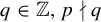 $q\in \mathbb {Z}, p\nmid q$
, where each
$q\in \mathbb {Z}, p\nmid q$
, where each $f_{i}$
is a ‘good’ polynomial, meaning that it behaves very similarly to a
$f_{i}$
is a ‘good’ polynomial, meaning that it behaves very similarly to a $\mathbb {Z}/p$
-valued polynomial. One can then prove that periodicity conditions on f descend to similar conditions on
$\mathbb {Z}/p$
-valued polynomial. One can then prove that periodicity conditions on f descend to similar conditions on $f_{k}$
, leading to the conclusion that
$f_{k}$
, leading to the conclusion that ${f_{k}}/{p}$
is ‘good’. We may then absorb the term
${f_{k}}/{p}$
is ‘good’. We may then absorb the term ${f_{k}}/{p^{k}}$
into
${f_{k}}/{p^{k}}$
into ${(f_{k-1})}/{(p^{k-1})}$
and reduce k by 1. Inductively, we have
${(f_{k-1})}/{(p^{k-1})}$
and reduce k by 1. Inductively, we have $k=0$
, which implies that
$k=0$
, which implies that $qf$
itself is ‘good’. For future references, we refer to this approach as the p-expansion trick.
$qf$
itself is ‘good’. For future references, we refer to this approach as the p-expansion trick.
Proof of Proposition 7.6
Throughout the proof, we assume that $p\gg _{d,k} \delta ^{-O_{d,k}(1)}$
.
$p\gg _{d,k} \delta ^{-O_{d,k}(1)}$
.
Step 1: setup for the induction. For convenience, denote ${d':=\mathrm {rank}_{p}(M)\geq s^{2}+s+3}$
. We assume that
${d':=\mathrm {rank}_{p}(M)\geq s^{2}+s+3}$
. We assume that $s{\kern-1pt}\leq{\kern-1pt} k{\kern-1pt}+{\kern-1pt}1$
since otherwise, one can simply take
$s{\kern-1pt}\leq{\kern-1pt} k{\kern-1pt}+{\kern-1pt}1$
since otherwise, one can simply take $P{\kern-1pt}={\kern-1pt}P_{2}, Q{\kern-1pt}={\kern-1pt}Q_{2}, q{\kern-1pt}={\kern-1pt}1$
, and
$P{\kern-1pt}={\kern-1pt}P_{2}, Q{\kern-1pt}={\kern-1pt}Q_{2}, q{\kern-1pt}={\kern-1pt}1$
, and $P_{1}=Q_{1}=0$
. Since
$P_{1}=Q_{1}=0$
. Since $P,Q$
take values in
$P,Q$
take values in $\mathbb {Q}$
and are of degree at most k, by the multivariate polynomial interpolation, there exists
$\mathbb {Q}$
and are of degree at most k, by the multivariate polynomial interpolation, there exists $q\in \mathbb {N}, p\nmid q$
, and
$q\in \mathbb {N}, p\nmid q$
, and $t_{0}\in \mathbb {N}$
such that
$t_{0}\in \mathbb {N}$
such that
 $$ \begin{align*} qP=\sum_{j=0}^{t_{0}}\frac{P^{\prime}_{j}}{p^{j}} \quad \text{and} \quad qQ=\sum_{j=0}^{t_{0}}\frac{Q^{\prime}_{j}}{p^{j}} \end{align*} $$
for some integer coefficient polynomials $P^{\prime }_{j},Q^{\prime }_{j}\in \text {poly}(\mathbb {Z}^{d}\to \mathbb {Z})$
with
$P^{\prime }_{j},Q^{\prime }_{j}\in \text {poly}(\mathbb {Z}^{d}\to \mathbb {Z})$
with $\deg (P^{\prime }_{j})\leq k-1$
and
$\deg (P^{\prime }_{j})\leq k-1$
and $\deg (Q^{\prime }_{j})\leq k$
. We say that a polynomial
$\deg (Q^{\prime }_{j})\leq k$
. We say that a polynomial $f\colon \mathbb {Z}^{d}\to \mathbb {Z}$
is good if
$f\colon \mathbb {Z}^{d}\to \mathbb {Z}$
is good if
 $$ \begin{align*}f=\sum_{j=0}^{\lfloor \deg(f)/2\rfloor}M^{j}f_{j}\end{align*} $$
for some integer coefficient polynomial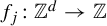 $f_{j}\colon \mathbb {Z}^{d}\to \mathbb {Z}$
of degree at most
$f_{j}\colon \mathbb {Z}^{d}\to \mathbb {Z}$
of degree at most $\deg (f)-2j$
. A good polynomial not only takes integer values in
$\deg (f)-2j$
. A good polynomial not only takes integer values in $V_{p}(M)$
, but also admits a nice decomposition in terms of M. Clearly,
$V_{p}(M)$
, but also admits a nice decomposition in terms of M. Clearly, $P^{\prime }_{0},\ldots ,P^{\prime }_{t_{0}},Q^{\prime }_{0},\ldots ,Q^{\prime }_{t_{0}}$
are good polynomials.
$P^{\prime }_{0},\ldots ,P^{\prime }_{t_{0}},Q^{\prime }_{0},\ldots ,Q^{\prime }_{t_{0}}$
are good polynomials.
Let $t\in \mathbb {N}$
be the smallest integer such that we can write
$t\in \mathbb {N}$
be the smallest integer such that we can write
 $$ \begin{align*} q'P=\sum_{j=0}^{t}\frac{P^{\prime\prime}_{j}}{p^{j}}+P' \quad \text{and} \quad q'Q=\sum_{j=0}^{t}\frac{Q^{\prime\prime}_{j}}{p^{j}}+Q' \end{align*} $$
for some $q'\in \mathbb {N}, p\nmid q'$
, some good polynomials
$q'\in \mathbb {N}, p\nmid q'$
, some good polynomials $P^{\prime \prime }_{j},Q^{\prime \prime }_{j}\in \text {poly}(\mathbb {Z}^{d}\to \mathbb {Z})$
with
$P^{\prime \prime }_{j},Q^{\prime \prime }_{j}\in \text {poly}(\mathbb {Z}^{d}\to \mathbb {Z})$
with $\deg (P^{\prime \prime }_{j}){\kern-1pt}\leq{\kern-1pt} k{\kern-1pt}-{\kern-1pt}1$
,
$\deg (P^{\prime \prime }_{j}){\kern-1pt}\leq{\kern-1pt} k{\kern-1pt}-{\kern-1pt}1$
, $\deg (Q^{\prime \prime }_{j}){\kern-1pt}\leq{\kern-1pt} k$
, and some
$\deg (Q^{\prime \prime }_{j}){\kern-1pt}\leq{\kern-1pt} k$
, and some $P',Q'{\kern-1pt}\in{\kern-1pt} \text {poly}(\mathbb {Z}^{d}\to \mathbb {Q})$
with
$P',Q'{\kern-1pt}\in{\kern-1pt} \text {poly}(\mathbb {Z}^{d}\to \mathbb {Q})$
with ${\deg (P')\leq s-2}$
and
${\deg (P')\leq s-2}$
and $\deg (Q')\leq s-1$
. Obviously, such t exists and is at most
$\deg (Q')\leq s-1$
. Obviously, such t exists and is at most $t_{0}$
. Our first goal is to show that
$t_{0}$
. Our first goal is to show that $t=0$
.
$t=0$
.
Suppose in contrast that $t>0$
. We consider the last terms and write
$t>0$
. We consider the last terms and write
 $$ \begin{align*} P^{\prime\prime}_{t}=\sum_{j=0}^{\lfloor (k-1)/2\rfloor}M^{j}P_{j} \quad\text{and}\quad Q^{\prime\prime}_{t}=\sum_{j=0}^{\lfloor k/2\rfloor}M^{j}Q_{j} \end{align*} $$
for some integer coefficient polynomials $P_{j},Q_{j}\in \text {poly}(\mathbb {Z}^{d}\to \mathbb {Z})$
with
$P_{j},Q_{j}\in \text {poly}(\mathbb {Z}^{d}\to \mathbb {Z})$
with $\deg (P_{j})\leq k-1-2j$
and
$\deg (P_{j})\leq k-1-2j$
and $\deg (Q_{j})\leq k-2j$
. We say that a polynomial
$\deg (Q_{j})\leq k-2j$
. We say that a polynomial $g\in \text {poly}(\mathbb {Z}^{d}\to \mathbb {Z})$
is s-simple if
$g\in \text {poly}(\mathbb {Z}^{d}\to \mathbb {Z})$
is s-simple if
 $$ \begin{align*} q'g=pg_{0}+pMg_{1}+g_{2} \end{align*} $$
for some $q'\in \mathbb {N}_{+}, q'\leq O_{k,s}(1)$
, some
$q'\in \mathbb {N}_{+}, q'\leq O_{k,s}(1)$
, some $g_{0}\in \text {poly}(\mathbb {Z}^{d}\to \mathbb {Z})$
with
$g_{0}\in \text {poly}(\mathbb {Z}^{d}\to \mathbb {Z})$
with $\deg (g_{0})\leq \deg (g)$
, some integer coefficient polynomials
$\deg (g_{0})\leq \deg (g)$
, some integer coefficient polynomials $g_{1}\in \text {poly}(\mathbb {Z}^{d}\to \mathbb {Z})$
with
$g_{1}\in \text {poly}(\mathbb {Z}^{d}\to \mathbb {Z})$
with $\deg (g_{0})\leq \deg (g)-2$
, and some
$\deg (g_{0})\leq \deg (g)-2$
, and some $g_{2}\in \text {poly}(\mathbb {Z}^{d}\to \mathbb {Q})$
with
$g_{2}\in \text {poly}(\mathbb {Z}^{d}\to \mathbb {Q})$
with $\deg (g_{2})\leq s-1$
. Roughly speaking, if g is s-simple, then
$\deg (g_{2})\leq s-1$
. Roughly speaking, if g is s-simple, then ${Q=q'g/p}$
is a
${Q=q'g/p}$
is a $\mathbb {Z}/p$
-valued polynomial that admits a decomposition similar to (7.1). If we can show that all of
$\mathbb {Z}/p$
-valued polynomial that admits a decomposition similar to (7.1). If we can show that all of $P_{0},\ldots ,P_{\lfloor (k-1)/2\rfloor }$
are
$P_{0},\ldots ,P_{\lfloor (k-1)/2\rfloor }$
are $(s-1)$
-simple and all of
$(s-1)$
-simple and all of $Q_{0},\ldots ,Q_{\lfloor k/2\rfloor }$
are s-simple, then enlarging the constant
$Q_{0},\ldots ,Q_{\lfloor k/2\rfloor }$
are s-simple, then enlarging the constant $q'$
if necessary, we may absorb the term
$q'$
if necessary, we may absorb the term ${P^{\prime \prime }_{t}}/{p^{t}}$
into
${P^{\prime \prime }_{t}}/{p^{t}}$
into ${(P^{\prime \prime }_{t-1})}/{(p^{t-1})}+P'$
, and the term
${(P^{\prime \prime }_{t-1})}/{(p^{t-1})}+P'$
, and the term ${Q^{\prime \prime }_{t}}/{p^{t}}$
by
${Q^{\prime \prime }_{t}}/{p^{t}}$
by ${(Q^{\prime \prime }_{t-1})}/{(p^{t-1})}+Q'$
, which contradicts the minimality of t.
${(Q^{\prime \prime }_{t-1})}/{(p^{t-1})}+Q'$
, which contradicts the minimality of t.
In the rest of the proof, we say that g is simple instead of s-simple if the value of s is clear from the context. By induction, it then suffices to show that if all of $P_{i+1},\ldots ,P_{\lfloor k/2\rfloor }, Q_{i+1},\ldots ,Q_{\lfloor k/2\rfloor }$
are simple for some
$P_{i+1},\ldots ,P_{\lfloor k/2\rfloor }, Q_{i+1},\ldots ,Q_{\lfloor k/2\rfloor }$
are simple for some $0\leq i\leq \lfloor k/2\rfloor $
, then
$0\leq i\leq \lfloor k/2\rfloor $
, then $P_{i}$
and
$P_{i}$
and $Q_{i}$
are also simple (for the special case
$Q_{i}$
are also simple (for the special case $i=\lfloor k/2\rfloor $
, we show that
$i=\lfloor k/2\rfloor $
, we show that $P_{i}$
and
$P_{i}$
and $Q_{i}$
are simple without induction hypothesis).
$Q_{i}$
are simple without induction hypothesis).
Since $P_{i+1},\ldots ,P_{\lfloor k/2\rfloor },Q_{i+1},\ldots ,Q_{\lfloor k/2\rfloor }$
are simple, enlarging the constant
$P_{i+1},\ldots ,P_{\lfloor k/2\rfloor },Q_{i+1},\ldots ,Q_{\lfloor k/2\rfloor }$
are simple, enlarging the constant $q'$
and absorbing the term
$q'$
and absorbing the term ${1}/{p^{t}}\sum _{j=i+1}^{\lfloor k/2\rfloor }M^{j}P_{j}$
into
${1}/{p^{t}}\sum _{j=i+1}^{\lfloor k/2\rfloor }M^{j}P_{j}$
into ${(P^{\prime \prime }_{t-1})}/{(p^{t-1})}+P'$
, and the term
${(P^{\prime \prime }_{t-1})}/{(p^{t-1})}+P'$
, and the term $({1}/{p^{t}})\sum _{j=i+1}^{\lfloor k/2\rfloor }M^{j}Q_{j}$
by
$({1}/{p^{t}})\sum _{j=i+1}^{\lfloor k/2\rfloor }M^{j}Q_{j}$
by ${(Q^{\prime \prime }_{t-1})}/{(p^{t-1})}+Q'$
if necessary, we may assume without loss of generality that
${(Q^{\prime \prime }_{t-1})}/{(p^{t-1})}+Q'$
if necessary, we may assume without loss of generality that
 $$ \begin{align*} P^{\prime\prime}_{t}=\sum_{j=0}^{i}M^{j}P_{j} \quad\text{and}\quad Q^{\prime\prime}_{t}=\sum_{j=0}^{i}M^{j}Q_{j}. \end{align*} $$
Step 2: the isolation trick. We first provide an outline ti show that $P_{i},Q_{i}$
are simple. For simplicity, we assume for the moment that (7.2) holds for
$P_{i},Q_{i}$
are simple. For simplicity, we assume for the moment that (7.2) holds for $(n,h_{1},\ldots ,h_{s})\in \Box _{p,s}(V(M))$
. By the construction of
$(n,h_{1},\ldots ,h_{s})\in \Box _{p,s}(V(M))$
. By the construction of $P^{\prime \prime }_{t}$
and
$P^{\prime \prime }_{t}$
and $Q^{\prime \prime }_{t}$
, and by multiplying (7.2) by
$Q^{\prime \prime }_{t}$
, and by multiplying (7.2) by $p^{t}$
, we have
$p^{t}$
, we have
 $$ \begin{align} \Delta_{h_{s-1}}\cdots\Delta_{h_{1}}P^{\prime\prime}_{t}(n){\kern-1pt}+{\kern-1pt}\Delta_{h_{s}}\cdots\Delta_{h_{1}}Q^{\prime\prime}_{t}(n){\kern-1pt}\in{\kern-1pt} p\mathbb{Z} \quad\text{for all } (n,h_{1},\ldots,h_{s}){\kern-1pt}\in{\kern-1pt}\Box_{p,s}(V(M)). \end{align} $$
If $i=0$
, then we may apply Corollary 7.4 directly to show that
$i=0$
, then we may apply Corollary 7.4 directly to show that $P_{0}$
and
$P_{0}$
and $Q_{0}$
are simple. When
$Q_{0}$
are simple. When $i>0$
, our strategy is to replace
$i>0$
, our strategy is to replace $(n,h_{1},\ldots ,h_{s})$
by
$(n,h_{1},\ldots ,h_{s})$
by $(n+pm_{0},h_{1}+pm_{1},\ldots ,h_{s}+pm_{s})$
and use the periodicity property of
$(n+pm_{0},h_{1}+pm_{1},\ldots ,h_{s}+pm_{s})$
and use the periodicity property of $P^{\prime \prime }_{t}$
and
$P^{\prime \prime }_{t}$
and $Q^{\prime \prime }_{t}$
to isolate
$Q^{\prime \prime }_{t}$
to isolate $P_{i}$
and
$P_{i}$
and $Q_{i}$
for different i (for convenience, we call this the isolation trick). To illustrate this, consider the case when
$Q_{i}$
for different i (for convenience, we call this the isolation trick). To illustrate this, consider the case when $i=1$
,
$i=1$
, $s=1$
, and
$s=1$
, and $M(n)={1}/{p}(n\cdot n)$
. Then, (7.3) implies that
$M(n)={1}/{p}(n\cdot n)$
. Then, (7.3) implies that
 $$ \begin{align} & P_{0}(n+pm_{0})+(MP_{1})(n+pm_{0})+\Delta_{h_{1}+pm_{1}}Q_{0}(n+pm_{0})\nonumber\\ & \quad+\Delta_{h_{1}+pm_{1}}(MQ_{1})(n+pm_{0})\in p\mathbb{Z} \end{align} $$
for all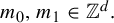 $m_{0},m_{1}\in \mathbb {Z}^{d}.$
Since
$m_{0},m_{1}\in \mathbb {Z}^{d}.$
Since $M(n+pm)\equiv M(n)+2m\cdot n \,\mod p\mathbb {Z}$
and
$M(n+pm)\equiv M(n)+2m\cdot n \,\mod p\mathbb {Z}$
and $R(n+pm)\equiv R(n)\,\mod p\mathbb {Z}$
for all integer coefficient polynomial R, one can show that the expression in (7.4) modulo
$R(n+pm)\equiv R(n)\,\mod p\mathbb {Z}$
for all integer coefficient polynomial R, one can show that the expression in (7.4) modulo $p\mathbb {Z}$
is equal to
$p\mathbb {Z}$
is equal to $P_{0}(n)+(MP_{1})(n)+\Delta _{h_{1}}Q_{0}(n)+\Delta _{h_{1}}(MQ_{1})(n)+2(m_{0}\cdot n)P_{1}(n)$
plus
$P_{0}(n)+(MP_{1})(n)+\Delta _{h_{1}}Q_{0}(n)+\Delta _{h_{1}}(MQ_{1})(n)+2(m_{0}\cdot n)P_{1}(n)$
plus
 $$ \begin{align*}2(n+h_{1})\cdot (m_{0}+m_{1})Q_{1}(n+h_{1})-2n\cdot m_{0}Q_{1}(n)+2n\cdot m_{0}P_{1}(n).\end{align*} $$
Since $m_{0}$
and
$m_{0}$
and $m_{1}$
are arbitrary, this implies that
$m_{1}$
are arbitrary, this implies that $Q_{1}(n+h_{1}), Q_{1}(n)-p_{1}(n)\in p\mathbb {Z}$
whenever
$Q_{1}(n+h_{1}), Q_{1}(n)-p_{1}(n)\in p\mathbb {Z}$
whenever $n,n+h_{1}\in V_{p}(M)$
and
$n,n+h_{1}\in V_{p}(M)$
and $n,n+h\neq \mathbf {0}$
, which implies that
$n,n+h\neq \mathbf {0}$
, which implies that $P_{1}$
and
$P_{1}$
and $Q_{1}$
are simple.
$Q_{1}$
are simple.
We now carry out this trick to the general setting. To apply the isolation trick, we need to restrict ourself to the set of $(n,h_{1},\ldots ,h_{s})$
where there is sufficient freedom in choosing
$(n,h_{1},\ldots ,h_{s})$
where there is sufficient freedom in choosing $m_{0},\ldots ,m_{s}$
. By the pigeonhole principle, there exists a subset
$m_{0},\ldots ,m_{s}$
. By the pigeonhole principle, there exists a subset $W_{0}$
of
$W_{0}$
of $\Box _{p,s}(V(M))\cap ([p]^{d})^{s+1}$
of cardinality at least
$\Box _{p,s}(V(M))\cap ([p]^{d})^{s+1}$
of cardinality at least $\delta \vert \Box _{p,s}(V(M))\cap ([p]^{d})^{s+1}\vert /2$
and for each
$\delta \vert \Box _{p,s}(V(M))\cap ([p]^{d})^{s+1}\vert /2$
and for each $(n,h_{1},\ldots ,h_{s})\in W_{0}$
, a set
$(n,h_{1},\ldots ,h_{s})\in W_{0}$
, a set $W_{0}(n,h_{1},\ldots ,h_{s})\subseteq ([pK]^{d})^{s+1}$
of cardinality at least
$W_{0}(n,h_{1},\ldots ,h_{s})\subseteq ([pK]^{d})^{s+1}$
of cardinality at least $\delta (pK)^{d(s+1)}/2$
such that
$\delta (pK)^{d(s+1)}/2$
such that
 $$ \begin{align*}(n+pm_{0},h_{1}+pm_{1},\ldots,h_{s}+pm_{s})\in W\end{align*} $$
for all $(n,h_{1},\ldots ,h_{s})\in W_{0}$
and
$(n,h_{1},\ldots ,h_{s})\in W_{0}$
and $(m_{0},\ldots ,m_{s})\in W_{0}(n,h_{1},\ldots ,h_{s})$
. Now, fix any
$(m_{0},\ldots ,m_{s})\in W_{0}(n,h_{1},\ldots ,h_{s})$
. Now, fix any $(n,h_{1},\ldots ,h_{s})\in W_{0}$
and
$(n,h_{1},\ldots ,h_{s})\in W_{0}$
and $(m_{0},\ldots ,m_{s})\in W_{0}(n,h_{1},\ldots ,h_{s})$
. We have
$(m_{0},\ldots ,m_{s})\in W_{0}(n,h_{1},\ldots ,h_{s})$
. We have
 $$ \begin{align*}\Delta_{h_{s-1}+pm_{s-1}}\cdots \Delta_{h_{1}+pm_{1}}P(n)+\Delta_{h_{s}+pm_{s}}\cdots \Delta_{h_{1}+pm_{1}}Q(n)\in\mathbb{Z}\end{align*} $$
by assumption. So,
 $$ \begin{align} \begin{aligned} \Delta_{h_{s-1}+pm_{s-1}}\cdots \Delta_{h_{1}+pm_{1}}P^{\prime\prime}_{t}(n)+\Delta_{h_{s}+pm_{s}}\cdots \Delta_{h_{1}+pm_{1}}Q^{\prime\prime}_{t}(n)\in p\mathbb{Z}. \end{aligned} \end{align} $$
We now show that (7.5) in fact holds for all $m_{0},\ldots ,m_{s}$
(and thus, we are in good shape to use the isolation trick). Assume that
$m_{0},\ldots ,m_{s}$
(and thus, we are in good shape to use the isolation trick). Assume that
 $$ \begin{align*} M(n)=\frac{1}{p}((nA)\cdot n+u\cdot n+v) \end{align*} $$
for some $d\times d$
symmetric integer coefficient matrix A, some
$d\times d$
symmetric integer coefficient matrix A, some $u\in \mathbb {Z}^{d}$
, and some
$u\in \mathbb {Z}^{d}$
, and some $v\in \mathbb {Z}$
. Then, for all
$v\in \mathbb {Z}$
. Then, for all $m,n\in V_{p}(M)$
, we have
$m,n\in V_{p}(M)$
, we have
 $$ \begin{align} M(n+pm)\equiv M(n)+((2(nA)+u)\cdot m) \,\mod p\mathbb{Z}. \end{align} $$
For any $r\in \mathbb {N}_{+} \epsilon =(\epsilon _{1},\ldots ,\epsilon _{r})\in \{0,1\}^{r}$
and
$r\in \mathbb {N}_{+} \epsilon =(\epsilon _{1},\ldots ,\epsilon _{r})\in \{0,1\}^{r}$
and $a=(a_{1},\ldots ,a_{r})\in (\mathbb {Z}^{d})^{r}$
, denote
$a=(a_{1},\ldots ,a_{r})\in (\mathbb {Z}^{d})^{r}$
, denote
 $$ \begin{align*}\epsilon\cdot a:=\epsilon_{1}a_{1}+\cdots+\epsilon_{r}a_{r}\in \mathbb{Z}^{d}.\end{align*} $$
Since $P_{j}$
and
$P_{j}$
and $Q_{j}$
have integer coefficients, it is not hard to see from (7.5) and (7.6) that for any
$Q_{j}$
have integer coefficients, it is not hard to see from (7.5) and (7.6) that for any $(n,h_{1},\ldots ,h_{s})\in W_{0}$
and
$(n,h_{1},\ldots ,h_{s})\in W_{0}$
and $(m_{0},\ldots ,m_{s})\in W_{0}(n,h_{1},\ldots ,h_{s})$
, we have
$(m_{0},\ldots ,m_{s})\in W_{0}(n,h_{1},\ldots ,h_{s})$
, we have
 $$ \begin{align} & \frac{1}{p}\sum_{j=0}^{i}\sum_{\epsilon_{\ast}\in\{0,1\}^{s-1}}(-1)^{\vert\epsilon_{\ast}\vert}(M(n'+\epsilon_{\ast}\cdot h_{\ast}) \nonumber \\ & \qquad\qquad\qquad\qquad\qquad +(2(n'+\epsilon_{\ast}\cdot h_{\ast})A+u)\cdot (\epsilon_{\ast}\cdot m_{\ast}))^{j} P_{j}(n'+\epsilon_{\ast}\cdot h_{\ast}) \nonumber\\ &\quad+\frac{1}{p}\sum_{j=0}^{i}\sum_{\epsilon\in\{0,1\}^{s}}(-1)^{\vert\epsilon\vert}(M(n'+\epsilon\cdot h)\nonumber\\ & \qquad\qquad\qquad\qquad\qquad\quad +(2(n'+\epsilon\cdot h)A+u)\cdot (\epsilon\cdot m))^{j} Q_{j}(n'+\epsilon\cdot h)\in \mathbb{Z}, \end{align} $$
where $n'=n+pm_{0}$
,
$n'=n+pm_{0}$
, $h=(h_{1},\ldots ,h_{s})$
,
$h=(h_{1},\ldots ,h_{s})$
, $h_{\ast }=(h_{1},\ldots ,h_{s-1})$
,
$h_{\ast }=(h_{1},\ldots ,h_{s-1})$
, $m=(m_{1},\ldots ,m_{s})$
, and
$m=(m_{1},\ldots ,m_{s})$
, and $m_{\ast }=(m_{1},\ldots ,m_{s-1})$
, and the terms
$m_{\ast }=(m_{1},\ldots ,m_{s-1})$
, and the terms $\epsilon _{\ast }, h_{\ast },m_{\ast }$
are regarded as non-existing if
$\epsilon _{\ast }, h_{\ast },m_{\ast }$
are regarded as non-existing if $s=1$
. Since
$s=1$
. Since $P_{i}$
and
$P_{i}$
and $Q_{i}$
have integer coefficients, the residue class mod
$Q_{i}$
have integer coefficients, the residue class mod $\mathbb {Z}$
of the left-hand side of (7.7) remains unchanged if we replace
$\mathbb {Z}$
of the left-hand side of (7.7) remains unchanged if we replace $m_{i}$
by
$m_{i}$
by $m_{i} \,\mod p\mathbb {Z}$
for
$m_{i} \,\mod p\mathbb {Z}$
for $0\leq i\leq s$
. In other words, for fixed
$0\leq i\leq s$
. In other words, for fixed $(n,h_{1},\ldots ,h_{s})\in W_{0}$
, the left-hand side of (7.7) is a p-periodic polynomial in the variables
$(n,h_{1},\ldots ,h_{s})\in W_{0}$
, the left-hand side of (7.7) is a p-periodic polynomial in the variables $(m_{0},\ldots ,m_{s})$
. Since
$(m_{0},\ldots ,m_{s})$
. Since $W_{0}(n,h_{1},\ldots ,h_{s}) \,\mod p(\mathbb {Z}^{d})^{s+1}$
contains at least
$W_{0}(n,h_{1},\ldots ,h_{s}) \,\mod p(\mathbb {Z}^{d})^{s+1}$
contains at least $\delta p^{d(s+1)}/2$
residue classes mod
$\delta p^{d(s+1)}/2$
residue classes mod $p\mathbb {Z}$
, it follows from Lemma 4.10 that (7.7) (and thus (7.5)) holds for all
$p\mathbb {Z}$
, it follows from Lemma 4.10 that (7.7) (and thus (7.5)) holds for all $m_{0},\ldots ,m_{s}\in \mathbb {Z}^{d}$
and for all
$m_{0},\ldots ,m_{s}\in \mathbb {Z}^{d}$
and for all $(n,h_{1},\ldots ,h_{s})\in W_{0}$
(and thus, for all
$(n,h_{1},\ldots ,h_{s})\in W_{0}$
(and thus, for all $(n,h_{1},\ldots ,h_{s})\in W_{0}+p(\mathbb {Z}^{d})^{s+1}$
).
$(n,h_{1},\ldots ,h_{s})\in W_{0}+p(\mathbb {Z}^{d})^{s+1}$
).
We now apply the isolation trick to (7.7) to deduce information on $P_{i}$
and
$P_{i}$
and $Q_{i}$
. We first consider the case when
$Q_{i}$
. We first consider the case when $2nA+u,h_{1}A,\ldots ,h_{s}A$
are p-linearly independent (this corresponds to the condition where
$2nA+u,h_{1}A,\ldots ,h_{s}A$
are p-linearly independent (this corresponds to the condition where $n,n+h\neq \mathbf {0}$
in the outlined example). It is not hard to see that for any
$n,n+h\neq \mathbf {0}$
in the outlined example). It is not hard to see that for any $1\leq j\leq i$
and
$1\leq j\leq i$
and $c_{j}\in \mathbb {Z}^{d}$
, there exists
$c_{j}\in \mathbb {Z}^{d}$
, there exists $m_{j}\in \mathbb {Z}^{d}$
such that
$m_{j}\in \mathbb {Z}^{d}$
such that
 $$ \begin{align*}(2nA+u)\cdot m_{j}, (h_{j'}A)\cdot m_{j}, (h_{i+j}A)\cdot m_{j}-c_{j}\in p\mathbb{Z}\end{align*} $$
for all $1\leq j'\leq s, j'\neq i+j$
. For
$1\leq j'\leq s, j'\neq i+j$
. For $i+1\leq j\leq s$
, let
$i+1\leq j\leq s$
, let $m_{j}=\mathbf {0}$
.
$m_{j}=\mathbf {0}$
.
The generalization of the isolation trick to the case $i\geq 2$
requires a lot of computations, which is what we will do now. Then, for all
$i\geq 2$
requires a lot of computations, which is what we will do now. Then, for all $0\leq j\leq i$
and
$0\leq j\leq i$
and $\epsilon _{\ast }\in \{0,1\}^{s-1}$
, we have that
$\epsilon _{\ast }\in \{0,1\}^{s-1}$
, we have that
 $$ \begin{align} & (M(n+\epsilon_{\ast}\cdot h_{\ast})+(2(n+\epsilon_{\ast}\cdot h_{\ast})A+u)\cdot (\epsilon_{\ast}\cdot m_{\ast}))^{j}P_{j}(n+\epsilon_{\ast}\cdot h_{\ast})\nonumber\\ &\quad=(M(n+\epsilon_{\ast}\cdot h_{\ast})+(2(n+\epsilon'\cdot h'+\epsilon^{\prime\prime}_{\ast}\cdot h^{\prime\prime}_{\ast})A+u)\cdot (\epsilon'\cdot m'))^{j}P_{j}(n+\epsilon_{\ast}\cdot h_{\ast})\nonumber\\ &\quad \equiv\bigg(M(n+\epsilon_{\ast}\cdot h_{\ast})+2\sum_{\ell=1}^{i}\epsilon_{\ell}\epsilon_{i+\ell}c_{\ell}\bigg)^{j}P_{j}(n+\epsilon_{\ast}\cdot h_{\ast}) \,\mod p\mathbb{Z}, \end{align} $$
where $h':=(h_{1},\ldots ,h_{i})$
,
$h':=(h_{1},\ldots ,h_{i})$
, $h^{\prime \prime }_{\ast }:=(h_{i+1},\ldots ,h_{s-1})$
,
$h^{\prime \prime }_{\ast }:=(h_{i+1},\ldots ,h_{s-1})$
, $\epsilon ':=(\epsilon _{1},\ldots ,\epsilon _{i})$
, and
$\epsilon ':=(\epsilon _{1},\ldots ,\epsilon _{i})$
, and $\epsilon ^{\prime \prime }_{\ast }:=(\epsilon _{i+1}, \ldots ,\epsilon _{s-1})$
. Similarly, for all
$\epsilon ^{\prime \prime }_{\ast }:=(\epsilon _{i+1}, \ldots ,\epsilon _{s-1})$
. Similarly, for all $0\leq j\leq i$
and
$0\leq j\leq i$
and $\epsilon \in \{0,1\}^{s}$
, we have that
$\epsilon \in \{0,1\}^{s}$
, we have that
 $$ \begin{align} &(M(n+\epsilon\cdot h)+(2(n+\epsilon\cdot h)A+u)\cdot (\epsilon\cdot m))^{j}Q_{j}(n+\epsilon\cdot h)\nonumber\\ &\quad\equiv\bigg(M(n+\epsilon\cdot h)+2\sum_{\ell=1}^{i}\epsilon_{\ell}\epsilon_{i+\ell}c_{\ell}\bigg)^{j}Q_{j}(n+\epsilon\cdot h) \,\mod p\mathbb{Z}. \end{align} $$
Combining (7.7), (7.8), and (7.9), we have that
 $$ \begin{align} &\sum_{j=0}^{i}\sum_{\epsilon_{\ast}\in\{0,1\}^{s-1}}(-1)^{\vert\epsilon_{\ast}\vert} \bigg(M(n+\epsilon_{\ast}\cdot h_{\ast})+2\sum_{\ell=1}^{i}\epsilon_{\ell}\epsilon_{i+\ell}c_{\ell}\bigg)^{j}P_{j}(n+\epsilon_{\ast}\cdot h_{\ast}) \nonumber\\ &\quad+\sum_{j=0}^{i}\sum_{\epsilon\in\{0,1\}^{s}}(-1)^{\vert\epsilon\vert} \bigg(M(n+\epsilon\cdot h)+2\sum_{\ell=1}^{i}\epsilon_{\ell}\epsilon_{i+\ell}c_{\ell}\bigg)^{j}Q_{j}(n+\epsilon\cdot h)\in p\mathbb{Z} \end{align} $$
for all $c_{1},\ldots ,c_{j}\in \mathbb {Z}^{d}$
. Viewing (7.10) as a polynomial of
$c_{1},\ldots ,c_{j}\in \mathbb {Z}^{d}$
. Viewing (7.10) as a polynomial of $c_{1},\ldots ,c_{i}$
and considering the coefficient of the term
$c_{1},\ldots ,c_{i}$
and considering the coefficient of the term $c_{1}\cdot \cdots \cdot c_{i}$
, by interpolation, we have that
$c_{1}\cdot \cdots \cdot c_{i}$
, by interpolation, we have that
 $$ \begin{align*} \begin{aligned} & q"\sum_{\epsilon^{\prime\prime\prime}_{\ast}\in\{0,1\}^{s-2i-1}}(-1)^{\vert\epsilon^{\prime\prime\prime}_{\ast}\vert} P_{i}(n+h_{1}+\cdots+h_{2i}+\epsilon^{\prime\prime\prime}_{\ast}\cdot h^{\prime\prime\prime}_{\ast})\\ & \quad +q"\sum_{\epsilon"'\in\{0,1\}^{s-2i}}(-1)^{\vert\epsilon"'\vert} Q_{i}(n+h_{1}+\cdots+h_{2i}+\epsilon"'\cdot h"')\in p\mathbb{Z} \end{aligned} \end{align*} $$
for some $q"\in \mathbb {N}_{+}, q"\leq O_{d,k}(1)$
, where
$q"\in \mathbb {N}_{+}, q"\leq O_{d,k}(1)$
, where $h"'=(h_{2i+1},\ldots ,h_{s}), h^{\prime \prime \prime }_{\ast }=(h_{2i+1},\ldots ,h_{s-1})$
,
$h"'=(h_{2i+1},\ldots ,h_{s}), h^{\prime \prime \prime }_{\ast }=(h_{2i+1},\ldots ,h_{s-1})$
, $\epsilon ^{\prime \prime \prime }_{\ast }=(\epsilon _{2i+1},\ldots ,\epsilon _{s-1})$
, and
$\epsilon ^{\prime \prime \prime }_{\ast }=(\epsilon _{2i+1},\ldots ,\epsilon _{s-1})$
, and $\epsilon "'=(\epsilon _{2i+1},\ldots ,\epsilon _{s})$
, and the sum
$\epsilon "'=(\epsilon _{2i+1},\ldots ,\epsilon _{s})$
, and the sum
 $$ \begin{align*} \sum_{\epsilon\in\{0,1\}^{r}}(-1)^{\vert\epsilon\vert}a(n+\epsilon\cdot h) \end{align*} $$
is considered as $a(n)$
if
$a(n)$
if $r=0$
, and as
$r=0$
, and as $0$
if
$0$
if $r<0$
. In conclusion, we have that
$r<0$
. In conclusion, we have that
 $$ \begin{align} \begin{aligned} q"(\Delta_{h_{s-1}}\cdots\Delta_{h_{2i+1}}P_{i}(n')+\Delta_{h_{s}}\cdots\Delta_{h_{2i+1}}Q_{i}(n')) \in p\mathbb{Z} \end{aligned} \end{align} $$
with $n'=n+h_{1}+\cdots +h_{2i}$
for all
$n'=n+h_{1}+\cdots +h_{2i}$
for all $(n,h_{1},\ldots ,h_{s})\in W_{0}+p(\mathbb {Z}^{d})^{s+1}$
such that
$(n,h_{1},\ldots ,h_{s})\in W_{0}+p(\mathbb {Z}^{d})^{s+1}$
such that $2nA+u,h_{1}A,\ldots ,h_{s}A$
are p-linearly independent.
$2nA+u,h_{1}A,\ldots ,h_{s}A$
are p-linearly independent.
Step 3: imposing linear independent conditions. The problem is now reduced to a point where Corollary 7.4 is applicable, as long as $2nA+u,h_{1}A,\ldots ,h_{s}A$
are rarely p-linearly dependent. It is convenient to work in the
$2nA+u,h_{1}A,\ldots ,h_{s}A$
are rarely p-linearly dependent. It is convenient to work in the $\mathbb {F}_{p}^{d}$
-setting in Step 3. Let
$\mathbb {F}_{p}^{d}$
-setting in Step 3. Let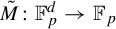 $\tilde {M}\colon \mathbb {F}_{p}^{d}\to \mathbb {F}_{p}$
be the non-degenerate quadratic form induced by M, and
$\tilde {M}\colon \mathbb {F}_{p}^{d}\to \mathbb {F}_{p}$
be the non-degenerate quadratic form induced by M, and $W'$
be the set of
$W'$
be the set of $(n',h_{2i+1},\ldots ,h_{s})\in (\mathbb {F}_{p}^{d})^{s-2i+1}$
such that
$(n',h_{2i+1},\ldots ,h_{s})\in (\mathbb {F}_{p}^{d})^{s-2i+1}$
such that $n'=n+h_{1}+\cdots +h_{2i}$
for some
$n'=n+h_{1}+\cdots +h_{2i}$
for some $(n,h_{1},\ldots ,h_{s})\in \iota (W_{0})$
such that
$(n,h_{1},\ldots ,h_{s})\in \iota (W_{0})$
such that $2n\iota (A)+\iota (u),h_{1}\iota (A),\ldots ,h_{s}\iota (A)$
are linearly independent. Then, it is not hard to see that (7.11) holds for all
$2n\iota (A)+\iota (u),h_{1}\iota (A),\ldots ,h_{s}\iota (A)$
are linearly independent. Then, it is not hard to see that (7.11) holds for all $(n',h_{2i+1},\ldots ,h_{s})\in \iota ^{-1}(W')$
. If we can show that
$(n',h_{2i+1},\ldots ,h_{s})\in \iota ^{-1}(W')$
. If we can show that ${\vert W'\vert \geq \delta \vert \Box _{s-2i}(V(\tilde {M}))\vert /8}$
, then it follows from (7.11) and Corollary 7.4 that
${\vert W'\vert \geq \delta \vert \Box _{s-2i}(V(\tilde {M}))\vert /8}$
, then it follows from (7.11) and Corollary 7.4 that $P_{i}$
and
$P_{i}$
and $Q_{i}$
are simple.
$Q_{i}$
are simple.
We now estimate the cardinality of $W'$
. Since
$W'$
. Since $d'\geq s^{2}+s+3$
, it follows from Proposition 4.19 that
$d'\geq s^{2}+s+3$
, it follows from Proposition 4.19 that
 $$ \begin{align} \vert\Box_{j}(V(\tilde{M}))\vert=p^{(j+1)d-(({j(j+1)}/{2})+1)}(1+O_{j}(p^{-1/2})) \end{align} $$
for all $0\leq j\leq s$
. For convenience, denote
$0\leq j\leq s$
. For convenience, denote $\mathbf {x}:=(n',h_{2i+1},\ldots ,h_{s})$
. We say that
$\mathbf {x}:=(n',h_{2i+1},\ldots ,h_{s})$
. We say that $\mathbf {x}$
is good if
$\mathbf {x}$
is good if $2n'\iota (A)+\iota (u),h_{2i+1}\iota (A),\ldots ,h_{s}\iota (A)$
are linearly independent. Let
$2n'\iota (A)+\iota (u),h_{2i+1}\iota (A),\ldots ,h_{s}\iota (A)$
are linearly independent. Let $W^{\prime }_{\mathbf {x}}$
denote the set of
$W^{\prime }_{\mathbf {x}}$
denote the set of $(h_{1},\ldots ,h_{2i})\in (\mathbb {F}_{p}^{d})^{2i}$
such that
$(h_{1},\ldots ,h_{2i})\in (\mathbb {F}_{p}^{d})^{2i}$
such that $(n'-h_{1}-\cdots -h_{2i},h_{1},\ldots ,h_{s})\in \iota (W)$
. Then,
$(n'-h_{1}-\cdots -h_{2i},h_{1},\ldots ,h_{s})\in \iota (W)$
. Then,
 $$ \begin{align} \sum_{\mathbf{x}\in \Box_{s-2i}(V(\tilde{M}))}\vert W^{\prime}_{\mathbf{x}}\vert{\kern-1pt}={\kern-1pt}\vert W_{0}\vert\geq \delta \vert\Box_{s}(V(\tilde{M}))\vert/2{\kern-1pt}={\kern-1pt}\frac{1}{2}\delta p^{(s+1)d-(({s(s+1)}/{2})+1)}(1+O_{s}(p^{-1/2})). \end{align} $$
Therefore, informally speaking, by (7.12) and (7.13), on average, the cardinality of $W^{\prime }_{\mathbf {x}}$
is at least
$W^{\prime }_{\mathbf {x}}$
is at least $\delta p^{2id-(2s-2i+1)i}/2$
.
$\delta p^{2id-(2s-2i+1)i}/2$
.
Note that for good $\mathbf {x}$
,
$\mathbf {x}$
, $(h_{1},\ldots ,h_{2i})\in W^{\prime }_{\mathbf {x}}$
only if
$(h_{1},\ldots ,h_{2i})\in W^{\prime }_{\mathbf {x}}$
only if $(n'-h_{1}-\cdots -h_{2i},h_{1},\ldots ,h_{s})\in \Box _{s}(V(\tilde {M}))$
. Using Lemma 4.18, this is equivalent of saying that:
$(n'-h_{1}-\cdots -h_{2i},h_{1},\ldots ,h_{s})\in \Box _{s}(V(\tilde {M}))$
. Using Lemma 4.18, this is equivalent of saying that:
-
•
$\tilde {M}(n')-\tilde {M}(n'-h_{j})=(2n'\iota (A)+\iota (u))\cdot h_{j}=0$
for all
$1\leq j\leq 2i$
; -
•
$(h_{j}\iota (A))\cdot h_{j'}=0$
for all
$1\leq j,j'\leq s$
with at least one of
$j,j'$
belonging to
$\{1,\ldots ,2i\}$
.






There are in total $(2s-2i+1)i\leq (s+1/2)^{2}/2$
independent equations above in total. Since
$(2s-2i+1)i\leq (s+1/2)^{2}/2$
independent equations above in total. Since $d\geq s^{2}+s+3$
, by repeatedly using Corollary 4.16 and the fact that
$d\geq s^{2}+s+3$
, by repeatedly using Corollary 4.16 and the fact that $\mathbf {x}$
is good, it is not difficult to show that
$\mathbf {x}$
is good, it is not difficult to show that
 $$ \begin{align} \vert W^{\prime}_{\mathbf{x}}\vert\leq p^{2id-(2s-2i+1)i}(1+O_{s}(p^{-1/2})). \end{align} $$
We leave the proof of (7.14) to the interested readers. (Alternatively, (7.14) can also be deduced as a special case of [Reference Sun18, Theorem 5.11] (in the terminology introduced in [Reference Sun18], $W^{\prime }_{\mathbf {x}}$
is a subset of an
$W^{\prime }_{\mathbf {x}}$
is a subset of an $\tilde {M}$
-set of total co-dimension
$\tilde {M}$
-set of total co-dimension $(2s-2i+1)i$
).)
$(2s-2i+1)i$
).)
Let $V:=\{n\iota (A)\colon n\in \mathbb {F}_{p}^{d}\}\subseteq \mathbb {F}_{p}^{d}$
. Then, V is a subspace of
$V:=\{n\iota (A)\colon n\in \mathbb {F}_{p}^{d}\}\subseteq \mathbb {F}_{p}^{d}$
. Then, V is a subspace of $\mathbb {F}_{p}^{d}$
of dimension
$\mathbb {F}_{p}^{d}$
of dimension $d'$
. Let
$d'$
. Let $V'$
be the set of
$V'$
be the set of $m,m_{2i+1},\ldots ,m_{s}\in V$
such that
$m,m_{2i+1},\ldots ,m_{s}\in V$
such that $2m+\iota (u),m_{2i+1},\ldots ,m_{s}$
are linearly dependent. Similar to the proof of Lemma 4.11(i), it is not hard to see the
$2m+\iota (u),m_{2i+1},\ldots ,m_{s}$
are linearly dependent. Similar to the proof of Lemma 4.11(i), it is not hard to see the ${\vert V'\vert \leq sp^{(d+1)(s-2i)}}$
. However, for each
${\vert V'\vert \leq sp^{(d+1)(s-2i)}}$
. However, for each $m\in V$
, the number of
$m\in V$
, the number of $n\in \mathbb {F}_{p}^{d}$
such that
$n\in \mathbb {F}_{p}^{d}$
such that ${n\iota (A)=m}$
is at most
${n\iota (A)=m}$
is at most $p^{d-d'}$
. Therefore, the number of
$p^{d-d'}$
. Therefore, the number of $\mathbf {x}\in (\mathbb {F}_{p}^{d})^{s-2i+1}$
which are not good is at most
$\mathbf {x}\in (\mathbb {F}_{p}^{d})^{s-2i+1}$
which are not good is at most $p^{d-d'}\vert V'\vert \leq sp^{(s-2i+1)d+(s-2i)-d'}$
. So,
$p^{d-d'}\vert V'\vert \leq sp^{(s-2i+1)d+(s-2i)-d'}$
. So,
 $$ \begin{align} \sum_{\mathbf{x}\in (\mathbb{F}_{p}^{d})^{s-2i+1},\ \textbf{x} \text{ is not good}}\vert W^{\prime}_{\mathbf{x}}\vert\leq sp^{(s-2i+1)d+(s-2i)-d'}\cdot p^{2id}=sp^{(s+1)d+(s-2i)-d'}. \end{align} $$
Since $(s+1)d+(s-2i)-d'<(s+1)d-(({s(s+1)}/{2})+1)$
, it follows from (7.12), (7.13), (7.14), (7.15), and the pigeonhole principle that there exists a subset
$(s+1)d+(s-2i)-d'<(s+1)d-(({s(s+1)}/{2})+1)$
, it follows from (7.12), (7.13), (7.14), (7.15), and the pigeonhole principle that there exists a subset $W"\subseteq \Box _{s-2i} (V(\tilde {M}))$
of cardinality at least
$W"\subseteq \Box _{s-2i} (V(\tilde {M}))$
of cardinality at least $\delta \vert \Box _{s-2i}(V(\tilde {M}))\vert /20$
such that
$\delta \vert \Box _{s-2i}(V(\tilde {M}))\vert /20$
such that $\vert W^{\prime }_{\mathbf {x}}\vert \geq \delta p^{2id-(2s-2i+1)i}/20$
for all
$\vert W^{\prime }_{\mathbf {x}}\vert \geq \delta p^{2id-(2s-2i+1)i}/20$
for all $\mathbf {x}\in W"$
. In particular,
$\mathbf {x}\in W"$
. In particular, $W^{\prime }_{\mathbf {x}}$
is non-empty for all
$W^{\prime }_{\mathbf {x}}$
is non-empty for all $\mathbf {x}\in W"$
. Therefore,
$\mathbf {x}\in W"$
. Therefore, $W"$
is a subset of
$W"$
is a subset of $W'$
and thus,
$W'$
and thus, $\vert W'\vert \geq \vert W"\vert \geq \delta \vert \Box _{s-2i}(V(\tilde {M}))\vert /20$
.
$\vert W'\vert \geq \vert W"\vert \geq \delta \vert \Box _{s-2i}(V(\tilde {M}))\vert /20$
.
Step 4: reducing the complexity of the denominator. In conclusion, we have shown by induction that $t=0$
and, therefore, we may write
$t=0$
and, therefore, we may write
 $$ \begin{align*}qP=P^{\prime}_{0}+P' \quad\text{and}\quad qQ=Q^{\prime}_{0}+Q'\end{align*} $$
for some good polynomials $P^{\prime }_{0},Q^{\prime }_{0}$
of degrees at most
$P^{\prime }_{0},Q^{\prime }_{0}$
of degrees at most $k-1$
and k, respectively, and some
$k-1$
and k, respectively, and some $P',Q'\in \text {poly}(\mathbb {Z}^{d}\to \mathbb {Q})$
of with
$P',Q'\in \text {poly}(\mathbb {Z}^{d}\to \mathbb {Q})$
of with $\deg (P')\leq s-2$
and
$\deg (P')\leq s-2$
and $\deg (Q')\leq s-1$
. Our final goal is to show that one can further require q to be small.
$\deg (Q')\leq s-1$
. Our final goal is to show that one can further require q to be small.
Let $q^{\ast }\in \mathbb {N}_{+}$
be such that
$q^{\ast }\in \mathbb {N}_{+}$
be such that $qq^{\ast }\equiv 1 \,\mod p^{k}\mathbb {Z}$
. Then,
$qq^{\ast }\equiv 1 \,\mod p^{k}\mathbb {Z}$
. Then, $P=({1-qq^{\ast }}/{q})P^{\prime }_{0}+q^{\ast }P^{\prime }_{0}+{1}/{q}P'$
. Denote
$P=({1-qq^{\ast }}/{q})P^{\prime }_{0}+q^{\ast }P^{\prime }_{0}+{1}/{q}P'$
. Denote $P_{0}:=(1-qq^{\ast })P^{\prime }_{0}$
. Since
$P_{0}:=(1-qq^{\ast })P^{\prime }_{0}$
. Since $P^{\prime }_{0}$
is good, we have that
$P^{\prime }_{0}$
is good, we have that $P_{0}$
has coefficients in
$P_{0}$
has coefficients in $\mathbb {Z}$
and that
$\mathbb {Z}$
and that $\Delta _{h_{s-1}}\cdots \Delta _{h_{1}}(q^{\ast }P^{\prime }_{0})(n)\in \mathbb {Z}$
for all
$\Delta _{h_{s-1}}\cdots \Delta _{h_{1}}(q^{\ast }P^{\prime }_{0})(n)\in \mathbb {Z}$
for all $(n,h_{1},\ldots ,h_{s})\in \Box _{p,s}(V(M))$
. Similarly,
$(n,h_{1},\ldots ,h_{s})\in \Box _{p,s}(V(M))$
. Similarly, $Q_{0}:=(1-qq^{\ast })Q^{\prime }_{0}$
also has coefficients in
$Q_{0}:=(1-qq^{\ast })Q^{\prime }_{0}$
also has coefficients in $\mathbb {Z}$
, and
$\mathbb {Z}$
, and $\Delta _{h_{s}}\cdots \Delta _{h_{1}}(q^{\ast }Q^{\prime }_{0})(n)\in \mathbb {Z}$
for all
$\Delta _{h_{s}}\cdots \Delta _{h_{1}}(q^{\ast }Q^{\prime }_{0})(n)\in \mathbb {Z}$
for all $(n,h_{1},\ldots ,h_{s})\in \Box _{p,s}(V(M))$
. So, we have that
$(n,h_{1},\ldots ,h_{s})\in \Box _{p,s}(V(M))$
. So, we have that
 $$ \begin{align} \Delta_{h_{s-1}}\cdots\Delta_{h_{1}}P_{0}(n)+\Delta_{h_{s}}\cdots\Delta_{h_{1}}Q_{0}(n)\in q\mathbb{Z} \end{align} $$
for all $(n,h_{1},\ldots ,h_{s})\in W+([pK']^{d})^{s+1}$
, where for convenience, we denote
$(n,h_{1},\ldots ,h_{s})\in W+([pK']^{d})^{s+1}$
, where for convenience, we denote $K':=pK$
.
$K':=pK$
.
Our strategy is to fix $(n,h_{1},\ldots ,h_{s})$
, apply (7.16) for
$(n,h_{1},\ldots ,h_{s})$
, apply (7.16) for $(n{\kern-1pt}+{\kern-1pt}pm_{0},h_{1}{\kern-1pt}+{\kern-1pt}pm_{1},\ldots , h_{s}{\kern-1pt}+{\kern-1pt}pm_{s})$
, and then apply Proposition 3.18 as a polynomial in the variables
$(n{\kern-1pt}+{\kern-1pt}pm_{0},h_{1}{\kern-1pt}+{\kern-1pt}pm_{1},\ldots , h_{s}{\kern-1pt}+{\kern-1pt}pm_{s})$
, and then apply Proposition 3.18 as a polynomial in the variables $m_{0},\ldots ,m_{s}$
. By the pigeonhole principle, there exists some
$m_{0},\ldots ,m_{s}$
. By the pigeonhole principle, there exists some $(n,h_{1},\ldots ,h_{s})\in \Box _{p,s}(V(M))\cap ([p]^{d})^{s+1}$
and a subset
$(n,h_{1},\ldots ,h_{s})\in \Box _{p,s}(V(M))\cap ([p]^{d})^{s+1}$
and a subset $J\subseteq ([K']^{d})^{s+1}$
of cardinality at least
$J\subseteq ([K']^{d})^{s+1}$
of cardinality at least $\delta { K'}^{d(s+1)}$
such that
$\delta { K'}^{d(s+1)}$
such that $(n+pm_{0},h_{1}+pm_{1},\ldots ,h_{s}+pm_{s})\in W$
for all
$(n+pm_{0},h_{1}+pm_{1},\ldots ,h_{s}+pm_{s})\in W$
for all $(m_{0},\ldots ,m_{s})\in J$
. Write
$(m_{0},\ldots ,m_{s})\in J$
. Write
 $$ \begin{align*} & G(m_{0},m_{1},\ldots,m_{s}):=\Delta_{h_{s-1}+pm_{s-1}}\cdots\Delta_{h_{1}+pm_{1}}P_{0}(n+pm_{0})\\ & \quad+\Delta_{h_{s}+pm_{s}}\cdots\Delta_{h_{1}+pm_{1}}Q_{0}(n+pm_{0}). \end{align*} $$
Then, G is a rational polynomial of degree at most k. By assumption, $({1}/{q})G(\mathbf {m})\in \mathbb {Z}$
for all
$({1}/{q})G(\mathbf {m})\in \mathbb {Z}$
for all $\mathbf {m}\in J+([K']^{d})^{s+1}$
. So, by Proposition 3.18, there exists
$\mathbf {m}\in J+([K']^{d})^{s+1}$
. So, by Proposition 3.18, there exists $r\in \mathbb {N}_{+}$
with
$r\in \mathbb {N}_{+}$
with $r\ll _{d,k,s} \delta ^{-O_{d,k,s}(1)}$
such that all the coefficients of
$r\ll _{d,k,s} \delta ^{-O_{d,k,s}(1)}$
such that all the coefficients of $({1}/{q})G$
are in
$({1}/{q})G$
are in $\mathbb {Z}/r$
. Write
$\mathbb {Z}/r$
. Write
 $$ \begin{align*} \begin{aligned} &G'(m_{0},m_{1},\ldots,m_{s}):=\frac{1}{q}G\bigg(\frac{1}{p}m_{0}-n,\frac{1}{p}m_{1}-h_{1},\ldots,\frac{1}{p}m_{s}-h_{s}\bigg)\\ &\quad=\Delta_{m_{s-1}}\cdots\Delta_{m_{1}}\bigg(\frac{1}{q}P_{0}\bigg)(m_{0})+\Delta_{m_{s}}\cdots\Delta_{m_{1}}\bigg(\frac{1}{q}Q_{0}\bigg)(m_{0}). \end{aligned} \end{align*} $$
Then, the coefficients of $G'$
are in
$G'$
are in $\mathbb {Z}/rp^{k}$
. However, since
$\mathbb {Z}/rp^{k}$
. However, since $P_{0}$
and
$P_{0}$
and $Q_{0}$
are integer coefficient polynomials, the coefficients of
$Q_{0}$
are integer coefficient polynomials, the coefficients of $G'$
are in
$G'$
are in $\mathbb {Z}/q$
and are thus in
$\mathbb {Z}/q$
and are thus in $(\mathbb {Z}/rp^{k})\cap (\mathbb {Z}/q)\subseteq \mathbb {Z}/r$
.
$(\mathbb {Z}/rp^{k})\cap (\mathbb {Z}/q)\subseteq \mathbb {Z}/r$
.
Now, assume that
 $$ \begin{align*}\frac{1}{q}P_{0}(n):=\sum_{i\in\mathbb{N}^{d},\vert i\vert\leq k} a_{i}n^{i} \quad\text{and}\quad \frac{1}{q}Q_{0}(n):=\sum_{i\in\mathbb{N}^{d},\vert i\vert\leq k} b_{i}n^{i}\end{align*} $$
for some $a_{i},b_{i}{\kern-1pt}\in{\kern-1pt} \mathbb {Q}$
. Fix any
$a_{i},b_{i}{\kern-1pt}\in{\kern-1pt} \mathbb {Q}$
. Fix any $i{\kern-1pt}={\kern-1pt}(i_{1},\ldots ,i_{d}){\kern-1pt}\in{\kern-1pt} \mathbb {N}^{d}$
with
$i{\kern-1pt}={\kern-1pt}(i_{1},\ldots ,i_{d}){\kern-1pt}\in{\kern-1pt} \mathbb {N}^{d}$
with $\vert i\vert {\kern-1pt}\geq{\kern-1pt} s{\kern-1pt}-{\kern-1pt}1$
. Let
$\vert i\vert {\kern-1pt}\geq{\kern-1pt} s{\kern-1pt}-{\kern-1pt}1$
. Let $(m_{1},\ldots ,m_{\vert i\vert +1})\in (\mathbb {Z}^{d})^{\vert i\vert }$
be any vector such that
$(m_{1},\ldots ,m_{\vert i\vert +1})\in (\mathbb {Z}^{d})^{\vert i\vert }$
be any vector such that $m_{s}=\mathbf {0}$
and such that the number of
$m_{s}=\mathbf {0}$
and such that the number of $m_{i'}, 1\leq i'\leq \vert i\vert +1, i'\neq s$
which is equal to the jth standard unit vector is equal to
$m_{i'}, 1\leq i'\leq \vert i\vert +1, i'\neq s$
which is equal to the jth standard unit vector is equal to $i_{j}$
for all
$i_{j}$
for all $1\leq j\leq d$
. Then, it is not hard to see that
$1\leq j\leq d$
. Then, it is not hard to see that
 $$ \begin{align*}\Delta_{m_{\vert i\vert+1}}\cdots\Delta_{m_{s+1}}G'(\mathbf{0},m_{1},\ldots,m_{s})=i!a_{i}.\end{align*} $$
Since the coefficients of $G'$
are in
$G'$
are in $\mathbb {Z}/r$
, we have that
$\mathbb {Z}/r$
, we have that $a_{i}\in \mathbb {Z}/r'$
for all
$a_{i}\in \mathbb {Z}/r'$
for all $i\in \mathbb {N}^{d}$
with
$i\in \mathbb {N}^{d}$
with $\vert i\vert \geq s-1$
, where
$\vert i\vert \geq s-1$
, where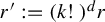 $r':=(k!)^{d}r$
.
$r':=(k!)^{d}r$
.
Now, fix any $i=(i_{1},\ldots ,i_{d})\in \mathbb {N}^{d}$
with
$i=(i_{1},\ldots ,i_{d})\in \mathbb {N}^{d}$
with $\vert i\vert \geq s$
. Let
$\vert i\vert \geq s$
. Let $(m_{1},\ldots ,m_{\vert i\vert })\in (\mathbb {Z}^{d})^{\vert i\vert }$
be any vector such that the number of
$(m_{1},\ldots ,m_{\vert i\vert })\in (\mathbb {Z}^{d})^{\vert i\vert }$
be any vector such that the number of $m_{i'}, 1\leq i'\leq \vert i\vert $
which is equal to the jth standard unit vector is equal to
$m_{i'}, 1\leq i'\leq \vert i\vert $
which is equal to the jth standard unit vector is equal to $i_{j}$
for all
$i_{j}$
for all $1\leq j\leq d$
. Then, it is not hard to see that
$1\leq j\leq d$
. Then, it is not hard to see that
 $$ \begin{align*} \Delta_{m_{\vert i\vert}}\cdots\Delta_{m_{s+1}}G'(\mathbf{0},m_{1},\ldots,m_{s})=i!b_{i}+(i-m_{s})!a_{i-m_{s}}. \end{align*} $$
Since the coefficients of $G'$
are in
$G'$
are in $\mathbb {Z}/r$
and since
$\mathbb {Z}/r$
and since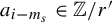 $a_{i-m_{s}}\in \mathbb {Z}/r'$
, we have that
$a_{i-m_{s}}\in \mathbb {Z}/r'$
, we have that $b_{i}\in \mathbb {Z}/r'$
for all
$b_{i}\in \mathbb {Z}/r'$
for all $i\in \mathbb {N}^{d}$
with
$i\in \mathbb {N}^{d}$
with $\vert i\vert \geq s$
. So, we may write
$\vert i\vert \geq s$
. So, we may write $P_{0}$
as
$P_{0}$
as $({1}/{q})P_{0}=P_{1}+P_{2}$
for some polynomial
$({1}/{q})P_{0}=P_{1}+P_{2}$
for some polynomial $P_{1}$
with coefficients in
$P_{1}$
with coefficients in $\mathbb {Z}/r'$
having at most the same degree as P and some
$\mathbb {Z}/r'$
having at most the same degree as P and some $P_{2}$
of degree at most
$P_{2}$
of degree at most $s-2$
. So,
$s-2$
. So,
 $$ \begin{align*} r'P=r'(q^{\ast}P^{\prime}_{0}+P_{1})+\bigg(r'P_{2}+\frac{1}{q}P'\bigg), \end{align*} $$
where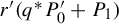 $r'(q^{\ast }P^{\prime }_{0}+P_{1})$
take integer values in
$r'(q^{\ast }P^{\prime }_{0}+P_{1})$
take integer values in $V_{p}(M)$
. A similar decomposition apples to Q and so we are done.
$V_{p}(M)$
. A similar decomposition apples to Q and so we are done.
8 An example for the Heisenberg group
Before proving Theorem 5.1, we use a sample case to illustrate the idea of the proof. The Heisenberg group is the set $G=\mathbb {R}^{3}$
with the group action given by
$G=\mathbb {R}^{3}$
with the group action given by
 $$ \begin{align*} (a,b,c)\ast (a',b',c'):=(a+a',b+b',c+c'+ab') \quad\text{for all } a,b,c,a',b',c'\in\mathbb{R}. \end{align*} $$
This is a 2-step nilmanifold with respect to the lower central series $G_{\mathbb {N}}$
(that is,
$G_{\mathbb {N}}$
(that is, $G_{0}=G_{1}=G, G_{2}=\{0\}^{2}\times \mathbb {R}$
, and
$G_{0}=G_{1}=G, G_{2}=\{0\}^{2}\times \mathbb {R}$
, and $G_{i}=\{(0,0,0)\}$
for all
$G_{i}=\{(0,0,0)\}$
for all $i\geq 3$
). Let
$i\geq 3$
). Let $\Gamma =\mathbb {Z}^{3}$
. The Lie algebra of G has a Mal’cev basis
$\Gamma =\mathbb {Z}^{3}$
. The Lie algebra of G has a Mal’cev basis $\mathcal {X}=\{X_{1},X_{2},X_{3}\}$
with the Mal’cev coordinate map
$\mathcal {X}=\{X_{1},X_{2},X_{3}\}$
with the Mal’cev coordinate map $\psi ^{-1}\colon \mathbb {R}^{3}\to G$
given by
$\psi ^{-1}\colon \mathbb {R}^{3}\to G$
given by
 $$ \begin{align*}\psi^{-1}(t_{1},t_{2},t_{3}):=\exp(t_{1}X_{1})\exp(t_{2}X_{2})\exp(t_{3}X_{3})=(t_{1},t_{2},t_{1}t_{2}+t_{3}).\end{align*} $$
In this section, we provide an outline for the proof of the following simple case of Theorem 5.1 for linear polynomial sequences.
Proposition 8.1. Let $0<\delta <1/2, d\in \mathbb {N}_{+},s\in \mathbb {N}$
with
$0<\delta <1/2, d\in \mathbb {N}_{+},s\in \mathbb {N}$
with $d\gg _{s} 1$
, and p be a prime. Let
$d\gg _{s} 1$
, and p be a prime. Let $M\colon \mathbb {F}_{p}^{d}\to \mathbb {F}_{p}$
be the quadratic form given by
$M\colon \mathbb {F}_{p}^{d}\to \mathbb {F}_{p}$
be the quadratic form given by $M(n)=n\cdot n$
. Let
$M(n)=n\cdot n$
. Let $G_{\mathbb {N}}$
be the Heisenberg group with the lower central series filtration and
$G_{\mathbb {N}}$
be the Heisenberg group with the lower central series filtration and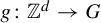 $g\colon \mathbb {Z}^{d}\to G$
be of the form
$g\colon \mathbb {Z}^{d}\to G$
be of the form $g(n_{1},\ldots ,n_{d})=a_{1}^{n_{1}}\cdot \cdots \cdot a_{d}^{n_{d}}$
for some
$g(n_{1},\ldots ,n_{d})=a_{1}^{n_{1}}\cdot \cdots \cdot a_{d}^{n_{d}}$
for some $a_{1},\ldots ,a_{d}\in G$
commuting with each other with
$a_{1},\ldots ,a_{d}\in G$
commuting with each other with $a_{i}^{p}\in \Gamma $
. If
$a_{i}^{p}\in \Gamma $
. If $p\gg _{\delta ,d} 1$
and
$p\gg _{\delta ,d} 1$
and $(g(n)\Gamma )_{n\in \iota ^{-1}(V(M))}$
is not
$(g(n)\Gamma )_{n\in \iota ^{-1}(V(M))}$
is not $\delta $
-equidistributed on
$\delta $
-equidistributed on $G/\Gamma $
, then there exists a non-trivial type-I horizontal character
$G/\Gamma $
, then there exists a non-trivial type-I horizontal character $\eta $
with
$\eta $
with $0<\Vert \eta \Vert \ll _{\delta , d} 1$
such that
$0<\Vert \eta \Vert \ll _{\delta , d} 1$
such that $\eta \circ g \,\mod \mathbb {Z}$
is a constant on
$\eta \circ g \,\mod \mathbb {Z}$
is a constant on $V_{p}(M)$
.
$V_{p}(M)$
.
Sketch of the proof of Proposition 8.1.
Step 1: construction of a nilsequence in a joining system. By Lemma 3.23, if $(g(n)\Gamma )_{n\in \iota ^{-1}(V(M))}$
is not
$(g(n)\Gamma )_{n\in \iota ^{-1}(V(M))}$
is not $\delta $
-equidistributed on
$\delta $
-equidistributed on $G/\Gamma $
, then there exist
$G/\Gamma $
, then there exist $\xi \in \mathbb {Z}$
with
$\xi \in \mathbb {Z}$
with ${\vert \xi \vert \ll \delta ^{-O(1)}}$
and a function
${\vert \xi \vert \ll \delta ^{-O(1)}}$
and a function $F\colon G/\Gamma \to \mathbb {C}$
with
$F\colon G/\Gamma \to \mathbb {C}$
with $\Vert F\Vert _{\mathrm { Lip}}\leq 1$
and vertical frequency
$\Vert F\Vert _{\mathrm { Lip}}\leq 1$
and vertical frequency $\xi $
such that
$\xi $
such that
 $$ \begin{align*} \begin{aligned} \bigg\vert\mathbb{E}_{n\in \iota^{-1}(V(M))}F(g(n)\Gamma)-\int_{G/\Gamma} F\,dm_{G/\Gamma}\bigg\vert\gg_{d} \delta^{O_{d}(1)}, \end{aligned} \end{align*} $$
where $m_{G/\Gamma }$
is the Haar measure of
$m_{G/\Gamma }$
is the Haar measure of $G/\Gamma $
. If
$G/\Gamma $
. If $\xi =0$
, then we may invoke the discussion in [Reference Green and Tao5, after (7.1)] to reduce the problem to the 1-step case, which can be addressed by Lemma 9.6. So, from now on, we assume that
$\xi =0$
, then we may invoke the discussion in [Reference Green and Tao5, after (7.1)] to reduce the problem to the 1-step case, which can be addressed by Lemma 9.6. So, from now on, we assume that $\xi \neq 0$
. Then, it follows that
$\xi \neq 0$
. Then, it follows that
 $$ \begin{align*} \begin{aligned} \vert\mathbb{E}_{n\in \iota^{-1}(V(M))}F(g(n)\Gamma)\vert\gg_{d} \delta^{O_{d}(1)}. \end{aligned} \end{align*} $$
For $h=(h_{1},\ldots ,h_{d})\in \mathbb {Z}^{d}$
and
$h=(h_{1},\ldots ,h_{d})\in \mathbb {Z}^{d}$
and $a=(a_{1},\ldots ,a_{d})\in G^{d}$
, denote
$a=(a_{1},\ldots ,a_{d})\in G^{d}$
, denote $a^{h}:=a_{1}^{h_{1}}\cdot \cdots \cdot a_{d}^{h_{d}}$
. Denote
$a^{h}:=a_{1}^{h_{1}}\cdot \cdots \cdot a_{d}^{h_{d}}$
. Denote
 $$ \begin{align*}\tilde{F}_{h}(x,y):=F(\{a^{h}\}x)\overline{F}(y) \quad\text{for all } x,y\in G/\Gamma.\end{align*} $$
Using the (multi-dimensional version of) Green–Tao argument in [Reference Green and Tao5, §5], we may generalize the outline of the proof of Corollary 1.6 described in §5 to non-abelian nilmanifolds and conclude that
 $$ \begin{align*}\vert\mathbb{E}_{n\in \iota^{-1}(V(M)^{\iota(h)})}F^{\square}_{h}(\tilde{a}_{h}^{n}\Gamma^{\square})\vert\gg_{d} \delta^{O_{d}(1)},\end{align*} $$
where $G^{\square }:=\{(g,g')\in G^{2}\colon g^{-1}g'\in G_{2}\}$
,
$G^{\square }:=\{(g,g')\in G^{2}\colon g^{-1}g'\in G_{2}\}$
, $\Gamma ^{\square }:=\{(g,g')\in \Gamma ^{2}\colon g^{-1}g'\in G_{2}\}$
,
$\Gamma ^{\square }:=\{(g,g')\in \Gamma ^{2}\colon g^{-1}g'\in G_{2}\}$
, $F^{\square }_{h}$
is the restriction of
$F^{\square }_{h}$
is the restriction of $\tilde {F}_{h}$
on
$\tilde {F}_{h}$
on $G^{\square }$
, and
$G^{\square }$
, and
 $$ \begin{align*}\tilde{a}_{h}^{n}:=(\{a^{h}\}^{-1}a_{1}^{n_{1}}\{a^{h}\},\ldots,\{a^{h}\}^{-1}a_{d}^{n_{d}}\{a^{h}\},a_{1}^{n_{1}},\ldots,a_{d}^{n_{d}}).\end{align*} $$
It is not hard to see that $\tilde {F}_{h}$
is invariant under
$\tilde {F}_{h}$
is invariant under $[G^{\square },G^{\square }]$
and, thus, one can use the tools for 1-step nilmanifold (such as Lemma 9.6) to conclude that there exists a non-trivial type-I horizontal character
$[G^{\square },G^{\square }]$
and, thus, one can use the tools for 1-step nilmanifold (such as Lemma 9.6) to conclude that there exists a non-trivial type-I horizontal character $\eta _{h}\colon G^{\square }\to \mathbb {R}$
with
$\eta _{h}\colon G^{\square }\to \mathbb {R}$
with $0<\Vert \eta _{h}\Vert \ll _{d,m} \delta ^{-O_{d,m}(1)}$
such that
$0<\Vert \eta _{h}\Vert \ll _{d,m} \delta ^{-O_{d,m}(1)}$
such that $P_{h}(n):=\eta _{h}\circ \tilde {a}_{h}^{n} \,\mod \mathbb {Z}$
is a constant on
$P_{h}(n):=\eta _{h}\circ \tilde {a}_{h}^{n} \,\mod \mathbb {Z}$
is a constant on $V_{p}(M)^{h}$
. By the pigeonhole principle, we may assume without loss of generality that
$V_{p}(M)^{h}$
. By the pigeonhole principle, we may assume without loss of generality that $\eta _{h}$
equals the same
$\eta _{h}$
equals the same $\eta $
for many h. Writing
$\eta $
for many h. Writing $P_{h}(n)=n\cdot (\eta \circ \tilde {a}_{h}^{1}):=n\cdot v_{h}\colon \mathbb {Z}^{d}\to \mathbb {R}$
for some
$P_{h}(n)=n\cdot (\eta \circ \tilde {a}_{h}^{1}):=n\cdot v_{h}\colon \mathbb {Z}^{d}\to \mathbb {R}$
for some $v_{h}\in \mathbb {Z}^{d}/p$
, we have that
$v_{h}\in \mathbb {Z}^{d}/p$
, we have that
 $$ \begin{align} P_{h} \,\, \mod \mathbb{Z} \text{ is a constant on } \iota^{-1}(V(M)^{\iota(h)})=\iota^{-1}(V(M)\cap \{n\in\mathbb{F}_{p}^{d}\colon 2n\cdot h+h\cdot h=0\}). \end{align} $$
Step 2: solving polynomial equations. For any linear polynomial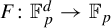 $F\colon \mathbb {F}_{p}^{d}\to \mathbb {F}_{p}$
, if it vanishes on
$F\colon \mathbb {F}_{p}^{d}\to \mathbb {F}_{p}$
, if it vanishes on $V(M)$
, then it must vanish everywhere (this is because F is of the form
$V(M)$
, then it must vanish everywhere (this is because F is of the form $MR$
by Proposition 6.2, which forces
$MR$
by Proposition 6.2, which forces $F=R\equiv 0$
by comparing the degrees of F and
$F=R\equiv 0$
by comparing the degrees of F and $MR$
). Similarly, if a linear polynomial F vanishes on the intersection of
$MR$
). Similarly, if a linear polynomial F vanishes on the intersection of $V(M)$
and the affine subspace
$V(M)$
and the affine subspace $\{n\in \mathbb {F}_{p}^{d}\colon 2n\cdot h+h\cdot h=0\}$
, then the inheriting principle implies that F must vanish on this entire affine subspace. Translating this observation into the
$\{n\in \mathbb {F}_{p}^{d}\colon 2n\cdot h+h\cdot h=0\}$
, then the inheriting principle implies that F must vanish on this entire affine subspace. Translating this observation into the $\mathbb {Z}/p$
-setting, the linearity of
$\mathbb {Z}/p$
-setting, the linearity of $P_{h}$
and (8.1) implies that
$P_{h}$
and (8.1) implies that $P_{h} \,\mod \mathbb {Z}$
must be a constant on
$P_{h} \,\mod \mathbb {Z}$
must be a constant on $\iota ^{-1}(\{n\in \mathbb {F}_{p}^{d}\colon 2n\cdot h+h\cdot h=0\})=\{n\in \mathbb {Z}^{d}\colon 2n\cdot h+h\cdot h\in p\mathbb {Z}\}$
). This implies that the vector
$\iota ^{-1}(\{n\in \mathbb {F}_{p}^{d}\colon 2n\cdot h+h\cdot h=0\})=\{n\in \mathbb {Z}^{d}\colon 2n\cdot h+h\cdot h\in p\mathbb {Z}\}$
). This implies that the vector $v_{h}$
is parallel to
$v_{h}$
is parallel to $({1}/{p})h$
mod
$({1}/{p})h$
mod $\mathbb {Z}^{d}$
. Unlike in the case of [Reference Green and Tao5], here, we cannot conclude that
$\mathbb {Z}^{d}$
. Unlike in the case of [Reference Green and Tao5], here, we cannot conclude that $v_{h}\in p\mathbb {Z}^{d}$
.
$v_{h}\in p\mathbb {Z}^{d}$
.
Step 3: analyzing the coefficients. Suppose that $\psi (a_{i})=(\gamma _{i,1},\gamma _{i,2},\ast )$
. Write
$\psi (a_{i})=(\gamma _{i,1},\gamma _{i,2},\ast )$
. Write ${\gamma _{i}:=(\gamma _{i,1},\gamma _{i,2})}$
and
${\gamma _{i}:=(\gamma _{i,1},\gamma _{i,2})}$
and $\zeta _{i}:=(-\gamma _{i,2},\gamma _{i,1})$
. Following the Green–Tao argument in [Reference Green and Tao5, §5], one can conclude that the ith coordinate of
$\zeta _{i}:=(-\gamma _{i,2},\gamma _{i,1})$
. Following the Green–Tao argument in [Reference Green and Tao5, §5], one can conclude that the ith coordinate of $v_{h}$
is equal to
$v_{h}$
is equal to $k_{1}\cdot \gamma _{i}+k_{2}\zeta _{i}\cdot \{\sum _{i=1}^{d}h_{i}\gamma _{i}\}$
for some
$k_{1}\cdot \gamma _{i}+k_{2}\zeta _{i}\cdot \{\sum _{i=1}^{d}h_{i}\gamma _{i}\}$
for some $k_{1}\in \mathbb {Z}^{2}$
and
$k_{1}\in \mathbb {Z}^{2}$
and $k_{2}\in \mathbb {Z}$
of complexities
$k_{2}\in \mathbb {Z}$
of complexities $\ll _{d,m}\delta ^{-O_{d,m}(1)}$
which are not all zero (this is a multi-dimensional version of [Reference Green and Tao5, equation before (5.7)]). Since
$\ll _{d,m}\delta ^{-O_{d,m}(1)}$
which are not all zero (this is a multi-dimensional version of [Reference Green and Tao5, equation before (5.7)]). Since $v_{h}$
is parallel to
$v_{h}$
is parallel to $({1}/{p})h$
mod
$({1}/{p})h$
mod $\mathbb {Z}^{d}$
, one can conclude that
$\mathbb {Z}^{d}$
, one can conclude that
 $$ \begin{align} & \bigg(k_{1}\cdot\gamma_{1}+k_{2}\zeta_{1}\cdot \bigg\{\sum_{i=1}^{d}h_{i}\gamma_{i}\bigg\},\ldots,k_{1}\cdot\gamma_{d} +k_{2}\zeta_{d}\cdot \bigg\{\sum_{i=1}^{d}h_{i}\gamma_{i}\bigg\}\bigg)\nonumber \\ &\quad -c_{h}h\in\mathbb{Z}^{d} \quad\text{for some } c_{h}\in\mathbb{Z}/p, \end{align} $$
whose general case is (9.26). The expression (8.2) differs from [Reference Green and Tao6, Lemma 4.3] because of the appearance of the term $c_{h}h$
. However, its generalization (to be proved in Proposition 9.8) allows us to deduce that there exists
$c_{h}h$
. However, its generalization (to be proved in Proposition 9.8) allows us to deduce that there exists $k\in \mathbb {Z}^{2}$
with
$k\in \mathbb {Z}^{2}$
with $0<\vert k\vert \ll _{d,m}\delta ^{-O_{d,m}(1)}$
such that
$0<\vert k\vert \ll _{d,m}\delta ^{-O_{d,m}(1)}$
such that $k\cdot \gamma _{i}\in \mathbb {Z}$
for all
$k\cdot \gamma _{i}\in \mathbb {Z}$
for all $1\leq i\leq d$
. Let
$1\leq i\leq d$
. Let $\eta '$
be the type-I horizontal character induced by k, then
$\eta '$
be the type-I horizontal character induced by k, then $\eta '\circ g \,\mod \mathbb {Z}$
is a constant on
$\eta '\circ g \,\mod \mathbb {Z}$
is a constant on $\mathbb {Z}^{d}$
and thus on
$\mathbb {Z}^{d}$
and thus on $V_{p}(M)$
.
$V_{p}(M)$
.
Step 4: completion of the proof. The proof of Proposition 8.1 is already completed in Step 3. However, it is worth mentioning that for general polynomial sequences, due to the appearance of nonlinear terms, one still has to run an argument similar to [Reference Green and Tao5, discussion after Claim 7.7] to complete the proof.
9 Proof of the main equidistribution theorem
9.1 Some preliminary reductions
We prove Theorem 5.1 in this section. We start with a technical lemma on the connections between subspaces of $\mathbb {F}_{p}^{d}$
and those of
$\mathbb {F}_{p}^{d}$
and those of $\mathbb {Z}^{d}$
. Let
$\mathbb {Z}^{d}$
. Let $V+c$
be an affine subspace of
$V+c$
be an affine subspace of $\mathbb {F}_{p}^{d}$
of dimension
$\mathbb {F}_{p}^{d}$
of dimension $d'$
and
$d'$
and $L\colon \mathbb {F}_{p}^{d'}\to V$
be a bijective linear transformation. Let
$L\colon \mathbb {F}_{p}^{d'}\to V$
be a bijective linear transformation. Let $\tilde {V}$
be the
$\tilde {V}$
be the $\mathbb {Z}$
-span of
$\mathbb {Z}$
-span of $\tau (L(e_{1})),\ldots ,\tau (L(e_{d'}))$
and
$\tau (L(e_{1})),\ldots ,\tau (L(e_{d'}))$
and $\tilde {L}\colon \mathbb {Z}^{d'}\to \tilde {V}$
be the bijective linear transformation given by
$\tilde {L}\colon \mathbb {Z}^{d'}\to \tilde {V}$
be the bijective linear transformation given by
 $$ \begin{align*}\tilde{L}(n_{1},\ldots,n_{d'}):=n_{1}\tau(L(e_{1}))+\cdots+n_{d'}\tau(L(e_{d'})).\end{align*} $$
In other words, $\tilde {L}/p$
is the regular lifting of L. Then, it is clear that
$\tilde {L}/p$
is the regular lifting of L. Then, it is clear that $\iota \circ \tilde {L}=L\circ \iota $
and
$\iota \circ \tilde {L}=L\circ \iota $
and $\tilde {L}\circ \tau \equiv \tau \circ L \,\mod p\mathbb {Z}^{d}$
.
$\tilde {L}\circ \tau \equiv \tau \circ L \,\mod p\mathbb {Z}^{d}$
.
Let B be a subset of $V+c$
. It is clear that there is a bijection between
$V+c$
. It is clear that there is a bijection between $L^{-1}(B-c)$
and B given by
$L^{-1}(B-c)$
and B given by $z\mapsto L(z)+c$
. However, the map
$z\mapsto L(z)+c$
. However, the map $z\mapsto \tilde {L}(z)+\tau (c)$
is not necessarily a bijection between
$z\mapsto \tilde {L}(z)+\tau (c)$
is not necessarily a bijection between $\iota ^{-1}(L^{-1}(B-c))$
and
$\iota ^{-1}(L^{-1}(B-c))$
and $\iota ^{-1}(B)$
. To connect the sets
$\iota ^{-1}(B)$
. To connect the sets $\iota ^{-1}(L^{-1}(B-c))$
and
$\iota ^{-1}(L^{-1}(B-c))$
and $\iota ^{-1}(B)$
by
$\iota ^{-1}(B)$
by $\tilde {L}$
, we define a map
$\tilde {L}$
, we define a map $\Phi _{L,c}\colon \mathbb {Z}^{d'}\times \mathbb {Z}^{d}\to \mathbb {Z}^{d}$
as
$\Phi _{L,c}\colon \mathbb {Z}^{d'}\times \mathbb {Z}^{d}\to \mathbb {Z}^{d}$
as
 $$ \begin{align*}\Phi_{L,c}(z,w):=\tau(c)+\tilde{L}(z)+pw.\end{align*} $$
Lemma 9.1. For all $K,K'\in \mathbb {N}_{+}$
, the map
$K,K'\in \mathbb {N}_{+}$
, the map $\Phi _{L,c} \,\mod pK\mathbb {Z}^{d}$
is a
$\Phi _{L,c} \,\mod pK\mathbb {Z}^{d}$
is a ${K'}^{d}$
-to-1 map between
${K'}^{d}$
-to-1 map between $(\iota ^{-1}(L^{-1}(B-c))\cap [pK']^{d'})\times [K]^{d}$
and
$(\iota ^{-1}(L^{-1}(B-c))\cap [pK']^{d'})\times [K]^{d}$
and $\iota ^{-1}(B)\cap [pK]^{d}$
.
$\iota ^{-1}(B)\cap [pK]^{d}$
.
Proof. For convenience, denote $\Phi :=\Phi _{L,c}$
. Let
$\Phi :=\Phi _{L,c}$
. Let $(z,w)\in \iota ^{-1}(L^{-1}(B-c))\times \mathbb {Z}^{d}$
. Then,
$(z,w)\in \iota ^{-1}(L^{-1}(B-c))\times \mathbb {Z}^{d}$
. Then,
 $$ \begin{align*}\iota\circ\Phi(z,w)=\iota(\tau(c)+\tilde{L}(z)+pw)=c+\iota\circ\tilde{L}(z)=c+L\circ\iota(z)\in B.\end{align*} $$
So, the range of $\Phi \,\mod pK\mathbb {Z}^{d}$
is contained in
$\Phi \,\mod pK\mathbb {Z}^{d}$
is contained in $\iota ^{-1}(B)\cap [pK]^{d}$
.
$\iota ^{-1}(B)\cap [pK]^{d}$
.
Now, for all $n{\kern-1pt}\in{\kern-1pt} \iota ^{-1}(B)$
, we may pick some
$n{\kern-1pt}\in{\kern-1pt} \iota ^{-1}(B)$
, we may pick some $z'{\kern-1pt}\in{\kern-1pt} L^{-1}(B-c)$
such that
$z'{\kern-1pt}\in{\kern-1pt} L^{-1}(B-c)$
such that $\iota (n){\kern-1pt}={\kern-1pt}L(z')+c$
. Let
$\iota (n){\kern-1pt}={\kern-1pt}L(z')+c$
. Let $z=\tau (z')$
. Then, z belongs to
$z=\tau (z')$
. Then, z belongs to $\iota ^{-1}(L^{-1}(B-c))\cap [p]^{d'}$
and
$\iota ^{-1}(L^{-1}(B-c))\cap [p]^{d'}$
and
 $$ \begin{align*}\tilde{L}(z)+\tau(c)=\tilde{L}\circ\tau(z')+\tau(c)\equiv \tau\circ L(z')+\tau(c)=\tau\circ\iota(n)\equiv n \,\mod p\mathbb{Z}^{d}.\end{align*} $$
So, there exists $w{\kern-1pt}\in{\kern-1pt} \mathbb {Z}^{d}$
such that
$w{\kern-1pt}\in{\kern-1pt} \mathbb {Z}^{d}$
such that $n{\kern-1pt}={\kern-1pt}\tilde {L}(z)+\tau (c){\kern-1pt}+{\kern-1pt}pw.$
Therefore,
$n{\kern-1pt}={\kern-1pt}\tilde {L}(z)+\tau (c){\kern-1pt}+{\kern-1pt}pw.$
Therefore, $\Phi (z, w \,\mod K\mathbb {Z}^{d})\equiv n \,\mod pk\mathbb {Z}^{d}$
. So, the map
$\Phi (z, w \,\mod K\mathbb {Z}^{d})\equiv n \,\mod pk\mathbb {Z}^{d}$
. So, the map $\Phi \,\mod pK\mathbb {Z}^{d}$
is surjective.
$\Phi \,\mod pK\mathbb {Z}^{d}$
is surjective.
Finally, for $(z,w), (z',w')\in (\iota ^{-1}(L^{-1}(B-c))\cap [pK']^{d'})\times [K]^{d}$
, we have that
$(z,w), (z',w')\in (\iota ^{-1}(L^{-1}(B-c))\cap [pK']^{d'})\times [K]^{d}$
, we have that $\Phi (z,w)\equiv \Phi (z',w') \,\mod \!{pK}\mathbb {Z}^{d}$
if and only if
$\Phi (z,w)\equiv \Phi (z',w') \,\mod \!{pK}\mathbb {Z}^{d}$
if and only if $\tilde {L}(z-z')+p(w-w')\in pK\mathbb {Z}^{d}$
. If this is the case, then
$\tilde {L}(z-z')+p(w-w')\in pK\mathbb {Z}^{d}$
. If this is the case, then $\tilde {L}(z-z')\in p\mathbb {Z}^{d}$
and thus,
$\tilde {L}(z-z')\in p\mathbb {Z}^{d}$
and thus, $\mathbf {0}=\iota \circ \tilde {L}(z-z')=L\circ \iota (z-z')$
. Since L is injective, this implies that
$\mathbf {0}=\iota \circ \tilde {L}(z-z')=L\circ \iota (z-z')$
. Since L is injective, this implies that $\iota (z-z')=\mathbf {0}$
and thus,
$\iota (z-z')=\mathbf {0}$
and thus, $z\equiv z' \,\mod p\mathbb {Z}^{d'}$
. Now, for any such
$z\equiv z' \,\mod p\mathbb {Z}^{d'}$
. Now, for any such $z-z'$
and any fixed w, there is a unique
$z-z'$
and any fixed w, there is a unique $w'\in [K]^{d}$
such that
$w'\in [K]^{d}$
such that $({1}/{p})\tilde {L}(z-z')+(w-w')\in K\mathbb {Z}^{d}$
. Since for each
$({1}/{p})\tilde {L}(z-z')+(w-w')\in K\mathbb {Z}^{d}$
. Since for each $z\in \mathbb {Z}^{d'}$
, the number of
$z\in \mathbb {Z}^{d'}$
, the number of $z'\in [pK']^{d}$
for which
$z'\in [pK']^{d}$
for which $z\equiv z' \,\mod p\mathbb {Z}^{d'}$
is equal to
$z\equiv z' \,\mod p\mathbb {Z}^{d'}$
is equal to ${K'}^{d}$
. So,
${K'}^{d}$
. So, $\Phi \,\mod pK\mathbb {Z}^{d}$
is a
$\Phi \,\mod pK\mathbb {Z}^{d}$
is a ${K'}^{d}$
-to-1 map.
${K'}^{d}$
-to-1 map.
Before proving Theorem 5.1, we start with some simplifications. Suppose first that the conclusion holds for $V+c=\mathbb {F}_{p}^{d}$
. For the general case, let
$V+c=\mathbb {F}_{p}^{d}$
. For the general case, let $L\colon \mathbb {F}_{p}^{d-r}\to V$
be a bijective linear transformation. Let
$L\colon \mathbb {F}_{p}^{d-r}\to V$
be a bijective linear transformation. Let $M'\colon \mathbb {F}_{p}^{d-r}\to \mathbb {F}_{p}$
be the quadratic map given by
$M'\colon \mathbb {F}_{p}^{d-r}\to \mathbb {F}_{p}$
be the quadratic map given by $M'(z):=M(L(z)+c)$
. Then, it is clear that
$M'(z):=M(L(z)+c)$
. Then, it is clear that $L^{-1}((V(M)\cap (V+c))-c)=V(M')$
.
$L^{-1}((V(M)\cap (V+c))-c)=V(M')$
.
Let $g\in \text {poly}(\mathbb {Z}^{d}\to G_{\mathbb {N}})$
be rational. By Corollary 3.19, we may assume that g is
$g\in \text {poly}(\mathbb {Z}^{d}\to G_{\mathbb {N}})$
be rational. By Corollary 3.19, we may assume that g is $pK$
-periodic for some
$pK$
-periodic for some $K\in \mathbb {N}_{+}$
. Then, for any function
$K\in \mathbb {N}_{+}$
. Then, for any function $F\colon G/\Gamma \to \mathbb {C}$
, it follows from Lemma 9.1 (setting
$F\colon G/\Gamma \to \mathbb {C}$
, it follows from Lemma 9.1 (setting $B=V(M)\cap (V+c)$
and
$B=V(M)\cap (V+c)$
and $K'=K$
) that
$K'=K$
) that
 $$ \begin{align*} &\mathbb{E}_{n\in \iota^{-1}(V(M)\cap(V+c))}F(g(n)\Gamma)=\mathbb{E}_{n\in \iota^{-1}(V(M)\cap(V+c))\cap [pK]^{d}}F(g(n)\Gamma)\\ &\quad=\mathbb{E}_{z\in \iota^{-1}(V(M'))\cap [pK]^{d-r}}\mathbb{E}_{w\in [K]^{d}}F(g(\tau(c)+\tilde{L}(z)+pw)\Gamma)\\ &\quad=\mathbb{E}_{(z,w)\in \iota^{-1}(V(M"))\cap [pK]^{2d-r}}F(g(\tau(c)+\tilde{L}(z)+pw)\Gamma), \end{align*} $$
where $M"\colon \mathbb {F}_{p}^{2d-r}\to \mathbb {F}_{p}$
is the quadratic form given by
$M"\colon \mathbb {F}_{p}^{2d-r}\to \mathbb {F}_{p}$
is the quadratic form given by $M"(z,w):=M'(z)$
and
$M"(z,w):=M'(z)$
and $\tilde {L}/p$
is the regular lifting of L. It is clear that all of
$\tilde {L}/p$
is the regular lifting of L. It is clear that all of $M,M'$
, and
$M,M'$
, and $M"$
have the same rank, and that the map
$M"$
have the same rank, and that the map $(z,w)\mapsto g(\tau (c)+\tilde {L}(z)+pw)$
is rational. So, by assumption, if
$(z,w)\mapsto g(\tau (c)+\tilde {L}(z)+pw)$
is rational. So, by assumption, if $(g(n)\Gamma )_{n\in \iota ^{-1}(V(M)\cap (V+c))}$
is not
$(g(n)\Gamma )_{n\in \iota ^{-1}(V(M)\cap (V+c))}$
is not $\delta $
-equidistributed on
$\delta $
-equidistributed on $G/\Gamma $
, then there exists a non-trivial type-I horizontal character
$G/\Gamma $
, then there exists a non-trivial type-I horizontal character $\eta $
with
$\eta $
with $0<\Vert \eta \Vert \ll _{d,m} \delta ^{-O_{d,m}(1)}$
such that
$0<\Vert \eta \Vert \ll _{d,m} \delta ^{-O_{d,m}(1)}$
such that $\eta \circ g(\tau (c)+ \tilde {L}(z)+pw) \,\mod \mathbb {Z}$
is a constant for all
$\eta \circ g(\tau (c)+ \tilde {L}(z)+pw) \,\mod \mathbb {Z}$
is a constant for all $z\in \iota ^{-1}(V(M'))$
and
$z\in \iota ^{-1}(V(M'))$
and $w\in \mathbb {Z}^{d}$
. By Lemma 9.1, we have that
$w\in \mathbb {Z}^{d}$
. By Lemma 9.1, we have that $\eta \circ g(n) \,\mod \mathbb {Z}$
is a constant for all
$\eta \circ g(n) \,\mod \mathbb {Z}$
is a constant for all $n\in \iota ^{-1}(V(M)\cap (V+c))$
. So, in the rest of §9, we may make the following assumption.
$n\in \iota ^{-1}(V(M)\cap (V+c))$
. So, in the rest of §9, we may make the following assumption.
Assumption 9.2. Assume $V+c=\mathbb {F}_{p}^{d}, r=0$
, and
$V+c=\mathbb {F}_{p}^{d}, r=0$
, and $\mathrm {rank}(M)\geq s+13$
.
$\mathrm {rank}(M)\geq s+13$
.
Denote $d'=\mathrm {rank}(M)$
. Suppose that we have already proved Theorem 5.1 for all quadratic forms of the form
$d'=\mathrm {rank}(M)$
. Suppose that we have already proved Theorem 5.1 for all quadratic forms of the form
 $$ \begin{align} M_{c,c',\unicode{x3bb}}(n_{1},\ldots,n_{d}):=cn_{1}^{2}+n^{2}_{2}+\cdots+n_{d'}^{2}+c'n_{d'+1}-\unicode{x3bb} \end{align} $$
for some $c,c',\unicode{x3bb} \in \mathbb {F}_{p}, c\neq 0$
. Let M be an arbitrary quadratic form of rank
$c,c',\unicode{x3bb} \in \mathbb {F}_{p}, c\neq 0$
. Let M be an arbitrary quadratic form of rank $d'$
. By Lemma 4.3, there exist
$d'$
. By Lemma 4.3, there exist $c,c',\unicode{x3bb} \in \mathbb {F}_{p}$
and
$c,c',\unicode{x3bb} \in \mathbb {F}_{p}$
and $v\in \mathbb {F}_{p}^{d}$
with
$v\in \mathbb {F}_{p}^{d}$
with $c\neq 0$
and a
$c\neq 0$
and a $d\times d$
invertible matrix R in
$d\times d$
invertible matrix R in $\mathbb {F}_{p}$
such that
$\mathbb {F}_{p}$
such that $M(n)=M_{c,c',\unicode{x3bb} }(nR+v)$
.
$M(n)=M_{c,c',\unicode{x3bb} }(nR+v)$
.
For convenience, denote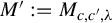 $M':=M_{c,c',\unicode{x3bb} }$
. Then,
$M':=M_{c,c',\unicode{x3bb} }$
. Then, $R(V(M)+vR^{-1})=V(M')$
. Let
$R(V(M)+vR^{-1})=V(M')$
. Let ${g\in \text {poly}(\mathbb {Z}^{d}\to G_{\mathbb {N}})}$
be rational. By Corollary 3.19, we may assume that g is
${g\in \text {poly}(\mathbb {Z}^{d}\to G_{\mathbb {N}})}$
be rational. By Corollary 3.19, we may assume that g is $pK$
-periodic for some
$pK$
-periodic for some $K\in \mathbb {N}_{+}$
. Then, for any function
$K\in \mathbb {N}_{+}$
. Then, for any function $F\colon G/\Gamma \to \mathbb {C}$
, it follows from Lemma 9.1 (setting
$F\colon G/\Gamma \to \mathbb {C}$
, it follows from Lemma 9.1 (setting $B=V(M)$
and
$B=V(M)$
and $K'=K$
) that
$K'=K$
) that
 $$ \begin{align*} &\mathbb{E}_{n\in \iota^{-1}(V(M))}F(g(n)\Gamma)=\mathbb{E}_{n\in \iota^{-1}(V(M))\cap [pK]^{d}}F(g(n)\Gamma)\\ &\quad=\mathbb{E}_{z\in \iota^{-1}(V(M'))\cap [pK]^{d}}\mathbb{E}_{w\in [K]^{d}}F(g(\tau(-vR^{-1})+\tilde{R^{-1}}(z)+pw)\Gamma)\\ &\quad=\mathbb{E}_{(z,w)\in \iota^{-1}(V(M"))\cap [pK]^{2d}}F(g(\tau(-vR^{-1})+\tilde{R^{-1}}(z)+pw)\Gamma), \end{align*} $$
where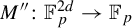 $M"\colon \mathbb {F}_{p}^{2d}\to \mathbb {F}_{p}$
is the quadratic form given by
$M"\colon \mathbb {F}_{p}^{2d}\to \mathbb {F}_{p}$
is the quadratic form given by $M"(z,w):=M'(z)$
and
$M"(z,w):=M'(z)$
and $\tilde {R^{-1}}/p$
is the regular lifting of
$\tilde {R^{-1}}/p$
is the regular lifting of $R^{-1}$
. It is clear that all of
$R^{-1}$
. It is clear that all of $M,M'$
, and
$M,M'$
, and $M"$
have the same rank, and that
$M"$
have the same rank, and that $M"$
is also of the form (9.1) (for the same
$M"$
is also of the form (9.1) (for the same $d'$
but with dimension increased from d to
$d'$
but with dimension increased from d to $2d$
). Moreover, the map
$2d$
). Moreover, the map $(z,w)\mapsto g(\tau (-vR^{-1})+\tilde {R}^{-1}(z)+pw)$
is rational. So, by assumption, if
$(z,w)\mapsto g(\tau (-vR^{-1})+\tilde {R}^{-1}(z)+pw)$
is rational. So, by assumption, if $(g(n)\Gamma )_{n\in \iota ^{-1}(V(M))}$
is not
$(g(n)\Gamma )_{n\in \iota ^{-1}(V(M))}$
is not $\delta $
-equidistributed on
$\delta $
-equidistributed on $G/\Gamma $
, then there exists a non-trivial type-I horizontal character
$G/\Gamma $
, then there exists a non-trivial type-I horizontal character $\eta $
with
$\eta $
with $0<\Vert \eta \Vert \ll _{d,m} \delta ^{-O_{d,m}(1)}$
such that
$0<\Vert \eta \Vert \ll _{d,m} \delta ^{-O_{d,m}(1)}$
such that $\eta \circ g(\tau (-vR^{-1})+\tilde {R^{-1}}(z)+pw)\,\mod \mathbb {Z}$
is a constant for all
$\eta \circ g(\tau (-vR^{-1})+\tilde {R^{-1}}(z)+pw)\,\mod \mathbb {Z}$
is a constant for all $z\in \iota ^{-1}(V(M'))$
and
$z\in \iota ^{-1}(V(M'))$
and ${w\in \mathbb {Z}^{d}}$
. By Lemma 9.1, we have that
${w\in \mathbb {Z}^{d}}$
. By Lemma 9.1, we have that $\eta \circ g(n) \,\mod \mathbb {Z}$
is a constant for all
$\eta \circ g(n) \,\mod \mathbb {Z}$
is a constant for all $n\in \iota ^{-1}(V(M))$
. So, in the rest of §9, we may make the following assumption.
$n\in \iota ^{-1}(V(M))$
. So, in the rest of §9, we may make the following assumption.
Assumption 9.3. Assume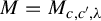 $M=M_{c,c',\unicode{x3bb} }$
is given by (9.1).
$M=M_{c,c',\unicode{x3bb} }$
is given by (9.1).
Let $\psi \colon G\to \mathbb {R}^{m}$
denote the Mal’cev coordinate map associated to
$\psi \colon G\to \mathbb {R}^{m}$
denote the Mal’cev coordinate map associated to $\mathcal {X}$
. Now, suppose that the conclusion holds under the additional assumption that
$\mathcal {X}$
. Now, suppose that the conclusion holds under the additional assumption that $g(\mathbf {0})=\mathrm {id}_{G}$
, the identity element of G. For the general case, write
$g(\mathbf {0})=\mathrm {id}_{G}$
, the identity element of G. For the general case, write $g(\mathbf {0})=\{g(\mathbf {0})\}[g(\mathbf {0})]$
. Let
$g(\mathbf {0})=\{g(\mathbf {0})\}[g(\mathbf {0})]$
. Let $g'(n):=\{g(\mathbf {0})\}^{-1}g(n)g(\mathbf {0})^{-1}\{g(\mathbf {0})\}$
. Then,
$g'(n):=\{g(\mathbf {0})\}^{-1}g(n)g(\mathbf {0})^{-1}\{g(\mathbf {0})\}$
. Then, $g'$
is rational by the Baker–Campbell–Hausdorff formula and
$g'$
is rational by the Baker–Campbell–Hausdorff formula and $g(n)\Gamma =\{g(\mathbf {0})\}g'(n)\Gamma $
for all
$g(n)\Gamma =\{g(\mathbf {0})\}g'(n)\Gamma $
for all $n\in \mathbb {Z}^{d}$
. Since
$n\in \mathbb {Z}^{d}$
. Since $\Vert F(\{g(\mathbf {0})\}\cdot )\Vert _{\mathrm {Lip}}\leq O(1)\Vert F\Vert _{\mathrm {Lip}}$
by [Reference Green and Tao5, Lemma A.5], if
$\Vert F(\{g(\mathbf {0})\}\cdot )\Vert _{\mathrm {Lip}}\leq O(1)\Vert F\Vert _{\mathrm {Lip}}$
by [Reference Green and Tao5, Lemma A.5], if $(g(n)\Gamma )_{n\in \iota ^{-1}(V(M))}$
is not
$(g(n)\Gamma )_{n\in \iota ^{-1}(V(M))}$
is not $\delta $
-equidistributed on
$\delta $
-equidistributed on $G/\Gamma $
, then
$G/\Gamma $
, then $(g'(n)\Gamma )_{n\in \iota ^{-1}(V(M))}$
is not
$(g'(n)\Gamma )_{n\in \iota ^{-1}(V(M))}$
is not $O(\delta )$
-equidistributed on
$O(\delta )$
-equidistributed on $G/\Gamma $
. Since
$G/\Gamma $
. Since $g'(\mathbf {0})=\mathrm {id}_{G}$
, by assumption, there exists a non-trivial type-I horizontal character
$g'(\mathbf {0})=\mathrm {id}_{G}$
, by assumption, there exists a non-trivial type-I horizontal character $\eta $
with
$\eta $
with $0<\Vert \eta \Vert \ll _{d,m} \delta ^{-O_{d,m}(1)}$
such that for all
$0<\Vert \eta \Vert \ll _{d,m} \delta ^{-O_{d,m}(1)}$
such that for all $n\in \iota ^{-1}(V(M))$
,
$n\in \iota ^{-1}(V(M))$
, $\eta \circ g'(n) \,\mod \mathbb {Z}$
is a constant, and thus,
$\eta \circ g'(n) \,\mod \mathbb {Z}$
is a constant, and thus, $\eta \circ g(n) \,\mod \mathbb {Z}$
is a constant. So, in the rest of §9, we may make the following assumption.
$\eta \circ g(n) \,\mod \mathbb {Z}$
is a constant. So, in the rest of §9, we may make the following assumption.
Assumption 9.4. Assume $g(\mathbf {0})=\mathrm {id}_{G}$
. As a result, we may further assume that
$g(\mathbf {0})=\mathrm {id}_{G}$
. As a result, we may further assume that $G=G_{0}=G_{1}$
.
$G=G_{0}=G_{1}$
.
Now, suppose that the conclusion holds under the additional assumption that $\psi (g(e_{i}))$
belongs to
$\psi (g(e_{i}))$
belongs to $[0,1)^{m}$
for all
$[0,1)^{m}$
for all $1\leq i\leq d$
, where
$1\leq i\leq d$
, where $e_{i}$
is the ith standard unit vector in
$e_{i}$
is the ith standard unit vector in $\mathbb {Z}^{d}$
. For the general case, write
$\mathbb {Z}^{d}$
. For the general case, write $g(e_{i})=\{g(e_{i})\}[g(e_{i})]$
and let
$g(e_{i})=\{g(e_{i})\}[g(e_{i})]$
and let $g'(n):=g(n)\prod _{i=1}^{d}[g(e_{i})]^{-n_{i}}$
. Then,
$g'(n):=g(n)\prod _{i=1}^{d}[g(e_{i})]^{-n_{i}}$
. Then, $\psi (g'(e_{i}))\in [0,1)^{m}$
and
$\psi (g'(e_{i}))\in [0,1)^{m}$
and $g'$
is rational by the Baker–Campbell–Hausdorff formula. Moreover, for any type-I horizontal character
$g'$
is rational by the Baker–Campbell–Hausdorff formula. Moreover, for any type-I horizontal character $\eta $
, since
$\eta $
, since $\eta $
vanishes on
$\eta $
vanishes on $\Gamma $
,
$\Gamma $
, $\eta \circ g'$
differs from
$\eta \circ g'$
differs from $\eta \circ g$
by a constant. This enables us to prove the general case of Theorem 5.1. So, in the rest of §9, we may make the following assumption.
$\eta \circ g$
by a constant. This enables us to prove the general case of Theorem 5.1. So, in the rest of §9, we may make the following assumption.
Assumption 9.5. Assume $\psi (g(e_{i}))\in [0,1)^{m}$
for all
$\psi (g(e_{i}))\in [0,1)^{m}$
for all $1\leq i\leq d$
.
$1\leq i\leq d$
.
It is helpful to introduce some further convention of notation. Throughout this section, we assume that $p\gg _{d,m}\delta ^{-O_{d,m}(1)}$
. Denote
$p\gg _{d,m}\delta ^{-O_{d,m}(1)}$
. Denote
 $$ \begin{align*}M_{c}(n_{1},\ldots,n_{d})=cn_{1}^{2}+n^{2}_{2}+\cdots+n_{d'}^{2},\end{align*} $$
which is the degree two terms of M, and let $\tilde {M}\colon \mathbb {Z}^{d}\to \mathbb {Z}/p$
be a regular lifting of M and
$\tilde {M}\colon \mathbb {Z}^{d}\to \mathbb {Z}/p$
be a regular lifting of M and $\tilde {M}_{c}\colon \mathbb {Z}^{d}\to \mathbb {Z}/p$
be an homogeneous regular lifting of
$\tilde {M}_{c}\colon \mathbb {Z}^{d}\to \mathbb {Z}/p$
be an homogeneous regular lifting of $M_{c}$
(whose existence is guaranteed by Lemma 2.5). Then,
$M_{c}$
(whose existence is guaranteed by Lemma 2.5). Then, $M(n)=\iota \circ (p\tilde {M})\circ \tau (n)$
and
$M(n)=\iota \circ (p\tilde {M})\circ \tau (n)$
and $M_{c}(n)=\iota \circ (p\tilde {M}_{c})\circ \tau (n)$
for all
$M_{c}(n)=\iota \circ (p\tilde {M}_{c})\circ \tau (n)$
for all ${n\in \mathbb {F}_{p}^{d}}$
. It is clear that
${n\in \mathbb {F}_{p}^{d}}$
. It is clear that $\iota ^{-1}(V(M))=V_{p}(\tilde {M})$
.
$\iota ^{-1}(V(M))=V_{p}(\tilde {M})$
.
Let A be the $d\times d \mathbb {F}_{p}$
-valued matrix associated to M and
$d\times d \mathbb {F}_{p}$
-valued matrix associated to M and $M_{c}$
. Then,
$M_{c}$
. Then, $\tau (A)$
is the
$\tau (A)$
is the $d\times d$
integer valued matrix associated to
$d\times d$
integer valued matrix associated to $\tilde {M}$
and
$\tilde {M}$
and $\tilde {M}_{c}$
. With a slight abuse of notation, we identify the matrix A both as the
$\tilde {M}_{c}$
. With a slight abuse of notation, we identify the matrix A both as the $\mathbb {F}_{p}$
-valued matrix and as the
$\mathbb {F}_{p}$
-valued matrix and as the $[p]$
-valued matrix
$[p]$
-valued matrix $\tau (A)$
.
$\tau (A)$
.
Let $(G/\Gamma )_{\mathbb {N}}$
be a nilmanifold with filtration
$(G/\Gamma )_{\mathbb {N}}$
be a nilmanifold with filtration $(G_{i})_{i\in \mathbb {N}}$
. Denote
$(G_{i})_{i\in \mathbb {N}}$
. Denote $m:=\dim (G)$
,
$m:=\dim (G)$
, ${m_{i}:=\dim (G_{i})}$
,
${m_{i}:=\dim (G_{i})}$
, $m_{ab}:=\dim (G)-\dim ([G,G])$
(the dimension of the Type-I horizontal torus of
$m_{ab}:=\dim (G)-\dim ([G,G])$
(the dimension of the Type-I horizontal torus of $(G/\Gamma )_{\mathbb {N}}$
),
$(G/\Gamma )_{\mathbb {N}}$
), $m_{\mathrm {lin}}:=m-m_{2}$
(the linear degree of
$m_{\mathrm {lin}}:=m-m_{2}$
(the linear degree of $(G/\Gamma )_{\mathbb {N}}$
), and
$(G/\Gamma )_{\mathbb {N}}$
), and $m_{\ast }:=m_{ab}-m_{\mathrm {lin}}$
(the nonlinear degree of
$m_{\ast }:=m_{ab}-m_{\mathrm {lin}}$
(the nonlinear degree of $(G/\Gamma )_{\mathbb {N}}$
).
$(G/\Gamma )_{\mathbb {N}}$
).
9.2 The case
$s=1$

We first prove Theorem 5.1 for the case $s=1$
(the case
$s=1$
(the case $s=0$
is trivial). We make use of the following corollary of Lemma 4.12.
$s=0$
is trivial). We make use of the following corollary of Lemma 4.12.
Lemma 9.6. Let $d,K\in \mathbb {N}_{+}$
and p be a prime number. Let
$d,K\in \mathbb {N}_{+}$
and p be a prime number. Let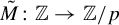 $\tilde {M}\colon \mathbb {Z}\to \mathbb {Z}/p$
be a quadratic form of p-rank r. Suppose that
$\tilde {M}\colon \mathbb {Z}\to \mathbb {Z}/p$
be a quadratic form of p-rank r. Suppose that $r\geq 3$
. Then, for all
$r\geq 3$
. Then, for all $\xi =(\xi _{1},\ldots ,\xi _{d})\in \mathbb {Z}^{d}\backslash pK\mathbb {Z}^{d}$
, we have that
$\xi =(\xi _{1},\ldots ,\xi _{d})\in \mathbb {Z}^{d}\backslash pK\mathbb {Z}^{d}$
, we have that
 $$ \begin{align*} \begin{aligned} \mathbb{E}_{n\in V_{p}(\tilde{M})\cap [pK]^{d}}\exp\bigg(\frac{\xi}{pK}\cdot n\bigg)=O(p^{-(r-2)/{2}}). \end{aligned} \end{align*} $$
Proof. Note that
 $$ \begin{align*} & \mathbb{E}_{n\in V_{p}(\tilde{M})\cap [pK]^{d}}\exp\bigg(\frac{\xi}{pK}\cdot n\bigg) =\mathbb{E}_{n\in V_{p}(\tilde{M})\cap [p]^{d}}\mathbb{E}_{m\in [K]^{d}}\exp\bigg(\frac{\xi}{pK}\cdot (n+pm)\bigg)\\ &\quad =\mathbb{E}_{n\in V_{p}(\tilde{M})\cap [p]^{d}}\mathbb{E}_{m\in [K]^{d}}\exp\bigg(\frac{\xi}{pK} \cdot n\bigg)\mathbb{E}_{m\in [K]^{d}}\exp\bigg(\frac{\xi}{K}\cdot m\bigg). \end{align*} $$
Since $\xi \in \mathbb {Z}^{d}$
, it is not hard to see that
$\xi \in \mathbb {Z}^{d}$
, it is not hard to see that $\mathbb {E}_{m\in [K]^{d}}\exp ({\xi }/{K}\cdot m)=0$
unless
$\mathbb {E}_{m\in [K]^{d}}\exp ({\xi }/{K}\cdot m)=0$
unless $\xi =K\xi '$
for some
$\xi =K\xi '$
for some $\xi '\in \mathbb {Z}^{d}$
, in which case,
$\xi '\in \mathbb {Z}^{d}$
, in which case,
 $$ \begin{align*} \mathbb{E}_{n\in V_{p}(\tilde{M})\cap [pK]^{d}}\exp\bigg(\frac{\xi}{pK}\cdot n\bigg)=\mathbb{E}_{n\in V_{p}(\tilde{M})\cap [p]^{d}}\exp\bigg(\frac{\xi'}{p}\cdot n\bigg) \end{align*} $$
and thus, the conclusion follows from Lemma 4.12.
Since $s=1$
, we have
$s=1$
, we have $m_{\ast }=m$
and
$m_{\ast }=m$
and $G/\Gamma =\mathbb {R}^{m}/\mathbb {Z}^{m}=\mathbb {T}^{m}$
. We may write
$G/\Gamma =\mathbb {R}^{m}/\mathbb {Z}^{m}=\mathbb {T}^{m}$
. We may write
 $$ \begin{align*} g(n)=(b_{1}\cdot n,\ldots,b_{m}\cdot n)+(v_{1},\ldots,v_{m}) \end{align*} $$
for some $K\in \mathbb {N}_{+}$
,
$K\in \mathbb {N}_{+}$
, $b_{i}\in \mathbb {Z}^{d}/pK$
, and
$b_{i}\in \mathbb {Z}^{d}/pK$
, and $v_{i}\in \mathbb {R}$
. Clearly, g is
$v_{i}\in \mathbb {R}$
. Clearly, g is $pK$
-periodic. If
$pK$
-periodic. If $(g(n)\Gamma )_{n\in V_{p}(\tilde {M})\cap [pK]^{d}}$
is not
$(g(n)\Gamma )_{n\in V_{p}(\tilde {M})\cap [pK]^{d}}$
is not $\delta $
-equidistributed, then by Lemma 3.23, there exists a vertical frequency
$\delta $
-equidistributed, then by Lemma 3.23, there exists a vertical frequency $\xi =(\xi _{1},\ldots ,\xi _{m})\in \mathbb {Z}^{m}$
with
$\xi =(\xi _{1},\ldots ,\xi _{m})\in \mathbb {Z}^{m}$
with $\vert \xi \vert \ll _{m} \delta ^{-O_{m}(1)}$
such that
$\vert \xi \vert \ll _{m} \delta ^{-O_{m}(1)}$
such that
 $$ \begin{align} \begin{aligned} \bigg\vert\mathbb{E}_{n\in V_{p}(\tilde{M})\cap[pK]^{d}}\exp(\xi\cdot g(n))-\int_{\mathbb{T}^{m}} \exp(\xi\cdot x)\,dm_{\mathbb{T}^{m}}(x)\bigg\vert\gg_{m} \delta^{O_{m}(1)}, \end{aligned} \end{align} $$
where $m_{\mathbb {T}^{m}}$
is the Haar measure on
$m_{\mathbb {T}^{m}}$
is the Haar measure on $\mathbb {T}^{m}$
. So, we have that
$\mathbb {T}^{m}$
. So, we have that $\xi \neq \mathbf {0}$
as otherwise, the left-hand side of (9.2) is zero. Thus,
$\xi \neq \mathbf {0}$
as otherwise, the left-hand side of (9.2) is zero. Thus,
 $$ \begin{align*}\vert\mathbb{E}_{n\in V_{p}(\tilde{M})\cap[pK]^{d}}\exp(\xi\cdot g(n))\vert\gg_{m} \delta^{O_{m}(1)}.\end{align*} $$
Note that $\xi \cdot g(n)=(\xi B)\cdot n+\xi \cdot v$
, where B is the
$\xi \cdot g(n)=(\xi B)\cdot n+\xi \cdot v$
, where B is the $\mathbb {Z}/pK$
-valued
$\mathbb {Z}/pK$
-valued $m\times d$
matrix whose ith row is
$m\times d$
matrix whose ith row is $b_{i}$
. If
$b_{i}$
. If $\xi B\notin \mathbb {Z}^{d}$
, then since
$\xi B\notin \mathbb {Z}^{d}$
, then since $\mathrm {rank}_{p}(M)\geq 3$
, Lemma 9.6 implies that
$\mathrm {rank}_{p}(M)\geq 3$
, Lemma 9.6 implies that
 $$ \begin{align*}\vert\mathbb{E}_{n\in V_{p}(\tilde{M})\cap[pK]^{d}}\exp((\xi B)\cdot n)\vert=O(p^{-{(d-2)}/{2}}), \end{align*} $$
which is impossible if $p\gg _{m} \delta ^{-O_{m}(1)}$
. So, we must have that
$p\gg _{m} \delta ^{-O_{m}(1)}$
. So, we must have that $\xi B\in \mathbb {Z}^{d}$
, which implies that
$\xi B\in \mathbb {Z}^{d}$
, which implies that $\xi \circ g \,\mod \mathbb {Z}$
is a constant. This finishes the proof.
$\xi \circ g \,\mod \mathbb {Z}$
is a constant. This finishes the proof.
9.3 Construction of a nilsequence in a joining system
We now assume that $s\geq 2$
(and thus,
$s\geq 2$
(and thus, $d'\geq s+13$
) and that Theorem 5.1 holds for smaller s (and any
$d'\geq s+13$
) and that Theorem 5.1 holds for smaller s (and any $m_{\ast }$
), and for the same value of s and a smaller value of
$m_{\ast }$
), and for the same value of s and a smaller value of $m_{\ast }$
. The readers are advised to familiarize themselves with the machinery in [Reference Green and Tao5, §8] before reading this section in detail. We follow the outline of the proof of Proposition 8.1 in §8. Following Step 1 in §8, we first run the argument of [Reference Green and Tao5] to reduce the problem to a polynomial equation (9.18). By Corollary 3.19, we may assume that g is
$m_{\ast }$
. The readers are advised to familiarize themselves with the machinery in [Reference Green and Tao5, §8] before reading this section in detail. We follow the outline of the proof of Proposition 8.1 in §8. Following Step 1 in §8, we first run the argument of [Reference Green and Tao5] to reduce the problem to a polynomial equation (9.18). By Corollary 3.19, we may assume that g is $pK$
-periodic for some
$pK$
-periodic for some $K\in \mathbb {N}_{+}$
. By Lemma 3.23, if
$K\in \mathbb {N}_{+}$
. By Lemma 3.23, if $(g(n)\Gamma )_{n\in V_{p}(\tilde {M})\cap [pK]^{d}}$
is not
$(g(n)\Gamma )_{n\in V_{p}(\tilde {M})\cap [pK]^{d}}$
is not $\delta $
-equidistributed on
$\delta $
-equidistributed on $G/\Gamma $
, then there exist a vertical frequency
$G/\Gamma $
, then there exist a vertical frequency $\xi \in \mathbb {Z}^{m_{s}}$
with
$\xi \in \mathbb {Z}^{m_{s}}$
with $\Vert \xi \Vert \ll _{m} \delta ^{-O_{m}(1)}$
, and a function
$\Vert \xi \Vert \ll _{m} \delta ^{-O_{m}(1)}$
, and a function $F\colon G/\Gamma \to \mathbb {C}$
with
$F\colon G/\Gamma \to \mathbb {C}$
with $\Vert F\Vert _{\mathrm {Lip}}\leq 1$
and vertical frequency
$\Vert F\Vert _{\mathrm {Lip}}\leq 1$
and vertical frequency $\xi $
such that
$\xi $
such that
 $$ \begin{align} \begin{aligned} \bigg\vert\mathbb{E}_{n\in V_{p}(\tilde{M})\cap[pK]^{d}}F(g(n)\Gamma)-\int_{G/\Gamma} F\,dm_{G/\Gamma}\bigg\vert\gg_{m} \delta^{O_{m}(1)}, \end{aligned} \end{align} $$
where $m_{G/\Gamma }$
is the Haar measure of
$m_{G/\Gamma }$
is the Haar measure of $G/\Gamma $
. If
$G/\Gamma $
. If $\xi =\mathbf {0}$
, then we may invoke the discussion in [Reference Green and Tao5, after (7.1)] to reduce the problem to the
$\xi =\mathbf {0}$
, then we may invoke the discussion in [Reference Green and Tao5, after (7.1)] to reduce the problem to the $s-1$
degree case and then use the induction hypothesis to finish the proof. So, from now on, we assume that
$s-1$
degree case and then use the induction hypothesis to finish the proof. So, from now on, we assume that $\xi \neq \mathbf {0}$
.
$\xi \neq \mathbf {0}$
.
Since F is of vertical frequency $\xi $
, (9.3) implies that
$\xi $
, (9.3) implies that
 $$ \begin{align} \begin{aligned} \vert\mathbb{E}_{n\in V_{p}(\tilde{M})\cap[pK]^{d}}F(g(n)\Gamma)\vert\gg_{m} \delta^{O_{m}(1)}. \end{aligned} \end{align} $$
By taking squares on both sides of (9.4), we have that
 $$ \begin{align*} & \delta^{O_{m}(1)} \ll_{m} \mathbb{E}_{n,m\in V_{p}(\tilde{M})\cap[pK]^{d}}F(g(m)\Gamma)\overline{F}(g(n)\Gamma)\\ & \quad=\mathbb{E}_{(n,h)\in \Box_{p,1}(V_{p}(\tilde{M}))\cap[pK]^{2d}}F(g(n+h)\Gamma)\overline{F}(g(n)\Gamma), \end{align*} $$
where we used Lemma 7.2 and the fact that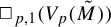 $\Box _{p,1}(V_{p}(\tilde {M}))$
is a p-periodic set. By Lemma 4.12,
$\Box _{p,1}(V_{p}(\tilde {M}))$
is a p-periodic set. By Lemma 4.12, $\vert \Box _{p,1}(V_{p}(\tilde {M}))\cap [p]^{d}\vert =\vert V_{p}(\tilde {M})\cap [p]^{d}\vert ^{2}=p^{2d-2}(1+O(p^{-1/2}))$
. So, this implies that
$\vert \Box _{p,1}(V_{p}(\tilde {M}))\cap [p]^{d}\vert =\vert V_{p}(\tilde {M})\cap [p]^{d}\vert ^{2}=p^{2d-2}(1+O(p^{-1/2}))$
. So, this implies that
 $$ \begin{align} \begin{aligned} \frac{1}{\vert V_{p}(\tilde{M})\cap[pK]^{d}\vert^{2}}\sum_{h\in V_{p}(\tilde{M})\cap[pK]^{d}}\sum_{n\in V_{p}(\tilde{M})^{h}\cap[pK]^{d}}F(g(n+h)\Gamma)\overline{F}(g(n)\Gamma) \gg_{m} \delta^{O_{m}(1)}. \end{aligned} \end{align} $$
Since $d\geq 5$
, it follows from Proposition 4.19 that
$d\geq 5$
, it follows from Proposition 4.19 that
 $$ \begin{align*}\mathbb{E}_{h\in [pK]^{d}}\vert\mathbb{E}_{n\in V_{p}(\tilde{M})^{h}\cap [pK]^{d}}F(g(n+h)\Gamma)\overline{F}(g(n)\Gamma)\vert\gg_{m} \delta^{O_{m}(1)}.\end{align*} $$
By the pigeonhole principle, there exists a subset $J_{1}$
of
$J_{1}$
of $[pK]^{d}$
of cardinality
$[pK]^{d}$
of cardinality $\gg _{m}\delta ^{O_{m}(1)}(pK)^{d}$
such that
$\gg _{m}\delta ^{O_{m}(1)}(pK)^{d}$
such that
 $$ \begin{align} \begin{aligned} \vert\mathbb{E}_{n\in V_{p}(\tilde{M})^{h}\cap [pK]^{d}}F(g(n+h)\Gamma)\overline{F(g(n)\Gamma)}\vert\gg_{m} \delta^{O_{m}(1)} \end{aligned} \end{align} $$
for all $h\in J_{1}$
. Recall that A is the
$h\in J_{1}$
. Recall that A is the $d\times d \mathbb {Z}$
-valued matrix associated to M. Since
$d\times d \mathbb {Z}$
-valued matrix associated to M. Since $d'\geq 3$
, by Lemmas 4.12 and 7.2, passing to a subset if necessary, we may assume that
$d'\geq 3$
, by Lemmas 4.12 and 7.2, passing to a subset if necessary, we may assume that
 $$ \begin{align} (hA)\cdot h, h_{1},\ldots,h_{d}\notin p\mathbb{Z} \quad\text{for all } h=(h_{1},\ldots,h_{d})\in J_{1}. \end{align} $$
It is helpful to view $V_{p}(\tilde {M})^{h}$
as the preimage of
$V_{p}(\tilde {M})^{h}$
as the preimage of $\iota $
of the intersection of the hyperspheres
$\iota $
of the intersection of the hyperspheres $V(M)$
and
$V(M)$
and $V(M(\cdot +h))$
. We will use the inheriting principle to apply the induction hypothesis on these sub-hyperspheres. Recall that
$V(M(\cdot +h))$
. We will use the inheriting principle to apply the induction hypothesis on these sub-hyperspheres. Recall that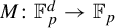 $M\colon \mathbb {F}_{p}^{d}\to \mathbb {F}_{p}$
is the quadratic form induced by
$M\colon \mathbb {F}_{p}^{d}\to \mathbb {F}_{p}$
is the quadratic form induced by $\tilde {M}$
and
$\tilde {M}$
and $V_{p}(\tilde {M})^{h}=\iota ^{-1}(V(M)^{\iota (h)})$
. For
$V_{p}(\tilde {M})^{h}=\iota ^{-1}(V(M)^{\iota (h)})$
. For $h\in J_{1}$
, note that
$h\in J_{1}$
, note that $V(M)^{\iota (h)}=V(M)\cap U_{h}$
, where
$V(M)^{\iota (h)}=V(M)\cap U_{h}$
, where $U_{h}:=\{n\in \mathbb {F}_{p}^{d}\colon M(n+\iota (h))=M(n)\}$
. Then, we may write
$U_{h}:=\{n\in \mathbb {F}_{p}^{d}\colon M(n+\iota (h))=M(n)\}$
. Then, we may write $U_{h}=V_{h}+u_{h}$
for some
$U_{h}=V_{h}+u_{h}$
for some $u_{h}\in \mathbb {F}_{p}^{d}$
, where
$u_{h}\in \mathbb {F}_{p}^{d}$
, where $V_{h}:=\{n\in \mathbb {F}_{p}^{d}\colon (nA)\cdot \iota (h)=0\}$
. It follows from (9.6) that
$V_{h}:=\{n\in \mathbb {F}_{p}^{d}\colon (nA)\cdot \iota (h)=0\}$
. It follows from (9.6) that $V_{h}$
is a subspace of
$V_{h}$
is a subspace of $\mathbb {F}_{p}^{d}$
of co-dimension 1. Let
$\mathbb {F}_{p}^{d}$
of co-dimension 1. Let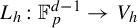 $L_{h}\colon \mathbb {F}_{p}^{d-1}\to V_{h}$
be any bijective linear transformation, and let
$L_{h}\colon \mathbb {F}_{p}^{d-1}\to V_{h}$
be any bijective linear transformation, and let $M_{h}\colon \mathbb {F}_{p}^{d-1}\to \mathbb {F}_{p}$
be the quadratic form given by
$M_{h}\colon \mathbb {F}_{p}^{d-1}\to \mathbb {F}_{p}$
be the quadratic form given by $M_{h}(z):=M(L_{h}(z)+u_{h})$
and let
$M_{h}(z):=M(L_{h}(z)+u_{h})$
and let $\tilde {M}_{h}\colon \mathbb {Z}^{d-1}\to \mathbb {Z}/p$
be the quadratic form induced by
$\tilde {M}_{h}\colon \mathbb {Z}^{d-1}\to \mathbb {Z}/p$
be the quadratic form induced by $M_{h}$
. Since
$M_{h}$
. Since $(hA)\cdot h\notin p\mathbb {Z}$
, we have that
$(hA)\cdot h\notin p\mathbb {Z}$
, we have that
 $$ \begin{align} &\mathrm{rank}_{p}(\tilde{M}_{h})=\mathrm{rank}(M_{h})=\mathrm{rank}(M\vert_{\text{span}_{\mathbb{F}_{p}}\{\iota(h)\}^{ \perp{M}}})\nonumber \\ & \quad=\mathrm{rank}(M)-1\geq (s-1)+13 \quad\text{for all } h\in J_{1}. \end{align} $$
Let $\tilde {L}_{h}/p$
be the regular lifting of
$\tilde {L}_{h}/p$
be the regular lifting of $L_{h}$
. Then,
$L_{h}$
. Then,
 $$ \begin{align} (hA)\cdot \tilde{L}_{h}(z)\in p\mathbb{Z} \quad\text{for all } z\in \mathbb{Z}^{d-1}. \end{align} $$
Since $V(M)^{\iota (h)}=V(M)\cap (V_{h}+u_{h})$
, it is not hard to see that
$V(M)^{\iota (h)}=V(M)\cap (V_{h}+u_{h})$
, it is not hard to see that $L_{h}^{-1}(V(M)^{\iota (h)}-u_{h})=V(M_{h})$
and
$L_{h}^{-1}(V(M)^{\iota (h)}-u_{h})=V(M_{h})$
and $V_{p}(\tilde {M}_{h})=\iota ^{-1}(V(M_{h}))$
. Since g is
$V_{p}(\tilde {M}_{h})=\iota ^{-1}(V(M_{h}))$
. Since g is $pK$
-periodic, by (9.6) and Lemma 9.1 (setting
$pK$
-periodic, by (9.6) and Lemma 9.1 (setting $B=V(M)^{\iota (h)}$
and
$B=V(M)^{\iota (h)}$
and $K'=K$
), the average
$K'=K$
), the average
 $$ \begin{align} \vert\mathbb{E}_{(z,m)\in (V_{p}(\tilde{M}_{h})\cap [pK]^{d-1})\times [pK]^{d}}F(g(pm +\tilde{L}_{h}(z)+\tau(u_{h})+h)\Gamma)\overline{F(g(pm+\tilde{L}_{h}(z)+\tau(u_{h}))\Gamma)}\vert\\[-24pt]\nonumber \end{align} $$
is at least $\gg _{m} \delta ^{O_{m}(1)}$
for all
$\gg _{m} \delta ^{O_{m}(1)}$
for all $h\in J_{1}$
.
$h\in J_{1}$
.
We decompose g as $g=g_{\text {nlin}}g_{\mathrm {lin}}$
, where
$g=g_{\text {nlin}}g_{\mathrm {lin}}$
, where
 $$ \begin{align*}g_{\mathrm{lin}}(n_{1},\ldots,n_{d}):=g(e_{1})^{n_{1}}\cdots g(e_{d})^{n_{d}}\end{align*} $$
is the linear component of g and
 $$ \begin{align*}g_{\text{nlin}}(n):=g(n)g_{\mathrm{lin}}(n)^{-1}\end{align*} $$
is the nonlinear component of g, where $e_{i}$
is the ith standard unit vector in
$e_{i}$
is the ith standard unit vector in $\mathbb {Z}^{d}$
. Since
$\mathbb {Z}^{d}$
. Since $g\in \text {poly}(\mathbb {Z}^{d}\to G_{\mathbb {N}})$
, we have that
$g\in \text {poly}(\mathbb {Z}^{d}\to G_{\mathbb {N}})$
, we have that $g_{\mathrm { lin}},g_{\text {nlin}}\in \text {poly}(\mathbb {Z}^{d}\to G_{\mathbb {N}})$
by [Reference Green, Tao and Ziegler8, Corollary B.4].
$g_{\mathrm { lin}},g_{\text {nlin}}\in \text {poly}(\mathbb {Z}^{d}\to G_{\mathbb {N}})$
by [Reference Green, Tao and Ziegler8, Corollary B.4].
Note that $g_{\text {nlin}}(\mathbf {0})=g_{\text {nlin}}(e_{1})=\cdots =g_{\text {nlin}}(e_{d})=\mathrm {id}_{G}$
, and
$g_{\text {nlin}}(\mathbf {0})=g_{\text {nlin}}(e_{1})=\cdots =g_{\text {nlin}}(e_{d})=\mathrm {id}_{G}$
, and $g_{\text {nlin}}$
takes values in
$g_{\text {nlin}}$
takes values in $G_{2}$
by the Baker–Campbell–Hausdorff formula. For all
$G_{2}$
by the Baker–Campbell–Hausdorff formula. For all $h\in \mathbb {Z}^{d}$
, let
$h\in \mathbb {Z}^{d}$
, let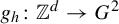 $g_{h}\colon \mathbb {Z}^{d}\to G^{2}$
be the sequence
$g_{h}\colon \mathbb {Z}^{d}\to G^{2}$
be the sequence
 $$ \begin{align} \begin{aligned} g_{h}(n):= (\{{g}_{\mathrm{lin}}(h)\}^{-1}{g}(n+h)[{g}_{\mathrm{lin}}(h)]^{-1},{g}(n)), \end{aligned} \end{align} $$
and $F_{h}\colon G^{2}/\Gamma ^{2}\to \mathbb {C}$
be the function
$F_{h}\colon G^{2}/\Gamma ^{2}\to \mathbb {C}$
be the function
 $$ \begin{align*} F_{h}(x,y):=F(\{{g}_{\mathrm{lin}}(h)\}x)\overline{F}(y). \end{align*} $$
Then, (9.10) implies that
 $$ \begin{align} \begin{aligned} \vert\mathbb{E}_{(z,m)\in (V_{p}(\tilde{M}_{h})\cap [pK]^{d-1})\times [pK]^{d}}F_{h}({g}_{h}(pm+\tilde{L}_{h}(z)+\tau(u_{h}))\Gamma^{2})\vert\gg_{m} \delta^{O_{m}(1)} \end{aligned} \end{align} $$
for all $h\in J_{1}$
.
$h\in J_{1}$
.
For groups G and H with $H<G$
, denote
$H<G$
, denote
 $$ \begin{align*}G\times_{H}G:=\{(g,h)\in G\times G\colon g^{-1}h\in H\}.\end{align*} $$
Note that $G\times _{H}G$
is a group as long as
$G\times _{H}G$
is a group as long as $[G,H]\subseteq H$
. It is not hard to check that
$[G,H]\subseteq H$
. It is not hard to check that ${g}_{h}$
takes values in
${g}_{h}$
takes values in $G^{\square }:=G\times _{G_{2}}G$
for all
$G^{\square }:=G\times _{G_{2}}G$
for all $h\in \mathbb {Z}^{d}$
(see the argument in [Reference Green and Tao5, after (7.6)]). So (9.12) implies that
$h\in \mathbb {Z}^{d}$
(see the argument in [Reference Green and Tao5, after (7.6)]). So (9.12) implies that
 $$ \begin{align} \begin{aligned} \vert\mathbb{E}_{(z,m)\in (V_{p}(\tilde{M}_{h})\cap [pK]^{d-1})\times [pK]^{d}}F^{\square}_{h}(g^{\square}_{h}(pm+\tilde{L}_{h}(z)+\tau(u_{h}))\Gamma^{\square})\vert\gg_{m} \delta^{O_{m}(1)} \end{aligned} \end{align} $$
for all $h\in J_{1}$
, where
$h\in J_{1}$
, where $F^{\square }_{h}$
,
$F^{\square }_{h}$
, $g^{\square }_{h}$
, and
$g^{\square }_{h}$
, and $\Gamma ^{\square }$
are the restrictions of
$\Gamma ^{\square }$
are the restrictions of $F_{h}, {g}_{h}$
, and
$F_{h}, {g}_{h}$
, and $\Gamma ^{2}$
to
$\Gamma ^{2}$
to $G^{\square }$
, respectively. By repeating the argument in [Reference Green and Tao5, after (7.7)],
$G^{\square }$
, respectively. By repeating the argument in [Reference Green and Tao5, after (7.7)], $F^{\square }_{h}$
is invariant under
$F^{\square }_{h}$
is invariant under ${G^{\triangle }_{s}:=\{(g_{s},g_{s})\colon g_{s}\in G_{s}\}}$
. Thus,
${G^{\triangle }_{s}:=\{(g_{s},g_{s})\colon g_{s}\in G_{s}\}}$
. Thus, $F^{\square }_{h}$
induces a function
$F^{\square }_{h}$
induces a function $\overline {F_{h}^{\square }}$
on
$\overline {F_{h}^{\square }}$
on $\overline {G^{\square }}:=G^{\square }/G^{\triangle }_{s}$
. By (9.13), we have that
$\overline {G^{\square }}:=G^{\square }/G^{\triangle }_{s}$
. By (9.13), we have that
 $$ \begin{align} \begin{aligned} \vert\mathbb{E}_{(z,m)\in (V_{p}(\tilde{M}_{h})\cap [pK]^{d-1})\times [pK]^{d}}\overline{F^{\square}_{h}}(\overline{g^{\square}_{h}}(pm+\tilde{L}_{h}(z)+\tau(u_{h}))\overline{\Gamma^{\square}})\vert\gg_{m} \delta^{O_{m}(1)}, \end{aligned} \end{align} $$
where $\overline {\Gamma ^{\square }}:=\Gamma ^{\square }/(\Gamma ^{\square }\cap G_{k}^{\triangle })$
and
$\overline {\Gamma ^{\square }}:=\Gamma ^{\square }/(\Gamma ^{\square }\cap G_{k}^{\triangle })$
and $\overline {g^{\square }_{h}}$
is the projection of
$\overline {g^{\square }_{h}}$
is the projection of $g^{\square }_{h}$
to
$g^{\square }_{h}$
to $\overline {G^{\square }}$
.
$\overline {G^{\square }}$
.
By [Reference Green and Tao6, Proposition 4.2] and [Reference Green and Tao5, Lemma 7.4], we have that:
-
• the groups
$G^{\square }$
and
$\overline {G^{\square }}$
are connected, simply connected nilpotent Lie groups of degree
$s-1$
with respect to the
$\mathbb {N}$
-filtrations given by
$(G^{\square })_{i}:=G_{i}\times _{G_{i+1}}G_{i}$
and
$(\overline {G^{\square }})_{i}:=(G_{i}\times _{G_{i+1}}G_{i})/G^{\triangle }_{k}$
, respectively; -
• there exist
$O_{m,s}(\delta ^{-O_{m,s}(1)})$
-rational Mal’cev basis
$\mathcal {X}^{\square }$
for
$G^{\square }/\Gamma ^{\square }$
, and
$\overline {\mathcal {X}^{\square }}$
for
$\overline {G^{\square }}/\overline {\Gamma ^{\square }}$
, adapted to the filtrations
$(G^{\square })_{\mathbb {N}}$
and
$(\overline {G^{\square }})_{\mathbb {N}}$
, respectively; -
• the Mal’cev coordinate map
$\psi _{\mathcal {X}^{\square }}(x,x')$
of
$\mathcal {X}^{\square }$
is a polynomial of degree
$O_{m,s}(1)$
with rational coefficients of complexity
$O_{m,s}(\delta ^{-O_{m,s}(1)})$
in the coordinates
$\psi (x)$
and
$\psi (x')$
; -
• under the metrics induced by
$\mathcal {X}^{\square }$
and
$\overline {\mathcal {X}^{\square }}$
, we have that
$\Vert F^{\square }_{h}\Vert _{\mathrm {Lip}}, \Vert \overline {F^{\square }_{h}}\Vert _{\mathrm {Lip}}\ll _{m,s}(\delta ^{-O_{m,s}(1)})$
; -
•
$g^{\square }_{h}$
belongs to
$\text {poly}(\mathbb {Z}^{d}\to (G^{\square })_{\mathbb {N}})$
and
$\overline {g^{\square }_{h}}$
belongs to
$\text {poly}(\mathbb {Z}^{d}\to (\overline {G^{\square }})_{\mathbb {N}})$
.















Since g is rational and $pK$
-periodic, it is not hard to see that:
$pK$
-periodic, it is not hard to see that:
-
•
$g^{\square }_{h}$
and
$\overline {g^{\square }_{h}}$
are rational and
$pK$
-periodic.


Let $\tilde {M}^{\prime }_{h}\colon \mathbb {Z}^{2d-1}\to \mathbb {Z}/p$
be the quadratic form given by
$\tilde {M}^{\prime }_{h}\colon \mathbb {Z}^{2d-1}\to \mathbb {Z}/p$
be the quadratic form given by $\tilde {M}^{\prime }_{h}(z,m):=\tilde {M}_{h}(z)$
. It is clear from (9.8) that
$\tilde {M}^{\prime }_{h}(z,m):=\tilde {M}_{h}(z)$
. It is clear from (9.8) that $\mathrm {rank}_{p}(\tilde {M}^{\prime }_{h})=\mathrm {rank}_{p}(\tilde {M}_{h})\geq (s-1)+13$
for all
$\mathrm {rank}_{p}(\tilde {M}^{\prime }_{h})=\mathrm {rank}_{p}(\tilde {M}_{h})\geq (s-1)+13$
for all $h\in J_{1}$
. So, by (9.14) and the induction hypothesis, for all
$h\in J_{1}$
. So, by (9.14) and the induction hypothesis, for all $h\in J_{1}$
, there exist a type-I horizontal character
$h\in J_{1}$
, there exist a type-I horizontal character $\overline {\eta }_{h}\colon \overline {G^{\square }}\to \mathbb {R}$
with
$\overline {\eta }_{h}\colon \overline {G^{\square }}\to \mathbb {R}$
with $0<\Vert \overline {\eta }_{h}\Vert \ll _{d,m}\delta ^{-O_{d,m}(1)}$
and a constant
$0<\Vert \overline {\eta }_{h}\Vert \ll _{d,m}\delta ^{-O_{d,m}(1)}$
and a constant $a_{h}\in \mathbb {R}$
such that for all
$a_{h}\in \mathbb {R}$
such that for all $m\in \mathbb {Z}^{d}$
and
$m\in \mathbb {Z}^{d}$
and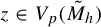 $z\in V_{p}(\tilde {M}_{h})$
,
$z\in V_{p}(\tilde {M}_{h})$
,
 $$ \begin{align*}\overline{\eta}_{h}\circ \overline{g^{\square}_{h}}(pm+\tilde{L}_{h}(z)+\tau(u_{h}))\equiv a_{h} \,\mod \mathbb{Z}.\end{align*} $$
By the pigeonhole principle, there exists a subset $J_{2}$
of
$J_{2}$
of $J_{1}$
with
$J_{1}$
with $\vert J_{2}\vert \gg _{d,m}\delta ^{O_{d,m}(1)}(pK)^{d}$
such that
$\vert J_{2}\vert \gg _{d,m}\delta ^{O_{d,m}(1)}(pK)^{d}$
such that $\overline {\eta }_{h}$
is equal to a same
$\overline {\eta }_{h}$
is equal to a same $\overline {\eta }$
for all
$\overline {\eta }$
for all $h\in J_{2}$
. Writing
$h\in J_{2}$
. Writing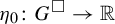 $\eta _{0}\colon G^{\square }\to \mathbb {R}$
to be the type-I horizontal character
$\eta _{0}\colon G^{\square }\to \mathbb {R}$
to be the type-I horizontal character $\eta _{0}(x)=\overline {\eta }(\overline {x})$
, where
$\eta _{0}(x)=\overline {\eta }(\overline {x})$
, where $\overline {x}$
is the projection of x, we have that
$\overline {x}$
is the projection of x, we have that $\eta _{0}$
is a type-I horizontal character with
$\eta _{0}$
is a type-I horizontal character with $0<\Vert \eta _{0}\Vert \ll _{d,m}\delta ^{-O_{d,m}(1)}$
and that
$0<\Vert \eta _{0}\Vert \ll _{d,m}\delta ^{-O_{d,m}(1)}$
and that
 $$ \begin{align} \begin{aligned} \eta_{0}\circ g^{\square}_{h}(pm+\tilde{L}_{h}(z)+\tau(u_{h}))\equiv a_{h} \,\mod \mathbb{Z} \quad\text{for all } h\in J_{2}, m\in\mathbb{Z}^{d}, z\in V_{p}(\tilde{M}_{h}). \end{aligned} \end{align} $$
We apply Lemma 9.1 to simplify this condition. Denote $\Phi _{L_{h},u_{h}}(z,m):=pm+\tilde {L}_{h}(z)+\tau (u_{h})$
. Applying Lemma 9.1 with
$\Phi _{L_{h},u_{h}}(z,m):=pm+\tilde {L}_{h}(z)+\tau (u_{h})$
. Applying Lemma 9.1 with $d'=d-1, K'=1, V=V_{h}, c=u_{h}$
, and
$d'=d-1, K'=1, V=V_{h}, c=u_{h}$
, and ${B{\kern-1pt}={\kern-1pt}V(M)^{\iota (h)}}$
, we have that
${B{\kern-1pt}={\kern-1pt}V(M)^{\iota (h)}}$
, we have that $\Phi _{L_{h},u_{h}} \,\mod p\mathbb {Z}^{d}$
is a bijection between
$\Phi _{L_{h},u_{h}} \,\mod p\mathbb {Z}^{d}$
is a bijection between $\iota ^{-1}((L_{h}^{-1}(V(M)^{\iota (h)}-u_{h}))\cap [p]^{d-1})\times [K]^{d}$
and
$\iota ^{-1}((L_{h}^{-1}(V(M)^{\iota (h)}-u_{h}))\cap [p]^{d-1})\times [K]^{d}$
and $\iota ^{-1}(V(M)^{\iota (h)})\cap [pK]^{d}$
, which is between
$\iota ^{-1}(V(M)^{\iota (h)})\cap [pK]^{d}$
, which is between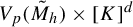 $V_{p}(\tilde {M}_{h})\times [K]^{d}$
and
$V_{p}(\tilde {M}_{h})\times [K]^{d}$
and $V_{p}(\tilde {M})^{h}\cap [pK]^{d}$
(recall the discussion between (9.9) and (9.10)). Since
$V_{p}(\tilde {M})^{h}\cap [pK]^{d}$
(recall the discussion between (9.9) and (9.10)). Since $g^{\square }_{h}$
is
$g^{\square }_{h}$
is $pK$
-periodic, by (9.15),
$pK$
-periodic, by (9.15),
 $$ \begin{align} \begin{aligned} \eta_{0}\circ g^{\square}_{h}(n)\equiv a_{h} \,\mod \mathbb{Z} \quad\text{for all } h\in J_{2}, n\in V_{p}(\tilde{M})^{h}. \end{aligned} \end{align} $$
Finally, since g is $pK$
-periodic,
$pK$
-periodic,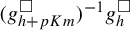 $(g^{\square }_{h+pKm})^{-1}g^{\square }_{h}$
take values in
$(g^{\square }_{h+pKm})^{-1}g^{\square }_{h}$
take values in $\Gamma ^{2}$
for all
$\Gamma ^{2}$
for all $h\in J_{2}$
and
$h\in J_{2}$
and ${m\in \mathbb {Z}^{d}}$
. So
${m\in \mathbb {Z}^{d}}$
. So $ \eta _{0}\circ g^{\square }_{h}= \eta _{0}\circ g^{\square }_{h+pKm} \,\mod \mathbb {Z}$
. Therefore, we may upgrade (9.16) to conclude that
$ \eta _{0}\circ g^{\square }_{h}= \eta _{0}\circ g^{\square }_{h+pKm} \,\mod \mathbb {Z}$
. Therefore, we may upgrade (9.16) to conclude that
 $$ \begin{align} \begin{aligned} \eta_{0}\circ g^{\square}_{h}(n)\equiv a_{h} \,\mod \mathbb{Z} \quad\text{for all } h\in J_{2}+pK\mathbb{Z}^{d}, n\in V_{p}(\tilde{M})^{h} \end{aligned} \end{align} $$
for some constant $a_{h}$
.
$a_{h}$
.
Denote $\eta _{1}\colon G\to \mathbb {R}, \eta _{1}(g):=\eta _{0}(g,g)$
and
$\eta _{1}\colon G\to \mathbb {R}, \eta _{1}(g):=\eta _{0}(g,g)$
and $\eta _{2}\colon G_{2}\to \mathbb {R}, \eta _{2}(g)=\eta _{0}(g,\mathrm {id}_{G})$
, we have that
$\eta _{2}\colon G_{2}\to \mathbb {R}, \eta _{2}(g)=\eta _{0}(g,\mathrm {id}_{G})$
, we have that $\eta _{0}(g',g)=\eta _{1}(g)+\eta _{2}(g'g^{-1})$
for all
$\eta _{0}(g',g)=\eta _{1}(g)+\eta _{2}(g'g^{-1})$
for all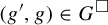 $(g',g)\in G^{\square }$
. Similar to [Reference Green and Tao5, Lemma 7.5],
$(g',g)\in G^{\square }$
. Similar to [Reference Green and Tao5, Lemma 7.5], $\eta _{1}$
is a type-I horizontal character on G, and
$\eta _{1}$
is a type-I horizontal character on G, and $\eta _{2}$
is a type-I horizontal character on
$\eta _{2}$
is a type-I horizontal character on $G_{2}$
which annihilates
$G_{2}$
which annihilates $[G,G_{2}]$
. Moreover,
$[G,G_{2}]$
. Moreover, $\Vert \eta _{1}\Vert ,\Vert \eta _{2}\Vert \ll _{d,m}\delta ^{-O_{d,m}(1)}$
.
$\Vert \eta _{1}\Vert ,\Vert \eta _{2}\Vert \ll _{d,m}\delta ^{-O_{d,m}(1)}$
.
Similar to the approach [Reference Green and Tao6, between (4.8) and (4.10)] (along with some notation changes), one can compute that (we leave the details to the interested readers)
 $$ \begin{align} \begin{aligned} Q(n+h)-Q(n)+P(n)+\sigma(h)\cdot n-a_{h}\equiv 0 \,\mod \mathbb{Z} \end{aligned} \end{align} $$
for all $h\in J_{2}+pK\mathbb {Z}^{d}$
and
$h\in J_{2}+pK\mathbb {Z}^{d}$
and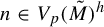 $n\in V_{p}(\tilde {M})^{h}$
, where
$n\in V_{p}(\tilde {M})^{h}$
, where
 $$ \begin{align*} \kern-28pt P(n):=\eta_{1}({g}(n)), \, Q(n):=\eta_{2}({g}_{\text{nlin}}(n)), \, \sigma(h):=\omega_{h}+h\Lambda, \end{align*} $$
 $$ \begin{align*} \omega_{h}:=(\eta_{2}([{g}(e_{1}),\{{g}_{\mathrm{lin}}(h)\}]),\ldots,\eta_{2}([{g}(e_{d}),\{{g}_{\mathrm{ lin}}(h)\}]))\in\mathbb{R}^{d}, \end{align*} $$
and $\Lambda =(\unicode{x3bb} _{i,j})_{1\leq i,j\leq d}$
is the
$\Lambda =(\unicode{x3bb} _{i,j})_{1\leq i,j\leq d}$
is the $d\times d$
matrix in
$d\times d$
matrix in $\mathbb {R}$
with
$\mathbb {R}$
with $\unicode{x3bb} _{i,j}=\eta _{2}([{g}(e_{i}),{g}(e_{j})])$
if
$\unicode{x3bb} _{i,j}=\eta _{2}([{g}(e_{i}),{g}(e_{j})])$
if $i<j$
and
$i<j$
and $\unicode{x3bb} _{i,j}=0$
otherwise. Since g is rational, it is clear that all the entries of
$\unicode{x3bb} _{i,j}=0$
otherwise. Since g is rational, it is clear that all the entries of $\Lambda $
are in
$\Lambda $
are in $\mathbb {Q}$
.
$\mathbb {Q}$
.
9.4 Solving polynomial equations
Following Step 2 in §8, we now solve (9.18). Note that (9.18) is more complicated than the equation in the Heisenberg case (8.1) due to the appearance of the nonlinear terms, and than [Reference Green and Tao6, (4.10)] since (9.18) only holds on some hyperspheres. As a result, this step is the most challenging part in adapting the Green–Tao approach, which is also the reason why the efforts in §§6 and 7 are needed.
Since g is rational and is of step at most s, we have that P and Q are of degree at most s and take values in $\mathbb {Q}$
. Replacing n in (9.18) by
$\mathbb {Q}$
. Replacing n in (9.18) by $n, n+h_{2}, n+h_{3},n+h_{2}+h_{3}$
, respectively, replacing h in (9.18) by
$n, n+h_{2}, n+h_{3},n+h_{2}+h_{3}$
, respectively, replacing h in (9.18) by $h_{1}$
, and taking the second-order differences, we have that
$h_{1}$
, and taking the second-order differences, we have that
 $$ \begin{align} \begin{aligned} \Delta_{h_{3}}\Delta_{h_{2}}\Delta_{h_{1}}Q(n)+\Delta_{h_{2}}\Delta_{h_{1}}P(n)\in\mathbb{Z} \end{aligned} \end{align} $$
for all $h_{3}\in J_{2}+pK\mathbb {Z}^{d}$
and
$h_{3}\in J_{2}+pK\mathbb {Z}^{d}$
and $(n,h_{1},h_{2})\in \Box _{p,2}(V_{p}(\tilde {M})^{h_{3}})$
. By Proposition 4.19 (and a change of variables), it is not hard to compute that the number of
$(n,h_{1},h_{2})\in \Box _{p,2}(V_{p}(\tilde {M})^{h_{3}})$
. By Proposition 4.19 (and a change of variables), it is not hard to compute that the number of $(n,h_{1},h_{2},h_{3})\in \Box _{p,3}(V_{p}(\tilde {M}))\cap ([pK]^{d})^{4}$
with
$(n,h_{1},h_{2},h_{3})\in \Box _{p,3}(V_{p}(\tilde {M}))\cap ([pK]^{d})^{4}$
with $h_{3}\in J_{2}$
is
$h_{3}\in J_{2}$
is $\gg _{d,m}\delta ^{-O_{d,m}(1)}\vert \Box _{p,3}(V_{p}(\tilde {M}))\cap ([pK]^{d})^{4}\vert $
. Since
$\gg _{d,m}\delta ^{-O_{d,m}(1)}\vert \Box _{p,3}(V_{p}(\tilde {M}))\cap ([pK]^{d})^{4}\vert $
. Since $d'\geq s+13\geq 3^{2}+3+3$
, it follows from (9.19) and Proposition 7.6 (if K is not divisible by p, then we may replace the set
$d'\geq s+13\geq 3^{2}+3+3$
, it follows from (9.19) and Proposition 7.6 (if K is not divisible by p, then we may replace the set $J_{2}$
by
$J_{2}$
by $(J_{2}+pK\mathbb {Z}^{d})\cap [p^{2}K]^{d}$
to apply Proposition 7.6) that
$(J_{2}+pK\mathbb {Z}^{d})\cap [p^{2}K]^{d}$
to apply Proposition 7.6) that
 $$ \begin{align} Q=\frac{1}{q}Q_{1}+Q_{0} \quad\text{and} \quad P=\frac{1}{q}P_{1}+P_{0} \end{align} $$
for some $q\in \mathbb {N}_{+}$
with
$q\in \mathbb {N}_{+}$
with $q\ll _{d}\delta ^{-O_{d}(1)}$
, some polynomials
$q\ll _{d}\delta ^{-O_{d}(1)}$
, some polynomials $Q_{1},P_{1}\in \text {poly}(V_{p}(\tilde {M})\to \mathbb {R}\vert \mathbb {Z})$
with
$Q_{1},P_{1}\in \text {poly}(V_{p}(\tilde {M})\to \mathbb {R}\vert \mathbb {Z})$
with $\deg (Q_{1})\leq \deg (Q), \deg (P_{1})\leq \deg (P)$
, and some
$\deg (Q_{1})\leq \deg (Q), \deg (P_{1})\leq \deg (P)$
, and some $Q_{0},P_{0}\colon \mathbb {Z}^{d}\to \mathbb {R}$
such that
$Q_{0},P_{0}\colon \mathbb {Z}^{d}\to \mathbb {R}$
such that
 $$ \begin{align} Q_{0}(n)=(n\Omega)\cdot n+v\cdot n+v_{0} \quad\text{and}\quad P_{0}(n)=u\cdot n+u_{0} \end{align} $$
for some $v,u\in \mathbb {R}^{d}$
,
$v,u\in \mathbb {R}^{d}$
, $v_{0},u_{0}\in \mathbb {R}$
, and symmetric
$v_{0},u_{0}\in \mathbb {R}$
, and symmetric $d\times d \mathbb {Q}$
-valued matrix
$d\times d \mathbb {Q}$
-valued matrix $\Omega $
. (If P and Q were
$\Omega $
. (If P and Q were $\mathbb {Z}/p$
-valued polynomials, then we could apply Corollary 7.4 instead of Proposition 7.6 and simplify the proof. However, this is not the case in general. This is the reason why we need to improve Corollary 7.4 to the more general version Proposition 7.6.)
$\mathbb {Z}/p$
-valued polynomials, then we could apply Corollary 7.4 instead of Proposition 7.6 and simplify the proof. However, this is not the case in general. This is the reason why we need to improve Corollary 7.4 to the more general version Proposition 7.6.)
9.5 Analyzing the low degree terms
Following Step 3 in §8, our next goal is to derive better descriptions for the lower degree polynomials $Q_{0}$
and
$Q_{0}$
and $P_{0}$
by substituting (9.20) and (9.21) back to (9.18). For all
$P_{0}$
by substituting (9.20) and (9.21) back to (9.18). For all $h\in J_{2}+pK\mathbb {Z}^{d}$
and
$h\in J_{2}+pK\mathbb {Z}^{d}$
and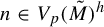 $n\in V_{p}(\tilde {M})^{h}$
, it follows from (9.20) that
$n\in V_{p}(\tilde {M})^{h}$
, it follows from (9.20) that
 $$ \begin{align*}Q(n)-Q_{0}(n)\equiv Q(n+h)-Q_{0}(n+h)\equiv P(n)- P_{0}(n)\equiv 0 \ \,\mod \frac{1}{q}\mathbb{Z}. \end{align*} $$
So (9.18) implies that
 $$ \begin{align} \begin{aligned} t_{h}\cdot n\equiv b_{h} \,\mod \mathbb{Z} \quad\text{for all } h\in J_{2}+pK\mathbb{Z}^{d} \quad\text{and}\quad n\in V_{p}(\tilde{M})^{h} \end{aligned} \end{align} $$
for some $b_{h}\in \mathbb {R}$
, where
$b_{h}\in \mathbb {R}$
, where
 $$ \begin{align} \begin{aligned} t_{h}:=q(2h\Omega+u+\sigma(h)). \end{aligned} \end{align} $$
Note that the conditions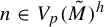 $n\in V_{p}(\tilde {M})^{h}$
remain unchanged if we replace n by
$n\in V_{p}(\tilde {M})^{h}$
remain unchanged if we replace n by $n+pn'$
for any
$n+pn'$
for any $n'\in \mathbb {Z}^{d}$
. So, the condition
$n'\in \mathbb {Z}^{d}$
. So, the condition $t_{h}\cdot n\equiv b_{h} \,\mod \mathbb {Z}$
is also unaffected if we change n to
$t_{h}\cdot n\equiv b_{h} \,\mod \mathbb {Z}$
is also unaffected if we change n to $n+pn'$
. Therefore, we must have that
$n+pn'$
. Therefore, we must have that $t_{h}\in \mathbb {Z}^{d}/p, b_{h}\in \mathbb {Z}/p$
for all
$t_{h}\in \mathbb {Z}^{d}/p, b_{h}\in \mathbb {Z}/p$
for all $h\in J_{2}+pK\mathbb {Z}^{d}$
.
$h\in J_{2}+pK\mathbb {Z}^{d}$
.
This is another place where our approach deviates from that of [Reference Green and Tao5] (in which case, one can easily conclude that $t_{h}\in \mathbb {Z}^{d}$
). Recall that the
$t_{h}\in \mathbb {Z}^{d}$
). Recall that the $\iota $
-image of the set
$\iota $
-image of the set $V_{p}(\tilde {M})^{h}$
is the intersection of the hypersphere
$V_{p}(\tilde {M})^{h}$
is the intersection of the hypersphere $V(M)$
and an affine subspace of co-dimension at most 1 which is orthogonal to
$V(M)$
and an affine subspace of co-dimension at most 1 which is orthogonal to $hA$
. Therefore, we may expect to deduce from (9.22) that the
$hA$
. Therefore, we may expect to deduce from (9.22) that the $\iota $
image of
$\iota $
image of $t_{h}$
is parallel to
$t_{h}$
is parallel to $hA.$
To be more precise, we now show that
$hA.$
To be more precise, we now show that
 $$ \begin{align} \begin{aligned} t_{h}-c_{h}(hA)\in\mathbb{Z}^{d} \quad\text{for some } c_{h}\in\mathbb{Z}/p \ \text{for all } h\in J_{2}+pK\mathbb{Z}^{d}. \end{aligned} \end{align} $$
Note that (9.22) implies that the $\iota (t_{h})$
is orthogonal to the
$\iota (t_{h})$
is orthogonal to the $\iota (V_{p}(\tilde {M})^{h}-V_{p}(\tilde {M})^{h})$
. So, (9.24) follows if one can show that the span of
$\iota (V_{p}(\tilde {M})^{h}-V_{p}(\tilde {M})^{h})$
. So, (9.24) follows if one can show that the span of $\iota (V_{p}(\tilde {M})^{h}-V_{p}(\tilde {M})^{h})$
is the orthogonal complement of
$\iota (V_{p}(\tilde {M})^{h}-V_{p}(\tilde {M})^{h})$
is the orthogonal complement of $\iota (hA)$
. To do so, we fix
$\iota (hA)$
. To do so, we fix $h\in J_{2}+pK\mathbb {Z}^{d}$
and identify
$h\in J_{2}+pK\mathbb {Z}^{d}$
and identify $V_{p}(\tilde {M})^{h}$
by
$V_{p}(\tilde {M})^{h}$
by $V_{p}(\tilde {M}_{h})$
via the linear transformation
$V_{p}(\tilde {M}_{h})$
via the linear transformation $\tilde {L}_{h}$
. The desired spanning property can be restated as follows.
$\tilde {L}_{h}$
. The desired spanning property can be restated as follows.
Claim. There exist $w_{0},\ldots ,w_{d-1}\in V_{p}(\tilde {M}_{h})$
such that
$w_{0},\ldots ,w_{d-1}\in V_{p}(\tilde {M}_{h})$
such that $w_{1}-w_{0},\ldots ,w_{d-1}-w_{0}$
are p-linearly independent.
$w_{1}-w_{0},\ldots ,w_{d-1}-w_{0}$
are p-linearly independent.
Proof of Claim
Recall that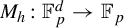 $M_{h}\colon \mathbb {F}_{p}^{d}\to \mathbb {F}_{p}$
is the quadratic form induced by
$M_{h}\colon \mathbb {F}_{p}^{d}\to \mathbb {F}_{p}$
is the quadratic form induced by $\tilde {M}_{h}$
and by (9.8)
$\tilde {M}_{h}$
and by (9.8) $\mathrm {rank}(M_{h})\geq 3$
. Translating everything in the
$\mathrm {rank}(M_{h})\geq 3$
. Translating everything in the $\mathbb {F}_{p}^{d}$
-setting, it suffices to show that there exist
$\mathbb {F}_{p}^{d}$
-setting, it suffices to show that there exist $v_{0},\ldots ,v_{d-1}\in V(M_{h})$
such that
$v_{0},\ldots ,v_{d-1}\in V(M_{h})$
such that $v_{1}-v_{0},\ldots ,v_{d-1}-v_{0}$
are linearly independent. Fix any
$v_{1}-v_{0},\ldots ,v_{d-1}-v_{0}$
are linearly independent. Fix any $v_{0}\in V(M_{h})$
(whose existence is given by Lemma 4.12). Suppose that for some
$v_{0}\in V(M_{h})$
(whose existence is given by Lemma 4.12). Suppose that for some $0\leq k\leq d-2$
, we have chosen
$0\leq k\leq d-2$
, we have chosen $v_{1},\ldots ,v_{k}\in V(M_{h})$
such that
$v_{1},\ldots ,v_{k}\in V(M_{h})$
such that $v_{1}-v_{0},\ldots ,v_{k}-v_{0}$
are linearly independent. If
$v_{1}-v_{0},\ldots ,v_{k}-v_{0}$
are linearly independent. If $k\leq d-3$
, then the number of
$k\leq d-3$
, then the number of $v\in \mathbb {F}_{p}^{d}$
with
$v\in \mathbb {F}_{p}^{d}$
with $v_{1}-v_{0},\ldots ,v_{k}-v_{0}, v-v_{0}$
being linearly dependent is at most
$v_{1}-v_{0},\ldots ,v_{k}-v_{0}, v-v_{0}$
being linearly dependent is at most $p^{k}\leq p^{d-3}$
, while
$p^{k}\leq p^{d-3}$
, while ${\vert V(M_{h})\vert =p^{d-2}(1+O(p^{-1/2}))}$
. If
${\vert V(M_{h})\vert =p^{d-2}(1+O(p^{-1/2}))}$
. If $p\gg _{d} 1$
, then there exists
$p\gg _{d} 1$
, then there exists $v_{k+1}\in V(M_{h})$
such that
$v_{k+1}\in V(M_{h})$
such that $v_{1}-v_{0},\ldots ,v_{k+1}-v_{0}$
are linearly independent. If
$v_{1}-v_{0},\ldots ,v_{k+1}-v_{0}$
are linearly independent. If $k=d-2$
, then let
$k=d-2$
, then let $Q(v)$
denote the determinant of the
$Q(v)$
denote the determinant of the $(d-1)\times (d-1)$
matrix with
$(d-1)\times (d-1)$
matrix with $v_{1}-v_{0},\ldots ,v_{d-2}-v_{0}, v-v_{0}$
being the row vectors. Then, Q is a non-constant degree 1 polynomial in v. So, Q cannot be written in the form
$v_{1}-v_{0},\ldots ,v_{d-2}-v_{0}, v-v_{0}$
being the row vectors. Then, Q is a non-constant degree 1 polynomial in v. So, Q cannot be written in the form $Q=Q'M_{h}$
for some
$Q=Q'M_{h}$
for some $Q'\in \text {poly}(\mathbb {F}_{p}^{d}\to \mathbb {F}_{p})$
with
$Q'\in \text {poly}(\mathbb {F}_{p}^{d}\to \mathbb {F}_{p})$
with $\deg (Q')\leq \deg (Q)$
. By Proposition 6.2, there exists
$\deg (Q')\leq \deg (Q)$
. By Proposition 6.2, there exists $v_{d-1}\in V(M_{h})\backslash V(Q)$
. So,
$v_{d-1}\in V(M_{h})\backslash V(Q)$
. So, $v_{1}-v_{0},\ldots ,v_{d-1}-v_{0}$
are linearly dependent. This completes the proof of the claim.
$v_{1}-v_{0},\ldots ,v_{d-1}-v_{0}$
are linearly dependent. This completes the proof of the claim.
We now continue the proof of (9.24). Let $w_{0},\ldots ,w_{d-1}\in V_{p}(\tilde {M}_{h})$
be given by the claim. Then, for all
$w_{0},\ldots ,w_{d-1}\in V_{p}(\tilde {M}_{h})$
be given by the claim. Then, for all $1\leq i\leq d-1$
, it follows from (9.22) that
$1\leq i\leq d-1$
, it follows from (9.22) that
 $$ \begin{align*}t_{h}\cdot (\tilde{L}_{h}(w_{i}-w_{0}))=t_{h}\cdot ((\tilde{L}_{h}(w_{i})+u_{h})-(\tilde{L}_{h}(w_{0})+u_{h}))\equiv b_{h}-b_{h}=0 \,\mod\mathbb{Z}.\end{align*} $$
Since $w_{1}-w_{0},\ldots ,w_{d-1}-w_{0}$
are p-linearly independent, by linearity, there exists
$w_{1}-w_{0},\ldots ,w_{d-1}-w_{0}$
are p-linearly independent, by linearity, there exists $q_{h}\in \mathbb {N}, p\nmid q_{h}$
such that
$q_{h}\in \mathbb {N}, p\nmid q_{h}$
such that $q_{h}t_{h}\cdot \tilde {L}_{h}(e_{i})\in \mathbb {Z}$
for all
$q_{h}t_{h}\cdot \tilde {L}_{h}(e_{i})\in \mathbb {Z}$
for all $1\leq i\leq d-1$
. Since
$1\leq i\leq d-1$
. Since $t_{h}\in \mathbb {Z}^{d}/p$
, we have
$t_{h}\in \mathbb {Z}^{d}/p$
, we have
 $$ \begin{align} t_{h}\cdot \tilde{L}_{h}(e_{i})\in \frac{1}{q_{h}}\mathbb{Z}\cap \frac{1}{p}\mathbb{Z}=\mathbb{Z}. \end{align} $$
Recall that $h_{1}\notin p\mathbb {Z}$
since
$h_{1}\notin p\mathbb {Z}$
since $h\in J_{2}+pK\mathbb {Z}^{d}$
. Since
$h\in J_{2}+pK\mathbb {Z}^{d}$
. Since $t_{h}\in \mathbb {Z}^{d}/p$
, we may write
$t_{h}\in \mathbb {Z}^{d}/p$
, we may write ${t_{h}=c_{h}(hA)+(0,t^{\prime }_{h})}$
for some
${t_{h}=c_{h}(hA)+(0,t^{\prime }_{h})}$
for some $c_{h}\in \mathbb {Z}/p$
and
$c_{h}\in \mathbb {Z}/p$
and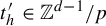 $t^{\prime }_{h}\in \mathbb {Z}^{d-1}/p$
. Since
$t^{\prime }_{h}\in \mathbb {Z}^{d-1}/p$
. Since $(hA)\cdot \tilde {L}_{h}(e_{i})\in p\mathbb {Z}$
for all
$(hA)\cdot \tilde {L}_{h}(e_{i})\in p\mathbb {Z}$
for all $1\leq i\leq d-1$
by (9.9), it follows from (9.25) that
$1\leq i\leq d-1$
by (9.9), it follows from (9.25) that $t^{\prime }_{h}B\in \mathbb {Z}^{d-1}$
, where B is the
$t^{\prime }_{h}B\in \mathbb {Z}^{d-1}$
, where B is the $(d-1)\times (d-1)$
matrix whose column vectors are transposes of
$(d-1)\times (d-1)$
matrix whose column vectors are transposes of $\tilde {L}_{h}(e_{1}),\ldots ,\tilde {L}_{h}(e_{d-1})$
with the first coefficient removed.
$\tilde {L}_{h}(e_{1}),\ldots ,\tilde {L}_{h}(e_{d-1})$
with the first coefficient removed.
If $\tilde {L}_{h}(e_{1}),\ldots , \tilde {L}_{h}(e_{d-1}),(1,0,\ldots ,0)$
are p-linearly dependent, then the fact that
$\tilde {L}_{h}(e_{1}),\ldots , \tilde {L}_{h}(e_{d-1}),(1,0,\ldots ,0)$
are p-linearly dependent, then the fact that $(hA)\cdot \tilde {L}_{h}(e_{i})\in p\mathbb {Z}, 1\leq i\leq d-1$
implies that
$(hA)\cdot \tilde {L}_{h}(e_{i})\in p\mathbb {Z}, 1\leq i\leq d-1$
implies that $(hA)\cdot \tilde {L}_{h}(1,0,\ldots ,0)=\tau (c)h_{1}\in p\mathbb {Z}$
, which is a contradiction. Therefore,
$(hA)\cdot \tilde {L}_{h}(1,0,\ldots ,0)=\tau (c)h_{1}\in p\mathbb {Z}$
, which is a contradiction. Therefore, $\tilde {L}_{h}(e_{1}),\ldots ,\tilde {L}_{h}(e_{d-1}),(1,0,\ldots ,0)$
are p-linearly independent and thus,
$\tilde {L}_{h}(e_{1}),\ldots ,\tilde {L}_{h}(e_{d-1}),(1,0,\ldots ,0)$
are p-linearly independent and thus, $\det (B)\notin p\mathbb {Z}$
. So,
$\det (B)\notin p\mathbb {Z}$
. So, $t^{\prime }_{h}\in ({1}/{q^{\prime }_{h}})\mathbb {Z}^{d-1}$
for some
$t^{\prime }_{h}\in ({1}/{q^{\prime }_{h}})\mathbb {Z}^{d-1}$
for some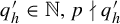 $q^{\prime }_{h}\in \mathbb {N}, p\nmid q^{\prime }_{h}$
. Since
$q^{\prime }_{h}\in \mathbb {N}, p\nmid q^{\prime }_{h}$
. Since $t^{\prime }_{h}\in ({1}/{p})\mathbb {Z}^{d-1}$
, we have that
$t^{\prime }_{h}\in ({1}/{p})\mathbb {Z}^{d-1}$
, we have that $t^{\prime }_{h}\in \mathbb {Z}^{d-1}$
. This completes the proof of (9.24).
$t^{\prime }_{h}\in \mathbb {Z}^{d-1}$
. This completes the proof of (9.24).
Next, we need to take a closer look at (9.24) by unpacking the definition of $\sigma (h)$
. Since the map
$\sigma (h)$
. Since the map $(b,c)\to \eta _{2}([b,c])$
is bilinear, the map
$(b,c)\to \eta _{2}([b,c])$
is bilinear, the map $c\to \eta _{2}([g(e_{i}),c])$
is a homomorphism. So, there exists
$c\to \eta _{2}([g(e_{i}),c])$
is a homomorphism. So, there exists $\xi =(\xi _{1},\ldots ,\xi _{d})\in (\mathbb {R}^{m})^{d}$
such that
$\xi =(\xi _{1},\ldots ,\xi _{d})\in (\mathbb {R}^{m})^{d}$
such that
 $$ \begin{align*}\eta_{2}([g(e_{i}),x])=\xi_{i}\cdot\psi(x) \,\mod \mathbb{Z}\end{align*} $$
for all $1\leq i\leq d$
and
$1\leq i\leq d$
and $x\in G$
. Similar to [Reference Green and Tao5, discussion after (7.15)], all but the first
$x\in G$
. Similar to [Reference Green and Tao5, discussion after (7.15)], all but the first $m_{\mathrm {lin}}$
coefficients of
$m_{\mathrm {lin}}$
coefficients of $\xi _{i}$
are non-zero, and
$\xi _{i}$
are non-zero, and $\vert \xi _{i}\vert \ll _{d,m}\delta ^{-O_{d,m}(1)}$
. Denote
$\vert \xi _{i}\vert \ll _{d,m}\delta ^{-O_{d,m}(1)}$
. Denote $\gamma _{i}:=\psi (g(e_{i}))$
and
$\gamma _{i}:=\psi (g(e_{i}))$
and ${\gamma :=(\gamma _{1},\ldots ,\gamma _{d})\in (\mathbb {R}^{m})^{d}}$
. Since g is rational, it is clear that
${\gamma :=(\gamma _{1},\ldots ,\gamma _{d})\in (\mathbb {R}^{m})^{d}}$
. Since g is rational, it is clear that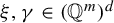 $\xi ,\gamma \in (\mathbb {Q}^{m})^{d}$
.
$\xi ,\gamma \in (\mathbb {Q}^{m})^{d}$
.
Denote $\gamma (h):=\sum _{j=1}^{d}\gamma _{j}h_{j}\in \mathbb {Q}^{m}$
. Let
$\gamma (h):=\sum _{j=1}^{d}\gamma _{j}h_{j}\in \mathbb {Q}^{m}$
. Let $\{\gamma (h)\}\in [0,1)^{m}$
be the coordinate-wise fractional part of
$\{\gamma (h)\}\in [0,1)^{m}$
be the coordinate-wise fractional part of $\gamma (h)$
. Then,
$\gamma (h)$
. Then,
 $$ \begin{align*}\sigma(h)=h\Lambda+\xi\ast \{\gamma(h)\},\end{align*} $$
where $\ast $
is the coordinate-wise product of vectors in
$\ast $
is the coordinate-wise product of vectors in $\mathbb {R}^{m}$
. So for all
$\mathbb {R}^{m}$
. So for all $h\in J_{2}+pK\mathbb {Z}^{d}$
, it follows from (9.23) and (9.24) that
$h\in J_{2}+pK\mathbb {Z}^{d}$
, it follows from (9.23) and (9.24) that
 $$ \begin{align} q(hB+u+\xi\ast \{\gamma(h)\})-c_{h}(hA)\in\mathbb{Z}^{d} \quad\text{for some } c_{h}\in\mathbb{Z}/p, \end{align} $$
where $B:=2\Omega +\Lambda $
.
$B:=2\Omega +\Lambda $
.
We need the following lemma to study (9.26).
Lemma 9.7. Let $d,m,N\in \mathbb {N}_{+}$
, p be a prime,
$d,m,N\in \mathbb {N}_{+}$
, p be a prime, $\delta>0, \beta ,\alpha _{1},\ldots ,\alpha _{d}\in \mathbb {R}$
, and
$\delta>0, \beta ,\alpha _{1},\ldots ,\alpha _{d}\in \mathbb {R}$
, and $\xi ,\gamma _{0},\gamma _{1},\ldots ,\gamma _{d}\in \mathbb {Q}^{m}$
. Let V be a subset of
$\xi ,\gamma _{0},\gamma _{1},\ldots ,\gamma _{d}\in \mathbb {Q}^{m}$
. Let V be a subset of $\{-N,\ldots ,N\}^{d}$
of cardinality at least
$\{-N,\ldots ,N\}^{d}$
of cardinality at least $\delta (2N+1)^{d}$
such that
$\delta (2N+1)^{d}$
such that
 $$ \begin{align*} \beta+\sum_{i=1}^{d}\alpha_{i}h_{i}+\xi\cdot\bigg\{\gamma_{0}+\sum_{i=1}^{d}\gamma_{i}h_{i}\bigg\}\in \mathbb{Z} \end{align*} $$
for all $h=(h_{1},\ldots ,h_{d})\in V$
. If
$h=(h_{1},\ldots ,h_{d})\in V$
. If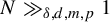 $N\gg _{\delta ,d,m,p}1$
(we caution the readers that N is dependent on p. However, this will not cause any trouble for the application of this lemma) then at least one of the following holds:
$N\gg _{\delta ,d,m,p}1$
(we caution the readers that N is dependent on p. However, this will not cause any trouble for the application of this lemma) then at least one of the following holds:
-
(i) there exists
$r\in \mathbb {Z}$
with
$0<r\ll _{d,m} \delta ^{-O_{d,m}(1)}$
such that
$r\xi \in \mathbb {Z}^{m}$
; -
(ii) there exists
$k{\kern-1pt}\in{\kern-1pt} \mathbb {Z}^{m}$
with
$0<\vert k\vert {\kern-1pt}\ll _{d,m} \delta ^{-O_{d,m}(1)}$
such that
$k\cdot \gamma _{i}\in \mathbb {Z}$
for all
$1{\kern-1pt}\leq{\kern-1pt} i{\kern-1pt}\leq{\kern-1pt} d$
.







Proof. Lemma 9.7 generalizes [Reference Green and Tao6, Lemma 4.3] in two aspects. The first is that Lemma 9.7 allows the appearance of the term $\gamma _{0}$
. The second is that we do not impose any bound for the complexity of
$\gamma _{0}$
. The second is that we do not impose any bound for the complexity of $\xi $
. The strategy of the proof is to reduce the problem to the case when
$\xi $
. The strategy of the proof is to reduce the problem to the case when $\gamma _{0}$
is zero and
$\gamma _{0}$
is zero and $\xi $
is bounded in the unit box, and then apply [Reference Green and Tao6, Lemma 4.3].
$\xi $
is bounded in the unit box, and then apply [Reference Green and Tao6, Lemma 4.3].
Since
 $$ \begin{align} \bigg\{\gamma_{0}\bigg\}+\bigg\{\sum_{i=1}^{d}\gamma_{i}h_{i}\bigg\}-\bigg\{\gamma_{0}+\sum_{i=1}^{d}\gamma_{i}h_{i}\bigg\} \end{align} $$
takes at most $2^{m}$
different values, passing to a subset of V if necessary, we may assume without loss of generality that (9.27) take the same value for all
$2^{m}$
different values, passing to a subset of V if necessary, we may assume without loss of generality that (9.27) take the same value for all $h\in V$
. Absorbing constant terms into
$h\in V$
. Absorbing constant terms into $\beta $
if necessary, we may assume without loss of generality that
$\beta $
if necessary, we may assume without loss of generality that $\gamma _{0}=\mathbf {0}$
.
$\gamma _{0}=\mathbf {0}$
.
Since
 $$ \begin{align*}a\{b\}=\{a\}\{b\}+\lfloor a\rfloor b-\lfloor a\rfloor\lfloor b\rfloor\end{align*} $$
for all $a,b\in \mathbb {R}$
, we have that
$a,b\in \mathbb {R}$
, we have that
 $$ \begin{align*} \beta+\sum_{i=1}^{d}\alpha_{i}h_{i}+\xi\cdot\bigg\{\sum_{i=1}^{d}\gamma_{i}h_{i}\bigg\}\equiv \beta+\sum_{i=1}^{d}(\alpha_{i}+\lfloor\xi\rfloor\cdot \gamma_{i})h_{i}+\{\xi\}\cdot\bigg\{\sum_{i=1}^{d}\gamma_{i}h_{i}\bigg\}\,\mod \mathbb{Z}. \end{align*} $$
So, it suffices to prove Lemma 9.7 for the case $\xi \in [0,1)^{m}$
. By [Reference Green and Tao6, Lemma 4.3], either there exists
$\xi \in [0,1)^{m}$
. By [Reference Green and Tao6, Lemma 4.3], either there exists $r{\kern-1pt}\in{\kern-1pt} \mathbb {Z}, 0{\kern-1pt}<{\kern-1pt}r\ll _{d,m}\delta ^{-O_{d,m}(1)}$
such that
$r{\kern-1pt}\in{\kern-1pt} \mathbb {Z}, 0{\kern-1pt}<{\kern-1pt}r\ll _{d,m}\delta ^{-O_{d,m}(1)}$
such that $\Vert r\xi _{i} \Vert _{\mathbb {R}/\mathbb {Z}}\ll _{d,m} \delta ^{-O_{d,m}(1)}/N$
for all
$\Vert r\xi _{i} \Vert _{\mathbb {R}/\mathbb {Z}}\ll _{d,m} \delta ^{-O_{d,m}(1)}/N$
for all $1{\kern-1pt}\leq{\kern-1pt} i{\kern-1pt}\leq{\kern-1pt} d$
(where
$1{\kern-1pt}\leq{\kern-1pt} i{\kern-1pt}\leq{\kern-1pt} d$
(where $\xi =(\xi _{1},\ldots ,\xi _{m})$
), or there exists
$\xi =(\xi _{1},\ldots ,\xi _{m})$
), or there exists $k\in \mathbb {Z}^{m}$
with
$k\in \mathbb {Z}^{m}$
with $0<\vert k\vert \ll _{d,m} \delta ^{-O_{d,m}(1)}$
such that
$0<\vert k\vert \ll _{d,m} \delta ^{-O_{d,m}(1)}$
such that $\Vert k\cdot \gamma _{i}\Vert _{\mathbb {R}/\mathbb {Z}}\ll _{d,m} \delta ^{-O_{d,m}(1)}/N$
for all
$\Vert k\cdot \gamma _{i}\Vert _{\mathbb {R}/\mathbb {Z}}\ll _{d,m} \delta ^{-O_{d,m}(1)}/N$
for all $1\leq i\leq d$
.
$1\leq i\leq d$
.
Since $\xi ,\gamma _{1},\ldots ,\gamma _{d}\in \mathbb {Q}^{m}$
, by choosing N to be sufficiently large depending on
$\xi ,\gamma _{1},\ldots ,\gamma _{d}\in \mathbb {Q}^{m}$
, by choosing N to be sufficiently large depending on $\delta ,d,m$
, and p, we have that either
$\delta ,d,m$
, and p, we have that either $r\xi _{i}\in \mathbb {Z}$
for all
$r\xi _{i}\in \mathbb {Z}$
for all $1\leq i\leq d$
or
$1\leq i\leq d$
or $k\cdot \gamma _{i}\in \mathbb {Z}$
for all
$k\cdot \gamma _{i}\in \mathbb {Z}$
for all $1\leq i\leq d$
.
$1\leq i\leq d$
.
With the help of Lemma 9.26, we may conclude from (9.26) the following proposition.
Proposition 9.8. We have that either there exists $r\in \mathbb {N}_{+}$
with
$r\in \mathbb {N}_{+}$
with $r\ll _{d,m} \delta ^{-O_{d,m}(1)}$
such that
$r\ll _{d,m} \delta ^{-O_{d,m}(1)}$
such that $r\xi \in (\mathbb {Z}^{m})^{d}$
, or there exists
$r\xi \in (\mathbb {Z}^{m})^{d}$
, or there exists $k\in \mathbb {Z}^{m_{\mathrm {lin}}}\times \{0\}^{m-m_{\mathrm {lin}}}$
with
$k\in \mathbb {Z}^{m_{\mathrm {lin}}}\times \{0\}^{m-m_{\mathrm {lin}}}$
with $0<\vert k\vert \ll _{d,m}\delta ^{-O_{d,m}(1)}$
such that
$0<\vert k\vert \ll _{d,m}\delta ^{-O_{d,m}(1)}$
such that $k\cdot \gamma _{i}\in \mathbb {Z}$
for all
$k\cdot \gamma _{i}\in \mathbb {Z}$
for all $1\leq i\leq d$
.
$1\leq i\leq d$
.
Proof. We remark that we cannot apply the Green–Tao approach (or Lemma 9.26) directly due to the appearance of the term $c_{h}(hA)$
in (9.26). To overcome this difficulty, we get rid of this term by multiplying both sides of (9.26) by vectors which are orthogonal to
$c_{h}(hA)$
in (9.26). To overcome this difficulty, we get rid of this term by multiplying both sides of (9.26) by vectors which are orthogonal to $hA$
.
$hA$
.
Let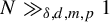 $N\gg _{\delta ,d,m,p} 1$
be chosen later. For
$N\gg _{\delta ,d,m,p} 1$
be chosen later. For $w\in \mathbb {F}_{p}^{d}$
, let
$w\in \mathbb {F}_{p}^{d}$
, let $V_{w}:=\{n\in \mathbb {F}_{p}^{d}\colon (nA)\cdot w=0\}$
and
$V_{w}:=\{n\in \mathbb {F}_{p}^{d}\colon (nA)\cdot w=0\}$
and $Z_{w}=J_{2}\cap \iota ^{-1}(V_{w})$
. For
$Z_{w}=J_{2}\cap \iota ^{-1}(V_{w})$
. For $w'\in \iota ^{-1}(w)$
and
$w'\in \iota ^{-1}(w)$
and $h\in Z_{w}+pK\mathbb {Z}^{d}$
, note that
$h\in Z_{w}+pK\mathbb {Z}^{d}$
, note that $(hA)\cdot w'\equiv \tau ((\iota (h)A)\cdot w)=0 \,\mod p\mathbb {Z}$
. Taking the dot product of both sides of (9.26) with
$(hA)\cdot w'\equiv \tau ((\iota (h)A)\cdot w)=0 \,\mod p\mathbb {Z}$
. Taking the dot product of both sides of (9.26) with $w'$
, we have that
$w'$
, we have that
 $$ \begin{align} hB\cdot qw'+u\cdot qw'+\bigg(\sum_{i=1}^{d}qw^{\prime}_{i}\xi_{i}\bigg)\cdot \{\gamma(h)\}\in\mathbb{Z} \end{align} $$
for all $w\in \mathbb {F}_{p}^{d}, w'\in \iota ^{-1}(w)$
and
$w\in \mathbb {F}_{p}^{d}, w'\in \iota ^{-1}(w)$
and $h\in Z_{w}+pK\mathbb {Z}^{d}$
. To apply Lemma 9.7, we need to identify those w for which the set
$h\in Z_{w}+pK\mathbb {Z}^{d}$
. To apply Lemma 9.7, we need to identify those w for which the set $Z_{w}$
is large.
$Z_{w}$
is large.
Since
 $$ \begin{align*}\sum_{w\in \mathbb{F}_{p}^{d}, wA\neq \mathbf{0}}\vert Z_{w}\vert\geq p^{d-1}\vert J_{2}\vert\gg_{d,m} \delta^{O_{d,m}(1)}p^{d-1}(pK)^{d},\end{align*} $$ $\vert Z_{w}\vert \leq (pK)^{d}$
, and
$\vert Z_{w}\vert \leq (pK)^{d}$
, and
 $$ \begin{align*}\vert\{w\in \mathbb{F}_{p}^{d}, wA\neq \mathbf{0}\}\vert\geq p^{d}-p^{d-d'}\geq p^{d}-p^{d-2},\end{align*} $$
by the pigeonhole principle, there exists a subset W of $\{w\in \mathbb {F}_{p}^{d}, wA\neq \mathbf {0}\}$
of cardinality
$\{w\in \mathbb {F}_{p}^{d}, wA\neq \mathbf {0}\}$
of cardinality $\gg _{d,m}\delta ^{O_{d,m}(1)} p^{d}$
such that
$\gg _{d,m}\delta ^{O_{d,m}(1)} p^{d}$
such that $\vert Z_{w}\vert \gg _{d,m} \delta ^{O_{d,m}(1)} p^{d-1}K^{d}$
for all
$\vert Z_{w}\vert \gg _{d,m} \delta ^{O_{d,m}(1)} p^{d-1}K^{d}$
for all $w\in W$
.
$w\in W$
.
To apply Lemma 9.7, we also need to rewrite (9.28) by identifying $V_{w}$
as
$V_{w}$
as $\mathbb {F}_{p}^{d-1}$
via linear transformations. Since
$\mathbb {F}_{p}^{d-1}$
via linear transformations. Since $wA\neq \mathbf {0}$
,
$wA\neq \mathbf {0}$
, $V_{w}$
is a subspace of
$V_{w}$
is a subspace of $\mathbb {F}_{p}^{d}$
of co-dimension 1. Let
$\mathbb {F}_{p}^{d}$
of co-dimension 1. Let $L_{w}\colon \mathbb {F}_{p}^{d-1}\to V_{w}$
be any bijective linear transformation and let
$L_{w}\colon \mathbb {F}_{p}^{d-1}\to V_{w}$
be any bijective linear transformation and let $\tilde {L}_{w}/p$
be the regular lifting of
$\tilde {L}_{w}/p$
be the regular lifting of $L_{w}$
. Since all of
$L_{w}$
. Since all of $B,\xi _{i},\gamma $
are rational, there exists
$B,\xi _{i},\gamma $
are rational, there exists $K'\in \mathbb {N}_{+}$
such that for any
$K'\in \mathbb {N}_{+}$
such that for any ${h,h'\in \mathbb {Z}^{d}}$
,
${h,h'\in \mathbb {Z}^{d}}$
, $\{\gamma (h)\}$
remains unchanged if we replace h by
$\{\gamma (h)\}$
remains unchanged if we replace h by $h+pK'h'$
. By Lemma 9.1, the map
$h+pK'h'$
. By Lemma 9.1, the map $\Phi \colon \mathbb {Z}^{d-1}\times \mathbb {Z}^{d}\to \mathbb {Z}^{d}$
given by
$\Phi \colon \mathbb {Z}^{d-1}\times \mathbb {Z}^{d}\to \mathbb {Z}^{d}$
given by
 $$ \begin{align*}\Phi(z,m):=\tilde{L}_{w}(z)+pm\end{align*} $$
mod $pK\mathbb {Z}^{d}$
is a
$pK\mathbb {Z}^{d}$
is a ${K'}^{d-1}$
-to-1 map between
${K'}^{d-1}$
-to-1 map between $[pK']^{d-1}\times [K]^{d}$
and
$[pK']^{d-1}\times [K]^{d}$
and $\iota ^{-1}(V_{w})\cap [pK]^{d}$
. Since
$\iota ^{-1}(V_{w})\cap [pK]^{d}$
. Since $\vert Z_{w}\vert =\vert \iota ^{-1}(V_{w})\cap J_{2}\vert \gg _{d,m} \delta ^{O_{d,m}(1)} p^{d-1}K^{d}$
, we have that
$\vert Z_{w}\vert =\vert \iota ^{-1}(V_{w})\cap J_{2}\vert \gg _{d,m} \delta ^{O_{d,m}(1)} p^{d-1}K^{d}$
, we have that $\vert \Phi ^{-1}(Z_{w})\cap ([pK']^{d-1}\times [K]^{d})\vert \gg _{d,m} \delta ^{O_{d,m}(1)} (pK')^{d-1}K^{d}$
. So, there exists some
$\vert \Phi ^{-1}(Z_{w})\cap ([pK']^{d-1}\times [K]^{d})\vert \gg _{d,m} \delta ^{O_{d,m}(1)} (pK')^{d-1}K^{d}$
. So, there exists some $m_{w}\in [K]^{d}$
such that the set
$m_{w}\in [K]^{d}$
such that the set
 $$ \begin{align*}I_{w}:=\{z\in [pK']^{d-1}\colon \Phi(z,m_{w}) \in Z_{w}+pK\mathbb{Z}^{d}\}\end{align*} $$
is of cardinality $\gg _{d,m} \delta ^{O_{d,m}(1)} (pK')^{d-1}$
. So, it follows from (9.28) that
$\gg _{d,m} \delta ^{O_{d,m}(1)} (pK')^{d-1}$
. So, it follows from (9.28) that
 $$ \begin{align} \tilde{L}_{w}(z)B\cdot qw'+u+(pm_{w}B)\cdot qw'+\bigg(\sum_{i=1}^{d}qw^{\prime}_{i}\xi_{i}\bigg)\cdot \{\gamma(\tilde{L}_{w}(z)+pm_{w})\}\in\mathbb{Z} \end{align} $$
for all $z\in I_{w}$
. By the choice of
$z\in I_{w}$
. By the choice of $K'$
, we have that (9.29) also holds for all
$K'$
, we have that (9.29) also holds for all $z\in I_{w}+pK'\mathbb {Z}^{d-1}$
.
$z\in I_{w}+pK'\mathbb {Z}^{d-1}$
.
We are now ready to apply Lemma 9.7. Note that
 $$ \begin{align*} \begin{aligned} \liminf_{N\to\infty}\frac{\vert (I_{w}+pK'\mathbb{Z}^{d-1})\cap \{-N,\ldots,N\}^{d-1}\vert}{(2N+1)^{d-1}} =\frac{\vert I_{w}\vert}{(pK')^{d-1}}\gg_{d,m}\delta^{O_{d,m}(1)}. \end{aligned} \end{align*} $$
Recall that the last $m-m_{\mathrm {lin}}$
coefficients of
$m-m_{\mathrm {lin}}$
coefficients of $\xi _{i}$
are zero and so the last
$\xi _{i}$
are zero and so the last $m-m_{\mathrm {lin}}$
coefficients of
$m-m_{\mathrm {lin}}$
coefficients of $\xi _{i}$
and
$\xi _{i}$
and $\gamma _{i}$
does not affect the expression in (9.29). If
$\gamma _{i}$
does not affect the expression in (9.29). If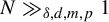 $N\gg _{\delta ,d,m,p} 1$
, then we may apply Lemma 9.7 to (9.29) to conclude that either there exists
$N\gg _{\delta ,d,m,p} 1$
, then we may apply Lemma 9.7 to (9.29) to conclude that either there exists $r_{w}\in \mathbb {Z}, 0<r_{w}\ll _{d,m}\delta ^{-O_{d,m}(1)}$
such that
$r_{w}\in \mathbb {Z}, 0<r_{w}\ll _{d,m}\delta ^{-O_{d,m}(1)}$
such that $r_{w}q\sum _{i=1}^{d}w^{\prime }_{i}\xi _{i}\in \mathbb {Z}^{m}$
for all
$r_{w}q\sum _{i=1}^{d}w^{\prime }_{i}\xi _{i}\in \mathbb {Z}^{m}$
for all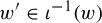 $w'\in \iota ^{-1}(w)$
, or there exists
$w'\in \iota ^{-1}(w)$
, or there exists $k_{w}\in \mathbb {Z}^{m_{\mathrm {lin}}}\times \{0\}^{m-m_{\mathrm {lin}}}$
,
$k_{w}\in \mathbb {Z}^{m_{\mathrm {lin}}}\times \{0\}^{m-m_{\mathrm {lin}}}$
, $0<\vert k_{w}\vert \ll _{d,m}\delta ^{-O_{d,m}(1)}$
such that
$0<\vert k_{w}\vert \ll _{d,m}\delta ^{-O_{d,m}(1)}$
such that $k_{w}\cdot (\gamma \circ \tilde {L}_{w}(z))\in \mathbb {Z}$
for all
$k_{w}\cdot (\gamma \circ \tilde {L}_{w}(z))\in \mathbb {Z}$
for all $z\in \mathbb {Z}^{d-1}$
(or equivalently,
$z\in \mathbb {Z}^{d-1}$
(or equivalently, $k_{w}\cdot \gamma (h)\in \mathbb {Z}$
for all
$k_{w}\cdot \gamma (h)\in \mathbb {Z}$
for all $h\in V_{w}$
).
$h\in V_{w}$
).
By the pigeonhole principle, there exists a subset $W'$
of W of cardinality
$W'$
of W of cardinality $\gg _{d,m}\delta ^{O_{d,m}(1)} p^{d}$
such that either there exists
$\gg _{d,m}\delta ^{O_{d,m}(1)} p^{d}$
such that either there exists $r\in \mathbb {Z}$
with
$r\in \mathbb {Z}$
with $0<r\ll _{d,m}\delta ^{-O_{d,m}(1)}$
such that
$0<r\ll _{d,m}\delta ^{-O_{d,m}(1)}$
such that $rq\sum _{i=1}^{d}w^{\prime }_{i}\xi _{i}\in \mathbb {Z}^{m}$
for all
$rq\sum _{i=1}^{d}w^{\prime }_{i}\xi _{i}\in \mathbb {Z}^{m}$
for all $w'\in \iota ^{-1}(W')$
, or there exists
$w'\in \iota ^{-1}(W')$
, or there exists $k\in \mathbb {Z}^{m}$
with
$k\in \mathbb {Z}^{m}$
with $0<\vert k\vert \ll _{d,m}\delta ^{-O_{d,m}(1)}$
such that
$0<\vert k\vert \ll _{d,m}\delta ^{-O_{d,m}(1)}$
such that $k\cdot \gamma (h) \in \mathbb {Z}$
for all
$k\cdot \gamma (h) \in \mathbb {Z}$
for all $h\in \tilde {V}_{w}:=\tilde {L}_{w}(\mathbb {Z}^{d-1})=\text {span}_{\mathbb {Z}}\{\tau (L_{w}(e_{1})),\ldots , \tau (L_{w}(e_{d-1}))\}$
.
$h\in \tilde {V}_{w}:=\tilde {L}_{w}(\mathbb {Z}^{d-1})=\text {span}_{\mathbb {Z}}\{\tau (L_{w}(e_{1})),\ldots , \tau (L_{w}(e_{d-1}))\}$
.
If it is the former case, then since $\iota ^{-1}(W')=\tau (W')+p\mathbb {Z}^{d}$
, we must have that
$\iota ^{-1}(W')=\tau (W')+p\mathbb {Z}^{d}$
, we must have that $rq\xi _{i}\in \mathbb {Z}^{m}/p$
for all
$rq\xi _{i}\in \mathbb {Z}^{m}/p$
for all $1\leq i\leq d$
. Since
$1\leq i\leq d$
. Since $p\gg _{d,m}\delta ^{-O_{d,m}(1)}$
, there exist
$p\gg _{d,m}\delta ^{-O_{d,m}(1)}$
, there exist $w_{1},\ldots ,w_{d}\in W'$
such that the determinant Q of the matrix
$w_{1},\ldots ,w_{d}\in W'$
such that the determinant Q of the matrix $(w_{i,j})_{1\leq i,j\leq d}$
is not divisible by p, where
$(w_{i,j})_{1\leq i,j\leq d}$
is not divisible by p, where ${w_{j}:=(w_{j,1},\ldots ,w_{j,d})}$
. Then, the fact that
${w_{j}:=(w_{j,1},\ldots ,w_{j,d})}$
. Then, the fact that $rq\sum _{i=1}^{d}\tau (w_{j,i})\xi _{i}\in \mathbb {Z}^{m}$
for
$rq\sum _{i=1}^{d}\tau (w_{j,i})\xi _{i}\in \mathbb {Z}^{m}$
for $1\leq j\leq d$
implies that
$1\leq j\leq d$
implies that $rq\xi _{i}\in \mathbb {Z}^{m}/Q$
. So,
$rq\xi _{i}\in \mathbb {Z}^{m}/Q$
. So, $rq\xi _{i}\in ({1}/{Q})\mathbb {Z}^{m}\cap ({1}/{p})\mathbb {Z}^{m}=\mathbb {Z}^{m}$
and thus,
$rq\xi _{i}\in ({1}/{Q})\mathbb {Z}^{m}\cap ({1}/{p})\mathbb {Z}^{m}=\mathbb {Z}^{m}$
and thus,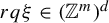 $rq\xi \in (\mathbb {Z}^{m})^{d}$
(recall that
$rq\xi \in (\mathbb {Z}^{m})^{d}$
(recall that $q\ll _{d}\delta ^{-O_{d}(1)}$
).
$q\ll _{d}\delta ^{-O_{d}(1)}$
).
If it is the latter case, then it is clear that there exist two $w,w'\in W'$
such that
$w,w'\in W'$
such that $\tilde {V}_{w}\neq \tilde {V}_{w'}$
and that
$\tilde {V}_{w}\neq \tilde {V}_{w'}$
and that $\theta \cdot \gamma (h)\in \mathbb {Z}$
for all
$\theta \cdot \gamma (h)\in \mathbb {Z}$
for all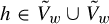 $h\in \tilde {V}_{w}\cup \tilde {V}_{w}$
. By linearity,
$h\in \tilde {V}_{w}\cup \tilde {V}_{w}$
. By linearity, $k\cdot \gamma (h)\in \mathbb {Z}$
for all
$k\cdot \gamma (h)\in \mathbb {Z}$
for all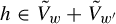 $h\in \tilde {V}_{w}+\tilde {V}_{w'}$
. Since
$h\in \tilde {V}_{w}+\tilde {V}_{w'}$
. Since $\tilde {V}_{w}$
and
$\tilde {V}_{w}$
and $\tilde {V}_{w'}$
are distinct subspaces of
$\tilde {V}_{w'}$
are distinct subspaces of $\mathbb {Z}^{d}$
of co-dimension 1 and
$\mathbb {Z}^{d}$
of co-dimension 1 and $d\geq 2$
, we have that
$d\geq 2$
, we have that $\tilde {V}_{w}+\tilde {V}_{w'}=\mathbb {Z}^{d}$
. Equivalently, this means that
$\tilde {V}_{w}+\tilde {V}_{w'}=\mathbb {Z}^{d}$
. Equivalently, this means that $k\cdot \gamma _{i}\in \mathbb {Z}$
for all
$k\cdot \gamma _{i}\in \mathbb {Z}$
for all $1\leq i\leq d$
.
$1\leq i\leq d$
.
9.6 Completion of the proof
As is mentioned in Step 4 in §8, our final task is to use Proposition 9.8 to complete the proof of Theorem 5.1. Except for Proposition 9.9, the outline of the proof is similar to the argument in [Reference Green and Tao5, after Claim 7.7 to the end of §7]. Suppose first that there exists $k\in \mathbb {Z}^{m_{\mathrm {lin}}}\times \{0\}^{m-m_{\mathrm {lin}}}$
with
$k\in \mathbb {Z}^{m_{\mathrm {lin}}}\times \{0\}^{m-m_{\mathrm {lin}}}$
with $0<\vert k\vert \ll _{d,m}\delta ^{-O_{d,m}(1)}$
such that
$0<\vert k\vert \ll _{d,m}\delta ^{-O_{d,m}(1)}$
such that $k\cdot \gamma _{i}\in \mathbb {Z}$
for all
$k\cdot \gamma _{i}\in \mathbb {Z}$
for all $1\leq i\leq d$
. Consider the map
$1\leq i\leq d$
. Consider the map $\eta \colon G\to \mathbb {R}/\mathbb {Z}$
defined by
$\eta \colon G\to \mathbb {R}/\mathbb {Z}$
defined by
 $$ \begin{align*}\eta(x):=k\cdot \psi(x).\end{align*} $$
Then, $\eta $
is a type-I horizontal character and is of complexity at most
$\eta $
is a type-I horizontal character and is of complexity at most $O_{d,m}(\delta ^{-O_{d,m}(1)})$
. Moreover, for all
$O_{d,m}(\delta ^{-O_{d,m}(1)})$
. Moreover, for all $n_{1},\ldots ,n_{d}\in \mathbb {Z}$
, we have that
$n_{1},\ldots ,n_{d}\in \mathbb {Z}$
, we have that
 $$ \begin{align*}\eta(g(n_{1},\ldots,n_{d}))=\eta(g(e_{1})^{n_{1}}\cdots g(e_{d})^{n_{d}})=\sum_{i=1}^{d}n_{i}k\cdot\gamma_{i}\equiv 0 \,\mod \mathbb{Z}.\end{align*} $$
This completes the proof of Theorem 5.1.
We now consider the case $r\xi \in (\mathbb {Z}^{m})^{d}$
for some
$r\xi \in (\mathbb {Z}^{m})^{d}$
for some $r\in \mathbb {N}_{+}$
with
$r\in \mathbb {N}_{+}$
with $r\ll _{d,m} \delta ^{-O_{d,m}(1)}$
. For
$r\ll _{d,m} \delta ^{-O_{d,m}(1)}$
. For $1\leq j\leq m$
, let
$1\leq j\leq m$
, let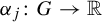 $\alpha _{j}\colon G\to \mathbb {R}$
be given by
$\alpha _{j}\colon G\to \mathbb {R}$
be given by $\alpha _{j}(x):=\eta _{2}([x,\exp (X_{j})])$
. Note that
$\alpha _{j}(x):=\eta _{2}([x,\exp (X_{j})])$
. Note that $\alpha _{j}$
is a type-I horizontal character, annihilates
$\alpha _{j}$
is a type-I horizontal character, annihilates $G_{2}$
, and
$G_{2}$
, and $\Vert \alpha _{j}\Vert \ll _{d,m}\delta ^{-O_{d,m}(1)}$
. If
$\Vert \alpha _{j}\Vert \ll _{d,m}\delta ^{-O_{d,m}(1)}$
. If $\alpha _{j}$
is non-trivial for some
$\alpha _{j}$
is non-trivial for some $1\leq j\leq m$
, then for all
$1\leq j\leq m$
, then for all $n_{1},\ldots ,n_{d}\in \mathbb {Z}$
, we have that
$n_{1},\ldots ,n_{d}\in \mathbb {Z}$
, we have that
 $$ \begin{align*}r\alpha_{j}\circ g(n_{1},\ldots,n_{d})=r\alpha_{j}(g(e_{1})^{n_{1}}\cdots g(e_{d})^{n_{d}})=\sum_{i=1}^{d}n_{i}r\xi_{i}\cdot\psi(X_{j})\equiv 0 \,\mod \mathbb{Z},\end{align*} $$
and we again prove Theorem 5.1.
Now, suppose that all of $\alpha _{j}$
are trivial. In this case,
$\alpha _{j}$
are trivial. In this case, $\eta _{2}$
annihilates
$\eta _{2}$
annihilates $[G,G]$
. So, we have that
$[G,G]$
. So, we have that $\Lambda $
is the zero matrix and that
$\Lambda $
is the zero matrix and that $\xi $
is the zero vector. Therefore,
$\xi $
is the zero vector. Therefore, $\sigma (h)=0$
. It follows from (9.24) that
$\sigma (h)=0$
. It follows from (9.24) that
 $$ \begin{align} t_{h}-c_{h}(hA)=q(2h\Omega+u)-c_{h}(hA)\in\mathbb{Z}^{d} \end{align} $$
for some $c_{h}\in \mathbb {Z}/p$
for all
$c_{h}\in \mathbb {Z}/p$
for all $h\in J_{2}+pK\mathbb {Z}^{d}$
. This implies that
$h\in J_{2}+pK\mathbb {Z}^{d}$
. This implies that $t_{h}=q(2h\Omega +u)\in \mathbb {Z}^{d}/p$
for all
$t_{h}=q(2h\Omega +u)\in \mathbb {Z}^{d}/p$
for all $h\in J_{2}+pK\mathbb {Z}^{d}$
, which further implies that
$h\in J_{2}+pK\mathbb {Z}^{d}$
, which further implies that $q\Omega $
and
$q\Omega $
and $qu$
takes
$qu$
takes $\mathbb {Z}/p$
coefficients. So, for all
$\mathbb {Z}/p$
coefficients. So, for all $h\in J_{2}+pK\mathbb {Z}^{d}$
and
$h\in J_{2}+pK\mathbb {Z}^{d}$
and $n\in \mathbb {Z}^{d}$
with
$n\in \mathbb {Z}^{d}$
with $(nA)\cdot w\in p\mathbb {Z}^{d}$
, (9.30) implies that
$(nA)\cdot w\in p\mathbb {Z}^{d}$
, (9.30) implies that ${q(2h\Omega +u)\cdot n\in \mathbb {Z}.}$
Since
${q(2h\Omega +u)\cdot n\in \mathbb {Z}.}$
Since $J_{2}$
contains
$J_{2}$
contains $\gg _{d,m}\delta ^{O_{d,m}(1)}p^{d}$
residue classes mod
$\gg _{d,m}\delta ^{O_{d,m}(1)}p^{d}$
residue classes mod $p\mathbb {Z}$
, it follows from Corollary 7.5 that
$p\mathbb {Z}$
, it follows from Corollary 7.5 that $qu\in \mathbb {Z}$
and
$qu\in \mathbb {Z}$
and $2q\Omega =rA+B'$
for some
$2q\Omega =rA+B'$
for some $r\in \mathbb {Z}/p$
and matrix
$r\in \mathbb {Z}/p$
and matrix $B'$
with integer entries. It then follows from (9.20) and (9.21) that (replacing q by
$B'$
with integer entries. It then follows from (9.20) and (9.21) that (replacing q by $2q$
if necessary)
$2q$
if necessary)
 $$ \begin{align} \eta_{2}(g_{\text{nlin}}(n))=Q(n)=\frac{1}{q}Q_{2}(n)+T(n) \end{align} $$
for some $Q_{2}\in \text {poly}(V_{p}(\tilde {M})\to \mathbb {R}\vert \mathbb {Z})$
and some polynomial
$Q_{2}\in \text {poly}(V_{p}(\tilde {M})\to \mathbb {R}\vert \mathbb {Z})$
and some polynomial $T\colon \mathbb {Z}^{d}\to \mathbb {R}$
of degree at most 1.
$T\colon \mathbb {Z}^{d}\to \mathbb {R}$
of degree at most 1.
If $\eta _{2}$
is trivial, then
$\eta _{2}$
is trivial, then $Q\equiv 0$
and
$Q\equiv 0$
and $\Omega $
can be taken to be the zero matrix. It follows from (9.30) that
$\Omega $
can be taken to be the zero matrix. It follows from (9.30) that
 $$ \begin{align*}qu-c_{h}(hA)\in\mathbb{Z}^{d}\end{align*} $$
for some $c_{h}\in \mathbb {Z}/p$
for all
$c_{h}\in \mathbb {Z}/p$
for all $h\in J_{2}$
. Note that if
$h\in J_{2}$
. Note that if $qu\notin \mathbb {Z}^{d}$
, then the number of such h is at most
$qu\notin \mathbb {Z}^{d}$
, then the number of such h is at most $K^{d}\cdot p^{d+1-\mathrm {rank}_{p}(A)}\leq K^{d}p^{d-1}<\vert J_{2}\vert $
, which is a contradiction. So, we must have that
$K^{d}\cdot p^{d+1-\mathrm {rank}_{p}(A)}\leq K^{d}p^{d-1}<\vert J_{2}\vert $
, which is a contradiction. So, we must have that $qu\in \mathbb {Z}^{d}$
. So, it follows from (9.20) that if
$qu\in \mathbb {Z}^{d}$
. So, it follows from (9.20) that if $M(n)\in \mathbb {Z}$
, then
$M(n)\in \mathbb {Z}$
, then
 $$ \begin{align*}q\eta_{1}(g(n))=qP(n)=P_{1}(n)+(qu)\cdot n+qu_{0}\in \mathbb{Z}+qu_{0}.\end{align*} $$
Since $\eta _{0}(g',g)=\eta _{1}(g)+\eta _{2}(g'g^{-1})$
is non-trivial and
$\eta _{0}(g',g)=\eta _{1}(g)+\eta _{2}(g'g^{-1})$
is non-trivial and $\eta _{2}$
is trivial, we have that
$\eta _{2}$
is trivial, we have that $\eta _{1}$
is non-trivial. Since
$\eta _{1}$
is non-trivial. Since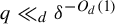 $q\ll _{d}\delta ^{-O_{d}(1)}$
, this completes the proof of Theorem 5.1 by setting
$q\ll _{d}\delta ^{-O_{d}(1)}$
, this completes the proof of Theorem 5.1 by setting ${\eta =q\eta _{1}}$
.
${\eta =q\eta _{1}}$
.
So, from now on, we assume that $\eta _{2}$
is not trivial. If
$\eta _{2}$
is not trivial. If $m_{\ast }=0$
, then
$m_{\ast }=0$
, then $\eta _{2}$
vanishes on
$\eta _{2}$
vanishes on $G_{2}$
and so it is trivial, which is a contradiction. We now assume that
$G_{2}$
and so it is trivial, which is a contradiction. We now assume that $m_{\ast }\geq 1$
. Since
$m_{\ast }\geq 1$
. Since $\eta _{2}$
annihilates
$\eta _{2}$
annihilates $[G,G]$
, we may extend
$[G,G]$
, we may extend $\eta _{2}$
to a genuine type-I horizontal character
$\eta _{2}$
to a genuine type-I horizontal character $\tilde {\eta }_{2}$
on G in an arbitrary way such that
$\tilde {\eta }_{2}$
on G in an arbitrary way such that $\tilde {\eta }_{2}\vert _{G_{2}}=\eta _{2}$
, and that the complexity of
$\tilde {\eta }_{2}\vert _{G_{2}}=\eta _{2}$
, and that the complexity of $\tilde {\eta }_{2}$
is comparable to
$\tilde {\eta }_{2}$
is comparable to $\eta _{2}$
. With a slight abuse of notation, we denote
$\eta _{2}$
. With a slight abuse of notation, we denote $\tilde {\eta }_{2}$
by
$\tilde {\eta }_{2}$
by $\eta _{2}$
as well and treat
$\eta _{2}$
as well and treat $\eta _{2}$
as a genuine type-I horizontal character on G. Suppose that
$\eta _{2}$
as a genuine type-I horizontal character on G. Suppose that $\eta _{2}\colon G\to \mathbb {R}$
is given by
$\eta _{2}\colon G\to \mathbb {R}$
is given by $\eta _{2}(x)=k\cdot \psi (x)$
for some
$\eta _{2}(x)=k\cdot \psi (x)$
for some $k=(k_{1},\ldots ,k_{m})\in \mathbb {Z}^{m}$
with
$k=(k_{1},\ldots ,k_{m})\in \mathbb {Z}^{m}$
with $\vert k\vert \ll _{d,m}\delta ^{-O_{d,m}(1)}$
. Since
$\vert k\vert \ll _{d,m}\delta ^{-O_{d,m}(1)}$
. Since $\eta _{2}$
annihilates
$\eta _{2}$
annihilates $[G,G]$
, we have that
$[G,G]$
, we have that $k_{i}=0$
for all
$k_{i}=0$
for all $i>m_{ab}$
.
$i>m_{ab}$
.
Denote $G^{\prime }_{0}=G^{\prime }_{1}=G$
and
$G^{\prime }_{0}=G^{\prime }_{1}=G$
and $G^{\prime }_{i}=G_{i}\cap \ker (\eta _{2})$
for
$G^{\prime }_{i}=G_{i}\cap \ker (\eta _{2})$
for $i\geq 2$
. By [Reference Green and Tao5, Lemma 7.8],
$i\geq 2$
. By [Reference Green and Tao5, Lemma 7.8], $G_{\mathbb {N}}'=(G^{\prime }_{i})_{i\in \mathbb {N}}$
is a filtration of G with degree at most s and nonlinearity degree
$G_{\mathbb {N}}'=(G^{\prime }_{i})_{i\in \mathbb {N}}$
is a filtration of G with degree at most s and nonlinearity degree $m^{\prime }_{\ast }\leq m_{\ast }-1$
. Each
$m^{\prime }_{\ast }\leq m_{\ast }-1$
. Each $G^{\prime }_{i}$
is closed, connected, and
$G^{\prime }_{i}$
is closed, connected, and $O_{d,m}(\delta ^{-O_{d,m}(1)})$
-rational with respect to the Mal’cev basis
$O_{d,m}(\delta ^{-O_{d,m}(1)})$
-rational with respect to the Mal’cev basis $\mathcal {X}$
on
$\mathcal {X}$
on $G/\Gamma $
adapted to
$G/\Gamma $
adapted to $G_{\mathbb {N}}$
. We need a special factorization proposition.
$G_{\mathbb {N}}$
. We need a special factorization proposition.
Proposition 9.9. Fix any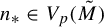 $n_{\ast }\in V_{p}(\tilde {M})$
. There exists
$n_{\ast }\in V_{p}(\tilde {M})$
. There exists $r\in \mathbb {N}_{+}$
with
$r\in \mathbb {N}_{+}$
with ${r\ll _{d,m}\delta ^{-O_{d,m}(1)}}$
such that we may write
${r\ll _{d,m}\delta ^{-O_{d,m}(1)}}$
such that we may write $g=g'\gamma $
for some rational
$g=g'\gamma $
for some rational $g'\in \mathrm {poly}(\mathbb {Z}^{d}\to G^{\prime }_{\mathbb {N}})$
and some
$g'\in \mathrm {poly}(\mathbb {Z}^{d}\to G^{\prime }_{\mathbb {N}})$
and some ${\gamma \in \mathrm {poly}_{\approx r, n_{\ast }}(V_{p}(\tilde {M})\to G_{\mathbb {N}}\vert \Gamma )}$
.
${\gamma \in \mathrm {poly}_{\approx r, n_{\ast }}(V_{p}(\tilde {M})\to G_{\mathbb {N}}\vert \Gamma )}$
.
We first complete the proof of Theorem 5.1 assuming Proposition 9.9. Let the notation be the same as Proposition 9.9. By Proposition 3.17, there exists $r'\in \mathbb {N}_{+}$
with
$r'\in \mathbb {N}_{+}$
with $r'\ll _{d,m}\delta ^{-O_{d,m}(1)}$
such that
$r'\ll _{d,m}\delta ^{-O_{d,m}(1)}$
such that $\gamma \in \text {poly}_{r'}(V_{p}(\tilde {M})\to G_{\mathbb {N}}\vert \Gamma )$
. For all
$\gamma \in \text {poly}_{r'}(V_{p}(\tilde {M})\to G_{\mathbb {N}}\vert \Gamma )$
. For all $m\in [r']^{d}$
, there exists
$m\in [r']^{d}$
, there exists $\tilde {m}\in \mathbb {Z}^{d}$
with
$\tilde {m}\in \mathbb {Z}^{d}$
with $\tilde {m}-m\in r'\mathbb {Z}^{d}$
and
$\tilde {m}-m\in r'\mathbb {Z}^{d}$
and $\tilde {m}-n_{\ast }\in p\mathbb {Z}^{d}$
. Since
$\tilde {m}-n_{\ast }\in p\mathbb {Z}^{d}$
. Since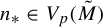 $n_{\ast }\in V_{p}(\tilde {M})$
, we have
$n_{\ast }\in V_{p}(\tilde {M})$
, we have $\tilde {m}\in V_{p}(\tilde {M})$
. Since
$\tilde {m}\in V_{p}(\tilde {M})$
. Since $\gamma \in \text {poly}_{r'}(V_{p}(\tilde {M})\to G_{\mathbb {N}})$
, we have that
$\gamma \in \text {poly}_{r'}(V_{p}(\tilde {M})\to G_{\mathbb {N}})$
, we have that
 $$ \begin{align} \gamma(\tilde{m})\Gamma=\gamma(r'n+m)\Gamma \quad\text{for all } n\in\mathbb{Z}^{d} \quad\text{with } r'n+m\in V_{p}(\tilde{M}). \end{align} $$
Denote
 $$ \begin{align*}g^{\prime}_{m}(n):=\{\gamma(\tilde{m})\}^{-1}g'(r'n+m)\{\gamma(\tilde{m})\}.\end{align*} $$
Since $g'$
and
$g'$
and $\gamma $
are rational, by Corollary 3.19, there exists
$\gamma $
are rational, by Corollary 3.19, there exists $K'\in \mathbb {N}_{+}$
which is divisible by
$K'\in \mathbb {N}_{+}$
which is divisible by $pK$
such that
$pK$
such that $g'$
and
$g'$
and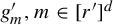 $g^{\prime }_{m}, m\in [r']^{d}$
are all
$g^{\prime }_{m}, m\in [r']^{d}$
are all $K'$
-periodic. For
$K'$
-periodic. For $m\in \mathbb {Z}^{d}$
, let
$m\in \mathbb {Z}^{d}$
, let ${M_{m}\colon \mathbb {Z}^{d}\to \mathbb {Z}/p}$
be the quadratic map given by
${M_{m}\colon \mathbb {Z}^{d}\to \mathbb {Z}/p}$
be the quadratic map given by $\tilde {M}_{m}(n):=\tilde {M}(r'n+m)$
. Then, since
$\tilde {M}_{m}(n):=\tilde {M}(r'n+m)$
. Then, since $r\ll _{d,m}\delta ^{-O_{d,m}(1)}$
,
$r\ll _{d,m}\delta ^{-O_{d,m}(1)}$
, $\tilde {M}_{m}$
and
$\tilde {M}_{m}$
and $\tilde {M}$
have the same p-rank. Note that for all
$\tilde {M}$
have the same p-rank. Note that for all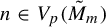 $n\in V_{p}(\tilde {M}_{m})$
, we have that
$n\in V_{p}(\tilde {M}_{m})$
, we have that $r'n+m\in V_{p}(\tilde {M})$
. Then, it follows from (9.32) and (9.4) that
$r'n+m\in V_{p}(\tilde {M})$
. Then, it follows from (9.32) and (9.4) that
 $$ \begin{align*} & \delta^{O_{d,m}(1)}\ll_{d,m} \vert\mathbb{E}_{n\in V_{p}(\tilde{M})\cap[pK]^{d}}F(g(n)\Gamma)\vert =\vert\mathbb{E}_{n\in V_{p}(\tilde{M})\cap[r'K']^{d}}F(g(n)\Gamma)\vert\\ &\quad=\vert\mathbb{E}_{m\in [r']^{d}}\mathbb{E}_{n\in V_{p}(\tilde{M}_{m})\cap [K']^{d}}F(g(r'n+m)\Gamma)\vert+O(p^{-1/2})\\ &\quad=\vert\mathbb{E}_{m\in [r']^{d}}\mathbb{E}_{n\in V_{p}(\tilde{M}_{m})\cap [K']^{d}}F(g'(r'n+m)\gamma(r'n+m)\Gamma)\vert+O(p^{-1/2})\\ &\quad=\vert\mathbb{E}_{m\in [r']^{d}}\mathbb{E}_{n\in V_{p}(\tilde{M}_{m})\cap [K']^{d}}F(g'(r'n+m)\gamma(\tilde{m})\Gamma)\vert+O(p^{-1/2})\\ &\quad=\vert\mathbb{E}_{m\in [r']^{d}}\mathbb{E}_{n\in V_{p}(\tilde{M}_{m})\cap [K']^{d}}F(\{\gamma(\tilde{m})\}g^{\prime}_{m}(n)\Gamma)\vert+O(p^{-1/2}). \end{align*} $$
So by the pigeonhole principle, there exists some $m\in [r']^{d}$
such that
$m\in [r']^{d}$
such that
 $$ \begin{align*}\vert\mathbb{E}_{n\in V_{p}(\tilde{M}_{m})\cap [K']^{d}}F^{\prime}_{m}(g^{\prime}_{m}(n)\Gamma)\vert\gg_{d,m}\delta^{O_{d,m}(1)},\end{align*} $$
where $F^{\prime }_{m}:=F(\{\gamma (\tilde {m})\}\cdot )$
. By the construction of
$F^{\prime }_{m}:=F(\{\gamma (\tilde {m})\}\cdot )$
. By the construction of $K'$
,
$K'$
, $g^{\prime }_{m}$
is a rational and
$g^{\prime }_{m}$
is a rational and $K'$
-periodic polynomial in
$K'$
-periodic polynomial in $\text {poly}(\mathbb {Z}^{d}\to G^{\prime }_{\mathbb {N}})$
and
$\text {poly}(\mathbb {Z}^{d}\to G^{\prime }_{\mathbb {N}})$
and $\Vert F'\Vert _{\mathrm {Lip}}=O(1)$
. We may now invoke the induction hypothesis to deduce that there exists a non-trivial type-I horizontal character
$\Vert F'\Vert _{\mathrm {Lip}}=O(1)$
. We may now invoke the induction hypothesis to deduce that there exists a non-trivial type-I horizontal character $\eta $
of complexity at most
$\eta $
of complexity at most $O_{d,m}(\delta ^{-O_{d,m}(1)})$
such that
$O_{d,m}(\delta ^{-O_{d,m}(1)})$
such that $\eta \circ g^{\prime }_{m}\,\mod \mathbb {Z}$
is a constant on
$\eta \circ g^{\prime }_{m}\,\mod \mathbb {Z}$
is a constant on $V_{p}(\tilde {M}_{m})$
. Since
$V_{p}(\tilde {M}_{m})$
. Since
 $$ \begin{align*} & \eta\circ g^{\prime}_{m}(n)=\eta\circ g'(r'n+m)\\ & \quad=\eta\circ g(r'n+m)-\eta\circ \gamma(r'n+m)\equiv \eta\circ g(r'n+m)-\eta\circ \gamma(m)\,\mod \mathbb{Z} \end{align*} $$
for all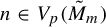 $n\in V_{p}(\tilde {M}_{m})$
, we have that
$n\in V_{p}(\tilde {M}_{m})$
, we have that $\eta \circ g\,\mod \mathbb {Z}$
is a constant on
$\eta \circ g\,\mod \mathbb {Z}$
is a constant on $V_{p}(\tilde {M})$
. This finishes the proof of Theorem 5.1.
$V_{p}(\tilde {M})$
. This finishes the proof of Theorem 5.1.
So, it remains to prove Proposition 9.9. Proposition 9.9 can be viewed as an analog of [Reference Green and Tao5, Lemma 7.9], but its proof deviates significantly from [Reference Green and Tao5, Lemma 7.9].
Proof of Proposition 9.9
Let $0\leq s'\leq s$
be the largest integer such that at least one of the entries
$0\leq s'\leq s$
be the largest integer such that at least one of the entries $k_{m-m_{s'}+1},\ldots ,k_{m-m_{s'+1}}$
is non-zero (where we denote
$k_{m-m_{s'}+1},\ldots ,k_{m-m_{s'+1}}$
is non-zero (where we denote $m_{0}:=0$
). Since
$m_{0}:=0$
). Since $\eta _{2}$
is non-trivial, such an
$\eta _{2}$
is non-trivial, such an $s'$
always exists and
$s'$
always exists and $s'\geq 2$
. Denote
$s'\geq 2$
. Denote $m':=m-m_{s'+1}$
. Then, we may write
$m':=m-m_{s'+1}$
. Then, we may write $k=(k',\mathbf {0})$
for some
$k=(k',\mathbf {0})$
for some $k'\in \mathbb {Z}^{m'}$
.
$k'\in \mathbb {Z}^{m'}$
.
Assume that
 $$ \begin{align*}\psi(g(n))=\sum_{i\in\mathbb{N}^{d},0\leq\vert i\vert\leq s}w_{i}\binom{n}{i}\end{align*} $$
for some $w_{i}\in \{0\}^{m-m_{\vert i\vert }}\times \mathbb {R}^{m_{\vert i\vert }}$
. Since
$w_{i}\in \{0\}^{m-m_{\vert i\vert }}\times \mathbb {R}^{m_{\vert i\vert }}$
. Since $Q(\mathbf {0})=Q(e_{i})=0$
, we may write
$Q(\mathbf {0})=Q(e_{i})=0$
, we may write
 $$ \begin{align*}\psi(g_{\text{nlin}}(n))=\sum_{m\in\mathbb{N}^{d},2\leq \vert i\vert\leq s}t_{i}\binom{n}{i}\end{align*} $$
for some $t_{i}\in \{0\}^{m-m_{\vert i\vert }}\times \mathbb {R}^{m_{\vert i\vert }}$
. Write
$t_{i}\in \{0\}^{m-m_{\vert i\vert }}\times \mathbb {R}^{m_{\vert i\vert }}$
. Write $w_{i}=(w^{\prime }_{i},w^{\prime \prime }_{i}), t_{i}=(t^{\prime }_{i},t^{\prime \prime }_{i})$
for some
$w_{i}=(w^{\prime }_{i},w^{\prime \prime }_{i}), t_{i}=(t^{\prime }_{i},t^{\prime \prime }_{i})$
for some $t^{\prime }_{i},w^{\prime }_{i}\in \mathbb {R}^{m'}$
and
$t^{\prime }_{i},w^{\prime }_{i}\in \mathbb {R}^{m'}$
and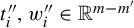 $t^{\prime \prime }_{i},w^{\prime \prime }_{i}\in \mathbb {R}^{m-m'}$
. Since the first
$t^{\prime \prime }_{i},w^{\prime \prime }_{i}\in \mathbb {R}^{m-m'}$
. Since the first $m-m_{\vert i\vert }$
entries of
$m-m_{\vert i\vert }$
entries of $t_{i}$
are zero and the last
$t_{i}$
are zero and the last $m_{s'+1}$
entries of k are zero, we have that
$m_{s'+1}$
entries of k are zero, we have that $k\cdot t_{i}=0$
if
$k\cdot t_{i}=0$
if $\vert i\vert \geq s'+1$
. By (9.31),
$\vert i\vert \geq s'+1$
. By (9.31),
 $$ \begin{align*} \frac{1}{q}Q_{2}(n)+T(n)=\eta_{2}(g_{\text{nlin}}(n))=\sum_{i\in\mathbb{N}^{d},2\leq \vert i\vert\leq s}(k\cdot t_{i})\binom{n}{i}=\sum_{i\in\mathbb{N}^{d},2\leq \vert i\vert\leq s'}(k'\cdot t^{\prime}_{i})\binom{n}{i}. \end{align*} $$
In particular, we have that $\deg (Q_{2})\leq s'$
.
$\deg (Q_{2})\leq s'$
.
Since k is of complexity $\ll _{d,m}\delta ^{-O_{d,m}(1)}$
, there exists
$\ll _{d,m}\delta ^{-O_{d,m}(1)}$
, there exists $q'\in \mathbb {N}_{+}, q'\ll _{d,m}\delta ^{-O_{d,m}(1)}$
, and
$q'\in \mathbb {N}_{+}, q'\ll _{d,m}\delta ^{-O_{d,m}(1)}$
, and $u=(u_{1},\ldots ,u_{m})\in \mathbb {Z}^{m}$
whose only non-zero entries are
$u=(u_{1},\ldots ,u_{m})\in \mathbb {Z}^{m}$
whose only non-zero entries are $u_{m-m_{s'}+1},\ldots ,u_{m-m_{s'+1}}$
such that
$u_{m-m_{s'}+1},\ldots ,u_{m-m_{s'+1}}$
such that $k\cdot u=q'.$
Denote
$k\cdot u=q'.$
Denote
 $$ \begin{align*}\gamma(n):=\prod_{i=m-m_{s'}+1}^{m-m_{s'+1}}\exp\bigg(\frac{1}{qq'}u_{i}(Q_{2}(n)-Q_{2}(n_{\ast}))X_{i}\bigg).\end{align*} $$
Since $\deg (Q_{2})\leq s'$
, it follows from [Reference Green, Tao and Ziegler8, Corollary B.4] that
$\deg (Q_{2})\leq s'$
, it follows from [Reference Green, Tao and Ziegler8, Corollary B.4] that $\gamma \in \text {poly}(\mathbb {Z}^{d}\to (G_{2})_{\mathbb {N}})$
.
$\gamma \in \text {poly}(\mathbb {Z}^{d}\to (G_{2})_{\mathbb {N}})$
.
We now show that there exists $r\in \mathbb {N}_{+}$
with
$r\in \mathbb {N}_{+}$
with $r\ll _{d,m}\delta ^{-O_{d,m}(1)}$
such that
$r\ll _{d,m}\delta ^{-O_{d,m}(1)}$
such that $\gamma $
belongs to
$\gamma $
belongs to $\text {poly}_{\approx r, n_{\ast }}(V_{p}(\tilde {M})\to G_{\mathbb {N}}\vert \Gamma )$
and takes values in
$\text {poly}_{\approx r, n_{\ast }}(V_{p}(\tilde {M})\to G_{\mathbb {N}}\vert \Gamma )$
and takes values in $G_{2}$
. In fact, it suffices to show that
$G_{2}$
. In fact, it suffices to show that $Q_{2}(n_{\ast }+rn)-Q_{2}(n_{\ast })\in qq'\mathbb {Z}$
for all
$Q_{2}(n_{\ast }+rn)-Q_{2}(n_{\ast })\in qq'\mathbb {Z}$
for all $n\in \mathbb {Z}^{d}$
with
$n\in \mathbb {Z}^{d}$
with $n_{\ast }+rn\in V_{p}(\tilde {M})$
. By interpolation, all the coefficients of the polynomial
$n_{\ast }+rn\in V_{p}(\tilde {M})$
. By interpolation, all the coefficients of the polynomial $Q_{2}$
belongs to
$Q_{2}$
belongs to $\mathbb {Z}/p^{s'}q"$
for some
$\mathbb {Z}/p^{s'}q"$
for some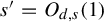 $s'=O_{d,s}(1)$
and
$s'=O_{d,s}(1)$
and $q"\in \mathbb {N}_{+}$
with
$q"\in \mathbb {N}_{+}$
with $q"\leq O_{d,s}(1)$
. So, for all
$q"\leq O_{d,s}(1)$
. So, for all $n\in \mathbb {Z}^{d}$
, we have that
$n\in \mathbb {Z}^{d}$
, we have that $Q_{2}(n_{\ast }+rn)-Q_{2}(n_{\ast })\in qq'\mathbb {Z}/p^{s'}$
, where
$Q_{2}(n_{\ast }+rn)-Q_{2}(n_{\ast })\in qq'\mathbb {Z}/p^{s'}$
, where $r:=qq'q"$
. However, if
$r:=qq'q"$
. However, if $n_{\ast }+rn, n_{\ast }\in V_{p}(\tilde {M})$
, then
$n_{\ast }+rn, n_{\ast }\in V_{p}(\tilde {M})$
, then $Q_{2}(n_{\ast }+rn)-Q_{2}(n_{\ast })\in \mathbb {Z}$
. Since
$Q_{2}(n_{\ast }+rn)-Q_{2}(n_{\ast })\in \mathbb {Z}$
. Since $qq'$
is not divisible by p, this implies that
$qq'$
is not divisible by p, this implies that $Q_{2}(n_{\ast }+rn)-Q_{2}(n_{\ast })\in qq'\mathbb {Z}$
. So,
$Q_{2}(n_{\ast }+rn)-Q_{2}(n_{\ast })\in qq'\mathbb {Z}$
. So, $\gamma \in \text {poly}_{\approx r, n_{\ast }}(V_{p}(\tilde {M})\to G_{\mathbb {N}}\vert \Gamma )$
and takes values in
$\gamma \in \text {poly}_{\approx r, n_{\ast }}(V_{p}(\tilde {M})\to G_{\mathbb {N}}\vert \Gamma )$
and takes values in $G_{2}$
.
$G_{2}$
.
Writing $h:=g\gamma ^{-1}$
, we have that
$h:=g\gamma ^{-1}$
, we have that $h\in \text {poly}(\mathbb {Z}^{d}\to (G_{2})_{\mathbb {N}}\vert (\Gamma \cap G_{2}))$
. Note that for all
$h\in \text {poly}(\mathbb {Z}^{d}\to (G_{2})_{\mathbb {N}}\vert (\Gamma \cap G_{2}))$
. Note that for all $n,h_{1},h_{2}\in \mathbb {Z}^{d}$
,
$n,h_{1},h_{2}\in \mathbb {Z}^{d}$
,
 $$ \begin{align} & \Delta_{h_{2}}\Delta_{h_{1}}(\eta_{2}\circ g(n)) =\eta_{2}\circ(\Delta_{h_{2}}\Delta_{h_{1}}g)(n)=\eta_{2}\circ(\Delta_{h_{2}}\Delta_{h_{1}}g_{\text{nlin}})(n)\nonumber\\ &\quad =\Delta_{h_{2}}\Delta_{h_{1}}(\eta_{2}\circ g_{\text{nlin}})(n) =\Delta_{h_{2}}\Delta_{h_{1}}\bigg(\frac{1}{q}Q_{2}(n)+T(n)\bigg)=\Delta_{h_{2}}\Delta_{h_{1}}\bigg(\frac{1}{q}Q_{2}(n)\bigg). \end{align} $$
So, (9.33) implies that
 $$ \begin{align} \begin{aligned} &\quad \Delta_{h_{2}}\Delta_{h_{1}}(\eta_{2}\circ h(n)) =\Delta_{h_{2}}\Delta_{h_{1}}(\eta_{2}\circ g(n))-\Delta_{h_{2}}\Delta_{h_{1}}(\eta_{2}\circ \gamma(n)) =0. \end{aligned} \end{align} $$
Set $g':=g\gamma ^{-1}=g_{\text {nlin}}g_{\mathrm {lin}}\gamma ^{-1}$
. It is clear that
$g':=g\gamma ^{-1}=g_{\text {nlin}}g_{\mathrm {lin}}\gamma ^{-1}$
. It is clear that $g'\in \text {poly}(\mathbb {Z}^{d}\to G_{\mathbb {N}})$
. Moreover, by (9.34),
$g'\in \text {poly}(\mathbb {Z}^{d}\to G_{\mathbb {N}})$
. Moreover, by (9.34),
 $$ \begin{align*}\Delta_{h_{2}}\Delta_{h_{1}}(\eta_{2}\circ g')(n)=\eta_{2}(\Delta_{h_{2}}\Delta_{h_{1}}g'(n))=0\end{align*} $$
for all $n,h_{1},h_{2}\in \mathbb {Z}^{d}$
. So, it is not hard to see that
$n,h_{1},h_{2}\in \mathbb {Z}^{d}$
. So, it is not hard to see that $g'$
belongs to
$g'$
belongs to $\text {poly}(\mathbb {Z}^{d}\to G^{\prime }_{\mathbb {N}})$
. Finally, since
$\text {poly}(\mathbb {Z}^{d}\to G^{\prime }_{\mathbb {N}})$
. Finally, since $g'=g\gamma ^{-1}$
, it follows from the Baker–Campbell–Hausdorff formula that
$g'=g\gamma ^{-1}$
, it follows from the Baker–Campbell–Hausdorff formula that $g'$
is rational.
$g'$
is rational.
We end this paper with an immediate consequence of Theorem 5.1, which will be used in [Reference Sun16].
Corollary 9.10. Let $0<\delta <1/2, d,k,m\in \mathbb {N}_{+},s,r\in \mathbb {N}$
with
$0<\delta <1/2, d,k,m\in \mathbb {N}_{+},s,r\in \mathbb {N}$
with $d\geq r$
, and
$d\geq r$
, and $p\gg _{d,m} \delta ^{-O_{d,m}(1)}$
be a prime. Let
$p\gg _{d,m} \delta ^{-O_{d,m}(1)}$
be a prime. Let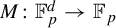 $M\colon \mathbb {F}_{p}^{d}\to \mathbb {F}_{p}$
be a quadratic form and
$M\colon \mathbb {F}_{p}^{d}\to \mathbb {F}_{p}$
be a quadratic form and $V+c$
be an affine subspace of
$V+c$
be an affine subspace of $\mathbb {F}_{p}^{d}$
of co-dimension r. Suppose that
$\mathbb {F}_{p}^{d}$
of co-dimension r. Suppose that $\mathrm {rank}(M\vert _{V+c})\geq s+13$
. Let
$\mathrm {rank}(M\vert _{V+c})\geq s+13$
. Let $G/\Gamma $
be an s-step
$G/\Gamma $
be an s-step $\mathbb {N}$
-filtered nilmanifold of dimension m, equipped with a
$\mathbb {N}$
-filtered nilmanifold of dimension m, equipped with a ${1}/{\delta }$
-rational Mal’cev basis
${1}/{\delta }$
-rational Mal’cev basis $\mathcal {X}$
, and that
$\mathcal {X}$
, and that $g\in \mathrm { poly}(\mathbb {Z}^{d}\to G_{\mathbb {N}})$
be a rational polynomial sequence. Let
$g\in \mathrm { poly}(\mathbb {Z}^{d}\to G_{\mathbb {N}})$
be a rational polynomial sequence. Let $\gamma \in G$
be an element of complexity at most 1, and let
$\gamma \in G$
be an element of complexity at most 1, and let $g'\in \mathrm {poly}(\mathbb {Z}^{d}\to G^{\prime }_{\mathbb {N}})$
be the map given by
$g'\in \mathrm {poly}(\mathbb {Z}^{d}\to G^{\prime }_{\mathbb {N}})$
be the map given by $g'(n):=\gamma ^{-1}g(n)\gamma $
for all
$g'(n):=\gamma ^{-1}g(n)\gamma $
for all $n\in \mathbb {Z}^{d}$
, where
$n\in \mathbb {Z}^{d}$
, where $G^{\prime }_{i}:=\gamma ^{-1} G_{i}\gamma $
for all
$G^{\prime }_{i}:=\gamma ^{-1} G_{i}\gamma $
for all $i\in \mathbb {N}$
. Denote
$i\in \mathbb {N}$
. Denote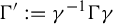 $\Gamma ':=\gamma ^{-1}\Gamma \gamma $
. If
$\Gamma ':=\gamma ^{-1}\Gamma \gamma $
. If $(g(n)\Gamma )_{n\in \iota ^{-1}(V(M)\cap (V+c))}$
is not
$(g(n)\Gamma )_{n\in \iota ^{-1}(V(M)\cap (V+c))}$
is not $\delta $
-equidistributed on
$\delta $
-equidistributed on $G/\Gamma $
, then
$G/\Gamma $
, then $(g'(n)\Gamma ')_{n\in \iota ^{-1}(V(M)\cap (V+c))}$
is not
$(g'(n)\Gamma ')_{n\in \iota ^{-1}(V(M)\cap (V+c))}$
is not $C^{-1}\delta ^{C}$
-equidistributed on
$C^{-1}\delta ^{C}$
-equidistributed on $G'/\Gamma '$
for some
$G'/\Gamma '$
for some $C=C(d,m)\geq 1$
.
$C=C(d,m)\geq 1$
.
Proof. By Theorem 5.1, there exists a non-trivial type-I horizontal character $\eta $
with
$\eta $
with $0<\Vert \eta \Vert \ll _{d,m} \delta ^{-O_{d,m}(1)}$
such that
$0<\Vert \eta \Vert \ll _{d,m} \delta ^{-O_{d,m}(1)}$
such that $\eta \circ g'=\eta \circ g \,\mod \mathbb {Z}$
is a constant on
$\eta \circ g'=\eta \circ g \,\mod \mathbb {Z}$
is a constant on $\iota ^{-1}(V(M)\cap (V+c))$
. By [Reference Green and Tao5, Lemma A.13],
$\iota ^{-1}(V(M)\cap (V+c))$
. By [Reference Green and Tao5, Lemma A.13], $G'/\Gamma '$
is an s-step
$G'/\Gamma '$
is an s-step $\mathbb {N}$
-filtered nilmanifold of dimension m, equipped with a
$\mathbb {N}$
-filtered nilmanifold of dimension m, equipped with a ${1}/({\delta ^{O(1)}})$
-rational Mal’cev basis. Since
${1}/({\delta ^{O(1)}})$
-rational Mal’cev basis. Since $\vert \mathbb {E}_{n\in \iota ^{-1}(V(M)\cap (V+c))}\exp (\eta (g'(n)))\vert =1$
, this implies that
$\vert \mathbb {E}_{n\in \iota ^{-1}(V(M)\cap (V+c))}\exp (\eta (g'(n)))\vert =1$
, this implies that $(g'(n)\Gamma ')_{n\in \iota ^{-1}(V(M)\cap (V+c))}$
is not
$(g'(n)\Gamma ')_{n\in \iota ^{-1}(V(M)\cap (V+c))}$
is not $C^{-1}\delta ^{C}$
-equidistributed on
$C^{-1}\delta ^{C}$
-equidistributed on $G'/\Gamma '$
for some
$G'/\Gamma '$
for some $C=C(d,m)\geq 1$
.
$C=C(d,m)\geq 1$
.
Acknowledgements
We thank James Leng for helpful discussions. We also thank the anonymous referee, whose comments greatly increased the presentation of the paper. This paper was partially supported by the NSF Grant DMS-2247331.


 Open access

