


Introduction
People coming together to achieve a common purpose is at the core of third sector research. Collective action ranges from a few people pooling resources to give to others (Eikenberry, Reference Eikenberry2006) to co-productive arrangements for public service provision (Branson & Honingh, Reference Branson and Honingh2016), to the complexities of international and national laws governing civil society organizations (DeMattee, Reference DeMattee2019) and their responses (Appe et al., Reference Appe, Barragan and Reich2019). Institutions—defined as rules, norms and strategies (Ostrom, Reference Ostrom2005)—are central in all of these examples. An ongoing challenge is data limitations in comparative third sector research, particularly for large-N studies (Gazley & Guo, Reference Gazley and Guo2020; Simsa & Brandsen, Reference Simsa and Brandsen2021; Weipking et al., Reference Weipking2021), and arguably, in the study of institutions in third sector contexts. In this paper, we present the Institutional Grammar (IG) as a theoretically informed approach to support institutional analysis to advance third sector research.
The IG is a method that provides a systematic coding process to translate institutional statements into data that then allows for comparative analysis of institutional variation. An important distinction in terminology that diverges from common use is that “institution” does not refer to an entity but rather the rules, norms and strategies that permit, require, or prohibit actions within identified temporal, spatial, or procedural boundaries (Ostrom, Reference Ostrom2005). For example, a civil society organization will have many institutions that formally (e.g., restrict foreign aid) or informally (e.g., religious norms of giving) guide behavior. Institutions can be represented formally (e.g., as statutes, regulations, bylaws) or informally (e.g., as spoken or tacitly understood social norms or cultural practices) (Watkins & Westphal, Reference Watkins and Westphal2016).
Over the last decade, published research demonstrates the versatility of the IG (see for example, a 2021 symposium in Public Administration (vol. 99, no. 2) and a forthcoming special issue in the Policy Studies Journal), but it has had little application in third sector research despite the inclusion of third sector actors in IG research. We begin with a description of the IG syntax coding method followed by an example of US state charity involuntary dissolution laws to demonstrate how the IG provides structured data to answer the research question: Do the rules embedded in regulatory text differ between bifurcated and unitary jurisdictions? We then build from this illustrative example to discuss how the IG can be utilized to advance knowledge for third sector research in areas such as rule compliance, inter-organizational collaboration, comparative institutional designs, and longitudinal studies of change. We conclude with a discussion of where the IG is headed: the use of the IG to codify rules, norms, and strategies in spoken language and advances in machine learning that can scale up the volume of coded text.
The Institutional Grammar
The IG is a theoretically informed approach for analyzing the structure and meaning of institutions that govern behavior in collective action settings, or settings in which two or more individuals are interacting (Crawford & Ostrom, Reference Crawford and Ostrom1995). The IG aids in the assessment of institutional content by drawing attention to the compositional characteristics of rules, norms and strategies. Under the IG, any given institution is assumed to be comprised of one or more institutional statements defined as a linguistically conveyed or tacitly understood rule, norm, or strategy that (i) describes expected actions for actors within the presence or absence of particular constraints; or (ii) parameterizes features of a system (see Frantz & Siddiki, Reference Frantz and Siddiki2020 for all references in this section). Table 1 provides an example of an institutional statement that might be found in a state-level institution governing nonprofit corporations.
Table 1 A third sector-related institutional statement example

“The nonprofit corporation must follow state regulations describing its scope of authority at all times, or else the circuit court will dissolve the nonprofit corporation by an order.” |
Further, the IG identifies a syntax (See IGRI, 2021 for details) by which the information contained within an institutional statement can be parsed and organized, recognizing that institutional statements observed across domains typically convey common types of information relevant to understanding how rules, norms and strategies are intended to govern and incentivize human behavior.
The IG (version 2.0) presents two syntaxes for parsing institutional statements (Frantz & Siddiki, Reference Frantz and Siddiki2021). One syntax is for “regulative institutional statements,” which are statements that prescribe specific activity for actors within particular constraints. The other syntax is for “constitutive institutional statements,” which are statements that parameterize features of a governed system (e.g., by defining positions that can be held by actors, entities that occupy different positions, and venues in which activity occurs). In addition to serving different functions within a governed domain as essentially conveyed in their meaning, regulative and constitutive institutional statements also tend to exhibit different structural characteristics. Any given policy, for example, typically consists of a mix of regulative and constitutive statements.
In this paper, we focus on regulative institutional statements to demonstrate the IG syntax coding which is comprised of some configuration of the following syntactic “ABDICO” components:
(i) [A]ttribute, an actor (individual or corporate) that carries out, or is expected to/to not carry out the action of the institutional statement;
(ii) O[B]ject, the receiver of the action of the statement;
(iii) [D]eontic, a prescriptive operator that defines to what extent the action of an institutional statement is compelled, restrained, or discretionary;
(iv) A[I]m, the goal or action of the statement assigned to the statement Attribute;
(v) [C]ontext, the context in which the statement action is applicable;
(vi) [O]r else, an incentive linked to the statement action, often this is the sanction that will be applied following compliance/non-compliance. Often these are represented as a nested institutional statement.
An institutional statement must have an Attribute, Aim, and Context (necessary) and may or may not include Objects, Deontics, and Or else components (sufficient).
Returning to our example institutional statement above (Table 1), the syntactic components are notated in parentheses following the words or phrases to which they correspond. Note in this example that the statement clause corresponding to the Or else is represented as a “nested” statement.
The nonprofit corporation (Attribute) must (Deontic) follow (Aim) state regulations describing its scope of authority (Object) at all times (Context)
Nested clause: Or else the circuit court (Attribute) will (Deontic) dissolve (Aim) the nonprofit corporation (B) by an order (Context).
Sub-classification of the nested clause supports and expands the possibilities for analyzing IG-coded data at more extensive granularity to reveal institutional patterns.
The Context component of ABDICO can be further coded into an “Activation Condition” or “Executional Constraint.” This differentiation allows the analyst to identify whether the Context of a statement is instantiating (i.e., representing) a situation in which the activity described in the statement applies (Activation Condition), or is simply qualifying the activity (Execution Constraint) with temporal, spatial, procedural, or other constraints on the activity. A single institutional statement can contain both Activation Condition and Execution Constraint type clauses as follows:
If the nonprofit corporation is found to be abusing the authority granted to it by law (Activation Condition), the Circuit Court (Attribute) will (Deontic) dissolve (Aim) the nonprofit corporation (Object) by order (Execution Constraint).”
Here, the Context clause “If the nonprofit corporation is found to be abusing the authority granted to it by law” is characterized as being an Activation Condition because it is describing the setting in which the Circuit Court will dissolve the nonprofit corporation. The Context clause “by order” is characterized as an “Execution Constraint” because it qualifies how the Circuit Court will engage in the dissolution. While several sub-classification possibilities exist within the IG 2.0, we limit discussion to Context because it is most germane to the example in this paper.
To apply IG, the analyst parses the text into institutional statements and ABDICO syntactic components and nested clauses. This creates syntax-level data that can be engaged in a wide variety of analyses. Most analyses of IG data identify patterns among institutional structures and/or meanings by engaging in a descriptive summary of institutional statements and/or syntactic data. Descriptive summaries of statements afford, among other insights, our understanding of the number of statements included within a broader context such as charity bylaws or laws, ordering of institutional statements, and how institutional statements link, or configure, within a given context. Descriptive summaries of syntactic components generate an understanding of the presence of certain syntactic components within and across statements, patterns in information corresponding to syntactic components across institutional statements, and even inter-syntactic relations (e.g., whether certain syntactic components and corresponding values tend to appear within specific configurations) within and across institutional statements.
Ultimately, how one goes about analyzing IG data is driven by the research question. In the analysis that follows, we illustrate how syntactic component-level analysis can be leveraged to inform research questions of interest for third sector research. More specifically, the following section presents a comparative analysis of US state charity laws to systematically analyze variation in rules governing involuntary dissolution. Because state laws use many different terms for nonprofit organizations such as corporations, trust, public benefit organizations, we are using the term “charity.”
Charity Dissolution Laws
In the USA, charities incorporate at the state, territory, or federal district (Washington, DC) level and can then choose whether to organize as a 501(c)3 nonprofit and apply to the federal Internal Revenue Service (IRS) for tax-deductible status. While the federal government can withdraw tax-deductible status if the nonprofit violates IRS rules, the state, territory, or federal district (hereafter “jurisdiction”) has the power to dissolve the charity. Most often it is the jurisdiction’s Attorney General’s (AG) office that has the power to start proceedings to involuntarily dissolve a charitable organization. Generally, the jurisdiction’s AG’s office has a charity office that operates under a division of public protection (Stateag.org, 2020). In some states, staff and attorneys are within the charity office, and in other states, charity regulators are in other offices within the AG including consumer protection, antitrust, bankruptcy, and criminal divisions to address various matters involving charitable organizations (Lott et al., Reference Lott, Boris, Goldman, Johns, Gaddy and Farrell2016a).
The majority of jurisdictions place the oversight of charitable organizations under the exclusive or “unitary” control of their state AG’s office that is granted broad regulatory authority. However, in other states, the regulatory and enforcement jurisdiction of charitable organizations is shared or “bifurcated” between the AG office and another state administrative office, such as the Secretary of State. These offices are often given statutory authority to require organizations to enforce, for example, charity organization registration and reporting requirements (Lott et al., Reference Lott, Boris, Goldman, Johns, Gaddy and Farrell2016a: 7). There is little known about how unitary or bifurcated structures affect the oversight of charities. Lott et al. (Reference Lott, Boris, Goldman, Johns, Gaddy and Farrell2016b, Reference Lott, Shelly, Dietz and Gaddy2018) created a legal compendium (described below) to build a solicitation index and found that the jurisdictions with robust regulatory regimes were nearly evenly split between unitary and bifurcated jurisdictions. Jurisdictions with less broad regulatory regimes are slightly more likely to be unitary (Reference Lott, Shelly, Dietz and Gaddy2018, p. 7).
In the example application, we highlight the utility of an IG-based quantitative analysis of charity regulations to ask the question: Do the rules embedded in regulatory text addressing the involuntary dissolution of charity organizations differ between bifurcated and unitary jurisdictions? We might expect that bifurcated jurisdictions with regulation split from enforcement might have more stringent laws governing involuntary dissolution. Or, we may find, similar to Lott et al., Reference Lott, Shelly, Dietz and Gaddy2018, that the unitary/bifurcated distinction is evenly split. Using the IG, we can distill the rules for involuntary dissolution to test for differences.
Methods
To begin, we drew on the Legal Compendium of regulations of charity organizations (Lott et al., Reference Lott, Boris, Goldman, Johns, Gaddy and Farrell2016b), which provides (1) citations to the appropriate statutes for each of the 50 states, territories, and Washington, DC; (2) information on whether the jurisdiction falls under the bifurcated or unitary categorization; and (3) a variety of other categories summarizing legal text that govern charities.
We searched for the explicit regulatory text related to the rules for the involuntary dissolution of a charity and we extracted the legal text. We were able to confidently locate the correct legal language for 45 US States and Washington, D.C. for our analysis. Table 2 provides one example of the legal code for Alabama describing the rules or grounds for involuntary dissolution of a charity.
Table 2 The explicit legal text found in Alabama’s Title 10A (Alabama Business and Nonprofit Entities Code), Chapter 3 (Nonprofit Corporations), Article 7 (Dissolution), Section 10A-3-7.07 (Involuntary dissolution-Grounds).

A nonprofit corporation may be dissolved involuntarily by an order of the circuit court of the county in which the registered office of the nonprofit corporation is situated in an action filed by the Attorney General when it is established that: |
(1) The nonprofit corporation procured its certificate of formation through fraud; |
(2) The nonprofit corporation has continued to exceed or abuse the authority conferred upon it by law; |
(3) The nonprofit corporation has failed for 90 days to appoint and maintain a registered agent in Alabama; or |
(4) The nonprofit corporation has failed for 90 days after change of its registered agent to file in the office of the judge of probate a statement of the change |
Next, we turned to interpreting these texts and organizing their embedded rules into the IG 2.0 syntax. In Table 3, we demonstrate the coding of Alabama. Similar to the example provided in “Charity Dissolution Laws” section, there is a nested clause in the Alabama law, “by an order of the circuit court of the county in which the registered office of the nonprofit corporation is situated,” but for simplicity, we focus on the Attorney General-related Attribute institutional statements.
Table 3 Alabama’s Section 10A-3-7.07 Involuntary dissolution grounds organized by IG syntactic structure

Attribute |
Object (B) |
Deontic |
Aim (I) |
Context (C) |
|---|---|---|---|---|
Attorney general |
Nonprofit corporation |
May |
Be dissolved involuntarily |
(1) The nonprofit corporation procured its certificate of formation through fraud; (2) The nonprofit corporation has continued to exceed or abuse the authority conferred upon it by law; (3) The nonprofit corporation has failed for 90 days to appoint and maintain a registered agent in Alabama; or (4) The nonprofit corporation has failed for 90 days after change of its registered agent to file in the office of the judge of probate a statement of the change |
All jurisdictions had the Deontic “may” in their involuntary dissolution laws indicating that the AG has the power to choose whether to invoke the Aim (goal or action). What becomes readily apparent from the initial coding in Table 3 is that the Context field contains the interesting text. The next step, shown in Table 4, codes Context into Activation Conditions and Execution Constraints. We implemented a similar decomposition for the jurisdictions in our database.
Table 4 Alabama’s Section 10A-3-7.07 Involuntary dissolution grounds

Context: activation conditions |
Context: execution constraints |
|---|---|
1AC. The nonprofit corporation procured its certificate of formation through fraud |
|
2AC. The nonprofit corporation has continued to exceed or abuse the authority conferred upon it by law |
|
3AC. The nonprofit corporation has failed [3EC] to appoint and maintain a registered agent in Alabama |
3EC for 90 days |
4AC. The nonprofit corporation has failed [4EC(a)] after change of its registered agent to file [4EC(b)] a statement of the change |
4EC (a) for 90 days 4EC (b) in the office of the judge of probate |
Context statements organized into activation conditions or execution constraints
Codes in brackets refer to the corresponding “context: executive constraint” column
With this level of granularity, it focuses attention explicitly on the ACs, and it makes it much easier to examine differences among jurisdictions than reading rich legal text to determine when an attorney general can take action to dissolve a charity.
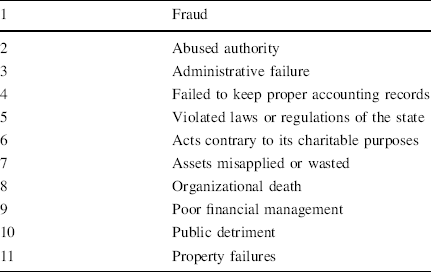
We coded 46 jurisdictions and categorized them according to 11 different Action Condition clusters. The exact language varies among jurisdictions but the meaning of that language allowed us to build clusters of terms in Table 5.
Table 5 Activation condition cluster categories for US jurisdictions’ to trigger involuntary dissolution

1 |
Fraud |
|---|---|
2 |
Abused authority |
3 |
Administrative failure |
4 |
Failed to keep proper accounting records |
5 |
Violated laws or regulations of the state |
6 |
Acts contrary to its charitable purposes |
7 |
Assets misapplied or wasted |
8 |
Organizational death |
9 |
Poor financial management |
10 |
Public detriment |
11 |
Property failures |
Lastly, to prepare for quantitative analysis, we created variables for each jurisdiction’s row signifying, for each AC Category shown in Table 5, whether that state had such an AC clause for that cluster category (coded 1 for yes), or if it did not (coded 0 for no).
Results
Our data allow us to answer the research question on whether the rules for involuntary dissolution of charity organizations differ between bifurcated and unitary jurisdictions. Our original plan was to utilize Contingency Tables to test whether bifurcation or unitary correlates with each of the AC categories, and we created tables for the eleven different AC categories in Table 5. As an example, Table 6 below presents the Unitary and Bifurcated distribution for Category 2, “Abused Authority.”
Table 6 Activation condition—category 2 abused authority

No Abused authority clause (0) |
Yes Abused authority clause (1) |
|
|---|---|---|
Unitary jurisdiction (0) |
6 |
11 |
Bifurcated Jurisdiction (1) |
2 |
26 |
We had no a priori expectation on the resulting distributions of each of these eleven tables, and in every case, there were small numbers (e.g., less than the number 5) in cells within either the “no” or “yes” columns. We considered the use of Chi-square statistical tests and other tests (Fisher’s Exact Test, Boschloo’s Test Statistic) that are better suited for 2 × 2 tables where small numbers exist in various cells. However, given our results across all eleven Contingency Tables tables, a test statistic is simply not needed. Returning to our research question: Do the rules embedded in regulatory text addressing the involuntary dissolution of charity organizations differ between bifurcated and unitary jurisdictions? The answer is clearly no.
Discussion
In the analysis above, we provide an example of the IG coding process and data analysis to illustrate how IG can be used to (1) transform legal text with widely varied language use into structured institutional statements and (2) utilize the IG-coded statements to identify key clauses for analysis to comparatively test for differences. For demonstration purposes, we chose a simple research question to pursue but we could have combined it with additional data gathered through qualitative or quantitative methods to test additional questions. For example, we could compare the implementation of Activation Conditions by gathering data on state charity office staffing (to measure capacity) and/or number of dissolutions in a given period to test the application of the “may” Deontic. Or, we could incorporate IG-coded dissolution Activation Conditions as a dependent variable(s) in multivariate analyses. Or, similar to Lott et al.’s (Reference Lott, Boris, Goldman, Johns, Gaddy and Farrell2016a) solicitation index, we could build an index of Activation Condition stringency for dissolution laws.
The takeaway from the preceding application of the IG is that it can help the analyst systematically wade through rich legal text to inform third sector research questions. In our case, the use of IG 2.0 led us to identify the eleven Activation Condition clauses where there was interesting variation in laws. The case demonstrates an important methodological advance that yields granular, structured analyses of rules, norms and strategies that may be difficult to identify with other methods.
Institutional Grammar for Advancing Third Sector Research
The example utilized in this paper is illustrative to signal the potential utility of IG to aid scholars in third sector research. But reader’s may still be asking: How would IG be useful in third sector research? In this section, we provide five areas where an IG-based analysis could be insightful. Given space constraints, we will provide only a few examples for each analytic category for readers’ further reference.
First, third sector scholars might be interested in examining questions involving rule compliance. One such example is Siddiki and Lupton’s (Reference Siddiki and Lupton2016) study of the United Way Worldwide, a federated nonprofit, where they utilized the IG to code the formalized rules and then compared the affiliates’ survey responses to understand how affiliates interpreted the rules and ultimately their compliance to rules. This study contributes to the understanding of nonprofit accountability as a dynamic regulatory process (Benjamin, Reference Benjamin2008; Ebrahim, Reference Ebrahim2005; Irvin, Reference Irvin2005; Williams & Taylor, Reference Williams and Taylor2013) and could be utilized for third sector research in which scholars seek to understand how a government, parent organization, or a collaborative partner interprets the rules into practices that can then be expanded to ask broader questions of accountability.
Second, IG-based analysis can assist in the study of inter-organizational collaboration. Utilizing the IG in study designs has the potential to address gaps in the collaborative governance literature (Gazley & Guo, Reference Gazley and Guo2020) by disentangling rules governing collaboration, identifying the diversity of arrangements and, importantly, comparative analysis that can inform the success and failure of collaborations. An IG-based study of inter-organizational collaboration by Carter et al. (Reference Carter, Heikkila and Weible2016) analyzed disclosure policies to identify how Colorado’s hydraulic fracturing policy allocates responsibilities among public servants, nonprofit associations, and private industry. This IG application could be advanced by a third sector perspective to delve deeper into the variation among the nonprofit associations within the co-productive relationships.
Third, the IG can support the comparative study of institutional design. The IG methodology structures comparative analysis that can be particularly useful for country comparison. In the social welfare context, Dunajevas and Skučiene (Reference Dunajevas and Skučiene2016) utilize the IG to undertake a cross-national comparison of rules related to mandatory pension systems in the Baltic states. As an example of a larger-n comparison, Lien et al. (2018) used the IG to classify and compare water trading institutions across a variety of US states and found significant diversity in institutional designs across the cases. These IG studies could be deepened by understanding the government-third sector relationships in pension system implementation or to further understand the water trading institutions within the context of the array of nongovernmental or quasi-governmental entities prevalent in third sector research. Importantly, the IG can be utilized to generate new data, for example, by coding social enterprise institutional designs to inform comparative analysis such as how country differs in what is permitted, required, or prohibited or how certain institutional designs result in improved outcomes on non-institutional variables (e.g., fulfilling mission; Defourny et al., Reference Defourny, Nyssens and Brolis2021).
Fourth, IG-based analysis can support the study of institutional change. The IG can provide a structured method to compare how institutions evolve from one period to another that has relevance for a wide variety of third sector research such as formal and informal philanthropic giving, national governments’ policies that facilitate and restrict CSOs, and changing accountability practices for government contracts with third sector organizations for service delivery. For example, Hanlon et al. (Reference Hanlon, Olivier and Schlager2017) undertook a multi-temporal IG analysis to examine institutional adaptation related to 18 years of New York City watershed governance that involved multiple levels of government and nongovernmental actors. More recently, Turner and Stiller (2020) utilized IG to examine rule changes in nonprofit homeowner association regulations.
These four areas represent research foci for which utilizing the IG in research designs could advance knowledge.
Conclusions and Implications for Future Study
The IG’s methodological contribution is the systematic study of institutional designs that can be applied in diverse third sector research contexts. The IG coding syntax helps analysts systematically wade through text to dissect rules into finer syntactical segments to “cut through the weeds” and get to the key components of interest to the researcher. The ABDICO coding creates comparable data that can be utilized in small- and large-N studies and combined with other methods (e.g., surveys, interviews) to advance third sector knowledge.
Looking toward the future of IG, there are at least three areas of development of interest to third sector research. First, there is an expanding focus on the use of natural language to help translate language into structured institutional statements (Watkins & Westphal, Reference Watkins and Westphal2016). This is a promising direction for understanding civil society where norms, rules and strategies are codified in cultural practices rather than documents. The natural language approach can allow the actors themselves to articulate the rules, norms and strategies that govern their behavior.
Second—and even more promising—a team of researchers have recently introduced an automated approach for annotating policy documents into the IG (Rice et al., Reference Rice2021) and have also released all code necessary for applying the approach in other contexts. The automated approach—which employs deep learning models and contextualized embedding features to learn a classification model based on sets of texts already classified into the IG—overcomes two limitations for the adoption of the IG in most research settings. First, the complexity of the IG requires significant up-front investment to learn how to code statements into the IG both validly and reliably. Second, even for expect coders parsing statements into the IG is intensive, requiring significant time investment that has historically precluded large-scale classification of institutional statements. The automated approach, however, clears those barriers by permitting fast, reliable, and valid coding, with recent code releases indicating the program has achieved approximately 90% accuracy in classification tasks.
Finally, researchers are utilizing laboratory experiments to test actors’ responses to varying institutional arrangements (Frantz et al. 2016; Ghorbani and Bravo 2020). Third sector researchers could utilize IG datasets created in the laboratory to understand responses to varying institutional designs for philanthropy giving, volunteering, and other major topics of third sector research (Ma and Konrath, Reference Ma and Konrath2018).
The main limitation for utilizing the IG in research designs is the learning curve required to understand and apply. Fortunately, a National Science Foundation grant funded the creation of the IG Research Initiative (insitutionalgrammar.org) that focuses on IG-related training and the support of a growing scientific community. The authors invite interested third sector researchers and students to join and utilize the IG in their third sector research projects.
Funding
Funding was provided by National Science Foundation (Grant No. SES-1917908).






 Open access

