


Introduction
In this paper, we present the evolution and current state of academic Political Science (PoliSci) journals in Romania. In doing so, we draw on data we have collected from journals and bibliometric datasets, and on our decades-spanning experiences as readers, authors, reviewers, members of editorial boards, and eventually, editors of PoliSci journals. Since 2021, Luciana Alexandra Ghica has been the editor-in-chief of Analele Universității din București. Științe Politice/Annals of the University of Bucharest. Political Science series (AUBSP), while Claudiu Tufiș has been the editor of the Romanian Journal of Political Science (RJPS). Like the other papers in this collection, we address three main questions: (1) What is the purpose of such journals? (2) How do they react to changes in the field? and (3) How do they position themselves within the center-periphery debate?
When compared with other national academic communities in Europe (Illonszki and Roux Reference Illonszki and Roux2022; Capano and Verzichelli Reference Capano and Verzichelli2023), the Romanian case reveals an unusual pattern: Over the last two decades, as the number of PoliSci programs gradually declined, the number of journals in the field increased. We investigate this by focusing on the journals’ relationship with their home universities and editorial teams, and on their reaction to the opening of Romanian PoliSci to the outside world. We found that in a context characterized by low competition, insufficient resources, and no functioning professional associations or national conferences, journals failed to cut across departmental boundaries and evolve into a national platform for scientific publishing. Changes in national academic standards also brought them in direct competition with international journals. Although, through internationalization, standards of scientific publishing have improved, the landscape of Romanian PoliSci journals remains semiperipheral and the national community continues to be fragmented and tribal, organized around small local communities.
The paper is structured as follows: In the first part, we introduce the context in which the disciplinary and academic publishing landscapes emerged and evolved in close connection to each other and to the dynamics of political transformations. In the second part, we identify, systematize, and discuss the main developments of publishing PoliSci journals in Romania, as well as the key characteristics and challenges present in the country in relation to this field in recent years.
Disciplinary context
PoliSci in Romania has a long and convoluted disciplinary history. The discipline emerged as a specialization in law faculties, with the first attested PoliSci degrees obtained by Romanians granted abroad in the mid-nineteenth century (Vlad Reference Vlad2007). The first local institution teaching “state sciences” (later renamed “political sciences,” științe politice in Romanian) was established in 1871, while the first Romanian journal in the field, Revue générale de droit et sciences politiques, appeared in 1886 (Ghica Reference Ghica2014). Until World War II, the discipline continued to evolve as in other parts of Europe, but the communist regime changed this trajectory. PoliSci was excluded from most universities and survived only in a “sanitized” form, at the academy preparing the cadres of the communist party, who exercised a heavy ideological and political control of the field. Although a Romanian Political Science Association was created as a contact point for the International Political Science Association (IPSA) and the journal Analele Universității din București. Științe Politice was established, these were not academically independent from the communist party.
After the fall of the communist regime, PoliSci initially struggled to be widely accepted as a legitimate and independent domain (Stan Reference Stan1999; Barbu Reference Barbu2002; Buzogány et al. Reference Buzogány, Coman and de Araujo Vasquez2021), but currently its existence is rarely challenged, showcasing numerous study programs and almost two dozen journals. However, the academic community still lacks a functioning professional association and an affiliated national conference. In addition, the pattern identified by Jańczak (2022: 579) in other Central and Eastern European cases is also present in Romania: The preference for programs in PoliSci peaked during the early 2000 s, then International Relations and European Studies (IRES) and later Security Studies (SS) programs became more attractive. As of 2024, PoliSci/IRES/SS programs are distributed across 24 universities in 14 cities, but only five public universities have undergraduate programs in all three of them. Overall, there are more IRES than PoliSci programs at both BA and MA levels. At PhD level PoliSci still has an institutional advantage, with five PoliSci doctoral schools over only one in IRES and none in SS. Within this institutional context, one may expect Romanian scientific journals relevant for the domain to focus mainly on PoliSci. As we argue, this is not necessarily the case.
After the fall of the communist regime, Analele Universității din București. Științe Politice disappeared for a decade, but it was reestablished in 1999, as a new series, at the Faculty of Political Science, University of Bucharest. Three new academic journals were also established in the early 2000s: Studia Politica, Romanian Review of Political Science (at the same faculty), the Romanian Journal of Political Science (by the Romanian Academic Society, an independent think-tank), and the Romanian Journal of Politics & Society (by scholars from several public universities). The first postcommunist journals assuming PoliSci as a legitimate area of investigation were Sfera Politicii (est. 1992) and Polis (est. 1994). Publishing translations and articles combining academic research with political opinions, most authored by “engaged intellectuals,” both played a significant role in framing the political debates at the time, often as polemical commentaries against the communist past. When more journals appeared, the political engagement of these first outlets led to their decline, as scholars started to follow stricter international standards and consequently preferred publishing in university-affiliated journals. At the same time, the majority of newly established journals were in-house projects, often perceived as the personal fiefs of their editors. This resulted in a fragmented public and authorship landscape, in which journals appear as disconnected “islands.”
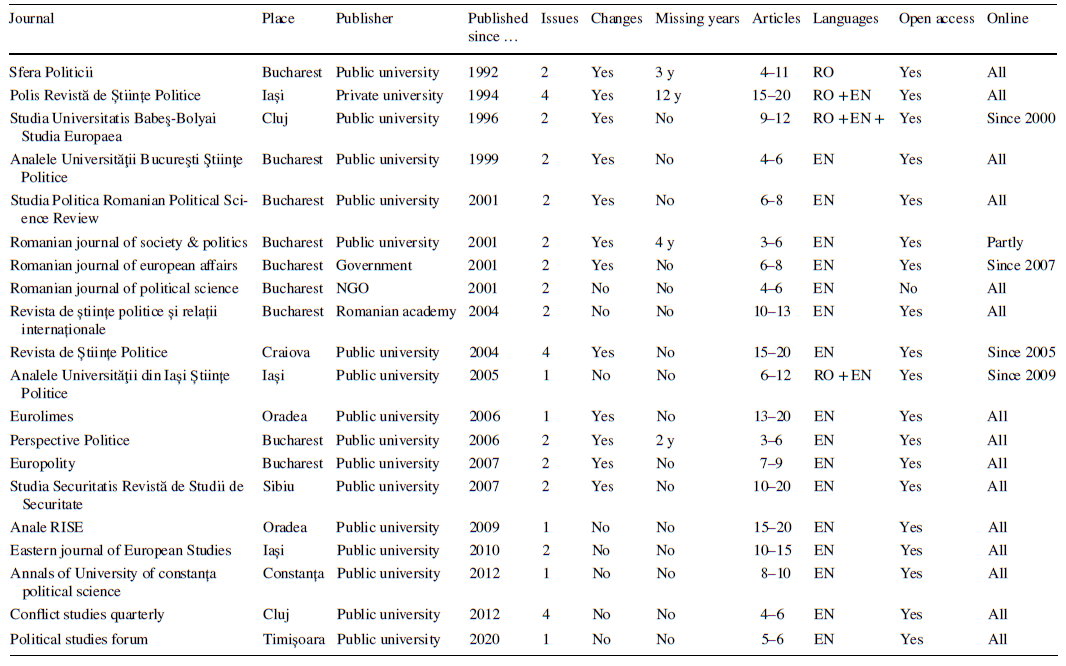
In Table 1, we summarize the features of PoliSci (including IRES and SS) academic journals published in Romania. We have identified 20 active titles. We also know of at least three journals that have ceased to exist due to insufficient submissions and/or diminishing human and financial resources for managing the publication. Most of the currently active journals are either PoliSci journals or generalist, publishing also IRES or SS papers. There are only four IRES journals (Europolity, Bucharest; Eurolimes, Oradea; Romanian Journal of European Affairs, Bucharest; Studia Europaea, Cluj), one SS journal (Studia Securitatis, Sibiu), and one Area Studies journal (Eastern Journal of European Studies, Iași). Of the 20 titles, one is published by a private university, three are published by research-oriented institutions, and nine public universities are publishing the rest. Half of the journals are published by universities that have PoliSci PhD programs. At the same time, almost half of the journals are owned by Bucharest-based publishers. The other half is published in seven other major university centers. This suggests that public universities in large cities still hold the major role in shaping this landscape.
Table 1 PoliSci, IRES, and SS journals in Romania

From our discussions with members of the editorial teams and authors, the lack of sustainable resources and the lack of recognition seem to be the main factors affecting the journals’ growth. Only three journals are published four times a year, 12 are published twice a year and five are published yearly. However, 12 journals have changed their publication frequency during their existence, usually reducing the number of issues per year, as a solution to the problem of insufficient submissions. Within journals, there is also significant variation with respect to the number of articles per issue, another sign that journals are struggling with the number of submissions. While statistics regarding submissions are not publicly reported, based on our experience and on discussions with colleagues it seems the number of submissions is rather low and many of initial submissions are not good enough for peer-review. For instance, between 2021 and 2024, AUBSP received 87 manuscripts and rejected in the desk review phase 34, usually for plagiarism. Similarly, from 2020 to 2023 RJPS received 137 submissions. Of these, 43% (59 submissions) have been desk-rejected, 32% (44) have been peer-review rejected, and 25% (34) have been published.
In terms of accessibility, all journals but one is published as Open Access. They do not charge fees for submissions or for access to the published versions, with the editorial work being conducted pro bono and most of the financial support necessary for the publication coming from the host institution. Similarly, except for five journals, all others have complete archives freely available online.
This “low resources, high accessibility” model also influenced linguistic and managerial choices. A process of uniformization toward publishing in English is particularly noticeable during the last decade. Sfera Politicii remains the only journal publishing articles exclusively in Romanian, perhaps because it is not a purely academic outlet, and it aims at a wider audience. All other journals are publishing English-language articles, with two of them also accepting Romanian language papers, and a third one also accepting other major languages.
The journal landscape in Romanian political science: developments and key issues
Over the last three decades, PoliSci journals have shifted their purposes. In the early 1990s, as PoliSci faculties were still being established around the country, journals aimed primarily to educate the general public. As PoliSci faculties grew, more journals were needed to cover the demand for publishing coming from scholars aiming to advance their careers. As a result, 17 new journals were created from 1996 to 2012. In the absence of any factors pushing the journals into competition with each other, most authors usually chose the easiest publishing solutions: publishing in the journal edited by one’s own faculty or in another Romanian journal. The main consequence of this publishing pattern was that the peer-review process did not manage to fulfill its main function, that of maintaining a high standard for publications in the discipline.
In 2011, the Ministry of Education implemented new criteria for the advancement of careers in higher education and research (Government of Romania 2011). For the domain “Political Sciences,” changes included a mandatory requirement to publish in impact-factor (IF) journals indexed in Clarivate’s Web of Science. In addition, a minimal threshold of citations that authors must obtain for their work was introduced, with citations in IF journals being favored. Since only one Romanian journal was initially indexed and the indexation process takes several years, publishing in Romanian PoliSci journals became of secondary importance for Romanian academics. Rather, they were forced to consider IF international journals as their first choice, a tendency also observed in other fields (Cernat Reference Cernat2024).
In this new context, all journals except one (Sfera Politicii) decided to publish more articles in English, as a means to increase the chance of gathering citations. To increase the chance of Romanian authors to publish in internationally indexed outlets, many of these journals applied to be indexed in Web of Science or Scopus. However, for that purpose they also needed to publish international authors and to achieve certain editorial and impact thresholds, especially regarding citations. Under these circumstances, the previous publication strategy, which focused on attracting mostly authors from the faculties editing the journals, no longer functioned.
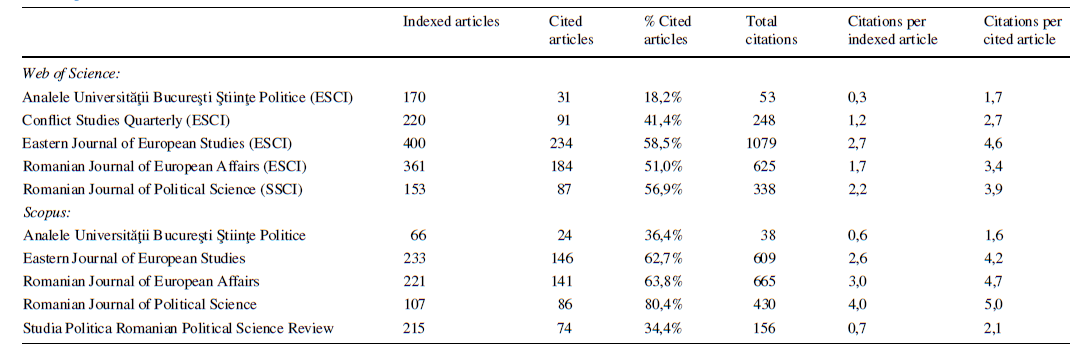
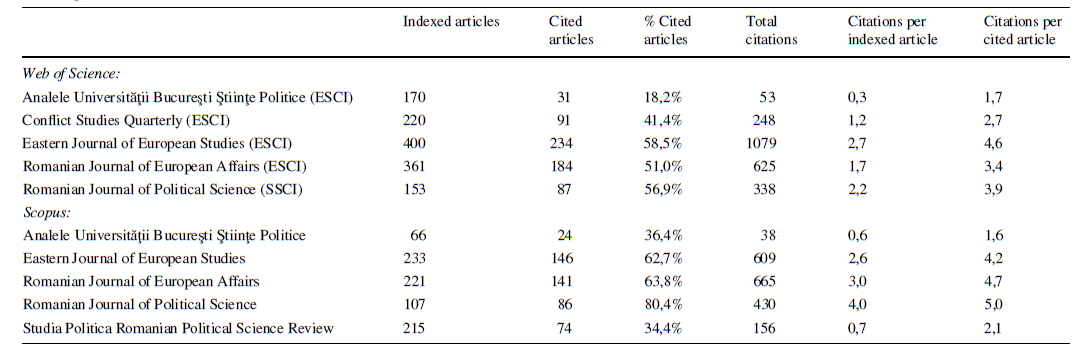
Although these decisions were rational, their main consequence was that Romanian PoliSci journals started to compete with all other international journals, without benefitting from more resources or a coherent growth strategy adapted to the new, more challenging context. Just as Romanian universities are generally doing poorly in international rankings, Romanian PoliSci journals are also placed at the semi-periphery, when evaluated by current bibliometric indicators and indexing in the main databases. At the moment, while most of the identified journals are indexed in at least three of the international databases recognized in the Romanian system, only four of them are indexed in both Web of Science and Scopus. A fifth one is indexed only in Web of Science and a sixth one only in Scopus. The bibliometric indicators presented in Table 2 show that even these four are not performing very well in comparison to other journals in the field: Many of the articles published in these journals are not cited, and those which are cited have, on the average, less than five citations.
Table 2 Romanian journals indexed in Web of Science and Scopus.
Source: Data compiled by the authors from Clarivate Analytics’ Web of Science and Scopus databases, April 2024
Although these top Romanian journals are currently in the fourth quartile, it does not necessarily mean they publish low-quality research. Their position is the result of an institutional context that did not prepare them to be competitive against more established international journals: PoliSci had to be reinvented and accepted as a scientific discipline for almost a decade after the political regime change, and the genuine scientific journals appeared mostly during the last two decades, in a low-competition environment, without funding and without significant connections to the outside world. Their inclusion in the databases is relatively recent and consequently they are still little known internationally. In this respect, a Matthew effect of accumulated advantages may be also present—a text published in an already better known journal will very likely have significantly more citations than a text of similar quality published in a lesser known journal, not necessarily due only to the number of people familiar with the better known journal, but also due to the higher level of trust in outlets that already have a good reputation.
The data suggest that Romanian PoliSci journals are at a crossroads: Although they switched to English to attract foreign submissions, without increased support and visibility they failed to attract a significant and constant number of high-quality submissions. Based on personal experiences from the outlets that we are editing, as well as on discussions with other editors, Romanian PoliSci journals have managed so far to increase submissions from other vulnerable scientific communities (especially from the former Soviet space, Middle East, and Africa), often on topics unrelated to the declared aims and scope of the journals. Articles from scholars based in Western (European) institutions are also increasing, but many are still invited contributions or from members of the Romanian scientific diaspora. One may thus argue that the center-periphery divide was translated to the East and South, with Romanian PoliSci journals becoming a semi-periphery and playing for authors from other scientifically vulnerable or volatile areas the same role that journals in the global “center” (i.e., Western Europe and North America) are playing for Romanian authors. While we do not have complete data to sustain this argument, some support might be offered by an example: Out of 43 submissions rejected by the RJPS in 2023 and 2024, 12 were from Russia, 11 were from various African countries, 10 from China, and only 6 from Europe.
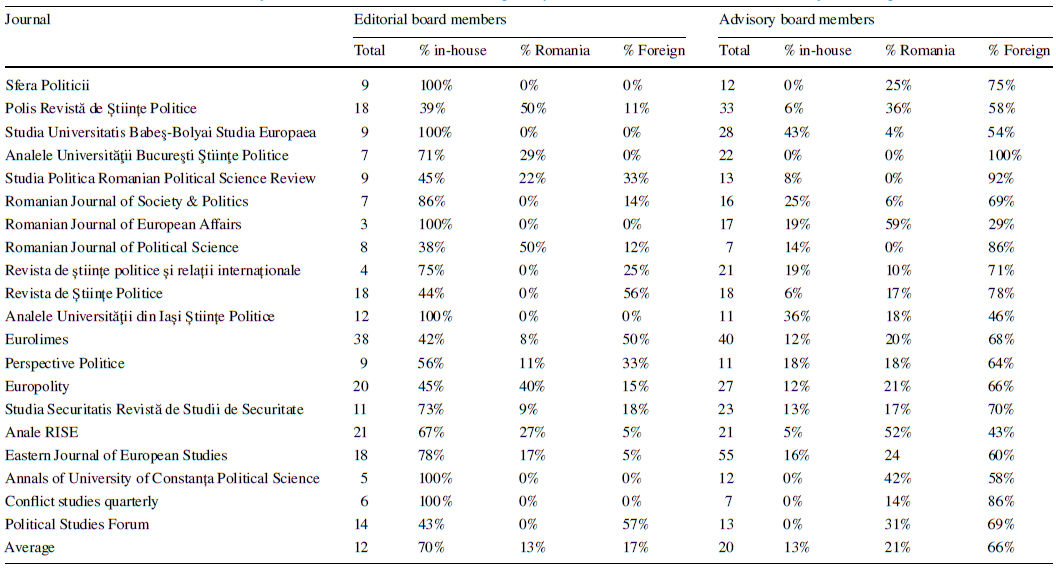
To increase bonds with the international community and the “center,” all Romanian journals have also attempted to invite respected scholars from abroad to join their editorial or advisory boards. We have collected data on editorial and advisory board members (see Table 3), but it has several limitations. Most significantly, different journals use different names and different rules for membership in the two bodies. As a result, it is difficult to compare editorial boards among various journals. Perhaps equally important is the fact that, based on anecdotal evidence, there seems to be a lot of variation with respect to the involvement of board members in running the journal, especially for advisory board members. On average, advisory boards have 20 members, ranging from a low of 7 to a high of 55, with 66% of them coming from foreign universities located overwhelmingly in Europe or the US. In the case of the editorial boards the proportions are reversed, with 70% of the members, on average, coming from the publishing institution.
Table 3 Boards of PoliSci, IRES, and SS journals in Romania.

Source: Data compiled by the authors from the official website of the journals or printed editions, 2023
Most journals do not have very clear procedures for their organization and functioning. It is difficult to find information regarding the rules for selecting the editorial team or their goals (see Ghica Reference Ghica2021 for an example). Moreover, the aims and scope of these journals do not offer enough information to differentiate between them. Most journals declare that they are interested in publishing research in PoliSci, IRES, or SS, but there does not seem to be any sort of regional, methodological, theoretical, or conceptual focus.
Not least, one must note that there are just too many journals for a national community that is rather small: The entire teaching staff in PoliSci, IRES, or SS programs from all Romanian universities consists of less than 500 people (Preda Reference Preda2023: 83) and there are only six doctoral programs in the country. Furthermore, a part of this teaching staff is specialized in other disciplines (history, philosophy, and sociology), and some publish mostly in journals of those disciplines. In short, the existing national community, doctoral students included, cannot offer enough submissions to support such a large number of journals, especially when publications in Romanian journals are considered, according to the national criteria, as second tier.
Conclusions
The current state of Romanian PoliSci journals can be largely explained via a path dependency perspective through decisions made as PoliSci as a discipline was rebuilt during the 1990s. The multiplication of PoliSci departments translated into a multiplication of in-house PoliSci journals that set up very low standards for themselves. This decision stunted the growth of both the authors and the journals themselves, keeping the landscape fragmented and inward-oriented. As the Romanian scientific community and academic careers’ standards became increasingly internationalized, the journals had to adapt to the new competitive context without being prepared for it.
The future of Romanian PoliSci journals does not look very bright and there are not many escape routes available. One set of solutions would require focusing the resources of the community on the journals that are already indexed and having an IF, with one of them becoming the flagship outlet for the entire community. The survival of the rest would depend on how they succeed in differentiating their aims on methodological, theoretical, or sub-disciplinary grounds. An alternative set of solutions would require a national evaluation of the PoliSci journals, coupled with giving more value to articles published in the top-tier Romanian journals. Unfortunately, such solutions are unlikely because they require the cooperation of a majority of the PoliSci community, which is still quite fragmented and tribal. Methodological and theoretical divisions, significant differences between the formative experiences of those educated in different systems abroad, as well as the legacies of the communist past are often present in a community of scholars that grew in a society that does not value cooperation and that is quick to interpret criticism as personal attacks. This institutional culture also leads to a very low propensity to cross tribal lines and cooperate with “others” for the advancement of the community as a whole and of the discipline. In this context, probably the most fruitful path implies primarily trust-building measures (e.g., consistent, continuous, and honest dialog among different departments and editorial teams), supported through institution-building measures (e.g., national professional association, periodic scientific conference of the national community of PoliSci scholars, and community-based professional standards).
Funding
HORIZON EUROPE Framework Programme, 101095237 Grant Agreement n. 101.
Declarations
Conflict of interests On behalf of all authors, the corresponding author states that there is no conflict of interest.

 Open access

