

Introduction
Austrian politics in 2022 was affected by a growing level of dissatisfaction among the public. Mass surveys regularly showed low points in the level of citizens’ satisfaction with the functioning of the Austrian democratic system (e.g., Austrian Democracy Lab 2023). Public support for the government coalition between the Christian-Democratic Austrian People's Party/Österreichische Volkspartei (ÖVP) and the Greens/Die Grünen–Die Grüne Alternative (GRÜNE) continued to decline after dramatic losses, especially for the ÖVP in the previous year. By the end of 2022, the polls reported 21 per cent support for the ÖVP and 11 per cent for the Greens (compared to 38 per cent and 14 per cent, respectively, in the 2019 general election; Austria Presse Agentur 2023). The high level of dissatisfaction with the functioning of the democratic system falls into a time of pandemic fatigue due to the ongoing COVID-19 crisis, rising inflation as a consequence of the war in Ukraine and the judicial, as well as political, reconditioning of the so-called ÖVP corruption-affaire.
The two big opposition parties benefited from these developments. While the Austrian Social Democratic Party/Sozialdemokratische Partei Österreichs (SPÖ) recorded strong gains during the first half of 2022, by the end of the year, the right-wing populist Austrian Freedom Party/Freiheitliche Partei Österreichs (FPÖ) had become the strongest political actor according to the polls (25 per cent and 28 per cent, respectively; Austria Presse Agentur 2023). The liberal party The New Austria/Das Neue Österreich (NEOS) remained stable at around 10 per cent. The extra-parliamentary parties scored just above (Beer Party/Bierpartei, BIER) or below (MFG Austria—People Freedom Fundamental Rights/MFG Österreich–Menschen Freiheit Grundrechte, MFG) the 4 per cent threshold for parliamentary representation at the end of 2022.
The high level of dissatisfaction dominated the presidential election as well as the regional election in Tyrol. The sitting President, Alexander Van der Bellen (independent, former party chairmen of the Greens), was re-elected after an electoral campaign with heated discussions as to whether the President should remove the government from office. The regional government parties, ÖVP and Greens—and hence the same parties that hold government responsibility at the national level—suffered severe losses at the Tyrolian election and lost their parliamentary majority. As a result, an ÖVP–SPÖ coalition came into office after the election in Tyrol.
Election report
Presidential elections
The presidential election took place on 9 October. The acting President, Alexander Van der Bellen, put himself forward for re-election. Austrian presidential elections follow a majoritarian two-round voting system. More than 50 per cent of the votes are required to win the election. If no candidate receives a majority in the first round, a second round that is limited to the two top candidates is held. Van der Bellen gained 56.7 per cent of the votes and secured his re-election in only one round.
The electoral outcome was not surprising, given that all five previous Austrian presidents since 1945 who have run for re-election were able to secure their position in the first round. Nevertheless, several aspects are noteworthy with respect to the 2022 election. Including the incumbent, seven candidates competed in the election. This is the highest number of candidates that ever campaigned in an Austrian presidential election. On average, only three names are present on a presidential ballot paper during the first round. Yet, for the first time since 1986, no women were among the candidates, and the election thus did not change the fact that Austria has never had a female president.
The incumbent, Alexander Van der Bellen, was the former party chairman of the parliamentary party the Greens. In 2016, in the run-off to his first election, he put his party membership on hold and campaigned as an independent candidate. Nevertheless, he received support from the Greens with respect to funding (in all elections), staff and donations in kind (only in 2016). The SPÖ, as well as the liberal party NEOS, publicly endorsed Van der Bellen, while the ÖVP declined to give a voting recommendation. The FPÖ was the only parliamentary party that presented a candidate. The ombudsman and lawyer Walter Rosenkranz campaigned for the FPÖ. Rosenkranz gained 17.7 per cent of the votes, which is somewhat lower than the FPÖ scored in representative surveys at that time, and was not enough to get a second ballot. The restraint of the other parliamentary parties was in line with their supporters’ preferences as a representative survey had shown in spring 2022. Only supporters of the FPÖ wished to see their own candidate on the ballot paper (Seidl Reference Seidl2022). Thus, the long ballot paper can be explained by the high number of candidates supported by an extra-parliamentary party and independent candidates.
Party chairman Michael Brunner received support from his party, the MFG. The MFG was formed during the COVID-19 pandemic and mainly called into question protective measures such as the COVID-19 vaccine or lockdowns. The MFG had received considerable electoral support at the local and regional levels during the height of the pandemic. However, towards the end of 2022, the MFG had become insignificant as shown by Brunner's result of only 2.1 per cent in the presidential election and the failure to gain parliamentary representation in Tyrol (see Regional elections).
Party chairman Dominik Wlazny received support from his BIER party. BIER is only represented at the local level and was formed as a satirical party. Wlazny, better known by his alias Marco Pogo, is a trained doctor, artist and entrepreneur who tried to get away from his image as a joke candidate. With 8.3 per cent of the votes, he achieved a respectable outcome, especially among the younger voters.
The independent candidates were Tassilo Wallentin, a lawyer mainly known due to his column in the highest-reach newspaper Kronen Zeitung; Gerald Grosz, a former FPÖ and BZÖ politician active mainly as a blogger in social media; and Heinrich Staudinger, a left-wing entrepreneur (see Table 1).
Table 1. Elections for president in Austria in 2022

Notes:
1. Gerald Grosz was a former member of the BZÖ and the FPÖ.
2. Alexander Van der Bellen was a former member of the Greens. The Greens supported Van der Bellen financially.
3. BIER, Beer Party/Bierpartei; FPÖ, Austrian Freedom Party/Freiheitliche Partei Österreichs; MFG, MFG Austria—People Freedom Fundamental Rights/MFG Österreich–Menschen Freiheit Grundrechte.
Source: Federal Ministry for the Interior (2022) (https://bundeswahlen.gv.at/2022/).
The electoral campaign was dominated by the massive inflation and—since fighting inflation is beyond the jurisdiction of the Austrian president—the candidates’ evaluation of the incumbent government. The Austrian president has the power to remove the government from office, although no president has ever exercised that right. Candidates Grosz and Brunner promised to dismiss the government, Rosenkranz and Wallentin wanted to await future government actions, and Van der Bellen, Wlazny, as well as Staudinger did not want to remove the government. Overall, the challengers appealed to the large group of dissatisfied voters, while Van der Bellen positioned himself as the guarantor for stability in turbulent times. On Election Day, voters decided on the latter.
Regional elections
One regional election took place in 2022, in Tyrol, on 25 September. The region was a stronghold of the ÖVP governed by a coalition of ÖVP and Greens, headed by Land governor Günther Platter (ÖVP). The election was scheduled for 2023. However, when Platter unexpectedly announced his retirement from politics, the coalition partners decided on early elections. Platter remained in office until the election. State minister Toni Mattle became the top candidate for the ÖVP.
At the time of the election, six parties held seats in the diet (Landtag): ÖVP (17 seats out of 36 seats), SPÖ (six), FPÖ (five), Greens (four), the regional party Citizen's Forum Austria/Bürgerforum Österreich (FRITZ) (two) and NEOS (two). All regional parliamentary parties ran again. In addition, the COVID-19 vaccine-sceptic MFG campaigned for the first time, and two small parties contested in only some electoral districts.
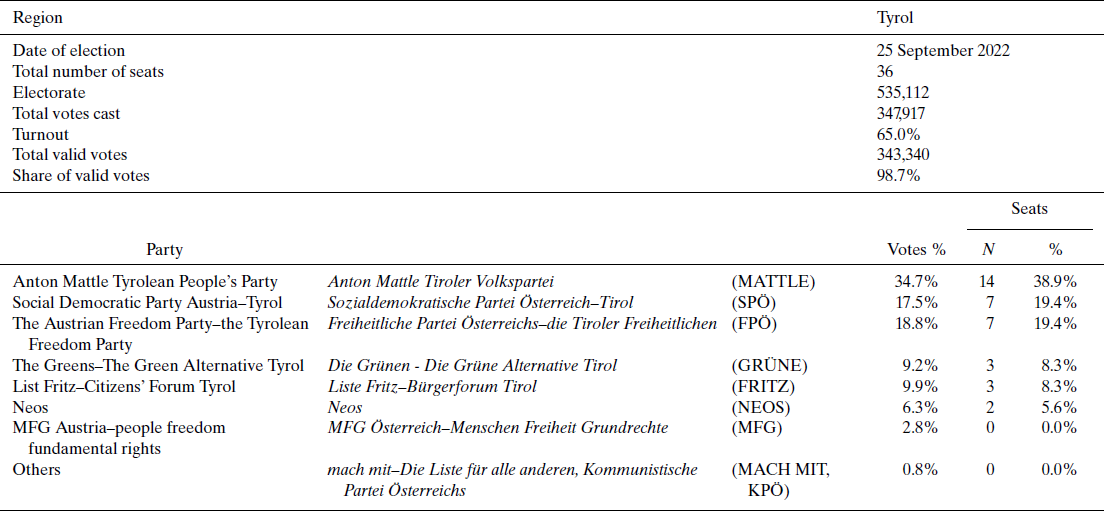
The election result brought massive losses for the ÖVP. The party obtained 34.7 per cent of the votes (−9.6 percentage points) and 14 seats. The FPÖ obtained 18.8 per cent (+3.3) and seven seats. The SPÖ gained marginally receiving 17.5 per cent of the votes (+0.2) and seven seats. The Greens suffered slight losses and obtained 9.2 per cent (−1.5) and three seats. FRITZ gained 9.9 per cent (+4.4) and three seats. NEOS gained slightly and received 6.3 per cent (+1.1) and held their two seats. The MFG as well as the other two small parties failed to reach parliamentary representation (see Table 2).
Table 2. Results of regional (Tyrol) elections in Austria in 2022

Note: The MFG was established in 2021 and took part in the election for the first time.
Source: Amt der Tiroler Landesregierung (2022) (https://wahlen.tirol.gv.at/landtagswahl_2022/index.html).
Despite the ÖVP's losses, the composition of the Tyrolian delegation to the national Parliament's upper house remained unchanged (three ÖVP, one FPÖ and one SPÖ). Thus, the national government parties ÖVP and Greens continued to hold a majority in the second chamber.
Cabinet report
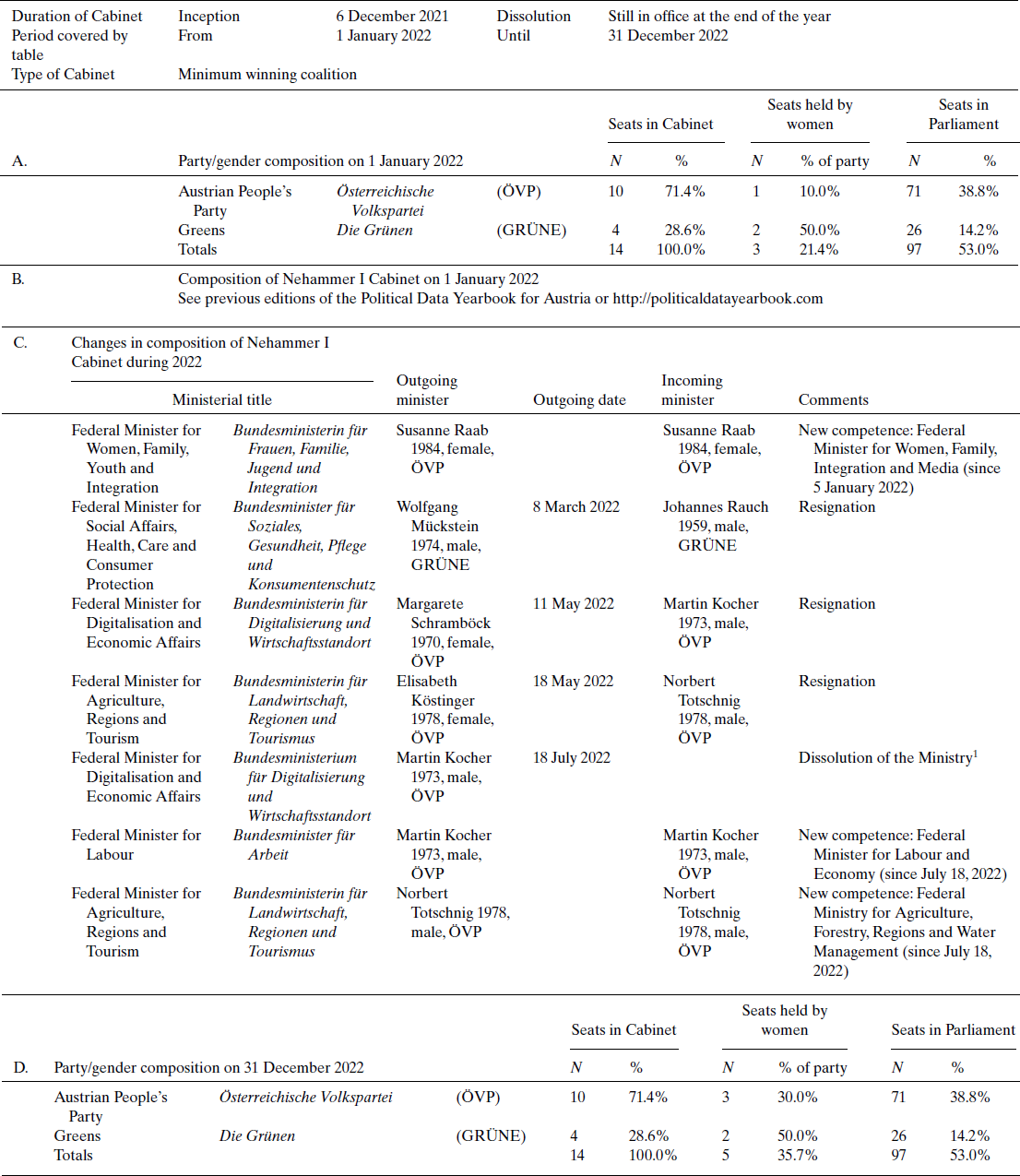
On 5 January, minister Susanne Raab took over the responsibility for the media agenda. The youth agenda now fell within the jurisdiction of State Secretary Claudia Plakolm. Raab's new ministry was rebranded as the Federal Ministry for Women, Family, Integration and Media. This new distribution of competences ended the first large Cabinet reshuffle following the appointment of Karl Nehammer (ÖVP) as chancellor in December 2021.
On 8 March, the Federal Minister for Social Affairs, Health, Care and Consumer Protection, Wolfgang Mückstein (Greens), resigned. The general practitioner was in office for less than a year. Mückstein justified his resignation by referring to threats against himself and his family. He was succeeded by Johannes Rauch (Greens), who became the third Minister of Health in the ongoing legislative period.
On 9 May, both the Federal Minister for Agriculture, Regions and Tourism, Elisabeth Köstinger (ÖVP), and the Federal Minister for Digitalisation and Economic Affairs, Margarete Schramböck (ÖVP), announced their retirement from politics. Both ministers were close associates of the former chancellor Sebastian Kurz (ÖVP) and thanked Kurz for his support during their statements, justifying their retirement by stating that it was time for them to start a new chapter in their lives. As a consequence of these announcements, on 11 May, Minister Kocher (ÖVP) temporarily took over the Federal Ministry for Digitalisation and Economic Affairs. Two new State Secretaries were appointed: State Secretary Susanne Kraus-Winkler (ÖVP), allocated to the Federal Ministry for Digitalisation and Economic Affairs, and State Secretary Florian Tursky, allocated to the Federal Ministry for Finance. On 18 May, Norbert Totschnig (ÖVP) was sworn in as Federal Minister for Agriculture, Regions and Tourism.
The resignation of Schramböck and Köstinger was followed by an amendment of the Federal Ministries Act (Bundesministeriengesetz) on 18 July 2022. The Federal Ministry for Digitalisation and Economic Affairs was dissolved and the economic affairs were reassigned to the Minister for Labour (which now reads Federal Ministry for Labour and Economy). The digital issues were taken over by the Federal Ministry of Finance and now fall within the jurisdiction of State Secretary Tursky. The Federal Ministry for Agriculture, Regions and Tourism was renamed into the Federal Ministry for Agriculture, Forestry, Regions and Water Management. The tourism issue was taken over by the Federal Ministry for Labour and Economy and now falls within the jurisdiction of State Secretary Krauss-Winkler. The amendment of the Federal Ministries Act ended the second Cabinet reshuffle within the Cabinet Nehammer I (see Table 3 for data on Cabinet composition).
Table 3. Cabinet composition of Nehammer I in Austria in 2022

Notes:
1. The digital/e-government issues, previously belonging to the Federal Minister for Digital and Economic Affairs, were taken over by the Federal Ministry of Finance.
2. Two of the 10 ÖVP seats in Cabinet were held by independent ministers nominated by the ÖVP.
Sources: Federal Chancellery of Austria–Bundeskanzleramt (2023) (www.bundeskanzleramt.gv.at/bundeskanzleramt/die-bundesregierung/bundesministerinnen-und-bundesminister.html); Österreichischer Amtskalender (2022) (https://amtskalender.jurnet.at).
Parliament report
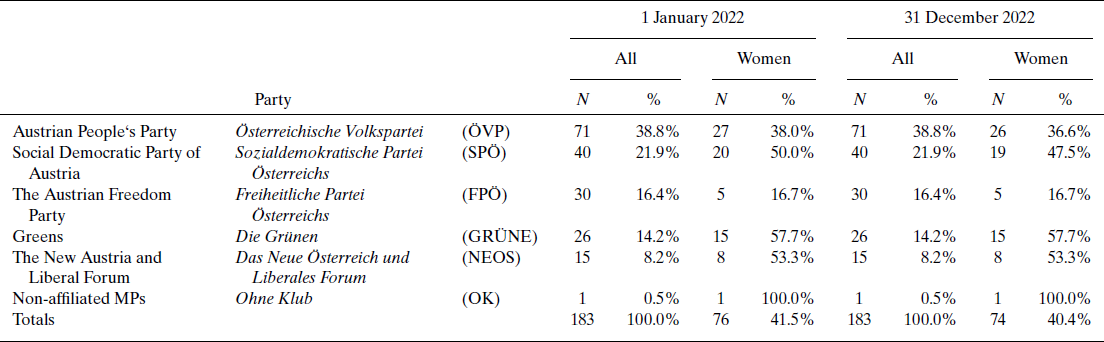
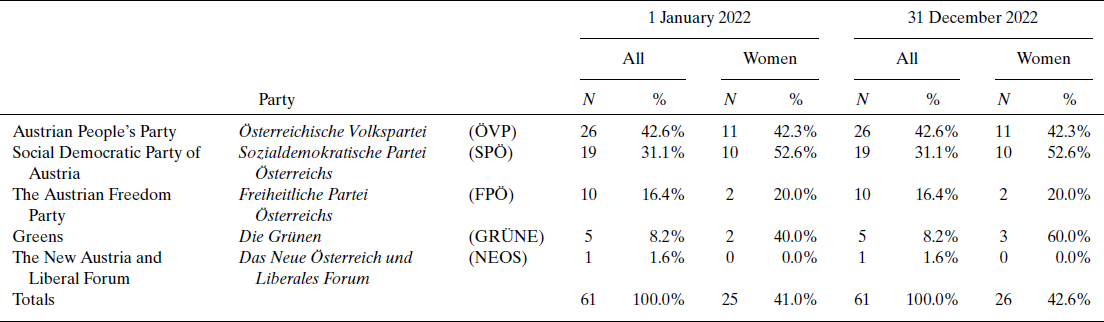
The composition of the National Council (Nationalrat) and the Federal Council (Bundesrat) is reported in Tables 4 and 5. The government parties, ÖVP and Greens, had a parliamentary majority in both chambers and, consequently, there were no conflictual issues between the National Council and the politically much weaker Federal Council (its veto power usually prolongates the legislative process, but does not stop it).
Table 4. Party and gender composition of the lower house of Parliament (Nationalrat) in Austria in 2022

Source: Austrian Parliament (2023) (www.parlament.gv.at/recherchieren/personen/nationalrat/nationalrat-seit-1920).
Table 5. Party and gender composition of the upper house of Parliament (Bundesrat) in Austria in 2022

Source: Austrian Parliament (2023) (www.parlament.gv.at/recherchieren/personen/bundesrat/bundesrat-seit-1920).
The ÖVP–Green coalition agreed on two prestige projects of this government: On 20 January, the National Council voted on the socio-economic tax reform that included a CO2-pricing. Parts of the measures were adopted by a parliamentary majority and other parts unanimously (National Council 2022b).
On 12 October, the National Council voted on the abolishment of the so-called ‘cold progression’ (tax bracket creep). Apart from the SPÖ, who had argued for a better targeting of the measures, all parliamentary parties voted in favour of the bill (National Council 2022c). Two other prestige projects of the current government did not pass: By the end of the year, Austria was still waiting for a new climate protection law (the former climate protection law became ineffective by the beginning of 2021). Equally, the government parties remained divided on the new transparency law and hence the abolishment of the official secret. Austria thus remains the last European democracy with an official secret guaranteed by the constitution.
The ÖVP Corruption Committee of Inquiry held 43 meetings and questioned 82 respondents. The committee of inquiry had been established by the end of 2021 to review corruption allegations against ÖVP government members (National Council 2023). The investigative committee put the governing parties to a severe test. While Green parliamentarians tried to perform their control duties, Green government members tried to maintain peace within the coalition government. The investigative committee was accompanied by the publication of chat transcripts that put the moral image of politics in a bad light.
The year 2022 brought an end to the renovation of the Austrian Parliament. Since the beginning of the renovation works in 2018, the Austrian Parliament was located in an alternative accommodation at the Hofburg Palace and other nearby premises. The end of the construction work allowed parliamentarians to relocate to the historic building. The official opening ceremony was scheduled for 12 January, and the first session of the National Assembly was for 31 January 2023.
Political party report
There were no major developments within Austrian political parties with respect to leadership, splits, mergers or policy shifts.
Institutional change report
There were no major changes to the constitution, basic institutional framework, electoral law or other major changes to the rules of the game.
Issues in national politics
The most notable debates evolved around (a) the combat of the COVID-19 pandemic, (b) the consequences on Austria's economy and foreign policy in the wake of the Ukraine war, (c) the issue of climate change and (d) the ÖVP Corruption Committee of Inquiry (see Parliament report for information on the committee of inquiry).
Combatting the COVID-19 pandemic remained a highly salient issue in national politics. Already at the beginning of the year, the intense and controversial debates culminated in the adoption of the compulsory vaccination bill on 20 January. A majority of 137 out of the 170 parliamentarians present voted by roll call in favour of the bill that was introduced to Parliament in December of the previous year. The FPÖ, four parliamentarians of NEOS and one SPÖ member opposed the bill. In addition to the compulsory voting bill, the National Council decided on incentive packages to increase vaccination coverage, namely, a vaccination lottery and financial benefits for communities with high vaccination coverage. When the Omicron variant of the COVID-19 virus hit Austria, infection numbers increased, yet the figures in hospitals remained largely stable. The following months were characterised by the removal of COVID-19-related restrictions and ultimately the abolishment of the compulsory vaccination bill only five months after its decision (and before it was actually implemented). Neither the vaccination lottery nor the financial benefits for communities with high vaccination coverage were enacted (National Council 2022a).
Over the course of the year, inflation increased, driven by rising energy costs in the wake of the Ukraine war (OECD 2022). Inflation, rather than the war in Ukraine, became the most important issue. Several packages of measures to combat the effects of inflation were enacted (e.g., increase in cash benefits for particularly affected groups, electricity price compensation for the economy, direct subsidies for energy-intensive companies and the abolishment of the tax bracket creep). In the meantime, the question arose whether Austria should maintain its neutrality in the new security policy situation. On the part of the politicians, however, this discussion was refused because none of the parties (with the exception of NEOS) wanted to shake Austrian neutrality, which was popular with the people.
Finally, climate change has been a central issue in the public debate, even if its importance has taken a bit of a back seat due to the COVID-19 pandemic and increased inflation. The starting point for the discussions was the Austrian Climate Citizens’ Assembly in the first half of the year. It was the first state-organised nationwide deliberative mini-public in Austria. Randomly selected citizens discussed and developed proposals for climate protection to achieve climate neutrality by 2040. The climate assembly met on six weekends in the cities of Vienna and Salzburg. Their 93 recommendations were handed over to the government on 4 July (ARGE Klimarat 2022). The Federal Ministry for Climate Action answered to the assembly's recommendations in a written report in November 2022 (Federal Ministry for Climate Action 2022).


 Open access

