

Introduction
In what is becoming a regular phrase to describe British politics in recent years, 2022 was a turbulent year that saw three Prime Ministers, mass ministerial resignations, the death of Queen Elizabeth II and a deepening economic crisis. The year began with ongoing investigations into alleged breaches of Covid-19 regulations in Number 10, with civil servant Sue Gray producing a report in May that found that there had been ‘failures of leadership’ and the then Prime Minister Boris Johnson being fined by the Metropolitan Police for lockdown rule-breaking.
An election to the Northern Ireland Assembly was held on 5 May after the First Minister Paul Girvan resigned over issues with the Northern Ireland Protocol division of the Brexit negotiations. For the first time in the Assembly's history, Sinn Féin became the largest party, but the Assembly was unable to function due to the Democratic Unionist Party (DUP)'s refusal to nominate a Speaker.
The year also saw a worsening cost of living crisis, with inflation rising to a rate not seen for 40 years resulting in pressures on both food and energy costs. Public sector workers began a series of strikes in May that lasted until the end of the year. Last, in response to the war in Ukraine, the United Kingdom pledged substantial support for Ukraine, including the provision of weapons and the welcoming of over 100,000 refugees from the conflict.
Election report
There were no national elections in the United Kingdom in 2022.
Subnational elections
The Northern Ireland protocol was agreed as a key part of the Brexit negotiations in 2021, governing checks on goods; the move of these checks from the border with the Republic of Ireland to Northern Ireland's ports has proved to be particularly controversial to Unionist parties. In February 2022, the First Minister of Northern Ireland, Paul Givan of the Democratic Unionist Party, resigned in protest over the Protocol, which also meant Sinn Féin's Michelle O'Neil lost her position as Deputy First Minister under the power-sharing arrangement. An election to the Northern Ireland Assembly took place on 5 May. For the first time in Northern Ireland's history, the nationalist party Sinn Féin became the largest party with 27 Members of the Legislative Assembly. This means that, under the terms of power-sharing as specified in the Good Friday Agreement, for the first time, Northern Ireland would have a Nationalist First Minister and a Unionist Deputy Minister. However, to express their continued dissatisfaction with the Northern Ireland Protocol, the DUP refused twice to participate in the nomination of a Speaker, which prevented a government from being formed, triggering the suspension of the Assembly. Another election is required to be held if an executive cannot be appointed, but the deadline of 27 October 2022 passed without an agreement. The Northern Ireland Secretary Chris Heaton Harris extended the new deadline to January 2024.
Cabinet report
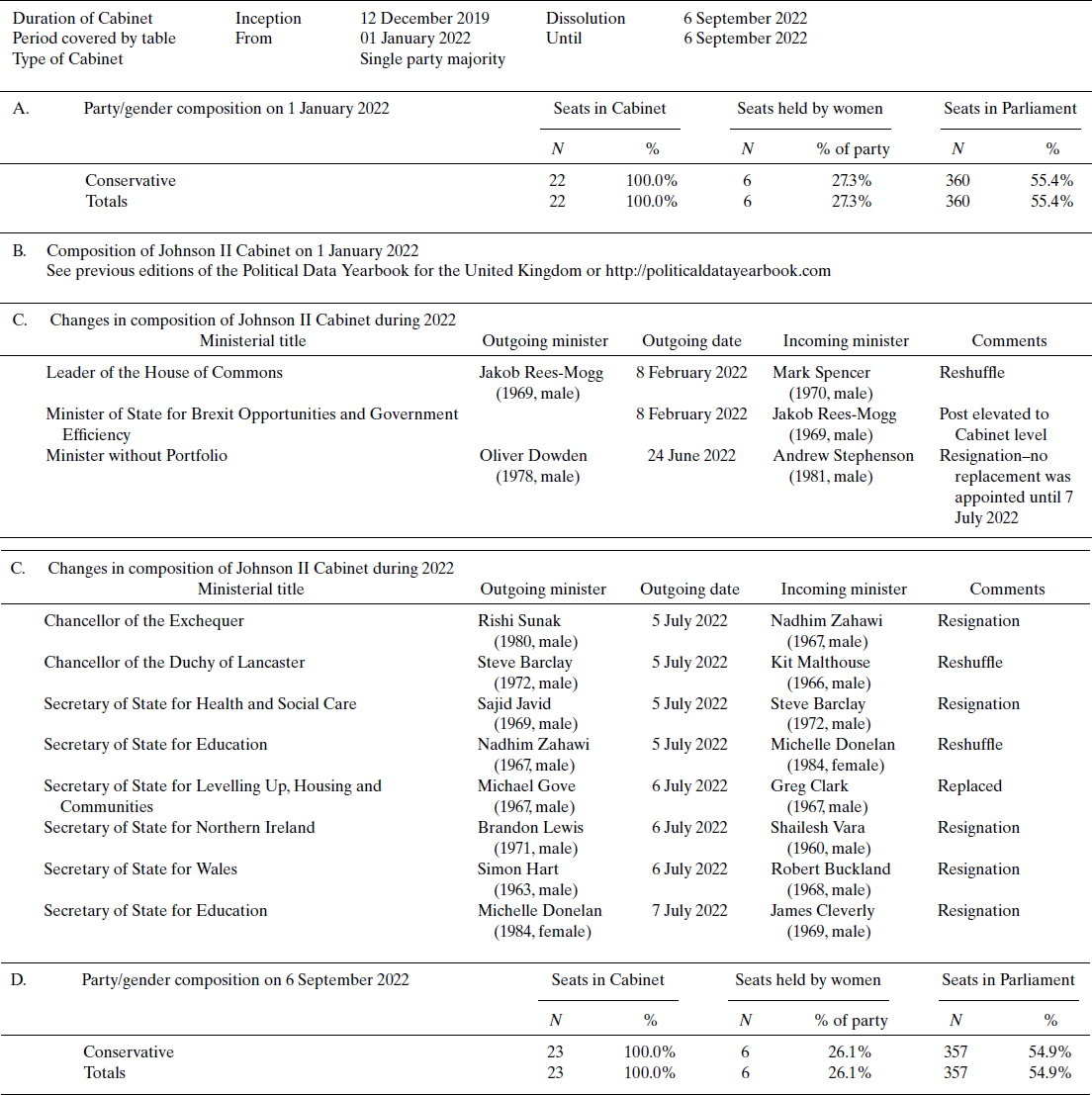
The current government took office on 13 December 2019 and is a single-party majority government. However, there were a series of substantial changes in Cabinet throughout 2022 (see Tables 1, 2 and 3). First, on 8 February, Jacob Rees-Mogg was moved from his position as Leader of the House of Commons to take up a new Cabinet-level ministerial post of Minister of State for Brexit Opportunities and Government Efficiency, being replaced in his previous post by Chief Whip Mark Spencer. Johnson survived a vote of no-confidence by his party on 6 June, which seemed to precipitate the substantial Cabinet changes of the subsequent few weeks. The next significant change came on 24 June, when Minister without Portfolio Oliver Dowden resigned after two by-election defeats, declaring that ‘someone must take responsibility’, being replaced by Andrew Stephenson. July proved to be a tumultuous month for Johnson's Cabinet as well as his own leadership. On 5 July, Secretary of State for Health and Social Care Sajid Javid tendered his resignation expressing frustration over Johnson's leadership, followed nine minutes later by Chancellor of the Exchequer Rishi Sunak, who stated ‘we cannot continue like this’ (BBC 2022). Over the next 24 hours, 32 ministers resigned, the highest number in a 24-hour period since 1932.
Table 1. Cabinet composition of Johnson II in the United Kingdom in 2022

Source: UK Parliament (n.d.).
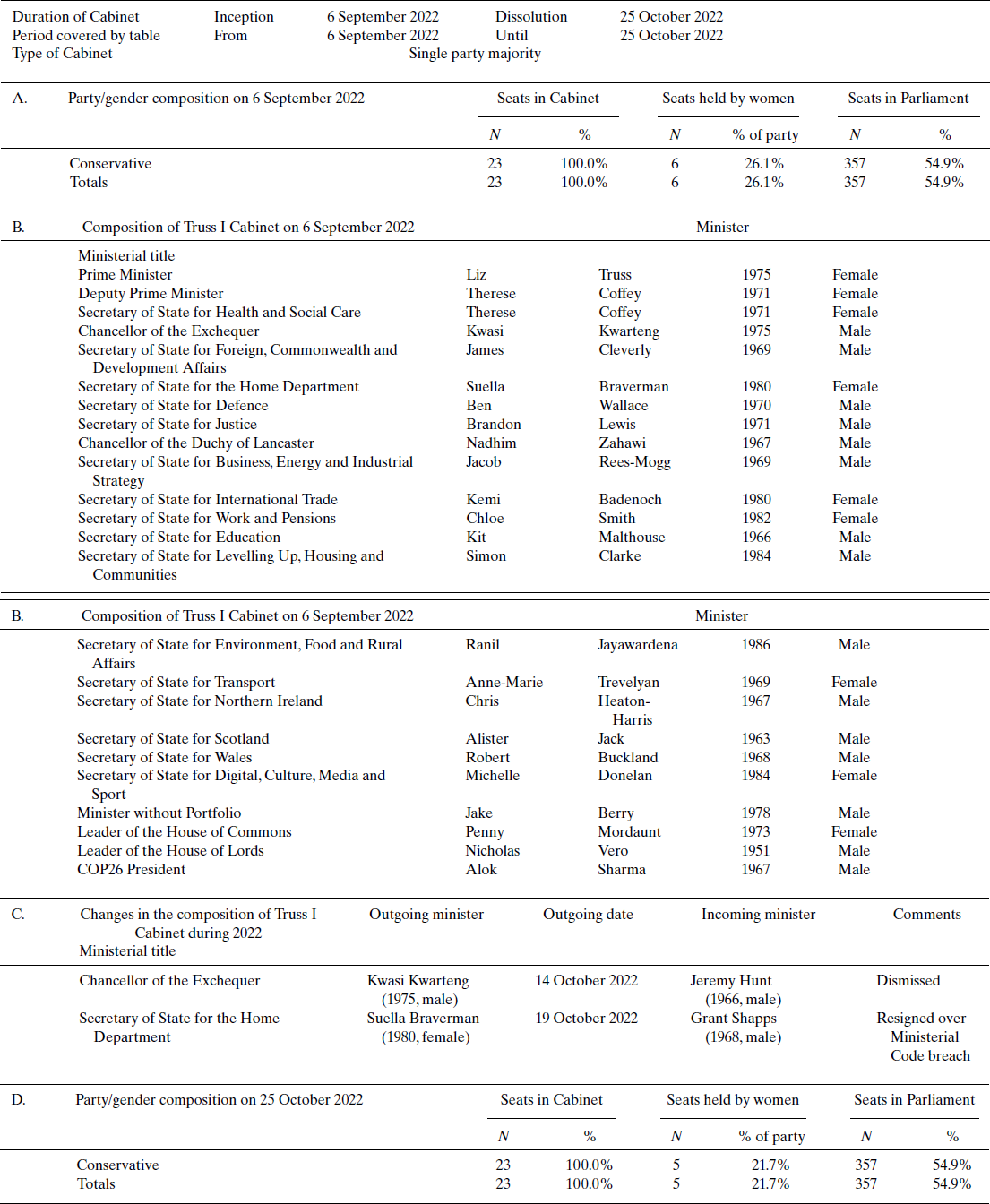
Table 2. Cabinet composition of Truss I in the United Kingdom in 2022

Notes: The Cabinet-level post of Secretary of State for Business, Energy and Industrial Strategy, occupied by Jacob Rees-Mogg, was left vacant.
Source: UK Parliament (n.d.).

Steve Barclay, the serving Chancellor of the Duchy of Lancaster, was moved to cover Javid's departure, and Secretary of State for Education Nadhim Zahawi became Chancellor of the Exchequer. In turn, Michelle Donelan, a junior education minister, became Secretary of State for Education, before resigning her new position just two days later. James Cleverly, another junior minister who has previously served as party chairman filled the role. Secretary of State for Northern Ireland Brandon Lewis resigned on the 7 July and was replaced by Shailesh Vara. Secretary of State for Wales Simon Hart also resigned and was replaced by Robert Buckland. Amidst these multiple senior-level resignations, Michael Gove, the Secretary of State for Levelling Up, Housing and Communities was sacked by Johnson and replaced by Greg Clark on 6 July. In total, 62 ministers resigned between 5 and 7 July leaving few to replace them. After Johnson announced his resignation on 7 July, the Cabinet remained unchanged until his departure on 8 September.
Liz Truss, on becoming Prime Minister on 6 September, substantially overhauled much of the Cabinet. Business Secretary Kwasi Kwarteng replaced Nadhim Zahawi as Chancellor of the Exchequer, with Zahawi becoming Chancellor of the Duchy of Lancaster. James Cleverly was moved into Truss’ former position as Foreign Secretary. Priti Patel, who had served as Home Secretary since 2019 left the Cabinet and was replaced by Suella Braverman, the former Attorney General. For the first time in history, none of the four most senior Cabinet-level positions—including the Prime Minister—were occupied by a White man. Truss also appointed to the Cabinet some of her key rivals for the leadership, including Penny Mordaunt as Leader of the House of Commons and Kemi Badenoch as Secretary of State for International Trade. Jacob Rees-Mogg's post as Minister of State for Brexit Opportunities and Government Efficiency was abolished after only seven months, and he became Business Secretary. Despite Truss’ tenure as Prime Minister lasting just 49 days, her Cabinet also underwent changes. The launch of ‘The Growth Plan 2022’—a mini-budget—on 23 September caused considerable financial turmoil, with the exchange rate plunging, the Bank of England buying emergency bonds and the mortgage market contracting. The Office for Budget Responsibility had not been allowed to examine the fiscal impacts of the proposals, and the Institute for Fiscal Responsibility heavily criticised Kwarteng, describing him as ‘not just gambling on a new strategy, he is betting the house’ (Adam et al. Reference Adam, Delestre, Emmerson, Johnson, Joyce, Stockton, Waters, Xu and Zaranko2022). After much condemnation, including from Conservative Members of Parliament (MPs), plans to abolish higher rates on income tax on high-earners were reversed. However, Kwarteng was sacked as Chancellor of the Exchequer on 14 October, serving just 38 days. He was replaced by Jeremy Hunt, who brought extensive Cabinet experience, although he had not served under Johnson after he contested him for the leadership in 2019. On 19 October, Home Secretary Suella Braverman resigned after breaching the ministerial code by sharing secure information from her personal email. She was replaced by Grant Shapps, the former Transport Secretary who had been left out of Truss’ original Cabinet after supporting Sunak in the leadership election.
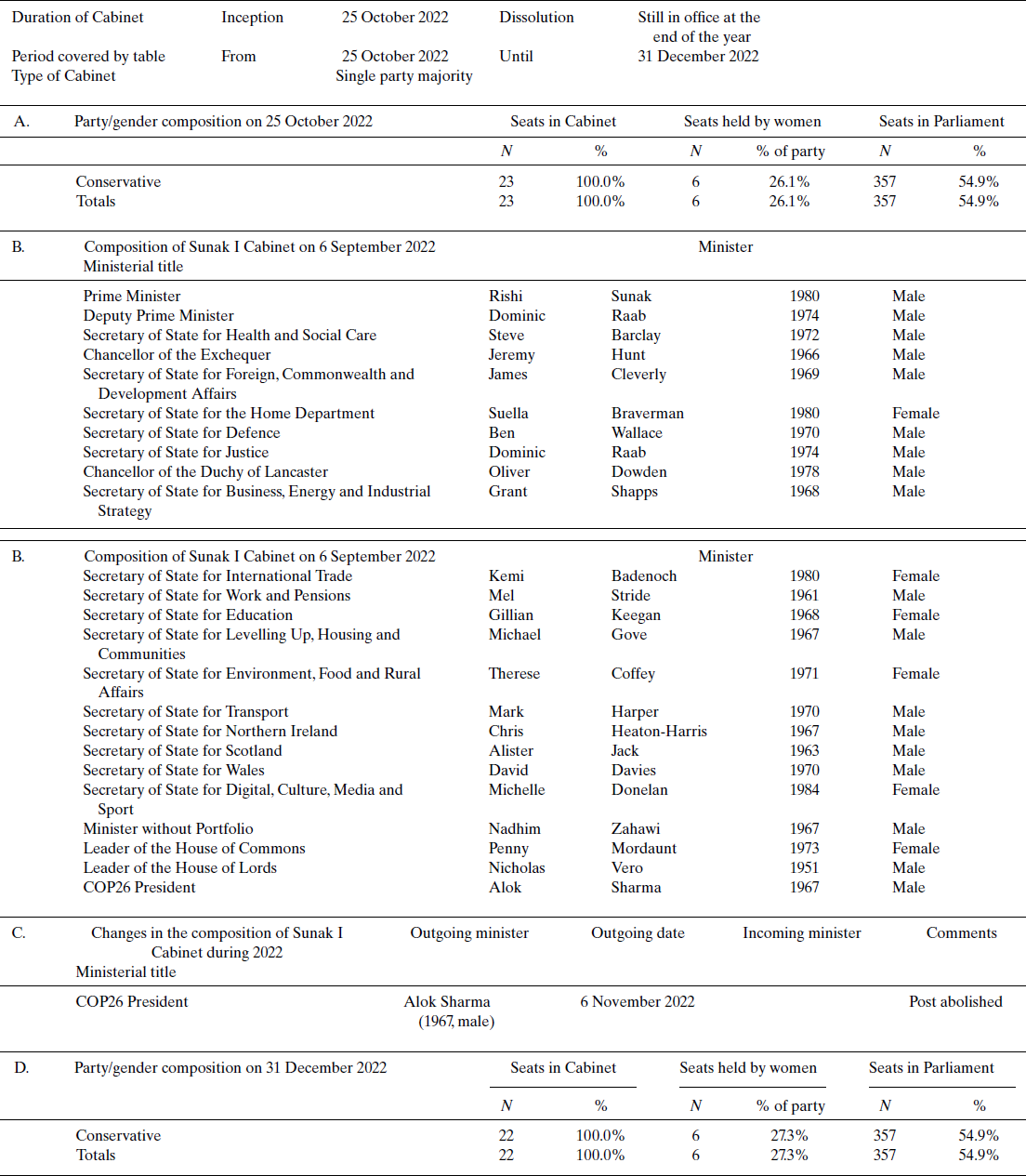
The arrival of Rishi Sunak as Prime Minister on 25 October led to yet another reshaping of the Cabinet. Rees-Mogg, Lewis, Clarke, Berry, Smith, Malthouse, Jayawardena, Trevelyan and Buckland all departed the Cabinet. While Alok Sharma retained his position as United Nations Climate Change Conference (COP26) President, he would no longer attend the Parliament. Therese Coffey lost her position as Deputy Prime Minister and Justice Secretary, replaced in both by the re-entering Dominic Raab. Nadhim Zahawi moved to become Minister without Portfolio, being replaced as Chancellor of the Duchy of Lancaster by the also returning Oliver Dowden. Grant Shapps was moved from his position in the Truss Cabinet as Home Secretary to which he had only been appointed on 19 October; he was replaced by his returning predecessor Suella Braverman, amid some controversy. Gillian Keegan and David TC Davies picked up their first Cabinet posts as Education Secretary and Welsh Secretary, respectively.
Parliament report
Six by-elections were held in 2022. The first was held on 3 February, to fill the vacancy left by the murder of Sir David Amess the previous November. The other major parties did not contest the seat out of respect, and Conservative Anna Firth gained the seat with 86 per cent of the vote. The second was held in Birmingham Erdington on 3 March after the death of Labour's Jack Dromey; the party held the seat, with new MP Paulette Hamilton becoming the first Black MP to represent a Birmingham constituency.
On 23 June 2022, two by-elections were held. One was held in Wakefield after the sitting Conservative MP Imran Khan was convicted of sexual assault. Prior to Khan's victory in 2019, Wakefield had been held by Labour since 1932, and Labour regained it at the by-election. The other contest was held in Tiverton and Honiton, a seat held by the Conservatives since it was created in 1997. The sitting MP, Neil Parish, resigned after admitting to watching pornography in the Commons chamber on two occasions and having the whip withdrawn. The Liberal Democrats gained the seat with a majority of over 6000.
The City of Chester constituency held a by-election on 1 December, after the resignation of Labour's Chris Matheson who had held the seat since 2015. He was suspended from the Commons for four weeks after being accused of a serious sexual assault on a member of his staff and would have faced a recall petition if he had not resigned. The resulting by-election saw the seat held by Labour's Samantha Dixon with an increased share of the vote. The final by-election of the year was held on 15 December after Stretford and Urmston's Labour MP Kate Green resigned to take up a post as Deputy Mayor of Greater Manchester. The seat was retained by Labour, with new MP Andrew Western also increasing the party's vote.
Christian Wakeford, elected as Conservative MP for Bury South in 2019, crossed the floor to join Labour on 19 January 2022.
The year 2022 was also a bumper year for MPs having the whip withdrawn. Besides those who were already sitting as independents at the start of the year (including former Labour leader Jeremy Corbyn), an additional 15 had the whip withdrawn for at least part of 2022. Several of these were suspended for a few months; Tobias Ellwood (Conservative) and Anne Marie Morris (Conservative) both had the whip suspended for several months after voting against Boris Johnson. Patrick Grady (Scottish National Party) and Conor Burns (Conservative) were also suspended while sexual misconduct allegations were investigated but were restored to their parties before the end of the year. For Labour, Neil Coyle (racist remarks), Conor McGinn (ongoing investigation), Nick Brown (ongoing investigation), Christina Rees (bullying) and Rupa Huq (alleged racist remark against Kwasi Kwarteng) had the whip withdrawn and ended the year sitting as independents.
For the Conservatives, David Warburton (drug use and sexual misconduct) and Julian Knight (sexual assault) also ended the year as independents. Former Health Secretary Matt Hancock also had the whip withdrawn in November after it emerged he would be participating in the reality show I'm A Celebrity, Get Me Out Of Here. Last, and perhaps most importantly, Chris Pincher resigned as Deputy Whip on June 30 after a story of sexual assault emerged in the press, with the party whip withdrawn the following day. It emerged that there had been previous allegations regarding his behaviour, and although Boris Johnson initially denied any knowledge of this and multiple ministers appeared on media outlets to reinforce this message, Lord McDonald, former Permanent Under-Secretary at the Foreign and Commonwealth Office and Head of the Diplomatic Service, stated that this denial was not true and Johnson had indeed been told in person. This in part precipitated the tumult of July that resulted in Johnson's resignation.
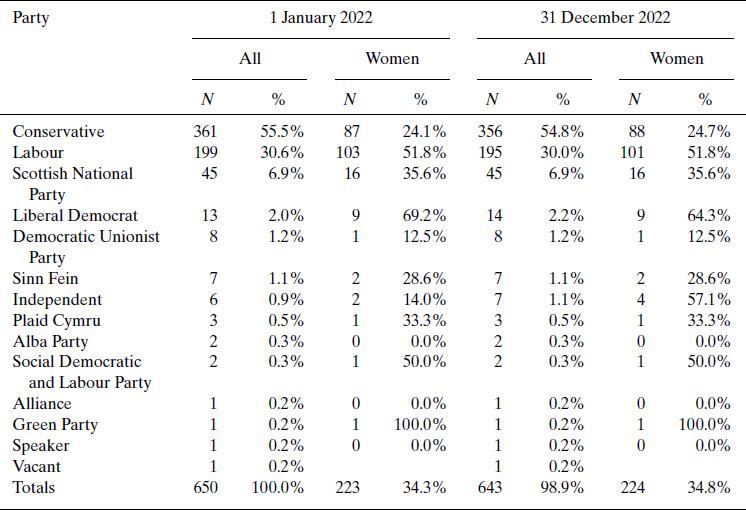
Information on the composition of the House of Commons in 2022 can be found in Table 4.
Table 4. Party and gender composition of the lower house (House of Commons) in the United Kingdom in 2022

Source: UK Parliament (2022a).
House of Lords
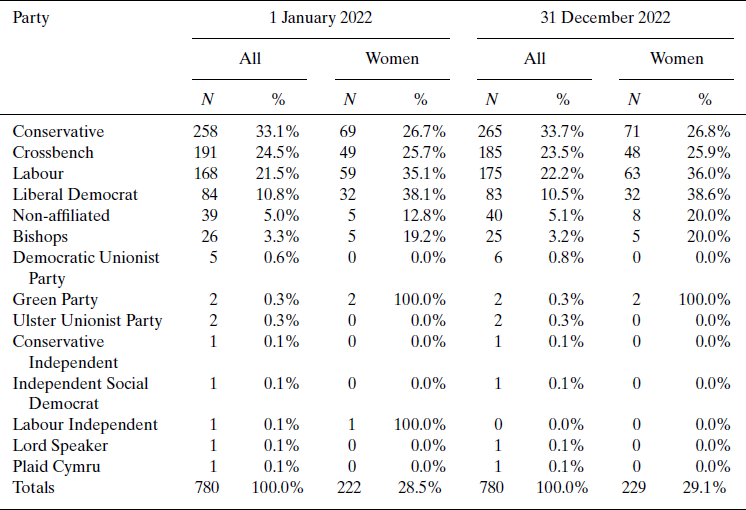
New entries to the Lords in 2022 included Nicholas Soames, who had had the Conservative whip withdrawn by Johnson in 2019 after voting against the government, former junior minister Hugo Swire, former Deputy Labour Leader Tom Watson and other former MPs including Stewart Jackson, Angie Bray, Graham Evans and Ruth Smeeth. Arlene Foster, former leader of the DUP and an important figure in Theresa May's premiership, became a non-affiliated Lord. As the year closed, both Boris Johnson and Liz Truss were due to make resignation honours lists. A summary of the composition of the House of Lords can be found in Table 5.
Table 5. Party and gender composition of the upper house (House of Lords) in the United Kingdom in 2022

Source: UK Parliament (2022b).
Political party report
From the start of the year, Conservative MPs began to submit a steady trickle of letters expressing no confidence in Boris Johnson's leadership to the 1922 Committee, which represents all Conservative backbench MPs. Many referenced Partygate and the findings of the Sue Gray report, with Steve Brine, MP for Winchester stating ‘rule-makers cannot be law-breakers’ (Brine Reference Brine2022). The threshold of 15 per cent of MPs was reached on 6 June, just days after Johnson had apparently been booed by the public at the Queen's Platinum Jubilee Thanksgiving Service. The vote was held that evening, with 41 per cent (148) of his MPs expressing no confidence, a greater proportion than the 37 per cent who voted against Theresa May in 2018. Former Conservative Leader William Hague considered Johnson's continued leadership of the party as ‘unsustainable’ (Cowburn Reference Cowburn2022). Under party rules, Johnson would be immune to leadership challenges for 12 months, although rumours abounded that changes could be made to the process.
However, the febrile environment in the Conservative Party continued, and as detailed in the Parliament report, controversy over Chris Pincher's appointment and how much Johnson had personally known about his behaviour fuelled the mass ministerial resignations of 5–7 July. Several senior Cabinet ministers also openly called for his resignation. Johnson resigned on the morning of 7 July, stating that he would remain in office until a new leader was appointed.
Johnson's resignation triggered a leadership contest, in which 11 candidates declared their intention to stand, three of whom withdrew (Sajid Javid, Rehman Chisti and Grant Shapps) before nominations closed. The remaining eight were nominated by at least 20 Conservative MPs and participated in a series of MP ballots. In the first round, Nadhim Zahawi and Jeremy Hunt were eliminated for not reaching the 30-vote threshold. Suella Braverman was eliminated in the second round before a televised debate was held on Channel 4. Tom Tugendhat was next to be eliminated, followed by another TV debate before Kemi Badenoch was eliminated from the contest. Penny Mordaunt was eliminated at the final MP ballot, leaving Rishi Sunak (137 votes) and Liz Truss (113 votes) as the top two candidates. Sunak and Truss then embarked on a series of hustings to Conservative Party members over the summer before the final vote on 5 September, where Truss was elected leader and de facto Prime Minister with 57 per cent of the party's support (Clarke & Leach Reference Clarke and Leach2022).
Just over a month later, Truss too resigned, triggering another contest. The 1922 Committee changed the rules for this contest to speed up the decision, requiring candidates to be nominated by at least 100 Conservative MPs. Although Johnson flew back from holiday and it was rumoured that he had enough nominations, Penny Mordaunt and Rishi Sunak were the only candidates to openly declare their leadership bid. With two minutes until the nomination deadline, Mordaunt withdraw, leading to Sunak automatically being elected Conservative Leader and Prime Minister.
Polling for the Conservatives showed a continuation of the decline seen at the end of 2021, and by mid-January, they were 11 points behind Labour in the polls (YouGov 2022a). After the mini-budget of September, Labour led the Conservatives by 33 percentage points (YouGov 2022b). Despite changes in Conservative policy and leadership, the year closed with the party consistently over 20 points behind in the polls (YouGov 2022c).
For the party leaders, Johnson began the year with 73 per cent believing he was doing a bad job as Prime Minister and, despite a brief 10 percentage point improvement after the war on Ukraine began, disapproval for his leadership began to once again climb until he stepped down (YouGov 2022d). Liz Truss became the least popular Prime Minister in the history of polling in the United Kingdom (Fiedler Reference Fiedler2022). Rishi Sunak entered office with a 28 per cent approval rating but ended the year with 50 per cent saying he was doing a bad job as Prime Minister (YouGov 2022e). Keir Starmer's popularity did not quite echo that of his party's poll ratings: He began the year with 52 per cent believing he was doing a bad job as Labour year, and despite enjoying a surge in popularity towards the end of Johnson's administration, he closed the year with only 36 per cent approval (YouGov 2022f).
Information on changes in political parties in 2022 can be found in Table 6.
Table 6. Changes in political parties in the United Kingdom in 2022

Source: See main text.
Institutional change report
There were no major institutional changes made in the United Kingdom in 2022.
Issues in national politics
After the war on Ukraine began in February, the UK government moved quickly to demonstrate support. Sanctions were initiated on Russia, totalling £18 billion by November (Gov.uk 2022), with long-time Chelsea owner Roman Abramovich selling the club in March as a result of those sanctions. The government also sought ways to reduce dependency on Russian oil and gas, committing to ending all imports by the end of 2022. Military support was also provided, with Ukrainian troops being trained in the United Kingdom and £2.3 billion in military aid provided. Over 100,000 Ukrainian refugees also sought sanctuary in the United Kingdom, with many hosted via the Homes for Ukraine scheme. Johnson and Sunak both visited Ukraine during the year.
The lingering economic impact of the pandemic, as well as the war on Ukraine, led to a cost of living crisis in the United Kingdom in 2022, with inflation reaching a 40-year high. The price of essential food items increased at a rate far outstripped by wage costs, and poorer households were particularly affected (Hourston Reference Hourston2023). In particular, energy prices spiralled; a windfall tax on energy companies in May led to financial support for households, and the Energy Price Guarantee, introduced by Truss, limited the average household energy cost. Nonetheless, energy prices in particular increased substantially over the year, placing more pressure on households. Interlinked with the cost of living crisis were a series of strikes by public sector workers that began in May 2022, with the National Union of Railway, Maritime and Transport Workers voting to initiate strikes on the railway network. Barristers, teachers, nurses, postal workers, ambulance workers, university staff and refuse workers, amongst others, all held strikes during the latter half of the year protesting over below-inflation pay rises and working conditions. A total of 2.472 million working days were lost between June and December 2022 (Office for National Statistics 2023), but in the post-pandemic environment, the ability for some members of the public to work from home may have insulated them from the impact. Polling showed the public was split between seeing trade unions as positive or negative, but the proportion of those viewing them positively actually increased from June onwards (YouGov 2022g).


 Open access

