

Introduction
The year 2019 was a mega‐election year due to the European Parliament (EP) election in May, Madeira regional elections and the general election in September. Throughout the year, the government was able to rely on excellent opinion polls.
Election report
Three significant elections took place during 2019: the EP election on 20 May, the Madeira regional election on 22 September and the general election on 6 October. Opinion polls predicted a victory for the Socialist Party/Partido Socialista (PS) in the EP and general elections and an excellent performance in the Madeira regional elections, traditionally a stronghold of the main opposition party Social Democratic Party/Partido Social Democrata (PSD).
European Parliament elections on 26 May 2019
In April 2019, according to the opinion polls, there was a possibility that the main opposition party PSD would be able to challenge the governing party PS in the EP elections. However, one week before the election, the gap widened in terms of electoral share between the PS and PSD, forecasting 36 per cent for the former and 28 per cent for the latter. It seems that Prime Minister Antonio Costa was able to rely on his popularity and also government performance, particularly in terms of the economy. The main candidate of the PS was Pedro Marques, the former Minister for Planning and Infrastructure who left the government in February after a major reshuffle. He was a loyal supporter of the Prime Minister and stayed in the background during the campaign. More charismatic was the main candidate of the PSD, Paulo Rangel, who already had quite a long track record as an MEP since 2009. Rangel focused on exposing the wrongdoings of the Socialist government. However, due to a quite good economic situation, the main opposition party had significant difficulties in making itself heard. The left‐wing parties the Left Block/Bloco da Esquerda (BE) and the Communist Party/Partido Comunista Português‐Partido Ecologista Os Verdes (PCP‐PEV) had difficulties in developing arguments against the Socialist government due to their parliamentary support during the legislature. The right‐centre Democratic Social Center‐People's Party/Centro Democrático‐Social‐Partido Popular (CDS‐PP) could rely on the experienced Nuno Melo, who had been MEP since 2009.
The EP election was regarded as a rehearsal for the October legislative elections, so that national themes tended to prevail. The results confirmed the forecast of the opinion polls. The Socialists won the election with 33.4 per cent and nine of the 21 seats, one more than in 2014; the PSD had a quite disappointing result of 21.9 per cent and six seats. A big winner was the Left Block, which doubled its electoral share to 9.8 per cent and two seats in comparison with 2014. In contrast, the Communists lost half their share and now had 6.9 per cent and two seats. Also, the conservative CDS‐PP proved unable to improve and won 6.2 per cent and one seat. The big surprise was the election of one MP for the Party of the People, Animals, and Nature/Partido das Pessoas, dos Animais e da Natureza (PAN), which is a green party and soon joined after the European Party of the Greens. Probably, the most negative headline was the high abstention of 69.3 per cent. Despite the win, the result of the PS was rather weak, and only possible because the PSD had done even worse.
Table 1. Elections to the European Parliament in Portugal

Notes: In 2014, the PSD and CDS‐PP formed a joint electoral list. Therefore, it is not possible to provide the ∆ in vote or seat share.
Source: MAI (2020).
The regional election to the Autonomous Region of Madeira on 22 September 2019
On 22 September 2019, elections to the autonomous region of Madeira were held. The contest was between the incumbent social‐democratic President Miguel Albuquerque and the challenger Paulo Cafôfô, an independent candidate supported by the PS and other parties. Cafôfô was previously Mayor of Funchal, the capital of the island archipelago, but he resigned that position to take part in the election. Madeira is traditionally a stronghold of the PSD and had been run by the party for the past 43 years. Cafôfô was well known in Madeira and had a chance to achieve a good result. However, opinion polls before and throughout the campaign forecast the victory of President Albuquerque, but without an absolute majority. Other parties would struggle to get regional MPs elected.
The election night confirmed the forecast by the opinion polls. President Miguel Albuquerque and his PSD got 39.4 per cent (−4.9 per cent) and 21 seats (−3), the PS 35.8 got per cent and 19 seats (2015: in a coalition with other parties, 11.4 per cent and six seats), the CDS‐PP got 5.8 per cent (−6 per cent) and 3 (−4), the citizen's list Together for the People/Juntos para o Povo (JPP) got 5.3 per cent (−4.8 per cent) and three seats (−2), the PCP‐PEV got 1.8 per cent (−3.7 per cent) and one seat (−1), and the Left Block got 1.7 per cent (−2.1 per cent). The big winner of the night was the PS, which used a polarization strategy and almost matched the result of the incumbent PSD. The PS strategy had an impact on all other left‐wing parties with the consequence that both the Communists and Left Block lost considerably, the latter even by not being represented in the regional parliament. Also, the citizen's list JPP and the conservative CDS‐PP lost considerably. After the elections, it became clear that a coalition government could happen under the leadership of the PSD and PS. In early October, the PSD formed a coalition government with the conservative CDS‐PP getting a razor‐thin majority of 24 out of 47 seats in the regional parliament.
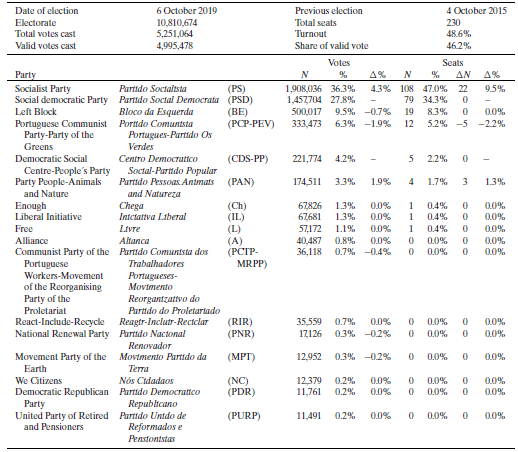
Table 2. Legislative election in Portugal on 6 October 2019

Notes: In 2015, the PSD and CDS‐PP formed a joint electoral list. Therefore, it is not possible to provide the ∆ in vote or seat share.
Source: MAI (2020).
The legislative elections of 6 October 2019
Throughout September and early October, political parties campaigned for the legislative elections scheduled for 6 October 2019. Throughout the year, opinion polls forecast a victory of the PS under Prime Minister Costa. At the beginning of September, there was even the possibility that the PS could get an absolute majority. The main opposition party was the PSD under new leader Rui Rio. After defeat in the EP elections, there was growing scepticism inside the party that he would get a good result in the legislative elections. Rio's style was too secretive, particularly in the way he drafted the electoral programme, irritating quite a lot of his colleagues. His main rival, former Prime Minister Pedro Santana Lopes, decided to leave the party and founded a new political organization, Alliance/Aliança (A) in October 2018. This had its first party conference in February 2019. Lopes presented a quite radical neo‐liberal programme.
Moreover, Rio had to deal with the growing fragmentation of the right due to the emergence of new parties led by a new generation of politicians. Among them were Liberal Initiative/Iniciativa Liberal (IL) and the populist new right party Enough!/Chega! (Ch). The popularity and policy score of Rio in terms of economic and social competences was always lower than that of the quite popular Prime Minister Costa. The excellent management of the economy by finance minister Mario Centeno was an essential reason for the strong position of the Socialists in the elections. Rio's alternative programme for government focused on lowering taxes, which had reached a high level, and undertaking necessary structural reforms in the economy. The promotion of the proposed measures to the electorate was painful because the government had been quite successful in reducing the budget deficit over the four years to 2019. Even Joaquim Miranda Sarmento, Rio's economic adviser, was cautious about reducing taxes due to the high public debt.
The Communists and Left Block had difficulties in presenting an alternative to the PS after supporting them over the four‐year legislative period. However, the Left Block wanted to become strong enough to prevent an absolute majority for the PS and be able to constructively get more of their policies implemented through agreements with a potential incoming Socialist government. Charismatic Catarina Martins was well liked in the population and hoped to get a good result. The Communists suffered considerably under the growing resistance against the party's support for Socialist policies. The PAN left an excellent impression in terms of work in the legislature. Main leader André Silva was able to enthuse the younger environmentally aware generation. Opinion polls predicted a possible entrance of new parties in Parliament, such as the three right‐wing parties Enough, Liberal Initiative and Alliance, and the left‐wing Free/Livre (L).
The results confirmed the forecast of the opinion polls. The Socialists won a moderate victory with 36.3 per cent (+4 per cent) and 108 seats (+22), while the Social democrats under Rio achieved a poor result of 27.8 per cent and 79 seats. Comparisons with the 2015 election are only partly possible because, at that time, the PSD and CDS‐PP formed a joined electoral coalition. However, the CDS‐PP also had one of its most miserable results: 4.2 per cent and five seats. Together in 2015, they had 38.4 per cent and 107 seats; in 2019, it had declined to 32 per cent and 84 seats. The main reason for this collapse in the vote is related to weak leadership in both parties, and still the negative perception of a previous government that had to conduct austerity policies during the Troika. The Socialists were able to profit immensely from this narrative, presenting themselves as an alternative, even if the two contexts cannot be compared. Despite all this, the incumbent PS minority government was only able to win 4 percentage points more than in 2015 and missed an absolute majority that had been on the cards.
The Left Block was able to repeat almost the same result as in 2015, by achieving 9.5 (−0.7 per cent) and 19 seats (no change). Apart from the PS, the big winner of the night was the Green PAN party, which increased the share of the vote threefold to 3.4 per cent and the number of seats fourfold to 4. Also quite positive is the entrance of new political parties in Parliament right‐wing populist Enough, Liberal Initiative and the left‐wing Free with one seat each.
Quite negative was the fact that the largest block of voters was the abstentionists, now reaching 51.4 per cent (+7.2 per cent) of electors who did not turn out to vote. The abstention level is a quite worrying phenomenon because it has become a permanent and increasing feature of Portuguese democracy. It leads to quite a strange result that the present single‐party minority government of Costa received just 17.6 per cent of all registered voters. Still, it was just seven seats short of an absolute majority (Fernandes & Magalhães Reference Fernandes and Magalhães2020).
After the elections, Costa decided to continue a Socialist minority government and to look for variable majorities in Parliament according to different issues.
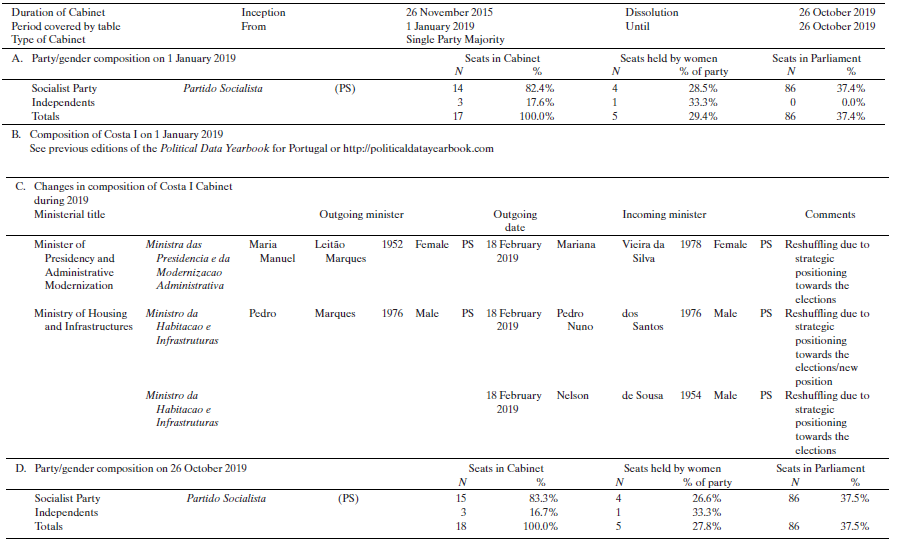
Table 3. Cabinet composition of Prime Minister Antonio Costa I in Portugal in 2019

Source: Governo de Portugal, 2020.
Cabinet report
Strategic government reshuffle on 18 February 2019: Preparing for the mega‐election year
On 18 February 2019, Prime Minister Costa reshuffled his government before the mega‐election year. Two ministers were replaced by three. The main change was the selection of Pedro Marques, Minister of Planning and Infrastructures, as head of the list of the PS for the EP elections. Until then, Marques was in charge of the implementation of the European Structural and Investment Funds. His ministry was split into two: planning, on the one hand, and housing and infrastructures, on the other. Nelson the Souza and Pedro Nuno dos Santos were rewarded with the new positions, respectively. De Souza has excellent professional experience in the industrial sector and the management of Structural and Investment Funds. He was previously Secretary of State for Cohesion and involved in similar positions in previous governments. Nuno dos Santos is a party loyalist and was already State Secretary for Parliamentary Affairs. Probably the most controversial appointment was that of Mariana Vieira da Silva as Minister of the Presidency and Modernization of Public Administration. She is the daughter of José Antonio Vieira da Silva, then Minister of Labour, Solidarity and Social Security, and a grandee of the PS. This appointment reinforced the wrong image of the party that was co‐opting family members to the government (the so‐called ‘Familygate’).
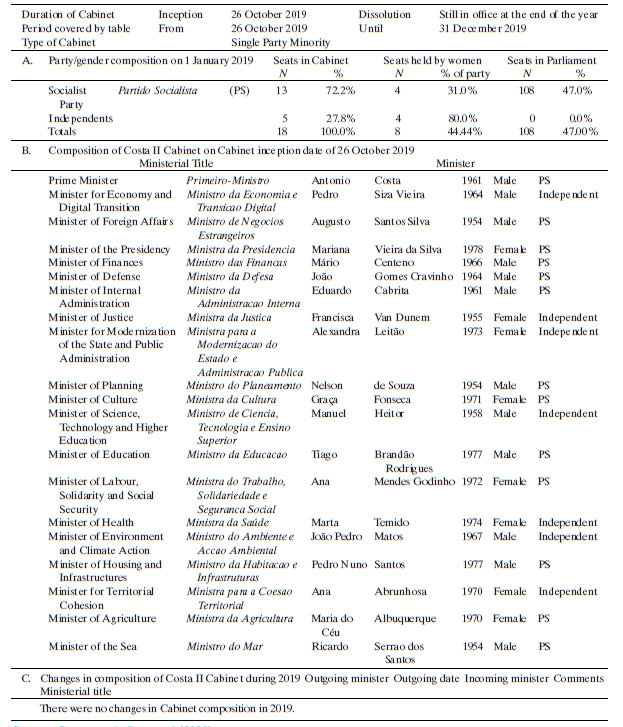
New government on 26 October 2019
After the general election, a new single‐party minority government was formed by Prime Minister Costa on 26 October 2019. The government increased from 18 to 20 members. The new government included most of the members of the previous one, but there were some changes and additions. Costa tried to form a government in which there were fewer family connections, so that he replaced one member of the same family that may be represented in the government. While he kept Mariana Vieira da Silva as Minister of the Presidency, he replaced her father, José Antonio Vieira da Silva, with Ana Mendes Godinho, who was previously Secretary of State of Tourism. A similar replacement due to Familygate happened to Ana Vitorino, Minister of the Sea, who is the wife of Eduardo Cabrita, Minister of Internal Administration. Both Vitorino and Cabrita were angry about this decision as if Vitorino were entitled to the position. She was replaced by Ricardo Serrão Santos, a scholar of oceanography from the University of Azores and MEP between 2014 and 2019. A further replacement was that of Minister of Agriculture Luis Capoulas dos Santos by former Secretary of State for Regional Development Maria do Céu Albuquerque. In the agricultural sector, this was not regarded as a very positive appointment because Albuquerque has no experience in agriculture, and it may indicate government priorities related to a more sustainable environmentally friendly agriculture. There were fears that she may not be up to the job in the ongoing negotiations of the Common Agricultural Policy (CAP) for the period 2021–27.
Two new ministries were created. Alexandra Leitão, former adjoint Secretary of State for Education, became Minister for State Reform and Administrative Modernization; and Ana Abrunhosa became Minister for Territorial Cohesion. The latter has made a career in the deconcentrated regional public administration and was President of the Coordinating Commission for Regional Development of Centre Portugal between 2014 and 2019.


Parliament report
Law on the foundations of the National Health Service
Throughout the first half of 2019, a new bill on the National Health Service was negotiated between the political parties. Despite a discussion with all political forces, in the end, just the Communists and Left Block approved the new bill in August. The new law abolished any business‐oriented management in the National Health Service, and emphasized the principle of public management. Moreover, existing and future public–private partnerships were banned from the National Health Service.
Budget negotiations 2020
After the legislative election, the political parties started to negotiate the new budget for 2020. However, a first draft was only submitted in November, and approval of the budget was scheduled for the forthcoming year.
Political party report
On the night of the general elections, Assunção Cristas, leader of the conservative CDS‐PP, resigned from her position due to the catastrophic results. A party conference was scheduled for 25–26 January 2020. The poor results also led to significant cuts in the costs of the party structure. In the last three months of the year, several young leaders were positioning themselves to succeed Cristas.
Issues in national politics
Familygate: The scandal of co‐option of family members into the government
After the appointment of Mariana Vieira da Silva as Minister for the Presidency and Administrative Modernization on 18 February 2019, further cases began to emerge of a direct link between the city council in Lisbon and appointments to the government. Prime Minister Costa was Mayor of Lisbon between 2007 and 2015. It seems he began to transfer many of his former colleagues to the government. As a result, a ‘municipalization’ of the government took place, in which 69 people from Lisbon's city administration, including civil servants and drivers, migrated to offices in the government. About 12 cases were family members appointed to different departments through cross‐relationships and cross‐appointments of people who knew each other. Probably the worst example was when the Secretary of State for Environment appointed his cousin, Armindo Santos Alves, to be his Assistant State Secretary. Both had to resign (Expresso, 6 April 2019: 6–7). An opinion of the consultative body of the State Prosecutor's Office did not find any significant wrongdoing, though it could not express itself on the individual cases. ‘Familygate’ then also expanded to tenders given to enterprises that belonged to family members who were in government. In most cases, these were indirect relationships, but there were also direct cases. There was the rule that if the member of government did not own more than 10 per cent of the firm of a particular family member, a direct tender could not be considered an infringement of the law.
The fuel lorry drivers strike of 12–19 August 2019
Prime Minister Costa had to deal with a major conflict between the new Trade Union of Lorry Drivers of Dangerous Materials (Sindicato Nacional de Motoristas de Materiais Perigosos – SNMMP), founded in 2018, and the Association of Public Railway and Merchandise Transporting Enterprises (Associação Nacional de Transportadores Publicos Rodoviários e Mercadorias – ANTRAM), which led to three strikes in April, August and September 2019. The SNMMP wanted ANTRAM to recognize the fuel lorry drivers as a professional group on their own, to get better working conditions, mainly due to the dangerous goods they were transporting, as well as better pay. Finally, a one‐year agreement was achieved in mid‐October, in which lorry drivers would get an 11.1 per cent wage increase leading on average to €1400–1600 gross salary per month. The outstanding issues would be discussed in the next agreement negotiations in 2020.
Overall, it was quite a good year for Portugal. Finance Minister Mário Centeno was able to reduce the budget deficit to 0.2 per cent and public debt to 117.7 per cent of gross domestic product (GDP).
Acknowledgments
Open access funding enabled and organized by Projekt DEAL.



 Open access

