





According to Ideal Contractualism, the requirements of justice are those principles for governing political institutions that rational, mutually disinterested persons would choose when they are deprived of knowledge about themselves that would allow them to favour their own interests over others (that is, when they are placed behind the veil of ignorance).Footnote 1 This theory faces some significant challenges when accounting for justice between generations. In this paper, we will explore how these challenges can be met.
Our first task will be to make clear just how significant these challenges are (section 1). In particular, we emphasize the following worry: because principles governing intergenerational justice are identity-affecting, the choices available to the parties seem to provide them with information about where they are in the order of generations. We go on to present a unified solution to this and the other major challenges facing the application of Ideal Contractualism to the intergenerational setting (section 2). We propose to reject the assumption that the parties conceive of their choices as causally efficacious and to assume instead that they choose in light of the news value of their decision. With this general conception of the choice-situation in hand, we explore what concrete principle would be chosen by the parties as governing intergenerational saving (section 3). We argue that if the parties can be assumed to obey ex ante Pareto sequentially, they will choose in accordance with ex post Average Utilitarianism.
1. Problems for Ideal Contractualism
In this section, we outline the significant challenges faced by Ideal Contractualism in specifying a theory of intergenerational justice.
As is well-known, there are deep difficulties associated with attempting to imagine the contract situation as representing a compact between generations, with the contracting parties corresponding to all those persons who actually exist, be they past, present, or future.Footnote 2 Because of the far-going and profound influence of political institutions, the composition and size of the total population of everyone who will ever live varies depending on what principles govern those institutions. As a result, it seems we cannot coherently conceive of the choice among principles as to be made by an assembly of all those persons who will ever exist. We cannot coherently conceive of an assembly of individuals choosing among options if the choice of some of those options would make it the case that some of them do not exist, never have existed, and never will exist.
A potential solution is to imagine that some individuals behind the veil of ignorance may represent merely possible people who will never exist.Footnote 3 Among other problems discussed in the literature, the proposal arguably goes against the core Ideal Contractualist belief that principles of justice correspond to what those who are governed by the principles would together choose for themselves, by giving a say in the design of the principles to people who are not to be governed by them.Footnote 4 Moreover, insofar as merely possible people who may never exist are to choose among options that determine whether or not they will ever exist, it seems they must do so in part by comparing whether they are better off existing as opposed to never existing at all. It is far from clear, however, that such comparisons even make sense.Footnote 5
We could instead imagine that the contracting parties know that they all belong to the same generation, although the veil of ignorance deprives them of knowledge about the identity of the particular generation to which they all belong.Footnote 6 Yet this makes it hard to see why the parties should agree to principles that require them to save anything at all on behalf of later generations, assuming that each aims to maximize their own standard of living. Given this aim, it would be best for the members of each generation to save nothing and consume everything.Footnote 7
Jane English and John Rawls attempted to solve this problem via the introduction of an additional constraint on the choice of savings principle, proposing that “the correct principle is that which the members of any generation … would adopt as the one their generation is to follow and as the principle that they would want preceding generations to have followed … no matter how far back … in time”.Footnote 8 The idea is that the parties will agree to principles that require them to save on behalf of later generations, since the parties want any preceding generations to have done the same on their behalf.
This constraint has an ad hoc quality.Footnote 9 Nor is it altogether clear what it means for a principle of saving to be one that you would want preceding generations to have followed. If you are glad to be alive, does it follow that you would want preceding generations to have followed whatever principle of saving had to have been followed in order for you to come into existence? If the contracting parties expect to be happy to be alive, does it follow that they should choose such principles? Would it follow that whatever idiosyncratic saving schedule is a necessary condition of their existence is, by that very fact, just? This result seems absurd, but it is not clear how to avoid it.
Last but not least, this proposal fails to resolve what we perceive as an especially serious problem faced by Ideal Contractualism in the intergenerational setting. If the choice of principles at any given time determines the size of the subsequent population and no one can coherently be conceived as making choices that would bring about their own non-existence, then it seems impossible to keep the members of each generation ignorant of the generation to which they belong. Unless arbitrarily restricted, the choices available to the parties will inevitably provide them with information about who they are. Unsurprisingly, this leads to some unwelcome results. The problem is especially acute when we consider the choices available to members of the first generation.
Consider the following case, representing a choice to be faced by the members of the first generation:
Case One

Going down in this case represents the choice not to save and to leave no descendants. Going up represents the choice to bring into existence a second generation and to save on their behalf so that they can enjoy a much higher standard of living than is available to members of the first generation.
Suppose that we try to put the members of ${G_1}$
behind the veil of ignorance and ask them to choose a principle governing this case.Footnote
10
They may reason as follows. We cannot coherently conceive of an assembly of individuals choosing among options if the choice of some of those options would make it the case that some of them do not exist, never have existed, and never will exist. But the members of
${G_1}$
behind the veil of ignorance and ask them to choose a principle governing this case.Footnote
10
They may reason as follows. We cannot coherently conceive of an assembly of individuals choosing among options if the choice of some of those options would make it the case that some of them do not exist, never have existed, and never will exist. But the members of ${G_2}$
(and any subsequent generations) depend for their existence on whether the parties now choose a principle that requires
${G_2}$
(and any subsequent generations) depend for their existence on whether the parties now choose a principle that requires ${G_1}$
to go up (to save) as opposed to down (to not save). Therefore, the parties know that they must be in
${G_1}$
to go up (to save) as opposed to down (to not save). Therefore, the parties know that they must be in ${G_1}$
. Insofar as each aims to maximize their own standard of living, each will prefer a principle whose implementation results in
${G_1}$
. Insofar as each aims to maximize their own standard of living, each will prefer a principle whose implementation results in ${G_1}$
going down in Case One. This choice trivially satisfies the requirement that the parties must want preceding generations to have followed the same principle, no matter how far back in time. Thus the correct principle of intergenerational saving will apparently have the first generation save nothing for posterity and leave no descendants.Footnote
11
${G_1}$
going down in Case One. This choice trivially satisfies the requirement that the parties must want preceding generations to have followed the same principle, no matter how far back in time. Thus the correct principle of intergenerational saving will apparently have the first generation save nothing for posterity and leave no descendants.Footnote
11
It may be objected that the parties behind the veil of ignorance should not be imagined as able to make choices about what generations will exist. But note that choices about how to arrange society and about how much to save for future generations will predictably have an effect on the size and composition of the future population. And, when they do, cases structured like Case One are possible.
Some may think that this issue rests simply on a failure to keep in mind the basic elements of the Ideal Contractualism framework. It may seem natural to think that Ideal Contractualism straightforwardly justifies depriving the parties of the ability to choose such a principle, precisely because its availability allows the members of ${G_1}$
to work out who they are. Its availability is therefore incompatible with the assumption that principles of justice are to be chosen from behind a veil of ignorance. If we hold fast to that assumption, it may seem that any such principle must be off the table. We find this unpersuasive. The availability of this principle does not allow the members of
${G_1}$
to work out who they are. Its availability is therefore incompatible with the assumption that principles of justice are to be chosen from behind a veil of ignorance. If we hold fast to that assumption, it may seem that any such principle must be off the table. We find this unpersuasive. The availability of this principle does not allow the members of ${G_1}$
to distinguish themselves from other existing people. After all, if it is chosen, then they are the only existing people, and we have just argued that this principle, if available, will be chosen. The veil of ignorance is intended to ensure that the parties do not have knowledge about themselves that would distinguish them from others. It is not intended to keep them from knowing something that is true of everyone who will ever live.Footnote
12
${G_1}$
to distinguish themselves from other existing people. After all, if it is chosen, then they are the only existing people, and we have just argued that this principle, if available, will be chosen. The veil of ignorance is intended to ensure that the parties do not have knowledge about themselves that would distinguish them from others. It is not intended to keep them from knowing something that is true of everyone who will ever live.Footnote
12
Others may object that this problem is illusory or irrelevant, since there has never existed a first generation.Footnote 13 The claim that a first generation never existed presumably appeals to the vagueness of the boundary between those of our remote biological ancestors to which requirements of justice do not apply and those more recent ancestors to which they do. Nevertheless, we cannot infer that no first generation existed from the fact that it is vague which generation was the first. Among theories of vagueness, both epistemicism and supervaluationism entail that we can truly say that there existed a first generation.Footnote 14 Moreover, even if there was no first generation, there could in principle have existed one, and we should want our theory of justice to be able to apply in possible worlds in which a first generation exists.Footnote 15
Finally, some have objected that the problem posed by Case One can be avoided if we assume that the individuals who occupy the Original Position are to be imagined not as actual people in a state of ignorance, but as trustees who choose on their behalf.Footnote 16 Yet, interpreting the parties as people’s trustees contradicts the contractualist tenet that “the fair terms of social cooperation are conceived as agreed to by those engaged in it”.Footnote 17 Furthermore, it does not seem to help. The parties can infer by a similar argument that they are trustees for the first generation, provided that a trustee can only represent a person if she exists and that who she represents is independent of her choice.Footnote 18 Moreover, if a trustee could represent possible people who will never exist, then the trustee would need to be able to compare whether existence is better than non-existence for that possible person. As noted, it is far from clear whether such comparisons between existence and non-existence can be made.
2. Ideal Contractualism, Meet Evidential Decision Theory
The key insight that underwrites our proposed solution is the observation that the argument presented in the foregoing discussion of Case One implicitly assumes what we call
The Causal View By virtue of their agreement to a given body of principles behind the veil of ignorance, the parties consider themselves as causally determining what principles govern their political institutions.Footnote 19
This assumption is crucial to the reasoning by which the parties were imagined as inferring that they belong to ${G_1}$
. Given this assumption, the parties can infer that the existence of people who are not in
${G_1}$
. Given this assumption, the parties can infer that the existence of people who are not in ${G_1}$
depends causally on their choice of principles. Since their own existence does not depend causally on their choice of principles, it follows that the individuals who are to choose must belong to
${G_1}$
depends causally on their choice of principles. Since their own existence does not depend causally on their choice of principles, it follows that the individuals who are to choose must belong to ${G_1}$
.
${G_1}$
.
While there may be many potential ways to block this argument, we propose to replace the Causal View with
The Evidential View By virtue of their agreement to a given body of principles behind the veil of ignorance, the parties consider themselves as gaining evidence about what principles govern their political institutions and not as causally determining what principles govern their political institutions.
If we assume, in addition, that the parties obey Evidential Decision Theory, then the evidential connection between their agreement and what principles actually inhere in society will suffice to make the individuals invested in their agreement. Roughly speaking, Evidential Decision Theory instructs you to choose the option that you would most like to learn that you will choose.Footnote 20 The main rival theory is known as Causal Decision Theory; it instructs you to choose the act that can be expected to cause the best outcome.Footnote 21 It can be the case that learning that you will make some choice is good news even if your choice is merely correlated with, but does not cause, some desirable outcome. In such cases, Evidential and Causal Decision Theory are liable to disagree.Footnote 22
Note that, behind the veil of ignorance, given the Evidential View, the choice of principles is not conceived by the parties as having any causal effect on society. The choice of principle only gives the parties evidence about what principle of justice is implemented in society. So, if the individuals follow Causal Decision Theory, they would have no preference for any principle given the Evidential View. If they follow Causal Decision Theory, the Causal View is needed for them to have any interest in the choice of principles.
Given the Evidential View, the parties cannot reason in the way described earlier. They cannot infer that they belong to ${G_1}$
from the premise that the existence of
${G_1}$
from the premise that the existence of ${G_2}$
is causally dependent on their choice, since they treat that premise as false. Furthermore, they cannot reason in an analogous fashion based on the corresponding evidential dependencies. They cannot infer that they must belong to
${G_2}$
is causally dependent on their choice, since they treat that premise as false. Furthermore, they cannot reason in an analogous fashion based on the corresponding evidential dependencies. They cannot infer that they must belong to ${G_1}$
from the premise that their choices provide them with evidence about whether or not
${G_1}$
from the premise that their choices provide them with evidence about whether or not ${G_2}$
exists but do not provide them with evidence about whether or not they themselves exist.Footnote
23
Since the ‘evidence about’ operator creates an opaque context, Leibniz’s Law cannot be applied in the standard fashion in this setting. The parties cannot reasonably infer with high confidence that they are in
${G_2}$
exists but do not provide them with evidence about whether or not they themselves exist.Footnote
23
Since the ‘evidence about’ operator creates an opaque context, Leibniz’s Law cannot be applied in the standard fashion in this setting. The parties cannot reasonably infer with high confidence that they are in ${G_1}$
unless they choose a principle whose acceptance is strong evidence that
${G_1}$
unless they choose a principle whose acceptance is strong evidence that ${G_1}$
will go down in Case One. If they instead choose a principle whose acceptance is strong evidence that
${G_1}$
will go down in Case One. If they instead choose a principle whose acceptance is strong evidence that ${G_1}$
goes up in Case One, they should consider it possible that they are in
${G_1}$
goes up in Case One, they should consider it possible that they are in ${G_2}$
. And they may well prefer to learn that they might be members of
${G_2}$
. And they may well prefer to learn that they might be members of ${G_2}$
rather than members of
${G_2}$
rather than members of ${G_1}$
, since the members of
${G_1}$
, since the members of ${G_2}$
have a standard of living much higher than that achievable by the members of
${G_2}$
have a standard of living much higher than that achievable by the members of ${G_1}$
.
${G_1}$
.
We now explain how this same approach allows us to solve the other hurdles to the intergenerational application of Ideal Contractualism that were noted in the previous section.
Consider the following problem. Suppose that the contracting parties know that they all belong to the same generation, although the veil of ignorance deprives them of knowledge about the generation to which they all belong. As noted, this can seem to make it difficult to see why the parties should agree to save anything, assuming that each aims to maximize their own standard of living.Footnote 24
This argument, however, does not go through if we assume that the parties obey Evidential Decision Theory. Even if there is nothing that you can do now to affect whether or not some desirable outcome occurs, your choice may be evidence that that desirable outcome occurs or has occurred. That choice may therefore be recommended by Evidential Decision Theory. In particular, within the framework of Ideal Contractualism, the choice of a principle requiring some positive rate of saving serves as evidence that previous generations have saved on our behalf, as we now explain.
Here is why. Since it is intended to define the contours of ideal justice, the choice situation imagined by Ideal Contractualism involves an assumption of full compliance.Footnote 25 This assumption extends across time, as well as holding within a generation. In choosing among principles, the parties assume that all persons have complied, currently comply, or will comply with whatever principles they choose. The parties do not believe that their choices causally determine the actions of past people. Rather, they treat their choice of principles as evidence that those principles define a just institutional order and assume that the principles governing their political institutions are, have been, and will be just. Therefore, even if they are purely self-interested, they have reason to choose principles that require some positive rate of saving.Footnote 26
The Evidential View, accordingly, explains why the parties should choose principles that require them to save on behalf of future generations – even given that they know they all belong to the same generation. There is an obvious affinity between the Evidential View, so applied, and Rawls’s suggestion that the parties are to choose a principle of saving that they would want previous generations to have followed. At the same time, the Evidential View serves to clarify and refine that idea so as to avoid problems with which it is otherwise beset. For example, earlier we noted that the contracting parties could well be said to want previous generations to have adhered to whatever idiosyncratic savings schedule represents a necessary condition of their own existence, whereas it is absurd to suppose that adherence to that savings schedule is, by that very fact, just. The Evidential View avoids this problem. The parties are assumed to obey Evidential Decision Theory and to choose a savings principle according to the news value of their decision. While their existence may depend causally on past people behaving in some particular way, nothing they could learn about the behaviour of past people through their choice of savings principle can raise or lower their confidence that they are currently alive, since their existence is already certain. The causal dependence of their existence on some particular schedule of past savings behaviour is irrelevant to their decision and drops out of consideration, as desired.
The Evidential View also undermines the motivation for rejecting the idea of a contract between generations in the first place. As set out in the previous section, that rejection was motivated by the thought that the composition and size of the total population of everyone who will ever live varies depending on what principles govern a society’s political institutions, whereas we cannot coherently conceive of an assembly of persons choosing among a set of principles if adoption of some of those principles would result in some of those people having never existed in the first place. As should be clear at this point, the Evidential View does away with that problem and allows us to make sense of the the contract situation as representing a contract between generations, with the contracting parties corresponding to all those persons who actually exist, be they past, present, or future. Their choices do not causally affect what principles govern their shared institutions, and therefore cannot change the size and composition of the population of everyone who will ever live. Their choices can provide them with evidence about the size and composition of the total population of everyone who will ever live, but that is no obstacle to the assumption that the choosing parties together represent that very population.
3. What Principle Would the Parties Choose?
Given that we adopt the Evidential View, what principles of justice can the parties be expected to choose? In order to answer this question, it is necessary to make more detailed assumptions about the decision theory that describes the contracting parties.Footnote 27
The Ideal Contractualism tradition contains varying assumptions on this point. In the intragenerational setting, Rawls argues that the parties decide in accordance with the non-probabilistic Maximin rule. Harsanyi argues that the parties will obey the Laplace Criterion, which uses a uniform probability distribution. The depth of their disagreement is unclear, however. Harsanyi seems concerned with fundamental questions about rational decision making under uncertainty, whereas for Rawls’ Maximin is merely a plausible “rule of thumb” appropriate under specific conditions.Footnote 28 These include the assumption that each decision maker “cares very little, if anything, for what he might gain above the minimum stipend that he can, in fact, be sure of by following the maximin rule”.Footnote 29 Under the specific assumptions Rawls adopts, it is very plausible that the recommendations of the Laplace Criterion coincide with those of Maximin, as Rawls acknowledges.Footnote 30 Rawls rejects utilitarianism considered as the public charter on the basis of which the basic structure is to be organized.Footnote 31 Harsanyi’s concerns are more fundamental, even meta-ethical, encompassing what it means to make a moral judgement or express a moral preference.
Notably, Rawls does not recommend Maximin as a decision rule for choosing the intergenerational rate of saving.Footnote 32 He seems thereby to concede that the particular conditions that justify Maximin as a rule of thumb fail to hold in this context. But he suggests nothing to replace it. We shall assume that the parties’ decisions coincide with those that would be recommended in light of subjective expected utility theory – in its evidential guise, of course.Footnote 33
Given this approach, the principle to be chosen by the parties will depend on how they asses the probability of belonging to generations that might possibly exist but whose existence cannot be guaranteed by the predictor’s implementation of the chosen principles. The existence of these generations may depend, in addition, on one or more chance events. For instance, consider
Case Two

For simplicity, we assume that the generations in our examples are all the same size. In this case, how should the individuals assess the option of saving?
A first idea is to retain probabilistic impartiality between the generations and to regard it equally likely that one is in ${G_1}$
as that one is in
${G_1}$
as that one is in ${G_2}$
. Since the individuals know that they exist, we shouldn’t focus on expected well-being in variable-population cases behind the veil of ignorance but instead on conditional expected well-being. Let the conditional expected well-being of a person
${G_2}$
. Since the individuals know that they exist, we shouldn’t focus on expected well-being in variable-population cases behind the veil of ignorance but instead on conditional expected well-being. Let the conditional expected well-being of a person $S$
from a prospect
$S$
from a prospect $X$
be equal to
$X$
be equal to $S$
’s expectation from
$S$
’s expectation from $X$
given that
$X$
given that $S$
exists.Footnote
34
Then the average conditional expected well-being from saving is
$S$
exists.Footnote
34
Then the average conditional expected well-being from saving is $\left( {\left( {1 + 1} \right)/2 + 13} \right)/2 = 7$
, which is better than the average conditional expected well-being from not saving – that is,
$\left( {\left( {1 + 1} \right)/2 + 13} \right)/2 = 7$
, which is better than the average conditional expected well-being from not saving – that is, $5$
.
$5$
.
A second idea is to regard the potential positions one might occupy in society as equally likely: ${G_1}$
given that chance goes up,
${G_1}$
given that chance goes up, ${G_2}$
given that chance goes up, and
${G_2}$
given that chance goes up, and ${G_1}$
given that chance goes down. Taking these mutually exclusive and jointly exhaustive positions as equally likely, we get that the expected well-being of saving for the individuals is
${G_1}$
given that chance goes down. Taking these mutually exclusive and jointly exhaustive positions as equally likely, we get that the expected well-being of saving for the individuals is $\left( {1 + 13 + 1} \right)/3 = 5$
, which is the same as the expected well-being of not saving.Footnote
35
$\left( {1 + 13 + 1} \right)/3 = 5$
, which is the same as the expected well-being of not saving.Footnote
35
A third idea is that it’s equally likely that chance goes up or down and, if chance goes up, it’s equally likely that one is in ${G_1}$
or in
${G_1}$
or in ${G_2}$
. According to this line of thinking, the individuals’ expectations from saving is
${G_2}$
. According to this line of thinking, the individuals’ expectations from saving is $\left( {\left( {\left( {1 + 13} \right)/2} \right) + 1} \right)/2 = 4$
, which is worse than their expectation from not saving, which is
$\left( {\left( {\left( {1 + 13} \right)/2} \right) + 1} \right)/2 = 4$
, which is worse than their expectation from not saving, which is $5$
.Footnote
36
$5$
.Footnote
36
Hence we get that saving in Case Two might be better than, worse than, or equally good as not saving depending on how we should assess uncertain prospects where some generations only have some chance of existing. Let us now assess the plausibility of these three alternative ideas.
Conditional Ex Ante Average Utilitarianism
The first idea, of retaining probabilistic impartiality between the generations by relying on conditional expected well-being, leads to
Conditional Ex Ante Average Utilitarianism A prospect $x$
is choice-worthy if and only if there is no feasible prospect
$x$
is choice-worthy if and only if there is no feasible prospect $y$
such that
$y$
such that ${V_{CEAAU}}\left( y \right)\gt {V_{CEAAU}}\left( x \right),$
where ${V_{CEAAU}}\left( x \right){ = _{{\rm{df}}}}$
the average conditional expected well-being for possible people in
${V_{CEAAU}}\left( x \right){ = _{{\rm{df}}}}$
the average conditional expected well-being for possible people in $x$
.
$x$
.
Notably, this principle leads to an extreme form of longtermism:Footnote 37 any future lives with positive probability (however small) count the same as any current lives and any certain life. There are many more possible people that we may bring about with some probability in the far future than in the near future. Given the enormous amount of possible people that have some chance of existing in the far future, this principle will give an enormous proportional weight to the long-term. Not only will the future matter more than the near future, it will matter in a strange way. Since the probability of a life is not taken into account, it will not be important to merely reduce the probability of bad lives or increase the probability of good lives. What matters is whether you can affect whether these lives would still be possible.
Even though Conditional Ex Ante Average Utilitarianism has some counter-intuitive implications, it might still makes sense from the perspective of the parties behind the veil of ignorance (given the Evidential View). Would they opt for this principle? It seems that they would not. Conditional Ex Ante Average Utilitarianism gives rise to significant problems in sequential cases. It violates the following principle:Footnote 38
The Weak Sequential Statewise Pareto Principle If $S$
and
$S$
and $S{\rm{'}}$
are two plans such that the same people exist in the outcomes of these plans and, in each state of nature, everyone has a higher well-being in the outcome of
$S{\rm{'}}$
are two plans such that the same people exist in the outcomes of these plans and, in each state of nature, everyone has a higher well-being in the outcome of $S$
than in the outcome of
$S$
than in the outcome of $S{\rm{'}}$
, then
$S{\rm{'}}$
, then $S{\rm{'}}$
is not followed if
$S{\rm{'}}$
is not followed if $S$
available.
$S$
available.
Consider
Case Three

At node 2, the conditional ex ante average is $\left( {7 + 1} \right)/2 = 4$
if we go up and
$\left( {7 + 1} \right)/2 = 4$
if we go up and $3$
if we go down. Accordingly, Conditional Ex Ante Average Utilitarianism would go up at node 2. Taking that into account at node 1, the conditional ex ante average is
$3$
if we go down. Accordingly, Conditional Ex Ante Average Utilitarianism would go up at node 2. Taking that into account at node 1, the conditional ex ante average is $\left( {\left( {7 + 11} \right)/2 + 1} \right)/2 = 5$
if we go up and
$\left( {\left( {7 + 11} \right)/2 + 1} \right)/2 = 5$
if we go up and $\left( {2 + 10} \right)/2 = 6$
if we go down. So Conditional Ex Ante Average Utilitarianism (using backward induction) would go down at node 1. This violates the Weak Sequential Statewise Pareto Principle. To see this, consider the following table of what happens if we follow the plan recommended by Conditional Ex Ante Average Utilitarianism and the plan consisting in doing the opposite of its recommendations:
$\left( {2 + 10} \right)/2 = 6$
if we go down. So Conditional Ex Ante Average Utilitarianism (using backward induction) would go down at node 1. This violates the Weak Sequential Statewise Pareto Principle. To see this, consider the following table of what happens if we follow the plan recommended by Conditional Ex Ante Average Utilitarianism and the plan consisting in doing the opposite of its recommendations:

Regardless of whether $E$
happens, it holds that the plan consisting in going up at node 1 and down at node 2 gives
$E$
happens, it holds that the plan consisting in going up at node 1 and down at node 2 gives ${G_1}$
a higher well-being than the plan down at node 1 and that
${G_1}$
a higher well-being than the plan down at node 1 and that ${G_2}$
will not exist.
${G_2}$
will not exist.
Veiled Average Utilitarianism
The second idea, taking the potential positions one might be in society as equally likely, leads to the following principle:Footnote 39
Veiled Average Utilitarianism A prospect $x$
is choice-worthy if and only if there is no feasible prospect
$x$
is choice-worthy if and only if there is no feasible prospect $y$
such that
$y$
such that ${V_{VAU}}\left( y \right)\gt {V_{VAU}}\left( x \right)$
,
${V_{VAU}}\left( y \right)\gt {V_{VAU}}\left( x \right)$
,
where ${V_{VAU}}\left( x \right){ = _{{\rm{df}}}}$
the expected total well-being in
${V_{VAU}}\left( x \right){ = _{{\rm{df}}}}$
the expected total well-being in $x$
divided by the expected population size in
$x$
divided by the expected population size in $x$
.
$x$
.
This principle avoids the extreme weight that Conditional Ex Ante Average Utilitarianism put on very unlikely future people. It will still support the conclusion that the far future matters much more than the near-term, given at least a moderate probability that there a lot more people in the future than there will be in the short term.
Would the parties behind the Evidential Veil opt for Veiled Average Utilitarianism? It seems that they would not. Veiled Average Utilitarianism violates, even in non-sequential cases,
The Conditional Ex Ante Pareto Principle If the same people possibly exists in prospects $x$
and
$x$
and $y$
and each one of them has a higher conditional expected well-being in
$y$
and each one of them has a higher conditional expected well-being in $x$
than in
$x$
than in $y$
, then
$y$
, then $y$
is not chosen if
$y$
is not chosen if $x$
could be chosen instead.
$x$
could be chosen instead.
Consider, for instance,
Case Four

If we go up, the expected total divided by expected size is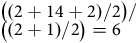 $\left( {\left( {2 + 14 + 2} \right)/2} \right)/\left( {\left( {2 + 1} \right)/2} \right) = 6$
, and, if we go down, it is
$\left( {\left( {2 + 14 + 2} \right)/2} \right)/\left( {\left( {2 + 1} \right)/2} \right) = 6$
, and, if we go down, it is $\left( {1 + 13} \right)/2 = 7$
. Hence Veiled Average Utilitarianism would go down. But this violates the Conditional Ex Ante Pareto Principle, since going up gives everyone a greater conditional expectation than going down.
$\left( {1 + 13} \right)/2 = 7$
. Hence Veiled Average Utilitarianism would go down. But this violates the Conditional Ex Ante Pareto Principle, since going up gives everyone a greater conditional expectation than going down.
Conditional expectations in Case Four

So each generation is doing worse, conditional on their existence, if Veiled Average Utilitarianism is followed.Footnote 40
Veiled Average Utilitarianism also violates the Weak Sequential Statewise Pareto Principle. To see this, consider
Case Five

At node 2, the expected total divided by expected size is $\left( {2 + 4} \right)/2 = 3$
if we go up and
$\left( {2 + 4} \right)/2 = 3$
if we go up and $2$
if we go down. So Veiled Average Utilitarianism would go up at node 2. Taking this into account at node 1, the expected total divided by expected size is
$2$
if we go down. So Veiled Average Utilitarianism would go up at node 2. Taking this into account at node 1, the expected total divided by expected size is $\left( {\left( {2 + 4 + 18} \right)/2} \right)/\left( {\left( {2 + 1} \right)/2} \right) = 8$
if we go up and
$\left( {\left( {2 + 4 + 18} \right)/2} \right)/\left( {\left( {2 + 1} \right)/2} \right) = 8$
if we go up and $\left( {1 + 17} \right)/2 = 9$
if we go down. Therefore, Veiled Average Utilitarianism (using backward induction) goes down at node 1. This violates the Weak Sequential Statewise Pareto Principle. To see this, consider the following table of what happens if we follow the plan recommended by Veiled Average Utilitarianism and the plan consisting in doing the opposite of its recommendations:
$\left( {1 + 17} \right)/2 = 9$
if we go down. Therefore, Veiled Average Utilitarianism (using backward induction) goes down at node 1. This violates the Weak Sequential Statewise Pareto Principle. To see this, consider the following table of what happens if we follow the plan recommended by Veiled Average Utilitarianism and the plan consisting in doing the opposite of its recommendations:

Regardless of whether $E$
happens, it holds that the plan consisting in going up at node 1 and down at node 2 gives
$E$
happens, it holds that the plan consisting in going up at node 1 and down at node 2 gives ${G_1}$
a higher well-being than the plan down at node 1 and that
${G_1}$
a higher well-being than the plan down at node 1 and that ${G_2}$
will not exist.
${G_2}$
will not exist.
Ex Post Average Utilitarianism
Finally, the third idea – to accept the probabilities of the chance events and, for each final outcome, to regard it as equally likely that one belongs to each of the generations in that outcome – leads to the principle
Ex Post Average Utilitarianism A prospect $x$
is choice-worthy if and only if there is no feasible prospect
$x$
is choice-worthy if and only if there is no feasible prospect $y$
such that
$y$
such that ${V_{EPAU}}\left( y \right)\gt {V_{EPAU}}\left( x \right)$
,
${V_{EPAU}}\left( y \right)\gt {V_{EPAU}}\left( x \right)$
,
where ${V_{EPAU}}\left( x \right){ = _{{\rm{df}}}}$
the expected average well-being in
${V_{EPAU}}\left( x \right){ = _{{\rm{df}}}}$
the expected average well-being in $x$
.
$x$
.
Is this the principle we are looking for? Like Veiled Average Utilitarianism, it violates The Conditional Ex Ante Pareto Principle. To see this, consider
Case Six

If we go up in Case Six, the expected average well-being is $\left( {1 + 9} \right)/2 = 5$
and, if we go down it is
$\left( {1 + 9} \right)/2 = 5$
and, if we go down it is $\left( {6 + 2} \right)/2 = 4$
. Accordingly, Ex Post Average Utilitarianism would go up.
$\left( {6 + 2} \right)/2 = 4$
. Accordingly, Ex Post Average Utilitarianism would go up.
Conditional expectations in Case Six

We have that Ex Post Average Utilitarianism violates Conditional Ex Ante Pareto, since going down gives everyone a higher conditional expectation than going up. But, unlike the reasoning that led to Conditional Ex Ante Average Utilitarianism, the reasoning that led to the Ex Post Average Utilitarianism does not attach any importance to conditional expectations. There seems to be little reason to care about this kind of dominance in conditional expected well-being if you do not think that you are equally likely to be anyone in a prospect.Footnote
41
In Case Six, you should think that it is more likely that you belong to ${G_1}$
if we go up than if we go down at the choice node. So the parties need not care about violations of the Conditional Ex Ante Pareto Principle.
${G_1}$
if we go up than if we go down at the choice node. So the parties need not care about violations of the Conditional Ex Ante Pareto Principle.
And, unlike the earlier principles, Ex Post Average Utilitarianism does not violate Sequential Statewise Pareto. Hence, of the three approaches, Ex Post Average Utilitarianism emerges as the only plausible choice.
4. Conclusion
Ideal Contractualism faces a number of significant challenges when applied to questions of intergenerational justice. These problems, however, can be solved by rejecting the Causal View and endorsing the Evidential View in its stead.
In addition, we have shown that it is possible to make significant progress in determining what particular principles the parties will endorse by reasoning about dynamic decision problems and assuming that the parties obey Ex Ante Pareto sequentially. This leads us to expect that the parties will choose in accordance with Ex Post Average Utilitarianism.
Average Utilitarianism is often dismissed due to a number of supposedly fatal objections.Footnote 42 These objections are based on intuitive ethical judgements. To count against Average Utilitarianism given Ideal Contractualism, these judgements must move the parties behind the evidential veil who are only concerned with securing their individual ends. But, behind the evidential veil, the parties will have good reasons, as we have seen, to disregard any considerations that conflicts with Ex Post Average Utilitarianism – and, more generally, the parties are unmoved by any ethical considerations as they just aim to secure their own ends. Yet there remains the worry that, even if these objections do not work if they are considered from within the framework of Ideal Contractualism, they may still be compelling objections to the whole of Ideal Contractualism.
Appendix: Evidential and Causal Decision Theory
We can formalize Evidential and Causal Decision Theory in terms of expected utility theory in accordance with the framework proposed by David Lewis.Footnote
43
Let $S$
be the set of possible worlds. Let a
$S$
be the set of possible worlds. Let a $K$
-partition of
$K$
-partition of $S$
be a partition such that each
$S$
be a partition such that each $k \in K$
fully specifies the causal dependence of each possible outcome on each available act. Then, if
$k \in K$
fully specifies the causal dependence of each possible outcome on each available act. Then, if $\left\{ {{k_1},{k_2}, \ldots, {k_m}} \right\}$
is a
$\left\{ {{k_1},{k_2}, \ldots, {k_m}} \right\}$
is a $K$
-partition of
$K$
-partition of $S$
,
$S$
, $P\left( \cdot \right)$
is the agent’s rational credence function, and
$P\left( \cdot \right)$
is the agent’s rational credence function, and $u\left( \cdot \right)$
is her utility function, then an available act
$u\left( \cdot \right)$
is her utility function, then an available act $a$
is rationally permissible according to Evidential Decision Theory if and only if there is no available act
$a$
is rationally permissible according to Evidential Decision Theory if and only if there is no available act $a{\rm{'}}$
such that
$a{\rm{'}}$
such that
 $$\mathop \sum \limits_{i = 1}^m P({k_i}|a)u\left( {{k_i} \wedge a} \right) \lt \mathop \sum \limits_{i = 1}^m P({k_i}|a{\rm{'}})u\left( {{k_i} \wedge a{\rm{'}}} \right)$$
By contrast, an available act $a$
is rationally permissible according to Causal Decision Theory if and only if there is no available act
$a$
is rationally permissible according to Causal Decision Theory if and only if there is no available act $a{\rm{'}}$
such that
$a{\rm{'}}$
such that
 $$\mathop \sum \limits_{i = 1}^m P\left( {{k_i}} \right)u\left( {{k_i} \wedge a} \right) \lt \mathop \sum \limits_{i = 1}^m P\left( {{k_i}} \right)u\left( {{k_i} \wedge a{\rm{'}}} \right)$$
In other words, Causal Decision Theory asks us to compute expected utilities using the unconditional prior probabilities of each $k \in K$
, whereas Evidential Decision Theory asks us to compute expected utilities using the corresponding conditional probabilities.
$k \in K$
, whereas Evidential Decision Theory asks us to compute expected utilities using the corresponding conditional probabilities.
We emphasize that the distinction between Evidential and Causal Decision Theory has more general significance and need not assume that agents maximize expected utility relative to a unique subjective probability function, which may be unacceptable to Rawlsians. In particular, consider agents whose beliefs are modelled not by a single probability function, but by a set of probability functions (a so-called representor), corresponding to the different chance hypotheses left open by her evidence.Footnote 44 Many different decision principles for agents whose beliefs are so-represented have been proposed.Footnote 45 But virtually all of these principles entail that the agent’s preferences over acts depend on the expected utility of the available acts with respect to the elements of the representor. In computing the expected utilities of the available acts relative to any element of the representor, a decision may then be faced as to whether to compute the evidentiary expected utility or the causal expected utility.
Consider, in particular, an agent who acts in accordance with the Maximin-Expected-Utility Principle, which instructs her to choose the option with the greatest minimum expected utility relative to the probability functions in her representor.Footnote
46
This principle should be of especial interest to Rawlsians, since it reduces to Maximin in the case where the agent’s beliefs, as represented by sets of probabilities, are maximally spread out for each state. Note, then, that in order to compute the minimum expected utility of a given action, we can use either the evidential expected utility, such that the Maximin-Expected-Utility Principle is given by the rule that an act $a \in A$
is rationally permissible if and only if there is no
$a \in A$
is rationally permissible if and only if there is no $a{\rm{'}}$
such that
$a{\rm{'}}$
such that
 $$\mathop {{\rm{min}}}\limits_{P\left( \cdot \right) \in R} \left( {\mathop \sum \limits_{i = 1}^m P({k_i}|a)u\left( {{k_i} \wedge a} \right)} \right) \lt \mathop {{\rm{min}}}\limits_{P\left( \cdot \right) \in R} \left( {\mathop \sum \limits_{i = 1}^m P({k_i}|a{\rm{'}})u\left( {{k_i} \wedge a{\rm{'}}} \right)} \right)$$
or the causal expected utility, where it is given by the rule that act $a \in A$
is rationally permissible if and only if there is no
$a \in A$
is rationally permissible if and only if there is no $a{\rm{'}}$
such that
$a{\rm{'}}$
such that
 $$\mathop {{\rm{min}}}\limits_{P\left( \cdot \right) \in R} \left( {\mathop \sum \limits_{i = 1}^m P\left( {{k_i}} \right)u\left( {{k_i} \wedge a} \right)} \right) \lt \mathop {{\rm{min}}}\limits_{P\left( \cdot \right) \in R} \left( {\mathop \sum \limits_{i = 1}^m P\left( {{k_i}} \right)u\left( {{k_i} \wedge a{\rm{'}}} \right)} \right).$$
Johan E. Gustafsson is a research scientist at the University of Texas at Austin. He is the author of the book Money-Pump Arguments and works on decision theory, ethics, political philosophy and metaphysics. Email: johan.eric.gustafsson@gmail.com. URL: https://johanegustafsson.net.
Andreas L. Mogensen is a senior research fellow in the Faculty of Philosophy at the University of Oxford. He has published on issues such as the demands of beneficence, decision-making under deep uncertainty, population ethics, and discounting in the context of climate policy, with publications appearing in journals including Noûs, Philosophy and Phenomenological Research, The Journal of Philosophy and Philosophical Studies. URL: https://andreasmogensen.com/.


 Open access

