


Introduction
Czech politics in 2019 may be characterized by ongoing scandals and investigations into Prime Minister Andrej Babiš (ANO 2011/ANO 2011 – ANO), massive protests organized by the ‘Million Moments for Democracy’ movement and a deepening crisis for the Czech Social Democrats Party/Česká strana sociálně demokratická (ČSSD).
Except for a Senate by‐election, there were only European Parliament (EP) elections, which traditionally attract less than one‐fifth of the Czech electorate. Although the leading government party (ANO) gained the highest share of votes in the EP elections, their results were about 10 percentage points below the long‐term election models of most Czech survey agencies. The EP elections confirmed the ongoing agony of the ČSSD, which was suffering from internal conflicts, a weak leader and insufficient publicity for their work in government. The position of the ČSSD was weakened further by the ongoing pragmatic pact between President Miloš Zeman and Prime Minister Andrej Babiš.
Unfavourable results from a European Commission audit regarding the Prime Minister's conflicts of interest, as well as the abrupt dismissal of the Minister of Justice, resulted in a series of protests over the whole country. However, the demand for the Prime Minister's resignation was not fulfilled, and the Prime Minister's party, the ANO, maintained stable public support.
Election report
There were EP elections and a Senate by‐election in 2019 (Table 1).
European Parliament elections
Despite lacking strong mobilizing topics during the campaign, these elections gathered relatively high interest in terms of voter turnout. A record number of 39 political parties and movements entered the elections. The turnout reached 28.7%, which was the highest turnout when compared with the previous three European elections (a remarkable rise from 18.2% in 2014).
Prime Minister Babiš started the ANO campaign wearing a red baseball cap with the slogan ‘Strong Czechia’ (evidently inspired by Donald Trump's MAGA cap). The ANO campaigned similarly to the Civic Democrats (ODS), aiming at strengthening the Czech position within the European Union (EU). The Social Democrats and Communists (Communist Party of Bohemia and Moravia/Komunistická strana Čech a Moravy – KSČM) tried to highlight social issues and strengthening welfare policies. The ČSSD, as well as the Christian Democratic Union–Czechoslovak People's Party/Křesťanská a demokratická unie‐Československá strana lidová (KDU‐ČSL), mentioned the acute housing crisis. Tradition, Responsibility, Prosperity/Tradice Odpovědnost Prosperita (TOP09) made an effort to discuss accepting the euro, encourage regional development and, like the Czech Pirate Party/Česká pirátská strana (Piráti) and KDU‐ČSL, focus on topics related to environmental protection. Using anti‐immigration narratives, the Freedom and Direct Democracy – Tomio Okamura/Svoboda a přímá demokracie – Tomio Okamura (SPD) explicitly called for a referendum on the exit of the Czech Republic from the EU (referred to as Czexit). Overall, the most notable topic of the 2019 campaign was the issue of double standards for food quality.
Six political parties and one two‐party coalition crossed the 5% (10% for coalitions) threshold and entered the EP. The clear winner of these elections was the ANO. Despite the problems with their party leader and Cabinet changes, the ANO managed to reach the highest share of votes (21.2%) and six seats in the EP. The ODS, with their 14.5% of votes and three seats, came second. The ODS expressed satisfaction with the result because the party was still recovering from their crisis caused by scandals under Prime Minister Petr Nečas (ODS), and the EP elections demonstrated an ongoing trend of improving election performances. Piráti came third (14%), securing three seats in the EP and confirming their strong position among opposition political parties. Fourth place was taken by a coalition of the Mayors and Independents/Starostové a nezávislí (STAN) and TOP09 (11.7%), who lost one seat in the EP and almost did not pass the 10% threshold for two‐party coalitions. The SPD, with 9.1% of votes, came in fifth, giving them two seats in the EP. Sixth was the KSČM (6.9%) who lost two seats since the last EP elections, resulting in only one MEP. These EP elections were tragic for the social democrats, who lost all four of their seats. The loss may be attributed to their performance in government, internal party issues and an inability to attract their traditional older electorate which they lost to the ANO.
Senate by‐election
Zuzana Baudyšová (1948, female, ANO) stepped down from her Senate mandate in the Prague 9 constituency at the end of January. She had held the mandate since the 2014 regular Senate elections but resigned from her seat due to health‐related issues. A two round by‐election was held in the first half of April. In the second round, David Smoljak (1959, male), an independent candidate nominated by STAN, got elected by a 19 percentage point margin over Jan Jarolím (1946, male, ODS) winner of the first round and nominee of an electoral coalition of the KDU‐ČSL and ODS.
Cabinet report
In 2019, the functioning of Babiš’s government was affected mainly by the ongoing police investigation of the Prime Minister regarding EU subsidy fraud, the weakening position of the ČSSD, and a series of protests against Babiš and some of his changes in the Cabinet (discussed in the ‘Issues in national politics’ section). Babiš’s position in minority government remained relatively stable due to the president's support, as well as the internal problems of their coalition partner, the Social Democrats. They struggled to make changes in their ministers, and for several weeks they were unable to decide whether to remain in the government or terminate the coalition agreement.
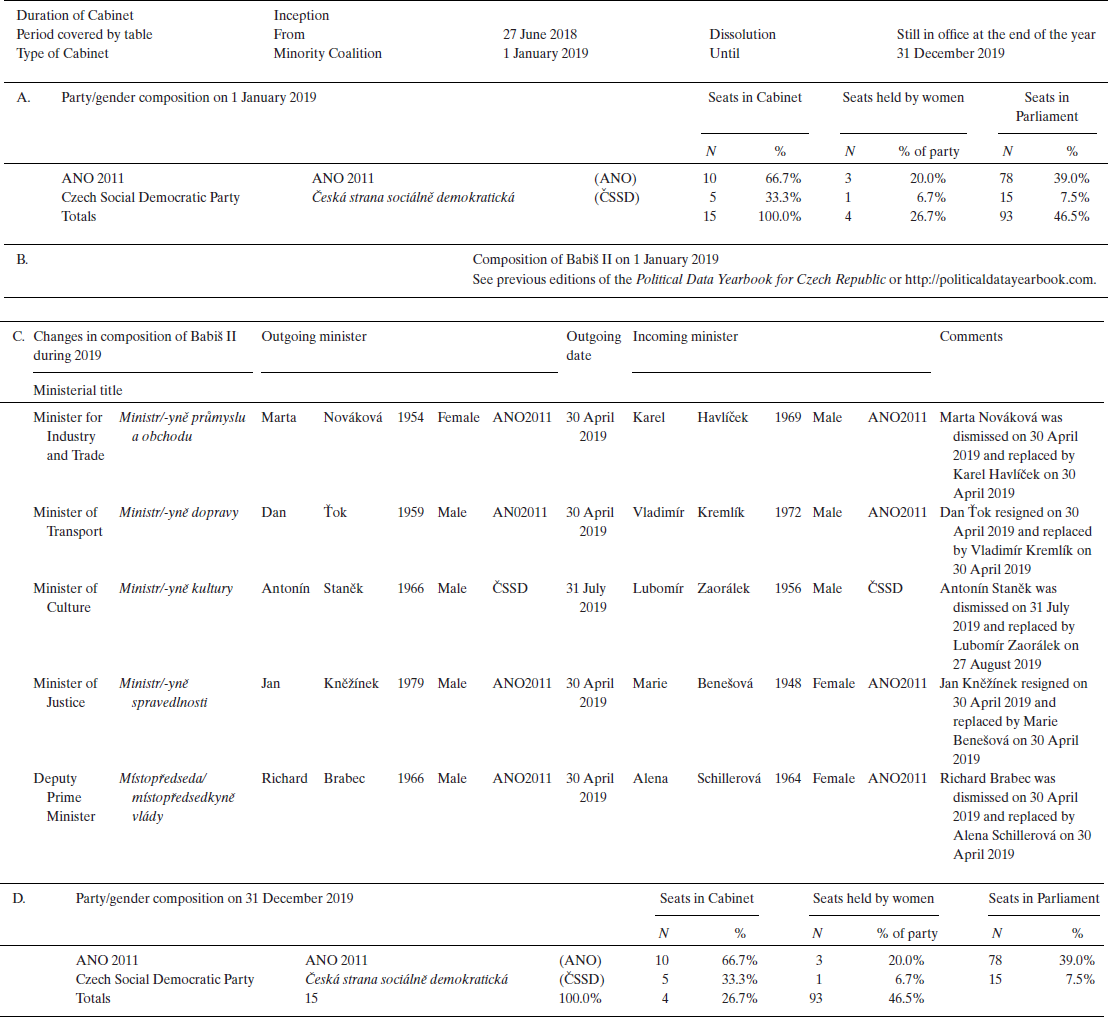
There were four changes in Babiš’s Cabinet in 2019 (Table 2). The first took place on 30 April 2019 and involved only members of the Prime Minister's party (ANO). The timing (a month before the EP elections) and selection of candidates to be changed hint at Babiš’s intention to sacrifice three Cabinet members for better results in the upcoming elections. Ministers were not removed because of any scandal, unlike those replaced in 2018 (Petrusek, Kudrnac Reference Petrúšek and Kudrnáč2019), but they were perceived as performing poorly.
Specifically, Marta Nováková (ANO), Minister for Industry and Trade, was replaced by Karel Havlíček (ANO). Nováková made some unfortunate statements and actions that undermined her competence in the eyes of the public. She had defended telecommunication companies’ high prices by stating that the reason for expensive mobile data was people using too much free wi‐fi. Additionally, it was revealed that a Taiwanese representative was forced to leave a diplomatic meeting at the Ministry for Industry and Trade on the Chinese ambassador's request. These scandals resulted in Nováková being replaced by Havlíček, who also became one of the three Deputy Prime Ministers.
Minister of Transport Dan Ťok (ANO) resigned due to severe criticism of the long‐lasting road repairs on the most important highway in the country, the D1. Ťok was replaced by Vladimír Kremlík (ANO). Ťok decided to leave politics entirely and also resigned from his mandate as an MP.
The most discussed change in Babiš’s Cabinet was the resignation of Minister of Justice Jan Kněžínek (ANO). Prime Minister Babiš had been prosecuted for EU subsidy fraud regarding his Stork's Nest project, and his critics suspected that the change at the Ministry of Justice was made due to progress in the investigation. These suspicions were fuelled by the resignation of Jan Kněžínek being announced a day after police investigators proposed charges against the Prime Minister for EU subsidy fraud. Furthermore, Kněžínek was replaced by Marie Benešová (ANO since 2019, previously a member of the ČSSD) who had been at that time Miloš Zeman's judiciary advisor. The appointment of Benešová as Minister of Justice resulted in massive protests organized by the movement Million Moments for Democracy.
Additionally, Richard Brabec (ANO) was replaced by Minister of Finance Alena Schillerrová (ANO) as Deputy Prime Minister.
The last change in Babiš’s Cabinet during 2019 was controversial because of the president's actions, which were described by several expert lawyers as unconstitutional (e.g., Aktuálně 2019; Respekt 2019; Lidovky 2019). In May, the head of the ČSSD, Jan Hamáček, announced the decision to dismiss Minister of Culture Antonín Staněk (ČSSD) for the supposedly unjustified firing of two directors of state‐run art galleries. Although Staněk resigned, he also publicly announced that he did not agree with the decision and that the resignation was solely made at the request of ČSSD's leader Hamáček. President Zeman, who is legally obliged to accept the resignation and appoint a new minister upon the Prime Minister's request, refused to accept Staněk's resignation. Zeman argued that Staněk should not be punished for revealing serious economic malpractice at the state‐run galleries. Hamáček reacted by asking the Prime Minister to dismiss Staněk, which is a decision that the president has to respect. The ČSSD threatened to leave the government if Zeman refused their nominee because that would mean a violation of a coalition agreement that each coalition partner can nominate their ministers. Eventually, Zeman agreed to dismiss Staněk. However, he refused to appoint the new ČSSD's nominee, Michal Šmarda, arguing that Šmarda lacked experience in cultural affairs. After a several weeks‐long government crisis, the ČSSD withdrew their position and agreed that Staněk would be replaced by a fellow party member and former Minister of Foreign Affairs, Lubomír Zaorálek (ČSSD), whose nomination was acceptable to the President.
Parliament report
The activities of both houses of Parliament were routine during 2019. No changes to the posts of Speakers or Vice‐Speakers occurred in 2019.
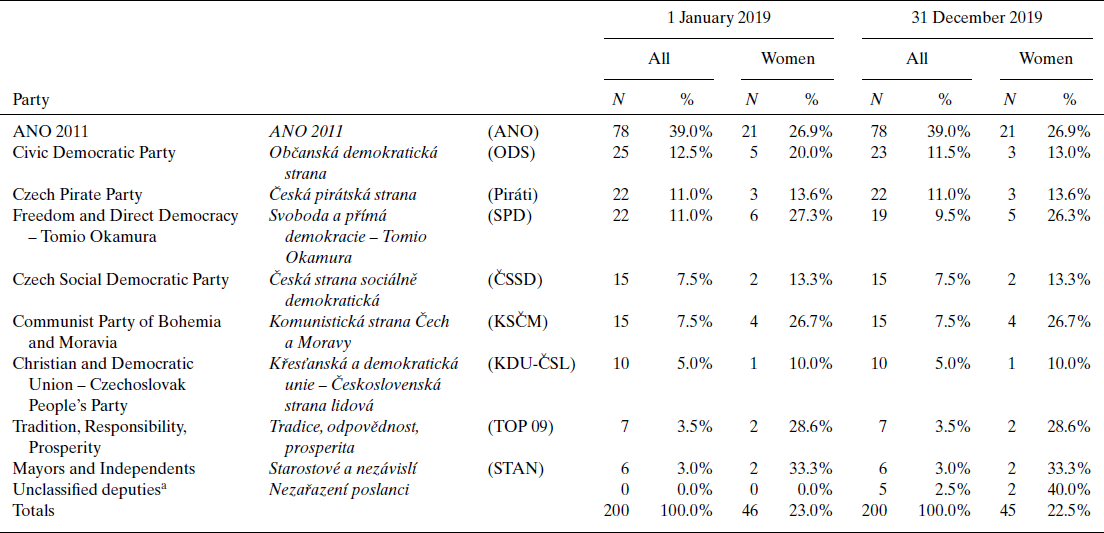
In the Chamber of Deputies, several significant changes to party groups occurred (Table 3). These changes were a result of three distinct causes: (1) members of the Chamber being elected to the EP, (2) former government ministers resigning from their mandates and (3) groups of MPs leaving their original party groups to become unclassified deputies.
Radka Maxová (1968, female, ANO), Veronika Vrecionová (1965, female, ODS) and Mikuláš Peksa (1986, male, Piráti) were elected to the EP in May, and thus their mandates ceased to exist in early July 2019. On 2 July, they were replaced in the Chamber of Deputies by the following candidates on the respective regional party lists from the 2017 general elections: Ondřej Babka (1994, male, ANO), Petr Bendl (1966, male, ODS) and František Navrkal (1992, male, Piráti).
In January, the former Minister of Interior (2014–17) Milan Chovanec announced that he would resign from his mandate because of his strong disagreement with the ČSSD forming a coalition government with the ANO. He formally resigned in April and was replaced by Václav Votava (1956, male, ČSSD). Dan Ťok, Minister of Transport in three consecutive governments (2014–19), resigned from his seat in April and was replaced by Iva Kalátová (1962, female, ANO).
In March 2019, three MPs from the SPD announced they were leaving the party and its party group in the lower house. Lubomír Volný (1973, male), the leader of this group, criticized the SPD for being a party with racist and neo‐nazi tendencies. Along with his two splintering colleagues, Marian Bojko (1962, male) and Ivana Nevludová (1977, female), they founded a new political party, Jednotní – alternativa pro patrioty (JAP), in March 2019.
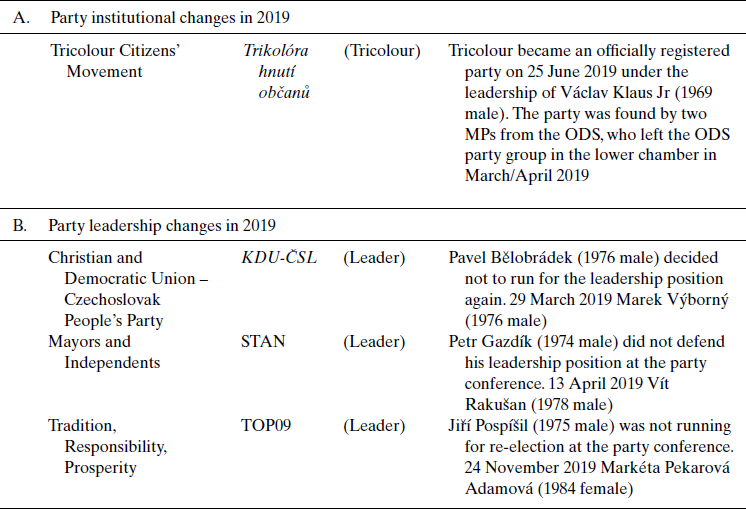
Following his expulsion from the ODS in mid‐March, Václav Klaus Jr (1969, male) left the ODS party group to become an unaffiliated deputy. Klaus Jr, who is a son of Václav Klaus (i.e., the former Czech Prime Minister, former Speaker of the Chamber of Deputies, and the former two‐time President), had long‐term quarrels with ODS party leadership. In April, Klaus Jr was followed by his close collaborator Zuzana Majerová Zahradníková (1972, female), who also became an unaffiliated deputy. In June 2019 they formed a new political party the Tricolour Citizens’ Movement/Trikolóra hnutí občanů (Tricolour).
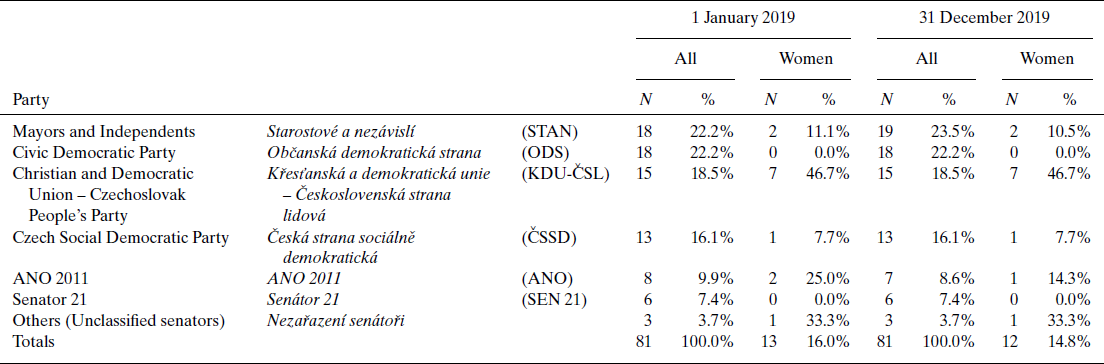
The only personal change in the Senate (Table 4) resulted from the April by‐election, after which Zuzana Baudyšová (1948, female, ANO) was replaced by David Smoljak (1959, male, STAN).
Political party report
Four parliamentary parties held general conferences in 2019. Prime Minister Babiš (being the only candidate, as in the previous 2017 party conference) confirmed his leadership position of the ANO by obtaining 206 votes from 238 delegates. The ANO conference in February also confirmed the position of Jaroslav Faltynek (Chairman of the ANO lower chamber party group) as the first Vice‐Chairman.
Three remaining general conferences led to a change in leadership. Pavel Bělobrádek, leader of the Christian Democrats between 2010 and 2019, announced that he would not defend his leadership during the March conference. Marek Výborný became the new KDU‐ČSL leader by defeating Marian Jurečka in the second round ballot (256 votes to 124).
Petr Gazdík of STAN did not defend his leadership position at the April conference. Vít Rakušan, being the only candidate, became the new leader of STAN. TOP09 held their general conference in November when their latest leader and MEP, Jiří Pospíšil, was not running for re‐election. MP Markéta Pekarová Adamová beat Senator Tomáš Czernin in the close contest by obtaining 96 votes from 177 delegates. Pekarová Adamová was (as of the end of 2019) the only female leader of a Czech parliamentary party.
Klaus Jr became the leader of the newly founded the Tricolour party during the founding assembly held in September. He secured 185 out of 188 votes. All changes in Czech political parties' leadership is presented in Table 5.
Institutional change report
No legislation that would significantly change the institutional framework or electoral law was passed in 2019.
Issues in national politics
Most of the crucial events in Czech politics during 2019 were related to Prime Minister Babiš. Issues connected to changes in the Cabinet are discussed above. Therefore, this section mentions other significant issues in Czech national politics.
After the first European Commission audit in 2017, which focused on EU Structural Funds, there was a second audit in 2019. The second audit investigated the distribution of agricultural subsidies paid to the Agrofert holding Babiš founded and placed in a trust fund two years ago. As in 2017, Babiš was found to have a conflict of interest. The argument formulated by the auditors was that Babiš was well aware of what the Agrofert holding companies did and as Prime Minister could directly benefit from them. Babiš stated he did not agree with the audit findings and initially refused to release the report publicly, claiming the document was confidential.
Other important events were related to the police investigation of Babiš’s alleged fraud. The day after Babiš’s case was given to prosecutors, the Minister of Justice resigned, and Babiš had already selected a new candidate. In September, the Prosecutor decided to stop the investigation of Babiš. Simultaneously, President Zeman publicly declared that he was ready to grant Babiš an abolition, which would mean an immediate halt of a criminal investigation. However, Babiš refused to accept the abolition. Several days later, Chief Prosecutor Pavel Zeman declared that the prosecutor assigned to the case wrongly assessed the available evidence. Thus, the case was ordered to be given back to the assigned prosecutor for further investigation.
Babiš’s scandals initiated the founding of the Million Moments for Democracy movement in 2017. However, only the events of 2019 have shown its vast mobilization potential. A movement led by university student Mikuláš Minář, whose initial aim was to obtain 1 million signatures demanding Babiš’s resignation as Prime Minister, organized several demonstrations throughout 2019. The main protests occurred in Wenceslas Square and Letná Park (both in the capital, Prague). The protest named ‘It's up to us!’, which took place at Letná 23 June, was the biggest protest since the fall of Communism in 1989. Estimates suggest that more than 250,000 people protested against Babiš and the new Minister of Justice, Benešová. Another protest at Letná took place symbolically on the eve of 17 November, the 30th anniversary of the Velvet Revolution in 1989. Again, about 250,000 people attended the protest demanding Babiš’s resignation for not being a Prime Minister who respects democratic principles and institutions and who has severe conflicts of interest.
Table 1. Elections to the European Parliament (Evropský parlament) in the Czech Republic in 2019

Source: Czech Statistical Office (2019).
Table 2. Cabinet composition of Babiš II in the Czech Republic in 2019

Source: Vláda České republiky (2019).
Table 3. Party and gender composition of the lower house of Parliament (Poslanecká sněmovna) in the Czech Republic in 2019

Note: aUnclassified deputies are MPs who left their initial party group during 2019 (i.e., they do not constitute a political party).
Source: Poslanecká sněmovna (2019).
Table 4. Party and gender composition of the upper house of Parliament (Senát) in the Czech Republic in 2019

Source: Senát (2019).
Table 5. Changes in political parties in the Czech Republic in 2019

Source: Ministry of the Interior (2019).


 Open access

