

Introduction
In Bulgaria, 2020 was – just as everywhere else – a year of the extraordinary. In the Bulgarian case, the COVID-19 crisis was accompanied by the longest and most persistent protests against the long-standing Prime Minister and leader of the governing Citizens for European Development of Bulgaria/Grazhdani za evropeysko razvitie na Bulgaria (GERB) party Boyko Borissov. Protests blocked Sofia and other big cities in the summer of 2020, and Borissov responded with promises for institutional and constitutional changes. However, he managed to avoid calling for early elections and ended the year still in control of the executive in the country.
Election report
There were no elections in 2020.
Cabinet report
The Borissov III Cabinet experienced challenges throughout the year that combined small shake-ups and more major problems that reflected popular dissatisfaction with its work, intra-coalitional problems, and challenges from the opposition in- and outside Parliament.
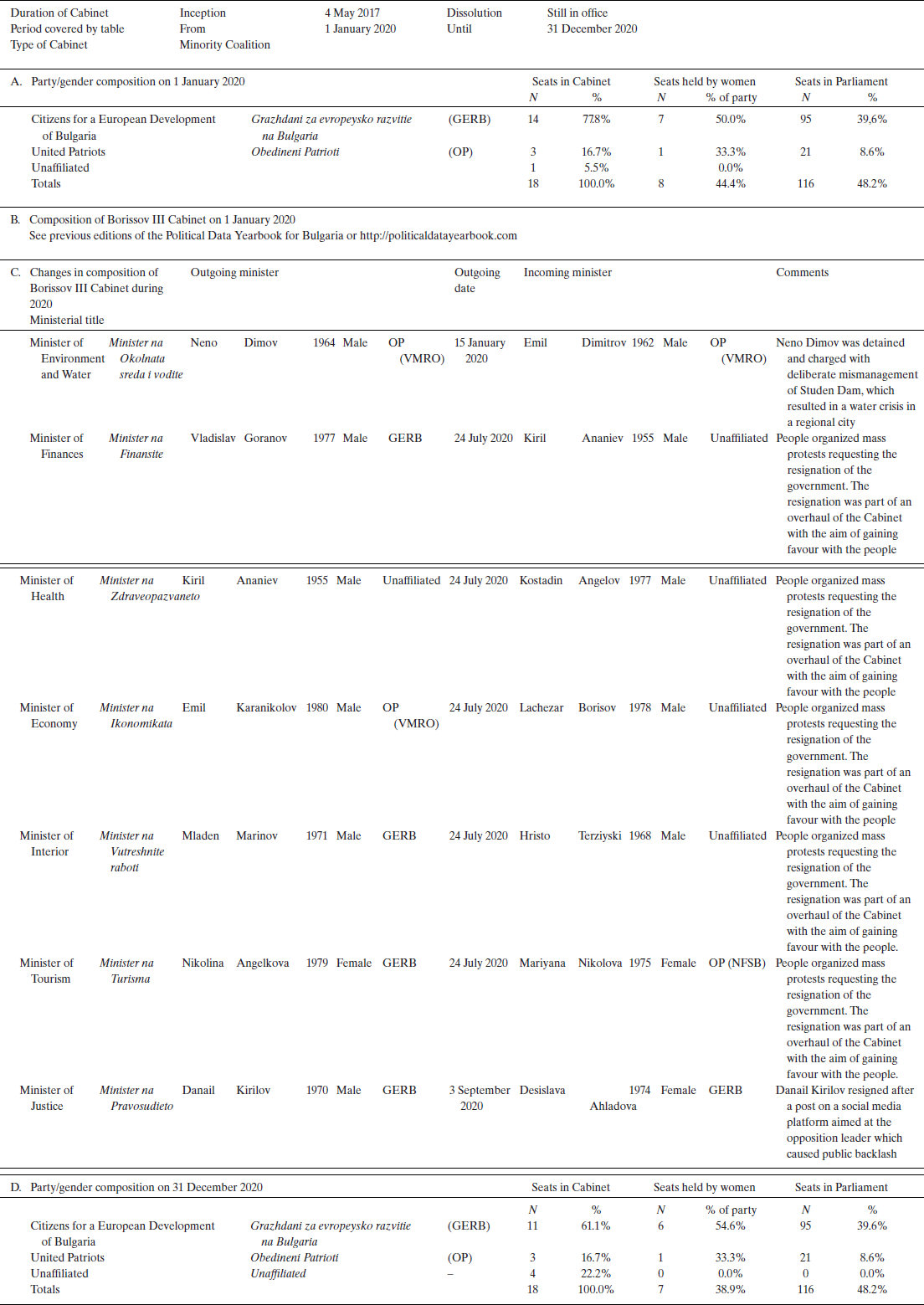
Personnel shake-ups started from the very beginning of the year. In January, Minister of Environment and Water Neno Dimov was detained and charged with deliberate mismanagement of water facilities, which had resulted in a water shortage crisis in the city of Pernik. As a result, on 15 January, Emil Dimitrov was voted in as the new Minister of Environment and Water with support from the parliamentary groups of the governing GERB–United Patriots/Obedineni Patrioti (OP) coalition.
In July, a bigger shake-up followed, which reflected bigger problems. During June, opposition politicians raised public alarm about the alleged questionable deals of the Movement for Rights and Freedoms/Dvizhenie za Prava I Svobodi (DPS), its honorary chair Ahmed Dogan and notorious member Delyan Peevski (see Spirova Reference Spirova2015 for the 2014 protests around the personality of Peevski). As a consequence, speculation emerged about the dependency of the then current Borissov III Cabinet on support from Peevski. Upon consultations with the regional party coordinators, and amidst quickly growing protests in the streets of Sofia and other cities, Borissov asked three ministers to resign, arguing that the ministers themselves were directly linked to Peevski. Minister of Finance Vladislav Goranov, Minister of Internal Affairs Mladen Marinov and Minister of Economy Emil Karanikolov resigned from office on the request of the Prime minister and were replaced by less questionable GERB personalities. Using the opportunity of the shake-up, another minister was asked to resign: Nikolina Angelkova, Minister of Tourism. Coalition partner OP had long been unhappy with her work, so they used the opportunity to ask for her resignation and replace her with their own vice-MP Mariyana Nikolova. A fifth minister – Kiril Ananiev, Minister of Healthcare – changed portfolios and was replaced by his deputy. This complex personnel change (see Table 1 for details) was an attempt by Borissov to freshen up his Cabinet and respond to the demands of the protesters for changes in the style of government.
Table 1. Cabinet composition of Borissov III in Bulgaria in 2020

Notes: United Patriots is a coalition of the VMRO–NFSB alliance of the Internal Macedonian Revolutionary Organisation/Vatreshna Makedosnka Revolucionna Organizacia (VMRO) and the National Front for the Salvation of Bulgaria/Natzionalen Front za Spasenie na Bulgaria (NFSB).
Sources: Council of Ministers website http://www.gov.bg/en/Cabinet (accessed February 2021); Parliament of Republic of Bulgaria website https://www.parliament.bg/en/MP.
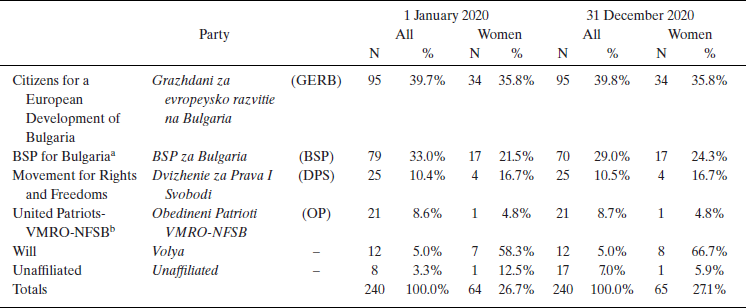
Table 2. Party and gender composition of the Parliament (Narodno sabranie) in Bulgaria in 2020

Notes: aNine members of the BSP left the party in September after their faction lost the internal elections against the incumbent leader. Consequently, they are considered unaffiliated as of 31 December 2020.
b United Patriots is a coalition of the VMRO–NFSB alliance. It consists of the Internal Macedonian Revolutionary Organisation/Vatreshna Makedosnka Revolucionna Organizacia (VMRO) and the National Front for the Salvation of Bulgaria/Natzionalen Front za Spasenie na Bulgaria (NFSB), Bulgarska Socialisticheska Partia (BSP).
Source: Parliament of Republic of Bulgaria website https://parliament.bg/en/ns (accessed 17 February 2021).
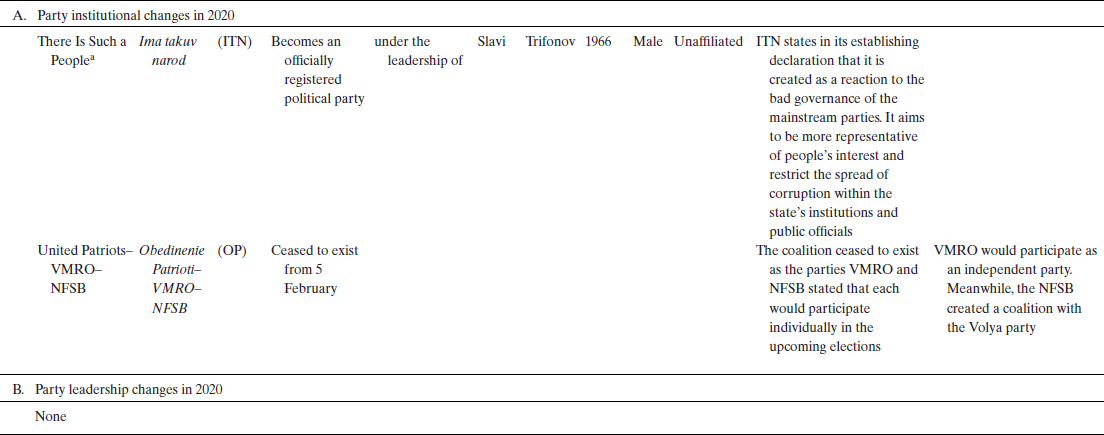
Table 3. Changes in political parties in Bulgaria in 2020

Note: aThere Is Such a People was created by popular musician and television host Slavi Trifonov. ITN is created after Trifonov's previous political project, ‘There Is no Such State’, was denied registering as political party by the Supreme Cassation Court. The motives were that the party's logo contained Bulgarian official symbols, which is illegal under the Political Parties law. Recent polls show that the party has the potential to become third or fourth biggest parliamentary group. See the survey conducted by Trend at https://rctrend.bg/project (accessed on 17 February 2021).
Sources: ITN's official website, https://pp-itn.bg/ (accessed on 16 February 2021); press conference of the NFSB, https://www.bgonair.bg/a/2-bulgaria/216738-nsfb-i-vmro-se-razdelyat-kray-na-koalitsiyata-obedineni-patrioti (accessed 16 February 2021).
However, public protests against the Cabinet intensified with opposition leader Hristo Ivanov gaining in popularity. On 26 August, Danail Kirilov, Minister of Justice, was asked to resign from his post. This happened again in response to the anti-government protests following Kirilov's social media improper behaviour and mockery of Hristo Ivanov. Overall, the year was turbulent in terms of the personnel changes of the Cabinet, and the instability was only further strengthened by the behaviour of the parties in Parliament.
Parliament report
The work of the Bulgarian National Assembly in 2020 (see Table 2 for its party make up) was naturally split in two main periods: before and after the summer, which this year also brought public anti-government protests. While the whole year was characterized by increased challenges to the Borissov Cabinet from both within the coalition and from the opposition, the second half of the year clearly saw their intensification. Symbolically, Parliament also underwent a major change: for the second half of the year it moved from the historical building to a renovated hall in the old Communist Party headquarters in order to ensure better working conditions in the COVID-19 pandemic situation. The move initiated a lot of negative speculations in the media and among the political elites about a return to the (pre-1989) ‘old ways’.
The Parliament in Bulgaria remained in regular session from 15 January to 30 July, with a short interruption between 26 March and 4 April, when it stopped regular legislative activity because of the state of emergency instituted in the county because of the pandemic. During that parliamentary session, the opposition Bulgarian Socialist Party initiated two votes of no confidence. The first came immediately the legislature started working in January, with the motives of the BSP for Bulgaria/BSP za Bulgaria (BSP) being mostly linked to the protection of the environment: the water crisis in the city of Pernik, the illegal import of waste from Italy and poor air quality. On 29 January, the National Assembly rejected the motion of no confidence. A total of 102 representatives voted in favour, 124 against and nine abstained. The opposition BSP was supported by the DPS. The ruling coalition of GERB and OP was backed by the representatives of Ataka, who had left the coalition in 2019. The nine MPs of Will/Volya abstained.
Before the summer recess, in July, the BSP followed up with their fifth motion of no confidence, motivated by the corrupt practices of the governing coalition. The ruling coalition won with 125 votes against, while the vote was supported by 102 votes in favour, and 11 MPs abstained. As expected only BSP and DPS supported the vote.
During the summer recess, challenges to the Cabinet intensified outside Parliament. Protesters called for the resignation of Prime Minister Borissov and Attorney General Ivan Geshev with accusations of obtuse and close relations between the political system, the judiciary, the oligarchs and the media. In response, Borissov promised a restart of the political system and speculated about ideas about a new Constitution. While these plans fizzled out later on, the second half of the parliamentary year was coloured by this much more serious debate about the further fate of the GERB's model of government.
Parliament reconvened on 2 September in the new building, amongst protesters throwing eggs at the MPs and police lines protecting the MPs from the protests. Work in the legislature began turbulently with demands from the BSP, DPS and the President for the resignation of the GERB Cabinet. Instead, the GERB pushed its proposal for a new constitution. Ultimately, the proposal could not get the necessary 120 votes to support the initiation of a new constitutional process. The President also intervened to argue that this was not a desirable move. It became quickly clear that the GERB could no longer rely on the tacit support from the DPS, and with the BSP in strong opposition and the OP in disarray, the GERB could only hope to avoid early elections. Despite challenges from all sides and public support for Borissov and his Cabinet plummeting (Alpha Research 2020), Borissov managed to achieve this and at the end of the year preparations for regularly scheduled elections began.
Political party report
BSP leadership elections were held in late 2020. This was the first time in its history that the socialists had elected a leader directly. Until 2020, leaders were always chosen at the national congress of the party as a result of a compromise between the various factions. In October 2020, current leader Kornelia Ninova won 43,228 votes and 81 per cent of the votes in the party elections (see table 3 for a summary of the party changes). Her opponents left the party and the party parliamentary group in a demonstration of the deep divisions among them.
Political party There Is Such a People/Ima takuv narod (ITN) around the personality of Bulgarian television show host and singer Slavi Trifonov was officially registered on 16 February 2020. The party (https://pp-itn.bg/) is a broad populist political project, which purports to aim to rid the country of corruption and increase public participation in its governance. Trifonov had tried to register early on with the name There Is no Such State, but the registration was stopped after a court battle for reasons of the reference to the state in its name, which is outlawed by the law on political parties (art 5(1)).
Institutional change report
On 17 September 2020, the National Assembly adopted changes to the electoral law that allowed machine and paper voting in all districts with more than 300 voters. Disputed by many as virtually making machine voting redundant, the changes were vetoed by the President, but the veto was overturned by a vote on 8 October with support by the governing coalition with 124 votes in favour and 89 against (for the Law, see https://www.parliament.bg/bg/laws/ID/163319).
Issues in national politics
COVID-19 crisis
The coronavirus reached Bulgaria in early March 2020, but remained relatively contained until the fall of 2020. Government reaction was quick and stern: a state of emergency was announced on 13 March and then extended until 13 May. Strict measures included a ban on leaving cities, a ban on walking in public parks, and closures of schools and public spaces. About 2000 cases and fewer than 100 deaths were registered by early May when the Cabinet changed direction and opened up the country.
The fall of 2020 came with a much higher rate of spread of the disease. While the death rates also spiralled, the Cabinet refrained from imposing the stricter measures of the spring, and in fact the Cabinet prided itself on being the most liberal in the European Union (EU) in terms of corona-related restrictions. Shops remained open and small public gatherings were allowed. By the end of 2020, however, the death rate of 3.7 per cent of all cases was among the highest in Europe and the world. Criticisms included inconsistency in the policies, lack of clarity in the healthcare system about the protocols for the treatment of the disease, and lack of public attention to the generally difficult situation in the hospitals in the country.
Zadkulisie
Zadkulisie is a term literally meaning behind the curtains-ness that has been used in Bulgaria for quite some time to describe alleged intertwined links between politics, business, media and the judiciary, and the resulting non-transparent manner of public governance. During 2020, public outcry with zadkulisie intensified, partially as a result of the appointment of Chief Prosecutor Ivan Geshev. In late 2019, Geshev was appointed as Chief Public Prosecutor of Bulgaria.
Geshev was the only candidate proposed to succeed Sotir Tsatsarov as in 2019, which triggered controversy and public protests against his candidacy. The decision of Bulgaria's Supreme Judicial Council in late 2019 was vetoed by Bulgarian President Rumen Radev. A second vote of the council confirmed Geshev as the Chief Prosecutor and constitutionally forced Radev to accept his nomination. He was inaugurated on 18 December 2019.
Further institutional battles ensued as the special forces of the Prosecutor's office and prosecutors entered the presidency and searched the offices of President Radev's advisors and other staff. This was without precedent in the democratic political history in Bulgaria and caused further accusations that the GERB–DPS political machine was trying to stifle political opposition. On 2 April 2020, President Radev withdrew confidence from the government because ‘it does not work in the interest of the citizens’ (BNR 2020). Public outcry with the alleged collusion between the prosecutor general, the government and some political parties further contributed to the intensification of the protests in the summer and political challenges to the Cabinet.
North Macedonia
The year 2020 also saw a turn in Bulgaria's policy towards North Macedonia, after years of positive development and increased cooperation among the two states. In November 2020, Bulgaria vetoed the decision to open EU accession negotiations with North Macedonia. The motives included the lack of progress in the fields, which were part of the treaty for friendship that was signed two years ago.

 Open access

