

Introduction
Cross-functional coordination is essential for accomplishing complex organizational tasks, especially as work becomes increasingly specialized (Van de Ven, Delbecq, & Koenig Jr, Reference Van de Ven, Delbecq and Koenig1976; Young-Hyman, Reference Young-Hyman2017). However, such coordination is often difficult to achieve due to misaligned goals across departments and professional boundaries (Bach, Kessler, & Heron, Reference Bach, Kessler and Heron2012; Denison, Hart, & Kahn, Reference Denison, Hart and Kahn1996; Wadmann, Holm-Petersen, & Levay, Reference Wadmann, Holm-Petersen and Levay2019). Among the many barriers to cross-functional coordination (Bach et al., Reference Bach, Kessler and Heron2012; Currie, Finn, & Martin, Reference Currie, Finn and Martin2007; Weinberg, Reference Weinberg2011; Wicks, Reference Wicks1998), status–authority asymmetry stands out as a particularly difficult obstacle to overcome. This asymmetry occurs when professionals of lower status are given functional authority to supervise higher-status professionals and demand their compliance with particular processes or tasks (Karunakaran, Reference Karunakaran2022).
For example, 911 dispatchers hold the functional authority to assign emergency calls to police officers, but have a lower professional status. Similarly, in magazine publishing, fact-checkers – despite having lower professional status – have the functional authority to demand revisions from magazine writers. As work becomes more specialized and sophisticated, an increasing number of professional roles, including safety auditors, fact checkers, and sustainability managers, are endowed with functional authority (Augustine, Reference Augustine2021; Cohen, Reference Cohen and Wagner1998; Huising, Reference Huising2015). These professionals often occupy a lower rank in the occupational hierarchy but are nonetheless responsible for overseeing the work of higher-status professionals.
Here, status refers to professional status, defined as the position within a professional hierarchy that accrues through acts of respect and deference (Karunakaran, Reference Karunakaran2022; Nembhard & Edmondson, Reference Nembhard and Edmondson2006). Authority refers to functional authority, defined as the formal entitlement granted by an organization to supervisory roles to exercise control over particular activities (Blau, Reference Blau1968; Karunakaran, Reference Karunakaran2022; Stinchcombe, Reference Stinchcombe2001). Thus, lower-status professionals gain functional authority from their official positions and roles within an organization rather than tradition or charisma (Blau, Reference Blau1968; Stinchcombe, Reference Stinchcombe2001).
Under such circumstances, low-status professionals often struggle to fulfill their supervisory roles. They face a tension between meeting functional obligations and adhering to social norms that encourage adherence to higher-status members (Goode, Reference Goode1960). On one hand, asserting authority requires them to question, criticize, or even reject decisions of higher-status professionals. On the other hand, the social expectation to defer to those of higher status can inhibit such behaviors. When disagreements arise, lower-status professionals may avoid confrontation to prevent resistance and accusations from their higher-status counterparts (Cohen, Reference Cohen and Wagner1998; Thomas, Kumar, & Chur-Hansen, Reference Thomas, Kumar and Chur-Hansen2021).
How, then, can low-status professionals achieve effective cross-functional coordination when they are authorized to supervise high-status professionals? Previous research has provided some suggestions, such as resorting to human third-party support to enforce the high-status group’s compliance (Karunakaran, Reference Karunakaran2022; Kellogg, Reference Kellogg2022) or ingratiating themselves with the high-status group to obtain reciprocity (Davidson & Chismar, Reference Davidson and Chismar2007; Huising, Reference Huising2015). However, these strategies are often costly or ineffective. Resorting to a third party is precarious because a human third party may be more inclined to prioritize the high-status group to maintain the existing status hierarchy (Tajfel & Turner, Reference Tajfel, Turner, Jost and Sidanius2004). If they do not help, then the resorting behavior may further decrease cooperation from the high-status group. Ingratiating requires considerable emotional labor and may not yield reciprocity, as the high-status group may undervalue or overlook these efforts (Leifer, Reference Leifer1988).
While the traditional workplace may lack viable methods for lower-status professionals to assert authority with good coordination, the digital age offers new possibilities. Many organizations now adopt digital technologies such as collaboration and productivity tools and information systems to improve cross-functional coordination (e.g., Patel, Jamoom, Hsiao, Furukawa, & Buntin, Reference Patel, Jamoom, Hsiao, Furukawa and Buntin2013). These technologies can influence various types of workers, their work, and the collaboration and coordination among them. It can streamline work processes, increase work interdependency, and reduce information processing costs (Argyres, Reference Argyres1999; Claggett & Karahanna, Reference Claggett and Karahanna2018; Nembhard & Edmondson, Reference Nembhard and Edmondson2006). However, the literature provides only a few references to the potential of digital technology to improve cross-functional coordination.
We suggest that digital technology may function as a third party acting without vested interests, capable of breaking existing barriers or connecting contradictory groups (Carte & Chidambaram, Reference Carte and Chidambaram2004; Lyytinen, Yoo, & Boland Jr, Reference Lyytinen, Yoo and Boland2016). Moreover, the latest digital technologies often have a participatory design that allows users to reinvent technology for their purposes (Simonsen & Robertson, Reference Simonsen and Robertson2012). This provides additional opportunities for low-status professionals to assert authority and coordinate effectively.
In this study, we explore how low-status professionals can utilize digital technology to improve cross-functional coordination. We conducted a 17-month ethnographic study in an Eastern Chinese Grade-A tertiary hospital to provide a holistic picture of how low-status pharmacists utilize a rational drug use management system to improve coordination with high-status doctors. They must coordinate with doctors to achieve medication efficiency and ensure safety. We chose the healthcare setting for the salience of cross-functional coordination and the distinctiveness of professional hierarchy (Asthana, Jones, & Sheaff, Reference Asthana, Jones and Sheaff2019; Currie, Lockett, Finn, Martin, & Waring, Reference Currie, Lockett, Finn, Martin and Waring2012; Rogers, De Brún, Birken, Davies, & McAuliffe, Reference Rogers, De Brún, Birken, Davies and McAuliffe2020).
Based on data collected from observations, interviews, and documents, combined with researchers’ notes, we found that low-status pharmacists performed contingent exploitation, strategically restricted utilization of digital technology, to improve coordination with high-status doctors. Through strategic configuration of process streamlining, knowledge imprinting, and compliance enforcement, they managed to exert functional authority without evoking fierce resistance from the high-status doctors, achieving better cross-functional coordination outcomes in the end.
This study has the following contributions. First, it advances the literature on cross-functional coordination by showing how digital technologies can act as communication media that alleviate coordination barriers rooted in status–authority asymmetry. Specifically, we identify contingent exploitation as an effective strategy for low-status professionals with supervisory roles and delineate the mechanisms through which it addresses the compliance elicitation problem. Second, we contribute to the technological adaptation literature by revealing how professionals navigate conflicting social dynamics when implementing digital tools. Our findings suggest that adaptation in such contexts requires strategic coping that considers both users’ goals and how other workers may react to technology use.
Theoretical Background
Low-Status Professionals’ Elicitation of High-Status Professionals’ Compliance
Status hierarchy in an organization provides order and facilitates coordination (Clark, Clark, & Polborn, Reference Clark, Clark and Polborn2006; de Kwaadsteniet & van Dijk, Reference de Kwaadsteniet and van Dijk2010; Luan, Hu, & Xie, Reference Luan, Hu, Xie, Salas, Rico and Passmore2017; Magee & Galinsky, Reference Magee and Galinsky2008). Status acts as a social signal for workers to identify who should yield to whom, thus creating the social norm of conformity in collaborative work that low-status workers should defer to high-status workers (de Kwaadsteniet & van Dijk, Reference de Kwaadsteniet and van Dijk2010; Goode, Reference Goode1960; Ridgeway, Reference Ridgeway, Webster and Foschi1988). It can boost work efficiency by identifying the person in charge and reducing the possibility of conflict (e.g., Keltner, van Kleef, Chen, & Kraus, Reference Keltner, van Kleef, Chen and Kraus2008).
In cross-functional coordination, profession is a significant source of status (Liberati, Gorli, & Scaratti, Reference Liberati, Gorli and Scaratti2015). Professional status comes from public respect for an occupation accrued through the long-term development of this occupation (Karunakaran, Reference Karunakaran2022; Nembhard & Edmondson, Reference Nembhard and Edmondson2006). Workers in lower-status professions tend to comply with those in higher-status professions to meet the social norm of conformity. Although professional status varies between individuals within a professional group, it matters in cross-functional coordination mainly because of the variance between professional groups that accumulates broadly and over the long period of a profession’s development.
However, the organizational design of work structures may disrupt the existing profession-based status hierarchy (Belrhiti, Van Belle, & Criel, Reference Belrhiti, Van Belle and Criel2021). The organization’s supervisory positions (e.g., police dispatchers, biosafety officers, and fact checkers) and the related job duties grant workers the functional authority to demand others’ compliance with particular activities, even if others have a higher professional status. Because functional authority targets work processes instead of individuals, its influence lies in the middle ground between coercion and advisement (Karunakaran, Reference Karunakaran2022; Koontz & Weihrich, Reference Koontz and Weihrich2012). Individuals with functional authority are responsible for monitoring, overseeing, and directing other employees’ work activities but cannot reward or punish them based on their compliance (Karunakaran, Reference Karunakaran2022; Koontz & Weihrich, Reference Koontz and Weihrich2012; cf. Dalton, Reference Dalton1950; French & Raven, Reference French, Raven and Cartwright1959).
This structural design naturally comes with goal conflict between different functions (Worren & Pope, Reference Worren and Pope2024), as the supervisory function’s goal is to regulate other professionals’ behaviors, while the other function’s goal is to obtain approval. When low-status professionals occupy a supervisory position, their job duties divert them from mere obedience to compliance elicitation because of the functional authority attached to them. Therefore, in addition to status hierarchy, functional authority affects the appropriate order of yielding.
Given the tension between the social norm of conformity and the fulfillment of functional obligations (Goode, Reference Goode1960), the low-status group faces difficulties in eliciting the high-status group’s compliance without breaking the balance. Previous studies identify several strategies for this purpose. For example, a low-status group can resort to a human third party for additional influence to pressure the high-status group to comply (Barley, Reference Barley1986; Karunakaran, Reference Karunakaran2022; Kellogg, Reference Kellogg2022; Orlikowski, Reference Orlikowski2000). However, this strategy is precarious, and low-status professionals must rely largely on a third party. Another strategy for low-status professionals is to ingratiate themselves with high-status professionals to gain reciprocity (Belrhiti et al., Reference Belrhiti, Van Belle and Criel2021; Currie & Burgess, Reference Currie, Burgess, Floyd and Wooldridge2017; Davidson & Chismar, Reference Davidson and Chismar2007; Huising, Reference Huising2015; Lapointe & Rivard, Reference Lapointe and Rivard2005). However, this strategy is also not cost-effective because it requires substantial efforts with no guaranteed returns.
Digital Technology as a Potential Remedy for Cross-Functional Coordination
Digital technology facilitates dependency management among different functions and influences an organization’s coordination structure (Claggett & Karahanna, Reference Claggett and Karahanna2018; Malone & Crowston, Reference Malone and Crowston1994). It streamlines work processes, enhances work interdependency, minimizes the need for direct interpersonal contact, reduces information processing costs, and facilitates efficient and holistic governance (Argyres, Reference Argyres1999; Bernardi & Exworthy, Reference Bernardi and Exworthy2020; Claggett & Karahanna, Reference Claggett and Karahanna2018; Nembhard & Edmondson, Reference Nembhard and Edmondson2006).
The literature on technological adaptation has revealed the impact of technology introduction and integration on status dynamics. For example, Barley (Reference Barley1986), Anthony (Reference Anthony2018), and Barrett, Oborn, Orlikowski, and Yates (Reference Barrett, Oborn, Orlikowski and Yates2012) emphasize that technology acts as a trigger for structuring processes. In healthcare organizations, whether technology implementation reinforces or threatens existing status hierarchies remains unclear (Petrakaki, Klecun, & Cornford, Reference Petrakaki, Klecun and Cornford2016; Ziebland, Hyde, & Powell, Reference Ziebland, Hyde and Powell2021). Some studies report a reinforcement effect in that technology reinforces professional boundaries (e.g., Bach et al., Reference Bach, Kessler and Heron2012; Currie et al., Reference Currie, Finn and Martin2007) or low-status individuals see their interests undermined in technology-induced role negotiations (e.g., Barrett et al., Reference Barrett, Oborn, Orlikowski and Yates2012; Kellogg, Reference Kellogg2022). Other studies identify a rebalancing effect because technology either disrupts the high-status professionals’ jurisdiction and expands the low-status professionals’ roles (e.g., Badejo, Sagay, Abimbola, & Van Belle, Reference Badejo, Sagay, Abimbola and Van Belle2020), or it forces the high-status group to address the low-status group’s feedback (e.g., Melby & Hellesø, Reference Melby and Hellesø2014).
However, technology itself can be a means. Technology has unique advantages for cross-functional coordination, creating opportunities for low-status professionals to strategically improve their cooperation with other professionals. Technology has the potential to break through barriers or bridge fault lines that exist even before real contact occurs (Carte & Chidambaram, Reference Carte and Chidambaram2004; Lyytinen et al., Reference Lyytinen, Yoo and Boland2016). For example, Lyytinen et al. (Reference Lyytinen, Yoo and Boland2016) argue that digital technology can enhance connectivity within innovation networks by reducing communication costs and expanding their range. Many companies use Trello, Confluence, Slack, and other tools to open communication channels between groups (Atlassian, 2016). For healthcare organizations with professional tribalism or interdisciplinary segregation (Braithwaite et al., Reference Braithwaite, Clay-Williams, Vecellio, Marks, Hooper, Westbrook, Westbrook, Blakely and Ludlow2016; Rogers et al., Reference Rogers, De Brún, Birken, Davies and McAuliffe2020), technology may solve the ‘silo working’ problem.
As a means to bridge fault lines, Carte and Chidambaram (Reference Carte and Chidambaram2004) argue that leveraging a technology’s ‘reductive abilities’ (i.e., ability to limit traditional face-to-face communication) can help groups with diverse membership to mitigate the negative effects of diversity during their early formation stage. Although many studies show technology’s negative impact on coordination for reduced information density and relationship-building obstacles (e.g., Maruping & Agarwal, Reference Maruping and Agarwal2004; Sherif, Zmud, & Browne, Reference Sherif, Zmud and Browne2006), this reductive ability could reduce the salience of superficial differences among collaboration parties with pre-existing dividing lines and thus alleviate interpersonal conflict. Even if technology cannot mitigate all conflict, it provides platforms for collective troubleshooting by creating work interdependency (Asthana et al., Reference Asthana, Jones and Sheaff2019; Greenhalgh, Wherton, Shaw, Papoutsi, Vijayaraghavan, & Stones, Reference Greenhalgh, Wherton, Shaw, Papoutsi, Vijayaraghavan and Stones2019).
Furthermore, the latest digital technologies incorporate participatory design, which enables stakeholders to reinvent technologies to meet their specific needs (Simonsen & Robertson, Reference Simonsen and Robertson2012; Smith, Bossen, & Kanstrup, Reference Smith, Bossen and Kanstrup2017). This characteristic provides additional opportunities for workers who hold supervisory duties and for those who previously had limited jurisdictional control. Unfortunately, we have limited knowledge of how these people can grasp opportunities to improve their current situation and fight for more benefits.
All considered, this study aims to reveal how lower-status professionals can effectively leverage digital technologies to achieve coordination from higher-status professionals and fulfill their supervisory responsibilities. To this end, we conducted a contextualized study in a Grade-A tertiary hospital in eastern China.
Research Setting
The site hospital, founded in the 19th century, has four main campuses with approximately 4,000 beds and 7,000 medical staff. In recent years, it has been advancing its digitalization by introducing healthcare information systems, developing Internet hospitals, and applying information technology to cope with COVID-19.
We specifically focused on the prescription-issuing process, during which pharmacists oversee doctors’ prescriptions and sometimes elicit compliance with the final disposition of prescriptions. The prescription-issuing process proceeds from doctors to pharmacists and then to patients. The doctors first prescribed the medicines and delivered their preliminary decisions to the pharmacists. Subsequently, pharmacists reviewed the prescription’s appropriateness and potential risks and, if necessary, contacted the prescribing doctor for revision. Only when the prescription review pharmacist approves the prescription can it be issued in the next step. In inpatient units, the prescription went to nurses who gave the medicine to patients, whereas in outpatient units, patients directly received medicine from pharmacists.
A pharmacist’s review is an important step to avoid fatal consequences. In 1966, psychiatrist Charles K. Hofling conducted a field experiment where an invented doctor gave an incorrect prescription to nurses, and found that 95% of nurses followed the instruction and gave it to patients (Hofling, Brotzman, Dalrymple, Graves, & Pierce, Reference Hofling, Brotzman, Dalrymple, Graves and Pierce1966). Flood and Scott (Reference Flood and Scott1978) also demonstrated the potential harm of doctors’ dominance over medication. To ensure patient safety, many hospitals in China ask pharmacists to supervise the prescription decision-making process to limit doctors’ dominance in prescribing and compensate for doctors’ lack of pharmacological knowledge.
Throughout the process, pharmacists were required to communicate with both doctors and nurses; however, they lacked visibility in hospitals. Other medical staff viewed pharmacists as assistants helping with prescription issuing and medicine dispensing, and as not important in decision-making around prescriptions. Their specialized expertise in pharmacology did not receive much respect for clinical medications. The pharmacists themselves knew the situation, and they believed that in the hospital, doctors had the highest status, followed by nurses and then pharmacists. Online Appendix I also shows that the pharmacy department was undervalued as an auxiliary department in the hospital we studied.
The professional status difference between pharmacists and doctors is not an exception in this hospital, but is general in the healthcare sector based on the traditional inequalities among professions. Doctors’ medical domination has historically been supported by the belief that they can save and extend lives, and was further reinforced in the later segmentation and development of diverse medical specializations (Badejo et al., Reference Badejo, Sagay, Abimbola and Van Belle2020; Belrhiti et al., Reference Belrhiti, Van Belle and Criel2021; Currie et al., Reference Currie, Lockett, Finn, Martin and Waring2012; Liberati et al., Reference Liberati, Gorli and Scaratti2015; Thomas et al., Reference Thomas, Kumar and Chur-Hansen2021). Its persistence can also be attributed to the privileged profession’s natural inclination to defend its dominance by reinforcing institutionalized control over other professions (Elston, Reference Elston, Gabe, Calnan and Bury1991; Heldal, Reference Heldal2015). In China, legal restrictions support doctors’ complete control over their treatment choices. According to the Prescription Administrative Policy, only doctors can acquire the right to prescribe, and other professionals, including pharmacists, can only provide prescribing suggestions (处方管理办法 [Prescription Administrative Policy], 2007). This professional hierarchy poses a challenge for other medical professionals to coordinate with doctors (e.g., Currie, Burgess, & Hayton, Reference Currie, Burgess and Hayton2015), and sometimes results in the phenomenon that ‘even if the pharmacist knows better, the doctors’ decision goes’ (Thomas et al., Reference Thomas, Kumar and Chur-Hansen2021: 1).
The functional authority of pharmacists originates from the structure of their work processes. To improve medication safety and effectiveness, many hospitals, including the one we studied, assign pharmacists the duty of reviewing doctors’ prescriptions. This additional step aims to regulate doctors’ prescriptions by involving more medical staff, especially experts outside the doctors’ professional groups, to double-check prescriptions. This new duty requires prescription review pharmacists to assert authority and request doctor compliance.
Notwithstanding the superordinate goals of pharmacists and doctors for efficient and effective medication, these two professions naturally have goal conflict because of their disparate functional roles. Doctors aim to accelerate the prescription process to treat patients, whereas pharmacists prioritize medication safety by identifying every problem they find. To discuss problematic prescriptions with prescribing doctors in the site hospital, pharmacists traditionally use landline calls, which are nearly the only coordinating interactions between the two functions. They are dispersed; therefore, there are limited opportunities for face-to-face communication. Pharmacists discussed prescription problems with doctors by calling the specific prescribing doctor or the doctor’s clinical department. However, pharmacists’ interventions may be viewed by doctors as an encroachment into their traditional clinical roles (Badejo et al., Reference Badejo, Sagay, Abimbola and Van Belle2020). Status and authority matter because, in clinical care, many patient-specific problems have no absolute right or wrong answers. The effectiveness of a treatment can only be determined after it is administered, so the pre-administration discussions – where the treatment plan is decided – are often shaped by the status and authority of the participants.
After implementing the drug use management system, pharmacists and doctors digitalized their work processes. This system aims to reduce medication errors and promote safe and effective medications. It influenced pharmacists’ prescription review work, doctors’ prescribing work, and the coordination between these two professional groups. It provides a rational drug use analysis that considers the efficacy, safety, suitability for the patient, cost, dosage, and duration of treatment. It performs analyses based on big data, including label instructions and clinical medication guidelines. After analysis, it issues reminders to the prescribing doctors and prescription review pharmacists. On the doctor’s interface, it can show pop-up reminders of the risk of continuing the prescription, and on the pharmacist’s interface, it can show a green or red icon in front of every prescription, indicating whether it is rational. In addition, the system has a participatory design that allows pharmacists to revise back-end functioning rules to meet their needs.
Methods
We conducted a 17-month ethnographic study in the site hospital described earlier. We focused on the coordination between pharmacists and doctors and their interaction through a rational drug use management system. An ethnographic approach is well suited for capturing medical staff’s actual practices and their first-hand perspectives (Barley & Kunda, Reference Barley and Kunda2001; Li, Leung, Chen, & Luo, Reference Li, Leung, Chen and Luo2012; Tripsas, Reference Tripsas2009). We shadowed 24 pharmacists and 35 doctors throughout their daily work to obtain rich observational data. Data were also collected from interviews, archives, news, and photos. We coded all data using abductive reasoning to generate plausible explanations for an unexplained phenomenon (Sætre & Van de Ven, Reference Sætre and Van de Ven2021). We chose abduction rather than induction because our analysis aimed to detect pharmacists’ effective strategies and explain why such strategies can improve coordination, instead of finding ideas that pharmacists commonly agreed on or the behaviors they shared.Footnote 1
Sample Selection
Our sample comprised two professional groups: 24 pharmacists and 35 doctors. Because we focused on a rational drug use management system, our primary target was prescription review pharmacists directly involved in system use and cross-functional coordination. We included all 11 prescription review pharmacists working in the prescription review center located at Campus B and five Campus B clinical pharmacists who took monthly shifts to the prescription review center and irregularly visited clinical departments working with doctors. Within Campus B, we believe it is also necessary to include one dispensing pharmacist and one management pharmacist in charge of the Center of Pharmacy Intravenous Admixture Service (PIVAS) and the prescription review center. We also included three clinical pharmacists, two dispensing pharmacists, and one informatics pharmacist from the other campuses.
We aimed to understand doctors’ reactions and opinions toward pharmacists’ actions; therefore, we contacted doctors from different clinical departments. With the help of several clinical pharmacists, we eventually obtained seven doctors from Respiratory Medicine, 11 doctors from Burns, six doctors from Hepato-pancreato-biliary (HPB) Surgery, five doctors from Neurology, and six doctors from Dermatology.
In addition, we conducted informant-free observations in the PIVAS, the prescription review center, the clinical pharmacy division, Pediatrics, Cardiology, Neurology, Pediatric Nurse Station, and Neurology & Neurosurgery-1 Nurse Station. Online Appendix II includes the individual informants’ demographics and informant-free observation samples.
Data Collection
The pharmacy department supported our fieldwork by introducing us as project collaborators along with the department’s director. The hospital also provided the internal identity with white coats and ID badges, which gave us legitimacy by having us look similar to medical staff and allowed us to become acquainted with new informants. One of the authors worked as the principal ethnographer. During fieldwork, she went to work and left work with pharmacists, doctors, and nurses, and shadowed them throughout their daily work. The ethnographer did not tell the informants the specific research question, but stated that we aimed to understand the usage of the rational drug use management system and improve the entire prescription review process. She observed the informants’ behaviors and informally interviewed them during their leisure activities. Some informants were willing to share information, while others were not. However, through everyday acquittance, they became accustomed to the ethnographer and expressed opinions that they would not voluntarily express to other colleagues in front of her. Thus, this study collected valuable information.
The 17-month ethnographic investigation was divided into three parts. From September 2022 to October 2022Footnote 2, the ethnographer and a research assistant completed a preliminary investigation of the rational drug use management system. The informants during this period were pharmacists recommended by the department director. The ethnographer did not ask each informant for permission to record. Instead, after finishing the observation, she restated the information to the research assistant in regular meetings and recorded these meetings, including the researchers’ notes. This included approximately 80h of observation, 5h of meetings, and 3h of formal interviews. During that time, we also had an opportunity for formal interviews with recording permission, in return for serving as third-party interviewers in the department’s frontline job satisfaction inquiry to dispel interviewees’ concerns.
From June 2023 to July 2023, the ethnographer completed immersive fieldwork with pharmacists, doctors, and nurses on Campus B. She shadowed every pharmacist working in the prescription review center and contacted other medical staff with the help of acquainted clinical pharmacists. During the observation period, she conducted informal interviews during the pharmacists’ leisure time (see the interview protocols in Online Appendix III). After each workday, she verbally recounted the day’s events to herself and recorded them. This included 168h of observation and 4h of recording. She also formally interviewed the management pharmacist of Campus B PIVAS and the prescription review center. After initial contact with doctors and nurses, we believed that it was necessary to delve deeper into doctors’ prescribing work to gain a comprehensive understanding of the entire prescribing process and cross-functional coordination.
In January 2024, the ethnographer observed doctors from five departments for 104h. She also conducted informal interviews during the observation period (Online Appendix III) in the doctors’ leisure time. As before, she verbally recounted the day’s events, accumulating 3h of recording. In addition to the 5-month immersive fieldwork, we held six regular meetings with the pharmacy department throughout the study. In addition, we included 35 documents, 2 pieces of news, and 52 photographs.
Observations
The ethnographer conducted observations with specific targets (marked ‘I + number’ in Online Appendix II) and informant-free observations (marked ‘P + number’ for pharmacy divisions, ‘D + number’ for clinical departments, and ‘N + number’ for nurse stations in Online Appendix II). The main observational data were observations with specific targets. The ethnographer sat beside their benches to observe what they were doing and listen to what they were saying on landline calls.
Interviews
The interviews included 6 formal and 28 informal interviews, all of which were semi-structured (see the protocols in Online Appendix III). For the formal interviews, the ethnographer invited the informants to a separate room and recorded them with permission. She used the drug use management system as a starting point, encouraging participants to talk about work changes, usage problems, and communication with other medical professionals. Informal interviews were conducted during the observation period so that we could triangulate their oral responses with their real behavior.
Archival materials
Six public archives related to the drug use management system and the pharmacy department were collected. In addition, we included 29 internal documents, including 25 formal regulations with signatures and seals in the official online institution learning center (mobile terminal), and 4 internal training materials.
Others
We also included 2 pieces of news about rational drug use systems, and 52 photos of work scenes, computer interfaces, and bulletin boards.
Data Analysis
We analyzed data using abductive reasoning to create explanations that would render the atypical phenomenon understandable (Sætre & Van de Ven, Reference Sætre and Van de Ven2021). The analysis process includes finding, verifying, and assessing anomalies, and then creating and assessing hunches (Sætre & Van de Ven, Reference Sætre and Van de Ven2021). Online Appendix IV describes the coding in detail.
First, we observed the anomalies. We reread the materials carefully, line by line, and bolded or underlined evidence that we found interesting and inspiring. These bolded lines were all original words from informants. For example, we bolded ‘If it is a red icon, I examine carefully; if it is a green icon, I just look through’ when a pharmacist was talking about the system’s role. These pieces of evidence were unexpected and unique; therefore, they were treated as potential anomalies.
Second, we confirmed the presence of these anomalies. It required us to understand the phenomena from both a close-up and a distant perspective, taking into account its context and ubiquity, and then diagnose last-phase anomalies (Sætre & Van de Ven, Reference Sætre and Van de Ven2021). We went through the last phase anomalies and judged whether they only occurred in one specific person or if they were a common characteristic of the group. For example, we found that many doctors regarded system remainders as ‘kind’, so we decided to confirm it as an anomaly.Footnote 3
Third, we generated hunches using the constant comparison approach (Glaser & Strauss, Reference Glaser and Strauss1967) and proposed potential explanations for anomalies using categories (Sætre & Van de Ven, Reference Sætre and Van de Ven2021; Weick, Reference Weick1989). Beyond grounded anomaly evidence, we theorized our explanations for hunches. For instance, based on the pharmacists’ adaptive practices toward the system, we theorized about their behaviors and explained why they performed differently in different tasks. In this step, we did not limit the number of categories or hunches, some of which overlapped, and noted all of them.
Finally, we evaluated the hunches. Following Weick (Reference Weick1989), we selected and compared the most plausible hunches using diverse selection criteria. The most important criterion is whether the hunches are both theoretically and practically reasonable. They also needed to be relevant and insightful for our research question. Based on this, we evaluated the hunches’ theoretical independence and refined them using simpler expressions.
Results
Traditional Cross-Functional Coordination: Expertise Exchange Asymmetry
The status difference facilitates clinical knowledge transmission from doctors to pharmacists, but hinders pharmacological knowledge transmission from pharmacists to doctors. Before a prescription is issued to the patient, pharmacists and doctors may hold differing views on the treatment and need to negotiate over the prescription. Doctors with a higher status had more treatment-related expertise, and they considered medication as pivoting on how to cure certain illnesses. Pharmacists with a lower status had pharmacological and medicine-related expertise, and they considered medication pivoting on how to safely administer medicine. However, the status difference between these two professions hinders sufficient knowledge exchange, resulting in the final decision being fully dependent on the opinion of the high-status profession. For example, one day in the prescription-review center:
I15: Do you interfere with [the questionable prescriptions of] the Surgery ICU?
I12: Interfere? Doctors will say ‘none of your business’.
I15: (Showing agreement) Depends on the doctor’s attitude. If s/he scolds me, I won’t dare to question [his/her prescriptions] again.
After this prescription, I12 told us that they only called the doctor for a double-check, and ‘if the doctor wants to use it, we can only approve’. Other pharmacists also expressed similar opinions that some doctors took advice, while others did not, and there was nothing pharmacists could do if they refused to accept (e.g., I5, I24).
Pharmacists attempted to transmit medicine-related expertise, but this did not work well. Occasionally, they compiled precautions related to rational drug use and shared their pharmacological knowledge with doctors in certain clinical departments. The choice of department depends on the department’s prescription rigor. For example, if a department always has adverse drug use events, it might arrange an ‘educational’ meeting. Yet, such meetings were infrequent and could not influence doctors’ prescribing actions daily. Another attempt by pharmacists was a prescription evaluation, based on which they publicized each clinical department’s drug use performance on the hospital’s official website. Specifically, pharmacists regularly organized prescription evaluation and summarized the number and types of irrational drug use incidents on the website. However, the results were unsatisfactory. Many doctors would not visit the website and read, as the evaluation results would not affect their earnings. Consequently, the status difference facilitated the transmission of doctors’ treatment-related expertise to pharmacists, thus influencing their opinions, but also hindered the transmission of pharmacists’ medicine-related expertise, not influencing doctors’ opinions in the same manner.
In this situation, pharmacists coordinate with doctors via peer-to-peer communication on landlines. This occurred before the admixture of intravenous drugs when pharmacists encountered problems. They marked the prescription as a ‘mistake’ in HIS and called the doctor to revise. The problems for which pharmacists intervened were quite limited; most were drip speed, dosage, and incompatibility problems. They had no extra capacity to address ‘quality problems’, that is, the rationality of prescriptions.
Contingent Exploitation: StrategicallyRestricted Utilization of Digital Technology
A lure for status rocketing
The rational drug use management system provides pharmacists with the opportunity to mandatorily exert functional authority. Pharmacists can revise the system rules and use them to stop prescriptions that they believe are problematic. As Figure 1 shows, when a doctor prescribes irrational prescriptions, the system can pop up a warning with the only button ‘revise’, indicating that the doctor must revise the prescription, or it will not be saved.

Figure 1. Systematic pop-up warnings: An example of non-negligible warnings (prescription process interception)
For example, in HPB Surgery, we observed a doctor prescribed a 25.9-g compound amino acid injection, and it was stopped by the system showing ‘Compound amino acid injection (18AA-III) for single infusion of amino acids requires consultation from Nutrition and you can call the clinical pharmacy office (number) *** to activate the permission of this medical record number’. Under this information, the system provided only one button, ‘revise’, for the doctor to click. The doctor (I43) explained his professional reasons for doing so and added that injecting amino acids also has a regulatory effect on osmotic pressure; therefore, he wanted to prescribe it as a supplement alone rather than for parenteral nutrition concerns. We then asked how he handled it, and he answered, ‘I can’t do anything about it. I just switched to another medication’. We also asked if he would continue to prescribe similarly in the future, and he answered, ‘I know (it’s not allowed) now, so I won’t prescribe (it) anymore’.
In this way, it seemed that the pharmacists’ status rocketed, even beyond doctors. This seemed perfect to solve the problem of doctors’ noncompliance. However, pharmacists realized that they could not proceed in this manner. One concern for pharmacists is that they anticipated extensive complaints and resistance from doctors, and they did not dare make mandatory demands. We asked several pharmacists why they did not use this function as much as possible to control doctors’ prescriptions, and they told us, ‘We don’t dare to do mandatory interception. We just don’t dare’ (I9, I24). In addition, pharmacists must be attentive to patients and adequately equipped to handle exceptional cases that occur frequently in hospitals. Many pharmacists agreed that they could not let the system take over all situations. As one of them told us, ‘The system is not comprehensive enough. You need to take a comprehensive look at the patient’s condition, for example, referring to data in “the panoramic view.” You can’t leave it all to the system for a “one size fits all” approach’ (I22).
The apparent technological empowerment of pharmacists proved dispiriting. At times, they complained that ‘the system is useless’, when in fact they meant it was simply less useful than expected. Confronted with this reality, they gave up taking advantage of the system and accepted their status inferiority.
Task classification practices
Facing this dilemma, pharmacists felt that they could not take advantage of the system for status rocketing, nor could they give up using the system and return to the traditional asymmetric approach. They realized that they had to steer a middle course; that is, to make the system useful, but needed to figure out how. After explorative attempts, they decided to perform task classification and exploit the system at different levels and in different ways to achieve their purposes.
Specifically, they divided the need-to-review prescriptions into three categories according to the severity level and clarified the purpose of each task type (see Online Appendix V). The three categories were no-question prescriptions (Levels 1–4), quality-questionable (Level 5–7), and safety-questionable (Level 8).
First, no-question prescriptions were ranked as Levels 1–4, where doctors faced few obstacles in prescribing and pharmacists barely performed the intervention. In this type of task, pharmacists mainly use the system to increase internal prescription-reviewing efficiency. The coordination process went from doctors to the system, and then to pharmacists. Doctors can prescribe at their own will, and the system shows green icons in the pharmacists’ prescription-reviewing interface. By viewing the green icon, pharmacists can roughly verify a prescription’s safety and quality.
Second, quality-questionable prescriptions were those with a degree of risk or overdose that might cause controversy (e.g., pain relief medicines with the same medication mechanism). Pharmacists used the system to remind doctors of medication risks and reached agreements through interactive negotiations and discussions. In doing so, pharmacists attained their goal of keeping room for customized prescriptions concerning patients’ particular conditions, especially for patients with limited medication options. The coordination process is bidirectional. On one hand, the system reminded doctors of prescribing risks, and it went from pharmacists to the system and then to doctors. Pharmacists also need to preset reminders in the system, marked as Levels 5–7. When the system identified these prescriptions, warnings popped up in the interface to remind doctors of prescription risks. Doctors could then choose to revise or ignore the warnings and continue prescribing drugs. The system also reminds pharmacists of the prescribing risks. It would show red icons to remind pharmacists of the prescription risk in the pharmacists’ prescription-reviewing interface, and they would carefully examine prescription problems and manually intervene via peer-to-peer communication on landline calls with doctors.
Third, safety-questionable prescriptions referred to prescriptions with definite mistakes that could cause serious adverse reactions (e.g., external medication prescribed as oral medication). Pharmacists used this system to enforce doctors’ compliance and eliminate malpractice. The coordination process went from pharmacists to the system and then to doctors, which was the reverse of the process for no-question prescriptions. To enforce doctors’ compliance, pharmacists preset system rules of interception, marked as Level 8. When the system met Level 8 prescriptions, it executed pharmacists’ preset rules and displayed prohibitive warnings in doctors’ prescribing interfaces, indicating that the doctor had no choice but to comply and revise.
Strategic configuration of process streamlining, knowledge imprinting, and compliance enforcement
The pharmacists’ classification practices demonstrate their diverse levels of technological utilization for different purposes. To further theorize the pharmacists’ practices, we coded their utilization of the system based on three aspects of coordination: assistance, joint decision-making, and supervision (Table 1). For assistance, pharmacists aimed to support the prescription-issuing process and utilized technology to accelerate the cross-functional work process, which we coded as process streamlining. For joint decision making, pharmacists aimed to influence doctors’ prescribing and utilized technology to convey their specialized knowledge and sway doctors’ prescribing decisions, which we coded as knowledge imprinting. For supervision, pharmacists aimed to regulate doctors’ prescriptions and utilized technology to exert their functional authority, which we coded as compliance enforcement. These three dimensions collectively constitute contingent exploitation, which refers to strategically restricted utilization of digital technology to achieve one function’s own purposes.
Table 1. Dimensions of contingent exploitation

Contingency was reflected in the low-status strategic configuration of the exploitation degree in three dimensions: process streamlining was the least restricted, knowledge imprinting was partially restricted, and compliance enforcement was the most restricted. Here, the restriction was due to the pharmacists’ deliberate desire to limit the utilization of technology, instead of objective limitations with the system’s built-in functionalities. The system’s built-in functionalities imposed low constraints on high-status doctors in process streamlining, medium constraints on doctors in knowledge imprinting, and high constraints on doctors in compliance enforcement.
First, process streamlining means that pharmacists utilize the system to accelerate the cross-functional prescription-issuing process. Every prescription review pharmacist changed their work habits from the traditional one-by-one prescription review to the new ‘system-then-me’ review. Nearly every time they received new prescriptions, they first clicked the ‘rational drug use analysis’ button, waited for the analysis results to be shown, and then started reviewing. The pharmacists made their final decisions based on the system analysis results (red icons for potential irrationality and green icons for potential safety). If they marked a prescription as questionable, its icon would change color to white, indicating under-intervention.
According to pharmacists, they changed their work habits because the new work method could reduce errors and cognitive load. As I13 said, ‘The first [reason] is fear of omission. I think if [I] don’t click [the rational drug use analysis] and examine it one by one, I’m afraid that by any chance there’s something I leave out. Checking the system can actually give me a reference. The second [reason] is that the red/green icon can distinguish what needs to be focused on and what can be gone through quickly’. I4 also echoed I13’s idea that ‘[If] observing with the naked eye, there will be omissions. At least I’m not able to do that [without omission]. The rational drug use analysis can serve as a supplement and a reminder’. As to reducing cognitive load, I10 had a more detailed explanation that ‘[The system] acts as a guide. [It] can filter for me at the beginning, so I don’t have to examine each prescription that carefully. If it is a red icon, I examine carefully; if it is a green icon, I just look through’ (I18, I3, and I20 also had similar remarks).
Second, knowledge imprinting means that pharmacists utilize the system to convey pharmacological knowledge and influence doctors’ decisions. Specifically, they applied their specialized knowledge to revise the system’s results and pop-up warning content and direct the system to show negligible warnings on the doctors’ interface (Fig. 2). The warnings included prescription time, questionable drug name, warning content, rationality suggestions, and warning level.

Figure 2. Systematic pop-up warnings: An example of negligible warnings (drug use risk reminder)
For example, in the warning content, they conveyed ‘inappropriate dosing regimen’ and explained in the rationality suggestion that ‘Solifenacin succinate tablets should be taken orally, and must be swallowed whole with water’. In doing so, they imprint pharmacological knowledge on doctors’ minds with prescriptions serving as the unit of occurrence, resulting in more frequent reinforcement than traditional methods. Every time a doctor prescribed solifenacin succinate tablets in a dosing regimen other than oral administration, they received a warning. Regardless of whether the doctor accepted it, the warning information was shown repeatedly.
Pharmacists do not require immediate acceptance by doctors. They set an ‘ignore’ button for doctors’ unacceptance, but they persisted in knowledge imprinting, waiting for doctors’ gradual internalization. Especially for prescriptions that only they (not doctors) believed were questionable, they used knowledge imprinting to sway doctors’ prescribing decisions.
Third, compliance enforcement implies that pharmacists utilize the system to exert their functional authority. As Figure 1 shows, they used the system’s prescription interception function, but not for status rocketing. Instead, they forcibly elicited doctors’ compliance when they made serious mistakes. In other words, they did not enlarge the ‘pharmacist-in-command’ area, which was relatively limited, but hardened their dealing manner in this area’s prescriptions.
Pharmacists acknowledged that such a mandatory intervention via the system was highly effective, owing to its immediate effect and 100% intervention success rate, as it could not be rejected by doctors. As the manager of the prescription review center said, ‘If it’s a system interception, it’s acceptable. However, if it’s us, the prescription review pharmacists, who stop them (doctors), they will be very unhappy and we will have big problems. Sometimes when the doctor is really pushy, there’s not much we can do’ (I14). In addition, to grant their compliance enforcement firmer standing, they unified prescription review standards across different campuses of the hospital to eliminate doctors’ opportunistic mindsets by viewing every prescription as negotiable (I6, I14).
Additionally, they did not completely abandon traditional peer-to-peer communication. Instead, they treated it as a follow-up negotiation where they could have deeper and more professional discussions with doctors. This is quite different from the communication in traditional cross-functional coordination. In addition to simple problems such as drip speed and dosage, they traditionally focused on, they paid attention to more complicated problems such as repeated medication, off-label usage, and contraindications. As Online Appendix VI reports, pharmacists paid attention to nine types of irrationality and recorded every error type and modification progress.
In summary, the exploitation by the low-status function is contingent on the degree of restriction. The basis of contingent exploitation was to differentiate coordination aspects so that low-status professionals could specify their roles in each coordination aspect and avoid simple behavioral coping. Beyond that, strategic configuration is essential and is the core of contingent exploitation. The pharmacists did not maximally utilize the system to achieve their goals in any aspect or condition of coordination; instead, they were least restricted in process streamlining, partially restricted in knowledge imprinting, and most restricted in compliance enforcement. For process streamlining, the pharmacists’ goal was to assist doctors in prescribing and accelerate the prescription-issuing process, and all of them changed their work habits to fully utilize the system to achieve this goal. For knowledge imprinting, they tried to influence doctors’ prescribing by popping up warnings over and over again, but they still set the ‘ignore’ button for doctors’ autonomy. For compliance enforcement, pharmacists aimed to monitor doctors for malpractice and used the most mandatory intervention method; however, this was only applied to a small range of prescriptions.
This idea was manifested especially in pharmacists’ system maintenance, where the pharmacist in charge (I2) regularly modified prescription levels (e.g., from Level 8 to Level 5). She said, ‘Although [all] setting to Level 8 is definitely labor-saving for us, we cannot consider only our labor’ (I2). For example, for prescriptions that are not absolute mistakes but are not recommended according to the pharmacists’ internal consensus, she ‘still preferred setting Level 5’ to avoid fierce resistance from doctors.
Impact on Prescribing Doctors: Reactive Supervised Learning
In contrast to the traditional asymmetry of expertise exchange, the pharmacists’ contingent exploitation of the rational drug use management system provided more expertise exchange channels in terms of quantity and variety. Pharmacists cannot expect doctors to proactively acquire pharmacological knowledge, but guide doctors’ learning through feedback after doctors’ prescribing trials. We coded the impact on doctors as reactive supervised learning because, in contrast to proactive learning from books or lectures, doctors acquired pharmacological knowledge after pharmacists’ feedback on prescriptions, and it was indirect because doctors did not see the knowledge itself but needed to infer it from the feedback.
Feedback receptiveness
An important impact on doctors is their feedback receptiveness. Pharmacists imprinted their specialized knowledge and perspectives on doctors through systematic reminders. This happened during the doctors’ prescribing process instead of afterward, and in the form of objective systematic prompts instead of subjective individual opinions. This weakened the perceived functional authority in doctors’ views of pharmacists; thus, doctors were less resistant to feedback and less likely to have an uncooperative attitude.
Indeed, doctors described system reminders as ‘kind reminders’ (I25), and they felt that it was ‘here to help’ (I25, I42) rather than ‘questioning my judgment’ (I43, referring to other doctors) or ‘causing me trouble’ (I34, I35). Even if doctors think certain reminders are useless or meaningless in content, they are still willing to receive reminders because having someone double-check is always a good thing (I29). As systematic reminders repeatedly popped up, doctors would gradually get used to them, and unconsciously, their impression of pharmacological knowledge would deepen through repetition.
Grasp of approval standards
Another impact was the grasp of approval standards as a consequence of pharmacist compliance enforcement. Doctors can grasp the pharmacists’ approval standards through real-time systematic feedback and follow-up negotiations. On the one hand, doctors who receive no reminders or only negligible reminders would know their prescriptions would be less likely to be challenged (I33, I51, I59). This was how they gained a sense of the pharmacists’ open lines. On the other hand, if their prescription was forcibly intercepted, they would know that such prescriptions fell into the pharmacists’ red lines. Most doctors quickly accepted and learned from the ‘no’ feedback, indicating they would not prescribe in that way anymore (I30, I35, I43). However, a few would still keep trying on other cases (I54, I59). Even so, these persistent doctors had a strong impression of the rule, that is, what was not allowed, and if it was indeed malpractice, no matter how they tried, the prescription would never be passed on to the prescription review pharmacists.
As for the additional peer-to-peer negotiation, although some doctors perceived it as questioning their professional judgment, others welcomed such discussions to bring about new perspectives and knowledge. One of them told us that he did not care about problems such as drip speed, ‘If you say it’s wrong, ok, fine’, but if pharmacists told him why these two drugs cannot be used together or how to use an antibiotic more effectively, he would be very happy to hear it (I37). A doctor from another department expressed similar ideas, ‘We, a surgical department, do limited medications; we may know the risk of [a commonly used medicine in this department], but we don’t know if there are any [interactions] between drugs. They (pharmacists) are professionals; it’s good to tell us about it’ (I43).
Changes in the Pharmacist–Doctor Interaction Pattern
Although the primary obstacle to pharmacist–doctor coordination – status–authority asymmetry – persisted, changes emerged in their pattern of interaction, including condensed negotiation scope, enhanced bilateral learning, and increased mutual understandings.
Condensed negotiation scope
The scope of negotiations between the pharmacists and doctors was condensed from all prescriptions to quality-questionable prescriptions. Neither pharmacists nor doctors needed to pay much attention to no-question prescriptions, as they both knew these were most likely to move quickly to the next stage (I11, I20, I59). As for safety-questionable prescriptions, traditionally, pharmacists had to engage in massive, difficult persuasion, but the system enabled them to disapprove of these prescriptions without saying a word and with a 100% success rate (I14, I25, and I38). This left only quality-questionable prescriptions within the scope of negotiation, where pharmacists and doctors engaged in deeper and more professional discussions.
Enhanced bilateral learning
Contingent exploitation also enhances bilateral learning, especially for doctors’ learning from pharmacists. Pharmacists’ learning from doctors was already facilitated by differences in professional status and the prescription-issuing sequence. For example, they learned clinical know-how (I4), the unexpected effects of drugs (I3), and the latest clinical medication guidelines (I22).
Regarding doctors’ learning from pharmacists, their absorption of pharmacological knowledge was unconsciously ongoing when they repeatedly skimmed systematic reminders. Sometimes, if they intentionally wanted to study the reminder content, they gained new knowledge (I30, I33). On the other hand, they exhibited an interest in deep and professional discussions with pharmacists (I37, I43), and acquired drug selection and dosing regimen knowledge (I20, referring to several doctors, I42, I43).
Increased mutual understanding
There was increased mutual understanding between the two professions. From the pharmacists’ perspective, they tried to guess and, many times, successfully understood doctors’ lines of thought when prescribing. For example, a doctor prescribed a drug with a respiratory inhibition effect to a patient with bronchitis, and the system deemed it irrational, with a risk reminder. A prescription review pharmacist believed that the doctor would never make such a serious and obvious mistake (especially when the system had already warned); therefore, the doctor must have a reason for such a prescription (I2). Experienced pharmacists can quickly understand doctors’ intentions. For example, the system warned about the risk of doctors’ repeated medication (one drug in both 10 and 40 mg doses), but the pharmacist can understand that ‘The doctor maybe wants a dose not being a multiple of 40 or 10, so s/he prescribed both to make up the right amount’ (I20; similar cases from I2, I4, I11).
Doctors also attempted to understand the pharmacists’ concerns (I41, I43, and I47). For example, I43 had been reminded of medication use in patients with low platelet counts. Although he did not give up using this drug, he understood the pharmacists’ concerns and explained his reasons to the pharmacists. Sometimes, doctors incorporate pharmacists’ concerns into their prescriptions. One of them considered pharmacists’ concerns in advance and added a note to the prescription stating, ‘no mistake, discharge medication’ (I11, referring to another doctor).
Cross-Functional Coordination Outcomes
We conclude our data analysis in Figure 3 by providing a panoramic view of contingent exploitation and its influence on cross-functional coordination. Low-status professionals performed contingent exploitation in which they strategically deployed process streamlining, knowledge imprinting, and compliance enforcement. Contingent exploitation stimulates the high-status professionals’ reactive supervised learning (feedback receptiveness, grasp of approval standards), changes the interaction pattern (condensed negotiation scope, enhanced bilateral learning, and increased mutual understanding), and further improves cross-functional coordination (efficiency improvement, know-how creation, and malpractice reduction).

Figure 3. Contingent exploitation to improve cross-functional coordination
Efficiency improvement
The foremost consequence of contingent exploitation on cross-functional coordination is efficiency improvement. Traditionally, without a system, all prescriptions, whether potentially rational or not, were mixed together. When a pharmacist was addressing earlier irrational prescriptions, later rational prescriptions were impeded from being administered to patients. However, pharmacists’ differentiation of prescriptions and strategic utilization of the system improved the overall cross-functional work efficiency. We observed that during the busiest period, pharmacists clicked the system analysis to have red or green icons, glanced over green-icon prescriptions, quickly marked questionable red-icon prescriptions as white, and allowed all others to pass to the next stage. After the busiest period, they concentrated on questionable prescriptions and made multiple calls to doctors (I17, I19).
Pharmacists felt that when they readily adopted technology, they could finish basic tasks faster and better, and engage more in professional negotiations with doctors. Information exchange efficiency and dispute resolution efficiency also improved because technology enabled pharmacists to participate in doctors’ work in real time, and their deliberate restrictions on technology utilization alleviated doctors’ resistance to their intervention.
Know-how creation
Another coordination outcome was know-how creation. Each time the pharmacists and doctors resolved a dispute, new know-how could emerge. For example, we observed many cases in which pharmacists passed prescriptions for pharmacological instructions. If both professionals reached an agreement on off-label drug use, these cases would become a new routine, and the pharmacists would revise the intervention rules accordingly (I2, I8).
Regarding irresolvable conflicts between clinical practices and pharmacological instructions, they sometimes sought a compromise or workaround, and this is where know-how was created. For example, in one case, a doctor prescribed an intravenous drug to a child in a half-bag dosage, but the dosage was below the minimum allowed amount (probably because of drug admixture problems). Thus, the prescription review pharmacist disapproved the prescription and called the doctor to discuss solutions. They finally came up with a solution in which the doctor prescribed a full-bag dosage, the dispensing pharmacists prepared the drug admixture, and the nurses administered half a bag to the patient (D1).
Malpractice reduction
The final outcome was malpractice reduction. It was clear that doctors’ malpractice was reduced because of the 100% success rate of interception. Doctors had nothing to do with the pharmacists’ mandatory intervention via technology. When facing systematic interception, doctors themselves knew that the red line was not directed against one individual but applied universally to everyone, and that it was barely possible to make temporary adjustments to the system (I26, I38, I41). Therefore, the only option for doctors was to comply with these rules. However, this result could hardly be achieved without the pharmacists’ contingent exploitation, which induced doctors to accept such a forceful intervention.
Discussion
Pharmacists and doctors must coordinate because their work is interdependent, and they have a superordinate goal of efficient and effective medication. However, their disparate goals conflict, as doctors aim to accelerate the prescription-issuing process, while pharmacists inadvertently cause delays in their efforts to catch problematic prescriptions. Status–authority asymmetry compounds these coordination challenges, making it difficult for low-status pharmacists to exercise their functional authority without evoking fierce resistance from high-status doctors.
Our 17-month ethnographic study reveals how low-status pharmacists strategically utilize digital technology to improve coordination with high-status doctors. Through contingent exploitation – the strategically restricted utilization of digital technology – pharmacists successfully configure process streamlining, knowledge imprinting, and compliance enforcement to enhance cross-functional coordination while maintaining collaborative relationships.
Theoretical Contributions
This study makes theoretical contributions to the literature on cross-functional coordination and technological adaptation. First, it contributes to the cross-functional coordination literature by proposing an advanced strategy to solve compliance elicitation problems via digital technology. Second, this study contributes to the literature on technological adaptation by extending our understanding of how professionals adapt to technology in social contexts with interfunctional goal conflict.
Enhancing cross-functional coordination by invisibilizing status–authority asymmetry
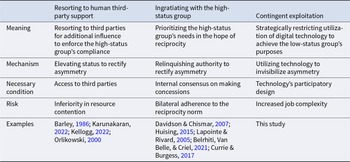
Previous research reveals two primary strategies for low-status professionals to elicit high-status compliance: resorting to human third-party support and ingratiating with the high-status group (e.g., Huising, Reference Huising2015; Karunakaran, Reference Karunakaran2022). We summarize these two strategies and interpret their underlying mechanisms (Table 2).
Table 2. Strategies for the low-status group to improve coordination with the high-status group

Both strategies can be successful by rectifying status–authority asymmetry. The resorting strategy works by elevating the status of the low-status group with the help of additional influence, thereby reducing the asymmetry. However, this approach requires access to third parties and carries the risk of resource contention. Alternatively, the ingratiating strategy works by having the low-status group relinquish authority to reduce asymmetry and elicit compliance from the high-status group through reciprocity. This approach requires internal consensus on making such concessions and carries the risk of unreciprocated returns.
Our findings reveal a third approach: contingent exploitation of digital technologies mitigates the hindrance of status–authority asymmetry on cross-functional coordination without directly rectifying the asymmetry itself. By invisibilizing asymmetry in technology-mediated interactions, this strategy enables low-status professionals to exert functional authority without triggering high-status professionals’ direct evaluation of the regulator’s status and authority. Technology serves as a buffer, reducing the salience of status differences and facilitating compliance. However, contingent exploitation requires participatory technology design that allows the low-status group to manipulate coordination processes. It also increases job complexity, transforming simple, structured work into strategic, flexible coping that considers both technological capabilities and high-status group reactions.
This contribution is particularly relevant in Eastern healthcare systems, where professional hierarchies are especially rigid due to earlier specialization in medical education and more separated professional training tracks compared with Western healthcare systems (Gauld, Asgari-Jirhandeh, Patcharanarumol, & Tangcharoensathien, Reference Gauld, Asgari-Jirhandeh, Patcharanarumol and Tangcharoensathien2018; Yu, Zhang, Zhang, & Wang, Reference Yu, Zhang, Zhang and Wang2020). Our strategy offers a viable path for low-status professionals to navigate status inferiority challenges while enhancing high-status professionals’ willingness to cooperate.
Extending technological adaptation in conflicting social contexts
Technological adaptation research typically focuses on individual users and technology characteristics (e.g., Bala & Venkatesh, Reference Bala and Venkatesh2016; Burton-Jones & Grange, Reference Burton-Jones and Grange2013; Chen, Guo, Guo, & Li, Reference Chen, Guo, Guo and Li2022), with limited attention to social contexts involving potential conflict. The prevailing implication encourages users to maximize technology utilization and reinvent technology for personal goals (e.g., Leonardi, Reference Leonardi2011; Nevo, Nevo, & Pinsonneault, Reference Nevo, Nevo and Pinsonneault2016). This approach is inadequate in cross-functional contexts where professional groups pursue disparate and potentially conflicting objectives. We contribute to the literature by revealing the necessity of including other workers influenced by technology implementation within the research scope. Furthermore, our findings highlight the importance of strategic coping that involves anticipating other workers’ reactions rather than pursuing self-centric technology utilization.
This contribution addresses the growing complexity of digital transformation, where conflicting demands and tensions are increasingly common. Recent research on Chinese enterprises has identified various tensions during digital transformation (Liu, Dong, & Jiao, Reference Liu, Dong and Jiao2025; Liu, Xiao, & Sheng, Reference Liu, Xiao and Sheng2023). We join this conversation by revealing that medical functions face goal conflicts and coordination challenges during technology implementation, thereby contributing to a broader understanding of how organizations navigate the complex intersection of rapid technological adoption and entrenched status hierarchies.
Practical Implications
This study has three practical implications. First, organizations undergoing digital transformation should recognize informal status differences between formally horizontal functions as a critical factor impeding adaptation. While policy support and consensus exist regarding technology benefits, localized adaptation remains essential for realizing technology’s potential in improving work efficiency and effectiveness (Asthana et al., Reference Asthana, Jones and Sheaff2019; Bach, Kessler, & Heron, Reference Bach, Kessler and Heron2008; Greenhalgh et al., Reference Greenhalgh, Wherton, Shaw, Papoutsi, Vijayaraghavan and Stones2019; Kellogg, Reference Kellogg2022). When traditional coordination mechanisms collapse, functions struggle to establish new equilibria, making informal status differences particularly consequential. Our findings highlight the importance of contingent approaches to coordination problems rooted in status differences. Digital technology implementation should balance compliance enforcement with flexibility based on issue characteristics.
Second, healthcare management can leverage strategic technology implementation to enhance interprofessional collaboration. Healthcare requires interprofessional collaboration to develop specialized ideas and cross-validate treatment plan safety and effectiveness (Belrhiti et al., Reference Belrhiti, Van Belle and Criel2021; Currie et al., Reference Currie, Burgess and Hayton2015; Hall, Reference Hall2005; Melby & Hellesø, Reference Melby and Hellesø2014). This study highlights a method to enhance information exchange among different professions using digital technologies. Our discovery reveals that with strategic design and utilization, digital technology could serve as an effective communication medium, enhancing bilateral learning and mutual understanding among medical professionals.
Third, this study has implications for pharmaceutical care in China. As pharmaceutical services in China shift toward patient-centered care (Liu, Chen, et al., Reference Liu, Chen, Zhang, Zhao, Ao, Qu and Zhang2023; Yu, Kang, Tian, Wang, & Huang, Reference Yu, Kang, Tian, Wang and Huang2017), pharmacists may face role transition challenges in clinical practice (Deng et al., Reference Deng, Lu, Liang, Zeng, Li, Lu and Xu2023). Our research suggests that pharmacists should develop both pharmacological expertise and digital literacy competencies to assert their professional value in clinical decision-making. Pharmacy departments also should strengthen targeted training programs to support this transition and promote value-added pharmaceutical care (He, Hu, Yao, Xu, Dai, & Dai, Reference He, Hu, Yao, Xu, Dai and Dai2024; Jin, Huang, Xi, & Chen, Reference Jin, Huang, Xi and Chen2023; Li, Cao, Sun, Jiang, & Liu, Reference Li, Cao, Sun, Jiang and Liu2020).
Limitations and Future Research Directions
This study has several limitations and opportunities for future research. First, our findings may not generalize to contexts lacking clearly defined status differences or where relative status changes over time. The same profession in different organizations may also have different statuses compared to other intra-organizational functions, such as graphic designers in branding agencies and manufacturing companies. Thus, future research can explore status conferrals as contingencies affecting contingent exploitation’s influence on cross-functional coordination.
Second, we lack direct empirical evidence of the invisibilizing mechanism of contingent exploitation. In our interviews, we asked how doctors viewed pharmacists and their work; however, few doctors answered the questions due to courtesy and ethical concerns. However, future quantitative studies using surveys and experiments could test this mechanism more rigorously. Additionally, future research can examine whether involving high-status professionals in technology design changes the coordination mechanism and the technological adaptation process.
Finally, the confidentiality of prescription data and the lack of coordination records prevented our collection of non-intrusive data, limiting our demonstration of cross-functional coordination improvement. Future research is needed to confirm the coordination outcomes using objective measures.
Data availability statement
The authors confirm that the data supporting the findings of this study are available within the article’s supplementary materials.
Acknowledgements
The authors thank all medical professionals in The Second Affiliated Hospital, Zhejiang University School of Medicine who kindly gave access and participated in this research. The authors would like to express deep gratitude to Senior Editor Wei He and three anonymous reviewers for their valuable and insightful comments. We are also grateful for the opportunity to present this work at the inaugural MOR Paper Development Workshop and the 2023 Digital Healthcare Management Doctoral Students Forum. Special thanks to Han Li and Yuting Chen for their constructive feedback.
Funding statement
This research was supported by Grant No. 72232009 awarded to X.-Y.X., Grant No. 72272134 awarded to Q.H. from the National Natural Science Foundation of China, and Fundamental Research Funds for the Central Universities (226-2024-00232).
Xiao-Yun Xie (xiexy@zju.edu.cn) is a full professor of management at Zhejiang University. His current research focuses on organizational design, human-AI teaming, and human-technology interaction in digital contexts. He serves as Editor-in-Chief of the Journal of Digital Management, director of the Digital Intelligence Innovation and Management Laboratory at Zhejiang University, and director of the Zhejiang–Hong Kong Human–AI Collaboration and Organizational Transformation Laboratory.
Chencan Ye (yechencan@zju.edu.cn) is a PhD candidate in organizational behavior at Zhejiang University, School of Management. She focuses on digitalization-induced organizational change, with particular interests in human–technology interaction and cross-functional coordination.
Qingjing Hu (qjhu@zju.edu.cn) is an associate professor at the School of Management, Zhejiang University, and a core member of the Digital Intelligence Innovation and Management Laboratory at Zhejiang University. His research interests focus on leadership, status, and team dynamics. Recently, he has begun to explore these topics in digitalization contexts. His work has appeared in journals such as the Academy of Management Journal, Journal of Business Venturing, and Human Relations.
Wei He (2198039@zju.edu.cn) is a chief pharmacist and the assistant director at the Department of Pharmacy, the Second Affiliated Hospital of Zhejiang University School of Medicine, and a clinical pharmacy preceptor of respiratory medicine certified by the National Health Commission. Her research focuses on neuropharmacology, respiratory clinical pharmacy, and pharmaceutical administration. She currently serves as the vice chairman of the Precision Medication Branch of the Chinese Aging Well Association.
Haibin Dai (haibindai@zju.edu.cn) is a professor at the Second Affiliated Hospital of Zhejiang University School of Medicine and the director of the Department of Pharmacy. He received his PhD from Zhejiang University and was a visiting scholar at Harvard Medical School. His research focuses on neuropharmacology and clinical pharmacy, and has published over 70 SCI papers as first/corresponding author. He serves as Editor-in-Chief of Precision Medication.