


Introduction
Gender balance in political life is desirable for many reasons. Not only does it improve descriptive (Mansbridge, Reference Mansbridge1999) and substantive representation, but it also enhances the sense of efficacy (Atkeson & Carrillo, Reference Atkeson and Carrillo2007) and legitimacy among citizens (Karp & Banducci, Reference Karp and Banducci2008) and contributes to higher levels of satisfaction with democracy (Clayton et al., Reference Clayton, O'Brien and Piscopo2019). Democratic outcomes benefit from the presence of women: heterogeneity leads to a healthier quality of deliberation (Cowan et al., Reference Cowan, Thompson and Ellsworth1984) and the inclusion of women offers better prospects in peace negotiations (Nagel, Reference Nagel2021). Yet, women are still underrepresented in most legislative bodies across the world. In the European Union, the proportion of women in parliaments in 2020 was 32 per cent, while the total female population was 51 per cent. Similar gaps exist in the Americas: the ratio of women in legislatives was 34 per cent versus 50 per cent in the population in Latin America and 28 per cent versus 50 per cent in North America. Although global trends are upwards, with an overall increase of 14 per cent in the proportion of seats held by women between 1997 and 2020, the balance is far from what one could call a fair gender representation. If not a demographic minority, women are a minority in politics. A large body of research has addressed women's political participation and explored how institutions, context and personal characteristics impact on it. However, it is only recently that research has started addressing the role of campaign financing in the gender representation gap. Our study sheds light on the extent to which women suffer from lower campaign budgets and explores how contextual elements aggravate or alleviate it.
One of the reasons behind the underrepresentation of women has to do with the disproportionally large costs that they face when running for office. First, there are material costs. As women tend to be newcomers, they are generally unable to rely on well‐established patronage networks and suffer a disadvantage when it comes to fundraising (Piscopo et al., Reference Piscopo, Hinojosa, Thomas and Siavelis2022). Second, they face the psychological and reputational costs of sexist attacks, stereotyping and media bias (Cassese & Holman, Reference Cassese and Holman2018; Valentino et al., Reference Valentino, Wayne and Oceno2018; Van der Pas & Aaldering, Reference Van der Pas and Aaldering2020). The literature on the latter type of costs has covered a considerably large number of countries outside the United States and combined single country studies – which remain more common – with comparative evidence (e.g., Kittilson & Fridkin, Reference Kittilson and Fridkin2008; Lühiste & Banducci, Reference Lühiste and Banducci2016; van der Pas, Reference Pas2022). Regarding the study of material costs in campaign processes, Muriaas et al. (Reference Muriaas, Wang and Murray2020) and Murray et al. (Reference Murray, Muriaas and Wang2023) considerably advance our understanding of electoral financing and its implications for gender‐balanced political representation. However, comparative studies of campaigning have paid very little attention to gender (De Winter et al., Reference De Winter, Karlsen and Schmitt2021). The campaign finance literature – particularly outside the Unites States – has focused on differential effects for challengers and incumbents (Benoit & Marsh, Reference Benoit and Marsh2008, Reference Benoit and Marsh2010; Maddens et al., Reference Maddens, Wauters, Noppe and Fiers2006), how much money matters (Benoit & Marsh, Reference Benoit and Marsh2003, Reference Benoit and Marsh2010; Cox & Thies, Reference Cox and Thies2000; Johnston & Pattie, Reference Johnston and Pattie2008), and how spending impacts electoral participation (Cancela & Geys, Reference Cancela and Geys2016; Geys, Reference Geys2006), but has largely overlooked the gendered nature of campaign finance. This is despite female candidates mentioning lack of campaign financing and limited support from parties as key deterrents for women to enter politics (IPU, 2008). We try to fill the lacuna by investigating the resource gap using the wealth of data from the Comparative Candidates Survey (CCS). Integrating candidates’ self‐reported campaign experience with institutional and contextual data, we account for macro, meso and micro level elements to explain the extent to which parties, electoral rules and contextual idiosyncrasies disadvantage women when they contest elections. In so doing, we bridge two literatures that sit at different tables: one centring on institutions and women's political participation, and another on campaign financing. Political processes such as recruitment (Kenny, Reference Kenny, Krook and Mackay2011; Lawless & Fox, Reference Lawless and Fox2005, Reference Lawless and Fox2010; Norris & Lovenduski, Reference Norris and Lovenduski1995) and campaigning (Herrnson et al., Reference Herrnson, Lay and Stokes2003) not only are key to the understanding of gender imbalances, but they also have shed light on how the gap could be closed. Campaigns are at the core of electoral processes and identifying the extent to which the electioneering experience of male and female candidates differs is vital to addressing gender underrepresentation in parliaments. By untangling what widens and what closes the gender resource gap, we highlight what caveats need to be considered when designing interventions. It is bearing in mind the potential for data‐driven policy recommendations, that we explore the gender resource gap in electioneering activity, using data from over 7000 candidates in 16 countries across 28 elections.
We find unequivocal evidence of a gender resource gap across countries, as female candidates spend significantly less on their electoral campaigns than their male counterparts. We also find that this financial disparity is conditioned by factors at both the individual and contextual levels. Our findings reveal that incumbency exasperates the gender resource gap, as the financial disadvantage of female candidates is significantly bigger – but possibly less consequential – among incumbents than challengers, and the gendered resource gap is bigger in parties that enforce voluntary gender quotas than those that do not. With regard to budget composition, party contributions tend to constitute a bigger part of female candidates’ campaign budgets than they do for male candidates, while the opposite holds for candidates’ own funds. Our findings indicate that campaign finance regimes should be revised to correct a systematic bias against female candidates. Measures, such as voluntary party quotas, are ineffective if not supported by substantively boosting women's campaign resources. The intervention needs to be conspicuous as women have systematically less campaign money at their disposal.
The article is organised as follows. In the next section, we review the literature and formalise testable hypotheses on how macro, meso and micro level factors deepen or close the gender gap in campaign resources. We then move to outlining the data and empirical approach used. This is followed by our empirical findings. The article ends with concluding remarks on how our results speak to the wider literature, and their relevance for future research and policy interventions.
The resource gap in campaign financing
Studies of voter, media and party biases have mapped the determinants, aggravating factors and consequences of underrepresentation, contributing knowledge to both the academy and the adoption of policy solutions. The literature on political ambition has unveiled societal, financial and motivational barriers inhibiting women running for office. Evidence comes primarily from the United States, where scholars have systematically detected a gender gap in political recruitment by party officials and party leaders (Fox & Lawless, Reference Fox and Lawless2010; Lawless, Reference Lawless2012). Relying on a pool of potential candidates, Lawless (Reference Lawless2012) finds that women are 18 per cent less likely than men to be asked to run for office by party agents, highlighting how the political ambition gap is rooted in lack of support for women. However, some studies have showed that once women do enter the political arena, their fundraising efforts are as good as men's (Hogan, Reference Hogan2007). The extent to which women suffer from a fundraising disadvantage has sparked a lively debate among Amaericanists (Barber et al., Reference Barber, Butler and Preece2016; Crespin & Deitz, Reference Crespin and Deitz2010; Thomsen & Swers, Reference Thomsen and Swers2017). Some point to the idea that no difference in campaign effort should be expected across genders: women are as good as men at fundraising and campaigning more in general. Yet, in high‐budget campaign environments like Congressional elections, despite no fundraising gap between men and women, donor pools are found to be gendered and highly ideological (Thomsen & Swers, Reference Thomsen and Swers2017). Male and female candidates may gather equal amount of funds, but the money comes from different sources. This has also proven to be true outside the United States (Tolley et al., Reference Tolley, Besco and Sevi2022), providing support for the idea that dedicated women networks help female candidates. Whether these mechanisms are enough to fill the resource gap remains to be seen. Also, an overwhelmingly United States‐based literature cannot speak for the impact of systemic and contextual factors.
Until very recently, studies from other contexts were scarce. Evidence from Italy (Feo et al., Reference Feo, Fiorelli and Piccio2023), Brazil (Janusz et al., Reference Janusz, Barreiro and Cintron2022), Chile (Piscopo et al., Reference Piscopo, Hinojosa, Thomas and Siavelis2022), Ireland (Buckley & Mariani, Reference Buckley and Mariani2023), Belgium (Wauters et al., Reference Wauters, Weekers and Maddens2010), Israel (Atmor et al., Reference Atmor, Harsgor and Kenig2023) and the United Kingdom (Murray, Reference Murray2023) show unambiguously that raising campaign funds is harder for women. This seems to be the case in different countries, under different electoral laws, and within different party systems. Although the evidence comes from single country studies rather than designs with systematic comparisons, taken together, these findings reinforce the idea that women do suffer a resource gap when running for office. After all, a closed gap has only been found in the United States (Hogan, Reference Hogan2007), offering a partial picture that seems to translate poorly to different contexts.
Campaigning requires time and is more successful when better resourced, with a substantive body of studies demonstrating that money matters in determining electoral results across contexts, electoral and party systems (Benoit & Marsh, Reference Benoit and Marsh2003, Reference Benoit and Marsh2008; Maddens et al., Reference Maddens, Wauters, Noppe and Fiers2006; Palda, & Palda, Reference Palda and Palda1998; Pattie et al., Reference Pattie, Johnston and Fieldhouse1995; Sudulich et al., Reference Sudulich, Wall and Farrell2013; Trumm, Reference Trumm2016, Reference Trumm2022). No comparative study has addressed the actual experience of campaigns and what barriers women may encounter in securing the resources needed when running for office. This means that, while we know that money matters independently from electoral rules and party systems, we do not know if the gender gap in campaign financing depends on them. Obviously, the amount of campaign funds invested in electioneering varies considerably across contexts: congressional campaigns in the United States require multimillion investments, while under capped regimes – like in the United Kingdom – a few thousand pounds can be decisive. Campaign finance reporting regimes also vary considerably from country to country, making global assessment difficult to perform. Is this variation meaningful for the gender resource gap?
We begin by seeking confirmation that a significant gender gap in campaign resources exists. Although there is little doubt around it, we expand on existing knowledge by testing its significance and estimating its size. We formalise this as our first research hypothesis:
H1: Female candidates dispose of fewer campaign resources than male candidates.
Macro level
Crucially, institutions define the structure of available opportunities and the extent to which processes and outcomes may be gendered. Specifically, in the case of electoral institutions, evidence shows that proportional systems – intrinsically suited to produce fairer representation – do indeed deliver more gender balanced legislatives (Krook, Reference Krook, Herron, Pekkanen and Shugart2018), and that women are more likely to run as list candidates in mixed systems that utilise both list and direct candidacy (Coffee & Davidson‐Schmich, Reference Coffee and Davidson‐Schmich2020). Institutional and electoral incentives offered by the two types of systems condition political ambition, aggravating women’ reluctance to run as district candidate. The electoral incentives under PR systems lower the costs of change for parties, so that changing their old ways and placing more women on the ballot becomes more acceptable. Similarly, the cost of electioneering for individual candidates is less onerous. As such, electoral systems pertaining to proportional traditions seem more likely to create the conditions under which more women can get elected (outcome). However, do they do so by closing the electoral finance gap (process)? If gender neutral outcomes are to be welcome, whether their delivery happens though gendered processes must be understood and, ideally, rectified. As such, we need to explore which electoral laws and regulations are more suited to closing the finance gap. What is said above about parties putting forward more female candidates and women feeling more comfortable running in list systems still does not necessarily mean that female candidates in PR systems can avail of resources matching those of male candidates.
Some crucial differences between PR systems must also be considered. Murray et al. (Reference Murray, Muriaas and Wang2023) reiterate in their collection that PR systems are better for women's chances to get elected, but also note how not all proportional systems are the same. Allik (Reference Allik2015) concludes that closed list systems do not improve women's representation as they tend to be placed lower in the party list, echoing Matland and Taylor (Reference Matland and Taylor1997), who expose parties’ general reluctance to nominate female frontrunners. Women tend to be elected at a greater rate where party magnitude – the expected party seat share – is larger, since they rarely occupy top party list positions. In open list systems, voters have the opportunity of changing candidate rankings and pick those they prefer, creating stronger incentives for candidates to distinguish themselves from their competitors and build a personal ‘brand’. For example, under Single Transferable Vote (PR‐STV), voters rank – if they so wish – all candidates, maximising competitiveness at the individual level, among and within parties. As such, instead of looking at the effects of PR versus Single Member District (SMD), we approach the effects of electoral institutions by looking at the incentives they create for candidates to cultivate a personal vote (Carey & Shugart, Reference Carey and Shugart1995). This is particularly relevant when assessing the effects of electoral institutions on the gender finance gap, because not only it tests whether there is a difference between majoritarian and proportional systems, but it also accounts for the extent to which voters can alter the party ranking and district magnitude, all in one measure. Incentives to cultivate a personal vote result in candidates bearing higher costs – time and resources – of campaigning, with Sudulich and Trumm (Reference Sudulich and Trumm2019) estimating an average increase of three hours of campaigning per week when moving from low to high incentives to cultivate a personal vote. Time and resources tend to go hand in hand. As such, we expect women to experience a larger resource gap in systems that place more emphasis on incentives to cultivate a personal vote.
H2: The gender resource gap is moderated by electoral incentives to cultivate the personal vote: the stronger the incentive, the larger the gap.
Meso level
When it comes to electoral processes, institutions define the rules of the competition, but it is up to the teams to select players and devise a successful strategy. Parties differ greatly from one another depending on ideology, national context and size.
The way the role of women in society is viewed by parties is a good proxy for their commitment to gender balanced representation. Progressive parties have more egalitarian values and hold less traditional views of women in the workforce and in society more generally. One of the ideological pillars of leftist parties is egalitarianism, which has translated into being traditionally at the forefront of electing more women: for example, in the United Kingdom, the Labour Party generally puts forward higher percentages of female candidates than the Conservative Party. Similarly, the Democratic Party in the United States and left‐leaning parties in Europe have generally achieved higher ratios of female representatives than right‐wing parties (Crowder‐Meyer & Lauderdale, Reference Crowder‐Meyer and Lauderdale2014; Weeks et al., Reference Weeks, Coffe, Meguid and Kittilson2022). However, parties are rational actors and would seize an opportunity when they see one. Weeks et al. (Reference Weeks, Coffe, Meguid and Kittilson2022) show that radical right populist parties, which certainly do not promote feminist values, put forward more female candidates when facing electoral losses to capitalise on the female vote. Female politicians have also been leading right wing populist parties in France (Marine Le Penn), Italy (Giorgia Meloni) Germany (Petry in 2015–2017), Poland (Szydlo) and Denmark (Kjaersgaard), but this has not necessarily translated into a targeted effort to elect more female representatives. The extent to which this latest trend may impact upon the gender resource gap is unknown. While acknowledging it, we expect to find a smaller resource gap where the commitment to gender equality is stronger:
H3: The gender resource gap is moderated by ideology: the gap is smaller for candidates on the left than for candidates on the right.
Procedurally, parties operate according to self‐imposed rules and practices with considerable variation due to ideological position, internal and territorial organisation. Historically, candidate selection procedures lack transparency (Gallagher & Marsh, Reference Gallagher and Marsh1988) and, where sufficient information exists, the picture is one of a consistent status quo bias that inevitably favours male candidates. Traditionally, and globally, selectorates tend to have conservative preferences that create a hospitable environment for affluent, older white males (Fox & Lawless, Reference Fox and Lawless2010; Niven, Reference Niven1998). When parties introduce voluntary quotas, candidate selection outcomes are gender balanced, although context and history condition their effects (Verge & Espírito‐Santo, Reference Verge and Espírito‐Santo2016). The effects of quotas are mostly researched regarding their natural outcome: the election of more women (Schwindt‐Bayer, Reference Schwindt‐Bayer2009) and, while some studies have looked at their effects on substantive representation (Franceschet & Piscopo, Reference Franceschet and Piscopo2008; Weeks & Masala, Reference Weeks and Masala2023), their implications for the resource gap remain unclear. The introduction of quotas has produced non‐linear results on the resource gap. When assessing their impact over time, Crespin and Deitz (Reference Crespin and Deitz2010) find that initially (low) quotas closed the gap, but subsequently they widened it for those female candidates with slim chances of success. Lacking longitudinal data, we address the moderating effects of voluntary quotas by relying on the expectation that parties’ self‐imposed measures to reach gender parity should signal commitment to closing the resource gap. We expect parties to ‘put their money where their mouth is’:
H4: The gender resource gap is moderated by voluntary party quotas: the gap is smaller for candidates running for parties that have adopted such quotas.
Micro level
Finally, having considered variation in electoral rules and parties, we need to consider the candidate herself. We know that incumbents and challengers differ greatly in their capacity for fundraising. Incumbents dispose of various highly valuable assets. A large and predominantly American literature has dealt with this (e.g., Campbell, Reference Campbell1983; Carson et al., Reference Carson, Engstrom and Roberts2007; Druckman et al., Reference Druckman, Kifer and Parkin2020; Fouirnaies & Hall, Reference Fouirnaies and Hall2014). First, sitting MPs have power. Obviously, the specific context dictates how much power they have and its reach, but in general incumbents take decisions and make policies. In doing so, they engage in political networking activities that involve privileged access to potential donors. Second, by occupying political office, they avail of resources, such as staff and media coverage, that can have great value when campaigning for re‐election. Third, their names tend to be known to voters, which is a particularly strong benefit in low information elections. All these contribute to making incumbents more successful when seeking re‐election, enjoying what is known as the incumbent advantage. Although only few studies have addressed the relationship between gender and incumbency status, their conclusion is that the incumbency advantage serves women as much as men (Smrek, Reference Smrek2020) and, in cases of Chile (Piscopo et al., Reference Piscopo, Hinojosa, Thomas and Siavelis2022) and Colombia (Gamboa & Morales, Reference Gamboa and Morales2021), find that incumbency status can close the gender resource gap. It is reasonable to expect the gender resource gap to be narrower among incumbents than challengers:
H5: The gender resource gap is moderated by incumbency status: the gap is larger among challengers than incumbents.
Having formalised our expectations on the gender gap in campaign resources (H1), and on what elements may moderate it (H2 to H5), we turn to our final test that looks at how this gap might take form. Digging deeper into where campaign resources come from, we develop expectations on three sources: party, donors and own funds.
The most straightforward expectation is that female candidates rely less on personal resources than their male counterparts. First, an overall and persistent gender pay gap means that women, on average, have less resources than men. Second, engaging in campaigning means losing revenue to a greater extent for women than it does for men (Ballington, Reference Ballington2008). Regarding party contributions, the matter is more complex. We know that discriminating mechanisms are well‐documented (Lawless, Reference Lawless2012; Lawless & Fox, Reference Lawless and Fox2010) and parties may still disproportionately support male candidates. However, more women are running for office and some parties have made considerable efforts like self‐imposed quotas (Weeks et al., Reference Weeks, Coffe, Meguid and Kittilson2022). Buckley and Mariani (Reference Buckley and Mariani2023) find that Irish parties, after the introduction of gender quotas, increased expenditure on female candidates. Although promotion of female candidates is certainly not the norm, outright discrimination in the allocation of party resources may not be the standard either, or at least no longer. Political institutions remain male‐dominated where women face the additional cost of needing to access highly homogenous environments. Hassell and Visalvanich (Reference Hassell and Visalvanich2019) find that parties in the United States support women to a greater extent than men to compensate for the extra costs that female candidates tend to face when they engage in a campaign. This is what they call the party promotion hypothesis, holding for the United States Congress’ primary elections in 2010 and 2014. Again, using data from the United States, Crespin and Deitz (Reference Crespin and Deitz2010) find that, when relying on female donor networks, women can outspend men. Conversely, other contexts have showed that women are at a disadvantage when it comes to fundraising (Piscopo et al., Reference Piscopo, Hinojosa, Thomas and Siavelis2022), with female politicians less likely to hold executive offices that provide access to resources that sustain clientelism (Franceschet & Piscopo, Reference Franceschet and Piscopo2014), as well as in their ability to draw on personal resources (Murray, Reference Murray2023). While not ideal for determining whether parties support female candidates to a greater or lesser extent than male candidates, our data can dig into the distribution of budget sources. We expect the composition of the budget to be different across male and female candidates, with male candidates relying more on mobilising personal resources and donor contributions, while female candidates on their party's financial support, as they lack those extensive patronage networks and private resources as their male counterparts.
H6: We expect that (a) personal resources account for a smaller proportion of female candidates’ campaign budgets when compared to male candidates’ campaign budgets, (b) donations account for a smaller proportion of female candidates’ campaign budgets when compared to male candidates’ campaign budgets and (c) party contributions account for a bigger proportion of female candidates’ campaign budgets when compared to male candidates’ campaign budgets.
Data and methods
We evaluate our theoretical expectations using information on candidates running for office in parliamentary elections. The main source of this information is the CCS project.Footnote 1 It brings together a range of national candidate studies and uses a common core questionnaire to allow for cross‐country comparisons. We use CCS data to capture candidates’ personal and political profiles, as well as their campaign resources.Footnote 2 We combine these data with information on parties’ ideological positioning from the Comparative Manifesto Project (Lehmann et al., Reference Lehmann, Franzmann, Burst, Refel, Riethmüller, Volkens, Weßels and Zehnter2023), information on voluntary party‐level gender quotas from the Gender Quotas Database (International IDEA, 2023), information on legislative quotas from the Quota Adoption and Reform over Time Database (Hughes et al., Reference Hughes, Paxton, Clayton and Zetterberg2017, Reference Hughes, Paxton, Clayton and Zetterberg2019) and on countries’ electoral rules from their national electoral commissions. The merging of data from different sources allows us to evaluate the relevance of individual‐level, party‐level, as well as country‐level factors in shaping the size of the gender resource gap.
Dependent variables
The CCS includes a series of questions around candidates’ campaign budget. We rely here on the survey questions that ask candidates about their overall campaign spending as well as the sources of their funds. Taken together, they provide insight into the extent to which a resource gap exists and how different funding sources feed into it. First, we capture candidates’ overall campaign budget. We do so by taking their self‐reported campaign spending and adjust it using purchasing power parities to eliminate any differences in price levels both between countries and over time.Footnote 3 This yields us a measure of purchasing power parity adjusted campaign spending in Euros (campaign budget), providing a useful comparative indicator of the level of financial resource different candidates used.
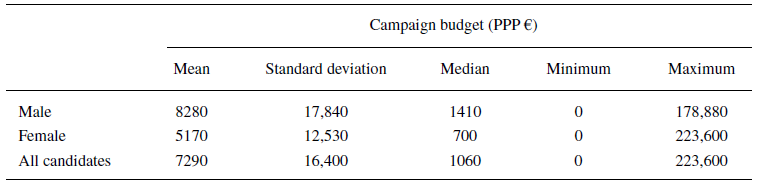
Table 1 summarises the level of campaign spending by candidates, both aggregate and by gender.Footnote 4 We report the mean campaign budget and, given the large number of candidates who spent very little on their campaign and some who spent a lot, the median. In addition, we present the range of candidates’ campaign spend and the associated standard deviation. Note first that the average campaign spend is relatively low. The mean campaign spend across all candidates is €7290 and, when looking at the median, it drops to as low as €1060 per candidate. What is perhaps even more interesting, however, is the difference between female and male candidates. There is an initial indication that a resource gap – and a rather significant one, in fact – between female and male candidates indeed exists. We find the average campaign budget for female candidates to be €3110 lower than it is for male candidates (€5170 vs. €8280). A similar pattern also emerges when looking at their median spend. The figure is more than twice as high for male candidates than it is for female candidates (€1410 vs. €700).
Table 1. Descriptive statistics on campaign budget

Next, we look at the composition of candidates’ campaign budget. We do so through a series of three separate, but interlinked, variables. Party captures the ratio of party contributions within candidates’ campaign budget. It is a continuous measure, operationalised as the per cent of campaign budget made up of party contributions, ranging from 0 to 100. A score of 0 would mean that none of a candidate's campaign expenditure came from her party, and a score of 100 would mean that a candidate's entire campaign expenditure came from her party. Donations measures the ratio of donations and Own captures the percentage of the campaign that is self‐funded. These three variables are connected. A change in one corresponds to a change in the other two. Therefore, taken together, the variables must add up to 100 per cent, corresponding to the entirety of one's campaign spending.Footnote 5
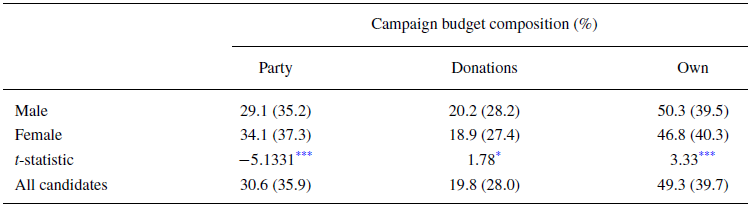
Table 2 shows the breakdown of different funding sources in candidates’ campaign budget. We find a clear hierarchy, with candidates’ private funds making up on average almost half of their overall campaign spending (49.3 per cent), followed by party funds (30.6 per cent) and donations (19.8 per cent). There are significant differences along gender lines though when comparing the importance of different funding sources for male and female candidates. Party contributions tend to make up a higher proportion of female candidates’ campaign budget than they do for male candidates (34.1 per cent vs. 29.1 per cent), with the difference being statistically significant (t = –5.13, p < 0.01). Donations make up a slightly larger part of male candidates’ campaign budget than they do for their female counterparts (20.2 per cent vs. 18.9 per cent), but the difference here is only statistically significant at 90 per cent level (t = 1.78, p < 0.1). The gap is larger and significant (t = 3.33, p < 0.01) for the percentage of campaign budget coming from own funds, amounting to 50.3 per cent for male candidates versus 46.8 per cent for female candidates.
Table 2. Descriptive statistics on campaign budget composition

Note: Standard deviations in parentheses. *p < 0.1; **p < 0.05; ***p < 0.01.
Explanatory variables
Beginning with the macro level, we classify electoral systems following the seminal study of Farrell and Scully (Reference Farrell and Scully2007), which operationalises electoral incentives as a cumulative score of: (i) ballot access, (ii) vote choice and (iii) district.Footnote 6 This measure captures the extent to which an electoral system creates incentives for candidates to cultivate a personal vote as part of their campaign effort. It ranges from 3 to 9, with higher values corresponding to greater incentives to cultivate a personal vote.Footnote 7
At the meso level, we include two party‐level indicators that might play a role in shaping the campaign resources of candidates. First, thinking about the role of ideology (H3), we capture party ideology through the RILE index of the Comparative Manifesto Project (Lehmann et al., Reference Lehmann, Franzmann, Burst, Refel, Riethmüller, Volkens, Weßels and Zehnter2023). It is a continuous measure that could in principle range from –100 (whole manifesto is devoted to ‘left’ categories) to +100 (whole manifesto is devoted to ‘right’ categories). The actual range of values for parties featuring in our analysis is from ‐64 to +73. Second, party quota is a binary variable that captures whether parties enforce voluntary gender quotas or not. It is coded 1 if they do and 0 if they do not, with these data derived from the Gender Quotas Database (International IDEA, 2023). It is likely that the presence of gender quotas influences parties’ candidate pool.
Finally, at the individual level, we include two explanatory variables. First, our key explanatory variable is female. It is coded 0 for male candidates and 1 for female candidates. In addition, we account for candidates’ political profile. Those who have an established political profile as elected representatives are likely to have an advantage when it comes to their capacity to fundraise. We operationalise incumbency as a dichotomous measure that distinguishes between those who run as incumbents (1) and those who run as challengers (0).
Control variables
We also include several control variables in our analysis. On the macro level, we account for legislative quota to capture whether the candidate runs in a country that has a legislative gender quota (coded 1) or not (coded 0).Footnote 8 Although existing evidence on the impact of legislative quotas on the gender resource gap is still sparse (for notable exceptions, see Gamboa & Morales, 2021; Maddens et al., Reference Maddens, Muyters and Put2023; Smulders et al., Reference Smulders, Put and Maddens2019), they may influence candidates’ campaign financing patterns. On the meso level, we include female leader to capture whether the candidate stands for a party with a female leader (coded 1) or not (coded 0). It is possible that access to campaign funds varies not only across male and female candidates, but also across parties led by male versus female leaders. On the micro level, we account for four control variables, pertaining to both candidates’ political and personal profiles. Party office is a dichotomous measure, coded 1 for those who have held regional or national party office and 0 for those who have not. Next to that, we control for candidates’ age. It is operationalised as a continuous measure that captures how old a candidate is at the time of the election. The intuitive expectation here is that older candidates have been able to build more extensive networks from which to draw greater campaign resources, and we test whether this holds in practice. We also control for education, which separates candidates who have a university degree (1) from those who do not (0) on the premise that university graduates enjoy an earnings premium that might influence their ability to access and raise more campaign funds (Britton et al., Reference Britton, Dearden, Erve and Waltmann2020). The last individual‐level measure that we control for is locality: we consider locals those who live in the constituency where they run (1) versus those who live outside the constituency (0). Candidates who are more embedded in the broader community they seek to represent may find it easier to raise financial support for their campaign from local businesses, interest groups, and so on.
Empirical strategy
Given the different data structures of our dependent variables, different estimation techniques are used to analyse variation in campaign spending and campaign budget composition.Footnote 9 First, we use ordinary least squares to examine variation in candidates’ campaign spending.Footnote 10 We run a baseline model without interaction terms, but also four separate models with interactions between female and: (i) electoral incentives, (ii) party ideology, (iii) party quota and (iv) incumbency. Second, we use compositional regression to examine how important different funding sources are in the make‐up of candidates’ campaign budgets.Footnote 11 This allows us to explain variation in the extent to which candidates’ campaign budgets are composed of party money, donations and their funds within a single multivariate model.
Findings
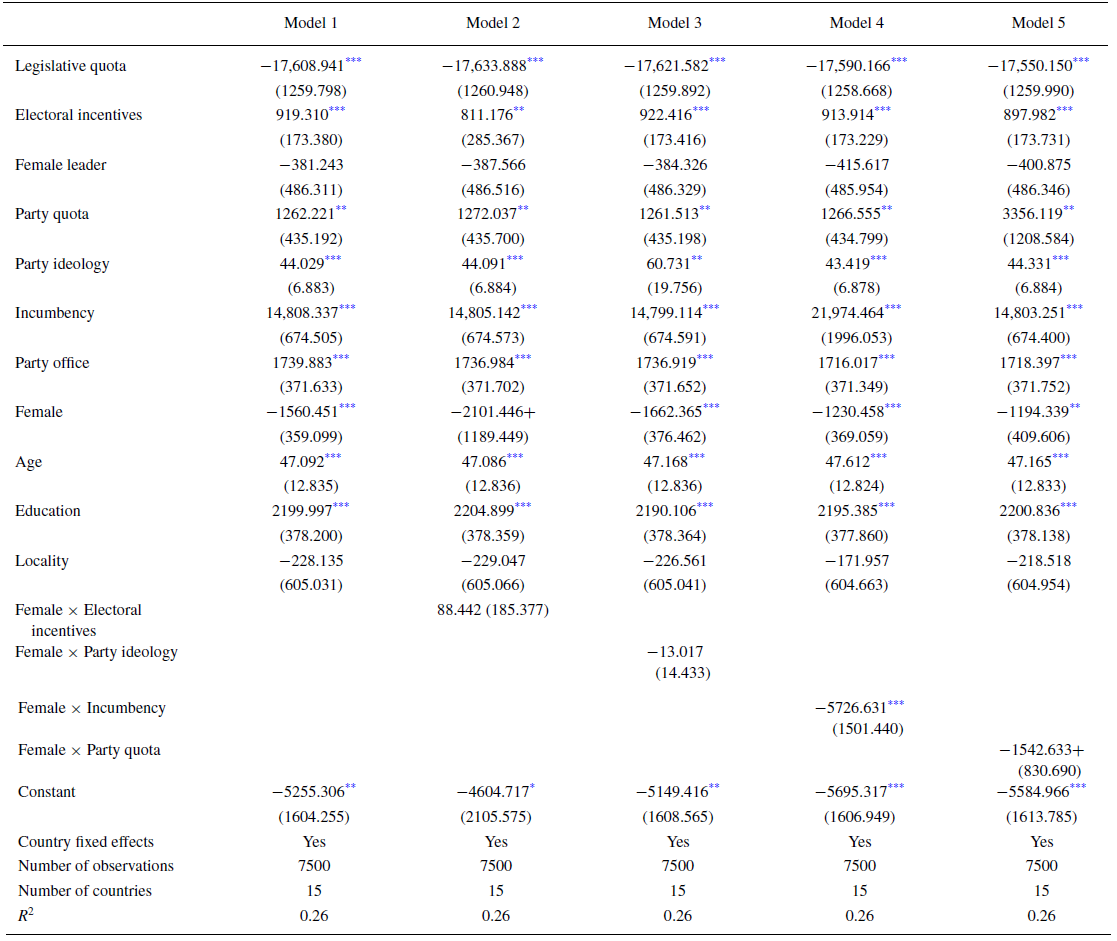
The first set of models, reported in Table 3, explains variation in how much money candidates spent on their campaign in total. Model 1 is the baseline model without interaction terms, with Models 2–5 including interactions between female and a variety of other explanatory variables.
Table 3. Explaining variation in campaign budget

Note: Standard errors in parentheses. +p < 0.1; *p < 0.05; **p < 0.01; ***p < 0.001.
In line with our theoretical expectation (H1), we find evidence of a gendered resource gap: female candidates tend to have more modest campaign budgets than their male counterparts. Predicted values based on the baseline model show female candidates to spend €3142 less on their campaign than male candidates (€5137 vs. €8279).Footnote 12 This clearly affects their ability to fund additional campaign activities. Although greater campaign spending is not a guarantee of electoral success, money clearly matters, and our findings provide cross‐national evidence that male candidates tend to have a substantial financial advantage.
Regarding the other variables, the positive coefficients for age and education suggest that, as expected, older candidates tend to dispose of higher campaign budgets and university‐educated candidates tend to spend more than those without a university degree do. We also find consistent evidence that candidates’ political profile matters. The stand‐out effect here is that of incumbency, with the positive coefficients showing that incumbents tend to spend much more than challengers. Predicted values based on the baseline model show incumbents to spend €18,926 more than challengers (€24,924 vs. €5998).Footnote 13 Political experience also matters; candidates who have held positions in their party organisations tend to spend more than those who have not, but the effect size is smaller here. Moving on, contextual factors also help us explain some of the variation in candidates’ campaign spending. The positive and significant coefficients for electoral incentives suggest that candidates tend to spend more when they are competing in electoral systems where they have stronger incentives to cultivate a personal vote. Predicted values based on the baseline model show candidates running in most candidate‐centred systems spending €8785 more than candidates running in most party‐centred ones.Footnote 14 At the same time, the negative and significant coefficients for legislative quota suggest that candidates tend to spend less in countries that have legislative gender quotas. Predicted values based on the baseline model show candidates running in countries with legislative quotas spending €3764 more than those running in countries without one.Footnote 15 Similarly, we find some evidence that party‐level factors affect how much money candidates end up spending as part of their campaign effort. The positive and significant coefficients for party quota and party ideology suggest that campaign spending tends to be higher for candidates whose parties have voluntary gender quotas and who run for parties with a more right‐leaning ideological profile, respectively. Predicted values based on the baseline model show candidates of parties that have a voluntary gender quota spending €1082 more than candidates of parties that do not have such a quota.Footnote 16 They also show that a 50‐point shift to the right from 0 to +50 (on the ideological spectrum that ranges from –100 ‘far left’ to +100 ‘far right’) is predicted to correspond to a €2874 increase in campaign spending, while a shift from 0 to –50 is predicted to correspond to a €2606 decrease in campaign spending.Footnote 17
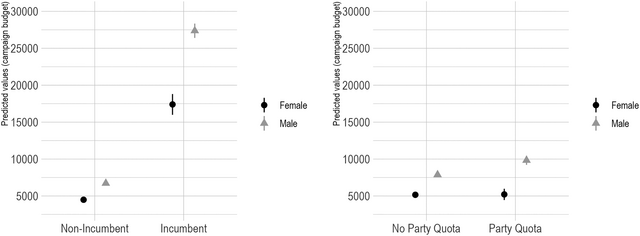
Focusing on the models with interaction effects, we fail to find support for H2 and H3. Although incentives to cultivate a personal vote correspond to higher campaign spending, they do not have differential effects for male and female candidates. We expected female candidates to be disproportionately disadvantaged under systems that strongly incentivise the personal vote, but this is not the case. Our expectation on party ideology is also falsified: if more proactive at promoting women's candidacy, leftist parties are no more supportive of their female candidates than right‐wing parties when it comes to campaign budgets. When testing H4 and H5 we find that the resource gap is moderated by incumbency and by the adoption of voluntary quotas, but in both cases not in the way we had expected. Not only is the gap larger among incumbents, but it is also larger among candidates whose parties have introduced voluntary quotas. Female incumbents tend to have substantially smaller budgets than male incumbents and so do female candidates whose parties use quotas. These are somewhat unexpected outcomes that we need to look closely at. To illustrate these effects and provide an intuitive comparison of the effect sizes, we show the predicted values for campaign budget in Figure 1, by incumbency and party quota. Although male challengers are predicted to spend €2227 more than female challengers (€6717 vs. €4490), the resource gap increases to €9975 for male versus female incumbents (€27,374 vs. €17,399). Incumbency indubitably brings electoral benefits for candidates. It is associated with greater name recognition, proven track record, ability to raise funds, and so on and these apply to both male and female candidates, but it translates into a disproportionately larger financial advantage for male candidates.

Figure 1. Predicted values for campaign budget.
The interactive effect between gender and party quotas is smaller in size, but also different in nature. The presence of voluntary party quota widens the gap between male and female candidates’ budgets. The gap is €2716 when candidates run for parties that do not use quotas (predicted values of €7876 and €5160 for male and female candidates, respectively), but goes up to €4618 when a quota is in place (predicted values of €9830 and €5212 for male and female candidates, respectively). An unintended consequence of having party quotas appears to be the widening of the gender resource gap. This is probably due to the larger number of female candidates. Quotas after all are supposed to increase the number of women running for office. We expected parties that actively commit to having more women on the ballot to display lower resource gaps among their candidates. However, our findings indicate that the presence of more female candidates does not necessarily mean that they are, on average, better resourced. It may be the case that parties that enforce quotas have larger numbers of female candidates with small budgets and still a considerable number of male candidates – possibly incumbents – with well‐resourced campaigns. Although this is contrary to the expectations in H4, it is in line with what Janusz et al. (Reference Janusz, Barreiro and Cintron2022) find in the case in Brazil; legislative quotas do not necessarily mean adequate financial support for female candidates. Our findings suggest that this is the case even when parties introduce quotas voluntarily. The compositional models should shed some light on what these unexpected trends may mean.
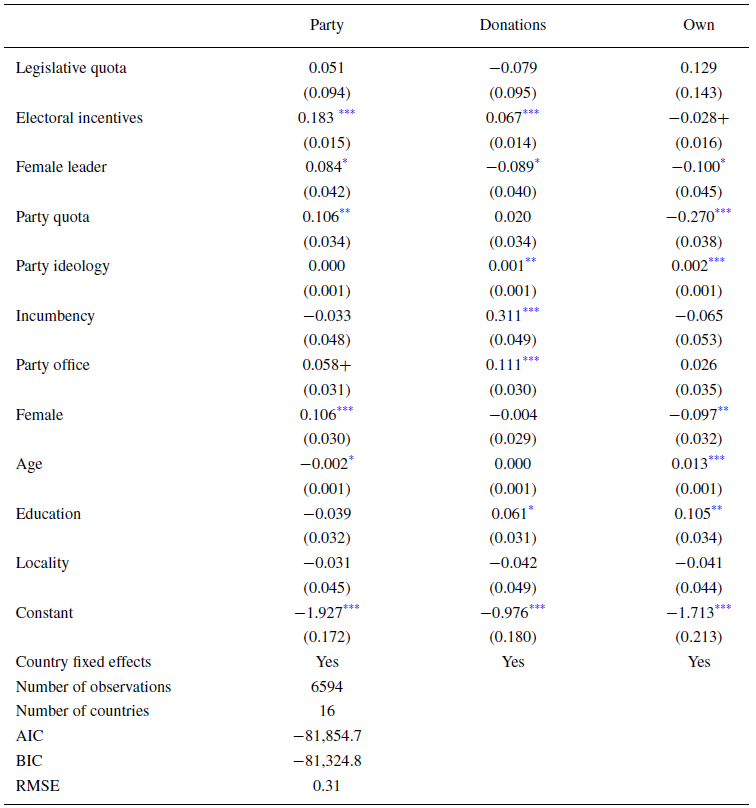
Turning to campaign budget composition (Table 4), gender appears to matter once again. The key differences here are confined to the extent to which male and female candidates’ campaign budgets are composed of party funds and their own money. The positive and significant coefficient of 0.106 under party shows that party funds make up a higher proportion of female candidates’ campaign budgets than they do for male candidates. At the same time, the negative and significant coefficient of –0.097 under own shows that candidates’ own money tends to make up a smaller proportion of female candidates’ campaign budgets than it does for male candidates. With regard to donations, we do not find significant differences in the extent to which these make up female and male candidates’ campaigns budgets. Although donations most likely come from different sources, with women receiving money mostly from women's networks like Emily List and ElectHer in the United Kingdom, TiCandido in Italy, Women for Election in Ireland, there is no significant difference between male and female candidates in terms of how much of their campaign budgets are composed of donations. However, we do need to keep in mind that these are differences – or lack thereof – in proportions. In absolute terms, as shown earlier, female candidates’ campaign budgets tend to be smaller than those of their male counterparts. In other words, while party contributions tend to constitute a larger proportion of female candidates’ campaign budgets, this does not necessarily mean that parties contribute more money to the campaigns of their female candidates. Similarly, comparable proportion of donations does not necessarily indicate that male and female candidates raise equal amounts of funds. With regard to other explanatory variables, the coefficients for female leader are significant for all three funding sources. Here, it transpires that party contributions tend to make up more of candidates’ campaign budgets if they have a female party leader (coefficient of 0.084 under party), suggesting greater party support for candidates whose party leader is a woman. The three models are interrelated, as one category goes up at least one other must adjust downwards: both donations and own funds make up smaller proportions of campaign budgets for candidates who run for parties with female leaders (coefficients of –0.089 and ‐0.1 under donations and own, respectively). It also transpires that donations tend to make up greater proportions of incumbents’ and party officers’ campaign budgets than they do for candidates who run as challengers and who have not held a regional or national party office. Incumbency and political experience, as expected, matter in attracting donors’ contributions.
Table 4. Explaining variation in campaign budget composition

Note: Standard errors in parentheses. +p < 0.1; *p < 0.05; **p < 0.01; ***p < 0.001.
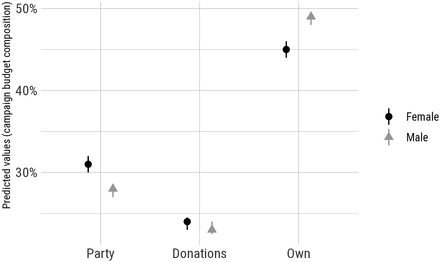
Figure 2 presents the predicted values for the three dependent variables by gender. Note, first, that donations make up almost an identical proportion of male and female candidates’ campaign budgets. The relevant predicted values are 23 per cent and 24 per cent, respectively, with notable overlap in the confidence intervals. We do find the differences in the extent to which party funds and own funds make up male and female candidates’ campaign budgets, however, not only statistically significant, but also substantively meaningful. The predicted values for the proportion of campaign budget from party funds rise from 28 per cent for male candidates to 31 per cent for female candidates, while the predicted values for the proportion of campaign budget being made up of private funds decline from 49 per cent for male candidates to 45 per cent for female candidates. There is no overlap in the associated 95 per cent confidence intervals in either case. It does appear that gender differences manifest not only in the size of female and male candidates’ overall campaign budgets, but also in the make‐up of their campaign budgets.

Figure 2. Predicted values for campaign budget composition.
The compositional model contributes to explaining the results in Tables 2 and 3, and the persistent existence of the gender resource gap. To finance their campaign, male candidates rely on their own resources, more so than their female counterparts do. These resources tend to be not only higher than those that female candidates avail of, but higher than any other form of campaign contribution. Male candidates, on average, can invest in their campaign more than what parties can contribute to, and more than what both male and female candidates raise from donations. This is crucial to identifying potential solutions. We discuss the implications below.
Conclusions
This study confirms the presence of a gender resource gap, using data from 16 countries and over 7000 candidates. The cross‐national nature of these data enables us to generalise some of the patterns previously identified in single countries. Undeniably, the gender resource gap remains a prominent feature of contemporary election campaigns (H1). Given that campaign spending influences the likelihood of electoral success, the persistence of a gender resource gap is likely to keep hindering efforts to close the gender representation gap.
We explored the relevance of a broad range of factors in mitigating or exasperating the disparity in financial resources. Resources are disproportionally higher for male candidates in candidate‐centred systems, as much as they are under electoral rules that do not promote a personal vote (H2). Party ideological stance does not moderate the gap either. Female candidates can rely on less money even when their own party is ideologically committed to egalitarianism (H3). The resource gap is bigger, however, when parties enforce voluntary gender quotas (H4). These parties are likely to put forward more female candidates than parties who do not commit to any given gender ratio: higher number of female newcomers without officeholding experience and the associated lack of financial resources (Buckley & Mariani, Reference Buckley and Mariani2023), combined with limited party resources to distribute among them, may explain why this is the case. Parties may be committed to gender parity but lack the resources to pave a true path to fairer representation. Besley et al. (Reference Besley, Folke, Persson and Rickne2017) attribute the widening of the gender resource gap after the introduction of party quotas in the Swedish Social Democratic Party to the removal of mediocre men: men with higher chances of success and stronger fundraising capacity are retained, while mediocre men are replaced by (newcomer) women. Qualitative studies are better suited to clarify the exact mechanisms at play that lead to the presence of a voluntary gender quota widening the gender resource gap. Longitudinal studies suggest this could be only a temporary setback as quotas can have curvilinear effects: things can get worse before getting better (Wauters et al., Reference Wauters, Maddens and Put2014).
We also find incumbency to aggravate the resource gap, as the financial disadvantage of female candidates is bigger among incumbents than challengers (H5). It is important to highlight here that, while we have data on candidates’ incumbency, we do not know how many terms each of them had served at the time of the survey. Schwindt‐Bayer (Reference Schwindt‐Bayer2005) finds that incumbent women still suffer a disadvantage from having been in office less than men. The larger resource gap we identify may reflect some elements of such disadvantage. However, the extent to which this larger gap among incumbents may impact on chances of success is potentially less of a concern, knowing that spending matters more for challengers than incumbents (Benoit & Marsh, Reference Benoit and Marsh2008; Jacobson, Reference Jacobson1990; Johnston et al., Reference Johnston, Pattie and Hartman2021; Pattie et al., Reference Pattie, Hartman and Johnston2017), and that female incumbents are as likely as male incumbents to translate their incumbency advantage into re‐election (Lühiste & Kenny, Reference Lühiste and Kenny2016; Smrek, Reference Smrek2020). If unexpected, this could be a positive note: the resource gap among challengers is more consequential, but also smaller in size, and, therefore, easier to close.
Disentangling the composition of campaign budgets offers further important insights: party contributions tend to constitute a bigger part of female candidates’ campaign budgets than they do for male candidates, while private funds make up a smaller proportion of female candidates’ budgets than they do for male candidates. There is no significant difference in donations. This is only partially in line with our expectations (H6), as we did not expect party contributions to be more important for female candidates. Although this is a positive note, we must bear in mind that female candidates’ budgets are, on average, considerably smaller than those of their male counterparts. In other words, while parties contribute, on average, bigger proportions of female candidates’ budgets, in absolute terms this does not mean that they contribute enough funds to overcome the disparity in male and female candidates’ overall campaign budgets.
Our findings confirm a considerable gender resource gap that exists across electoral systems and irrespective of party ideology. We also identify counterintuitive effects associated with some of the micro and meso level factors that further research should explore longitudinally to untangle short‐, medium‐ and long‐term trends. Finally, we highlight how party contributions tend to make up larger proportions of female candidates’ campaign budgets. Yet, if female candidates’ overall budgets are systematically and significantly lower than male candidates’, equivalent party contributions are not enough to level the playing field. Men can rely on higher personal resources, while parties’ interventions to level the playing field should be large enough to make up for such differences. Further research could shed light into what would make a material difference that allows female candidates to compete on more equitable grounds.
Finally, while a cross‐national study like this contributes generalisability to what is found by single country studies, it does not score high in depth and comes with inevitable limitations. We depend on secondary data that do not contain all the information we wish we had. The collection of countries in CCS is diverse and offers good variation across the key explanatory variables, but the core questionnaire can be modified by national teams, leading to a smaller sample of countries containing all the variables we needed to test our hypotheses. This has led to a European‐centric sample; while studies of Latin American countries have addressed the resource gap in campaign finance, little evidence still exists from other continents. The smaller sample also sets limits to the range of explanatory factors that could be accounted for, and our research design cannot uncover causal mechanisms: experimental research and process tracing are better placed to explore this angle. When it comes to the composition of the campaign budget, our findings are meaningful in terms of where we find differences (in proportions), but it is important to bear in mind that we cannot speak to why the differences exist, and this is another limitation we need to acknowledge.
Acknowledgements
The authors would like to thank the reviewers and the editors, whose contructive comments significantly improved the article.
Data Availability Statement
The data that support the findings of this study are available upon request.
Online Appendix
Additional supporting information may be found in the Online Appendix section at the end of the article:
Appendix A. Sample of countries
Appendix B. Explanatory and control variables
Appendix C. Robustness checks for campaign budget
Appendix D. Robustness check for campaign budget composition
Data
Replication Code


 Open access

