


Introduction
The categorization of people into different groups along social, cultural, ethnic and racial lines can lead to discrimination (Brubaker, Reference Brubaker2009). By drawing on these categories, social identity thinking can provide an economically efficient way of protecting the interests of the majority group that holds political and economic power (Akerlof & Kranton, Reference Akerlof and Kranton2010; Tajfel & Turner, Reference Tajfel, Turner, Hatch and Schultz1979). For minority groups, by contrast, socially constructed notions of in‐groups versus outgroups prevent them from fully participating in society. Research in North America and Western Europe reports persistent discrimination against minorities in the labour and housing markets (Auer, Reference Auer2022; Flage, Reference Flage2018; Quillian et al., Reference Quillian, Pager, Hexel and en2017; Zschirnt & Ruedin, Reference Zschirnt and Ruedin2016), and in other domains of everyday life (Blank, Reference Blank2005), including political participation (Hainmueller & Hangartner, Reference Hainmueller and Hangartner2013). Despite various efforts to curb discrimination, not the least of these through legislation, systematic disadvantages of minorities persist because the perception of ethnic and racial difference ostensibly shifts only slowly and gradually – if it changes at all (Alba, Reference Alba2017; Brubaker, Reference Brubaker2016; Wimmer, Reference Wimmer2008).
Contrary to existing accounts (e.g., Brubaker, Reference Brubaker2016; Quillian et al., Reference Quillian, Pager, Hexel and en2017), we show that discrimination can change quickly as a reaction to galvanizing events. In 2018, during the FIFA Football World Cup, a group of three Swiss soccer players – two of them with a Kosovo‐Albanian background – celebrated their victory in a crucial game with a highly politicized gesture, which symbolizes the heraldic animal of Albania. Their illicit public showing of a political symbol forced the governing body FIFA to launch an investigation on whether the players should be banned, in part because of the highly sensitive context of the game that was played against Serbia – Kosovo's enemy in the Yugoslav Wars. The victory was crucial to uphold Switzerland's chances of promotion to the tournament, and the Swiss team turned the game in its last moments, with Xerdan Shaqiri and Granit Xhaka (both ethnic Kosovo‐Albanians) scoring the decisive goals. In Switzerland, the depiction of such a counter‐stereotypical adherence by team players to a nation other than Switzerland spurred an extraordinary public debate about belonging to multiple groups and the social integrity of the national team, which is the ultimate ingroup (Houlihan, Reference Houlihan1997; Porter & Smith, Reference Porter and Smith2013). This cognitive dissonance was further reinforced when autochthonous Swiss Stephan Lichtsteiner, the team captain, performed the gesture himself.
Based on a 30‐week‐long field experiment in the housing market that we coincidentally conducted in the months prior to and after this event, we demonstrate that the invitation rates for apartment viewings increased by 6 percentage points for the applicants with a Kosovo‐Albanian name immediately after the event such that the penalty against this group relative to the applicants with native Swiss names effectively disappeared. This substantial change persisted for the entire post‐game observation period, that is, for almost 100 days. With this, we provide causal evidence from a natural experiment to demonstrate rapid and sustained changes in discrimination that have not been observed outside the laboratory to date. In studying a particular galvanizing event, we emphasize the following three likely mechanisms that amplified and prolonged the effect of the gesture: (1) the players being role models; (2) a tendency to rally behind a common cause against an investigation by the World Cup's governing body FIFA; and (3) a major (yet nonjudgmental, see Kalla & Broockman, Reference Kalla and Broockman2020) public debate that discussed the situation of immigrant groups that led to perspective‐taking.
We extend recent work on changing attitudes (Broockman & Kalla, Reference Broockman and Kalla2016; Kalla and Broockman, Reference Kalla and Broockman2020) to show that similar changes in behaviour are possible in competitive markets. Accordingly, we challenge the established accounts of ethnicity as entities that only change gradually and slowly. We provide empirical support that minority role models, such as soccer players, may play an important role in alleviating ethnic discrimination — as they may reach populations who otherwise are not exposed to perspective‐taking and counter‐stereotypical images. This conclusion gives hope that, with the right interventions, ethnic discrimination and anti‐minority attitudes can be reduced more quickly than previously acknowledged.
How discrimination (can) change
For discrimination to occur, people need to be perceived as members of groups, which requires the construction and persistence of ‘differences’ between groups (Alba, Reference Alba2017; Lamont & Molnár, Reference Lamont and Molnár2002; Wimmer, Reference Wimmer2008). Earlier contributions laid the groundwork to argue and demonstrate that because such ‘differences’ are socially constructed, they are in principle malleable. They reflect the human tendency to divide the world into ingroups (‘us') and outgroups (‘them'), but the construction of such ‘difference’ requires symbols or markers that allow ingroups to be distinguished from outgroups. Some of the most prominent cleavages responsible for discrimination in contemporary Western societies relate to ethnic and racial groups and anti‐immigrant sentiments (Hewstone & Swart, Reference Hewstone and Swart2011; Kaufmann & Goodwin, Reference Kaufmann and Goodwin2018; Peterie & Neil, Reference Peterie and Neil2020).
In market situations, discrimination means that members of some groups are restricted from participating in or barred from the privileges enjoyed by majority groups (Akerlof & Kranton, Reference Akerlof and Kranton2010). In contrast to absolute exclusion such as that experienced under apartheid or racial segregation in the Southern United States, most contemporary discrimination incidents reduce chances (e.g., to participate or access markets) – which tends to accumulate (Blank, Reference Blank2005). Although the literature continues to emphasize discrimination in different contexts and guises (Auer, Reference Auer2022; Flage, Reference Flage2018; Quillian et al., Reference Quillian, Pager, Hexel and en2017; Zschirnt & Ruedin, Reference Zschirnt and Ruedin2016), little is known about overcoming prejudice to the extent that we can end discrimination outside of laboratory experiments (Couzin‐Frankel, Reference Couzin‐Frankel2017; Kurzban et al., Reference Kurzban, Tooby and Cosmides2001). It appears as if anti‐discrimination legislation does not suffice to end discrimination (Quillian et al., Reference Quillian, Pager, Hexel and en2017). Theoretical work explicitly recognizes that group membership can change (Alba, Reference Alba2017; Brubaker, Reference Brubaker2016; Wimmer, Reference Wimmer2008) – which implies changes in discrimination – but it is less clear where these changes come from other than from continued challenges to ethnic exclusion and long‐term minority protest.
As a consequence, multiple generations of persistent challenges may be required to change levels of discrimination, and this time frame is corroborated by studies on immigrant integration, intermarriage or the perception of ‘mixed’ children where changes are measured in ‘generations’ (Alba, Reference Alba2017; Rumbaut, Reference Rumbaut2008; Song, Reference Song2015; Törngren & Sato, Reference rngren and Sato2019). Focusing on members of the minority groups, this literature also recognizes intermediary positions, where individuals can express loyalty and feel attached to both the minority and majority groups at the same time. Such slow changes are in line with contact theory (Allport, Reference Allport1954; Williams, Reference Williams1947) that indicated how differences between immigrants and natives often gradually disappear as both sides learn more about one another and reduce prejudice. For instance, Schindler and Westcott (Reference Schindler and Westcott2020) suggest that contact can lead to persistent change by showing that a quasi‐random variation in the presence of black U.S. soldiers stationed in the United Kingdom during World War II is associated with reduced anti‐immigrant attitudes in 2010.
Recent work on value change and prejudice, however, suggests that more rapid changes in discrimination may be possible. In addition to slow changes taking generations (Brubaker, Reference Brubaker2016; Paluck & Green, Reference Paluck and Green2009), such work recognizes relatively fast changes measured in years (Inglehart, Reference Inglehart2018). Social psychologists suggest even shorter timescales by showing that groups can be created and changed in the short term (Kurzban et al., Reference Kurzban, Tooby and Cosmides2001): By emphasizing other alliances, at least within the realm of controlled laboratory experiments, categorization by race can be greatly reduced to the extent that it no longer constitutes a valid signal of a coalition. Similarly, political scientists have demonstrated shifts in attitudes as a consequence of specific, targeted canvassing efforts and perspective‐taking (Broockman & Kalla, Reference Broockman and Kalla2016; Kalla and Broockman, Reference Kalla and Broockman2020; Simonovits et al., Reference Simonovits, zdi and Kardos2017). Kalla and Broockman (Reference Kalla and Broockman2018) suggest that almost all campaigns and persuasive efforts fail to change attitudes because they tend to judge those with different attitudes and opinions, which evokes resistance (Kalla and Broockman, Reference Kalla and Broockman2020). With intensive 10‐minute conversations that do not judge the participants, however, attitudinal changes can be achieved (Kalla and Broockman, Reference Kalla and Broockman2020). It remains unclear, however, the extent to which these findings extend to changing real‐world behaviour such as ethnic discrimination, especially as more accurate information does not necessarily translate into changed attitudes (Hopkins et al., Reference Hopkins, Sides and Citrin2019; Jørgensen & Osmundsen, Reference Jørgensen and Osmundsen2022).
We believe that work in social psychology is central to understanding ‘rapid’ changes in attitudes and discriminatory behaviour. Indeed, although attitudes and values tend to be relatively stable over the adult life course (Paluck & Green, Reference Paluck and Green2009), changes tend to occur episodically in the context of specific life events, such as getting divorced or starting a new job (Hatemi, Reference Hatemi2013; Voorpostel et al., Reference Voorpostel, Kuhn and Monsch2020). The relevant mechanisms for sudden changes in discrimination may be perspective‐taking and exposure to counter‐stereotypical images and behaviours – although empirical work is typically limited to laboratory experiments (Dovidio et al., Reference Dovidio, Hewstone, Glick and Esses2010). Perspective‐taking occurs when individuals perceive a situation from the point of view of the other group, which can reduce prejudice (Adida et al., Reference Adida, Lo and Platas2018; Simonovits et al., Reference Simonovits, zdi and Kardos2017). However, the literature provides mixed results on how quickly these changes manifest themselves and how long the observed effects last (Kalla & Broockman, Reference Kalla and Broockman2018). Moreover, it remains unclear how to translate promising findings from controlled experiments into the real world in which people can select themselves out of treatment, i.e., exposure may not be readily induced. Here we draw on the work on the importance of (celebrity) role models – evidence exists particularly for gender (Bohnet, Reference Bohnet2016). Such role models who cut across existing social networks may be key in overcoming discrimination because they can reach populations who typically select themselves out of exposure to campaigns and political messages. As they use nonjudgmental messages, role models also overcome the challenge of resistance highlighted by Kalla and Broockman (Reference Kalla and Broockman2020). In particular, we focus on celebrity sportsmen with broad appeal.
In the following, we leverage a coincidental natural experiment combined with a large‐scale field experiment to demonstrate that rapid changes in discrimination also occur outside the lab. We first describe the situation on 22 June 2018 – the day when three Swiss soccer players made the highly contested gesture of showing sympathy to another nation during one of the world's largest sports events. We then show a rapid decline in discrimination immediately after the game. After ascertaining the robustness of these findings, we elaborate on likely mechanisms behind the drop in discrimination. Broadly speaking, we argue that the act of contestation created counter‐stereotypical images that are observed by a significant part of the population. More specifically, we provide suggestive evidence that large media attention may not be enough to affect levels of discrimination: The counter‐stereotypical behaviour of the Swiss celebrity role models was embedded in a conducive (winning) environment, and the developments following the hours and days after the salient event encouraged Swiss people to rally behind their representative players and discuss double‐loyalties.
The double‐headed eagle gesture
Like in many other countries, soccer is a major spectator sport in Switzerland. The World Cup games attract more television viewers than any other programme, whether sports or other entertainment. In 2018, an average of 1.6 million (of 8.5 million) inhabitants watched the soccer games of the national team on television in Switzerland, compared to 0.6 million who typically watch the main evening news (Aargauer Zeitung, Reference Zeitung2019; Widmer, Reference Widmer2017). For many people, the national soccer team ranks among the most important symbols of the nation; it is a representation of the nation like few others (Porter & Smith, Reference Porter and Smith2013). At the same time, many players on the Swiss national team are naturalized immigrants or children of immigrants (Sonntag & García, Reference Sonntag and García2020), which is partly a reflection of the country's long history of post‐World War II labour migration and the refugee influx in the wake of the Yugoslav Wars of the 1990s (Ruedin et al., Reference Ruedin, Alberti and Amato2015). Although the socio‐economic integration of immigrants from former Yugoslavia may be relatively good, people from Southeastern Europe (e.g., Albania, Kosovo and Turkey) are regarded more negatively in the population than many other immigrant groups (Ruedin, Reference Ruedin2020). The Swiss national team sent to the World Cup in the summer of 2018 consisted of approximately 70 per cent naturalized players or children of immigrants, including two involved in the double‐headed eagle gesture: Kosovo‐born Xherdan Shaqiri, who has grown up in Switzerland since his earliest years, and Granit Xhaka, who was born in Switzerland to Albanian parents. As double nationals, they had to choose which national team they wanted to play for in adulthood. Similar to other Western countries, the high share of nonnative players had previously led to sporadic public discussions about loyalty and whether these players truly represented the nation (Groeneveld, Reference Groeneveld2018; Sonntag & García, Reference Sonntag and García2020).
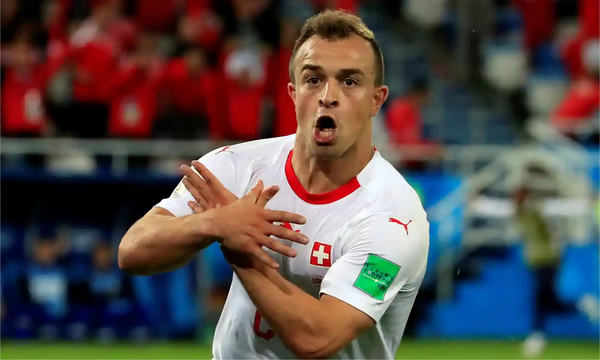
On 22 June 2018, Shaqiri, Xhaka, and team captain Stephan Lichtsteiner – key players on the national team – showed the double‐headed eagle gesture (DHE) when celebrating a crucial victory in the World Cup game against Serbia (Figure 1). The double‐headed eagle symbolizes (ethnic) Albania and is often associated with calls for ‘Greater Albania’, including regions in Kosovo, North Macedonia and Montenegro, which are predominantly inhabited by ethnic Albanians (Strange, Reference Strange2020). In 2014, a Euro Championship qualifier football game between Albania and Serbia in Belgrade was abandoned after fighting between fans and players erupted following the public display of the double‐headed eagle gesture (The Guardian, 2014). Photographs of Swiss military recruits using this gesture – a symbol of the migrant outgroup – had already led to public debates on loyalty to the nation‐state in the past (Lanz, Reference Lanz2016). Thus, the gesture has an exceptionally strong political component, particularly given the conflict in the 1990s and early 2000s between Serbian‐dominated Yugoslavia and Kosovo. Its showing at the World Cup 2018 further fueled a charged atmosphere both during the game and in its aftermath, as not only the Serbian players but also politicians and the public in Serbia felt provoked by this gesture (BBC, 2018).

Figure 1. The double‐headed eagle gesture. [Colour figure can be viewed at wileyonlinelibrary.com]
Note: Shaqiri celebrating with the double‐headed eagle gesture in the World Cup game against Serbia on 22 June 2018. © Fuentes/Reuters.
The situation on 22 June 2018 was special as Switzerland needed a victory to keep alive its chances of qualifying for the knockout stages and because allegations of provocation surfaced before the game with Serbia. With a strong fan base of Kosovo‐Albanian immigrants in Switzerland and the violent history between Kosovo and Serbia, the game was considered high risk (swissinfo, 2018; Strange, Reference Strange2020). Of the Swiss team that played Serbia, half came from a former Yugoslav country. Switzerland secured a last‐minute victory, and both goalscorers – Shaqiri and Xhaka – and the autochthonous Lichtsteiner celebrated their victory by showing the double‐headed eagle gesture, which immediately led to a turbulent situation on the pitch.
Empirical setting
Experimental data
We leverage the date of this incident as the treatment and test whether it affected anti‐Kosovo‐Albanian behaviour in Switzerland. As is common with natural experiments, the date can be considered a ‘bundled’ cause (Dunning, Reference Dunning2012) that triggers other mechanisms, and we provide empirical evidence for these after presenting the effect of the double‐headed eagle gesture. Our measure of anti‐minority behaviour comes from a nationwide field experiment in the housing market (Auer et al., Reference Auer, Lacroix, Ruedin and Zschirnt2019). Between 5 March and 29 September 2018, the research team sent out $N=11,930$ queries to view an apartment advertised on a website that aggregates all major listings in the country. The website lists approximately 100,000 rental objects at any time. We used a fully randomized paired design, in which each proprietor received two queries, one from a person with a Swiss name (according to the language region of the apartment, namely, German, French or Italian) and one with a non‐Swiss name, either Kosovo‐Albanian, Turkish or a name typical of neighbouring countries, that is, Germany, France, and Italy. Given and family names were randomly combined from a list of common names to implement stimulus sampling (see the complete roster of names in Table A.1 in the online Appendix). We randomly used four levels of application text quality (seven templates in total), which were pretested with proprietors in different parts of the country for their realism (see online Appendix Table A.2 for example). In addition to the names, the applicants’ gender, age, occupation and residence permit (in the case of non‐Swiss applicants) were randomly varied. The number of children was randomized but constrained to the number of rooms of the advertised apartment to ascertain realistic matches. Similarly, income information was defined as a function of three times the apartment's advertised rent plus/minus a random component, in line with common recommendations on the Swiss housing market.
Identification
As is common in such correspondence tests, we deduce ethnic discrimination from the differences in the invitation rates across the name groups. That is, on average, applications differ only with respect to the name of the applicant and are identical across all other characteristics, as is shown in the balancing test in Figure A.1 in the online Appendix. Therefore, the experimental setting ensures that the application characteristics are exogenous to apartment and landlord characteristics, such that discrimination can simply be measured by deducting the expected invitation rate of queries with a Swiss name from queries with a Kosovo‐Albanian name ( $\Delta Y=E[\text{foreign}] - E[\text{native}]$, with values $Y<0$ indicating discrimination).
The empirical setup lends itself to a classical difference‐in‐differences design. That is, we observe the change in the difference between Swiss and Kosovo‐Albanian applications sent prior to and after the day of the gesture (22 June 2018). Specifically, we apply a generalized difference‐in‐differences framework that allows for the common change in outcomes to vary across time (i.e., invitation rates can have a general temporal trend; c.f. Abadie, Reference Abadie2005; Athey & Imbens, Reference Athey and Imbens2006). Accordingly, $Y_i$ denotes the propensity to be invited for viewing as a function of the individual ethnicity signal $S_i$ based on the name, and the time $D_t$ is when the inquiry was sent, with $D_t=1$ denoting the post‐game period, and $D_t=0$ denoting the pre‐game period. The interaction coefficient τ estimates the causal effect in question:
 $$\begin{equation} Y_i = \alpha + \beta S_i + \delta D_t + \tau (S_i \times D_t) + \mu _t + \mu _c + \mu _i + \mu _m + \varepsilon _{itm} \end{equation}$$
In all models, we adjust for date $\mu _t$ (days) and canton (read: region) fixed effects $\mu _$c to account for potential differences over time and regions. Moreover, we stepwise add application‐level controls $\mu _i$ provided by the randomized inquiry texts (gender, rent and rooms in the apartment, and template fixed effects) and municipality‐level controls $\mu _m$ that depend on the location of the respective apartment (urbanization rate, population size, social assistance recipient rate, dwelling vacancy rate, and share of foreign residents). Given the paired design of the experiment, standard errors are clustered at the apartment level throughout, which provide identical results to a within‐apartment design. Note that the extensive set of fixed effects accounts for any within and between time and apartment/proprietor variation.
Parallel trends
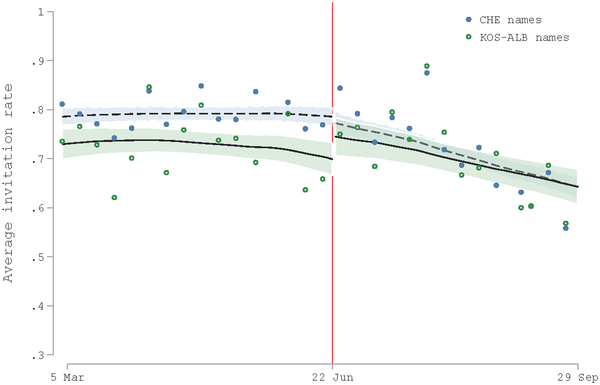
Figure 2 plots the average invitation rate over time for the applications with Swiss ( $N=5297$) and Kosovo‐Albanian names ( $N=1793$). The overall invitation rate of approximately 75 per cent matches comparable field experiments on the housing market in other countries (Auspurg et al., Reference Auspurg, Schneck and Hinz2019; Flage, Reference Flage2018) and is plausible given the mild intervention of requesting to view an apartment and the set of relatively elaborated texts. A decrease can be observed in the invitation rate in the last third of the observation period. This temporal trend (which is accounted for with date fixed effects) is due to the number of moves increasing in the fall and, thus, competition for tenants decreasing so that proprietors can be more selective in whom they invite (see Figure A.3).

Figure 2. Invitation rates for Swiss and Kosovo‐Albanian names. [Colour figure can be viewed at wileyonlinelibrary.com]
Note: $N=5297$ queries for Swiss and $N=1793$ queries for Kosovo‐Albanian names. Treatment in week 25 (game against Serbia, vertical red line). Weekly averages with an average of $N=275$/ $SD=79$ ( $N=78$ in week 22; $N=41$ in week 31 due to a national holiday). Epanechnikov polynomial fit for the pre‐/post‐game period is based on daily callbacks (bandwidth 28 days). The colour‐shaded areas indicate 90 per cent confidence intervals. Figure A.5 further indicates that the pre‐treatment parallel trends assumption holds when restricting the observation period to 1 month prior/after the game. The negative trend in the invitation rates after July occurs because the number of moves increased, and thus the competition for tenants decreased (see Figure A.3).
Strikingly, the observed invitation rate for applications with a Kosovo‐Albanian name clearly converges towards the Swiss reference group immediately after the game in which the three national team players demonstrated their sympathies for ‘(Greater) Albania’. On average, 78.8 per cent of the applicants with a Swiss name are invited in the pre‐game period, while this proportion is 70.5 per cent post‐game. The change for Kosovo‐Albanian names, by contrast, is substantially smaller, with 72.3 per cent pre‐ versus 69.1 per cent post‐game. The slight dip in the invitations of Kosovo‐Albanian names in June is mainly driven by one outlier week with a small N (week 22 with $N=78$ applications with Kosovo‐Albanian names). In the robustness section below, we provide indicative evidence that the parallel trends assumption holds through the pre‐treatment period (see online Appendix Table A.3 for a linear approach and Figure A.4 for semi‐parametric evidence). Moreover, we provide a sensitivity check that shows that the effects remain stable in an alternative pre‐treatment specification (Figure A.5 and Table A.4). Eventually, we confirm our main findings by providing the results for alternative specifications that are robust to potential violations of the parallel trends assumption (Abadie, Reference Abadie2005; Sant'Anna & Zhao, Reference Anna and Zhao2020). The fact that the results are substantively identical further raises our confidence that the results are not biased by unobserved heterogeneity.
Post‐treatment convergence in invitation probabilities
In Panel A of Table 1, we present the results of the generalized difference‐in‐differences framework. The baseline coefficients for KOS‐ALB name indicate that the probability of being invited for viewing is approximately 6.7 percentage points lower for applications with Kosovo‐Albanian names compared to applications with a Swiss native name (CHE). This amounts to a penalty of almost 10 per cent of the overall invitation rate of approximately 75 per cent. In all models, we adjust for temporal and regional differences using fixed effects. In Models 2 and 3, we further add template fixed effects, which capture the level of information and style of the application, and apartment characteristics (rent and the number of rooms). In Model 3, we further include location controls that capture municipality‐level characteristics such as urbanization (through population size and the urbanization rate) and the share of social assistance recipients or the share of empty apartments. Because of the experimental nature of our data, we do not expect the coefficients to change substantially after adding the covariates. Indeed, the negative effect of a Kosovo‐Albanian name is stable across all model specifications in which we add the template fixed effects and further application‐level covariates (Model 2) and municipality controls (Model 3). Moreover, the municipality controls themselves should converge towards 0 due to the pairwise design (proprietors receive both a Swiss and a foreign application), which is the case in Table 1. Eventually, the observation of a generally higher invitation probability for more expensive apartments can be explained by a higher level of competition for tenants among proprietors, as apartments with a very high rent receive fewer applications on average.
Table 1. Effect of the DHE gesture on invitation probability

Note: Outcome variable: invitation probability. Reference category: Applications with Swiss (CHE) name. Treatment: Double‐headed eagle (DHE) gesture made by Shaqiri, Xhaka and Lichtsteiner during the FIFA World Cup on 22 June 2018. Post‐game period refers to 22 June until 29 September, pre‐game period to 5 March until 21 June. Panel A: Generalized difference‐in‐differences OLS regression. Panel B: Doubly robust difference‐in‐differences estimator for repeated cross sections. DRIPW is based on stabilized inverse probability weighting and ordinary least squares. DRIMP is based on the inverse probability of tilting and weighted least squares (Sant'Anna and Zhao, Reference Anna and Zhao2020). IPW estimates the standardized inverse probability weighting DiD estimator discussed by Abadie (Reference Abadie2005). All models: Robust SE clustered at apartment level. Additional randomized individual characteristics (age, profession, permit, family status) are captured within template fixed effects. *p <0.10; **p <0.05; ***p <0.01.
Abbreviations: DiD, difference‐in‐differences; FE, fixed effects; OLS, ordinary least squares.
The estimated effect of Kosovo‐Albanian names on the invitation rates after 22 June 2018 – as indicated by the interaction term KOS‐ALB name × post‐game period – confirms the descriptive evidence in Figure 2, which shows a substantial positive change that entirely compensates for the baseline penalty (adding coefficients for Kosovo‐Albanian names and the interaction term). Note that this convergence appears to be driven by both Kosovo‐Albanian names being invited more and Swiss names less, which is plausible given that proprietors are unlikely to have altered the number of applicants that they invited after the treatment. That is, they have become more likely to replace a (less suited) Swiss candidate with a (more suited) Kosovo‐Albanian candidate by keeping the total number of invitations constant, which results in a reduction of Swiss invitations. Although a closer investigation of the detailed invitation strategy would be an interesting addition, such findings do not affect our substantive results and the inference that discrimination substantially declined. Moreover, it is important to emphasize that the estimated coefficients depict the average causal effect across the entire post‐treatment observation period, that is, for approximately 100 days until the end of September 2018. We infer that the substantial reduction in ethnic discrimination was not limited to a short time frame around the World Cup but indicated a more persistent change.
Robustness
We perform six robustness checks to emphasize the stability of our findings. First, we provide two different assessments of the parallel trends assumption, i.e., the condition that in the absence of the double‐headed eagle gesture, Kosovo‐Albanian and Swiss invitation rates would have evolved similarly. On the one hand, we provide indicative evidence that this fundamentally untestable assumption holds by looking at the trends in the pre‐treatment period (see Figure 2). Specifically, we test whether the week of the application in the pre‐treatment period predicts differences in the invitation probabilities between the two name groups by fitting a linear model that captures any general temporal trends (Table A.3 in the online Appendix) and a non‐linear model that does not restrict the functional form (Figure A.4). Neither of the two tests rendered any significant differences between the two name groups, which indicates that prior to the treatment, the trends in the invitation rates were indeed parallel in statistical terms. On the other hand, even if the parallel trends assumption was to be violated, it is possible to recover the causal effects by adjusting for observed factors before comparing the two groups. We therefore apply a series of doubly robust difference‐in‐differences estimators as described in Sant'Anna and Zhao (Reference Anna and Zhao2020), which we report in Table 1. Specifically, Model 4 adjusts the samples using stabilized inverse probability weighting and subsequently fits an ordinary least squares (OLS) model, whereas Model 5 tilts the estimated propensity scores instead and then performs a weighted least squares regression (for a detailed description, see Sant'Anna and Zhao, Reference Anna and Zhao2020). Model 6 performs the standard inverse probability weighting (i.e., the probability of having either a Kosovo‐Albanian or a Swiss name) based on Abadie (Reference Abadie2005). All models estimate a change in discrimination against Kosovar applicants that is highly statistically significant and very similar to the coefficients in our main specification, which further raises our confidence that the results are not biased by unobserved heterogeneity.
Second, we test whether the effects remain stable when restricting the observation period to a relatively short period of 1 month prior and 1 month after the game (from 22 May to 22 July). Figure A.5 in the online Appendix provides evidence of the parallel pre‐treatment trends and the substantial increase in the invitation rates of Kosovo‐Albanian applicants. This shift is confirmed in the corresponding regression model in Table A.4 in the online Appendix, which shows a statistically significant interaction effect that is comparable in magnitude to our main results. Together, this analysis that focuses on a restricted period further indicates that proprietors reacted quickly and changed their invitation behaviour immediately after the game. In addition, it provides evidence that our findings are not biased by some unobserved World Cup effect (from 14 June to 15 July) that may have remained unobserved in the aggregate effect over the full observation period.
Third, we already adjust for applicant characteristics in the full model in Table 1, which accounts for any potential systematic variation in observed characteristics. Nonetheless, we confirm the successful randomization by showing that the probability of sending a query with a Kosovo‐Albanian name relative to a Swiss name does not differ between non‐native and native names or between the pre‐ and post‐treatment periods (Figure A.1 in the online Appendix). This condition ensures that no systematic differences in the application or apartment characteristics could bias the results of the natural experiment by chance. Similarly, in Figure A.2, we show for both name groups that the apartment and location characteristics did not change between the pre‐ and post‐game periods. This demonstrates that our experimental design did not change in the post‐game period so that the effects cannot be driven by a selected sample of apartments, proprietors or locations.
Fourth, our results could be biased if proprietors and agencies fail to associate the names used in our experiment with the respective nationalities. Proprietors and agencies could mistake Kosovo‐Albanian applicants as coming from another country (which would underestimate our effect) or wrongly believe that other names (e.g., Swiss names) used in the experiment belong to the Kosovo‐Albanian group (which would overestimate our effect). To test for this potential bias, we conducted a representative online survey among $N=1100$ respondents in Switzerland in early 2020. The results shown in Figure A.6 in the Appendix suggest that Kosovo‐Albanian names are mostly recognized as such, while Swiss names are never mistaken for originating from Kosovo‐Albania by the representative survey respondents. Therefore, we have reason to believe that the causal effect of the double‐headed eagle gesture can be regarded as a conservative estimate because, if anything, proprietors would not identify an applicant with a Kosovo‐Albanian name as such but rather assume that the applicant originates from Turkey or Italy, for which we do not expect the double‐headed eagle gesture to play a role. We return to potential spillover effects in the next section . Additionally, among the names that we used in the experiment, the names from neighbouring countries were often mistaken for Swiss names and vice versa. Given that Switzerland consists of three dominant language regions that match its neighbours – Germany, France, and Italy – this finding is not surprising. Still, we expand the in‐group category and re‐estimate all the models, including the applications with neighbouring‐country names in the control group ( $N=1791$; Table A.6 in the online Appendix). As expected, the additional control group adds noise to the estimations, but the overall pattern of a substantial increase for Kosovo‐Albanian applicants after the incident is robust to this expansion of the control group.
Fifth, we provide alternative evidence that suggests that the change in the invitation rates is indeed a result of changes in the majority‐population attitudes and not driven by some unobserved coincidental factor. Specifically, we leverage identical survey items on the perceived threat of (foreign) groups that were fielded in 2020 and in a representative telephone survey in 2013. Table A.7 in the online Appendix shows that the perceived distance between the Swiss and Kosovo‐Albanian groups has slightly declined over time. In fact, the perceived threat level among the Swiss population has increased considerably overall from 2013 to 2020. However, although the Kosovo‐Albanian profile is still considered the most threatening, the increase in 2020 is exclusively driven by other groups.
Sixth, in the 2020 representative survey, we conducted a randomized experiment to capture the extent to which the population believes that Kosovo‐Albania/the double‐headed eagle symbol belongs to Switzerland. The respondents were randomly shown one of the following three photographs with the double‐headed eagle gesture: the Albanian flag with its heraldic symbol; Shaqiri's celebration (Figure 1); and two neutral hands making the gesture. To test for social desirability bias, we presented a fourth photograph of Swiss soldiers, all showing the double‐headed eagle. This controversial photograph has received some public attention in the past and is clearly associated with a negative context (Lanz, Reference Lanz2016). The results in Table A.8 indicate, first, a strong sense of belonging on behalf of the majority population. Approximately one‐third of the respondents believe that immigrants from Kosovo‐Albania (somewhat) belong to Switzerland. Second, this support is not affected by which photograph is shown, except for the photograph of the soldiers, which is in line with our expectations.
Likely mechanisms
The double‐headed eagle gesture that symbolizes adherence to an outgroup by well‐known soccer players led to an unprecedented public debate on social media, on television and in print media. We argue that this debate about the loyalty of role models and immigrant integration and a likely rally‐round‐the‐flag effect meant that many people thought about immigrants from Kosovo. Accordingly, the debate constitutes a perspective‐taking moment that amplified and prolonged the initial treatment effect.
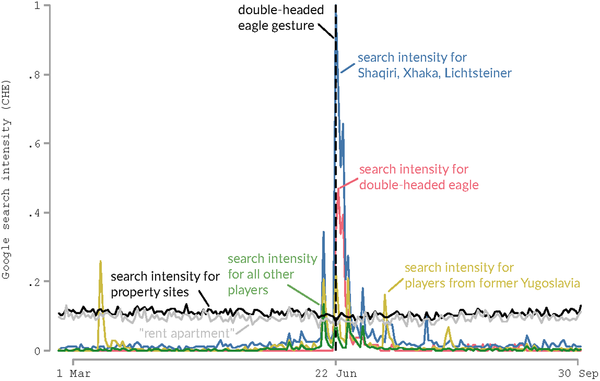
First, we demonstrate the exceptional salience of the double‐headed eagle gesture in public discourse. Using trends in the Google search volume, national newspaper coverage, Wikipedia searches, and Twitter posts, we identify a sharp peak of attention immediately after the game in which the players made the double‐headed eagle gesture (22 June 2018). Figure 3 shows the standardized Google search volume in Switzerland for Shaqiri, Xhaka, and Lichtsteiner (blue line), five Swiss players who originate from the former Yugoslavian republics (yellow line), and the rest of the Swiss national team (15 players, green line). The searches are averaged per player to make them comparable. The smaller peaks for each group coincide with the Swiss games at the World Cup and constitute a general World Cup effect as a baseline to compare against the search volume. The red line captures the search intensity for the term double‐headed eagle, which demonstrates that the gesture had an important effect on the public that, after an initial shock, lasted several weeks (the groups are shown individually in Figure A.7). In Figure A.8 in the online Appendix, we substantively replicate these large attention effects using newspaper keyword hits on the six largest outlets with national coverage, and Figure A.9 shows the Wikipedia searches. These clear attention effects are further corroborated by the 2020 representative survey described above, according to which approximately half of the respondents reported to have been somewhat or very interested in the double‐headed eagle debate, independent of being personally interested in soccer.

Figure 3. Google search intensity in reaction to the DHE gesture. [Colour figure can be viewed at wileyonlinelibrary.com]
Note: Average number of hits per player/keyword rescaled to relative intensities (maximum = 1: Shaqiri, Xhaka, and Lichtsteiner, 22 June 2018).
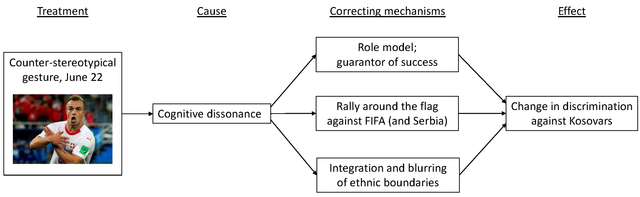
We argue that the change in ethnic discrimination is driven by three likely mechanisms when the Swiss population attempted to solve the cognitive dissonance of Swiss (autochthonous) soccer players showing adherence to a foreign nation.Footnote 1 First, the three players were key players on the national team and role models given their contributions to a successful campaign at the World Cup. Second, the double‐headed eagle gestures were investigated by the governing body FIFA, which encouraged a rally‐round‐the‐flag effect. Third, the public debate moved from the players and their situation to the integration of Kosovo‐Albanian immigrants more generally; this debate focused on the background of the immigrants and questions of loyalty and double allegiance. The mechanisms are summarized in Figure 4. We support our theoretical considerations with an analysis of tweets and newspaper coverage that considers the sentiment and content of these contributions.

Figure 4. Mechanisms linking the double‐headed eagle gesture and discrimination. [Colour figure can be viewed at wileyonlinelibrary.com]
First, Shaqiri and Xhaka were not only integral parts of the team, similar to team captain Lichtsteiner, but they were also the goalscorers in the decisive game on 22 June 2018. That is, the players whose integrity could have been questioned were positive role models and arguably responsible for the successful campaign at the 2018 World Cup. Using a sentiment analysis of all German‐language tweets about the players, we demonstrate that the double‐headed eagle gesture did not lead to more negative tweets about Shaqiri and Xhaka (Figure A.10 in the online Appendix). Tweets are classified on a continuous scale from −1 to +1 on the basis of the words therein and draw on a large dictionary of positively and negatively connoted words. Indeed, positive tweets about the two players with a Kosovo‐Albanian background continued to increase in the days and weeks after the gesture. Similarly, we demonstrate that the majority of tweets that refer to the double‐headed eagle gesture were positive. The average sentiment for Lichtsteiner does not seem to follow the games, while the average sentiment for all other players jointly (minus Shaqiri, Xhaka and Lichtsteiner), however, did not change substantively after the double‐headed eagle gesture, which rules out that sentiment changes were driven solely by a general World Cup effect.
Second, we believe that the effect could have been amplified by two aspects that invoked the rallying‐around‐the‐flag effect, i.e. the tendency of people to unite behind a common cause, institution or person when under external threat (e.g. Lee, Reference Lee1977).Footnote 2 On the one hand, because political statements are sanctioned during competitive soccer games, the governing body FIFA investigated the double‐headed eagle gestures and quickly sanctioned the involved players with fines (Strange, Reference Strange2020). This external scrutiny led to increased support for the players and solidarity, an action that probably amplified the effects of the debates around (double) loyalty. Moreover, images of the Yugoslav and Kosovo wars may have played a role, where Serbs are widely regarded as oppressors (Strange, Reference Strange2020), which facilitated members of the majority Swiss population to side with the Kosovo‐Albanian minority. On the other hand, the fact that the autochthonous Lichtsteiner – the team captain – also showed the double‐headed eagle gesture and was equally investigated by FIFA may have further encouraged the rallying‐around‐the‐flag behaviour. Lichtsteiner's role made it cognitively difficult to take a clear position with the governing body against the players: Doing this would have meant siding against an obvious member of the ingroup. We support this assumption empirically with the sentiments expressed in the national newspapers, as explained below.
Third, the double‐headed eagle gesture triggered a debate about integration and (double) loyalty – particularly regarding Kosovo‐Albanian immigrants. The quality of the reactions varied in the (social) media and during prime‐time debates on national television (for a qualitative assessment, see Sonntag & García, Reference Sonntag and García2020): Some dismissed the ‘foreign’ players as (demonstrably) not really members of the ingroup, many viewed the double‐headed eagle as a highly political symbol (such symbols are sanctioned during competitive soccer games), and others argued that the gesture had lost its political connotations. Although much of the media coverage focused on Shaqiri, the use of the gesture by the autochthonous Lichtsteiner made the blurring of ethnicity more visible: A ‘true’ Swiss used a gesture that symbolizes Albania. Indeed, Lichtsteiner previously made critical statements about naturalized players on the national team (Ramming, Reference Ramming2015). In this case, the option of questioning the integrity of the team and its loyalty to the country did not apply, and resolution to this tension lay in subsuming Kosovo‐Albanians within the Swiss identity and downplaying differences. Other voices portrayed double loyalties in a positive light. Such contributions highlighted to the members of the majority population how minorities can be loyal to both the origin and the majority nation, which is perhaps best exemplified by Shaqiri's choice of customized soccer boots: On his left boot, his stronger foot, Shaqiri had the Swiss flag embroidered, and on the right boot, he had the flag of Kosovo embroidered to indicate his Kosovo‐Albanian heritage. The publicized reactions shared an attempt to make sense of this ostensible contradiction between the in‐ and out‐groups.
Using an automated analysis of all newspaper articles that mention ‘Shaqiri’ 100 days before and after the treatment, we highlight the outlined patterns empirically. We use a dictionary of predetermined keywords (Table A.9 in the online Appendix). The top left panel of Figure A.11 in the online Appendix highlights the increased attention to loyalty after the gesture. Qualitative evidence suggests that such questions occasionally appear for sports teams across Western Europe (Sonntag & García, Reference Sonntag and García2020; Strange, Reference Strange2020), but here, we observe a clear increase after the treatment. The top right panel of Figure A.11 further shows that discussions of the players’ background and ‘home’ increased immediately after the gesture. The bottom right of Figure A.11 demonstrates keyword hits in line with rallying around the flag, while the bottom left of the figure shows that these topics replaced discussions of soccer as a sport to a substantive extent.
Accordingly, we believe that the effect of the double‐headed eagle gesture on reductions in ethnic discrimination worked through a combination of a highly mediatized debate on (double) loyalty, a positive context in which the soccer players were role models with broad appeal and possibly because of rally‐around‐the‐flag effects. In this sense, the gesture (our treatment) triggered a debate about minority groups and their place in society that affected their perception by presenting counter‐stereotypical images to a wider public (Goldman & Hopkins, Reference Goldman and Hopkins2018; Lupia et al., Reference Lupia, Casey, Karl, Piston, Ryan and Skovron2015). Although the double‐headed eagle gesture concerns Kosovo‐Albanians in particular, other immigrant groups may also benefit from the debate on the successful integration and double loyalties. To explore potential spillover effects, we add to the main model applications with Turkish‐sounding names ( $N=1716$) as a second treatment group in online Appendix Table A.5. However, the double‐headed eagle gesture has no significant effect on callbacks for applicants with a Turkish‐sounding name, but they experience similar levels of overall discrimination as the Kosovar‐sounding applicants. Moreover, our survey shows that the vast majority of Swiss respondents correctly assigned Kosovar and Turkish names to their respective nationality (Figure A.6), which further supports our assumption that the treatment effect is largely confined to Kosovo‐Albanian applicants.
The images in the media continued to blur the difference between the ingroup and the Kosovo‐Albanian outgroup over a longer period, which prolonged and amplified the initial effect of the gesture because implicitly, these images question whether a given marker describes the outgroup. If a national sports player, as a stereotypical member of the ingroup and role model, uses a gesture associated with a minority group, then this gesture ceases to work as a marker of distinction. Such events may encourage some members of the majority population to question fixed images, consider the perspective of members of ethnic minorities, and recognize the effects of exclusion (Adida et al., Reference Adida, Lo and Platas2018). This event may then reduce prejudice against minority groups (Adida et al., Reference Adida, Lo and Platas2018; Goldman & Hopkins, Reference Goldman and Hopkins2018; Plant et al., Reference Plant, Devine, Cox, Columb, Miller, Goplen and Peruche2009). In our case, a symbol that represents (ethnic) Albania shown by an (autochthonous) role model on the national team may result in a blurred demarcation between Swiss natives and Kosovo‐Albanians who are otherwise excluded from (full) ingroup membership. We provide indicative evidence in support of these mechanisms, but targeted work is necessary to fully establish how the actions of celebrities can affect ethnic discrimination and related attitudes.
Conclusion: Rapid changes in ethnic discrimination
Despite legal changes since the 1960s, researchers report substantial levels of discrimination against ethnic and racial minorities that seem to persist over time (Quillian et al., Reference Quillian, Pager, Hexel and en2017; Zschirnt & Ruedin, Reference Zschirnt and Ruedin2016) or decline only slowly (Auspurg et al., Reference Auspurg, Schneck and Hinz2019). Such slow changes, if they occur at all, are consistent with the accounts of ethnic and racial boundaries (Brubaker, Reference Brubaker2009; Fouka & Tabellini, Reference Fouka and Tabellini2021; Paluck & Green, Reference Paluck and Green2009; Wimmer, Reference Wimmer2008). Through ongoing contestation, the perception of difference may change gradually over time. The possibility of rapid changes, however, is largely overlooked outside of laboratory experiments. In the laboratory, the tendency to categorize by race can be greatly reduced – at least in the short term – by highlighting other alliances in a social context in which race is not a valid signal of coalitions (Kurzban et al., Reference Kurzban, Tooby and Cosmides2001). Recent work on political campaigns suggests that most persuasive efforts are ineffective because they lead to resistance, but that nonjudgmental debates may offer a way to alleviate anti‐minority attitudes (Kalla & Broockman, Reference Kalla and Broockman2018; Kalla and Broockman, Reference Kalla and Broockman2020). Similarly, simply providing people with accurate information about immigrants and integration misperceptions does not suffice to change attitudes because people are selective in the way that they update their beliefs. Here, we demonstrate that, under the right circumstances, rapid changes in ethnic discrimination – behaviour – with tangible and persistent outcomes are possible in the real world, and we provide an important step in understanding how discrimination may be reduced or even ended by presenting likely mechanisms.
We find evidence suggesting that acts of contestation have a substantial effect on ethnic discrimination if they create counter‐stereotypical images in a positive context in which members of the minority group act as role models and attract strong media attention. In this reading, a clearly positive context that involves minority celebrities as role models, such as the national team winning a crucial game, may be required so that members of the majority population fully perceive and engage with counter‐stereotypical examples – including individuals in social networks where they are typically not exposed to such images. Such an event can encourage perspective‐taking and eventually reduce prejudice. Indeed, more than half of the respondents to our 2020 representative survey in Switzerland have indicated some or a strong interest in the debate around the double‐headed eagle, and this debate was nonjudgmental in character because it sought to understand the ostensible contradiction between an outgroup gesture and ingroup members. The results from a randomized experiment included in this survey show that approximately one‐third now believe that Kosovo‐Albanian immigrants belong to Switzerland (Table A.8).
The large amount of media attention paid to the double‐headed eagle gesture, along with a form of rallying around the flag against the FIFA governing body and the perceived Serbian oppressor (Baum, Reference Baum2002; Sonntag & García, Reference Sonntag and García2020), apparently constituted an important reason why we observed an almost complete reduction in discrimination against Kosovo‐Albanians on the housing market. In this context, the role of celebrities deserves more scholarly attention because their actions reach audiences that may not otherwise engage with ethnic and racial minority groups. Perspective‐taking may ensue, especially when members of the majority population identify with the celebrity for reasons other than his or her minority status, such as the sports team on which celebrities play or the type of music that they make.
The mobilizing power of soccer has been demonstrated in other settings (e.g., Foos and Bischof, Reference Foos and Bischof2019), but we are aware of only one other study that explored the impact of celebrities on anti‐minority behaviour (Alrababa'h et al., Reference h, Marble, Mousa and Siegel2021). This analysis shows a large drop in hate crime relative to a synthetic control group that coincides with the arrival of Mohamed Salah at Liverpool Football Club. In a separate survey experiment, the authors suggest that Salah's presence may have increased familiarity, a conclusion which emphasizes contact theory. In this article, we leverage a much clearer event and explicitly measure anti‐minority outcomes by capturing ethnic discrimination in a field experiment, which allows us to exclude alternative explanations and relate changes in behaviour to likely social mechanisms. Our analysis clarifies why no open or deliberate contestation of discrimination is necessary for discrimination to decline – when the circumstances are right. We further clarify the nature of the positive role model effects by emphasizing how specific counter‐stereotypical images can trigger debates that amplify perspective‐taking to create lasting change in anti‐minority behaviour.
As a limitation, at this stage, we do not have a definitive answer regarding how the fertile mix between celebrity action and a conducive context can be triggered and translated to other contexts. The decline in discrimination presented in this study is limited to one minority group, and it remains unclear to what extent other influences like anti‐immigrant discourse in politics can counter the outlined effects in the years and decades to come. In light of the stable levels of discrimination, despite many efforts to curb it by legal means (Flage, Reference Flage2018; Quillian et al., Reference Quillian, Pager, Hexel and en2017), we offer promising research on the effective means and potential policies to reduce ethnic and racial discrimination, but further research is needed to test the mechanisms sketched in this article more explicitly. Contrary to work on canvassing by Kalla and Broockman (Reference Kalla and Broockman2020), the mechanisms that we identify are not subject to self‐selection (it is much more difficult to escape a broad public debate than refuse opening the door to canvassers), and we demonstrate a lasting effect on behavioural outcomes. With the focus on (celebrity) role models who cut across existing social networks, we emphasize the importance of reaching populations who otherwise are not exposed to counter‐stereotypical images by emphasizing that social identity thinking (Akerlof & Kranton, Reference Akerlof and Kranton2010; Tajfel & Turner, Reference Tajfel, Turner, Hatch and Schultz1979) may be useful for predicting changes in discrimination rather than merely describing them. A corollary of the findings when applied to the Black Lives Matter protests in the United States in 2020 or the kneeling protests started by Colin Kaepernick in 2016 is that the participation of White people alongside Black protesters – in our case, the gesture being used by the autochthonous Lichtsteiner – may be an important feature of the protests’ success in affecting public opinion and official action, because their participation makes it cognitively more difficult to dismiss the minority protest.
Acknowledgements
This research was supported by the Swiss Federal Office for Housing (BWO), the NCCR on the move, and the Swiss Network for International Studies (SNIS). The funders had no role in study design, data collection and analysis, decision to publish, or preparation of the manuscript. We would like to thank Julie Lacroix and Eva Zschirnt for their support with the field experiment; Claire Robinson El Attar, Julie Mancini, Maud Rouvinez and Olivia Gasser for invaluable assistance during the fieldwork; Verena Wisthaler, Lorenzo Piccoli and Marco Pecoraro for support with the translations. We also thank Daniel Bischof, Valentina Di Stasio, Marc Helbling, Paul Herfs, Ruud Koopmans, Eylem Kanol, Johannes Kunz, James Laurence, Marcel Lubbers, Daniel Meierrieks, Ines Michalowski, Tom Nijs, Marco Pecoraro, Judy Rich, Max Schaub, Patrick Simon, Tobias Stark, Eva Van Belle, Susanne Veit, Pieter‐Paul Verhaeghe, Wouter Zwysen and the participants at IMISCOE 2019 and ECSR 2019 conferences, and the WZB‐MAD colloquium for valuable feedback. We also would like to thank the editors and the three anonymous referees at the EJPR for providing excellent comments that helped with improving the paper throughout the review process. The authors are listed in alphabetical order and contributed equally to this study.
Open access funding enabled and organized by Projekt DEAL.
Ethics statement
Ethical approval was obtained by the University of Neuchâtel on 23 January 2018.
The methodology used in this research is a correspondence test, which is a field experiment conducted in the housing market. We apply the same methodological approach as in previous studies on discrimination in the housing market published, for instance, in PLOS One (Öblom & Antfolk, Reference blom and Antfolk2017), the American Academy of Political and Social Science (Gaddis & Ghoshal, Reference Gaddis and Ghoshal2015), the Journal of Urban Economics (Acolin et al., Reference Acolin, Bostic and Painter2016), or the Journal of Housing Economics (Carlsson & Eriksson, Reference Carlsson and Eriksson2014). The research participants received no information on this experiment and no informed consent was sought. Correspondence tests are inherently conducted without obtaining the informed consent of the participants. Correspondence tests are a form of covert research, which, for instance, the British Sociological Association acknowledges ‘may be justified in certain circumstances. The nonbinding European Union Code of Ethics for Socio‐Economic Research (Dench et al., Reference Dench, Iphofen and Huws2004) specifically recognized the study of discriminatory practices as one area in which it may be possible to obtain information only using covert research and deception.
Preregistration, data and code availability
The field experiment was preregistered on 11 January 2018. Preregistration, data, and syntax are available at https://doi.org/10.17605/OSF.IO/RU8Y6.
Online Appendix
Additional supporting information may be found in the Online Appendix section at the end of the article:
Table A.1: Names used for stimulus sampling in the field experiment
Table A.2: Example application letters
Figure A.1: Probability of sending a Kosovo‐Albanian named application
Figure A.2: Pre‐post game variation in application characteristics
Figure A.3: Housing market dynamics, 2018
Table A.3: Linear test for parallel trends
Figure A.4: Semi‐parametric test for parallel trends
Figure A.5: Parallel trends assumption, shorter time frame
Table A.4: Effect of the double‐headed eagle gesture (restricted period)
Figure A.6: Recognizability of names used in the experiment
Table A.5: Effect of the DHE gesture on Turkish invitation rates
Table A.6: Effect of the DHE gesture, including D/F/I as a control
Table A.7: Perceived threat in 2013 vs. 2020
Table A.8: OLS effect on context‐dependent Kosovo‐Albanian symbols
Figure A.7: Google searches in reaction to the DHE gesture
Figure A.8: Newspaper coverage in reaction to the DHE gesture
Figure A.9: Wikipedia searches in reaction to the DHE gesture
Figure A.10: Average sentiment of tweets, March to September 2018
Table A.9: Keywords in newspapers
Figure A.11: Keyword hits in all newspaper articles mentioning ‘Shaqiri’
 N=5297
 N=1793
 N=275
N=275 SD=79
SD=79 N=78
N=78 N=41
N=41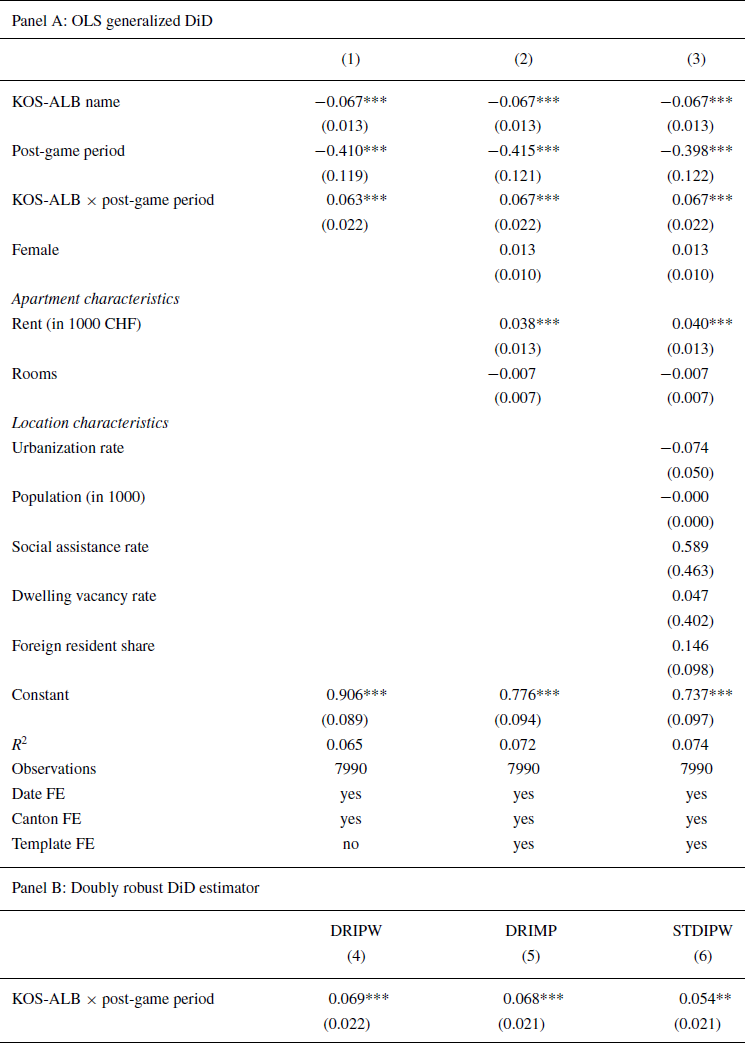


 Open access

