


Introduction
Potsherd pavements are important architectural features in medieval West African archaeology, dating from the mid-first to late second millennium AD (Nzewunwa Reference Nzewunwa1989). These durable surfaces, constructed from pottery fragments, sometimes combined with stones or pebbles, appear in various contexts, including palaces, shrines and household courtyards (Garlake Reference Garlake1974). Beyond their reflection of high craftsmanship and functional roles in water management, erosion control and sanitation, the pavements also held aesthetic, symbolic and spatial value (Aguigah Reference Aguigah2018: 111–33).
A hallmark of classical Ile-Ife, the edge-laid and herringbone-patterned pavements became a pan-Yoruba material expression of a sociotechnological, political phenomenon and architectural identity (Ogunfolakan Reference Ogunfolakan, Falola and Usman2009). Early examples have been documented at Jenne-Jeno (Mali) and at Diama and Ulaira in northern Nigeria (Connah Reference Connah1976; Nzewunwa Reference Nzewunwa1989; McIntosh Reference McIntosh1995), dating to the first millennium AD. Between the twelfth and fifteenth centuries AD, the tradition spread across Yorùbáland, particularly in Ile-Ife, Benin and Old Oyo (Garlake Reference Garlake1974; Agbaje-Williams Reference Agbaje-Williams1987). The wide distribution in Nigeria, Togo and the Benin Republic (Ogundiran Reference Ogundiran2002; Haour Reference Haour2013; Aguigah Reference Aguigah2018: 111–33) suggests extensive regional interaction. Despite their prominence, potsherd pavements remain under-researched. While earlier studies focused on layout and spatial use, more recent work has begun examining potsherd composition and production technology (Ogunfolakan Reference Ogunfolakan, Falola and Usman2009; Owoseni Reference Owoseni2023). However, comparative studies of pavement-potsherd samples remain scarce.
This study addresses this gap through a macroscopic comparison of potsherds from herringbone-patterned pavements at two medieval sites in northern Yorùbáland: Ilorin City and Erinle Town. It examines features, including temper, surface treatment and modifications to explore local technological choices and broader regional interactions.
As part of a broader postdoctoral research project at the University of Cambridge, this study complements ongoing scientific work on Ilorin pottery, with Erinle samples to follow. By integrating typological and geochemical data, the ongoing research seeks to trace raw material sources and production strategies, offering new insights into sociopolitical developments and craft traditions in medieval Yorùbáland.
Study areas
Ilorin City (8°32′14.41″N, 4°32′39.81″E)
Ilorin, the capital of Kwara State in north-central Nigeria (Figure 1), is a key location in Yoruba history and archaeology. It was regarded as a frontier of the Oyo Empire (seventeenth–nineteenth centuries AD) and an entrepôt of Islam in Yorùbáland (Jimoh Reference Jimoh1994). Located 168km north of Ile-Ife and 360km north-east of Lagos, Nigeria, Ilorin was, by the late eighteenth century, involved in West African Atlantic trade, dealing in commodities such as stone beads and pottery (O’Hear Reference O’Hear1983). Recent archaeological investigations in Ilorin have pushed back the occupation of northern Yorùbáland, suggesting complex societies in the area (sixth and twelfth centuries AD), pre-dating Oyo imperialism (Owoseni & Haour Reference Owoseni and Haour2022; Owoseni Reference Owoseni2023).

Figure 1. Map of Nigeria showing Ilorin and Erinle and the locations of the pavement sites (figure by B. Owoseni).
Erinle Town (8°05′50.30″N, 4°42′11.46″E)
Located south-east of Ilorin, this primarily agrarian community lies 126km north-west of Ile-Ife and 273km north-east of Lagos (Figure 1). Oral tradition traces the town’s foundation to the thirteenth century AD, linked to migration from Ile-Ife (Oduntan Reference Oduntan2022). As with Ilorin, Erinle features herringbone-patterned potsherd pavements, offering valuable comparative potential for studying regional interactions and production in medieval Yorùbáland.
Materials and methods
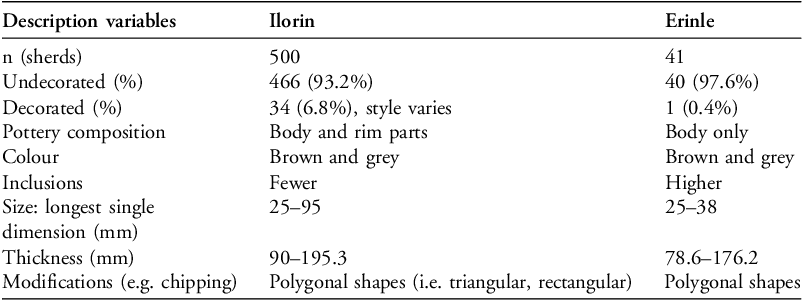
The study examined 500 potsherds from Ilorin, recovered from the potsherd pavement surface of a 1 × 1m excavated unit (PPII), part of previous archaeological research (Owoseni Reference Owoseni2023) (Table 1, Figure 2). Due to its location, exposed on an unpaved motor road, excavation opportunities for the potsherd pavement in Erinle were limited and only 41 samples were collected (Table 1). Sherds were carefully extracted using trowels to prevent breakage. Macroscopic analysis focused on surface decorations, sherd morphology (rim or body), colour, size, shape and thickness, and identifying inclusions and edge modifications (Table 1).
Table 1. Summary of analysed potsherds from Ilorin and Erinle Pavement sites.


Figure 2. Potsherd pavement from Ilorin (photograph by B. Owoseni).
Discussion
The construction of herringbone potsherd pavements at Ilorin and Erinle reflects shared architectural traditions and suggests cultural connections (Table 1). However, comparative analysis of the sherds reveals nuanced differences in technological choices associated with pottery production (Figures 3 & 4). Similarities in surface colour characteristics suggest comparable oxidising conditions during firing, likely achieved through open firing methods (Heather & Miller Reference Heather and Miller2007). Both centres show evidence of intentional modification of sherds for reuse in pavements, consistent with practices elsewhere in West Africa (Ogundiran Reference Ogundiran2002). Oral accounts from Ilorin mention the use of iron blades by artisans to shape potsherds used for pavement constructions.

Figure 3. Pottery from Ilorin pavements: a mixture of polygonal-shaped sherds, including both decorated and plain examples (photograph by B. Owoseni).

Figure 4. Pottery from Erinle pavements; left) the only decorated sherd from Erinle, which is worn (photograph by B. Owoseni).
Erinle potsherds have more inclusions (likely mica and quartz) than those from Ilorin, indicating differences in raw material sourcing, ecological environments or trade networks (Rice Reference Rice2005), and probable geological or ecological influences on production choices. Ilorin’s larger assemblage includes both body and rim sherds, while only body sherds were identified at Erinle—restricting efforts at the latter to determine vessel forms and functions, as rims are crucial for such interpretations. Larger, thicker sherds at Ilorin suggest different vessel types, clay sources or preferences for pavement construction. Decoration also varied: decorated potsherds were more prevalent in the Ilorin assemblage, suggesting greater emphasis on aesthetics, possibly indicating social hierarchy, ritual function or community identity. Comparative analysis suggests that the potsherds were from locally produced, domestic pottery repurposed for pavement construction, rather than traded items made specifically for pavement architecture. This implies they were everyday objects adapted for a new purpose.
Shared features, such as the herringbone pavement pattern and sherd colouration and polygonal modifications, suggest that these centres participated in larger cultural traditions with regional interactions through architectural knowledge, artisan practices or social values. However, variations in inclusions, decorations, ceramic compositions, sizes and thickness, suggest local adaptations based on community resources, environmental constraints and social practices.
Conclusion
The shared potsherd-pavement tradition exemplified in Ilorin and Erinle highlights the interconnectedness of medieval Yorùbáland, underscoring regional interaction and cultural continuity, while production variation in pottery demonstrates local innovation and identity. Comparative ceramic analysis thus provides valuable insights into the technological practices, social dynamics and cultural exchanges of medieval West Africa.
Acknowledgement
My thanks to Dr Matthew Davies for his comments on the manuscript.
Funding statement
I am grateful for the funding received from the McDonald Institute for Archaeological Research, University of Cambridge, UK.
Author contribution: CRediT Taxonomy
Bolaji Owoseni: Conceptualization-Lead, Data curation-Lead, Formal analysis-Lead, Funding acquisition-Lead, Investigation-Lead, Methodology-Lead, Project administration-Lead, Resources-Lead, Software-Lead, Supervision-Lead, Validation-Lead, Visualization-Lead, Writing - original draft-Lead, Writing - review & editing-Lead.



 Open access

