


Introduction
A large stream of research in the last decades shows that mass publics’ commitment to civil liberties is largely shaped by the momentary context (Davis & Silver, Reference Davis and Silver2004). Research has repeatedly shown that the public's adherence to some of the most fundamental principles of democracy ebbs and flows along with levels of societal and personal threat (Feldman & Stenner, Reference Feldman and Stenner1997; Hetherington & Suhay, Reference Hetherington and Suhay2011; Hetherington & Weiler, Reference Hetherington and Weiler2009; Stenner, Reference Stenner2005; Ziller & Helbling, Reference Ziller and Helbling2020). During normal times support for core features of democracy tends to increase, while in tumultuous times societies witness significant authoritarian backslidings in terms of tolerance for outgroups, the rule of law, respect of individual freedoms or support for institutional procedures (Doty et al., Reference Doty, Peterson and Winter1991; Hetherington & Suhay, Reference Hetherington and Suhay2011; Stenner, Reference Stenner2005).
The Covid‐19 pandemic has brought unprecedented restrictions to civil liberties in many places around the world, especially regarding citizens’ freedom of movement (Engler et al., Reference Engler, Brunner, Loviat, Abou‐Chadi, Leemann, Glaser and Kübler2021; Goetz & Martinsen, Reference Goetz and Martinsen2021; Rausis & Hoffmeyer‐Zlotnik, Reference Rausis and Hoffmeyer‐Zlotnik2021; Sebhatu et al., Reference Sebhatu, Wennberg, Arora‐Jonsson and Lindberg2020). These restrictions lie in tension with fundamental democratic freedoms. This is underlined by the fact that, as research shows, stronger democratic regimes were more reluctant to implement freedom‐restricting measures (Engler et al., Reference Engler, Brunner, Loviat, Abou‐Chadi, Leemann, Glaser and Kübler2021; Sebhatu et al., Reference Sebhatu, Wennberg, Arora‐Jonsson and Lindberg2020). On the one hand, the lockdowns that took place in several countries resulted in severe and prolonged restrictions of movement that would be unimaginable during normal times. In some countries, such as Israel, the restrictions of movement were extended to include public protests, which caused an outcry by civil rights groups, lawyers and activists. Apart from the restriction of individual freedoms, the Covid‐19 pandemic caused an unprecedented increase in public surveillance with the introduction of mobile software applications that track users informing them whether they have been near others who may have had the virus or monitor whether individuals who became infected abide by the quarantine measures (Sharma & Bashir, Reference Sharma and Bashir2020). In June 2020, a few months after the pandemic first hit, contact tracing mobile applications were in use in 28 countries, while 35 countries were using other digital tracking measures such as Google or Facebook tracking.Footnote 1 Both the lockdown and surveillance measures were enforced as regular legislation in several advanced democracies, in some cases using emergency procedures, despite a widespread concern over the ethics of contact tracing apps as well as the limits of governmental control on citizens’ privacy and movement (Blasimme & Vayena, Reference Blasimme and Vayena2020; Lucivero et al., Reference Lucivero, Hallowell, Johnson, Prainsack, Samuel and Sharon2020). These civil liberty restricting policies were generally popular among European mass publics (Amat et al., Reference Amat, Arenas, Falcó‐Gimeno and Muñoz2020; Jørgensen et al., Reference Jørgensen, Bor, Lindholt and Petersen2021). Investigating the psychological mechanisms that render citizens prone to giving away important civil liberties in order to protect themselves from threat becomes particularly important for two reasons. First, for understanding citizens’ commitment to fundamental individual freedoms under conditions of threat and, second, for helping assess the further impact of the Covid‐19 pandemic or future threatening events on democratic politics.
The aim of this article is to investigate individual‐level differences in support for the restriction of civil liberties in the light of the Covid‐19 pandemic. In order to do so it draws on theories of affect and decision making to assess the extent to which different emotional reactions toward the pandemic influenced attitudes toward mobile phone surveillance and the implementation of curfews. We test our hypotheses in five European democracies, Austria, France, Germany, Italy and the United Kingdom, using panel data which allow us to investigate the net role of emotions in support for restrictive policies controlling for individual heterogeneity. All of these countries are advanced democracies and they all adopted severe restrictions in freedom of movement during the same period in March 2020. Specifically, movement surveillance by the government through Covid‐19 apps was introduced during the first pandemic wave in all countries. Further, army‐controlled curfews were implemented in Italy in March 2020, the period in which the first wave of the data were collected.
The results suggest that experiencing fear about Covid‐19 had a strong positive impact on supporting these measures, while feeling hopeful or angry only played a minimal role. Further, the findings indicate that emotions moderate the impact of trust toward the government, a key variable for supporting the restriction of civil liberties, on supporting curfews and surveillance. Specifically, experiencing fear was associated with higher acceptance of civil liberty restrictions. Moreover, experiencing fear substantially decreased the effect of trust in the government, rendering those who lack trust more supportive of civil liberty restrictions.
These findings help explain why the draconian measures implemented to tackle the spread of Covid‐19 met such limited opposition by public opinion during the pandemic. At the same time, they have broader implications for our understanding of citizens’ willingness to sacrifice civil liberties in the name of protection. The Covid‐19 pandemic provides an ideal testbed for understanding the public's commitment to individual liberties. The findings not only provide robust evidence of the association between fear and restriction of liberties in the context of a pandemic, but more importantly show that experiencing fear leads citizens to set aside their distrust toward their governments and endorse the restriction of their liberties. This has important consequences for understanding the public's adherence to the basic principles of liberal democracy in times of unusually intense external threats.
Finally, our findings help advance the understanding of the role that emotions play on mass behaviour. Past research on emotions and political decision making has relied almost exclusively on laboratory experimental treatments that may often suffer from limited external validity or cross‐sectional data that have high external validity but cannot assess causal mechanisms. This has led some scholars to question the causal association between emotions and political behaviour arguing that the association may be endogenous (Ladd & Lenz, Reference Ladd and Lenz2008; Reference Ladd and Lenz2011). Studies on the association between emotions and politics with panel survey data that control for individual heterogeneity remain rare (but see Erhardt et al., Reference Erhardt, Freitag, Filsinger and Wamsler2021; Rico et al., Reference Rico, Guinjoan and Anduiza2017). In this article, we conduct a comparative study on emotions and politics using individual fixed effects models to control for unobservables that may simultaneously impact emotions and support for these measures. In this vein, the use of panel data allows an empirical test of theories of affect and provides support for the causal role of emotion on political behaviour.
Emotions and political choice
The experience and intensity of different emotional reactions depends on the type of threat, how the threat is framed by various elites, as well as individual psychological traits (Albertson & Gadarian, Reference Albertson and Gadarian2015; Jost et al., Reference Jost, Glaser, Kruglanski and Sulloway2003; Leger et al., Reference Leger, Charles, Turiano and Almeida2016; Vasilopoulos & Brouard, Reference Vasilopoulos and Brouard2020). In the case of Covid‐19, the emotional reactions to the pandemic could be affected by a plethora of factors such as the type and volume of information exposure, personal experience, health status, psychological characteristics, use of social or mainstream media, levels of social trust, personal communications as well as cueing by elites (e.g., Albertson & Gadarian, Reference Albertson and Gadarian2015; Jennings et al., Reference Jennings, Stoker, Valgarðsson, Devine and Gaskell2021; MacKuen et al., Reference MacKuen, Wolak, Keele and Marcus2010; Marcus et al., Reference Marcus, Neuman and MacKuen2000; Widmann, Reference Widmann2021; Vasilopoulos & Brouard, Reference Vasilopoulos and Brouard2020). All of these different mechanisms involve and elicit emotion. Affective reactions can be formed through different cognitive processes toward political actors, countries, situations or policies. Once distinct emotions such as fear, anger and hope are evoked they point to different behavioural repertoires.
Research has repeatedly shown that the main emotional reactions that citizens experience following exposure to various types of threats are fear and anger (Albertson & Gadarian, Reference Albertson and Gadarian2015; Erisen et al., Reference Erisen, Vasilopoulou and Kentmen‐Cin2020; Huddy et al., Reference Huddy, Feldman, Cassese, Marcus, Russell Neuman, MacKuen and Crigler2007; Lerner et al., Reference Lerner, Gonzalez, Small and Fischhoff2003; Wagner, Reference Wagner2014; Vasilopoulos et al., Reference Vasilopoulos, Marcus, Valentino and Foucault2019). Even though fear and anger are both negative emotions, they are the product of different appraisals of the environment and, in turn, point to divergent coping strategies. Fear is experienced when a threat is novel and unfamiliar, there is a lack of attribution of blame, and the threat is perceived as being beyond an individual's control (Lazarus, Reference Lazarus1991). On the other hand, anger is experienced when an individual has certainty over the source of the threat and has confidence in his or her resources to overcome it (Frijda, Reference Frijda1986; Lazarus, Reference Lazarus1991). Other studies have shown that threatening events may also evoke hope, in circumstances when people appraise that there exists a capacity for a positive result in an uncertain situation (Huddy et al., Reference Huddy, Feldman, Cassese, Marcus, Russell Neuman, MacKuen and Crigler2007; Lazarus, Reference Lazarus1991; Smith & Ellsworth, Reference Smith and Ellsworth1985).
At the same time different types of threatening societal events will produce different levels of fear, anger and hope among mass publics. The presence of external actors, the imminence of the threat or the proximity to a threatening event should, according to appraisal theories of emotion, have an impact on the levels of fear, anger and hope that the public experiences. For instance, past research shows that terror attacks (where there usually is a clear attribution of blame) evoke heightened fear and anger and little hope (Vasilopoulos & Brouard, Reference Vasilopoulos and Brouard2020). On the other hand, threats such as natural disasters tend to trigger high levels of fear (Albertson & Gadarian, Reference Albertson and Gadarian2015). And, as we will present shortly, the Covid‐19 pandemic elicited a powerful emotional response across all of the three emotional dimensions that we investigate here.
Despite both being negative emotions, fear and anger, once evoked, point to contrasting decision‐making processes. Fear motivates individuals to engage in risk‐avoidant behaviour in order to protect themselves from threat (Lerner & Keltner, Reference Lerner and Keltner2000; Reference Lerner and Keltner2001). Past research has found that because of these qualities, experiencing fear renders individuals more likely to comply with authorities and increases support for policies that restrict civil freedoms (Albertson & Gadarian, Reference Albertson and Gadarian2015). These findings have been confirmed in the domain of public health threats. Using an experimental design, Albertson and Gadarian found that experiencing fear over a fictitious chickenpox outbreak was associated with willingness to restrict freedom of movement and privacy (Albertson & Gadarian, Reference Albertson and Gadarian2015). Drawing on the case of the Covid‐19 pandemic, Eggers and Harding (Reference Eggers and Harding2021) found that governmental lockdown announcements evoked increased fear even among those previously unconcerned, while Brouard et al. (Reference Brouard, Vasilopoulos and Becher2020) and Harper et al. (Reference Harper, Satchell, Fido and Latzman2020) showed that fear about Covid‐19 boosted compliance with freedom‐restricting public health measures (but see Arceneaux et al., Reference Arceneaux, Bakker, Hobolt and De Vries2020).
The Affective Intelligence Theory (AIT; Marcus et al., Reference Marcus, Neuman and MacKuen2000) offers a nuanced framework for understanding the behavioural effects of fear. Rather than anticipating a uniform effect, the theory argues that fear affects individuals depending on their prior dispositions and the information circulating in their social environment. Specifically, AIT posits that fear stimulates attention and information seeking, rendering individuals more likely to reconsider past choices in the light of new information (Marcus et al., Reference Marcus, Neuman and MacKuen2000). In line with the premises of AIT, research has found that experiencing fear is associated with heightened motivation to seek out political information online and in mass media even from sources that contravene one's partisan convictions (Albertson & Gadarian, Reference Albertson and Gadarian2015; MacKuen et al., Reference MacKuen, Wolak, Keele and Marcus2010; Valentino et al., Reference Valentino, Hutchings, Banks and Davis2008). In turn, AIT argues that the acquisition of novel information leads to change in political choices by making citizens less reliant on extant political convictions such as ideology, partisanship or prior attitudes in favour of contemporaneous assessments of their external environment (MacKuen et al., Reference MacKuen, Marcus, Neuman, Keele, Marcus, Russell Neuman, MacKuen and Crigler2007; Marcus et al., Reference Marcus, Neuman and MacKuen2000, Reference Marcus, Valentino, Vasilopoulos and Foucault2019; see also Brader, Reference Brader2005; Redlawsk et al., Reference Redlawsk, Civettini and Emmerson2010; Wagner, Reference Wagner2014). Anxious individuals become more likely to change opinions in the light of information they encounter in the media and the political environment (MacKuen et al., Reference MacKuen, Marcus, Neuman, Keele, Marcus, Russell Neuman, MacKuen and Crigler2007; Marcus et al., Reference Marcus, Neuman and MacKuen2000). During the initial stages of the Covid‐19 pandemic in Europe, the media repeatedly pointed to the serious risks posed by the virus (Starosta et al., Reference Starosta, Onete, Grosu and Plesea2020), while there was a political consensus on the need for restrictive measures in order to protect the public (Collignon et al., Reference Collignon, Makropoulos and Rüdig2021). Consequently, we anticipate that citizens who were particularly anxious about the pandemic to have endorsed liberty‐restricting policies even if they were distrusting of the government who implemented them.
Anger on the other hand has quite distinct behavioural consequences compared to fear. Anger is associated with optimistic perceptions on the probability of tackling the threat (Lerner et al., Reference Lerner, Gonzalez, Small and Fischhoff2003). Experiencing anger renders voters less likely to seek out political information (MacKuen et al., Reference MacKuen, Wolak, Keele and Marcus2010; Valentino et al., Reference Valentino, Hutchings, Banks and Davis2008). On the other hand, unlike fear, anger leads to shallower processing of information, based on heuristics (Lerner & Keltner, Reference Lerner and Keltner2001). Further, studies have shown that angry individuals are more likely to strengthen their prior preferences even in the light of information that challenges these preferences (Suhay & Erisen, Reference Suhay and Erisen2018). Moreover, they are more prone at relying on their past convictions and their attitudinal, ideological or partisan orientations in order to form political choices (MacKuen et al., Reference MacKuen, Wolak, Keele and Marcus2010; Valentino et al., Reference Valentino, Wayne and Oceno2018). When it comes to political choice, anger renders citizens more likely to endorse aggressive, punitive and risk‐seeking policies and candidates (Banks, Reference Banks2014; Banks & Valentino, Reference Banks and Valentino2012; Rico et al., Reference Rico, Guinjoan and Anduiza2017; Valentino et al., Reference Valentino, Wayne and Oceno2018; Vasilopoulos et al., Reference Vasilopoulos, Marcus, Valentino and Foucault2019).
Unlike fear and anger, the impact of hope on political behaviour has received less attention, despite being a common affective response to threat (Vasilopoulos & Brouard, Reference Vasilopoulos and Brouard2020). A stream of research investigates hope together with other positive emotions such as enthusiasm or pride without differentiating the effects of each (Brader & Marcus, Reference Brader, Marcus, Huddy, Levy and Sears2013; MacKuen et al., Reference MacKuen, Wolak, Keele and Marcus2010; Marcus et al., Reference Marcus, Neuman and MacKuen2000, Reference Marcus, Neuman and MacKuen2017). In the realm of behaviour, positive emotions such as hope, joy or enthusiasm render individuals less likely to seek out information about a threatening stimulus and more likely to decide on the basis of extant convictions (Brader, Reference Brader2005; Marcus et al., Reference Marcus, Neuman and MacKuen2000). Further, positive emotions mobilize individuals to invest resources in the pursuit of a desired goal, being associated for instance with increased political participation (Marcus et al., Reference Marcus, Neuman and MacKuen2000). When it comes to hope specifically, studies have indeed found a positive impact of hope on political efficacy and participation (Greenaway et al., Reference Greenaway, Cichocka, Veelen, Likki and Branscombe2016; Wlodarczyk et al., Reference Wlodarczyk, Basabe, Páez and Zumeta2017). Others have argued that hope may lead to a desire for social change as well as preferences for compromise and reconciliation during conflict (Leshem & Halperin, Reference Leshem and Halperin2021).
The role of trust
Trust refers to the relation between the self and an external actor. It can be generally defined as the ‘expectation of good will in others’ (Glanville & Paxton, Reference Glanville and Paxton2007, p. 230). Trust is considered to be cultivated during one's formative years within the family and education system (Glanville & Paxton, Reference Glanville and Paxton2007; Uslaner, Reference Uslaner2000). It is shaped both by long‐term internal psychological dispositions (Glanville & Paxton, Reference Glanville and Paxton2007) as well as social characteristics that affect one's environment such as social class, ethnicity or occupation (Newton et al., Reference Newton, Stolle, Zmerli and Uslaner2018; Putnam, Reference Putnam2000; Wilkes & Wu, Reference Wilkes and Wu2018). Other works highlight the importance of macrohistorical characteristics and path dependent processes in shaping collective levels of trust (Aghion et al., Reference Aghion, Algan, Cahuc and Shleifer2010; Almond & Verba, Reference Almond and Verba1963; Putnam, Reference Putnam1994). The objects of trust may vary to include people from a person's direct social environment, institutions, political actors or people as a whole (Newton et al., Reference Newton, Stolle, Zmerli and Uslaner2018; Putnam, Reference Putnam1994). Trust has long been considered a key component of increased social cooperation and effective governance (e.g., Putnam, Reference Putnam1994).
Political trust encompasses a broad set of attitudes toward political actors, parties and national or supranational institutions (Newton et al., Reference Newton, Stolle, Zmerli and Uslaner2018). In this article we focus on one aspect of political trust, which is trust toward the national government. We conceptualize governmental trust as one's confidence in the ability and the intentions of a government to produce desired outcomes (see Hetherington, Reference Hetherington1998; Keele, Reference Keele2007). Governmental trust has been hypothesized to play a major role on threat perceptions and compliance with restrictive measures during the Covid‐19 pandemic (Devine et al., Reference Devine, Gaskell, Jennings and Stoker2020; Harring et al., Reference Harring, Jagers and Löfgren2021; Toshkov et al. Reference Toshkov, Yesilkagit and Carroll2020; Van Bavel et al., Reference Van Bavel, Baicker, Boggio, Capraro, Cichocka, Cikara, Crockett, Crum, Douglas, Druckman, Drury, Dube, Ellemers, Finkel, Fowler, Gelfand, Han, Haslam, Jetten and Willer2020). In the context of the pandemic, it has further been argued that both general social trust and trust toward authorities are important for understanding the severity of measures as well as citizen compliance. This is because, in order to comply, citizens should trust not only the government that the measures are in the right direction, but also their fellow citizens in that they are going to follow the measures (Harring et al. Reference Harring, Jagers and Löfgren2021).
Similarly to other forms of trust, such as interpersonal trust, governmental trust is also thought to be rooted up to an extent in socialization processes and shaped by enduring psychological factors (Newton et al., Reference Newton, Stolle, Zmerli and Uslaner2018). Unlike other forms of social trust, however, trust in government is strongly shaped by partisan attachments and is largely affected by electoral outcomes (Listhaug, Reference Listhaug, Klingemann and Fuchs1995). Moreover, and unlike other forms of trust that are deep‐rooted, governmental trust also entails an ephemeral component, being largely shaped by government performance (Hetherington, Reference Hetherington1998; Keele, Reference Keele2007; Listhaug, Reference Listhaug, Klingemann and Fuchs1995). A large stream of research has shown that trust in government ebbs and flows along short‐term factors such as various performance indicators, satisfaction with specific policies or scandals (Solé‐Ollé & Sorribas‐Navarro, Reference Solé‐Ollé and Sorribas‐Navarro2018; Van Erkel & Van Der Meer, Reference Van Erkel and Van Der Meer2016).
Trust toward the government has been identified as a key factor affecting the willingness to restrict civil liberties. This is especially true in times of threat (Davis, Reference Davis2007; Davis & Silver, Reference Davis and Silver2004). Davis (Reference Davis2007) argues that citizens who trust the government may be more willing to sacrifice their civil liberties in order to protect themselves and others from harm. This is because these individuals are more optimistic of the good‐intentioned and benevolent nature of the civil‐restricting measures as well as more confident that their liberties will be restored once the threat ends (Davis, Reference Davis2007, p. 69). Hence, according to this view, increased trust in government provides a leeway for a government to temporarily impose a set of restraining measures aimed at addressing an exogenous threat. This finding has been confirmed by Trüdinger and Steckermeier (Reference Trüdinger and Steckermeier2017). Drawing on German data, they demonstrate that governmental trust was positively associated with support for surveillance policies aiming at mitigating terrorist threat. In the context of the Covid‐19 pandemic, Toshkov et al. (Reference Toshkov, Yesilkagit and Carroll2020) draw on aggregate level data to demonstrate that higher levels of trust toward the government are associated with the implementation of civil‐restricting measures such as lockdowns or curfews during the first wave of the pandemic in Europe in 2020.
At the same time past research suggests that levels of threat moderate the impact of trust on support for restrictive policies. Specifically, drawing on post 9/11 data, Davis (Reference Davis2007) and Davis and Silver (Reference Davis and Silver2004) illustrate that considering that the probability of another terror attack on US soil is high renders citizens who are trusting of the government more likely to adhere to authoritarian policies compared to those who were not concerned about the possibility of another attack. In other words, their results suggest a positive interaction between trust toward the government and threat on the restriction of civil liberties. However, based on the literature on the distinct behavioural qualities of fear and anger that we reviewed above, we suspect that the interaction of trust toward the government with threat may go in opposite directions depending on whether citizens respond to a threat by experiencing fear or anger. Indeed, the same threatening stimulus can evoke fear among some and anger among others; yet once each emotion is elicited, they point to diverging behavioural repertoires. Fear makes individuals more likely to abandon their current political convictions, while anger makes them more likely to strengthen their prior convictions. Consequently, we anticipate contrasting moderating effects of fear and anger with governmental trust on endorsing the restriction of civil liberties: Fear should decrease the impact of trust in government on support for restricting measures, rendering distrusting citizens more likely to sacrifice civil liberties. Anger should have the opposite effect, leading citizens who are distrusting toward the government to become even less supportive of restricting measures to tackle the Covid‐19 pandemic.
At this point we should note that our analysis does not rule out the possibility that emotional reactions were affected by levels of governmental trust or, conversely, that trust in the government was affected as a result of emotional reactions in the light of the Covid‐19 threat. Indeed, drawing on data from the United States, Australia, Italy and the United Kingdom, Jennings et al. (Reference Jennings, Stoker, Valgarðsson, Devine and Gaskell2021) show that different types of political trust affected Covid‐19 threat perceptions. Other studies point to an increase in different forms of interpersonal and political trust as a result of the public health measures that were implemented during the first pandemic wave (Bol et al., Reference Bol, Giani, Blais and Loewen2021; Esaiasson et al., Reference Esaiasson, Sohlberg, Ghersetti and Johansson2020). Emotions seem to mediate this relationship: Making use of a quasi‐experimental design in a Dutch sample Schraff (Reference Schraff2020) argues that anxiety boosted political trust, measured as trust toward the parliament. Similarly, drawing on a Swiss panel Erhardt et al. (Reference Erhardt, Freitag, Filsinger and Wamsler2021) argue that fear increased while anger decreased governmental trust. Based on the literature we have reviewed, our aim is to assess the independent effect of emotions on favouring the restriction of civil liberties, net of trust. Controlling for individual heterogeneity in fixed effects models further allows for an improved estimation of the net effect of emotional reactions by better accounting for unobservables that may simultaneously influence both trust and emotions. We return to this issue in the results section.
Hypotheses
Based on the literature we discussed in the previous sections we formed the following hypotheses:Footnote 2
H1: Trust in government is positively associated with preferences for restricting civil liberties.
In line with Davis (Reference Davis2007) and Davis and Silver (Reference Davis and Silver2004) we anticipate that trust in government should make citizens more confident in the appropriateness of the civil‐restricting policies, their benefit to society, as well as in the benign and well‐intentioned motives of the government.
H2: Fear about the Covid‐19 pandemic is positively associated with preferences for restricting civil liberties.
Following past literature that indicated that fear renders voters more likely to seek out risk‐averse choices that maximize protection from harm, we anticipate that, all else equal, fear will cause an increase in support both for curfews and surveillance. We further expect that the positive effect of fear will hold in models controlling for individual heterogeneity.
H3: Anger about the Covid‐19 pandemic is negatively associated with preferences for restricting civil liberties.
Based on past research that argues that anger is associated with optimistic judgments regarding the course of a threatening situation, we hypothesize that it may be associated with decreased support for the implementation of restrictive measures in order to protect the population from Covid‐19.
H4: Fear about the Covid‐19 pandemic reduces the effect that trust exerts on preferences for restricting civil liberties
Following AIT's claim that fear leads individuals to abandon their extant political convictions in favour of contemporaneous assessments, we anticipate that fear evoked by the Covid‐19 pandemic will render citizens who are otherwise distrusting of the government to endorse civil‐restricting policies in order to protect public health. Hence, we anticipate a negative interaction between fear and governmental trust.
H5: Anger about the Covid‐19 pandemic increases the effect that trust exerts on preferences for restricting civil liberties
On the other hand, as anger makes individuals more likely to decide and act on the basis of their extant political beliefs, we expect that anger should boost the impact of government distrust on civil liberty restrictions. In other words, we anticipate a positive interaction between anger and governmental trust.
We refrain from developing a hypothesis on the role of hope as there is no apparent mechanism connecting hope and support for civil‐restricting measures. Hope is associated with collective action and mobilization toward a desired outcome, yet unlike fear and anger, hope is not generally associated with preferences for specific political outcomes. Having said that, it is still important to include hope in our empirical strategy given that hope correlates with both fear and anger and, consequently, it is important to control for all three dimensions to assess the independent effect of each more precisely (see Marcus et al., Reference Marcus, Neuman and MacKuen2017).
Data and methods
Data come from the collaborative project ‘Citizens’ Attitudes Under COVID‐19 Pandemic’, a cross‐national panel study produced by IPSOS in 2020 (see Brouard et al., Reference Brouard, Foucault, Michel, Becher, Vasilopoulos, Bono and Sormani2021 for a full description). The study was conducted using Computer Assisted Web Interviewing (CAWI) on a quota sample. Specifically, the sample is stratified by age, gender, occupation, and region. We use three waves of the panel conducted in five countries: France, Italy, United Kingdom, Austria and Germany. The first wave of the survey was carried out between March 16 and March 30, soon after the pandemic reached the countries we study. In this period, most of these countries were beginning to implement lockdowns and stay‐at‐home orders. The second wave was administered between April 15 and April 20. For the third period of analysis, we use wave four of the panel conducted between December 5 and December 9.Footnote 3
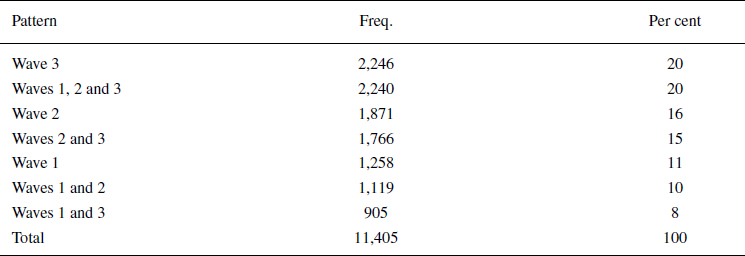
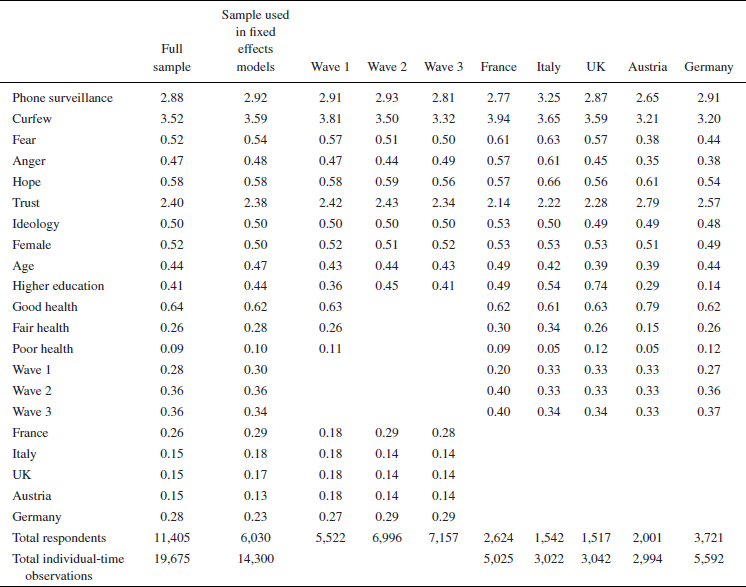
Table 1 documents the structure of the panel. The sample totals 11,405 respondents, corresponding to 19,675 individual‐time observations. Some respondents were observed in a single wave while others were observed in multiple waves. As in all longitudinal studies, respondents may be lost over time (panel attrition) while others entered the panel after the first wave. First‐wave respondents were contacted again for subsequent waves. Those who failed to respond were replaced by new respondents in a way that matched the sample quota targets (see Brouard et al., Reference Brouard, Foucault, Michel, Becher, Vasilopoulos, Bono and Sormani2021). Overall, 6,030 respondents, or about half of the sample, are seen in multiple waves, corresponding to 14,300 individual‐time observations. Those respondents who are tracked over time form the subsample used in the panel fixed effects models described below. Descriptive statistics on both the full sample (N = 11,405) and the fixed effects subsample (N = 6,030), shown in Table 2, confirm that panel attrition does not alter the sample composition. Those who remain in the panel over time do not differ substantially in terms of the variables used in the analysis.
Table 1. Panel structure

Source: Citizens’ Attitudes Under COVID‐19 Pandemic (Brouard et al. Reference Brouard, Foucault, Michel, Becher, Vasilopoulos, Bono and Sormani2021)
Table 2. Descriptive statistics on all variables by country and wave

Note: Descriptive statistics are calculated on the individual‐time observations.
Source: Citizens’ Attitudes Under COVID‐19 Pandemic (Brouard et al. Reference Brouard, Foucault, Michel, Becher, Vasilopoulos, Bono and Sormani2021)
Dependent variables
We use two dependent variables to measure public support for the restriction of civil liberties: (1) attitudes toward the use of mobile phone surveillance and (2) attitudes toward the implementation of curfews and checks by police and the army to control citizens’ movements. These are time‐variant measurements based on an identical question asked at all waves. Support for these policies is measured on a five‐point scale, where 1 indicates no support and 5 indicates full support. Descriptive statistics for the full sample in Table 2 indicate moderate support for phone surveillance (mean = 2.88) and higher support for curfews (mean = 3.52).
Independent variables
Two sets of independent variables are included in the models: those which are time‐variant, measured in all waves, and those which are time‐invariant, measured in wave 1.
Emotional reactions are time‐variant. Respondents are asked to rate how much of each of these emotions they feel about the coronavirus situation on a scale from 0 to 10, where 0 indicates ‘not at all’ and 10 ‘a great deal’. All variables have been rescaled from 0 to 1. Fear and anger are significantly higher in France, Italy and the United Kingdom relative to other countries (Table 2).
Trust towards the government is also a time‐repeated variable, measured using a four‐point scale, which we reverse coded to indicate 3 for ‘complete trust’ and 0 for ‘no trust’. We also use a left‐right political ideology scale measured in all waves, coded 0 for far‐left and 10 for far‐right.
The models further control for the following time‐invariant characteristics: age (coded in years and rescaled from 0 to 1), education (a dummy indicating a university degree), gender (a dummy indicating female), country of residence (France, Italy, United Kingdom, Austria or Germany) and self‐reported health (coded good, fair or poor). As health status was not consistently measured after wave 1, we ran a cross‐sectional model on this wave separately. Because the data are pooled across countries, the models are clustered at the country level and estimated with robust standard errors.
Models
As our dependent variables are ordinal, we use ordinal logistic regressions that predict support for mobile phone surveillance and the implementation of curfews, respectively. We run a series of cross‐sectional and panel models to assess the net effects of trust and emotions as stated in hypotheses 1, 2 and 3. We begin by a model estimated on data from wave 1 only. This cross‐sectional model allows us to control for self‐reported health, which is only well reported in the first wave.
Two types of panel models are then estimated. In these models, the data are structured in long format, with the potential for multiple time observations per individual. We first run random effects models, which draw on the full sample pooling all waves, followed by fixed effects models. Unlike fixed effects models, random effects models enable time‐invariant covariates to be estimated, while accounting for the fact that the data contain repeated individual‐time observations (Allison, Reference Allison2009). Fixed effects models draw on intra‐individual variation over time to predict the effect of a change in the independent variables on a change in the dependent variables. They have the advantage of controlling for unobserved, time‐invariant characteristics of individuals, or individual heterogeneity. By reducing omitted variable bias, these estimates can be interpreted more readily as causal effects. They therefore allow us to test the robustness of the independent variables of interest. However, they come with the drawback of restricting the sample to individuals who are observed at least twice (Table 1) and cannot estimate time‐invariant covariates.
Finally, to test hypotheses 4 and 5, we introduce three interaction terms into the panel models between trust and all emotional reactions (fear, anger and hope). Interactions are depicted graphically using the random effects models, but we also show that the findings are robust in fixed effects specifications.
Random effects models are estimated using Stata's xtologit command, while fixed effects models are run using the feologit command which relies on the blow‐up and cluster (BUC) estimator developed by Baetschmann et al. (Reference Baetschmann, Ballantyne, Staub and Winkelmann2020). Each observation in the dataset is copied K − 1 times (K being the number of categories of the dependent variable). Stata then applies the CML estimator clogit typically used for binary outcomes, clustering the standard errors at the individual level due to the dependence of the copied observations (for further details on the command, see Baetschmann et al. Reference Baetschmann, Ballantyne, Staub and Winkelmann2020). Because fixed effects models cannot estimate the effects of time‐invariant observables, these are not included. Random effects models are clustered at the country level and estimated with robust standard errors. All panel models further control for whether the observation is measured in wave 1, 2 or 3.
Results
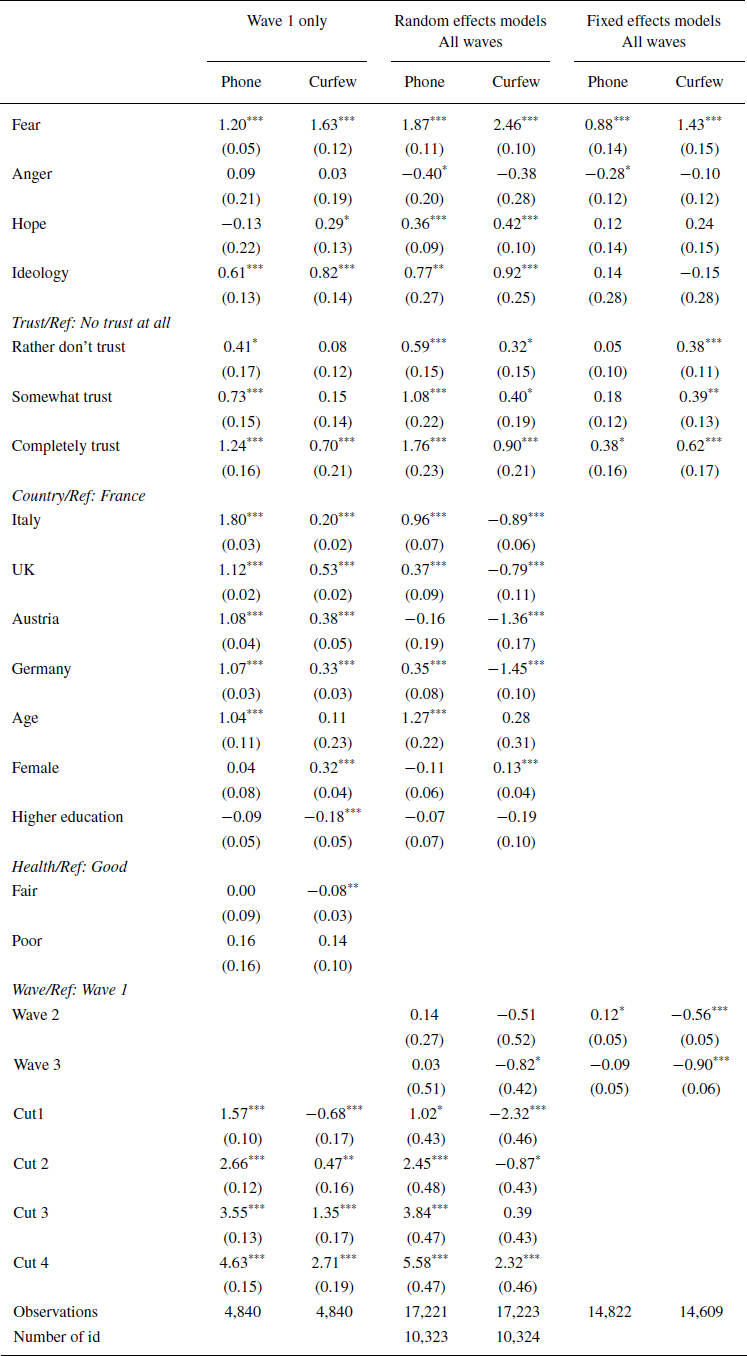
Table 3 reports full results from all model specifications, not including interactions. Trust in the government is associated with support to curb civil liberties in light of the Covid‐19 threat. The more trusting in the government, the more respondents support governmental use of phone surveillance and curfews.Footnote 4 This is in line with our first hypothesis. Yet this association loses some significance in fixed effects models predicting phone surveillance, suggesting that some of this effect may be linked to individual unobservables. We further find that as ideology moves from left to right, the propensity to endorse these measures increases, although again this effect is not found in fixed effects models. Age and female tend to be positively associated with support, while higher education correlates negatively. There is no significant difference in favouring phone surveillance and curfews between respondents in good health compared to those reporting poor health.
Table 3. Ordinal logistic regressions predicting phone surveillance and curfew implementation

Table shows coefficients with robust standard errors in parentheses.
* p < 0.05,
** p < 0.01,
*** p < 0.001
Source: Citizens’ Attitudes Under COVID‐19 Pandemic (Brouard et al., Reference Brouard, Foucault, Michel, Becher, Vasilopoulos, Bono and Sormani2021)
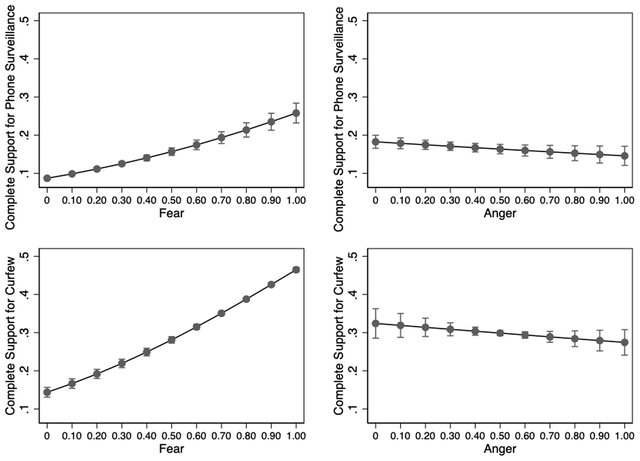
A robust positive effect of fear on adhering to restrictive measures in light of the Covid‐19 pandemic is observed in all models, providing broad support for H2. This effect is robust to controls, including levels of trust in government. Further, the positive effect of fear persists even after accounting for individual heterogeneity in the fixed effects models. In other words, fear boosts the willingness to implement these measures even after controlling for any unobserved stable characteristics of respondents that may correlate both with fear and the dependent variables. Figure 1 illustrates the net effect of fear, documenting an increase of about 20–30 percentage points in full support of the measures between low and high levels of fear. Fear has a stronger effect on support for curfews compared to phone surveillance.

Figure 1. The effects of fear and anger on support for phone surveillance and curfew implementation Source: Citizens’ Attitudes Under COVID‐19 Pandemic (Brouard et al., Reference Brouard, Foucault, Michel, Becher, Vasilopoulos, Bono and Sormani2021).
Note: Graphs display predicted probabilities of complete support for the measures by levels of fear and anger. They are calculated from the random effects models controlling for fear, anger, hope, ideology, trust, country, age gender, education and wave.
In contrast, the two other emotional reactions, anger and hope, matter little to individual endorsement of these measures. As posited in H3, anger tends to be negatively associated with supporting phone surveillance and curfews, yet contrary to the hypothesis the effect is only significant in two estimations. Figure 1 depicts the weak effects of anger compared to fear on support for these measures. While there is some evidence that hope, like fear, increases adherence to curfew implementation, this effect disappears in the fixed effect models controlling for individual heterogeneity.
As a robustness check, we also report cross‐sectional models for waves 2 and 3 (Table A1 Supporting Information Appendix) and the fixed effects models separately by country (Table A2). Results show consistently positive effects of fear across waves and national contexts, with the exception of a loss of significance in the models predicting support for phone surveillance in France, Italy and Austria.
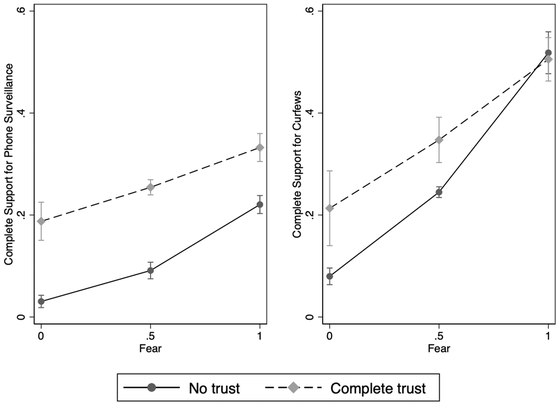
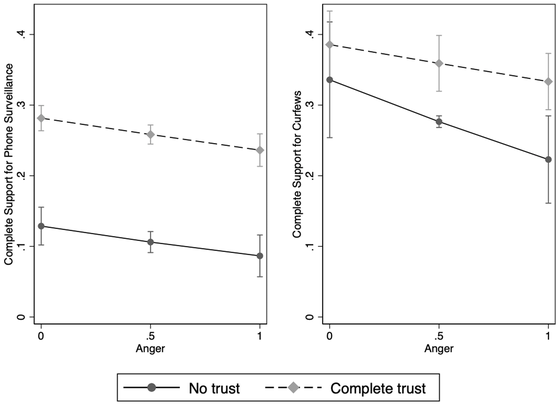
We now turn to the models including interaction terms between trust and the three emotional reactions. Full results for the interaction models (both random and fixed effects) are reported in Table A3. To ease interpretation, we plotted predicted probabilities from the random effects models of full support for both measures by levels of trust and fear (Figure 2) and trust and anger (Figure 3). No trust refers to respondents who scored the lowest on the trust variable, while complete trust refers to respondents who scored the highest. As hope is not central to our hypotheses, we do not show a figure depicting this interaction.

Figure 2. Interactions between fear and trust. Source: Citizens’ Attitudes Under COVID‐19 Pandemic (Brouard et al., Reference Brouard, Foucault, Michel, Becher, Vasilopoulos, Bono and Sormani2021).
Note: Graphs display the predicted probabilities of complete support for the measures by levels of fear and trust. They are calculated from the random effects models controlling for three interaction terms (anger × trust, fear × trust and hope × trust), ideology, country, age, gender, education and wave.

Figure 3. Interactions between anger and trust. Source: Citizens’ Attitudes Under COVID‐19 Pandemic (Brouard et al., Reference Brouard, Foucault, Michel, Becher, Vasilopoulos, Bono and Sormani2021).
Note: Graphs display the predicted probabilities of complete support for the measures by levels of anger and trust. They are calculated from the random effects models controlling for three interaction terms (anger × trust, fear × trust and hope × trust), ideology, country, age, gender, education and wave.
Figure 2 shows that, in line with the prediction made in H4, fear moderates the effect of governmental trust on support for civil‐restricting measures. The gap in the support for civil liberty‐restricting policies between those who distrust and those who trust the government diminishes substantially when respondents experience a higher level of fear, as indicated by the steeper slope of fear for those distrusting the government. When it comes to curfew implementation, significant differences in support for the measure linked to trust disappear entirely when fear levels are at their highest. These findings suggest that fear motivates individuals to adhere to restrictive measures among untrusting citizens who would not be predisposed to do so. Fixed effects models including the interactions in Table A3 confirm this finding.
Figure 3 documents variations in the effect of trust by levels of anger. We do not find substantial evidence for H5. As previously shown, anger has a mostly null impact on support for phone surveillance and curfews. Further, anger appears to slightly increase the gap in the support for civil liberty‐restricting policies between those who distrust and those who trust the government, yet the effect falls short of reaching statistical significance in both the random effects and the fixed effects models shown in Table A3.
Finally, as a robustness check, we run these interactions separately by country. Results from random effects models are displayed in Table A4. The diminished effect of trust in the government for fearful respondents is found in most countries.
Conclusion
Several measures implemented by governments around the world to tackle the spread of Covid‐19 lie in tension with some of the most fundamental civil liberties. This has caused concern among civil liberties groups, law organizations, academics and citizens. This article investigated the role of emotional reactions and trust toward the government on the endorsement of civil liberty restricting measures, drawing on panel data from Austria, France, Germany, Italy and the United Kingdom. Specifically, we examined the role of fear, anger, hope and trust toward the government on the propensity to support two common civil liberty restricting measures that governments around the world implemented in order to tackle the Covid‐19 pandemic: restriction of movement in the form of curfews and enhanced surveillance through Covid‐19 tracing mobile phone applications. The findings from these five European countries indicate that experiencing fear about Covid‐19 was positively associated with an increased willingness to sacrifice civil liberties in order to protect public health. Further, experiencing fear made those who did not trust the government overcome their distrust and support both phone surveillance and the implementation of curfews. We also find some limited evidence that anger had the opposite effect, leading distrusting citizens to reject the restriction of their liberties even more strongly.
Our analysis offers robust evidence that emotional responses have causal effects on political behaviour by controlling for individual heterogeneity, providing additional empirical support from large‐N panel surveys to past studies using experimental methods (Brader, Reference Brader2005; Groenendyk, Reference Groenendyk2016; MacKuen et al., Reference MacKuen, Wolak, Keele and Marcus2010; Suhay & Erisen, Reference Suhay and Erisen2018; Valentino et al., Reference Valentino, Hutchings, Banks and Davis2008, Reference Valentino, Brader, Groenendyk, Gregorowicz and Hutchings2011, Reference Valentino, Wayne and Oceno2018). Hence, support for these measures among fearful citizens cannot be attributed to unobserved characteristics.
Overall, the conclusions of this study confirm and extend findings of previous studies that have traced a link between threat and public willingness to curb civil liberties. Importantly, the panel nature of the study allowed us to use fixed effects models that combine high external validity with a stronger causal leverage. In this sense the results demonstrate that emotions are not mere epiphenomena of political attitudes or other unobserved traits but rather play an important causal role on political choice. Specifically, threat induced fear has a real and powerful role on the willingness to restrict civil liberties even among those who would otherwise be opposed to such restrictions. This provides strong confirmation of similar findings in the context of fear induced following terror attacks that draw on cross‐sectional or lagged dependent variable panel designs (Huddy et al., Reference Huddy, Feldman, Cassese, Marcus, Russell Neuman, MacKuen and Crigler2007; Vasilopoulos et al., Reference Vasilopoulos, Marcus and Foucault2018). On the other hand, in most cases, anger had a null effect. This finding was against our predictions. Perhaps this could be attributed to the variety of objects of anger during the pandemic (government, health officials, uncomplying citizens, etc.) that could, in turn, evoke different behavioural and attitudinal patterns.
Overall, the findings offer a clear illustration of the volatility of public attitudes toward key individual liberties, and point to the worrying conclusion that support for some of the foundations of liberal democracy may swiftly wane in the light of a severe collective threat such as the Covid‐19 pandemic. They further suggest that citizens are not only willing to restrict freedoms for suspected individuals or minorities, as past research on the impact of terror attacks has shown, but they are also willing to sacrifice their own fundamental liberties in order to tackle a serious threat. Moreover, the effect of fear is potent enough to make citizens overcome their scepticism over the government that implements these measures. Hence, dangers for liberal democracy do not necessarily need to come in the form of extremist movements or antiliberal parties, but they can well stem from an anxious citizenry seeking protection from an external threat. These findings should, in our view, be a cause for concern among proponents of democracy, law and policymakers, as well as the broader public. Future experimental research could extend these findings by investigating more specific mechanisms and situations under which fear leads to the erosion of support for civil liberties and under which it does not. Further, future research could investigate the extent to which inherent attributes of different types of threat such as the local or global impact of threat, the presence or absence of clear attributions of blame on the causes of the threat, and the imminent or distant character of a possible threatening event, evoke different emotional reactions and how these in turn shape policy preferences.
Given that we live in an era of increasingly high collective threat related to viruses, terror attacks and climate change, the uncovering of mechanisms protecting individual freedoms and civil liberties becomes particularly important.
Acknowledgements
The authors would like to thank the participants of the Far‐right Politics and Societal Resillience (FREXO) seminar held by the University of Oslo, as well as the editor and three anonymous reviewers for their comments in earlier versions of the articles. All remaining errors are our own.
Online Appendix
Additional supporting information may be found in the Online Appendix section at the end of the article:
Table A1. Ordinal Logistic Regression Models Separately for Waves 2 and 3
Table A2. Ordinal Logistic Regression Models Separately by Country (Fixed Effects)
Table A3. Ordinal Logistic Regression Models Including Interactions between Emotions and Trust
Table A4. Ordinal Logistic Regression Models including Interactions by Country (Random Effects)


 Open access

