

Introduction
As in most countries, 2020 in Norway was dominated by the Covid-19 pandemic. Besides the pandemic, the most important political event was that the right-wing populist party, the Progress Party/Fremskrittspartiet (Frp), left government. The party entered government for the first time in 2013 in a coalition led by the Conservative Party/Høyre (H) Erna Solberg, and left government after seven years in 2020 due to a disagreement about bringing home a so-called Islamic State (IS) woman and her two children.
Election report
There was no election in Norway in 2020
Cabinet report
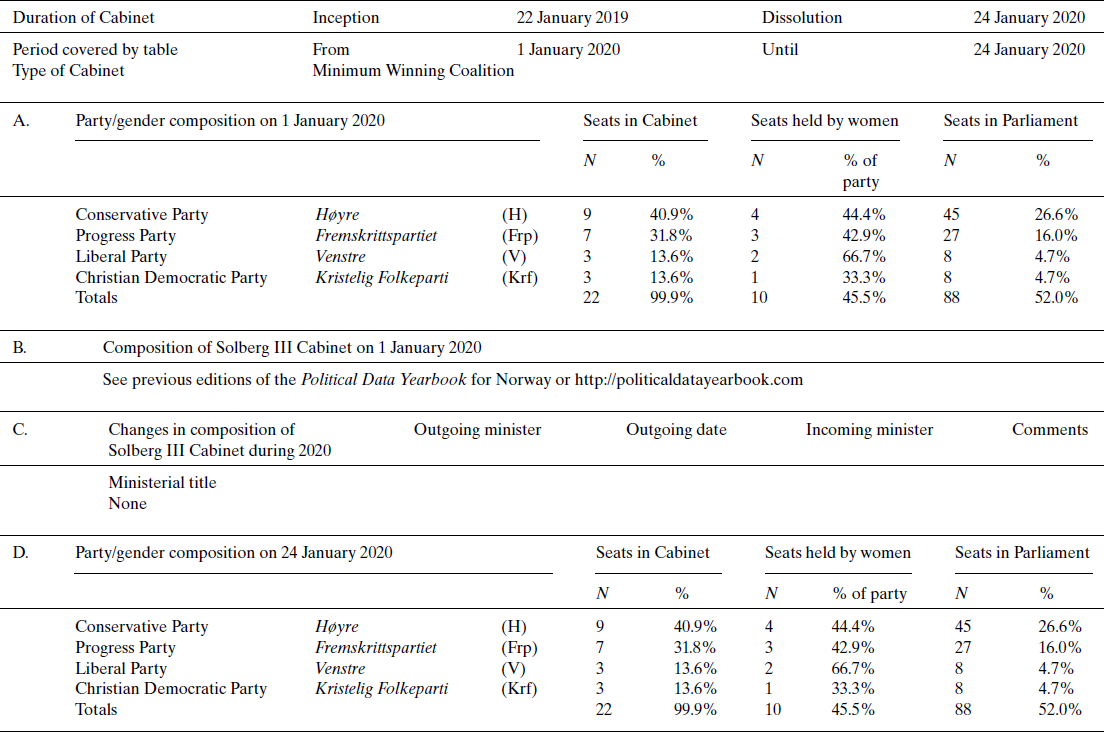
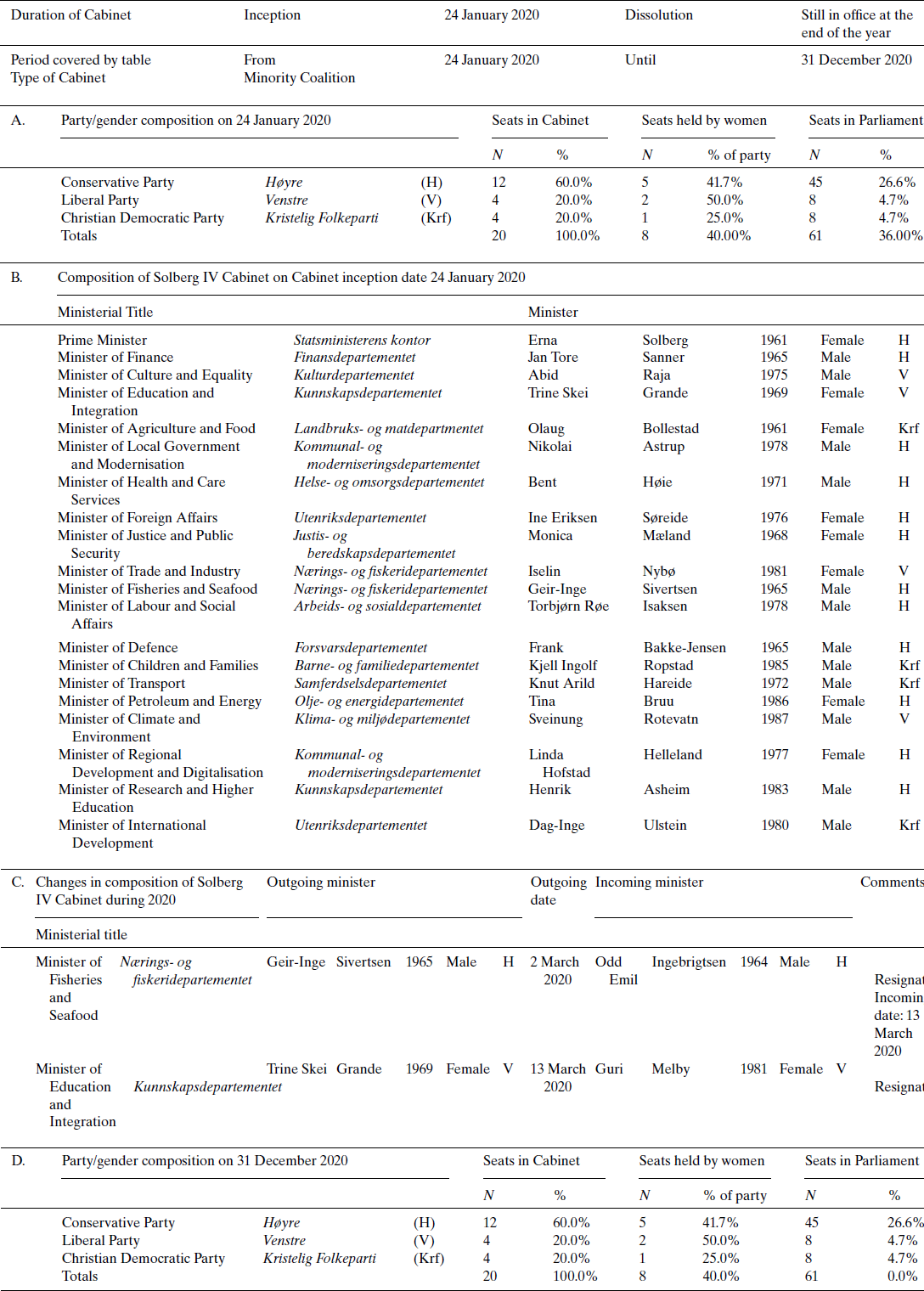
In January 2020, Norway's Cabinet consisted of a coalition of four political parties that together had a majority in Stortinget (Parliament). The coalition was led by Prime Minister Erna Solberg of the Conservatives, and it included the right-wing populist Progress Party, as well as two centrist parties: the Liberal Party/Venstre (V) and the Christian Democratic Party/Kristelig Folkeparti (Krf). On 24 January, the Progress Party decided to withdraw from the governing coalition (see below), and PM Solberg formed a new government consisting of the three remaining coalition partners.
Parliament report
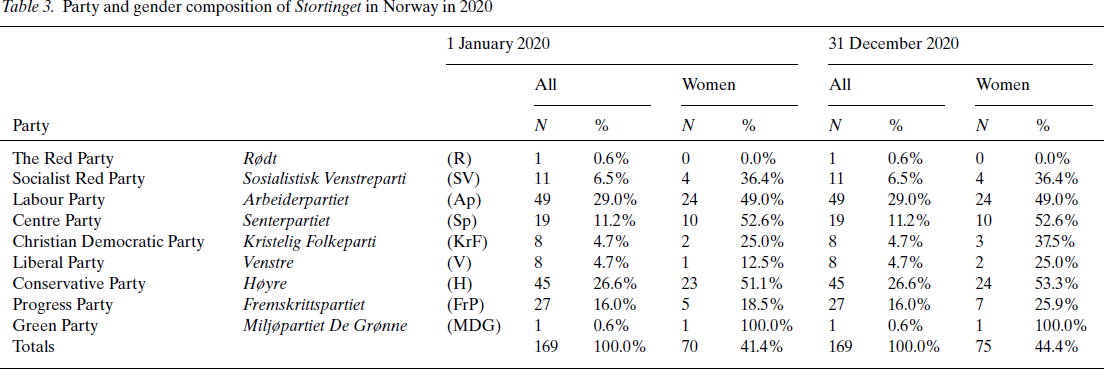
There were some minor changes in the composition of Parliament in 2020, mainly due to MPs from the Progress Party returning to Parliament. The gender balance increased somewhat, from 41 per cent to 44 per cent, due to the Progress Party returning female ministers to the Stortinget at the expense of male temporary deputies, but also changes in the three other governing parties increased the proportion of women in the Stortinget.
Political party report
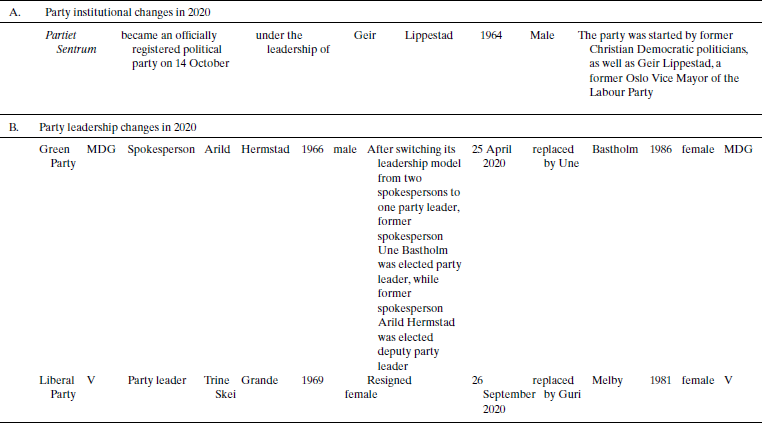
Liberal Party leader Trine Skei Grande resigned and was replaced by new leader Guri Melby. The Green Party/Miljøpartiet De Grønne (MGD) changed its leadership from having two ‘spokespeople’ to having an actual party leader, like the rest of Norway's major political parties. Une Bastholm became leader in 2020.
Institutional change report
There were no major institutional changes in 2020.
Issues in national politics
At the beginning of 2020, Norway's Cabinet consisted of four political parties that together had a majority in the Stortinget (Parliament). The governing coalition was led by Prime Minister Erna Solberg of the Conservatives, and it included the right-wing populist Progress Party, as well as two centrist parties: the Liberals and the Christian Democrats. The centre-right gained a majority in Parliament in 2013 and retained a slimmer majority in the 2017 election. After two different constellations of minority governments, it was not until January of 2019 that all four parties were included in a coalition. Tensions in the coalition were obvious throughout 2019 (Bergh and Karlsen 2020), especially between the two centrist parties, on the one hand, and the Progress Party, on the other.
Immigration policy is one issue where the strains within the coalition were particularly stark. It is a defining issue for the Progress Party, which consistently advocates for a stricter immigration policy, whereas the two centrist parties hold more liberal views. In January 2020, the government faced a decision over whether to bring home a woman who had been a part of the so-called Islamic State (IS) in Syria. The woman, a Norwegian national of Pakistani origin, was charged with terrorism offenses by the Norwegian authorities. She had her children with her in the refugee camp, one of whom was said to be in need of healthcare. A decision was made to bring the woman and her children to Norway, over the dissent of the Progress Party. As a result of that decision, and internal deliberations within the party, the Progress Party decided to withdraw from the governing coalition.
On 24 January, Prime Minister Solberg formed a new government of the three remaining coalition partners. This was a unique event in Norwegian parliamentary history: that a party withdrew from a governing coalition, but the remainder of the coalition continued to govern. This unique circumstance was made possible by the fact that the Progress Party was unwilling to support a centre-left government. By default, therefore, Solberg's government had the backing of a majority in Parliament.Footnote 1 The three-party minority government retained power throughout 2020, and was soon faced with handling the Covid-19 pandemic.
As the pandemic spread around the world, and cases were also discovered in Norway, the government implemented unprecedented lockdown measures on 12 March. As in most countries, the rest of the political year was dominated by the pandemic. The swift lockdown and the population's broad adherence to measures, such as social distancing and working from home, led to a rapid decline in infections. Support for the sitting government, and Prime Minister Solberg rose according to public opinion polls at the time.
The first few months of the pandemic saw limited political debate in Norway. The government was in charge of both the handling of the pandemic and various economic stimulus packages. There was some discussion and involvement of Parliament in the passing of economic stimuli. Due to Norway's large oil revenues and the ‘oil fund’ (The Government Pension Fund Global), the government has ample resources to stimulate the economy and to support businesses that were harmed by lockdown, without any deficit spending.
While Norway was hit with a second wave of infections in the fall, and lockdown measures were lifted, reinstated and adjusted countless times in 2020, the general consensus was that the country was successful at weathering the storm. The numbers of infections, hospitalizations and deaths were lower than in most European countries. Voters generally gave the government a positive evaluation of the handling of the pandemic, according to surveys.
Most other political issues received far less attention in 2020 than they would in an ordinary year. There were anti-racism demonstrations in June as part of the global Black Lives Matter (BLM) movement. There was some debate in September about bringing refugees to Norway from the refugee camp on the Greek island of Lesbos. Support for the Center Party rose substantially in the polls toward the end of the year. The party, which traditionally represents rural interests, was successful in criticizing the government for various reforms that were seen as taking power and services away from local communities. These arguments seemed to have some sway over voters even during the pandemic.
Table 1. Cabinet composition of Solberg III in Norway in 2020

Source: regjeringen.no, Norwegian government's website, 2021.
Table 2. Cabinet composition of Solberg IV in Norway in 2020

Source: regjeringen.no, Norwegian government's website, 2021.
Table 3. Party and gender composition of Stortinget in Norway in 2020

Notes: The gender balance was slightly higher at the end of 2020 as a result of the insertion of Solberg IV as well as changes in the composition of Solberg IV.
One of the Progress Party's male representatives, Ulf Leirstein, resigned from the party in 2019 and now sits as an independent. The Progress Party's parliamentary group therefore consists only of 26 representatives.
Source: www.stortinget.no, Norwegian Parliament's website, 2021.
Table 4. Changes in political parties in Norway in 2020

Note: The Green Party switched its leadership model at the same time of the party leader election. One of the two former spokespersons, Une Bastholm. was elected party leader.
Sources: The Brønnøysund Register Centre, and the Green Party's and the Liberal Party's websites. 2020.

 Open access

