Contents
Research Article
Three periodic solutions for discontinuous perturbations of the vector p-Laplacian operator
- Part of:
-
- Published online by Cambridge University Press:
- 20 March 2017, pp. 673-681
-
- Article
- Export citation
-
Using a variational approach we obtain the existence of at least three periodic solutions for discontinuous perturbations of the vector p-Laplacian operator
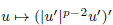 .
.
 .
.The lack of exponential stability for a class of second-order systems with memory
- Part of:
-
- Published online by Cambridge University Press:
- 31 May 2017, pp. 683-702
-
- Article
- Export citation
-
We analyse the decay properties of the solution semigroup S(t) generated by the linear integrodifferential equation

where the operator A is strictly positive self-adjoint with A –1 not necessarily compact. The asymptotic stability of S(t) is investigated in terms of the dependence of the parameter γ ∈ ℝ. In particular, we show that S(t) is not exponentially stable when γ ≠ 1.
Tilting subcategories with respect to cotorsion triples in abelian categories
- Part of:
-
- Published online by Cambridge University Press:
- 28 June 2017, pp. 703-726
-
- Article
- Export citation
-
Given a non-negative integer n and a complete hereditary cotorsion triple
 , the notion of
  subcategories in an abelian category
  is introduced. It is proved that a virtually Gorenstein ring R is n-Gorenstein if and only if the subcategory
  of Gorenstein injective R-modules is
  with respect to the cotorsion triple
  , where
  stands for the subcategory of Gorenstein projectives. In the case when a subcategory
  of is closed under direct summands such that each object in
  admits a right -approximation, a Bazzoni characterization is given for to be . Finally, an Auslander–Reiten correspondence is established between the class of subcategories and that of certain subcategories of which are
  -coresolving covariantly finite and closed under direct summands.
 , the notion of
  subcategories in an abelian category
  is introduced. It is proved that a virtually Gorenstein ring
  of Gorenstein injective
  with respect to the cotorsion triple
  , where
  stands for the subcategory of Gorenstein projectives. In the case when a subcategory
  of
of  admits a right
  -coresolving covariantly finite and closed under direct summands.
Size estimates of unknown boundaries with a Robin-type condition
- Part of:
-
- Published online by Cambridge University Press:
- 16 March 2017, pp. 727-741
-
- Article
- Export citation
The algebra of symmetric analytic functions on L ∞
- Part of:
-
- Published online by Cambridge University Press:
- 31 May 2017, pp. 743-761
-
- Article
- Export citation
-
We consider the algebra of holomorphic functions on L ∞ that are symmetric, i.e. that are invariant under composition of the variable with any measure-preserving bijection of [0, 1]. Its spectrum is identified with the collection of scalar sequences
 such that
  is bounded and turns to be separable. All this follows from our main result that the subalgebra of symmetric polynomials on L ∞ has a natural algebraic basis.
 such that
  is bounded and turns to be separable. All this follows from our main result that the subalgebra of
 Second-order differential equations with random perturbations and small parameters
- Part of:
-
- Published online by Cambridge University Press:
- 05 July 2017, pp. 763-779
-
- Article
- Export citation
Construction of ray-class fields by smaller generators and their applications
- Part of:
-
- Published online by Cambridge University Press:
- 20 March 2017, pp. 781-812
-
- Article
- Export citation
Finite speed of propagation and waiting time for a thin-film Muskat problem
- Part of:
-
- Published online by Cambridge University Press:
- 05 July 2017, pp. 813-830
-
- Article
- Export citation
Invariants of GLn (𝔽q ) in polynomials modulo Frobenius powers
- Part of:
-
- Published online by Cambridge University Press:
- 05 July 2017, pp. 831-873
-
- Article
- Export citation
Positive solutions of Kirchhoff-type non-local elliptic equation: a bifurcation approach
- Part of:
-
- Published online by Cambridge University Press:
- 28 June 2017, pp. 875-894
-
- Article
- Export citation