

Introduction
The coalition government of the christian‐democratic Austrian People's Party (Österreichische Volkspartei/ÖVP) and right‐wing populist Freedom Party of Austria (FPÖ), under Federal Chancellor Sebastian Kurz and Vice‐Chancellor Heinz‐Christian Strache, pressed ahead throughout the year in implementing its government programme. The interests negatively affected reacted strongly to the reforms, but public support for Federal Chancellor Kurz and the ÖVP, less so for the FPÖ, remained strong, bolstered by an economic boom in the country. The most difficult situation that the coalition government, and in particular its Minister of the Interior Herbert Kickl, faced was the ‘BVT Affair’, a police raid of the ministry's domestic intelligence service that led to a parliamentary committee of inquiry. In four regional elections in spring the sitting Land governors were confirmed. The national leaders of almost all opposition parties changed.
Election report
Four regional elections (Landtagswahlen) – in Lower Austria, Carinthia, Tyrol and Salzburg – were held under the new political constellation of a federal ÖVP–FPÖ government in office. As the right‐wing party Team Stronach (TS) had dissolved the previous year, its voters and seats in the Land diets and Land governments were up for grabs.
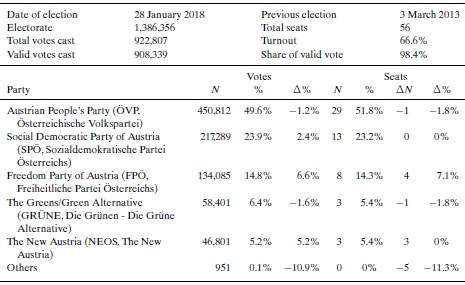
Elections in Lower Austria were held on 28 January. Lower Austria allocates government seats in proportion to the parties’ shares in the Land election, and the last government included members of the ÖVP, Social Democratic Party of Austria (SPÖ) and TS. The ÖVP, led by Land governor Johanna Mikl‐Leitner, held a majority in the regional parliament and in the regional government. Mikl‐Leitner had succeeded long‐time governor Erwin Pröll in office the year before. In her first and highly personalized campaign, Mikl‐Leitner won 49.6 per cent of the votes for the ÖVP (down by 1.2 percentage points), and a majority of the seats (1 percentage point down). The SPÖ obtained 23.9 per cent (up 2.4 percentage points) and remained at 13 seats. The FPÖ obtained 14.8 per cent (up 6.6 percentage points) of the votes and doubled the number of seats from four to eight. The Greens/Green Alternative (GRÜNE) obtained 6.4 per cent of the votes (down 1.6 percentage points) and three seats (one down), as did The New Austria (NEOS) with a vote share of 5.2 per cent. The large decline of votes in the category ‘other parties’ is due to the demise of the TS.
Table 1. Result of regional (Land) elections in Lower Austria in 2018

Source: Amt der Niederösterreichischen Landesregierung (2018).
Regional elections in Tyrol were held on 25 February, where a coalition government between the ÖVP, led by Land governor Günther Platter, and GRÜNE, led by Ingrid Felipe, had been in office. Felipe was for a few months national party leader in 2017, but focused on Land politics again after the party's disastrous result in the national elections. The dominant ÖVP had suffered from breakaway parties in the previous election. Conditions of economic boom made the traditional concerns in Tyrol, high costs of living and housing, and the burdensome transit traffic crossing the region less prominent this time. After a highly personalized campaign, Platter's ÖVP obtained 44.3 per cent of the votes (up 4.9 percentage points) and 17 of the 36 seats (up one). Other parties remained at a distance. The second largest party SPÖ obtained 17.3 per cent (up 3.5 percentage points) resulting in six seats, the FPÖ obtained 15.5 per cent (up 6.2 percentage points) and five seats. GRÜNE came in fourth with 10.7 per cent (down 1.9 percentage points) and four seats. List Fritz, an older ÖVP breakaway party, retained its two seats and a share of votes of 5.5 per cent (down 0.2 percentage points). Running for the first time, NEOS successfully crossed the 5 per cent threshold with 5.2 per cent and also received two seats. Other parties remained below the threshold (Amt der Tiroler Landesregierung 2018). A coalition treaty for a second term of the government between the ÖVP and GRÜNE was quickly concluded and Platter became again Land governor.
The regional elections in Carinthia were held on 4 March. Proportional allocation of government seats based on the election result had recently been abolished. Government composition would thus depend on coalition negotiations with decision‐making in the executive by unanimity. The outcome of the election was a triumph for SPÖ Land governor Peter Kaiser, which elevated his status in the national party considerably. The SPÖ obtained 47.9 per cent of the votes (up 10.8 percentage points) and 18 (up four) of the 36 seats. The FPÖ came in second with 23 per cent (up 6.1 percentage points) and nine seats (up three), the ÖVP third with 15.5 per cent (up 1.1 percentage points) and six seats (up one). The losers of the election were parties suffering from quarrels and splits: GRÜNE, BZÖ (Alliance for the Future of Austria, Bündnis Zukunft Österreich) and Team Carinthia. GRÜNE, previously in the Land government, lost three‐quarters of its past vote, dropping to 3.1 per cent (down 9 percentage points) and below the 5 per cent entry threshold. The BZÖ, a decade ago the Land’s dominant party, had lost its two MPs during the term and collected only 0.4 per cent of the votes (down 6 percentage points). Team Carinthia, the remnant of former party TS, held on to 5.7 per cent (–5.5 percentage points) of the votes and three seats (down one). NEOS and other parties failed to get into Parliament (Amt der Kärntner Landesregierung 2018). The SPÖ and ÖVP negotiated a coalition treaty, but just after it was agreed in principle the ÖVP Land party leader Christian Benger stepped down and was replaced by Martin Gruber. A furious SPÖ forced further concessions on the ÖVP: government decisions would be by majority vote and the SPÖ would be free to seek alternative legislative majorities in the diet.
Elections in Salzburg on 22 April brought one more success for the ÖVP. Following the 2013 election, a three‐party coalition of the ÖVP, GRÜNE and TS had been into office, led by ÖVP Land governor Wilfried Haslauer. The TS's government member left his party, but had to step down due to an undeclared donation. The government's majority then rested on a renegade MP's support. The ÖVP goal was to obtain a stable two‐party coalition; GRÜNE wanted to remain its partner. In the election the ÖVP increased its vote share considerably to 37.8 per cent (up 8.8 percentage points) and 15 of the 36 seats (up four). The GRÜNE vote share collapsed by more than half to 9.3 per cent (down 10.9 percentage points) and three seats (down four). The SPÖ obtained 20 per cent of the vote (down 3.8 percentage points) and eight seats (down one); the FPÖ 18.8 per cent (up 1.8 percentage points) and seven seats (up one). The Free Party Salzburg (FPS, Freie Partei Salzburg), a FPÖ splinter organization, and List Hans Mayr (Liste Hans Mayr ‐ die Salzburger Bürgergemeinschaft), a TS spin‐off, failed to enter the regional parliament (Amt der Salzburger Landesregierung 2018). The ÖVP led by Haslauer formed a coalition government with GRÜNE and NEOS.
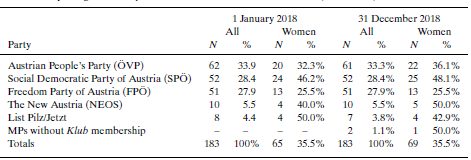
Turnout in regional elections was on average 15 percentage points lower than in the national election of autumn 2017. The seat distribution in the Federal Chamber, whose members are elected in proportion to the seat distribution in the regional parliament, changed after each election. The FPÖ gained a seat in Lower Austria from the TS, in Tyrol from GRÜNE, in Carinthia a seat held by an expelled MP and in Salzburg a seat held by the party split‐off Free Party Salzburg. The ÖVP lost a seat in Carinthia to the SPÖ and gained a seat in Salzburg from GRÜNE (Table 4).
Cabinet report
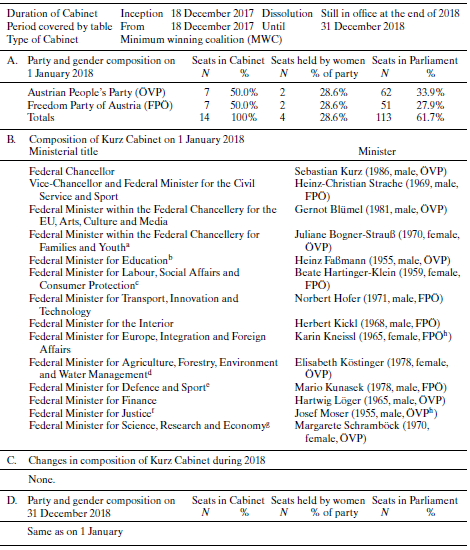
The Cabinet of Federal Chancellor Kurz remained unchanged throughout 2018, with the final set‐up of ministries and designations as set by the updated Federal Ministries law coming into force on 8 January.
Table 2. Cabinet composition of Kurz in Austria in 2018

Notes: aAn updated Federal Ministries law came into effect on 8 January 2018. The Ministry was renamed the Federal Ministry within the Federal Chancellery for Women, Families and Youth.
b From 8 January the Federal Ministry for Education, Science and Research.
c From 8 January the Federal Minister for Labour, Social Affairs, Health and Consumer Protection.
d From 8 January the Federal Minister for Sustainability and Tourism.
e From 8 January the Federal Minister for Defence.
f From 8 January the Federal Minister for Constitutional Affairs, Reforms, Deregulation and Justice.
g From 8 January the Federal Minister for Digital and Economic Affairs.
h Kneissl and Moser hold no membership of their respective party.
Minister of the Interior Herbert Kickl (FPÖ) immediately became the government's most polarizing minister, and the ministry's new general secretary, Peter Goldgruber, its most controversial high civil servant. Minister Kickl appeared to thrive on controversy with journalists. He declared his intention ‘to concentrate’ asylum‐seekers in fewer primary service centres, a choice of word that was criticized for being far too close to the National Socialists’ (Nazi) concentration camps. Soon after he decreed the renaming of the state's ‘first take‐up centres’ for refugees as ‘departure centres’. His pet project, a mounted police force in the capital Vienna, drew ridicule. A serious state affair was the early morning raid by a police unit of the ministry's own domestic intelligence service – the Federal Office for the Protection of the Constitution and Counter‐Terrorism (Bundesamt für Verfassungsschutz und Terrorismusbekämpfung – BVT) – on 28 February, authorized by Kickl and Goldgruber in cooperation with a state attorney from an anticorruption unit. The reason given – misuse of authority by intelligence service members – was nebulous; the leader of the police unit chosen for the search and seizure of materials identified as an FPÖ partisan, while one of the offices raided held the service's confidential data on right‐wing extremists in Austria. Kickl suspended the BVT director, a decision that was repealed by an administrative court soon after, and a higher court half a year later declared the raid almost entirely unwarranted. The immediate outcry by opposition and media was loud and the opposition parties quickly established a parliamentary committee of inquiry. The coalition partner ÖVP remained mostly silent, even though the BVT director and others accused were considered its partisans. After the ‘BVT Affair’ broke, European intelligence services cooperating in the ‘Bern Club’ curbed information‐sharing with their Austrian counterpart.
Throughout the year the coalition government of the ÖVP and FPÖ exhibited a remarkable degree of coalition discipline and showed a united front to the public. An inter‐ministerial taskforce located at the Federal Chancellery planned the weekly agenda setting and talking points for ministers, who gave press conferences often in a bipartisan group setting. ‘Message control’ became the buzzword for the government's strict communication policy. With few exceptions, Kurz refrained from criticizing the FPÖ, earning him the nickname the Silent Chancellor (Schweigekanzler).
Parliament report
Coalition cohesion extended to the parliamentary arena and enabled the government to pass successfully several controversial bills. These included the FPÖ demand to repeal a smoking ban in bars and restaurants passed by the previous coalition government; a business sector demand to increase maximum daily working time to 12 hours; and – an issue important to both parties – a drastic overhaul of the self‐governed social security sector that lowered the number of agencies from 21 to five, replaced directors and strengthened employers’ representation on agency boards. A demonstration organized by the labour unions against the ‘12‐hour‐day’ was the year's largest with about 100,000 participants. The coalition also passed ‘welfare chauvinist’ laws that provide lower levels of social benefits to refugees and other foreigners, including from European Union countries, than to Austria's citizens.
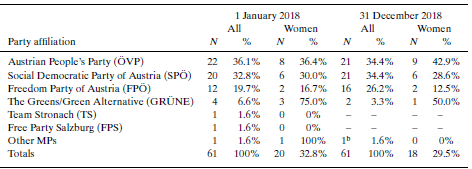
Table 3. Party and gender composition of the lower house of Parliament (Nationalrat) in Austria in 2018

Sources: Austrian Parliament (2019); author's own calculations.
Table 4. Party and gender composition of the upper house of Parliament (Bundesrat) in Austria in 2018a

Notes: aMembers of the Bundesrat are delegated by the Land diets (Landtage) on the basis of the results of the Land elections.
b An ÖVP MP was expelled from the party group.
Sources: Austrian Parliament (2019); author's own calculations.
Establishing a committee of inquiry is a parliamentary minority right. However, the government parties in the Rules Committee repudiated an SPÖ demand to institute a committee of inquiry on the BVT Affair, calling the proposed mandate for the inquiry too wide. The SPÖ, NEOS and Pilz List jointly introduced a reworked demand and the committee of inquiry assumed its work in April. Another committee of inquiry, demanded by NEOS, was set up to study the acquisition of Eurofighter Typhoon airplanes for the Austrian armed forces in 2002 and subsequent decisions. A previous committee of inquiry on the same subject had to close ahead of the parliamentary elections.
Three popular initiatives collecting signatures in October passed the 100,000 quorum required for deliberation in Parliament. The ‘Don't Smoke’ popular initiative by the Austrian Medical Association and Cancer Aid organization directly challenged the government's repeal of the ban of smoking in bars and restaurants and collected 881,569 signatures (which amounts to 13.8 per cent of the electorate). A ‘Women's Popular Initiative 2.0’ collected 481,959 signatures (7.6 per cent of the electorate) and an initiative to repeal Austrian public broadcasting dues collected 320,239 signatures (5.0 per cent of the electorate).
Political party report
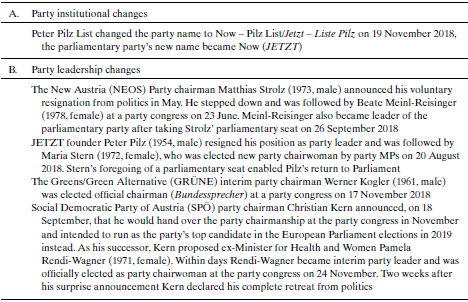
NEOS party leader Matthias Strolz announced his voluntary retirement from politics in May and handed his post to Beate Meinl‐Reisinger at a party congress on 23 June. Meinl‐Reisinger, previously leading NEOS in the Land Parliament in Vienna, took his National Council seat and became leader of the parliamentary party.
The split‐off party of former GRÜNE MP Peter Pilz, simply called Pilz List, had an unruly year. Accused of past harassment of women, Pilz refrained from taking the parliamentary seat after the election on 2017, but intended to return as soon as investigations against him closed, which happened in spring 2018 due to lack of evidence and lapse of time. A return to the National Council, however, required a fellow MP to relinquish the seat. Negotiations with Martha Bißmann (1980, female), who had succeeded Pilz, came to nothing. Parliamentary party leader Peter Kolba (1959, male) resigned eventually, but another woman, ranked above Pilz on the candidate list, also had to give up her claim. For doing so Maria Stern (1972, female) was rewarded with the post of party leader. Pilz became deputy party leader. At the swearing in of Pilz as MP on 11 June, almost all other parties’ women MPs left the plenary in protest. Bißmann was expelled from the parliamentary party a month later. The party's name was changed from List Peter Pilz to Now – Pilz List/JETZT – Liste Pilz in November.
Table 5. Political party changes in Austria in 2018

After the disastrous 2017 parliamentary elections – GRÜNE dropped out of the National Council – Werner Kogler took over as interim party leader (Bundessprecher) from short‐term predecessor Ingrid Felipe (Jenny Reference Jenny2018: 29), cut party staff numbers and renegotiated debts with its creditors. Deemed successful as a crisis manager, he was elected as official party chairman at a party congress in November.
The SPÖ party leader Christian Kern was widely seen as failing in the role as leader of the largest opposition party. A week after his re‐nomination as leader by the party executive, he surprised the public by announcing on 18 September that he was stepping down as party chairman and planned to run as top candidate in the next year's European Parliament elections instead. He had been forced to make the announcement after a leak of his plans to the media. Kern proposed Pamela Rendi‐Wagner as successor, who debuted in national politics as Minister for Health and Women in the previous SPÖ–ÖVP coalition government and had been the party's number two in the 2017 election. The party executive quickly made Rendi‐Wagner interim party leader. Two weeks later, Kern declared his complete retreat from politics. A party congress on 24 November elected Rendi‐Wagner as the first female leader of the SPÖ, adopted a new party programme initiated by Kern, and confirmed former parliamentary party chairman Andreas Schieder as top candidate for the European elections. Support for the SPÖ in November 2018 was at a year's low of 25 per cent (Politico 2019).
Issues in national politics
An old songbook of the fraternity Germania containing an extreme anti‐Semitic phrase led to public distancing by the ÖVP in Lower Austria from future cooperation with regional FPÖ party leader Udo Landbauer, a member of the fraternity. German‐national students’ fraternities constitute a traditional recruitment pool for the FPÖ. At a traditional ball of this sector, Vice‐Chancellor Strache declared there was no place for antisemitism in the FPÖ. The party's attempts to improve relations with the Jewish community in Austria, however, were rebuffed by representatives of the latter. Radical statements by lower level party functionaries and partisans during the year led to criticism that the FPÖ maintained a fuzzy demarcation towards the extreme right.
Agnes Bierlein was appointed as the first female president of the Constitutional Court in February. The court declared in legal decisions a right to register a third gender in official documents and forbid discrimination between heterosexual and homosexual marriages.
In June, Austria assumed the presidency of the European Union. The government wanted to focus on managing the UK's departure (Brexit), the upcoming multiannual financial framework and, reflecting its own foreign policy, supporting the accession efforts of South Eastern European countries. After the European Union‐NATO summit in July, FPÖ MEP and party general secretary Herbert Vilimsky accused European Commission President Jean‐Claude Juncker of substance abuse and called for his resignation. President Alexander Van der Bellen condemned Vilimsky for use of foul language and criticized Federal Chancellor Kurz's silence on the matter. The president also urged the government to stop ignoring left‐leaning interest groups in law‐making consultations. Austrian Foreign Minister Karin Kneissl's private invitation of Russian President Vladimir Putin to her wedding in August (with a curtsy to Putin) was criticized by the opposition as undermining the European Union's joint position towards Russia because of its role in the Ukraine conflict.

 Open access

