

Introduction
After a year of considerable political upheaval in 2022, 2023 saw Rishi Sunak's first full year as Prime Minister open with his declaration of five policy pledges, which included tackling small boat crossings in the Channel. Later in the year, the Conservative government also repositioned itself politically in rolling back the net zero agenda. After several of his nominated resignation peerages had been rejected, and the Privileges Committee recommended he be suspended for lying to Parliament, former Prime Minister Boris Johnson resigned as a Member of Parliament (MP) in June, triggering a by-election. Long-serving Scottish National Party leader Nicola Sturgeon announced her resignation as party leader and First Minister of Scotland, later being arrested and questioned as part of an investigation into the party's finances.
The Cabinet saw some long-serving ministers depart, including Ben Wallace, who had served continuously as Defence Secretary since 2019. A November Cabinet reshuffle saw Suella Braverman sacked as Secretary of State for the Home Office, while several new MPs joined the Cabinet for the first time. Former Prime Minister David Cameron, who had stepped down as an MP in 2016, was appointed as a Life Peer by Sunak, taking up a Cabinet position as Foreign Secretary.
The seven by-elections that were held over the year emphasised the difficulties facing the Conservatives in the polls; five took place in Conservative seats, but the party retained just one, with some historically large swings.
Election report
There were no national elections in the United Kingdom in 2022.
Cabinet report
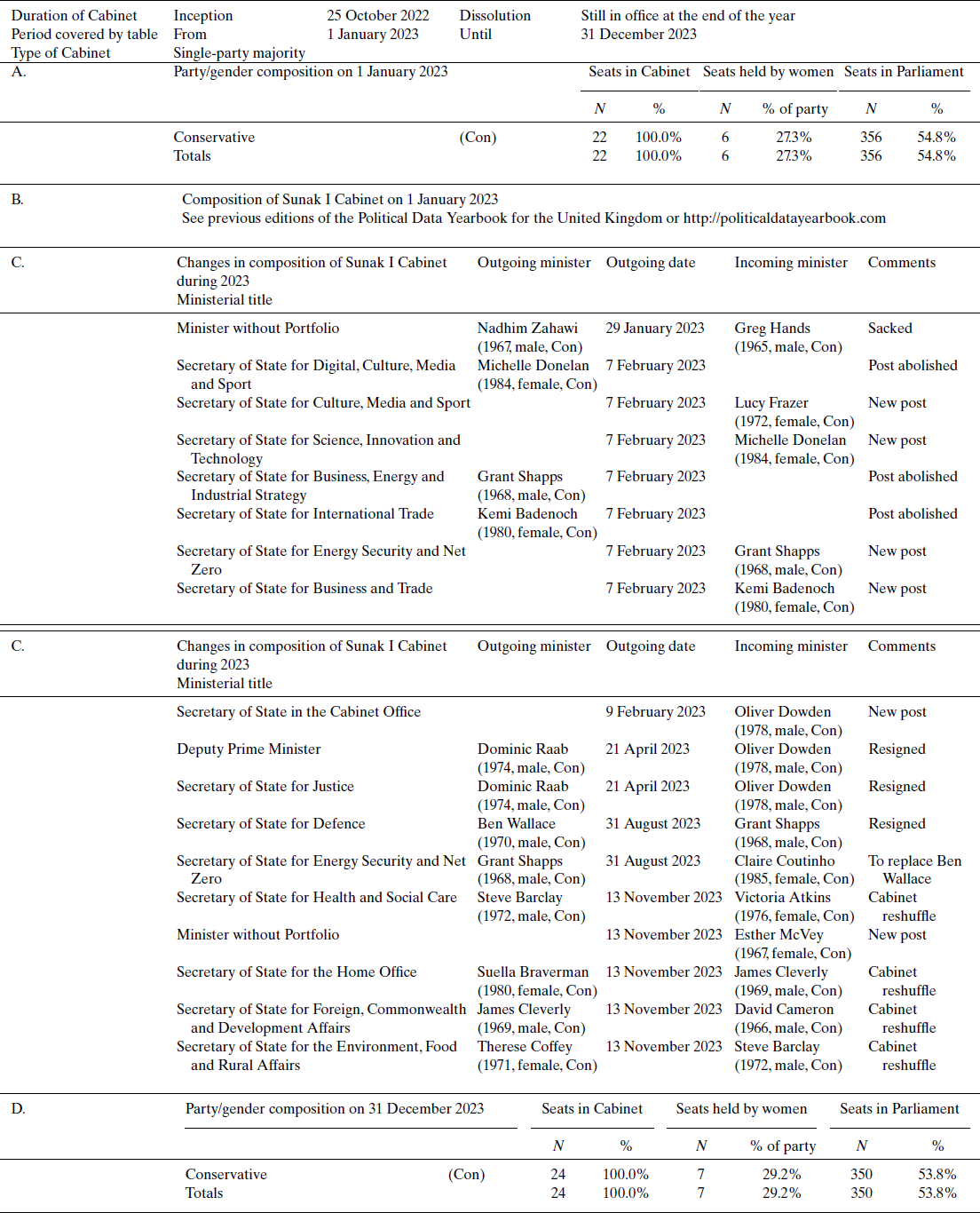
The current government took office on 13 December 2019 and is a single-party majority government. The year saw multiple changes in the Cabinet (Table 1), the first coming on 29 January, when Sunak sacked Minister without Portfolio and former Chancellor Nadim Zahawi; he had been found to have breached the ministerial code by not revealing that he had been under investigation by His Majesty's Revenue and Customs (the United Kingdom's national tax authority) during his tenure as Chancellor. He was replaced by Greg Hands, who also took over Zahawi's post as Conservative Party Chair. Grant Shapps’ position as Secretary of State for Business, Energy and Industrial Strategy and Kemi Badenoch's position as Secretary of State for International Trade were both abolished on 7 February, with Badenoch becoming the new Secretary of State for Business and Shapps becoming the new Secretary of State for Energy Security and Net Zero. Similarly, the position of Secretary of State for Digital, Culture, Media and Sport was split into two; Michelle Donelan became the new Secretary of State for Science, Innovation and Technology, while Lucy Frazer became the Secretary of State for Culture, Media and Sport. Dominic Raab, who had served almost continuously in the Cabinet since 2018, resigned from his positions as Secretary of State for Justice and Deputy Prime Minister in April 2023. This came after an investigation found that he had bullied parliamentary staff—a conclusion that he vehemently denied (BBC 2023). A new entrant to the Cabinet, Alex Chalk, replaced him as Justice Secretary, whereas Oliver Dowden became Deputy Prime Minister, alongside a new position as Secretary of State in the Cabinet Office. Secretary of State for Defence, Ben Wallace, who had served continuously in the post since July 2019, announced his resignation in July and declared he would not contest the next election; was replaced by Grant Shapps. A new entrant to the Cabinet, Claire Coutinho, replaced Shapps as Secretary of State for Energy Security and Net Zero.
Table 1. Cabinet composition of Sunak I in the United Kingdom in 2023

Source: UK Parliament (n.d.).
A substantial reshuffle took place on 13 November. Secretary of State for the Home Office Suella Braverman had become increasingly vocal regarding her policy differences with the government and had published an article in The Times in which she questioned whether the police were treating protesters from different groups equally, with edits insisted upon by Downing Street not made (Nevett Reference Nevett2023). She was sacked from the Cabinet in the reshuffle and replaced by Foreign Secretary James Cleverly. In a surprise move, former Prime Minister David Cameron was created a Life Peer and appointed as the new Foreign Secretary, despite having left the Commons in 2016. This was the first time in over 50 years that a former Prime Minister had re-entered the Cabinet of one of their successors, although on that occasion the former Prime Minister (Alec Douglas-Home) was still serving as an MP. Secretary of State for the Environment, Food and Rural Affairs, Thérèse Coffey, resigned from the Cabinet, being replaced by former Health Secretary Steve Barclay. The new Health Secretary was Victoria Atkins, occupying her first Cabinet-level position. Former Secretary of State for Work and Pensions under Theresa May, Esther McVey, rejoined the Cabinet as a Minister without Portfolio. Her role was to be what was described as ‘a minister for common sense’, addressing a move by the Conservatives to tackle the perceived woke agenda.
Parliament report
Seven by-elections were held in 2023. The first by-election of the year was held on 9 February, after Labour's Rosie Cooper had resigned to become the Chair of the Mersey Care National Health Service (NHS) Foundation Trust. Labour's Ashley Dalton retained the seat, with an increased majority. The 20th of July saw three by-elections held on the same day. The first was in Selby and Ainsty, where the incumbent Conservative MP Nigel Adams resigned over his omission from Boris Johnson's resignation honours. The seat, held by the Conservatives since its inception in 2010, was gained by Labour's Keir Mather, who became the youngest serving MP at 25. The second, in Somerton and Frome, came after the incumbent MP David Warburton resigned. He had been suspended by the Conservative Party in 2022 after allegations regarding his conduct required investigation. The Liberal Democrats, who had held the seat between 1997 and 2015, won the by-election with a swing of 29 per cent. The third by-election held on this day came in Uxbridge and South Ruislip, the seat of former Prime Minister Boris Johnson. After an investigation into Partygate, the Privileges Committee recommended a suspension (Lilly Reference Lilly2023), which would have triggered a recall petition. Johnson resigned, and the Conservatives retained the seat, with the new MP Steve Tuckwell attributing his victory to public dislike of the Ultra Low Emission Zone (ULEZ) policy of the London Mayor, Sadiq Khan (Patrick Reference Patrick2023).
On 5 October, a by-election was held in Rutherglen and Hamilton West after a successful recall petition. The petition had been triggered by the sitting MP Margaret Ferrier's suspension from Parliament after breaking Coronavirus regulations in 2020. Ferrier had also been suspended by the Scottish National Party since 2020. Labour won the seat with a swing of 20.4 per cent. The 19th of October saw two more by-elections. The first, in Tamworth, came after Chris Pincher lost his appeal against his suspension for groping. The former Conservative MP had been suspended since 2022; the seat was lost to Labour, with one of the largest swings since 1945. Last, Conservative Nadine Dorries triggered a by-election in Mid Bedfordshire, after being omitted from Johnson's resignation honours. She had announced her intention to stand down immediately in June but did not do so until 29 August. Her seat—held by the Conservatives since 1931—was lost to Labour.
Wellingborough's Peter Bone was investigated by the Independent Expert Panel over allegations of bullying and sexual misconduct. He was suspended from the Commons for six weeks, which triggered a recall petition. This was successful on 19 December, and his seat was left vacant as the year closed, ahead of a by-election in February 2024.
Several Conservative MPs had the party whip withdrawn in 2023. Andrew Bridgen, MP for North West Leicestershire since 2010, had the whip suspended by the Conservatives in January for comments regarding the COVID-19 vaccine. He was expelled by the party in April, whereupon he joined the Reclaim Party—a right-wing party founded in 2020 by actor Laurence Fox. Bridgen briefly became the party's first MP, before his resignation from Reclaim in December. Crispin Blunt (Reigate) had the whip withdrawn in October after his arrest over accusations of rape and drug use. Scott Benton (Blackpool South) had the whip withdrawn in April over breaches of lobbying rules—as the year closed a parliamentary investigation recommended that he be suspended from the Commons. Last, Bob Stewart (Beckenham) surrendered the whip after being convicted of racial abuse.
Labour also saw several MPs having the whip suspended. Former Shadow Home Secretary Diane Abbott (Hackney North and Stoke Newington) had the whip withdrawn after writing a controversial letter regarding racism to the Observer. Bambos Charalambous (Enfield Southgate) had the whip withdrawn after an unspecified allegation over his behaviour. Geraint Davies (Swansea West) was suspended by Labour after allegations of sexual harassment, and Andy McDonald (Middlesbrough) lost the whip over comments made at a rally in support of Palestine. The Scottish National Party's Angus MacNeil (Na h-Eileanan an Iar) lost the party whip after missing key votes and refused to rejoin the party. SNP MP for East Kilbride, Strathaven and Lesmahagow, Lisa Cameron, crossed the floor to join the Conservatives on 12 October.
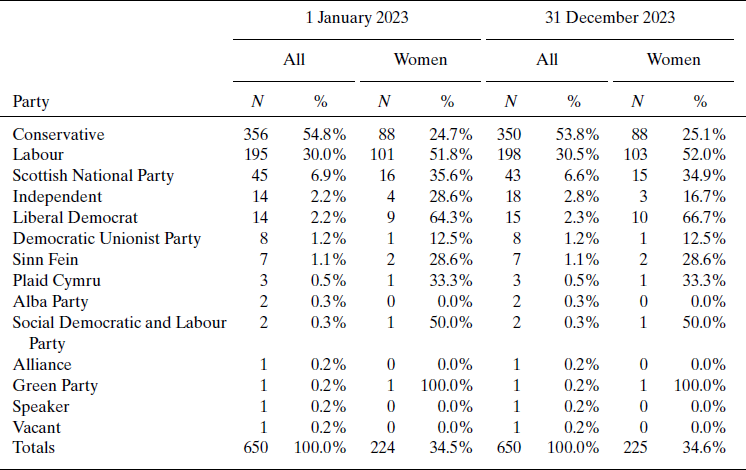
Information on the composition of the House of Commons in 2023 can be found in Table 2.
Table 2. Party and gender composition of the House of Commons in the United Kingdom in 2023

Source: UK Parliament (2023a).
House of Lords
Resignation honours for those nominated by former Prime Ministers Boris Johnson and Liz Truss were announced. Johnson's list (Cabinet Office 2023a) was announced on 9 June accompanied by controversy. He created seven peers, including former Conservative London mayoral candidate Shaun Bailey, who had been accused of breaking COVID-19 restrictions; the police opened a new investigation into these in July. Peerages were also given to his former Chief of Staff (Dan Rosenfield), Deputy Chief of Staff (Ben Gascoigne), the Tees Valley Metro Mayor (Ben Houchen), his former Transport advisor from his time as London Mayor (Kulveer Ranger) and the Political Director of the Conservative Party (Ross Kempsall). The final peerage was awarded to Johnson's Special Adviser Charlotte Owen, who at 30 became the youngest life peer since the introduction of the life peerage system in 1958. Priti Patel, the former Home Secretary, became a Dame, as did MPs Andrea Jenkins and Amanda Milling. MPs Jacob Rees-Mogg, Conor Burns and Simon Clarke—all ministers under Johnson—received knighthoods, as did Johnson supporter Michael Fabricant. However, the House of Lords Appointment Committee (HOLAC) confirmed that it had not supported eight of Johnson's proposed peerages, and Rishi Sunak accused the former Prime Minister of asking him to override HOLAC's recommendations (Nevett & Seddon Reference Nevett and Seddon2023). Johnson resigned as an MP just hours after the list was published, alongside Nadine Dorries and Nigel Adams, both of whom had been rumoured to be among those receiving peerages but did not appear on the list.
Liz Truss’ resignation honours (Cabinet Office 2023b) were announced alongside the New Year's honours list on 29 December. The awarding of these honours was considered controversial by some due to the brevity of Truss’ tenure as Prime Minister. Among her nominations were three new members of the Lords; the former head of Vote Leave, Matthew Elliott; Ruth Porter, her former Chief of Staff; and Conservative party donor Jon Moynihan.
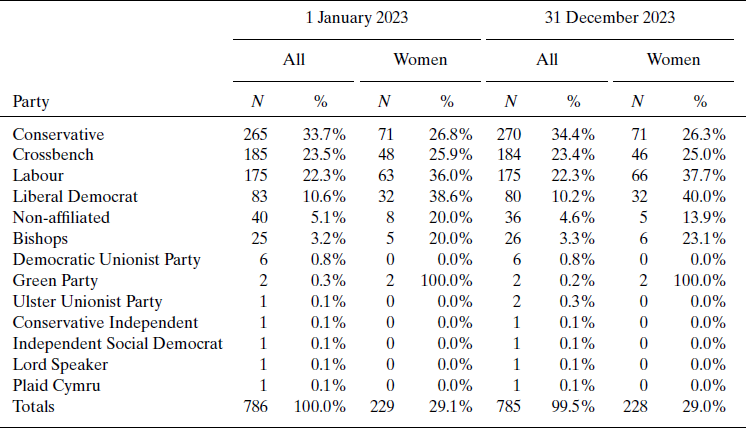
Information on the composition of the House of Lords in 2023 can be found in Table 3.
Table 3. Party and gender composition of the House of Lords in the United Kingdom in 2023

Source: UK Parliament (2023b).
Political party report
On 15 February, SNP leader and Scottish First Minister Nicola Sturgeon unexpectedly announced her intention to resign from both positions ahead of the upcoming party conference that would decide the future of independence policy, citing the pressures of leadership. She formally stepped down on the 28 March. A contest was held to replace her—the first for the party in over 20 years—with three candidates standing: junior minister Ash Regan, Finance Secretary Kate Forbes and Health Secretary Humza Yousaf. Regan exited on the first round, and Yousaf became the new SNP leader after winning the second round with 52.1 per cent of the vote (Table 4). However, the contest was fraught with difficulties, including the resignation of the party's chief executive Peter Murrell over membership figures. The party saw a continued decline in polling over the course of the year, although they still led over Scottish Labour (Smith Reference Smith2023).
Table 4. Changes in political parties in the United Kingdom in 2023

Source: Scottish National Party (2023).
Despite the change in Prime Minister, the Conservatives opened the year polling 21 percentage points behind Labour (YouGov 2023a). The polls remained comparatively static over the course of the year, with the Conservatives still continuing to trail more than 20 percentage points as December approached (YouGov 2022b).
For the party leaders, Sunak began the year with 56 per cent believing he was doing a bad job as Prime Minister, which rose to 65 per cent by the end of the year (YouGov 2023c). Keir Starmer's popularity also suffered over the course of the year, going from 42 per cent of people believing he was doing a bad job as Labour leader in January to 46 per cent thinking he was doing a bad job in December (YouGov 2023d).
Institutional change report
There were no major institutional changes made in the United Kingdom in 2023.
Issues in national politics
On 4 January, Prime Minister Rishi Sunak gave a speech in which he announced five key priorities for his administration. These were halving inflation, growing the economy, reducing national debt, cutting NHS waiting lists and stopping immigration via small boats crossing the Channel. This last priority reemphasised the importance of immigration under Sunak's tenure. The then Home Secretary Suella Braverman announced in April that a barge, the Bibby Stockholm, would be fitted out to house asylum seekers off the coast of Dorset. Ahead of the first migrants arriving on 7 August, serious concerns were raised regarding the safety of the vessel. Some of the migrants refused to board, and just four days later, Legionella bacteria was discovered, necessitating the evacuation of all migrants—who did not return until October. Conditions were reportedly poor, and an asylum seeker committed suicide on-board in December (Taylor & Syal Reference Taylor and Syal2023). Plans to send asylum seekers to Rwanda for processing had been in development since 2022, and in November 2023, the policy reached the Supreme Court, which ruled that it was illegal, leaving it in limbo. Newly appointed Home Secretary, James Cleverly, announced a five-point plan specifically to tackle immigration in December. These included an increase in the minimum salary requirements for many jobs, removing the right to bring spouses and children automatically on a visa, and an increase in the minimum income level required to sponsor a spouse's visa.
The Conservative Party's retention of Uxbridge and South Ruislip at the by-election triggered by Boris Johnson's resignation as MP proved to be an opportunity for the party to make policy changes. One of the key underlying factors perceived to explain the result was the unpopularity of London Mayor Sadiq Khan's ULEZ policy. This policy aims to reduce emissions in London by charging non-compliant vehicles and had originally been introduced by Boris Johnson when he was London's Mayor before being further expanded by Khan in 2021 and again in 2023, latterly covering the entire Greater London area. A scheme to assist drivers with scrapping non-compliant vehicles was introduced, but the expansion of the zone led to some enforcement cameras being attacked. On 20 September, Sunak gave a speech dedicated to changes to the government's environmental policy agenda. While remaining committed to the United Kingdom becoming net zero by 2050, he announced policy rollbacks, including delaying the ban on the sale of new petrol and diesel cars to 2035. In his speech he referred to the ‘unacceptable costs’ of the previously planned policies on the public, seeking to offer consumers a choice to make environmentally friendly decisions rather than imposing them (Prime Minister's Office, 10 Downing Street 2023).
The commencement of the Israeli–Palestinian conflict saw Sunak meet with both the Israeli Prime Minister Benjamin Netanyahu and the leader of the Palestinian Authority Mahmoud Abbas in a two-day visit to the region. The Conservatives, Labour, Liberal Democrats and Greens all adopted an official position of a two-state solution, but the conflict proved to be particularly divisive for Labour. The party saw resignations amongst local councillors protesting against Starmer's refusal to call for a ceasefire, with 150 Muslim Labour councillors writing to him. Divisions also emerged with Scottish Labour; leader Anas Sarwar accused Israel of breaching international law. Sarwar joined Mayor of Greater Manchester Andy Burnham and London Mayor Sadiq Khan in calling openly for a ceasefire, going against Starmer's stance. Imran Hussain, MP for Bradford East, resigned from the Shadow Cabinet in protest over Starmer's stance.


 Open access

