

Introduction
The year 2023 brought a new term to Bulgarian politics: сглобка, or cobbled together, or make-shift Cabinet. Following two years of extreme instability, 2023 saw, finally, the installation of a politically accountable Cabinet between Citizens for European Development of Bulgaria (Grazhdani za evropeysko razvitie na Bulgaria, GERB) and We Continue the Change (Prodalzhavame promyanata, PP)–Democratic Bulgaria (Demokratichna Bulgaria, DB). Seen as a political creation artificially cobbled together under the influence of various Western actors, the Cabinet struggled with increasing opposition and a declining public image throughout the year. While steps toward further EU integration were made, and the influence of the openly pro-Russian President Radev was curbed both formally and de facto, the country remains split on the Russian question, while rising nationalism and political apathy do not promise a clear positive political horizon.
Election report
Twenty-two parties and coalitions registered and ran in the early elections on 2 April 2023. These were the fifth early elections in a row, keeping in the spirit of the previous two years (for details, see Spirova Reference Spirova2022, Reference Spirova2023). The campaign started in early March and was dominated by two main events. One was the formation of an electoral coalition between PP and DB in early February. Under the acronym PP-DB, they appeared together at the elections and vowed to govern together, having signed a formal agreement that set up their policy priorities of making Bulgaria a normal, democratic, European state with a high standard of living and guaranteed rights. The second was the release, by the United States, of a second list of names of Bulgarian businesspeople and companies alleged to have participated in various corrupt dealings in the spirit of the Magnitsky law, many of whom were linked to GERB (US Department of the Treasure 2023). Neither of these prevented, however, the emergence of GERB as the plurality winner of the elections in April.
With a voter turnout of 40.6 per cent, just as in 2022, the elections did not produce a clear majority winner (Table 1). GERB solidified its plurality with a few percentage points more, while the PP-DB coalition, in fact, lost votes and seats, compared to 2022. The nationalist Revival (Vazrazhdane) drew even more support than previously and emerged as the third party in Parliament. The Turkish-dominated Movement for Rights and Freedoms (Dvijenie za prava i svobodi, DPS) preserved its vote share but dropped to fourth party faction in the legislature. The Socialists (Bulgaraska socialisticheska partiya za Bulgaria [BSP]) continued on their downward trend. In a somewhat surprising development, There is Such a Nation (Ima takuv narod, ITN), which had remained outside Parliament in 2022, managed to pass the 4 per cent threshold and obtained representation in Parliament. Overall, however, the seat distribution did not promise an easy solution for a Cabinet. In the context of two years of caretaker cabinets, which de facto gave power to President Radev (see Spirova Reference Spirova2023), this was an unwelcome development.
Table 1. Elections to the 49th National Assembly (49-to Narodno Sabranie) in Bulgaria in 2023

Notes:
1. There is an option on the ballot “I do not support any of the nominated,” which received 109,095 votes.
2. Since the last election, PP and DB created a coalition. DB is an electoral alliance formed by three parties. The results for Δ% and ΔN were calculated by adding the results from PP and DB as separate parties during the last election.
Source: Central Election Commission (2023) (Parliamentary Elections, https://results.cik.bg/ns2023/rezultati/index.html).
Cabinet report
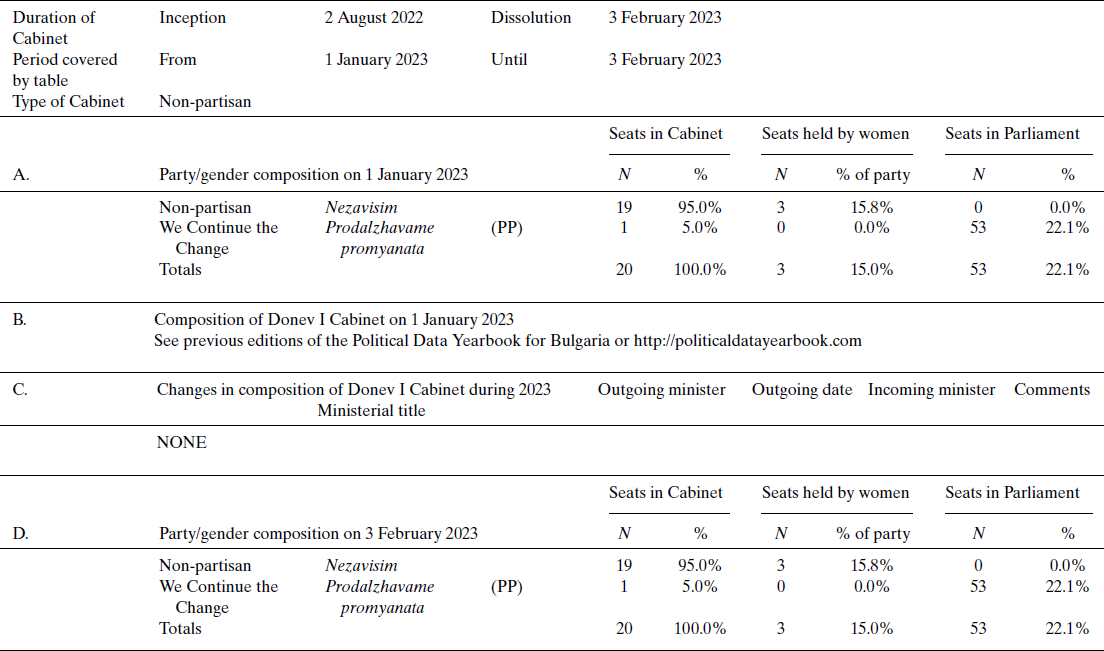
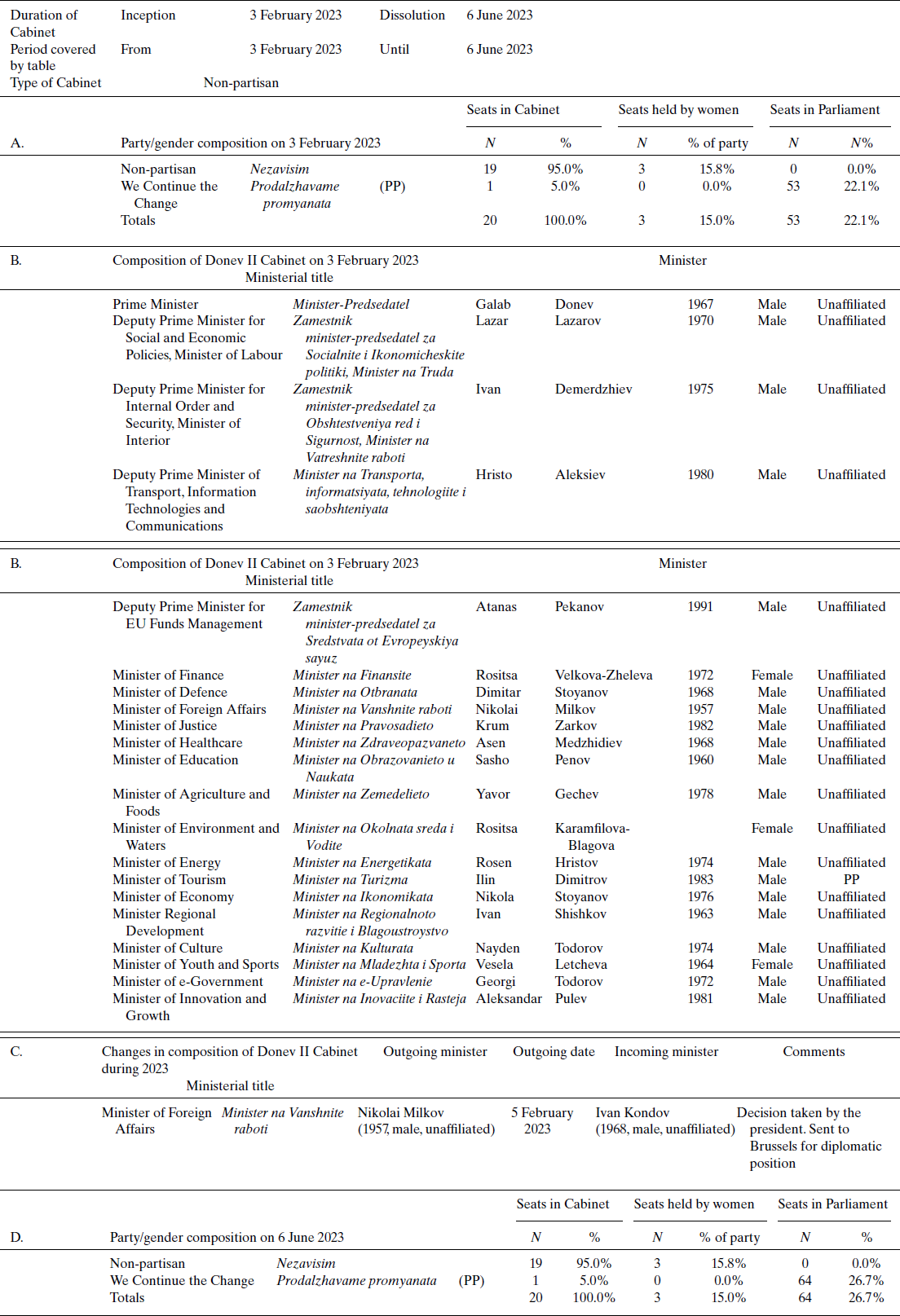
The year 2022 had ended with the failure of GERB to form a Cabinet (based on the 2022 election results), and early 2023 did not bring anything new. PP was given the possibility to form a Cabinet next but did not even try, and neither did the next in line, the BSP. There were no serious talks between the parties for a possible coalition and in early February, the 48th National Assembly was disbanded, and the caretaker government (Donev II) remained in power as new elections were scheduled. The Cabinet remained the same as the previous one except for a change of the Minister of Culture, who resigned in February for personal reasons (see Tables 2 and 3).
Table 2. Cabinet composition of Donev I in Bulgaria in 2023

Source: Council of Ministers. www.government.bg/en/Cabinet/CABINET-MEMBERS (2023).
Table 3. Cabinet composition of Donev II in Bulgaria in 2023

Source: Web Archive (2023) (May, https://web.archive.org/web/20230524182607/https://www.gov.bg/en/Cabinet/CABINET-MEMBERS).
Another Cabinet change followed in May, when the Foreign Affairs Minister, Nikolay Milkov, was sent to Brussels and was replaced by Ivan Kondov in the caretaker Cabinet.
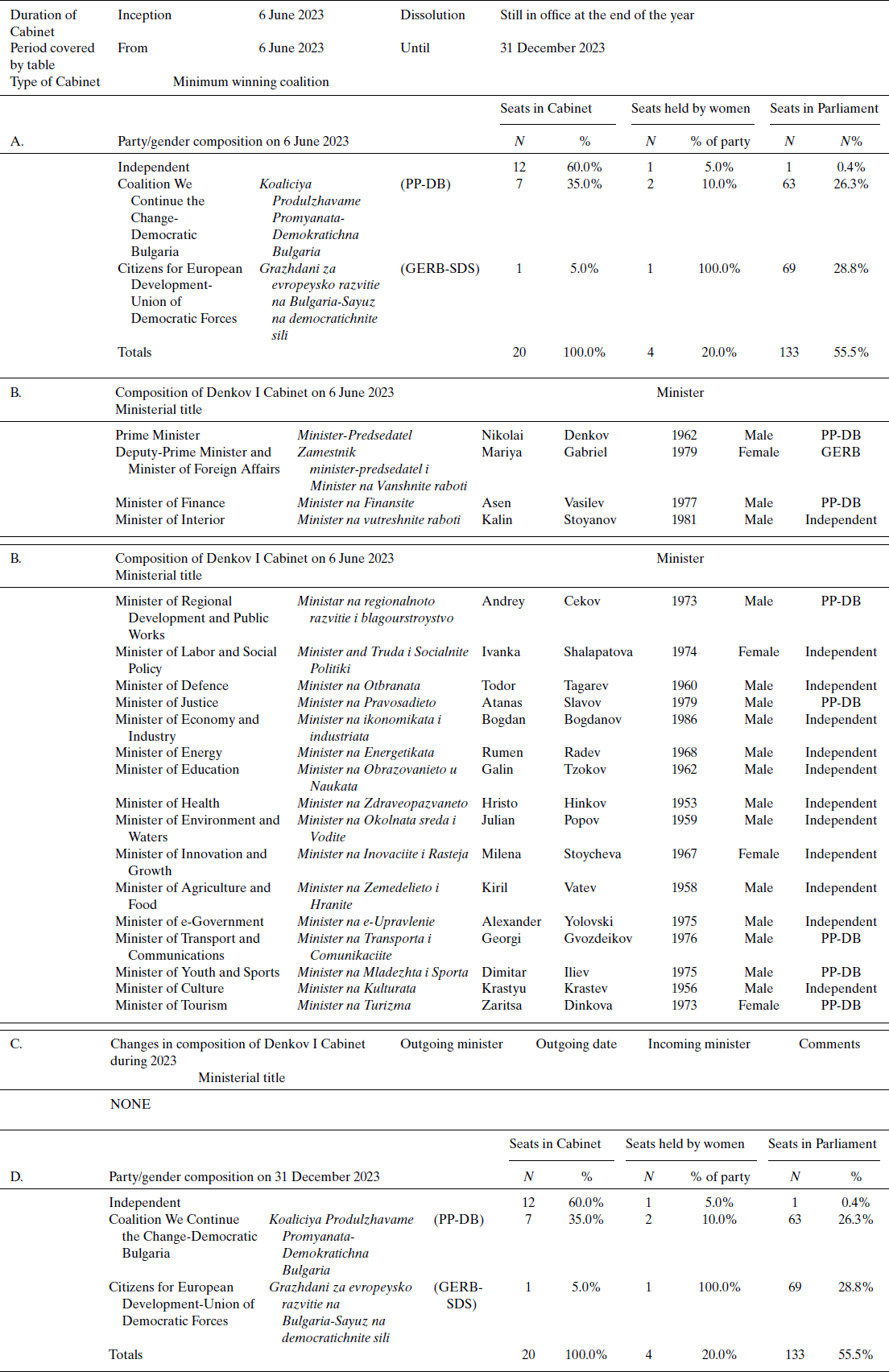
The formation of the postelection Cabinet followed relatively quickly in comparison to the prolonged formation periods in the previous two years. With pressure from the EU, a joint Cabinet of GERB and PP was formed in an open attempt to limit the de facto power of President Radev. With an openly pro-Russian stance, his ability to appoint caretaker cabinets had caused worry in Brussels. By 15 May, GERB had received the mandate to form a Cabinet, and negotiations started on the personnel and policy decisions. A new formula was introduced, one or rotating Prime Ministers (PMs), with PP-DB taking over the PM position in the first nine-month period, and GERB providing the vice-PM. The plan was to rotate to a situation of GERB PM and PP-DB vice-PM in March 2024. GERB politician, Maria Gabriel, resigned as European Commissioner to return as vice-PM, while PP-DB nominated academician and nonparty member Nikolay Denkov to lead the Cabinet. The Denkov–Gabriel Cabinet was voted in on 6 June 2023 (Table 4).
Table 4. Cabinet composition of Denkov I in Bulgaria in 2023

Source: www.government.bg/en/Cabinet/CABINET-MEMBERS (2023).
From the Cabinet's inception, speculation abounded that the Cabinet could not make its proposed 18-month tenure, as the newly minted coalition partners had vouched to never join a Cabinet with each other during their electoral campaigns. The accusations of being a marriage of convenience, a make-shift Cabinet (sglobka/сглобка in Bulgarian) in the hands of foreign embassies and representatives, only intensified in the months that followed. They were particularly strong coming from the opposition BSP, ITN, and Vazrazhdane.
After the summer, opposition to the Cabinet intensified in anticipation of the local elections in late October. A vote of no confidence was introduced by the BSP, Vazrazhdane, and ITN on 5 October. The vote was justified by the alleged failure of the Cabinet to maintain price and supply stability in the energy sector and was rejected on 13 October. A second vote was introduced in November, justified by the alleged failure of the Cabinet to deal with issues of national defense and national security, and was rejected on 22 November. Both votes attempted to play up the makeshift nature of the Cabinet and to capitalize on it in time for the local elections, which took place on 29 October and 5 November. The Cabinet, however, was not only in control of more than 55 per cent of the seats in Parliament, but it could also rely on support from the DPS, whose leader, Delyan Peevski, had emerged as a tacit supporter of the Cabinet. The opposition, despite being quite vocal, could not destabilize the Cabinet, which remained in power and without personnel changes until the end of the year.
Parliament report
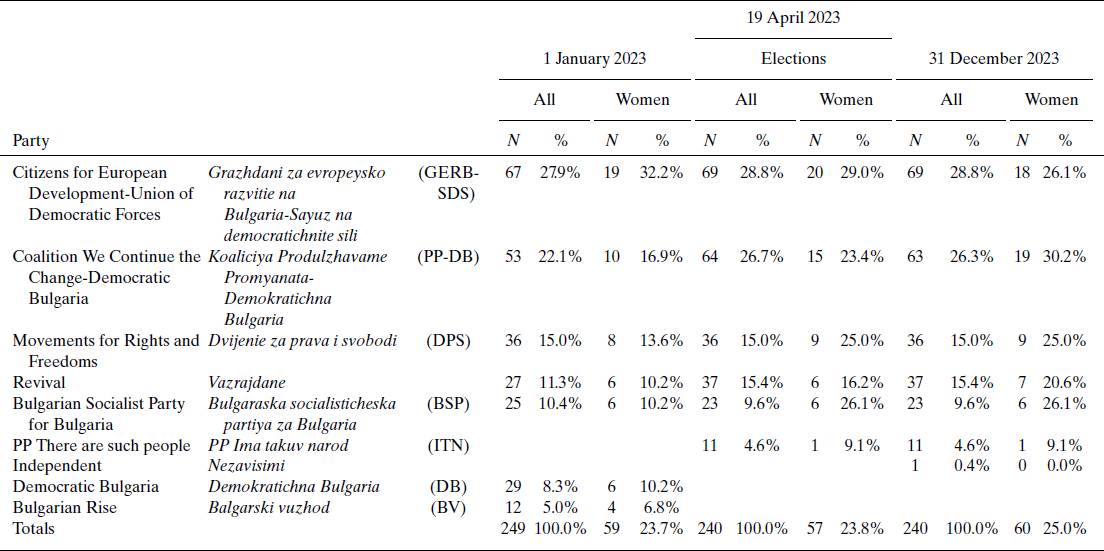
The year saw a new Parliament come into being after the April elections (Table 5). The 49th National Assembly convened on 11 April 2023, and at first appearance, it did not differ much from its predecessor and thus was not expected to last long. It had one party faction fewer and replaced Bulgarian Rise with ITN. PP and DB kept their promises and, having fielded joint lists and formed one parliamentary faction, thus emerged as the logical counterbalance of GERB. However, with both of them in control of about a quarter of the seats, no easy parliamentary majority was possible, leading to the somewhat forced marriage of the PP-DB-GERB coalition and parliamentary majority. No other major change in the make-up of the National Assembly occurred; women remained at 25 per cent of all MPs, and parliamentary activity was channeled along the government–opposition division.
Table 5. Party and gender composition of the 48th and 49th National Assembly (48-mo i 49-to Narodno Sabranie) in Bulgaria 2023

Notes:
1. For 1 January 2023, data about PP-DB are only from PP (see note 2).
2. From 19 April onward, DB is part of PP-DB (see note 1).
3. Some changes occurred in the Parliament between April and December due to local elections in October.
Source: National Council website (2024).
The Cabinet coalition partners also agreed on a common legislative agenda. This included as the most important legislative priorities: reforms under the EU's Recovery and Resilience Plan, Bulgaria's accession to the euro and Schengen areas, changes in the Code of Criminal Procedure (including the introduction of a mechanism for control over the prosecutor-general), control of corruption, and protection from domestic violence. In addition, they also split the two most important positions within Parliament: GERB would fill the chair of the Parliament, and the chair of the parliamentary legal committee would be nominated by PP-DB.
BSP, ITN, and Vazrazhdane joined forces informally to provide opposition to the Cabinet, which they saw as an artificial construction and subjugated to foreign interests. Interestingly, however, the Turkish minority-dominated DPS gradually emerged as a tacit supporter to the GERB-PP-DB coalition: Its leader, previously highly controversial political figure Delyan Peevski, became chair of the parliamentary group and, in the opinion of many, a kingmaker in Bulgaria's politics.
Political party report
The political parties in Bulgaria did not undergo any significant changes in 2023 in terms of leadership or organizational development. All major parties preserved their leadership, and no major splits occurred. PP-DB and GERB formed a governing coalition (Table 6) but preserved their legislative and party independence, and PP and DB preserved independent party status. In the DPS, Delyan Peevski announced his future candidacy for chairman of the party, next to being the single chair of the parliamentary faction. The election will take place at the DPS conference in early 2024.
Table 6. Changes in political parties in Bulgaria in 2023

Source: Mediapool (2023) (February 13, www.mediapool.bg/pp-i-db-veche-ofitsialno-sa-koalitsiya-postaviha-si-13-zadachi-news344843.html).
Institutional change report
By far, the most significant change in the institutional set-up was the amendment of the Constitution that changed the power of the president to appoint a caretaker PM.
In December 2023, a constitutional amendment limited the choice of potential caretaker PMs to the people occupying one of four state positions or their deputies: the chair of the National Assembly, the Bulgarian National Bank Governor or their deputy, the Chair of the Audit Office or their deputy, and the Ombudsman or their deputy. This amendment was made in an open move to limit the powers of the president, and in particular, those of President Radev, who had appointed four separate caretaker cabinets in the post-2021 period and who had been seen to use them for his own political interests. At the same time, the Constitution was also amended to mandate that the National Assembly remain in session until a new Parliament is elected. Taken together, the two amendments ensure that in case a regular Cabinet resigns and no new Cabinet can be elected by the sitting Parliament, the executive power will remain in the hands of the currently politically powerful parties rather than in those of the head of state.
In addition, in May 2023, the Parliament adopted a mechanism for an independent investigation of the Attorney General. This happened 14 years after the decision of the European Court of Human Rights in the case “Kolevi v. Bulgaria.” Back in 2009, the court in Strasbourg established that the Bulgarian chief prosecutor (then Nikola Filchev) was untouchable and obliged Bulgaria to introduce opportunities for criminal prosecution and public accountability. Controversial Attorney-General Ivan Geshev (Spirova 2021) was removed from office in June and later on announced that he was entering politics and created а nationalist movement called “Justice for Bulgaria.”
Issues in national politics
The pro/anti-Russian split in the country remained a continuing concern. The positions of the President and leaders of parliamentary represented parties, such as BSP and Vazrazhdane, continued to call for neutrality in the Russian-Ukrainian war, while the official government position (after May 2023) aligned with NATO and the EU. The interests of the Russian oil and gas industry were seen as playing a significant role in promoting the pro-Russian position among the population. The Cabinet reacted by an early termination of the Russian-owned Lukoil contract with the port of Bourgas in September 2023, a move that was seen by the opposition as a step guaranteeing a spike of energy prices and thus, irresponsible. In general, Bulgarians displayed the most positive attitude toward Russian President Putin and the lowest levels of perception of Russia as a threat to the security of the country, or Bulgarian identity and values, among all East and Central European countries in 2023 (GLOBSEC 2023).
Ironically, pro-Russian attitudes are also linked to strong nationalist feelings in the country, which are reflected in the increased (in comparison to 2022) electoral support for nationalist parties such as Vazrazhdane and ITN. This has been paralleled by increased skepticism to the autonomy of the country to make decisions vis-à-vis Brussels (GLOBSEC 2023), transforming the previous tacit pro-EU consent into creeping Euroskepticism.
The biggest challenge, though, remained the political apathy displayed by the Bulgarian population. Voter turnout was slightly up in 2023 (40.63 per cent), compared to 2022 (39.4 per cent), but it remained extremely low. While trust in democracy remained stable, trust in the government had remained low and declining in 2023 (GLOBSEC 2023). Coupled with a high perception of corruption and never-improving macroeconomic indicators, such as inflation and the cost of living, these political attitudes contribute to a general sense of political inefficacy and a perception of stagnant political and economic development.



 Open access

