Skip to main content Accessibility help
×
Hostname: page-component-68c7f8b79f-tw422 Total loading time: 0 Render date: 2025-12-29T07:11:12.872Z Has data issue: false hasContentIssue false

1 - Palmyra in the Mediterranean World

Published online by Cambridge University Press:  21 October 2025

Rubina Raja
Affiliation:
Aarhus Universitet, Denmark

Summary

Palmyra, the famous oasis city in the Syrian Desert, has long been a subject of study. It is often brought to the forefront as a case study on trade networks, elite culture and local religious life. However, over the course of the last decades the data available from the city now allows us to investigate new facets of the city’s life, its culture, and its social and religious structure. This contribution provides a short introduction to the history and archaeology of the city as well as the history of research, before turning to the ways in which Palmyra was not only unique in the sense that through its location in an oasis and as a major trade hub it came to hold a pivotal role in the region for a while in the Roman period but can also be studied in a unique light in its relation to the Mediterranean world through the evidence from the city.

Information

Type
Chapter
Information
Publisher: Cambridge University Press
Print publication year: 2025

1 Palmyra in the Mediterranean World

Palmyra, an Oasis City in the Sea of the Syrian Desert

Palmyra, ancient Tadmor, situated in the Syrian Steppe Desert midway between the Mediterranean to the west and the River Euphrates to the east, has for centuries been a subject of study – both scholarly and more broadly speaking – due to its monumental, almost exclusively Roman-period ruins as well as its rich corpus of art and inscriptions – most of which also date to the first three centuries AD. However, over the last decade the city has received renewed attention in scholarship, both as a result of the war in Syria and the destruction which Palmyra, a UNESCO World Heritage Site since 1980, has suffered during the conflict, and also because the city’s archaeology and history have been the focus of several research projects within which Palmyrene material and written culture of all kinds has been collected, analysed, re-evaluated and discussed over the last decade.Footnote 1

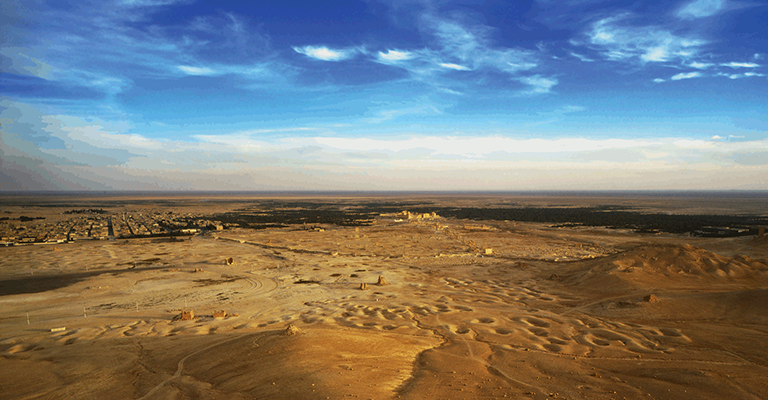
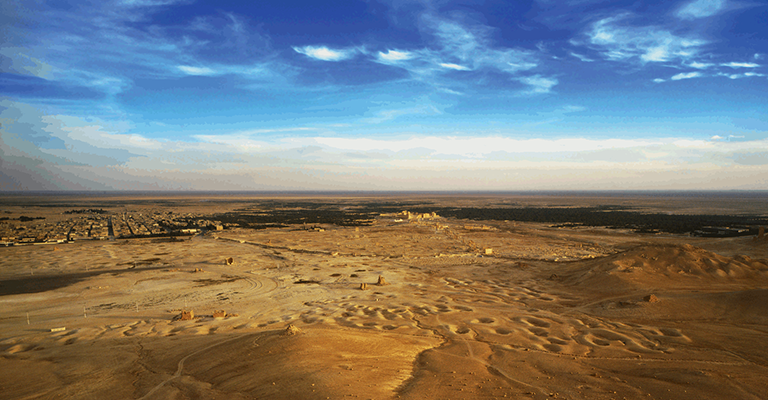
Palmyra, located in an oasis with the Efqa Spring as its main, but not only, source of water, became a central node in the global trade networks rapidly developing during the first three centuries AD. It is also from these centuries that most of the archaeological evidence from the site stems. There is no other site in the region which has yielded as rich a material and written record as Palmyra has, a heritage which give us a detailed insight into the complex society of Palmyra in the Roman period (Figure 1.1). Human activity at and around Palmyra, however, reaches far back into the prehistoric periods.Footnote 2 But not much is known about the extent of the human settlement in these early periods, and even the Hellenistic period remains quite elusive in the archaeological record, despite the fact that research in recent decades has brought more evidence to light, which underlines that the settlement might have been more substantial than hitherto known.Footnote 3
Content of image described in text.

Figure 1.1 View of Palmyra with the oasis in the background.

Palmyra was known empire-wide in antiquity as well; for example, Pliny the Elder writes about it in his Natural History, although he never visited the city himself but based his description on other ancient authors:

Palmyra is a city famous for its situation, for the richness of its soil, and for its agreeable springs; its fields are surrounded on every side by a vast circuit of sand, and it is as it were isolated by nature from the world, having a destiny of its own between the two mighty empires of Rome and Parthia, and at the first moment of a quarrel between them always attracting the attention of both sides.Footnote 4

This very famous quotation about the splendid oasis city succinctly describes its situation. A situation that is reflected in the archaeology and written sources from the city – which, although overwhelmingly in Palmyrene Aramaic, also contain a rich corpus of Greek and bilingual inscriptions – as well as in its art, which shows a strong awareness of contemporary trends in both Roman and Parthian art.Footnote 5

Palmyra is rich in material evidence and inscriptions from the Roman period, despite the fact that the city was sacked twice by Roman troops, in AD 272 and 273, as well as being inhabited in the post-Roman periods, with much material being reused and the local limestone burned for slaked lime for new building projects.Footnote 6 However, the rich surviving material record is so abundant – with more than 3,000 inscriptions and 4,000 portraits as well as several hundred funerary monuments, tower tombs and underground tombs dotting the landscape around the urban core, in addition to monumental building complexes in the city itself – that until recently it had not been synthesized in any comprehensive way.Footnote 7

According to new calculations, Palmyra covered about 140 hectares at its greatest extent; however, only a small part has been investigated in any archaeological detail.Footnote 8 Most attention has been given to the exploration of either the monumental funerary monuments, the so-called tower tombs and the underground graves (hypogea), or the urban monuments, the sanctuaries and the public spaces.Footnote 9 So while we have a fairly good overview of the overall development of the site, in particular in the first three centuries AD,Footnote 10 we in fact do not know much about, for example, the domestic architecture of the city or the post-Roman periods in general.Footnote 11 Only in the last few years has there been a greater focus on private houses and the late antique and later periods overall, leaving us with a skewed image of the city and its development.Footnote 12

Systematic archaeological research at the site has been undertaken since the early twentieth century, but as early as the seventeenth century visitors brought objects from the site back with them to their home countries.Footnote 13 This ‘culture’ tourism intensified in the eighteenth and nineteenth centuries, and under the Ottoman Empire numerous Western travellers visited Palmyra. From the middle of the nineteenth century onwards, interest in the architecture and art of Palmyra intensified, and the first European collections of Palmyrene antiquities came into being, some of which – the collections in Istanbul, Paris and Copenhagen – remain the largest to this day.Footnote 14

The first large-scale systematic excavations at the site commenced shortly after the institution of the French Mandate in 1923. Already in 1924, a French mission had begun extensive archaeological work in Palmyra, and their concession was also extended and new ones given to researchers from other European nations to work at the site together with the French.Footnote 15 From 1924, these included the Danish archaeologist Harald Ingholt, who in 1928 published what was, until recently, the most comprehensive monograph on the Roman-period funerary portraits from Palmyra – in Danish, however.Footnote 16

The archaeological work of the 1920s and 1930s focused mostly on large-scale projects, such as the one in which the modern village in Palmyra, located within the temenos walls of the Sanctuary of Bel, was entirely demolished and cleared and the local population moved to new houses outside the core of the ancient site, in order to restore the sanctuary to its Roman-period state.Footnote 17 While the excavations were published, they did not document in any detail the demolition of the village, for example, nor the numerous post-antique phases and the use of the ancient monuments through the millennia.Footnote 18 Ingholt worked for several seasons in the necropoleis around the city and documented more than eighty graves, of which he only published a few.Footnote 19 The history of the archaeology of the site as such still remains to be written in a holistic way and will be a difficult task, since archival material is spread across the world and, in many cases, may have been lost, and the documentation in Syria may not be accessible or exist anymore. However, over recent years, first attempts to tackle the complex excavation histories have been undertaken either on the basis of what is already known or by delving into newly available archival material.Footnote 20

The Second World War brought a halt to archaeological work, and archaeological research at the site was only continued years later, by both Syrian and foreign missions.Footnote 21 The site became a UNESCO World Heritage Site in 1980, and in 2013 it was put on the UNESCO list of endangered World Heritage Sites.Footnote 22

Past Approaches

The city has been much discussed in scholarship within the framework of the Near East or as a case study of a location framed by two even greater powers, Rome and Parthia, and most scholarship has focused on the centuries that we have mentioned, the Roman imperial period.Footnote 23 The research cited in the previous section and other publications, among which the 2021 monograph by Michal GawlikowskiFootnote 24 needs to be singled out, have given entirely new insights into the city’s complex societal structures and its society’s ability to position itself and certain groups within the rapidly developing and highly volatile world around them, with the city playing a pivotal role in the way in which global trade was managed and developed for centuries. Current approaches to the study of Palmyra now include ongoing projects on digital reconstruction and archival work, as well as the application of computational methodologies to the large datasets from the city, which in turn can give overviews of the development as seen through the dating of the buildings and the art as well as the many thousands of inscriptions.Footnote 25

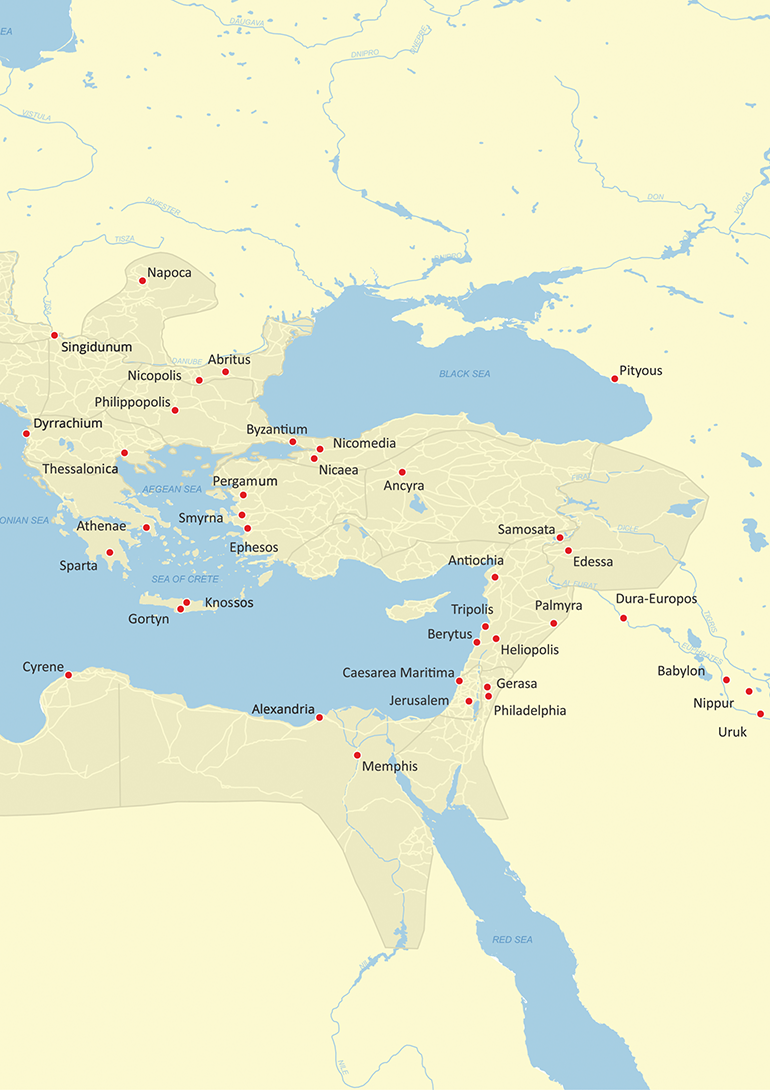
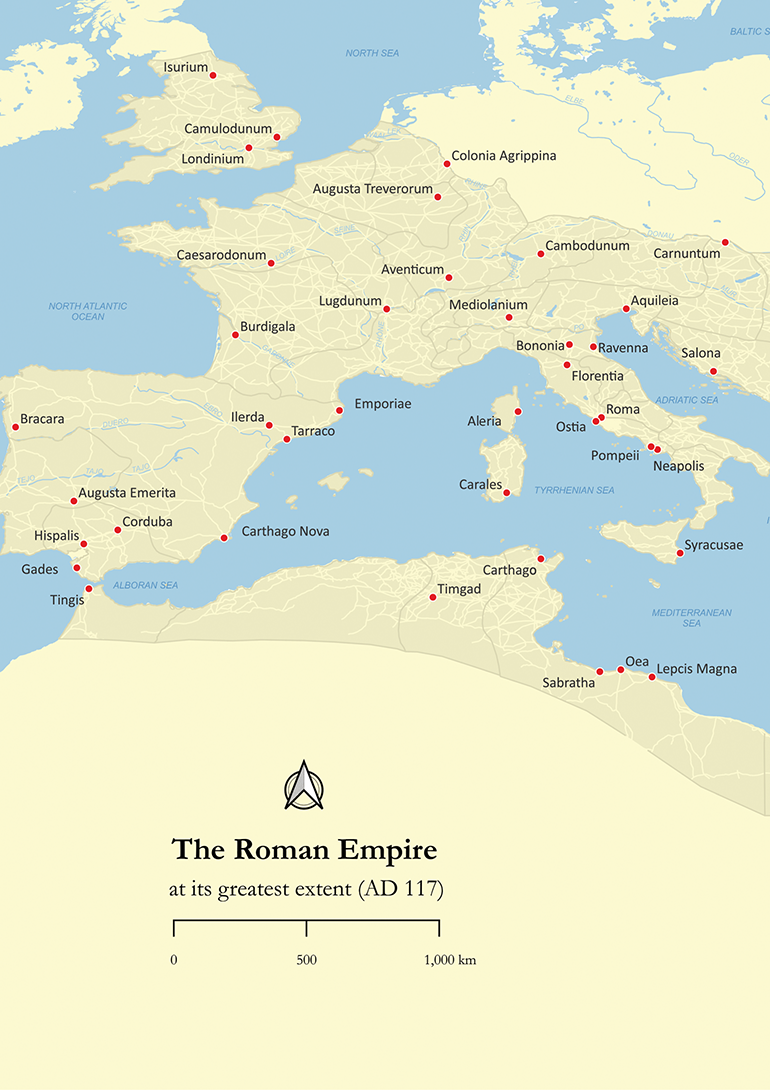
Today, we have an entirely new view on Palmyra and entirely new data and ways in which we can reassess the city’s relationship with the world around it, including the world to the west of Palmyra, namely the Mediterranean world (Map 1.1). Some attention has already been given to the relationship between Palmyra and the eastern regions, relations with Parthia both in terms of trade and cultural exchange, such as that reflected in the artistic traditions in Palmyra.Footnote 26 Furthermore, political relations with the Roman Empire have also been a topic of much research.Footnote 27 Nonetheless, the extent to which the Mediterranean connections has been explored leaves much to be desired in light of the corpora of evidence from the city now available in various forms.Footnote 28
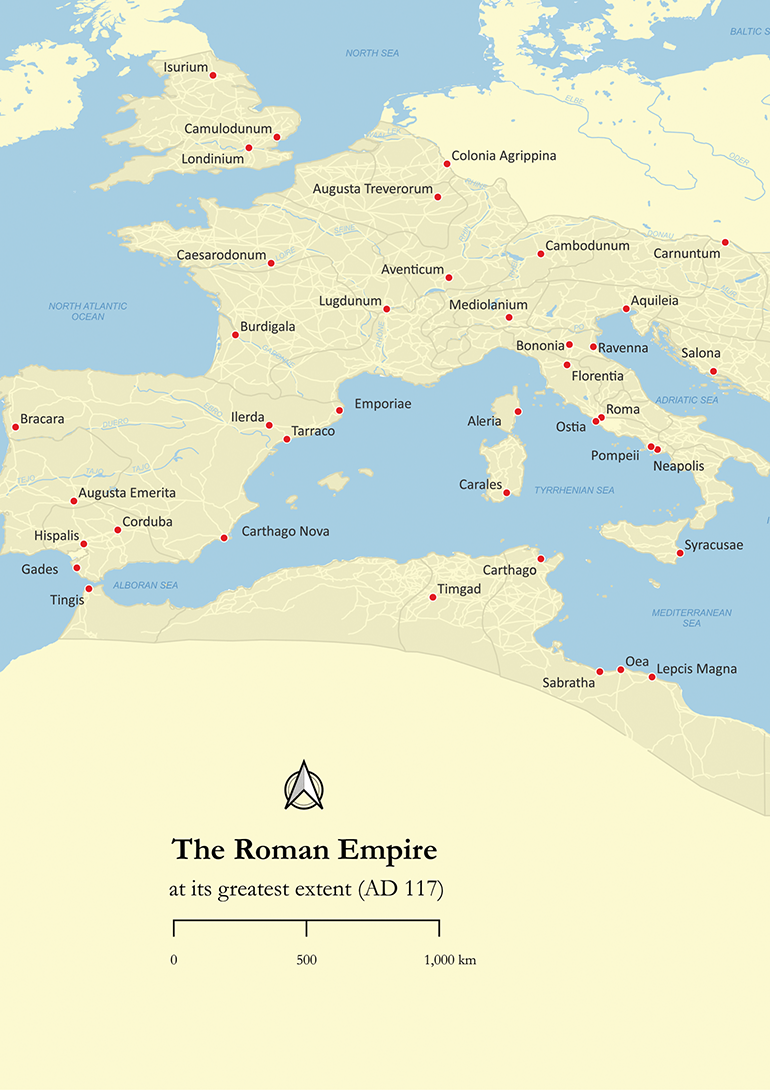
Map showing the Roman Empire at its greatest extent in Anno Domini 117, highlighting key cities including Palmyra. See long description.
Map 1.1.01Long description

The map emphasises the geographic diversity of the empire, showcasing its reach across Europe, North Africa, and parts of Asia with a clear visual scale of 0 to 1000 kilometres and labelled bodies of water including the Mediterranean Sea, Alboran Sea, North Atlantic Ocean, North Sea, Baltic Sea, Adriatic Sea and the Tyrrhenian Sea. The marked cities include Isurium, Camulodunum, Londinium, Colonia Agrippina, Augusta Treverorum, Caesarodonum, Aventicum, Cambodunum, Carnuntum, Burdigala, Lugdunum, Mediolanium, Aquileia, Bononia, Revenna, Salona, Florentia, Roma, Ostia, Pompeii, Neapolis, Syracusae, Aleria, Carales, Emporiae, Ilerda, Tarraco, Bracara, Augusta Emerita, Corduba, Hispalis, Gades, Tingis, Carthago Nova, Carthago, Timgad, Sabratha, Oea and Lepcis Magna.
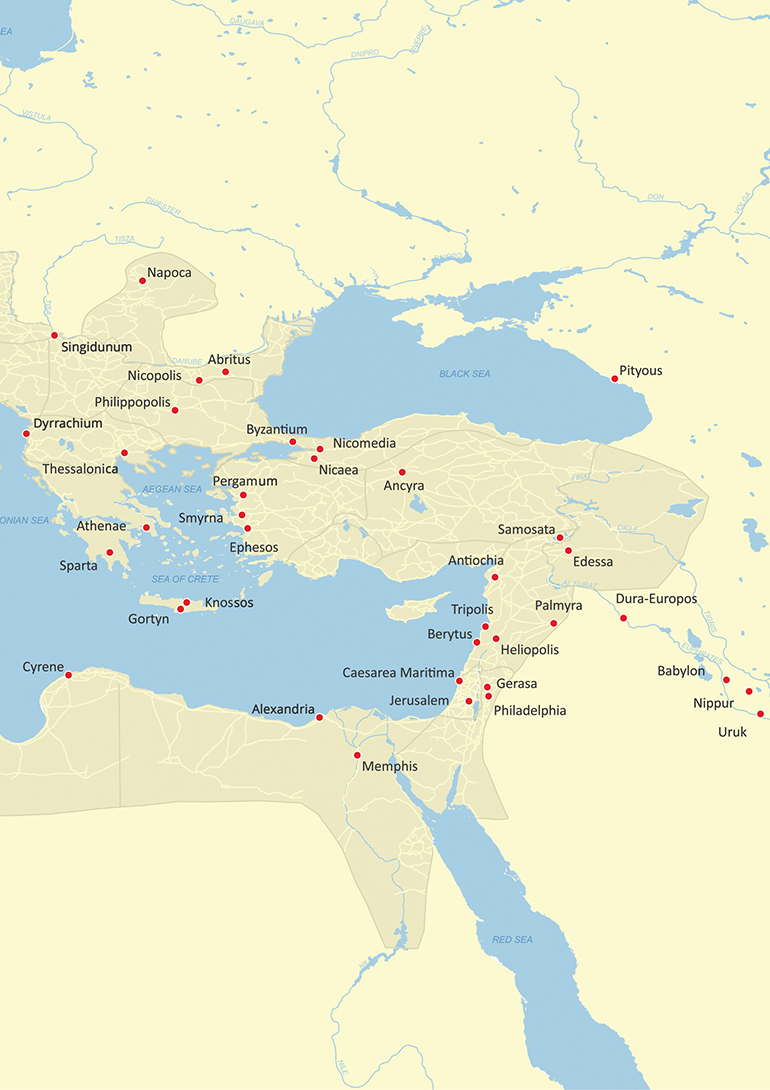
The continuation of a map showing the eastern Roman Empire and surrounding regions, highlighting key cities including Palmyra. See long description.
Map 1.1.02Long description

The continuation of the map emphasises the regions under the Roman Empire to the east of the Mediterranean Sea and near the Aegean Sea, the Sea of Crete and the Black Sea. The plotted cities include Napoca, Singidunum, Abritus, Nicopolis, Philippopolis, Dyrrachium, Thessalonica, Athenae, Sparta, Byzantium, Pergamum, Smyrna, Ephesos, Nicomedia, Nicaea, Ancyra, Knossos, Gortyn, Pityous, Samosata, Antiochia, Edessa, Palmyra, Dura-Europos, Babylon, Nippur, Uruk, Tripolis, Berytus, Heliopolis, Gerasa, Philadelphia, Caesarea Maritima, Jerusalem, Alexandria, Memphis and Cyrene.

Map 1.1 Palmyra in the Roman Empire.

How Far from Palmyra Was the Mare Nostrum (‘Our Sea’) of the Roman Empire?

Studies taking their point of departure in the geographic region of the Mediterranean have long flourished, going as far back as the monumental work by Braudel.Footnote 29 Large parts of this book were written while he was a prisoner of war in Germany during the Second World War, and ironically, considering the circumstances, it was an attempt to write a universal history of the Mediterranean showing the ways in which regions and their inhabitants were interconnected, despite rivalry, competition and being at war with each other.Footnote 30 Already at that time, others were writing histories of various Mediterranean themes as well, taking their point of departure in the Mediterranean region in one way or another.Footnote 31

In particular in the last three decades, a string of books and articles centring on the archaeology and history of the Mediterranean region, diachronically, regionally and topically, have been published.Footnote 32 Within classical studies, the discourse really took off with the monumental work The Corrupting Sea by Horden and Purcell, which was published in 2000 and still resonates with literature within the broader field. Despite being criticized by some for putting too much emphasis on the concept of micro-regions, we cannot ignore that The Corrupting Sea forced us to think about the ancient world in quite a different geographical manner, pushing the boundaries of how to conceptualize and describe interaction, networks, exchange and connectivity of all sorts through the lens of punctual-event history (histoire événementielle) or from a longue durée perspective – or potentially in a mix thereof. Today, the concept of micro-regions, which was one of main lenses through which Horden and Purcell described the Mediterranean and explained the ways in which it developed, might seem somewhat outdated, but the concept was and still is useful for some regions or ways of studying the past. However, since then new theoretical frameworks have emerged – for example, network studies. Despite not being without flaws, network studies have allowed us to view micro-regions in different ways by examining both weak and strong ties in a variety of networks, which could be fragile but continuous, or strong but broken by singular events such as natural catastrophes or wars.Footnote 33

In the wake of Horden and Purcell’s book, an immense revival of Mediterranean studies and of the Mediterranean as a conceptual study region took off, and we saw a surge in monumental works writing and rewriting various aspects of the archaeology and history of the Mediterranean, which has continued until today.Footnote 34 The Mediterranean realm as a geographic region has become a case study, a lens, a stable factor in research, which seems to be here to stay.Footnote 35 Exactly because such a research lens might persist, we are obliged to keep the discourses and discussions alive and feed these dialogues with evidence that can also push borders. Furthermore, we need to be able to enter critical dialogues about the ways in which we define and discuss the Mediterranean. Since the publication of Horden and Purcell’s monumental work, which was followed up recently by a volume containing some of their most important contributions since the 2000 publication, much has happened to change our modern understanding of the Mediterranean, which makes the study of the Mediterranean even more relevant than it was twenty years ago. The intention with this edited volume is precisely to focus on ‘old’ or already-known evidence as well as on new evidence in a new framework of discussion through the lens or concept of the Mediterranean, the Romans’ Mare Nostrum. In whatever way known evidence can and should be used to set agendas, we need to utilize the deep knowledge that classical studies bring to the world regarding past events from which we can still draw a lot of new knowledge.

Flipping the Map: Resituating Palmyra in the Mediterranean World

However, in order to resituate Palmyra within a broader regional and global framework, it might in fact also be necessary to revisit the site in the light of its numerous relations with the Mediterranean world.Footnote 36 This entails fresh looks at evidence that we, for the most part, already know, but which has not been studied to such ends. Palmyra offers a wealth of material evidence, both archaeological and epigraphic. Much has been written about the site and its various monuments, its sculptural habit, its involvement in trade, its famous Tax Tariff and its religious life.Footnote 37 However, only recently have studies begun to pull together material evidence in new ways in order to use it not as backdrops to narratives but to understand broader historical developments in a new light.Footnote 38 While globalization has been widely discussed in terms of whether it is a useful or less useful term when studying the ancient world, the ways in which a site like Palmyra was indeed directly connected with the Mediterranean world, if at all, has not been discussed at length, nor the ways in which interlinks and entanglements are expressed in the archaeological and historical evidence.Footnote 39 But how do we actually begin to disentangle what evidence, and in what form, needs to be presented in order for us to push forward with detailed studies about the relationship between places and societies seemingly far away from the Mediterranean shores but still a very integral part of the Mediterranean world? This is what the nine contributions in this volume attempt to tackle from very different perspectives and through varying evidence.

The volume opens with the contribution by Eivind Heldaas Seland on ‘The Western Networks of Palmyra’ (Chapter 2). Through a study of the organization of power networks, peer-polity interaction and what he terms shared mental models, Seland draws on the work of the sociologist Michael Mann and uses concepts both from archaeology and New Institutional Economics to explain in what ways Palmyra and the Palmyrenes were able to tap into existing power networks and could even be part of developing them. Jean-Baptiste Yon’s chapter ‘You Can’t Get There from Here: Itineraries of the Palmyrenes in the Mediterranean’ (Chapter 3) focuses on the evidence of Palmyrenes outside of Palmyra and what he terms the discrete evidence, which does not always allow us to reconstruct the actual underlying networks, but which certainly underlines that they were in place and that Palmyrene society was an integrated part – at least to some extent – of the Mediterranean world. He importantly points to what can also be termed weak ties, but ties that were in place potentially only at certain moments or periods of time. Through a set of case studies, Yon gives an overview of what we know of the itineraries of the Palmyrenes towards the West and the Mediterranean, and he shows us byways and shortcuts that are pivotal to our view of the integration of Palmyra into the Mediterranean world. Rubina Raja turns to one of the most enigmatic groups of evidence from Palmyra, namely the so-called banqueting tesserae. These tiny objects hold the widest range of information about the diversity of the religious life of the city, but they also hold an unleashed potential for understanding iconographic trends and fashions in Palmyra – including those imported from other places further west, since they hold a wide range of signet seal imprints. These imprints have never been studied systematically, and in the contribution ‘Palmyrene Iconographic Traditions and Their Mediterranean Connections: A Note on Some Signet Seal Impressions on the Palmyrene Tesserae’ (Chapter 4), the imprints showing female deities in Graeco-Roman style (Tyche, Athena and Nike) are addressed for the first time. In his chapter ‘Palmyra and Emesa or “Palmyre sans Émèse”: Some Considerations on Palmyrene Trade Networks and the Mediterranean’ (Chapter 5), Leonardo Gregoratti reminds us of the puzzling lacunae in written and archaeological evidence from Palmyra and beyond about the routes taken by the caravans carrying imports from the East after leaving Palmyra and until they reached the Mediterranean harbours and other Roman markets. As he rightly states, ‘there is no clue in Palmyrene inscriptions about the itinerary for the oriental goods after Palmyra, and there is no explicit mention of other political subjects involved in the last tract of the so-called Silk Road, the one crossing the Roman provincial territories’ (Chapter 6). Indeed, knowing just how central Palmyra was in the trade networks of the first three centuries AD, it is surprising that we do not have firm evidence that allows us to disentangle the networks in this region that connected Palmyra with the shores of the Mediterranean. Gregoratti’s contribution revisits earlier hypotheses and gives its own take on how we might imagine that such networks worked and which evidence we might be able to draw on from the wider region in order to get closer to an understanding of the Palmyrene situation. Staying with the trade networks and the Palmyrene economy, Katia Schörle addresses Palmyra’s involvement in Mediterranean markets, focusing on economic patterns and the networks behind them both spatially and socially speaking in her contribution ‘Organizing Networks to Supply Mediterranean Markets’. She uses the evidence for economic activities in a broader sense to push for theories about the Palmyrene entanglement in wider Mediterranean market structures of very different kinds. The Tax Tariff from Palmyra is undeniably one of the most globally famous written documents from the ancient world. John F. Healey in his contribution ‘Language, Law and Religion: The Palmyrene Tariff in Its Roman Context’ revisits the Tariff in order to study it for the broader contexts which can be teased out from the Greek and Palmyrene Aramaic phrasing in the extensive document, despite the fact that it does not concern the international caravan trade as such but reflects taxation of the caravan trade, as Healey argues. This unique document, inscribed on large limestone slabs, today in the Hermitage in St Petersburg, is an important reminder that such documents were made for local use, but beneath the surface this usage would also inherently reflect broader patterns in place outside the city. These are the patterns that Healey looks for and explains to us, reminding us that revisiting well-known evidence indeed pays off. Maura K. Heyn turns to the Palmyrene portraits. Produced in the local limestone, these numerous representations usually of deceased Palmyrenes and their family members remain the largest corpus of portraits in the Roman world stemming from one place outside of Rome. In her contribution ‘Channels of Communication and Connections of Style: Palmyrene Portraiture in Its Wider Context’ she takes us on a comprehensive tour of portraiture from across the Roman Empire and draws out similarities and differences in portraiture from other outlier regions in the empire. While acknowledging that no one-fits-all interpretations can be applied to studies of portraiture from the Roman world, Heyn details the ways in which societies either did or did not tap into a broader visual koine that drew on traditions that also had roots in pre-Roman times for some regions. Most importantly, she reminds us of the pitfalls inherent in studying portraiture from regions remote from Rome through an exclusively provincial approach. Eleonora Cussini turns to the Jewish community in and of Palmyra in her contribution ‘Identity and Mobility of Palmyrene Jews’. Through studying the available evidence of Jews in and from Palmyra, she unpacks as far as possible the networks of this group of inhabitants – who also seem to have had broad-ranging networks, although not very visible in the evidence – across regions in the Mediterranean area. She begins from the few, but secure, attestations of Palmyrene Jewish families and addresses issues of the identity of the Palmyrene Jews through these sources and investigates the mobility of this group as well as their ties with their city. While such evidence mostly comes from the prosopography available through inscriptions, and not from material cultural evidence, apart from a few examples, it underlines exactly how difficult presence and absence of certain groups – religious or ethnic or both – can be to ascertain in the evidence available to us. We all know that absence of evidence does not equal actual absence, but we often still have difficulties dealing with this reality. Cussini shows us potential ways of tackling such issues. In the contribution ‘Palmyrene Military Expatriation and Its Religious Transfer at Roman Dura-Europos, Dacia and Numidia’, Nathanael Andrade revisits evidence for Palmyrenes outside of Palmyra who had travelled with the Roman army in various capacities and did not return to Palmyra as far as we know after they ended their military careers. Through comparing evidence from different regions and sites, including that of Dura-Europos further east, Andrade shows in which ways we might begin to understand the integration of Palmyrene ex-army members in a different light also in parts of the empire west of Palmyra.

Together these nine contributions give new, refreshing and solid insights into the possibilities of studying the relations between Palmyra and the Mediterranean on the basis of already-available evidence. Even though this evidence does not always give a lot away at face value, it has a tremendous potential when contextualized within the wider framework of evidence from a variety of other comparable sites or comparable situations as well as evidence which does not seem comparable, but which pushes us to revisit the Palmyrene evidence in a new light. With this volume, it is the intention and hope that new discussions may arise about Palmyrene society’s role in the broader Mediterranean world.
Footnotes

This research for this volume was conducted with generous support by the Danish National Research Foundation (DNRF119 – Centre for Urban Network Evolutions (UrbNet)), the Carlsberg Foundation, the Augustinus Foundation and the ALIPH Foundation.

1 The series Studies in Palmyrene Archaeology and History (SPAH, published by Brepols) has in recent years brought out an array of volumes addressing a wide variety of aspects of Palmyra’s archaeology and history: Bobou et al. Reference Bobou, Kristensen, Jensen, Raja and Thomsen2021a; Raja and Steding Reference Raja and Steding2021; Raja et al. Reference Raja, Steding and Yon2021; Lapatin and Raja Reference Lapatin and Raja2022; Raja Reference Raja2022b; Steding Reference Steding2022; Bobou and Raja Reference Bobou and Raja2023; Heyn and Raja Reference Heyn and Raja2023; Andrade and Raja Reference Andrade and Raja2023. Also see the review article by Raja and Seland Reference Raja and Seland2024, which addresses the last decade of publications on the site.

2 Cremaschi and Zerboni Reference Cremaschi, Zerboni, Biehl and Nieuwenhuyse2016. For an overview of the early evidence from the site, see Raja Reference Raja2022a.

4 Plin. NH 5.88: Palmyra urbs nobilis situ, divitiis soli et aquis amoensis, vasto undique ambitu harensis includit agros, ac velut terris exempta a rerum natura, privata sorte inter duo imperia summa Romanorum Parthorumque et prima in discordia semper utrimque cura. The description by Pliny the Elder (23 BCAD 79) of Palmyra’s location dates to AD 77. The citation here is from H. Rackman’s translation in the Loeb series.

6 On the sacking of Palmyra, see Hartmann Reference Hartmann2001; Andrade Reference Andrade2018. On the reuse of material, see Intagliata Reference Intagliata2018, 31; Reference Intagliata, Andrade and Raja2023.

9 Delplace Reference Delplace2023, 11–38. Also see Raja Reference Raja2022a, chapter 1 for an overview of the urban development and excavation history.

10 Hammad Reference Hammad2010; Schnädelbach Reference Schnädelbach2010; Seigne Reference Seigne2021. See Gawlikowski Reference Gawlikowski2021 – his monograph – and Raja Reference Raja2022a for recent overviews with further references.

11 For a short summary on what is known about post-Roman domestic architecture in Palmyra, see Intagliata Reference Intagliata2018, 43–5. This book is also the most recent substantial overview focusing on the post-Roman periods in Palmyra.

13 For example, Halley Reference Halley1695; Seller Reference Seller1705.

17 Dukhan Reference Dukhan, van der Lans, Seland and Teigen2017; Schmidt-Colinet Reference Schmidt-Colinet2020; Baird et al. Reference Baird, Kamash and Raja2023 for further references on the dismantling of the village.

19 Ingholt Reference Ingholt1932; Reference Ingholt1935. A more comprehensive publication of Ingholt’s material can be found in the recent multi-volume publications of and commentaries on his fieldwork diaries (see Raja et al. Reference Raja, Steding and Yon2021), and in his archive of Palmyrene sculpture (see Bobou et al. Reference Bobou, Kristensen, Jensen, Raja and Thomsen2021a). For more, see Bobou et al. Reference Bobou, Miranda and Raja2022a; Reference Bobou, Miranda and Raja2022b; Reference Bobou, Mortensen and Raja2022d; Reference Bobou and Raja2023.

20 Gawlikowski Reference Gawlikowski2021; Sartre-Fauriat Reference Sartre-Fauriat2021; Raja Reference Raja2022a; Baird et al. Reference Baird, Kamash and Raja2023 (only focusing on the legacy data of Ingholt).

22 UNESCO n.d.

23 Young Reference Young2001; Edwell Reference Edwell2008; Reference Edwell, Nielsen and Raja2019; Seland Reference Seland2015; Reference Seland, Walter and Ito-Adler2016. Also see Sommer Reference Sommer2020 for a set of contributions dealing with Palmyra’s situation – political, military and cultural.

26 Lapatin and Raja Reference Lapatin and Raja2022. Also see several chapters in Raja Reference Raja2024a, with further references.

28 However, also see Sommer Reference Sommer2020 as well as all the recent volumes in the SPAH series.

31 Horden and Kinoshita Reference Horden and Kinoshita2014 contains a strong set of contributions on a variety of topics treated from a diachronic perspective.

34 Abulafia Reference Abulafia2011; Broodbank Reference Broodbank2013; Manning Reference Manning2018; Leidwanger Reference Leidwanger2020. Even Greg Woolf’s The Life and Death of Ancient Cities has a substantial chapter entitled ‘An Urban Mediterranean’ (Woolf Reference Woolf2020).

35 Also note the several departments of Mediterranean archaeology across Europe, which have come into existence over the last decades. Some of these were previously departments of Classical archaeology, which have attempted to rebrand themselves by taking a different name at a time when classical humanities have been under extreme pressure for political reasons and therefore also pushed on their survival potential – which in the end is all about government funding. Several research centres have also come into existence, and so have various book series, of which the current series is one (founded in 2017 – but with a delayed publication schedule for various reasons).

36 Raja Reference Raja2022a, for a recent account of the site’s archaeology and history in a diachronic perspective.

39 For example, Pitts and Versluys Reference Pitts and Versluys2015. However, see of course the standard works on the Roman Near East, which also take into account the Mediterranean perspective even if they do not frame it as a conceptual lens: Millar Reference Millar1993; Sartre Reference Sartre2001.

References

Abulafia, D. 2011, Mediterranean History as Global History, History and Theory 50.2, 220–8.CrossRefGoogle Scholar
al-Asʿad, K. and Ruprechtsberger, E. M. 1987, Palmyra in spätantiker, oströmischer (byzantinischer) und frühislamischer Zeit, in Ruprechtsberger, E. M. (ed.), Palmyra, Geschichte, Kunst und Kultur der syrischen Oasenstadt: Einführende Beiträge und Katalog zur Ausstellung, Linz, 137–48.Google Scholar
al-Asʿad, K. and Schmidt-Colinet, A. 1992, Joint Archaeological Mission at Palmyra in 1991–2, Chronique archéologique en Syrie: Publication spéciale consacrée aux rapports annuels de l’archéologie en Syrie 1, 140–2.Google Scholar
Andrade, N. J. 2018, Zenobia: Shooting Star of Palmyra, Oxford.CrossRefGoogle Scholar
Andrade, N. J. and Raja, R. (eds.) 2023, Reuse and Exchange in Roman Palmyra: Examining Economy and Circularity, Studies in Palmyrene Archaeology and History 8, Turnhout.CrossRefGoogle Scholar
Bahrani, Z., Çelik, Z. and Eldem, E. (eds.) 2011, Scramble for the Past: A Story of Archaeology in the Ottoman Empire, 1753–1914, Istanbul.Google Scholar
Baird, J., Kamash, Z. and Raja, R. 2023, Knowing Palmyra: Mandatory Production of Archaeological Knowledge, Journal of Social Archaeology 23.1. https://doi.org/10.1177/14696053221144013.CrossRefGoogle Scholar
Bobou, O. and Raja, R. 2023, Palmyrene Sarcophagi, Studies in Palmyrene Archaeology and History 10, 2 vols., Turnhout.CrossRefGoogle Scholar
Bobou, O., Kristensen, N. B., McAvoy, S. and Raja, R. 2020, Archive Archaeology in Palmyra, Syria: A New 3D Reconstruction of the Tomb of Ḥairan, Digital Applications in Archaeology and Cultural Heritage 19, e00164.CrossRefGoogle Scholar
Bobou, O., Kristensen, N. B., Jensen, J. V., Raja, R. and Thomsen, R. R. 2021a, Studies on Palmyrene Sculpture: A Translation of Harald Ingholt’s Studier over Palmyrensk Skulptur, Edited and with Commentary, Studies in Palmyrene Archaeology and History 1, Turnhout.CrossRefGoogle Scholar
Bobou, O., Raja, R. and Romanowska, I. 2021b, Historical Trajectories of Palmyra’s Elites through the Lens of Archaeological Data, Journal of Urban Archaeology 4, 153–66. https://doi.org/10.1484/J.JUA.5.126598.CrossRefGoogle Scholar
Bobou, O., Miranda, A. C. and Raja, R. (eds.) 2022a, Archival Historiographies: The Impact of Twentieth-Century Legacy Data on Archaeological Investigations, Turnhout.CrossRefGoogle Scholar
Bobou, O., Miranda, A. C. and Raja, R. 2022b, Harald Ingholt’s Twentieth-Century Archive of Palmyrene Sculptures: ‘Unleashing’ Archived Archaeological Material of Modern Conflict Zones, Journal of Eastern Mediterranean Archaeology and Heritage Studies 10.1, 74101.CrossRefGoogle Scholar
Bobou, O., Miranda, A. C., Raja, R. and Yon, J.-B. 2022c, The Ingholt Archive: The Palmyrene Material, Transcribed with Commentary and Bibliography, 4 vols., Turnhout.CrossRefGoogle Scholar
Bobou, O., Raja, R. and Steding, J. 2022d, Excavating Archives: Narratives from 20th-Century Palmyra Excavating Archives, Aarhus.Google Scholar
Bobou, O., Mortensen, E. and Raja, R. 2023, Unboxing Palmyra: The Archive of Harald Ingholt, Current World Archaeology Magazine 118, 3841.Google Scholar
Braudel, F. 1949, La Méditerranée et le monde méditerranéen à l’époque de Philippe II, Paris.Google Scholar
Broodbank, C. 2013, The Making of the Middle Sea: A History of the Mediterranean from the Beginning to the Emergence of the Classical World, London.Google Scholar
Brughmans, T., Collar, A. and Coward, F. (eds.) 2016, The Connected Past: Challenges to Network Studies in Archaeology and History, Oxford.CrossRefGoogle Scholar
Brughmans, T., Hanson, J. W., Mandich, M. J., Romanowska, I., Rubio-Campillo, X., Carrignon, S., Collins-Elliott, S., Crawford, K., Daems, D., Fulminante, F., de Haas, T., Kelly, P., Moreno, E. M., Paliou, E., Prignano, L. and Ritondale, M. 2019, Formal Modelling Approaches to Complexity Science in Roman Studies: A Manifesto, Theoretical Roman Archaeology Journal 2.1, 4. https://doi.org/10.16995/traj.367.CrossRefGoogle Scholar
Campmany Jiménez, J., Romanowska, I., Raja, R. and Seland, E. H. 2022, Food Security in Roman Palmyra (Syria) in Light of Paleoclimatological Evidence and Its Historical Implications, PloS One 17, e0273241, https://doi.org/10.1371/journal.pone.0273241.CrossRefGoogle Scholar
Campmany Jiménez, J., Romanowska, I., Raja, R. and Seland, E. H. 2023, Modelling an Urban Hinterland: The Case of Roman Palmyra, in Raja, R. and Andrade, N. (eds.), Exchange and Reuse in Roman Palmyra: Examining Economy and Circularity, Studies in Palmyrene Archaeology and History 8, Turnhout, 724.CrossRefGoogle Scholar
Colledge, M. A. R. 1976, The Art of Palmyra, London.Google Scholar
Cremaschi, M. and Zerboni, A. 2016, The Oasis of Palmyra in Prehistory, in Biehl, P. F. and Nieuwenhuyse, O. P. (eds.), Climate and Cultural Change in Prehistoric Europe and the Near East, Albany, 1336.Google Scholar
Delplace, C. 2023, Topographia Palmyrena, vol. II, Le centre urbain, Mémoires de l’Académie des inscriptions et belles-lettres 61, Paris.Google Scholar
Denker, A. 2017, Rebuilding Palmyra Virtually: Recreation of Its Former Glory in Digital Space, Virtual Archaeology Review 8, 2030.CrossRefGoogle Scholar
Dukhan, H. 2017, Who Are the Tadamera? Modern Life among the Ruins of Palmyra, in van der Lans, B., Seland, E. H. and Teigen, H. F. (eds.), Journeys to Tadmor: History and Cultural Heritage in Palmyra and the Middle East, Bergen, pp. 68.Google Scholar
Edwell, P. M. 2008, Between Rome and Persia: The Middle Euphrates, Mesopotamia and Palmyra under Roman Control, London.Google Scholar
Edwell, P. M. 2019, Palmyra between Rome and the Parthians, in Nielsen, A. M. and Raja, R. (eds.), The Road to Palmyra, Copenhagen, 109–26.Google Scholar
Eristov, H. and Vibert‑Guigue, C. (eds.) 2019, Le tombeau des trois frères à Palmyre, Mission archéologique franco‑syrienne (= Bibliothèque archéologique et historique 215), Beirut.CrossRefGoogle Scholar
Gawlikowski, M. 1970, Monuments funéraires de Palmyre, Warsaw.Google Scholar
Gawlikowski, M. 1996, Palmyra, Excavations 1995, Polish Archaeology in the Mediterranean 7, 139–46.Google Scholar
Gawlikowski, M. 1997, Palmyra, Excavations 1996, Polish Archaeology in the Mediterranean 8, 191–7.Google Scholar
Gawlikowski, M. 1998, Palmyra, Excavations 1997, Polish Archaeology in the Mediterranean 9, 197211.Google Scholar
Gawlikowski, M. 1999, Palmyra, Excavations 1998, Polish Archaeology in the Mediterranean 10, 189–96.Google Scholar
Gawlikowski, M. 2000, Palmyra, Season 1999, Polish Archaeology in the Mediterranean 11, 249–60.Google Scholar
Gawlikowski, M. 2002, Palmyra, Season 2001, Polish Archaeology in the Mediterranean 13, 257–69.Google Scholar
Gawlikowski, M. 2003, Palmyra, Season 2002, Polish Archaeology in the Mediterranean 14, 279–90.Google Scholar
Gawlikowski, M. 2004, Palmyra, Season 2003: Preliminary Report, Polish Archaeology in the Mediterranean 15, 313–24.Google Scholar
Gawlikowski, M. 2005, Palmyra 2004, Polish Archaeology in the Mediterranean 16, 461–5.Google Scholar
Gawlikowski, M. 2007, Beyond the Colonnades: Domestic Architecture in Palmyra, in Galor, K. and Waliszewski, T. (eds.), From Antioch to Alexandria: Recent Studies in Domestic Architecture, Warsaw, 7994.Google Scholar
Gawlikowski, M. 2009, Palmyra in the Early Islamic Time, in Bartl, K. and Moaz, A. R. (eds.), Residences, Castles, Settlements: Transformation Processes from Late Antiquity to Early Islam in Bilad al-Sham. Proceedings of the International Conference held at Damascus, 5–9 November 2006, Rahden, 8996.Google Scholar
Gawlikowski, M. 2021, Tadmor – Palmyra: A Caravan City between East and West, Kraków.Google Scholar
Genequand, D. 2010, Rapport préliminaire des campagne 2008 et 2009 de la mission archéologique Syro-Suisse de Palmyre, SLSA – Jahresbericht 2009, 221–32.Google Scholar
Genequand, D. 2011, Rapport préliminaire des travaux de la mission archéologique Syro-Suisse de Palmyre en 2010, SLSA – Jahresbericht 2010, 81–6.Google Scholar
Genequand, D. 2012, Les établissements des élites omeyyades en Palmyène et au Proche-Orient, Beirut.Google Scholar
Greenhalgh, M. 2017, Syria’s Monuments: Their Survival and Destruction, Leiden.Google Scholar
Halley, E. 1695, Some Account of the Ancient State of the City of Palmyra, with Short Remarks upon the Inscriptions Found There, Philosophical Transaction of the Royal Society 19, 160–75.Google Scholar
Hammad, M. 2010, Palmyre: Transformations urbaines; développement d’une ville antique de la marge aride syrienne, Paris.Google Scholar
Hanson, J. W. 2016, An Urban Geography of the Roman World, Roman Archaeology 18, Oxford.Google Scholar
Hanson, J. W., Ortman, S. G., Bettencourt, L. M. and Mazur, L. C. 2019, Urban Form, Infrastructure and Spatial Organisation in the Roman Empire: Supplementary Material, Antiquity 93.369, 18.CrossRefGoogle Scholar
Hartmann, U. 2001, Das palmyrenische Teilreich, Stuttgart.Google Scholar
Hekster, O. and Kaizer, T. 2004, Mark Antony and the Raid on Palmyra: Reflections on Appian, ‘Bella civilia’ V, 9, Latomus 63.1, 7080.Google Scholar
Henning, A. 2013, Die Turmgräber von Palmyra: Eine lokale Bauform im kaiserzeitlichen Syrien als Ausdruck kultureller Identität, Rahden.Google Scholar
Heyn, M. 2024a, Representations of Men in Palmyra, in Raja, R. (ed.), The Oxford Handbook of Palmyra, New York, 451–66.Google Scholar
Heyn, M. 2024b, Representations of Palmyrene Women, in Raja, R. (ed.), The Oxford Handbook of Palmyra, New York, 433–50.Google Scholar
Heyn, M. and Raja, R. (eds.) 2023, Odds and Ends: Unusual Elements in Palmyrene Iconography, Studies in Palmyrene Archaeology and History 9, Turnhout.CrossRefGoogle Scholar
Horden, P. and Kinoshita, S. 2014, A Companion to Mediterranean History, Chichester.CrossRefGoogle Scholar
Horden, P. and Purcell, N. 2000, The Corrupting Sea: A Study of Mediterranean History, Oxford.Google Scholar
Horden, P. and Purcell, N. 2020, The Boundless Sea: Writing Mediterranean History, London.Google Scholar
Ingholt, H. 1928, Studier over Palmyrensk Skulptur, Copenhagen.Google Scholar
Ingholt, H. 1932, Quelques fresques récemment découvert à Palmyre, Annales archéologiques arabes syriennes 3, 120.Google Scholar
Ingholt, H. 1935, Five Dated Tombs from Palmyra, Berytus 2, 57120.Google Scholar
Intagliata, E. 2018, Palmyra after Zenobia AD 273–750: An Archaeological and Historical Reappraisal, Oxford.CrossRefGoogle Scholar
Intagliata, E. 2023, A Matter of Size: A Dimensional Approach to the Study of Reused Inscriptions and Sculptures from the Sanctuary of Baalshamin at Palmyra, in Andrade, N. and Raja, R. (eds.), Exchange and Reuse in Roman Palmyra: Examining Economy and Circularity, Studies in Palmyrene Archaeology and History 8, Turnhout, 99111.CrossRefGoogle Scholar
Kaizer, T. 2002, The Religious Life of Palmyra: A Study of the Social Patterns of Worship in the Roman Period, Oriens et Occidens 4, Stuttgart.Google Scholar
Kaizer, T. 2006, Reflections on the Dedication of the Temple of Bel at Palmyra in AD 32, in de Blois, L., Funke, P. and Hahn, J. (eds.), The Impact of Imperial Rome on Religion: Ritual and Religious Life in the Roman Empire. Proceedings of the Fifth Workshop of the International Network Impact of Empire, Impact of Empire 5, Leiden, 95105.Google Scholar
Kaizer, T. 2017a, Empire, Community, and Culture on the Middle Euphrates: Durenes, Palmyrenes, Villagers, and Soldiers, in Purcell, N. (ed.), Roman History: Six Studies for Fergus Millar, London, 6395.Google Scholar
Kaizer, T. 2017b, Trajectories of Hellenism at Tadmor-Palmyra and Dura-Europos, in Chrubasik, B. and King, D. (eds.), Hellenism and the Local Communities of the Eastern Mediterranean: 400 BCE–250 CE, Oxford, 2952.Google Scholar
Kaizer, T. 2020, Tadmur-Palmyra as a Greek City in the Roman World (or Not) in Five Episodes, in Sommer, M. (ed.), Inter duo imperia: Palmyra between East and West, Stuttgart, 2336.Google Scholar
Kowalski, S. P. 1994, The Praetorium of the Camp of Diocletian in Palmyra, Studia Palmireńskie 9, 3970.Google Scholar
Kowalski, S. P. 1995, The Prefect’s House in the Late Roman Legionary Fortress in Palmyra, Études et travaux 17, 73–8.Google Scholar
Kowalski, S. P. 1996, Doubtful Christian Reutilization of the Baalshamin Temple in Palmyra, Damaszener Mitteilungen 9, 217–26.Google Scholar
Lapatin, K. and Raja, R. (eds.) 2022, Palmyra and the East, Studies in Palmyrene Archaeology and History 6, Turnhout.Google Scholar
Leidwanger, J. 2020, Roman Seas: A Maritime Archaeology of Eastern Mediterranean Economies, New York.CrossRefGoogle Scholar
Leidwanger, J. and Knappett, C. (eds.) 2018, Maritime Networks in the Ancient Mediterranean World, Cambridge.CrossRefGoogle Scholar
Majcherek, G. 2008, Palmyra (Syria), 46th Season of Excavations, Basilica IV, Newsletter of the Polish Centre of Mediterranean Archaeology of the University of Warsaw 2008. Available at www.pcma.uw.edu.pl/en/pcma-newsletter/2008/hellenistic-and-graeco-roman-period/palmyra-syria.Google Scholar
Majcherek, G. 2009, Palmyra (Syria), 47th Season of Excavations, Basilica IV, Newsletter of the Polish Centre of Mediterranean Archaeology of the University of Warsaw 2009. Available at www.pcma.uw.edu.pl/en/pcma-newsletter/2009/hellenistic-and-graeco-roman-period/palmyra-syria.Google Scholar
Majcherek, G. 2012, Polish Archaeological Mission to Palmyra. Seasons 2008 and 2009, Polish Archaeology in the Mediterranean 21, 459–79.Google Scholar
Majcherek, G. 2013, Excavating the Basilicas, Studia Palmireńskie 12, 251–68.Google Scholar
Malkin, I. 2011, A Small Greek World: Networks in the Ancient Mediterranean, New York.CrossRefGoogle Scholar
Manning, G. 2018, The Open Sea: The Economic Life of the Ancient Mediterranean World from the Iron Age to the Rise of Rome, Princeton.Google Scholar
Millar, F. 1993, The Roman Near East, 31 BC–AD 337, London.Google Scholar
Pitts, M. and Versluys, M. J. 2015, Globalisation and the Roman World: World History, Connectivity and Material Culture, New York.Google Scholar
Pliny, 1942, Natural History, Volume II: Books 3–7, translated by H. Rackham, Loeb Classical Library 352, Cambridge.Google Scholar
Raja, R. 2017, Powerful Images of the Deceased: Palmyrene Funerary Portrait Culture between Local, Greek and Roman Representations, in Boschung, D. and Queyrel, F. (eds.), Bilder der Macht: Das griechische Porträt und seine Verwendung in der antiken Welt, Paderborn, 319–48.Google Scholar
Raja, R. 2019, The Palmyra Collection: Ny Carlsberg Glyptotek, Copenhagen.Google Scholar
Raja, R. 2022a, Pearl of the Desert: A History of Palmyra, Oxford.CrossRefGoogle Scholar
Raja, R. (ed.) 2022b, The Small Stuff of the Palmyrenes: The Coins and Tesserae from Palmyra, Studies in Palmyrene Archaeology and History 5, Turnhout.Google Scholar
Raja, R. (ed.) 2024a, The Oxford Handbook of Palmyra, Oxford.CrossRefGoogle Scholar
Raja, R. 2024b, The Palmyrene Funerary Sculpture, in Raja, R. (ed.), The Oxford Handbook of Palmyra, New York, 417–32.CrossRefGoogle Scholar
Raja, R., Bobou, O. and Romanowska, I. 2021, Three Hundred Years of Palmyrene History: Unlocking Archaeological Data for Studying Past Societal Transformations, PLoS ONE 16.11, e0256081. https://doi.org/10.1371/journal.pone.0256081.CrossRefGoogle ScholarPubMed
Raja, R. and Seland, E. H. 2024, Palmyra: At the Crossroads of the Ancient World, Journal of Archaeological Research. https://doi.org/10.1007/s10814-024-09203-8.CrossRefGoogle Scholar
Raja, R. and Steding, J. (eds.) 2021, Production Economy in Greater Roman Syria: Trade Networks and Production Processes, Studies in Palmyrene Archaeology and History 2, Turnhout.Google Scholar
Raja, R. and Yon, J.-B. 2022, Palmyrene Funerary Sculptural Representations with Greek, Latin and Bilingual Inscriptions, Zeitschrift für Orientarchäologie 14, 170229.Google Scholar
Raja, R., Steding, J. and Yon, J.-B. 2021, Excavating Palmyra: Harald Ingholt’s Excavation Diaries. A Transcript, Translation, and Commentary, Studies in Palmyrene Archaeology and History 4, 2 vols., Turnhout.CrossRefGoogle Scholar
Romanowska, I., Bobou, O. and Raja, R. 2021, Reconstructing the Social, Economic and Demographic Trends of Palmyra’s Elite from Funerary Data, Journal of Archaeological Science, 133, e105431. https://doi.org/10.1016/j.jas.2021.105432.CrossRefGoogle Scholar
Römer-Strehl, C. 2013, Hellenistic Pottery from Palmyra: Imports and Local Production in a City between Cultural and Political Frontiers, in Finn, N. and Römer-Strehl, C. (eds.), Networks in the Hellenistic World: According to the Pottery in the Eastern Mediterranean and Beyond, Oxford, 309–17.Google Scholar
Sartre, M. 2001, D’Alexandre à Zénobie: histoire du Levant antique, IVe siècle avant J.-C.–IIIe siècle après J.-C., Paris.Google Scholar
Sartre-Fauriat, A. 2019, The Discovery and Reception of Palmyra, in Nielsen, A. M. and Raja, R. (eds.), The Road to Palmyra, Copenhagen, 6576.Google Scholar
Sartre-Fauriat, A. 2021, Aventuriers, voyageurs et savants: à la découverte archéologique de la Syrie (XVIIe–XXe siècle), Paris.Google Scholar
Schmidt-Colinet, A. 2020, Kein Tempel in Palmyra! Plädoyer gegen einen Wiederaufbau des Beltempels, Frankfurt.Google Scholar
Schmidt-Colinet, A. and al-Asʿad, W. (eds.) 2013, Palmyras Reichtum durch Weltweiten Handel: Archäologische Untersuchungen im Bereich der Hellenistischen Stadt, 2 vols., Vienna.Google Scholar
Schmidt-Colinet, A., al-Asʿad, K. and al-Asʿad, W. 2008, Untersuchungen im Areal der ‘hellenistischen’ Stadt von Palmyra. Zweiter Vorbericht, Zeitschrift für Orient-Archäologie 1, 452–78.Google Scholar
Schmidt-Colinet, A., al-Asʿad, K. and al-Asʿad, W. 2013, Thirty Years of Syro-German/Austrian Archaeological Research at Palmyra, Studia Palmyreńskie 12, 299318.Google Scholar
Schnädelbach, K. 2010, Topographia Palmyrena, Damascus.Google Scholar
Seigne, J. 2021, Observations sur la topographie de Palmyre, Warsaw.CrossRefGoogle Scholar
Seland, E. H. 2015, Palmyrene Long-Distance Trade: Land, River, and Maritime Routes in the First Three Centuries CE, in Walter, M. N. and Ito-Adler, J. P. (eds.), Long-Distance Trade, Culture, and Society, Cambridge, 101–31.Google Scholar
Seland, E. H. 2016, Ships of the Desert and Ships of the Sea: Palmyra in the World Trade of the First–Third Centuries CE, Wiesbaden.Google Scholar
Seller, A. 1705, The Antiquities of Palmyra: Containing the History of the City, and Its Emperors, from Its Foundation to the Present Time; With an Appendix of Critical Observations on the Names, Religion, and Government of the Country; And a Commentary on the Inscriptions Lately Found There, London.Google Scholar
Seyrig, H., Amy, R. and Will, E. 1968, Le temple de Bel à Palmyre: album, Paris.Google Scholar
Seyrig, H., Amy, R. and Will, E. 1975, Le temple de Bel à Palmyre: Texte e planches, Paris.Google Scholar
Shifman, I. S. 2014, The Palmyrene Tax Tariff, Oxford.Google Scholar
Smith, A. M. I. 2013, Roman Palmyra: Identity, Community, and State Formation, Oxford.CrossRefGoogle Scholar
Sommer, M. 2018, Palmyra: A History, New York.Google Scholar
Sommer, M. (ed.) 2020, Inter duo imperia: Palmyra between East and West, Oriens et Occidens 31, Stuttgart.CrossRefGoogle Scholar
Steding, J. 2022, Carvers and Customers: The Production Economy of Limestone Loculus Reliefs from Roman Palmyra, 1st to 3rd Century AD, Studies in Palmyrene Archaeology and History 7, Turnhout.Google Scholar
UNESCO [n.d.], Site of Palmyra. http://whc.unesco.org/en/list/23.Google Scholar
Wielgosz-Rondolino, D. 2024, Public Sculptures from Palmyra, in Raja, R. (ed.), The Oxford Handbook of Palmyra, New York, 399416.CrossRefGoogle Scholar
Woolf, G. 2020, The Life and Death of Ancient Cities: A Natural History, Oxford.Google Scholar
Yon, J.-B. 2002, Les notables de Palmyre, Beirut.CrossRefGoogle Scholar
Young, G. K. 2001, Rome’s Eastern Trade: International Commerce and Imperial Policy, 31 BC–AD 305, London.Google Scholar
Żuchowska, M. 2011, Space Organization and House Planning at Hellenistic and Roman Palmyra, Światowit 9, 141–53.Google Scholar
Figure 0

Figure 1.1 View of Palmyra with the oasis in the background.

Figure 1

Map 1.1Map 1.1.01 Map 1.1.01 long description.

Figure 2

Map 1.1Map 1.1.02 Map 1.1.02 long description.

Accessibility standard: WCAG 2.1 AA

Why this information is here

This section outlines the accessibility features of this content - including support for screen readers, full keyboard navigation and high-contrast display options. This may not be relevant for you.

Accessibility Information

The HTML of this book complies with version 2.1 of the Web Content Accessibility Guidelines (WCAG), covering newer accessibility requirements and improved user experiences and achieves the intermediate (AA) level of WCAG compliance, covering a wider range of accessibility requirements.

Content Navigation

Table of contents navigation
Allows you to navigate directly to chapters, sections, or non‐text items through a linked table of contents, reducing the need for extensive scrolling.
Index navigation
Provides an interactive index, letting you go straight to where a term or subject appears in the text without manual searching.

Reading Order & Textual Equivalents

Single logical reading order
You will encounter all content (including footnotes, captions, etc.) in a clear, sequential flow, making it easier to follow with assistive tools like screen readers.
Short alternative textual descriptions
You get concise descriptions (for images, charts, or media clips), ensuring you do not miss crucial information when visual or audio elements are not accessible.
Full alternative textual descriptions
You get more than just short alt text: you have comprehensive text equivalents, transcripts, captions, or audio descriptions for substantial non‐text content, which is especially helpful for complex visuals or multimedia.

Visual Accessibility

Use of colour is not sole means of conveying information
You will still understand key ideas or prompts without relying solely on colour, which is especially helpful if you have colour vision deficiencies.

Structural and Technical Features

ARIA roles provided
You gain clarity from ARIA (Accessible Rich Internet Applications) roles and attributes, as they help assistive technologies interpret how each part of the content functions.

Save book to Kindle

To save this book to your Kindle, first ensure no-reply@cambridge.org is added to your Approved Personal Document E-mail List under your Personal Document Settings on the Manage Your Content and Devices page of your Amazon account. Then enter the ‘name’ part of your Kindle email address below. Find out more about saving to your Kindle.

Note you can select to save to either the @free.kindle.com or @kindle.com variations. ‘@free.kindle.com’ emails are free but can only be saved to your device when it is connected to wi-fi. ‘@kindle.com’ emails can be delivered even when you are not connected to wi-fi, but note that service fees apply.

Find out more about the Kindle Personal Document Service.

Available formats
×

Save book to Dropbox

To save content items to your account, please confirm that you agree to abide by our usage policies. If this is the first time you use this feature, you will be asked to authorise Cambridge Core to connect with your account. Find out more about saving content to Dropbox.

Available formats
×

Save book to Google Drive

To save content items to your account, please confirm that you agree to abide by our usage policies. If this is the first time you use this feature, you will be asked to authorise Cambridge Core to connect with your account. Find out more about saving content to Google Drive.

Available formats
×