

Introduction
Austria returned to normal politics at the beginning of 2020 as a new government coalition of the Christian-Democratic Austrian People's Party/Österreichische Volkspartei (ÖVP) and the Greens/Die Grünen – Die Grüne Alternative (GA) assumed office. However, two months later the country found itself in the international spotlight again, when an Alpine winter sports village became an early hotspot and ‘superspreader’ of the SARS-CoV-2 virus in Europe. The struggle against the Covid-19 pandemic and its effects dominated Austrian politics for the remainder of the year. Two regional elections confirmed sitting Social Democratic Land governors. A parliamentary committee of inquiry's work and judicial investigations produced increasingly discomforting news reports for the ÖVP.
Election report
Regional election
Two regional elections took place in 2020, in Burgenland on 26 January and in Vienna on 11 October, two strongholds of the Austrian Social Democratic Party/Sozialdemokratische Partei Österreichs (SPÖ). In their first electoral test in office, both SPÖ Land governors increased the party's vote share, profiting from regional electorates’ reckoning with the right-wing populist Austrian Freedom Party's/Freiheitliche Partei Österreichs (FPÖ) ‘Ibiza’ scandal of May 2019. The scandal had ended the political career of long-time FPÖ leader Heinz-Christian Strache and the national coalition government of the ÖVP and FPÖ, put a non-partisan Cabinet in place for most of the year, and led to early parliamentary elections in autumn of the year (Jenny 2021).
Burgenland, the smallest of the nine Länder allocates government seats in proportion to the parties’ seats in the regional Parliament. Politically, however, Burgenland was ruled by a coalition of the SPÖ and FPÖ, headed by SPÖ Land governor Hans Peter Doskozil. After the Ibiza scandal broke, he moved the election date forward by some months. Outside of Burgenland, many in the party looked unfavourably at the partnership with the FPÖ, which contributed to a testy relationship between Doskozil, a right wing in the party, and party chairwoman Pamela Rendi-Wagner, heading the largest opposition party in the national Parliament. Debate on that point ended after the election result brought an SPÖ single-party majority in Burgenland, but other disagreements remained (see Political party report below).
Five parties had held seats in the previous diet (Landtag): SPÖ (15 seats out of 36), ÖVP (11), FPÖ (6), Greens (2) and Alliance List Burgenland/Bündnis Liste Burgenland (LBL) (2), an FPÖ breakaway. All ran again, plus the liberal party The New Austria/Das Neue Österreich (NEOS). Targeting right-wing voters, the SPÖ enticed one of the LBL MPs to run on its list. The SPÖ obtained 49.9 per cent (+8 percentage points) and 19 out of 36 seats (+4) (Table 1). The ÖVP obtained 30.6 per cent (+1.5) and remained at 11 seats. The FPÖ obtained 9.8 per cent (–5.3) of the votes and four seats (–2). The Greens gained 6.7 per cent (+0.3) and remained at two seats. NEOS obtained 1.7 per cent (–0.6) and no seats. The LBL dropped to 1.3 per cent (–3.6) and lost its two seats. That reduced the new diet's number of parties to four. The composition of the Burgenland delegation to the national Parliament's upper house remained unchanged (two SPÖ and one ÖVP delegate).
Table 1. Results of regionalelections (Landtagswahlen) in Burgenland and Vienna in 2020

Vienna has a complex dual status as a Land and as a city. Government seats are allocated in proportion to parties’ seats in the regional Parliament. Unlike in Burgenland, however, policy responsibilities get distributed only among parties forming a majority coalition in the diet, which creates members of the executive with policy responsibility belonging to government parties and ‘non-administrative’ members of the executive belonging to parties acting as parliamentary opposition.
In Vienna, a coalition between the SPÖ and Greens ruled. The opposition in the diet consisted of (in descending order of size) the FPÖ, ÖVP and NEOS. Almost all parties’ top candidates were new. The SPÖ was headed by Land governor and mayor Michael Ludwig who replaced long-time predecessor Michael Häupl in mid-term. The Greens’ top candidate Birgit Hebein became regional party leader in 2018 and vice-mayor a year later. Relations in the coalition between the SPÖ and Greens were strained and rift lines, for example on transit policy, deepened under the new leaders. After the Ibiza scandal broke in May 2019, Dominik Nepp became the new regional FPÖ party leader, but he had to contend with a rival list headed by ex-party leader Heinz-Christian Strache (‘Team HC Strache Alliance for Austria’/Team HC Strache – Allianz für Österreich – HC). The ÖVP ran with regional party leader Gernot Blümel, who was also Minister of Finance in the national government. NEOS party leader Christoph Wiederkehr followed Beate Meinl-Reisinger who became national party leader in 2018. Until the Ibiza scandal broke, the national government parties ÖVP and FPÖ were hopeful of weakening the SPÖ in its stronghold Vienna, but subsequent events in national politics reset the board. The Greens, ÖVP and NEOS competed as potential coalition partners of the SPÖ whose leader Ludwig indicated no preferences, except for ruling out the FPÖ.
Nine party lists ran in all electoral districts; three lists ran in some districts only. In addition to the five parties represented in the last diet, new parties running were Team HC Strache, two leftist party lists (Left/LINKS Social Future Austria/Soziales Österreich der Zukunft (SÖZ)) and the satirical ‘Beer Party/Bierpartei (BIER)’. The SPÖ obtained 41.6 per cent of the votes (+2.0 percentage points) and increased its number of seats to 46 (+2 seats) in a diet of 100 seats (Table 1). The ÖVP did extremely well, came in second at 20.4 per cent of the votes (+11.2) and obtained 22 seats (+15). The Greens obtained 14.8 per cent of the votes (+3.0) and 16 seats (+6). NEOS obtained 7.5 per cent of the votes (+2.9) and 8 seats (+3) and narrowly surpassed the FPÖ which dropped from 30.8 per cent of the votes in 2015 to 7.1 per cent (–23.7) and from 34 to 8 seats (–26). Team HC Strache and other lists remained below the 5 per cent entry threshold. Turnout decreased from 74.8 to 65.3 per cent, indicating that many former FPÖ voters sanctioned the party by staying away. The Greens’ hopes of another term in office were dashed when the SPÖ chose NEOS as its new partner. Land governor Ludwig formed the first coalition government between the SPÖ and NEOS.
Cabinet report
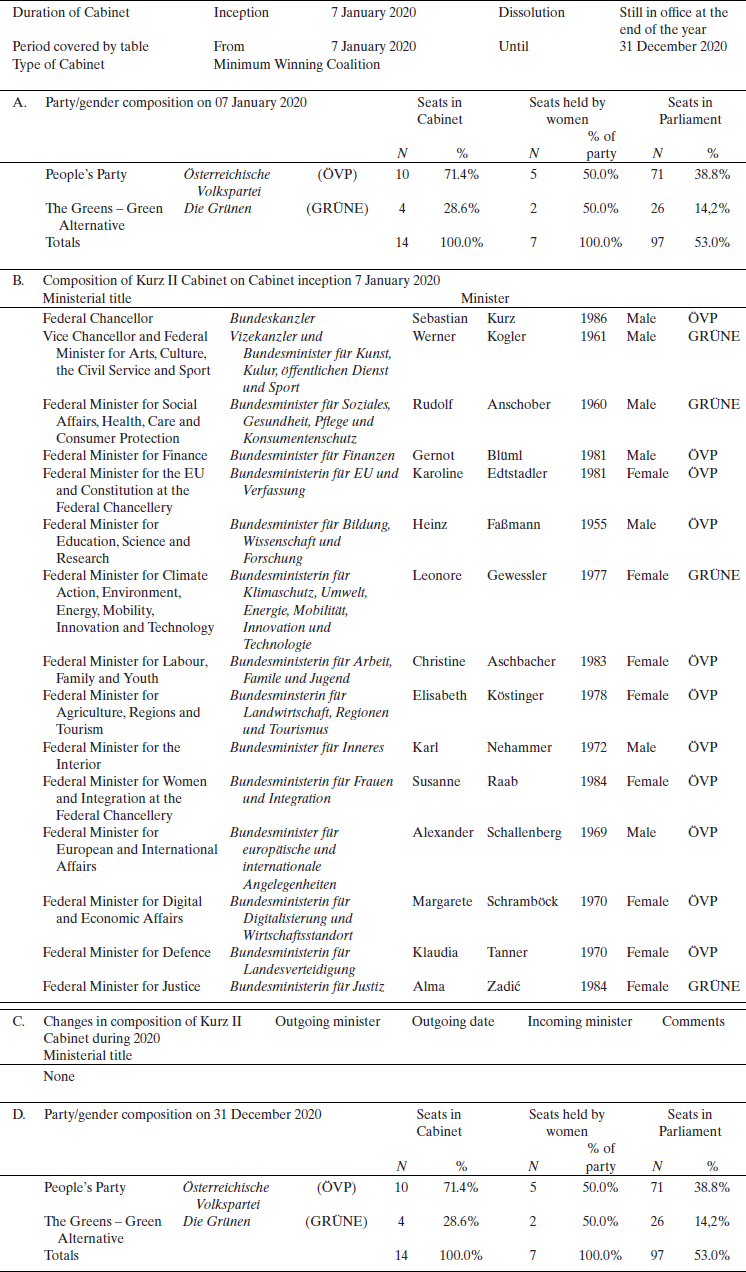
After the extraordinary non-partisan government during most of 2019 (Table 2), ordinary party government was back at the start of 2020. A coalition government between the ÖVP and the Greens, the two big winners of the lower house elections in autumn (Jenny Reference Jenny2020), was sworn in at the beginning of January with ÖVP party leader Sebastian Kurz sworn in again as Federal Chancellor and with the Greens’ party leader Werner Kogler as Vice-Chancellor. It was the first coalition between the two parties at the national level. The ÖVP nominated 11 Cabinet ministers, plus one state secretary, while the Greens nominated four ministers, plus one state secretary. State secretaries do not belong to the Federal Cabinet. Women held more than half of the government posts. Final allocation of portfolios to ministers came at the end of the month with an updated federal ministries law (Table 2).
Table 2. Cabinet compositionof Bierlein in Austria in 2020

Note: Following the parliamentary elections on 29 September 2019 the Cabinet Bierlein remained in office as a provisional government until the swearing in of a new government.
Source: Österreichischer Amtskalender (2020).
With the exception of last year's non-partisan government, the ÖVP had been in all national governments since 1986, whereas the Greens’ held only a few posts in subnational governments. However, most of the new ÖVP ministers had no prior experience in executive office, either. A first conflict in the coalition erupted after the deportation of several teen girls and their families from Georgia and Armenia after years of living in Austria.
The Covid-19 pandemic elevated Minister of Health Rudolf Anschober, the only Green minister with subnational executive experience, to a central role in the government. Frequent government press conferences during the pandemic also put the smaller coalition partner on an equal footing. The Ministry of Health was in charge of drafting many of the bills and government decrees that restricted public life and civil rights during the various stages of the pandemic. The high pace of rule-making produced faulty clauses that later were repealed by the Constitutional Court. The opposition parties provided some leeway during the height of the first wave of the pandemic (Jenny & Müller Reference Jenny and Müller2020, Reference Jenny and Müller2021), but stopped doing so later in spring. The opposition and legal experts admonished Chancellor Kurz's apparent low respect for the rule of law after his defence of fast, potentially faulty, rules that would be out of force again before any judicial review (e.g., Somek Reference Somek2020). After criticism by the cultural sector for the lack of state support Green State Secretary Ulrike Lunacek stepped down in May and was replaced by Andrea Mayer, a former top ministry official.
Table 3. Cabinet compositionof Kurz II in Austria in 2020

Source: Österreichischer Amtskalender (2020).
Parliament report
At the end of January, the lower house installed a Parliamentary Committee of Inquiry looking into alleged bribery under the previous ÖVP–FPÖ coalition government during the period 2017 and 2019 – the ‘Ibiza Committee’ – based on a request of the opposition parties SPÖ and NEOS. The Ibiza video scandal had been an FPÖ affair, but subsequent revelations and judicial investigations put the ÖVP on the spot for alleged favourable laws and acts of patronage coordinated between the two parties that lifted party members or party donors into management and supervisory board positions in state-affiliated companies. Setting up a Parliamentary Committee of Inquiry is a minority right, but the new coalition curtailed the range of inquiry through its majority in the Rules of Procedures Committee. The Constitutional Court then decided the conflict in favour of the opposition parties’ broad original request. Conflicts between police and judicial authorities and among the latter investigating the Ibiza scandal, linked to ÖVP sympathizers in these institutions, produced unfavourable news for the ÖVP throughout the year. The FPÖ, now in opposition, piled on the pressure as well on its former partner. The issue agenda increased the visibility of Green Minister of Justice Alma Zadic who had, like her colleague Anschober, collected favourable ratings in surveys (Kurier 2020).
A period of political truce between government and opposition parties during the first wave of the pandemic in spring ended after a few weeks. However, the opposition parties’ positions towards the government's measures in dealing with the pandemic varied. The FPÖ, led by parliamentary party leader Herbert Kickl, increasingly became the voice of the Corona-sceptical part of the public and of an extra-parliamentary movement opposed to public health-oriented restrictions of public life.
The government coalition lacked a two-thirds majority needed for passing constitutional changes. That required support by either the SPÖ or FPÖ. To avoid a temporary blockade of bills by the upper house, which the opposition imposed several times, or of a referral of a bill to the Constitutional Court for scrutiny, it often sought a compromise with the SPÖ (Tables 4 and 5).
Table 4. Party and gender compositionof the lower house of Parliament (Nationalrat) in Austria in 2020

Source: Austrian Parliament (2020).
Table 5. Party and gender composition of the upper house of Parliament (Bundesrat) in Austria in 2020

Source: parlament.gv.at.
Political party report
SPÖ party leader Pamela Rendi-Wagner held a party members survey in March in which she asked for a ‘vote of confidence’. The turnout rate of 42.7 per cent out of 160,000 party members was higher than in past party surveys. A total of 71.4 per cent of the survey participants expressed that they wanted her to continue as party leader (SPÖ 2020). The outcome was better than expected and quietened the intra-party debate for some time.
Institutional change report
State institutions amended procedures to cope with restrictions brought by the Covid-19 pandemic.
Issues in national politics
Five peoples’ initiatives were presented to the Austrian electorate in June 2020, and four passed the threshold of 100,000 signatures required for submission to Parliament. The people's initiative on climate protection as a constitutional right collected 380,590 signatures, which amounts to support by 6.0 per cent of the electorate. The result is in midrange in the historical ranking of people's initiatives. An anti-smoking initiative collected 140,526 signatures (2.0 per cent), a rival pro-smoking initiative only 33,265 signatures (0.5 per cent). A people's initiative for European Union (EU) law-compliant asylum procedures collected 135,087 signatures (2.1 percent) and another one demanding Austria to leave the EURATOM treaty collected 100,482 signatures (1.6 percent) (Federal Ministry of the Interior 2020).




 Open access

