


Introduction
The assassination of former Prime Minister Shinzō Abe just days before the House of Councillors election in July was the defining event in Japan's politics in 2022. The Liberal Democratic Party (LDP) won a majority of seats in the subsequent election but spent much of the rest of the year on the back foot as investigations revealed links between many of the party's lawmakers and the Unification Church. This “new religious movement,” often described as a cult, employs aggressive tactics in soliciting large donations from its members, even to the point of driving them to financial ruin. The family of Abe's assassin had been severely impacted by the cult's financial tactics, leading him to target Abe as a senior politician with deep links to the Church. There was significant turnover in the Cabinet, with Prime Minister Fumio Kishida removing several Unification Church-linked ministers in August, with further resignations coming later in the year as more ministers’ links to the organization were revealed. Approval for the government fell sharply in opinion polls as a consequence, defying hopes that the country's gradual emergence from COVID-19 restrictions would deliver a bounce in support for the ruling parties.
Election report
Parliamentary elections
Japan held an election for the House of Councillors, the upper house of its bicameral Diet, on 10 July. Members of the House of Councillors serve six-year terms, with elections for half of the seats being held every three years. One hundred and twenty-four of the 248 seats were up for election in this cycle; additionally, Kanagawa Prefecture held a merged election for the seat vacated by Shigefumi Matsuzawa to run (unsuccessfully) for mayor of Yokohama in 2021, with the fifth-ranked candidate in Kanagawa serving the remaining three years of that seat's term. This brought the total number of seats up for election to 125: 75 were elected by single non-transferable vote (SNTV) in 45 prefectural single- and multi-member districts (four prefectures having been merged into two districts in the 2015 revision to the Public Offices Election Law, see Hino Reference Hino2016: 160), and 50 were elected in a national district by D'Hondt proportional representation with optionally open lists. Three of these seats—one in Saitama and two in the national PR (Proportional Representation) district—were newly created at this election, in accordance with the 2018 revision to the Public Offices Election Law, which had added six seats to the House of Councillors (see Hino & Ogawa Reference Hino and Ogawa2020: 216, 223).
This was the second national election to be held since Fumio Kishida became leader of the ruling LDP/Jiyū-Minshutō (Jimin) in October 2021, and the first election for the Constitutional Democratic Party of Japan (CDP)/Rikken-Minshutō (Ritsumin) under new leader Kenta Izumi, who had replaced Yukio Edano following the party's weak performance in October's House of Representatives election. Another opposition party, the Japan Innovation Party (JIP)/Nippon Ishin no Kai (Ishin), had gained a significant number of seats during that election, and there was significant interest in whether it would be able to continue its advance, especially in regions outside its home territory around Osaka, Japan's second-largest city.
Following the disappointing results for most of the opposition parties (with the notable exception of the JIP) in the previous year's election (see Hino et al. Reference Hino, Ogawa, Fahey and Liu2022: 265), the strategy of coordinating among parties to back a single opposition candidate in single-member districts was largely abandoned in this election. This resulted in a large number of districts having competing candidates from parties that had fielded joint candidates in the 2021 House of Representatives and 2019 House of Councillors elections, as well as candidates from opposition parties that had not previously cooperated in candidate coordination, such as the JIP and the Democratic Party for the People (DPFP)/Kokumin-Minshutō (Kokumin).
Prior to the assassination of former Prime Minister Abe on 8 July, which occurred while he was giving a speech in support of LDP incumbent Kei Satō in Nara city, the primary issues in the election had been rising consumer prices and the government's handling of the ongoing COVID-19 pandemic, with the Russian invasion of Ukraine also pushing national security issues to the front of many voters’ minds. With all of these being essentially valence issues, the election was framed in the media as something of a referendum on the leadership of Prime Minister Kishida, with a strong showing for the ruling coalition potentially granting him a strong mandate for the three-year window before the party would face another national election (the next scheduled election being for the other half of the House of Councillors in 2025). The assassination completely dominated the media cycle for the last two days before the election, although most candidates carried out their public events as planned on the final day of campaigning.
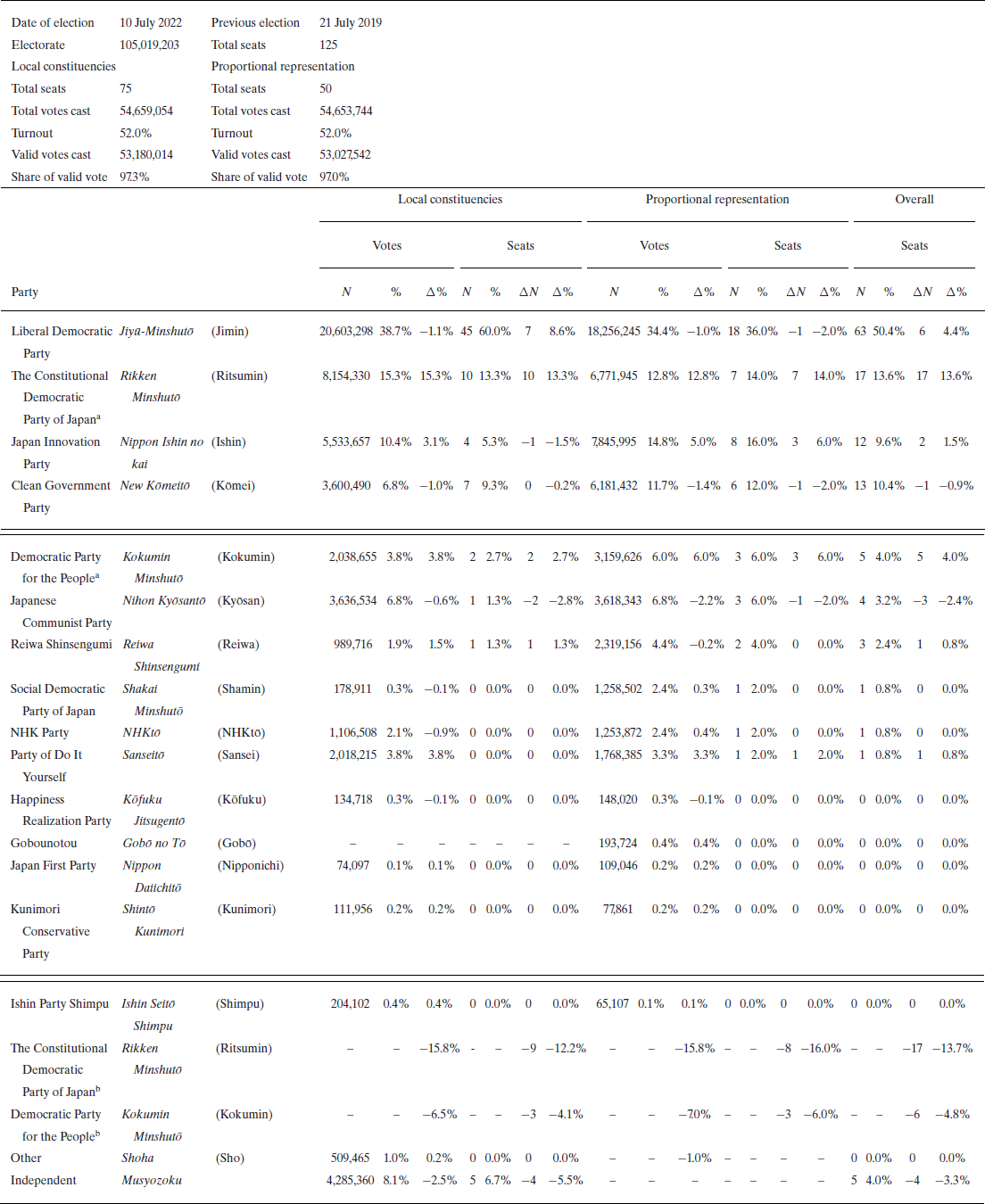
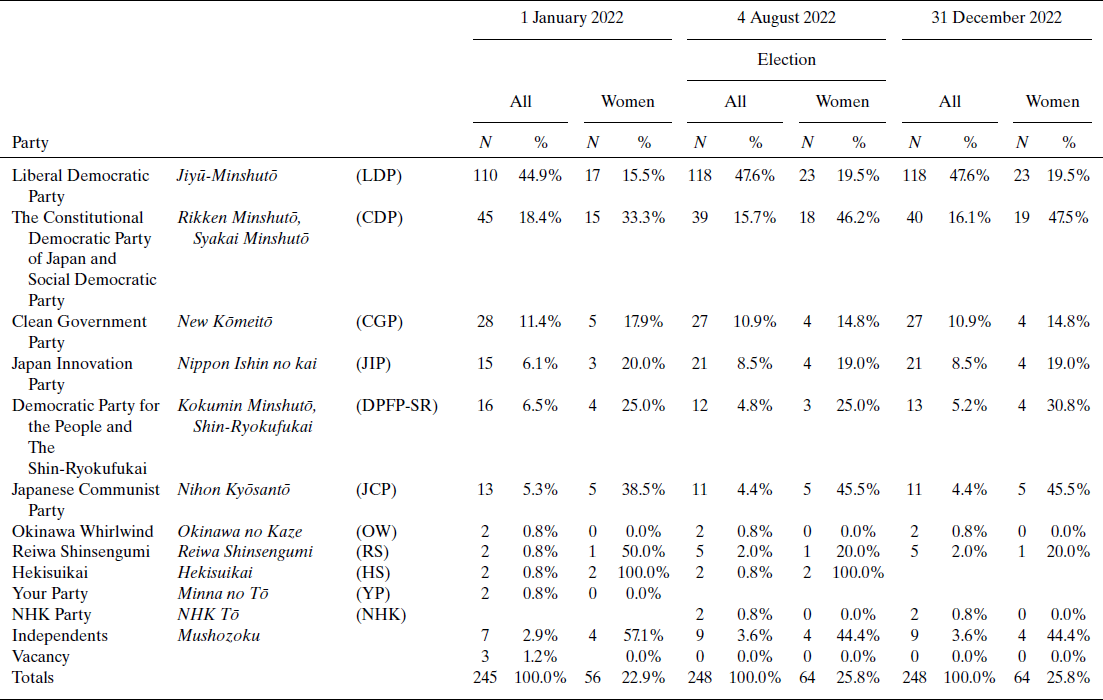
While the assassination may have affected the outcome of the election to some degree, such effects appear to have been limited. The election results did not deviate significantly from pre-election seat projections based on opinion polls in the major newspapers, which had predicted modest seat gains for both the LDP and JIP, with little change for other parties. As seen in the final results shown in Table 1, the LDP won 63 of the 125 contested seats, a gain of eight seats over its pre-election strength (the seat change numbers in Table 1 are comparisons with the 2019 election, not pre-election seats). This meant that the ruling coalition expanded its majority in the upper house, with a net gain of seven seats (the LDP's coalition partner, the Clean Government Party [CGP]/Kōmeitō [Kōmei], having lost one seat) bringing the coalition to 146 seats. The LDP performed especially strongly in the country's single-member districts, winning 28 of the 32 SMDs (Single Member Districts) that were up for election as the opposition parties’ decision not to coordinate their candidate choices rendered them largely ineffective in these districts. Overall, the traditional left-wing opposition parties fared badly in the election; the CDP lost six seats, falling from its pre-election count of 23 to 17 (with its overall share of the seats in the House of Councillors dropping from 45 to 39), while the Japan Communist Party (JCP)/Nihon Kyōsantō (Kyōsan) lost two seats, falling from six to four seats (leaving its total in the House of Councillors at 11).
Table 1. Elections to the upper house of the Parliament (House of Councillors/Sangiin) in Japan in 2022

Notes: aThe CDPthat participated in 2019 elections to the upper house of Parliament ceased to exist on 14 September 2020.
b The CDP that participated in 2022 elections to the upper house of Parliament was set up on 15 September 2020.
c The DPFP that participated in 2019 elections to the upper house of Parliament ceased to exist on 11 September 2020.
d The DPFP that participated in 2022 elections to the upper house of Parliament was set up on 11 September 2020.
Source: Ministry of Internal Affairs and Communications (2022).
The JIP continued to make gains at this election, doubling its seats from six to 12 and bringing its total seats in the House of Councillors to 21. Notably, the party took second place in the national proportional representation vote for the first time, becoming the leading opposition party by this metric with 14.8 per cent of the vote to the CDP's 12.8 per cent—although the CDP won significantly more votes in SNTV districts (the CDP having fielded candidates in more districts), and thus more seats overall, suggesting that JIP's slate of candidates has not yet caught up to its rising public support. There was also minor success for Japan's small populist parties, with the left-wing Reiwa Shinsengumi (Reiwa) (see Hino & Ogawa Reference Hino and Ogawa2020: 214, for its breakthrough in the 2019 upper house election) gaining three seats to bring its House of Councillors total to five, while the right-wing NHK Party (NHK)/NHK Tō (NHK) and Party of Do It Yourself (DIY)/Sanseitō (Sansei) added one seat apiece, giving NHK its second and DIY its first seat in the House. The seat won by DIY is the latest example of a new party making inroads in Parliament through the upper house election, where the threshold for winning a seat in the nationwide PR bloc is lower than in any other national election.
Cabinet report
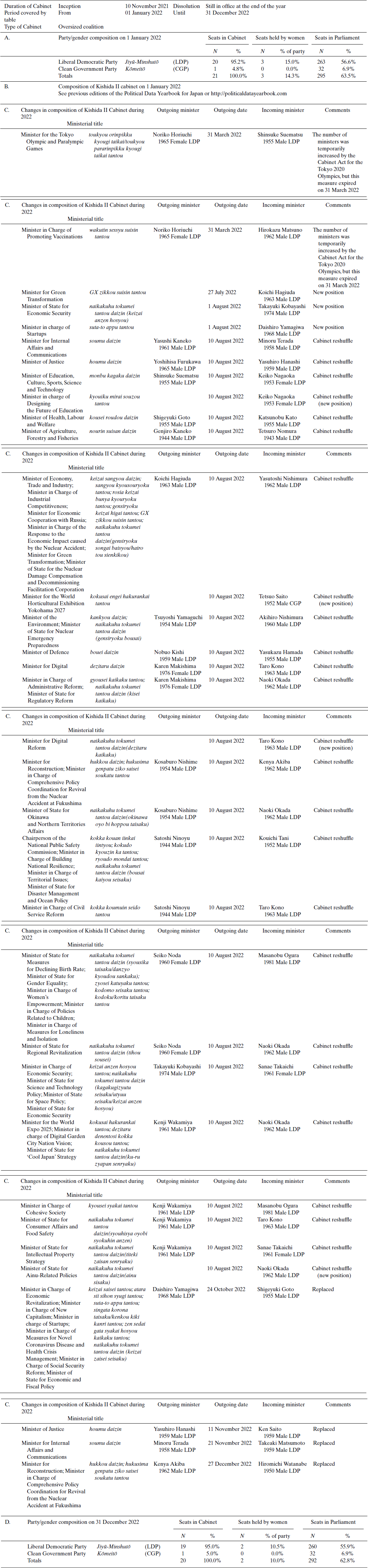
One change was made to the Kishida Cabinet before the election, when the temporary expansion of the Cabinet from 19 members to 20 to create a ministerial position in charge of the Tokyo Olympics (since 2015, see Hino Reference Hino2016: 157) expired on 31 March. Noriko Horiuchi consequently left the Cabinet and her two portfolios—Minister for the Tokyo Olympic and Paralympic Games and Minister in Charge of Promoting Vaccinations—were split up between existing Cabinet members Shinsuke Suematsu and Hirokazu Matsuno, respectively (see note to Table 2).

On 10 August, facing a rising tide of criticism over links between LDP lawmakers and the Unification Church, Prime Minister Fumio Kishida carried out a major reshuffle of his Cabinet, one month earlier than expected (past Cabinet reshuffles often took place in September). Fourteen of the 19 ministers were replaced, with half of those removed having confirmed connections to the religious movement. The seven LDP ministers with ties to the Unification Church who lost their Cabinet positions in the reshuffle were Minister of Defence Nobuo Kishi (Shinzō Abe's younger brother); Minister of Economy, Trade, and Industry Koichi Hagiuda (who was moved to a senior party position as secretary-general of the LDP); Minister of Education, Culture, Sports, Science, and Technology Shinsuke Suematsu; National Public Safety Commission Chairperson Satoshi Ninoyu; Minister in Charge of Economic Security Takayuki Kobayashi; Minister of State for Regional Revitalisation Seiko Noda; and Minister of the Environment Tsuyoshi Yamaguchi. Kishida appointed veteran ministers to many of the vacated positions, with former Minister of Defence Yasukazu Hamada and former Minister of Health, Labour, and Welfare Katsunobu Kato returning to their former portfolios, while former Minister of State for Economic and Fiscal Policy Yasutoshi Nishimura took on the Minister of Economy, Trade, and Industry portfolio.
While the primary objective of the reshuffle was to distance the Cabinet from the links to the Unification Church that were causing such public anger, some commentators noted that Kishida had taken the opportunity to rebalance the Cabinet representation of the LDP's various internal factions. This balance had formerly been tipped toward the right-wing faction headed up by former Prime Minister Abe, whose votes Kishida had relied upon in the 2021 leadership election; as well as bringing veteran ministers back into the Cabinet, the reshuffle re-established the power balance between the major factions. Kishida also took the opportunity to appoint both of his major rivals in that leadership election to Cabinet roles, with Taro Kono taking on the newly created Minister for Digital Reform portfolio and Sanae Takaichi becoming Minister in Charge of Economic Security.
The LDP leadership claimed to have instructed incoming ministers in the new Cabinet to reveal any connections they may have had to the Unification Church. Despite the objective of distancing the party from such links, several of the newly appointed ministers admitted to connections such as having given donations to the religious group in the past. Kishida stated that the new ministers had agreed to review such ties and provide assistance to the victims of the Church's activities. However, both Minister in Charge of Economic Revitalisation Daishiro Yamigiwa and Minister for Reconstruction Kenya Akiba were revealed to have undisclosed links to the Church, subsequently resigning from their positions on 24 October and 27 December, respectively. Two other senior Cabinet ministers were also forced to resign by scandals unrelated to the Church: Minister of Justice Yasuhiro Hanashi resigned on 11 November after making public comments that appeared to make light of the death penalty, while Minister for Internal Affairs and Communications Minoru Terada resigned on 21 November following allegations of irregularities in his campaign finances. Cabinet reshuffles are normally expected to boost the Cabinet's approval rate ,but the Kishida Cabinet instead lost support in the subsequent months, sinking by approximately 20 per cent to lows of around 30 per cent approval in most polling.
Cabinet changes and composition are shown in Table 2.
Parliament report
In the ordinary session, which ran from 17 January to 15 June, all of the 61 government-sponsored bills submitted to the Diet passed. Seventy-eight bills were passed in total, including 17 legislator-sponsored bills (Cabinet Legislation Bureau 2022). Among the bills passed were a number of pieces of legislation establishing the Children and Families Agency, which is designed to integrate government functions related to family and child-raising that were formerly spread among multiple departments including the Ministry of Education, Culture, Sports, Science, and Technology, the Ministry of Health, Labour, and Welfare, and the Cabinet office, among others. Two motions of no confidence were proposed and defeated in this session, both on 8 June—one against lower house Speaker Hiroyuki Hosoda and the other against the Kishida Cabinet. In addition, motions were passed condemning human rights abuses against the Uyghur people in China and the invasion of Ukraine by Russia. The budget for fiscal 2022 was 107.7 trillion yen, about one trillion higher than had originally been projected, and a 2.7 trillion yen supplementary budget was approved in May, which included measures to counter rising consumer prices. An initial budget for fiscal year 2023 of 114.4 trillion yen was approved in December, marking the first time that the country's budget had exceeded 110 trillion yen.
A brief extraordinary session was convened from 3 to 5 August to elect the new speaker and deputy speaker of the House of Councillors. A further extraordinary session ran from 3 October to 10 December, in which 21 government-sponsored bills (out of 22 submitted) and six legislator-sponsored bills were passed, a total of 27. The most notable bill passed in this session was a law restricting malicious donation solicitations by religious and other groups, which primarily targeted the fundraising activities of the Unification Church. The passage of this bill was a key priority for the government, with the extraordinary session being extended into Saturday to allow it to be deliberated—the first time that the lower house had convened on a weekend since the mid-1990s.
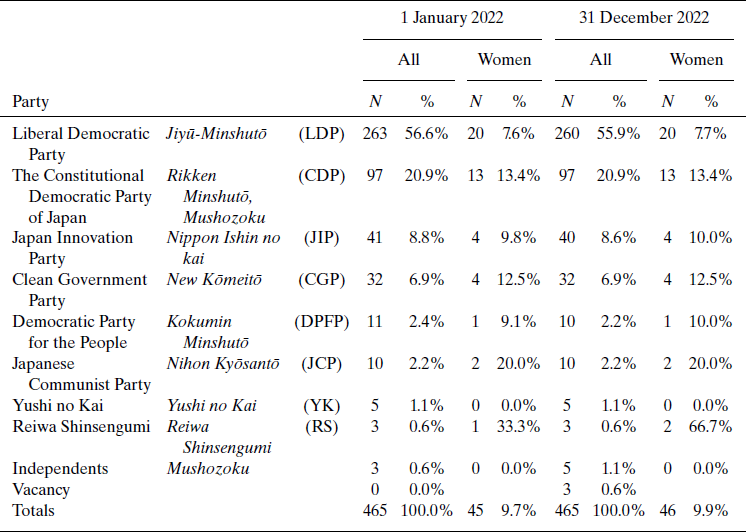
Tables 3 and 4 show the composition of both houses of Parliament in 2022.
Table 3. Party and gender composition of the lower house of the Parliament (House of Representatives/Shūgiin) in Japan in 2022


Political party report
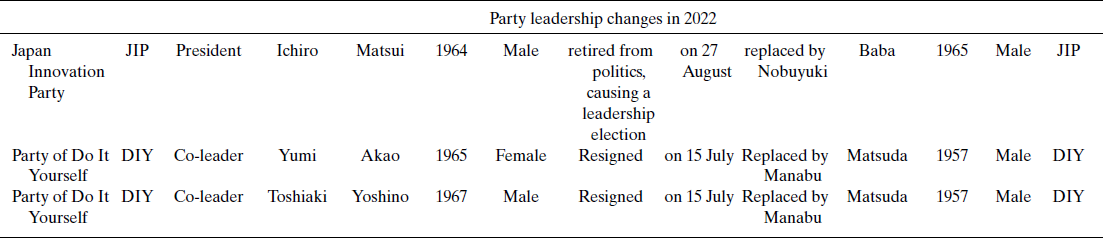
The JIP held a leadership election on 27 August following the announcement that party President Ichirō Matsui wished to step down from the leadership and intended to retire from politics at the end of his term as mayor of Osaka in 2023. Three candidates stood for the election: JIP co-leader Nobuyuki Baba, House of Representatives legislator Yasushi Adachi, and House of Councillors legislator Mizuho Umemura. Matsui endorsed Baba as his successor in the role, and Baba was subsequently elected by a large majority, winning 8527 votes out of the 10,825 valid ballots cast. Osaka Governor Hirofumi Yoshimura, who had chosen not to stand in the leadership race in order to focus on his role in local politics, was subsequently appointed as party co-leader, filling the role vacated when Baba became party President.
Changes in political parties are shown in Table 5.
Table 5. Changes in political parties in Japan in 2022

Notes: DIY shifted from co-leadership system (Co-leaders: Manabu Matsuda, Yumi Akao, Toshiaki Yoshino) to sole leadership system (Manabu Matsuda) on 15 July 2022.
Sources: Ministry of Internal Affairs and Communications (2022); The Asahi Shimbun Online Newspaper Database (2022).
Issues in national politics
National politics in Japan in 2022 was dominated by the assassination of Shinzō Abe and the subsequent repercussions for the ruling LDP. Abe, who was the longest-serving Prime Minister in Japanese history, holding the office for almost nine years in total before resigning in mid-2020, was shot at close range by a 41-year-old Japanese man with a home-made firearm. The shooting was particularly shocking given the extremely low rates of gun crime in Japan. Political violence is also very rare: Abe was the first national lawmaker to be killed since Kōki Ishii, who was murdered by a member of a right-wing group in 2002, and the first former or current Prime Minister to be murdered since 1936. Questions were raised immediately about the security provisions for political figures during election campaigns, during which even the most senior Japanese politicians routinely travel the country to give speeches in open, public areas (Asahi Shimbun Online Newspaper Database 2022; Yomiuri Shimbun Online Newspaper Database 2022).
In the days following the assassination, it emerged that the killer's motive was related to Abe's support for the Family Federation for World Peace and Unification, better known as the Unification Church, a new religious movement founded by Sun Myung Moon in South Korea in 1954 and now led by the late Moon's widow, Hak Ja Han. The organization has been active in Japan since the 1960s and is often described as a cult, with criticism mostly focusing on its aggressive practices in soliciting large financial donations from members, a strategy known as “spiritual sales.” The killer blamed the Church for severe financial problems that had impacted his family—his mother joined the Church in the 1990s and had subsequently donated almost all of the family's funds, including their family home and some inherited land, to the organization, even continuing to make donations after filing for bankruptcy in 2002. He chose to target Abe, rather than Church leader Hak Ja Han, after researching the ties between the Abe family and the Church—a close relationship encompassing three generations of the political dynasty, starting with Abe's grandfather, former Prime Minister Nobusuke Kishi, who assisted the establishment of the Church in Japan in the 1960s.
The media subsequently reported that many other LDP politicians had connections to the Unification Church, which included accepting donations, using Church members as campaign volunteer staff, attending meetings organized by the Church and its partner organizations, or giving speeches praising the Church and its leadership. In some cases, lawmakers had even signed pledges promising to support the Church's positions on various policy issues, notably including opposition to gender equality and LGBT rights, as a condition of receiving electoral support from the organization. Media coverage implied that these connections with the LDP had shielded the Church from censure over its recruitment and fundraising practices. Public outcry over these connections forced the LDP to initiate an internal investigation, ordering lawmakers to reveal any connections to the Church. In August, Prime Minister Kishida reshuffled his Cabinet, removing seven senior ministers who had acknowledged ties to the Unification Church, including Abe's younger brother, Minister of Defence Nobuo Kishi. In September, LDP Secretary General Toshimitsu Motegi announced that 179 of the party's 379 lawmakers had confirmed connections to the Church. Opposition lawmakers suggested that this was an underestimate, as it only included Diet members, while the Unification Church had also been active in local politics in many areas. Some legislators also failed to disclose their links to the Church at this point—notably including two new Cabinet members, Minister in Charge of Economic Revitalisation Daishiro Yamigiwa and Minister for Reconstruction Kenya Akiba, who both resigned after claiming not to remember having attended Church events.
These issues undermined Kishida's attempts to draw a line under the Unification Church scandal, even after passing a bill in December that restricted the tactics organizations could use in soliciting donations and was clearly designed to inhibit the “spiritual sales” conducted by the Church. Support for the Cabinet, which had peaked directly after the July election, collapsed as the Unification Church story came to dominate the public discourse; by December, polling for the Mainichi Shimbun showed that approval of the Cabinet was at only 25 per cent, with 69 per cent of respondents disapproving (Mainichi Shimbun Online Newspaper Database 2022). Public outcry about the LDP's involvement with the Church also spilled over into a contentious debate over whether a state funeral should be held for Abe—the state funeral was eventually held in September, but opinion polls showed the nation deeply divided over the issue, and public demonstrations against the state funeral were held in many cities.
Beyond the assassination and its consequences, the ongoing response to the COVID-19 pandemic remained a major issue in Japan in 2022. “Quasi-emergency” policies to control the spread of COVID-19—including requesting that business follow guidelines such as restricting the hours at which alcohol is served—were in place in many prefectures until March. Japan was one of the last countries in the world to lift pandemic restrictions on travel, permitting a small number of tourists to enter the country on guided tours in June, before finally resuming the visa waiver program and opening for regular tourism and business travel on 11 October. The move was welcomed by airlines and tourism-dependent businesses, which had been hit badly when the anticipated tourism boom for the Tokyo Olympics in 2020 was cut off by the pandemic. However, the government continued to take a cautious approach overall to rolling back its pandemic policies, noting that the country was hit by new waves of infections in August and November/December. Guidelines calling for mask-wearing outdoors were eased in late May, but requests to wear them in enclosed places and on public transport continued through the end of the year, as did the requirement for inbound travelers to show proof of vaccination or negative COVID-19 tests.
Rising consumer prices also commanded significant attention, especially in the wake of the Russian invasion of Ukraine in February. The government passed a 2.7 trillion yen supplementary budget in May that contained measures designed to lessen the impact of rising prices. Price inflation was exacerbated by a steep drop in the value of the yen, compared with the US dollar, driving up the cost of imported goods. The yen fell steadily throughout the year, dipping below 150 yen to the dollar—a 32-year low—in late October, even after the government and the Bank of Japan had made their first intervention in the currency market (selling dollars and buying yen) in 24 years on 22 September. Inflation also peaked in October, when the composite consumer price index rose to 3.6 per cent year-on-year, the highest level seen since 1982. However, some individual sectors saw much higher rises; energy prices were especially hard-hit, with a 20.9 per cent year-on-year rise in the cost of electricity and a 26.8 per cent rise for natural gas.
The invasion of Ukraine and ongoing missile tests by North Korea—a number of which flew over the Japanese islands—contributed to growing concerns about national security, with many politicians and commentators comparing the situation of Russia and Ukraine to that of Japan's neighboring countries China and Taiwan. In response, Kishida announced on 5 December that he was ordering a 50 per cent increase in defense spending over five years from 2023. While increasing defense spending has traditionally been a highly contentious issue in Japanese politics, concerns over Ukraine, North Korea, and Taiwan led to relatively muted opposition to Kishida's stated plan to eventually double the country's annual defense budget to 2 per cent of GDP, in line with the guidelines for NATO members.

 Open access

