

In 2016, a New York Times dance critic devalued the genre of Chinese dance dramas by reducing a performance of Dragon Boat Racing (Shawanwangshi 沙湾往事) by the Guangdong Song and Dance Ensemble to “kitschy spectacle.” This review exemplifies illiteracy of Chinese dance dramas based on bias against maximalist deployment of spectacle filtered through a Cold War influenced understanding of Chinese aesthetics that is exacerbated by American ignorance of Chinese history. This dismissive review contrasts with the warm reception the Chinese language press gave this contemporary piece (2014 premiere) and the regional and national awards it won in China (Liu Reference Liu2014). Chinese critics generally describe it as an original choreographic work grounded in the specifics of local Cantonese culture (F Wu Reference Wu2014; She Reference She2018). This positive reception aligns with my experience watching the piece with a mostly Chinese diaspora audience at the Merriam Theater in Philadelphia in January 2018.Footnote 1 This article addresses the gap in understanding, examining the dynamics that shaped the development of Chinese dance dramas as a genre as well as the forces shaping American reception of it. I assert that key to the mistranslation is differing understandings of the maximalist deployment of spectacle, which is connected to fissures in the field of dance between supporters of classical ballet and modern dance. I argue that the use of the aesthetic is a celebration of China’s economic development and an assertion of belonging in modernity. But, in the United States its reception is shaped by aesthetic hierarchies developed during the Cold War.
In my analysis below, I argue that Chinese dance dramas are characterized by aesthetics of spectacle and that this is a legacy of the Chinese dance field’s negotiation of postcolonial modernity. I follow Ming Xie (Reference Xie1997), Claire Conceison (Reference Conceison2004), and Emily Wilcox (Reference Wilcox2018b) in analyzing China through a post-colonial lens. I argue that by facing a hierarchical post-colonial world order that attempts to place them in the temporal past, Chinese dance artists use the choreographic technology of the Chinese dance drama in combination with spectacle, an aesthetic of modernity, to strategically assert themselves in the temporal present on the global stage. The conception of performance as technology builds upon Tarryn Chun’s argument that in China modernizing material elements of the stage “propelled a reconceptualization of drama as a technology in the service of political and ideological goals” (Chun Reference Chun2016, iii), in this case the claiming of place in a global aesthetic caste. By anchoring Chinese dance dramas to the temporal present, the use of spectacle in the context of Chinese dance drama enables creativity around “Chineseness” in other areas of the work, including but not limited to body movement.
An important contribution of this essay is a reflection on how dynamics of the Cold War continue to shape American aesthetic taste, which in turn shapes mainstream American reception. I deepen scholarship on Cold War containment by connecting it to bias against two interconnected aspects of aesthetics—spectacle and ballet. I also extend scholarship on Cold War containment by asking how aesthetic norms consolidated by containment continue to shape aesthetic taste (Kowal Reference Kowal2010; Kowal Reference Kowal2020; Ma Reference Ma2023; Graff Reference Graff1997; Kosstrin Reference Kosstrin2017). I ask how the U.S.’s role as a hegemonic power atop an asymmetrical global system impacts the reception of aesthetics and kinesthetics developed in socialist spaces, in particular work not in dialogical relation with lineages of modern/post-modern dance.
This question is most acute for arts from the PRC, one of the few countries that maintained aspects of socialism while integrating with the capitalistic world order. These dynamics are visible in asymmetrical interest in bodily knowledge: Americans go to China in the hierarchically high position of dance teacher, and rarely in the hierarchically low position of dance student, while Chinese artists frequently come in the low position of student.Footnote 2 This dynamic began in the early Cold War (Miao Reference Miao2022), and persists to the present. Within North America this has ghettoized fluency in the dominant Chinese aesthetics (not in dialogical relation with modern/post-modern dance) within diasporic communities (Gerdes and Lin Reference Gerdes and Lin2022; Rann Reference Rann2023). This leads American gatekeepers to misinterpret Chinese dance dramas and the broader fields of Chinese classical, folk and minority dance, thereby subverting the majority of dance artists from the PRC engaged in this genre.
To show current understanding of Chinese dance dramas and the aesthetics of spectacle by the dance field in the United States, I utilize dance criticism as a proxy for the attitudes and values of U.S. based dance gatekeepers. Reviews serve as important public evidence of often silent bias manifested in rejections, micro-aggressions, or private discussions. While gatekeepers are not a homogenous group, historically dance criticism often influenced the perception of curators, festival organizers, funders, and dance professors (Mattingly Reference Mattingly2023). Whether the misinterpretations in the review reflect widespread biases or are part of the cycle of shaping aesthetic values, it is critical for dance studies to discuss them to minimize their impact on dancers and to help dancers understand the forces shaping reviews. This is especially true when the biases are about one of the most popular forms in another country.
I focus on Dragon Boat Racing, because it is an ideal case study in the differing reception of Chinese dance dramas: it was reviewed in both the United States and China, is the subject of Chinese-language scholarship, and was called representative of the aesthetic standards of the genre of Chinese dance drama by Dai and Dai (Reference Dai and Zheng2015). This is a rare combination due to the lack of American Anglophone reviews of Chinese dance dramas. The dearth of English-language reviews is true in the US where there are only a handful of reviews of Chinese dance in the last decade, and even in Beijing, where English-language publications review ballet and modern dance performances by Chinese and international companies, but rarely, if ever, review the vastly more popular Chinese dance forms, including Chinese dance dramas or shorter pieces in the connected forms of Chinese classical, folk or minority dance. Against the gap this paucity creates, the words of one critic stand out as influential, Brian Seibert. I have no intention of singling him out, as I do not believe he is unique in his views. However, he is one of the only US dance critics who reviews Chinese dance dramas and, as such, his voice is influential in shaping reception of this form. He reviewed at least four Chinese dance dramas, while no other American dance critic writing in English reviewed Chinese dance dramas more than once.Footnote 3 This void makes his review crucial in analyzing the misinterpretation of the form. Additionally, the prominence of his platform, The New York Times, gives his words power to shape perception of Chinese dance dramas in the US and beyond.
Dragon Boat Racing Dialogical Relationship with Ballet
Dragon Boat Racing is a dance piece in the genre of the Chinese dance drama choreographed by two women choreographers, Zhou Liya (周莉亚) and Han Zhen (韩真).Footnote 4 The genre was developed in the PRC during the second half of the twentieth century and has flourished in the twenty-first century: between 2000 and 2016, at least 200 dance dramas were choreographed in China (Y. Mao Reference Mao2016). The 2016 performance of the piece by the Guangdong Song and Dance Ensemble at the Koch Theater at the Lincoln Center in New York is part of a trend of professional Chinese dance companies touring Chinese dance dramas globally. Since 2000 there were at least twenty-eight tours of Chinese dance dramas to the United States (Supplementary Table 1).
Outside of Chinese communities in the United States these professional tours are the most visible performances of Chinese dance dramas, but they are not the only performances in the United States. Chinese dance studios and their amateur companies also perform Chinese dance dramas, some of which are fully original productions, but many of which are reinterpretations of famous productions from the PRC.Footnote 5 As such, these touring performances along with videos of domestic performances in the PRC are an inspiration for many practitioners of “Chinese dance.” Without a U.S. based professional company performing “Chinese dance” or Chinese dance dramas, these tours are an important opportunity for U.S. based practitioners to see Chinese dance performances live. Reviews of these performances are places where U.S. based practitioners of “Chinese dance” can view the dance world’s reception of their forms. In this section, I introduce key aspects of the development of the genre. I focus on the relationship with classical ballet in the development of the form, as the genre’s dialogical relationship with the aesthetics of classical ballet impacts its reception in the United States. I end the section by demonstrating these dynamics in the piece Dragon Boat Racing.
Chinese dance dramas along with the broader field of “Chinese dance” developed during the second half of the twentieth century in dialogical relation to ballet. The establishment of the PRC in 1949 ushered in an era of nation-building and change as well as a focus on developing a new national identity. The genre of the Chinese dance drama is a hybrid project that Sinicizes (makes Chinese) the form of narrative ballet by engaging aesthetic practices from local Chinese sources (Wilcox Reference Wilcox2018a). This places China in a parallel project with countries established in the wake of World War II (Giersdorf Reference Giersdorf2013) and postcolonial countries (Ann Ness Reference Ness1997; Sörgel Reference Sörgel2007; Reynoso Reference Reynoso2023; Djebbari Reference Djebbari2019) where there was emphasis on adapting local dances for modern society. As was common at the time, especially for countries in socialist or non-aligned blocs during the Cold War, local forms were put in a dialogical relationship with ballet. In some spaces the lineages of modern dance were not an equivalent universal during this period. In East Germany, the Soviet Union as well as the PRC modern dance was perceived as an embodiment of bourgeois capitalist values, thereby leading to marginalization (Ma Reference Ma2023; Wilcox Reference Wilcox, Morris and Nicholas2017a; Giersdorf Reference Giersdorf2013; Ezrahi Reference Ezrahi2012). In this model, ballet becomes a dynamic universal medium not limited by its history as a classical form or expectations of purity.
The choreographic structure and many aesthetic elements of Chinese dance dramas attest to the appropriation of the choreographic techniques of Soviet and classical narrative ballets. Like classical narrative ballet, dance dramas are largely story-driven evening-length productions for the proscenium stage. Dramatic music, large casts, virtuosic dancing, sumptuous sets and props all work together to tell a legible story via a typical narrative arc: “opening, climax, ending” (Zhong Reference Zhong2014, 58). These overarching aesthetic standards together define the form as a genre. All genres, even post-modern dance, modern dance and ballet, have underlying aesthetic standards differentiating them from others. Creativity co-exists and is even nourished by the presence of these aesthetic norms.
The appropriation of choreographic structure of narrative ballet does not make the form less Chinese. I follow Yueh-yu in viewing the process of Sinification as an agential one of negotiation (Yeh, Reference Yeh2002). A fertile field, dance drama inspired many creative experiments in the 1950s and early 60s, which were accompanied by lively debate and criticism with dancers, playwrights, “composers, poets, film critics, and worker-peasant students chiming in about the future of Chinese dance form” (Wilcox Reference Wilcox2018a, 60). In Chinese writings of the period, dance drama theory separated out choreographic technique from narrative content and body technique. The degree of foreign influence on narrative content and body technique became an area of contestation, but the technology of foreign choreographic technique was uncontroversial. In the 1950s, large amounts of ballet movement technique in a dance drama subjected it to criticism, but use of the choreographic technique of narrative ballets did not (Wilcox Reference Wilcox2018a, 98). The adoption was an agential one of negotiation and creative decision making. This dialogical relationship is visible in Dragon Boat Racing. In terms of narrative, Dragon Boat Racing tells a twentieth century story with an emphasis on legibility. Dragon Boat Racing is set in the 1920s-1930s in Shawan (沙湾) in Guangdong (Canton). Historical fiction, it adapts the story of a family of famous Cantonese composers known by the appellation Heshisanjie (何氏三杰)Footnote 6 and dramatizes the composition of a quintessential Cantonese song “Dragon Boat Racing” (Sailongduojin 赛龙夺锦), which was composed by one of the family members, He Liutang (何柳堂), between 1925 and 1930 (Liang Reference Liang2018, 34). Not meant to be veridical, the dance drama reimagines three middle-aged male members of the He family as a pair of youthful cousins: He Liunian and He Shaoyan. It also reimagines other aspects of their lives with dramatic flair, featuring the invading Japanese army, and a pair of lovers broken up by an arranged marriage.
It both draws from and develops classical ballet plots. Like many dance dramas, it leaves behind the class based stories of royalty common in classical ballets (Wilcox Reference Wilcox2018a), and instead, it tells a story about the challenges of romantic love during war. Rather than turning towards abstraction as a space of creativity, as some Western ballet choreographers are doing in the recent choreographic revival of narrative ballets, the choreographers of Dragon Boat Racing turn toward a different aspect of contemporary society for choreographic inspiration—TV dramas. While the classical ballet Giselle utilizes a love-triangle—one of the romantic leads has another prospective romantic partner—Dragon Boat Racing utilizes a common TV drama plot device of a love quadrangle. This means both romantic leads have potential romantic prospects outside the main pairing.
Dragon Boat Racing manifests the overarching aesthetic standards of Chinese dance dramas as it developed during the second half of the twentieth century and early twenty-first century. These standards were initially developed via dialogical relation with classical and Soviet ballet, but became Chinese via decades of development and change by Chinese choreographers. In order to tell a legible story via a simple narrative arc it embraces a maximalist deployment of dramatic music, large casts, virtuosic dancing, sets and props, which work in tandem. While some aspects of this choreographic technique is particular to dance dramas, many aspects of the aesthetics are part of the broader field of “Chinese dance,” which developed alongside and partly through Chinese dance dramas (Wilcox Reference Wilcox2018a; Reference Wilcox2018b). Judgement of these aesthetics as spectacle therefore implicates most of the project of “Chinese dance.”
Spectacle by Any Other Name…
Chinese dance dramas, as well as Chinese narrative ballets, are frequently described as spectacles within the American ecosystem of dance criticism. New York Times dance critic Brian Seibert and other mainstream American dance reviewers routinely use the word “spectacle” to describe Chinese dance dramas. In addition to Dragon Boat Racing, Seibert also applied the term in reviews of the Chinese dance dramas Silk Road in 2013 and The Red Dress in 2014. Additionally, Jonathan Mandell described the Chinese dance drama Confucius as spectacle (Reference Mandell2017), and American critics commonly apply it to Chinese narrative ballets (Mullis Reference Mullis2017, 64). This frequent usage is striking compared to the mere handful of English language reviews of Chinese narrative dance productions written in the last decade and a half. In the next few sections I disentangle the aesthetic of spectacle from judgments of spectacle as “kitschy,” show its function in Chinese dance dramas as an attempt to claim modernity, and show how American critics’ perception of it is shaped by aesthetic legacies of the Cold War.
Spectacle is a slippery word in English. Unlike “spectacular,” which is undisputedly positive, “spectacle” is often interpreted as a negative word of judgement. It has a primary level of meaning that describes the aesthetics of a type of show, a (theatrical) spectacle. It is in this space of slippage that mis-translation occurs. Seibert’s usage allows for both interpretations. A paired down version of the key sentence in the review reads as “what they bring are… spectacles,” which treats spectacles as a thing, a category of performance. A spectacle, in the sense of performance category, as defined in an English-language encyclopedia is “a public performance, media event, or epic film produced on a grand scale and with impressive visual effects [emphasis added]” (Chandler and Munday, Reference Chandler and Munday2011). This neutral definition is based on the aesthetics of a piece and allows for the conception of an aesthetics of/mechanics of spectacle, which Chinese dance drama choreographers historically unselfconsciously deployed without tempering.
Pairing spectacle with the word “kitschy” to modify it fixes it as distinctly less-than and disappears agency in deployment of the aesthetic. Kitsch is associated with arbitration of taste; its usage in the contemporary US context demarks work that the speaker perceives as poor taste and as categorically different from art (Kjellman-Chapin Reference Kjellman-Chapin2010; Călinescu Reference Călinescu1977; Amariglio Reference Amariglio2010). In her analysis of Clement Greenberg’s 1939 essay “Avant-Garde and Kitsch,” Monica Kjellman-Chapin identifies a “lack of substance” or emptiness in the concept of kitsch (2010, 34). Related to concepts of mass consumption, Cǎlinescu calls kitsch an ‘efficient art.’ Ciobotari develops Russian director Lev Dodin’s analogy with ‘fast food,’ which denies kitsch creativity as it implies kitsch deploys “recipes and prefabricated items,” “applying pre-established dosages to standard formulae” without originality (Ciobotari Reference Ciobotari2017, 282). Designation of Dragon Boat Racing as kitsch denies the choreographers and dance artists recognition of their creativity as well as artistry, which falls uncomfortably close to Orientalist stereotypes around rule following and lack of creativity.Footnote 7 This aligns with Alexis Boylan’s conclusion that the framework of kitsch perpetuates a racist system of exclusion because it relies on a binary based on the universalism of the concepts of both “high culture” and “low culture” (Reference Boylan2010). The word kitsch is important in locking the slippery word spectacle into a decidedly negative and problematic meaning, which looks at the piece suspiciously and denies the artists’ creativity and the piece the basic status of art.
The 1960s were a key period for the rejection of spectacle by the U.S. field of concert dance. It occurred against the backdrop of the Cold War and racial binaries of exclusion. The imperative against the use of spectacle in American concert dance is clear in Yvonne Rainer’s famous 1965 “No Manifesto” that begins with “No to spectacle” ([1965] Reference Rainer and Carter1998). Rebecca Chaleff situates this postmodern rejection of the “extraordinary” and “spectacular” in American concert dance against a burgeoning recognition of the technical prowess of black dancers and choreographers. While the intent may not have been racially exclusionary, she suggests that in practice “the aesthetics of US American postmodern dance preserved and perpetuated the whiteness of high modernism by twisting the trope of racial exclusions from a focus on trained bodies to a focus on ordinary bodies” (Chaleff Reference Chaleff2018, 72). Additionally, the shift away from the spectacular also aligns with the Cold War dynamic of differentiation from aesthetics associated with the Soviet Union and other socialist countries. Domestically, the gatekeepers of American dance, who decided State Department tours, avoided “ballets deemed heavy on spectacle or story” in an attempt to differentiate American work from Soviet ballet (Croft Reference Croft2015, 45). This was done out of a Cold War fear of competing with the Soviets, in the race to accrue soft power. American dance critics judged Soviet tours on this aesthetic hierarchy. When the Bolshoi Ballet company toured the United States in 1962, New York dance critics panned Leonid Yakobson’s Spartacus calling it spectacle and comparing it unfavorably to the non-elite form of Hollywood (Searcy Reference Searcy2020). The reviews were so negative that the production was pulled from the rest of the tour. The rejection of spectacle by the American dance field in the early 1960s differentiated white American modern/postmodern dance artists from two different “Others” and re-ordered aesthetic hierarchies to consolidate cultural positions.
The perception of spectacle as a communist aesthetic goes beyond dance. Spectacle scholars in the West typically see communism, along with fascism, as political-economic systems that utilizes spectacles as propaganda (Hung Reference Hung2007; Merkel Reference Merkel2013; Mally Reference Mally2000; Falasca-Zamponi Reference Falasca-Zamponi2000). In his book The Society of the Spectacle ([1967]Reference Debord and Nicolson-Smith1994), Guy Debord develops a typology of spectacle, which divides spectacle into two types: “concentrated” and “diffuse.” Concentrated spectacle is widely seen as connected to totalitarian governments (Crary Reference Crary1989; Roberts Reference Roberts2003; Codeluppi Reference Codeluppi, Armano and Briziarelli2017). Debord does not actually use the words authoritarian, totalitarian, communist, or fascist in the section of The Society of the Spectacle in which he defines concentrated spectacle. Debord focuses on the concept of bureaucracy ending with the example of Maoist China, which he characterizes as a cult. Later scholars who interpreted Debord as connecting spectacle to totalitarian governments do it based on their views of Maoist China. Jonathan Crary makes the connection explicit. He asserts that “concentrated spectacle was what characterized Nazi Germany, Stalinist Russia, and Maoist China; the preeminent model of diffused spectacle was the United States” (Crary Reference Crary1989, 105). Writing in 1989 at the end of the Cold War, Crary places the United States on the “diffuse” side of the spectacle binary and countries perceived as enemies of the United States during World War II or the Cold War on the other. The tidiness of the listing of countries with geopolitical divides suggests that perceptions around the aesthetics of spectacle specifically in communist countries falls under the shadow of Cold War ideology, which is a form of Orientalism (Vukovich Reference Vukovich2012).
Chinese dance dramas are part of the larger paradigm of “national dance,” which implicates ideas of “authenticity” in reception. The meta genre was an important medium of connection for socialist and anti-imperialist internationalisms (Wilcox Reference Wilcox2020; Wilcox Reference Wilcox2017b), which closely connects the meta-genre with Cold War geopolitical alignments the United States was trying to contain. Projects of nationalism and advertising in combination with Orientalism shaped “authenticity” as an expectation for this broader genre (Shay Reference Shay1999; Nájera-Ramírez Reference Nájera-Ramírez, Nájera-Ramírez, Cantú and Romero2009). This expectation of “authenticity” clashes with the broader genre’s frequent deployment of spectacle. Using the term theatricality, Diana Taylor, highlights the constructedness of the aesthetic (Taylor Reference Taylor2003, 13). Although the field of dance in China emphasizes creativity not “authenticity,” this framework is often applied to music and dance from the PRC (Wilcox Reference Wilcox2018c; Trimillos Reference Trimillos, Gere, Segal, Koelsch and Zimmer1995). Against the expectation of “authenticity,” it is tempting to describe spectacle filled performances as fake, but this denies the artistic agency inherent in the act of constructing/creating and is especially problematic in the case of the PRC as the long shadow of the Cold War primes Americans to view the PRC as deceptive.
The prolific marketing campaign of an un-related spectacle-filled Chinese diasporic phenomenon, “Shen Yun,” likely increases mistaken expectations of “authenticity,” that exacerbate feelings of duplicity. The touring show “Shen Yun” is a large American touring enterprise with advertisements that blanket cities around the globe claiming to represent “5,000 Years of Civilization Reborn.” Shen Yun, which has a vast marketing program, often performs at the same US theaters as dance companies from China, making it easy for a layperson to conflate the two forms. Though the marketing makes claim to pure authentic Chineseness, Shen Yun is not from mainland China and often includes anti-PRC propaganda in its shows. Wong categorizes Shen Yun as an Asian American dance company because it is based in New York, is ubiquitous in cities around the US, trains Asian American dancers for its company across the US, and offers a BFA at its own college in upstate New York (Wong Reference Wong and Wong2016). Shen Yun is related to the Falun Gong, an organization founded in 1992, which is banned in the PRC. Benjamin Penny argues that Shen Yun performances reflect Falun Gong leader Li Hongzhi’s heliocentric religious teaching of divine rule that implicitly centers himself as the heavenly mandated ruler (Reference Penny, Smith, Nakamaki, Matsunaga and Ramsay2019). In contrast, the history of the Chinese dance drama is deeply intertwined with the history of the PRC, which Shen Yun rejectsFootnote 8—but since it shares a touring landscape in the US, confusion around its spectacle provenance crops up in audiences and critics. In particular, the invocation of authenticity in Shen Yun’s marketing provides a framework in which spectacle becomes a marker of artificiality, which is one factor that predisposes US dance critics to devalue Chinese dance drama. Thus, the conflation of Shen Yun with Chinese dance drama likely contributes to the misinterpretation of spectacle in Chinese dance drama choreography.
When Chinese artists put their work in dialogical relationship with modern/postmodern aesthetics, which are associated with the “Western/capitalistic” side of the Cold War, American critics receive these pieces as an exception, reviewing them positively, even embracing their mitigated use of spectacle. An example is Seiberts’ review of Under Siege. Although labeled as a “dance drama” (wuju 舞剧) in Chinese-language sources (Chen Reference Chen2015), the work does not follow the aesthetic conventions of Chinese dance drama, a fact that Seibert himself acknowledges by categorizing Under Siege as dance theater. Choreographed by Yang Liping, a famous independent Chinese choreographer who positions herself outside of and as a critic of the mainstream Chinese dance drama landscape, the choreographic norms and choice of movement in this piece are in dialogical relationship with the lineages of modern and post-modern dance, not narrative ballet. In comparison to ballet influenced Chinese dance dramas which utilize spectacle in an unrestrained way, the use of spectacle in Under Siege is tempered by aesthetics of modern/postmodern dance including minimalism, lack of plot, discordant music, and mixing of modern dance with non-dance elements of Chinese culture, such as taiqi, martial arts, “Chinese Opera,” the Yijing, Chinese Chess, or calligraphy.Footnote 9 In this pattern, dances in modern/postmodern lineages become a “neutral,” “universal” medium of creativity “able to contain all difference” that is authenticated as Chinese by the non-dance elements of Chinese culture (Gerdes Reference Gerdes and Wong2016; Chatterjea Reference Chatterjea2013, 11).Footnote 10 In so much as Taiwanese dance artists were key in developing the model, it is a model that developed out of Cold War era exchanges with the United States (Lee Reference Lee2020). As such, Seibert’s positive review of Under Siege, a production that sanitizes its use of spectacle with modern/postmodernist aesthetics, is categorically different from his reviews of mainstream Chinese dance dramas, which are in dialogical relation with ballet not modern/postmodern dance.
When American aesthetic gatekeepers only elevate Chinese forms in dialogical relation with modern/postmodern dance—an important yet marginal part of the PRC’s dance field—they create a neo-colonial dynamic that reifies global aesthetic caste.Footnote 11 Seibert’s positive response to Under Siege in contrast to his dismissive reviews of more mainstream Chinese dance dramas reflects a well-documented tendency among US critics to favor choreography that adopts modern and postmodern approaches. According to Anaya Chatterjea (Reference Chatterjea2013), a dialogical connection with modern/postmodern dance is one of the “unspoken conditions for participation on the global stage,” as gate-keepers reward conformity to this pattern and erase difference via the exclusion of dances that stray from it (2013, 12). This preference marginalizes both Chinese dance dramas and Chinese narrative ballets. Its impact is visible in the example of China’s Zhengzhou Song and Dance Troupe. When it entered into discussion with the entertainment firm U.S. Landmark Entertainment Group to bring the award-winning dance drama “Shaolin in the Wind” to the United States, U.S. Landmark Entertainment told them to reduce the amount of [Chinese] dance and replace it with martial arts (Xinhua News Agency 2007). Additionally, when Seibert reviewed the narrative ballet Mulan he calls it a letdown invoking as a better example the “martial-arts flair” of Under Siege (Reference Seibert2019b).Footnote 12 Because Chinese dance dramas are mostly in dialogical relationship with Soviet and classical ballet and have more limited (if expanding) engagement with modern/postmodern dance, the preference for modern/postmodern dance among US dance critics negatively predisposes them to Chinese dance dramas. The positive reviews given to this important, yet marginal “exception” provides cover for biases against forms such as the Chinese dance drama which are dominant in the PRC, and in which most dance artists in the PRC from amateurs to professionals engage. From the perspective of impact, this creates an anti-mainland China bias.
Orderly Large Casts
In this section, I demonstrate the continued role of stereotypes and Cold War influenced fears in mediating American perception of the use of spectacle in Chinese dance dramas by focusing on a common aesthetic element of spectacle, that of orderly large casts. I then address how aspects of the aesthetic pre-date the introduction of communist ideology and socialist governance into China and show how they persisted into the market reform period. The last aspect is important considering the 2014 premiere of Dragon Boat Racing. While the dance drama utilizes an aesthetic developed during the periods when socialism predominated, the creation of the dance drama in 2014 requires contending with contemporary market forces.Footnote 13
Orderly large casts are a core element of dance dramas; some have “dozens or even hundreds of performers” (Wilcox Reference Wilcox2018a, 93). Dragon Boat Racing deploys a large cast in numerous group pieces danced by both male and female corps to express femininity, celebration, and the invading Japanese army.Footnote 14 The goal is uniformity of look and movement, projecting order. A female corps performs with precision a parasol dance and yingge (英歌), a local folk dance, which features a hand-held drum. Later, a corps coded male performing as Japanese soldiers opens Act III. The finale features 40 dancers filling the stage. He Liunian, the lead male, looms large standing tall on a lion drum in a spotlight on center stage. Sixteen men crouch low in front of him each holding a red oar; they slowly row synchronously as the music soars. He Shaoyan leads a group of dancers positioned upstage behind them. Standing, twenty-three dancers lunge their torsos forward and backwards echoing the exaggerated rowing of the front group, but in counter-point. The synchroneity of a large group of dancers emphasizes the collaborative nature of dragon boat racing, and more abstractly the power of the collective. They face front staring down the audience as if staring down the colonizer. In returning the audiences’ gaze they assert their own agency. The slow and simple synchronous movements focus attention on the summation of the bodies (Photo 1). Most steps are performed synchronously with deliberate differences, creating an ordered whole that embodies a theory of unity. The use of formations and transitions heighten the spectacle as they create impressive visual effects and, in this case, assert power.

Photo 1 The finale asserts post-colonial resistance by returning the audience’s gaze while embodying the collective nature of dragon boat racing.
There is a tendency among US critics to interpret scenes of unison movement of large groups in Chinese films and performances as an expression of political power and authoritarianism. However, scholars of Chinese media and culture have critiqued these interpretations as overly narrow and sometimes misleading. In his analysis of Zhang Yimou films, Andy Rodekohr considers the use of crowds to be a “ritualizing agent” that draws “attention to the impossibility of achieving the wholeness they point toward” (Rodekohr Reference Rodekohr, Li and Zhang2016, 272). Similarly, the performance of unity through the aesthetic element of a unified large cast in Chinese dance dramas reveal a desire that is only sometimes manifested in reality. The sense of order does not always hold if the frame of examination is expanded beyond the stage itself to include the audience. At professional performances of Chinese dance in China and with diasporic audiences in the United States the assigned seat numbers are sometimes taken more as a mere suggestion. A show I attended in Oakland, California that was primarily advertised in Chinese via diasporic networks and platforms started half an hour late because the seating arrangement was overly complicated and there were no ushers. The seating chart was beyond the control of the touring dance troupe from China, but the decision to forgo ushers reveals low importance placed on order beyond the stage. The embodied theory of unity seen on the stage stood in stark contrast to the lack of order in the lived experience of the audience.
The shadow of the Cold War in combination with Orientalism means fear often shapes American interpretations of unified large casts in Chinese productions. Chinese movies and performances, like the Opening Ceremony of the 2008 Beijing Olympics, “clearly activated a dark yet familiar alternative image of the Chinese as an undifferentiated, highly disciplined mass, a threatening yellow horde that comes from an imagination fueled by both longstanding American racism and Cold War fantasies of communism” (McGrath Reference McGrath2013, 51). These are problematic deep-seated tropes, aspects of which trace to Plato and Aristotle (Brownell Reference Brownell2008, 24). Despite the theme of international friendship and harmony during the Opening Ceremony, the Cold War motifs cast an air of fear over the NBC broadcast. It is especially important we are cognizant of the limitations of the embodiment of theories of order in this Sinophobic moment when Cold War fears and anti-Asian discrimination are being re-ignited in the US and globally through trade-wars and the Covid-19 pandemic, and the internationalization of regional wars through geo-political alliances.
It is tempting to attribute the prominence of spectacle in Chinese performance culture in the PRC to China’s communist history, but aesthetics of spectacle pre-date the introduction of communism into China. According to Shih-Ming Li Chang and Lynn E. Frederickson, “[t]he number and virtuosity of dancers, the elaborate costuming, the sheer size of a production and its technical impact, all grow from the ‘bigger the better, more the merrier, 以锯为美、以众为观 Yijuweimei yizhongweiguan’ mindset because, historically, the emperor’s prestige was gauged and reinforced by the magnitude of the presentations” (Chang, Frederiksen, and Wilcox Reference Chang, Lynn and Wilcox2016, 63). The choreographic aesthetics Chang and Frederiksen list are all aesthetics that are mechanics of spectacle. These individual parts contribute to spectacle as a performance category. Spectacle is not a new “impure” aesthetic introduced from the outside by communists; it was used by performers prior to the introduction of communism. Like the dynastic use of spectacle, contemporary usage connotes prestige. I suggest that in addition to bestowing prestige on the troupe, province, or country via the performers, the example of the emperor means that prestige is also bestowed on the audience. Sending a large and well-rehearsed production to the United States is as much a statement of respect for US audiences as an expression of power.
Viewing contemporary use of this aesthetic solely through the lens of communism is also problematic in light of the dynamic nature of China’s political-economic system during the second half of the twentieth century and ignores the continued importance of spectacle in Chinese society. Chinese communism, as a social and economic system, has gone through a number of transformations. One marker often regarded as important in these transformations is Premier Deng Xiaoping’s southern tour in 1992, “which gave the signal for massively accelerated marketization” (Wu Reference Wu2020, 644). These changes did not mark the end of the aesthetic of spectacle. The introduction of consumer culture saw the introduction of ‘diffuse spectacle,’ the second type in Debord’s typology. According to Guanjun Wu, both types of spectacle, diffuse and concentrated, co-exist (2020, 630). Dance dramas created and performed in the contemporary moment defy Debord’s binary as they utilize a form developed during high socialism but contend with the market forces of capitalism including its fierce competition for eyeballs. In the contemporary PRC, spectacle as an aesthetic is used for capitalistic and communist ends.
Spectacle as a Postcolonial Aesthetic
In this section I bridge the gap of misinterpretation of spectacle by looking to Chinese history to contextualize the deployment of the aesthetics of spectacle by the choreographers, Zhou Liya and Han Zhen. Anglophone scholars have not traditionally viewed China through the lens of postcoloniality because China was only partially colonized territorially (Conceison Reference Conceison2004, 14). This exclusion ignores the manifestation of the expansionist colonial global system in China and the mobilizing influence of that system beyond its territorial borders; Western aggression resulted in unequal treaties and the relinquishment of control over territory called “concessions.”Footnote 15 This history of aggression by Western colonial powers looms large in Chinese collective memory as a “century of humiliation.” According to Rebecca Karl, around the turn of the twentieth century key Chinese intellectuals began viewing the global space of modernity as uneven, shaped by global hierarchies implicated in narratives of temporality. They identified China as co-eval with colonized peoples globally due to China’s place in the hierarchy vis a vis the United States and Europe as less-than (Reference Karl2002). In its wake there have been two strategies for dealing with this world order: the optimistic attempt to abolish the world order, and the attempt to climb the hierarchy that one is resigned about changing. Unlike the danced solidarity via anti-imperialist dance dramas and socialist internationalist post-colonial dance exchanges with other post-colonial nations of the 1950s and 1960s that attempted to overturn the world order (Wilcox Reference Wilcox2018b), Dragon Boat Racing reifies the sense of global hierarchy via depictions of oppression.
In China modernity became a perceived anecdote to the threat of imperialism. As Dipesh Chakrabarty articulates in relation to the colonial legacy in India, progress of “Others” is indexed against a linear narrative of progress as experienced in the West (Chakrabarty Reference Chakrabarty1992). In China, the political crisis of imperialism initiated domestic dialogues that indexed the West to the temporal present and China to the temporal past creating what is often referred to in East Asian studies as “colonial modernity.”Footnote 16 Chinese intellectuals connected the political crisis with what they saw as backward technology leading to a turn toward scientism and new technology in all aspects of life including theater (Chun Reference Chun2016, 6-8). Materially, Western proscenium stages and electric lighting were introduced during this period of unequal power relations with the West. Through temporal indexing they became signs of modernity. Demonstrations of technology therefore became a way of alleviating anxieties of being “behind” in a world order that punished those who are weak with colonialism.
While some may dispute the continued validity of the lens of postcoloniality for China due to its current position of economic and military strength, the dance drama Dragon Boat Racing demonstrates a worldview shaped by China’s brushes with the global order of colonialism/imperialism. Dragon Boat Racing embodies an anticolonial story: Set during the 1930s, acts three and four re-enact military violence by Japan, an imperial Other with colonial ambitions. Act three begins with abstractions of Japanese military power and the resultant suffering of the Chinese people. The curtain rises on Japanese troupes silhouetted in blood red light marching in place. The Japanese troupes enter Sanrenting, the He family home, carrying guns with bayonets. When He Liunian’s wife tries to retrieve sheet music from the soldiers they kill her. The scene cuts; the next scene opens with bodies strewn about implying a massacre. After He Liunian is captured by the Japanese, a small group led by He Shaoyan rescues him in an act of resistance. This is a story that views the world as shaped by (colonial) hierarchies and demonstrates the stakes of being weak within this world order. It is different from the utopian post-colonialism of the PRC’s revolutionary period, when the PRC was a relatively weak country that made alliances with other Third World and non-aligned countries. This is instead a pragmatic post-post colonialism of a country where revolutionary fervor left a toll. The connection to nationalism can be disquieting and makes this story ill-suited for soft-diplomacy, but nonetheless gives clues about a world view in the wake of colonialism that is highly sensitive to hierarchy and the need to project status.
The deployment of the aesthetic of spectacle is a strategy to counter “Othering” and the associated indexing with the temporal past. In Salsa Crossings, Cindy García maps out socio-political and socio-economic divides between salsa dancers (Reference García2013). She argues that Hispanic-American salsa dancers who want to distinguish themselves from immigrant and class presumptions perform a distinctly American version of Latinidad, practicing what she calls “sequined” salsa. “Sequined” salsa dancers accumulate social capital through flashier material objects such as costumes as well as through flashier, virtuosic, choreography. Salsa dancers use these aspects of spectacle to fight against automatic indexing to the temporal past and to gain social capital. Seen as such, spectacle becomes a technology for asserting oneself in the temporal present.
Like García’s sequins, the use of spectacle in Chinese dance dramas is part of a strategy of asserting a place in the temporal present through an aesthetic of modernity. The rejection of a perception of China as backwards is conspicuously obvious through the material aspects of dance dramas, which often feature sumptuous sets, lush costumes, and numerous props. It takes 200 boxes spread across two vehicles to transport all the lights, costumes, soft and hard set pieces, as well as props needed for Dragon Boat Racing (Zhang Reference Zhang2016, 30). The many set pieces, including large movable carved wooden panels, is notable because traditional Chinese theater did not use stage settings. Their common usage in dance dramas shows an embrace of materiality. Since the introduction of modern stage lighting technology into China during the early twentieth century, Chinese lighting technology largely continued to lag behind the West; the creation of dramatic stage lighting through more than 600 lighting cues and the use of color changing stage lights as described by Qin (Reference Qin2014, 78), therefore, is an embrace of the aesthetic opportunities of economic wealth and technical progress.
In contrast to the aesthetic of minimalism, these aesthetics are of excess and are an assertion of economic success. They are a material announcement that one (and by extension the nation) has “made it!” The high production values serve a function similar to the consumption of luxury goods in bestowing status and face. Like orderly large casts, the sumptuous material goods bestow status on the dancers, choreographer, dance troupe, producing organization, sponsoring province, and even the nation. While the luxurious nature of this aesthetic may seem gaudy to some in the United States, it’s worth asking ourselves how much simpler aesthetics like minimalism, characteristic of postmodern dance, are a function of self-assured privilege.Footnote 17
Like García’s sequins, spectacle as an assertion of modernity also manifests closer to the dancing body through virtuosic dancing. García’s sequined dancers don’t just wear flashy costumes; the technique of their dancing is also flashy, featuring fast turns and spectacular drops. The material aspects of “sequined” salsa are not sufficient for a dancer to rise in the salsa hierarchy, the dancer also needs to perform salsa technique that is easily recognizable as requiring skill. As an aspect of the moving body virtuosic technique is intimately tied to fundamental definitions of dance within dance studies, yet it is also an important element of spectacle as it serves the purpose of creating an impressive visual effect.
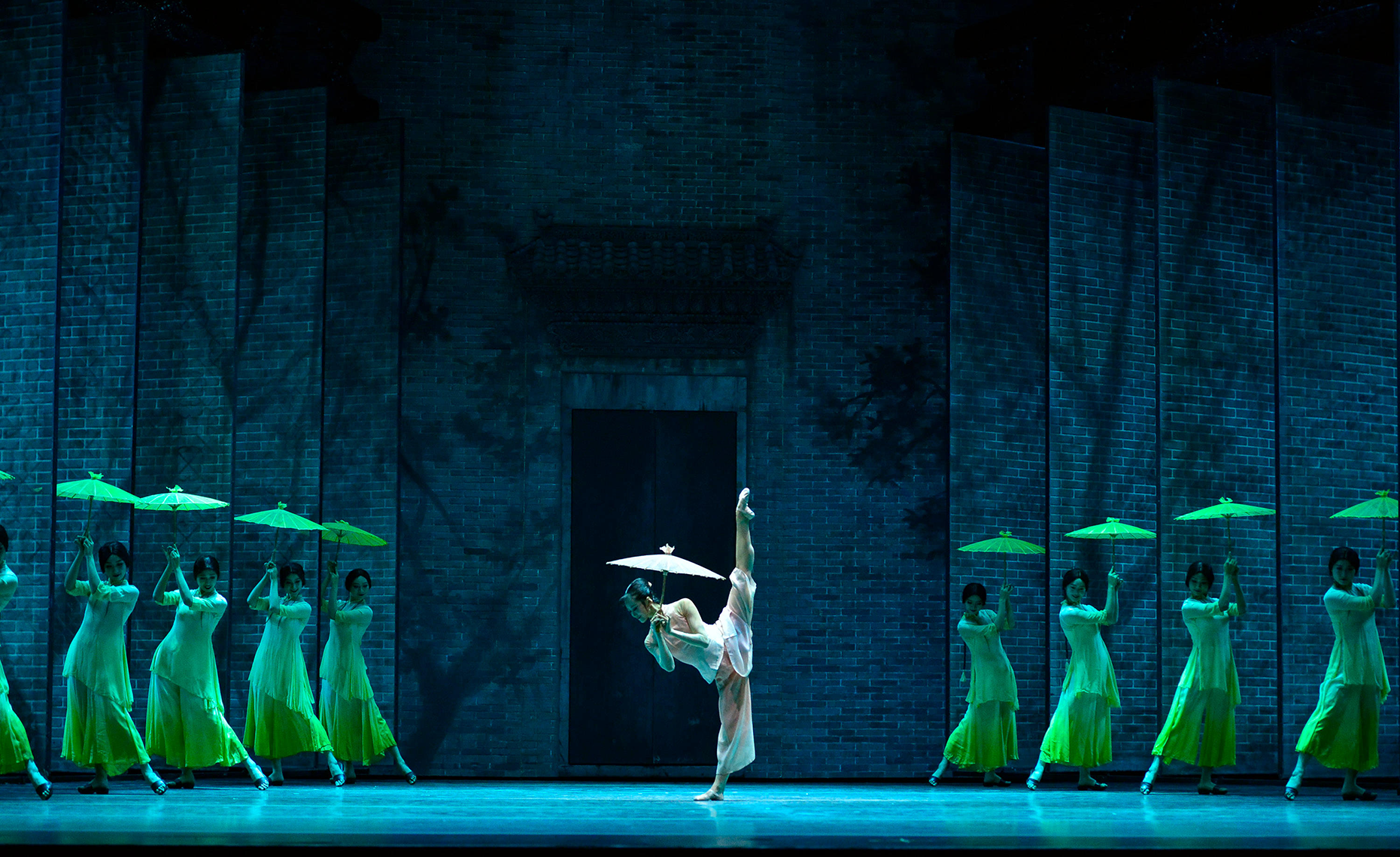
Professional Chinese dance emphasizes virtuosic technique that is easily recognizable as requiring skill, countering traces of the Orientalist colonial idea that China was the “‘Sick Man of East Asia’ (dongya bingfu).” Dragon Boat Racing features a diversity of virtuosity of flexibility, acrobatics, leaps, and props. The parasol dance performed by the female corps demands recognition of skill; perfect synchronization and execution leaves no space to doubt the dancers’ professional mastery. After the female soloist enters, the female corps holds a tableau focusing the audience’s gaze on the soloist who lifts one leg into a controlled 180 degree side split without the help of her hands (Photo 2). This step that combines the extended leg path of the battement and the control of the développé is known as bantui (搬腿). It is a prevalent iconic pose associated with Chinese dance similar in status to the arabesque in ballet.Footnote 18 It:
serves as proof that a dancer has endured the hardships of professional dance training and has mastered the self-discipline requirement of it. Maintaining perfect balance on one leg, while extending the other, controlled, high into the air, the dancer demonstrates control of her own physical body […]. (Wilcox Reference Wilcox2011, 2)

Photo 2. The female lead’s execution of bantui in the parasol dance asserts bodily achievement that is easy to judge and impossible to ignore.
Imperfect execution is obvious, because leg height is simple to gauge and wobbly ankles are immediately visible. A clean performance is an assertion of bodily achievement. The impossibility of ignoring virtuosity is similar to the fast turns of García’s “sequined dancers.”
The bantui is just one virtuosic element among many in Dragon Boat Racing. The national importance of a strong body (as articulated through virtuosic bodily skill) is demonstrated in Act III when the Japanese soldiers are in the He family home, Sanrenting. A Japanese soldier inspects and sizes up various members of the family. After bullying a scared female musician, the soldier lunges at Liunian. He Liunian sweeps his extended straight leg across eye-level from one side to the other executing a martial pian tui over the soldier who slides underneath, thereby creating the illusion of dodging a kick in a fight. He Liunian then repeats the leg sweep of the pian tui in a jump above the soldier. The virtuosic steps abstract the violence of the fight, a common tactic in xiqu. After the two passes neither has won. Importantly, He Liulian did not acquiesce. He is demonstrated as the equal of the Japanese soldier. He is not the “Sick Man of the East,” a name Japan called China during the war years; he does not just give in to the Japanese soldier. The use of virtuosity is an embodied aspect of spectacle, that when combined with the material aspects of spectacle is a strategy of asserting oneself (or a nation) in postcolonial hierarchies.
American gatekeepers are likely to receive these aesthetics as of the past instead of seeing the articulation of spectacle as a post-colonial claim to the aesthetic present through aesthetics of modernity. In “When is Contemporary Dance?,” SanSan Kwan argues that imperatives of postmodern dance shape the reception and understanding of contemporary dance today. Contemporary dance often has explicit consciousness “of its modern and postmodern dance heritage,” which impacts the perception of other dance forms (Kwan Reference Kwan2017). According to Kwan the term “contemporary” has a double value linking it both to the dance happening now and to aesthetic preoccupations tied to its modern and postmodern lineage. This double valued term “yokes that which is contemporaneous to a stylistic definition of what is contemporary. This in turn risks excluding an artist whose work does not align with what we have determined to be contemporary” (Kwan Reference Kwan2017, 39). This is particularly true for dances in dialogical relation with ballet, with its strong historical linkages. The elements of ballet recognized as contemporary are those in dialogical relationship with modern/postmodern aesthetics, not those of dance dramas which are associated with classical ballet. The assumption that the aesthetics of the now are rooted in the postmodern precludes other aesthetics such as those in a dialogic relationship with ballet from being an aesthetic of the now. This binds Chinese artists; their strategy of asserting modernity through spectacle ironically keeps them trapped in the aesthetic past. For Anglophone dance critics to recognize Chinese artists as part of the aesthetic present they would need to reject the aesthetic of spectacle or at least mitigate it by adopting aesthetic, movement or choreographic techniques in the lineage of modern/postmodern dance. This expectation reproduces colonial hierarchies and expectations, but do Chinese artists have other choices in fighting relegation to the aesthetic past?
Conclusion
I ask American gatekeepers to be aware of how Cold War dynamics of containment shaped the development of aesthetic hierarchies that have turned into global norms, thereby creating a U.S. centric global aesthetic caste that excludes socialist lineages of dance creation. Due to current global asymmetries of power over the formation of aesthetic hierarchies, distaste for maximalist deployment of spectacle and the policing of ballet influence on non-European dance forms runs the risk of creating neo-colonial dynamics. For all its limitations, the Cold War was a period with multiplicities of aesthetic hierarchies. While many artists were limited to one set of aesthetic hierarchies, there were two networks of artistic production. Artists in both networks were in community and could consider their artistic forms as in dialogical relation with a global aesthetic norm. Because of American gatekeepers’ continued rejection of artistic forms in lineage with socialist artistic practice, I suggest that the end of the Cold War resulted in a narrowing of global aesthetics to a U.S. centric global aesthetic caste that is unable to recognize creativity not in dialogical relationship with lineages of modern and post-modern dance.
While not intentional, this singular aesthetic caste creates biases that negatively impact artists working with forms not in dialogical relation with mainstream U.S. lineages of dance. As the PRC is a globally connected country that continues to embrace its socialist heritage, especially in the arts, this global aesthetic caste clashes most acutely with artistic practices of the PRC. The biases against spectacle prevent understanding of PRC dance artists’ use of the aesthetic to strategically assert themselves in the temporal present in a post-colonial world order that has a history of pushing China into the temporal past. Additionally, the reduction of the aesthetic to kitsch denies choreographers recognition of their creativity, which negatively impacts all choreographers both in China and in the diaspora who work in related globally circulating forms.
Supplementary Material
To view supplementary material for this article, please visit http://doi.org/10.1017/S0149767725000014.