


Introduction
There is a mounting concern that as democratic societies become increasingly divided and people become less willing to talk and listen to each other across political divides, a vicious cycle will fuel hostility and incivility towards political opponents, bolster biased political thinking and ultimately undermine democracy (Dryzek et al., Reference Dryzek, Bächtiger, Chambers, Cohen, Druckman, Felicetti, Fishkin, Farrell, Fung, Gutmann, Landemore, Mansbridge, Marien, Neblo, Niemeyer, Setälä, Slothuus, Suiter, Thompson and Warren2019; Mason, Reference Mason2018; but see Rosenblum, Reference Rosenblum2008; Shapiro, Reference Shapiro and Macedo1999 for an alternative perspective). Recent research argues that reflective reasoning – careful consideration and integration of multiple and opposing perspectives on an issue – could ameliorate political polarization and promote democratic accountability (Arceneaux & Vander Wielen, Reference Arceneaux and Vander Wielen2017; Brader & Tucker, Reference Brader and Tucker2018).
But is it possible to motivate people to think reflectively? Prior research shows that different situational contexts can evoke more or less reflection in people's reasoning (Kuklinski et al., Reference Kuklinski, Quirk, Jerit and Rich2001), but the results are mixed. For instance, there is some evidence that deliberative discussions create an environment where a group of citizens learn about different perspectives, deliberate with others and arrive at more reflective political decisions (Neblo et al., Reference Neblo, Esterling and Lazer2018), as well as conflicting evidence that inducing people to deliberate carefully about their decisions does not alter their political choices (Barker, Reference Barker2018). Furthermore, it is unclear if induced deliberation – when it works – causes people to adopt less biased attitudes because it increases reflection, or whether it merely increases levels of information (Brader & Tucker, Reference Brader and Tucker2018), or decreases the motivation to appear partisan (Bullock et al., Reference Bullock, Gerber, Hill and Huber2015).
In this article, we build on insights from motivational theories of reflection, emotion research in politics and social psychology; and investigate the efficacy of one approach: empathy for the other, which involves imagining the thoughts, feelings and other mental states of others (Todd & Galinsky, Reference Todd and Galinsky2014). This approach tries to harness human beings’ ability to empathize with others as a route to reflection. We also seek to open the black box by measuring the degree to which people engage in the kind of complex cognition that is the hallmark of reflection. Finally, we investigate whether empathy for the other is effective in facilitating change in people's attitudes in the direction of the opposing side.
Reflective political reasoning and motivational theories of reflection
According to dual‐process theory, people's reasoning is the product of two distinct processes, the intuitive (elsewhere called dispositional, automatic or system 1) and deliberative (surveillance, reflective or system 2) (Arceneaux & Vander Wielen, Reference Arceneaux and Vander Wielen2017; Marcus, Reference Marcus1988; Marcus & MacKuen, Reference Marcus and Mackuen1993; Stanovich, Reference Stanovich2011). Intuitive reasoning is characterized by effortless and automatic processes. Deliberative reasoning is a more effortful and time‐consuming endeavour. The latter is the focus of this paper, which we name reflection or reflective reasoning here. We define reflection as the willingness to second‐guess one's prior views and beliefs by considering diverse and opposing solutions and perspectives. In conceptualizing reflection, we build upon normative democratic theory and the expectation that before making political decisions citizens should engage in reflective thinking, by actively taking into account the counter‐attitudinal thoughts and ideas (Dewey, Reference Dewey1933; Habermas, Reference Habermas1998). Even though reflection creates an opportunity for an attitude change, it does not always require it. Sometimes the opposing perspective can be persuasive enough to trigger shifts in an individual's attitudes in the direction of the counter‐attitudinal perspective. In other times, one could stop and reflect with an open mind, yet still end up with the conclusion that their original policy preferences were correct.
Previous scholarship in the domain of politics shows that when people are motivated to engage in reflection, rather than rely on intuitive or easily available heuristics (e.g., party affiliation), they tend to reach decisions that are more in line with their underlying values (Arceneaux & Vander Wielen, Reference Arceneaux and Vander Wielen2017; Marcus et al., Reference Marcus, Neuman and MacKuen2000). Yet, there is a great deal of empirical evidence that many citizens deviate substantially from this ideal. When forming political preferences, citizens’ partisan identification and prior issue attitudes (e.g., Klar, Reference Klar2014; Lodge & Taber, Reference Lodge and Taber2013) bias their political judgements significantly. Instead of engaging in reflection, the literature shows, most citizens engage in biased political thinking.
Is reflection possible? Research finds that there are differences in individuals’ ability and willingness to engage in reflective political reasoning. Those who score high on Actively Open‐minded Thinking (AOT) are more prone to actively seek the reasons contradicting their own thinking and yield to the evidence (Baron, Reference Baron2019). Arceneaux and Vander Wielen (Reference Arceneaux and Vander Wielen2017) measure trait‐level variable dispositional reflection, at the intersection of two measures of cognitive style, need for affect (NFA) and need for cognition (NFC) and define reflective citizens as the ones scoring low in NFA and high in NFC. These (and other) studies show that people's willingness and tendency to engage in reflective political reasoning vary. The question thus arises as to whether, and if so how, individuals can be encouraged to engage in reflection, irrespective of their dispositional characteristics.
A line of research argues that it is possible under the right conditions. The assumption underlying this line of research is that the tendency of individuals to engage in reflective reasoning hinges upon their motivations (Druckman, Reference Druckman2012; Kraft et al., Reference Kraft, Lodge and Taber2015; Kuklinski et al., Reference Kuklinski, Quirk, Jerit and Rich2001; Kunda, Reference Kunda1990). Depending on the nature of motivations, individuals engage in either non‐reflective or reflective reasoning. When driven by directional goals, people engage in a kind of reasoning which is shaped by partisan attachments and prior beliefs and attitudes. When driven by accuracy goals1, they are able to reason about their decisions in an even‐handed and reflective manner.
Prior scholarship investigated the question of whether altering individuals’ motivations can engender more reflection in political reasoning. Holding people accountable by telling them that their justifications for their viewpoints on an issue will be made public can motivate individuals to process information in a more self‐critical and deliberative way (Colombo, Reference Colombo2018; Tetlock, Reference Tetlock1983). Paying individuals to be accurate in their judgements can sometimes have a similar effect (Bullock et al., Reference Bullock, Gerber, Hill and Huber2015; Prior et al., Reference Prior, Sood and Khanna2015). Discussing political issues with different others, either in formal or informal settings, can produce similar reflection‐inducing effects (e.g., Esterling et al., Reference Esterling, Neblo and Lazer2011; Fishkin, Reference Fishkin2018; Muradova, Reference Muradova2021a, Reference Muradova2021b; Suiter et al., Reference Suiter, Farrell and O'Malley2016).
Affective intelligence theory
Another seminal line of research examines the motivating force of emotions for people's political reasoning. The type of emotions individuals experience in response to political candidates, issues or messages, the studies show, predetermines the type of political reasoning processes individuals engage in (Brader, Reference Brader2006; Birch et al., Reference Birch, Allen and Sarmiento‐Mirwaldt2017; Redlawsk et al., Reference Redlawsk, Civettini and Emmerson2010). The Affective Intelligence Theory (AIT), advanced by George Marcus and colleagues (Marcus, Reference Marcus2000; Marcus & MacKuen, Reference Marcus and Mackuen1993; Marcus et al., Reference Marcus, Neuman and MacKuen2000, Reference Marcus, MacKuen and Neuman2011) provides an essential framework for understanding the role of emotions in deliberative reasoning. According to the theory, one particular discrete emotion – anxiety – acts as a motivator for reflective political learning, information search and reasoning. The AIT employs a dual‐process perspective to reasoning and posits that citizens rely on their routine and habits (i.e., dispositional system) when making political decisions, unless something novel and/or threatening intrudes their world (i.e., surveillance system). It is the degree of novelty, signalled by a heightened sense of emotions, that makes a difference for people's engagement in deliberative reasoning. The disposition system is guided by two affective dimensions, enthusiasm and anger, while anxiety is at the heart of the surveillance system. When the environment produces anxiety in individuals, this heightened anxiety signals that relying on old reasoning habits and routines is not adequate and hence, motivates attention toward information search, learning and deliberation. Anger and enthusiasm, on the other hand, motivates individuals to rely on their habitual routines of reasoning. Enthusiasm signals that the environment is safe and that the habitually learned routines of reasoning can be applied. Anger, on the other hand, denotes that although the environment is threatening, it is also familiar and the threat can be addressed successfully with the help of existing reasoning routines and habits (Johnston et al., Reference Johnston, Lavine and Woodson2015, p. 475).
In line with the AIT, a large body of scholarship has found that anxiety triggers more information seeking, political learning and increased engagement with politics. For example, people are motivated to learn more about political candidates when they have higher levels of anxiety (Marcus et al., Reference Marcus, Neuman and MacKuen2000). Marcus and MacKuen (Reference Marcus and Mackuen1993) show that anxiety motivates people to break from habitual political dispositions and encourages careful attention and political learning about presidential candidates. Anxious voters actively attend to contemporaneous information, such as policy proposals and the personality of political candidates in their political judgements, instead of merely relying on their partisan attachments (Marcus et al., Reference Marcus, MacKuen and Neuman2011). Anxiety triggered by racial and ethnic cues in elite discourse on immigration seems to motivate changes in individuals’ opinions in the direction of contemporaneous information (Brader et al., Reference Brader, Valentino and Suhay2008). While the heightened aversion inhibits the deliberative information search by motivating individuals to retreat to their prior beliefs and search for information that is consistent with their existing beliefs, heightened anxiety encourages the search for conflicting information and a greater willingness to learn about the opposing viewpoints. Vasilopoulos et al. (Reference Vasilopoulos, Marcus and Foucault2018) investigate the effects of two different affective reactions to a terrorist attack in France on individuals’ policy preferences. Their empirical findings show that anger increases people's reliance on prior dispositions and extant convictions. Anxiety, on the other hand, prompts a kind of decision making that is less reliant on predispositions and more so on the momentary context. Yet, Gadarian and Albertson (Reference Gadarian and Albertson2014) find that anxious individuals read, learn and remember particularly about threatening information.
Taken together, a broad stream of empirical work provides convincing empirical support for the view that emotions affect how people process political information and reason about politics. However, the extant research mainly focuses on the role of a limited number of emotions. The effects of other emotions, such as empathy, jealousy and regret, have been largely unexplored (Brader & Marcus, Reference Brader, Marcus, Huddy, Sears and Levy2013, p. 11). Among others, empathy has received very little (if any) attention in this respect. Where does empathy fit in this framework? The AIT has not so far theorized about the potential role of empathy in these processes and doing so is important because it can challenge the up‐to‐now held assumption that only the negative emotions (e.g., anxiety) are conducive to reflective political judgements (see Johnston et al., Reference Johnston, Lavine and Woodson2015 for an exception). AIT founders do not deny the possibility that ‘the novelty’ that starts off the reflective system ‘can come in positive packages as well’ (Marcus et al., Reference Marcus, MacKuen and Neuman2011, p. 333).
Thereby, in this article we ask whether empathy, more specifically empathy for the other, can start off similar, reflection‐inducing processes in individuals’ political reasoning (RQ1). Although the potential of empathy to prompt other democratically desired outcomes, such as out‐group tolerance and altruism, have been widely studied by social psychologists and neuroscientists (Batson, Reference Batson2011; Decety, Reference Decety2011a, Reference Decety2011b), its reflection‐inducing effect has been under‐examined.
Empathy and reflection
Empathy is defined differently across different disciplines and scholars. Some conceive of it as an emotional response ‘that stems from another's emotional state or condition’ (Eisenberg & Strayer, Reference Eisenberg and Strayer1987, p. 5) and a vicarious affect ‘that is congruent with but not necessarily identical to the emotion of another person’ (McCullough et al., Reference McCullough, Worthington and Rachal1997, p. 322). Others define empathy as primarily a cognitive construct, such as taking the other person's perspective or role, and trying to see the world how the other person sees it (e.g., Mead, Reference Mead1934). The growing tendency among scholars is to understand empathy as a multidimensional concept encompassing both affective and cognitive dimensions (Cikara et al., Reference Cikara, Bruneau and Saxe2011; Davis, Reference Davis1983). In this paper, we rely on the latter conceptualization of empathy and define it as actively imagining, feeling and understanding the world from the other person's vantage point. This conceptualization, thereby accentuates both cognitive and affective aspects of empathy, respectively named as perspective‐taking and empathic concern in the extant literature (Sirin et al., Reference Sirin, Valentino and Villalobos2020).
Empathy is argued to have a set of individual and societal benefits. Philosophers and political theorists alike have long argued about the potential of empathy to promote inclusiveness, deeper understanding of different others’ needs, mutual respect and reciprocity among individuals (Krause, Reference Krause2008; Mansbridge, Reference Mansbridge1983). In the healthcare context, research finds that the ability of health professionals to see the world from their patients’ perspectives is highly beneficial for patients’ adherence to the treatment and their levels of satisfaction overall (Cheng et al., Reference Cheng, Chen and Decety2017, p. 2).
We argue that when individuals are induced to take the perspective of someone with whom they disagree on a political matter, they are more likely to engage in reflective political thinking. In the language of AIT, when the cues from the environment generate empathy in individuals towards people with dissonant views, the resulting empathy signals the individuals to stop relying exclusively on prior habits of reasoning and engage in more reflection. There are good reasons to suspect that empathy for the other can serve as a trigger for individuals’ surveillance system. Social psychologists argue that one approach to reducing people's biases against those who espouse different opinions or ways of life is to encourage people to actively take the perspective of the other person (Todd & Galinsky, Reference Todd and Galinsky2014). Research shows that perspective taking engenders more positive explicit and implicit intergroup evaluations and reduced prejudice towards people of different nationalities (e.g., Asian Americans, Turks, Roma, etc.), and marginalized groups (e.g., convicted murderers, drug addicts, the elderly, etc.) (Galinsky & Moskowitz, Reference Galinsky and Moskowitz2000; Simonovits et al., Reference Simonovits, Kézdi and Kardos2018; Todd et al., Reference Todd, Bodenhausen and Galinsky2012). When faced with political disagreement, empathy can assist people to ‘move beyond facile dismissal of opposing viewpoints’ (Tuller et al., Reference Tuller, Bryan, Heyman and Christenfeld2015, p. 18) and change their attitudes in the direction of the opposing side.
Several mechanisms have been proposed. Empathy may ‘instill a sense of psychological connectedness’ between individuals (Todd et al., Reference Todd, Bodenhausen and Galinsky2012, p. 739). Actively taking someone else's perspective may result in discovering shared similarities between the perspective taker and the target, whose perspective is being taken. As a result, one may perceive oneself as being more like the other or perceive the other to be more like themselves (Erle & Topolinski, Reference Erle and Topolinski2017), which may encourage people to understand the mental states of people who are different from them. Alternatively, the process of empathetic imaginings could activate more positive explicit and implicit evaluations of others (i.e., more liking) (Erle & Topolinski, Reference Erle and Topolinski2017; Galinsky & Ku, Reference Galinsky and Ku2004; Galinsky & Moskowitz, Reference Galinsky and Moskowitz2000; Todd & Burgmer, Reference Todd and Burgmer2013) and/or elicit increased feelings of concern, sympathy and warmth in individuals towards the other (Todd & Galinsky, Reference Todd and Galinsky2014, p. 379–380). The increased feelings of concern and/or liking may encourage the individual to lay aside their biased thinking and begin entertaining the views of others.
Yet, this is not to say that empathy always produces positive normative outcomes. It can lead people to sometimes make decisions that feel morally justified but are less so when subjected to logic (Bloom, Reference Bloom2016). Furthermore, sharing another person's emotion is positive insofar as doing so leads people to be compassionate, or at least thoughtful, towards others, but sharing other people's moral convictions has a ‘dark side’ as well (Workman et al., Reference Workman, Yoder and Decety2020). Some research suggests that empathy may backfire, by leading to more negative evaluations about the outgroup, especially when the perspective taker strongly identifies with her own in‐group (e.g., Catapano et al., Reference Catapano, Tormala and Rucker2019). Recent observational work in political science suggests that higher levels of empathic concern can facilitate, rather than alleviate, political polarization (Simas et al., Reference Simas, Clifford and Kirkland2020). However, previous research has not directly measured the way in which people deliberate when they are asked to take the perspective of someone with whom they disagree. Moreover, while Simas et al. (Reference Simas, Clifford and Kirkland2020) focus on individual trait‐level differences in the tendency to be empathetic, we study situational empathy, building on the expectation that situational contexts strongly affect individuals’ tendency and ability to be empathic towards others (Cheng et al., Reference Cheng, Chen and Decety2017). Thus, in our study we focus on a context in which we expect empathy to play a more positive role: Trying to understand where someone with different beliefs is coming from and, in doing so, being more reflective and open minded about what this person has to say. Hence, we expect that,
H1: Empathy will have a positive effect on reflectiveness of citizens’ political reasoning.
Yet, some scholars suggest that empathy is partial and intrinsically biased (Bloom, Reference Bloom2016). The claim is that human beings are less likely to take the perspective of and feel empathic towards the people who are dissimilar to them, and more likely so when there are similarities between the empathizer and the target. Similarity/dissimilarity has been defined along different characteristics in prior literature, such as gender, age, race, ethnicity, life experiences and party identification (Han, Reference Han2018). In this paper, we operationalize similarity with individuals’ gender identification. More specifically, we investigate whether the relationship between empathy and reflective political judgements is moderated by respondents’ gender identification of female, given the target – whose perspective the respondent is asked to take – is also a woman. Hence, to the extent that the gender of the target could lead to differences in perceived similarity between the perspective taker and the target, we predict that,
H2: The effect of empathy on reflection will be stronger among women.
Lastly, we question whether an intervention designed to evoke empathy on one specific policy issue can have transfer effects on another policy issue. Simonovitz and colleagues (2018) found that taking perspectives of Hungarian Romas had a spill over effect on respondents’ attitudes towards another outgroup – refugees – the effect of which was attributed to perceived similarity of these groups. Other studies, however, found no transfer effects of perspective taking to other groups (Todd & Galinsky, Reference Todd and Galinsky2014). Our design differs from these studies fundamentally. Perspective taking intervention in our study is designed to target a policy opponent, rather than a specific outgroup member. Yet, one might argue that, once motivated to consider the opposing perspectives on one policy issue, respondents may be more inclined to apply the same reasoning technique when thinking about a different policy issue, in particular within the same period of time. But it is also possible that the effect of empathy for the other is issue specific. As such, we do not have strong theoretical reasoning underpinning this expectation.
Empathy and attitude change
Can empathy also facilitate openness to attitude change? Prior research in the self‐persuasion paradigm shows some evidence for the positive effect of perspective taking interventions on individuals’ willingness to change their attitudes on an issue (see Catapano et al., Reference Catapano, Tormala and Rucker2019 for a review). Tuller and colleagues (2015) rely on four experimental studies and examine whether writing from the perspective of one's opponent engenders attitude change in individuals in the direction of the opposing perspective. Their findings show that perspective taking causes respondents to moderate their views, even on deeply entrenched policy issues (e.g., legalized abortion).
Yet, effectiveness of perspective taking seems to be conditional on both personalization and accountability. It is much easier for individuals to take the perspective of someone they have met and interacted with. By holding them accountable to that met person assists them in having a more accurate vision of that person and their perspectives. Recent research also finds that perspective taking can have a backfire effect on attitude change, when there is a perceived value incongruence between the target and the perspective‐taker (Catapano et al., Reference Catapano, Tormala and Rucker2019). When the perspective‐taker generates arguments that go counter to their own values, they are less likely to change their attitudes on the issue. This negative effect diminishes when individuals take the perspective of someone who holds similar values, despite holding an opposing perspective.
In this paper, we examine whether empathy for the other influences one's receptiveness to attitude change in the direction of the opposing perspective if the target of the empathy is a complete stranger (i.e., the unmet other) (RQ2).
Research design
To evaluate the effect of empathy on reflective reasoning and policy attitudes, we pre‐registered and conducted a survey experiment in a sample of UK subjects (N = 2014), recruited by Dynata in March 20192 (see the online appendices G and H). The sample was matched on census age, gender and region to make it nationally representative.
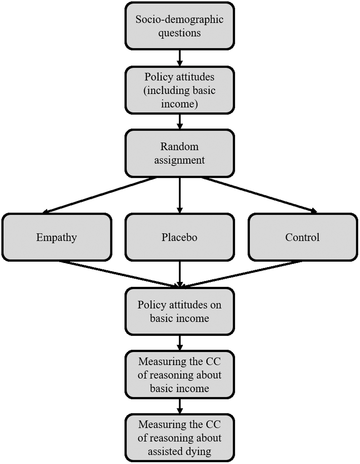
The study proceeded as follows. After having consented to take part in the study, participants were enquired about their socio‐demographic characteristics (e.g., gender, age, education), their general political attitudes and views on a policy issue of ‘introducing a universal basic income (UBI) scheme in the UK’, which was the issue context for the experiment. UBI is a dividing policy issue, the public support for which is split almost 50/50 among the British population, according to the European Social Survey (ESS, 2016). Despite its contested nature, however, we do not expect individuals to hold long‐entrenched beliefs about it.
Next, respondents were randomly assigned to one of three experimental conditions – a control group, a placebo group and a treatment group (Gerber et al., Reference Gerber, Green, Kaplan and Kern2010) (Figure 1). We induced empathy via a writing assignment (Todd & Galinsky, Reference Todd and Galinsky2014). Those in the empathy condition read a short text about a fictitious character – Sarah – who is either in favour of or against the UBI, and provides an argument for her approval or disapproval. To make it easier for respondents to imagine Sarah's life, the vignettes were accompanied with a photo of Sarah. All participants were exposed to Sarah with views that run counter to their own view. Next, individuals were instructed to imagine Sarah's feelings and thoughts and write what they imagined. Those randomly assigned to the placebo condition were exposed to the same vignette, but were not instructed to take Sarah's perspective. Respondents in the control condition were neither exposed to Sarah nor were instructed to take her perspective. To employ their time, they were instructed to write about their last weekend (online appendix B). The objective of this condition was to be able to disentangle the effect of mere exposure to counter‐attitudinal views (placebo vs. control) from the effect of empathy for the other (empathy vs. placebo).

Figure 1. Experiment flowchart.
After the survey, we gauged the level of empathic concern participants felt towards their issue opponents (this was measured only in placebo and empathy conditions). We used C. Daniel Batson's widely used and well‐validated scale from social‐psychological research (Batson et al., Reference Batson, O'Quin, Fultz, Vanderplas and Isen1983; see McCullough et al., Reference McCullough, Worthington and Rachal1997, p. 324 for a discussion of the validity of the measure). Respondents were asked to indicate the extent to which they felt sympathetic, empathic, concerned, moved, compassionate, warm and soft‐hearted towards Sarah (response scale 1−5). All items in our battery loaded well in one factor, with high internal consistency (Cronbach's alpha = 0.91)3. The items were summed to form an index measure (M = 16.7; SD = 6.7; range: 7–35), which was further rescaled to 0–1 to facilitate the interpretation and comparison of effects. We used this measure to test the degree to which our manipulation worked. Finally, we measured our main outcomes of interest, reflective thinking and policy attitudes on UBI (which we discuss in depth in the following section). For a spill over effect hypothesis, we chose a more emotion‐laden and salient issue about which respondents may likely hold deeply entrenched attitudes – legalizing assisted dying. Assisted dying is illegal in the United Kingdom and it is a contentious and dividing policy issue among British political elites. Public support for it, however, is strong, according to many polls (Bowcott, Reference Bowcott2019) (see online appendix B for more information about the policy contexts of our study).
Measurements of outcome variables: Cognitive complexity score and attitude change
The question of how to conceptualize and measure reflective political reasoning is an important, but a challenging one. Most of the work up to now has captured it with dispositional variables (Arceneaux & Vander Wielen, Reference Arceneaux and Vander Wielen2017; Bakker et al., Reference Bakker, Lelkes and Malka2020). This approach allows researchers to observe whether trait‐level differences in the penchant for engaging in reflection moderates how people make political decisions (for exceptions, see the research by George Marcus and colleagues). While this offers circumstantial evidence for the thesis that reflection leads people to consider opposing opinions, it does not offer firm causal evidence for this claim.
What we are interested in this paper is to actually measure reflection in how people reason about political arguments. With this objective in mind, we used cognitive complexity of political reasoning to capture reflection. Cognitive complexity, a widely used construct by social and political psychologists alike (e.g., Brundidge et al., Reference Brundidge, Reid, Choi and Muddiman2014), captures ‘a combination of flexibility, high levels of information search, and tolerance for ambiguity, uncertainty and lack of closure’ (Suedfeld, Reference Suedfeld2010, p. 1669−1670; Suedfeld & Tetlock, Reference Suedfeld and Tetlock1977) and brings two crucial components of reasoning together: differentiation and integration. Differentiation concerns the number of dimensions of a problem that a citizen acknowledges in her judgement. In other words, it indicates ‘the individual's recognition that a topic has more than one dimension or that more than one legitimate viewpoint about it exists’ (Suedfeld & Tetlock, Reference Suedfeld and Tetlock2014, p. 597). Integration captures the development of compound connections among these dimensions or characteristics (Suedfeld & Tetlock, Reference Suedfeld and Tetlock1977; Tetlock, Reference Tetlock1983). It captures ‘the recognition of relationships such as interactions or trade‐offs among the differentiated dimensions or viewpoints’ (Suedfeld & Tetlock, Reference Suedfeld and Tetlock2014, p. 597). These two dimensions make one unidimensional score that ranges from least complex to most complex. The least complex language means that individuals ‘rely on rigid, one‐dimensional, evaluative rules in interpreting events, and to make decisions on the basis of only a few salient items of information’, whereas the most complex refers to a language which ‘interpret events in multidimensional terms and to integrate a variety of evidence in arriving at decisions’ (Tetlock et al., Reference Tetlock, Bernzweig and Gallant1985, p. 1228). These characteristics make the cognitive complexity an excellent proxy for measuring the kind of reflective political reasoning we are interested in this paper.
Cognitive complexity in our study is captured with an open‐ended display item that asked respondents to provide justifications for their position on the issue. Qualitative responses to this question were used to calculate the cognitive complexity score, with the help of a computerized text analysis software package called Linguistic Inquiry and Word Count (LIWC). LIWC builds on the belief that ‘natural language use provides important clues as to how people process information and interpret it to make sense of their environment’ (Tausczik & Pennebaker, Reference Tausczik and Pennebaker2010). As opposed to human coders, LIWC provides researchers with a less biased and more objective measure for cognitive complexity. Cognitive complexity is concerned with the structure of the processes underlying reasoning, rather than its specific content. Human coders can be highly susceptible to the content of the arguments, and biased by ‘for instance, playing favourites and assigning higher scores’ (Tetlock et al., Reference Tetlock, Metz, Scott and Suedfeld2014, p. 626) to the arguments they like, and underscoring those they dislike. Relying on human coders is also time‐consuming and expensive. Last, but not least, LIWC provides researchers with more replicable and transparent ways of coding texts4.
LIWC scores are based on LIWC dictionaries with psychometrically validated groups of words. The software analyses the text and categorizes each word into psychologically relevant groups. It further provides the researcher with an output showing the percentage of words in the essays that belong to each identified LIWC category. LIWC categories have been validated by independent judges and more detailed information about these validation processes can be found in Pennebaker et al. (Reference Pennebaker, Chung, Ireland, Gonzales and Booth2007) and Tausczik and Pennebaker (Reference Tausczik and Pennebaker2010). Following Owens and Wedeking (Reference Owens and Wedeking2011), we employed 10 LIWC indicators (e.g., causation, insight, tentativeness, certainty; see online appendix D for more detailed information about each indicator) that link both the differentiation and integration dimensions of cognitive complexity. Previous work has carried out reliability and validity tests of its different operationalizations and found this specific one to be the most adequate to capture deliberative reasoning (Wyss et al., Reference Wyss, Beste and Bächtiger2015, p. 643). We put these ten indicators into a formula and calculate one quantity of interest – cognitive complexity score (M = 25.3; SD = 24.6; range: −150–200).
Next, we measured policy attitude change. Recall that we measured UBI policy attitudes pre‐ and post‐treatment. To capture attitude change in the direction of the counter‐attitudinal view, we constructed a categorical variable from raw attitude change, where the answers were coded to indicate whether the respondent polarized their policy attitude or did not change their attitudes (0) or moved towards the opposing direction (1). In other words, we assigned the value of 1 to every participant whose post‐treatment position was away from the direction of their prior attitudes and in the opposing direction.
Results
We present the findings in the following manner. First, we estimate the homogenous and heterogeneous effects of empathy on cognitive complexity of reasoning. Second, we test the effect of empathy on attitude change. Lastly, we explore the relationship between reflection and attitude change.
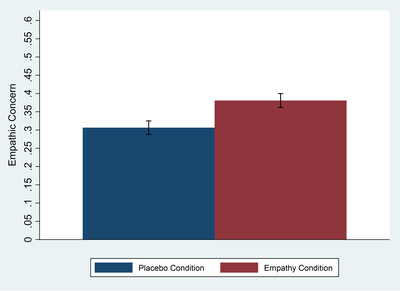
Before examining our research questions and testing our hypotheses, we investigate whether our intervention evoked the feelings of empathy in participants towards their issue opponents (Figure 2). As mentioned earlier, right after the exposure to empathy intervention, we measured the levels of empathy participants felt towards Sarah, a hypothetical person who holds counter‐attitudinal views on a policy issue.

Figure 2. Empathic concern induced by writing exercise. [Colour figure can be viewed at wileyonlinelibrary.com]
As the Figure 2 shows, respondents in the empathy condition experienced greater empathic concern towards Sarah (M = 0.38; SD = 0.24) than respondents in the placebo condition (M = 0.31; SD = 0.23). The difference is statistically and substantively significant and equals to 0.07 points in a scale range of 0–1 or more than one third standard deviation (SD) if expressed in standardized coefficients (two‐tailed p < 0.000). Our experimental intervention worked very well, as it was able to evoke the feelings of empathy in respondents towards their issue opponents.
Reflection
To estimate the effect of empathy intervention on our outcome variable – reflection – we ran a series of simple linear regression models. In all our models, we control for education, age, political ideology, partisanship and region.
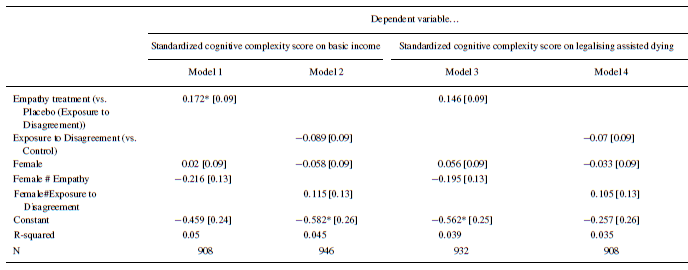
Model 1 (ref. category: placebo condition) (Table 1) estimates the effect of empathy treatment on people's cognitive complexity5. For clarity and interpretability of the effect sizes, we standardized the cognitive complexity score by the mean and variance in the control group (similar to Simonovits et al., Reference Simonovits, Kézdi and Kardos2018). The model also includes an interaction term between gender and the treatment condition. As mentioned elsewhere, our hypothesis is that the intervention will be particularly effective when respondents self‐identify as female. Two results are worth mentioning. First, empathy intervention exerts a positive and significant effect on respondents’ cognitive complexity score, with the effect size amounting to 0.17 SD. Taking the perspective of someone with counter‐attitudinal views prompts people to entertain diverse perspectives in their reasoning about an issue. Second, the interaction term between gender and treatment is statistically insignificant.
Table 1. Effect of empathy on cognitive complexity

Note: Estimates are from simple linear regressions. Each specification controls for gender, education, age, political partisanship, ideology and region. Standard errors in brackets. * p < 0.05; ** p < 0.01; *** p < 0.001
In Model 2, we explore whether the mere exposure to political disagreement per se (without its empathy part) is effective in increasing individuals’ cognitive complexity score and find no empirical evidence for this conjecture. Being exposed to one's policy opponent neither increases, nor decreases people's willingness to engage in reflective thinking.
Models 3 and 4 estimate the effect of empathy treatment and exposure to disagreement on individuals’ cognitive complexity score on another policy issue – legalizing assisted dying. The empathy treatment designed for one policy issue (introducing a basic income scheme) seems to have no significant transfer effect on citizens’ cognitive complexity on another policy issue (legalizing assisted dying). T
Alternative explanations
Yet, could it be that something else accounts for the effect of empathy on cognitive complexity of political reasoning? One potential confounder could be people's differing ability to express themselves in written form. We doubt that out treatment would improve people's ability to express themselves in written form as it is intended to induce empathy and has little to do with writing abilities. Moreover, even if the measure captures writing ability to some extent, random assignment means that, in expectation, the distribution of writing ability should be the same across the experimental conditions. This strengthens our interpretation of the findings: Perspective taking increases the degree to which participants engaged with the vignette, net of their writing ability. Yet, to completely rule out this possibility, we took the following steps. First, we coded the length of written essays for each individual (with the help of LIWC) and examined whether the mean text length differed across experimental conditions. It could be that empathy treatment prompted respondents to write longer essays, which could have subsequently led to higher cognitive complexity scores. The text length (word count) variable in our data ranges from 1 to 202, with overall mean M = 24 and standard deviation of SD = 22 for the whole sample. We conducted difference‐in‐means t‐tests to examine if the text length differed along the experimental conditions. The results show that there is no significant difference in the volume of texts across experimental conditions (Mplacebo = 23.7; SDplacebo = 0.89; Mperspective = 24.8; SDperspective = 0.8; difference = 1.06; two‐tailed p < 0.37). Additionally, we run Ordinary Least Squares (OLS) regression analyses to examine if the volume of the text itself is correlated with the cognitive complexity score in the full sample and within each experimental condition (Table F1, online appendix F). Model 1 examines the bivariate relationship between the word count and the cognitive complexity of thinking, whereas Model 2 includes an interaction term between the experimental conditions and the word count. Model 1 shows that there is indeed a statistically significant relationship between the length of the text and its cognitive complexity – more words are associated with higher complexity. Yet, the effect size is substantively trivial (β = 0.003). Most importantly, there is no interaction effect between the word count and empathy treatment in influencing the cognitive complexity of thinking (Model 2).
Attitude change
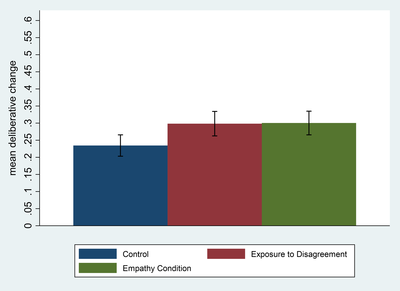
Next, we examine how empathy affects people's policy attitudes. As mentioned earlier, we constructed a dichotomous variable, with ‘0’ capturing either ‘no change’ or ‘change in the direction of one's prior attitudes and ‘1’ capturing ‘attitudinal shifts in the direction of opposing attitudes’ on UBI. Figure 3 graphs mean attitude change across experimental conditions, with their respective confidence intervals (CI).

Figure 3. Mean attitude change in the direction of counter‐attitudinal side, across experimental conditions. [Colour figure can be viewed at wileyonlinelibrary.com]
Two findings are worth mentioning here. First, it is notable that all subjects in our study moved in the counter‐attitudinal direction, post‐treatment. In other words, taking the survey per se made people to slightly shift their attitudes on the issue. Second, the last two columns show that the mean attitude change in both placebo (i.e., mere exposure to counter‐attitudinal views on UBI) and empathy conditions is greater than the mean change in the control condition. Difference‐in‐means t‐tests show that both empathy and exposure to political disagreement exerted a positive and significant effect on people's willingness to shift their attitudes towards the other side with the effect size amounting to 0.06 points (two‐tailed p < 0.01). In terms of a gross change, this equals to 6.4 and 6.6 per cent of respondents in placebo and empathy conditions respectively shifting their attitudes in the opposite direction (Figure E1, online appendix E). Empathy intervention per se, however, had no significant effect on attitude change6.
Empathy, reflection and attitude change
Our study has shown that empathy increases reflectiveness of people's political reasoning and encourages them to shift their policy attitudes in the direction of opposing perspectives. An interesting and important RQ is whether reflection (i.e., cognitive complexity of political reasoning) and attitude change are correlated. Does reflection play a role, if anything, to manage, alter, enrich or hinder the impact of prior empathic response on attitude change?7 Or are reflection and attitude change unrelated?
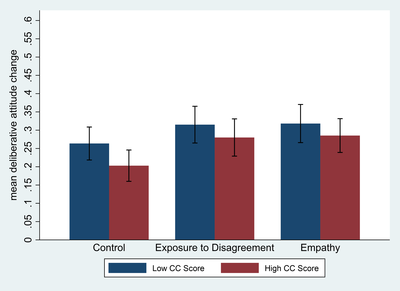
To explore the extent to which the cognitive complexity of political reasoning is associated with individuals’ tendency to change their attitudes, we run the following analyses. First, we examine whether there is a systematic difference in attitude change between those individuals who engaged in reflection most and those who engaged in reflection less. Figure 4 presents the mean attitude change across the subgroup of individuals who either score low (e.g., less than or equal to 50 per cent percentile; blue column) or high (e.g., more than 50 per cent percentile; red column) in cognitive complexity score, per experimental condition.

Figure 4. Mean attitude change in each experimental condition, depending on the CC score. [Colour figure can be viewed at wileyonlinelibrary.com]
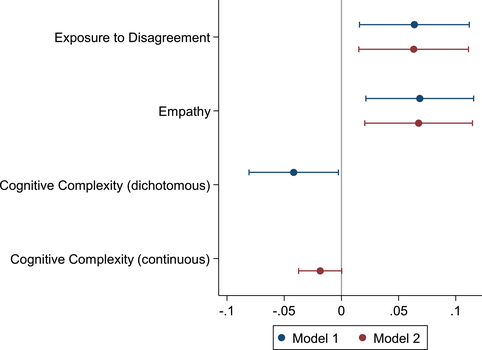
Figure 4 shows individuals who on average score high on cognitive complexity (CC) (as opposed to those who score low on CC) are less likely to shift their attitudes on the issue of UBI. The difference is larger among individuals in the control condition (p < 0.10) and is statistically insignificant among respondents in the exposure to disagreement and empathy conditions. Further tests (e.g., a simple linear regression analysis) show that people's tendency to shift their attitudes towards the other side is negatively correlated with their reflection scores in the control condition (βcontrol = −0.06; p < 0.06) and is unrelated in the disagreement and empathy conditions (βdisagreement = −0.03; p < 0.34; βempathy = −0.03; p < 0.38). Finally, we run OLS regression analyses estimating the effect of our treatments on attitude change, and controlling for CC score (Figure 5). Model 1 controls for a dichotomous CC score (high versus low CC) while Model 2 includes a continuous CC score. In both models, the effect of the treatments on attitude change remains robust to the addition of the CC score. Yet, the CC seems to be negatively associated with people's willingness to shift their policy attitudes in the opposing direction (Model 1: β = −0.04, p < 0.05; Model 2: β = −0.02, p < 0.06).

Figure 5. Estimating the effect of treatments on attitude change, controlling for the CC score. [Colour figure can be viewed at wileyonlinelibrary.com]
In sum, our data shows that those who most engaged in reflection tend to change their policy attitudes less than those who are less engaged in reflection. Yet, as Figure 4 demonstrates, within placebo and empathy conditions the difference is statistically insignificant.
General discussion and limitations
This study shows that empathy towards one's issue opponent increases individuals’ willingness to consider the policy issue from diverse and opposing perspectives. Counter to our H2, however, this effect is not moderated by respondents’ gender. What we do not know, however, how durable the empathy effect is and whether it is possible to motivate individuals to internalize such reasoning techniques and apply it in future political thinking. Yet, we also find that empathy for the other in the political disagreement context does not lead to more openness to attitude change, at least no more than mere exposure to an opposing perspective. These findings illustrate that there is not a simple connection between empathy, reflection and attitude change. After all, it is possible to see another person's viewpoint without adopting it.
Future studies could advance this research in the following ways. First, it would be interesting to study the effect of empathy on reflection on other contentious and polarizing matters, such as immigration. It may be easier to evoke empathy in individuals on more emotion‐laden and contentious political issues. Thereby, the effect of empathy on political reasoning could be greater. Alternatively, if citizens have higher emotional stakes in the policy issue, biases in their reasoning could be stronger and empathy intervention could have little effect on it. Future research could test this conjecture, by systematically studying the boundary conditions of empathy – reflection argument.
Second, we may have chosen a weak test for a similarity argument. Uncovering whether and to what extent other and more salient social identities, such as race, ethnicity, nationality, or partisanship moderate the effect of empathy on reflection would be an important endeavour. For example, would the effect hold if party affiliation of the policy opponent is made salient?
Another interesting and crucial question is whether rumination plays a role in people's tendency to moderate their political attitudes. Some deliberative democrats have assumed that those most engaged in reflection (as opposed to those who do not reflect much) would be more open to change their attitudes. This study shows that in general the level of cognitive complexity (a proxy for reflection in this study) and attitude change are negatively associated. More reflection does not seem to lead to more openness to attitude change. Nonetheless, this association is weaker among respondents either exposed to their issue opponent or encouraged to be empathetic towards them. Thus, this study provides inconclusive evidence for the relationship between reflection and attitude change; and future studies should examine the conditions under which reflection is positively or negatively consequential for people's openness to attitude change.
Fourth, this study does not provide empirical evidence on the mechanism(s) via which empathy increases complexity of reasoning, which opens up avenues for future research. Next, we acknowledge that specific experimental instructions can potentially introduce bias in the responses provided by the respondents. Therefore, future research should examine the extent to which the nature of instructions can influence the tendency of respondents to engage in the process of perspective taking and subsequently, reflection. Another limitation worth mentioning is the proxy measure we use to measure reflection – the automated cognitive complexity score. Nuance and subtleness in speech may be difficult to capture with automated text analysis. Future studies should complement this proxy with other, non‐automated measures.
Conclusion
In this article, we have attempted to assess whether or not reflective thinking can be evoked effectively in citizens’ political judgements, using empathy for the other instructions.
The findings of this study offer several important contributions to the extant research. First, we contribute to the body of research in political psychology that studies the conditions under which citizens are motivated to think reflectively, by showing a causal evidence for the claim that irrespective of individual predispositions, people can be induced to reason reflectively: asking people to imagine the world from the vantage point of someone who has an opposing viewpoint has a positive causal effect on cognitive complexity of their reasoning. The effect size of 0.17 SD is roughly equivalent to the difference in cognitive complexity scores among politically liberal and conservative citizens in the control condition (0.10 SD). While the effect size 0.17 SD is relatively modest, it is in line with the effect sizes of real‐world interventions aimed at changing people's minds (e.g., Kalla & Broockman, Reference Kalla and Broockman2020).
Our intervention has a number of advantages when it comes to prompting reflection in citizens’ political thinking. Most interventions designed to promote reflective thinking are both labour and time intensive (e.g., deliberative forums). We suggest that in parallel to such demanding strategies, we can apply simpler instructional interventions, such as asking people to write from the perspective of someone who holds opposing viewpoints, to evoke more reflection in their political judgements.
Second, this research expands the AIT, by testing (for the first time in the literature) the effect of empathy on citizens’ political reasoning. Our findings are consistent with the argument advanced by George Marcus and colleagues about the crucial role of emotions for political reasoning. We bring a novelty to this literature. Prior scholarship investigated the extent to which three different emotions, anxiety, anger and enthusiasm, motivate citizens to seek more information about political issues and candidates. Our research tested the effect of another discrete emotion – empathy – on citizens’ political thinking with a more indirect and comprehensive proxy for reflectiveness of individuals’ political reasoning – cognitive complexity of thinking (Suedfeld, Reference Suedfeld2010; Suedfeld & Tetlock, Reference Suedfeld and Tetlock1977; Tetlock et al., Reference Tetlock, Bernzweig and Gallant1985). Our findings suggest that when the environment is fertile for triggering empathy for the other, individuals are more likely to reflect on their political decisions.
Third, the results speak to the body of research studying the positive and negative effects of empathy, such as inclusionary behaviour, political polarization and intergroup prejudice (e.g., Adida et al., Reference Adida, Lo and Platas2018; Simas et al., Reference Simas, Clifford and Kirkland2020; Wojcieszak & Warner, Reference Wojcieszak and Warner2020). Our contribution to this field is threefold. First, our study shows that consistent with the previous research, asking people to actively take the perspective of the other is effective in eliciting the other‐oriented feelings of empathic concern in individuals towards their issue opponents, with the effect size amounting to one third SD. Second, we find that empathy makes people entertain diverse and opposing perspectives when reasoning about politics. This finding goes counter to the argument by Paul Bloom (Reference Bloom2016) and others on the potentially pernicious influence of empathy for human rationality. Lastly, we show that an empathy intervention does not have a transfer effect on the cognitive complexity of people's reasoning on another policy issue, for which the intervention was not designed specifically.
Finally, this research also has implications for the debate on whether exposure to counter‐attitudinal views is good or bad for democratic citizenry (e.g., Mutz, Reference Mutz2006). Overall, we find that a mere exposure to dissonant views in the absence of active perspective taking neither increases nor decreases reflectiveness of citizens’ political thinking. Only when accompanied with empathy for the other can the exposure lead to more cognitively complex political reasoning in individuals. Yet, this exposure is effective in shifting people's attitudes in the divergent direction.
In sum, the findings of this study contribute to a nascent body of research investigating the potential of different affective and cognitive strategies to mitigate increasingly polarized and biased political reasoning among citizens in democracies. Our study shows that empathy for the other intervention is a simple, inexpensive and practical way of motivating individuals to engage in reflective political thinking. When interpersonal political conversations are not possible, imagining the world from different others’ perspectives can motivate individuals to consider the opposing perspectives. Moreover, merely reading about the opposing viewpoint on an issue can engender attitudinal changes in individuals in the counter‐attitudinal direction. Future research should investigate how such interventions could be embedded in different spaces of a democratic system, such as schools, workplace or referendums.
Acknowledgements
Lala Muradova is grateful to André Bächtiger, Bert Bakker, John Bullock, Michael Delli Carpini, Thomas Leeper, Jonas Lefevere, George Marcus, Sofie Marien, Steven van de Walle and the colleagues at the Democratic Innovations and Legitimacy Research Group in KU Leuven for their valuable comments on earlier drafts of this paper. Thanks also go to the participants of MPSA and ECPR General Conferences 2019, and German Political Science Association Conference 2021 for their questions and feedback. Finally, the authors are extremely grateful to three anonymous reviewers for their helpful suggestions. The project has received funding from the European Research Council (ERC) under the European Union's Horizon 2020 research and innovation programme (grant agreement n° 759736). This publication reflects the authors’ views and that the Agency is not responsible for any use that may be made of the information it contains. Lala Muradova also wants to acknowledge Research Foundation – Flanders (FWO, Belgium) and the European Union's Horizon 2020 research and innovation programme under grant agreement No 959234. This paper received the ‘Best Paper Prize’ within the Standing Group on Democratic Innovations at the ECPR General Conference 2019.
Open access funding provided by IReL.
Data Availability Statement
Replication materials are available in the Harvard Dataverse at https://dataverse.harvard.edu/dataset.xhtml?persistentId=doi:10.7910/DVN/QYMM1Z
Online Appendix
Additional supporting information may be found in the Online Appendix section at the end of the article:
Supplementary information


 Open access

