

Introduction
Literature reviews can be included in other studies but also increasingly are published as a article or book chapter (Anlesinya & Dadzie, Reference Anlesinya, Dadzie, Rana, Singh and Kathuria2023). It can be helpful to do a background review before starting a new study as a form of due diligence. This enables homework to be done and careful consideration about what sources to consult. Reviews are rapidly transforming business management research and are often shared amongst researchers at all stages of the research life cycle (Aguinis, Ramani & Alabduljader, Reference Aguinis, Ramani and Alabduljader2023). They provide a effective way to summarise a field and highlight main research trajectories.
The expanding footprint of reviews has influenced publication practices with up-to-date and timely information being preferred (Rowley & Slack, Reference Rowley and Slack2004). Doing a review can be a laborious process but offers an efficient approach to analysing data. Good reviews are done in a reflective way partnering existing research with new ideas (Snyder, Reference Snyder2019). Whilst scholars are trying to stay ahead of current practices by refining the process there is still uncertainty on the correct way to do a review. Reviews were implicitly part of business management theses but are now standalone articles or book chapters (Ratten, Reference Ratten2023). With this transformation comes a question: What makes a good review? And more importantly: What new trends are affecting the process of writing a review?
In business management reviews offer time effective ways to synthesise large amounts of literature (Varsha, Chakraborty & Kar, Reference Varsha, Chakraborty and Kar2024). They are a research method that provides a quick and useful summary of the main literature. The benefit of reviews are accompanied by concerns of its timeliness as new literature is written all the time. Especially in a field like business management the literature can be spread across a number of different areas. This means there is a challenge in ensuring the validity and reliability of such research presented in reviews.
A good review should have a balanced assessment of the literature whilst emphasising its value. There are some idiosyncrasies and nuances of the literature that cannot be captured by a general review (Wagner, Lukyanenko & Paré, Reference Wagner, Lukyanenko and Paré2022). Rather they should be separately read and understood in isolation in order to assess their reasoning. There are underexplored concerns in reviews due to ethical and methodological considerations. Algorithm and data collection biases may decrease the ethics of a review (Klarin, Reference Klarin2024). The epistemological and philosophical underpinnings of a review may lead to methodological questions. Reviews have value in capturing a holistic overview of a field. In early stage research tasks such as study design it is useful to consult with a review. Context concerns such as real world and current applications influence the authenticity of reviews. Moreover, the increasing usage of artificial intelligence to conduct then analyse reviews further raises questions about the usefulness of reviews.
This editorial article is structured as follows. Firstly, the reason for doing reviews is discussed in terms of its importance. Different types of reviews are then stated that leads to the process of conducting a review being summarised. Lastly suggestions for future improvements are stated.
Main reasons for literature reviews
The main reasons for literature reviews can be categorised as helpful, educative and progressive (Torraco, Reference Torraco2005). Each reason is used in different ways during the research process as a tool to understand trends. This makes it easier to identify key themes, authors and topics that are evident in the existing literature and how to move research forward in new ways. Each type will now be discussed in terms of key features.
Helpful reviews
Helpful reviews have several purposes with the main one to give the person reading it an overview of the current literature. This means taking a reflective approach in analysing what has been done on the topic. The goal of a helpful review is to tell a person new knowledge that they previously did not know (van Riel & Snyder, Reference van Riel and Snyder2024). This will promote a change in how they view the topic with some views being confirmed and others being challenged.
Doing a helpful review is a considerable task when done in the right way. This implies that careful thought is required in considering the processes required and the need. The way a review is done is based on the skills of the researcher (Templier & Paré, Reference Templier and Paré2015). Some take a traditional approach by reading and analysing each article that can result in a better understanding of the topic. Others are more technologically savvy and use computers. Whatever the approach used it is important to think about what the end goal is and how it can be best achieved.
Helpful reviews should provide answers as to how the literature has changed over time. This enables key authros to gain recognition for their insights. History shows it can take time for seminal articles to gain traction in the literature (Ratten & Usmanij, Reference Ratten and Usmanij2021). This means allowing time for a seminal article to be cited and acknowledged. Recognition highlights various research practices that have been underappreciated. Some literature might be more popular in certain geographic markets due to where the authors are from or due to the topic’s perceived importance. Through reviews scholars can observe patterns in how the literature is cited (Seuring & Gold, Reference Seuring and Gold2012). This provides a way to recognise past achievements whilst opening up new possibilities.
The nature of research can be quite different depending on the methodology. Qualitative research might be based on smaller sample sizes but provide more descriptive quotes whereas quantitative research can be based on large samples but analysed in numerical ways. Information about what methodologies have been used can explain the topic discourse. This will bridge the practitioner-academic gap and enable literature to be synthesised.
Research should enable actions at various stages of business processes (Ratten, Reference Ratten2025). It can be used to inform management but also provide ways to engage stakeholders. Wisdom gained from literature reviews can act in promoting knowledge gains for society. Literature reviews enable insights to be gained to respond to pressing business issues.
Educative reviews
Educative reviews should provide information about current literature that is known about a topic. This includes the values underpinning research practice and how it is embedded in the literature. Obtaining knowledge then learning through it is a key tenet of business studies. Business advancements are based on authentic knowledge systems that can be shared with others. New research is guided by the past and transformed into other outputs. Educative reviews focus on research that provides ways for people to learn and focus on distinct topics. It is required as many may be unfamiliar with a topic.
New knowledge is constantly being created in different locations and in various formats. This makes it difficult to assess collective knowledge as it changes quickly. Literature reviews in the past were assumed as being done but they have recently grown in significance due to the realization that they are their own research method (Linnenluecke, Marrone & Singh, Reference Linnenluecke, Marrone and Singh2020). Collecting literature on prior studies tended to be a tedious task but is easier now with artificial intelligence and technology software. In the business management field where the research is new and emerging, literature reviews can provide useful information.
An essential feature of academic research is the ability to review, synthesise and analyse literature (Boell & Cecez-Kecmanovic, Reference Boell and Cecez-Kecmanovic2015). The breadth of research can be understood better when it is explored in a meaningful way. Existing research can be compared and contrasted in order to evaluate its quality. The usefulness of reviews is based on exploring the weaknesses and strengths of research. Different timepoints in when and how the research was conducted might find inconsistencies.
Due to the increased ability of computers to use big data there is a rise in technology enabled reviews. This is resulting in innovation and more detailed information being obtained. Fine grained analysis tools can now identify patterns that were previously undetected. To increase the quality of reviews it is important to be innovative. This will ensure creative approaches to finding and analysing data are obtained. Combining different types of techniques that incorporate mutually beneficial outcomes is required. This may mean thinking about the process of reviews in a new way. This could include sources such as books, book chapters and other publications that were missing due to the emphasis on journal articles. Multi-language inclusion is required in order to analyse articles not written in English.
Progressive reviews
Progressive reviews should analyse the literature but then go further by providing new information. This can involve analysing the literature through advanced methodologies to find alternative analysis that were previously conducted. To advance knowledge progressive reviews should be used as a tool to enhance learning. This means facilitating a deeper understanding of the literature. Often the same kind of reviews are conducted so it is important to step outside the box and offer new review tehcniques.
Alternative reviews can take different approaches from focusing on key points about the literature. This can involve identifying exemplary practices that provide a way to holistically see the literature. This means interpreting the literature through multiple cultural and societal perspectives. To do so will help in forming connections about the literature. The ideology about the reason for the literature should be analysed.
The use of technology tools to collect data is a methodological advancement but shifts the onus on obtaining the right literature from the research to technology. This means shortcuts whilst providing time efficiency can challenge the truth of reviews. Historical data should be reviewed based on when it was written. This will provide knowledge based on how it was interpreted based on the time period. Research outputs are based on cultural conditions that are often implied. Research experiences are incorporated within social meanings that are best understood by understanding the geographic and social conditions. Over simplifying research findings may lead to a loss of cultural conclusion. This means social patterns and stereotypes should be considered when focusing on research findings.
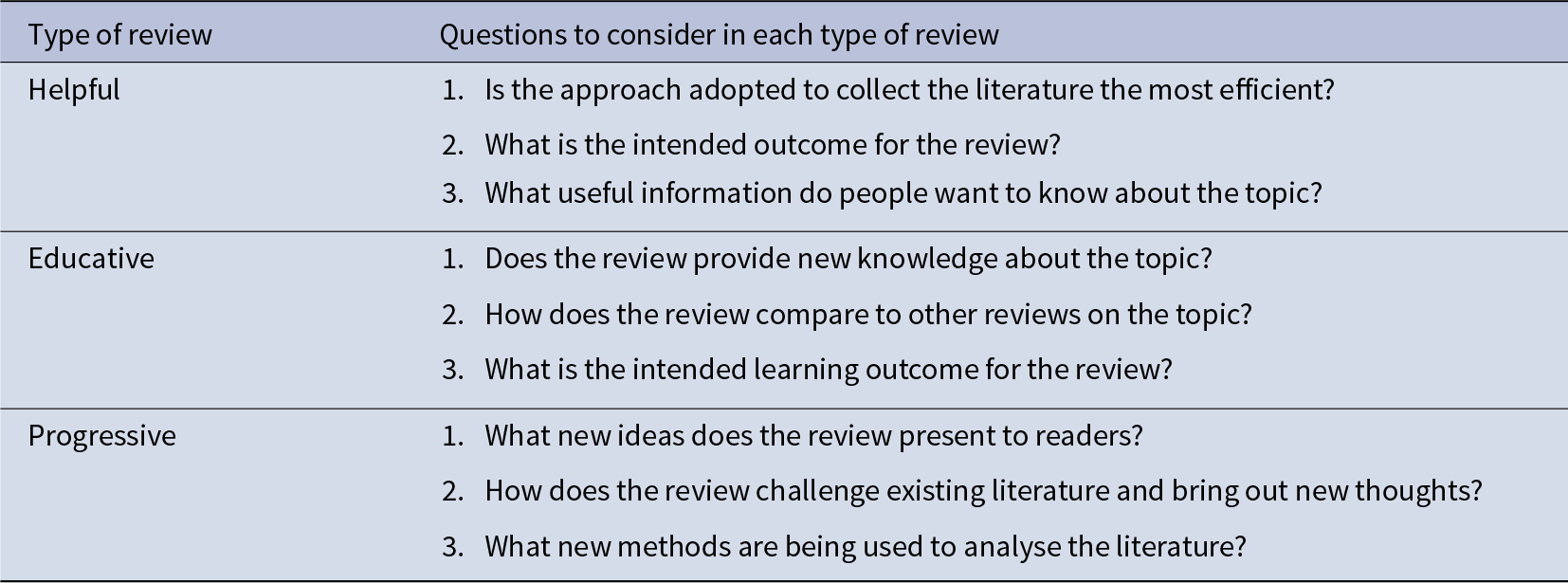
Overemphasising research conclusions may be based on factually incorrect outputs. This is due to research often being based on the researchers subjective perceptions that are influenced by their age, sociodemographics and experience. By detecting inaccuracies of past research, it can help in placing a research field in context. Such reflexivity is helpful in obtaining different points of view. Table 1 below states each type of review and questions to consider.
Table 1. Type of review and questions to consider

Procedures for conducting a review
The procedures for conducting a review begin with asking the reason or rationale for conducting the study. Within this answered it should be easier then to begin the process. At the start a review should identify literature based on database searches or other methods. Some researchers search specific databased based on their reputation such as Scopus or Web of Science. The quality or ranking of a journal can be used as a method to search specific literature. The search method can be done via GoogleScholar on a online web search as well as physically going through printed journals. Not all journals are digitalised although most are now. Moreover, the language of the material is usually in English but journals also publish in other languages. This is especially relevant in highly regarded Spanish, French, Chinese and other language periodicals that are prestigious outlets for authors mainly from those countries or speak that language. With GoogleTranslate it can be easier for non-speakers of language to understand article content but this can be a difficult process so often reviews only include English language periodicals.
The search period should be stated with often more recent periods preferred. To search the literature the article title and keywords are normally analysed first but the article content should also be examined. Once articles have been collected then they can be organised in to main themes such as authors, theory and methodology. The analysis process will differ between reviews depending on the focus of the search. The articles will be evaluated based on the key emphasis that might including findings. After analysing the articles then they need to be reported. This can mean presenting the findings based on key themes with tables included. The limitations of the review should be stated together with suggestions for future research.
Main types of reviews
There are many types of literature reviews conducted in the business management area. Each type of review has their own advantages and disadvantages depending on how it is conducted. Some types of review are preferred in specific sub-discipline management areas of study due to popularity or trends (Brignardello-Petersen, Santesso & Guyatt, Reference Brignardello-Petersen, Santesso and Guyatt2025). Increasingly hybrid reviews that combine different approaches are being done in order to innovate the findings. The main types will now be discussed in terms of how they apply to the business management field.
A narrative review offers a way to tell a story about the current state of the literature (Ferrari, Reference Ferrari2015). This means summarising the literature by interpreting it and providing feedback. Narrative reviews are considered less rigorous than systematic literature reviews as they do not necessarily have a set way they are conducted. This means they are focused on gathering information as a way to provide information. They do not necessarily assess the quality of work so are less timely to conduct. Normally an informal approach is undertaken to write the review based on the authors style. The goal of a narrative review is to explore topics in order to open up discussion (Pae, Reference Pae2015).
A scoping review provides a way to generally focus on the key themes of the literature (Pham et al., Reference Pham, Rajić, Greig, Sargeant, Papadopoulos and McEwen2014). By doing so it enables a broad perspective about the concepts in the literature to be identified. Scoping reviews are favoured in different fields as a way to provide general knowledge as they provide a snapshot of research. It normally is perceived as lower quality than a systematic review (Peterson, Pearce, Ferguson & Langford, Reference Peterson, Pearce, Ferguson and Langford2017). Reviews are a way to provide evidence of how the literature can be synthesised. Scoping reviews normally do not assess the quality of the research conducted.
Umbrella reviews are overviews of already conducted reviews (Papatheodorou, Reference Papatheodorou2019). This means they analyse systematic and often types of reviews as a way to identify what has already been reviewed. It is helpful to take an umbrella approach to reviews as it enables different points of view in terms of analysis to be included. This is helpful in offering alternative suggestions about how the literature has been conducted.
Integrative literature reviews incorporate different types of studies and synthesise their findings (Elsbach & van Knippenberg, Reference Elsbach and van Knippenberg2020). They are useful in looking at a specific topic from a variety of disciplinary and methodological perspectives. Bringing together studies that have been published in many fields can generate new knowledge.
Descriptive reviews provide an account of what has been published on a topic (Yang & Tate, Reference Yang and Tate2012). They are commonly performed as a way to understand the evolution of work in a area. They are called descriptive as they include information about the literature in a dense format that enables for better understanding. By doing so they rely on words rather than numbers to clarify how and why the literature has been developed. Thereby providing useful critical information that can be analysed in a meaningful manner.
Systematic literature reviews are named ‘systematic’ as there is a system to doing them. Different protocols of conducting them have been used with some such as the PRISMA protocol being more popular than others. Due to their reproductive nature, systematic literature reviews are considered by many as being better than other types of reviews (Callahan, Reference Callahan2014). This is due to their transparent nature that makes them reproducable by others. The idea of a systematic literature review is to make others to do the same kind of review and get similar results (Zorn & Campbell, Reference Zorn and Campbell2006). The inclusion and exclusion criteria in this type of review is stated clearly. This makes it more objective and less prone to biasness.
Bibliometric reviews are based on quantitative data analysis as they rely on statistical information to obtain objection data (Yamaguchi et al., Reference Yamaguchi, Bernardino, Ferreira, De Lima, Pascotini and Yamaguchi2023). Often they are conducted through data analytics software and are technologically based. A bibliometric review can evaluate the citation performance of articles based on outlets (Romanelli et al., Reference Romanelli, Gonçalves, de Abreu Pestana, Soares, Boschi and Andrade2021). Authors, institutions and geography are other categories used for the review. Science mapping is part of bibliometric reviews that help to identify coauthorship and co-occurrence analysis.
Conclusion
Review type articles are increasingly becoming popular in the business management field. This editorial article has discussed the main reasons for literature reviews, which can be categorised as helpful, educative and progressive. It is useful to categorize review articles in order to understand the underlying motivations and desired outcomes. Different types of review articles were highlighted in the article that showcases the versatility and diversity of approaches. The need for more integrative and innovative forms of review was stated as a way of paving the path for future research. By doing so it enables the rich data included in a review article to be timely and relevant thereby providing guidance to new and upcoming business management research.

 Open access

