




1. Introduction
The increasing pressure on natural resources, driven by unsustainable consumption patterns and the growing global demand for raw materials, has intensified environmental concerns (Mattson et al. Reference Mattson, Pack, Lofthouse and Bhamra2019; Ghazali et al. Reference Ghazali, Abdul-Rashid, Dawal, Irianto, Herawan, Ho, Abdullah, Rasib and Padzil2023). In this context, sustainable design has emerged as a strategy for reducing environmental impacts throughout the product lifecycle, promoting more conscious production and consumption practices (Bangsa & Schlegelmilch Reference Bangsa and Schlegelmilch2020; Delaney et al. Reference Delaney, Liu, Zhu, Xu and Dai2022; Zhu et al. Reference Zhu, Li, Lin, Lu and Jang2024). However, despite the growing awareness and interest in sustainability, a significant gap remains between users’ claimed green preferences and their actual product-related decisions (Luchs, Brower, & Chitturi Reference Luchs, Brower and Chitturi2012; Luchs & Kumar Reference Luchs and Kumar2017). This phenomenon is commonly referred to as the attitude–behavior gap and represents a critical barrier to the effectiveness of sustainable products (Skard, Jørgensen, & Pedersen Reference Skard, Jørgensen and Pedersen2021; Wang et al. Reference Wang, Xu, Lee and Li2022). The problems ascribable to the attitude–behavior gap are exacerbated by difficulties in recognizing ecodesigned products and judging them more favorably than standard counterparts (Maccioni, Borgianni & Basso Reference Maccioni, Borgianni and Basso2019a).
In this domain, numerous studies have explored the interplay between personal values and behavioral intentions (e.g., the theory of planned behavior) (Marcon et al. Reference Marcon, Ribeiro, Dangelico, Medeiros and Marcon2022; Gong & Wang Reference Gong and Wang2023; Suh & Yoo Reference Suh and Yoo2024). While the attitude–behavior gap highlights a complex set of psychological, contextual and design-related barriers, studies examining user preferences concerning green product attributes are numerous but insufficient to fully explain the phenomenon (Jo & Shin Reference Jo and Shin2017). Some researchers agree that product design attributes are critical mediators of green purchasing behavior (Gershoff & Frels Reference Gershoff and Frels2015; Marcon et al. Reference Marcon, Ribeiro, Dangelico, Medeiros and Marcon2022), while some scholars point out the uneven effect of these attributes on product perception (Maccioni, Borgianni & Pigosso Reference Maccioni, Borgianni and Pigosso2019b). These attributes not only influence how users perceive the value and credibility of sustainable products, but also shape their willingness to purchase consistently with their environmental values (Khan et al. Reference Khan, Atlas, Arshad, Akhtar and Khan2022; Li, Niu, & Wang Reference Li, Niu and Wang2023). Therefore, since users’ preferences are influenced by their initial assessment of the product, understanding the role of product design attributes in user perception is crucial for bridging the attitude–behavior gap (Alli & Rashid Reference Alli and Rashid2019; Ghazali et al. Reference Ghazali, Abdul-Rashid, Dawal, Irianto, Herawan, Ho, Abdullah, Rasib and Padzil2023). Marcon et al. (Reference Marcon, Ribeiro, Dangelico, Medeiros and Marcon2022) present a comprehensive list of green product attributes and examine how they influence consumer behavior. The review suggests that consumers tend to have less awareness of green attributes related to the production phase, as these attributes are not directly experienced until the product is used. Similarly, Ghazali et al. (Reference Ghazali, Abdul-Rashid, Dawal, Irianto, Herawan, Ho, Abdullah, Rasib and Padzil2023) develop a framework that integrates green product attribute preferences and cultural considerations into product design. The study highlights that understanding cultural values is essential for designers to create products that meet diverse user expectations and preferences.
This article takes a different path by systematically reviewing how sustainability cues embedded in product designs influence user perceptions. Sustainability cues are here understood as design attributes (whether visual, structural, auditory or olfactory) that, when perceived and interpreted by users, serve as signals communicating environmental benefits (Pancer, McShane, & Noseworthy Reference Pancer, McShane and Noseworthy2017; Gong & Wang Reference Gong and Wang2023). This review examines how these cues have been investigated in relation to perceived trade-offs between sustainability and other design attributes, and how they have been proposed as strategies to enhance the perceived value of sustainable products. By synthesizing evidence across studies, the article builds a more integrated theoretical basis for understanding the role of product design attributes in shaping perceptions of sustainability. In this article, product design attributes refer to a range of elements (visual, functional, ergonomic and sustainable) that together define the characteristics of a product, influencing its appeal, functionality and sustainability (Marcon et al. Reference Marcon, Ribeiro, Dangelico, Medeiros and Marcon2022).
The most diffused explicit sustainability cues are undeniably ecolabels, used to both inform users and promote products and brands (Bangsa & Schlegelmilch Reference Bangsa and Schlegelmilch2020; Minkov et al. Reference Minkov, Lehmann, Winter and Finkbeiner2020; Bengart & Vogt Reference Bengart and Vogt2023). Numerous studies and reviews have explored how ecolabels shape users’ perceptions, attitudes and decision-making processes (e.g., Horne Reference Horne2009; Atkinson & Rosenthal Reference Atkinson and Rosenthal2014; Ní Choisdealbha & Lunn Reference Ní Choisdealbha and Lunn2020; Nakaishi & Chapman Reference Nakaishi and Chapman2024; Hoffmann et al. Reference Hoffmann, Stork, Madysa and Borgianni2025). Given this established body of work, this review deliberately omits studies dealing with the effect of ecolabels alone. Conversely, studies that investigate ecolabels in combination with other sustainability cues are considered here, as they provide insights into more complex interactions among sustainability cues. By incorporating these perspectives, this review examines not only the design attributes that affect user perceptions but also how consumers rely on sustainability-related cues to identify sustainable products.
This article is structured as follows. Section 2 describes the methodology used for the literature review. Section 3 presents the results divided into two main areas that have been identified: design attributes and sustainability cues. Section 4 discusses the main findings and stresses the main research gaps. Conclusions can be found in Section 5, where the final remarks on the contribution of this research, its limitations and promising areas for further investigation are presented.
2. Methodology
This research is based on a systematic literature review conducted according to the Preferred Reporting Items for Systematic Reviews and Meta-Analyses (PRISMA) guideline (Moher et al. Reference Moher, Liberati, Tetzlaff and Altman2009). The search was run using the SCOPUS database between November 11 and December 4, 2024. Figure 1 depicts the methodology for the literature search and screening process. The different steps of the search process are described in the following subsection.

Figure 1. Research protocol flow chart of the literature search and selection of articles.
2.1. Identification of search terms and relevant articles
As an initial step to identify the relevant search terms and ensure the comprehensive coverage of the topic, the research scope was organized into three thematic areas: (1) sustainable design attributes, (2) human–product interaction and (3) sustainability cues. These areas served as a guide for exploring and identifying related search terms and synonyms. Based on this process, an initial search string was created by combining terms from all three areas, which yielded 260 results. The grouping of terms within each subset was guided by the need to capture literature that refers to both specific product-related aspects (e.g., attributes) and to design approaches (e.g., ecodesign). However, based on a preliminary review of abstracts, the results showed some unrelated topics, such as sustainable food preferences, food consumption and food purchasing behaviors. Additionally, the results did not emphasize the possible effects of product design attributes. Therefore, a second search string was created to complement the results. This yielded 41 results. A final search string was then formulated to better match the review scopes and target comprehensiveness, which resulted in 341 contributions. Table 1 presents the set of search strings used. All the search strings were applied to the title, abstract and authors’ keywords fields.
Table 1. Search queries applied in Scopus, with execution dates and results

2.2. Screening
Zotero was used to remove duplicate articles. The process involved merging the results of the three search strings into a single library. Then, the software’s built-in features were used to automatically detect duplicates based on matching fields (title, authors, year, type of document) and a final manual review was performed to ensure accuracy. After removing duplicates, an initial phase of screening titles and abstracts was conducted to exclude evidently unrelated studies. The aim was to discard articles unrelated to or neglecting product design attributes. For example, studies focusing only on attitudes toward social or ecological issues, sociodemographic characteristics, personality traits or general user characteristics were excluded. Articles that focused only on the effects of ecolabels, such as their design or the trust they inspire, were also excluded in line with the introduction. All the obtained articles were double-screened independently by all authors to address the risk of bias. Each article was checked and classified according to its main focus, thereby reducing the risk of selective interpretation. Differences were resolved through discussion until consensus was reached, ensuring reliability in the coding process. This resulted in 61 articles reaching the eligibility and inclusion stage, which is explained in the next subsection.
2.3. Eligibility and inclusion criteria
In this stage, a full-text screening was completed to select the pertinent articles. To be eligible, papers had to meet one or more of the following criteria:
-
• They examined how product design (e.g., design characteristics or product design attributes) influences user behavior (e.g., willingness to pay, perceived value, preferences or purchase intention).
-
• They focused on how users perceive sustainability cues and how these cues affect consumer/user behavior.
-
• They analyzed how sustainability cues are used to communicate a product’s sustainability.
In this case, since the field of sustainability cues is extensive, only articles related to design were considered. Therefore, papers associated only with advertising and marketing strategy were excluded, specifically this applied to papers related to:
-
• Types of sustainable messages in print ads, such as those that express sustainable consumer benefits or enhance emotional pride.
-
• The effects of “abstract” and “concrete” messages, or “positive” and “negative” expressions, in consumer behavior.
Finally, a snowballing process was carried out based on the references of the selected articles to complement the search, as evidenced in Figure 1. The whole process led to the eventual identification of 52 pertinent articles, which are subsequently analyzed in Section 3.
3. Human–product interaction with sustainable products
Based on the analysis of the collected articles, this section presents the main findings and trends identified in the literature. The articles were examined in terms of their main objectives, research focus and the sustainability aspects they explored. In order to have a structured synthesis of the literature, each article was assigned to a category based on the primary objective stated in the article. Table A1 in the appendix summarizes the selected studies, detailing their main objectives and the rationale for their inclusion based on design-related considerations. As presented in Table A1, a large number of papers fall into the category “Trade-Offs: Perception & Preferences,” as they focus on user perception and possible factors that affect the selection of sustainable products. Fewer articles belong to the category “Sustainability Cues,” covering topics such as packaging design, explicit cues of sustainability and product design attributes as sustainability cues. Since some papers address both perspectives, they are labeled as “Both Areas” in Table A1.
Hence, based on the reading of the selected articles, this section is divided into two subsections, which mirror the two main approaches of the topic. Section 3.1, which apparently reinforces some relevant concepts expounded in the Introduction, explores the perceived trade-offs between sustainability and performance, emphasizing how product design attributes influence this relationship. Section 3.2 presents the role of sustainability-related cues in shaping users’ choices and the current limitations of this topic to enhance product persuasiveness.
3.1. Sustainability versus performance: trade-offs in product design, perception and preferences
Integrating sustainability into product design has gained significant attention as industries and users seek environmentally responsible solutions (Ghazali et al. Reference Ghazali, Abdul-Rashid, Dawal, Irianto, Herawan, Ho, Abdullah, Rasib and Padzil2023; Zhu et al. Reference Zhu, Li, Lin, Lu and Jang2024). Sustainable products, often called “green products,” are designed to offer better environmental performance than conventional products while delivering functional value (Dinh, Uehara, & Tsuge Reference Dinh, Uehara and Tsuge2021). Despite the growing popularity of these products in developed and developing countries, a gap exists between users’ preferences for green products and their actual product-related decisions (Olson Reference Olson2013; Dinh et al. Reference Dinh, Uehara and Tsuge2021; Ghazali et al. Reference Ghazali, Abdul-Rashid, Dawal, Irianto, Herawan, Ho, Abdullah, Rasib and Padzil2023). This phenomenon has been addressed through sociological and psychological theories, such as the theory of planned behavior; however, attitude alone does not determine environmentally friendly product-related behavior (Luchs & Kumar Reference Luchs and Kumar2017; Ghazali et al. Reference Ghazali, Abdul-Rashid, Dawal, Irianto, Herawan, Ho, Abdullah, Rasib and Padzil2023; Suh & Yoo Reference Suh and Yoo2024). Product design attributes play a key role in how people interact with sustainable products, and the perceived trade-off in their use may explain the limited adoption of sustainable products (Dinh et al. Reference Dinh, Uehara and Tsuge2021; Skard et al. Reference Skard, Jørgensen and Pedersen2021; Khan et al. Reference Khan, Atlas, Arshad, Akhtar and Khan2022; Suh & Yoo Reference Suh and Yoo2024).
When considering trade-offs between sustainability and other product attributes (e.g., price), green products often do not possess the same advantages as conventional products. A common perception among users is that prioritizing sustainability may lead to trade-offs in other important attributes, such as functional performance, aesthetic design, price and safety (Luchs et al. Reference Luchs, Naylor, Irwin and Raghunathan2010, 2012; Paparoidamis & Tran Reference Paparoidamis and Tran2019). For example, Lin and Chan (Reference Lin and Chan2012) show that when using identical products, one labeled as sustainable and the other not, the participants tend to overuse the sustainable-labeled product to accomplish the same task, reflecting their perception of the effectiveness of the green product.
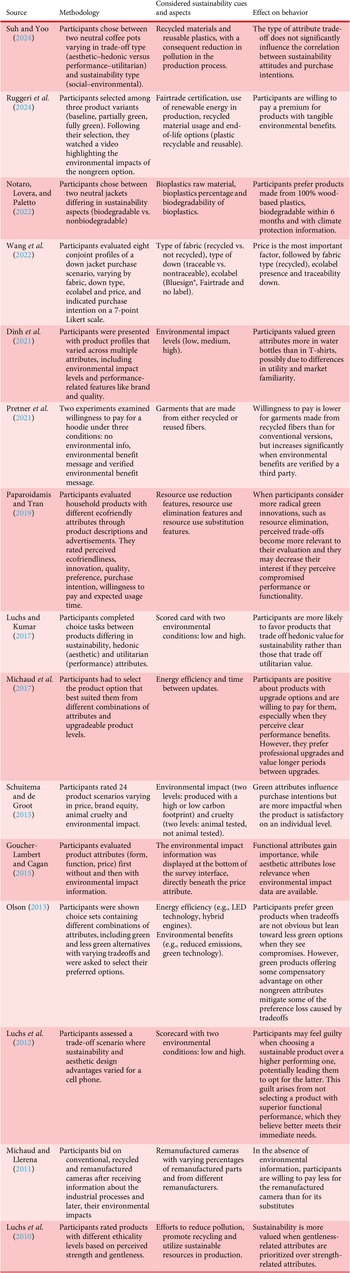
Research on green decision making is explored with numerous methods, such as conjoint analysis, choice-based techniques, questionnaires, surveys and scenario-based experiments. Luchs et al. (Reference Luchs, Brower and Chitturi2012) present a scenario-based experiment using performance and aesthetic design as possible mediators of the effect of sustainability importance on product choice. Their results show that participants prefer higher functional performance, as they feel more confident that their needs will be met. Nevertheless, a product that offers sustainability advantages, even if it underperforms, can benefit from an aesthetic design. Similarly, a study conducted by Goucher-Lambert and Cagan (Reference Goucher-Lambert and Cagan2015) finds that participants prioritize functional attributes over aesthetic attributes when environmental impact data are available. On the other hand, the results from Paparoidamis and Tran (Reference Paparoidamis and Tran2019) demonstrate that participants generally emphasize the trade-offs between sustainability and product performance when they perceive that resource inputs decrease during the ecoinnovation process. Table 2 summarizes the papers that address this perceived trade-off between sustainability and other design attributes. The list of articles represents a subset of the articles listed in Table A1, including only those that provide direct experimental evidence of trade-offs between sustainability and other design attributes.
Table 2. Overview of experimental studies on perceived trade-offs between sustainability and other design attributes

As inferable from Table 2, the impact of sustainability on product preference varies significantly, leading to different design approaches to address this issue. While some studies explicitly examined the trade-offs between sustainability and other design attributes, other experimental works explored the mechanisms that shape how users evaluate sustainable products. One of these research directions suggests that the role of sustainability in users’ perceptions may depend on the primary benefit sought in the product category (Luchs et al. Reference Luchs, Naylor, Irwin and Raghunathan2010; Skard et al. Reference Skard, Jørgensen and Pedersen2021; Gong et al. Reference Gong, Wang, Peverelli and Suo2022). Based on that, several authors propose that products can generally be classified into two categories: strength-dependent and gentleness-dependent. Strength-dependent products are those where attributes such as power and durability are highly valued. In contrast, gentleness-dependent products are characterized by attributes such as mild, soft and safe (Luchs et al. Reference Luchs, Naylor, Irwin and Raghunathan2010; Rudolph Reference Rudolph2018). Therefore, when users evaluate a gentleness-dependent product, sustainability may enhance product preferences, but when they evaluate a strength-dependent product, it increases functional perceived risk (Luchs et al. Reference Luchs, Naylor, Irwin and Raghunathan2010; Rudolph Reference Rudolph2018; Skard et al. Reference Skard, Jørgensen and Pedersen2021). For example, Luchs et al. (Reference Luchs, Naylor, Irwin and Raghunathan2010) evaluated this aspect by comparing a laundry detergent (strength-dependent) and a baby shampoo (gentleness-dependent). For each product type, participants were asked to indicate their relative preference between two versions that differed only in their level of sustainability (e.g., based on a sustainability rating provided by a hypothetical independent agency). The authors found that prioritizing strength over gentleness can significantly reduce the benefits of sustainability, leading to a stronger preference for less sustainable options.
Another line of research suggests that the effect of sustainability on product perceptions depends on the centrality of the attribute that offers the green benefit (Gershoff & Frels Reference Gershoff and Frels2015; De Medeiros & Ribeiro Reference De Medeiros and Ribeiro2017; Skard et al. Reference Skard, Jørgensen and Pedersen2021). Product design attributes can be classified as central or peripheral depending on the extent to which the attribute contributes to defining what the product is for users. A central attribute (also called “core” or “product-related attribute”) is an attribute that is directly related to the main function of a product, for example, the material or storage capacity of a mobile phone. On the other hand, peripheral (or “nonproduct related”) attributes are those that have a minor effect on the performance of the product, for example, packaging (Gershoff & Frels Reference Gershoff and Frels2015; Chen & Wu Reference Chen and Wu2020; Gong et al. Reference Gong, Wang, Peverelli and Suo2022). Hence, based on the centrality of the attributes, users are inclined to evaluate certain products as more ecofriendly than others, even when they provide the same environmental benefit. For example, Gershoff and Frels (Reference Gershoff and Frels2015) examined this aspect by manipulating the centrality of a green attribute through the way its importance was described within the product. In their study, a mattress was presented with an environmentally friendly side foam. While the green attribute and its environmental benefit were held constant, participants rated the product as more environmentally friendly when the foam was described as a structurally important attribute of the mattress. In line with this idea, some authors suggest that attribute centrality may influence user preferences positively or negatively, depending on the product category evaluated (Luchs & Kumar Reference Luchs and Kumar2017; Ghazali et al. Reference Ghazali, Abdul-Rashid, Dawal, Irianto, Herawan, Ho, Abdullah, Rasib and Padzil2023). Specifically, for strength-dependent products, green attributes are often perceived as disadvantageous, whether the attribute is central or peripheral, with a stronger effect when it is a central attribute. In contrast, for gentleness-dependent products, green attributes tend to be perceived as beneficial, especially when the attribute is central, since users infer that those products are also of better quality, compared with nongreen products (Skard et al. Reference Skard, Jørgensen and Pedersen2021). For example, this pattern was explored by Skard et al. (Reference Skard, Jørgensen and Pedersen2021), who compared a drain opener (strength-dependent) with a body lotion (gentleness-dependent). In this study, participants evaluated three alternatives: a product with a green core attribute (100% natural ingredients), a product with a green peripheral attribute (100% recycled packaging material) and a product without a green attribute. The results showed that green attributes decreased perceived quality in the strength-dependent product, with a stronger negative effect when the attribute was central. In contrast, for gentleness-dependent products, a green core attribute improved functional quality inferences regardless of participants’ green profile. Figure 2 illustrates how attribute centrality and product category influence users’ perception in Skard et al. (Reference Skard, Jørgensen and Pedersen2021).

Figure 2. Influence of attribute centrality and product category (strength- versus gentleness-dependent) on perceived product performance. Adapted from Skard et al. (Reference Skard, Jørgensen and Pedersen2021).
Another common way to categorize products is by their attributes, distinguishing between those with primarily hedonic attributes and those with predominantly utilitarian ones. The former are related to aesthetics and sensory experience, while the latter address functional performance (Arruda Filho & Brito Reference Arruda Filho and Brito2017; Luchs & Kumar Reference Luchs and Kumar2017). As far as the centrality of the attributes is concerned, green peripheral attributes lead to higher purchase intention in utilitarian product categories (e.g., shampoo). Conversely, in hedonic product categories (e.g., body lotion), consumers are more inclined to purchase products with green core attributes rather than those with green peripheral attributes (Luchs & Kumar Reference Luchs and Kumar2017; Gong et al. Reference Gong, Wang, Peverelli and Suo2022).
These results highlight the importance of product design as a moderator factor of the effectiveness of green products. Designers need to be aware not only of how to reduce the overall environmental impact of a product, but also how to align with users’ expectations about sustainable products. Based on the product category, designers can anticipate user expectations (positive or negative) of the product from early design stages and mediate this response based on attribute centrality. As shown in Figure 2, attribute centrality can be seen as an indicator of the sustainability level. Therefore, designers can strategically highlight sustainable attributes as central or peripheral depending on user priorities.
Drawing on these insights, a possible design-oriented recommendation for utilitarian/strength-dependent products is to present sustainable attributes as an additional benefit or complementary attribute, rather than a core redesign of the product that could affect functionality. On the contrary, a hedonic/gentleness-dependent product could benefit from highlighting sustainability attributes. Figure 3 summarizes the results on how the direction of effects varies across product categories (e.g., utilitarian, hedonic, strength, gentleness) and the centrality of the sustainable attribute (central vs. peripheral). Each bar represents one experimental study, with the number above the bar corresponding to the article identifier in Table A1. The color of each bar indicates the direction of the effect observed. As an example of interpretation, article 52 in Table A1 (Luchs et al. Reference Luchs, Naylor, Irwin and Raghunathan2010) found that perceptions and preferences for sustainable products were positive, using a product from the “gentleness” category and a central design attribute as the object of study.

Figure 3. Harvest plot summarizing the direction of effects across product categories and attribute centrality. Each bar represents an experimental study, with the number above the bar corresponding to the article identifier in Table A1. The color of each bar indicates the direction of the observed effect, as shown in the legend. The horizontal axis represents the outcomes of interest. As an example of interpretation, article 52 in Table A1 (Luchs et al. Reference Luchs, Naylor, Irwin and Raghunathan2010) found that perceptions and preferences for sustainable products were positive, using a product from the “gentleness” category and a central design attribute as the object of study.
3.2. Enhancing persuasiveness and sustainable consumption through sustainability cues
The adoption of sustainable products is closely linked to how effectively users recognize their sustainability attributes (She & MacDonald Reference She and MacDonald2018; Gong et al. Reference Gong, Wang, Peverelli and Suo2022). Sustainability is communicated through two main cue strategies, which influence how users perceive a product’s sustainability attributes: (i) explicit cues, such as ecolabels or print advertisements that directly highlight environmental benefits, and (ii) implicit cues, which are more subtle and context-dependent. In packaging, they consist of sensory elements, such as color, texture or shape, that subtly draw attention to product qualities. In product design, implicit cues refer to sustainable attributes that are integrated into the product itself, such as energy efficiency, which are not explicitly labeled as “green” but can still shape sustainability perceptions (Pancer et al. Reference Pancer, McShane and Noseworthy2017; Granato, Fischer, & Trijp Reference Granato, Fischer and Trijp2022; Gong & Wang Reference Gong and Wang2023).
There are different ways through which organizations can explicitly communicate the environmental orientation of their products; however, emphasizing the product’s ecofriendliness can negatively affect the perception of the performance of a green product (Luchs et al. Reference Luchs, Naylor, Irwin and Raghunathan2010; Rudolph Reference Rudolph2018). Some research suggests that using explicit and credible endorsement about product strength or effectiveness may reduce this negative perception (Luchs et al. Reference Luchs, Naylor, Irwin and Raghunathan2010; Rudolph Reference Rudolph2018; Gong et al. Reference Gong, Wang, Peverelli and Suo2022; Gong & Wang Reference Gong and Wang2023). For example, Chen and Wu (Reference Chen and Wu2020) affirm that when a green attribute is central, a double-message advertisement, that is, information on green and functional attributes, leads to significantly more positive green brand attitudes toward the product. On the other hand, given that the product category influences users’ perceptions, research suggests that explicit cues (such as descriptions of the product’s environmental benefits) lead to more favorable evaluations in product categories typically associated with greenness, such as hedonic products. In contrast, downplaying the green benefits tends to result in more positive user evaluations for strength-dependent products (Usrey et al. Reference Usrey, Palihawadana, Saridakis and Theotokis2020; Gong et al. Reference Gong, Wang, Peverelli and Suo2022; Gong & Wang Reference Gong and Wang2023).
Similarly, to enhance green purchase intention, packaging cues (visual and verbal elements) should evoke perceptions of sustainability that allow consumers to identify products as green (Magnier & Schoormans Reference Magnier and Schoormans2015; Pancer et al. Reference Pancer, McShane and Noseworthy2017; Steenis et al. Reference Steenis, van Herpen, van der Lans, Ligthart and van Trijp2017; Ischen et al. Reference Ischen, Meijers, Vandeberg and Smit2022). However, the combination of visual and verbal claims on packaging can have a dual effect: it can enhance sustainability recognition by reinforcing the message, or it can create confusion if the cues are inconsistent or misleading (Magnier & Schoormans Reference Magnier and Schoormans2015; Ertz, François, & Durif Reference Ertz, François and Durif2017; Granato et al. Reference Granato, Fischer and Trijp2022; Ischen et al. Reference Ischen, Meijers, Vandeberg and Smit2022). For example, Ertz et al. (Reference Ertz, François and Durif2017) and Pancer et al. (Reference Pancer, McShane and Noseworthy2017) reveal that using green color or a certified ecolabel in the packaging without other supporting environmental cues negatively affects clarity and trust. In contrast, according to Magnier, Schoormans, and Mugge (Reference Magnier, Schoormans and Mugge2016), the accumulation of cues (cardboard look and ecolabel) had an insignificant effect on the perception of sustainability. Granato et al. (Reference Granato, Fischer and Trijp2022) highlighted this issue and suggested that the decision to combine visual and verbal elements may depend on the understanding of the selected sustainable packaging cue. Their study showed that certain implicit packaging cues can independently trigger sustainability-related thoughts due to learned associations with nature and the environment, whereas others may fail to do so. Therefore, combining an explicit cue (e.g., an environmental description of the material), with a meaningful implicit packaging cue, such as packaging with green color, can be counterproductive, while combining explicit cues with a meaningless implicit cue (e.g., sticky tactile property, typical of water-soluble films and recycled plastic) may enhance perception (Ertz et al. Reference Ertz, François and Durif2017; Granato et al. Reference Granato, Fischer and Trijp2022).
Concerning implicit cues in sustainable product design, green product design attributes may subtly shape users’ perception and facilitate the identification of ecofriendly products (Luchs et al. Reference Luchs, Brower and Chitturi2012; She & MacDonald Reference She and MacDonald2018). However, these attributes are often hidden and unnoticed, which limits users’ ability to recognize them and therefore reduces the likelihood of influencing their product-related decisions. A current approach is to make sustainable attributes more visually obvious to enhance users’ awareness (Petersen & Brockhaus Reference Petersen and Brockhaus2017; She & MacDonald Reference She and MacDonald2018; El Dehaibi & MacDonald Reference El Dehaibi and MacDonald2022). For example, Reid, Frischknecht, and Papalambros (Reference Reid, Frischknecht and Papalambros2012) demonstrate that participants associate car silhouettes with sustainability, perceiving those with shorter vertical and longer horizontal dimensions as more fuel-efficient. She and MacDonald (Reference She and MacDonald2018) show that participants prioritize sustainability-related attributes, such as energy consumption, when they are exposed to visible attributes that trigger sustainability thoughts, such as a flip-cover to retain heat, a power-save button, an embossed leaf pattern and power levels on a dial in a toaster. Similarly, Du and MacDonald (Reference Du and MacDonald2018) demonstrate that the shape of a product (e.g., frame of a bicycle) is more effective at conveying hidden green attributes than a specific visual component of a product (e.g., bicycle handlebars). On the other hand, Diego-Mas, Poveda-Bautista, and Alcaide-Marzal (Reference Diego-Mas, Poveda-Bautista and Alcaide-Marzal2016) developed a mathematical model to predict the degree to which users perceive the sustainability of a product based on its physical design attributes. They suggest that designers can determine the physical attributes of a product that most effectively communicate the idea of “sustainability” to users.
In this line, users can associate some product design attributes as sustainable based on their perceptions, which do not always align with the product’s true environmental performance (Petersen & Brockhaus Reference Petersen and Brockhaus2017; El Dehaibi & MacDonald Reference El Dehaibi and MacDonald2022). For example, Cappelletti et al. (Reference Cappelletti, Menghi, Rossi and Germani2023) conducted a survey and a life cycle assessment of three swimming items. They found that participants displayed a lack of awareness about how different aspects of a product’s life cycle affect its sustainability. This led to significant differences between participants’ perceptions and the actual lifecycle assessment results. This biased perception can make it difficult for users to distinguish sustainable products. Therefore, a sustainable product must fulfill both engineered and perceived sustainability criteria to achieve success (Diego-Mas et al. Reference Diego-Mas, Poveda-Bautista and Alcaide-Marzal2016; El Dehaibi & MacDonald Reference El Dehaibi and MacDonald2022). Studies have developed methods to extract users’ perceptions of sustainable attributes from online reviews, revealing that positive perceptions are often associated with intangible attributes (durability) or reliable materials, while negative perceptions relate to perceived unsafe attributes or the use of plastic (El Dehaibi & MacDonald Reference El Dehaibi and MacDonald2022).
4. Findings and discussion
The growing interest in sustainability has driven the research for more durable and environmentally friendly alternatives. However, the gap between green attitudes and actual behavior related to sustainable products has led to research into the factors that affect the acceptance and adoption of these products. While our search strategy was broad, the body of literature is strongly focused on consumer products. From a design perspective, this problem has been addressed from two directions, which are elaborated in the following subsections.
4.1. Perceived trade-off in sustainable products
The results showed that a significant barrier against green consumption is the negative perception associated with the performance of a sustainable product. Users tend to perceive that, in order to make a product sustainable, manufacturers reduce other resource inputs that affect other significant attributes of the product, such as its durability. Table 2 shows that different studies focused on demonstrating the existing trade-off and the possible factors that can attenuate it, such as aesthetic design and environmental expectations of the product. This focus made it possible to identify that this “sustainability effect” significantly varies based on the product category and the importance of the green attribute within the product. This explains why some green products are well received and others are not.
Markedly, four definitions of product categories (strength-dependent, utilitarian, gentleness-dependent and hedonic) and two types of attributes (core and peripheral) appear as most relevant. For strength-dependent and utilitarian product categories (e.g., washing machines, drills or car shampoo), sustainability increases the perceived functional risk, making users pay more attention to the attributes mainly linked to the product performance. This effect is reinforced when the green benefit is presented as a core attribute (e.g., recycled material), increasing the sustainable perception of the product. This suggests that, for those product categories, sustainability needs to be perceived as an additional attribute that adds value to the product rather than an improvement of a main attribute. Conversely, hedonic and gentleness-dependent products (e.g., headphones, fashion apparel or skin care products) are positively associated with sustainability and the green benefit is expected in core and peripheral attributes (e.g., plant-based packaging material). These different perspectives on sustainability, depending on the product category, may explain the results in the attitude–behavior gap. However, the definition of the identified product categories and attributes is troublesome, as stressed in the following numbered list, which evidences relevant definitions to be formalized.
-
(i) The concepts of strength-dependent and utilitarian products overlap in most contexts, as well as gentleness-dependent and hedonic. The main difference between strength-dependent and utilitarian products is that the latter prioritize utility and performance, but not necessarily strength in their design. Nevertheless, “strength” attributes can be perceived as attributes that show the quality and reliability of the utilitarian product. In the same way, when it comes to gentleness and hedonism, the attributes that characterize the concept of “gentleness products” can be seen as attributes that positively contribute to the hedonic experience. In this sense, strength-dependent products can be seen as an internal classification of utilitarian products, and gentleness-dependent products among hedonic ones. However, this assumption should be rigorously verified. Beyond this conceptual overlap, our findings also suggest that both categorizations present limitations when it comes to understanding sustainability perceptions. While utilitarian and hedonic categories are widely established in consumer research, they often provide a more abstract concept that is difficult for users to directly recognize. Meanwhile, the strength/gentleness-dependent categories highlight aspects closer to the user experience but are restrictive in their definition. For example, products that fit into the “gentleness-dependent” category are typically products associated with personal care, which reduces their applicability with other products. In practice, most products integrate attributes from both dimensions (utilitarian and hedonic), reinforcing the need to develop new product categories that simultaneously capture their functional and experiential value.
-
(ii) Identifying a product’s category lacks an established method, relying instead on subjective definitions. With few exceptions, products possess both hedonic and utilitarian values for consumption, and previous studies have addressed this issue by classifying products through surveys and questionnaires, for example, with a Likert scale between “purely hedonic” and “purely utilitarian.” This leads to limitations related to:
-
a. Different interpretations of the scale.
-
b. Some respondents may favor utilitarian products if they believe they should prioritize functionality over pleasure.
-
c. Some respondents may rate a product as highly utilitarian, but still buy it for hedonic reasons.
-
-
(iii) Packaging is the design element commonly used to display peripheral attributes. However, all the attributes that add an additional value to the product (i.e., the existence of this attribute does not affect the principal function of the product) can be considered peripheral, and this varies based on how the product is presented and classified for the users. For example, Gershoff and Frels (Reference Gershoff and Frels2015) used an appliance capable of making waffles and panini sandwiches to examine how product categorization influences attribute perception. They found that the waffle cooking plates were perceived as a peripheral attribute when the appliance was categorized as a panini maker. In contrast, when the same appliance was viewed as a waffle maker, the plates were seen as a central, core attribute. This example illustrates how centrality has been operationalized experimentally in individual studies; however, no standardized criteria exist across the literature, highlighting the need for further research to establish reliable and generalizable measures of attribute centrality.
4.2. Sustainability cues
Research limitations also concern the factors that help users identify whether a product is sustainable. Regarding durable products, emphasis has been placed on the effect of direct persuasiveness/ explicit cues, such as
-
(i) reinforced messages about sustainability and performance,
-
(ii) the effect of the visibility of the environmental benefits in utilitarian and hedonic products and
-
(iii) visual and verbal elements on the packaging. Even though the importance of these factors in sustainable consumption is recognized, they are mostly related to marketing strategies for finished products rather than design choices.
From a design perspective, few studies have focused on the effect of material, shape and individual attributes as sustainable cues to enhance green adoption. For instance, She and MacDonald (Reference She and MacDonald2018) showed that minor details, such as a flip-cover to retain heat or two bread-depressing levers in a toaster, can trigger sustainability thoughts in users. All these studies found that these implicit design cues increase the perception of sustainability in users, which helps to identify green products. However, not all users necessarily recognize these products’ design attributes as sustainable, and they are not aware of the true environmental impact of some product design attributes. Therefore, studies are lacking that address how the design attributes of a product can trigger the idea of sustainability in users. Additionally, as discussed in a previous section, for utilitarian products, it may be more effective to present sustainability as a peripheral attribute to avoid concerns about potential trade-offs with performance. In this context, implicit design cues offer a promising strategy, as they allow designers to present sustainability in a subtle way. However, if these cues become meaningful (i.e., if users recognize and interpret them as central sustainability design cues), it remains unclear whether the peripheral presentation continues to be effective. This highlights a gap in current research on how the salience and interpretation of implicit design cues influence the perception of sustainability, particularly in utilitarian product categories. Therefore, further work is needed to understand the extent to which different product design attributes are recognized and whether there is a dependence on the product category.
4.3. Open issues and future work
Three main open issues were identified within sustainable consumption through product design.
First, the results showed that the sustainability impact varies with the product’s expected value, classifying it as either utilitarian or hedonic. However, there is a lack of formalism in how to define which category a product belongs to. Current methods can be limited by the subjectivity and understanding of users; therefore, more work is needed on the factors that effectively determine the classification of a product. Future studies can be intended to explore how to incorporate or quantify the contribution of product design attributes in the perception of a product as utilitarian or hedonic, and whether this perception changes between designers and users. It is well-known that users’ perception of a product’s functionality can sometimes diverge from the designer’s original intent. Designers focus on conveying intended functions, meanings and experiences. Users’ perceptions are affected by their prior knowledge (Becattini et al. Reference Becattini, Borgianni, Cascini and Rotini2020), contextual cues and visual representations. As emphasized in the “design as communication” perspective (Crilly et al. Reference Crilly, Good, Matravers and Clarkson2008), interpretation is an active process in which users construct meaning, often inferring persuasive or functional intentions behind design attributes (Crilly Reference Crilly2011; Da Silva, Crilly, & Hekkert Reference Da Silva, Crilly and Hekkert2015). This process can lead to misalignments between the intentions embedded by designers and the interpretations made by users. In the context of sustainable product design, such misalignments are particularly relevant because sustainability-related attributes rely on users’ correct interpretation to convey their environmental intent. When users fail to recognize these cues as meaningful indicators of sustainability, the design’s communicative function weakens, potentially reducing both perceived value and behavioral impact (Crilly et al. Reference Crilly, Good, Matravers and Clarkson2008). Conversely, when sustainability is overly emphasized or presented incongruently with other product attributes, it can trigger skepticism or perceptions of “greenwashing.” Despite tools and research aimed to design for User Experience (Pucillo & Cascini Reference Pucillo and Cascini2014), recent literature confirms the mismatch between design intention and user interpretation (Berni & Borgianni Reference Berni and Borgianni2025), highlighting the importance of explicitly addressing how design cues are communicated and received, and developing approaches that better align design intentions with user perception.
Second, the findings suggest that the greenness of a product depends on the centrality of the green attribute. However, the lack of formal methods to recognize how users decide which design attribute is core or peripheral is an additional research gap. Therefore, future studies can investigate the factors that affect the centrality of an attribute and whether this differs between designers and users, as well as across product categories.
Finally, more work needs to be done to understand how different product design attributes trigger sustainability thinking. Prior reviews have shown that ecolabels can increase purchase intention, but their effectiveness strongly depends on consumer familiarity, trust in the certifying body and label clarity. In comparison, design-based cues operate more subtly, often below conscious awareness. Therefore, future studies should analyze how users perceive (eco-) design principles such as reparability, modular and upgradeable design and energy efficiency, as sustainability cues. Additionally, while both ecolabels and product design attributes aim to communicate sustainability, the mechanisms by which they influence perception differ. Our findings suggest that, depending on the product category and the perceived centrality of the design attribute, sustainability-related cues may enhance or hinder perceived product value. Hence, future research should also investigate if the perception of different (eco-) design principles is negative or positive across product categories and whether the perceived centrality of those moderates this effect. This will contribute to the field of implicit design cues and can guide designers to create products that are and look sustainable.
5. Conclusion
Based on the analysis of articles collected through a systematic literature review, this article provides insights into how to address the attitude–behavior gap from a product design perspective. The results showed two lines of research to address this problem: (1) through the perception of product design attributes and (2) by means of sustainability cues. In the first line of research, it was found that sustainability can be seen as a negative or positive aspect based on product category. This perception is mediated by how users associate the green attribute with product functionality. On the other hand, the analysis of sustainability cues revealed that more research needs to be done regarding how product design attributes can shape user thinking about sustainability. Here, the goal would be designers’ proper guidance in the development of products that fulfill user expectations of what a sustainable product looks like and therefore, boost their selection. For example, based on the results presented, Table 3 presents some design-oriented recommendations.
Table 3. Designer-oriented synthesis matrix

This study also identified two key research limitations related to the lack of formal definitions and methods to categorize a product (as hedonic or utilitarian) and to determine the centrality of an attribute. Product design often involves balancing utilitarian and hedonic values; therefore, future studies need to investigate how to integrate the effects of product design attributes to determine the category a product predominantly belongs to. In the same way, another research direction is to explore how users perceive a specific attribute as core or peripheral based on the product category and if this perception differs from the designer’s view. Evidently, the findings of the article are affected by the qualitative nature of these product categorizations, which points out a limitation of this work. Finally, a key limitation of this study is the decision to exclude ecolabels and focus instead on other sustainability-related cues. While this allowed for a more in-depth analysis of product design attributes, it also limits the scope of the findings, given the important role that ecolabels may play in shaping user perceptions and choices.
Appendix
Table A1. Classification of reviewed studies by research focus and sustainability-related design aspects




 Open access

