

IntroductionFootnote 1
After a protracted government formation process, the Christian Democratic Union (CDU)/Christian Social Union (CSU) and Social Democratic Party (SPD) continued the grand coalition in March 2018 (Poguntke & Kinski Reference Poguntke and Kinski2018). The political year 2018 was marked by the continued weakness of the governing parties. While they sustained poor election results in the state elections of Bavaria and Hesse, the Greens benefited most from these developments, ranking before the Social Democrats in most nationwide surveys. The Alternative for Germany (AfD) was also one of the winners, having gained representation in all German state parliaments by the end of the year. Migration and refugee policy still dominated public discourse and brought the governing coalition close to collapse. After 18 years, Annegret Kramp‐Karrenbauer replaced Angela Merkel as CDU party leader.
Election report
Regional elections
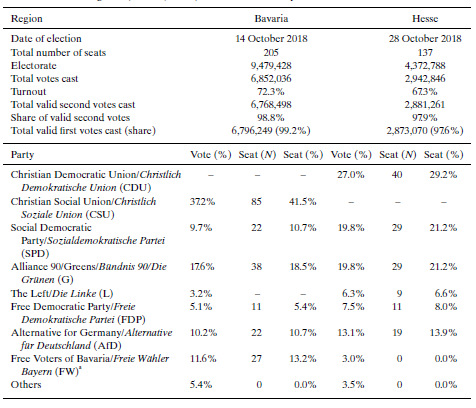
In October, Land elections were held in Bavaria and Hesse (Table 1). Turnout rose from 63.6 per cent in 2013 to 72.3 per cent in the former, while it fell to 67.3 per cent in the latter (–5.9 percentage points) (Forschungsgruppe Wahlen 2018a, 2018b).
In Bavaria, the CSU was returned as the strongest party mustering 37.2 per cent of the votes, yet incurring massive losses (–10.4 percentage points). This was the party's worst result since 1950. The SPD only reached 9.7 per cent of the vote (–10.9 percentage points), which was also its worst result in a state election after 1945. Coming second with 17.6 per cent of the vote, the Greens achieved its best result ever (+9.0 percentage points). Third place went to the conservative Free Voters (FW) with 11.6 per cent (+2.6 percentage points). The AfD reached 10.2 per cent of the vote, less than in the 2017 general election. While the Free Democratic Party (FDP) cleared the 5 per cent electoral threshold, the Left Party again clearly missed it (3.2 per cent) despite slight gains (+1.1 percentage points). With six party groups represented, the Bavarian Landtag has never been more fragmented in its history. A coalition between the CSU and the Greens as well as the CSU and the Free Voters was possible. Only three weeks after the election, the latter agreed on a coalition government led by Prime Minister Markus Söder (CSU) (Forschungsgruppe Wahlen 2018a).
Table 1. Results of regional (Bavaria, Hesse) elections in Germany in 2018

In Hesse, the CDU won the polls with 27.0 per cent of the vote, but also suffered the greatest losses (–11.3 percentage points), scoring its worst result in over 50 years. Similarly, the SPD only reached 19.8 per cent of the vote (–10.9 percentage points) – its worst ever result and the first time the party had dipped below 20 per cent in Hesse. The Greens also mustered 19.8 per cent of the vote, yet this was their best ever result (+8.7 percentage points). The Left party and the FDP both entered the state legislatures with slight gains. While the AfD had missed entering the Landtag in 2013 (4.1 per cent), it now clearly moved into Parliament (13.1 per cent). In December 2018, the CDU and the Greens agreed to continue the coalition government under Prime Minister Volker Bouffier (CDU). This time, the coalition only has a one‐vote majority in the state parliament (Forschungsgruppe Wahlen 2018b).
Cabinet report
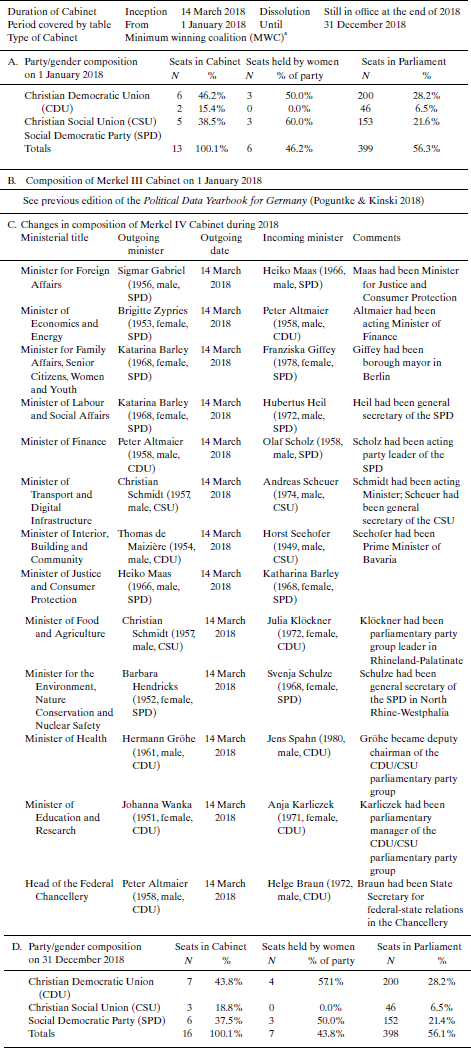
Table 2. Cabinet composition of Merkel IV in Germany in 2018

Angela Merkel's fourth Cabinet was sworn in on 14 March 2018, while the 19th Parliament had already been constituted on 24 October 2017. The Bundestag re‐elected her in the first round of voting with 364 of 692 votes cast (of the 709 MPs). The previous Cabinet was reshuffled extensively (Table 2). Only two ministers remained in office: Ursula von der Leyen as Minister of Defence (1958, female, CDU) and Gerd Müller (1955, male, CSU) as Minister for Economic Cooperation and Development.
Parliament report
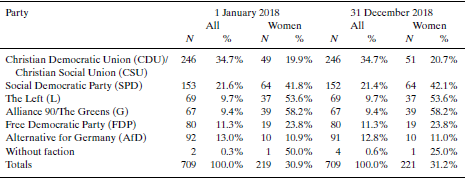
Table 3 depicts the composition of the Bundestag (lower house). In 2018, two MPs (AfD and SPD) left their respective parties and are now independent MPs in the Bundestag. In the CDU, two female MPs replaced two male colleagues. The share of women in Parliament still remains 6 percentage points lower than in the previous Parliament.
Table 3. Party and gender composition of the lower house of Parliament (Bundestag) in Germany in 2018

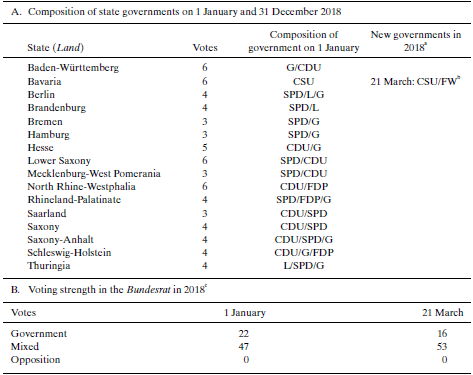
In the Bundesrat, the ‘government camp’ lost six votes as a result of the coalition between the CSU and the FW in Bavaria. This does not substantially modify the voting strength in the upper house (Table 4).
Table 4. Changes in the composition of the upper house of Parliament (Bundesrat) in Germany in 2018

Notes: aLists the dates of investiture of all new governments to provide a complete overview of the governmental effects of state elections. The first party is always the party of the Prime Minister.
b The FW is the regional association of the nationwide party Free Voters.
c The Bundesrat has 69 members. Regular decisions require a majority of 35 votes. If the Bundesrat rejects Bundestag legislation by a two‐thirds majority (46 votes), the Bundestag needs a two‐thirds majority to overrule this decision. Individual Länder cannot split their votes. Owing to the grand coalition of the CDU, CSU and SPD, the rules of counting are as follows: ‘government’ camp includes single‐party CDU or CSU governments, CDU/SPD coalitions and single‐party SPD governments; the ‘opposition’ camp includes governments formed by parties not in federal government (Left, Greens, FDP, FW and SSW single‐party governments and coalitions); the ‘mixed’ camp includes a combination of parties from both government and opposition camps.
Source: Bundesrat (2018).
Political party report
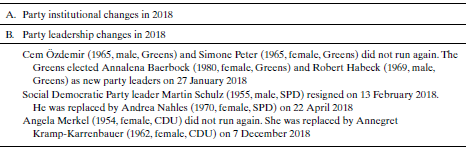
After the SPD and the CDU/CSU had agreed to continue the grand coalition in February 2018, the SPD had their party members vote on the coalition agreement. A total of 78.4 per cent of members participated and the agreement was approved with 66 per cent of the vote. Contrary to his earlier announcements, the SPD party leader, Martin Schulz, who, on election night, had excluded a continuation of the coalition, now wanted to join the Cabinet as Foreign Minister. In return, he offered to resign as party chairperson. This move was met with strong resistance within the SPD and eventually led to his resignation. At a special party convention in April, parliamentary party group leader Andrea Nahles was elected new party chair with only 66 per cent of the delegates’ vote. She is the first woman to head the Social Democrats.
Table 5. Changes in political parties in Germany in 2018

The year 2018 marked far‐reaching changes in the CSU/CSU party leadership. After Peter Tauber had resigned as CDU secretary general in February, party leader Angela Merkel introduced Saarland's Prime Minister Annegret Kramp‐Karrenbauer as the party's new secretary general. This was widely viewed as an attempt to put Kramp‐Karrenbauer in a good position to succeed Merkel. In September, the CDU/CSU parliamentary group surprisingly voted Volker Kauder out of office after 13 years as parliamentary party group leader, even though he had been endorsed by Chancellor Merkel. This was widely regarded as a sign of Merkel's eroding power. Ralph Brinkhaus was elected new party group chairperson with 52.7 per cent of the vote. Following bad Land election results (Table 1), Merkel announced in October that she would not run again for party leadership in December. She also made it clear that she intended to continue as Chancellor until the end of the legislative term, but would not seek re‐election. Three candidates presented themselves to the party grassroots in eight regional conferences throughout Germany: Annegret Kramp‐Karrenbauer, Health Minister Jens Spahn and Friedrich Merz, a former leader of the CDU/CSU parliamentary party group. The party's general secretary, Kramp‐Karrenbauer, is a confidant of Merkel's. She stood for continuity in the party's leadership. Spahn had gained a reputation as a Merkel critic in the past and emphasized issues such as modern patriotism and digital advances in healthcare. Merz, who had worked as a successful business lawyer after retiring from politics, was favoured by those who support a sharper conservative profile on cultural issues. He mainly focused on economic issues, however.
At the party conference in December, Kramp‐Karrenbauer received 45 per cent of the delegates’ votes in the first ballot, Merz 39 per cent and Spahn 16 per cent. In a run‐off vote with competitor Merz, Kramp‐Karrenbauer finally won the race with only 51.75 per cent of votes. It was the first time since 1971 that several candidates had stood for the CDU party leadership. Paul Ziemiak, former chairperson of the party's Young Union, was elected new secretary general with 62.8 per cent.
After the poor election results in the Bavarian state elections (Table 1), CSU party leader Horst Seehofer announced his resignation, but kept his office as Interior Minister. At a special party conference in January 2019, Markus Söder, Bavarian Prime Minister since 16 March 2018, was elected the new CSU party leader with 87.4 per cent of the delegates’ vote.
Institutional change report
In June, the grand coalition decided to increase state party funding from €165 million annually to €190 million in 2019; the opposition parties (Greens, FDP, Left Party) appealed against it to the Federal Constitutional Court (Bundesverfassungsgericht).
Issues in national politics
Political discourse in Germany was dominated by party politics (see also Political Party Report) as well as migration and refugee policy. In July 2018, Interior Minister Horst Seehofer presented his so‐called ‘Master Plan for Migration’. It aimed to accelerate deportation and repatriation of migrants through so‐called ‘anchor centres’. Asylum‐seekers who had already filed an application in another European Union (EU) member state should be rejected. This led to a fierce dispute between Chancellor Merkel and Seehofer. If necessary, the CSU and parts of the CDU wanted to take measures without the participation of neighbouring countries, but the Chancellor vehemently rejected this. At the height of the crisis in summer 2018, the common parliamentary party group of the CDU and the CSU, which had existed since 1949, was called into question. Seehofer announced his resignation as minister, which he again withdrew shortly afterwards. This exemplified the deeply rooted tensions between the ‘sister parties’ on migration and refugee policy.
In the summer of 2018, violent right‐wing extremists demonstrated in Chemnitz, Saxony, for days. Videos showed how foreign‐looking people were attacked on the streets. The federal government condemned such “hounding” of foreigners. The riots were preceded by the violent death of a 35‐year‐old German, allegedly caused by three asylum‐seekers.
After five years, the trial on a series of murders by the extreme right terror group National Socialist Underground (NSU) ended in July 2018. The main defendant, Beate Zschäpe, was sentenced to life imprisonment for ten counts of murder.
Environmental politics was also contested. Discussions focused on driving bans for diesel cars and the phasing out of energy production from coal. There were partly violent protests against the expansion of an open‐cast coalmine (Hambacher Forst). In February, a German court had in principle permitted driving bans in case EU limits for nitrogen oxides were exceeded.

 Open access

