

Introduction
The year 2022 was supposed to be a quiet political year after the turbulent 2021 (see Spirova Reference Spirova2022). A four-party coalition Cabinet had taken office just before the start of the year, led by We Continue the Change (PP) leader Kiril Petkov. As among the four were the two longest lasting rivals in Bulgarian politics (the socialist party, the BSP, and the successor of the centre-right opposition of the last 30 years, Democratic Bulgaria, DB), fears for its potential instability abounded. However, it was not the socialists but There is Such a people (ITN) who brought down the Cabinet in June 2022, leading to yet another round of early elections. The October 2022 elections did not manage to produce a Cabinet, prolonging the political crisis and allowing the President to govern de facto through the caretaker Cabinet of Donev I. The war in Ukraine politicized the pro/anti-Russian split in the country even further. Bulgaria remained in an ambivalent position with the Cabinet supporting the EU/NATO position and the President pleading for neutrality.
Election report
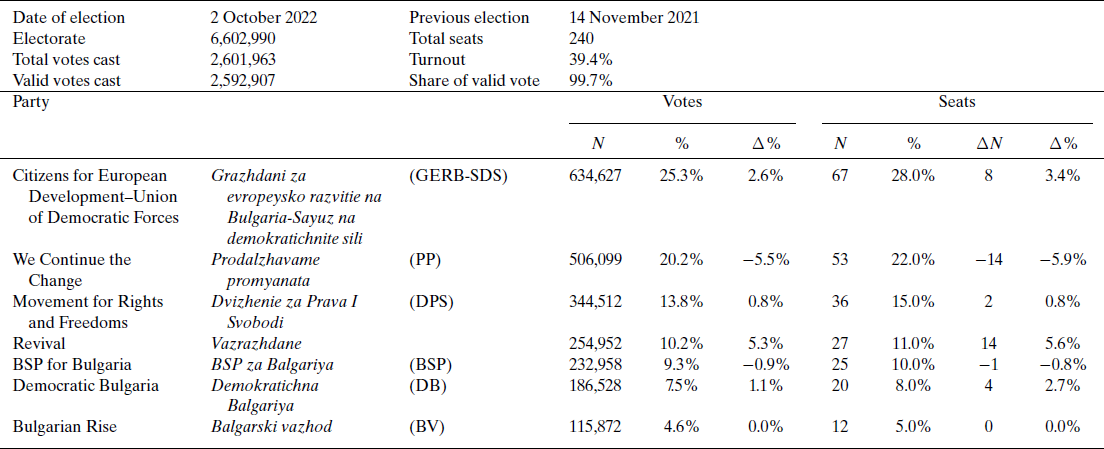
Elections for the National Assembly took place on 2 October 2022. Twenty-nine parties and coalitions ran for the elections, and campaign issues focused mostly on the juxtaposition between Citizens for European Development of Bulgaria (GERB) and the incumbent, PP. GERB, which had dominated politics in the country at all levels since 2009, benefited from its widespread local organizations and numerous members to campaign locally and mobilize the rising dissatisfaction with PP as incumbents. PP and Petkov focused on the achievements of the outgoing Cabinet and argued that PP is the choice necessary to stop corruption and zadkulisie (see Spirova Reference Spirova2021, for an explanation) from being resurrected. However, with the turnout at its lowest since 1990, at 39.4 per cent, the elections did not manage to produce a working majority. This development illustrated the continuous political apathy in the country and the stagnation within the political system.
As Table 1 illustrates, GERB emerged from the election as plurality leader and increased its number of deputies, while PP suffered from the incumbency disadvantage and lost seats in the National Assembly. The other incumbents—DP and the socialists—remained at their 2021 levels, and so did the Turkish-dominated DPS, which continued to win the plurality of votes among the Bulgarian diaspora. The biggest winners of the elections were the nationalists, which drew from the previous vote for PP. Revival had already been in Parliament, but doubled its seat share to 11 per cent, while Bulgarian Rise, a new nationalist and pro-Russian party led by caretaker PM Yanev (see Spirova Reference Spirova2022, for the Yanev I and II Cabinets) entered Parliament with a little over 4 per cent. This fragmentation of voter preferences destined the Parliament to a short life.
Table 1. Elections to the Parliament (Narodno Sabranie) in Bulgaria in 2022

Notes:
1. There is an option in the ballot “I don't support any of the nominated,” which received 87,635 votes.
2. GERB and SDS are two independent party organizations, but they participated and were voted for as a coalition. Therefore, I consider them as one “party.”
3. Democratic Bulgaria is an electoral alliance in Bulgaria formed by three political parties—Yes, Bulgaria!, Democrats for a Strong Bulgaria, and The Greens.
Source: Central Election Commission website, Parliamentary Elections (2022) (https://results.cik.bg/ns2022/rezultati/index.html).
Cabinet report
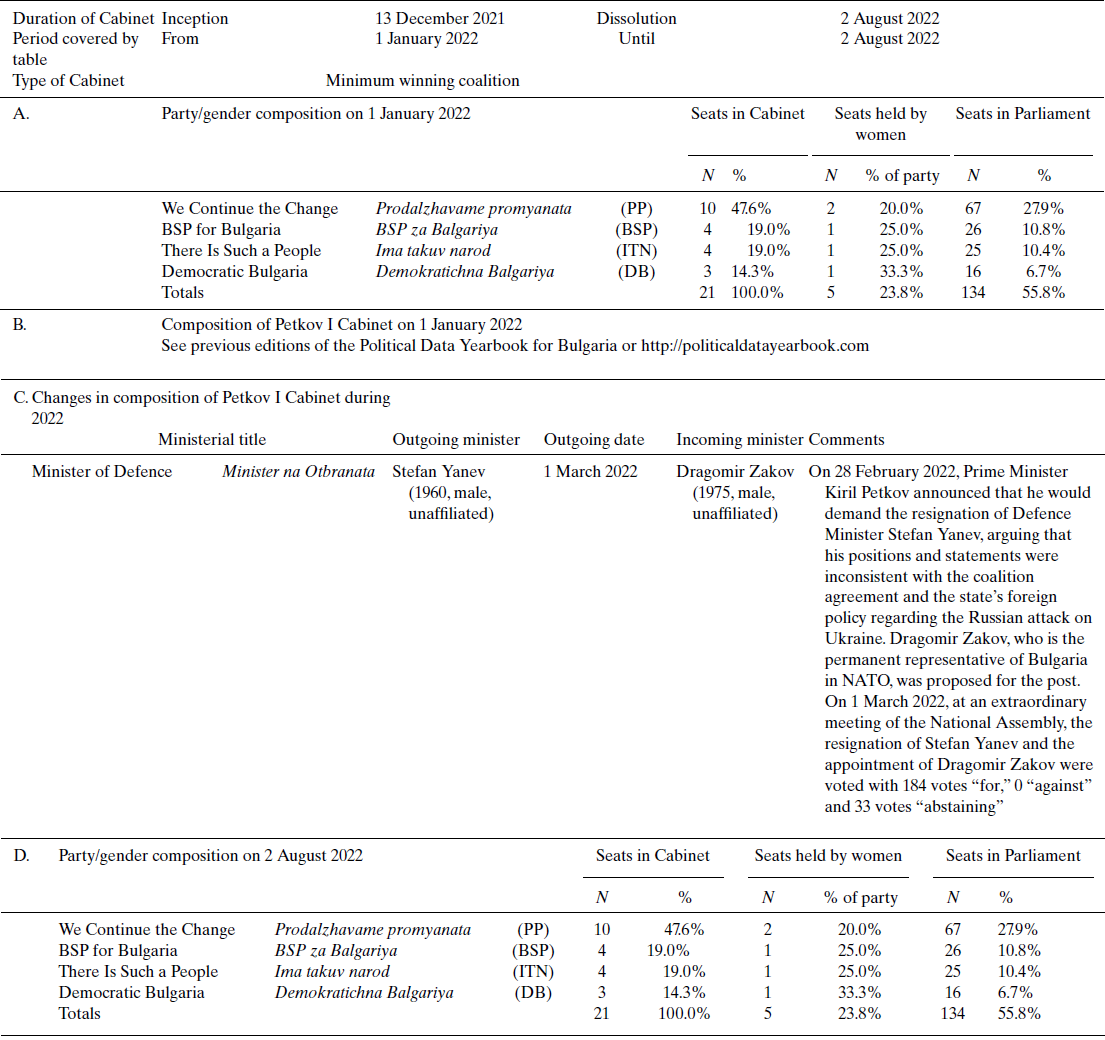
The Petkov I Cabinet (Table 2) began the year strongly. It was a four-party, minimum-winning coalition, in which all posts were distributed along a 10:4:4:3 formula among Petkov's PP, the Socialists, ITN, and DB. While the BSP appeared the odd man out in this coalition of the “protest parties” (see Spirova Reference Spirova2022, for discussion of the protest parties), it was There is such a Nation that proved to be trouble.
Table 2. Cabinet composition of Petkov I in Bulgaria in 2022

Note: Dragomir Zakov was unaffiliated, but, as a minister, he was part of the PP ministers’ quota.
Source: Council of Ministers (2022) (www.gov.bg/en/Cabinet).
The first months of 2022 saw plenty of challenges, as the Cabinet attempted multiple reforms, but the first personnel change came with the Ukraine war. On 28 February 2022, Prime Minister Kiril Petkov announced that he would demand the resignation of Defence Minister Stefan Yanev, arguing that his positions and statements were inconsistent with the coalition agreement and the state's foreign policy regarding the Russian attack on Ukraine. Dragomir Zakov, who was the permanent representative of Bulgaria in NATO, was proposed to replace Yanev at the post. He was voted in on an extraordinary meeting of the National Assembly on 1 March 2022, with the support of the majority of the deputies.
As the war intensified, so did the troubles for the Cabinet. In early May, ITN began to voice disagreement with the coalition leadership along several dimensions, including the position of the coalition on Macedonia's entry into the EU, and in late May, ITN withdrew its support for the coalition government, citing this disagreement. On 22 June, a no-confidence vote against Petkov I was initiated. One hundred and twenty-three MPs from GERB, the DPS, ITN, and Vazrazhdane voted against the Cabinet, and 116 MPs supported it. On 27 June, Petkov submitted the resignation of his Cabinet to Parliament.
Attempts to form a new coalition with ITN defectors followed, but other coalition partners showed discontent with Petkov and PP as well. The BSP demanded that Petkov would no longer be the proposed PM. However, by mid-July it was evident that a new PP-led coalition Cabinet was infeasible. GERB declared its intention to “return the mandate” to the President as well, signifying the inability of the Parliament to produce a working majority and Cabinet. As a result, on 1 August, President Radev scheduled parliamentary elections for 2 October and appointed a new caretaker Cabinet (Donev I) to take office as of 2 August 2022. This was the third caretaker Cabinet in a two-year period.
As a caretaker Cabinet, Donev I was tasked with organizing the early elections and managing the country (Table 3). Despite its apolitical nature, the Cabinet was deemed to reflect the position of the President, and fears that it might lead the country back to Russia's sphere of influence and energy dependency abounded.
Table 3. Cabinet composition of Donev I (caretaker) in Bulgaria in 2022

Source: Council of Ministers (2022) (www.gov.bg/en/Cabinet).
The new Parliament elected on 2 October did not prove to offer a clear solution to the political crisis. GERB's attempt to form a minority Cabinet failed in Parliament on 14 December, and PP was also not in a position to offer a workable coalition. As a result of the prolonged Cabinet negotiations, at the end of the year, Donev I was still in power.
Parliament report
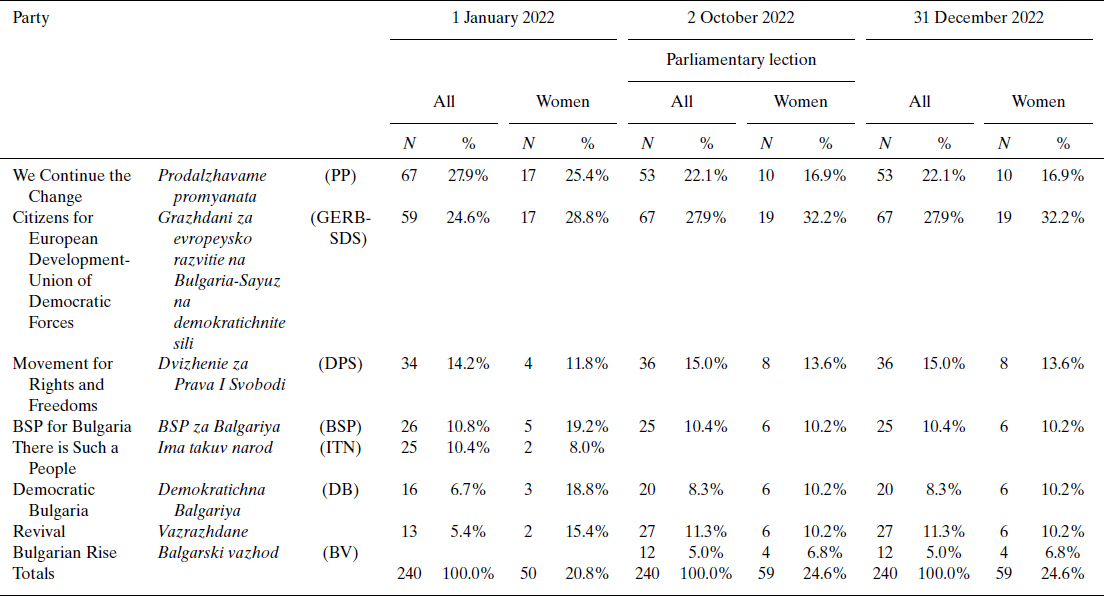
There were two separate legislatures in Bulgaria in 2022. The year started with the 47th National Assembly, elected in the November 2021 elections, which was dissolved on 1 August 2022. The 48th National Assembly was convened on 19 October 2022. The return of GERB as the leading party brought also more women to Parliament, as the percentage of women MPs increased from 20.8 per cent to 24.6 per cent from the beginning until the end of the year (Table 4).
Table 4. Party and gender composition of the Parliament (Narodno Sabranie) in Bulgaria in 2022

Note: The 47th Parliament ended on 29 July. The 48th Parliament started on 2 October. Between 29 July and 2 October, there was no Parliament.
Source: Central Election Commission website (2023) (www.cik.bg/).
Parliamentary activity was mostly focused on securing a majority for the Cabinet, Bulgaria's position on the Russia-Ukraine war, and passing the budget. As mentioned in previous sections, ITN withdrew support from the Cabinet in May, and a vote of no confidence was initiated and held on 22 June 2022. With ITN joining the opposition, Petkov I was voted out of power. With the many delays in parliamentary activities, budget decisions were delayed as well: On 11 February, the Parliament passed the budget for the second quarter of 2022 after seven hours of debates and months of delay. The 48th Parliament could not form a Cabinet, but it had to approve acts of the caretaker Cabinet, such as extending the 2022 budget, as the renewed political crisis prevented the drafting and passing of a new budget.
The war in Ukraine provided another point of disagreement in the Parliament. While the Cabinet supported the EU's line, one of the coalition partners, the BSP, took a neutral position, arguing against sanctions in February, and citing Bulgaria's much greater dependence on imports of energy resources from Russia than the average EU country as a reason to push for neutrality, oppose stationing NATO troops in Bulgaria, and against sending military aid to Ukraine.
Political party report
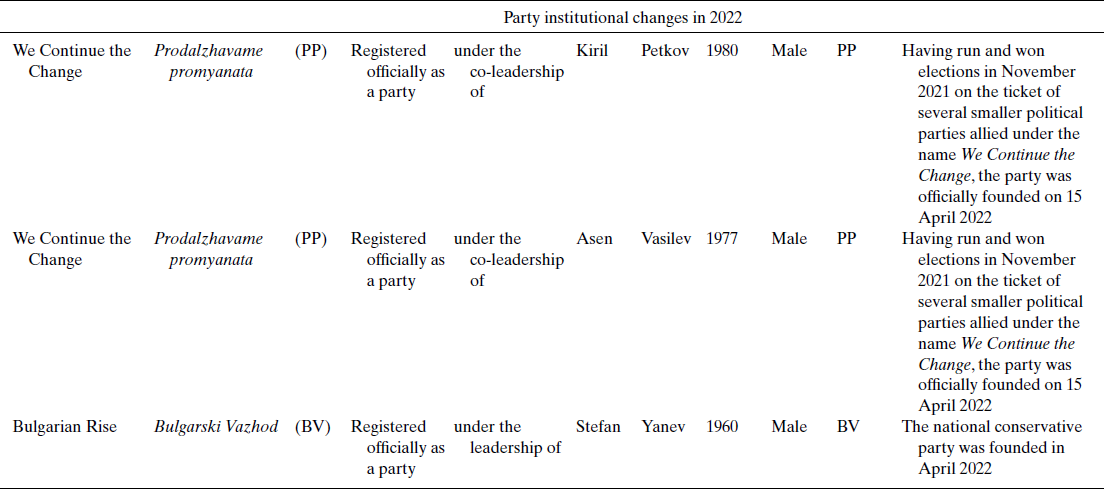
The year 2022 was not that turbulent on the political party development front but still saw some developments (Table 5). A newcomer to political competition emerged in March 2022, when following his replacement as foreign minister, Stefan Yanev formed his own political party, Bulgaria Rise. The plan to form the party was announced publicly in March and officially founded on 5 May 2022. The party self-identifies as a national conservative party, but it is considered an openly pro-Kremlin political force. It passed the 4 per cent threshold and entered Parliament in the October 2022 elections.
Table 5. Changes in political parties in Bulgaria in 2022

Source: See main text.
We continue the change (PP) was also formally established as a political party in April 2022, although it had been politically active since September 2021, when its leaders competed in the elections on the ticket of several smaller political parties, under an alliance with the name PP.
Institutional change report
The Electoral Law underwent one important change in 2022. At the end of the year, GERB, the BSP, and the DPS pushed through a partial reversal of changes made in 2021. In 2021, the use of voting machines was introduced throughout the electoral districts and made mandatory, in order to limit possibilities for buying and controlling electoral votes. In December 2022, the decision was reversed and paper election ballots were allowed again, together with other changes that mandated manual counting and more limited physical privacy for voters. In general, the changes were seen as a step back in the fight against buying and selling votes.
Issues in national politics
Politics in Bulgaria were marked by several important issues during 2022: the legacy of GERB and opposition to it, Bulgaria's position toward Russia, and the rising energy prices and their impact on Bulgaria's population.
The political mood of 2021 was focused on ending GERB's dominance in politics and its rent-seeking practices. In the first half of 2022, the Petkov Cabinet tried hard to dismantle some of these practices, including a short-lived arrest of GERB leader and PM Borissov. GERB reacted by activating their strong local organizations and using their links to various spheres of public life to re-claim their political power. In the October 2022 elections, GERB seemed to have won the battle, although, even as the plurality winner, it had trouble finding allies to govern the country with.
Positions on Russia in general and on the war in Ukraine also rocked the political landscape. Almost immediately after the outbreak of the war, rifts among the politically powerful appeared. Foreign Minister Yanev's ambivalent position (discussed above) was in conflict with the officially stated one and led to his resignation on 28 February. Political ambivalence continued, with the BSP and Revival continuing to demand neutrality. As a result, despite the Cabinet's commitment to supporting NATO, on 4 May, after five hours of debate, Parliament approved the provision of humanitarian, financial, and military-technical assistance, but not arms, to Ukraine. On 28 June, then outgoing Prime Minister Kiril Petkov announced that Bulgaria was expelling 70 diplomats from the Russian embassy in Sofia, but the caretaker Cabinet later in the year did not show such a decisive position. With the President continuing to plea for neutrality and not sending arms, he actively supported the rift in Bulgarian society (Lalov Reference Lalov2023). The end of the year saw the Parliament standing up to him, with the approval of sending military and technical support to Ukraine. Revival and the socialists (with one exception) voted unanimously against the decision. Nevertheless, with several pro-Russian parties in Parliament and an open rift in Bulgaria's society, the position on the war continues to divide the political landscape.
Naturally linked to this issue was the threat of ever-rising energy prices and the impact they might have on the already poor Bulgarian people. GAZPROM has a strong presence in the country, which relies on Russia not only for gas but also for oil. Despite threats that the winter would see people not being able to pay their utility bills, the Cabinet implemented measures to counter these trends and compensations were arranged for. Still, with soaring inflation (15.3 per cent in 2022, almost double the EU average) and an aging population that increasingly relies on state pensions, Bulgaria remains deeply troubled economically.


 Open access

