


Introduction
This study investigates Work Integration Social Enterprises (WISEs), a specific type of non-profit social enterprise that are driven by a socially-oriented mission, which is to create stable job opportunities for people with disadvantages. The focus of the study is a consortium of 22 organizations that operate under the umbrella of Harmony, the fictional name of a WISE founded in Veneto, Italy. In line with recent European research,Footnote 1 WISEs refer to private organizations which have the explicit aim of providing training and direct employment to people with disadvantages, for a limited period of time or in a stable way. The emergence of these organizations responds to the failure of the labour market to employ disadvantaged people (cf. Borzaga, Reference Borzaga1996; Galera, Reference Galera, Becchetti and Borzaga2010; Nyssens, Reference Nyssens, Defourny, Hulgaard and Pestoff2014). Current inequality statistics for Italy indicate that only 30% of people with disabilities are occupied. WISEs produce a variety of products, demanded by public administrations as well as by other businesses. In general, WISEs employ both ordinary and disadvantaged workers (at least 30% in Italy). The latter can have different conditions or circumstances, and in order to match such diversity, WISE can either focus on specific disabilities or on people who are excluded from the labour market for other reasons (e.g. immigrants, unemployed over 50 s, lonely parents). Approaches to work integration may also differ: workers may be trained and then integrated: (a) for a limited period of time, in view of being placed through the labour market with a conventional employer, (b) permanently within the WISE.
How they succeed in this task, what activities, coordination modalities and capabilities support work integration is the topic of this study. We address these questions by exploring the innovative model introduced in the early 1990s by an Italian consortium of WISEs. Specifically, we highlight why this model was needed, and in what ways it provided new solutions to work integration (Demil et al., Reference Demil, Lecocq, Ricart and Zott2015) and public value creation (Desa & Basu, Reference Desa and Basu2013) that were not developed by the public sector or by the labour market, whilst supporting sustainability of revenues (Battilana et al., Reference Battilana, Sengul, Pache and Model2015). The objective is to use our results to contribute to the formulation of new propositions and to the literature on strategy and social enterprise by placing strong emphasis on the prosocial organizational capabilities (PSOC) that support innovation for work integration and public value creation, while retaining economic viability (Bode et al., Reference Bode, Evers, Schulz and Nyssens2006; Doherty et al., Reference Doherty, Haugh and Lyon2014).
The article is structured as follows. Section two briefly presents the theoretical background. Section three describes the research method, details the data collection process, and the data analysis approach. Section four presents the main findings. Section five identifies specific prosocial capabilities. Conclusions identify the contribution and limitations of this work and some research implications.
Organizational Capabilities (OC)
A firm’s capabilities, as Nelson and Winter (Reference Nelson and Winter1982) argued, are the constellations of routines that organizations are able to create, in a way that is complementary and consistent with the technologies and the specificities of activities (Levinthal, Reference Levinthal, Dosi, Nelson and Winter2001). Routines, in this view, are considered as patterns of reactions to specific stimuli (which may come from within or from the environment) which are put in place by groups of actors within the organization. Organizational performances differ since routines (unlike undifferentiated production factors) cannot be exchanged on the market by means of contracts (Teece et al., Reference Teece, Pisano, Shuen, Dosi, Nelson and Winter2001). Early studies placed emphasis on R&D and innovation, and analyzed knowledge intensive sectors (Patel & Pavitt, Reference Patel, Pavitt, Dosi, Nelson and Winter2001), where capabilities have been argued to impact on performance by improving innovation (by means of learning and knowledge creation, acquisition and use) and cost effectiveness (by means of reduction in transaction and production costs). Specialised sets of knowledge have also been identified with “bodies of understanding” and hence as the intangible assets which can lead to the growth of multi-product organizations or to the production of goods that include multiple technologies (Pavitt, Reference Pavitt1998). The focus on R&D was consistent with the original approach that stresses aspects of performance (Garri et al. 2019) for value appropriation rather than social value creation. This is due, in our view, to the fact that, overall, OC have been studied in investor-owned for profit companies. In the literature, control is primarily attached to ownership rights, involving shareholders mainly (Table 3). As known, the problem of investor-centered mono-stakeholder governance is that it focuses on value extraction (Lazonick & Shin, Reference Lazonick and Shin2019) and as such it generates negative externalities and collective action problems (Ostrom, Reference Ostrom1990; Sacchetti & Borzaga, Reference Sacchetti and Borzaga2021) (Table 3). This is especially evident when disabilities are seen as a further opportunity to extract value by business (The Economist, Reference Economist2012). This failure can be mitigated by means of corporate social responsibility strategies and different degrees of stakeholder involvement (Blair & Stout, Reference Blair and Stout1999; Crane, Reference Crane2018), including worker participation (Weiss, Reference Weiss, Addabbo, Ales, Curzi, Fabbri, Rymkevich and Senatori2021). Capabilities have been used to explain performance on strategic areas including corporate environmental strategy (Dragomir, Reference Dragomir2020), corporate social responsibility (Nair and Battacharrya, Reference Nair and Bhattacharyya2019), human resources (Mohrman & Worley, Reference Mohrman and Worley2009; Wright et al., Reference Wright, Dunford and Snell2001).
In WISEs capabilities must be reinterpreted in support of innovation for value creation. In this sense, we focus on the capabilities associated with social innovation, conceived as a transformative solution introduced to unanswered social challenges by stakeholders for the stakeholders. In line with recent contributions, social innovation requires (a) cooperation among stakeholders focused on shared aims and values, (b) prosocial motives, (c) inclusive and multi-stakeholder governance, (d) caps to profit distribution (i.e. Sacchetti, Reference Sacchetti2015; Poledrini et al., Reference Poledrini, Tortia and Degavre2018).
Few studies so far have focused on the OC that support innovative systems for the work integration of people with vulnerabilities, with the exception of those focusing on: social entrepreneurship and scaling-up capabilities (Bloom & Chatterji, Reference Bloom and Chatterji2009), absorptive capacity and internal and external routines for social innovation (Chalmers & Balan-Vnuk, Reference Chalmers and Balan-Vnuk2013), transferability of strategic capabilities from for-profit companies to social enterprises (Jenner, Reference Jenner2016), knowledge management capabilities, emphasizing elements of trust, learning and knowledge sharing needed to serve stakeholders and gain legitimization (Granados & Rosli, Reference Granados and Rosli2020).
What is missing however are more specific studies of the capabilities needed for the work integration of people with diversified disabilities and needs, which in our view would also clarify why conventional companies or the public sector alone may not provide a comprehensive response to this socio-economic challenge and, in parallel, how a diverse model that involves WISEs and users (Osborne & Strokosch, Reference Osborne and Strokosch2013) can produce and co-produce with other public and private actors (Arena, Reference Arena2020; Brandsen & Pestoff, Reference Brandsen and Pestoff2006; Pestoff, Reference Pestoff2018) more social value for specific stakeholders (i.e. users and their families) and for the collectivity. Literature has not explored in depth how the aims and principles underlying the deployment of capabilities can differ depending on institutional diversity, with respect to the firm for-profit or non-profit orientation and specifically when the aim is social innovation for work integration rather than for value appropriation.
Methods
In line with recent contributions to the study of socially oriented organizations (e.g. Tracey et al., Reference Tracey, Phillips and Jarvis2011; Yitshaki & Kropp, Reference Yitshaki and Kropp2016), the research question highlighted in the introduction is addressed using grounded methodology (Corbin & Strauss, Reference Corbin and Strauss1990; Eisenhardt, Reference Eisenhardt1989). This methodology is suitable for a case study where the aim was not to obtain generalizable conclusions, but to identify how WISEs have responded to the marginalization of specific groups and by the growing structural unemployment within a circumscribed locality. Moreover, the phenomenon under scrutiny was not separated from the organizational context.
In Italy, most WISEs take the form of social cooperatives. The 2017 third sector reform, moreover, recognizes by law all social cooperatives as social enterprises. For the cooperative form, the regulator requires that governance is based on membership and democratic representation (Borzaga et al., Reference Borzaga, Poledrini and Galera2017). It also defines the type of activities that social cooperatives can undertake. Depending on activities, the law identifies two types of social cooperatives, named Type A (human and social promotion) and Type B (economic activities to provide employment to disadvantaged persons). A third type is the mixed social cooperative, which integrates activities of the A and B Type. The case study presented here belongs to this combined category.
Description of the Harmony Consortium
To answer our research question we conducted a qualitative, in-depth case study of “Harmony” (fictional name), a consortium of 22 organizations founded in Veneto, Italy, in the early 2000s with the aim of providing rehabilitation, training, and work integration for people facing specific challenges, especially those with minor mental ones. Not all WISEs deal with this category of users, but the case is instructive of a general approach to OC in the context of work integration aims. Because of the degree of complexity of work-integration services in the presence of health-related needs (mainly aspects of preventive psychiatric difficulties in this case), lessons can be learned also for WISEs that may feature a lower degree of complexity (e.g. addressing vulnerabilities of young people, young mothers, long-term unemployed, asylum seekers, former prisoners, etc.). A distinctive feature of this case is that the approach to rehabilitation privileges users’ active role as workers, and aims at being independent of public subsidies. For this reason, this case offers also an angle on WISE policy and practice.
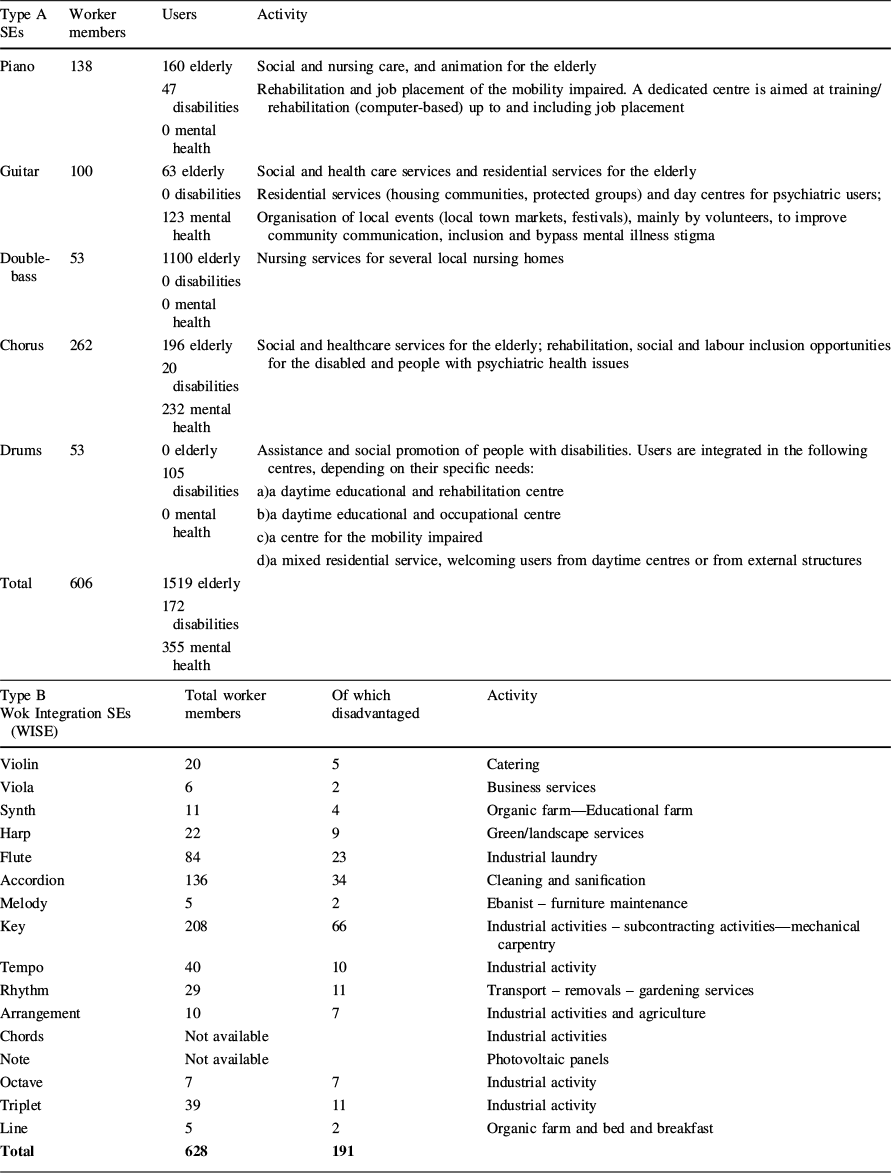
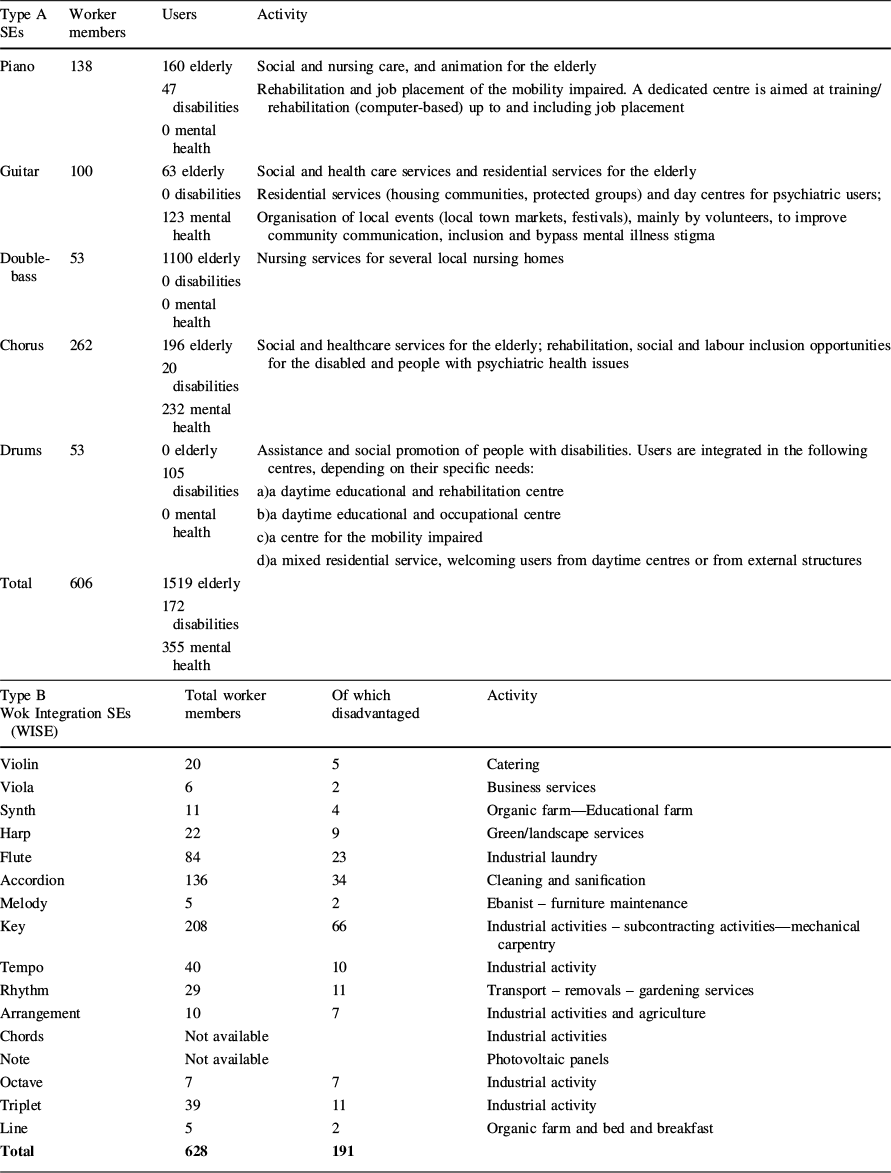
The case was approached with account taken of the strategies adopted by the consortium as a work integration system that coordinates Type A and Type B cooperatives, and how these strategies were socially effective and sustainable. The Harmony consortium is a second-tier cooperative, where members are Type A and Type B cooperatives that together form a work integration filière. The synergies between Type A and Type B organizations within the consortium are functional to support (dominantly with training, assistance and social promotion) and implement (with employment) work-integration and overcome the failures observed in public sector day centers and in conventional enterprises. Type A organizations carry out several activities beyond training. Although some Type A organizations are directly engaging in training and work-related competence creation, others offer different services (e.g. housing), which aim at creating life independence skills and are complementary to the work-integration project. Others, such as the care homes for the elderly, are not part of the work integration filière, but are sources of surplus to be reinvested in work-integration activities (see Table A). In Type A cooperatives, economic reward for users is progressive, and depends on the possibilities, effort, and results achieved by users. While in training, users receive a symbolic economic reward (“borsa lavoro”), which is partly funded by the public sector and in part by the demand that Type B cooperatives transfer to Type A cooperatives. The reward grows as users learn and can increase effort. When integrated in Type B cooperatives, users receive a salary equal or comparable with the salary of ordinary workers. Overall, the consortium coordinates production across complementary organisations and activities, it ensures financial stability by holding assets and collecting resources from single cooperatives and redistributing resources depending on the shared strategy decided at consortium level and coordinating with the public sector.
When this study was undertaken, the consortium occupied over 1200 workers in total. In Type A cooperatives workers were 606, attending 172 users with disabilities and 355 users with mental health issues and 1519 elderly persons. In Type B cooperatives there were 628 worker members, of which 191 are disadvantaged (Table A).
Data Collection Instruments
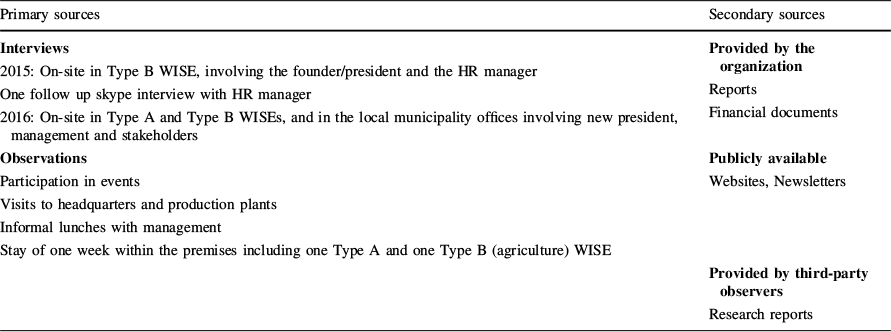
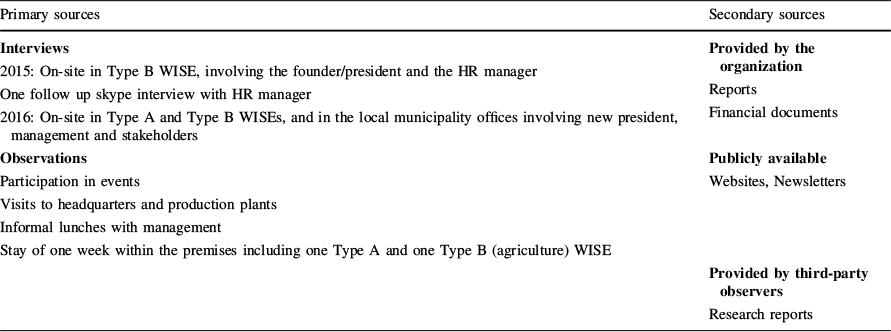
Using multiple interviews, field observations, archival data, we develop insights into the centrality of the cooperative project and the capabilities that supports it. Table 1 illustrates the primary and secondary data sources used to develop this case study. Overall, the goal of the interviews was to learn about the history of the consortium, the relation between the consortium and the stakeholders, and to map organizational solutions and strategies, assessing in what (novel) ways these could address work-integration challenges. In particular typical aspects of firm studies such as governance (Putterman, Reference Putterman1993), inter-firm division of labour (Richardson, Reference Richardson2003), technology (Teece, Reference Teece1982), and finance (Lazonick & Shin, Reference Lazonick and Shin2019) were addressed with apical figures. Interviews lasted between thirty minutes and two hours. They were digitally recorded and fully transcribed.
Table 1 Data sources
Primary sources |
Secondary sources |
|---|---|
Interviews 2015: On-site in Type B WISE, involving the founder/president and the HR manager One follow up skype interview with HR manager 2016: On-site in Type A and Type B WISEs, and in the local municipality offices involving new president, management and stakeholders |
Provided by the organization Reports Financial documents |
Observations Participation in events Visits to headquarters and production plants Informal lunches with management Stay of one week within the premises including one Type A and one Type B (agriculture) WISE |
Publicly available Websites, Newsletters |
Provided by third-party observers Research reports |
Data Collection Process and Respondents
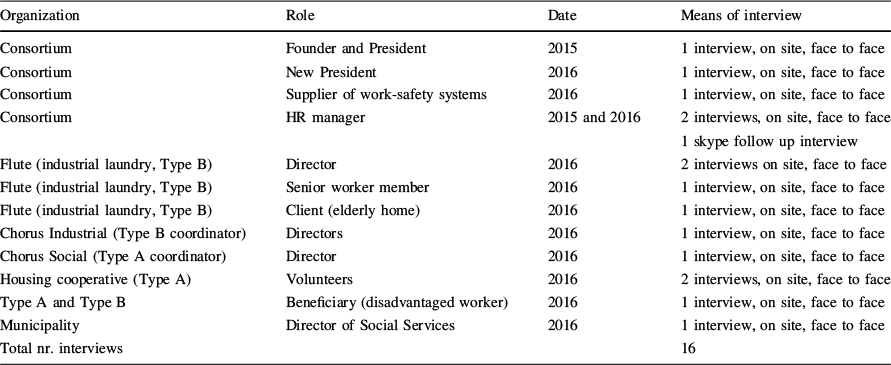
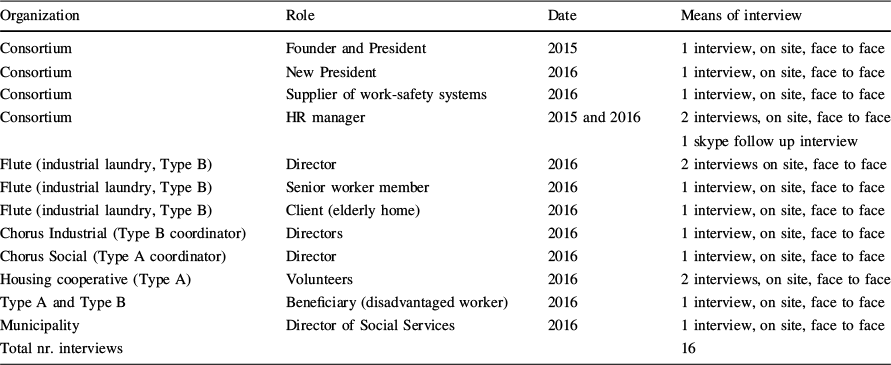
Sixteen unstructured interviews were conducted between 2015 and 2016. Table 2 summarises the details of the interviewees. In parallel, extensive, informal conversations were held with the consortium HR and communication managers, who were key players in identifying key informants in apical positions and accessing internal and external stakeholders (details in Table 2).
Table 2 Interview details
Organization |
Role |
Date |
Means of interview |
|---|---|---|---|
Consortium |
Founder and President |
2015 |
1 interview, on site, face to face |
Consortium |
New President |
2016 |
1 interview, on site, face to face |
Consortium |
Supplier of work-safety systems |
2016 |
1 interview, on site, face to face |
Consortium |
HR manager |
2015 and 2016 |
2 interviews, on site, face to face 1 skype follow up interview |
Flute (industrial laundry, Type B) |
Director |
2016 |
2 interviews on site, face to face |
Flute (industrial laundry, Type B) |
Senior worker member |
2016 |
1 interview, on site, face to face |
Flute (industrial laundry, Type B) |
Client (elderly home) |
2016 |
1 interview, on site, face to face |
Chorus Industrial (Type B coordinator) |
Directors |
2016 |
1 interview, on site, face to face |
Chorus Social (Type A coordinator) |
Director |
2016 |
1 interview, on site, face to face |
Housing cooperative (Type A) |
Volunteers |
2016 |
2 interviews, on site, face to face |
Type A and Type B |
Beneficiary (disadvantaged worker) |
2016 |
1 interview, on site, face to face |
Municipality |
Director of Social Services |
2016 |
1 interview, on site, face to face |
Total nr. interviews |
16 |
In 2015 we first interviewed the founder and then president, just before he retired, alongside the HR manager. A series of on-site interviews were then conducted in 2016, when we interviewed the new president in charge, and the presidents of the two coordinating cooperatives for Type A and Type B activities, as well as the directors of the industrial laundry which had recently introduced some radical technological innovation, and a housing cooperative.
Interviews with internal stakeholders, included two volunteers (senior and junior), one founding member worker of the above-mentioned industrial laundry. Extensive interviews with users were not possible since the process were judged to be potentially stressful for the interviewees and would have required extra research resources. The HR manager however identified one beneficiary for whom the interview was possible, since the person was close to completion of the work integration programme. We interviewed also external stakeholders, involving one key technology supplier, one private sector client, and a key public sector administrator who had been a long-term partner of the consortium. These participants, given research contingencies and opportunity, were identified with the HR manager to provide a perspective on external stakeholder experiences.
Data analysis was undertaken through a number of stages. During the first phase the focus was on: history data, work integration, organizational architectures and production practices for work integration. As research progressed, emerging themes were identified (first order) and grouped into common themes (second order) (Corbin and Strauss Reference Corbin and Strauss1990). These indicated a further dimension, evidencing a capability-based dimension of work integration (Fig. 1).

Fig. 1 Analysis of themes
Findings
As the consortium was developed and new needs emerged, diversification across sectors of activities allowed more users to access work integration. It also appeared that the key integration modality was work and its subdivision into tasks with different degrees of complexity. Production organization, together with cooperative governance solutions that link social and market-oriented organizations, enabled the achievement of social intents, while remaining economically sustainable.
These consortium’s features were embedded in each organization and emerged as shared complementary routines that provided the scope for integrating activities across the consortium. These routines enabled:
a) Diversification
b) Legitimisation
c) Division of labour between type A and B organizations
d) Technological innovations to serve work-integration and financial sustainability
e) Financial innovations that support the diversification and scaling up of activities using endogenously generated resources rather than equities.
Diversification and Legitimisation
A complex system emerged over time, building on localized assets and on the experience of the founder (a former trade-unionist) who gathered a group of nurses looking for occupation to form the first enterprise (Chorus) of the Harmony consortium. At that time, Chorus was a care home for the elderly that hosted, within the same premises, also younger people with disabilities (mostly psychiatric). This situation was not beneficial for the elderly, nor for the psychiatric patients, who were often working-age individuals with the need to be reintegrated into the community and live an autonomous and rewarding life. This represented the main, yet unsatisfied, societal challenge and opportunity, since it was obvious that nursing homes were unsuitable for this purpose. On the other hand, publicly run day centres were not addressing the causes of marginalisation. “The public health services had a day centre where people made and unmade things. There was no meaning. Users value the sense of performing useful and concrete work” (Consortium HR manager, 2015). As a consequence, centres were poorly attended. “So, we had the idea of setting up our work integration cooperatives. Simple stuff.” (Founder and 2015 consortium’s president).
A process of diversification started, and generated further organisations, which converged towards a second-tier cooperative. Whilst elderly care was still provided, Chorus diversified into the provision of activities for psychiatric conditions and created a new organization for rehabilitation and educational services. These services were organized around the idea of workshops where people could learn a profession, commitment and respect for the work of colleagues, relatedness and belonging. As noted by a user: “I … started doing a little job, there is a laboratory near the community, assemblages are made, a very simple thing, but just to start with and a bit at a time I improved my relationships with others, the desire to confront myself with others and also work. There I got used to work again, to want to do things too…” (User, 2016).
The simple components produced in the workshops were part of a complex production system orchestrated throughout the consortium by means of an intentional design of coherent organizational structures and a constellation of inclusive practices and technologies used by all the cooperatives and their workers, ordinary and with difficulties. Consequently, beneficiaries gained (in the words of the founder) “a sense of purpose” and belonging, as well as a symbolic payment, which increased as skills and work performance grew. Specific transport arrangements (a reserved bus to pick up each patient and the development of a personal relationship with the bus driver) were encouraged. These practices were intended to form a system of monetary and mostly non-monetary incentives ensuring that beneficiaries attached meaning to their work and to relationships with other people in the workshop. This entire model built on a very specific local cultural ethos, described by the HR manager “… in the Veneto region, work is part of a person’s identity, and not having an occupation, even with a disability, is equated to a loss of dignity (“Harmony” HR manager, 2015). A worker notices “and being busy, having a salary, being autonomous, gives the persons their dignity” (ordinary worker and cooperative member, 2016).
Following the first initiative, more day centres were established, alongside housing services. At the time, users who had recovered autonomy were introduced into the job market within a network of local commercial enterprises. “But users, after a first period, came back to rehabilitation. They went into crisis, and simply quit. Then we discovered that they had quit not so much because the company did not want them, but because they had colleagues on the shop-floor that laughed at them” (Founder and 2015 President). To respond, further diversification instituted Type B cooperatives. This financial model has also been functional to the development of internal demand within the consortium. Table A provides anonymized information on activities, workers and users.
Legitimization came primarily from the socio-economic benefits evidenced by the consortium model (consistent with Su, Zho and Zhang, 2019). “I have been in the cooperative for 22 years. I saw it taking its first steps … I saw this structure growing, … and like ‘mushrooms’ new cooperatives all sprang up within these three local health districts. And it makes you understand the value there is in investing, in believing in the community, in reinvesting to return resources to the local area, because the community then learns to know you and therefore believes in your project…” (“Chorus Industria” Type B, 2016 President). The financial viability of the model strengthened legitimization also with respect to social service costs. As a number of directors emphasized, by integrating workshop activities into industrial production, the cost of users’ bursaries within Type A organizations was only in part covered by the public sector (about 50%), since another half came from each Type B organization’s earned income. For the public sector this meant reducing welfare expenditures (consistent with Chiaf & Miniaci, Reference Chiaf and Miniaci2015). Social value creation was also evidenced by the spatial regeneration induced by the consortium’s investments in rural areas.
Obtaining the legitimization of the model, however, was initially problematic among the public administration (specifically the medical community) which viewed the project with suspicion as well as with the business community (which perceived Type B cooperatives as competitors). This resonates with what said by one user. In his city of origin (where he had been cured in a mental health centre) “it was therapy and therapy and therapy. There were no alternatives. … Here, however, the system is completely different … People have helped me—I don't know how much—to get out of this critical situation …” (User, 2016). One of the most notable effects of the model was the production of a cultural change among local institutions, local businesses and the community to overcome prejudice against situations of personal vulnerability. “Workshops have been taken to local school children “against the stigma of mental illness and therefore prejudice.” (“Chorus Sociale” Type A, president 2016). Also, the founder engaged with the public administrator in the creation of new practices, which were then transformed in new administrative rules for co-programming and co-production, at a time (in the 1990s) when the national and European indication was instead to use competitive bids. “It has been a difficult journey in which each partner renounced some of its rigidities to enter a domain that was in part unknown. People were visionary. There was a dialogue among institutions; it has been a cultural journey” (Head of municipal social services, 2016). This finding reflects what has been observed also in other work integration social enterprises (i.e. Pattinson, Reference Pattinson2020).
Division of Labour
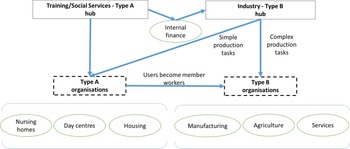
More organizations were created over time to integrate workers. The proliferation of complementary organizations increased coordination needs, and led to the creation of the consortium, a cooperative of cooperatives, which brought cooperatives of Type A and Type B under a unitary organization. Those of Type A were coordinated by “Chorus Sociale” (the social branch of the consortium) and those of Type B by “Chorus Industria” (the industrial branch of the consortium). “Chorus Industria is, let’s say, the heart of work integration… It passes on the work to the day workshops. Mincing, chopping the complex production processes into simpler processes that can be allocated to guided work centres, so that even the most seriously ill user is able to perform the job.” (“Chorus Industria” Type B hub; 2016 President). Figure 2 illustrates the structure of the consortium, the internal division of labour between Type A and Type B cooperatives, the sectors of activities, and the internal and external flows of resources.
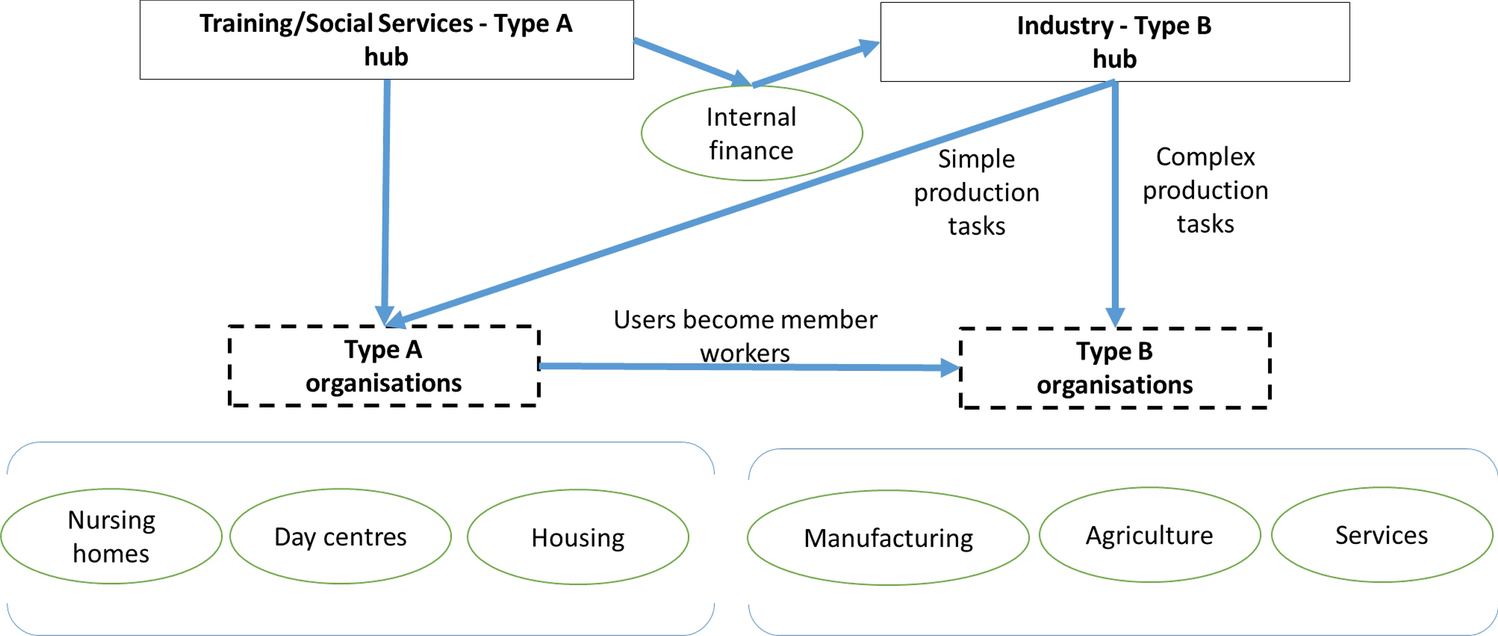
Fig. 2 The consortium integrated work-integration system
Technological Innovations
The work-integration system described above subverts the meaning and use of repetitive work. Instead of being outsourced, repetitive work takes a central role, as acknowledged in other WISE studies (Narayanan & Terris, Reference Narayanan and Terris2020). It has been brought back to the shop floor as the main work-integration resource. Long-term collaboration with a commercial supplier providing technologies for work safety are aimed at identifying solutions to reduce the negative impacts of repetitive work. As noted: “If the mission is inclusion, everything that creates an obstacle to this is seen as harmful…. (Health and safety services supplier, 2016). This eventually lead to the patenting of solutions for work safety and occupational health.
Likewise, major industrial automations that fit the production process have been designed and patented in partnership with commercial specialised suppliers to enable disadvantaged workers to perform their tasks, whilst keeping sustainable levels of productivity, increasing the quality of services and market competitiveness for Type B organizations. In order to be economically viable, these enterprises needed to find not only market demand to sustain marginalised workers (30%) but also corresponding levels of occupation for ordinary workers (70%). Technology and its innovation embed the coherent set of principles that guide work-integration as well as economic sustainability under market pressures. This, to provide an illustration, was the idea underpinning the R&D collaboration with a Swedish specialized supplier that lead Flute (industrial laundry) to invest in a new plant that could reduce mistakes in the labelling of clothes and allow users with difficulties to be integrated, while improving service quality for clients. As noted: “With the consortium we decided to invest in technology not to cut jobs but to give opportunities to work to those who are less able … We are within the social and labour economy. This refrains us from thinking in a strictly capitalist way. We put people at the centre. That's the philosophy of the consortium” (Flute, Type B, President’s inaugural speech, 2015).
Financial Innovations
The main challenges of this model were related to financial sustainability vis à vis the 20 million Euro investments required to meet market demand for goods and for social services, while creating social value. The inclusion of a local cooperative bank in the consortium made it possible to finance growth through debt, to complement endogenously generated resources. The surplus produced by single cooperatives was entirely shared and re-invested across the consortium, beyond what is required by the regulator. Type A cooperatives, including those which are not part of the work-integration filière, are less subject to market competition since they work in co-production of services with the public administrations or because they offer services for elderly people, which are in high demand. Financially they are more stable and they shared their surplus for the growth of the work-integration Type B cooperatives. This sometimes created tensions among cooperatives which, at the time this study was undertaken, were managed and handled under the leadership of the founder. Further developments, following generational change, will require attention in this respect.
Through reinvestment, funds were also leveraged from public administrations and a local cooperative bank on specific projects. No equities have ever been used. Moreover, in 2006 the consortium instituted a Consortium Solidarity Fund. This was an internal financial asset managed collectively. Funds were raised by contributing 0.10 euro cents per hour worked across the consortium. Every year 150 thousand euros ca. were collected, and the fund were for Type B to use, to finance new projects or new enterprise development, interpreting a reciprocity principle across member cooperatives.
Physical assets were also managed collectively through one ‘scope’ organization. This is a real estate cooperative within the consortium that built and owns all the estates of the cooperatives in the consortium. This solution allowed to internalize within the consortium all of the investments in industrial buildings and reduce the risks associated with asset specificity.
Also, financial sustainability was pursued, in parallel, by ensuring long-term contracts, and also by developing strong private–public partnerships. “We have invested twenty million in public facilities…These were about activities and services that we shared with the public administrations…We invested and built what was lacking, clearly in exchange for twenty-year contracts for the management of those services. So in twenty years I amortise the investment but at the same time I invent new jobs and employment” (Founder and 2015 President).
Organizational Prosocial Capabilities
The emerging themes summarised in Fig. 1 group the features which are functional to work integration. These themes suggest the presence of a further level, which concerns the unexplored analogy between organizational features and OC in the study of work integration. We identify the roots of innovative work integration in three distinct sets of OC, which we label prosocial: the capability to include stakeholders, to learn, and to grow by diversification.
Our interpretation is that all the emergent themes are encompassed within the PSOC. These represent the main features of this model and its effectiveness in producing social and economic value. They are the source of the consortium’s advantage with respect to other solutions. The public sector or the commercial for-profit solutions, as it emerges, could not replicate a composite organizational and production system entirely aimed at work integration and employment protection. The indication is that work-integration builds on core socially-oriented competences which allow for the constant introduction of new solutions in production, finance, use of technology, ways of relating with communities. These capabilities allowed the consortium to scale-up by means of new spin-off cooperatives. The constant tension towards capturing emerging needs and the development of the capabilities that support it on the other, have designed the structure of the consortium and the effectiveness of this model in creating value rather than extracting it from communities.
Capability to Include Stakeholders
This involves the presence of a structure and specific processes for the inclusion of multiple actors, especially the most vulnerable. On the one hand, this prosocial organizational capability is underpinned by the cooperative business form, which is based on membership and democratic governance. It is therefore conceived to integrate in the governing bodies the needs of users and other internal stakeholders (workers and volunteers). On the other hand, interviewees observed that the integration of users requires a long process. Infact, the dominant stakeholder is the ordinary worker. In this sense stakeholder inclusion does not happen simply as a reply to the legal requirements in place for social cooperatives (consistent with Colenbrander et al., Reference Colenbrander, Argyrou, Lambooy and Blomme2017), nor it arises solely or specifically from organizational governance, with ordinary workers and volunteers as the main participants. Rather, it needs to be supported by explicitly organizing production and technology (in partnership with technology suppliers), finance (within the consortium and with the support of a local bank), supporting policies (with the local administration), and local events (with other community constituencies) for inclusion. Most evidently, the consortium has supported a novel way to conceive technological development and innovation, since innovation was not introduced to cut labour costs, but to allow workers to access job tasks. For example, in the case of Flute (automated industrial laundry) the industrial plant was entirely re-designed to ensure three outcomes: higher service quality, inclusion of vulnerable workers, and a sustainable level of labour productivity.
We have also observed that the model’s effectiveness in creating highly effective work integration and at lower costs, as well as general employment in the community are crucial sources of legitimization. These results are consistent with Thompson et al. (Reference Thompson, Purdy and Ventresca2018) who evidence that, in the context of social business, ecosystems bottom-up interactions that build on shared meaning, resources and infrastructures are more effective than top-down actions.
Capability to Learn and Innovate
Observations suggest that this strategic capability is transversal to all other capabilities, dynamic and evolutionary, since it refers to the development of a structure and a system of practices which are able to generate responses to the emerging diversity and complexity of user needs, regulatory context, and market challenges. Learning capabilities have allowed the consortium and its members to reinterpret existing problems and generate new understandings and solutions (Aldrich & Fiol, Reference Aldrich and Fiol1994). The creation of a coherent set of structures, endogenous financial tools, practices and technologies has facilitated the transferability and learning of production skills as well as of cooperative behaviours across the consortium and beyond, at territorial level, to reach other community constituencies. Using their capability to learn, the organizations of the consortium introduced modalities that were innovative and more effective than other approaches (e.g. public sector, private for-profit sector work integration). They tapped into existing local resources and then enriched them, reinforcing shared solidarity values, local social capital, human capital, financial resources, discovering and regenerating them from the outset. This happened since the early stages of this experience, when the founder could start the first elderly care organization and then the first work-integration cooperative by building on localised social capital, tapping into the nursing school for healthcare related personnel, and into a large group of early retired workers from local small and medium manufacturing firms (the so-called “maestri d’arte”) to get experts who could teach production skills to users.
Capability to Grow by Diversifying
Occupational opportunities had to be diversified. Some user attitudes and needs could be more effectively met in agriculture and service provision (cleaning and landscape/gardening services). The necessity to constantly search for renewed solutions has to do with the already mentioned changing needs and environment. The literature posits that an organization can deploy its capabilities in different domains by means of diversification. In particular, the theory of the multi-product firm is clear on the fact that profit-oriented firms aim at capturing positive externalities by diversifying under a common organizational structure (Helfat & Eisenhardt, Reference Helfat and Eisenhardt2004; Penrose, Reference Penrose1959; Sakhartov & Folta, Reference Sakhartov and Folta2014; Teece, Reference Teece1982). Instead, at Harmony, diversification is functional to meeting multiple users and needs (a gradual move from emotional rehabilitation, learning skills and later employment) and creating more jobs overall within the community. Differently from conventional for-profit enterprises, the consortium shows that the internalisation of social value, or positive externalities, through diversification is instrumental to the reduction in socio-economic exclusion and structural unemployment, and therefore to the intentional creation of more positive externalities at collective level (e.g. lower social exclusion, higher occupational rates, lower welfare costs) and benefits for users. This is consistent also with more general argument around multi-product non-profit enterprises (Oster, Reference Oster, Seaman and Young2010).
By means of diversification, OC were applied across organizations at low marginal costs by means of Type A and Type B spin-offs, as the evolution of the consortium demonstrates. The value of each new organization created within the consortium depends on the variety it adds, or on the degree of complementary diversity of the new activity with respect to existing ones. In this model, the multi-product organization is a way to enhance vulnerable stakeholder opportunities and participation in the economic system, rather than a way to extract value for profit. This requires “dynamic capabilities” (Eisenhardt & Martin, Reference Eisenhardt and Martin2000), or that established competences are not seen as fixed. Besides being used across the organizations, they also need to adapt and evolve consistently, should users’ needs, local employment needs, and market conditions change.
Discussion: Reinterpreting Strategic Capabilities for Wises
Summary of the Main Findings
Altogether, the model described represents a specific social innovation, that is aimed at work integration problems, supported by mutually reinforcing prosocial capabilities. The consortium provides an organizational context in which to support inclusion and the creation of work opportunities in an efficient and effective manner by developing distinctive ways of including stakeholders, learning and growing by diversification. Through these capabilities the consortium bridges intents and actual outcomes, using coordination mechanisms that focus on cooperative governance, endogenously generated capital, division of labour, prosocial use of technology that enable competitive levels of productivity. This way of organizing activities shows continuity across the consortium and over time, and makes the organization distinct from alternatives such as public administrations and for-profit solutions. It taps well into the evolutionary way of thinking for which a variation (from the public solution) leads to selection (it becomes the most efficient and effective alternative) and then to retention (since the model persists over time).
Theoretical Implications
We can finally posit that in WISEs capabilities should be defined as consistent sets of prosocial organizational routines which enable solutions to complex neglected issues (such as the integration of disadvantaged categories) and which explicitly work towards the creation of social value. PSOC are retained if, in line with the aims of WISE, they are able to produce benefits for stakeholders and for the community while providing a competitive advantage that ensures the economic sustainability of the organization. The analysis contributes to the OC literature by adapting the notion to a context different from for-profit organizations, where the same notion of competitiveness for value appropriation is bypassed by the social goal which requires that value for society is produced in excess of what organizations actually appropriate (Sacchetti & Borzaga, Reference Sacchetti, Borzaga, Sacchetti, Cristoforou and Mosca2020; Santos, Reference Santos2012; Saebi et al., Reference Saebi, Foss and Linder2019). In particular, it may be hypothesised that the greater the degree to which WISEs are able to respond to complex integration needs and business demand for services, the greater the likelihood that PSOC are present and will evolve. A corollary hypothesis may be that the greater the degree to which OC support growth and evolve, the greater the likelihood of creating more work integration opportunities and societal value.
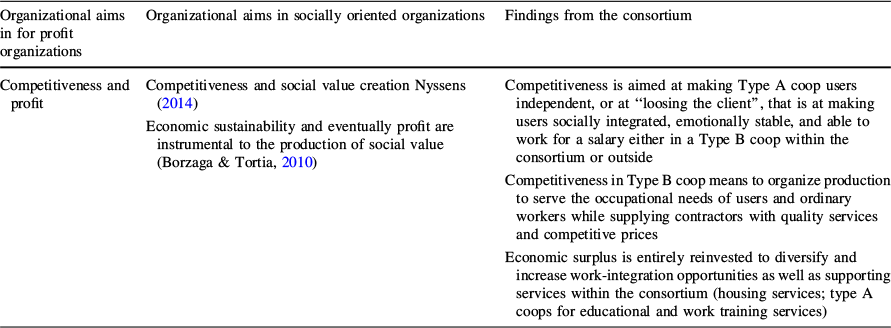
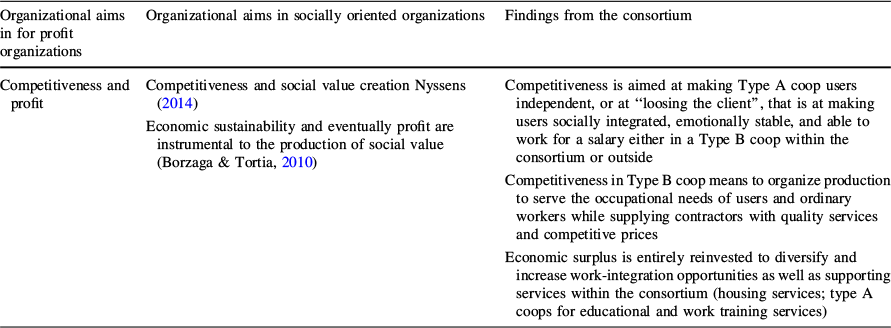
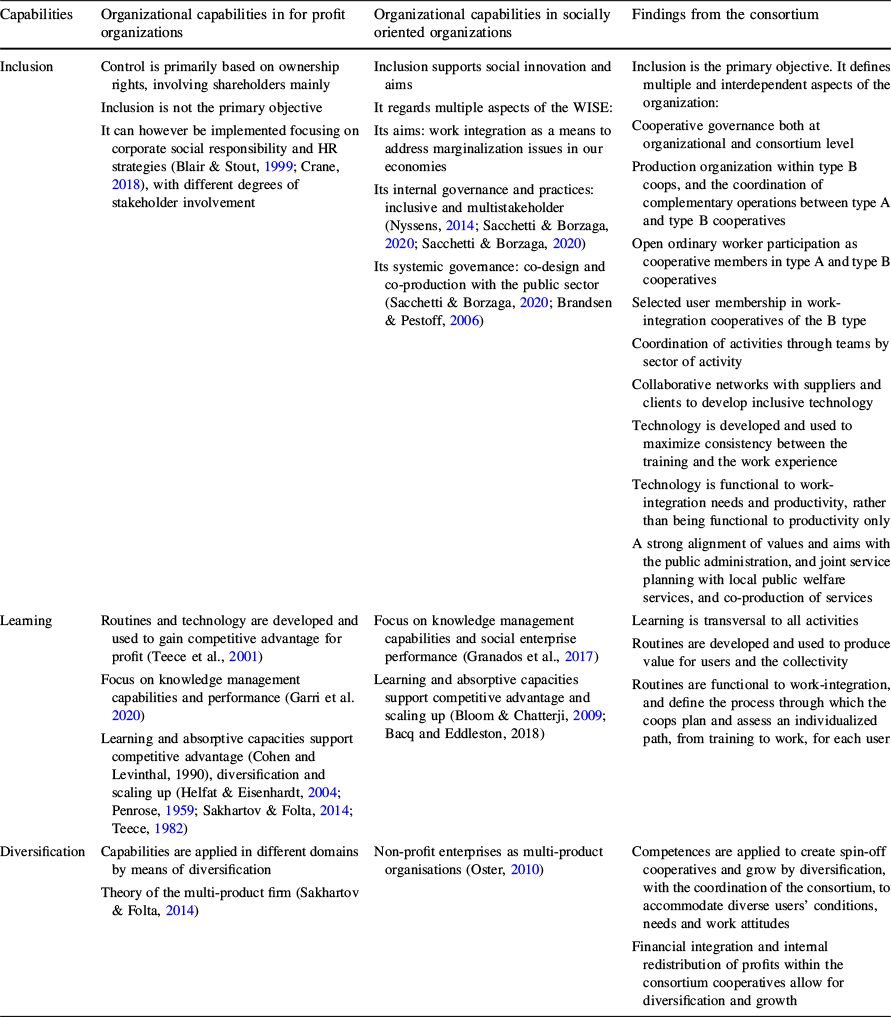
In Tables 3 and 4 we reconnect with the first Sections and synthetically compare our findings on prosocial organizational aims and capabilities both with the results highlighted by the literature on for profit companies, and the emerging studies on socially oriented organizations.
Table 3 Organizational objectives compared
Organizational aims in for profit organizations |
Organizational aims in socially oriented organizations |
Findings from the consortium |
|---|---|---|
Competitiveness and profit |
Competitiveness and social value creation Nyssens (Reference Nyssens, Defourny, Hulgaard and Pestoff2014) Economic sustainability and eventually profit are instrumental to the production of social value (Borzaga & Tortia, Reference Borzaga, Tortia, Becchetti and Borzaga2010) |
Competitiveness is aimed at making Type A coop users independent, or at “loosing the client”, that is at making users socially integrated, emotionally stable, and able to work for a salary either in a Type B coop within the consortium or outside Competitiveness in Type B coop means to organize production to serve the occupational needs of users and ordinary workers while supplying contractors with quality services and competitive prices Economic surplus is entirely reinvested to diversify and increase work-integration opportunities as well as supporting services within the consortium (housing services; type A coops for educational and work training services) |
Table 4 Organizational capabilities compared

Capabilities |
Organizational capabilities in for profit organizations |
Organizational capabilities in socially oriented organizations |
Findings from the consortium |
|---|---|---|---|
Inclusion |
Control is primarily based on ownership rights, involving shareholders mainly Inclusion is not the primary objective It can however be implemented focusing on corporate social responsibility and HR strategies (Blair & Stout, Reference Blair and Stout1999; Crane, Reference Crane2018), with different degrees of stakeholder involvement |
Inclusion supports social innovation and aims It regards multiple aspects of the WISE: Its aims: work integration as a means to address marginalization issues in our economies Its internal governance and practices: inclusive and multistakeholder (Nyssens, Reference Nyssens, Defourny, Hulgaard and Pestoff2014; Sacchetti & Borzaga, Reference Sacchetti, Borzaga, Sacchetti, Cristoforou and Mosca2020; Sacchetti & Borzaga, Reference Sacchetti and Borzaga2020) Its systemic governance: co-design and co-production with the public sector (Sacchetti & Borzaga, Reference Sacchetti, Borzaga, Sacchetti, Cristoforou and Mosca2020; Brandsen & Pestoff, Reference Brandsen and Pestoff2006) |
Inclusion is the primary objective. It defines multiple and interdependent aspects of the organization: Cooperative governance both at organizational and consortium level Production organization within type B coops, and the coordination of complementary operations between type A and type B cooperatives Open ordinary worker participation as cooperative members in type A and type B cooperatives Selected user membership in work-integration cooperatives of the B type Coordination of activities through teams by sector of activity Collaborative networks with suppliers and clients to develop inclusive technology Technology is developed and used to maximize consistency between the training and the work experience Technology is functional to work-integration needs and productivity, rather than being functional to productivity only A strong alignment of values and aims with the public administration, and joint service planning with local public welfare services, and co-production of services |
Learning |
Routines and technology are developed and used to gain competitive advantage for profit (Teece et al., Reference Teece, Pisano, Shuen, Dosi, Nelson and Winter2001) Focus on knowledge management capabilities and performance (Garri et al. Reference Garri, Spicer, Pereira, Temouri, Malik and Tarba2020) Learning and absorptive capacities support competitive advantage (Cohen and Levinthal, 1990), diversification and scaling up (Helfat & Eisenhardt, Reference Helfat and Eisenhardt2004; Penrose, Reference Penrose1959; Sakhartov & Folta, Reference Sakhartov and Folta2014; Teece, Reference Teece1982) |
Focus on knowledge management capabilities and social enterprise performance (Granados et al., Reference Granados, Mohamed and Hlupic2017) Learning and absorptive capacities support competitive advantage and scaling up (Bloom & Chatterji, Reference Bloom and Chatterji2009; Bacq and Eddleston, 2018) |
Learning is transversal to all activities Routines are developed and used to produce value for users and the collectivity Routines are functional to work-integration, and define the process through which the coops plan and assess an individualized path, from training to work, for each user |
Diversification |
Capabilities are applied in different domains by means of diversification Theory of the multi-product firm (Sakhartov & Folta, Reference Sakhartov and Folta2014) |
Non-profit enterprises as multi-product organisations (Oster, Reference Oster, Seaman and Young2010) |
Competences are applied to create spin-off cooperatives and grow by diversification, with the coordination of the consortium, to accommodate diverse users’ conditions, needs and work attitudes Financial integration and internal redistribution of profits within the consortium cooperatives allow for diversification and growth |
Recommendations for Future Research
Research on prosocial capabilities in WISEs can advance the agenda in important ways. First, it can provide illustrations of what OC are required by non-profit organizations, how they are developed consistently with prosocial aims and gain continuity. Second, it indicates how capabilities in a non-profit environment can be oriented towards the creation of social value rather than its appropriation. Third, it indicates how capabilities may change over time as a result of external market stimuli and new societal challenges. These themes could benefit further from comparative analysis on how PSOC differ across non-profit sectors of activity, for instance health, education, and culture. Last, since our study is based on case analysis, findings cannot be generalized. Additional research that considers other cases and extended survey analysis reaching out to a wider population of WISEs could contribute towards this limitation.
Acknowledgements
I wish to thank Carlo Borzaga and Ermanno Tortia for their support and scholarship, and Alistair Anderson for valuable comments on an earlier version of this work. Background knowledge to the case was provided by colleagues at Euricse and in particular Carlo Borzaga and Flaviano Zandonai. I wish to thank all the people I met at the consortium and the Municipality for their time and their interest in this project.
Funding
Open access funding provided by Università degli Studi di Trento within the CRUI-CARE Agreement. This work was initially supported by the Open University and by British Academy/Leverhulme Small Grants under Grant No. SG150560 and, in its final stages, by the Autonomous Province of Trento under Euricse (Trento, Italy).
Data Availability
The interview and archival data (in Italian) for this research are available if requested. Relevant extracts for this paper have been translated in English and available if requested. Early research results have been published in the Euricse working paper series, and in the practice-oriented journal “Impresa Sociale”.
Declarations
Conflict of interest
The author declare that they have no conflict of interest.
Appendix
See Table
Table 5 Specification of “Harmony” SEs and their activities (year 2011)
Source: Consortium publication, 2011. Organization names are fictitious
Type A SEs |
Worker members |
Users |
Activity |
|---|---|---|---|
Piano |
138 |
160 elderly 47 disabilities 0 mental health |
Social and nursing care, and animation for the elderly Rehabilitation and job placement of the mobility impaired. A dedicated centre is aimed at training/rehabilitation (computer-based) up to and including job placement |
Guitar |
100 |
63 elderly 0 disabilities 123 mental health |
Social and health care services and residential services for the elderly Residential services (housing communities, protected groups) and day centres for psychiatric users; Organisation of local events (local town markets, festivals), mainly by volunteers, to improve community communication, inclusion and bypass mental illness stigma |
Double-bass |
53 |
1100 elderly 0 disabilities 0 mental health |
Nursing services for several local nursing homes |
Chorus |
262 |
196 elderly 20 disabilities 232 mental health |
Social and healthcare services for the elderly; rehabilitation, social and labour inclusion opportunities for the disabled and people with psychiatric health issues |
Drums |
53 |
0 elderly 105 disabilities 0 mental health |
Assistance and social promotion of people with disabilities. Users are integrated in the following centres, depending on their specific needs: a)a daytime educational and rehabilitation centre b)a daytime educational and occupational centre c)a centre for the mobility impaired d)a mixed residential service, welcoming users from daytime centres or from external structures |
Total |
606 |
1519 elderly 172 disabilities 355 mental health |
Type B Wok Integration SEs (WISE) |
Total worker members |
Of which disadvantaged |
Activity |
|---|---|---|---|
Violin |
20 |
5 |
Catering |
Viola |
6 |
2 |
Business services |
Synth |
11 |
4 |
Organic farm—Educational farm |
Harp |
22 |
9 |
Green/landscape services |
Flute |
84 |
23 |
Industrial laundry |
Accordion |
136 |
34 |
Cleaning and sanification |
Melody |
5 |
2 |
Ebanist – furniture maintenance |
Key |
208 |
66 |
Industrial activities – subcontracting activities—mechanical carpentry |
Tempo |
40 |
10 |
Industrial activity |
Rhythm |
29 |
11 |
Transport – removals – gardening services |
Arrangement |
10 |
7 |
Industrial activities and agriculture |
Chords |
Not available |
Industrial activities |
|
Note |
Not available |
Photovoltaic panels |
|
Octave |
7 |
7 |
Industrial activity |
Triplet |
39 |
11 |
Industrial activity |
Line |
5 |
2 |
Organic farm and bed and breakfast |
Total |
628 |
191 |



 Open access

