

Introduction
The year 2021 was marked by the fight against the COVID-19 pandemic and by the massive vaccination campaign implemented throughout the country to immunize all population groups. By the end of the year, Spain had suffered a total of four waves of coronavirus infections. The year was also marked by two rulings of the Constitutional Court that declared unconstitutional several precepts of the legislation framing the COVID-19 state of alarm. Other key events included the pardons granted to the prisoners of the so-called procès (short for ‘Catalan independence process’), the changes in the national Cabinet, and the repercussions of the regional elections in Catalonia and Madrid on national politics.
Election report
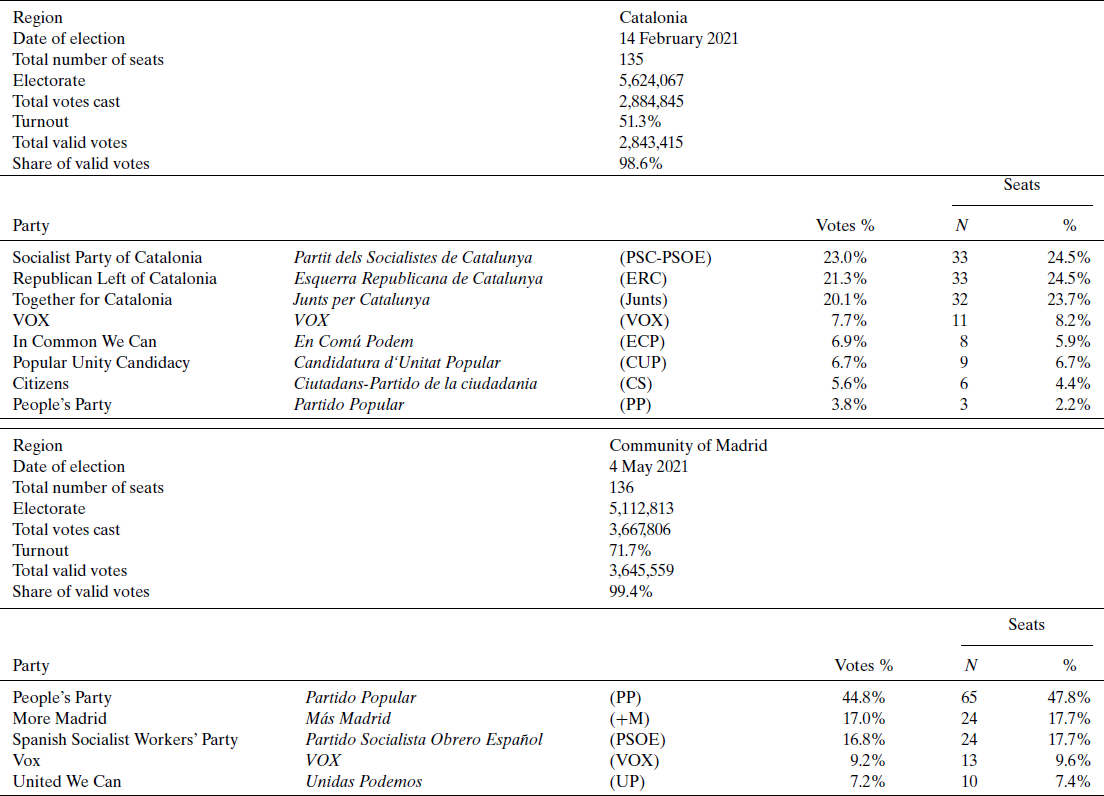
During 2021, two of the most important Spanish regions—Catalonia and Madrid—held early elections (table 1). Their electoral results had political consequences for national politics.
Table 1. Results of regional (Catalonia and Madrid) elections in Spain in 2021

Source: Central Election Commission (2021).
The regional election in Catalonia was held automatically on 14 February in accordance with legal provisions when no candidate received enough support in Parliament for an investiture vote. Several months before the election, Quim Torra had been disqualified as regional President by a Supreme Court ruling for disobeying the Central Electoral Board during the legislative elections of April 2019. The election date was then postponed to 30 May because of a new wave of COVID-19. Postal voting requests tripled and the number of people asking to be exempted from polling station duties also increased. The election turnout was 54%, and eight parties obtained seats in the regional Parliament. The Socialist Party of Catalonia/Partit dels Socialistes de Catalunya (PSC-PSOE), led by the former Minister of Health, who had had a prominent role during the pandemic, came first with 23 per cent of the votes. It was followed by the two majority pro-independence parties with, respectively, 21.3 (Republican Left of Catalonia/Esquerra Republicana de Catalunya—ERC) and 20 per cent (Together for Catalonia/Junts per Catalunya—Junts) of the votes. The other parties obtained lower levels of support, ranging from 11 per cent (VOX/VOX, a right-wing populist party) to 3.8 per cent (People's Party/Partido Popular—PP). After two failed investiture bids, the ERC leader, Pere Aragonés, was elected regional president in May with the support of the three pro-independence parties (ERC, Junts and the Popular Unity Candidacy/Candidatura d‘Unitat Popular—CUP), the first two subsequently forming a coalition government.
A snap election was also held in the Madrid Region (Community of Madrid). The president of the incumbent coalition government Isabel Díaz Ayuso (PP) called elections for 4 May. She anticipated the presentation of a motion of censure against her by her coalition partner Citizens/Ciudadanos-Partido de la Ciudadanía (Cs) and other parties. It was an action to avoid losing the government as happened a few days earlier in the region of Murcia. The leader of United We Can/Unidas Podemos (UP), Pablo Iglesias, resigned as second Vice-President of the national government and stood as candidate in the regional elections to try to save his party from an anticipated election disaster. Turnout was 77.8 per cent, and five parties obtained representation in the regional Parliament. The PP won with 45 per cent of the vote, twice the percentage they had achieved at the previous election, and ended up four seats short of an overall majority. Two left-wing parties, PSOE and More Madrid/Más Madrid (+M), obtained 17 per cent of the vote, two other populist right-wing, VOX, and left-wing parties, Podemos-Izquierda Unida (IU), 9 per cent and 7 per cent, respectively. After the electoral failure of Podemos, Pablo Iglesias decided to retire from politics. Another party that suffered a major failure was the PSOE, being surpassed as second-most voted party by Más Madrid, a party founded by members of a former faction of Podemos. Cs, the junior partner of the incumbent coalition government, did not obtain parliamentary representation. After a fist failed attempt, PP candidate Isabel Díaz Ayuso was sworn in as President of the Government of the Madrid region with the support of PP and VOX, and went on to form a minority PP government. The election contributed to Ayuso's consolidation as a key leadership figure within the right-wing party.
Cabinet report
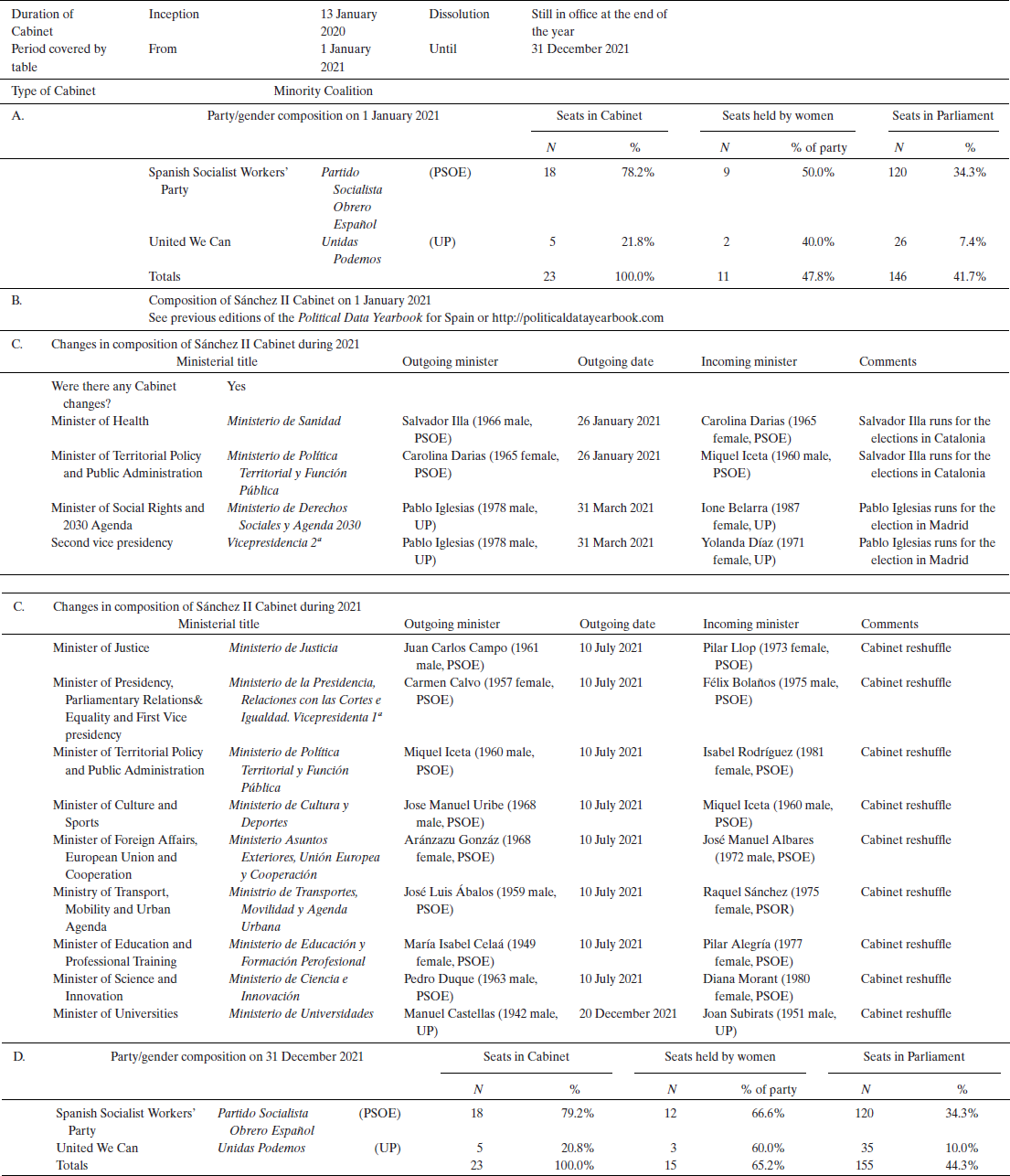
The Cabinet of Sánchez II, the first coalition government, experienced several changes during the year (table 2). In January, the President of the Government announced the first reshuffle of his Cabinet. After the appointment of the Minister of Health, Salvador Illa, as PSOE candidate for the regional elections in Catalonia, his post was assumed by Carolina Darias (PSOE), who was in turn replaced by new Cabinet member Miquel Iceta (PSOE) as Minister of Territorial Policy.

The second Cabinet reshuffle was held in March after Pablo Iglesias (Podemos), second Vice-President and Minister of Social Rights and Agenda 2030, resigned to run as candidate in the regional elections of the Community of Madrid. Nadia Calviño (PSOE) replaced him as second Vice-President and kept her position as Minister of Economic Affairs and Digital Transformation. Ione Belarra (Podemos), assumed the portfolio of Social Rights and Agenda 2030. Yolanda Díaz (Podemos) was appointed third Vice-President and retained the portfolio of Labour and Social Economy.
At the beginning of July, barely three months after the second reshuffle, a subsequent more profound reshuffle took place. This was the biggest Cabinet change since Pedro Sánchez became Prime Minister and one of the deepest in history, which turned the legislative session upside down. Seven ministers left and were replaced with seven new Cabinet members. The new Cabinet consists of 15 women and eight men. Carmen Calvo and José Luis Ábalos, two ministers who had been appointed in the Sánchez I Cabinet and were important figures within the Socialist Party, were dismissed. The former was replaced by Félix Bolaños (PSOE) as Minister of the Presidency; and the latter was replaced by Raquel Sánchez (PSOE) as Minister of Transport, Mobility and Urban Agenda; Pilar Llop (PSOE) assumed the post of Minister of Justice and replaced Juan Carlos Campo (PSOE); Isabel Rodríguez (PSOE) became the new Minister of Territorial Policy and the Government Spokesperson, replacing Miquel Iceta (PSOE), who became head of the Ministry of Culture and Sport, a role previously occupied by José Manuel Rodríguez Uribes (PSOE); José Manuel Albares (PSOE), new Minister of Foreign Affairs, replaced Arancha González Laya (PSOE); Pilar Alegría (PSOE), new Minister of Education and Vocational Training, replaced Isabel Celaá (PSOE); and Diana Morant (PSOE), new Minister of Science and Innovation, replaced Pedro Duque (Independent). The reshuffle only affected PSOE ministers, whereas all Unidas Podemos ministers continued in their post.
Sánchez argues that the reasons for the reshuffle were the government's main task of consolidating economic recovery and job creation, and managing the enormous opportunity that the Next Generation EU stimulus package represented for underpinning the modernization of the Spanish economy. Moreover, with the appointment of three female ex mayors the reshuffle involved a reinforcement of women in Cabinet, a generational renewal and a commitment to people who had succeeded in the municipal sphere.
The last change in Sánchez's Cabinet affected the quota of Podemos in the coalition government. In December, the Minister of Universities (an independent nominated by Podemos) left the government due to health problems and was replaced by Joan Subirats (independent), a minister with experience in municipal politics as a councillor for Culture and Education in the Barcelona City Council headed by a branch of Podemos.
Parliament report
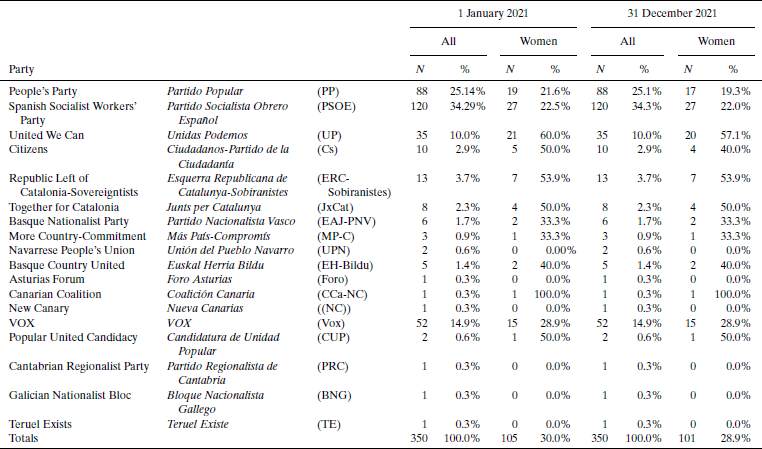
During 2021, the Lower House (table 3) validated 32 royal decrees issues by the government. Many of them did not achieve approval in Parliament. Of these, one-third dealt with issues related to the pandemic, natural disasters (a volcanic eruption and a snowstorm), the transposition of European directives, and other related to various policies.
Table 3. Party and gender composition of the lower house (Congreso de los Diputados) in Spain in 2021

Notes: MP Alberto Rodríguez (UP) was barred from holding public office on 22 October 2021 due to a judicial sentence. UP has left this seat empty.
MP Pablo Cambronero left Cs on 17 March 2021, but not his seat in the Lower House. Since then he belongs to the Mixed Parliamentary Group (Grupo Mixto) in this House.
Source: Lower House (Congreso de los Diputados) (2022).
A total of 11 organic laws were passed, for which the government enjoyed mixed support. The government was supported by the PSOE, the other left-wing parties and most regional and pro-independence parliamentary groups. In some cases, the laws obtained the support of the opposition People's Party. These include laws relating to doping in sports, the civil registry, and also child protection and personal data, the latter two of which were amended by Parliament. On the other hand, the PP voted against the law on euthanasia, two laws related to the judiciary and another on enhanced cooperation for the creation of the European Public Prosecutor's Office. Cs (centre) and VOX (populist right) sometimes abstained, other times voting in the same manner as the PP.
A total of 22 ordinary laws were also passed with mixed support. These included laws for the protection against violence against women, another for the protection of children and adolescents, and another on the introduction on labour rights in digital services. Another law, which transposed a European directive on the prevention of tax fraud, was supported by a majority in Parliament after introducing amendments.
At the end of the year, another seven laws were passed to meet the requirements of the EU recovery plan Next Generation EU and to achieve some of the policy goals of the coalition government. This included legislation on the reduction of temporary employment in public administrations (170 votes in favour and 156 abstentions), the guarantee of the sustainability of pensions (176 votes in favour and 148 votes against), as well as the annual budget, the minimum living income and the law on animal rights.
Political party report
The major changes in political parties in 2021 were limited to the two coalition government partners (table 4). As mentioned in the Cabinet report, Pablo Iglesias left the government to run as candidate in the regional election of the Community of Madrid, and subsequently resigned from his position as Secretary General of Podemos. On 13 June, Ione Belarra was elected as the new Secretary General of Podemos.
Table 4. Changes in political parties in Spain in 2021

Source: Podemos (2022). https://podemos.info.
For its part, the PSOE held its 40th Congress on 15–17 October 2021 in Valencia. Pedro Sánchez was re-elected as Secretary General in an uncontested contest. In accordance with the Socialist Party rules, there was no need for a leadership election as there were no alternative candidates. Worthy of mention is the resignation for personal reasons of the former Minister José Luis Ábalos as Secretary of Organisation of the PSOE, which is the second most important position within the party. He was succeeded by Santos Cerdán.
Institutional change report
After years of deadlock due to the lack of political consensus, the Constitutional Court was partially renewed with the election of four new members by the Lower House (Congreso de los Diputados) upon the proposal of the PSOE and PP. The agreement between the two major political parties also allowed for the renewal of the Court of Auditors, the ombudsman and the director of the national public radio and television broadcaster (RTVE). By contrast, the renovation of the General Council of the Judiciary, pending since 2018, continued to be unsolved. The Basic Law of the Judiciary was actually reformed to limit the competences of this organ when its mandate expires to operational tasks.
Issues in national politics
The year 2021 was particularly dense and challenging for the Spanish government. The management of the COVID-19 crisis occurred in a climate of political turmoil both inside and outside the executive. Within the government, fatigue of several members of the Cabinet and, in particular, of Vice-President Iglesias, culminated in a large reconfiguration of the executive. Besides, the results of the regional election in Catalonia and, above all, Madrid, with the PP nearly obtaining an overall majority of the votes, placed the government in an uncomfortable position. Indeed, the contrast between the central and Madrid's regional government's respective management of the health and economic crisis became one of the axes of comparison and assessment of crisis management success in public opinion, with the central government being in favour of stronger COVID-19 restrictions.
The adverse climate for the executive was reinforced by a Constitutional Court judgement that declared unconstitutional the first COVID-19 state of alarm declared by the government in March 2020, and which involved the general lockdown of the country, as well as its extension for a period of six-month (second state of alarm) and the suspension of parliamentary work during this later period were all three unconstitutional. In addition, the government's decision to pardon the Catalan secessionist leaders convicted for sedition by the Supreme Court over the failed independence bid of 2017, and the launching of a bilateral process of negotiation between the central and Catalan government, were also controversial.
Since the beginning of 2021, Spain began to experience an energy crisis. The price of electricity began rising gradually and the electricity tariff changes introduced by the government in the summer did not solve the situation. Moreover, other fuels such as natural gas experienced supply shortages due to different sets of factors including the COVID-19 pandemic, Brexit and the closure of the Maghreb–Europe gas pipeline by Algeria.
In the international arena, Spain experienced a migratory conflict with Morocco. In May, the Spanish government concealed the irregular entry of Brahim Ghali, leader of the Polisario Front, to be treated for COVID-19 in a hospital in Spain. This event led to a migratory crisis with the complicity of the Moroccan government that allowed the entry both by land and by sea of more than 5000 illegal immigrants in a single day to the Spanish city of Ceuta. This conflict was partially solved with the dismissal of the Minister of Foreign Affairs Arancha González Laya in the Cabinet reshuffle of July.
On a more positive note, in 2021 the government met the EU requirement to access the Next Generation EU funds. In April, the government presented the Spanish Plan of Recovery, Transformation and Resilience to the European Commission. Its positive assessment by the EU institutions allowed for an initial funding tranche of €10,000 million in December 2021.


 Open access

