

Echoes of the 2008 economic crisis continued to sound in the world's industrialised democracies in 2012, but they were quieter and less distinct. The dominant tone of the year – if any group of three-dozen countries can be said to have a single tone – was exhausted recovery and dissatisfaction.
Issues in national politics in 2012
The 20-year history of the Political Data Yearbook's introductory chapters shows a long-term ebb and flow in the salience of issues. Questions of defence and terrorism that dominated the early 2000s were dormant in the early 2010s, and with the exception of questions about the euro, the role of the European Union was also relatively muted. Culture-related questions about lifestyle and religion popped up in isolated domestic debates but showed no regional patterns, though several countries saw a confluence of international and cultural questions in debates on immigration and anti-immigrant extremism. In 2012, the economy remained central to political debate, but unhappiness also emerged in concerns about the disproportionate prosperity enjoyed by some regions and some political elites.
The economy
The economic fears that gripped most countries since 2008 eased slightly in 2012, but it is difficult to tell whether this reflected an improvement in economic fortunes or simply a sense of resignation that improvement, if any, would come very slowly. Outside of sharp protests in Greece and Slovenia and stirrings in a few other countries, political life in the Yearbook countries showed an inclination to adjust to a life of austerity and ‘get on with it’.
As befits an interdependent world, the economies of countries included in this Yearbook tend to travel in a pack, and in economic terms the dominant pattern over the past decade was a period of moderate growth for the first half of the 2000s followed by sharp contractions beginning in 2008 and 2009. The following two years produced a recovery sufficient to lift most countries out of full-blown recession but not into rapid growth, and by 2012 most countries covered in the Political Data Yearbook were experiencing reduced growth and even a return to recession (World Bank 2013).
Several countries stand apart from this central trend over the past decade. On one side, Australia, New Zealand and Israel were able to avoid the worst impacts of the 2008–2009 recession and continued to grow at relatively rapid rates, as did Poland (the only European economy to avoid contraction during the last decade). Several other small countries managed to return to high growth in 2012, though their unusually large increases followed unusually steep declines in 2008 and 2009. Iceland was slow to recover but eventually returned to growth in 2011. By contrast, Italy, Slovenia and Portugal followed the general recovery pattern through 2010 but almost immediately returned to recession. The Greek economy – the most significant outlier – continued deeper into recession, though its rate of decline was shallower than in the previous year for the first time since 2006.
Other major indicators tended to track growth, but a few countries stood out for unemployment levels out of line with overall economic growth, particularly the Baltic states and most other eastern European cases, whose relatively rapid expansion in 2012 co-existed with relatively high levels of unemployment (World Bank 2013). Unemployment also remained well above the recent norms of Yearbook countries in Portugal, Ireland and especially in Spain and Greece. Inflation remained low in 2012 and the distribution of inflation levels remained in an extremely tight band around the 2.5 per cent average (World Bank 2013).
Although the overall gross domestic product (GDP) of the crisis countries amounted to a relatively small share of the Yearbook countries overall, they occupied a huge share of the political debate. In the crisis countries themselves questions of austerity continued to break governments and shape alliances. The Portuguese economy continued to contract and ‘the troika’ of the International Monetary Fund (IMF), the European Union (EU) and the European Central Bank (ECB) remained an ever-present feature of political and economic life, ensuring that the government stuck to a path of strict austerity. In Greece, questions of bailout and withdrawal from the eurozone – sometimes shortened to ‘Grexit’ – dominated all political debate and forged new political configurations. After parliamentary elections in May produced no clear governing majority, a second election a month later yielded a narrow victory for an unlikely coalition of former adversaries who accepted the need for severe austerity, even if it had the short-run effect of deepening the economic recession and producing higher unemployment. Unlike the violent clashes in Greece, Ireland responded with little outward protest to the various measures demanded by the troika. Even the once controversial issue of the re-introduction of a local property tax crept back in with little fuss, though it was not clear whether such acceptance was due to a sense of fatalism or the realisation of the necessity of such a tax.
The common currency and interconnectedness of banking systems meant that worries were not localised however. Whereas domestic debate in countries in crisis often focused on demands from outside, the many countries experiencing solid recoveries also became embroiled in controversy over the consequences a Greek exit from the eurozone could have for other European economies and the best way to minimise harm. The path that finally received formal approval from eurozone states in 2012, and the year's major economic development overall, was the establishment of the European Stability Mechanism (ESM), designed to replace the European Financial Stability Facility and the European Financial Stabilisation Mechanism as a means to provide financial assistance for Greece and other struggling economies in the eurozone. The ESM's implementation took slightly longer than expected as its approval in Germany was the subject of a Federal Constitutional Court ruling concerning its constitutionality. The ESM also survived a referendum in Ireland, where financial self-interest (Ireland was one of the recipients of EU bail-out loans) appears to have triumphed over a tradition of scepticism toward other European treaties (most noticeable in its votes against the Nice and Lisbon treaties).
Corruption
Corruption continued to be an important and frequent issue in several of the countries covered in this issue, even in some of those usually considered to be the least corrupt in the world, such as Norway, Denmark, New Zealand and Canada. Scandals related to corruption and fraud were also reported in Austria, Bulgaria, the Czech Republic, Estonia, France, Germany, Greece, Hungary, Ireland, Israel, Italy, Latvia, Luxembourg, Malta, Poland, Romania, Slovakia, Slovenia, Switzerland and the United Kingdom. Many of these were relatively minor incidents, but some involved substantial amount of money and led to resignations of top-level politicians and electoral defeat for parties considered responsible for the scandals.
In both Germany and Hungary the presidents had to resign during 2012 – Christian Wulff in Germany on corruption charges and attempts to threaten the tabloid which revealed the story, and Pál Schmitt in Hungary upon accusations of having plagiarised his PhD thesis. Allegations of faking academic diplomas were also directed against the German Minister for Science and Education, who resigned in 2013, and against the Romanian Prime Minister Victor Ponta, as well as against several MPs in Slovenia.
There were also several high-level politicians and former ministers arrested due to corruption scandals or accused of being corrupt during 2012. In Greece, which was rocked by several major corruption scandals, the former Minister of Defence was arrested on charges of receiving bribes and money laundering, as were the former mayor of Thessaloniki and his associates for embezzlements of more than €50 million. In Poland, the Minister of Agriculture resigned following the detection of systematic malfeasance in the implementation of the EU's agricultural policies, and in Romania, former Prime Minister Adrian Nastase was also arrested on corruption charges. In the Czech Republic, regional governor David Rath was found in possession of a large sum of cash, allegedly from bribes related to public contracts, and in Bulgaria a ruling-party MP was caught taking a €50,000 bribe. Serious charges of corruption were also made against the leaders of Slovenia's two biggest parties – Prime Minister Janez Jansa and Zoran Janković. This and other instances of malfeasance led to large protests against corrupt politicians around the country.
Several scandals also occurred in France, involving high-level Socialist politicians, including the Budget Minister, who was accused of holding a secret Swiss bank account. In Ireland, the Mahon tribunal, which had been in operation since 1997, issued its final report in 2012 and found that corruption was present at ‘every level of Irish political life and was allowed to continue unabated’. Two former top politicians – Prime Minister Bertie Ahern and EU Commissioner Pádraig Flynn – were both found to have been involved in irregularities. The Danish Minister of Culture and the Norwegian Minister of Children, Equality and Social Inclusion both resigned after being accused of nepotism, although the sums involved were quite small. The Israeli Minister of Foreign Affairs also resigned in response to corruption allegations (although he was acquitted by the courts late in 2013). At the regional level, parties involved in corruption scandals in Carinthia and Salzburg in 2012 (BZÖ and SPÖ, respectively) took severe beatings at the early elections in 2013 and another accomplice in Carinthia – the ÖVP – had its regional party leader, together with three others, sentenced to prison. In Canada, the mayor of Montreal and another mayor in Quebec also resigned after corruption charges.
Finally, in Italy, corruption scandals forced Lega Nord's long-serving party leader Umberto Bossi to step down after the revelation of large-scale malfeasance by the party's treasurer, including trafficking in diamonds and gold. Early regional elections were called in Lombardy and Latinum on the basis of corruption scandals. These and other major corruption scandals gave rise to a new anti-establishment party, the Five Star Movement, led by comedian Beppe Grillo, which began actively to campaign for political office.
On the positive side, some countries adopted or proposed legislation aimed at reducing corruption, and more than half of the Yearbook countries considered some form of change in their institutional frameworks or other accountability structures. Austria adopted a ‘transparency package’ considered crucial for curbing corruption. It included, among other things, the stipulation that parties have to list donors contributing more than €3,500. Similar legislation is under way in the Netherlands. Slovakia abolished unrestricted parliamentary immunity for MPs and set to work on changes in the rules for party financing, and in Hungary the punishments for corruption and bribery were stiffened.
Regional autonomy and separatism
While those at the centre of the European project called for wider and deeper integration, the centrifugal forces of regionalism and separatism continue to remain relevant. This was particularly the case in Belgium, Spain and the United Kingdom. In Belgium, the Flemish Nationalist Party became the largest political party in Flanders and made significant gains at local elections, securing the election of its leader, Bart de Wever, as mayor of Antwerp. Although De Wever insisted that he did not want to secede from Belgium, he openly favoured a confederation in which wealthy Flanders would no longer have to subsidise poorer Wallonia. In an unusual move, King Albert in his 2012 Christmas message criticised the separatist movement and compared it to populist movements of the 1930s. In Spain, the economic recession exacerbated centrifugal tendencies along similar lines as richer regions sought both to express their own identity and end what they perceived as subsidisation of other areas. To this extent, the leader of the Catalonian movement for independence was successful in his aim of getting the parliament of Catalan to approve holding a referendum during the 2012–2016 term of the regional parliament. Similar feelings also began to re-emerge in Western Australia (a non-binding referendum on this topic was passed in 1933), where secessionist calls are primarily correlated to the state's economic fortunes. The mining boom of the past few years stirred a renewal of calls for greater autonomy from the federation, although certainly not to the extent that was evident in some European regions.
In the United Kingdom, the surprise victory of the Scottish National Party in the Holyrood elections of 2011 increased the impetus for a referendum on independence, although opinion polls in 2012 put support for it well below 50 per cent. Fears that a ‘yes’ vote in Scotland would herald a further breakup of the United Kingdom also appeared to have little basis. Opinion polls in Wales indicated that two-thirds of the population opposed independence, with just one in ten in favour, and although the issue is considerably more complex in Northern Ireland, even the growth of the Catholic community has not significantly diminished support for retention of the Union.
In Cyprus – the one Yearbook country where recent efforts seemed to push in the opposite direction – 2012 produced no further movement toward reunification. Turkey tried to push for a resolution of the issue before Cyprus hosted the EU Presidency in the second half of the 2012, but despite an international conference in January, little progress was made and direct talks were abandoned for the duration of the year.
New political actors
Based on the experience of previous economic downturns, particularly in the 1930s, we might have expected an impact on domestic party systems. Indeed, the emergence and success of new parties has become an increasingly common feature around the world. The elections held during 2012 show that this trend is continuing. In six of the eight countries which had national elections during the year, newly established parties managed to win seats. Only in France and not very surprisingly the United States, did that not occur. The electoral performances of these new parties were modest compared to some of the most spectacular successes in previous years, but the frequency of the phenomenon suggests the emergence of a broader pattern. Although most new party successes have come in countries experiencing crisis and corruption, recent developments suggest that even previously highly stable party systems can be affected if the conditions are right.
In Slovakia, the anti-party ‘Ordinary People’ won 8.6 per cent of the vote on a campaign against ‘partocracy’. In Lithuania, ‘Way of Courage’ won 8 per cent on the basis of an anti-corruption agenda and on promises to fight pedophilic networks within the justice system. In Romania, tabloid television broadcaster Dan Diaconescu's personal political vehicle People's Party–Dan Diaconescu won 14 per cent of the vote. In Greece, left-wing DINAR and right-wing ANEL won 6.1 and 10.6 per cent, respectively, and the neo-Nazi Golden Dawn expanded its support from 0.3 per cent in 2009 to 7 per cent and held on to 6.9 per cent in the follow-up election a month later.
Nor were rapidly ascending parties limited to eastern and southeastern Europe: in Japan, the nationalist Restoration Party won 54 seats in the lower house and other parties emerged from obscurity to take a significant number of seats. Elections in the Netherlands yielded nearly 2 per cent for the party 50+ which defended the rights of those over the age of fifty against austerity measures. Emerging parties also saw significant successes at the regional level, including the Pirate Party, which won between 7 and 8 per cent in German state elections in North Rhine-Westphalia, Schleswig-Holstein and Saarland; new left-wing separatist parties which won representation in the Spanish regions of Galicia (AGE, 14 per cent) and the Basque Country (EHB, 25 per cent); and Beppe Grillo's aforementioned Five Star Movement, which won almost 15 per cent of the votes in Sicily's regional election.
Ireland offered a partial exception to this pattern. Even though the governing Fianna Fáil suffered record losses in Ireland at the 2011 general election, the three mainstream parties of Fianna Fáil, Fine Gael and Labour won the same number of seats between them as they had at the height of the economic boom in 2002. Rather than turn to new parties, disillusioned Irish voters, as has been their wont, switched to independents instead, who had their best electoral outcome since 1927, winning 17 seats in a parliament of 166.
The changing composition of cabinets
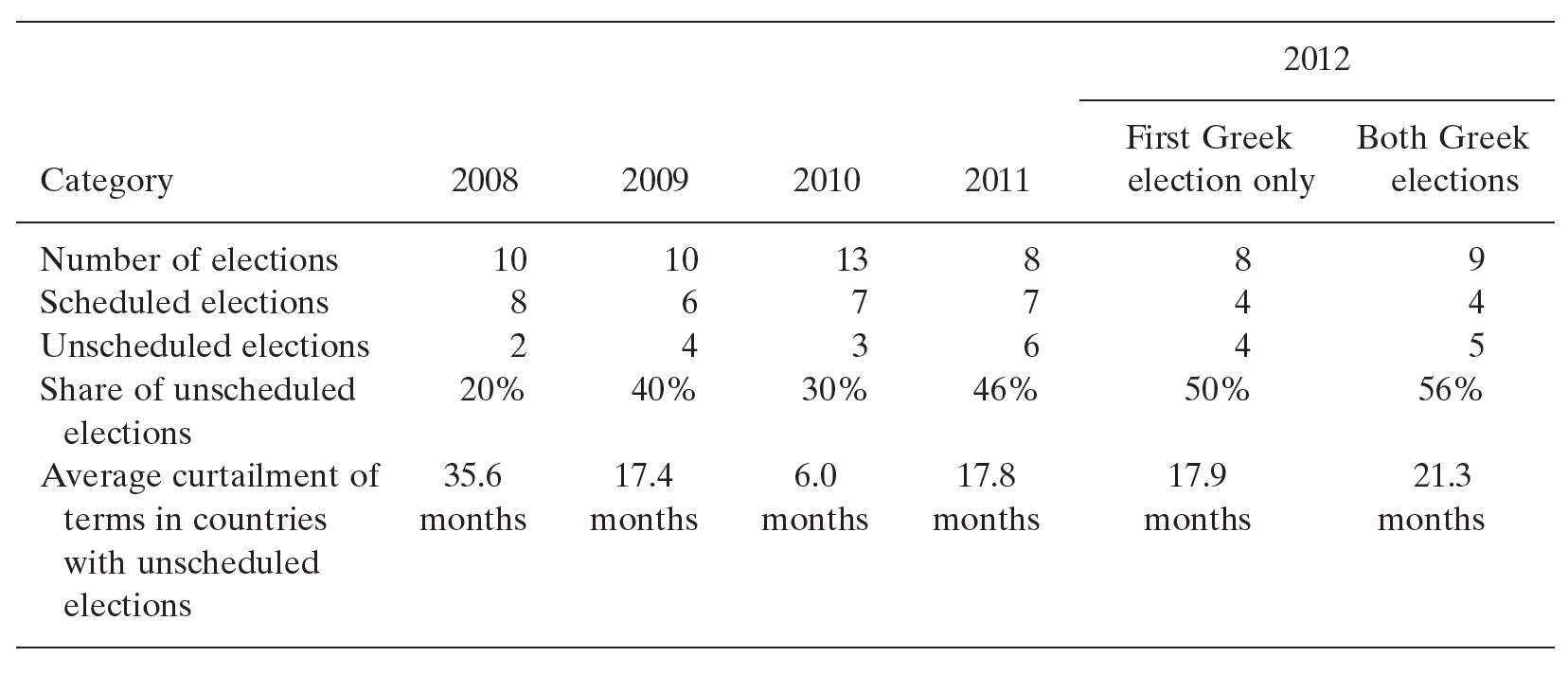
In 2012 the rush of government collapses seen in recent years slowed to its lowest level since 2008, but eight countries covered in this Yearbook experienced the fall of a government and two countries (Greece and Romania) saw the fall of more than one. The number of falling governments that triggered new elections also remained high: five government failures triggered new elections (Japan, Netherlands, Slovakia and twice in Greece), which meant that unscheduled elections actually outnumbered the four scheduled parliamentary elections (France, Lithuania, Romania and the United States). Furthermore, these new elections came quite early within their respective government cycles: eight months in Japan, 20 in the Netherlands and 26 in Slovakia. In Greece, the first elections came nearly 17 months early but the result failed to produce a stable coalition and led to another election nearly 47 months ahead of schedule.
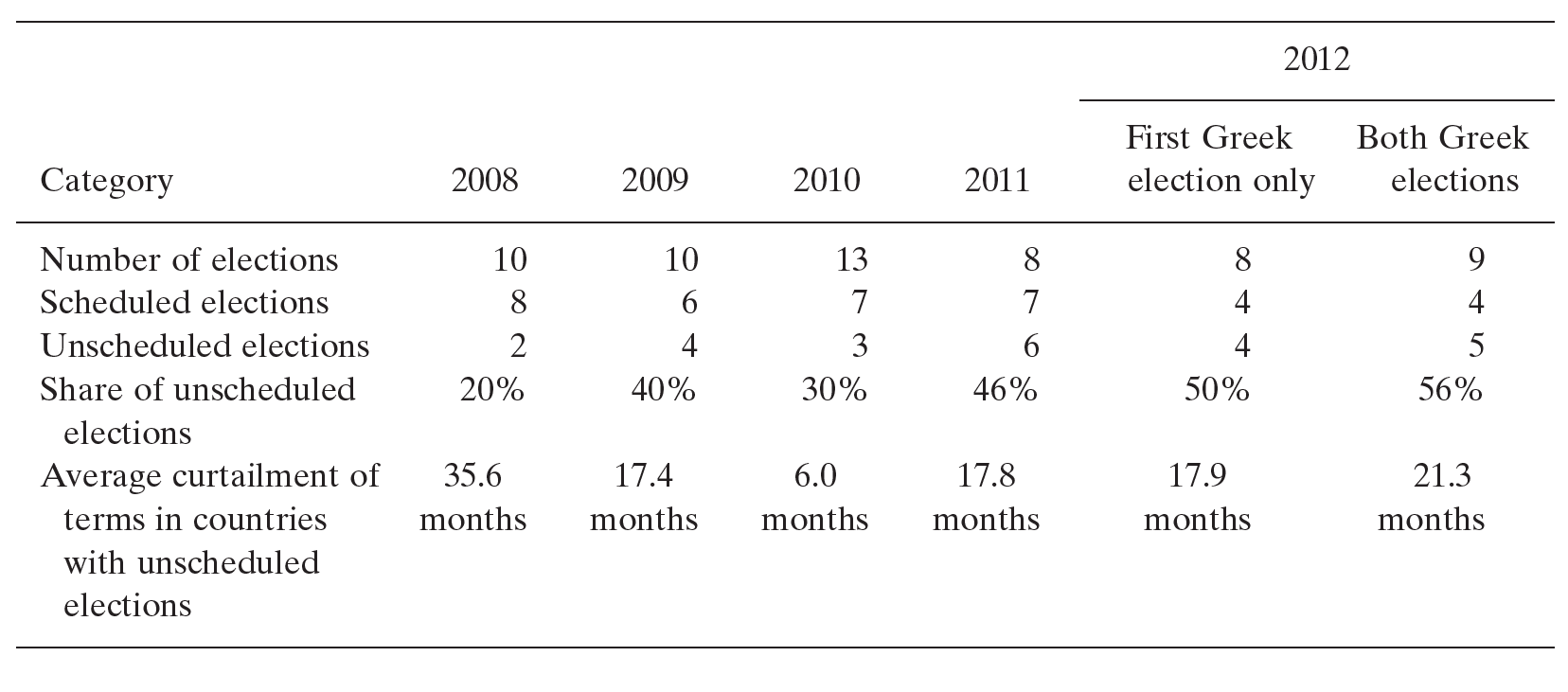
Table 1a puts these developments into a slightly broader time-perspective, showing a rise in unscheduled elections over this period. The combination of a relatively small number of elections, a relatively high number of unscheduled elections and a relatively significant degree of curtailment magnified the impact of the early elections in 2012. The new elections cut short parliamentary terms by nearly 18 months (21 months if the calculation includes the second Greek elections).
Table 1a. Types of elections and consequences for parliamentary term duration
All four of the scheduled elections in 2012 produced a movement toward what might be generally conceived of as the left, though the meaning and degree of the shift differed from place to place. In France and Lithuania, voters ousted governments led by the right in favour of those led by the left, though in France the change led to a nearly one-colour Socialist government, while in Lithuania the Social Democrats represented only the plurality position in a government that included parties of many ideological positions. In Romania, the voters confirmed the Social Democratic-led government of Victor Ponta with a strong margin, but its electoral coalition also included the country's National Liberal Party (the meaning of left and right within Romania's party system differs in some respects from those of other countries). In the bicameral system of the United States, the 2012 election produced a mixed parliament, with a slight increase in the share of seats for the left-of-centre Democratic Party in both lower and upper houses, though in the lower house, the right-of-centre Republican Party retained its majority of seats despite receiving a smaller share of votes than the Democrats.
In countries where elections occurred prematurely, results were ideologically more mixed. In two of these countries, voters shifted from right to left, but to different degrees. Voters in Slovakia replaced a four-party right-wing coalition with a single-party government led by the left-of-centre Direction-Social Democracy – the first party in Slovakia's democratic history to win a majority of parliamentary seats. In the Netherlands, the large centre-left and centre-right parties formed a governing coalition after both of them increased their vote and seat shares at the expense of Christian Democrats and parties nearer the left and right extremes, including the Party of Freedom.
In Japan and Slovenia, voters replaced left-leaning governments with right-leaning ones, but in both cases it was new parties that made the biggest impact. In Slovenia, formation of a new government was complicated by the presence of two new parties which had won a staggering 37 per cent of the vote. In Japan the huge losses incurred by the Democratic Party of Japan (DJP) (a 26 percentage point drop in votes and a 52 percentage drop in seats) did not translate into an increased vote share for the longstanding Liberal Democratic Party (though it increased its share of seats by 26 percentage points to retake the parliamentary majority). Instead, much of the drop in DPJ appeared to flow to two new parties winning 26 per cent of the vote and to a relatively young party which won an additional 9 per cent.
Finally, in Greece two sets of elections produced mixed results in the face of economic crisis. Conflict crossed the left-right divide and centred instead on parties' willingness to accept austerity measures demanded in exchange for loans to help ameliorate the Greek debt crisis (and stabilise the value of the euro and Greece's participation in it). After a first inconclusive election, a snap second election produced a narrow majority for austerity and a new political configuration. The parties New Democracy and PaSoK, which during the 1990s and 2000s had occupied nine-tenths of all parliamentary seats, together received less than half. Instead of occupying the opposing poles of Greece's party competition as they did in previous decades, these two agreed to form a coalition against anti-austerity forces on their left and right flanks.
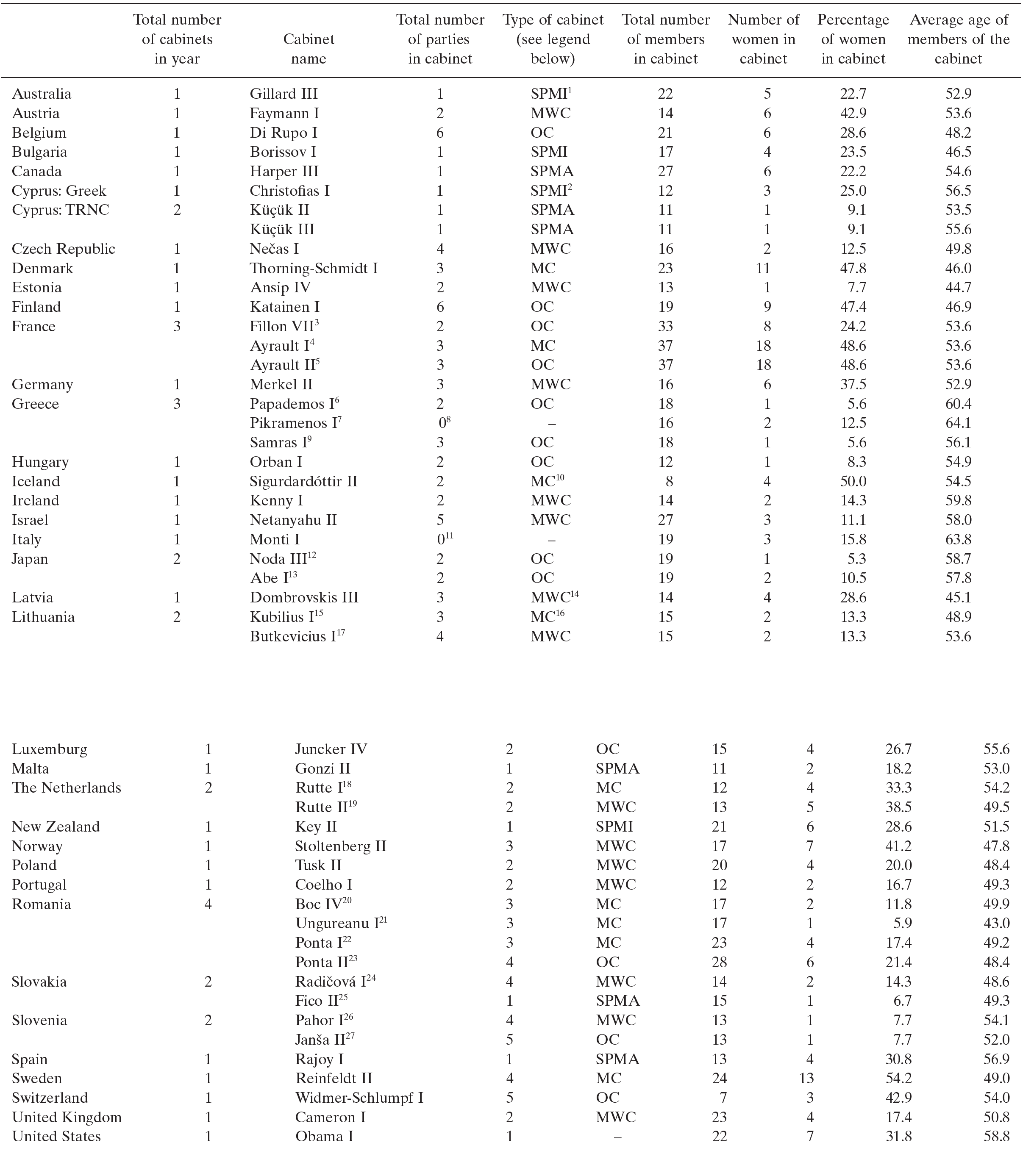
Table 1b presents data on cabinet party composition and type for 2012. The average cabinet during this period contained 2.6 parties, but ranged from 1 to 8, with a median of two (31 per cent). One-quarter of all cabinets during 2012 did not command majority support in parliament, though some of these could rely on independent members to provide a majority. Within the category of minority cabinets, the number of single-party minority governments fell while the number of minority coalitions rose, but the overall share remained consistent with historical averages and did not suggest any overall trend. For the tenth year in a row, minimum-winning coalitions were the most common form of cabinet (32 per cent) and oversized coalitions were the second most common (28 per cent). Single-party majority cabinets remained at 13 per cent – close to the average for the last decade.
Table 1b. Number of parties in cabinets, type of cabinet and age and gender of cabinet members on 31 December 2012
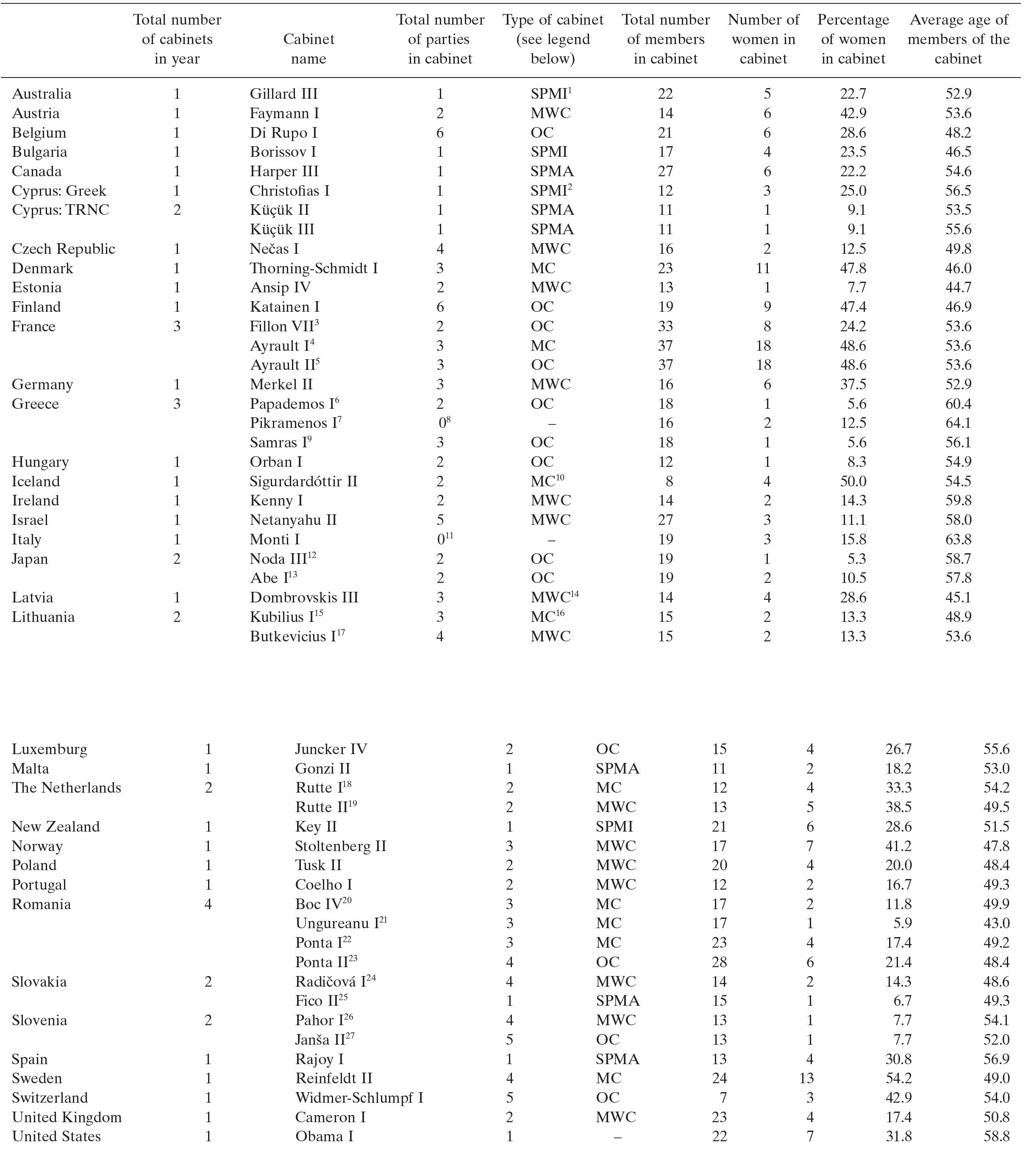
* Legend: SPMA (single-party majority); SPMI (single-party minority); MWC (minimum winning coalition); MC (minority coalition); OC (oversized coalition).
* Notes: 1 The government was supported by 4–6 independents, which in effect gave it a majority. 2 The Republic of Cyprus has a presidential system. The categorisation refers to the strength of the supporting parties of the government in parliament. 3 Resigned 16 May. 4 In office: 16 May–18 June. 5 Took office 18 June. 6 Resigned 16 May. 7 Caretaker government: 16 May–20 June. 8 Caretaker government composed of nonpartisans. 9 Took office 21 June. 10 The government lost its majority due to defections during the year. 11 The Monti cabinet was composed of nonpartisans. 12 Resigned 1 October. 13 Took office 26 December. 14 The government controlled exactly 50 per cent of the seats. 15 Resigned 12 December. 16 The government lost its majority in November. 17 Took office 12 December. 18 Resigned 5 December. 19 Took office 5 December. 20 Resigned 2 February. 21 In office: 2 February–27 April. 22 In office: 7 May–21 December. 23 Took office 21 December. 24 Resigned 3 April. 25 Took office 4 April. 26 Resigned 10 February. 27 Took office 10 February.
Table 1b also summarises information for each of the 37 countries about gender representation in the executive and average age (as of the end of each government on 31 December 2012). With integration of all Yearbook data into the Political Data Yearbook: Interactive, it is now possible to draw preliminary conclusions over longer periods of time.
The share of female cabinet ministers remained slightly below its peak of 25 per cent in 2010, but the current level still represents enormous gains from the beginning of the time-series in the early 1990s when the share was 12 per cent. Unlike the linear growth between 1991 and 2000, the subsequent period shows a less consistent pattern with periods of fast growth in the share of women in 1997–1999 and 2006–2009 followed by periods in which some (but not all) of the gains were lost. Trend lines were positive in every region, but regional differences increased slightly over time because the countries with the largest initial share of women – particularly in Scandinavia – also experienced the highest upward trend.
Average cabinet age, on the other hand, remained almost unchanged in 2012 (up by 0.3 years) within a narrow range that has not fallen below 50 or risen above 53 in the 20 years of Yearbook records. Using the data to disaggregate regional trends shows that age trends have been flat in the young cabinets of Scandinavia and the older cabinets of the eastern Mediterranean, while slight increases in Western Europe and Angolphone countries are offset almost completely by slight decreases in average ages of the already young cabinets of East and Central Europe. It is noteworthy, perhaps, that while the age of parliamentary ministers has remained stable over the past two decades, the average life expectancy within the countries of the Yearbook has risen by at least three years, making ministers in 2012, on average, slightly younger relative to the population as a whole and, on a personal level, endowed with three more years of life as a former minister.
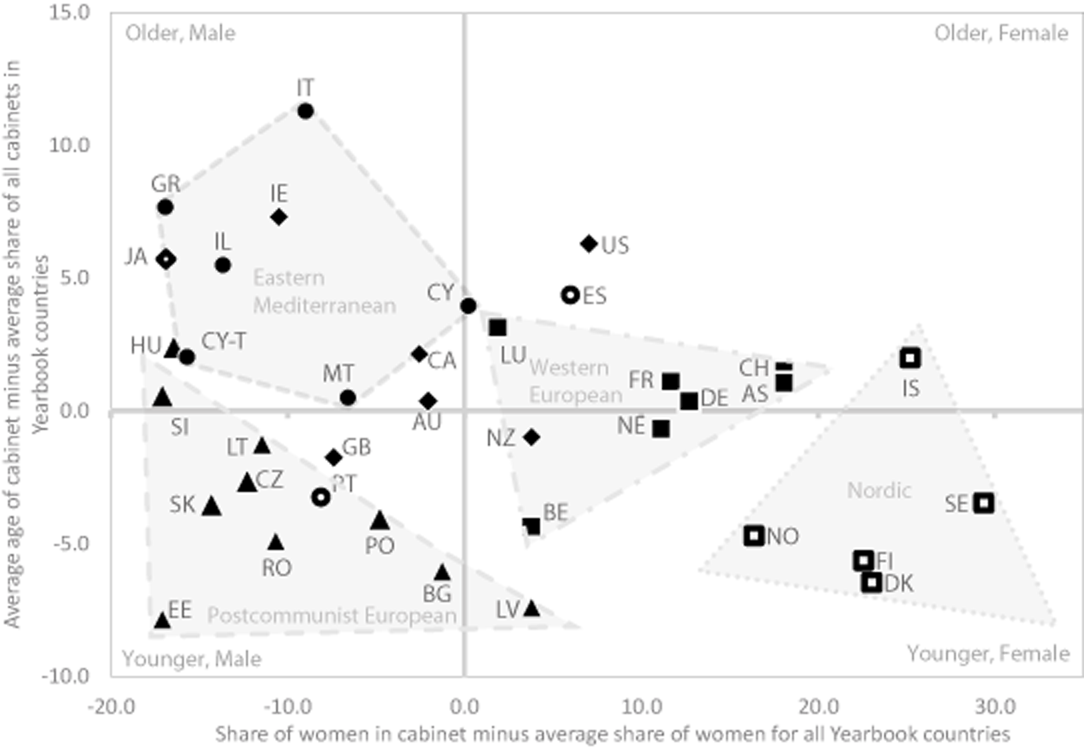
Combining age and gender data for 2012 into one graph reveals the striking patterns visible in Figure 1. Geographical regions cluster together with striking coherence: a tight cluster of the Nordic countries in the lower left quadrant indicate cabinets that are younger and more female than average; an equally tight cluster of Germanophone and Francophone countries are almost as young and almost as female. In the opposite quadrant lie the cabinets of the eastern Mediterranean, including Italy, Greece, Malta and Cyprus (as well as Japan and Ireland), which are an average of ten years older and have half as many women as their Nordic counterparts. Below these on the graph are the post-communist states of Central and Eastern Europe (and Portugal) which form a triangle including both the youngest and the most male cabinets in the sample. The Anglophone countries occupy a less coherent space, but none of these countries stands far from the median points for gender and age. Nor are these placements particularly unusual: long-term analysis of the Political Data Yearbook suggests that these regionally based clusters of age and gender in parliaments have endured for decades.

Figure 1. Gender and age distributions of cabinets in 2012.
The format of the Yearbook
The data on issues and on the composition of cabinets form only a part of the information gathered in this Yearbook, covering the period from 1 January 2012 to 31 December 2012. As in the earlier editions, each country report is broken down into a number of sections, with an emphasis on the inclusion of comparable, systematic data.
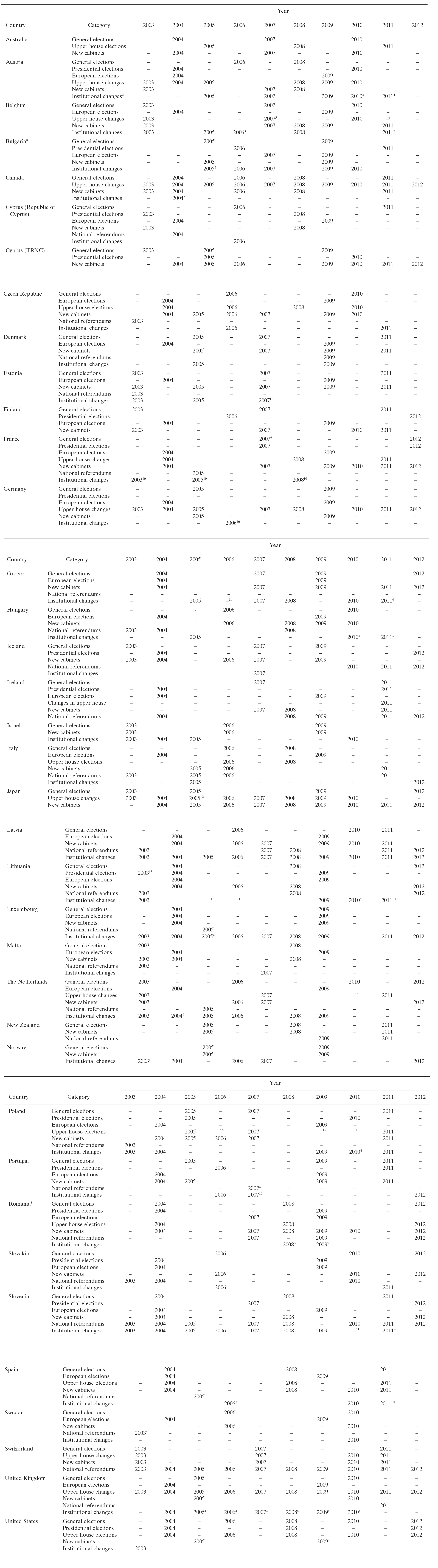
What is new since last year's edition of the Yearbook is a revised format for the comprehensive Table 3 that lists each major category of formal political change in a consistent timeline for each country, which allows both a sense of the confluence of events (elections and cabinet change, for example) and a sense of the kinds of formal change that a country may face (ranging from only three categories in New Zealand, Australia, Japan, Israel, Norway and Turkish Cyprus, to seven categories in France, Romania and Poland).
Table 2. Cumulative index of political eventsFootnote 1
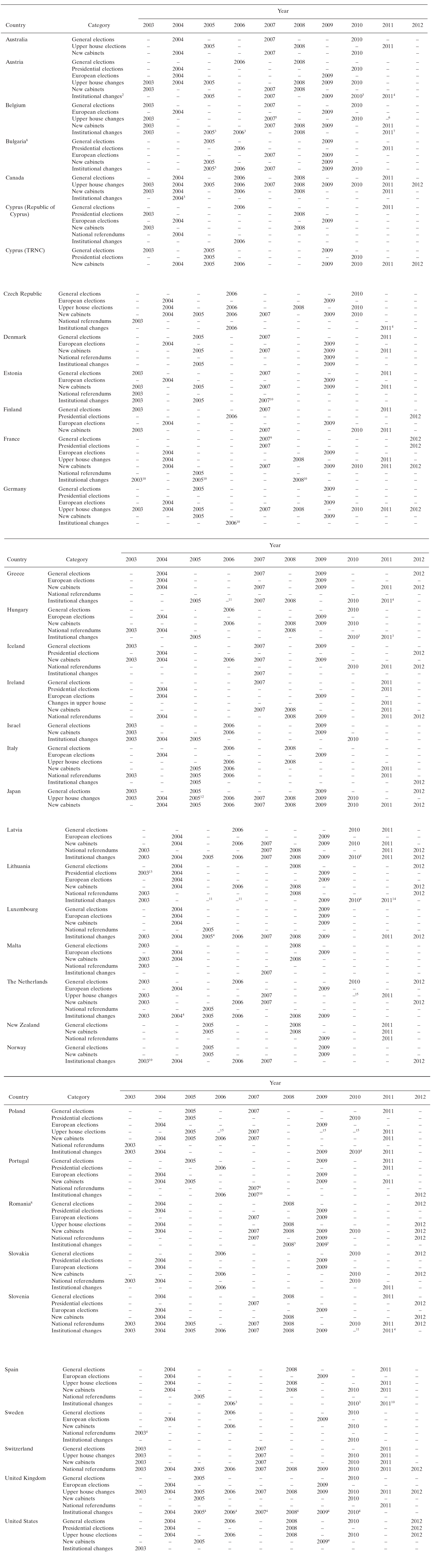
* Notes: 1 For a cumulative index 1991–2001, see Katz and Koole (Reference Katz and Koole2002: 890–895). For a cumulative index of 2002–2011, see Caramani et al. (Reference Caramani, Deegan-Krause and Murray2012: 3:23). 2 Unless otherwise specified, listings for ‘Institutional Change’ relate to the inclusion of this formal category or a similar category within the country chapter. In some cases, authors list significant institutional changes within other categories and marks these cases with appropriate footnotes. 3 Listed in the cumulative index in Caramani et al. (Reference Caramani, Deegan-Krause and Murray2012: 3:23) as ‘Institutional Change’ but listed changes are not included under a separate formal heading within the country chapter. 4 Not mentioned in the cumulative index in Caramani et al. (Reference Caramani, Deegan-Krause and Murray2012: 3:23). 5 Not mentioned in the cumulative index in Biezen and Katz (Reference Van Biezen and Katz2004, Reference Van Biezen and Katz2005, Reference Van Biezen and Katz2006). 6 Caramani et al. (Reference Caramani, Deegan-Krause and Murray2012: 3:23) lists minor changes linked to cabinet formation (Di Rupo I, 6 December 2011) after the very long ‘transition’ cabinet (Leterme II). 7 Major institutional changes agreed on in 2011, but not implemented until the following year. 8 First included in the Political Data Yearbook in 2007. 9 Not mentioned in the cumulative index in Bale and Biezen (Reference Bale and Van Biezen2008). 10 Institutional change listed under alternative heading (including ‘Constitutional Amendment’, ‘Constitutional Reform’, ‘Institutional Reform’ and ‘Reform Programme’). 11 Listed in Caramani et al. (Reference Caramani, Deegan-Krause and Murray2012: 3:23) because country chapter includes heading for ‘Institutional Change’ related to changes that did not gain formal approval during the period in question. 12 Not mentioned in the cumulative index in Biezen and Katz (Reference Van Biezen and Katz2006). 13 Second round of presidential elections; first round held in late 2002. 14 Caramani et al. (Reference Caramani, Deegan-Krause and Murray2012: 3:23) inadvertently locates its reference to Reference Caramani, Deegan-Krause and Murray2011 ‘Institutional Changes’ in the category for ‘Upper House Changes’. 15 Caramani et al. (Reference Caramani, Deegan-Krause and Murray2012: 3:23) refers to minor changes occurring outside the normal cycle of upper house changes.
In preparing each volume, a detailed outline of the headings under which material was to be gathered was provided to each of the authors of the country reports. This outline can be summarised as follows:
-
1. National election results
-
1.1 General elections to the (lower house of) parliament
-
1.2 Presidential elections (popular elections only)
-
1.3 Elections to the European Parliament
-
1.4 Changes in the composition of the upper house
-
1.5 Analysis of the election(s)
-
-
2. Cabinets
-
2.1 Cabinet composition
-
2.1.1 Party composition
-
2.1.2 Cabinet members
-
-
2.2 Changes in the cabinet
-
2.2.1 Resignation or end of cabinet
-
2.2.2 New cabinet
-
-
2.3 Changes in the cabinet (personnel changes, etc.)
-
2.4 Analysis of cabinet changes
-
-
3. Results of national referenda
-
4. Institutional changes
-
5. Issues in national politics
At the same time, it is obviously the case that not all of these headings will necessarily be relevant to every country in every year. In any one year, for example, it is likely that only a minority of countries will have held general elections, while an even smaller set of countries will be likely to have held national referenda or to have undergone major institutional changes.
Elections to the European Parliament obviously only occur in Member States of the European Union. In the subsequent reports, therefore, the absence of a heading simply indicates the lack of relevance of that particular topic. On the other hand, there are some headings that are always relevant, and will always be included. Finally, for ease of presentation, reports under some of the headings have sometimes been collapsed together, as, for instance, when the report of a general election also incorporates an analysis of the formation of a new government as well as a discussion of the issues in national politics.
As far as developments in 2012 are concerned, all of the country reports include information regarding cabinet composition and issues in national politics. Relevant data under the more ‘variable’ headings, on the other hand – that is, under those headings that are not necessarily relevant to each country – are reported for the following countries:
-
General elections to the lower house of parliament:
France; Greece; Japan; Lithuania; the Netherlands; Romania; Slovakia; United States
-
Presidential elections:
Finland; France; Iceland; Slovenia; United States
-
Elections to the European Parliament:
None
-
Land, cantonal, state elections (federal countries only):
Australia; Canada; Germany; Spain; Switzerland; United States
-
Changes in the composition of the upper house of parliament:
Canada; Germany; Romania; United Kingdom; United States
-
New cabinets:
Cyprus (T); France; Greece; Japan; Lithuania; the Netherlands; Romania; Slovakia; Slovenia
-
Results of national referenda:
Iceland; Ireland; Latvia; Lithuania; Romania; Slovenia; Switzerland
-
Institutional changes:
Italy; Latvia; Luxemburg; Norway; Portugal
The Political Data Yearbook: Interactive
Provisional versions of all Yearbook data from 1992 to 2013 is now available online at www.politicaldatayearbook.com. The website features an easy-to-use application for calculating and graphing parliamentary and presidential election and cabinet data (used extensively in the production of this chapter), as well as options for downloading the entire dataset for use in more complex calculations. The website allows almost instantaneous updates and, since autumn 2012, the editors have been posting election data for various countries within hours of the publication of official results.