




Introduction
Advance Care Planning (ACP) enables patients to express their healthcare preferences and ensures that their values guide medical decisions, particularly in situations of incapacity or end-of-life (EoL; Sudore et al. Reference Sudore, Lum and You2017; Mori et al. Reference Mori, Chan and Lin2025). Despite its recognized benefits such as reducing anxiety, improving quality of death, and preventing unnecessary aggressive interventions, ACP remains underutilized in Brazil (Rocha Tardelli et al. Reference Rocha Tardelli, Neves Forte and de Oliveira Vidal2023). Evidence suggests that limited adoption is not only solely attributable to structural or systemic barriers but also reflects significant gaps in knowledge, cultural misconceptions, and discomfort surrounding EoL discussions among patients, families, and healthcare professionals (Guccione et al. Reference Guccione, Fullerton and Gough2023; Pimsen et al. Reference Pimsen, Sumpuntharat and Rodney2025).
While several countries have incorporated ACP into national healthcare policies, promoting communication, shared decision-making, and respect for patient autonomy (Yennurajalingam et al. Reference Yennurajalingam, Noguera and Parsons2013; Borenko et al. Reference Borenko, Simon and Myers2023), Brazil remains considerably behind in this regard (Rocha Tardelli et al. Reference Rocha Tardelli, Neves Forte and de Oliveira Vidal2023; Trevizan et al. Reference Trevizan, Paiva and de Almeida2024). The absence of structured ACP initiatives perpetuates the stigma around EoL discussions, reinforces medical paternalism, and restricts patient autonomy (Goswami Reference Goswami2023; Zabawa Reference Zabawa2023). Additionally, cultural and institutional barriers sustain resistance to ACP, leading to reactive rather than proactive healthcare decisions (Dias et al. Reference Dias, Bezerra and Barra2022).
Although ACP has been globally recognized as a key component of high-quality care, its implementation in low- and middle-income countries, particularly in Latin America, remains limited and poorly documented. Existing evidence indicates that only a minority of Latin American nations have formal ACP regulations, and where these exist, they often reproduce legalistic, North American-inspired models that fail to reflect the region’s sociocultural and relational contexts (Soto-Perez-de-Celis et al. Reference Soto-Perez-de-Celis, Chavarri-Guerra and Pastrana2016; Tardelli et al. Reference Tardelli, Fukushima and van der Steen2025). The insufficient availability of educational initiatives and institutional guidelines adapted to local healthcare systems underscores the urgent need for context-specific strategies (Cajavilca et al. Reference Cajavilca, Dassel and Portugal-Bouza2024; Tardelli et al. Reference Tardelli, Fukushima and van der Steen2025).
Regional analyses show that none of the countries in the region provide adequate ACP training for health professionals, and that many clinicians report legal uncertainty when engaging in EoL conversations (Tardelli et al. Reference Tardelli, Fukushima and van der Steen2025). These challenges extend beyond regulatory limitations, reflecting systemic gaps such as the absence of ACP in health curricula, insufficient communication training, and the limited integration of Palliative Care (PC) into national health systems. Addressing these barriers requires not only descriptive inquiry but also the development of feasible, evidence-informed strategies that support ACP implementation in real-world clinical contexts. However, how ACP is interpreted, operationalized, and integrated into oncological care in Brazil and other Latin American countries remains poorly understood, as few empirical studies have examined the educational, operational, and cultural determinants of its adoption (Trevizan et al. Reference Trevizan, Paiva and de Almeida2024, Reference Trevizan, Paiva and Julião2023; Cajavilca et al. Reference Cajavilca, Dassel and Portugal-Bouza2024; Álvarez Acuña et al. Reference Álvarez Acuña, Ceballos Vejarano and Pinto Bustamante2025; Tardelli et al. Reference Tardelli, Fukushima and van der Steen2025; Arias-Rojas et al. Reference Arias-Rojas, Carreño-Moreno and Arredondo Holguín2025a).
Beyond these structural barriers, the paucity of research on ACP in Latin America also reflects broader cultural characteristics of region’s healthcare and educational systems. The dominance of a curative biomedical model, fragmented care pathways, and the lack of early EoL discussions contribute to the scarcity of ACP-related studies (Trevizan et al. Reference Trevizan, Paiva and de Almeida2024; Tardelli et al. Reference Tardelli, Fukushima and van der Steen2025). Therefore, research in this field should prioritize the identification of feasible and culturally sensitive approaches to expand ACP implementation and strengthen patient-centered care.
International debates have underscored the importance of reframing ACP as a dynamic, relational, and socially embedded process rather than a purely medical intervention. Emerging evidence highlights that patients’ and caregivers’ engagement in ACP is influenced by emotional readiness, family dynamics, and cultural meanings surrounding illness and autonomy. Consequently, future research should move beyond distal clinical outcomes, such as goal-concordant care or documentation rates, and explore the experiential dimensions of ACP, including feelings of safety, mutual understanding, strengthened relationships, and reduced caregiver burden (De Vleminck and den Block L Reference De Vleminck and den Block L2023).
Given this context, the present study seeks to deepen understanding of the barriers and facilitators of ACP in Brazil and to generate evidence that can inform educational, clinical, and policy initiatives across Latin America. By exploring cancer patients’ understanding of ACP, this study aims to explore cancer patients’ understanding of ACP and identify the main barriers that hinder its implementation, preventing the effective integration of ACP into routine oncology care.
Methods
Design study
Qualitative descriptive study, constituting the second phase of a larger investigation, building upon previously published quantitative data (Trevizan et al. Reference Trevizan, Paiva and de Almeida2024).
Participants
Patients were recruited by convenience sampling from the Women’s Outpatient Clinic and the Chemotherapy Infusion Center of a large Brazilian cancer hospital, recognized as one of the main reference centers for oncology care in Latin America. These settings provided access to women in different stages of treatment and follow-up, allowing for a diverse representation of experiences. Eligible participants were Brazilian women aged 18–75 years, with a confirmed diagnosis of breast cancer and an Eastern Cooperative Oncology Group Performance Status (ECOG-PS) ≤ 2. Patients were excluded if they had difficulty participating in online interviews or presented significant auditory, visual, or verbal communication impairments that could hinder the dialogue process.
Data collection and analysis
Initially, patients completed a sociodemographic questionnaire and received an informational brochure providing concise information about the concept of ACP. After 14 days, they were contacted via video conference and asked the question: How do you understand what ACP is? They were instructed to describe their understanding of the concept. The data collection took place while the patients were at home, alone, in a safe environment, with confidentiality guaranteed. Each interview lasted an average of 20 minutes.
Interviews were conducted by a male psychologist (PhD) experienced in qualitative methods and psycho-oncology. The researcher had formal training in qualitative interviewing and previous experience conducting studies in PC and ACP. He had no prior therapeutic or hierarchical relationship with participants, minimizing potential power asymmetries. Participants were informed that the interviewer was a researcher studying PC and ACP. Reflexive notes were written after each interview to document contextual impressions, non-verbal cues, and emerging analytical issues.
The interviews were recorded and transcribed in Portuguese, verified for accuracy by three independent researchers, and analyzed using Bardin’s method, following the Consolidated Criteria for Qualitative Research Reports (Tong et al. Reference Tong, Sainsbury and Craig2007). Manual coding was conducted without software assistance. Codes and categories were developed inductively from the data, and thematic convergence was discussed until consensus was reached. Discrepancies were resolved through analytical meetings to ensure reliability. Participants did not review transcripts or final interpretations. Representative quotations were selected to illustrate each theme in the results section. This study was approved by the Research Ethics Committee (approval number 4,987,629) on September 2021. All participants provided informed consent before participation.
Results
The study included 61 women, primarily married (78.7%, n = 48), Catholic (60.7%, n = 37), non-working (56.5%, n = 34), and with a family income of 1–3 minimum wages (54.8%, n = 33). Most had completed high school (47.5%, n = 29). Metastases were present in 47.5% (n = 29), and stage IV cancer in 45.9% (n = 28). Palliative systemic treatment was predominant (59.0%, n = 36).
Participants showed significant difficulty understanding ACP, about 40% (n = 25) were unfamiliar with the term or reluctant to discuss EoL issues. Around 35% (n = 21) confused ACP with general health care and prevention, without distinguishing it from EoL decision-making. Only 25% (n = 15) correctly identified ACP as a tool for self-determination and planning healthcare decisions in situations of incapacity or near EoL.
Each interview transcript was analyzed semantically to assess the participants’ level of understanding of ACP. Responses were categorized as correct understanding, when ACP was recognized as a process of shared decision-making and autonomy regarding future care; partial understanding, when it was misconceived as general health maintenance or preventive care; and unfamiliarity, when participants demonstrated limited or no knowledge of the concept. Table 1 presents a comparative synthesis of these findings.
Table 1. Comparative synthesis of participants’ discourses on Advance Care Planning according to level of understanding and thematic dimensions

Notes: ACP: Advance Care Planning; P: Participant ID.
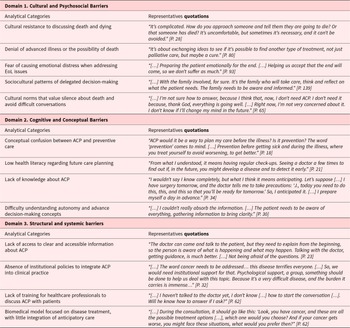
The comparative analysis revealed heterogeneous levels of understanding of ACP among participants. While some demonstrated a clear perception of ACP as a means to preserve autonomy, document preferences, and anticipate future care decisions, others interpreted it merely as a form of preventive or routine health management. A subset of participants expressed complete unfamiliarity with the concept. Beyond these conceptual variations, the findings underscore emotional and cultural barriers, such as fear of discussing death and misconceptions that associate ACP exclusively with terminality (Table 2). Participants who exhibited a more accurate understanding of ACP tended to emphasize its relational dimension, highlighting dialogue, family involvement, and professional empathy. In contrast, those with partial or absent understanding often relied on a predominantly biomedical or procedural perspective.
Table 2. Barriers to Advance Care Planning identified through qualitative analysis: domains, themes, and participant quotations

Notes: ACP: Advance Care Planning; EoL: End-of-life; P: Participant.
Figure 1 illustrates the interaction among the main barriers to ACP. The conceptual map highlights how cultural and psychosocial, cognitive and conceptual, and structural and systemic domains overlap, reinforcing one another and shaping patients’ limited understanding and engagement with ACP.

Figure 1. Conceptual map of the evolving pathway and dynamic interactions among barriers to Advance Care Planning.
The conceptual map demonstrates that barriers to ACP are not isolated phenomena but rather intersecting layers of cultural, cognitive, and structural factors that mutually reinforce one another. Cultural norms that discourage open dialogue about death, combined with low health literacy and limited institutional support, perpetuate silence and avoidance regarding future care.
Figure 2 synthesizes what patients currently know and what they need to know, and shows the transition from patients’ partial or distorted understanding of ACP to a more informed, autonomous, and value-centered perspective.

Figure 2. Transition from limited understanding to informed participation in Advance Care Planning: educational, communicational, and professional pillars fostering conceptual clarity and value-based engagement.
This transition is sustained by three interconnected pillars: education, communication, and professional support, which function as bridges between misunderstanding and awareness. Education enhances conceptual clarity and health literacy; enables patients to better grasp the purpose and process of ACP. Communication fosters trust, open dialogue, and emotional safety; and professional support creating space for meaningful discussions about values and preferences. Professional support anchors the process within institutional and ethical frameworks, ensuring continuity and legitimacy in clinical practice. Collectively, these pillars promote a transformation from fear and confusion to informed engagement and empowered shared decision-making, fostering a culture of autonomy and meaningful dialogue in ACP.
Discussion
The findings of this qualitative study highlight a significant gap in Brazilian cancer patients’ understanding of ACP. Many participants were unable to define ACP or distinguish it from general or preventive care. The analysis identified several challenges, including confusion between ACP and preventive health measures, as well as the predominant role of family members and physicians in decision-making. Emotional readiness for EoL decisions also influenced patients’ engagement with ACP (Arias-Rojas et al. Reference Arias-Rojas, Leiserovich and Castaño2025b). Without a clear understanding of the concept, patients may struggle to express their preferences, increasing the likelihood that EoL decisions will be made without active involvement (Mori et al. Reference Mori, Chan and Lin2025). These findings raise important concerns regarding patient autonomy, shared decision-making, and the role of healthcare professionals in facilitating discussions on future care. Addressing these issues requires targeted education interventions and broader cultural shift to normalize proactive EoL conversations (Guccione et al. Reference Guccione, Fullerton and Gough2023; Paiva et al. Reference Paiva, Bonilla-Sierra and Tripodoro2023; Goswami Reference Goswami2024; Trevizan et al. Reference Trevizan, Paiva and de Almeida2024).
The primary barrier to understanding ACP was conceptual confusion, as many patients misinterpreted it as preventive care due to the ambiguity of the term “planning.” Although some participants reported familiarity with ACP, their explanations revealed only superficial understanding, likely influenced by its limited integration into healthcare contexts dominated by prevention and treatment. The prevailing biomedical focus on cure and life prolongation reinforces the misconception that ACP seeks to prevent disease rather than guide care decisions in vulnerable or EoL situations (Arias-Rojas et al. Reference Arias-Rojas, Leiserovich and Castaño2025b). To address this issue, recent literature suggests rebranding ACP as “Advance Care Preparation” to better convey its intent (Guccione et al. Reference Guccione, Fullerton and Gough2023; Malhotra Reference Malhotra2024; Pimsen et al. Reference Pimsen, Sumpuntharat and Rodney2025).
In Brazil, limited awareness of ACP is compounded by a paternalistic healthcare culture, where patients often delegate medical decisions to doctors and family members (Kishino et al. Reference Kishino, Ellis-Smith and Afolabi2022; Rocha Tardelli et al. Reference Rocha Tardelli, Neves Forte and de Oliveira Vidal2023). Similar findings have been reported among other Latin American cancer patients (Yennurajalingam et al. Reference Yennurajalingam, Noguera and Parsons2013). Fear of mortality and complex medical choices may lead many to avoid future care discussions, transferring responsibility to trusted relatives (Board et al. Reference Board, Hughes and Stewart2025). The strong emphasis on family involvement reinforces patients’ tendency to relinquish autonomy, often without fully understanding their rights (Kishino et al. Reference Kishino, Ellis-Smith and Afolabi2022). This delegation is further fueled by misconceptions about ACP, such as the belief that planning for future care is unnecessary or carries a negative connotation (Leung et al. Reference Leung, Chung and Chan2024). The lack of proactive discussions forces healthcare teams to make critical decisions under pressure, often relying on family members overwhelmed by emotional stress, uncertainty, and feelings of guilt and failure for deciding on behalf of a loved one (Kishino et al. Reference Kishino, Ellis-Smith and Afolabi2022; Board et al. Reference Board, Hughes and Stewart2025; Pimsen et al. Reference Pimsen, Sumpuntharat and Rodney2025).
Another prominent phenomenon in studies on the Brazilian population is the pervasive fear of death, including discussing it (Trevizan et al. Reference Trevizan, Paiva and de Almeida2024; Vidal et al. Reference Vidal, Ribeiro and Kovacs2024). A common belief in Brazil is that “talking about death it closer,” reinforcing the fear that merely mentioning it could lead to its occurrence. Consequently, fear and psychological resistance hinder conversations about finitude and impact the acceptance of ACP in Brazil (Rocha Tardelli et al. Reference Rocha Tardelli, Neves Forte and de Oliveira Vidal2023; Trevizan et al. Reference Trevizan, Paiva and de Almeida2024). Deeply ingrained cultural norms discourage open conversations about mortality, reinforcing avoidance that delays or prevents EoL care discussions (Zhu et al. Reference Zhu, Rietjens and van Delden2025; Arias-Rojas et al. Reference Arias-Rojas, Leiserovich and Castaño2025b). This cultural silence is compounded by emotional barriers, as acknowledging mortality triggers anxiety, leading individuals to postpone or reject ACP as uncomfortable or unnecessary (Izumi et al. Reference Izumi, Garcia and Kualaau2024). Additionally, religious and spiritual beliefs often frame death as a transcendental event beyond individual control, weakening the perception of ACP as a proactive autonomous process. As a result of these barriers, critical EoL decisions are often made in crisis situations, without the patient’s direct involvement, increasing the likelihood of misaligned interventions (Rocha Tardelli et al. Reference Rocha Tardelli, Neves Forte and de Oliveira Vidal2023; Goswami Reference Goswami2024; Faiman Reference Faiman2025).
The multilevel model shows that the barriers to ACP emerge through an interconnected process shaped by sociocultural dynamics and systemic inertia. Cultural taboos surrounding death, dependence on family decisions, and the moral framing of “not giving up” act as collective defenses against existential anxiety while limiting discussions about autonomy (Pimsen et al. Reference Pimsen, Sumpuntharat and Rodney2025; Arias-Rojas et al. Reference Arias-Rojas, Leiserovich and Castaño2025b). These cultural forces become internalized, fostering low health literacy and reinforcing beliefs that medical authority should dominate care decisions, which the healthcare system mirrors by prioritizing technical interventions over relational communication and reflective decision-making (Vanderhaeghen et al. Reference Vanderhaeghen, Bossuyt and Menten2020; Dias et al. Reference Dias, Bezerra and Barra2022; Goswami Reference Goswami2023; Zabawa Reference Zabawa2023; Faiman Reference Faiman2025; Yan et al. Reference Yan, Derong and Qin2025).
Consequently, institutions become structured around procedural efficiency rather than dialogical care, producing insufficient training, lack of protocols, and fragmented coordination (Trevizan et al. Reference Trevizan, Paiva and de Almeida2024; Tardelli et al. Reference Tardelli, Fukushima and van der Steen2025). This escalation reveals a feedback loop: cultural avoidance fosters cognitive confusion, which sustains structural neglect, and systemic deficiencies, in turn, validate the original cultural silence (Arias-Rojas et al. Reference Arias-Rojas, Leiserovich and Castaño2025b). Breaking this cycle, therefore, requires interventions that do not merely educate or legislate but that reconfigure how care, communication, and death are collectively understood within the sociocultural health systems (Faiman Reference Faiman2025; Yan et al. Reference Yan, Derong and Qin2025).
To address these challenges, a multifaceted approach is required. First, patient and healthcare professional education is essential to clarify ACP as a patient-centered process, not preventive care (Arias-Rojas et al. Reference Arias-Rojas, Leiserovich and Castaño2025b; Mori et al. Reference Mori, Chan and Lin2025; Pimsen et al. Reference Pimsen, Sumpuntharat and Rodney2025; Volandes et al. Reference Volandes, Chang and Lakin2025). Educational initiatives should offer accessible materials and training that enhance understanding and communication skills among both groups. Second, culturally and emotionally sensitive communication is key to reducing resistance, with providers emphasizing empathy and respecting cultural and religious views while promoting autonomy in decision-making (Izumi et al. Reference Izumi, Garcia and Kualaau2024; Rak et al. Reference Rak, Indralingam and Richardson2025). Third, normalizing ACP during routine visits helps eliminate misconceptions and positions it as a standard part of quality care, not just EoL care. Additionally, shifting from therapeutic obstinacy to patient-centered care requires systemic efforts to reframe ACP as a proactive tool (Leung et al. Reference Leung, Chung and Chan2024; Pimsen et al. Reference Pimsen, Sumpuntharat and Rodney2025). These strategies improve autonomy, reduce family burden, and enhance care quality (Vanderhaeghen et al. Reference Vanderhaeghen, Bossuyt and Menten2020; Volandes et al. Reference Volandes, Chang and Lakin2025; Arias-Rojas et al. Reference Arias-Rojas, Leiserovich and Castaño2025b).
This study presents some limitations. It was conducted exclusively with Brazilian women with breast cancer recruited from a single cancer center, which may limit the transferability of findings to other populations, genders, and healthcare contexts. Nonetheless, this focus enabled a deep understanding of ACP perceptions within a culturally representative and vulnerable group. The online format may have excluded participants with limited digital access, yet it facilitated geographic diversity and provided comfort for discussing sensitive topics. As with all qualitative research, results reflect subjective experiences, but this approach was crucial to capture the emotional and sociocultural meanings often overlooked in quantitative designs. Cultural and linguistic nuances may also have influenced interpretations, though they enrich comprehension of how beliefs and communication styles shape ACP engagement. Future studies should include more diverse participants, and adopt longitudinal or multicenter designs. Interventional research testing educational or communication-based strategies is also warranted to strengthen ACP literacy and inform policies that promote culturally, equitable, and patient-centered care across Latin America.
This study revealed a critical gap in Brazilian cancer patients’ the understanding of ACP. Most participants demonstrated limited or inaccurate knowledge, often confusing ACP with preventive or routine healthcare. Cultural norms that discourage discussions about death, reliance on physicians and family members for decision-making, and the absence of institutional policies further hinder ACP engagement. These findings contribute to a broader understanding of how sociocultural dynamics shape ACP engagement in collectivist healthcare contexts, highlighting the interplay between autonomy, family roles, and institutional structures. Addressing these multilevel barriers requires coordinated strategies that health literacy, promote culturally sensitive communication strategies, and build institutional support. Reframing ACP as a proactive and relational process that aligns care with patients’ values and preferences may foster earlier, more meaningful, and ethically grounded conversations about future care, ultimately enhancing the quality and dignity of EoL experiences in Brazil and similar settings.
Acknowledgments
We thank the Research Group on Palliative Care and Health-Related Quality of Life (GPQual) at Barretos Cancer Hospital for their support.
Author contributions
FBT and BSRP served as the principal investigators. FBT conducted data collection under the guidance of BSRP. Data analysis was performed by FBT and BSRP. FBT, CEP, LCO, KSCR, and BSRP drafted the manuscript. BSRP is the corresponding author. All authors reviewed and approved the final manuscript.
Funding statement
B.S.R.P. was supported by the CNPq Research Productivity Fellowship Level C (grant number 305898/2024-8).
Competing interests
The authors declared no potential conflicts of interest with respect to the research, authorship, and/or publication of this article.
Ethical approval and informed consent statements
Ethical approval was obtained from the Ethics and Research Committee of Barretos Cancer Hospital (registration number 4,987,629). All participants provided written informed consent. Participants’ rights were protected by ensuring autonomy, confidentiality, privacy, and respectful treatment according to ethical research standards.



 Open access

