


Election report
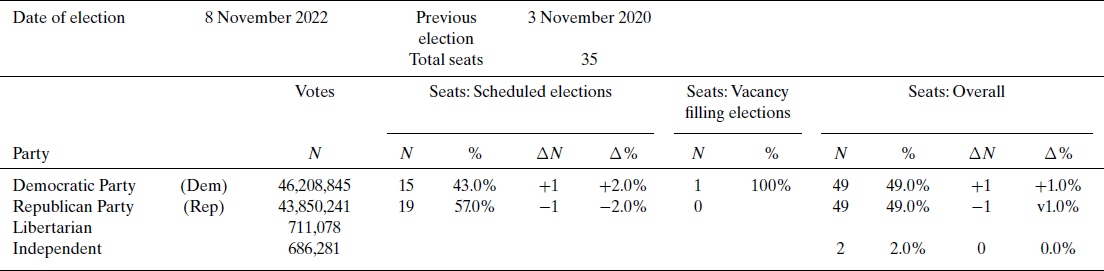
The November election chose all 435 seats in the House of Representatives, 35 Senate seats (34 for six-year terms ending in 2028 and one to complete the term—ending in 2026—of Oklahoma Senator Jim Inhofe, who had announced that he would resign at the end of the 117th Congress in January 2023), as well as 36 state governors, many state legislatures, and innumerable local officials. Congressional election results can be found in Tables 1 and 2.
Table 1. Elections to the House of Representatives in the United States in 2022

Notes:
1. “Electorate” is estimated “Voting-Eligible Population.”
2. Party vote totals include districts with more than one candidate of the same party.
Sources: https://www.electproject.org/2022g; Office of the Clerk, US House of Representatives, “Statistics of the Congressional Election from Official Sources for the Election of November 8, 2022.”
Table 2. Elections to the Senate in the United States in 2022

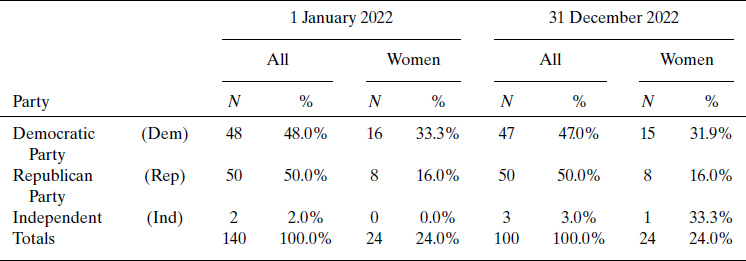
Notes: The two independents caucus with the Democrats, giving them an effective majority of 51 to 49.
Sources: Office of the Clerk, US House of Representatives, “Statistics of the Congressional Election from Official Sources for the Election of November 8, 2022.”
Based on the historical record of the incumbent president's party losing seats in the midterm election, Biden's low approval ratings, and high inflation, there was a widespread expectation of a “red [i.e., Republican] wave.” In the event, the Republicans gained only nine seats in the House of Representatives (still enough to give them a slim majority) and actually lost one seat in the Senate (in December, Kyrsten Sinema changed her affiliation from Democrat to independent but announced that she would not caucus with the Republicans, declaring that “Nothing's going to change for me,” and thus leaving the Democrats narrow majority intact.) The Democrats also increased their number of governorships (losing Nevada but gaining Arizona, Maryland, and Massachusetts).
One of the unsettled questions going into the 2022 election season was the extent of Donald Trump's hold over the Republican party. Trump endorsed more than 200 candidates running in Republican primaries. The vast majority were incumbents, of whom more than 99 per cent won their primaries, but so did most non-endorsed incumbents, with the exceptions of those who had voted in favor of Trump's impeachment. Particularly notable was the overwhelming primary defeat of January 6 Committee Vice-Chair, and strong Trump opponent, Liz Cheney, by Trump-endorsed Harriet Hageman (more than twice as many votes while spending less than one-fourth as much as Cheney). In a number of cases where the general election was expected to be competitive, the Democrats “supported” far-right or Trump-endorsed candidates in the Republican primaries (generally by running ads criticizing those candidates as “too conservative for …” or otherwise associating them with positions likely to be popular with Republican primary voters, but unpopular with the general electorate), on the theory that those candidates would be easier to beat in November. Although sometimes criticized as undemocratic (the counter-argument might be that they were merely informing the electorate), the Democrats won all six of the races in which the Democrat-“supported” candidate became the Republican nominee. Particularly, significant Trump victories came in the senatorial primaries in Georgia, Pennsylvania, Arizona, Nevada, and Ohio and in gubernatorial primaries in Michigan, Wisconsin, Massachusetts, Arizona, and Pennsylvania. The significance of these races became particularly clear when, with the sole exception of J. D. Vance running for the Ohio Senate seat vacated by the retirement of Republican Rob Portman, every one of these Trump-endorsed candidates lost in the general election.
Although every race was unique, in general terms, three issues dominated the 2022 campaign nationally. As always, the economy was a major concern, with the Republicans focusing on the high rate of inflation (the year-over-year inflation rate for October was 7.7 per cent, although that was down from 9.1 per cent in June) and the Democrats focusing on the extremely low unemployment rate (3.7 per cent, down from 14.7 per cent in April 2020).
With the overturning of Roe v. Wade (see Supreme Court report below), reproductive rights became a major motivating factor for many Democrats (while presumably losing some of its urgency for anti-abortion Republicans). Thirteen states had laws banning or very severely restricting access to abortion triggered by the Court's action, immediately (three states), after 30 days (three states), or after some relatively simple administrative action (seven states). Six states held popular votes addressing abortion in 2022; in all six, the anti-abortion position lost. Voters in California, Michigan, and Vermont approved state constitutional amendments guaranteeing reproductive rights. Proposed amendments to the state constitutions of Kansas and Kentucky stating that there was no constitutional right to abortion were defeated by voters, as was Montana's so-called “Born-Alive Infant Protection Act.” All of this suggested that even in Republican states, extremism with regard to abortion has become a losing issue for the Republicans.
Stimulated by the insurrection of 6 January 2021, and reinforced by the revelations of the January 6 Committee, the defense of democracy became a significant issue wielded by the Democrats. Generally, candidates associated with denying the legitimacy of the 2020 election polled behind other Republicans.
Other significant issues included the perennial questions of crime and gun violence (with Republicans reminding voters of “defund the police” slogans from racial justice protesters—a position that Biden had publicly rejected, and Democrats pushing for stricter gun laws—a position rejected by most Republicans who remained fixated on gun rights), immigration (primarily important to Republicans and highlighted by the “cruel political theatre” of Republican governors of Florida, Texas, and Arizona sending migrants to more liberal states), and climate change (widely regarded as an important issue but rarely regarded as the most important issue).
On 15 November, Donald Trump announced his candidacy for the 2024 presidential election, notwithstanding that many Republicans and commentators blamed him for the party's poor performance the week before.
Cabinet report
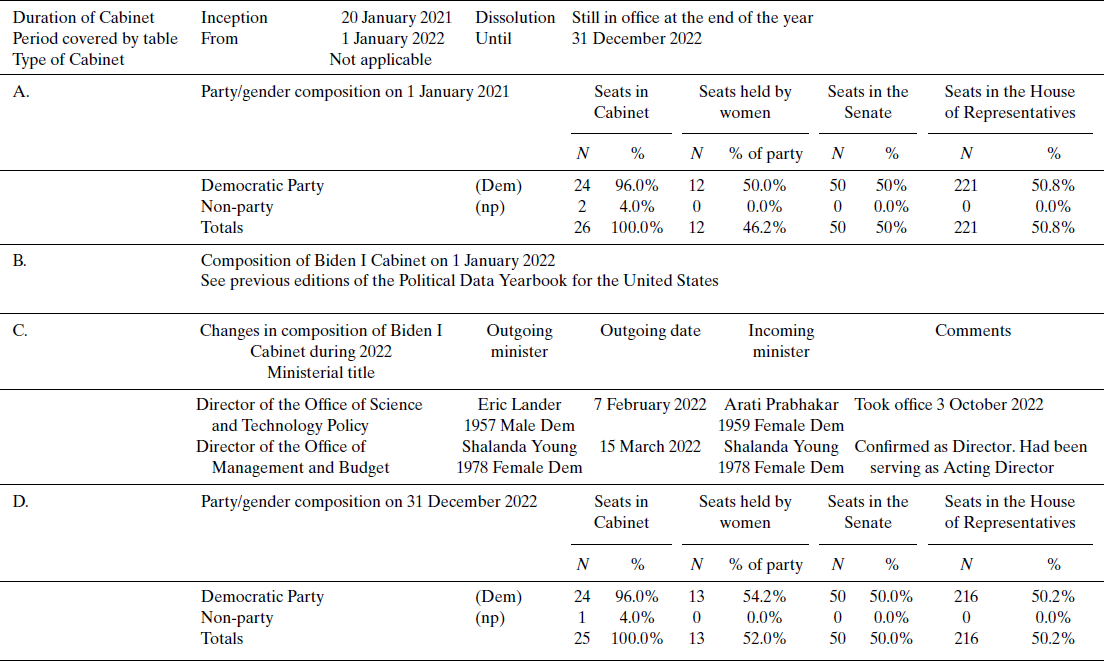
There was one change in the president's Cabinet, and one change of status, during 2022 (see Table 3). In February, Eric Lander, Director of the Office of Science and Technology Policy, resigned a few days after 14 current and former staff members accused him of bullying and demeaning subordinates—a charge that he admitted and apologized for. His initial appointment in 2021 had been questioned when 500 female scientists complained that he was well known in the scientific community for being offensive toward women. Lander's deputy director, Alondra Nelson, served as Acting Director until Arati Prabhakar became Director (confirmed 22 September; took office 3 October).
Table 3. Cabinet composition of Biden I in the United States in 2022

Notes: In this table, the two independent senators who caucus with the Democrats are counted as Democrats.
Sources: www.clerk.house.gov; www.senate.gov; www.whitehouse/gov.
In November 2021, Shalanda Young, who had been confirmed as Deputy Director of the Office of Management and Budget in 2021, and had served as Acting Director after the nomination of Biden's initial choice, Neera Tanden, was withdrawn, was nominated to the Director's position. Her nomination was confirmed on 15 March 2022.
Parliament report
Shortly after the November election, House Speaker Nancy Pelosi announced that she would be stepping down from leadership in the new Congress. With Pelosi's endorsement, the Democratic caucus elected Hakeem Jeffries to succeed her as party leader in 2023. When the new Congress convened in 2023, Jeffries became the first African-American to lead either party in Congress.
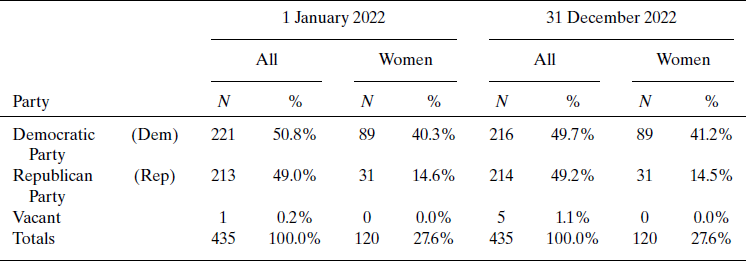
Over the course of 2022, the Republicans gained one seat in the House of Representatives; although there were deaths and resignations resulting in reduction of the Democratic majority at the end of the year, the gender balance remained unchanged. As mentioned above, in the Senate, in December, Krysten Sinema announced that she was changing her partisanship from Democrat to independent, but as with the other two independents in the Senate, this had no impact on partisan control (see Tables 4 and 5).
Table 4. Party and gender composition of the House of Representatives in the United States in 2022

Source: https://clerk.house.gov/.
Table 5. Party and gender composition of the Senate in the United States in 2022

Supreme Court
In 2022, the conservative majority of six justices, three of whom had been appointed by Donald Trump, showed considerable assertiveness in expanding the rights of gun owners, weakening the separation of church and state, weakening the capacity of the federal government to protect the environment, and overturning the long-standing constitutional protection of abortion rights. Although they also ruled that former President Trump could not block the release of White House records to the House of Representatives committee investigating the 6 January attack on the Capitol, many of the Court's decisions, some public statements by justices, and the extreme partisanship that had accompanied confirmation of the Trump appointees contributed to a decline in public confidence in the Court.
In New York State Rifle Association v. Bruen, the Court found a constitutional right to carry a pistol in public, although they still allowed states some latitude to require background checks or to ban guns from certain “sensitive places” like courthouses or polling places. In Kennedy v. Bremerton School District, the Court ruled that a public high school football coach had a constitutional right to pray at mid-field after his team's games, while in Carson v. Makin, they ruled that a Maine program that excluded religious schools from a state tuition program for communities with no public high school violated the First Amendment right to free exercise of religion. In the case of West Virginia v. Environmental Protection Agency, the Court ruled that the Environmental Protection Agency did not have the authority to use generation shifting mechanisms to require reduced emissions from existing power plants, thus highly limiting the administration's clean air options. Each of these cases was decided by a vote of the six conservative justices (Roberts, Kavanaugh, Barrett, Gorsuch, Alito, and Thomas) and opposed by the three liberals (Sotomayor, Kagan, and Breyer).
Most significantly, at least for partisan politics, in the case of Dobbs v. Jackson Women's Health Organization, the Court overturned the constitutional protection of a right to abortion that had been established in 1973 in the case of Roe v. Wade. The decision was released on 24 June, although a draft had been leaked in early May. The decision to uphold restrictions imposed by the state of Mississippi was decided 6–3, but while Chief Justice Roberts joined with the other five conservative justices in upholding the particular restrictions, he did not join the majority opinion overturning Roe altogether, so that part of the opinion—which attacked what had been the rationale for a number of other rights, including same-sex and inter-racial marriage and the availability of contraception—was decided 5–4. While the majority attempted to distinguish abortion from these rights, critics noted that many of the justices voting to overturn Roe had previously pronounced Roe to be “settled law,” suggesting that these other rights might not be as secure as the opinion in Dobbs sought to indicate.
In January, Justice Stephen Breyer announced his intention to retire when the Court rose for its summer recess. In February, President Biden nominated Judge Ketanji Brown Jackson of the Court of Appeals for the District of Columbia Circuit (to which he had appointed her in 2021 to replace Merrick Garland, when he became Attorney General). She was confirmed by the Senate 53–47, with three Republicans (Romney, Murkowski, and Collins) joining the unanimous Democrats. She was sworn in on 30 June, becoming the first African-American woman, and the first former public defender, on the Court.
Issues in national politics
In March, the first trial of one of the more than 900 individuals charged with federal crimes in relation to the attack on the Capitol on 6 January 2021 ended with guilty verdicts on all five charges: transporting a firearm in furtherance of a civil disorder, obstruction of an official proceeding, entering or remaining in a restricted area or grounds with a firearm, obstructing officers during a civil disorder; and obstruction of justice—hindering communication through force or threat of physical force. Several other participants, including “QAnon Shaman” Jacob Chansley, had already been sentenced to prison following guilty pleas or as a result of plea bargains, and Proud Boys member Matthew Greene accepted a plea agreement at the end of 2021, in which he agreed to cooperate in the prosecution of other Proud Boys members; those trials began in January 2023. At the beginning of August, he was sentenced to 7 1/4 years in prison. By the end of the year, the Justice Department reported that 484 defendants had pleaded guilty to various crimes, and 192 had been sentenced to time in prison. On 29 November, Stewart Rhodes, founder of the far-right Oath Keepers, and Kelly Meggs were found guilty of seditious conspiracy; three co-defendants were acquitted on that charge, but all five were convicted of other crimes. Four more Oath Keepers were convicted of seditious conspiracy in January 2023.
Abortion rights, which has long been an issue for Republicans but largely taken for granted by Democrats, became a major concern in May/June with the leak and then the release of the Supreme Court's decision overturning Roe v. Wade, removing federal protection of abortion rights and returning the question to the states. In September, the House of Representatives passed (218–211) a bill to protect access to abortion, but the bill died in the Senate due to the inability to muster the 60 votes required to break a filibuster.
As has become a regular occurrence in the United States, 2022 saw several high-profile mass shootings, including 10 with at least six fatalities. The killing of 10 African-American shoppers in a Buffalo, NY, supermarket, followed 10 days later by the killing of 19 students and two adults in an elementary school in Uvalde, TX, gained particular attention. In June, 14 Republicans joined all 220 Democrats in the House and 15 Republicans joined all 50 Democrats in the Senate to pass the Bipartisan Safer Communities Act, the first major legislation to combat gun violence in nearly 30 years.
In July, The House of Representatives Select Committee to Investigate the January 6 Attack on the United States Capitol, formed in July 2021 after Senate Republicans blocked the appointment of a joint committee, began a series of televised public hearings, focusing primarily on Donald Trump's role in fomenting the attack. The hearings were notable in that virtually all of the witnesses were well-respected Republicans, members of the Trump administration, or other Trump advisors. Testimony made clear that Trump knew there were no grounds to challenge the 2020 election's results, that the vice-president had no authority to reject certified slates of electors, that at least some members of the crowd he had summoned to Washington and sent to march on the Capitol were armed, and that, against the requests of his advisors, rather than taking action to protect the Capitol or call off the rioters, he simply watched events unfold on television. The committee's work culminated on 19 December, in the televised presentation of a summary of its report and the revelation of four criminal referrals to the Department of Justice (which has the sole authority to initiate criminal proceedings) against Trump (Obstruction of an Official Proceeding [18 U.S.C. § 1512(c)]); Conspiracy to Defraud the United States (18 U.S.C. § 371); Conspiracy to Make a False Statement (18 U.S.C. §§ 371, 1001); “Incite,” “Assist,” or “Aid and Comfort” an Insurrection (18 U.S.C. § 2383), and then with the online publication of its full report on 22 December, and the release of as many transcripts of witness testimony as possible before the expected disbanding of the committee by the incoming Republican majority.
In a separate investigation of possible legal violations by Trump, in August, the Federal Bureau of Investigation (FBI) executed a search warrant of the former president's Mar-a-Lago property to recover classified documents that should have been turned over to the National Archives when he left office or at least in response to a subpoena issued in May. Officials left with over 20 boxes of materials. As has become the norm when the legality of Trump's actions is questioned, many Republicans criticized the proceedings as “politically motivated witch hunts” and promised their own investigation into the FBI and Department of Justice, anticipating that they would take control of Congress in 2023.
On 16 August, Biden signed the Inflation Reduction Act of 2022. The bill was largely the result of secret negotiations between Senate Majority Leader Schumer and Senator Joe Manchin and was introduced as an amendment/substitute for 2021's proposed Build Back Better Act, which had apparently been killed by the withdrawal of Manchin's support at the end of 2021. As a budget reconciliation measure, the bill was not subject to a Senate filibuster and was passed 51–50 in the Senate (with the vice president casting the tie-breaking “yes” vote) and 220–207 in the House, both votes with all Democrats in favor and all Republicans opposed. Among other things, the law authorizes increased spending on clean energy and climate change mitigation, aimed to lower prescription costs by allowing Medicare to negotiate prices with pharmaceutical companies and by capping insulin prices, and extended Affordable Care Act subsidies for an additional three years. It also includes provisions aimed at increasing tax compliance and the modernization and expansion of the Internal Revenue Service. Although the law's likely impact on inflation remained in doubt, it represented a major legislative victory for the president in reviving much of his domestic agenda that had apparently been killed with the loss of the Build Back Better Act.
Although voting rights remained a high Democratic priority, their failure to enact meaningful federal legislation despite nominal control of both houses of Congress (real control of the Senate requires 60 votes) continued through 2022. On the other hand, by strenuously pushing the question, they raised “defense of democracy” as an important issue in the public's mind and arguably produced an increase in salience from which they benefitted in the 2022 elections. Even if there was no legislation at the federal level, there was considerable legislative action in several states. At least seven states passed legislation that makes voting more difficult in at least one respect; the Arizona legislature also proposed a ballot proposition that would have made voting more difficult, but that was narrowly rejected by the voters. At least 12 states (including some of the seven) enacted laws making voting easier in at least some respect. Additionally, several states enacted legislation making partisan interference in the conduct of elections easier or threatening the people and processes that make elections work.


 Open access

