


Introduction
Times of crisis and political upheavals reinforce NPOs’ roles as advocates, service providers as well as place for social engagement and thus highlights NPOs’ position as central hub between government, affected individuals and other civil society actors (Simsa and Zimmer Reference Simsa, Zimmer, Zimmer and Simsa2014; Meyer et al. Reference Meyer, Neumayr and Schneider2010; Anheier Reference Anheier2005). The significance of NPOs’ as civil society actor became especially evident in the ‘refugee crisis’ of 2015/16. Due to Austria´s geographic position and particularly its closeness to the ‘welcome-nation’ Germany, the country with a population of 8.7 million was confronted with more than one million refugees from Syria, Iraq and Afghanistan mostly transiting, but with over 100.000 also seeking asylum in Austria.Footnote 1 This huge amount of refugees by far exceeded Austria’s governmental structures and its capacity in crisis and emergency management (CEM)Footnote 2 (Roth Reference Roth2017, 6; Maduz and Roth Reference Maduz and Roth2017; 2 ff.; Gratz Reference Gratz2016, 167 ff.). Particularly, Austria lacked an appropriate national CEM strategy, which regulates CEM across federal states. Hence, coordination of refugee aid across federal states was mainly informal (Gratz Reference Gratz2016, 91; Roth Reference Roth2017, 7).
NPOs, particularly established rescue and aid organizations, strived to close this gap together with other civil society actors, such as grass-roots initiatives, self-organized volunteers (Simsa Reference Simsa2017, 79) and for-profit organizations, mainly infrastructure organizations and security firms (Gratz Reference Gratz2016, 142 ff.). In this context, NPOs were active in strategic political as well as in operative CEM. They substituted governmental deficiencies concerning strategic leadership and coordination of refugee aid as well as operative CEM issues, such as public security at national boarders (registration, transport, etc.) and primary care for refugees and asylum seekers (food supply, medication, etc.). NPOs also compensated privatized public duties, such as providing accommodation for asylum seekers (Maduz and Roth Reference Maduz and Roth2017; Frühwirth and Lachmayer Reference Frühwirth and Lachmayer2015).
In sum, the ‘Austrian refugee crisis’ centered on coping with transit refugees and it was handled by a multiplicity of actors (Simsa Reference Simsa2017; Roth Reference Roth2017; Maier and Ortner Reference Maier and Ortner2017). NPOs and other civil society actors predominantly fulfilled tasks, which exceeded governmental capacity in CEM or tasks, which have not been legally determined and were left to informality (Roth Reference Roth2017, 7; Gratz Reference Gratz2016, 91).
NPOs success in coping with the refugee crisis, particularly its capacity to handle the dynamics during these times, was substantially based on their experiences in international disaster relief and on their huge pool of human resources, especially volunteers (Simsa Reference Simsa2017; Gratz Reference Gratz2016). In addition to resources, NPOs displayed organizational capabilities, which were substantial to handle refuge crisis. NPOs were able to provide time-critical status reports including the identification of opportunities and threats, even though there was a lack of official communication structures. They managed to set up coordination and cooperation structures between diverse actors, and they were able to combine different logics such as spontaneous activism of volunteers and planning approach of rescue units in decision-making processes (Gratz Reference Gratz2016, 29 u. 63 f.). NPOs also succeeded in (re-)combining resource pools innovatively to set up critical infrastructure (Maduz and Roth Reference Maduz and Roth2017).
Being able to cope successfully with the situation described strongly suggests the presence of specific organizational capabilities—dynamic capabilities (DCs). This is because DCs are, firstly, capabilities which enable an organization to sense changes—opportunities and threats—and define possible resource actions (Teece Reference Teece2007, Reference Teece2014). Secondly, DCs help an organization seizing opportunities by selecting the appropriate resource actions and then implementing these decisions. Thirdly, DCs transform or rather align resources to the environmental dynamics (e.g., clients’, government’s, other partners’ needs) (Teece Reference Teece2014; Jantunen et al. Reference Jantunen, Ellonen and Johansson2012). In short, DCs support organizations to adapt to changing conditions by contributing to an environment-organization fit and hence support organizations to compete in dynamic environments (Di Stefano et al. Reference Di Stefano, Peteraf and Verona2014, 315). Correspondingly, DCs are prevalently related to positive performance effects (Teece et al. Reference Teece, Pisano and Shuen1997, Teece Reference Teece2007; Wang and Ahmed Reference Wang and Ahmed2007).
While there is (some) research regarding performance effects of DCs in NPOs (Piening Reference Piening2013; Kaltenbrunner Reference Kaltenbrunner2018), it remains largely unclear, which intra-organizational mechanisms foster the application of DCs (Pavlou and El Sawy Reference Pavlou and El Sawy2011; Sprafke et al. Reference Sprafke, Wilkens, Schiffer and Feldmann2013). Particularly, the link between organizations as agents on a macro-level and managers as agents on a microlevel needs to be explored in more detail (Di Stefano et al. Reference Di Stefano, Peteraf and Verona2014). Gaining insights into this link—the microfoundation of DCs—is crucial because it provides options for influencing the application of dynamic capabilities (Felin et al. Reference Felin, Foss and Ployhart2015).
Hence, we aim to explore the link between mechanisms on microlevel and DCs by answering the research question of how management affects the application of dynamic capabilities in NPOs active in refugee aid. A quantitative study among managers deployed in refugee camps all over Austria was conducted to answer this question. Based on the dynamic capability approach, we expect that NPOs coping successfully with the dynamics of refugee crisis applied dynamic capabilities and that managers’ behavior affected their application.
Our paper makes the following contributions: Firstly, it provides evidence on how management and dynamic capabilities are linked, and thus adds to the highly claimed microfoundation of DCs in general (Sprafke et al. Reference Sprafke, Wilkens, Schiffer and Feldmann2013; Teece Reference Teece2007, Reference Teece2014) and in the context of NPOs in particular. We examine the microfoundation of DCs in NPOs, where research regarding the microfoundation of DCs is even scarcer. Secondly, we provide an integrative illustration of management-related microfounding mechanisms and introduce participative leadership as a hardly researched leadership style potentially enhancing DCs. Thirdly, the illustration of microfounding managerial mechanisms provides opportunities for influencing or rather managing the application of DCs. This is particularly important because DCs enable continuous organizational change, which in turn supports NPOs to meet civil society´s changing needs. Fourthly, referring to NPO practice, we point out how managers can govern DCs.
The remainder of this paper is structured as follows; we first discuss the nature of dynamic capabilities and elaborate what these DCs could look like in refugee aid. We then illustrate the microfoundation of DCs as our theoretical background and explain how management can orchestrate the application of DCs in refugee aid. In the third section, we present the empirical results of our survey using a mediation analysis. The final section contains a brief discussion.
Framing Dynamic Capabilities in Theory and Practice
Nature and Relevance of Dynamic Capabilities
Despite difference in understandings of dynamic capabilities (Hsu and Wang Reference Hsu and Wang2010; Wang et al. Reference Wang, Senaratne and Rafiq2015), there is consensus in the literature that the purpose of DCs is balancing the organization’s, the employees’ and the customers’ needs as well as other ‘business opportunities’ (Baretto Reference Barreto2010; Eisenhardt and Martin Reference Eisenhardt and Martin2000) in order to ‘maintain leadership in continually shifting business environments’ (Teece Reference Teece2014, 329 f.). Scholars also agree that dynamic capabilities represent ‘higher-level activities’ (i.a. Teece Reference Teece2014; Güttel and Konlechner Reference Güttel and Konlechner2009) or ‘meta-capabilities’ (Baretto Reference Barreto2010; Eisenhardt and Martin Reference Eisenhardt and Martin2000) because they can govern other capabilities. DCs ‘enable the firm to integrate, build, and reconfigure internal and external resources’ (Teece Reference Teece2014, 335). ‘Higher-level activities’ or ‘meta-capabilities’ also refer to the fact that DCs are not directly observable or visible. DCs become visible as soon as ‘ordinary’ capabilitiesFootnote 3 and activities, such as knowledge or information processing, learning, coordination and reconfiguring activities ‘operationalize’ them. ‘Dynamic’ refers to how the resource base is changed (Ambrosini and Bowman Reference Ambrosini and Bowman2009). A capability is dynamic, provided the velocity of capability (re-)configuration corresponds to the velocity of environmental dynamics (Teece Reference Teece2007; Eisenhardt and Martin Reference Eisenhardt and Martin2000).
DCs are relevant because they provide two ‘added values’ in relation to ordinary capabilities (Kaltenbrunner Reference Kaltenbrunner2018). The first ‘value added’ of DCs is that DCs facilitate organizations’ adaptation to changing environmental conditions repeatedly (Teece Reference Teece2007, Reference Teece2014) or systematically and over time (Hsu & Wang Reference Hsu and Wang2010). This is what Teece (Reference Teece2014) defines as ‘dynamic fit.’ In the case of NPOs active during the refugee crisis, this fit consisted in ‘translating’ the needs of refugees into services such as providing food, setting up camps or lobbying as fast as needs were changing. The second ‘added value’ of DCs emanates from their potential to generate a ‘multi-perspective fit’, not only a ‘strategic fit’ in terms of Chandler (Reference Chandler1962). This implies that DCs can cope with dilemmasFootnote 4 in terms of multi-dimensional, partly conflicting interests, such as discrepant dominant logics of diverse internal and external stakeholders. During the refuge crisis, NPOs were, e.g., challenged to combine standard procedures of CEM disaster management (logic one) and activism, experimental search logics, such as intuition (logic two). By enhancing dynamic as well as multi-perspective fit, DCs support the organizational capacity to adapt and hence to compete in dynamic environments over time (Di Stefano et al. Reference Di Stefano, Peteraf and Verona2014, 315) and is reflected in strong evidence for a DC performance link (Teece et al. Reference Teece, Pisano and Shuen1997, Teece Reference Teece2007; Wang and Ahmed Reference Wang and Ahmed2007).
Conceptualization of Dynamic Capabilities and Refugee Aid
Following Teece’s et al. (Reference Teece, Pisano and Shuen1997, Reference Teece2007, Reference Teece2014) understanding, DCs consist of three clusters of higher-level activities. These are sensing, seizing and transforming activities. As previously mentioned, sensing refers to identifying, scanning and monitoring environmental changes—opportunities and threats—and defining possible resource actions. This includes, e.g., having a good observation and judgment ability, a profound understanding of the impact of internal and external environments, a sense for major opportunities and threats and a sound information management (Li and Liu Reference Li and Liu2014). Transferred to refugee crisis, sensing could manifest in the ability to estimate the direction and quantity of arriving refugees and to provide status reports, to detect the refugees’ needs and to anticipate their impact on infrastructure and resources. Seizing opportunities as the second cluster of activities mean choosing among possible resource actions and implementing the selected decision(s). Thus, seizing refers to the ability of absorbing and assimilating information in order to make (timely) client-oriented decisions, to design systems and structures and to mobilize the necessary resources for addressing the needs and opportunities for implementing decisions (Teece Reference Teece2014; Li and Liu Reference Li and Liu2014; Jantunen et al. Reference Jantunen, Ellonen and Johansson2012). Seizing in the crisis situation could be found in defining appropriate decision-making and coordination structures; in activating and mobilizing (existent) (slack) resources, particularly volunteers and partners on a local level; and in delineating a kind of ‘business model’ in order to guarantee food supply and medical care. Thirdly, the transforming cluster encompasses the ability of aligning tangible and intangible resources to the environmental dynamics. This is mainly done by reconfiguring or recombining different resources (Teece Reference Teece2014; Jantunen et al. Reference Jantunen, Ellonen and Johansson2012). There are various forms of reconfiguration, i.e., bundling existent resources and capabilities in new ways (Den Hertog et al. Reference Den Hertog, van der Aa and de Jong2010). Resource bundling could become evident in the NPOs’ ability to bundle their capabilities for setting up camps in a new way in order to build temporary homes. Reconfiguring also includes enriching existing resources and capabilities with new resources and capabilities. Transferred to the refugee crisis, this would be the NPOs’ ability to enrich emergency supply of clients with new resources and capabilities for providing continuous care. Furthermore, it refers to replication of resources and capabilities in new organizational and market domains, e.g., NPOs active in (international) tracing services could stretch these capabilities in order to provide migration services.
Theoretical Framework of Dynamic Capabilities
As illustrated above, DCs—particularly in the notion of Teece (Reference Teece2007, Reference Teece2014)—are based on resources or bundles of resources. These bundles of resources determine essentially, if an organization can compete over time or not. This view goes in line with the resource-based approach of Wernerfelt (Reference Wernerfelt1984), which correspondingly represents one dominant theoretical foundation of the dynamic capability approachFootnote 5 (Di Stefano et al. Reference Di Stefano, Peteraf and Verona2014). Complementarily a ‘dynamic dimension’ is added to enrich the dynamic capabilities approach because scholars regard bundles of resources as important, but not sufficient for gaining competitive advantage in dynamic environments. The ‘dynamic dimension’ refers to the organization’s capability to adapt to environmental changes (Teece et al. Reference Teece, Pisano and Shuen1997). This perspective roots in evolutionary economics (Nelson and Winter Reference Nelson and Winter1982). Evolutionary economics becomes particularly apparent in the dynamic capabilities approach via routines as fundament or building blocks of DCs. Thus, Teece (Reference Teece2016) regards the dynamic capabilities approach as ‘capabilities enriched economic theory.’
While the understanding of routines and capabilities is relatively elaborated, there is a lack of research regarding the microfoundation, the microlevel origins of routines and capabilities (Felin et al. Reference Felin, Foss, Heimeriks and Madsen2012, p. 1351). Microfoundation movement in the field of strategy and organization theory deals with the definition of underlying elements and mechanisms, which shape dynamic capabilities encompassing processes, activities, structures, rules as well as conditions of individual behavior, such as cognitions and affects and individual-level or group-level actions (cf. Teece Reference Teece2007; Eisenhardt et al. Reference Eisenhardt, Furr and Bingham2010). Felin et al. (Reference Felin, Foss, Heimeriks and Madsen2012) cluster microfoundation of routines and capabilities into three categories, which are individuals, processes/interactions and structure. The first category individuals as micromechanisms can be deconstructed in a cognitive and motivational dimension (Nelson and Winter Reference Nelson and Winter1982; Becker et al. Reference Becker, Lazaric, Nelson and Winter2005; Mäkelä et al. Reference Mäkelä, Sumelius, Höglund and Ahlvik2012). Eisenhardt et al. (Reference Eisenhardt, Furr and Bingham2010) highlight the significance of managers, particularly their cognitions, for balancing efficiency and flexibility. Similarly, Zahra et al. (Reference Zahra, Sapienza and Davidsson2006, p. 9) stress the key role of managers as decision-makers in applying dynamic capabilities. The second category, interactions and processes, relates to formal (e.g., procedures, rules) and informal forms of coordination (e.g., norms, experience) and illustrates how they shape routines and capabilities (Felin et al. Reference Felin, Foss, Heimeriks and Madsen2012). Organizational routines as building blocks of capabilities are established with an increased level of interactions (Nelson and Winter Reference Nelson and Winter1982). Interaction-related micromechanisms serve two different roles. Firstly, they can illustrate how DCs are applied (‘operationalized’), e.g., knowledge and information processes constituting sensing.Footnote 6 Secondly, processes as micromechanisms can describe how to govern or orchestrate DCs (cf. Coleman, Reference Coleman1990). In contrast to his earlier work, also Teece (Reference Teece2014) attributes managers an important role as micro-origin of dynamic capabilities. He emphasizes the role of managers in asset orchestration and leadership.
Microfoundation of Dynamic Capabilities in NPOs: Research Model and Hypotheses
Even if DCs are scarcely discussed in nonprofit research, scholars provide evidence that DCs are appropriate for NPOs, too. Pablo et al. (Reference Pablo, Reay, Dewald and Casebeer2007, 691) state that DCs are ‘providing synergistic benefits through internal processes irrespective of market structures, a condition that could apply to either private or public organizations’. Bryson et al. (Reference Bryson, Ackermann and Eden2007) note that DCs particularly enable NPOs to meet their stakeholders’ needs. Garrido and Camarero (Reference Garrido and Camarero2014) claim that NPOs’ organizational existence—similar to FPO—depends on sustainable competitive advantages, which in turn are influenced by DCs.
However, there is hardly research, which provides evidence regarding the microfoundation of DCs in NPOs (Piening Reference Piening2013; Kaltenbrunner Reference Kaltenbrunner2018). As previously mentioned, micromechanisms can refer to individuals, processes and interactions as well as structures (Felin et al. Reference Felin, Foss, Heimeriks and Madsen2012). Process-related micromechanisms can either illustrate how DCs are applied (‘operationalized’), e.g., knowledge and information processes constituting sensing,Footnote 7 or they describe how they orchestrate or govern DCs (cf., Coleman, Reference Coleman1990). In this context, Teece (Reference Teece2014) states that especially ‘the role of individual action by […] managers, the role of resources, strategy, and […] have been omitted or poorly integrated into the dynamic capabilities literature (p. 328)’. Similarly, Di Stefano et al. (Reference Di Stefano, Peteraf and Verona2014) mention that research still lacks empirical evidence regarding the linkage between leadership as microlevel phenomenon and dynamic capabilities as macro-level phenomena; the scholars recommend focusing on managerial cognitions.
In light of these observations, this paper seeks to explore how management affects the application of dynamic capabilities in NPOs active in refugee aid. As illustrated in Fig. 1, we assume that managerial behavior (participative leadership) and managerial characteristics (psychological empowerment) affect DCs. The illustration of microfounding managerial mechanisms is highly relevant because it provides opportunities for influencing and managing the application of DCs

Fig. 1 Research model
Participative Leadership and Dynamic Capabilities
We consider participative leadership as joint decision-making process, or at a minimum as shared influence of a manager and his or her employees in decision-making (Somech Reference Somech2006; Koopman and Wierdsma Reference Koopman, Wierdsma, Doentu, Thierry and de-Wolf1998). Participative leadership describes managerial behaviors that ‘use attentive listening and careful observation of nonverbal cues of member needs, feelings, etc.; serve as a consultant, advisor, teacher, and facilitator, model, and encourage appropriate leader behaviors; establish a climate that is conducive to expression of both feelings and ideas; encourage the group to address its maintenance needs and process problems in its regular group meetings; and relinquish control, allowing the group to make final decisions on appropriate issues’ (Yukl Reference Yukl1981, 246 f.).
We regard participative leadership as a pivotal informal coordination mechanism between the manager and his/her team substituting missing formal structures and coordination mechanisms in the context of refugee crisis.
In contrast to transactional and transformational leadership, there is hardly research dealing with the effects of participative leadership on dynamic capabilities; exceptions are i.a. Fillipini et al. (Reference Filippini, Güttel and Nosella2012) or Saunila et al. (Reference Saunila, Pekkola and Ukko2014). Fillipini et al. (Reference Filippini, Güttel and Nosella2012) provide evidence that i.a participative leadership promotes ambidextrous initiatives. Saunila et al. (Reference Saunila, Pekkola and Ukko2014) found that participative leadership, especially in small enterprises, has positive effects on dynamic capabilities in terms of innovation capability. Similarly, Leskovar-Spacapan and Bastic (Reference Leskovar-Spacapan and Bastic2007) show that participative leadership promotes creativity, which in turn facilitates innovation.
Scholars state that participative leadership opens communication channels, enhances interactions and thus increases the flow and use of information and knowledge (Schreiber and Carley Reference Schreiber and Carley2006, 69). Individuals can gather information relevant for fulfilling their tasks and turn their ideas and individual knowledge into innovative services, products or procedures (Somech Reference Somech2006, 152). In other terms, participative leadership provides conditions like enhanced interactions, which can facilitate the evolvement of human capital, such as cognitions (e.g., expertise) as well as the evolvement of social capital (Schreiber and Carley Reference Schreiber and Carley2006, 71). The enhanced human (and social) capital in turn can result in enhanced learning and adaptive outcomes (Schreiber and Carley Reference Schreiber and Carley2006, 69, 72), which are strongly related to DCs. Increased levels of interactions enhance organizational routines which are essential building blocks of (dynamic) capabilities (Nelson and Winter Reference Nelson and Winter1982). We propose that participative leadership affects DCs via enhanced outcomes and increased levels.
H1(+)
Participative leadership relates positively to dynamic capabilities.
Psychological Empowerment and Dynamic Capabilities
It is well established that individual cognitions affect the application of dynamic capabilities (Helfat and Peteraf Reference Helfat and Peteraf2015; Adner and Helfat Reference Adner and Helfat2003). Psychological empowerment represents a set of cognitions. Following Thomas and Velthouse (Reference Thomas and Velthouse1990), Spreitzer (Reference Spreitzer1995, 1443) defines psychological empowerment as ‘intrinsic task motivation manifested in a set of four cognitions reflecting an individual to his or her work role’. Empowerment fosters individuals to launch initiatives and to handle uncertainty and risks (Spreitzer Reference Spreitzer1995). These effects are fundamental for coping with dynamic environments. Moreover, psychological empowerment relates positively to learning and innovation (Sears and Baba Reference Sears and Baba2011) as well as to creativity (Deci et al. Reference Deci, Connell and Ryan1989). Learning, innovation and creativity are capabilities, which in turn are positively associated with dynamic capabilities. With regard to dynamic capabilities, Sprafke et al. (Reference Sprafke, Wilkens, Schiffer and Feldmann2013) provide evidence that psychological empowerment positively affects dynamic capabilities. This is due to the fact that psychological empowerment improves individual-level competences and perceived empowering working conditions enhance organizational capabilities. Psychological empowerment also increases self-efficacy of individual actors because highly competent individuals enjoy increased autonomy and self-determination and less competent individuals are provided with confidence in acting (Sprafke Reference Sprafke2016). Phoocharoon (Reference Phoocharoon2011) provides evidence that psychological empowerment enhances the relationship between team learning behavior and the dynamic capability ‘absorptive capacity’. Further, Hopkins et al. (Reference Hopkins, Mallette and Hopkins2013) discuss the relationship between psychological empowerment, commitment and strategic renewal and prove that empowerment positively effects strategic renewal. Hence, we propose that managers active in refugee aid, who feel self-empowered foster the application of dynamic capabilities because they feel more competent to handle risks and uncertainties in refugee aid and they perceive the working conditions as appropriate to do their jobs. We therefore hypothesize that
H2(+)
The manager’s psychological empowerment is linked positively to dynamic capabilities.
Participative Leadership, Psychological Empowerment and Dynamic Capabilities
Following the discussion above, we propose that the direct relationship between participative leadership and dynamic capabilities is mediated by psychological empowerment, which is illustrated by the manager´s perception of his competence, impact and self-determination. We assume that the participation and integration of team members in decision-making processes allow the manager to benefit from the team´s knowledge, creativity, ideas in terms of expanding knowledge and acquiring new skills (Srivastava et al. Reference Srivastava, Bartol and Locke2006). This in turn enhances the manager´s perceived empowerment, especially his/her self-efficacy and impact of his/her actions.
Thus, we assume a positive relationship between participative leadership, psychological empowerment and dynamic capabilities which results in the following hypotheses:
H3a(+)
The positive effect of participative leadership on DC is mediated by self-determination.
H3b(+)
The positive effect of participative leadership on DC is mediated by the leader’s self-perception of his/her impact.
H3c(+)
The positive effect of participative leadership on DC is mediated by the leader’s self-perception of his/her competence.
Figure 1 illustrates our research model and the corresponding hypotheses.
Research Design
Sample
For gathering information on participative leadership, empowerment and dynamic capabilities during the refugee crisis in 2016 we used a survey instrument developed in close cooperation with a variety of experts. In a first step, interviews of two NPO managers plus two scientists in the fields of strategic management and human resource management, respectively, were conducted about the instrument itself and the most appropriate group of respondents for the information needed. In a second step, four NPO practitioners pretested the instrument resulting in small adaptions of the questionnaire. The experts consulted shared a strong opinion on people holding management functions as the only eligible respondents being able to assess dynamic capabilities. Also, this very dynamic situation differed significantly from a standard way of organizing that would allow for a clear and stable allocation of employees to managers. Instead, during the peak of the refugee crises the majority of people not holding management positions were volunteers with partly very short lived commitment leading to enormous turnover rates that made the subordinate level very hard to grasp. We thus approached people holding management positions via an online platform connecting NPOs active in refugee aid.
In total, 340 respondents started the survey of which 90 held management functions and could thus continue with the survey. Out of these 90, 16 showed more than 30% ‘missing values’ (cf. Cohen et al. Reference Cohen, Cohen, West and Aiken2003) and were thus excluded. Our final sample consists of 74 managers active in refugee aid.
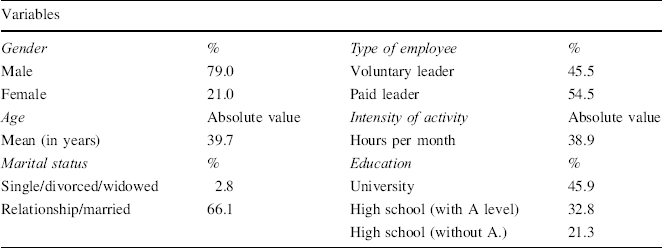
Table 1 describes the sample. In general, managers active in refugee aid were mostly male (79%). On average, the managers were about 40 years old and more than two-third were married or live in a relationship. 45% of the managers had a university degree. On average they spent 39 h per month in refugee aid. A little more than half of the respondents were paid staff (55%). The managers were working or volunteering for two well-established Austrian NPOs active in civil aid and rescue services. Organization A was founded in 1880 and currently has about 8.200 paid employees plus 73.000 volunteers and 4.300 civil servants. Organization B was founded in 1938 and has 14.000 paid and 40.000 voluntary employees.
Table 1 Respondent characteristics

Variables |
|||
|---|---|---|---|
Gender |
% |
Type of employee |
% |
Male |
79.0 |
Voluntary leader |
45.5 |
Female |
21.0 |
Paid leader |
54.5 |
Age |
Absolute value |
Intensity of activity |
Absolute value |
Mean (in years) |
39.7 |
Hours per month |
38.9 |
Marital status |
% |
Education |
% |
Single/divorced/widowed |
2.8 |
University |
45.9 |
Relationship/married |
66.1 |
High school (with A level) |
32.8 |
High school (without A.) |
21.3 |
||
N = 74
Measures
Dependent Variables
For measuring dynamic capabilities as dependent variable, we draw on the scale of Li and Liu (Reference Li and Liu2014). We use this DC scale because in contrast to most other DC scales, it has already been used in a setting other than competitive market structures (e.g., no complete market conditions and much political influence) which best approximate the conditions of refugee crisis. Li and Liu (Reference Li and Liu2014) define DCs as constructs of three dimensions. These are ‘sense-making capacity’ (six items, e.g., ‘we can fully understand the impact of internal and external environments’; ‘we have good observation and judgment abilities’), ‘timely decision-making capacity’ (four items, e.g., ‘under many circumstances we can make timely decisions to deal with strategic problems’; ‘we can quickly deal with conflicts in the strategic decision-making process’) and ‘change implementation capacity’ (five items, e.g., ‘our strategic changes can be carried out efficiently’; ‘we help each other in strategic change implementation’).
Independent Variables
For capturing the predictor variable participative leadership, we draw on the scale from Hoch et al. (Reference Hoch2013). The scholars applied the scale in an innovation context, which is similar to a DC context. This scale encompasses four items (e.g., ‘I decide, together with my team, which tasks have to be done’; ‘my team and I sit down together and reach agreements on the tasks to do’) measuring participative goal setting leadership.
Following previous DC research (cf. Sprafke et al., Reference Sprafke, Wilkens, Schiffer and Feldmann2013), we chose psychological empowerment according to Spreitzer (Reference Spreitzer1995) as mediator variable. This scale measures empowerment by drawing on four dimensions with three items each. These are ‘competence’ (e.g., ‘I am confident about my ability to do my job’), ‘self-determination’ (e.g., ‘I can decide on my own how to go about doing my job’), ‘impact’ (e.g., ‘I have significant influence over what happens in my department’) and ‘meaning’ (e.g., ‘The work I do is meaningful’). Due to the fact that refugee crisis represents an emergency situation, where reflections about the meaning in terms of the ‘fit between the needs of one´s work role and one´s beliefs, values and behavior’ (Spreitzer Reference Spreitzer1995, 603) are hardly possible, we decided to exclude ‘meaning’ as empowerment dimension. The study includes ‘environmental dynamics’ and ‘task complexity’ as control variables, which might affect the relation between participative leadership and DCs, particularly because these variables are context dependent. We measured ‘environmental dynamics’ using the item ‘our clients regularly ask for new products and services’ suggested by Jansen et al. (Reference Jansen, Van den Bosch and Volberda2006). Following Gaitanides and Stock (Reference Gaitanides and Stock2004), ‘task complexity’ was assessed through the item ‘the tasks of our team mainly involve solving complex problems’.
Factor Analysis, Reliability and Validity
Due to the explorative character of DCs, we did a factor analysis of the DC scale as well as on empowerment. For DCs, the three factor structure proposed by Li and Liu (Reference Li and Liu2014) could not be confirmed. The ‘capacity for timely decision-making’ did not show. Two of the items neither showed high enough loadings on the two factors identified nor formed their own factor. The remaining two items ‘under many circumstances we can make timely decisions to deal with strategic problems’ and ‘We can remedy quickly to unsatisfactory customers’ had high factor loadings on the other two dimensions. The factor ‘change implementation’ could be reproduced. KMO values for these two dimensions exceed the recommended value of 0.6 (Weiber and Mühlhaus Reference Weiber and Mühlhaus2014, 133; Backhaus et al. Reference Backhaus, Erichson, Weiber and Plinke2016, 398 f.). Reliability analysis produced Cronbach’s α values ranging from .659 to .808. Thus, scales are above the minimum level of 0.6 (Bagozzi and Yi Reference Bagozzi and Yi1988), which indicates internal consistency. The factor analysis of the items used for psychological empowerment neither showed the suggested three factor structure (Spreitzer, Reference Spreitzer1995). While the dimension ‘competence’ could be replicated ‘impact’ and ‘self-determination’ merged into one factor that we name ‘impact_self-determination.’ Again, KMO values of the scales exceed the recommended value of 0.6. Reliability analysis produced Cronbach’s α values ranging from .838 to .877. Finally, reliability analysis of the four-item participative leadership scale confirms one factor with Cronbach’s α = .829. Also, AVE, examining validity, exceeds the cutoff value of 0.5 (Weiber and Mühlhaus Reference Weiber and Mühlhaus2014, 64).
Findings
In order to test for linear direct and mediated effects, we employed ordinary least square regression combined with bootstrapping. We tested for model assumptions using scatterplots, VIF and a Kolmogorov–Smirnov test for normal distribution and did not find hints pointing to multicollinearity, heteroscedasticity or nonnormal distribution.
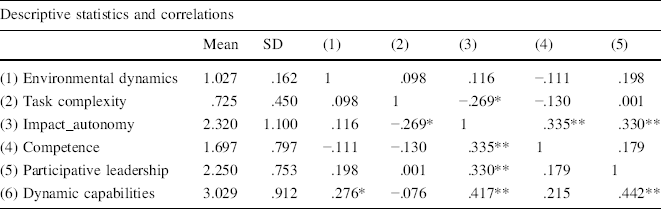
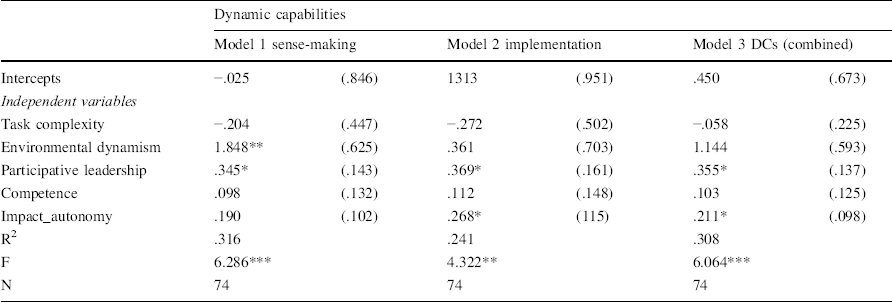
Table 2 contains means, standard deviations and correlations between the variables used. DCs significantly correlate with participative leadership and with one dimension of psychological empowerment, i.e., ‘impact_autonomy’. The relationship with the competence dimension is strong, but not significant (p = .06). The control variable environmental dynamics are significantly associated with DCs, while task complexity does not show any effect. Participative leadership is significantly correlated with ‘impact_autonomy’, but not with ‘competence’ dimension of empowerment. Table 3 shows the results of the ordinary least square regression for the hypothesized direct effects. This includes the effects of participative leadership and psychological empowerment on dynamic capabilities (model 3) as well as their effects on the specific DC ‘sense-making’ (model 1) and the DC ‘change implementation capacity’ (model 2). The illustration of these effects corresponds to H1 and H2.
Table 2 Descriptive statistics and correlations

Descriptive statistics and correlations |
|||||||
|---|---|---|---|---|---|---|---|
Mean |
SD |
(1) |
(2) |
(3) |
(4) |
(5) |
|
(1) Environmental dynamics |
1.027 |
.162 |
1 |
.098 |
.116 |
−.111 |
.198 |
(2) Task complexity |
.725 |
.450 |
.098 |
1 |
−.269* |
−.130 |
.001 |
(3) Impact_autonomy |
2.320 |
1.100 |
.116 |
−.269* |
1 |
.335** |
.330** |
(4) Competence |
1.697 |
.797 |
−.111 |
−.130 |
.335** |
1 |
.179 |
(5) Participative leadership |
2.250 |
.753 |
.198 |
.001 |
.330** |
.179 |
1 |
(6) Dynamic capabilities |
3.029 |
.912 |
.276* |
−.076 |
.417** |
.215 |
.442** |
N = 74
* p < .05; **p < .01; p*** < .001
Table 3 Results of regression analysis for direct effects

Dynamic capabilities |
||||||
|---|---|---|---|---|---|---|
Model 1 sense-making |
Model 2 implementation |
Model 3 DCs (combined) |
||||
Intercepts |
−.025 |
(.846) |
1313 |
(.951) |
.450 |
(.673) |
Independent variables |
||||||
Task complexity |
−.204 |
(.447) |
−.272 |
(.502) |
−.058 |
(.225) |
Environmental dynamism |
1.848** |
(.625) |
.361 |
(.703) |
1.144 |
(.593) |
Participative leadership |
.345* |
(.143) |
.369* |
(.161) |
.355* |
(.137) |
Competence |
.098 |
(.132) |
.112 |
(.148) |
.103 |
(.125) |
Impact_autonomy |
.190 |
(.102) |
.268* |
(115) |
.211* |
(.098) |
R2 |
.316 |
.241 |
.308 |
|||
F |
6.286*** |
4.322** |
6.064*** |
|||
N |
74 |
74 |
74 |
|||
OLS with robust standard errors; unstandardized coefficients and standard errors (in parentheses), *p < .05; **p < .01; ***p < .001
The results in model 3 indicate that participative leadership has a significantly positive effect (ß = .355*; SE = .137; p ≤ .05) on dynamic capabilities, thus supporting H1. Differentiating between the two dimensions of empowerment identified in the factor analysis shows that ‘impact_autonomy’ is significant (ß = .211*; SE = .098; p ≤ .05), whereas the effect of the empowerment dimension ‘competence’ is nonsignificant (ß = .103*; SE = .125; p = n.s.), thus finding only partial support for H2.
In order to substantiate the effects of participative leadership on dynamic capabilities, we added an analysis of the direct effects separating DCs into the two dimensions ‘change implementation capacity’ and ‘sense-making capacity’ identified in the factor analysis.
Model 2 illustrates the effects on the DC ‘change implementation capacity’. The effect of participative leadership on this DC is positive and significant (ß = .369*; SE = .161; p ≤ .05), thus supporting H1. Further, the direct effect of the empowerment dimension ‘impact_autonomy’ on this DC is significant (ß = .268*; SE = .115; p ≤ .05), whereas the direct effect of the empowerment dimension ‘competence’ is nonsignificant (ß = .112; SE = .148; p = n.s.), again finding only partial support for H2.
Model 1 shows the effects on the DC ‘sense-making capacity’. Again, participative leadership affects this DC positively and significantly (ß = .345*; SE = .143; p ≤ .05), thus supporting H1. The effects of both empowerment dimensions on this DC, though, are nonsignificant; ‘impact_autonomy’ shows ß = .190; SE = .102; p = n.s and ‘competence’ shows ß = .098; SE = .132; p = n.s. With regard to the DC ‘sense-making capacity’, we have to reject H2.
In sum, models 1–3 consistently support H1. Concerning the effects of psychological empowerment, the findings vary depending on which dimension of psychological empowerment and which DC is analyzed. Thus, the reported direct effects of empowerment are less appropriate for interpretation.
In order to test mediated effects as proposed by H3, we started with the procedure described by Baron and Kenny (Reference Baron and Kenny1986). This stepwise path procedure starts with a regression of the dependent variable (Y), dynamic capabilities, on the independent variable (X), participative leadership [c-path]. To continue mediation, the independent variable has to affect the dependent variable significantly. In a next step, the mediators (M), dimensions of psychological empowerment, are regressed on the independent variable, participative leadership [a-path]. Again, the relationships should be significant. Third, we deployed a regression of the dependent variable, DCs, on both: on participative leadership as independent variable [c-path] and on the dimensions of psychological empowerment as mediators [b-bath]. Here the mediators’ effects on the dependent variable should be significant, while the independent variable should not be affected (nonsignificance for full mediation, less significance than in c-path for partial mediation).
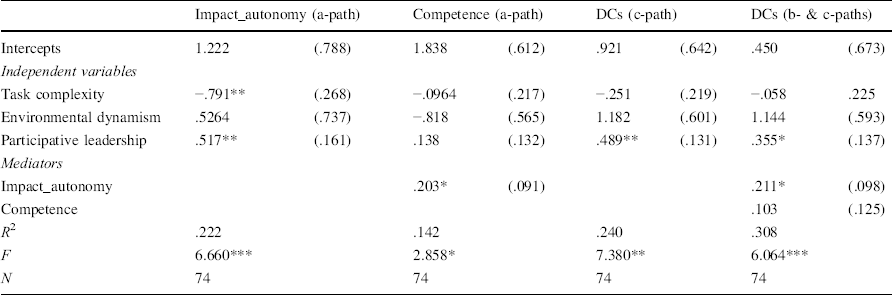
Table 4 shows the mediated effects of the independent variable participative leadership via the proposed mediators ‘impact_autonomy’ (H3ab)Footnote 8 and ‘competence’ (H3c) on dynamic capabilities as dependent variable.
• In the a-path, participative leadership influences ‘impact_autonomy’ significantly (ß = .517**; SE = .161; p ≤ .01), but doesn’t influence ‘competence’ (ß = .138; SE = .132; p = n.s.). Hence, the empowerment dimension ‘competence’ does not meet the requirements for continuing mediation analysis.
• The b-path for ‘impact_autonomy’ on DCs is also significant (ß = .211*; SE = .098; p ≤ .05), but again not for ‘competence’ (ß = .103; SE = .125; p = n.s.).
• The total effect of participative leadership (c-path) is significant (ß = .489**; SE = .131; p ≤ .01) and so is the c-path (ß = .355*; SE = .137; p ≤ .05).
Table 4 Results of regression analysis for the mediated effects on dynamic capabilities

Impact_autonomy (a-path) |
Competence (a-path) |
DCs (c-path) |
DCs (b- & c-paths) |
|||||
|---|---|---|---|---|---|---|---|---|
Intercepts |
1.222 |
(.788) |
1.838 |
(.612) |
.921 |
(.642) |
.450 |
(.673) |
Independent variables |
||||||||
Task complexity |
−.791** |
(.268) |
−.0964 |
(.217) |
−.251 |
(.219) |
−.058 |
.225 |
Environmental dynamism |
.5264 |
(.737) |
−.818 |
(.565) |
1.182 |
(.601) |
1.144 |
(.593) |
Participative leadership |
.517** |
(.161) |
.138 |
(.132) |
.489** |
(.131) |
.355* |
(.137) |
Mediators |
||||||||
Impact_autonomy |
.203* |
(.091) |
.211* |
(.098) |
||||
Competence |
.103 |
(.125) |
||||||
R 2 |
.222 |
.142 |
.240 |
.308 |
||||
F |
6.660*** |
2.858* |
7.380** |
6.064*** |
||||
N |
74 |
74 |
74 |
74 |
||||
OLS with robust standard errors; unstandardized coefficients and standard errors (in parentheses), * p < .05; **p < .01; ***p < .001
Accordingly, based on a positive and significant a-path and b-path, findings imply partial mediation for participative leadership through ‘impact_autonomy’; this supports H3ab. Due to the lack of significance in a-path and b-path, H3c is rejected.
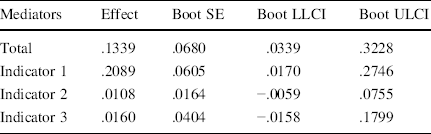
As Table 5 shows, the bootstrapped results support these findings because the confidence intervals for ‘impact_autonomy’ is above zero (.0170 to .2746), whereas the intervals for ‘competence’ include zero (− .0158 to .1799); similarly, the simultaneous mediation of both psychological empowerment dimensions also includes zero (− .0059 to.0755).
Table 5 Bootstrapped results for the indirect effects of participative leadership on dynamic capabilities

Mediators |
Effect |
Boot SE |
Boot LLCI |
Boot ULCI |
|---|---|---|---|---|
Total |
.1339 |
.0680 |
.0339 |
.3228 |
Indicator 1 |
.2089 |
.0605 |
.0170 |
.2746 |
Indicator 2 |
.0108 |
.0164 |
−.0059 |
.0755 |
Indicator 3 |
.0160 |
.0404 |
−.0158 |
.1799 |
Ind1: SKF_PART → SKF_Auto → SKF_DC
Ind2: SKF_PART → SKF_Auto → SKF_Comp → SKF_DC
Ind3: SKF_PART → SKF_Comp → SKF_DC
Discussion and Conclusions
The Refugee crisis of 2016 with its ambiguous, multi-dimensional and dynamically changing environmental conditions made evident that dynamic capabilities represent a crucial asset for NPOs because they facilitated NPOs to achieve the required continuous organization-environment fit. In other terms, DCs enabled NPOs to meet continuously changing civil society´s needs. In the case of NPOs active in refugee aid, this fit consisted in translating the needs of refugees into services, such as providing food, setting up camps or lobbying as fast as needs were changing. Dynamic capabilities are said to accomplish such a fit due to their property as meta-capabilities and thus governing other capabilities systematically and over time (Hsu and Wang Reference Hsu and Wang2010; Teece Reference Teece2014).
In order to better understand the nature of DCs and particularly to provide options for influencing the application of dynamic capabilities in refugee aid, we aim to explore mechanisms on microlevel, which found DCs. This is what research defines as microfoundation of DCs (Teece Reference Teece2007; Felin et al. Reference Felin, Foss and Ployhart2015). Following Di Stefano et al. (Reference Di Stefano, Peteraf and Verona2014) and Teece (Reference Teece2014), research particularly lacks of an integrated consideration of management-related aspects, e.g., managerial behavior and cognitions. Hence, we analyzed the link between micromechanisms and DCs on macro-level by examining how management affects the application of dynamic capabilities in NPOs. In this context, we include managerial behavior—by drawing on participative leadership–as well as managerial characteristics–by integrating psychological empowerment–into our research model.
Concerning the relationship between participative leadership and dynamic capabilities, we assume that participative leadership positively influences managers’ application of dynamic capabilities. This is because team members’ knowledge, ideas, and creativity–gained through participative leadership–are enablers for DCs. We provide evidence for direct effects between participative leadership and dynamic capabilities, illustrated via H1. This is in line with previous research in the field of dynamic capabilities (cf. Saunila et al. Reference Saunila, Pekkola and Ukko2014; Filippini et al. Reference Filippini, Güttel and Nosella2012) as well as with strategic management research in general (cf. Leskovar-Spacapan and Bastic Reference Leskovar-Spacapan and Bastic2007; Gottschalg and Zollo Reference Gottschalg and Zollo2007; Lindenberg and Foss Reference Lindenberg and Foss2011).
We suppose that NPOs active in refugee aid (or under comparable ambiguous, dynamically changing and multi-dimensional emergency situations) use participative leadership in terms of interactive decision patterns as substitute for nonexisting organizational structures, respectively, coordinative mechanisms. For instance, participative leadership can serve as substitutive for routines, e.g., standard operation procedures, which do not or rather only partly exist in such emergency situations. In this context, participative leadership is comparable to task forces or staff work.
Further, we deployed a differentiated analysis and explored the effects of participative leadership on the DC dimensions ‘sense-making capacity’ and ‘change implementation capacity’ separately. Whereas the findings indicate a significant and positive effect regarding ‘change implementation capacity’, it was nonsignificant concerning ‘sense-making capacity’. This could be due to the fact that team members can only restrictively serve as ‘sense-makers’ because they are not primarily cognizant of the overall political, economic or humanitarian situation and its dependences; they are experts, though, in delivering services which makes team members predestinated to provide information regarding ‘changes in implementation’.
In order to explore managerial influence on dynamic capabilities profoundly, we also explored the effect of psychological empowerment. Findings show that the empowerment dimension ‘impact_self-determination’ affects dynamic capabilities significantly. Thus, the managers’ perceptions, how self-determined (s)he is and how impactful his/her actions are, foster dynamic capabilities. This is because managers perceiving such cognitions are more motivated to take initiatives, to innovate as well as to increase performance (Sprafke et al. Reference Sprafke, Wilkens, Schiffer and Feldmann2013). Psychological empowerment shows that cognitions are strongly linked with motivation; Spreitzer (Reference Spreitzer1995) actually defines psychological empowerment as intrinsic task motivation. It is particularly important for NPOs to consider psychological empowerment in their capacity building because mainly intrinsic motivated volunteers constitute their work force. The effect of the second dimension ‘competence’ was not significant, though.
Our research focus was to explore the linkage between participative leadership, psychological empowerment and dynamic capabilities. In this relationship, psychological empowerment is considered to mediate the effects of participative leadership on dynamic capabilities. Comparable to findings mentioned above, we could not find evidence for the effect of ‘competence’ (H3c(+)) on DCs, but for the effect of ‘impact_self-determination’, supporting H3ab. ‘Impact_self-determination’ mediates participative leadership partially. This implies that this empowerment dimension enhances the effect of participative leadership on DCs.
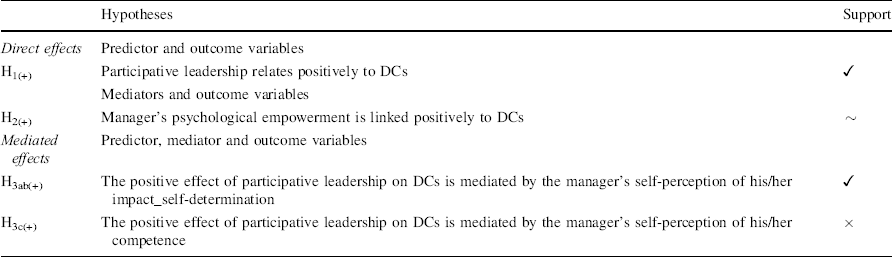
Table 6 provides an overview regarding the tested hypotheses.
Table 6 Overview of hypotheses support

Hypotheses |
Support |
|
|---|---|---|
Direct effects |
Predictor and outcome variables |
|
H1(+) |
Participative leadership relates positively to DCs |
✓ |
Mediators and outcome variables |
||
H2(+) |
Manager’s psychological empowerment is linked positively to DCs |
~ |
Mediated effects |
Predictor, mediator and outcome variables |
|
H3ab(+) |
The positive effect of participative leadership on DCs is mediated by the manager’s self-perception of his/her impact_self-determination |
✓ |
H3c(+) |
The positive effect of participative leadership on DCs is mediated by the manager’s self-perception of his/her competence |
× |
✓ Hypotheses supported-, × hypotheses not supported; ~ partly supported
Finally, we also provide evidence that DCs have a highly significant effect on organizational performance (cf. Table 2). Applying DCs increases NPOs performance in refugee aid or rather supports them to positively impact civil society´s needs.
The profound empirical evidence provided by our paper contributes significantly to the understanding of interdependences of DCs, management behavior and managerial cognitions. We examine this microfoundation in NPOs, where DC research is even more underrepresented. Hence, our study enlarges the research context of DCs. We found that managers represent a meaningful agent of DCs on microlevel and thus contribute to the behavioral foundation of organizations, which is an essential research stream of microfoundation to further explore (Felin et al. Reference Felin, Foss and Ployhart2015). By analyzing managerial behavior (participative leadership) as well as managerial cognitions (psychological empowerment), we even provide an integrative illustration of management-related microfounding mechanisms. In contrast to previous research, which particularly focused on transactional and transformational leadership, we introduced and empirically proved participative leadership as a ‘new’ DC enhancing leadership style. Our study shows that participative leadership represents a crucial, foremost informal coordination mechanism that can serve as substitute for barely existing formal coordination mechanisms in highly dynamic and even crisis situations. We show strong associations between participative leadership and DC, mediated by psychological empowerment. This suggests that actively stimulating a certain leadership style can have an impact on DCs and thus on organizational survival.
Acknowledgements
Open access funding provided by Paris Lodron University of Salzburg.
Compliance with Ethical Standards
Conflict of interest
The authors declare that they have no conflict of interest.


 Open access

