

Election report
No major elections or referenda took place in Romania in 2022.
Cabinet report
The Romanian government started the year short of one member. Minister of Research, Innovation, and Digitalization Florin-Claudiu Roman was forced to give up the portfolio in December 2021, when it became public that the academic achievements mentioned in his vitae were false (Stan & Zaharia Reference Stan and Zaharia2022). In January, journalist Emilia Șercan revealed that at least 42 of the 138 pages of Prime Minister Nicolae-Ionel Ciucă’s doctoral thesis, defended in 2003 at the National Defense University “Carol I,” were plagiarized. The Ministry of Education was asked to open an inquiry, but Ciucă asked the courts to settle the case, thus blocking the Ministry. Since the Romanian courts are notoriously slow, the case could drag on for years, thus allowing Ciucă to complete his mandate and even compete in the 2024 presidential elections. Toward the end of 2022, similar accusations were levied against Minister of Interior Lucian Bode, whom Șercan accused of copying at least 18.5 per cent of his doctoral thesis, defended in 2018 at the University Babeș-Bolyai of Cluj-Napoca. Bode defended himself and asked the courts to rule in his case. Both cases are pending.
Four ministers (two representing the Social Democratic Party [PSD], and two the National Liberal Party [PNL]) resigned in 2022. In two of these cases, the reasons were political, whereas the other two involved ethical breaches. In April, Dan Vîlceanu (PNL), Minister of Investments and European Union Projects, resigned because his friend, Vasile-Florin Cîțu, was removed from the position of president of the PNL. In October, Vasile Dîncu (PSD), Minister of National Defence, resigned after calling on Ukraine to negotiate with Russia, thus contradicting the official position of Romania and NATO. In June, Adrian-Ionuț Chesnoiu (PSD) resigned as Minister of Agriculture and Rural Development after the National Anticorruption Department placed him under investigation for preferential treatment of four job candidates who eventually were appointed as heads of county branches of his Ministry (Vulcan & Andrei Reference Vulcan and Andrei2022). Finally, in September, Sorin-Mihai Cîmpeanu (PNL) resigned as Minister of Education after Șercan accused him of plagiarizing 13 chapters authored by two professors teaching at the Agricultural and Veterinary Studies University in Bucharest.
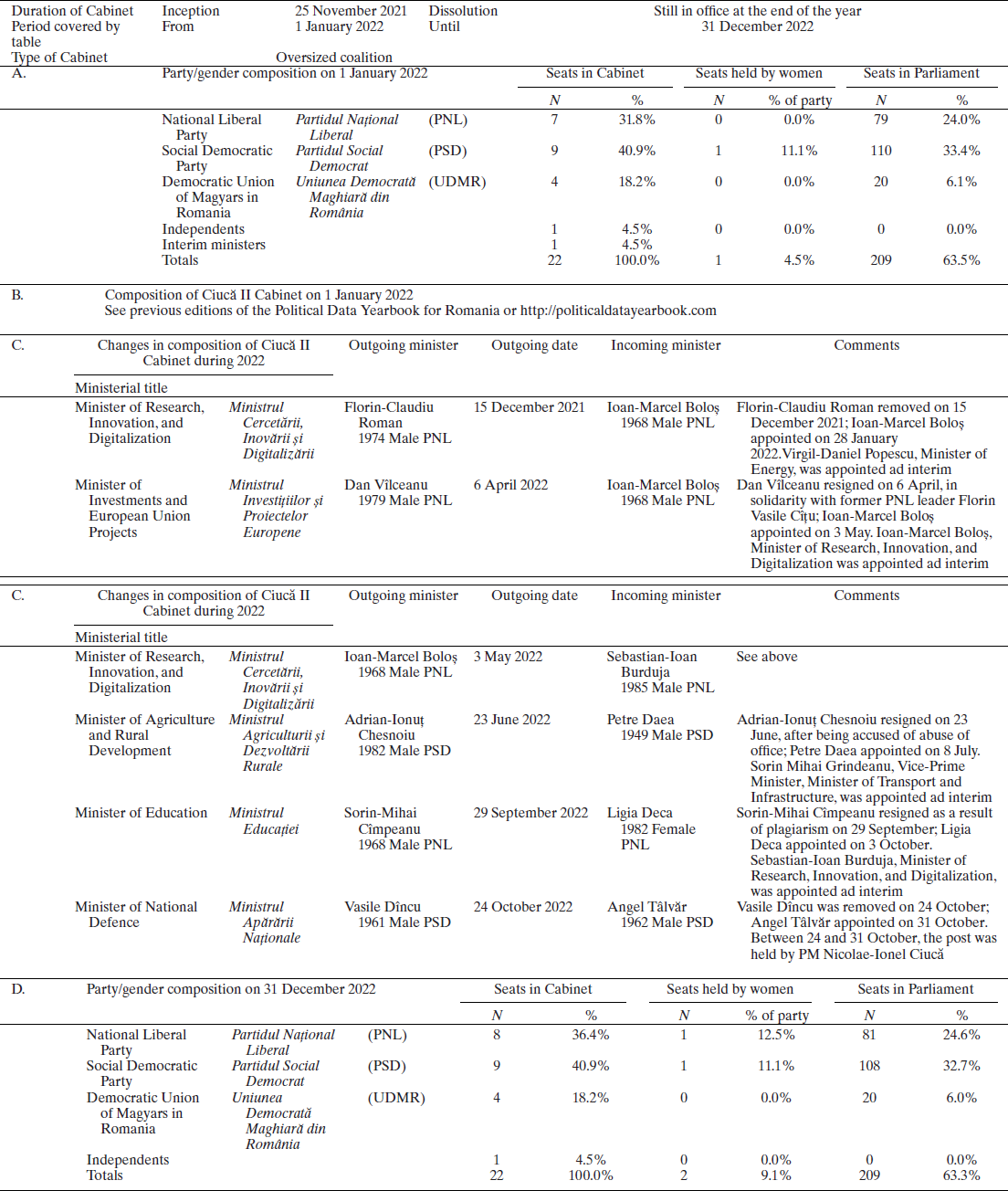
Details of Cabinet composition and changes can be found in Table 1.
Table 1. Cabinet composition of Ciucă II in Romania in 2022

Note: The interim minister on 1 January 2022 was the Minister of Energy Virgil-Daniel Popescu (male, PNL). He had taken the place of Florin-Claudiu Roman (male, PNL), after his resignation on 15 December 2021.
Sources: Camera Deputatilor website, 2022 (www.cdep.ro/); Guvernul Romaniei website, 2022 (https://gov.ro/ro/guvernul/cabinetul-de-ministri).
Parliament report
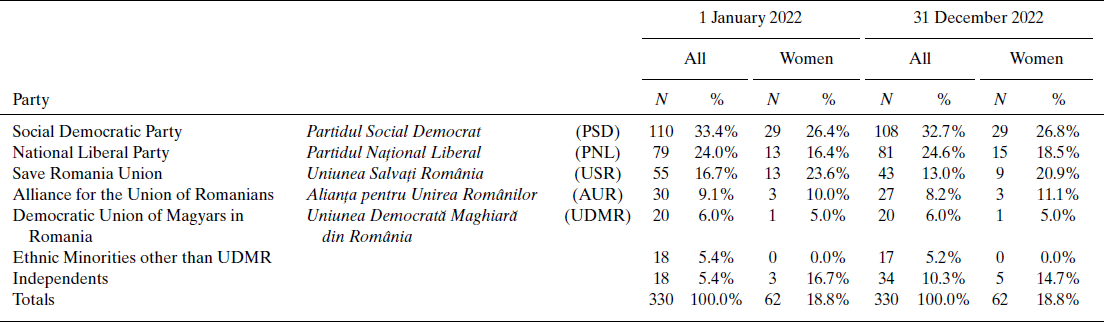
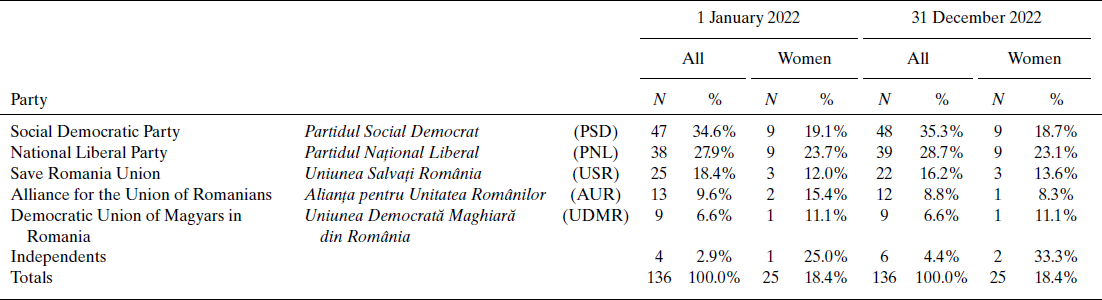
In 2022, the two chambers of the Romanian Parliament registered no significant changes in their composition (see Tables 2 and 3). The number of legislators representing the three ruling parties (the PSD, the PNL, and the Democratic Union of Magyars in Romania, the Democratic Union of Magyars in Romania (UDMR) remained unchanged. However, Alliance for the Union of Romanians (AUR) lost some legislators, whereas Save Romania Union (USR) lost many, all of whom joined Renewing Romania's European Project (REPER), a new political party formed by Dacian Cioloș (see Political party report). As a result, they became independent legislators.
Table 2. Party and gender composition of the lower house of the Parliament (Camera Deputaților) in Romania in 2022

Source: Camera Deputatilor website, 2022 (www.cdep.ro/).
Table 3. Party and gender composition of the upper house of the Parliament (Senat) in Romania in 2022

Source: Senatul României website, 2022 (www.senat.ro/).
Political party report
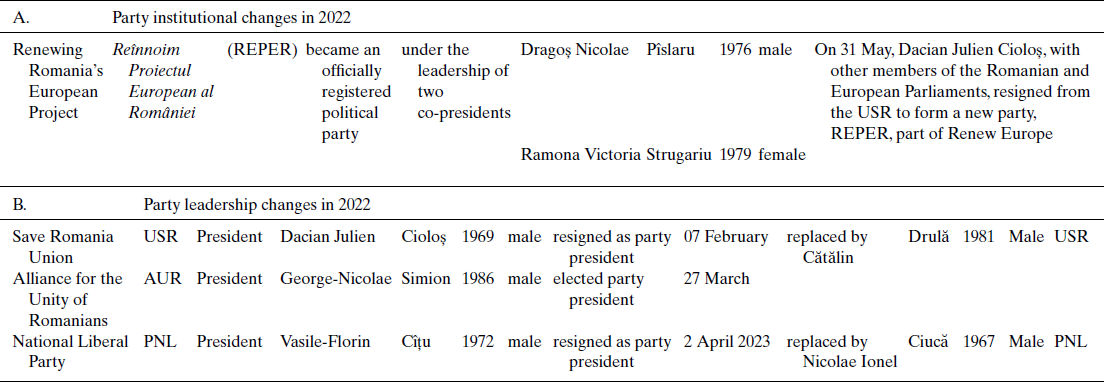
During the first half of the year, three parties represented in Parliament changed their leadership (see Table 4). In February, months after becoming the USR president, MEP Dacian Julien Cioloș resigned ostensibly because the party leadership refused to support his internal reform proposals, meant to strengthen the connection between the party leaders and party members. During his brief leadership, Ciolos remained isolated within the party, in part because of his own inability to gain the support of other long-standing party luminaries.
Table 4. Changes in political parties in Romania in 2022

Notes: 1. Cătălin Drulăad entered office ad interim, until new party congress is organized.
2. George-Nicolae Simion was AUR co-president with Claudiu Richard Târziu (1973, male) until elections were organized.
3. Nicolae Ionel Ciucă was elected president at the PNL Congress of 10 April.
Source: See main text.
After unexpectedly unseating Ilie-Dan Barna as party president, Cioloș failed to gain the support of the other party leaders for reorganizing the party. Until a new USR congress is held, the party's interim leader is Cătălin Drulă. In May, Cioloș, together with several members of the Romanian Parliament and the European Parliament, formed a new party, REPER. The party presents itself as pro-European and liberal (Euronews.ro 2022), but its leaders have also voiced anti-establishment positions similar to those espoused by the USR. It belongs to the Renew Europe caucus in the European Parliament. Cioloș served as caucus leader from 2019 to October 2021, when he resigned.
As a result, the electoral alliance between the USR and PLUS collapsed. Since his MEP status prevents him from overseeing the new party's organization, Cioloș sought no leadership position in it. The party has two co-presidents: Dragoș Nicolae Pîslaru and Ramona Victoria Strugariu.
On 27 March, the AUR elected George-Nicolae Simion as president, thus ending the co-presidency (represented by George-Nicolae Simion and Claudiu Richard Târziu).
On 10 April, Nicolae Ionel Ciucă replaced Vasile-Florin Cîțu as president of the PNL.
In June, Cîțu was replaced as Speaker of the Chamber of Deputies by Alina-Ștefania Gorghiu (PNL).
Institutional change report
In May, three new justices were appointed to the Constitutional Court. The Court has a president and eight justices appointed for mandates of nine years; the appointments are staggered so that every three years three new Court justices are appointed. The current president is Marian Enache, proposed by the PSD and appointed in 2016 by the Senate. The justices are the following: Dimitrie-Bogdan Licu, proposed by the PSD and appointed in 2022 by the Chamber of Deputies; Laura-Iuliana Scântei, proposed by the PNL and appointed in 2022 by the Senat; Mihaela Ciochină, appointed in 2022 by the Romanian President; Livia Doina Stanciu, appointed in 2016 by the Romanian President; Attila Varga, proposed by the UDMR and appointed in 2016 by the Chamber of Deputies; Elena-Simina Tănăsescu, appointed in 2019 by the Romanian President; Gheorghe Stan, proposed by the PSD and appointed in 2019 by the Chamber of Deputies; and Cristian Deliorga, proposed by the PSD and appointed in 2019 by the Senat. Four of the justices are women.
Issues in national politics
In 2022, Romania was affected by the Russian invasion of Ukraine. Proximity to Ukraine produced panic in eastern Romania and even worries that Russia might invade Romania. As the main Soviet actor, Russia is still blamed for communism in Romania. Close to 2.5 million Ukrainians crossed the border into Romania in 2022, 100,000 of whom remained there as refugees (UNHCR 2023). Romania facilitated Ukrainian exports of wheat and imports of medicine and military equipment (Președinția României 2023).
As a result of the invasion, Romania registered high inflation and lower living standards and faced an energy crisis. The inflation rate raised from 4.1 per cent in 2021 to 12 per cent in 2022, higher than the EU average of 9.2 per cent (Euronews.ro 2023). The only party that tried to draw political capital from the ensuing popular dissatisfaction was AUR, but it was unsuccessful since some of its leaders were perceived as pro-Russian.
An unresolved issue was the reform of the pension fund and the elimination of the so-called “special pensions.” Romania has 4.8 million pensioners, 210,000 of whom (army and police officers, intelligence agents, magistrates, and civil servants, among others) could retire at 45 and benefit from “special pensions” that are three to four times the average pension (Bechir Reference Bechir2023). As younger Romanians emigrate, natality decreases and the population becomes older, and the pension system is under strain. Employees can contribute to the public pension plan and benefit from private plans, and the retirement age was raised (Reference BechirBechir 2023), but these measures remain insufficient to make the pension system viable long-term.
On 22 November, the European Commission announced the end of the Mechanism for Cooperation and Verification for Romania, a step necessary for the country's inclusion into the Schengen space, which was expected to take place in December. But Romania was denied entry after Austria and the Netherlands voted against it. Austria's negative vote was related to Romania's inability to curb illegal migration into Western Europe, whereas the Netherlands argued that Romania had to join the Schengen space only together with Bulgaria, which unfortunately was unprepared.

 Open access

