


 → [patha]). This process plausibly changes syllable structure: the syllable where /s/ originated is closed at one representational level, but open on the surface ([


1. Introduction
In Sevillian Spanish, clusters consisting of orthographic 〈s〉 plus voiceless stop undergo several changes, including metathesis. Coda /s/ reduces to [h] (debuccalisation), producing h–stop sequences, and [h] metathesises with the adjacent stop, producing stop–h sequences as in (1) (Torreira Reference Torreira, Sagarra and Toribio2006; O’Neill Reference O’Neill2010; Parrell Reference Parrell2012; Torreira Reference Torreira2012; Ruch & Harrington Reference Ruch and Harrington2014; Ruch & Peters Reference Ruch and Peters2016; Henriksen et al. Reference Henriksen, Galvano and Fischer2023).

Metathesis is an ongoing change in the variety and can occur in all /s/–voiceless stop sequences. It occurs in all stress configurations (Ruch Reference Ruch2008; Torreira Reference Torreira2012; Horn Reference Horn2013) and both within morphemes and across word and morpheme boundaries (Ruch Reference Ruch2008; Horn Reference Horn2013). The realisation of 〈s〉–voiceless stop sequences is highly variable, and metathesis is only one possible variant in Sevillian (see §2.1).
Metathesis raises the following question: are the syllables /s/ metathesises out of heavy or light? The answer sheds light on the representation of these sequences and on the structure of the phonological grammar. Metathesis in /sC/ sequences could produce a mismatch between segmental order and syllable structure at different levels of representation or derivational stages. This mismatch permits us to disentangle surface forms from non-surface forms by designing experiments in which listeners’ responses can be explained by reference to one – but not another – level of representation. More broadly, the mismatch creates an opportunity to investigate the separation between components of the phonological grammar and the role of abstraction.
The possibility that syllable structure may differ in surface and non-surface forms arises because surface stop–h sequences are representationally ambiguous, as outlined in (2). On one hand, stop–h sequences could be realisations of a new aspirated stop category, as in (2a) (O’Neill Reference O’Neill2009; Gylfadottir Reference Gylfadottir2015). They look quite similar to aspirated stops in languages like English and German, at least on the surface. Under this conceptualisation, the syllable preceding the stop has no coda and is light at all levels of representation. On the other hand, stop–h sequences may still be realisations of /sC/ sequences (as they have been diachronically), derived by metathesis as in (2b). Under this analysis, segmental order and syllable structure may differ in non-surface and surface forms. At some non-surface representational or derivational level (depending on the style of analysis), /s/ syllabifies as a coda, creating a heavy syllable. On the surface, however, /s/ (realised as [h]) is no longer in that syllable because of metathesis. The resulting stop–h sequence is the onset to the following syllable, leaving the first syllable light (see §4.6.2 for further discussion of resyllabification).

Most existing research treats stop–h sequences as deriving from /sC/ sequences that undergo metathesis, as in (2b) (e.g., Torreira Reference Torreira, Sagarra and Toribio2006; Parrell Reference Parrell2012; Torreira Reference Torreira2012; Ruch Reference Ruch2013; Cronenberg et al. Reference Cronenberg, Gubian, Harrington and Ruch2020). This treatment is supported by results from a behavioural experiment in which Sevillian listeners treat stop–h sequences as realisations of underlying /sC/ clusters: they interpret [h] in word-initial stop–h sequences as /s/ on the preceding word (Gilbert Reference Gilbert2023). The abstract representation does not seem to have changed (/sC/), despite changes in pronunciation towards metathesis ([Ch]).
The current article tests the weight of syllables preceding stop–h sequences by investigating how they interact with stress. Spanish stress shows weight-sensitive restrictions, one of which is that antepenultimate stress does not occur in words with heavy penults (Harris Reference Harris1983; Roca Reference Roca1991). Given that stop–h sequences may arise from /sC/ sequences and involve a change in syllable structure, listeners could treat words with antepenultimate stress where /s/ has metathesised out of the penult differently from words with simple CV penults ( vs.
vs.  ). Although they have the same weight profile on the surface (LLL), they may differ at non-surface levels of representation.Footnote
1
). Although they have the same weight profile on the surface (LLL), they may differ at non-surface levels of representation.Footnote
1
The current article has two goals. The first goal is experimental. I present results from a forced-choice stress acceptability task designed to test the weight of syllables that have undergone metathesis (syllables where /s/ has metathesised out). In the task, listeners compare nonce words with antepenultimate stress that have penults of different shapes. The results suggest that listeners strongly prefer words with CV penults over words where /s/ has metathesised out of the penult, and over words with unambiguously heavy penults. A plausible interpretation is that (a) there is a mismatch between the surface form [Ch] and underlying form /sC/ and (b) stress is evaluated on a non-surface form that has a heavy penult. I also discuss (in §4.6) other possible interpretations of why these syllables may be treated as heavy.
The second goal is theoretical. Starting from the assumption that stop–h sequences derive from /sC/ clusters, I explore what kinds of theoretical frameworks can account for the interaction between stress and metathesis in Sevillian. The results from the experiment do not distinguish between several possible analyses, so I sketch analyses in two categories. Process-interaction analyses treat the Sevillian pattern as resulting from the interaction of two phonological processes: stress assignment and metathesis. The interaction is opaque because stress is constrained by structure not visible on the surface. More specifically, it falls into the category of countershifting opacity (Rasin Reference Rasin2022). If future research supports these analyses, the experimental results are interesting because they document productive opacity in an experimental setting (contra, e.g., Sanders Reference Sanders2003). Process interaction analyses need to be either serial or rule-based in order to account for the pattern. Representational analyses treat stress and metathesis as processes that differ in kind, and are relegated to different representational levels of the phonological grammar, such that they do not interact. Representational analyses can take many forms as long as the two processes are separated. I explore a system in which stress operates on layers of representation that include different kinds of timing and gestural information.
This article is organised as follows. §2 provides more information on /sC/ variants and metathesis in Sevillian Spanish, Spanish stress, metathesis and syllable structure, and experimental approaches to weight sensitivity in Spanish. §3 describes the stimuli for the main experiment and presents results from small production and perception studies to verify their acoustic properties. §4 presents the main experiment and several possible interpretations of the results. §5 sketches various theoretical analyses that could account for the interaction. §6 concludes.
2. Background
2.1. Spanish coda /s/ and Sevillian metathesis
The production of coda /s/ is variable throughout the Spanish-speaking world. From a categorical perspective, common realisations include the unreduced variant [s], debuccalisation to [h] and deletion to [ $\varnothing $
] (e.g., Cedergren Reference Cedergren1973; Terrell Reference Terrell1979; Lipski Reference Lipski1986, Reference Lipski1994). These variants are often conceived of as forming part of a reduction continuum, from less to more reduced, as in (3) (e.g., Ferguson Reference Ferguson, Croft, Denning and Kemmer1990; Mason Reference Mason1994).
$\varnothing $
] (e.g., Cedergren Reference Cedergren1973; Terrell Reference Terrell1979; Lipski Reference Lipski1986, Reference Lipski1994). These variants are often conceived of as forming part of a reduction continuum, from less to more reduced, as in (3) (e.g., Ferguson Reference Ferguson, Croft, Denning and Kemmer1990; Mason Reference Mason1994).

Coda /s/ reduction has operated diachronically in the development from Latin to Spanish and other Romance languages, and is often considered to be a reflex of a general pressure against coda consonants (Alonso Reference Alonso1945; Malmberg Reference Malmberg1965; Mason Reference Mason1994). Coda reduction is often treated as progressive feature loss: reduction occurs by loss of oral features ([s] → [h]) followed by loss of laryngeal features ([h] → [ $\varnothing $
]; Goldsmith Reference Goldsmith, Cressey and Napoli1981; Hualde Reference Hualde, Kirschner and DeCesaris1989a; McCarthy Reference McCarthy2008b). However, recent studies show that /s/ reduces more gradiently than can be captured by discrete allophonic categories (e.g., File-Muriel & Brown Reference File-Muriel and Brown2011; Erker Reference Erker2012; Henriksen & Harper Reference Henriksen and Harper2016).
$\varnothing $
]; Goldsmith Reference Goldsmith, Cressey and Napoli1981; Hualde Reference Hualde, Kirschner and DeCesaris1989a; McCarthy Reference McCarthy2008b). However, recent studies show that /s/ reduces more gradiently than can be captured by discrete allophonic categories (e.g., File-Muriel & Brown Reference File-Muriel and Brown2011; Erker Reference Erker2012; Henriksen & Harper Reference Henriksen and Harper2016).
Coda /s/ variants are in synchronic variation in all varieties of Spanish, and varieties differ as to which realisations are most common. Common factors that condition this variation include speech rate, speech style, morphological and phonological context, and speaker demographics (see Erker Reference Erker2012: 11–20 for a thorough overview). Despite high synchronic variation, coda /s/ realisations seem to be stable in most communities (Labov Reference Labov1994: 583–585). It is possible that coda /s/ is undergoing change, as has historically occurred, but at a rate not visible in synchronic variation patterns (Mason Reference Mason1994: 72–76).
Sevillian Spanish has the variants just described plus several others, including metathesis. Ruch (Reference Ruch2008) reports rates of variants of /st/ sequences in production data from 53 Sevillian speakers in several speech styles, shown in Table 1. Based on impressionistic classification, she finds variants where /s/ remains in its original location ([st], [ht]); variants with segmental metathesis ([th], [ts]); variants where /s/ is phonetically split around /t/ ([hth], [sth]); and variants with /s/ deletion accompanied by variable lengthening of /t/ ( ). Note the two possible results of metathesis for /st/ sequences: [th] (post-aspiration; stop–h in my terminology) and [ts] (post-affrication in the terminology of Ruch Reference Ruch2008).
Table 1 Rates of /st/ variants in Sevillian Spanish (Ruch Reference Ruch2008). The most frequent realisation for each speech style is bolded.

In conversational speech (column (a) of Table 1), /st/ is realised as metathesised ([th] or [ts]) in over 70% of forms. Other forms, including the pan-Hispanic standard ([s] retention) and non-standard reductions common in other Spanish varieties (debuccalisation and deletion), are comparatively infrequent. In read speech (column (b)), metathesised realisations constitute over 55% of forms, but the proportion of standard [s] realisations increases. Only in the most careful speech, word list reading (column (c)), are metathesised forms less frequent than non-metathesised ones. Even in that style, the categories with metathesis are the largest after [s] retention. I am unaware of any existing study that presents rates of variants for /sp/ and /sk/ sequences, although phonetic studies show that these sequences also undergo metathesis (e.g., Ruch & Peters Reference Ruch and Peters2016; Henriksen et al. Reference Henriksen, Galvano and Fischer2023).
These variants are undergoing change in Andalusian Spanish varieties. From both categorical and gradient perspectives, metathesis is advanced in Sevillian Spanish, and most advanced among younger speakers (Ruch Reference Ruch2008; Ruch & Peters Reference Ruch and Peters2016). Patterns of stratification by speech style, speaker age and level of education suggest that the stop–h variant is well-established in Seville and may be a regional standard. In contrast, post-affrication is a newer change. It has received scholarly attention only since the early 2000s (Moya Corral Reference Moya Corral2007; Ruch Reference Ruch2008; Vida-Castro Reference Vida-Castro2016, Reference Vida-Castro2022; Del Saz Reference Del Saz, Calhoun, Escudero, Tabain and Warren2019a; Moya Corral & Tejada Giráldez Reference Moya Corral, de la Sierra and Giráldez2020). Vida-Castro's (Reference Vida-Castro2022) comparison of recordings from 1995 and 2015 indicates that post-affrication has increased quickly in Western Andalusia and may carry covert prestige (Ruch Reference Ruch2008; Vida-Castro Reference Vida-Castro2016, Reference Vida-Castro2022).
The diachronic progression of this series of processes appears to have gone as follows: coda /s/ weakening/debuccalisation (plus lengthening of the following consonant) came first, followed by metathesis. For sequences where the second consonant is /t/, there is a further step: post-affrication (Ruch Reference Ruch2008: 69; Vida-Castro Reference Vida-Castro2016; Del Saz Reference Del Saz2019b; Moya Corral & Tejada Giráldez Reference Moya Corral, de la Sierra and Giráldez2020).Footnote 2 It is crucial that debuccalisation appears to have preceded metathesis, because debuccalisation may be a necessary precursor for articulatory and perceptual reasons (see §5.1.4). Although metathesis is not new (Moya Corral & Tejada Giráldez Reference Moya Corral, de la Sierra and Giráldez2020 find evidence of sporadic metathesis in a linguistic atlas from the 1960s), coda /s/ weakening occurs in all parts of the Spanish-speaking world and is older, dating from at least the 16th century (Romero Reference Romero1995a: 192–193). It is not clear whether metathesis is part of the cline of coda reduction or whether it is motivated by the same factors. One proposal is that it is, and that it is a good solution to the pressure against coda consonants: it removes /s/ from coda position while maintaining some of its features (Ruch Reference Ruch2008; Vida-Castro Reference Vida-Castro2016, Reference Vida-Castro2022; Moya Corral & Tejada Giráldez Reference Moya Corral, de la Sierra and Giráldez2020). However, this proposal is not obviously well supported, especially given that coda reduction and metathesis are often accompanied by lengthening of the stop closure, which can be interpreted as maintenance of the coda timing slot.Footnote 3
My experimental stimuli use stop–h forms for consistency across /sp, st, sk/ sequences (only /st/ has a post-affricated variant). Furthermore, while both both stop–h and post-affricated variants are common for /st/, [ts] sequences appear to carry more social meaning (and possibly stigma). Stop–h sequences are recognisable as Sevillian (Ruch Reference Ruch2018), but are standard enough to avoid attracting excessive attention in an experimental setting.
2.2. Spanish stress
In non-verbs, Spanish stress is uncontroversially contrastive and controversially weight sensitive. Primary stress falls in a right-aligned three-syllable window and can be penultimate (as in  ‘hip’), antepenultimate (
 ‘Saturday’) or final (
 ‘hummingbird’). Penultimate stress is by far the most common; antepenultimate stress is infrequent. Bárkányi (Reference Bárkányi2002) presents a study of stress patterns in non-verbs based on the Diccionario de la Real Academia Española. Based on my own calculations from her numbers, 9% of nouns have antepenultimate stress, 75% have penultimate stress and 15% have final stress (roughly similar to my calculations based on numbers reported by Morales-Front Reference Morales-Front, Núñez-Cedeño, Colina and Bradley2014: 244).
Stress is usually taken to be lexically marked in non-verbs, where it can be contrastive (e.g.,  ‘bed sheet’ vs.
  ‘savannah’; Harris Reference Harris1983, Reference Harris1991). However, several restrictions also suggest weight sensitivity. For example, words with final stress largely end in consonants (Harris Reference Harris1983, Reference Harris1991; Roca Reference Roca1991), and words ending in a consonant restrict the stress window to the final two syllables (Harris Reference Harris1992: 7). The crucial weight-related restriction for the current experiment is stated in (4):

The *ĹHσ restriction captures the fact that a heavy penult or ultima narrows the stress window to the final two syllables. There are exceptions, but these tend to be place names or loanwords (e.g., Mánchester, Ámsterdam; Roca Reference Roca1990), which arguably do not result from the language’s productive grammar.Footnote 4
The *ĹHσ restriction is evident in corpus studies of the Spanish lexicon. Bárkányi (Reference Bárkányi2002) finds several relevant generalisations about non-verbs, shown in Table 2. First, when the final two syllables are light, the most frequent stress location is penultimate (row (a) of Table 2). Second, when either the penult or ultima is heavy but the other is light, the heavy one is usually stressed (rows (b) and (c)).
Table 2 Stress patterns in Spanish by syllable type (adapted from Bárkányi Reference Bárkányi2002: 383). The highest percentage in each row is shown in bold.
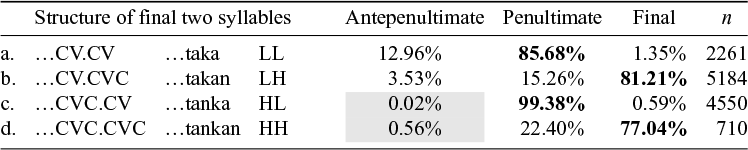
Although antepenultimate stress is infrequent overall, its frequency depends on the weight of the final three syllables. Table 2 shows that words ending in two light syllables, LL, have the highest percentage of antepenultimate stress (12.96%). Words with a heavy penult or ultima (or both) very rarely have antepenultimate stress (never constituting more than 4% of words with the given shape). Most importantly, words with heavy penults rarely have antepenultimate stress: the antepenult is stressed in only 0.02% of words ending in HL, and 0.56% of words ending in HH (the grey-shaded cells in Table 2). Fuchs (Reference Fuchs2018: 9) finds no such words in the written texts in EsPal, a corpus containing over 300 million word tokens (Duchon et al. Reference Duchon, Perea, Sebastián-Gallés, Martí and Carreiras2013).Footnote 5 In short, a heavy penult almost always prevents antepenultimate stress.
While some theoretical proposals for Spanish argue against weight-sensitivity (e.g., Roca Reference Roca1990, Reference Roca1991 et seq.; Baković Reference Baković2016; Piñeros Reference Piñeros and Núñez-Cedeño2016), there is evidence that speakers apply weight-sensitivity in experiments (see §2.4).
2.3. Metathesis changes syllable structure
Under the assumptions that (a) Spanish stress is weight-sensitive, and (b) Sevillian stop–h sequences are realisations of abstract /sC/ sequences, stress and metathesis could interact as illustrated in Table 3. When metathesis does not occur, /s/ is syllabified as a coda, which creates a heavy syllable. When metathesis does occur, it moves /s/ (debuccalised to [h]) to after the initial consonant of the next syllable, and the sequence syllabifies as an onset. The preceding syllable is light.
Table 3 Metathesis changes surface syllable structure.

If metathesis changes syllable structure, it potentially creates a mismatch between surface-visible structure and non-surface structure upon which stress operates. Stress could be conditioned by the phonetic structure visible on the surface, or by structure that is present only at a non-surface level. Given that antepenultimate stress is blocked in words with heavy penultimate syllables, listeners should disprefer words with antepenultimate stress that have heavy penults at both surface and non-surface levels (e.g., */ˈpa.tan.ka/, *[ˈpa.taŋ.ka]). This should hold regardless of which level of representation their decision is based on.
Table 4 illustrates possible decisions listeners could make for words with metathesis. Listeners might accept words with antepenultimate stress when /s/ has metathesised out of the penultimate syllable. This would suggest that they treat the penult as light, evaluating stress on the surface form where the penult has no coda. Or, listeners might disprefer words with antepenultimate stress and these kinds of penults, just like other penults closed with a consonant -- [s], [h] or any other. This would suggest that they treat the penult as heavy, evaluating stress on a structure not visible on the surface, where /s/ is still in coda position.
Table 4 Possibilities for stress judgements in words with metathesis.

An alternative explanation for why penults might be treated as heavy is that metathesis does not really change syllable structure; §4.6.2 argues against this possibility.
2.4. Perception of stress in Spanish
Recent research argues that weight sensitivity is an active restriction in Spanish, and that it affects participants’ production and acceptance of stress patterns. Participants apply weight sensitivity to nonce words and are sensitive to stress–weight configurations that violate restrictions (Shelton Reference Shelton2007, Reference Shelton2013; Shelton et al. Reference Shelton, Gerfen, Palma, Masullo, O’Rourke and Huang2009, Reference Shelton, Gerfen and Palma2012; Shelton & Grant Reference Shelton and Grant2018; Fuchs Reference Fuchs2018).
For example, Shelton (Reference Shelton2007) finds that Spanish speakers are sensitive to unattested combinations of stress location and heavy syllables. He asked Spanish-speaking participants to read aloud nonce words with antepenultimate or penultimate stress, and different kinds of penults. He tested words that (a) are phonotactically illicit or (b) are phonotactically licit in the synchronic system, but are absent for historical reasons. Participants made more mistakes with phonotactically illicit words (e.g., dóvalda, with antepenultimate stress and heavy penult) than with phonotactically licit words (e.g., dóvasa, with antepenultimate stress and light penult; doválda, with penultimate stress and heavy penult). For words that are phonotactically licit but absent for historical reasons, Shelton (Reference Shelton2007) used nonce words with palatal onsets in the final syllable (e.g., dovaña). These words should allow antepenultimate stress because all syllables are light.Footnote 6 In the experiment, participants produced words with final palatal onsets with error rates between those for phonotactically licit and illicit nonce words. Shelton (Reference Shelton2007: 101) suggests that speakers are ‘differentially sensitive to what is… theoretically prohibited by the synchronic grammar as well as to structures that are absent for historical reasons’. Weight restrictions in the synchronic grammar play a role in participants’ stress judgements. See also Fuchs (Reference Fuchs2018) for a study on how Spanish speakers treat words that should permit antepenultimate stress synchronically, but do not for diachronic reasons.
Garcia (Reference Garcia2019) targets the distinction between analogy and syllable weight in Brazilian Portuguese, a closely related language with stress patterns similar to Spanish. In a prior lexicon study, Garcia (Reference Garcia2017: 68) found that antepenultimate stress is more likely in words with light antepenults than in those with heavy antepenults. In his subsequent study, Garcia (Reference Garcia2019: 616) found that LLL words are more likely to bear antepenultimate stress (24% of LLL words) than HLL words (21% of HLL words). This finding is unnatural from the perspective of weight sensitivity, since heavy syllables typically attract stress.
Garcia’s (Reference Garcia2019) speakers did not generalise this unnatural pattern to nonce words in an experimental setting. His participants compared words with identical segmental material that had penultimate or antepenultimate stress (e.g., prísbade vs. prisbáde). The words had weight profiles LLL, HLL, LHL and LLH. Participants chose penultimate stress more than antepenultimate stress only for LHL words. For LLL, HLL and LLH words, listeners chose antepenultimate stress more than penultimate stress. The crucial result is that antepenultimate stress is chosen at a higher rate in HLL words than in LLL words: stress is ‘attracted’ to the antepenultimate syllable in HLL words (presumably because it is heavy). This behaviour goes against the lexical statistics above, where LLL words are more likely to have antepenultimate stress than HLL words. It also goes against the pattern observed for the subset of trisyllabic words in the lexicon, where most of the words that have antepenultimate stress are LLL (71%), and many fewer are HLL (29%) (Garcia Reference Garcia2019: 629). If participants’ choices were based on reference to existing forms, they would be expected to choose the antepenultimate stress version at higher rates in LLL words than in HLL words. Instead, participants applied a more natural pattern of weight sensitivity, with the heavy syllable attracting stress, despite the conflicting pattern in the lexicon.
Finally, Fuchs (Reference Fuchs2018) found that Spanish speakers apply weight sensitivity restrictions to nonce words in a stress judgement task. The nonce words had light penults (e.g.,  ) or heavy penults of various types (e.g.,
 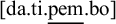 ), and each word was presented in written form with both penultimate and antepenultimate stress. Participants gave higher ratings to words with penultimate stress than to those with antepenultimate stress in all of the syllable structure conditions (e.g.,
 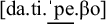 >
>  ). Among words with penultimate stress, words with heavy and light penults received similar ratings. However, among words with antepenultimate stress, words with heavy penults received significantly lower ratings than those with light penults ( $\gg $
 ). This suggests that the restriction against antepenultimate stress when the penult is heavy is active in Spanish speakers’ synchronic grammars, and is applied productively to nonce words: heavy penults make antepenultimate stress worse.Footnote
7
). This suggests that the restriction against antepenultimate stress when the penult is heavy is active in Spanish speakers’ synchronic grammars, and is applied productively to nonce words: heavy penults make antepenultimate stress worse.Footnote
7
My experiment, described in the next section, builds on Fuchs’s (Reference Fuchs2018) findings and (partially) on his methodology, applying them to Sevillian Spanish words with syllables whose codas have metathesised out.
3. Experimental setup
The main research question is as follows: Do Sevillian listeners treat syllables where /s/ has metathesised out as heavy or light? The experiment uses the interaction of metathesis with stress to test this. Metathesis creates a possible mismatch between syllable weight at surface and non-surface levels. Stress could operate on either level, and listeners’ responses to words with metathesis make clear which.
In the main experiment, listeners heard pairs of nonce words with antepenultimate stress that differed only in the type of penult. This section describes the stimulus words for the main experiment (§3.1), and presents acoustic and perceptual studies of them in order to ensure that they were produced, and are perceived, with stress in the intended location (§§3.3 and 3.4). Most of the stimuli nonce words are phonotactically illicit in Spanish (having antepenultimate stress and a heavy penult), and could have been difficult for a native speaker to produce. The results presented in this section show that the acoustic cues to stress are present on antepenultimate vowels in the stimulus words, and that Spanish speakers perceive stress in the intended (antepenultimate) location.
3.1. Stimuli for the main experiment
The nonce words for the main experiment have four syllables and antepenultimate stress. The onsets to the final syllable were /p, t, k/ (which can host metathesised [h]); the vowels in the antepenultimate and penultimate syllables were /a, i, u/. In a given word, the same vowel was used in both the antepenultimate and penultimate syllables (e.g.,  ) to avoid the possibility that listeners’ choices were based on the ability of a particular vowel to bear stress.Footnote
8
) to avoid the possibility that listeners’ choices were based on the ability of a particular vowel to bear stress.Footnote
8
The nonce words were designed in sets. Table 5 shows the three sets with final onset /p/ as an example. Each column is a set, and members of each set differ only in the type of penult: CV (no coda), CVN (coda sonorant), CVs (coda [s]), CVh (coda [h]) and CV.Ch (metathesised [h]). There were 45 test nonce words (9 words $\times $
5 penult types). The CV forms of the other sets are listed at the bottom of Table 5.
$\times $
5 penult types). The CV forms of the other sets are listed at the bottom of Table 5.
Table 5 Three of the word sets (/a, i, u/ with final onset /p/) used as stimuli for the stress judgement task.

Thirty-six filler words were also included (four filler words in each of the nine sets). The filler conditions involved changes that should not affect stress judgements. Two fillers in each set differed minimally from the CV word by (a) changing the onset of the final syllable from a stop to a nasal ( →
→  ) and (b) changing the voicing, continuancy, nasality or rhoticity/laterality of the first consonant (
 →
→  ). Another two fillers in each set differed minimally from the CV.Ch word by (a) changing the original voiceless stop in the final onset to a different voiceless stop (
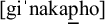 →
→  ) and (b) changing the first consonant (
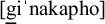 →
→  ).
).
The nonce words were recorded by a linguistically trained male native speaker of Sevillian Spanish in his late 20s. The recording was done in a quiet room with a Zoom H4N Pro recorder. The speaker was instructed to produce all words with antepenultimate stress and different variants of coda /s/ ([s], [h], [Ch]). Although words with this combination of stress and syllable structure do not exist in Spanish, he produced them easily, as verified in the following acoustic analysis and stimulus verification perception study.
Because antepenultimate stress is marked, listeners might be more willing to accept it on nonce words that are more similar to existing words with antepenultimate stress. I controlled for neighbourhood density based on the CV forms using Levenshtein distance, which is the edit distance to turn one string into another. Calculations were based on orthography.Footnote 9
First, I created a subset of four-syllable words with antepenultimate stress from SUBTLEX-ESP, a 41-million-word Spanish corpus based on film subtitles (Cuetos et al. Reference Cuetos, Glez-Nosti, Barbón and Brysbaert2012). Then, I calculated the Levenshtein distance between each CV nonce word candidate and each word in the corpus subset (using the stringdist package for R; van der Loo Reference van der Loo2014). Levenshtein distance is a rough measure of neighbourhood density, but has been found to explain much of listeners’ judgements of word similarity (Vitevitch & Luce Reference Vitevitch and Luce2016: 78).
For the experimental items, I chose CV nonce words that had no lexical neighbours at a Levenshtein distance of three or less, and no more than five neighbours at a distance of four. The goal was to use nonce words that are similar – but not too similar – to real words. Dautriche (Reference Dautriche2017: fn. 13) suggests that word confusability effects tail off after an edit distance of one to two, so words at a distance of three should be similarly susceptible to effects – or lack thereof – of lexical neighbours. The rest of the words in each set were built from these words with CV penults.
3.2. Statistical modelling
Data analysis for the preliminary production and perception experiments, as well as for the main perception experiment, was run in R (v. 4.1.3; R Core Team 2022). Models were run using lme4 (v. 1.1.27.1; Bates et al. Reference Bates, Maechler, Bolker and Walker2015) and lmerTest (v. 3.1.3; Kuznetsova et al. Reference Kuznetsova, Brockhoff and Christensen2017). Post-hoc tests were done with emmeans, with Tukey adjustments for multiple comparisons (v. 1.6.2-1; Lenth Reference Lenth2020). Further details about the models are included in the relevant sections.
3.3. Acoustic analysis of stimuli: stress
Although antepenultimate stress on words with heavy penults is rare in Spanish, an acoustic analysis suggests that the stimuli created for this study do indeed have antepenultimate stress. Spanish primary stress is realised acoustically with a combination of f0, duration, and intensity (Llisteri et al. Reference Llisteri, Machuca, de la Mota, Riera and Ríos2003; Ortega-Llebaria & Prieto Reference Ortega-Llebaria and Prieto2010). Stressed vowels are longer and have slightly higher intensity, but intensity is a weak and inconsistent correlate (Ortega-Llebaria & Prieto Reference Ortega-Llebaria and Prieto2010). In Castilian Spanish (North-Central Spain), stressed syllables have a rising pitch contour (Ortega-Llebaria & Prieto Reference Ortega-Llebaria and Prieto2010; Vogel et al. Reference Vogel, Anthanasopoulou, Pincus and Heinz2016) that peaks on the following syllable (Ortega-Llebaria & Prieto Reference Ortega-Llebaria and Prieto2010). I have not found studies of Sevillian intonation, but rising contours on stressed syllables are reported for nearby varieties (Henriksen & García-Amaya Reference Henriksen and García-Amaya2012).
The stimulus words show acoustic evidence of stress on the antepenultimate vowel, as intended; this is illustrated in Figure 1. This acoustic analysis compares antepenultimate vowels (intended to be stressed, as in  ) to penultimate vowels (intended to be unstressed, as in
  ). Figure 1a shows that antepenultimate vowels are longer than penultimate vowels. Figure 1b shows an example of an F0 contour on antepenultimate and penultimate vowels. The antepenultimate vowel, labelled u1, has rising F0 that peaks on the following (penultimate, unstressed) vowel. The penultimate vowel, u2, has falling F0. In other stimulus words, the contours are flatter, but mostly fall slightly because of the early peak from the preceding stressed vowel. What is crucial is that the contour differs substantially from the rising contour on stressed vowels. Antepenultimate and penultimate vowels do not differ in intensity.

Figure 1 Acoustic evidence of antepenultimate stress in recorded stimuli.
Linear regression models support these observations. The duration and intensity models contain fixed effects of word condition (CV, CVN, CVs, CVh and CV.Ch), vowel position (antepenultimate, penultimate), and their interaction. Penultimate vowels are shorter than antepenultimate vowels ( $\beta = -0.031$
,
$\beta = -0.031$
, $p < 0.01$
). Neither word condition nor the interaction between vowel position and word condition is significant. The difference in duration holds across conditions. This is important because it suggests that penultimate vowels are not shorter simply because many of them come from syllables with a coda consonant, while antepenultimate vowels all come from open syllables. Penultimate vowels are shorter than antepenultimate vowels even in words with CV penults.Footnote
10
The intensity model had no significant effects.
$p < 0.01$
). Neither word condition nor the interaction between vowel position and word condition is significant. The difference in duration holds across conditions. This is important because it suggests that penultimate vowels are not shorter simply because many of them come from syllables with a coda consonant, while antepenultimate vowels all come from open syllables. Penultimate vowels are shorter than antepenultimate vowels even in words with CV penults.Footnote
10
The intensity model had no significant effects.
For F0, measurements were taken at four points during each vowel (20 ms, 30 ms, 40 ms, 50 ms). For antepenultimate vowels, the maximum F0 on the following (penultimate) vowel was also taken, in order to capture the expected peak on the syllable following primary stress. Each vowel (/a, i, u/) was modelled separately in each position (antepenultimate, penultimate). The models had a fixed effect of measurement location. Results reported are from models and post-hoc tests with emmeans. For antepenultimate vowels (all qualities), the maximum F0 on the following vowel is higher than F0 at all locations within the antepenultimate vowel ( $p < 0.001$
for /a, i, u/). Although the F0 rise within the antepenultimate vowel is not significant, manual inspection shows that many of these vowels show a rise even within that vowel, as in Figure 1b. For penultimate vowels, measurement location was not a significant predictor of F0, but a slight fall is visible in many of the words. This may be because the first measurement point was 20 ms into the vowel, failing to capture the full extent of the fall.
$p < 0.001$
for /a, i, u/). Although the F0 rise within the antepenultimate vowel is not significant, manual inspection shows that many of these vowels show a rise even within that vowel, as in Figure 1b. For penultimate vowels, measurement location was not a significant predictor of F0, but a slight fall is visible in many of the words. This may be because the first measurement point was 20 ms into the vowel, failing to capture the full extent of the fall.
In sum, the antepenultimate vowels in my stimuli carry the acoustic correlates of stress: they are longer than unstressed vowels of the same quality, and have rising F0 contours with a peak on the following syllable. That stress is not reflected in intensity is not surprising, since intensity effects in Spanish stress are small, inconsistently produced and inconsistently used to identify stress (Llisteri et al. Reference Llisteri, Machuca, de la Mota, Riera and Ríos2003; Ortega-Llebaria & Prieto Reference Ortega-Llebaria, Prieto, Vigário, Frota and João Freitas2009, Reference Ortega-Llebaria and Prieto2010).
Other acoustic properties of the stimuli could plausibly affect the interpretation of results of the main experiment, specifically the duration of the final onset consonant, of the penultimate syllable rhyme, and of the segments involved in metathesis. Further discussion can be found in §4.6.2 and in the Supplementary Material. In brief, acoustic duration does not strongly correlate with participants’ responses in the main experiment.
3.4. Preliminary perception study
This preliminary perception study ensures that Spanish-speaking listeners hear stress on the syllable that was intended to be stressed in the stimulus words for the main study.
3.4.1. Materials and task
Recall that the stimuli for the main experiment are four syllables long and have antepenultimate stress (see Table 5). Because they all have antepenultimate stress, it was necessary to modify these words to design a task testing where listeners hear stress.
I created two three-syllable versions of each nonce word – one with antepenultimate stress and one with penultimate stress – by removing the first and final syllables, respectively (e.g.,  →
→  ,
,  ).Footnote
11
Table 6 illustrates the modified nonce words used in this preliminary perception study.
).Footnote
11
Table 6 illustrates the modified nonce words used in this preliminary perception study.
Table 6 Example stimuli for one word set for preliminary stress experiment.

The experiment was implemented in PCIbex (Zehr & Schwarz Reference Zehr and Schwarz2018). In each trial, listeners heard one word and clicked on one of two given orthographic representations to indicate the word they heard. The two answer choices differed only in the location of stress. Following orthographic conventions of Spanish, antepenultimate stress was marked with an acute accent and penultimate stress was not marked.Footnote
12
Stressed syllables were underlined in both answer choices to ensure that participants visually noticed the difference between choices. Words in three conditions had the same answer choices: CVs, CVh and CV.Ch words all had answer choices with orthographic 〈s〉, even though [s] was not acoustically present in CVh and CV.Ch words. For example, in the penultimate stress condition,  (<
(<  ) and
) and  (<
(<  ) had answer choices nalufus and
nálufus, which would be the corresponding orthographic forms. This should not matter, since the answer choices differed only in stress and /s/ reduction and deletion are common in this context.
) had answer choices nalufus and
nálufus, which would be the corresponding orthographic forms. This should not matter, since the answer choices differed only in stress and /s/ reduction and deletion are common in this context.

Figure 2 Stimulus verification study: accuracy in locating stress by penult type.
There were 162 words. Listener groups A and B each heard half of the words. Listeners in group A heard half of the words in a given set with penultimate stress (CV, CVs, CV.Ch, Filler1 and Filler3) and the other half of the words in the same set with antepenultimate stress (CVN, CVh, Filler2 and Filler4). For a different word set, they heard each word type with the opposite stress pattern. This pattern repeated for all of the word sets. Listeners in group B heard the inverse of group A. Trials were randomised. There were also two practice items and six attention checks.
3.4.2. Participants
Twenty participants from Spain were recruited on Prolific. Ten were assigned to listener group A and ten to listener group B. Region within Spain was not controlled, since the goal is to check if Spanish speakers generally hear stress in the intended location. The experiment lasted 5–15 minutes, and participants were paid. One listener from group A and three from group B were excluded for answering more than one attention check wrong, so the remainder of the analysis includes 16 listeners.
3.4.3. Results
Listeners heard stress where it was intended to be with 88%–98% accuracy across penult type conditions (Figure 2). A mixed-effects logistic regression (fixed effect of word condition, random intercepts for participant and item) finds one significant effect: accuracy was higher for the attention check words than the reference level CV words ( $\beta = -1.58$
,
$\beta = -1.58$
, $p < 0.05$
). This is expected because the attention check items were unambiguous, and listeners who failed more than one were excluded. The model and post-hoc tests with emmeans found no significant differences between other conditions. Listeners had high overall accuracy in identifying the stressed syllable where it was intended to be, and accuracy did not depend on condition.
$p < 0.05$
). This is expected because the attention check items were unambiguous, and listeners who failed more than one were excluded. The model and post-hoc tests with emmeans found no significant differences between other conditions. Listeners had high overall accuracy in identifying the stressed syllable where it was intended to be, and accuracy did not depend on condition.
In short, the acoustic cues to stress are present on the intended antepenultimate syllables in the stimuli, and Spanish-speaking listeners perceive them. I will thus assume that listeners’ behaviour in the main experiment is based on a correct perception of stress location.
4. Main experiment
4.1. Task
Participants completed the task in their homes; data were collected in 2020. In each trial, participants heard two words with antepenultimate stress that differed only in the type of penultimate syllable, paired as in Table 7 (e.g., one CV–CVN pair was  –
– ). The CV set compares words with different penult types to the word with a CV penult, testing whether words with CV penults are preferred over those with different kinds of heavy penults and the CV.Ch penult. The CV.Ch set compares words with different penult types to the word with a CV.Ch penult, testing whether words with CV.Ch penults are treated differently from words with penults that are unambiguously heavy or light.
Table 7 Condition pairings for CV and CV.Ch comparisons.

Participants were told that the words were not real words and were asked to choose which word would be a better word of Spanish by clicking buttons on the screen labelled 1 or 2, corresponding to the first and second words they heard.
There were 108 trials, composed of the 9 word sets (Table 5) arranged into the 12 comparisons in Table 7. In each trial, the two words were played with 300 ms in between. Trial order was randomised for each participant, and the order of presentation of the audio files within each trial was counterbalanced. Group A heard half of the word pairs with the base form (CV or CV.Ch) first and the comparison form second (e.g., CV–CVs), and the other half with the comparison form first and the base form second (e.g., CVh–CV). Group B heard the opposite orders. There was one practice trial. Participants also filled out a demographic questionnaire and were paid. The experiment lasted 12–35 minutes.
The task was inspired by Fuchs (Reference Fuchs2018), but differs in several key ways. First, I presented the stimulus words auditorily instead of orthographically, which allowed me to test different allophonic realisations of the same word. Given that metathesis is not represented orthographically, this is crucial. Additionally, Fuchs’s (Reference Fuchs2018) task was a goodness-rating task, which resulted in significant, but small, effects. The current study forces participants to make a binary choice in an attempt to distil their preferences.
4.2. Hypotheses
In general, listeners are expected to prefer words with light penults over those with heavy penults. Table 8 lays out listeners’ expected behaviour if they treat CV.Ch penults as heavy (column (a)) or light (column (b)). For the CV-base comparisons, listeners should prefer CV words over alternative CVN, CVs and CVh words. This is the expected preference under both sets of hypotheses, since CV.Ch words are not involved. The CV–CV.Ch comparison distinguishes the two hypotheses. If listeners treat the CV.Ch penult as heavy, they should prefer CV over CV.Ch. If they treat the CV.Ch penult as light, they should not have a preference between CV and CV.Ch.
Table 8 Predictions for listener responses based on whether they treat CV.Ch penults as heavy or light.

The pairs in the CV.Ch comparisons test the hypothesis more directly by comparing CV.Ch words to words with other penult types. For the CV.Ch-base comparisons, the two hypotheses predict different listener behaviour for each comparison type. If listeners treat CV.Ch penults as heavy, they should have no preference between CV.Ch and CVN, CVs or CVh words, and they should prefer CV words over CV.Ch words. (This last preference is the same as the CV–CV.Ch comparison in the CV-base comparisons.) If listeners treat CV.Ch penults as light, they should have no preference between CV.Ch and CV words, and should prefer the CV.Ch word over CVN, CVs and CVh words.
There are multiple possible explanations for why the penults created by metathesis might be treated as heavy or light. In order to separate the experimental results from the interpretation of those results, I leave further discussion of these possibilities for §4.6.
4.3. Statistical models
The results were modelled in mixed-effect logistic regressions using glmer from lme4 in R, and emmeans was used to determine and contrast estimated marginal means and contrasts between other levels of the main predictor (same details as in §3.2). Separate models were built for the CV and CV.Ch comparisons, predicting the likelihood of choosing the base form (CV or CV.Ch) over the alternative. The dependent variable was the response of the base form (coded as 1) vs. the alternative (coded as 0). Coefficients of logistic regressions are in log-odds. Positive coefficients indicate higher log-odds of base response; lower coefficients indicate lower log-odds of the base response (and thus higher log-odds of the alternative response). A log-odds value of 0 corresponds to a probability of 0.5; positive log-odds correspond to a probability greater than 0.5 and negative log-odds correspond to a probability less than 0.5.
Table 9 shows the fixed effect (comparison type) and random intercepts (word set, participant) in the models. A random slope of condition by participant and condition by word set were not included because models fitted with them resulted in singular fit warnings. Comparison type is dummy coded, and the underlined comparison type is the reference level for the factor. The models respond to the following question: There is a certain log-odds of a base response (e.g., CV) in the reference level of comparison type (e.g., CV–CVN). Does the log-odds of a base response in another comparison type (e.g., CV–CVs) differ from that of the reference level?
Table 9 Predictors in models (reference level in bold).

Tests between other levels of comparison type were done with emmeans, with Tukey adjustment for multiple comparisons. Estimated marginal means are calculated for each comparison type based on the model results, and statistical tests are applied to test for significant differences between the factor levels. For easier interpretation, I used a back-transformation within emmeans to calculate the estimates on the response scale instead of the model’s logit scale. Estimates and confidence limits (95% confidence level) are thus given in probabilities, and contrasts are calculated on the log-odds ratio scale. The estimated probabilities and confidence limits for each comparison type calculated from emmeans are overlaid on the plots of my listeners’ data.
4.4. Participants
The participants were 27 Sevillians (20 female and 7 male), with an average age of 37.9 years (range: 18–70). They were born and completed schooling in the city of Seville and smaller towns in the province. Most had lived their entire lives in the region, although some reported short-term (less than one year; UK, León and Majorca) and long-term stints (two years or longer; Switzerland/Finland, US, Madrid and Galicia) elsewhere. All participants had completed high school; 13 had completed a technical or university degree; and 12 had done postgraduate studies (one did not report education). Participants reported knowledge of languages other than Spanish: English (20), French (7), German (2), Italian (2), Portuguese (2), Gallego (1) and ‘Catalan/Valencian’ (1). Three participants reported almost-native proficiency in another language (English, French and Gallego). Some also participated in the experiment reported in Gilbert (Reference Gilbert2023).
4.5. Results
Figure 3 shows results for the CV comparisons (Figure 3a) and CV.Ch comparisons (Figure 3b). The y-axis is the proportion of base response (CV or CV.Ch) over the alternative. Each dot represents an individual speaker’s response rate for the comparison type. The line at 0.5 is for visual clarity. Dots above the line indicate that a listener chose the base form over the alternative more than 50% of the time; dots below the line indicate that a listener chose the alternative over the base more than 50% of the time. The blue dots and error bars are predicted probabilities and 95% confidence limits produced by emmeans based on the logistic regressions.

Figure 3 Listener results from the stress judgement task.
4.5.1. CV comparisons
In the CV comparisons (Figure 3a), the overall rate at which listeners chose CV over the alternative ranged from 67% to 74% across comparison types (percentages calculated within-category, combining all listener responses). Listeners preferred words with light penults over each alternative (CV > CVN, CVs, CVh, CV.Ch;  >
>  ,
,  ,
,  ,
,  ). The rate of preference for CV is similar for all of the alternative forms, including those with surface-heavy penults and those with CV.Ch penults.
The logistic regression supports these observations (Table 10). Recall that the model predicts the log-odds of choosing the base CV word over the alternative. Positive coefficients indicate higher log-odds of a CV response in the given comparison type than in CV–CVN (the reference level comparison type), while negative coefficients indicate the opposite. For CV–CVN comparisons, listeners chose the base CV word with a log-odds of 0.964 (the intercept; $p < 0.001$
). In terms of probability, this gives an estimated probability of 0.72 of a CV response.
$p < 0.001$
). In terms of probability, this gives an estimated probability of 0.72 of a CV response.
Table 10 Model for CV comparisons predicting probability of CV response (vs. alternative).

The effect of comparison type is not significant: the log-odds with which listeners prefer the base CV word over the alternative is not statistically different between the reference level CV–CVN and any other level (vs. CV–CVs: $\beta = -0.149$
,
$\beta = -0.149$
, $p = 0.469$
); vs. CV–CVh:
$p = 0.469$
); vs. CV–CVh: $\beta = 0.250$
,
$\beta = 0.250$
, $p = 0.240$
; vs. CV–CV.Ch:
$p = 0.240$
; vs. CV–CV.Ch: $\beta = 0.000$
,
$\beta = 0.000$
, $p = 1.000$
).
$p = 1.000$
).
The predicted probabilities for each level of comparison type (from emmeans) are in Table 11. For each comparison type, the predicted probability of a CV response is well above chance (ranging from 0.69 to 0.77). Furthermore, the 95% confidence limits do not span 0.5 (chance), indicating a high likelihood that the true parameter lies above chance. Listeners choose the alternative over the base form significantly over chance in all comparisons. The emmeans contrasts between the predicted probabilities suggest that the probabilities are not significantly different between any of the comparison types (results not shown).
Table 11 emmeans predictions by comparison type for CV model. Intervals are back-transformed from the logit scale.

That listeners prefer CV over CV.Ch words at a similar rate to that at which they prefer CV over CVN, CVh and CVs words does not suggest a robust difference between conditions, but neither does it provide positive evidence for their similarity. The next set of comparisons tests CV.Ch words directly against CVN, CVs and CVh words to address this issue. Do listeners treat all penult types as similarly unacceptable? The statistically significant results in the CV.Ch comparisons are compatible with the lack of effect in the CV comparisons.
4.5.2. CV.Ch comparisons
In the CV.Ch comparisons (Figure 3b), the overall rate at which listeners chose CV.Ch over the alternative was less than 50% in CV.Ch–CVN comparisons (40%) and CV.Ch–CVs comparisons (44%). That is, they dispreferred CV.Ch words in comparison to CVN and CVs words (e.g.,  <
<  ;
;  <
<  ). Listeners chose the CV.Ch word even less frequently in CV.Ch–CV comparisons (26%), which had a CV word as the alternative (
 <
<  ). In contrast, the CV.Ch–CVh comparisons were the only ones in which listeners chose the CV.Ch word at rate over 50% (56%;
  >
>  ).
).
The logistic regression (Table 12) supports the visual interpretation of the results. In CV.Ch–CVN comparisons (the reference level of comparison type), the log-odds of a CV.Ch response is −0.463 ( $p < 0.05$
). This indicates that listeners are less likely to choose CV.Ch than CVN (probability of 0.386 of choosing CV.Ch). In relation to this reference level, the log-odds of choosing CV.Ch in CV.Ch–CVs comparisons is not significantly different (
$p < 0.05$
). This indicates that listeners are less likely to choose CV.Ch than CVN (probability of 0.386 of choosing CV.Ch). In relation to this reference level, the log-odds of choosing CV.Ch in CV.Ch–CVs comparisons is not significantly different ( $\beta = 0.193$
,
$\beta = 0.193$
, $p = 0.325$
). However, in comparison to the reference level, the log-odds of a CV.Ch response is significantly lower in CV.Ch–CV comparisons (
$p = 0.325$
). However, in comparison to the reference level, the log-odds of a CV.Ch response is significantly lower in CV.Ch–CV comparisons ( $\beta = -0.710$
,
$\beta = -0.710$
, $p < 0.001$
) and significantly higher in CV.Ch–CVh comparisons (
$p < 0.001$
) and significantly higher in CV.Ch–CVh comparisons ( $\beta = 0.774$
,
$\beta = 0.774$
, $p < 0.001$
).
$p < 0.001$
).
Table 12 Model for CV.Ch comparisons predicting probability of CV.Ch response (vs. alternative).

The emmeans estimates of probability CV.Ch response for each comparison type are shown in Table 13. In most comparison types, the predicted probability of a CV.Ch response is less than 0.5 (lower than chance). CV.Ch–CVh comparisons are the only ones for which the predicted probability of a CV.Ch response is greater than 0.5. Note that the 95% confidence limits include chance (0.5) for CV.Ch–CVs and CV.Ch–CVh comparisons, indicating that we cannot exclude the possibility that the true estimate could be at chance. The upper confidence limit for CV.Ch–CVN comparisons is also close to 0.5 (0.489). The emmeans contrasts between the predicted probabilities (Table 14) suggest that the predicted probabilities are significantly different between all levels of comparison type, except CV.Ch–CVN vs. CV.Ch–CVs.
Table 13 emmeans predictions by comparison type for CV.Ch model. Intervals are back-transformed from the logit scale.

Table 14 emmeans contrasts between levels of comparison type for CV.Ch model. Tests are performed on the log-odds ratio scale. P value adjustment: Tukey method for comparing a family of four estimates.

Although there is a general dispreference for CV.Ch words compared to words with CVN and CVs penults (discussed further in §4.5.3), there are two crucial points. First, the predicted confidence limits for the CV.Ch–CVs comparison include chance (0.335–0.536); for CV.Ch–CVN comparisons, the confidence limits approach chance (0.293–0.489). Second, the predicted probability of a CV.Ch response in CV.Ch–CV comparisons is significantly lower than in all other comparisons, and the confidence limits are well below chance (0.166–0.325). In other words, despite an overall dispreference for CV.Ch in comparison to some words with heavy penults, there is a significantly stronger dispreference for these CV.Ch words when the alternative has a CV penult.
4.5.3 Results discussion
Table 15 summarises the results. Listeners prefer antepenultimate-stress words with CV penults over similar words with closed penults (CVN, CVs and CVh) or penults where /s/ has metathesised out (CV.Ch). Regardless of what consonant or surface manifestation of /s/ closes the penult, Sevillian listeners are more likely to choose the CV word, and they do so at similar rates across the alternatives. When choosing between antepenultimate-stress words with CV.Ch penults and those that have CVN, CVs or CVh penults, listeners have preferences, but these preferences are weak. Listeners choose CV.Ch words less frequently than CVN and CVs words and more frequently than CVh words, although the confidence limits around these predicted probabilities include, or are near, chance.
Table 15 Summary of listeners’ preferences in the stress judgement task.

The crucial point is the following: despite the weak dispreference for CV.Ch words when the alternatives are CVN or CVs, this dispreference for CV.Ch words is much stronger when the alternative is a CV word. The relative strength of this dispreference suggests that CV.Ch words are treated more like words with surface-heavy penults than like words with light CV penults. The results are broadly as predicted if CV.Ch penults are treated as heavy (cf. Table 8).
The differences between rates of preference for the CV.Ch word when compared to words with CVN, CVs and CVh penults are somewhat unexpected. The CVN, CVs and CVh words all have heavy penults and should be treated similarly. Furthermore, regardless of whether CV.Ch forms are taken to have heavy or light penults, neither account predicts that they should be dispreferred to forms with surface-heavy penults like CVN and CVs; they should either be treated similarly to these alternatives (if treated as heavy) or preferred over them (if treated as light). The dispreference for CV.Ch relative to CVN and CVs does not necessarily undermine the results. This dispreference could actually further support the idea that CV.Ch forms are treated as having heavy penults, since they are even more dispreferred than words with unambiguously heavy penults.
One result does not fit clearly with the predictions: listeners prefer CV.Ch over CVh words, and this is the only CV.Ch comparison where they choose CV.Ch more than 50% of the time. If CV.Ch derives from /sC/, then CV.Ch and CVh forms share an underlying representation and should be treated similarly. I suspect the preference for CV.Ch over CVh words arises because this comparison is qualitatively different. The judgement between CV and CVN words is a decision between two different words. In the judgement between CV.Ch and CVh words, the decision is between allophonic realisations of a sound in the same word. Between two non-standard pronunciations, listeners choose the one that is more frequent in their dialect (CV.Ch; see §2.1). Thus, this preference could be due to their familiarity with surface phonetic forms, rather than to the differing phonological structure of the forms. Another possibility is that the acoustics of the CVh stimulus words were particularly bad: a combination of surface-present coda [h] and a long closure duration of the final onset consonant resulted in an acoustically overlong penult (measurements are given in the Supplementary Material).
If participants prefer CV.Ch over CVh because CV.Ch is the more common allophonic variant of /sC/ sequences, we might also expect listeners to prefer CV.Ch over CVs, which is also infrequent in conversational speech (§2.1). They do not: CV.Ch forms are chosen slightly less than 50% of the time in CV.Ch–CVs comparisons. I speculate that this is because the full sibilant variant is the national and international standard. While listeners prefer the reduced form of their own dialect over reduced forms that are rare in their dialect (CV.Ch > CVh), they do not always prefer the reduced form of their dialect over the standard (CV.Ch $\lesssim $
CVs). The fact that CV.Ch was preferred over CVh but not over CVs could also be due to the fact that words with CVs penults did not have the acoustic ‘over-heaviness’ of the CVh penults (see the Supplementary Material).
$\lesssim $
CVs). The fact that CV.Ch was preferred over CVh but not over CVs could also be due to the fact that words with CVs penults did not have the acoustic ‘over-heaviness’ of the CVh penults (see the Supplementary Material).
These observations lead to a possibly different interpretation of the results: that listeners’ choices between the words were based on sociolinguistic factors, not syllable weight.Footnote 13 Listeners’ preference for CV words in CV–CVN and CV–CVs comparisons would be based on the heaviness of CVN and CVs penults. In CV–CVh and CV–CV.Ch comparisons, however, listeners’ preference for CV words could be because CVh and CV.Ch are non-standard variants. The additional surface weight of the CVh word would compound the dispreference for CVh words. This explanation could also apply to the slight dispreference for CV.Ch relative to CVN and CVs: CV.Ch words contain a non-standard variant and the others do not. When evaluating this possible explanation, it is important to keep in mind that although CV.Ch realisations of /sC/ sequences are non-standard at the supraregional level, they are apparently something of a regional standard. In data from nearby Málaga (Vida-Castro Reference Vida-Castro2016), CV.Ch variants are acceptable in most read speech styles, and most frequent among older speakers and highly educated speakers. (These patterns contrast with post-affricated variants, which are most frequent among young speakers and speakers with lower levels of education, and are avoided in read speech.) Whether these explanations hold would come down to how listeners interpreted the task: whether their decisions were based on the phonotactics of a new lexical item, or on the presence of (non-)standard allophonic variants. This would require further empirical testing.
4.6. Interpretation of results: syllable weight
This constellation of results suggests that CV.Ch penults are treated as heavy when it comes to stress assignment, similar to CVs, CVN and CVh penults. There are several possible ways to interpret these results. Because there is no evidence that the syllables created by metathesis are treated as light, I focus only on different analyses that can account for their heaviness: opaque process interaction or representational separation (§4.6.1, elaborated further in §5), syllabification (§4.6.2) and acoustic duration (§4.6.3).
4.6.1. Process interactions and representational separation
That CV.Ch penults are treated as heavy is in line with conceptualising stress and metathesis as processes that apply serially, in an opaque interaction where either stress is assigned before metathesis or the two processes apply at the same time to the same representation. In either case, stress only ‘sees’ the heavy penult, not the result of metathesis. Another way of understanding the stress–metathesis ‘interaction’ is as representational separation: stress and metathesis operate on different levels of the phonological grammar, on different types of representations, so the result of one cannot affect the result of the other. The goal of §5 is to flesh out some of these analytical possibilities in more detail.
4.6.2. Syllabification
Another way of interpreting the result that Sevillians seem to treat CV.Ch penults as heavy would be to say that these penults maintain heaviness due to syllabification. Stop–h sequences could syllabify across the syllable boundary, with the stop in the coda of the preceding syllable (VC.h, heterosyllabic), as opposed resyllabifying as an onset (V.Ch, tautosyllabic). Another possibility is that the stop is representationally linked to both syllables. I discuss these issues here so readers can take them into consideration in interpreting the results, but syllabic affiliation can only be established with future experimental work.
Resyllabification
If stop–h forms are syllabified as VC.h, metathesis would result in the same syllable structure post-metathesis as pre-metathesis, but with the segments swapped (e.g.,  , LLHL vs.
  , also LLHL). Both have a heavy penult. This VC.h syllabification is possible, but unlikely for several reasons.
First, the VC.h syllabification is not compatible with restrictions on coda obstruents in Spanish. Coda obstruents are restricted both word-medially and word-finally, and those that are allowed are often reduced or deleted (Campos-Astorkiza Reference Campos-Astorkiza2012; Colina Reference Colina2012). This pressure against coda obstruents is synchronically and diachronically evident throughout Romance languages (recall (3); Malmberg Reference Malmberg1965; Vennemann Reference Vennemann1988; Mason Reference Mason1994 and references therein). Syllabifying the sequence as VC.h maintains a consonant in coda position, and replaces /s/ with a voiceless stop. Depending on the theoretical approach taken – for example, based on sonority – a voiceless stop can be an even worse coda than [s] or [h].Footnote 14
Second, if /p, t, k/ were syllabified into coda position, they should reduce like other coda obstruents in Western Andalusian Spanish. In these varieties, coda /p, t, k/ behave like coda /s/: they undergo debuccalisation and metathesis (and affrication), and their weakening is accompanied by variable lengthening of the following consonant ( →
→  $\sim $
 ]; Del Saz Reference Del Saz, Calhoun, Escudero, Tabain and Warren2019a; Henriksen et al. Reference Henriksen, Galvano and Fischer2023). In Sevillian, /p, t, k/ in metathesised stop–h sequences do not reduce to [h] as in (5), suggesting that they are onsets, not codas (Gerfen Reference Gerfen and Lombardi2001).

If VC.h is unlikely, the other option is V.Ch. One possible objection to the V.Ch syllabification is that sequences of stops plus [h] are unattested in Spanish. I follow the discussion in Gilbert (Reference Gilbert2023) about this issue. Neither the VC.h nor the V.Ch syllabifications create preferred sequences in Spanish. The V.Ch syllabification is bad because it creates unattested onset sequences. Additionally, stop–h onsets do not have a sufficient sonority rise (Sonority Sequencing Principle; Clements Reference Clements1990; Blevins Reference Blevins and Goldsmith1995). The VC.h syllabification is bad because it (a) violates the restriction against coda obstruents, as already discussed and (b) violates the preference for sonority to fall across a syllable boundary (Syllable Contact Law; Murray & Vennemann Reference Murray and Vennemann1983; Clements Reference Clements1990; Gouskova Reference Gouskova2004). Given that coda obstruents are so dispreferred in these varieties of Spanish, it is not immediately clear whether the VC.h or V.Ch syllabification is worse. One theoretical possibility that might ameliorate the bad onset issue with V.Ch is Steriade’s (Reference Steriade, Cole and Kisseberth1994) proposal for Mazatec. In brief, she suggests that complex onsets are less marked if they are structurally similar to single segments. In Sevillian, Ch onsets may be less marked than they appear because the sequence consists of a closure and release, two phases which can be present in a single segment too (in aspirated stops). In short, how to account for Ch as a viable onset is an unresolved issue, but it is not obvious that the V.Ch syllabification is worse than VC.h.
Multiple linking
CV.Ch syllables also could be interpreted as heavy if the stop is representationally linked to both syllables. Coda /s/ reduction is often accompanied by variable lengthening of the following consonant in varieties of Andalusian Spanish (e.g., Alvar Reference Alvar1955; Romero Reference Romero1995b; Gerfen Reference Gerfen2002; Campos-Astorkiza Reference Campos-Astorkiza, Hajicová, Kotešovcová and Mírovský2003; Martínez-Gil Reference Martínez-Gil2012). Variable lengthening is also reported in varieties with metathesis (e.g.,  ; Ruch Reference Ruch2008; O’Neill Reference O’Neill2010; Ruch & Harrington Reference Ruch and Harrington2014; Henriksen et al. Reference Henriksen, Galvano and Fischer2023). Long stop closures accompanying /s/ reduction have been treated as compensatory lengthening in multiple varieties of Spanish (Hualde Reference Hualde1989b; Campos-Astorkiza Reference Campos-Astorkiza, Hajicová, Kotešovcová and Mírovský2003; Martínez-Gil Reference Martínez-Gil2012).
A moraic analysis (e.g., Hayes Reference Hayes1989) of compensatory lengthening would go as follows. /s/ reduces by delinking (in part or in full) from its mora, leaving the mora slot empty. The following consonant then spreads into that timing slot and is doubly linked, occupying both coda and onset position. Double linking is often argued to manifest as longer acoustic duration (Broselow et al. Reference Broselow, Chen and Huffman1997; Cohn Reference Cohn2003; Khattab & Al-Tamimi Reference Khattab and Al-Tamimi2014). Under this representation, the long stop would be syllabified across the syllable boundary (Maddieson Reference Maddieson and Fromkin1985); the syllable preceding the stop–h sequence would be heavy; and the assumption that metathesis changes syllable structure would be untenable. While this representation of consonant lengthening could be viable, there are several complications. Lengthening is variable and inversely correlated with the duration of metathesised [h], and stop closures appear to be shortening again as the metathesis change advances (Parrell Reference Parrell2012; Torreira Reference Torreira2012; Ruch & Harrington Reference Ruch and Harrington2014). Furthermore, lengthening can occur with /s/ debuccalisation, not only deletion, so the moraic slot is not entirely empty. It is not clear how a mora-sharing account of lengthening would account for these factors (see Gerfen Reference Gerfen2002), or for the interaction between lengthening and metathesis.
In the stimuli used for the experiment reported in this article, the CV.Ch stimulus words have similar final onset consonant durations to CV words (e.g., 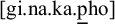 =
= 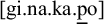 ), so acoustic lengthening would not provide reason for listeners to treat CV.Ch penults as heavier than CV penults (see Figure 1 in the Supplementary Material).
4.6.3. Acoustic duration
Finally, it is possible that CV.Ch penults were treated as heavy because these syllables were acoustically long in the stimulus words, in a way that made them more acoustically similar to CVN, CVs and CVh words than to CV words. As mentioned in §4.6.2, stop closure lengthening ( ) could contribute to the duration of the penultimate syllable. Other durations that could plausibly affect the interpretation of syllable weight include the intervocalic interval from the beginning of the penultimate vowel to the onset of the vowel in the final syllable (
 ; Steriade Reference Steriade2008, Reference Steriade2012). Longer duration could be interpreted as ‘heaviness’.
Measurements of the stimulus words and their correlations with listener response rates do not suggest that listeners’ responses in my experiment were straightforwardly based on heaviness coming from acoustic duration. Full details are in the Supplementary Material.
5. Analysing stress and metathesis in Sevillian
The analyses in this section start from the following assumptions: Sevillian stop–h sequences derive from /sC/ sequences by metathesis, and stop–h sequences resyllabify as the onset of the following syllable.Footnote 15
The main observation from the experiment is that syllables where /s/ has metathesised out are treated as heavy. There is a mismatch between an abstract, non-surface form relevant for stress placement, and the surface form. Listeners apply this mismatch productively to nonce words. To capture my listeners’ behaviour, an analysis needs to distinguish between CV penults and CV.Ch penults, even though they are both light on the surface. It needs to treat CV.Ch penults like CVN, CVs and CVh penults, even though they differ in syllable structure on the surface. Antepenultimate stress needs to be allowed to surface in words with CV penults but blocked in words with CV.Ch, CVN, CVs and CVh penults, which must receive penultimate stress instead (Table 16).
Table 16 Patterns to account for in the analyses.

These observations can be analysed in several types of frameworks. My experimental results do not distinguish between them, so I sketch two main types of analysis.
One type of account is based on process interactions: stress and metathesis are phonological processes that interact with each other (§5.1). Under this conceptualisation, the interaction is opaque because the factors that condition stress assignment are not visible on the surface. Metathesis has obscured them. Furthermore, applying one process before the other changes how the other applies. Stress and metathesis can also be applied at the same time, to the same representation, as long as the output of metathesis is not visible to stress. If these accounts were to be found to be accurate in future research, the experimental results would be significant because they document an opaque pattern that speakers apply productively to novel words. These accounts can vary along two axes: whether they are serial or parallel and whether they use rules or constraints. The only combination that cannot produce the stress–metathesis interaction is a parallel, constraint-based one.
Another type of account is representational: stress and metathesis are fundamentally different types of operations that occur at different levels of representation (§5.2). There is no ‘interaction’ and thus no opacity; the apparent interaction falls out from the separation between representational levels in the phonological grammar.
I close the section by evaluating properties of the analyses presented (§5.3), and suggest that a promising approach is one that separates stress and metathesis representationally, with metathesis operating on gestures. A model of this sort could capture variability in metathesis that is both extensive and constrained, and where variation in the degree of acoustic metathesis does not affect stress.
5.1. Process-interaction analyses
5.1.1. SPE
In a rule-based, SPE-style analysis, rules are ordered and apply sequentially, giving rise to intermediate derivational levels (Chomsky & Halle Reference Chomsky and Halle1968; Kenstowicz & Kisseberth Reference Kenstowicz and Kisseberth1979). Phonological processes interact by creating, removing or changing the context for other rules to apply (or failing to do so). This account is serial, and rules operate on segments.
This analysis treats stress, /s/ debuccalisation and metathesis as processes that occur due to phonological rules. The stress rule in (6) is a greatly simplified cover rule in order to focus on process order.Footnote 16 The simplifying assumptions are as follows (see §2.2): penultimate stress is the default, and antepenultimate stress is lexically marked; Spanish stress is weight-sensitive; and the location of stress on the surface is determined by mapping an abstract prominence mark to a surface form (Goldsmith Reference Goldsmith1976; McCarthy & Pruitt Reference McCarthy, Pruitt, Broekhuis and Vogel2013). The stress rule assigns stress in the lexically marked location unless the penult is heavy, in which case the heavy penult is stressed. If there is no lexical stress, stress is realised in the default location (penult). The debuccalisation rule in (7) reduces coda /s/ to [h] before another consonant in the same word or a word boundary. The metathesis rule in (8) changes the order of [h] and [p, t, k] when they are adjacent.


The derivations in (9) illustrate the interaction between rules using a nonce word from my perception experiment.Footnote 17 The three derivations in (9a) illustrate the rule interaction for CV, CVN and CV.Ch penults, where stress precedes metathesis. The derivation in (9b) illustrates how the opposite ordering gives the incorrect result.Footnote 18

When stress precedes metathesis, as in (9a), words with CV penults are treated differently from those with CVN and CV.Ch penults. When stress applies, CV penults are light and antepenultimate stress can surface. In contrast, CVN and CV.Ch penults are heavy when stress is assigned, and antepenultimate stress is thus blocked. By the time metathesis applies to CV.Ch words and makes the penults light, stress has already been determined. In short, CV words are treated differently from CVN and CV.Ch words because CV penults have different syllable structure than CVN and CV.Ch penults when stress applies. Ordering metathesis before stress fails to block antepenultimate stress in CV.Ch words, because the penult is light when stress applies. This order wrongly predicts that CV.Ch and CV penults should pattern the same, as in (9b).
Under this analysis, the interaction between stress and metathesis is opaque because metathesis obscures the structure that constrains stress. The results of my perception experiment would be explained as follows: participants evaluated stress on a non-surface form of the word, where the penult was heavy because metathesis had not yet applied.
5.1.2. Simultaneous application
The stress–metathesis interaction in Sevillian can also be derived by applying the stress rule in (6) and the metathesis rule in (8) to the same input representation simultaneously.Footnote 19 In (10), the stress rule sees the heavy penult (solid underline), constraining stress to the penult. The metathesis rule sees the same form (dashed underline) and switches the order of [h] and [C]. The output has a light penult derived by metathesis, but stress was constrained to the penult by the heavy syllable that is no longer visible.

The fact that simultaneous rule application gives the correct result for Sevillian suggests that serialism – and intermediate derivational representations – are not necessary to analyse this interaction. Indeed, both older and recent work suggests that some opaque interactions can be analysed with simultaneous rule application instead of serial application (Joshi & Kiparsky Reference Joshi, Kiparsky and Dinnsen1979, Reference Joshi and Kiparsky2005; Kenstowicz & Kisseberth Reference Kenstowicz and Kisseberth1979: ch. 8; Kiparsky Reference Kiparsky, Hsiao and Wee2015; Pruitt Reference Pruitt2023; Baković & Blumenfeld Reference Baković and Blumenfeld2024). §5.1.5 further discusses the role of serialism in deriving opaque interactions.
5.1.3. Harmonic Serialism
The Sevillian stress–metathesis interaction can be accounted for in Harmonic Serialism (HS; Prince & Smolensky [1993] Reference Prince and Smolensky2004; McCarthy Reference McCarthy2010), a serial implementation of Optimality Theory with derivational steps. At each step, the optimal candidate is chosen and is passed to another round of constraint evaluation with a new candidate set. The constraint ranking remains the same throughout. Faithfulness violations are calculated based on the input to the current step (not in relation to the original input; McCarthy Reference McCarthy2010). The derivation converges when no further changes improve the output, and the constraint ranking returns an output identical to the input. HS derivations are gradual: possible candidates at a derivational step are limited to those that differ from the input by a single change, which I define as a faithfulness violation (McCarthy Reference McCarthy2007, Reference McCarthy2008c). The order in which processes apply is determined by the constraint ranking. High-ranked markedness constraints force a process to occur early, because any candidate violating them is eliminated in early rounds of evaluation. After this process occurs, satisfying the relevant constraints, other processes that are triggered by lower-ranked markedness constraints can apply.
I assume that changes in syllabification do not ‘count’ as a change for the gradualness requirement because syllabification is not contrastive (not marked in the lexicon; Clements Reference Clements, Bogers, Hulst and Mous1986; Hayes Reference Hayes1989; Blevins Reference Blevins and Goldsmith1995; McCarthy Reference McCarthy, Féry and Vijver2003). Changes in syllabification thus cannot violate faithfulness constraints.
Furthermore, stress, debuccalisation and metathesis are all single changes that must occur in separate derivational steps. While debuccalisation and metathesis more clearly violate faithfulness constraints on feature deletion and segmental order, stress deserves further discussion. Stress assignment counts as a change because it violates a faithfulness constraint. I loosely follow McCarthy & Pruitt’s (Reference McCarthy, Pruitt, Broekhuis and Vogel2013) treatment of stress and metrical structure in HS (see also Goldsmith Reference Goldsmith1976 for the idea before implementation in HS). Contrastive stress is marked with a diacritic in the underlying representation. This diacritic is not visible on the surface until the phonological grammar maps it to an output. Its surface location is determined by the ranking of violable constraints. Mapping the diacritic to output stress violates a faithfulness constraint such as Dep-Stress, which penalises a stress present in the output that has no input correspondent (see Alderete Reference Alderete2001a,Reference Aldereteb and Elfner Reference Elfner, McCarthy and Pater2016 for similar ideas). In my analysis, this constraint would evaluate the input–output correspondence of stress, not of the diacritic. I omit Dep-Stress from the tableau: stress is always realised in the output, despite violations of this constraint. Furthermore, I assume that stress does not shift once it is assigned (Pruitt Reference Pruitt2010).
For stress in Sevillian, I use the constraints in (11)–(13). ID-Stress, in (11), prefers stress to be realised on the segment that bears the diacritic in the input (represented here by the symbol * before the lexically stressed vowel).Footnote 20 HaveStress, in (12), prefers words to have stress. Weight-to-Stress, in (13), prefers heavy syllables to be stressed.


I assume that coda consonants are assigned moras through Weight-by-Position (Hayes Reference Hayes1989), which requires codas to be moraic.Footnote 21 The details of this process are tangential to the analysis, so the output is shown in Step 1 of the derivation, above the tableau.
Debuccalisation to [h] and metathesis are obtained by the interaction of the constraints in (14)–(18). To compel debuccalisation, CodaCond penalises place features in coda position. CodaCond can be satisfied by delinking subsegmental place features, which results in debuccalisation (Goldsmith Reference Goldsmith, Cressey and Napoli1981; Hualde Reference Hualde, Kirschner and DeCesaris1989a; McCarthy Reference McCarthy2008b). For /s/, delinking the place feature [Coronal] leaves only the laryngeal feature [Spread Glottis], realised acoustically as [h]. As counterpoints to CodaCond, Max(Place) penalises deletion of a place feature, and Max penalises deletion of a segmental node. For metathesis, *HC disprefers sequences of a glottal fricative plus /p, t, k/,Footnote 22 and Linearity penalises changes in segmental order.


An analysis of Sevillian stress and metathesis using these constraints in HS is illustrated in (19):

Step 1, prosodification, shows syllabification and mora assignment. Coda /s/ receives a mora because it is syllabified as a coda. The output of this step is the input to step 2.
In step 2, possible candidates include those with stress (candidates (b) and (c)), with a different single change from the input (debuccalisation, in candidate (d)), or with no change (candidate (a)). A candidate with both stress assignment and debuccalisation is not available, since each process counts as a change and must be done in a separate step. Stress must be assigned at this step: candidates that apply another process first (or no process) are eliminated by high-ranked HaveStress. Candidate (c) wins this step. It satisfies HaveStress because the surface form has stress, and satisfies WSP because that stress is realised on the heavy penult. In satisfying these high-ranked constraints, (c) violates both ID-Stress, because the vowel marked for stress in the input is unstressed in the output, and CodaCond, because the place feature of /s/ is not linked to an onset position. The other candidates lose by not having stress (as in (a) and (d)), or by faithfully mapping stress to the light antepenult when the penult is heavy (satisfying ID-Stress but violating WSP, as in (b)).
Step 3 takes the winning candidate (c) from step 2 as its input. Possible candidates based on this input include one with no change (candidate (e)), one with debuccalisation (candidate (f)) and one with metathesis (candidate (g)). All the candidates shown have stress on the heavy penult, as determined in the previous step. Candidate (e), which was optimal at step 2, is no longer optimal compared to the new candidate set. Because stress has been assigned and the stress constraints have been satisfied, coda /s/ reduction can occur. Candidate (f) wins by debuccalising coda [s] to [h], satisfying CodaCond by deleting the place feature of /s/. Only the glottal feature, realised as [h], is left. The *HC violation incurred by debuccalisation does not affect the outcome at this step, because satisfying CodaCond is more important. Candidate (e) does not debuccalise, and loses because of its CodaCond violation. Candidate (g), with metathesis and no debuccalisation, would create a  sequence and is ruled out by CodaCond: coda [p] is as bad as coda [s], because both have a place feature. A candidate with both debuccalisation and metathesis is not available yet, because of the gradualness requirement.
At step 4, available candidates metathesise [h] (candidate (i)) or delete [h] (candidate (j)). Metathesis is preferred over deletion because of the ranking Max $\gg $
Linearity, so (i) wins. Note that one more step would technically be needed before the derivation converges: the mora associated with coda /s/ would need to delete after [p] and [h] syllabify as an onset. Onsets are not usually considered to be moraic (e.g., Hayes Reference Hayes1989). Mora deletion would violate a faithfulness constraint that is presumably ranked below Linearity. At this point, no further changes would be harmonically improving, and the derivation would converge.
$\gg $
Linearity, so (i) wins. Note that one more step would technically be needed before the derivation converges: the mora associated with coda /s/ would need to delete after [p] and [h] syllabify as an onset. Onsets are not usually considered to be moraic (e.g., Hayes Reference Hayes1989). Mora deletion would violate a faithfulness constraint that is presumably ranked below Linearity. At this point, no further changes would be harmonically improving, and the derivation would converge.
This analysis would require further elaboration to account for the acceptability of [Ch] as an onset sequence, the acoustic trade-offs in duration between /s/ and /C/, the range of permissible variability in metathesis, and the motivations of metathesis. In this analysis, debuccalisation is driven by constraints on coda consonants, but metathesis is not.
It is notable that the process order necessary to derive the Sevillian stress–metathesis interaction can be analysed in HS, unlike some other opaque interactions (e.g., counterbleeding). Rasin (Reference Rasin2022) points out that HS can analyse opaque interactions of the type he refers to as countershifting (discussed in §5.1.5).
5.1.4. Parallel Optimality Theory cannot derive the interaction
The Sevillian stress–metathesis interaction is not derivable in parallel Optimality Theory (Prince & Smolensky [1993] Reference Prince and Smolensky2004). The tableau in (20) uses the same constraints and ranking as the HS analysis, but gives the wrong result. Candidate (c) is the desired winner, but (f) wins. (f) is an undesired winner because it has antepenultimate stress in a word where /s/ has metathesised out of the penult, a pattern that participants in my stress judgement task dispreferred.

All candidates shown have stress. Candidates (a)–(c) have penultimate stress and heavy penults. They satisfy WSP but are eliminated because they violate ID-Stress. Candidates (d) and (e), with antepenultimate stress and heavy penults, satisfy faithfulness to underlying stress location but are eliminated by WSP because the heavy penults are unstressed.
The issue with a parallel OT analysis is that it simultaneously evaluates candidates that are segmentally identical but have stress in different locations. Compare (c) and (f), which both have debuccalisation and metathesis and differ only in stress location. Candidate (c), with penultimate stress, is the desired winner, but this candidate cannot win when compared with (f), which has antepenultimate stress. Candidate (f) is the actual winner, because it satisfies ID-Stress by being faithful to the location of the stress diacritic in the input. The weight of the penult needs to outweigh faithfulness to underlying stress in order to correctly prefer (c). However, syllable weight cannot do this in parallel OT: WSP is inactive for both candidates because it sees only surface forms, and both candidates have light penults on the surface. More generally, candidate (c) is harmonically bounded by (f), so no ranking of these constraints would prefer (c) over (f). One could make (c) win by adding a high-ranked constraint that prefers (c) over (f), but any such constraint would be ad hoc, at best. The HS analysis in §5.1.3 avoids this issue through intermediate derivational steps: two candidates with metathesis that differ only in stress location are never in direct competition.
In short, parallel OT is unable to account for the dispreference for antepenultimate stress with CV.Ch penults in the experimental results, because the grammar evaluates only surface forms. When only surface forms are evaluated, CV.Ch penults pattern with CV penults and differently from CVN, CVs and CVh penults. This is the opposite of participants’ preferences in the experiment.
There is also a segmental issue that affects both this analysis and the HS analysis: a candidate with metathesis but no debuccalisation would win if it were syllabified as an onset  . Imagine two candidates similar to (c) and (f) but without debuccalisation: (c′)
  and (f′)
  . (c′) and (f′) would be preferred over (c) and (f), respectively, because they avoid violating Max(Place). The winner of a tableau expanded from (20) to include these candidates would be (f′)
  . Constraints on onset clusters could be added to deal with these forms, but they would need to allow
  onsets and disallow
  ones (see also §4.6.2). This distinction could probably be made using sonority sequencing, but [h] and [s] do not obviously differ in sonority (Parker Reference Parker2002). Furthermore, using constraints on onset phonotactics misses the substantive connections between debuccalisation and metathesis. Both may be responses to the pressure for coda reduction (see §2.1 for caveats). Or, debuccalisation may have been a prerequisite for metathesis. Recall that metathesis appears to have arisen after debuccalisation diachronically (§2.1). Metathesis can arise from changes in real-time speech production that affect gestural timing in [hC] sequences (Parrell Reference Parrell2012), and may also be tied to perceptual factors involving [h] in [hC] sequences (Blevins & Garrett Reference Blevins, Garrett, Hayes, Steriade and Kirchner2004; Ruch & Harrington Reference Ruch and Harrington2014). These both could lead to progressively more extensive metathesis over time, and require /s/ to have debuccalised to [h] first.
The parallel OT analysis misses possible connections between debuccalisation and metathesis. The  candidate is required to be possible alongside all the others by the principle of Richness of the Base. HS captures more of the connection, in that debuccalisation to [h] can serially precede metathesis. In the tableau in (19),
  would become available at step 3 (alongside the
  syllabification already shown). For HS to capture a connection between debuccalisation and metathesis, the constraints would need to compel metathesis in a way that makes it possible only when [h] is the metathesising segment.
The  candidate does not make sense given the diachrony and mechanics of metathesis, but once it is considered, it is difficult to rule out with constraints on syllable structure or sonority sequencing. I leave this as a task for future theoretical research.
5.1.5. Comparison of analyses: opaque interactions
§§5.1.1–5.1.3 have presented analyses that treat stress and metathesis in Sevillian as two processes that interact opaquely: the heavy penult limiting stress placement is not visible on the surface because metathesis has made that syllable light. This pattern can be analysed through SPE-style rules (rule-based, serial), simultaneous rule application (rule-based, non-serial) or HS (constraint-based, serial). The interaction cannot be derived in parallel OT (constraint-based, non-serial).
The viability of an analysis for the stress–metathesis interaction may depend more on whether it uses rules or constraints than on whether it is serial or parallel. This observation is inspired by Pruitt (Reference Pruitt2023), who points out that a framework’s ability to derive opacity depends more on how phonological processes are motivated (rules vs. constraints) than on serialism.
In rule-based frameworks, processes are motivated by input configurations. Both serial and non-serial rule-based frameworks can derive opacity because rules apply if their conditions are met by their inputs, and do not evaluate the outputs they produce. These properties are helpful because opaque interactions, by definition, occur when the structure conditioning the application of a process is present in the input but is not visible on the surface. Furthermore, opaque interactions produce forms that violate language-general phonotactics, and rules can produce these structures without caring about the output. Serial rule application involves strict ordering: one process cannot ‘see’ the output of the other, because the second has not applied yet. Simultaneous application achieves this differently, by applying rules to the same input at the same time so that each is blind to the output of the other. Opacity may intuitively seem to require intermediate derivational steps, but simultaneous rule application can analyse some kinds of opacity, such as countershifting, without serialism or intermediate representations (Baković & Blumenfeld Reference Baković and Blumenfeld2024). For Sevillian stress–metathesis interactions, the crucial piece is that rules apply to the input configuration ([hC]) and do not evaluate their output ([Ch]), and that both serial and non-serial approaches prevent stress from operating on the output of metathesis.
In constraint-based frameworks, processes are motivated by their output consequences. These frameworks generally struggle to derive opacity, both non-serially and serially. Unlike rules, constraints motivate phonological processes by evaluating the outputs of these processes. Phonological processes apply in order to repair dispreferred structures, satisfying markedness constraints. Because opaque forms violate phonotactic generalisations of a language (Pruitt Reference Pruitt2023: 513), they are ruled out by the same markednesss constraints that apply across the language. And because constraints evaluate only the output, they do not ‘see’ the representations that motivate the surface form. This is the issue for parallel OT, which fails to derive opacity because constraints cannot motivate processes based on a structure that is not surface-visible. For Sevillian specifically, a parallel constraint-based analysis fails because stress cannot be restricted by the penult that is light on the surface where constraints act, but heavy at some other level. Even introducing serialism – thus giving access to intermediate derivational forms – does not always solve the problem. HS fares almost as poorly as parallel OT in analysing opacity generally (McCarthy Reference McCarthy2007), because of the nature of constraint evaluation (Pruitt Reference Pruitt2023). Despite working with intermediate representations, the markedness constraints still evaluate only outputs at each step.
Although many opaque patterns cannot be analysed in HS, the stress–metathesis interaction in Sevillian can be. This is because it falls into a category of opaque interactions referred to as countershifting (Rasin Reference Rasin2022).Footnote 23 In the more commonly discussed opaque interactions, counterfeeding and counterbleeding, the application of one process determines whether the second applies, leading to apparent over- and under-application of processes. In contrast, countershifting results in misapplication, changing how another process applies (Rasin Reference Rasin2022; Baković & Blumenfeld Reference Baković and Blumenfeld2024). Shifting and countershifting interactions have long been present in the literature (e.g., Joshi & Kiparsky Reference Joshi, Kiparsky and Dinnsen1979, Reference Joshi and Kiparsky2005; Kenstowicz & Kisseberth Reference Kenstowicz and Kisseberth1979: ch. 8; Zwicky Reference Zwicky1987), but are rarely recognised as a fundamentally different type of opacity. Serialism allows constraint-based frameworks to handle countershifting opacity in a way that does not help with counterfeeding and counterbleeding (Rasin Reference Rasin2022). The crucial difference is that in countershifting, the first process changes the context for the other to apply, but does not remove that context. The second process simply applies differently from how it would have, had it applied first.
The tableaux in (21) and (22) provide schematic analyses of why countershifting interactions can be modelled in HS while counterbleeding ones cannot. They show a single derivational step: the one that determines which of the two processes occurs first. The tableau in (21) illustrates countershifting with Sevillian stress and metathesis. I simplify down to a bare-bones analysis starting from debuccalised [h], to isolate process order. At the step shown, candidate (a) applies stress, satisfying HaveStress and violating *HC. Candidate (b) metathesises, satisfying *HC but violating HaveStress. Candidate (a) wins, so stress applies and metathesis will apply at a later step. Crucially, both candidates (a) and (b) – one where stress applies first and the one where metathesis applies first – violate one of the top two markedness constraints. This is the difference from counterbleeding.

Compare Sevillian countershifting to the counterbleeding interaction between palatalisation and vowel deletion in Bedouin Hijazi Arabic illustrated in (22) (adapted from Rasin Reference Rasin2022: 842). /k/ palatalises before /i/ ( ), and high vowels in non-final open syllables delete. Palatalisation must occur before deletion, because it applies even when there is no surface-present [i] to trigger it:
  →
→  . The constraint *ki penalises [ki] sequences (motivating palatalisation), and *iCV penalises high vowels in open non-final syllables (motivating [i]-deletion). For palatalisation to occur before deletion, *ki must outrank *iCV. Candidate (a), with palatalisation, satisfies *ki but violates *iCV. This candidate needs to win at this step, because palatalisation needs to occur before deletion removes the triggering environment. Candidate (b) has deletion but no palatalisation. By deleting [i], candidate (b) violates neither markedness constraint. *iCV is satisfied because the vowel is deleted. *ki is also satisfied, because the constraint is no longer applicable ([ki] no longer exists). Because it does not violate *ki, candidate (b) incorrectly wins. At the next step, palatalisation cannot be triggered because [i] is already gone.

Several cases of opacity that do not fit squarely into existing diagnostics can be categorised as countershifting opacity. These include stress–epenthesis interactions (Elfner Reference Elfner, McCarthy and Pater2016 and the reanalysis of her data by Rasin Reference Rasin2022) and a case of vowel copy epenthesis (data from Kuroda Reference Kuroda1967 and Steriade Reference Steriade1986; reanalysed by Baković & Blumenfeld Reference Baković and Blumenfeld2024: ex. (8)). The Sevillian stress–metathesis interaction is another case of countershifting, and appears to be formally very similar to stress-epenthesis interactions.
5.2. Representational analyses
Under a different kind of analysis, what appears to be an ‘interaction’ between stress and metathesis in Sevillian falls out from these phenomena occurring at different levels of the phonological grammar and on different kinds of representations. Stress operates on a different level and type of representation from metathesis, and metathesis is not visible at the level where stress operates. These accounts involve segmental and gestural representations, so I first introduce a gestural description of Sevillian metathesis (following Parrell Reference Parrell2012; Torreira Reference Torreira2012; Cronenberg et al. Reference Cronenberg, Gubian, Harrington and Ruch2020).
The gestural score for an /st/ sequence realised as [st] is in (23). [s] has a constricted tongue tip (TT) gesture (producing frication) and a laryngeal gesture (producing voicelessness). /t/ consists of a TT closure gesture. The laryngeal gesture extends slightly past the release of the closure, leading to a short VOT typical of unaspirated voiceless stops.Footnote 24 Other variants of /st/ sequences involve modifications of these gestures. Debuccalisation, shown in (24), occurs when TT gesture of /s/ weakens or deletes (dashed grey box), leaving only the glottal gesture (McCarthy Reference McCarthy1988; O’Brien Reference O’Brien2012).Footnote 25 Metathesis, in (25), occurs by gestural realignment: the stop closure gesture shifts leftwards, so that it starts at the same time as the laryngeal gesture (Ruch & Peters Reference Ruch and Peters2016; Cronenberg et al. Reference Cronenberg, Gubian, Harrington and Ruch2020). The acoustic result is that [h] surfaces mostly after the stop instead of before it. Incomplete forms ([hCh]) have also been reported (Ruch Reference Ruch2008; Ruch & Harrington Reference Ruch and Harrington2014), and are easily captured in this framework as an intermediate phase in the gestural shift.


5.2.1. Representational separation: Walker & Proctor’s (Reference Walker and Proctor2019) model
Walker & Proctor (Reference Walker and Proctor2019) present a model in which processes are relegated to different representational levels and operate on different kinds of representations. Phonological optimisation is non-serial; it operates over a single level of representation. This level is distinct from other, still-abstract levels that contain more information about how the first level of representations is implemented articulatorily. Representational models can succeed in accounting for Sevillian stress and metathesis because stress and metathesis are calculated over different representations. My analysis sketch follows Walker & Proctor’s (Reference Walker and Proctor2019), but the idea of separating levels of representation to account for properties of phonological processes is also the focus of work by Hall (Reference Hall2006) and Zsiga (Reference Zsiga2000).
Walker & Proctor’s framework, developed in Articulatory Phonology, has three levels of representation. Level 1 is the linguistic gestural representation (the gestural coupling graph), which consists of gestures for the articulators involved, the goal state for the articulators (e.g., closure, narrow, wide; Goldstein et al. Reference Goldstein, Byrd, Saltzman and Arbib2006), and the temporal coordination relations between the gestures (simultaneous, sequential). Level 2 is the gestural score, which specifies the activation period for the gestures and their timing in relation to others, based on the gestural coupling graph from Level 1. Level 3 is the articulatory trajectories. These are calculated using the gestural score as input to the Task Dynamic Model, which models temporal and spatial aspects of articulator movement. This third level is still abstract: the actual articulations used to produce the utterance, and the resulting acoustics, are affected by other linguistic and extralinguistic factors. The model also deals with syllable weight, by assigning moras to gestures that are in specific timing relations.
For Sevillian, I illustrate the three representational levels in (26)–(28) with the minimal sequence /asta/:


The linguistic gestural representation in (26) contains gestures and their coupling relations. Vowels /a1/ and /a2/ are created by a tongue body (TB) gesture (Browman & Goldstein Reference Browman and Goldstein1990). /s/ and /t/ have the same gestures and goal states as in (23). The coordination relations illustrated are standard in Articulatory Phonology. A consonant is timed synchronously with a following vowel in the same syllable ( ; in-phase, indicated by solid lines). A vowel is timed sequentially with a coda in the same syllable (
 ; anti-phase, dashed arrows; Browman & Goldstein Reference Browman and Goldstein1988; Goldstein et al. Reference Goldstein, Byrd, Saltzman and Arbib2006; Nam et al. Reference Nam, Goldstein, Saltzman, Pellegrino, Marsico, Chitoran and Coupé2009). I also assume that consonant sequences across syllable boundaries are timed sequentially (
 ). For Sevillian, the TB gesture of /a1/ is coordinated sequentially with the TT gesture of /s/. Because of this sequential timing relation, /s/ is moraic.Footnote
26
The TT gesture of /s/ is also coordinated sequentially with the TT gesture of /t/, and the latter is coordinated synchronously with /a2/.
). For Sevillian, the TB gesture of /a1/ is coordinated sequentially with the TT gesture of /s/. Because of this sequential timing relation, /s/ is moraic.Footnote
26
The TT gesture of /s/ is also coordinated sequentially with the TT gesture of /t/, and the latter is coordinated synchronously with /a2/.
The gestural score in (27) is derived from the linguistic gestural representation in (26). The tiers show which articulator implements each gesture, and boxes show the time period during which each gesture is active (boxes at the same vertical time point indicate gestural overlap). This gestural score is the same as the one in (23), with vowels added. The gestural score is used to generate articulatory trajectories, overlaid in (28). The TT forms a narrow constriction for /s/ and a full closure for /t/. The TB gesture for the two /a/ vowels is active throughout. The glottal opening gesture starts with /s/ and continues just past the release of /t/, leading to a short release. The acoustic level in (28) illustrates the approximate effect of the articulatory trajectories and alignment, but is not part of the representation.
Walker & Proctor’s (Reference Walker and Proctor2019: 470) analysis is framed in Optimality Theory. The phonological grammar optimises at the level of linguistic gestural representations (my (26); Smith Reference Smith2018; Walker & Proctor Reference Walker and Proctor2019). Inputs and outputs are linguistic gestural representations, and constraints select the optimal one. Linear ordering is present and meaningful in these representations. Because constraints evaluate only linguistic gestural representations, candidates can be differentiated by factors like their abstract timing relations, or the presence or absence of gestures. Constraints can affect whether gestures are active at the same time (synchronous vs. simultaneous), but not their actual duration (calculated outside this phonological optimisation). Even though the outputs of phonological optimisation also contain the derived gestural scores and articulatory trajectories, only the linguistic gestural representations are actually evaluated by the constraints.
The constraints needed for Sevillian are as follows:


In the tableau in (35), the input has the gestures for four segments. The order of the segments (and the gestures that constitute them) in the input is meaningful, and specified as shown. Next to each gesture, the segment it corresponds to is shown in parentheses for clarity. The candidates consist of gestures, for which only the constriction location is shown. /s/ is the only segment with an explicit mora; I assume vowels are inherently moraic. I do not show all possible candidates or all constraints that conflict with the ones above, and I do not attempt to establish ranking arguments between constraints.
All the candidates shown in (35) have stress, which is correctly assigned to the penult. Because this analysis is parallel, stress assignment could operate in a way similar to the parallel OT analysis in §5.1.4. In this tableau, stress assignment occurs, but metathesis does not. I focus on preventing metathesis.

Candidate (a), with no metathesis, wins.  is coordinated sequentially with the TT gesture of /s/, satisfying Coord-C. This relation ensures that /s/ is moraic, satisfying WBP. The TT gesture of /s/ is coordinated sequentially with the TT gesture of /t/, and the TT gesture of /t/ is, in turn, coordinated synchronously with
  (satisfying Coord-C and Sync-CV, respectively). Candidate (b), with metathesis, is eliminated by its Linearity violation (/t/ precedes /s/ instead of vice versa), and candidate (c) is eliminated by the Max-Gesture violation it incurs in omitting the TT gesture of /s/.
Thus, stress is assigned during this level of phonological optimisation (in the coupling graph), but metathesis is prevented. Metathesis would occur at other levels of representation – specifically, the gestural scores and articulatory trajectories that are derived from the coupling graph. The realignment that would result in metathesis was illustrated in (25). Because metathesis occurs on representations derived from the output of phonological optimisation, stress assigned during this optimisation is blind to the results of metathesis.
The apparently ‘opaque’ interaction between stress and metathesis falls out from the fact that stress and metathesis occur at different grammatical levels, even though phonological optimisation is monostratal. By separating the two processes, this analysis accounts for the invisibility of metathesis to stress. By having metathesis operate only over gestures, this account could lend itself well to describing the variable and gradient phonetic nature of metathesis, while shielding other phonological processes from the results of gestural shifts. However, whether leaving metathesis to implementation is a desired consequence is an open question, which I discuss further in §5.3.
5.3. Serial vs. representational separation
Representational analyses differ substantially from process-interaction analyses in how they account for the stress–metathesis interaction. The account styles differ in (a) what they assume about representations; (b) whether the processes apply in the same grammatical component or are separated into different components; and (c) how metathesis is driven. Analyses of both styles use ‘levels’, but these levels are qualitatively different. Representational accounts treat stress and metathesis as operating in separate, non-interacting components of the phonological grammar. In Walker & Proctor’s (Reference Walker and Proctor2019) system, the levels consist of different representational layers for each candidate. Although each candidate contains multiple representational layers, (non-serial) phonological optimisation evaluates only one of them. This is the level at which stress is determined. Metathesis occurs in a different grammatical layer, during the implementation of gestural scores and trajectories that result from phonological optimisation. In contrast, process-interaction analyses treat stress and metathesis as processes that interact in the same component of the phonological grammar. In SPE and HS, the ‘levels’ represent sequential derivational steps within a single grammatical component, and they operate on the same kinds of representations. In a rule-based analysis, serialism is not necessary: both sequential and simultaneous rule application derive the same (correct) result.
Whether stress and metathesis should be controlled by the same grammar or by different parts of the grammar is an open question, and one that has several consequences. For example, an HS analysis and a representational analysis like Walker & Proctor’s (Reference Walker and Proctor2019) allow different kinds of factors to affect metathesis. In HS, metathesis can be driven by phonological constraints (e.g., to improve syllable structure). In an analysis à la Walker & Proctor (Reference Walker and Proctor2019), metathesis cannot be driven by similar phonological constraints, because it is separate from phonological optimisation. The motivations would be limited to factors at the level of the gestural score and its implementation. On the other hand, this has a potential benefit: if the constraints evaluating syllable structure are no longer active when metathesis occurs, the [Ch] onset clusters created are less problematic.
One benefit to moving metathesis outside phonological optimisation is that implementational factors can affect how metathesis occurs, and the degree to which it occurs, without changes to the output of phonological optimisation. For example, the same optimal coupling graph could give rise to different degrees of metathesis at different speech rates, a result that has been reported by Parrell (Reference Parrell2012). Speech planning could also affect the degree of metathesis across word boundaries (since both words would need to be planned in the same chunk in order for metathesis to occur), even when the abstract coupling graphs are the same. Finally, the segment following /s/ can affect the precise articulatory implementation and acoustic result of metathesis by virtue of its place and manner of articulation. In other words, while the abstract coupling graphs might specify the same timing relations in an /st/ and /sk/ sequence, these timing relations may show up differently on the surface because of differences between /t/ and /k/.
However, leaving metathesis entirely up to implementational factors is also insufficient, because it is difficult to systematise metathesis at all. The implementation component of this model would need to be powerful in order to derive a gestural configuration that consistently results in acoustic metathesis, but also allows extensive variation and explains cross-dialectal differences in preferred variants of /sC/. On one hand, metathesis is the most frequent production of these sequences in Sevillian, and must be the preferred alignment over [hC]. On the other hand, the realisation of /sC/ sequences is highly variable (see §2.1) and metathesis applies both variably (application vs. non-application) and gradiently (degree of application). Given that /s/ still precedes /t/ in the output of phonological optimisation, how does the analysis capture both systematicity and variability? Furthermore, something more is needed to explain why /sC/ sequences are produced differently across Spanish dialects (e.g., [st, ht, t, th]), if the phonological optimisation outputs the same coupling graphs.
A promising avenue for a more comprehensive analysis combines a model like Walker & Proctor’s (Reference Walker and Proctor2019) with an additional grammatical component, similar to what Zsiga (Reference Zsiga2000) proposes. Following phonological optimisation, the output is passed to what Zsiga (Reference Zsiga2000) terms a ‘phonetic’ component, which has a different set of constraints and operates over gestural representations. It is in this component that the precise articulatory alignment of gestural targets is chosen. Zsiga (Reference Zsiga2000) also suggests that phase windows (Byrd Reference Byrd1996) could be used to control timing. Phase windows define a range in which gestures can be timed. The exact timing within the window is variable and influenced by language-internal and external factors. Because the framework separates the range of timing possibilities from the influences that affect timing within the range, it both allows and constrains variability. Applied to Sevillian, these phase windows would define a window of possible timing for the laryngeal and closure gestures (which may be shifting over time as metathesis develops), and also allow language-internal and external factors to affect the precise timing.
Many formal frameworks treat metathesis as the transposition of two discrete segments (e.g., SPE, Chomsky & Halle Reference Chomsky and Halle1968; and OT, McCarthy Reference McCarthy1995; McCarthy & Prince Reference McCarthy and Prince1995; Prince & Smolensky [1993] Reference Prince and Smolensky2004), but the idea that metathesis may occur by manipulating gestures is not entirely new. Cross-linguistically, multiple descriptions and analyses either propose explicitly or imply that some types of metathesis occur at the gestural level and through gestural realignment (Grammont Reference Grammont1933; Blevins & Garrett Reference Blevins and Garrett1998: 510–511; Hall Reference Hall2003: 4; Yanagawa Reference Yanagawa2003; Park Reference Park2006; Gilbert Reference Gilbert2022; Gilbert & Mooney Reference Gilbert, Mooney, Jurgec, Duncan, Elfner, Kang, Kochetov, O’Neill, Ozburn, Rice, Sanders, Schertz, Shaftoe and Sullivan2022; Mooney Reference Mooney2022).
Furthermore, treating metathesis as operating over gestures is similar to proposals for other processes. For example, Hall (Reference Hall2006) proposes that some inserted vowels arise through changes in gestural timing (intrusive vowels), whereas others are present in the abstract representation (epenthetic vowels). Each category of inserted vowel shares properties that seem to correspond with how they arise. Sevillian metathesis shares properties with Hall’s intrusive vowels. First, there is some evidence (phonetic, or reports of allophonic variants) of gestural overlap in metathesised /sC/ sequences (Alvar Reference Alvar1955; Hualde Reference Hualde, Kirschner and DeCesaris1989a; Romero Reference Romero1995b; Ruch Reference Ruch2008; Martínez-Gil Reference Martínez-Gil2012; Gilbert Reference Gilbert2022). Furthermore, metathesis applies regardless of morpheme and word boundaries (Ruch Reference Ruch2008; Horn Reference Horn2013), is not visible to stress (Ruch Reference Ruch2008; Torreira Reference Torreira2012; Horn Reference Horn2013; results of current experiment) and appears to be sensitive to speech rate (Parrell Reference Parrell2012). A gestural account of Sevillian metathesis also provides a mechanism for how it could have developed over time through gradual shifts (Ruch Reference Ruch2008). The extent to which Sevillian and other metatheses can be analysed as gesture-based, and as occurring in a separate grammatical component from processes like stress, remains to be established.
6 Conclusion
This article investigates the interaction between stress and metathesis in Sevillian Spanish, using a restriction against the combination of antepenultimate stress and heavy penultimate syllables. The behavioural experiment tests how Sevillian listeners evaluate nonce words that have antepenultimate stress and penults of different shapes – including penults followed by a stop–h sequence. If stop–h sequences derive from /sC/ clusters, then the syllable preceding the stop–h sequence is plausibly heavy at a non-surface level of representation, but light on the surface ( / → [
/ → [ ]). Results suggest that participants treated penultimate syllables followed by stop–h sequences as heavy for the purposes of stress assignment, evaluating stress based on structure that is not visible on the surface. This result also supports the claim that stop–h sequences are realisations of underlying /sC/ clusters, not of a new category of aspirated stops.
The mismatch between the abstract and surface forms can be accounted for in analyses of several styles. On the one hand, stress and metathesis can be treated as phonological processes that interact in the same component of the grammar. Under this conceptualisation, the interaction is one of countershifting opacity, in which either the two processes apply serially and the first modifies the context to which the second applies, or they apply simultaneously and are insensitive to each other’s outputs. On the other hand, the ‘interaction’ between stress and metathesis could be conceptualised as a separation of the two processes into different components of the phonological grammar, so that they operate on different levels of representation. Analyses that can account for the interaction do so by making the result of metathesis invisible to stress through serialism, through simultaneous application of two rules, or by separating the processes into different components of the phonological grammar. A comprehensive analysis will need to account for the extensive – but constrained – variability in the application and degree of metathesis, and using gestural representations seems a promising way to do so.
Supplementary material
The supplementary material for this article can be found at https://doi.org/10.1017/S0952675725100225.
Acknowledgements
This work was developed at NYU: thanks to Maria Gouskova, Lisa Davidson, Gillian Gallagher, Juliet Stanton, Kate Mooney and the NYU PEP Lab for their crucial feedback throughout its development. I’d also like to thank two anonymous Phonology reviewers and Eric Baković, as well as the Associate Editor and Editor Yoonjung Kang, for constructive input that contributed substantially to the development of this article, especially to the theoretical portions.
Funding statement
This work was largely done at New York University. It was finished in Paris, France, during my postdoctoral position at the Laboratoire de Phonétique et Phonologie. There, this work was partially supported by a public grant, overseen by the IdEx Université Paris Cité (ANR-18-IDEX-0001) as part of the Labex Empirical Foundations of Linguistics – EFL.
Competing interests
The author declares that there are no competing interests regarding the publication of this article.
Ethical standards
The studies in this article were approved by the NYU IRB, no. IRB-FY2020-3785.
 in the CVN condition is shortened to
  , and [m] is not a licit coda. I do not believe this is an issue, since the answer choices are identical except for stress: na
 , the answer choices were written as gui
 ; answer choices qui
 clusters, and between postaspirated stops and
  clusters. Several formal analyses argue that there is no representational difference between complex segments and clusters when it comes to aspirated stops and clusters containing a laryngeal and a consonant (e.g., Thráinsson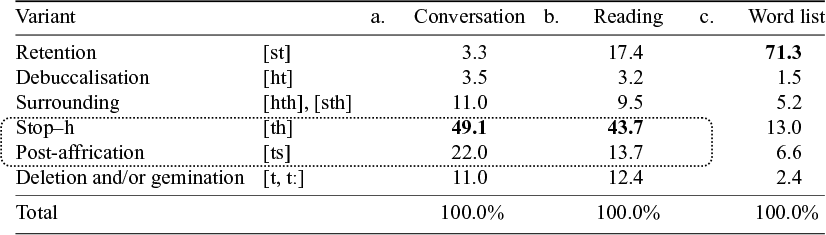
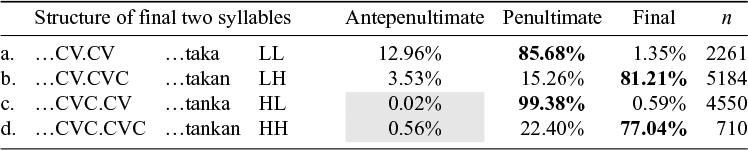
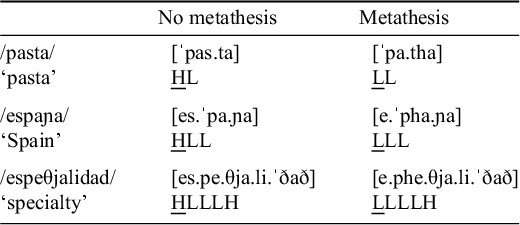

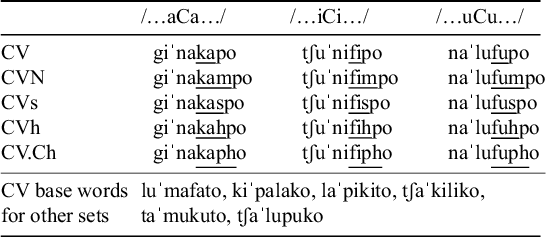
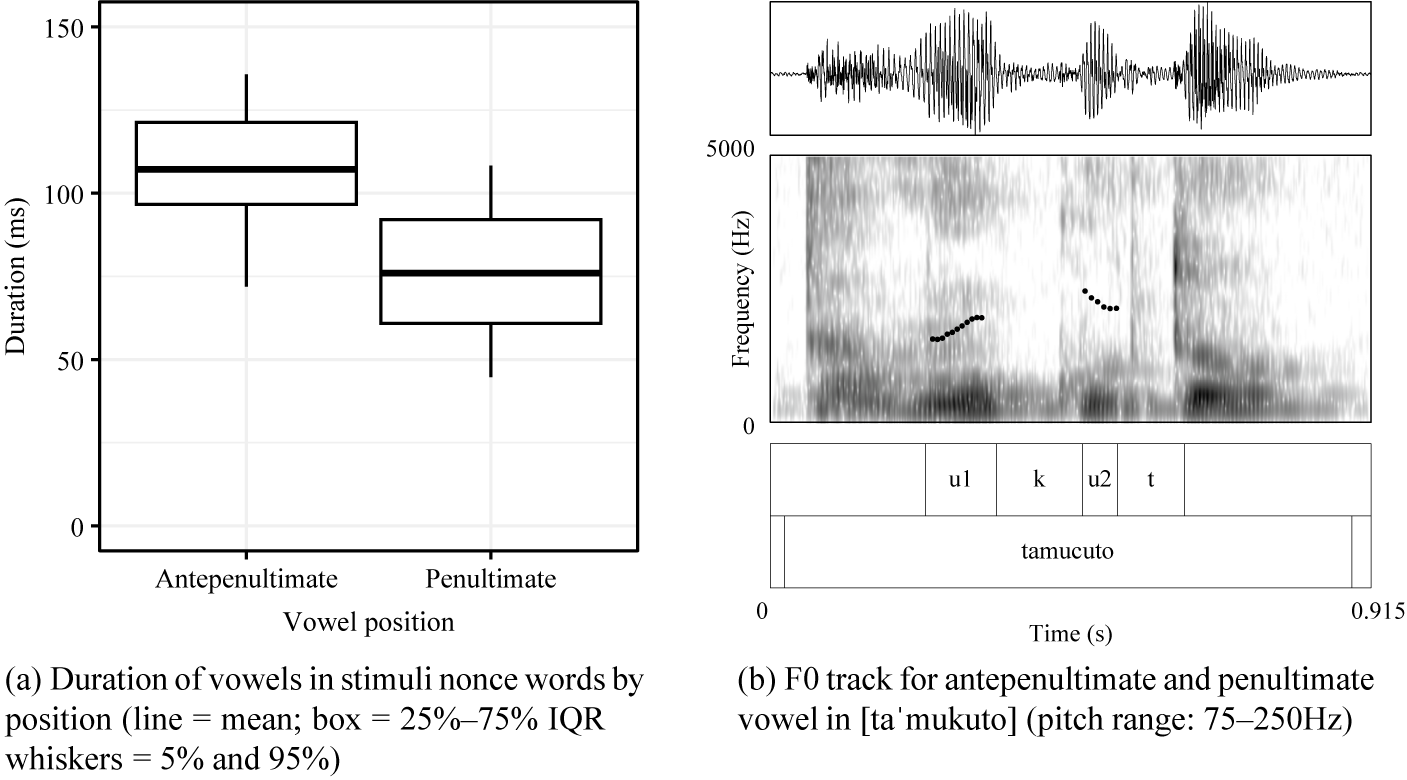
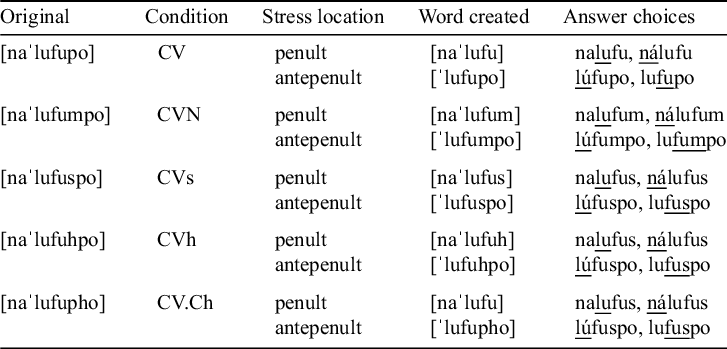
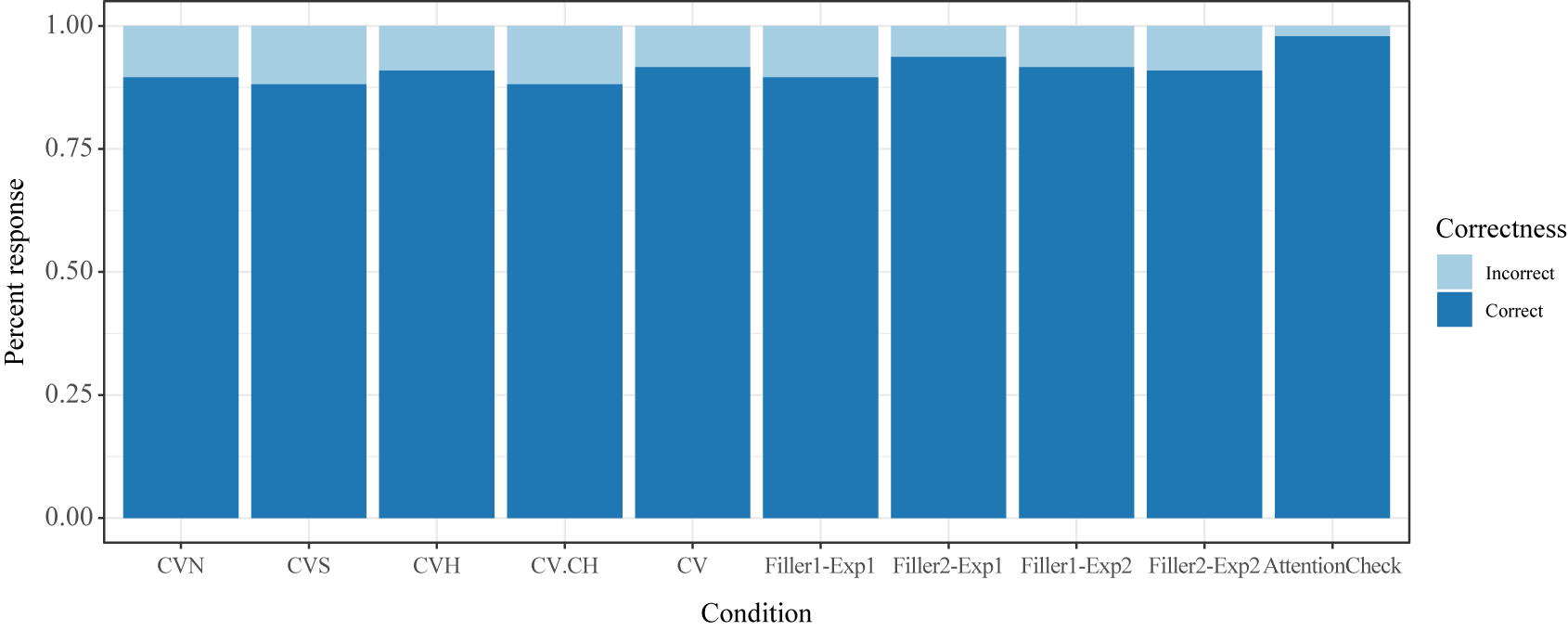
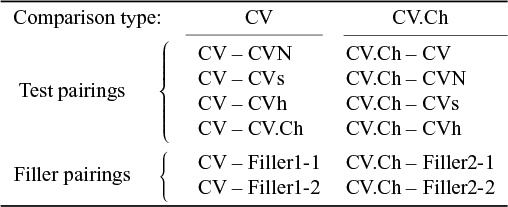
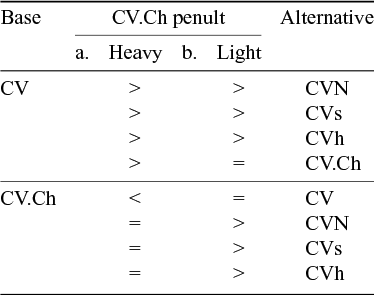
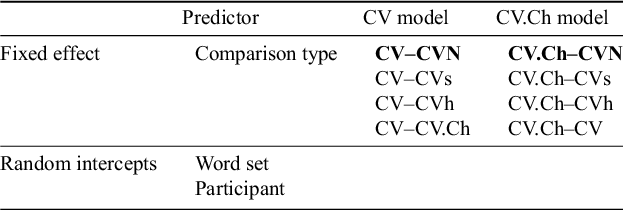
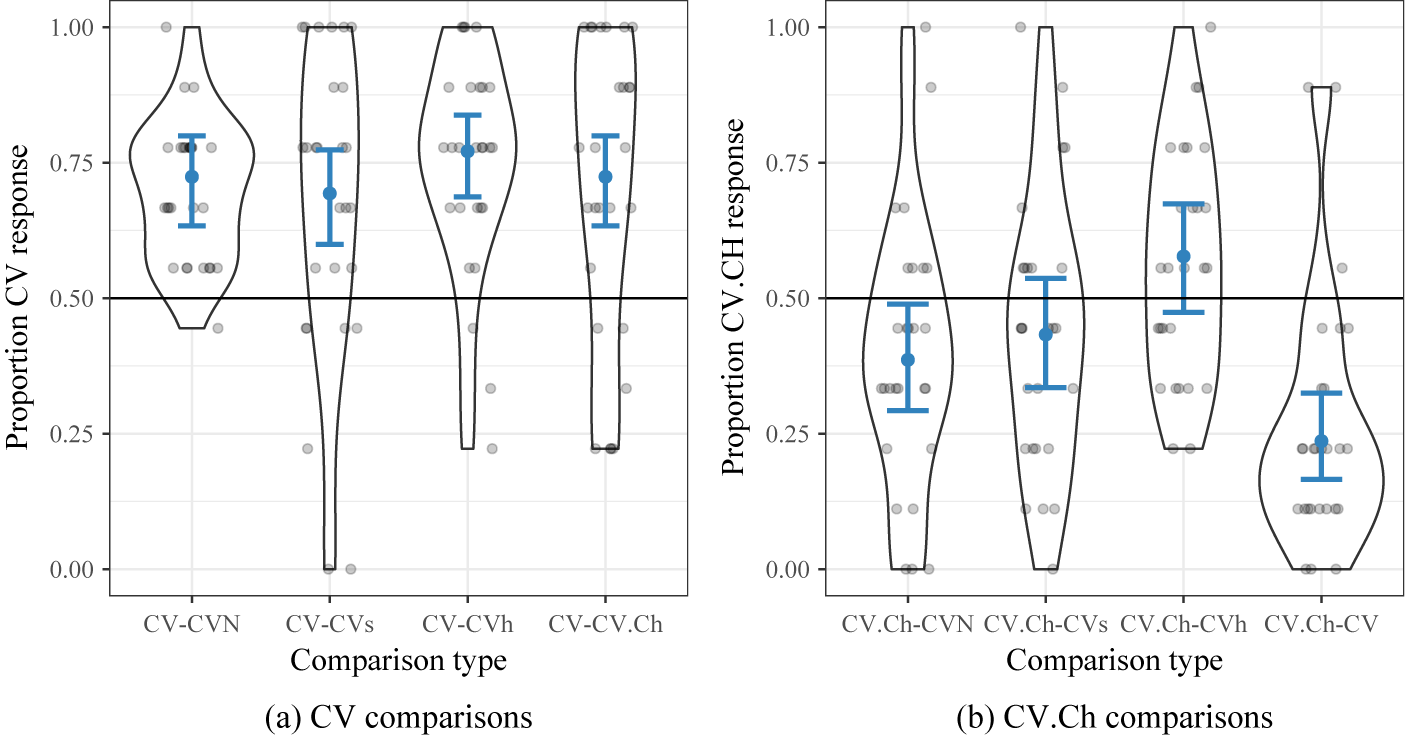
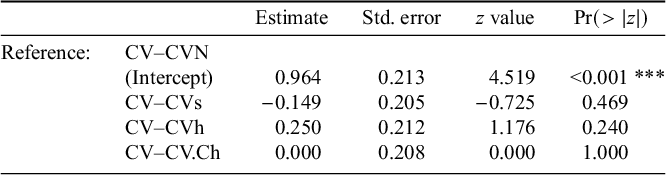
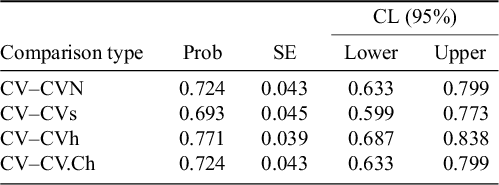
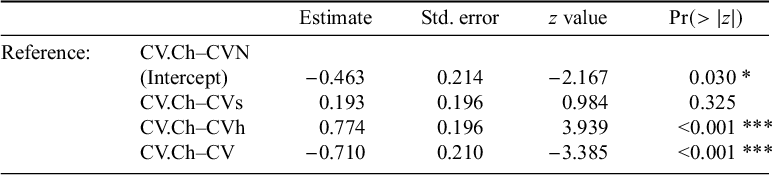
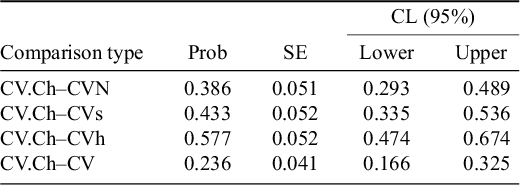
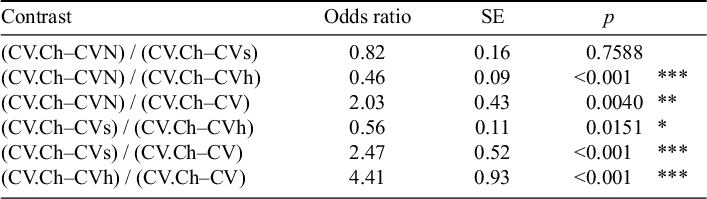
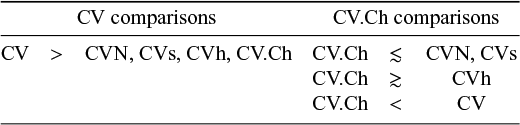
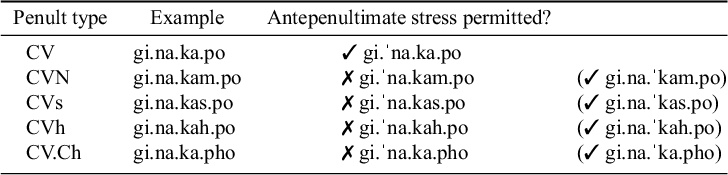


 Open access

