

1. Introduction
Let $X_0 = Y_1\cup _D Y_2$
be a projective surface that is the union of smooth surfaces
$X_0 = Y_1\cup _D Y_2$
be a projective surface that is the union of smooth surfaces $Y_i$
along a common smooth divisor
$Y_i$
along a common smooth divisor $D$
. In [Reference DonaldsonDon95, §§ 1 and 4], Donaldson raises the problem of constructing a good theory of stable sheaves on such an
$D$
. In [Reference DonaldsonDon95, §§ 1 and 4], Donaldson raises the problem of constructing a good theory of stable sheaves on such an $X_0$
with the following properties.
$X_0$
with the following properties.
-
I. It behaves well under smoothings. In other words, the numerical invariants of the theory on $X_0$
agree with the invariants of the usual moduli space of Gieseker-stable sheaves on a smoothing of
$X_0$
when those are defined.
$X_0$
agree with the invariants of the usual moduli space of Gieseker-stable sheaves on a smoothing of
$X_0$
when those are defined. -
II. It behaves well under decomposition. More precisely, there should be spaces of ‘relative stable sheaves’ for a pair
$(Y,D)$
of a smooth surface
$Y$
with a smooth divisor
$D$
such that the moduli space of sheaves on
$X_0$
can be related to the relative spaces for the pairs
$(Y_i,D)$
.


Such a theory would enable one to compute sheaf-theoretic invariants of projective surfaces through degenerations to a reducible surface. This has been successfully implemented in other settings, notably in the Gromov–Witten theory ([Reference LiLi01], [Reference LiLi02], [Reference Abramovich, Chen, Gross and SiebertACGS20], [Reference RanganathanRan22], [Reference Kim, Lho and RuddatKLR23]) and the Donaldson–Thomas theory (see, for example, [Reference Li and WuLW15], [Reference Maulik and RanganathanMR20]).
In this paper, we answer Donaldson’s questions for fibered surfaces. Let $f:X \to C$
be a surface fibered over a marked nodal curve (see Definition 1.6 for the precise meaning). Then we propose the following definition of ‘stability on the fiber’.
$f:X \to C$
be a surface fibered over a marked nodal curve (see Definition 1.6 for the precise meaning). Then we propose the following definition of ‘stability on the fiber’.
Definition 1.1 (Cf. Definition 3.1). A coherent sheaf $E$
on
$E$
on $X$
is
$X$
is $f$
-stable if it is torsion-free and:
$f$
-stable if it is torsion-free and:
-
(i) for every node or marked point
$x\in C$
, the restriction of
$E$
to
$f^{-1}(x)$
is a slope-stable vector bundle, and -
(ii) for every generic point
$\eta$
of an irreducible component of
$C$
, the restriction of
$E$
to
$f^{-1}(\eta )$
is slope stable.


Our first main result is that this notion of stability leads to well-behaved moduli spaces. This gives an answer to (I) for fibered surfaces.
Theorem 1.2 (Cf. Theorem3.25 and Proposition 4.4). Let $d$
and
$d$
and $r\gt 0$
be coprime integers. Let
$r\gt 0$
be coprime integers. Let $c_1\in H^2(X,{\mathbb{Z}})$
be a cohomology class with
$c_1\in H^2(X,{\mathbb{Z}})$
be a cohomology class with $c_1\cap f^{-1}(x) = d[pt]$
for any
$c_1\cap f^{-1}(x) = d[pt]$
for any $x\in C$
. Let
$x\in C$
. Let $\alpha$
be a generic stability condition on
$\alpha$
be a generic stability condition on $C$
and
$C$
and $L_0$
a line bundle on
$L_0$
a line bundle on $X$
of degree
$X$
of degree $d_0\gt 0$
on fibers. Then for any
$d_0\gt 0$
on fibers. Then for any $\Delta \in {\mathbb{Z}}$
, there exists a proper Deligne–Mumford moduli stack
$\Delta \in {\mathbb{Z}}$
, there exists a proper Deligne–Mumford moduli stack
 \begin{align*}M^{\alpha }_{X/C}(r,\overline {c_1},\Delta )\end{align*}
parametrizing $f$
-stable,
$f$
-stable, $\alpha$
-balanced sheaves of rank
$\alpha$
-balanced sheaves of rank $r$
and first Chern class
$r$
and first Chern class $c_1$
up to component twists and discriminant
$c_1$
up to component twists and discriminant $\Delta$
on expansions of
$\Delta$
on expansions of $X$
. Moreover, this stack has a natural virtual fundamental class and the numerical invariants are invariant under deformations of
$X$
. Moreover, this stack has a natural virtual fundamental class and the numerical invariants are invariant under deformations of $X$
together with the fibration and choice of
$X$
together with the fibration and choice of $c_1$
.
$c_1$
.
Here, we introduced two additional subtleties: expansions of a degenerate surface (cf. Definition 2.1) and balancing with respect to a choice of $L_0$
and a stability condition
$L_0$
and a stability condition $\alpha$
on a curve (cf. § 3.2).
$\alpha$
on a curve (cf. § 3.2).
Our construction automatically yields a notion of relative moduli space: putting markings $y_1,\ldots ,y_n$
on
$y_1,\ldots ,y_n$
on $C$
corresponds to working relative to the divisor
$C$
corresponds to working relative to the divisor $f^{-1}(y_1)\cup \cdots \cup f^{-1}(y_n)$
.
$f^{-1}(y_1)\cup \cdots \cup f^{-1}(y_n)$
.
Our second main result is a proof of II in the case that $X=Y_1\cup _F Y_2$
is a union of two irreducible components which meet along a fiber
$X=Y_1\cup _F Y_2$
is a union of two irreducible components which meet along a fiber $F$
of
$F$
of $f$
and so that we also have
$f$
and so that we also have $C = C_1\cup _x C_2$
. It provides a degeneration formula for Donaldson-type invariants on fibered surfaces, directly analogous to the established ones in the Gromov–Witten and Donaldson–Thomas theories in the case of double point degenerations. We state this result somewhat informally (see Theorem4.14 and Proposition 4.12 for more precise versions).
$C = C_1\cup _x C_2$
. It provides a degeneration formula for Donaldson-type invariants on fibered surfaces, directly analogous to the established ones in the Gromov–Witten and Donaldson–Thomas theories in the case of double point degenerations. We state this result somewhat informally (see Theorem4.14 and Proposition 4.12 for more precise versions).
Theorem 1.3.
The enumerative invariants of moduli spaces of $f$
-stable sheaves on
$f$
-stable sheaves on $X$
can be recovered from the relative invariants associated to the pairs
$X$
can be recovered from the relative invariants associated to the pairs $(Y_i, F)$
.
$(Y_i, F)$
.
For elliptic surfaces, the relative invariants can be determined from the absolute ones, which makes Theorem1.3 more powerful in practice. To illustrate this, we give an application to elliptic genera. For a proper scheme $M$
with perfect obstruction theory
$M$
with perfect obstruction theory $E_M$
, let
$E_M$
, let $T_M:=E_M^{\vee }$
denote the virtual tangent bundle. Let
$T_M:=E_M^{\vee }$
denote the virtual tangent bundle. Let $K^0(M)$
denote the Grothendieck
$K^0(M)$
denote the Grothendieck $K$
-group of perfect complexes in
$K$
-group of perfect complexes in $M$
, and let
$M$
, and let $y,q$
be formal variables. Define
$y,q$
be formal variables. Define
 \begin{align*}\mathcal{E}_{q,y}(M):=\bigotimes _{n\geqslant 0} \bigwedge \nolimits _{-y^{-1} q^n}T_M^{{{\rm vir}}} \otimes \bigotimes _{n\geqslant 1} \bigwedge \nolimits _{-yq}(T_M^{{{\rm vir}}})^{\vee } \otimes \bigotimes _{n\geqslant 1} \operatorname {Sym}_{q^n}\!\left (T_M^{{{\rm vir}}}\oplus (T_M^{{{\rm vir}}})^{\vee } \right )\!\in K^0(M)[y,y^{-1}][\![q]\!].\end{align*}
Then, set
 \begin{align*}{\textrm {Ell}}^{{{\rm vir}}}(M):= y^{-\frac {\operatorname {vdim} M}{2}}\int _{[M]^{{{\rm vir}}}} \textrm {ch}(\mathcal{E}_{q,y}(M)) \operatorname {td}(T_M^{{{\rm vir}}}).\end{align*}
This is the virtual elliptic genus as defined in [Reference Fantechi and GöttscheFG10]. In [Reference Göttsche and KoolGK19a], the authors predict an elegant formula for virtual elliptic genera of moduli spaces of sheaves on surfaces in the rank-two case. We also let $\phi _{0,1}(q,y)$
be the weak Jacobi form and
$\phi _{0,1}(q,y)$
be the weak Jacobi form and ${\bf L}(\phi _{0,1},p)$
its Borcherds lift as presented in [Reference Göttsche and KoolGK19a]. We recall that if
${\bf L}(\phi _{0,1},p)$
its Borcherds lift as presented in [Reference Göttsche and KoolGK19a]. We recall that if $f:X\to \mathbb{P}^1$
is an elliptic surface, its degree is the degree of the line bundle
$f:X\to \mathbb{P}^1$
is an elliptic surface, its degree is the degree of the line bundle $(R^1f_*\mathcal{O}_X)^{\vee }$
.
$(R^1f_*\mathcal{O}_X)^{\vee }$
.
Theorem 1.4.
Let $X$
be a degree
$X$
be a degree $e\geqslant 2$
elliptic surface over
$e\geqslant 2$
elliptic surface over $\mathbb{P}^1$
without multiple or reducible fibers. Let
$\mathbb{P}^1$
without multiple or reducible fibers. Let $d\geqslant 1$
be minimal so that
$d\geqslant 1$
be minimal so that $X$
has a
$X$
has a $d$
-section with divisor class
$d$
-section with divisor class $D$
. Let
$D$
. Let $H$
be an ample line bundle on
$H$
be an ample line bundle on $X$
and
$X$
and $[F]$
the cohomology class of a fiber. Let
$[F]$
the cohomology class of a fiber. Let $M_{X,H}(r, D,\Delta )$
denote the moduli space of
$M_{X,H}(r, D,\Delta )$
denote the moduli space of $H$
-Gieseker-stable sheaves on
$H$
-Gieseker-stable sheaves on $X$
of rank
$X$
of rank $r\gt 0$
, first Chern class
$r\gt 0$
, first Chern class $D$
and discriminant
$D$
and discriminant $\Delta$
. Assume that
$\Delta$
. Assume that $d$
is coprime to
$d$
is coprime to $r$
and that
$r$
and that $H$
is chosen so that stability equals semistability for sheaves of rank
$H$
is chosen so that stability equals semistability for sheaves of rank $r$
and first Chern class
$r$
and first Chern class $c_1$
, and all
$c_1$
, and all $\Delta$
. Consider the generating series
$\Delta$
. Consider the generating series
 \begin{align*}Z^{{\textrm {Ell}}}_{X,r,c_1}(p):= \sum _{\substack {\Delta \in {\mathbb{Z}} \\ 0\leqslant \ell \lt r}} {\textrm {Ell}}^{{{\rm vir}}}(M_{X,H}(r,c_1+\ell [F] ,\Delta ))\, p^{\dim M_{X,H}(r,c_1+\ell [F] ,\Delta )}.\end{align*}
Then,
 \begin{align*}Z^{{\textrm {Ell}}}_{X,r,c_1}(p) = \sum _{n\geqslant 0} {\textrm {Ell}}(\operatorname {Hilb}_n(X))\, p^{2n} = \left (\frac {1}{{\bf L}(\phi _{0,1},p^2)}\right )^{\chi (\mathcal{O}_X)}.\end{align*}
In the case $e=2$
, the surface
$e=2$
, the surface $X$
is a K3 surface and the statement reduces to the rank-one case, which was stated in [Reference Dijkgraaf, Moore, Verlinde and VerlindeDMVV97] and has been proven in [Reference Borisov and LibgoberBL03], [Reference Borisov and LibgoberBL05].
$X$
is a K3 surface and the statement reduces to the rank-one case, which was stated in [Reference Dijkgraaf, Moore, Verlinde and VerlindeDMVV97] and has been proven in [Reference Borisov and LibgoberBL03], [Reference Borisov and LibgoberBL05].
Remark 1.5. The proof of Theorem 1.4 goes through with ‘virtual elliptic genus’ replaced by ‘virtual cobordism‘ to give
 \begin{align*}Z^{\operatorname {cob}}_{X,r,c_1}(p) = \left (\sum _{n\geqslant 0}[K3^{[n]}] p^{2n}\right )^{\chi (\mathcal{O}_X)/2},\end{align*}
where the possible half-integer power is chosen to have constant coefficient one. In particular, this answers Göttsche and Kool’s Conjecture 7.7 in [Reference Göttsche and KoolGK19a] affirmatively for this class of elliptic surfaces.
1.1. Background
Our approach is inspired by earlier constructions of Gieseker–Li [Reference Gieseker and LiGL94] and Li [Reference LiLi03], [Reference LiLi18]. They consider moduli spaces of Simpson semistable sheaves on expansions of a degenerate surface $X_0$
. Under good conditions, this does result in moduli spaces which behave well under deformations and carry a virtual fundamental class. However, their approach does not lead to a degeneration formula, since it is unclear how to relate the moduli space of sheaves on the degeneration with the relative spaces for the pairs
$X_0$
. Under good conditions, this does result in moduli spaces which behave well under deformations and carry a virtual fundamental class. However, their approach does not lead to a degeneration formula, since it is unclear how to relate the moduli space of sheaves on the degeneration with the relative spaces for the pairs $(Y_i,D)$
. The problem is that Simpson stability of a sheaf on
$(Y_i,D)$
. The problem is that Simpson stability of a sheaf on $X_0$
cannot be determined by looking only at its restrictions to the
$X_0$
cannot be determined by looking only at its restrictions to the $Y_i$
, but also depends on how the sheaves are glued in a subtle manner.
$Y_i$
, but also depends on how the sheaves are glued in a subtle manner.
By restricting to fibered surfaces, we get around this issue. The notion of $f$
-stability is defined in terms of restriction on fibers, which can be checked on each component separately. The use of expansions is crucial for us; as in [Reference Gieseker and LiGL94], it allows us to work only with sheaves that are locally free along the singular locus of
$f$
-stability is defined in terms of restriction on fibers, which can be checked on each component separately. The use of expansions is crucial for us; as in [Reference Gieseker and LiGL94], it allows us to work only with sheaves that are locally free along the singular locus of $X_0$
. Just as importantly, we can guarantee stability on the fibers over marked points and nodes, which gives us restriction maps to the moduli spaces of stable vector bundles on curves. This is central to the decomposition result of Theorem1.3.
$X_0$
. Just as importantly, we can guarantee stability on the fibers over marked points and nodes, which gives us restriction maps to the moduli spaces of stable vector bundles on curves. This is central to the decomposition result of Theorem1.3.
Since $f$
-stability on
$f$
-stability on $X\to C$
is unchanged with respect to tensoring by a line bundle pulled back from
$X\to C$
is unchanged with respect to tensoring by a line bundle pulled back from $C$
, the moduli space of
$C$
, the moduli space of $f$
-stable sheaves will not be separated in families when
$f$
-stable sheaves will not be separated in families when $C$
degenerates from a smooth to a reducible curve, since the Picard scheme of
$C$
degenerates from a smooth to a reducible curve, since the Picard scheme of $C$
is not separated. Essentially, the issue is that in a one-parameter family of curves, the limit of the trivial line bundle does not need to be trivial, since one can twist by components of the special fiber. To deal with this issue, we need to restrict the possible twists of an
$C$
is not separated. Essentially, the issue is that in a one-parameter family of curves, the limit of the trivial line bundle does not need to be trivial, since one can twist by components of the special fiber. To deal with this issue, we need to restrict the possible twists of an $f$
-stable sheaf. This is achieved by picking a stability condition
$f$
-stable sheaf. This is achieved by picking a stability condition $\alpha$
on
$\alpha$
on $C$
when the base curve becomes reducible and demanding a certain numerical balancing condition which singles out a unique choice of twist.
$C$
when the base curve becomes reducible and demanding a certain numerical balancing condition which singles out a unique choice of twist.
Although $f$
-stability at first seems unrelated to Gieseker or slope stability, it turns out that these notions agree on a smooth fibered surface when one considers the latter with respect to a suitable choice of polarization. This is already present in the work of Yoshioka and is included here as Theorem2.24. Moreover, due to results of Mochizuki [Reference MochizukiMoc09], for surfaces with
$f$
-stability at first seems unrelated to Gieseker or slope stability, it turns out that these notions agree on a smooth fibered surface when one considers the latter with respect to a suitable choice of polarization. This is already present in the work of Yoshioka and is included here as Theorem2.24. Moreover, due to results of Mochizuki [Reference MochizukiMoc09], for surfaces with $p_g(X)\gt 0$
, virtual enumerative invariants are independent of choice of polarization whenever stability equals semistability. Thus, for such surfaces, there is no loss of generality in considering
$p_g(X)\gt 0$
, virtual enumerative invariants are independent of choice of polarization whenever stability equals semistability. Thus, for such surfaces, there is no loss of generality in considering $f$
-stability for the computation of invariants.
$f$
-stability for the computation of invariants.
In the case that the surface $X = F\times C$
is a product of a smooth curve
$X = F\times C$
is a product of a smooth curve $F$
and a marked nodal curve
$F$
and a marked nodal curve $C$
, an
$C$
, an $f$
-stable sheaf over an expansion of
$f$
-stable sheaf over an expansion of $C$
is the same thing as a prestable quasi-map [Reference t Ciocan-Fontanine, Kim and MaulikCFKM14] from
$C$
is the same thing as a prestable quasi-map [Reference t Ciocan-Fontanine, Kim and MaulikCFKM14] from $C$
into the moduli space of stable sheaves on
$C$
into the moduli space of stable sheaves on $F$
. Hence, in this situation, our space
$F$
. Hence, in this situation, our space $M^{\alpha }_{X/C}(r,c_1,\Delta )$
is related to a space of quasi-maps. If
$M^{\alpha }_{X/C}(r,c_1,\Delta )$
is related to a space of quasi-maps. If $C$
is stable and of compact type, we expect that this identifies
$C$
is stable and of compact type, we expect that this identifies $M^{\alpha }_{X/C}$
with a product of the space of zero-stable quasi-maps whose domain curve is an expansion of
$M^{\alpha }_{X/C}$
with a product of the space of zero-stable quasi-maps whose domain curve is an expansion of $C$
and a component of the Jacobian of
$C$
and a component of the Jacobian of $C$
. If
$C$
. If $C$
is not of compact type, the situation is more subtle and one needs to consider a compactified Jacobian of
$C$
is not of compact type, the situation is more subtle and one needs to consider a compactified Jacobian of $C$
. The study of sheaves via quasi-map spaces has been succesfully pursued in [Reference NesterovNes24].
$C$
. The study of sheaves via quasi-map spaces has been succesfully pursued in [Reference NesterovNes24].
1.2. Structure of the paper
In § 3, we introduce the definitions and constructions that go into Theorem1.2. Since we work over a general base $B$
, we automatically obtain deformation invariance.
$B$
, we automatically obtain deformation invariance.
In § 4, we show the decomposition in the situation of Theorem1.3. We include the proof of Theorem1.4 in § 4.7.
In § 2, we collect some material that is needed for the main constructions in the later sections. For a first reading, we suggest only taking a look at Definition 2.1 and Lemma 2.2 in § 2.1, and otherwise to refer back to this section as needed.
1.3. Relation to other work
Since the modern mathematical definition of Vafa–Witten invariants on algebraic surfaces by Tanaka and Thomas ([Reference Tanaka and ThomasTT20], [Reference Tanaka and ThomasTT17]), there has been renewed interest in the enumerative geometry of moduli spaces of sheaves on surfaces. Göttsche and Kool, in a series of works, developed many conjectures for the structure of such invariants (see [Reference Göttsche and KoolGK19b] for an excellent overview). However, beyond the cases of Hilbert schemes and special classes of surfaces such as rational, elliptic or K3 surfaces, very little is known. Notable exceptions are results on Donaldson invariants ([Reference Göttsche, Nakajima and YoshiokaGNY08], [Reference Göttsche, Nakajima and YoshiokaGNY11]) and blowup formulas ([Reference Kuhn and TanakaKT21], [Reference Kuhn, Leigh and TanakaKLT22]).
Recently, Dominic Joyce has announced results regarding deep structure theorems for enumerative invariants of surfaces with $p_g\gt 0$
, building on his theory of wall-crossing in abelian categories and his version of Mochizuki’s rank-reduction algorithm [Reference JoyceJoy21]. His result shows that the generating series of invariants are determined in terms of a number of universal power series and universal constants, and of finitely many fundamental enumerative invariants of the surface (its Seiberg–Witten invariants). It would be interesting to investigate whether there exists a connection between his universal series and the degeneration formula of the present paper.
$p_g\gt 0$
, building on his theory of wall-crossing in abelian categories and his version of Mochizuki’s rank-reduction algorithm [Reference JoyceJoy21]. His result shows that the generating series of invariants are determined in terms of a number of universal power series and universal constants, and of finitely many fundamental enumerative invariants of the surface (its Seiberg–Witten invariants). It would be interesting to investigate whether there exists a connection between his universal series and the degeneration formula of the present paper.
For rank-one sheaves, our results reduce to a theory of Hilbert schemes on degenerations, which is treated in [Reference Li and WuLW15] in the case of a smooth singular locus and was later generalized to arbitrary normal crossings degenerations in [Reference Maulik and RanganathanMR20].
1.4. Further directions
One problem that is not addressed here is to generalize the results of § 4 to the case of a non-separating node, i.e. given a fibered surface $X\to C$
and a non-separating node
$X\to C$
and a non-separating node $x$
of
$x$
of $C$
, to describe the enumerative invariants for the moduli space of
$C$
, to describe the enumerative invariants for the moduli space of $f$
-stable sheaves on
$f$
-stable sheaves on $X\to C$
in terms of those on
$X\to C$
in terms of those on $X'\to C'$
, where
$X'\to C'$
, where $C'\to C$
is the partial normalization of
$C'\to C$
is the partial normalization of $C$
at
$C$
at $x$
, and
$x$
, and $X'=X\times _C C'$
. This should be possible, but it requires a closer analysis of the combinatorics of the Picard scheme of
$X'=X\times _C C'$
. This should be possible, but it requires a closer analysis of the combinatorics of the Picard scheme of $C$
. An application of this, suggested by Jørgen Rennemo, would be to obtain a
$C$
. An application of this, suggested by Jørgen Rennemo, would be to obtain a $(1+1)$
-dimensional cohomological field theory by considering surfaces of the form
$(1+1)$
-dimensional cohomological field theory by considering surfaces of the form $F\times C \to C$
, where
$F\times C \to C$
, where $F$
is kept fixed and
$F$
is kept fixed and $C$
is an arbitrary marked nodal curve.
$C$
is an arbitrary marked nodal curve.
In another direction, the constructions here should generalize beyond the case of surfaces, which we mostly require to obtain a good enumerative theory. We expect that the same methods generalize to give, for example, degeneration formulas for fibered Fano and Calabi–Yau threefolds. We thank Richard Thomas for pointing this out to us.
1.5. Notations and conventions
-
– All schemes and stacks we consider will be locally Noetherian over
$\mathbb{C}$
. -
– By a curve over a base
$B$
, we mean a flat and finite type separated algebraic space over
$B$
with one-dimensional fibers. We drop reference to the base when
$B=\textrm {Spec}\,{\mathbb{C}}$
. -
– By a marked nodal curve over
$B$
we mean a curve over
$B$
with at worst nodal singularities and a finite number of sections which are disjoint and do not meet the singularities. Here, by ‘at worst nodal’, we mean étale locally of the form
$Z(xy-f)\subseteq B\times {\mathbb{A}}^2$
, where
$x,y$
are standard coordinates on
${\mathbb{A}}^2$
and
$f$
is a function on
$B$
. -
– Unless noted otherwise, we will assume all curves to be proper over the base and to have geometrically connected fibers.
-
– For (numerical) divisor classes
$D_1,D_2$
on a proper algebraic surface
$X$
, and more generally for classes in the second cohomology of
$X$
, we denote by
$(D_1,D_2) \in \mathbb{Q}$
their intersection product. -
– We will often indicate the base (resp., base changes) of a family of curves or surfaces simply by a subscript (resp., by the change thereof).
-
– We repeatedly use the uniqueness part of the valuative criterion and the existence part of the valuative criterion in the terminology of [Sta23, Definition 0CLG and Definition 0CLK] for morphisms of algebraic stacks. Since we are in the locally Noetherian case, we will consider only discrete valuation rings (DVRs) and finite field extensions in the valuative criteria, which is justified by [Sta23, Lemma 0E80 and Lemma 0CQM].
-
– We use
$A_*(Y)$
to denote the Chow groups of a finite-type algebraic stack
$Y$
in the sense of [Reference KreschKre99]. -
– We will sometimes work with Chow cycles on stacks
$Y$
which are only locally finite type and with projective pushforwards
$Z\to Y$
between them; here we always implicitly restrict to some suitably large quasi-compact open subset of
$Y$
(and to its preimage in
$Z$
in the case of pushforward). As in [Reference Bae and SchmittBS22, Appendix A], one can also define Chow groups in this case as a projective limit over all quasi-compact open substacks, although this will not be needed for us.





In this paper, we will use the following definition of a fibered surface.
Definition 1.6. We say $f:X\to C$
is a fibered surface if
$f:X\to C$
is a fibered surface if $C$
is a marked nodal curve and:
$C$
is a marked nodal curve and:
-
(i)
$f$
is flat and proper of dimension one with geometrically connected fibers, -
(ii)
$f$
is smooth over the nodes and marked points of
$C$
, -
(iii) for every irreducible component
$D\subseteq C$
, the scheme-theoretic preimage
$f^{-1}(D)\subseteq X$
is a smooth projective surface.


We say $f:X_B \to C_B$
is a family of fibered surfaces over a base
$f:X_B \to C_B$
is a family of fibered surfaces over a base $B$
if
$B$
if $C_B$
is a marked nodal curve over
$C_B$
is a marked nodal curve over $B$
and
$B$
and $f$
is flat and proper such that
$f$
is flat and proper such that $X_b\to C_b$
is a fibered surface for every geometric point
$X_b\to C_b$
is a fibered surface for every geometric point $b$
of
$b$
of $B$
.
$B$
.
2. Preliminaries
2.1 Expansions and expanded degenerations
We define what we mean by a family of expansions of marked nodal curves and show some basic properties. Let $(C_B,\sigma _1,\ldots ,\sigma _n)$
be a flat family of marked nodal curves over a base
$(C_B,\sigma _1,\ldots ,\sigma _n)$
be a flat family of marked nodal curves over a base $B$
. In this subsection we do not assume curves to be proper or geometrically connected.
$B$
. In this subsection we do not assume curves to be proper or geometrically connected.
Definition 2.1. Let $T$
be a scheme. A family of expansions of
$T$
be a scheme. A family of expansions of $C_B$
over
$C_B$
over $B$
parametrized by
$B$
parametrized by $T$
is given by a morphism
$T$
is given by a morphism $b:T\to B$
, a flat family of marked nodal curves
$b:T\to B$
, a flat family of marked nodal curves $(\widetilde {C}_T,\widetilde {\sigma }_1,\ldots ,\widetilde {\sigma }_n)$
over
$(\widetilde {C}_T,\widetilde {\sigma }_1,\ldots ,\widetilde {\sigma }_n)$
over $T$
and a proper morphism of marked curves
$T$
and a proper morphism of marked curves $c:\widetilde {C}_T \to C_T$
such that:
$c:\widetilde {C}_T \to C_T$
such that:
-
(i) the natural map
$\mathcal{O}_{C_T}\to Rc_*\mathcal{O}_{\widetilde {C}_T}$
is an isomorphism, -
(ii) for each
$t\in T$
, we have a fiberwise isomorphism of twisted dualizing sheaves
$c^*\omega _{C_t}(\sigma _1+\cdots +\sigma _n) \equiv \omega _{\widetilde {C}_t}(\widetilde {\sigma }_1+\cdots +\widetilde {\sigma }_n)$
.



We let ${\textrm {Exp}}_{C/B}$
denote the stack parametrizing expansions over
${\textrm {Exp}}_{C/B}$
denote the stack parametrizing expansions over $B$
.
$B$
.
One can give an alternative more explicit characterization, as in the following lemma.
Lemma 2.2.
Let $\widetilde {C}_T$
and
$\widetilde {C}_T$
and $C_T$
be flat families of marked nodal curves over a base
$C_T$
be flat families of marked nodal curves over a base $T$
and let
$T$
and let $c:\widetilde {C}_T\to C_T$
be a morphism of marked curves over
$c:\widetilde {C}_T\to C_T$
be a morphism of marked curves over $B$
. Then condition (i) of Definition 2.1 is equivalent to i’) below.
$B$
. Then condition (i) of Definition 2.1 is equivalent to i’) below.
-
(i’) The locus
$\Sigma _c\subset C_T$
where the map
$c$
is not an isomorphism is quasi-finite over
$T$
. For each
$x \in \Sigma _c$
, the scheme-theoretic fiber
$c^{-1}(x)$
is a connected nodal curve of arithmetic genus zero.


Assuming this condition holds, then ii) of Definition 2.1 is equivalent to (ii’) below.
-
(ii’’) If
$x\in \Sigma _c$
is lying over
$y\in T$
, then
$x$
is either a node or a marked point in the fiber
$C_y\subset C_T$
and
$c^{-1}(x)$
is a chain of rational curves
$R_1\cup \cdots \cup R_j$
containing two distinguished points of
$\widetilde {C}_y$
, one of which lies on
$R_1$
and one on
$R_j$
(these are two nodes if
$x$
is a node, or one node and one marked point if
$x$
is a marked point).





Proof. We first address the first part. By properness, $c$
is finite over the locus where
$c$
is finite over the locus where $c$
has zero-dimensional fibers. Then condition (i) holds over this locus if and only if
$c$
has zero-dimensional fibers. Then condition (i) holds over this locus if and only if $c$
is an isomorphism there. Now let
$c$
is an isomorphism there. Now let $x\in C_T$
be a point where
$x\in C_T$
be a point where $c$
has a one-dimensional fiber. It follows that
$c$
has a one-dimensional fiber. It follows that $c$
has to be a contraction of components. Since formation of
$c$
has to be a contraction of components. Since formation of $R^1c_*$
commutes with base change, the vanishing of
$R^1c_*$
commutes with base change, the vanishing of $R^1c_*\mathcal{O}_{\widetilde {C}}$
around
$R^1c_*\mathcal{O}_{\widetilde {C}}$
around $x$
is equivalent to
$x$
is equivalent to $c^{-1}(x)$
being of arithmetic genus zero.
$c^{-1}(x)$
being of arithmetic genus zero.
We now address the second part. Assume (i) and (i’) hold. If (ii) holds, then the twisted dualizing sheaf must be trivial on any components contracted by $c$
. We already know each such component is rational, so they must have precisely two distinguished points. Since
$c$
. We already know each such component is rational, so they must have precisely two distinguished points. Since $c^{-1}(x)$
has arithmetic genus zero, its components must be arranged as a chain
$c^{-1}(x)$
has arithmetic genus zero, its components must be arranged as a chain $R_1\cup \cdots \cup R_j$
. The distinguished points on the end of the chain must come from intersection with a remaining component of
$R_1\cup \cdots \cup R_j$
. The distinguished points on the end of the chain must come from intersection with a remaining component of $\widetilde {C}$
or from marked points. If there is a marked point on
$\widetilde {C}$
or from marked points. If there is a marked point on $c^{-1}(x)$
, it must map to a marked point of
$c^{-1}(x)$
, it must map to a marked point of $C$
(in particular, there can be only one). Otherwise, we must have that
$C$
(in particular, there can be only one). Otherwise, we must have that $c^{-1}(x)$
intersects the closure of
$c^{-1}(x)$
intersects the closure of $\widetilde {C}_y\setminus c^{-1}(x)$
at two points, lying on components
$\widetilde {C}_y\setminus c^{-1}(x)$
at two points, lying on components $S_0,S_1$
(which might coincide) of
$S_0,S_1$
(which might coincide) of $\widetilde {C}_y$
not inside
$\widetilde {C}_y$
not inside $c^{-1}(x)$
. Since
$c^{-1}(x)$
. Since $c$
is an isomorphism over a punctured étale neighborhood of
$c$
is an isomorphism over a punctured étale neighborhood of $x$
, we must have a node at
$x$
, we must have a node at $x$
with
$x$
with $S_0,S_1$
mapping to the two branches.
$S_0,S_1$
mapping to the two branches.
Conversely, assume that (ii’) holds. Then use the following standard characterization of the dualizing sheaf $\omega _C$
of a nodal curve
$\omega _C$
of a nodal curve $C$
: a section of
$C$
: a section of $\omega _C$
is the same as a meromorphic section of the sheaf of differentials of the normalization
$\omega _C$
is the same as a meromorphic section of the sheaf of differentials of the normalization $C^{\nu }$
with at most simple poles at the preimages of nodes of
$C^{\nu }$
with at most simple poles at the preimages of nodes of $C$
and such that for a node
$C$
and such that for a node $x\in C$
, the residues at the two preimages of
$x\in C$
, the residues at the two preimages of $x$
in
$x$
in $C^{\nu }$
add to zero. Now, say
$C^{\nu }$
add to zero. Now, say $x\in \Sigma _c$
is a node. Then, working locally around
$x\in \Sigma _c$
is a node. Then, working locally around $x$
, we may assume that
$x$
, we may assume that $\tilde {C}_y^{\nu } = C_y^{\nu }\coprod R_1 \coprod \cdots \coprod R_j$
. We define a map
$\tilde {C}_y^{\nu } = C_y^{\nu }\coprod R_1 \coprod \cdots \coprod R_j$
. We define a map $c^*\omega _{C_y}\to \omega _{\tilde {C}_y}$
by sending a section of
$c^*\omega _{C_y}\to \omega _{\tilde {C}_y}$
by sending a section of $\omega _{C_y}$
to the unique section of
$\omega _{C_y}$
to the unique section of $\omega _{\widetilde {C}_y}$
with the same value on
$\omega _{\widetilde {C}_y}$
with the same value on $C_y^{\nu }$
. This uses that
$C_y^{\nu }$
. This uses that $R_i\simeq \mathbb{P}^1$
and that for any two points
$R_i\simeq \mathbb{P}^1$
and that for any two points $z_1,z_2$
on
$z_1,z_2$
on $\mathbb{P}^1$
, there is a unique section of
$\mathbb{P}^1$
, there is a unique section of $\Omega _{\mathbb{P}^1}(z_1 + z_2)$
with prescribed residue
$\Omega _{\mathbb{P}^1}(z_1 + z_2)$
with prescribed residue $r$
at
$r$
at $z_1$
(and which then has residue
$z_1$
(and which then has residue $-r$
at
$-r$
at $z_2$
). The resulting map
$z_2$
). The resulting map $c^*\omega _{C_y}\to \omega _{\tilde {C}_y}$
sends a nowhere-vanishing section of
$c^*\omega _{C_y}\to \omega _{\tilde {C}_y}$
sends a nowhere-vanishing section of $\omega _{C_y}$
to one of
$\omega _{C_y}$
to one of $\omega _{\tilde {C}_y}$
and hence defines an isomorphism. In the case of
$\omega _{\tilde {C}_y}$
and hence defines an isomorphism. In the case of $x$
being a marked point, one proceeds analogously.
$x$
being a marked point, one proceeds analogously.
Lemma 2.3.
Let $\widetilde {C}_T$
and
$\widetilde {C}_T$
and $C_T$
be flat and proper families of nodal marked curves over a base
$C_T$
be flat and proper families of nodal marked curves over a base $T$
, and let
$T$
, and let $c:\widetilde {C}_T\to C_T$
be a morphism of marked curves over
$c:\widetilde {C}_T\to C_T$
be a morphism of marked curves over $T$
. Then condition (i) of Definition 2.1 is an open condition. On the locus where (i) holds, condition (ii) is an open condition.
$T$
. Then condition (i) of Definition 2.1 is an open condition. On the locus where (i) holds, condition (ii) is an open condition.
Proof. Openness of (i) follows from Tor-independent cohomology and base change [Sta23, Lemma 08IB], using that $\tilde {C}_T$
and
$\tilde {C}_T$
and $C_T$
are flat over
$C_T$
are flat over $T$
, and from the fact that the support of a coherent sheaf is closed and commutes with any base change. Now assume that (i) holds for
$T$
, and from the fact that the support of a coherent sheaf is closed and commutes with any base change. Now assume that (i) holds for $c$
. Then condition (ii’) is equivalent to the vanishing of
$c$
. Then condition (ii’) is equivalent to the vanishing of $R^1c_*(\omega _{\widetilde {C}_B/B}(\sigma _1'+\ldots + \sigma _n'))^{\otimes 2 }$
, which is open on the base, since the formations of
$R^1c_*(\omega _{\widetilde {C}_B/B}(\sigma _1'+\ldots + \sigma _n'))^{\otimes 2 }$
, which is open on the base, since the formations of $\omega _{\widetilde {C}_B/B}$
, of
$\omega _{\widetilde {C}_B/B}$
, of $R^1c_*$
and of the support of a coherent sheaf all commute with base change in
$R^1c_*$
and of the support of a coherent sheaf all commute with base change in $B$
.
$B$
.
The following should be true without the assumption of properness, but we consider only that case for simplicity.
Proposition 2.4.
Let $C_B\to B$
be a flat and proper family of nodal marked curves. The stack of expansions
$C_B\to B$
be a flat and proper family of nodal marked curves. The stack of expansions ${\textrm {Exp}}_{C_B/B}\to B$
is algebraic. It is locally of finite presentation and flat over
${\textrm {Exp}}_{C_B/B}\to B$
is algebraic. It is locally of finite presentation and flat over $B$
of pure dimension zero.
$B$
of pure dimension zero.
The following basic lemma lets us study expansions of curves locally on the curve.
Lemma 2.5.
Let $C_B,C_B'$
be flat families of marked nodal curves over
$C_B,C_B'$
be flat families of marked nodal curves over $B$
and suppose that we have an étale morphism
$B$
and suppose that we have an étale morphism $\gamma :C_B'\to C_B$
over
$\gamma :C_B'\to C_B$
over $B$
that induces isomorphisms of the singular and the marked loci. Then pullback along
$B$
that induces isomorphisms of the singular and the marked loci. Then pullback along $\gamma$
induces an isomorphism
$\gamma$
induces an isomorphism ${\textrm {Exp}}_{C_B/B}\to {\textrm {Exp}}_{C_B'/B}$
.
${\textrm {Exp}}_{C_B/B}\to {\textrm {Exp}}_{C_B'/B}$
.
Proof. We construct a quasi-inverse using flat descent for algebraic spaces (e.g. [Sta23, Lemma 0ADV]). For this, we may assume that $C_B'\to C_B$
is surjective by replacing
$C_B'\to C_B$
is surjective by replacing $C_B'$
with
$C_B'$
with $C_B'\coprod C_B^{\circ }$
, where
$C_B'\coprod C_B^{\circ }$
, where $C_B^{\circ }\subseteq C_B$
denotes the open subset obtained by removing the nodes and marked points (this leaves our assumptions as well as
$C_B^{\circ }\subseteq C_B$
denotes the open subset obtained by removing the nodes and marked points (this leaves our assumptions as well as ${\textrm {Exp}}_{C_B'/B}$
unchanged). Let
${\textrm {Exp}}_{C_B'/B}$
unchanged). Let $T$
be a test scheme over
$T$
be a test scheme over $B$
, and let
$B$
, and let $\tilde {C}'_T\to C'_T$
be an expansion. Let
$\tilde {C}'_T\to C'_T$
be an expansion. Let $C''_T := C'_T\times _{C_T} C_T'$
. Then the diagonal map
$C''_T := C'_T\times _{C_T} C_T'$
. Then the diagonal map $C_T'\to C_T''$
is an inclusion of a connected component. By assumption, the other components of
$C_T'\to C_T''$
is an inclusion of a connected component. By assumption, the other components of $C_T''$
do not contain any nodes or preimages of marked points. Thus, there is a unique structure of marked curve on
$C_T''$
do not contain any nodes or preimages of marked points. Thus, there is a unique structure of marked curve on $C_T''$
such that the diagonal
$C_T''$
such that the diagonal $C_T'\to C_T''$
and the two projections
$C_T'\to C_T''$
and the two projections $\operatorname {pr}_i:C_T''\to C_T'$
preserve the markings. Moreover, we have that the expansions
$\operatorname {pr}_i:C_T''\to C_T'$
preserve the markings. Moreover, we have that the expansions $\operatorname {pr}_1^*\tilde {C}_T'$
and
$\operatorname {pr}_1^*\tilde {C}_T'$
and $\operatorname {pr}_2^*\tilde {C}_T'$
of
$\operatorname {pr}_2^*\tilde {C}_T'$
of $\tilde {C}_T''$
are canonically isomorphic: over the diagonal copy of
$\tilde {C}_T''$
are canonically isomorphic: over the diagonal copy of $C_T'$
inside
$C_T'$
inside $C_T''$
they are identified with
$C_T''$
they are identified with $\widetilde {C}_T'$
, and over its complement they are trivial expansions. Using similar arguments, one checks that this isomorphism provides a canonical descent datum for
$\widetilde {C}_T'$
, and over its complement they are trivial expansions. Using similar arguments, one checks that this isomorphism provides a canonical descent datum for $\widetilde {C}_T'$
and thus, by descent, an expansion
$\widetilde {C}_T'$
and thus, by descent, an expansion $\widetilde {C}_T$
of
$\widetilde {C}_T$
of $C_T$
. In this way, we obtain a map
$C_T$
. In this way, we obtain a map ${\textrm {Exp}}_{C_B'/B}\to {\textrm {Exp}}_{C_B/B}$
. A further routine check shows that this construction provides a quasi-inverse to pullback along
${\textrm {Exp}}_{C_B'/B}\to {\textrm {Exp}}_{C_B/B}$
. A further routine check shows that this construction provides a quasi-inverse to pullback along $\gamma$
.
$\gamma$
.
Proof of Proposition
2.4. Consider the stack $\mathscr{M}$
of all marked nodal curves [Sta23, Tag 0DSX] with universal family
$\mathscr{M}$
of all marked nodal curves [Sta23, Tag 0DSX] with universal family $\mathscr{C}$
, and on
$\mathscr{C}$
, and on $\mathscr{M}\times B$
, consider the morphism space
$\mathscr{M}\times B$
, consider the morphism space ${\textrm {Hom}}_{\mathscr{M}\times B}(\mathscr{C},C_B)$
, which is an algebraic stack over
${\textrm {Hom}}_{\mathscr{M}\times B}(\mathscr{C},C_B)$
, which is an algebraic stack over $B$
locally of finite presentation [Sta23, Tag 0DPN]. The locus that preserves the markings is closed. The locus in which (i) and (ii) of Definition 2.1 hold is then open in this closed substack. Thus, we get
$B$
locally of finite presentation [Sta23, Tag 0DPN]. The locus that preserves the markings is closed. The locus in which (i) and (ii) of Definition 2.1 hold is then open in this closed substack. Thus, we get ${\textrm {Exp}}_{C_B/B}$
as a locally closed substack, and, in particular, it is algebraic and locally of finite presentation over
${\textrm {Exp}}_{C_B/B}$
as a locally closed substack, and, in particular, it is algebraic and locally of finite presentation over $B$
.
$B$
.
For the remaining properties, we may work locally on $B$
and assume without loss of generality that
$B$
and assume without loss of generality that $B=\textrm {Spec}\,R$
is the spectrum of a Henselian local ring with separably closed residue field. Then the result follows from Lemma 2.6.
$B=\textrm {Spec}\,R$
is the spectrum of a Henselian local ring with separably closed residue field. Then the result follows from Lemma 2.6.
Lemma 2.6.
Let $B = \textrm {Spec}\,R$
be the spectrum of a Henselian local ring with separably closed residue field
$B = \textrm {Spec}\,R$
be the spectrum of a Henselian local ring with separably closed residue field $k$
, and let
$k$
, and let $C_B\to B$
be a proper flat family of nodal marked curves with markings
$C_B\to B$
be a proper flat family of nodal marked curves with markings $\sigma _1,\ldots ,\sigma _n$
and with
$\sigma _1,\ldots ,\sigma _n$
and with $q_1,\ldots ,q_r$
the nodes of the special fiber
$q_1,\ldots ,q_r$
the nodes of the special fiber $C_k$
. Then
$C_k$
. Then ${\textrm {Exp}}_{C_B/B}\to B$
is flat of relative dimension zero, and the singularities are products of pullbacks of the singularities of the form
${\textrm {Exp}}_{C_B/B}\to B$
is flat of relative dimension zero, and the singularities are products of pullbacks of the singularities of the form ${\mathbb{A}}^n\to {\mathbb{A}}^1$
given by multiplication of the coordinates.
${\mathbb{A}}^n\to {\mathbb{A}}^1$
given by multiplication of the coordinates.
Proof. By the étale local structure of nodes combined with Lemma 2.5 and our assumptions on $B$
, we may reduce to the case that
$B$
, we may reduce to the case that $C$
is a disjoint union of open sets of the following form: for each node
$C$
is a disjoint union of open sets of the following form: for each node $q_i$
, there is a morphism
$q_i$
, there is a morphism $g_i: B\to {\mathbb{A}}^1$
such that the component
$g_i: B\to {\mathbb{A}}^1$
such that the component $U_i$
containing
$U_i$
containing $q_i$
is isomorphic to the pullback along
$q_i$
is isomorphic to the pullback along $g_i$
of a standard degeneration
$g_i$
of a standard degeneration ${\mathbb{A}}^2\to {\mathbb{A}}^1$
given by multiplication of the coordinates. Each marked point is contained in a component
${\mathbb{A}}^2\to {\mathbb{A}}^1$
given by multiplication of the coordinates. Each marked point is contained in a component $V_j\simeq B\times {\mathbb{A}}^1$
, with the marking given by the origin of
$V_j\simeq B\times {\mathbb{A}}^1$
, with the marking given by the origin of ${\mathbb{A}}^1$
. It follows that
${\mathbb{A}}^1$
. It follows that ${\textrm {Exp}}_{C_B/B}$
is a fiber product over
${\textrm {Exp}}_{C_B/B}$
is a fiber product over $B$
of pullbacks of the stacks
$B$
of pullbacks of the stacks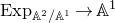 ${\textrm {Exp}}_{{\mathbb{A}}^2/{\mathbb{A}}^1}\to {\mathbb{A}}^1$
and
${\textrm {Exp}}_{{\mathbb{A}}^2/{\mathbb{A}}^1}\to {\mathbb{A}}^1$
and ${\textrm {Exp}}_{({\mathbb{A}}^1,0)}\to \textrm {Spec}\,{\mathbb{C}}$
. Following [Reference LiLi01, § 1] and [Reference Abramovich, Cadman, Fantechi and WiseACFW13, § 1 + § 6], we can give explicit descriptions of
${\textrm {Exp}}_{({\mathbb{A}}^1,0)}\to \textrm {Spec}\,{\mathbb{C}}$
. Following [Reference LiLi01, § 1] and [Reference Abramovich, Cadman, Fantechi and WiseACFW13, § 1 + § 6], we can give explicit descriptions of ${\textrm {Exp}}_{\mathbb{A}^2/\mathbb{A}^1}$
and
${\textrm {Exp}}_{\mathbb{A}^2/\mathbb{A}^1}$
and ${\textrm {Exp}}_{(\mathbb{A}^1,0)}$
from which the result follows.
${\textrm {Exp}}_{(\mathbb{A}^1,0)}$
from which the result follows.
Marked points. We first make the connection of our setting to theirs. Our Lemma 2.2 exhibits ${\textrm {Exp}}_{({\mathbb{A}}^1,0)}$
as equal to the stack
${\textrm {Exp}}_{({\mathbb{A}}^1,0)}$
as equal to the stack $\mathcal{T}_{na\ddot {\imath }ve}({\mathbb{A}}^1,0)$
of naïve expansions of Definitions 2.1.2 and 2.1.3 in [Reference Abramovich, Cadman, Fantechi and WiseACFW13]. By [Reference Abramovich, Cadman, Fantechi and WiseACFW13, Proposition 3.2.2 and Proposition 6.3.3], we further have an isomorphism
$\mathcal{T}_{na\ddot {\imath }ve}({\mathbb{A}}^1,0)$
of naïve expansions of Definitions 2.1.2 and 2.1.3 in [Reference Abramovich, Cadman, Fantechi and WiseACFW13]. By [Reference Abramovich, Cadman, Fantechi and WiseACFW13, Proposition 3.2.2 and Proposition 6.3.3], we further have an isomorphism $\mathcal{T}_{na\ddot {\imath }ve}({\mathbb{A}}^1,0)\simeq \mathcal{T}_{Li}({\mathbb{A}}^1,0)$
, where the latter is the space of expanded pairs constructed in [Reference LiLi02]. As explained in the proof of Proposition 6.3.3 in [Reference Abramovich, Cadman, Fantechi and WiseACFW13], the stack
$\mathcal{T}_{na\ddot {\imath }ve}({\mathbb{A}}^1,0)\simeq \mathcal{T}_{Li}({\mathbb{A}}^1,0)$
, where the latter is the space of expanded pairs constructed in [Reference LiLi02]. As explained in the proof of Proposition 6.3.3 in [Reference Abramovich, Cadman, Fantechi and WiseACFW13], the stack $\mathcal{T}_{Li}({\mathbb{A}}^1,0)$
(and hence
$\mathcal{T}_{Li}({\mathbb{A}}^1,0)$
(and hence ${\textrm {Exp}}_{({\mathbb{A}}^1,0)}$
) has a smooth cover by affine spaces
${\textrm {Exp}}_{({\mathbb{A}}^1,0)}$
) has a smooth cover by affine spaces $({\mathbb{A}}^n)_{n\geqslant 0}$
. Here, for each
$({\mathbb{A}}^n)_{n\geqslant 0}$
. Here, for each $n$
, the map
$n$
, the map ${\mathbb{A}}^n\to {\textrm {Exp}}_{({\mathbb{A}}^1,0)}$
is induced by an explicit expansion
${\mathbb{A}}^n\to {\textrm {Exp}}_{({\mathbb{A}}^1,0)}$
is induced by an explicit expansion $c[n]:\widetilde {C}[n]_{{\mathbb{A}}^n}\to {\mathbb{A}}^n\times {\mathbb{A}}^1$
in which the fiber over the origin of
$c[n]:\widetilde {C}[n]_{{\mathbb{A}}^n}\to {\mathbb{A}}^n\times {\mathbb{A}}^1$
in which the fiber over the origin of ${\mathbb{A}}^n$
is the expansion of
${\mathbb{A}}^n$
is the expansion of $({\mathbb{A}}^1,0)$
with the fiber over
$({\mathbb{A}}^1,0)$
with the fiber over $0$
being a chain of
$0$
being a chain of $n$
copies of
$n$
copies of ${\mathbb{P}}^1$
. Each coordinate axis of
${\mathbb{P}}^1$
. Each coordinate axis of ${\mathbb{A}}^n$
corresponds to a deformation smoothing exactly one of the
${\mathbb{A}}^n$
corresponds to a deformation smoothing exactly one of the $n$
nodes in the expansion. The automorphism group of the central fiber is
$n$
nodes in the expansion. The automorphism group of the central fiber is $\mathbb{G}_m^n$
. This group acts on the whole family
$\mathbb{G}_m^n$
. This group acts on the whole family $\widetilde {C}[n]_{{\mathbb{A}}^n}$
so that
$\widetilde {C}[n]_{{\mathbb{A}}^n}$
so that $c[n]$
becomes equivariant, where we let
$c[n]$
becomes equivariant, where we let $\mathbb{G}_m^n$
act trivially on
$\mathbb{G}_m^n$
act trivially on ${\mathbb{A}}^1$
and by scaling coordinates on
${\mathbb{A}}^1$
and by scaling coordinates on ${\mathbb{A}}^n$
. The induced map
${\mathbb{A}}^n$
. The induced map $[{\mathbb{A}}^n/\mathbb{G}_m^n]\to {\textrm {Exp}}_{({\mathbb{A}}^1,0)}$
is étale.
$[{\mathbb{A}}^n/\mathbb{G}_m^n]\to {\textrm {Exp}}_{({\mathbb{A}}^1,0)}$
is étale.
Nodes. Again by Lemma 2.2, we have an isomorphism ${\textrm {Exp}}_{{\mathbb{A}}^2/{\mathbb{A}}^1}\simeq \mathfrak{T}_{na\ddot {\imath }ve}({\mathbb{A}}^2/{\mathbb{A}}^1,0)$
where the latter is the stack of naïve expanded degenerations defined in [Reference Abramovich, Cadman, Fantechi and WiseACFW13, Definition 2.3.1 and Definition 2.3.2]. Combining their Proposition 3.2.3 and Proposition 6.3.3, we have an isomorphism
${\textrm {Exp}}_{{\mathbb{A}}^2/{\mathbb{A}}^1}\simeq \mathfrak{T}_{na\ddot {\imath }ve}({\mathbb{A}}^2/{\mathbb{A}}^1,0)$
where the latter is the stack of naïve expanded degenerations defined in [Reference Abramovich, Cadman, Fantechi and WiseACFW13, Definition 2.3.1 and Definition 2.3.2]. Combining their Proposition 3.2.3 and Proposition 6.3.3, we have an isomorphism $\mathfrak{T}_{na\ddot {\imath }ve}({\mathbb{A}}^2/{\mathbb{A}}^1,0) \simeq \mathfrak{T}_{Li}({\mathbb{A}}^2/{\mathbb{A}}^1,0)$
, where the latter is the stack of expanded degenerations defined in [Reference LiLi02]. As explained in [Reference Abramovich, Cadman, Fantechi and WiseACFW13] in the proof of Proposition 6.3.3 and in § 6.1, the stack
$\mathfrak{T}_{na\ddot {\imath }ve}({\mathbb{A}}^2/{\mathbb{A}}^1,0) \simeq \mathfrak{T}_{Li}({\mathbb{A}}^2/{\mathbb{A}}^1,0)$
, where the latter is the stack of expanded degenerations defined in [Reference LiLi02]. As explained in [Reference Abramovich, Cadman, Fantechi and WiseACFW13] in the proof of Proposition 6.3.3 and in § 6.1, the stack $\mathfrak{T}_{Li}({\mathbb{A}}^2/{\mathbb{A}}^1,0)$
(and hence
$\mathfrak{T}_{Li}({\mathbb{A}}^2/{\mathbb{A}}^1,0)$
(and hence ${\textrm {Exp}}_{{\mathbb{A}}^2/{\mathbb{A}}^1}$
) has a smooth cover by affine spaces
${\textrm {Exp}}_{{\mathbb{A}}^2/{\mathbb{A}}^1}$
) has a smooth cover by affine spaces $({\mathbb{A}}^{n+1})_{n\geqslant 0}$
. Again, the map
$({\mathbb{A}}^{n+1})_{n\geqslant 0}$
. Again, the map ${\mathbb{A}}^{n+1} \to {\textrm {Exp}}_{{\mathbb{A}}^2/{\mathbb{A}}^1}$
is obtained from an explicit standard model. In this case, this map is induced by a standard expanded degeneration
${\mathbb{A}}^{n+1} \to {\textrm {Exp}}_{{\mathbb{A}}^2/{\mathbb{A}}^1}$
is obtained from an explicit standard model. In this case, this map is induced by a standard expanded degeneration $c[n]:\tilde {C}[n]_{{\mathbb{A}}^{n+1}} \to {\mathbb{A}}^{n+1}\times _{{\mathbb{A}}^1} {\mathbb{A}}^2$
, where the map
$c[n]:\tilde {C}[n]_{{\mathbb{A}}^{n+1}} \to {\mathbb{A}}^{n+1}\times _{{\mathbb{A}}^1} {\mathbb{A}}^2$
, where the map ${\mathbb{A}}^{n+1}\to {\mathbb{A}}^1$
is given by multiplication of all coordinates. The fiber over the origin of
${\mathbb{A}}^{n+1}\to {\mathbb{A}}^1$
is given by multiplication of all coordinates. The fiber over the origin of ${\mathbb{A}}^{n+1}$
is an expansion of the nodal curve
${\mathbb{A}}^{n+1}$
is an expansion of the nodal curve $(xy=0)\subset {\mathbb{A}}^2$
with the preimage of the node being a chain of
$(xy=0)\subset {\mathbb{A}}^2$
with the preimage of the node being a chain of $n$
copies of
$n$
copies of ${\mathbb{P}}^1$
. Each coordinate direction of
${\mathbb{P}}^1$
. Each coordinate direction of ${\mathbb{A}}^{n+1}$
corresponds to a smoothing of one of the
${\mathbb{A}}^{n+1}$
corresponds to a smoothing of one of the $n+1$
nodes in the expansion. The automorphism group of the central fiber is
$n+1$
nodes in the expansion. The automorphism group of the central fiber is $\mathbb{G}_{m}^{n}$
, and the action extends to
$\mathbb{G}_{m}^{n}$
, and the action extends to $\tilde {C}[n]$
, which makes the expansion equivariant with respect to an action on
$\tilde {C}[n]$
, which makes the expansion equivariant with respect to an action on ${\mathbb{A}}^{n+1}$
for which the map to
${\mathbb{A}}^{n+1}$
for which the map to ${\mathbb{A}}^1$
is invariant. The induced map
${\mathbb{A}}^1$
is invariant. The induced map $[{\mathbb{A}}^{n+1}/\mathbb{G}_m^{n}]\to {\textrm {Exp}}_{{\mathbb{A}}^2/{\mathbb{A}}^1}$
is étale.
$[{\mathbb{A}}^{n+1}/\mathbb{G}_m^{n}]\to {\textrm {Exp}}_{{\mathbb{A}}^2/{\mathbb{A}}^1}$
is étale.
From the proof, we may also conclude the following result.
Corollary 2.7.
Let $C\to B$
be a flat and proper family of marked nodal curves. Then the existence part of the valuative criterion for properness holds for
$C\to B$
be a flat and proper family of marked nodal curves. Then the existence part of the valuative criterion for properness holds for ${\textrm {Exp}}_{C/B}\to B$
.
${\textrm {Exp}}_{C/B}\to B$
.
Proof. As in the proof of Lemma 2.6, we may reduce the proof to showing the existence part of the valuative criterion for the standard models ${\textrm {Exp}}_{({\mathbb{A}}^1,0)}\to \textrm {Spec}\,{\mathbb{C}}$
and
${\textrm {Exp}}_{({\mathbb{A}}^1,0)}\to \textrm {Spec}\,{\mathbb{C}}$
and ${\textrm {Exp}}_{{\mathbb{A}}^2/{\mathbb{A}}^1\to {\mathbb{A}}^1}$
, which we have identified as stacks of naïve expansions. In [Reference Abramovich, Cadman, Fantechi and WiseACFW13, Lemma 3.1.3 and Lemma 3.1.6], these stacks are identified as relative stacks of semistable maps into a projective target. These stacks are well known to satisfy the existence part of the valuative criterion. For example, one may reduce to the case of stable maps by adding suitable sections (this may involve passing to an extension of the DVR) and then use the properness of the space of stable maps (see [Reference Abramovich, Olsson and VistoliAOV11, Theorem 4.3] for a version treating the case of families).
${\textrm {Exp}}_{{\mathbb{A}}^2/{\mathbb{A}}^1\to {\mathbb{A}}^1}$
, which we have identified as stacks of naïve expansions. In [Reference Abramovich, Cadman, Fantechi and WiseACFW13, Lemma 3.1.3 and Lemma 3.1.6], these stacks are identified as relative stacks of semistable maps into a projective target. These stacks are well known to satisfy the existence part of the valuative criterion. For example, one may reduce to the case of stable maps by adding suitable sections (this may involve passing to an extension of the DVR) and then use the properness of the space of stable maps (see [Reference Abramovich, Olsson and VistoliAOV11, Theorem 4.3] for a version treating the case of families).
2.2 Moduli spaces of vector bundles on curves
We recall some results regarding the existence of universal bundles and the structure of the Picard group for moduli spaces of stable vector bundles on curves. We also derive a version of the Bogomolov–Gieseker inequality for fiber-stable sheaves on a product with ${\mathbb{P}}^1$
. Fix coprime integers
${\mathbb{P}}^1$
. Fix coprime integers $r,d$
with
$r,d$
with $r\gt 0$
. Let
$r\gt 0$
. Let $F$
be a smooth projective curve of genus
$F$
be a smooth projective curve of genus $g$
, and let
$g$
, and let $M_F(r,d)$
denote the moduli space of rank-
$M_F(r,d)$
denote the moduli space of rank- $r$
, degree-
$r$
, degree- $d$
stable vector bundles on
$d$
stable vector bundles on $F$
. For a degree-
$F$
. For a degree- $d$
line bundle
$d$
line bundle $L$
on
$L$
on $F$
, let
$F$
, let $M_F(r,L)$
denote the fiber of the determinant morphism
$M_F(r,L)$
denote the fiber of the determinant morphism $M_F(r,d) \to \textrm {Pic}^d F$
over
$M_F(r,d) \to \textrm {Pic}^d F$
over $[L]$
.
$[L]$
.
Proposition 2.8.
Suppose that $g\geqslant 2$
.
$g\geqslant 2$
.
-
(i) For any
$L\in \operatorname {Pic}^d F$
, the Picard group of
$M_F(r,L)$
is canonically isomorphic to
$\mathbb{Z}$
, identifying the ample generator with
$1$
. -
(ii) Let
$V$
be a vector bundle on
$F$
satisfying
$\operatorname {rk} V=r$
and
$\deg V=r(g-1) - d$
. Then for any choice of universal sheaf
$\mathcal{E}^u$
on
$F\times M_F(r,L)$
, the line bundle
is an ample generator of
\begin{align*}L_V:= \left (\det R\pi _*(\mathcal{E}^u\otimes p^*V)\right )^{\vee }\end{align*}
$\textrm {Pic} M_F(r,L)$
.
-
(iii) There is a unique choice of universal bundle on
$M_F(r,L)$
such that we have
$c_1(E|_{\{pt\}\times M_F(r,d)}) \simeq L_V^{k}$
for some integer
$0\leqslant k\lt r$
. This
$k$
is the unique integer in these bounds that satisfies
$dk -r k' =1$
for some
$k'\in \mathbb{Z}$
. In particular, we have
$(k,r)=1$
.








Proof. The first two points are Theorem B in [Reference Drezet and NarasimhanDN89]. The last point is [Reference RamananRam73, Remark 2.9].
Let $L$
be a line bundle on
$L$
be a line bundle on $\mathbb{P}^1\times F$
that is the pullback of a degree-(
$\mathbb{P}^1\times F$
that is the pullback of a degree-( $d_0\geqslant 1$
) line bundle from
$d_0\geqslant 1$
) line bundle from $F$
. We have the projection
$F$
. We have the projection $\pi : {\mathbb{P}}^1\times F\to {\mathbb{P}}^1$
. Let
$\pi : {\mathbb{P}}^1\times F\to {\mathbb{P}}^1$
. Let $V:= L^{\otimes r(g-1)-d}\oplus \mathcal{O}_{{\mathbb{P}}^1\times F}^{\oplus d_0r-1}$
so that
$V:= L^{\otimes r(g-1)-d}\oplus \mathcal{O}_{{\mathbb{P}}^1\times F}^{\oplus d_0r-1}$
so that $\operatorname {rk} V=rd_0$
and
$\operatorname {rk} V=rd_0$
and $\deg V|_F = d_0(r(g-1)-d)$
. For a coherent sheaf
$\deg V|_F = d_0(r(g-1)-d)$
. For a coherent sheaf $E$
on
$E$
on ${\mathbb{P}}^1\times F$
, we define
${\mathbb{P}}^1\times F$
, we define
 \begin{align*}L_V(E) := (\det R\pi _*(E\otimes V) )^\vee .\end{align*}
Suppose that $E$
has rank
$E$
has rank $r$
and degree
$r$
and degree $d$
on fibers of
$d$
on fibers of $\pi$
. A computation using Grothendieck–Riemann–Roch gives
$\pi$
. A computation using Grothendieck–Riemann–Roch gives
 \begin{align} \deg L_V(E) = d_0(c_1(E)^2/2 - r\textrm {ch}_2(E)) = \frac {d_0}{2}\Delta (E). \end{align}
Here we list related results.
Lemma 2.9.
Let $E$
be a rank-
$E$
be a rank- $r$
coherent sheaf on
$r$
coherent sheaf on $\mathbb{P}^1\times F$
satisfying
$\mathbb{P}^1\times F$
satisfying $(\det E, \mathcal{O}_{\mathbb{P}^1\times F}(F)) = d$
, and let
$(\det E, \mathcal{O}_{\mathbb{P}^1\times F}(F)) = d$
, and let $N$
be a line bundle on
$N$
be a line bundle on $\mathbb{P}^1$
. Then
$\mathbb{P}^1$
. Then $L_V(E) \cong L_V(E\otimes \pi ^* N)$
.
$L_V(E) \cong L_V(E\otimes \pi ^* N)$
.
Proof. By Riemann–Roch, we have
 \begin{align*} \operatorname {rk} R\pi _*(E\otimes V) &= \deg E|_{\operatorname {pt} \times F} \operatorname {rk} V + \operatorname {rk} E \deg V|_{\operatorname {pt}\times F} + \operatorname {rk}E \operatorname {rk} V (1-g) \\ &= d_0 \left (dr + r^2(g-1)- rd +r^2(1-g) \right ) = 0. \end{align*}
From the definition of $L_V(-)$
, the result follows from the following chain of isomorphisms:
$L_V(-)$
, the result follows from the following chain of isomorphisms:
 \begin{align*} \det R\pi _*(E \otimes \pi ^*N \otimes V)&\simeq \det \left (R\pi _*(E\otimes V) \otimes N \right ) \simeq \det R\pi _*(E\otimes V) \otimes N^{\operatorname {rk}R\pi _*(E\otimes V)}\\ & \simeq \det R\pi _*(E\otimes V). \end{align*}
Here, the first isomorphism is the projection formula and the second follows from the formula for the determinant of a tensor product of vector bundles after choosing a two-term resolution of $R\pi _*(E\otimes V)$
.
$R\pi _*(E\otimes V)$
.
Let $0\leqslant k\lt r$
be the unique integer in this range satisfying
$0\leqslant k\lt r$
be the unique integer in this range satisfying $dk - rk'=1$
for some
$dk - rk'=1$
for some $k'$
.
$k'$
.
Lemma 2.10.
Let $E$
be a degree-
$E$
be a degree- $r$
coherent sheaf on
$r$
coherent sheaf on $\mathbb{P}^1\times F$
such that
$\mathbb{P}^1\times F$
such that $c_1(E)$
has degree
$c_1(E)$
has degree $d$
on fibers over
$d$
on fibers over ${\mathbb{P}}^1$
. Then
${\mathbb{P}}^1$
. Then
 \begin{align} (L,c_1(E)) \equiv k\deg L_V(E) \mod d_0r. \end{align}
Proof. We have that $c_1(E)= d[{\mathbb{P}}^1\times y] +\ell [x\times F]$
for some
$c_1(E)= d[{\mathbb{P}}^1\times y] +\ell [x\times F]$
for some $\ell \in \mathbb{Z}$
. Thus,
$\ell \in \mathbb{Z}$
. Thus, $c_1(E)^2=2\ell d$
, and
$c_1(E)^2=2\ell d$
, and
 \begin{align*}k\deg L_V(E) =k d_0r c_2(E) - kd_0(r-1)\ell d\equiv d_0\ell k d \equiv d_0\ell = (L,c_1(E)) \mod d_0 r.\end{align*}
Lemma 2.11.
Suppose that $E$
is a rank-
$E$
is a rank- $r$
torsion-free coherent sheaf on
$r$
torsion-free coherent sheaf on ${\mathbb{P}}^1\times F$
such that the restriction of
${\mathbb{P}}^1\times F$
such that the restriction of $E$
to the generic fiber over
$E$
to the generic fiber over ${\mathbb{P}}^1$
is stable of degree
${\mathbb{P}}^1$
is stable of degree $d$
. Then
$d$
. Then $\Delta (E)\geqslant 0$
, with equality if and only if
$\Delta (E)\geqslant 0$
, with equality if and only if $E$
is a tensor product of the pullbacks of a stable sheaf on
$E$
is a tensor product of the pullbacks of a stable sheaf on $F$
and a line bundle on
$F$
and a line bundle on $\mathbb{P}^1$
.
$\mathbb{P}^1$
.
Proof. Since $E$
is torsion-free, it maps injectively to its double dual with zero-dimensional cokernel. We have
$E$
is torsion-free, it maps injectively to its double dual with zero-dimensional cokernel. We have $\Delta (E)\geqslant \Delta (E^{\vee \vee })$
, with equality if and only if
$\Delta (E)\geqslant \Delta (E^{\vee \vee })$
, with equality if and only if $E$
is locally free. By replacing
$E$
is locally free. By replacing $E$
with
$E$
with $E^{\vee \vee }$
if necessary, we may therefore assume that
$E^{\vee \vee }$
if necessary, we may therefore assume that $E$
is locally free.
$E$
is locally free.
By Langton’s procedure of elementary modifications [Reference LangtonLan75], one may find a locally free subsheaf $E' \subset E$
whose restriction to every fiber over
$E' \subset E$
whose restriction to every fiber over ${\mathbb{P}}^1$
is stable and such that
${\mathbb{P}}^1$
is stable and such that $E'$
is obtained from
$E'$
is obtained from $E$
through successive elementary modifications along maximally destabilizing quotients of fibers. One checks that
$E$
through successive elementary modifications along maximally destabilizing quotients of fibers. One checks that $\Delta (E)$
strictly decreases after each such modification, so
$\Delta (E)$
strictly decreases after each such modification, so $\Delta (E')\leqslant \Delta (E)$
, with equality if and only if
$\Delta (E')\leqslant \Delta (E)$
, with equality if and only if $E$
is already stable on every fiber. By replacing
$E$
is already stable on every fiber. By replacing $E$
with
$E$
with $E'$
if necessary, we may assume that this is the case.
$E'$
if necessary, we may assume that this is the case.
Then, after possibly tensoring $E$
by a line bundle from
$E$
by a line bundle from $\mathbb{P}^1$
, we may assume that
$\mathbb{P}^1$
, we may assume that $E$
is a pullback of the universal sheaf along a morphism
$E$
is a pullback of the universal sheaf along a morphism $\nu :\mathbb{P}^1\to M_F(r,L)$
for some
$\nu :\mathbb{P}^1\to M_F(r,L)$
for some $L$
. If
$L$
. If $g=1$
, this implies that
$g=1$
, this implies that $\nu$
is constant. Otherwise, if
$\nu$
is constant. Otherwise, if $g\geqslant 2$
, we have
$g\geqslant 2$
, we have $\Delta (E)=2k\deg \nu ^* L_V$
for
$\Delta (E)=2k\deg \nu ^* L_V$
for $L_V$
as in Proposition 2.8. Since
$L_V$
as in Proposition 2.8. Since $L_V$
is ample, this implies that
$L_V$
is ample, this implies that $\deg \nu ^*L_V\geqslant 0$
, with equality if and only if
$\deg \nu ^*L_V\geqslant 0$
, with equality if and only if $\nu$
is constant.
$\nu$
is constant.
2.3 Components of relative Picard schemes
In this subsection, we construct a stack parametrizing connected components of the relative Picard scheme for a family of fibered surfaces. We also construct a further quotient identifying line bundles which differ by component twists. This will be used for making precise the notion of ‘fixing the first Chern class’ in a family of fibered surfaces. In practice, one can do this by fixing a line bundle $L$
on a family of fibered surfaces
$L$
on a family of fibered surfaces $X_B\to C_B$
. This is then considered up to algebraic equivalence and up to twists coming from line bundles on
$X_B\to C_B$
. This is then considered up to algebraic equivalence and up to twists coming from line bundles on $C_B$
of total degree zero. We recommend skipping this subsection on a first reading.
$C_B$
of total degree zero. We recommend skipping this subsection on a first reading.
Let $X_B\to C_B\to B$
be a family of fibered surfaces over
$X_B\to C_B\to B$
be a family of fibered surfaces over $B$
with structure morphism
$B$
with structure morphism $\pi :X_B\to B$
. We make the following technical assumption.
$\pi :X_B\to B$
. We make the following technical assumption.
Assumption 2.13.
The sheaves $R^1\pi _* \mathcal{O}_{X_B}$
and
$R^1\pi _* \mathcal{O}_{X_B}$
and $R^2\pi _*\mathcal{O}_{X_B}$
are locally free on
$R^2\pi _*\mathcal{O}_{X_B}$
are locally free on $B$
.
$B$
.
This assumption guarantees that the dimensions of the cohomology groups $H^i(X_b,\mathcal{O}_{X_b})$
are locally constant on
$H^i(X_b,\mathcal{O}_{X_b})$
are locally constant on $B$
and that cohomology commutes with base change for the structure sheaf. For a proper and smooth family of varieties (as for us in characteristic zero), this is a consequence of Deligne’s theorem [Reference DeligneDel68, Theorem (5.5) (i)]. In our case of semistable degenerations, it holds whenever
$B$
and that cohomology commutes with base change for the structure sheaf. For a proper and smooth family of varieties (as for us in characteristic zero), this is a consequence of Deligne’s theorem [Reference DeligneDel68, Theorem (5.5) (i)]. In our case of semistable degenerations, it holds whenever $\pi$
is representable by schemes (Remark 2.14), and we suspect that it holds unconditionally (Remark 2.15). This uses a version of Deligne’s theorem in logarithmic geometry; a more direct argument would be desirable, but is not known to us.
$\pi$
is representable by schemes (Remark 2.14), and we suspect that it holds unconditionally (Remark 2.15). This uses a version of Deligne’s theorem in logarithmic geometry; a more direct argument would be desirable, but is not known to us.
Remark 2.14. Assumption 2.13 always holds if $\pi$
is representable by schemes: the family of nodal marked curves
$\pi$
is representable by schemes: the family of nodal marked curves $C_B\to B$
induces natural log-structures on
$C_B\to B$
induces natural log-structures on $B$
and
$B$
and $C_B$
, with respect to which
$C_B$
, with respect to which $C_B\to B$
is log-smooth [Reference KatoKat00]. Pulling back along
$C_B\to B$
is log-smooth [Reference KatoKat00]. Pulling back along $X_B\to C_B$
, we get a log-structure on
$X_B\to C_B$
, we get a log-structure on $X_B$
, with respect to which
$X_B$
, with respect to which $X_B\to B$
is log-smooth, vertical and exact. It follows from [Reference Illusie, Kato and NakayamaIKN05, Corollary 7.1] that
$X_B\to B$
is log-smooth, vertical and exact. It follows from [Reference Illusie, Kato and NakayamaIKN05, Corollary 7.1] that $R^i\pi _*\mathcal{O}_{X_B}$
is locally free on
$R^i\pi _*\mathcal{O}_{X_B}$
is locally free on $B$
and commutes with any base change.
$B$
and commutes with any base change.
Remark 2.15. Assumption 2.13 is likely unnecessary. One way to see this would be if one had a generalization of [Reference Illusie, Kato and NakayamaIKN05, Corollary 7.1] to algebraic spaces with a logarithmic structure. It has been pointed out to us by Luc Illusie that the proof there should work in the more general setting; see also [Reference Deligne and IllusieDI87, 4.2.5].
Since $X_B\to B$
is a flat and proper family with geometrically integral fibers, its relative Picard functor
$X_B\to B$
is a flat and proper family with geometrically integral fibers, its relative Picard functor $\textrm {Pic}_{X_B/B}$
exists as an algebraic space [Reference KleimanKle05, Theorem 4.18.6]. We collect some of its basic properties under the given assumptions.
$\textrm {Pic}_{X_B/B}$
exists as an algebraic space [Reference KleimanKle05, Theorem 4.18.6]. We collect some of its basic properties under the given assumptions.
Theorem 2.16.
Suppose that Assumption 2.13 holds: for example, if $X_B$
is a relative scheme over
$X_B$
is a relative scheme over $B$
.
$B$
.
-
(i) The dimension of the identity component
$\textrm {Pic}_{X_b}^0$
of the Picard scheme of the fiber
$X_b$
is locally constant on
$B$
. -
(ii) There is an open group subscheme
$\textrm {Pic}^0_{X_B/B}\subset \textrm {Pic}_{X_B/B}$
, of finite type over
$B$
, which restricts to the identity component of the Picard scheme over every point of
$B$
. -
(iii) The morphism
$\textrm {Pic}^0_{X_B/B}\to B$
is smooth.





Proof. By Assumption 2.13, the dimension of the tangent space of the Picard scheme $\textrm {Pic}_{X_b}$
at the identity is locally constant. Since we are in characteristic zero, this implies (i). Then (ii) follows as in [Reference KleimanKle05, Proposition 5.20]. Finally, (iii) follows from the same argument as in [Reference KleimanKle05, Remark 5.21] using Assumption 2.13 in place of smoothness (the projectivity there is only used to invoke the GAGA theorem, which holds more generally for a proper morphism).
$\textrm {Pic}_{X_b}$
at the identity is locally constant. Since we are in characteristic zero, this implies (i). Then (ii) follows as in [Reference KleimanKle05, Proposition 5.20]. Finally, (iii) follows from the same argument as in [Reference KleimanKle05, Remark 5.21] using Assumption 2.13 in place of smoothness (the projectivity there is only used to invoke the GAGA theorem, which holds more generally for a proper morphism).
Since the identity component $\textrm {Pic}_{X_B/B}^0$
is smooth over
$\textrm {Pic}_{X_B/B}^0$
is smooth over $B$
, we may take the free quotient algebraic space
$B$
, we may take the free quotient algebraic space $\mathcal{NS}_{X_B/B} := [\textrm {Pic}_{X_B/B} / \textrm {Pic}_{X_B/B}^0]$
. This is the relative Néron–Severi group and a quasi-separated group algebraic space. Similarly, we let
$\mathcal{NS}_{X_B/B} := [\textrm {Pic}_{X_B/B} / \textrm {Pic}_{X_B/B}^0]$
. This is the relative Néron–Severi group and a quasi-separated group algebraic space. Similarly, we let $\mathcal{NS}_{C_B/B} := [\textrm {Pic}_{C_B/B}/\textrm {Pic}_{C_B/B}^0]$
.
$\mathcal{NS}_{C_B/B} := [\textrm {Pic}_{C_B/B}/\textrm {Pic}_{C_B/B}^0]$
.
Proposition 2.17.
-
(i) The algebraic space
$\mathcal{NS}_{X_B/B}$
is unramified over
$B$
. -
(ii) The algebraic space
$\mathcal{NS}_{C_B/B}$
is étale over
$B$
. -
(iii) The sub-algebraic space
$\mathcal{NS}_{C_B/B}^0$
parametrizing line bundles with total degree zero is open and closed in
$\mathcal{NS}_{C_B/B}$
. -
(iv) Pullback of line bundles induces an open and closed immersion
\begin{align*}\mathcal{NS}_{C_B/B}\to \mathcal{NS}_{X_B/B}.\end{align*}


Proof. By construction, the morphism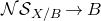 $\mathcal{NS}_{X/B}\to B$
is locally of finite type and has everywhere-vanishing relative Kähler differentials, which implies (i). The same holds for
$\mathcal{NS}_{X/B}\to B$
is locally of finite type and has everywhere-vanishing relative Kähler differentials, which implies (i). The same holds for $ \mathcal{NS}_{C_B/B}$
, which is moreover smooth over
$ \mathcal{NS}_{C_B/B}$
, which is moreover smooth over $B$
. Hence, it is étale over
$B$
. Hence, it is étale over $B$
, which gives (ii). Point (iii) follows from the local constancy of the Euler characteristic. The morphism in point (iv) is well defined, since the morphism
$B$
, which gives (ii). Point (iii) follows from the local constancy of the Euler characteristic. The morphism in point (iv) is well defined, since the morphism $\varphi :\textrm {Pic}_{C_B/B}\to \textrm {Pic}_{X_B/B}, L\mapsto f^*L$
preserves the identity components. By Lemma 2.18, the map
$\varphi :\textrm {Pic}_{C_B/B}\to \textrm {Pic}_{X_B/B}, L\mapsto f^*L$
preserves the identity components. By Lemma 2.18, the map $\varphi$
is a closed embedding and
$\varphi$
is a closed embedding and $\varphi ^{-1}\textrm {Pic}_{X_B/B}^0 = \textrm {Pic}_{C_B/B}^0$
. It follows that the induced morphism of quotient groups
$\varphi ^{-1}\textrm {Pic}_{X_B/B}^0 = \textrm {Pic}_{C_B/B}^0$
. It follows that the induced morphism of quotient groups $\overline {\varphi }:\mathcal{NS}_{C_B/B}\to \mathcal{NS}_{X_B/B}$
is a monomorphism. We claim it is also proper. By the third isomorphism theorem, we identify
$\overline {\varphi }:\mathcal{NS}_{C_B/B}\to \mathcal{NS}_{X_B/B}$
is a monomorphism. We claim it is also proper. By the third isomorphism theorem, we identify
 \begin{align*}\mathcal{NS}_{X_B/B} = \left [\textrm {Pic}_{X_B/B}\middle / \textrm {Pic}_{X_B/B}^0\right ] = \left [[\textrm {Pic}_{X_B/B}/\textrm {Pic}^0_{C_B/B}]\middle / [\textrm {Pic}_{X_B/B}^0/\textrm {Pic}^0_{C_B/B}]\right ].\end{align*}
Hence, we may factor $\overline {\varphi }$
as
$\overline {\varphi }$
as
 \begin{align*}[\textrm {Pic}_{C_B/B}/\textrm {Pic}_{C_B/B}^0] \to [\textrm {Pic}_{X_B/B}/\textrm {Pic}_{C_B/B}^0]\to \left [[\textrm {Pic}_{X_B/B}/\textrm {Pic}_{C_B/B}^0]\middle /[\textrm {Pic}_{X_B/B}^0/\textrm {Pic}_{C_B/B}^0]\right ].\end{align*}
The first of these is a closed embedding, since $\varphi$
is a closed embedding. Properness of the second map follows from properness of the quotient
$\varphi$
is a closed embedding. Properness of the second map follows from properness of the quotient $[\textrm {Pic}^0_{X_B/B}/\textrm {Pic}^0_{C_B/B}]$
, which is Lemma 2.19 below. Finally, since
$[\textrm {Pic}^0_{X_B/B}/\textrm {Pic}^0_{C_B/B}]$
, which is Lemma 2.19 below. Finally, since $\mathcal{NS}_{C_B/B}$
is étale over
$\mathcal{NS}_{C_B/B}$
is étale over $B$
and
$B$
and $\mathcal{NS}_{X_B/B}$
is unramified over
$\mathcal{NS}_{X_B/B}$
is unramified over $B$
, it follows that
$B$
, it follows that $\mathcal{NS}_{C_B/B}$
is formally étale, and hence étale over
$\mathcal{NS}_{C_B/B}$
is formally étale, and hence étale over $\mathcal{NS}_{X_B/B}$
. Any étale (even flat) monomorphism is, in particular, an open immersion [Sta23, Theorem 025G].
$\mathcal{NS}_{X_B/B}$
. Any étale (even flat) monomorphism is, in particular, an open immersion [Sta23, Theorem 025G].
Lemma 2.18.
The morphism $\varphi :\textrm {Pic}_{C_B/B}\to \textrm {Pic}_{X_B/B}, L\mapsto f^*L$
induced by pullback is a closed immersion. Moreover,
$\varphi :\textrm {Pic}_{C_B/B}\to \textrm {Pic}_{X_B/B}, L\mapsto f^*L$
induced by pullback is a closed immersion. Moreover, $\varphi ^{-1}\textrm {Pic}_{X_B/B}^0 = \textrm {Pic}_{C_B/B}^0$
.
$\varphi ^{-1}\textrm {Pic}_{X_B/B}^0 = \textrm {Pic}_{C_B/B}^0$
.
Proof. A closed immersion is the same as a proper monomorphism. Since $f_*\mathcal{O}_{X_B} = \mathcal{O}_{C_B}$
, we have for any line bundle
$f_*\mathcal{O}_{X_B} = \mathcal{O}_{C_B}$
, we have for any line bundle $L$
on
$L$
on $C_B$
that
$C_B$
that $f_*f^*L = L$
. The same holds after any base change on
$f_*f^*L = L$
. The same holds after any base change on $B$
, so pullback indeed gives a monomorphism. For properness, it suffices to check the existence part of the valuative criterion. (The uniqueness part is an immediate consequence of being a monomorphism.) Hence, we may assume
$B$
, so pullback indeed gives a monomorphism. For properness, it suffices to check the existence part of the valuative criterion. (The uniqueness part is an immediate consequence of being a monomorphism.) Hence, we may assume $B = \textrm {Spec}\,R$
for a DVR
$B = \textrm {Spec}\,R$
for a DVR $R$
with generic point
$R$
with generic point $\eta$
and that we are given a line bundle
$\eta$
and that we are given a line bundle $L$
on
$L$
on $X_B$
so that
$X_B$
so that $L_{\eta }$
is isomorphic to a line bundle pulled back from
$L_{\eta }$
is isomorphic to a line bundle pulled back from $C_{\eta }$
or, equivalently, so that
$C_{\eta }$
or, equivalently, so that $f_*L$
is a line bundle on
$f_*L$
is a line bundle on $C_{\eta }$
and that
$C_{\eta }$
and that $f^*f_{*}L\to L$
is an isomorphism over
$f^*f_{*}L\to L$
is an isomorphism over $X_{\eta }$
. We want to exhibit a line bundle
$X_{\eta }$
. We want to exhibit a line bundle $M$
on
$M$
on $C_R$
so that
$C_R$
so that $L\simeq f^*M$
. Viewing
$L\simeq f^*M$
. Viewing $f:X_R\to C_R$
as a family of curves, then, at least over the locus where
$f:X_R\to C_R$
as a family of curves, then, at least over the locus where $f$
is smooth, we can conclude that
$f$
is smooth, we can conclude that $f_*L$
is free and
$f_*L$
is free and $f^*f_*L\to L$
is an isomorphism, since the relative Picard scheme of a family of smooth curves is separated. Thus, these conditions hold, except possibly over a finite set of points
$f^*f_*L\to L$
is an isomorphism, since the relative Picard scheme of a family of smooth curves is separated. Thus, these conditions hold, except possibly over a finite set of points $x_1,\ldots ,x_n\in C_{\xi }$
contained in the smooth locus of
$x_1,\ldots ,x_n\in C_{\xi }$
contained in the smooth locus of $C_{\xi }$
. Since
$C_{\xi }$
. Since $C_R$
is regular of dimension two around each of the
$C_R$
is regular of dimension two around each of the $x_i$
, the double dual
$x_i$
, the double dual $M:= (f_*L)^{\vee \vee }$
is then locally free. But, since
$M:= (f_*L)^{\vee \vee }$
is then locally free. But, since $X_R$
is Cohen–Macaulay, any locally free sheaf is determined by its restriction away from any codimension-two locus. More precisely, this means that the isomorphism
$X_R$
is Cohen–Macaulay, any locally free sheaf is determined by its restriction away from any codimension-two locus. More precisely, this means that the isomorphism $f^*(f_*L)^{\vee \vee }\xleftarrow {\sim } f^*f_*L\xrightarrow {\sim } L$
, defined away from the fibers over
$f^*(f_*L)^{\vee \vee }\xleftarrow {\sim } f^*f_*L\xrightarrow {\sim } L$
, defined away from the fibers over $x_i$
, extends to an isomorphism
$x_i$
, extends to an isomorphism $f^*M\xrightarrow {\sim } L$
on all of
$f^*M\xrightarrow {\sim } L$
on all of $X_R$
.
$X_R$
.
To obtain properness, it remains to show that $\textrm {Pic}_{C_B/B}\to \textrm {Pic}_{X_B/B}$
is quasi-compact. For this, we may work locally on
$\textrm {Pic}_{C_B/B}\to \textrm {Pic}_{X_B/B}$
is quasi-compact. For this, we may work locally on $B$
, and even decompose
$B$
, and even decompose $B$
into locally closed strata [Sta23, Lemma 040W]. In particular, we may assume that
$B$
into locally closed strata [Sta23, Lemma 040W]. In particular, we may assume that $C_B$
has constant topological type over
$C_B$
has constant topological type over $B$
, that is, that
$B$
, that is, that $C_B$
is a union of smooth curves over
$C_B$
is a union of smooth curves over $B$
. Moreover, we may assume that
$B$
. Moreover, we may assume that $B$
is smooth, quasi-compact and irreducible, and that for each component
$B$
is smooth, quasi-compact and irreducible, and that for each component $C_i$
of
$C_i$
of $C_B$
we have an effective Cartier divisor
$C_B$
we have an effective Cartier divisor $D_i\subset f^{-1}C_i$
that is generically finite over
$D_i\subset f^{-1}C_i$
that is generically finite over $C_i$
. Then the numbers
$C_i$
. Then the numbers $\chi (f^{-1}C_i,L|_{f^{-1}C_i} \otimes k D_i)$
are locally constant on
$\chi (f^{-1}C_i,L|_{f^{-1}C_i} \otimes k D_i)$
are locally constant on $\textrm {Pic}_{X_B/B}$
and hence define a decomposition into open and closed subsets. The preimage of each such subset is either empty or consists of line bundles on
$\textrm {Pic}_{X_B/B}$
and hence define a decomposition into open and closed subsets. The preimage of each such subset is either empty or consists of line bundles on $C_B$
of a fixed multi-degree which is a quasi-compact set.
$C_B$
of a fixed multi-degree which is a quasi-compact set.
For the statement about identity components, it is immediate that $\varphi ^{-1}\textrm {Pic}_{X_B/B}^0$
is an open subspace of
$\varphi ^{-1}\textrm {Pic}_{X_B/B}^0$
is an open subspace of $\textrm {Pic}_{C_B/B}$
that contains
$\textrm {Pic}_{C_B/B}$
that contains $\textrm {Pic}^0_{C_B/B}$
. To show equality of these open subspaces, it is enough to work pointwise on
$\textrm {Pic}^0_{C_B/B}$
. To show equality of these open subspaces, it is enough to work pointwise on $B$
. Thus, we may reduce to the setting of the previous paragraph, where
$B$
. Thus, we may reduce to the setting of the previous paragraph, where $C_B = \cup C_i$
is a union of smooth irreducible components and where we have chosen effective Cartier divisors
$C_B = \cup C_i$
is a union of smooth irreducible components and where we have chosen effective Cartier divisors $D_i\subset f^{-1}C_i$
generically finite over
$D_i\subset f^{-1}C_i$
generically finite over $C_i$
. Then the identity component
$C_i$
. Then the identity component $\textrm {Pic}_{X_B/B}^0$
is contained in the open subset defined by
$\textrm {Pic}_{X_B/B}^0$
is contained in the open subset defined by $\chi (f^{-1}C_i, L|_{f^{-1}C_i} \otimes kD_i)=0$
for all
$\chi (f^{-1}C_i, L|_{f^{-1}C_i} \otimes kD_i)=0$
for all $i,k$
. The preimage of this subset under
$i,k$
. The preimage of this subset under $\varphi$
is exactly the subspace of
$\varphi$
is exactly the subspace of $\textrm {Pic}_{C_B/B}$
of line bundles of multi-degree zero, which is
$\textrm {Pic}_{C_B/B}$
of line bundles of multi-degree zero, which is $\textrm {Pic}_{C_B/B}^0$
.
$\textrm {Pic}_{C_B/B}^0$
.
Lemma 2.19.
The algebraic space $[\textrm {Pic}_{X_B/B}^0/\textrm {Pic}_{C_B/B}^0]$
is proper over
$[\textrm {Pic}_{X_B/B}^0/\textrm {Pic}_{C_B/B}^0]$
is proper over $B$
.
$B$
.
Proof. By Lemma 2.18, the map $\textrm {Pic}^0_{C_B/B}\to \textrm {Pic}^0_{X_B/B}$
is a closed embedding. This implies that
$\textrm {Pic}^0_{C_B/B}\to \textrm {Pic}^0_{X_B/B}$
is a closed embedding. This implies that $Y_B:=[\textrm {Pic}_{X_B/B}^0/\textrm {Pic}_{C_B/B}^0]$
is separated over
$Y_B:=[\textrm {Pic}_{X_B/B}^0/\textrm {Pic}_{C_B/B}^0]$
is separated over $B$
. By Theorem2.16 (ii), it is also of finite type. It remains to check properness. Working locally on
$B$
. By Theorem2.16 (ii), it is also of finite type. It remains to check properness. Working locally on $B$
, we may assume
$B$
, we may assume $B$
is affine. By Chow’s lemma [Sta23, Lemma 088U], we can find a proper birational map
$B$
is affine. By Chow’s lemma [Sta23, Lemma 088U], we can find a proper birational map $g:Z\to Y_B$
with
$g:Z\to Y_B$
with $Z$
quasi-projective over
$Z$
quasi-projective over $B$
(in particular, a scheme). It suffices to show that
$B$
(in particular, a scheme). It suffices to show that $Z$
is proper. By [Reference GrothendieckGro66, Corollary 15.7.11], a separated finite type morphism of schemes
$Z$
is proper. By [Reference GrothendieckGro66, Corollary 15.7.11], a separated finite type morphism of schemes $Z\to B$
with geometrically connected fibers is proper provided that it has proper fibers and that – at least after base change along some proper surjective map
$Z\to B$
with geometrically connected fibers is proper provided that it has proper fibers and that – at least after base change along some proper surjective map $B'\to B$
– there exists a section. For the existence of a section, we may take
$B'\to B$
– there exists a section. For the existence of a section, we may take $B'$
to be the preimage of the identity section under
$B'$
to be the preimage of the identity section under $g$
. Properness of the fibers of
$g$
. Properness of the fibers of $g$
is equivalent to properness of fibers of
$g$
is equivalent to properness of fibers of $Y_B\to B$
. Hence, we are reduced to showing that
$Y_B\to B$
. Hence, we are reduced to showing that $[\textrm {Pic}_{X}^0/\textrm {Pic}_C^0]$
is proper in the case that
$[\textrm {Pic}_{X}^0/\textrm {Pic}_C^0]$
is proper in the case that $B$
is a point. For this, we can use the existence part of the valuative criterion. Let
$B$
is a point. For this, we can use the existence part of the valuative criterion. Let $C_i$
and
$C_i$
and $X_i$
be the irreducible components of
$X_i$
be the irreducible components of $C$
and
$C$
and $X$
, respectively. Then, by writing any line bundle on
$X$
, respectively. Then, by writing any line bundle on $C$
in terms of line bundles on its components and glueing data, we have an exact sequence
$C$
in terms of line bundles on its components and glueing data, we have an exact sequence
 \begin{align*}0\to \mathbb{G}_m^{b}\to \textrm {Pic}^0_C\to \prod \textrm {Pic}^0_{C_i}\to 0,\end{align*}
where $b$
is the first Betti number of the dual graph of
$b$
is the first Betti number of the dual graph of $C$
. For
$C$
. For $X$
in place of
$X$
in place of $C$
, we analogously have
$C$
, we analogously have
 \begin{align*}0\to \mathbb{G}_m^b \to \textrm {Pic}_X^0 \to \prod \textrm {Pic}_{X_i}^0 \to \prod \textrm {Pic}^0 _{F_j},\end{align*}
where $F_j$
runs through the components of the singular locus of
$F_j$
runs through the components of the singular locus of $X$
. This latter sequence shows that the quotient of
$X$
. This latter sequence shows that the quotient of $\textrm {Pic}_X^0$
by
$\textrm {Pic}_X^0$
by $\mathbb{G}_m^b$
in
$\mathbb{G}_m^b$
in $\prod \textrm {Pic}_{X_i}^0$
is closed, and hence it is an abelian subvariety. Pullback along
$\prod \textrm {Pic}_{X_i}^0$
is closed, and hence it is an abelian subvariety. Pullback along $f$
induces the following commutative diagram.
$f$
induces the following commutative diagram.

It follows that we have an isomorphism
 \begin{align*}\left [{\textrm {Pic}}_X^0/{\textrm {Pic}}_C^0\right ]\simeq \left [[\textrm {Pic}_X^0/\mathbb{G}_m^b]\middle /[\textrm {Pic}_C^0/\mathbb{G}_m^b]\right ], \end{align*}
which is a quotient of an abelian variety by a subvariety, and hence it is an abelian variety. This shows the desired properness in the case of a point base.
Definition 2.20. We let
 \begin{align*}\overline {\mathcal{NS}}_{X_B/B} := \mathcal{NS}_{X_B/B}/\mathcal{NS}^0_{C_B/B} \end{align*}
and
 \begin{align*}\overline {\mathcal{NS}}_{X_B/C_B}:= \mathcal{NS}_{X_B/B}/\mathcal{NS}_{C_B/B}.\end{align*}
By Proposition 2.17, these are separated and unramified group algebraic spaces over $B$
.
$B$
.
The following result describes how the relative Néron–Severi spaces interact with expansions.
Lemma 2.21.
Let $\widetilde {X}_T\to \widetilde {C}_T$
be an expansion of
$\widetilde {X}_T\to \widetilde {C}_T$
be an expansion of $X_T\to C_T$
. Then pullback along
$X_T\to C_T$
. Then pullback along $\widetilde {X}_T\to X_T$
induces isomorphisms
$\widetilde {X}_T\to X_T$
induces isomorphisms $\overline {\mathcal{NS}}_{X_T/C_T} = \overline {\mathcal{NS}}_{X_B/C_B}\times _B T\xrightarrow {\sim } \overline {\mathcal{NS}}_{\widetilde {X}_T/\widetilde {C}_T}$
and
$\overline {\mathcal{NS}}_{X_T/C_T} = \overline {\mathcal{NS}}_{X_B/C_B}\times _B T\xrightarrow {\sim } \overline {\mathcal{NS}}_{\widetilde {X}_T/\widetilde {C}_T}$
and $\overline {\mathcal{NS}}_{X_T/T} = \overline {\mathcal{NS}}_{X_B/B}\times _B T\xrightarrow {\sim } \overline {\mathcal{NS}}_{\widetilde {X}_T/T}$
.
$\overline {\mathcal{NS}}_{X_T/T} = \overline {\mathcal{NS}}_{X_B/B}\times _B T\xrightarrow {\sim } \overline {\mathcal{NS}}_{\widetilde {X}_T/T}$
.
Proof. We treat only the case of $\overline {\mathcal{NS}}_{X_T/T}$
; the other is similar. Since the pullback map
$\overline {\mathcal{NS}}_{X_T/T}$
; the other is similar. Since the pullback map $\textrm {Pic}_{X_T/T}\to \textrm {Pic}_{\widetilde {X}_T/T}$
preserves the identity components, it descends to a morphism
$\textrm {Pic}_{X_T/T}\to \textrm {Pic}_{\widetilde {X}_T/T}$
preserves the identity components, it descends to a morphism $\mathcal{NS}_{X_T/T}\to \mathcal{NS}_{\widetilde {X}_T/T}$
. Since the total degree is preserved under pullback along
$\mathcal{NS}_{X_T/T}\to \mathcal{NS}_{\widetilde {X}_T/T}$
. Since the total degree is preserved under pullback along $\widetilde {C}_T\to C_T$
, this descends to a morphism
$\widetilde {C}_T\to C_T$
, this descends to a morphism $\overline {\mathcal{NS}}_{X_T/T}\to \overline {\mathcal{NS}}_{\widetilde {X}_T/T}$
. We claim that this is an isomorphism. It is enough to show that each section of
$\overline {\mathcal{NS}}_{X_T/T}\to \overline {\mathcal{NS}}_{\widetilde {X}_T/T}$
. We claim that this is an isomorphism. It is enough to show that each section of $\overline {\mathcal{NS}}_{\widetilde {X}_T/T}$
has a unique preimage. For this, we may work étale locally on
$\overline {\mathcal{NS}}_{\widetilde {X}_T/T}$
has a unique preimage. For this, we may work étale locally on $T$
and assume that
$T$
and assume that $\widetilde {C}_T\to T$
has sections meeting each irreducible component of each fiber. Suppose that
$\widetilde {C}_T\to T$
has sections meeting each irreducible component of each fiber. Suppose that $\overline {c_1} \in \overline {\mathcal{NS}}_{\widetilde {X}_T/T}(S)$
for some
$\overline {c_1} \in \overline {\mathcal{NS}}_{\widetilde {X}_T/T}(S)$
for some $T$
-scheme
$T$
-scheme $S$
. Then, locally on
$S$
. Then, locally on $S$
, we may assume that
$S$
, we may assume that $\overline {c_1}$
is represented by some line bundle
$\overline {c_1}$
is represented by some line bundle $L$
on
$L$
on $\widetilde {X}_S$
. Up to twisting
$\widetilde {X}_S$
. Up to twisting $L$
by a line bundle
$L$
by a line bundle $N$
pulled back from
$N$
pulled back from $\widetilde {C}_S$
of total degree zero, we may assume that
$\widetilde {C}_S$
of total degree zero, we may assume that $L$
is pulled back from
$L$
is pulled back from $X_S$
so that
$X_S$
so that $\overline {c_1}$
comes from an element
$\overline {c_1}$
comes from an element $\overline {c_1'}\in \overline {\mathcal{NS}}_{X_T/T}(S)$
. Moreover, we see that
$\overline {c_1'}\in \overline {\mathcal{NS}}_{X_T/T}(S)$
. Moreover, we see that $\overline {c_1'}$
is uniquely determined, since any two possible choices of
$\overline {c_1'}$
is uniquely determined, since any two possible choices of $N$
differ by a line bundle pulled back from
$N$
differ by a line bundle pulled back from $C_S$
.
$C_S$
.
2.4 Stability on fibered surfaces
We collect some results of Yoshioka that allow us to compare $f$
-stability on a smooth fibered surface with slope stability for a suitable polarization (see Theorem2.24).
$f$
-stability on a smooth fibered surface with slope stability for a suitable polarization (see Theorem2.24).
Let $X$
be a smooth projective surface, and let
$X$
be a smooth projective surface, and let $f: X \to C$
be a surjective morphism to a curve
$f: X \to C$
be a surjective morphism to a curve $C$
with connected fibers. For a coherent sheaf
$C$
with connected fibers. For a coherent sheaf $E$
on
$E$
on $X$
of rank
$X$
of rank $r\gt 0$
, we define its discriminant as
$r\gt 0$
, we define its discriminant as
 \begin{align*}\Delta (E)=2 rc_2(E) -(r-1)c_1(E)^2 = c_1(E)^2-2r\textrm {ch}_2(E)\in {\mathbb{Z}} .\end{align*}
We recall the following result of Yoshioka [Reference YoshiokaYos96, Lemma 2.1].
Lemma 2.22.
Given an exact sequence $0\to G_1 \to E\to G_2 \to 0$
, where
$0\to G_1 \to E\to G_2 \to 0$
, where $E_1$
and
$E_1$
and $E_2$
have ranks
$E_2$
have ranks $r_1\gt 0$
and
$r_1\gt 0$
and $r_2\gt 0$
respectively, we have an equality
$r_2\gt 0$
respectively, we have an equality
 \begin{align*}\frac {1}{r} \Delta (E) = \frac {1}{r_1}\Delta (G_1)+\frac {1}{r_2}\Delta (G_2) -\frac {1}{r r_1 r_2}\left (r_2c_1(G_1)-r_1c_1(G_2)\right )^2.\end{align*}
Proof. By additivity of the Chern character, we have
 \begin{align*} & \Delta (E)/r-\Delta (G_1)/r_1-\Delta (G_2)/r_2 \\ &\quad = (c_1(G_1)+c_1(G_2))^2/(r_1+r_2)-c_1(G_1)^2/r_1 -c_1(G_2)^2/r_2 \\ &\quad =-\frac {1}{r r_1 r_2}\left (r_2c_1(G_1)-r_1c_1(G_2)\right )^2 .\end{align*}
Let $F$
be the numerical divisor class of an arbitrary fiber of
$F$
be the numerical divisor class of an arbitrary fiber of $f$
, and let
$f$
, and let $H$
be an ample line bundle on
$H$
be an ample line bundle on $X$
. For a positive rational number
$X$
. For a positive rational number $t$
, we let
$t$
, we let $H_t := H+t F$
.
$H_t := H+t F$
.
Proposition 2.23.
Let $D$
be a divisor satisfying
$D$
be a divisor satisfying $(D,F)\neq 0$
. Suppose that
$(D,F)\neq 0$
. Suppose that $(D,H_t)=0$
for some
$(D,H_t)=0$
for some $t\gt 0$
. Then
$t\gt 0$
. Then
 \begin{align*}D^2 \leqslant -\frac {1}{(H,F)^2}(H^2+2t(H,F)).\end{align*}
Proof. This is [Reference YoshiokaYos99, Lemma 1.1].
Now we can prove an important consequence, which already appears in e.g. [Reference YoshiokaYos99], although it is stated there only for elliptic surfaces.
Theorem 2.24.
Fix values $r, \Delta \in {\mathbb{Z}}$
with
$r, \Delta \in {\mathbb{Z}}$
with $r\gt 0$
and
$r\gt 0$
and $c_1\in H^2(X,{\mathbb{Z}})$
such that
$c_1\in H^2(X,{\mathbb{Z}})$
such that $r$
and
$r$
and $(F,c_1)$
are relatively prime.
$(F,c_1)$
are relatively prime.
-
(1) There exists a constant
$C(r,c_1,\Delta )$
so that the collection of
$H_t$
-semistable sheaves with rank
$r$
, discriminant at most
$\Delta$
and first Chern class
$c_1$
is independent of
$H_t$
for all
$t\geqslant C(r,c_1,\Delta )$
. -
(2) For any
$t \geqslant C(r,c_1,\Delta )$
, semistability with respect to
$H_t$
equals stability, and a sheaf is stable with respect to
$H_t$
if and only if its restriction to the generic fiber of
$f$
is stable as a sheaf on a curve.






Proof. Let $\mu _t$
denote the slope with respect to
$\mu _t$
denote the slope with respect to $H_t$
. Suppose that there is a change of stability condition at
$H_t$
. Suppose that there is a change of stability condition at $t_0$
, i.e. there is a sheaf
$t_0$
, i.e. there is a sheaf $E$
of the given invariants which is
$E$
of the given invariants which is $H_t$
-semistable for
$H_t$
-semistable for $t=t_0$
but not for bigger (resp., smaller) values of
$t=t_0$
but not for bigger (resp., smaller) values of $t$
. Then we may find an exact sequence
$t$
. Then we may find an exact sequence
 \begin{align*}0\to E_1 \to E\to E_2 \to 0,\end{align*}
which is destabilizing for values of $t$
slightly bigger (resp., smaller) than
$t$
slightly bigger (resp., smaller) than $t_0$
, but which consists of semistable objects for
$t_0$
, but which consists of semistable objects for $t=t_0$
(take part of a HN filtration). In particular,
$t=t_0$
(take part of a HN filtration). In particular, $\mu _{t_0}(E_1) = \mu _{t_0}(E_2)$
. By Lemma 2.22 and the Bogomolov inequality applied to
$\mu _{t_0}(E_1) = \mu _{t_0}(E_2)$
. By Lemma 2.22 and the Bogomolov inequality applied to $E_1$
,
$E_1$
, $E_2$
, we have
$E_2$
, we have
 \begin{align*}\Delta (E)\geqslant -\frac {1}{r r_1r_2} (r_2c_1(E_1)-r_1c_1(E_2))^2=-D^2/(r r_1 r_2),\end{align*}
where we set $D:=r_2c_1(E_1)-r_1c_2(E_1)$
and
$D:=r_2c_1(E_1)-r_1c_2(E_1)$
and $r_i$
is the rank of
$r_i$
is the rank of $E_i$
. The assumption that
$E_i$
. The assumption that $r$
and
$r$
and $(c_1, F)$
are coprime implies that
$(c_1, F)$
are coprime implies that $(D, F)=r_2(c_1(E_1),F)-r_1(c_1(E_2),F)\neq 0$
. We also have
$(D, F)=r_2(c_1(E_1),F)-r_1(c_1(E_2),F)\neq 0$
. We also have $(D,H_{t_0})=r_1r_2(\mu _{t_0}(F_1)-\mu _{t_0}(F_2))=0$
. Therefore, Proposition 2.23 applies to
$(D,H_{t_0})=r_1r_2(\mu _{t_0}(F_1)-\mu _{t_0}(F_2))=0$
. Therefore, Proposition 2.23 applies to $D$
, and we find that
$D$
, and we find that
 \begin{align*}\Delta (E)\geqslant \frac {1}{r r_1 r_2 (H,F)^2}(H^2+2t_0 (H,F)) \geqslant \frac {H^2+2t_0(H,F)}{r^3 (H,F)^2}.\end{align*}
This shows that the values that $t_0$
can take are bounded above, so (1) follows.
$t_0$
can take are bounded above, so (1) follows.
To address (2), let $\eta \in C$
denote the generic point and
$\eta \in C$
denote the generic point and $F_{\eta }:= f^{-1}(\eta )$
. For any coherent sheaf
$F_{\eta }:= f^{-1}(\eta )$
. For any coherent sheaf $G$
on
$G$
on $X$
of rank
$X$
of rank $r_G\gt 0$
, the slope with respect to
$r_G\gt 0$
, the slope with respect to $H_t$
is
$H_t$
is
 \begin{align*}\mu _t(G) = ((c_1(G)),H)+t (c_1(G),F))/r_G.\end{align*}
Suppose that $E$
is semistable beyond the last wall. Then for any subsheaf
$E$
is semistable beyond the last wall. Then for any subsheaf $E'$
, we have
$E'$
, we have
 \begin{align*}\mu _t(E')\leqslant \mu _t(E)\end{align*}
for sufficiently large $t$
. Dividing by
$t$
. Dividing by $t$
and taking the limit as
$t$
and taking the limit as $t\to \infty$
gives
$t\to \infty$
gives
 \begin{align*}\mu (E'|_{F_{\eta }}) = (c_1(E'),F)/r' \leqslant (c_1(E),F)/r = \mu (E|_F).\end{align*}
By the coprimeness assumption, we have strict inequality, and therefore the restriction of $E$
to
$E$
to $F_{\eta }$
is stable.
$F_{\eta }$
is stable.
Conversely, assume that the restriction of $E$
to the generic fiber of
$E$
to the generic fiber of $f$
is stable. Then for any subsheaf
$f$
is stable. Then for any subsheaf $E'$
, we know that
$E'$
, we know that $(E',F)/r'\lt (E,F)/r$
. Let
$(E',F)/r'\lt (E,F)/r$
. Let $\mu _{0,max}(E)$
be the maximum value of
$\mu _{0,max}(E)$
be the maximum value of $\mu _0$
of a lower-rank subsheaf of
$\mu _0$
of a lower-rank subsheaf of $E$
, and let
$E$
, and let $\mu _{max}(E|_F)\lt \mu (E|_F)$
be the least slope of a non-zero lower-rank subsheaf of
$\mu _{max}(E|_F)\lt \mu (E|_F)$
be the least slope of a non-zero lower-rank subsheaf of $E|_F$
. Let
$E|_F$
. Let $E'\subset E$
be an arbitrary lower-rank subsheaf. Then we have
$E'\subset E$
be an arbitrary lower-rank subsheaf. Then we have
 \begin{align*}\mu _t(E') =(E',H)/r'+t (E',F)/r'\leqslant \mu _{0,max}(E) + t\mu _{max}(E) \end{align*}
and the right-hand side is strictly smaller than $\mu _t(E) = \mu _0(E) +t\mu (E|_F)$
for sufficiently large
$\mu _t(E) = \mu _0(E) +t\mu (E|_F)$
for sufficiently large $t$
, independent of
$t$
, independent of $E'$
. Therefore, there is no destabilizing subsheaf for sufficiently large
$E'$
. Therefore, there is no destabilizing subsheaf for sufficiently large $t$
.
$t$
.
It follows from what we have shown that $H_t$
-semistability of
$H_t$
-semistability of $E$
for
$E$
for $t\gg 0$
is equivalent to
$t\gg 0$
is equivalent to $H_t$
-stability and stability of
$H_t$
-stability and stability of $E|_{F_{\eta }}$
, as desired.
$E|_{F_{\eta }}$
, as desired.
3. Moduli spaces of sheaves on fibrations
Throughout this section, we fix coprime integers $r,d$
with
$r,d$
with $r\gt 0$
. Recall that we assume all curves to be proper and connected.
$r\gt 0$
. Recall that we assume all curves to be proper and connected.
3.1 Stacks of fiber-stable sheaves
Let $f:X\to C$
be a fibered surface over a nodal marked curve
$f:X\to C$
be a fibered surface over a nodal marked curve $C$
as defined in Definition 1.6. In particular, the fibers of
$C$
as defined in Definition 1.6. In particular, the fibers of $f$
over nodes and marked points, and over generic points of components of
$f$
over nodes and marked points, and over generic points of components of $C$
, are smooth projective curves.
$C$
, are smooth projective curves.
We define stability of sheaves relative to a fibration.
Definition 3.1. Let $\widetilde {C} \to C$
be an expansion of
$\widetilde {C} \to C$
be an expansion of $C$
, and let
$C$
, and let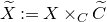 $\widetilde {X} := X\times _C \widetilde {C}$
. A torsion-free coherent sheaf
$\widetilde {X} := X\times _C \widetilde {C}$
. A torsion-free coherent sheaf $E$
of rank
$E$
of rank $r$
and with fiber degree
$r$
and with fiber degree $d$
on
$d$
on $\widetilde {X}$
is called
$\widetilde {X}$
is called $f$
-stable if it satisfies the following conditions.
$f$
-stable if it satisfies the following conditions.
-
(i) The sheaf
$E$
is locally free at the fibers of
$\widetilde {X} \to \widetilde {C}$
over singular and marked points. -
(ii) For any generic point
$\eta$
of
$\widetilde {C}$
, the restriction of
$E$
to the fiber
$\widetilde {X}_{\eta }$
over
$\eta$
is slope stable. -
(iii) For any marked or singular point
$c$
of
$\widetilde {C}$
, the restriction of
$E$
to the fiber over
$c$
is slope stable.


We extend this notion to arbitrary families.
Definition 3.2. Let $f:X_B\to C_B$
be a family of fibered surfaces over some base
$f:X_B\to C_B$
be a family of fibered surfaces over some base $B$
. Let
$B$
. Let $T$
be a
$T$
be a $\mathbb{C}$
-scheme. A family of
$\mathbb{C}$
-scheme. A family of $f$
-stable sheaves on an expansion of
$f$
-stable sheaves on an expansion of $X_B$
over
$X_B$
over $B$
, valued in
$B$
, valued in $T$
, is given by the following pieces of data:
$T$
, is given by the following pieces of data:
-
(i) a morphism
$T\to B$
, with pullback family
$X_T\to C_T$
, -
(ii) an expansion
$c:\widetilde {C}_T\to C_T$
with associated fibered surface
$\widetilde {X}_T:=X_T\times _{C_T}\widetilde {C}_T \to \widetilde {C}_T$
, -
(iii) a
$T$
-flat coherent sheaf
$E_T$
on
$\widetilde {X}$
such that, for every
$t\in T$
, the fiber
$E_t$
is
$f$
-stable for
$X_t\to C_t$
.





Let $f:X_B\to C_B$
be a family of fibered surfaces over some base
$f:X_B\to C_B$
be a family of fibered surfaces over some base $B$
.
$B$
.
Proposition 3.3.
There is an algebraic stack $\mathcal{M}_{X_B/C_B}(r,d)$
over
$\mathcal{M}_{X_B/C_B}(r,d)$
over $B$
parametrizing
$B$
parametrizing $f$
-stable sheaves of rank
$f$
-stable sheaves of rank $r$
and fiber degree
$r$
and fiber degree $d$
on expansions of
$d$
on expansions of $X_B$
over
$X_B$
over $B$
.
$B$
.
Remark 3.4. We make this explicit in the case $B=\textrm {Spec}{\mathbb{C}}$
. Say
$B=\textrm {Spec}{\mathbb{C}}$
. Say $X\to C$
is a fibered surface. Then a
$X\to C$
is a fibered surface. Then a $\mathbb{C}$
-point of
$\mathbb{C}$
-point of $\mathcal{M}_{X_B/C_B}(r,d)$
is given by a pair
$\mathcal{M}_{X_B/C_B}(r,d)$
is given by a pair $(c, E)$
, where
$(c, E)$
, where $c:\widetilde {C}\to C$
is an expansion of
$c:\widetilde {C}\to C$
is an expansion of $C$
and
$C$
and $E$
an
$E$
an $f$
-stable, rank-
$f$
-stable, rank- $r$
sheaf on the induced
$r$
sheaf on the induced $\widetilde {X}:= X\times _C\widetilde {C}$
with fiber degree
$\widetilde {X}:= X\times _C\widetilde {C}$
with fiber degree $d$
. We will sometimes write this as
$d$
. We will sometimes write this as $(\widetilde {X}, E)$
.
$(\widetilde {X}, E)$
.
An automorphism of the pair $(\widetilde {X}, E)$
is a pair
$(\widetilde {X}, E)$
is a pair $(g, \gamma )$
, where
$(g, \gamma )$
, where $g:\widetilde {X}\to \widetilde {X}$
is an automorphism that commutes with the contraction to
$g:\widetilde {X}\to \widetilde {X}$
is an automorphism that commutes with the contraction to $X$
, and
$X$
, and $\gamma :g^*E\to E$
is an isomorphism.
$\gamma :g^*E\to E$
is an isomorphism.
Proof. We work over the relative stack of expansions ${\textrm {Exp}}_{C_B/B}$
. Let
${\textrm {Exp}}_{C_B/B}$
. Let $c:\mathcal{C}\to C_B$
denote the universal expansion, and let
$c:\mathcal{C}\to C_B$
denote the universal expansion, and let $\mathcal{X}:=X_B\times _{C_B}\mathcal{C} \to \mathcal{C}$
denote the induced family of fibered surfaces over
$\mathcal{X}:=X_B\times _{C_B}\mathcal{C} \to \mathcal{C}$
denote the induced family of fibered surfaces over ${\textrm {Exp}}_{C_B/B}$
. Let
${\textrm {Exp}}_{C_B/B}$
. Let $\mathscr{M}(r,d)$
denote the stack of all torsion-free coherent sheaves of rank
$\mathscr{M}(r,d)$
denote the stack of all torsion-free coherent sheaves of rank $r$
and fiber degree
$r$
and fiber degree $d$
on
$d$
on $\mathcal{X}$
over
$\mathcal{X}$
over ${\textrm {Exp}}_{C_B/B}$
. Then, since being locally free and being slope stable are open conditions, one can see that the locus of those sheaves satisfying (i)-(iii) of Definition 3.1 is open. Thus, we get
${\textrm {Exp}}_{C_B/B}$
. Then, since being locally free and being slope stable are open conditions, one can see that the locus of those sheaves satisfying (i)-(iii) of Definition 3.1 is open. Thus, we get $\mathcal{M}_{X_B/C_B}(r,d)\subseteq \mathscr{M}(r,d)$
as the open locus of
$\mathcal{M}_{X_B/C_B}(r,d)\subseteq \mathscr{M}(r,d)$
as the open locus of $f$
-stable sheaves.
$f$
-stable sheaves.
Proposition 3.5.
The morphism $\mathcal{M}_{X_B/C_B}(r,d)\to B$
satisfies the existence part of the valuative criterion of properness.
$\mathcal{M}_{X_B/C_B}(r,d)\to B$
satisfies the existence part of the valuative criterion of properness.
Proof. We may assume that $B = \textrm {Spec}\,R$
for a DVR
$B = \textrm {Spec}\,R$
for a DVR $R$
with generic point
$R$
with generic point $\eta$
, that
$\eta$
, that $\widetilde {C}_{\eta }\to C_{\eta }$
is a given expansion of
$\widetilde {C}_{\eta }\to C_{\eta }$
is a given expansion of $C_B$
over
$C_B$
over $\eta$
and that
$\eta$
and that $E_{\eta }$
is an
$E_{\eta }$
is an $f$
-stable sheaf on
$f$
-stable sheaf on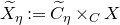 $\widetilde {X}_{\eta }:=\widetilde {C}_{\eta }\times _C X$
. Our goal is to show that we can extend this to a family of
$\widetilde {X}_{\eta }:=\widetilde {C}_{\eta }\times _C X$
. Our goal is to show that we can extend this to a family of $f$
-stable sheaves, possibly after passing to some extension of
$f$
-stable sheaves, possibly after passing to some extension of $R$
. By Corollary 2.7, we can at least extend
$R$
. By Corollary 2.7, we can at least extend $\widetilde {C}_{\eta }$
to some expansion
$\widetilde {C}_{\eta }$
to some expansion $\widetilde {C}_B$
over
$\widetilde {C}_B$
over $B=\textrm {Spec}\,R$
. For the proof, we may as well replace
$B=\textrm {Spec}\,R$
. For the proof, we may as well replace $C_{B}$
by
$C_{B}$
by $\widetilde {C}_B$
and hence assume that
$\widetilde {C}_B$
and hence assume that $\widetilde {C}_{\eta }\to C_{\eta }$
is an isomorphism. Let
$\widetilde {C}_{\eta }\to C_{\eta }$
is an isomorphism. Let $\xi$
denote the closed point of
$\xi$
denote the closed point of $\textrm {Spec}\,R$
.
$\textrm {Spec}\,R$
.
Case 1: $C_{\eta }$
is smooth. In this case, the desired result follows from Proposition 3.6 below.
$C_{\eta }$
is smooth. In this case, the desired result follows from Proposition 3.6 below.
Case 2: $C_{\eta }$
is of compact type. We proceed by induction on the number of components of
$C_{\eta }$
is of compact type. We proceed by induction on the number of components of $C_{\eta }$
. If there is only one component, we are in Case 1. Otherwise, we may decompose
$C_{\eta }$
. If there is only one component, we are in Case 1. Otherwise, we may decompose $C_{B} = C^1_{B}\cup _q C^2_{B}$
along any chosen node
$C_{B} = C^1_{B}\cup _q C^2_{B}$
along any chosen node $q$
that extends over the generic fiber. We add a marked point
$q$
that extends over the generic fiber. We add a marked point $q_i$
on each
$q_i$
on each $C^i_{B}$
where the node was. By inductive assumption, for each
$C^i_{B}$
where the node was. By inductive assumption, for each $i=1,2$
, we can find an expansion
$i=1,2$
, we can find an expansion $\widetilde {C}^i_B\to C^i_B$
that is an isomorphism over the generic fiber together with an
$\widetilde {C}^i_B\to C^i_B$
that is an isomorphism over the generic fiber together with an $f$
-stable sheaf
$f$
-stable sheaf $E^i$
on
$E^i$
on $\tilde {X}^i_B:= X_B\times _{C_B}\widetilde {C}^i_B$
extending the restriction of
$\tilde {X}^i_B:= X_B\times _{C_B}\widetilde {C}^i_B$
extending the restriction of $E_{\eta }$
. We denote the marked point on
$E_{\eta }$
. We denote the marked point on $\widetilde {C}^i_B$
lying over
$\widetilde {C}^i_B$
lying over $q_i$
again by
$q_i$
again by $q_i$
. In order to glue the total family back together over
$q_i$
. In order to glue the total family back together over $\textrm {Spec}\,R$
, we need to extend the isomorphism of
$\textrm {Spec}\,R$
, we need to extend the isomorphism of $E^1|_{q_1}$
and
$E^1|_{q_1}$
and $E^1|_{q_2}$
from
$E^1|_{q_2}$
from $\eta$
over all of
$\eta$
over all of $\textrm {Spec}\,R$
. But since these are fiberwise isomorphic families of stable sheaves, there exists such an extension, possibly after twisting one of
$\textrm {Spec}\,R$
. But since these are fiberwise isomorphic families of stable sheaves, there exists such an extension, possibly after twisting one of $E^1$
or
$E^1$
or $E^2$
by a multiple of
$E^2$
by a multiple of $\widetilde {X}_{\xi }^i$
. Here, we use Knudsen’s clutching construction [Reference KnudsenKnu83, Theorem 3.4] to glue the expansions
$\widetilde {X}_{\xi }^i$
. Here, we use Knudsen’s clutching construction [Reference KnudsenKnu83, Theorem 3.4] to glue the expansions $\widetilde {C}^i_B$
along the marked points.
$\widetilde {C}^i_B$
along the marked points.
Case 3: $C_{\eta }$
is arbitrary. We do an induction on the first Betti number of the dual graph of
$C_{\eta }$
is arbitrary. We do an induction on the first Betti number of the dual graph of $C_{\eta }$
. If it is zero, we are in Case 2. Otherwise, we may choose a non-separating node
$C_{\eta }$
. If it is zero, we are in Case 2. Otherwise, we may choose a non-separating node $q$
on
$q$
on $C_B$
that extends over the generic fiber and take a partial normalization
$C_B$
that extends over the generic fiber and take a partial normalization $\nu :C_B'\to C_B$
around
$\nu :C_B'\to C_B$
around $q$
, while remembering the preimage of the node through adding in markings
$q$
, while remembering the preimage of the node through adding in markings $q_{1}$
and
$q_{1}$
and $q_{2}$
. Then, by our inductive hypothesis, we can find some expansion
$q_{2}$
. Then, by our inductive hypothesis, we can find some expansion $\widetilde {C}'_{B}\to C_B'$
which is an isomorphism over
$\widetilde {C}'_{B}\to C_B'$
which is an isomorphism over $\eta$
and an extension
$\eta$
and an extension $E'$
of
$E'$
of $\nu ^*E_{\eta }$
to
$\nu ^*E_{\eta }$
to $\tilde {X}'_B:=X_B\times _{C_B} \widetilde {C}_B'$
. We again denote the lifts of
$\tilde {X}'_B:=X_B\times _{C_B} \widetilde {C}_B'$
. We again denote the lifts of $q_1,q_2$
to
$q_1,q_2$
to $\tilde {C}_B'$
by
$\tilde {C}_B'$
by $q_1,q_2$
. In order to glue together the total family along the markings
$q_1,q_2$
. In order to glue together the total family along the markings $q_1$
and
$q_1$
and $q_2$
, we need to produce an isomorphism
$q_2$
, we need to produce an isomorphism $E'|{q_{1}}\simeq E'|_{q_2}$
extending the given one over the generic fiber. As in the previous case, such an isomorphism exists after twisting, say,
$E'|{q_{1}}\simeq E'|_{q_2}$
extending the given one over the generic fiber. As in the previous case, such an isomorphism exists after twisting, say, $E'|_{q_1}$
along the preimage of
$E'|_{q_1}$
along the preimage of $\xi$
. However, since
$\xi$
. However, since $\widetilde {C}'_B$
is connected, it is a priori not clear how to do this without simultaneously changing
$\widetilde {C}'_B$
is connected, it is a priori not clear how to do this without simultaneously changing $E'|_{q_2}$
. To get around this issue, we may pass to a further expansion by blowing up
$E'|_{q_2}$
. To get around this issue, we may pass to a further expansion by blowing up $\widetilde {C}'_B$
along the intersection of
$\widetilde {C}'_B$
along the intersection of $q_1$
and the special fiber
$q_1$
and the special fiber $\widetilde {C}'_{\xi }$
. Then we can achieve the desired modification by twisting the pullback of
$\widetilde {C}'_{\xi }$
. Then we can achieve the desired modification by twisting the pullback of $E'$
by an integer multiple of the exceptional component.
$E'$
by an integer multiple of the exceptional component.
Proposition 3.6.
Let $R$
be a DVR with generic point
$R$
be a DVR with generic point $\eta$
and let
$\eta$
and let $X_R\to C_R \to \textrm {Spec}\,R$
be a family of fibered surfaces over
$X_R\to C_R \to \textrm {Spec}\,R$
be a family of fibered surfaces over $\textrm {Spec}\,R$
with
$\textrm {Spec}\,R$
with $C_{\eta }$
smooth over
$C_{\eta }$
smooth over $\eta$
. Let
$\eta$
. Let $E_{\eta }$
be an
$E_{\eta }$
be an $f$
-stable sheaf of rank
$f$
-stable sheaf of rank $r$
and fiber degree
$r$
and fiber degree $d$
on
$d$
on $X_{\eta }$
. Then, after possibly performing a base change on
$X_{\eta }$
. Then, after possibly performing a base change on $R$
, we can find an expansion
$R$
, we can find an expansion $\widetilde {C}_R\to C_R$
which is an isomorphism over
$\widetilde {C}_R\to C_R$
which is an isomorphism over $\eta$
and an
$\eta$
and an $f$
-stable sheaf
$f$
-stable sheaf $E_R$
on
$E_R$
on $\widetilde {X}_R$
.
$\widetilde {X}_R$
.
Proof. We may modify $C_R$
by repeatedly blowing up singular points to obtain a family with regular total space [Sta23, Tag 0CDE], which will automatically be an expansion of
$C_R$
by repeatedly blowing up singular points to obtain a family with regular total space [Sta23, Tag 0CDE], which will automatically be an expansion of $C_R$
. Without loss of generality, we may therefore assume that
$C_R$
. Without loss of generality, we may therefore assume that $C_R$
is nonsingular.
$C_R$
is nonsingular.
Let $\xi$
denote the closed point of
$\xi$
denote the closed point of $\textrm {Spec}\,R$
. By the argument in [Reference Gieseker and LiGL94, proof of the last statement of Proposition 3.3], after passing to some extension of
$\textrm {Spec}\,R$
. By the argument in [Reference Gieseker and LiGL94, proof of the last statement of Proposition 3.3], after passing to some extension of $R$
and further expanding
$R$
and further expanding $C_R$
over the special fiber, we can assume that
$C_R$
over the special fiber, we can assume that $E_{\eta }$
extends to a torsion-free coherent sheaf
$E_{\eta }$
extends to a torsion-free coherent sheaf $E_R$
on
$E_R$
on $X_R$
with the following properties.
$X_R$
with the following properties.
-
(a) The restriction of
$E_R$
to
$X_\xi$
is torsion-free. -
(b) The sheaf
$E_R$
is locally free along the fibers of
$X_\xi \to C_{\xi }$
over singular and marked points.


Let $P(C_{\xi })$
denote the collection of singular, marked and generic points of
$P(C_{\xi })$
denote the collection of singular, marked and generic points of $C_{\xi }$
. Unless
$C_{\xi }$
. Unless $E_R$
is
$E_R$
is $f$
-stable, there exists
$f$
-stable, there exists $x \in P(C_{\xi })$
such that the restriction
$x \in P(C_{\xi })$
such that the restriction $E_x$
of
$E_x$
of $E_R$
to the curve
$E_R$
to the curve $f^{-1}(x)$
is unstable. Let
$f^{-1}(x)$
is unstable. Let $a$
be the minimum of the values
$a$
be the minimum of the values $\mu _{min}(E_x)$
, where
$\mu _{min}(E_x)$
, where $\mu _{min}$
denotes the minimal slope in a Harder–Narasimhan filtration. Let
$\mu _{min}$
denotes the minimal slope in a Harder–Narasimhan filtration. Let $\rho$
be the maximum rank of a maximally destabilizing quotient of
$\rho$
be the maximum rank of a maximally destabilizing quotient of $E_{x}$
, ranging over those
$E_{x}$
, ranging over those $x\in P(C_{\xi })$
for which
$x\in P(C_{\xi })$
for which $\mu _{min}(E_x) = a$
. We claim that after taking a base change on
$\mu _{min}(E_x) = a$
. We claim that after taking a base change on $R$
and a further expansion of
$R$
and a further expansion of $C_R$
, we may find a different completion of
$C_R$
, we may find a different completion of $E_{\eta }$
such that either
$E_{\eta }$
such that either $a$
increases or
$a$
increases or $a$
stays the same and
$a$
stays the same and $\rho$
decreases. Since there are only finitely many possible values for
$\rho$
decreases. Since there are only finitely many possible values for $\rho$
, and since the set of possible values of
$\rho$
, and since the set of possible values of $a$
lies in
$a$
lies in ${\mathbb{Z}}/r$
and is bounded above by
${\mathbb{Z}}/r$
and is bounded above by $d/r$
, we find that after doing so finitely many times, we end up with an
$d/r$
, we find that after doing so finitely many times, we end up with an $f$
-stable extension of
$f$
-stable extension of $E_{\eta }$
.
$E_{\eta }$
.
To prove this claim, consider the relative Quot-scheme
 \begin{align*}q:\operatorname {Quot}_{E_R,X_R/C_R}(\rho ,a)\to C_R\end{align*}
parametrizing quotients of $E_R$
of rank
$E_R$
of rank $\rho$
and slope
$\rho$
and slope $a$
on the fibers of
$a$
on the fibers of $X_R\to C_R$
. By assumption, the image of
$X_R\to C_R$
. By assumption, the image of $q$
contains some points of
$q$
contains some points of $P(C_{\xi })$
. From the minimal choice of
$P(C_{\xi })$
. From the minimal choice of $a,\rho$
, it follows from an analysis of the relative deformation space that at each such point, the map
$a,\rho$
, it follows from an analysis of the relative deformation space that at each such point, the map $q$
is locally a closed embedding (see the proof of Theorem 5 in [Reference NitsureNit11]).
$q$
is locally a closed embedding (see the proof of Theorem 5 in [Reference NitsureNit11]).
We claim that, after passing to an extension of $R$
and further expanding
$R$
and further expanding $C_{R}$
along the special fiber, we can arrange that around each point in
$C_{R}$
along the special fiber, we can arrange that around each point in $P(C_{\xi })$
, the set-theoretic image of
$P(C_{\xi })$
, the set-theoretic image of $q$
is supported on
$q$
is supported on $C_{\xi }$
. This is equivalent to asking that the closure in
$C_{\xi }$
. This is equivalent to asking that the closure in $C_R$
of the set-theoretic image
$C_R$
of the set-theoretic image $\operatorname {Im} q|_{\eta }$
is disjoint from
$\operatorname {Im} q|_{\eta }$
is disjoint from $P(C_{\xi })$
. By
$P(C_{\xi })$
. By $f$
-stability,
$f$
-stability, $\operatorname {Im} q|_{\eta }$
is a finite collection of closed points of
$\operatorname {Im} q|_{\eta }$
is a finite collection of closed points of $C_{\eta }$
not meeting any nodes or marked points. After possibly passing to a finite extension of
$C_{\eta }$
not meeting any nodes or marked points. After possibly passing to a finite extension of $R$
, we may add new marked points
$R$
, we may add new marked points $\rho _{i,\eta }$
so that
$\rho _{i,\eta }$
so that $\operatorname {Im}q|_{\eta }$
is the union of the images of the
$\operatorname {Im}q|_{\eta }$
is the union of the images of the $\rho _{i,\eta }$
. Now the claim follows from the semistable reduction theorem for marked nodal curves. It follows that there is a closed subscheme
$\rho _{i,\eta }$
. Now the claim follows from the semistable reduction theorem for marked nodal curves. It follows that there is a closed subscheme $Z\subset C_R$
whose associated points are all in
$Z\subset C_R$
whose associated points are all in $P(C_{\xi })$
and such that around each of its associated points it agrees with the closed subscheme defined by the Quot-scheme.
$P(C_{\xi })$
and such that around each of its associated points it agrees with the closed subscheme defined by the Quot-scheme.
If $Z$
contains a component
$Z$
contains a component $C_i$
of
$C_i$
of $C_{\xi }$
, we may replace
$C_{\xi }$
, we may replace $E_R$
by the elementary modification of
$E_R$
by the elementary modification of $E_R$
along a maximally destabilizing quotient on that component. By the minimal choice of
$E_R$
along a maximally destabilizing quotient on that component. By the minimal choice of $a$
and
$a$
and $\rho$
, the resulting sheaf will still be locally free at fibers over marked points and nodes. This has the effect of dividing the ideal sheaf of
$\rho$
, the resulting sheaf will still be locally free at fibers over marked points and nodes. This has the effect of dividing the ideal sheaf of $Z$
by the uniformizer of that component. Thus, if
$Z$
by the uniformizer of that component. Thus, if $Z$
is locally principal, one can do so until
$Z$
is locally principal, one can do so until $Z$
becomes empty, in which case there is no point left in
$Z$
becomes empty, in which case there is no point left in $P(C_{\xi })$
with maximally destabilizing subsheaf of slope
$P(C_{\xi })$
with maximally destabilizing subsheaf of slope $a$
and rank
$a$
and rank $\rho$
. If
$\rho$
. If $Z$
is not locally principal, one can use Lemma 3.7 to find an extension
$Z$
is not locally principal, one can use Lemma 3.7 to find an extension $R'$
of
$R'$
of $R$
and an expansion
$R$
and an expansion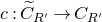 $c:\widetilde {C}_{R'}\to C_{R'}$
over
$c:\widetilde {C}_{R'}\to C_{R'}$
over $R'$
which is trivial over the generic fiber such that the scheme-theoretic preimage of
$R'$
which is trivial over the generic fiber such that the scheme-theoretic preimage of $Z$
in
$Z$
in $\widetilde {C}_{R'}$
is principal. Since the relative Quot-scheme is compatible with pullback, this reduces to the case that
$\widetilde {C}_{R'}$
is principal. Since the relative Quot-scheme is compatible with pullback, this reduces to the case that $Z$
is principal, which we already treated.
$Z$
is principal, which we already treated.
Lemma 3.7.
Let $\pi :C_R\to \textrm {Spec}\,R$
be a nodal marked curve over a DVR
$\pi :C_R\to \textrm {Spec}\,R$
be a nodal marked curve over a DVR $R$
with closed point
$R$
with closed point $\xi$
. Suppose that
$\xi$
. Suppose that $\pi$
has smooth generic fiber and that
$\pi$
has smooth generic fiber and that $C_R$
is regular. Let
$C_R$
is regular. Let $Z\subset C_R$
be a closed subscheme supported on
$Z\subset C_R$
be a closed subscheme supported on $C_{\xi }$
whose associated points are special, marked or generic points of components of the special fiber. Then there is an extension of DVRs
$C_{\xi }$
whose associated points are special, marked or generic points of components of the special fiber. Then there is an extension of DVRs $R\subset R'$
and an expansion
$R\subset R'$
and an expansion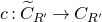 $c:\widetilde {C}_{R'}\to C_{R'}$
which is trivial over the generic point of
$c:\widetilde {C}_{R'}\to C_{R'}$
which is trivial over the generic point of $R'$
such that
$R'$
such that $c^{-1}(Z)$
has no marked points or nodes of
$c^{-1}(Z)$
has no marked points or nodes of $\widetilde {C}_{\xi }$
as associated points.
$\widetilde {C}_{\xi }$
as associated points.
Proof. We first argue that by repeatedly blowing up at marked points, one can achieve that the preimage of $Z$
is principal around each marked point. Working étale locally around a marked point
$Z$
is principal around each marked point. Working étale locally around a marked point $x$
, we may assume that
$x$
, we may assume that $Z$
is supported at
$Z$
is supported at $x$
and that the family is locally given by
$x$
and that the family is locally given by $\textrm {Spec}\,R[t]\to \textrm {Spec}\,R$
, with the section given by
$\textrm {Spec}\,R[t]\to \textrm {Spec}\,R$
, with the section given by $t=0$
. Let
$t=0$
. Let $\pi$
be a uniformizer of
$\pi$
be a uniformizer of $R$
. Let
$R$
. Let $Z_{\pi }$
and
$Z_{\pi }$
and $Z_t$
be the intersections of
$Z_t$
be the intersections of $Z$
with the loci
$Z$
with the loci $(\pi=0)$
and
$(\pi=0)$
and $(t=0)$
respectively. We claim that the invariant
$(t=0)$
respectively. We claim that the invariant $\ell (Z_{\pi })+\ell (Z_{t})$
decreases for the preimage of
$\ell (Z_{\pi })+\ell (Z_{t})$
decreases for the preimage of $Z$
on the blowup. Indeed, the new marked point on the blowup is cut out by coordinates
$Z$
on the blowup. Indeed, the new marked point on the blowup is cut out by coordinates $\pi , u$
, where
$\pi , u$
, where $t= \pi u$
. There exist elements
$t= \pi u$
. There exist elements $g_1 = t^a+\pi f_1$
and
$g_1 = t^a+\pi f_1$
and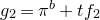 $g_2 = \pi ^b +t f_2$
in the defining ideal
$g_2 = \pi ^b +t f_2$
in the defining ideal $I_Z$
of
$I_Z$
of $Z$
, where
$Z$
, where $a=\ell (Z_{\pi })$
and
$a=\ell (Z_{\pi })$
and $b = \ell (Z_{t})$
. Let also
$b = \ell (Z_{t})$
. Let also $k$
be maximal so that
$k$
be maximal so that $I_Z\subseteq (\pi ,t)^k$
. Thus,
$I_Z\subseteq (\pi ,t)^k$
. Thus, $q^{-1}Z$
contains the exceptional divisor to order at least
$q^{-1}Z$
contains the exceptional divisor to order at least $k$
. Note that
$k$
. Note that $1\leqslant k\leqslant a,b$
. Let
$1\leqslant k\leqslant a,b$
. Let $\widetilde {Z}$
be the non-principal part of
$\widetilde {Z}$
be the non-principal part of $q^{-1 }Z$
at the marked point. Then by a direct computation, one has
$q^{-1 }Z$
at the marked point. Then by a direct computation, one has
 \begin{align*} \ell (\widetilde {Z}_\pi ) & \leqslant k,\\ \ell (\widetilde {Z}_u) & \leqslant b - k. \end{align*}
In particular, $\ell (\widetilde {Z}_\pi ) +\ell (\widetilde {Z}_\pi ) \leqslant b \lt \ell (Z_\pi ) +\ell (Z_t)$
. Essentially the same argument works for
$\ell (\widetilde {Z}_\pi ) +\ell (\widetilde {Z}_\pi ) \leqslant b \lt \ell (Z_\pi ) +\ell (Z_t)$
. Essentially the same argument works for $x$
a node in
$x$
a node in $C_{\xi }$
, where one has parameters
$C_{\xi }$
, where one has parameters $s,t$
locally cutting out the components of
$s,t$
locally cutting out the components of $C_{\xi }$
at
$C_{\xi }$
at $x$
. Here, one needs to repeatedly blow up the nodes in the reduced preimage of
$x$
. Here, one needs to repeatedly blow up the nodes in the reduced preimage of $C_{\xi }$
. This yields a modification
$C_{\xi }$
. This yields a modification $\widehat {C}_R\to C_{R}$
, which principalizes
$\widehat {C}_R\to C_{R}$
, which principalizes $Z$
and is an isomorphism over the generic fiber, but where the fiber
$Z$
and is an isomorphism over the generic fiber, but where the fiber $\widehat {C}_\xi$
may have non-reduced components. After taking a ramified extension
$\widehat {C}_\xi$
may have non-reduced components. After taking a ramified extension $R'$
of
$R'$
of $R$
with sufficiently divisible degree, taking the normalization of
$R$
with sufficiently divisible degree, taking the normalization of $\widehat {C}_{R'}$
and resolving the singularities through repeated blowups, we obtain an expansion of
$\widehat {C}_{R'}$
and resolving the singularities through repeated blowups, we obtain an expansion of $\widetilde {C}_{R'} \to C_{R'}$
with the desired properties.
$\widetilde {C}_{R'} \to C_{R'}$
with the desired properties.
3.2 Fixing twists from the base
In the last subsection, we saw that the moduli stack $\mathcal{M}_{X_B/C_B}(r,d)$
satisfies the existence part of the valuative criterion of properness. To get a proper moduli space, we need to introduce a further numerical stability condition which fixes twists by line bundles from
$\mathcal{M}_{X_B/C_B}(r,d)$
satisfies the existence part of the valuative criterion of properness. To get a proper moduli space, we need to introduce a further numerical stability condition which fixes twists by line bundles from $C_B$
. For stability of line bundles on a curve, we heavily use ideas from [Reference Oda and SeshadriOS79] and [Reference Esteves and PaciniEP16].
$C_B$
. For stability of line bundles on a curve, we heavily use ideas from [Reference Oda and SeshadriOS79] and [Reference Esteves and PaciniEP16].
Here, we fix $g\geqslant 0$
and consider only fibered surfaces
$g\geqslant 0$
and consider only fibered surfaces $f:X\to C$
whose fibers have arithmetic genus
$f:X\to C$
whose fibers have arithmetic genus $g$
.
$g$
.
For a marked nodal curve $C$
over a field, let
$C$
over a field, let $\operatorname {Irr}(C)$
denote the set of irreducible components of
$\operatorname {Irr}(C)$
denote the set of irreducible components of $C$
. For a line bundle
$C$
. For a line bundle $N$
on
$N$
on $C$
, we use
$C$
, we use $\deg L$
to denote the total degree and
$\deg L$
to denote the total degree and $\underline {\textrm {deg}}\,L$
to denote the component-wise degree, which is a function on
$\underline {\textrm {deg}}\,L$
to denote the component-wise degree, which is a function on $\operatorname {Irr}(C)$
.
$\operatorname {Irr}(C)$
.
Definition 3.8.
-
(i) Let
$C$
be a marked nodal curve over a field. A stability condition on
$C$
is a map
$\alpha : \operatorname {Irr}(C)\to \mathbb{R}$
. We define the degree of
$\alpha$
as
$\sum _{D\in \operatorname {Irr}(C)} \alpha (D)$
. -
(ii) Let
$C_B\to B$
be a family of marked nodal curves. A stability condition on
$C_B$
over
$B$
is given by a collection of stability conditions
$(\alpha _x)$
for each field-valued point
$x$
of
$B$
, which are compatible in the following sense: if
$\eta$
specializes to
$\xi$
in
$B$
, there is an induced surjective morphism
$\operatorname {Irr}(C_{\xi })\to \operatorname {Irr}(C_\eta )$
. We require that for each
$D\in \operatorname {Irr}(C_{\eta })$
, we have that
$\alpha _{\eta }(D)$
is equal to the sum of
$\alpha _{\xi }(D')$
for
$D'$
mapping to
$D$
.





Remark 3.9. It follows that for a family of curves over a finite type base $B$
, a stability condition is uniquely defined by its values on the most degenerate strata. For example, if
$B$
, a stability condition is uniquely defined by its values on the most degenerate strata. For example, if $B$
is the spectrum of a DVR, then giving a stability condition on
$B$
is the spectrum of a DVR, then giving a stability condition on $C_B$
is the same as giving one over the special fiber.
$C_B$
is the same as giving one over the special fiber.
Let $X\to C$
be a given fibration over a nodal marked curve, and let
$X\to C$
be a given fibration over a nodal marked curve, and let $E$
be an
$E$
be an $f$
-stable sheaf on an expansion
$f$
-stable sheaf on an expansion $\widetilde {X}\to \widetilde {C}$
.
$\widetilde {X}\to \widetilde {C}$
.
Definition 3.10.
-
(i) We say that a component of
$\widetilde {C}$
(resp., of
$\widetilde {X}$
) is exceptional if it is contracted by
$\widetilde {C}\to C$
(resp., by
$\widetilde {X}\to X$
). -
(ii) We say that the expansion
$\widetilde {X}$
is minimal if there is no intermediate expansion
$\widetilde {X}\to \widetilde {X}' \to X$
such that
$E$
is isomorphic to a pullback from
$\widetilde {X}'$
.





We use the following abuse of notation: let $\widetilde {C} \to C$
be an expansion and
$\widetilde {C} \to C$
be an expansion and $\alpha$
a stability condition on
$\alpha$
a stability condition on $C$
. For
$C$
. For $D\subset \widetilde {C}$
an irreducible component, we set
$D\subset \widetilde {C}$
an irreducible component, we set
 \begin{align*} \alpha (D):= \left\{\begin{array}{l@{\quad}l} 0, & \textrm{if}\; D\; \textrm{is}\; \textrm{exceptional,}\\ \alpha (c(D)), & \textrm{if}\; D\; \textrm{maps}\; \textrm{isomorphically}\; \textrm{to}\; \textrm{its}\; \textrm{image.}\end{array} \right. \end{align*}
For the rest of this subsection, let $f:X_B\to C_B$
be a family of fibered surfaces with genus
$f:X_B\to C_B$
be a family of fibered surfaces with genus $g$
fibers over a base
$g$
fibers over a base $B$
. Let
$B$
. Let $L_0$
be a line bundle on
$L_0$
be a line bundle on $X_B$
which has positive degree
$X_B$
which has positive degree $d_0$
on each fiber over
$d_0$
on each fiber over $C_B$
. Let
$C_B$
. Let $0\leqslant k\lt r$
be the unique integer such that
$0\leqslant k\lt r$
be the unique integer such that $kd - rk' = 1$
for some
$kd - rk' = 1$
for some $k'\in \mathbb{Z}$
. Define
$k'\in \mathbb{Z}$
. Define $W:= L_0^{\otimes (g-1)r-d}\oplus \mathcal{O}_X^{\oplus d_0r-1}$
. For any coherent sheaf
$W:= L_0^{\otimes (g-1)r-d}\oplus \mathcal{O}_X^{\oplus d_0r-1}$
. For any coherent sheaf $E$
on
$E$
on $X$
of finite cohomological dimension, consider the line bundle
$X$
of finite cohomological dimension, consider the line bundle
 \begin{align} M(E):= \frac {\det Rf_*((\det E)\otimes L_0) }{\det Rf_*(\det E)} \otimes \left (\det Rf_*(E\otimes W)\right )^{\otimes k}. \end{align}
We similarly define $M(E)$
for any expansion of
$M(E)$
for any expansion of $X_B$
by pulling back
$X_B$
by pulling back $L_0$
.
$L_0$
.
Remark 3.11. This definition is chosen so that $M$
has the following two properties whenever
$M$
has the following two properties whenever $E$
has rank
$E$
has rank $r$
and degree
$r$
and degree $d$
on fibers of
$d$
on fibers of $f$
, which is all that we will use in what follows.
$f$
, which is all that we will use in what follows.
-
(i) (Non-zero weight.) For any line bundle
$N$
on
$C_B$
, we have
\begin{align*}M(E\otimes f^* N) = M(E)\otimes N^{d_0 r}.\end{align*}
-
(ii) (Normalizable on exceptional components.) Consider the base change
$\widetilde {X}\to \widetilde {C}$
of
$f$
to any geometric point of
$B$
. Then for any exceptional component
$D\subset \widetilde {C}$
, we have that
$M(E)|_{D}$
has degree an integer multiple of
$d_0r$
.


The first property can be seen directly from Grothendieck–Riemann–Roch. The second is a consequence of Lemma 2.10.
We let $\alpha$
be a stability condition on
$\alpha$
be a stability condition on $C_B$
over
$C_B$
over $B$
. For a subcurve
$B$
. For a subcurve $Z\subset C$
of a nodal marked curve, we let
$Z\subset C$
of a nodal marked curve, we let $Z^c$
denote the ‘complementary’ subcurve formed by the union of components of
$Z^c$
denote the ‘complementary’ subcurve formed by the union of components of $C$
not contained in
$C$
not contained in $Z$
.
$Z$
.
First, we consider the case where $X\to C$
is a fibered surface over a field base
$X\to C$
is a fibered surface over a field base $B=\textrm {Spec}\,k$
. The following definition is essentially a version of Oda–Seshadri’s stability for torsion-free rank-one sheaves [Reference Oda and SeshadriOS79, Equation (∗∗∗) on page 8], but phrased for line bundles on an expansion, following the ideas of [Reference Esteves and PaciniEP16]. We will make this connection explicit in Lemma 3.17 below.
$B=\textrm {Spec}\,k$
. The following definition is essentially a version of Oda–Seshadri’s stability for torsion-free rank-one sheaves [Reference Oda and SeshadriOS79, Equation (∗∗∗) on page 8], but phrased for line bundles on an expansion, following the ideas of [Reference Esteves and PaciniEP16]. We will make this connection explicit in Lemma 3.17 below.
Definition 3.12. Let $\widetilde {X}\to X$
be an expansion. We say that an
$\widetilde {X}\to X$
be an expansion. We say that an $f$
-stable sheaf
$f$
-stable sheaf $E$
on
$E$
on $\widetilde {X}$
is
$\widetilde {X}$
is $\alpha$
-balanced if:
$\alpha$
-balanced if:
-
(1) for each proper subcurve
$\emptyset \subsetneq Z \subsetneq \widetilde {C}$
of
$\widetilde {C}$
we have(4)
\begin{align} \left | \frac {\deg M(E)|_Z}{rd_0 } - \sum _{D\subset Z} \alpha (D) \right | \leqslant \frac {\#(Z\cap Z^c)}{2} , \end{align}
-
(2) for each exceptional component
$D\subset \widetilde {C}$
we have that
$\deg M(E)|_D$
is non-negative.


Moreover, we say that $E$
is strictly
$E$
is strictly $\alpha$
-balanced if:
$\alpha$
-balanced if:
-
(3) whenever we have equality in (4), then one of
$Z$
or
$Z^c$
is a union of exceptional components.


One can see that (strict) $\alpha$
-balancedness is an open condition in families of
$\alpha$
-balancedness is an open condition in families of $f$
-stable sheaves, so this definition gives a well-behaved moduli functor for families over a general base
$f$
-stable sheaves, so this definition gives a well-behaved moduli functor for families over a general base $B$
.
$B$
.
Example 3.13. In Definition 3.12, let $Z\subset \widetilde {C}$
be a chain of exceptional components. If
$Z\subset \widetilde {C}$
be a chain of exceptional components. If $Z$
maps to a marked point, (4) requires that
$Z$
maps to a marked point, (4) requires that $M(E)$
has degree zero on all components of
$M(E)$
has degree zero on all components of $Z$
. If
$Z$
. If $Z$
maps to a node, then (4) requires that there is at most one component
$Z$
maps to a node, then (4) requires that there is at most one component $D$
of
$D$
of $Z$
on which
$Z$
on which $M(E)$
has non-zero degree, in which case
$M(E)$
has non-zero degree, in which case $\deg M(E)|_D = rd_0$
.
$\deg M(E)|_D = rd_0$
.
Definition 3.14. We let $\mathcal{M}^{\alpha }_{X_B/C_B}(r,d)\subseteq \mathcal{M}_{X_B/C_B}(r,d)$
denote the open substack consisting of
$\mathcal{M}^{\alpha }_{X_B/C_B}(r,d)\subseteq \mathcal{M}_{X_B/C_B}(r,d)$
denote the open substack consisting of $\alpha$
-balanced sheaves on minimal expansions.
$\alpha$
-balanced sheaves on minimal expansions.
Proposition 3.15.
The stack $\mathcal{M}^{\alpha }_{X_B/C_B}(r,d)$
satisfies the existence part of the valuative criterion of properness.
$\mathcal{M}^{\alpha }_{X_B/C_B}(r,d)$
satisfies the existence part of the valuative criterion of properness.
Proof. Let $R$
be a DVR with generic and closed points
$R$
be a DVR with generic and closed points $\eta$
and
$\eta$
and $\xi$
and with a given morphism
$\xi$
and with a given morphism $\textrm {Spec}\,R\to B$
. Let
$\textrm {Spec}\,R\to B$
. Let $E_{\eta }$
be a sheaf on an expansion
$E_{\eta }$
be a sheaf on an expansion $\widetilde {X}_{\eta }\to \widetilde {C}_{\eta }$
of
$\widetilde {X}_{\eta }\to \widetilde {C}_{\eta }$
of $X_{\eta }\to C_{\eta }$
such that
$X_{\eta }\to C_{\eta }$
such that $E_{\eta }$
is
$E_{\eta }$
is $f$
-stable and
$f$
-stable and $\alpha$
-balanced. By Proposition 3.6, we can find some extension
$\alpha$
-balanced. By Proposition 3.6, we can find some extension $\widetilde {X}_R\to \widetilde {C}_R$
of this data to an
$\widetilde {X}_R\to \widetilde {C}_R$
of this data to an $f$
-stable family
$f$
-stable family $E_R$
(possibly after replacing
$E_R$
(possibly after replacing $R$
by an extension). We claim that we can modify this data to obtain an
$R$
by an extension). We claim that we can modify this data to obtain an $\alpha$
-balanced bundle on a minimal expansion.
$\alpha$
-balanced bundle on a minimal expansion.
For this, pick a line bundle $N_0$
on
$N_0$
on $\widetilde {C}_R$
that has degree zero on exceptional components of
$\widetilde {C}_R$
that has degree zero on exceptional components of $\widetilde {C}_{\xi }$
and such that
$\widetilde {C}_{\xi }$
and such that $ M(E_R)\otimes N_0$
has degree a multiple of
$ M(E_R)\otimes N_0$
has degree a multiple of $rd_0$
on each component of
$rd_0$
on each component of $C_{\xi }$
(this may require further extending
$C_{\xi }$
(this may require further extending $R$
). This is possible by Remark 3.11 (ii). Then, further extending
$R$
). This is possible by Remark 3.11 (ii). Then, further extending $R$
if needed, we can pick
$R$
if needed, we can pick $N_1$
on
$N_1$
on $\widetilde {C}_R$
such that
$\widetilde {C}_R$
such that $\underline {\deg }\, N_1|_{\widetilde {C}_\xi }^{\otimes rd_0} = \underline {\deg } \,(M(E|_{Z})\otimes N_0)|_{\widetilde {C}_{\xi }}$
. By changing
$\underline {\deg }\, N_1|_{\widetilde {C}_\xi }^{\otimes rd_0} = \underline {\deg } \,(M(E|_{Z})\otimes N_0)|_{\widetilde {C}_{\xi }}$
. By changing $N_0$
, we may in fact assume without loss of generality that
$N_0$
, we may in fact assume without loss of generality that $N_1^{\otimes r d_0} \cong M(E) \otimes N_0$
on
$N_1^{\otimes r d_0} \cong M(E) \otimes N_0$
on $\widetilde {C}_R$
.
$\widetilde {C}_R$
.
Now consider the stability condition $\alpha' := \alpha + \underline {\textrm {deg}} \, N_0 / (r d_0)$
. Then we have the following lemma.
$\alpha' := \alpha + \underline {\textrm {deg}} \, N_0 / (r d_0)$
. Then we have the following lemma.
Lemma 3.16.
A sheaf $E$
is
$E$
is $\alpha$
-balanced if and only if
$\alpha$
-balanced if and only if $N_1$
is
$N_1$
is $\alpha'$
-semistable in the following sense:
$\alpha'$
-semistable in the following sense: $N_1$
has non-negative degree on exceptional components, and for every subcurve
$N_1$
has non-negative degree on exceptional components, and for every subcurve $\emptyset \subsetneq Z \subsetneq \widetilde {C}$
, we have
$\emptyset \subsetneq Z \subsetneq \widetilde {C}$
, we have
 \begin{align*}\left | \deg N_1|_Z - \sum _{D\subset Z} \alpha'(D) \right | \leqslant \frac {\# (Z\cap Z^c)}{2}.\end{align*}
Proof. Let $\emptyset \subsetneq Z \subsetneq \widetilde {C}$
be a subcurve. Then
$\emptyset \subsetneq Z \subsetneq \widetilde {C}$
be a subcurve. Then
 \begin{align*}\deg N_1|_{Z} = \frac {\deg M(E)|_Z}{rd_0} + \frac {\deg N_0|_Z}{rd_0}\end{align*}
and
 \begin{align*}\sum _{D\subset Z} \alpha '(D) = \sum _{D\subset Z} \alpha (D) + \frac {\deg N_0|_D}{r d_0} = \sum _{D\subset Z} \alpha (D) + \frac {\deg N_0|_{Z}}{rd_0},\end{align*}
so
 \begin{align*}\left | \deg N_1|_Z - \sum _{D\subset Z} \alpha '(D) \right | = \left | \frac {\deg M(E)|_Z}{rd_0 } - \sum _{D\subset Z} \alpha (D) \right |.\end{align*}
Since also the degree of $N_1$
on exceptional components is equal to a positive multiple of the degree of
$N_1$
on exceptional components is equal to a positive multiple of the degree of $M(E)$
, the lemma follows.
$M(E)$
, the lemma follows.
We consider the coherent sheaf $N_1':=c_*N_1$
on
$N_1':=c_*N_1$
on $C_R$
with adjunction map
$C_R$
with adjunction map $\psi :c^*N_1'\to N_1$
. If this is surjective, we obtain an induced map
$\psi :c^*N_1'\to N_1$
. If this is surjective, we obtain an induced map $P:\widetilde {C}_{R}\to \mathbb{P}(N_1')$
.
$P:\widetilde {C}_{R}\to \mathbb{P}(N_1')$
.
Lemma 3.17.
The following are equivalent (over the generic and closed point of $R$
respectively).
$R$
respectively).
-
(i) The line bundle
$N_1$
is
$\alpha '$
-semistable in the sense of Lemma 3.16
. -
-
(ii) (a) The sheaf
$N_1'$
is torsion-free, the morphism
$\psi$
is surjective and identifies
$N_1$
with the pullback along
$P$
of the universal quotient of
$N_1'$
, and
-
(b)
$N_1'$
is Oda–Seshadri
$\alpha '$
-semistable in the sense of [Reference Kass and PaganiKP19, Definition 4.1].
-


Proof. By the arguments in [Reference Esteves and PaciniEP16, § 5], it follows that (ii) (a) is equivalent to the condition that $N_1$
has only degrees
$N_1$
has only degrees $0,1$
on exceptional components and total degree at most
$0,1$
on exceptional components and total degree at most $1$
on each chain of exceptional components.
$1$
on each chain of exceptional components.
Then, one can check by hand that $\alpha '$
-stability for
$\alpha '$
-stability for $N_1$
(in the sense of Lemma 3.16) and Oda–Seshadri
$N_1$
(in the sense of Lemma 3.16) and Oda–Seshadri $\alpha '$
-semistability for
$\alpha '$
-semistability for $N_1'$
are equivalent by using a destabilizing subcurve for the one to construct one for the other. See also [Reference Esteves and PaciniEP16, Proposition] for the argument for a specific choice of stability condition.
$N_1'$
are equivalent by using a destabilizing subcurve for the one to construct one for the other. See also [Reference Esteves and PaciniEP16, Proposition] for the argument for a specific choice of stability condition.
As in [Reference Kass and PaganiKP19, Corollary 4.3], it follows from Simpson stability that any $\alpha '$
-semistable torsion-free sheaf on the generic fiber has an
$\alpha '$
-semistable torsion-free sheaf on the generic fiber has an $\alpha '$
-semistable limit. Let
$\alpha '$
-semistable limit. Let $N'_2$
be an
$N'_2$
be an $\alpha '$
-semistable limit that agrees with
$\alpha '$
-semistable limit that agrees with $N_1'$
on the generic fiber. After possibly further expanding
$N_1'$
on the generic fiber. After possibly further expanding $\widetilde {C}_{\xi }$
, we can assume that we have a morphism
$\widetilde {C}_{\xi }$
, we can assume that we have a morphism $P_2:\widetilde {C}_R\to \mathbb{P}(N_2')$
and denote by
$P_2:\widetilde {C}_R\to \mathbb{P}(N_2')$
and denote by $N_2$
the pullback of the universal line bundle along
$N_2$
the pullback of the universal line bundle along $P_2$
. Note that this implies that
$P_2$
. Note that this implies that $N_1$
and
$N_1$
and $N_2$
are isomorphic over
$N_2$
are isomorphic over $\eta$
. We consider the line bundle
$\eta$
. We consider the line bundle $N_E:=N_2\otimes N_1^{\vee }$
on
$N_E:=N_2\otimes N_1^{\vee }$
on $\widetilde {C}_R$
.
$\widetilde {C}_R$
.
Claim: The sheaf $E_1:= E\otimes f^*N_E$
is
$E_1:= E\otimes f^*N_E$
is $\alpha$
-balanced.
$\alpha$
-balanced.
To see this, note that $M(E_1) = M(E)\otimes N_E^{rd_0}$
. Therefore,
$M(E_1) = M(E)\otimes N_E^{rd_0}$
. Therefore,
 \begin{align*}\underline {\textrm {deg}} \; M(E_1) = \underline {\textrm {deg}}\; M(E) +rd_0(\underline {\textrm {deg}} \; N_2 -\underline {\textrm {deg}} \; N_1) = -\underline {\textrm {deg}}\; N_0 +rd_0\;\underline {\textrm {deg}}\; N_2.\end{align*}
In particular, using the reverse direction of Lemma 3.17 and Lemma 3.16, we find that $N_2$
is
$N_2$
is $\alpha '$
-stable and that
$\alpha '$
-stable and that $E_1$
is
$E_1$
is $\alpha$
-balanced. Since
$\alpha$
-balanced. Since $N_E$
is trivial along
$N_E$
is trivial along $\widetilde {X}_{\eta }$
, we find that
$\widetilde {X}_{\eta }$
, we find that $E_1$
is an
$E_1$
is an $\alpha$
-balanced extension of
$\alpha$
-balanced extension of $E_{\eta }$
.
$E_{\eta }$
.
Finally, one can obtain a minimal expansion $\widetilde {C}$
by contracting the components
$\widetilde {C}$
by contracting the components $D$
of
$D$
of $\widetilde {C}_{\xi }$
over which
$\widetilde {C}_{\xi }$
over which $E_1$
is isomorphic to a pullback along
$E_1$
is isomorphic to a pullback along $F\times D\to F$
, where
$F\times D\to F$
, where $F$
is the fiber of
$F$
is the fiber of $X_{\xi }\to C_{\xi }$
over the image of
$X_{\xi }\to C_{\xi }$
over the image of $D$
. Since we assumed that
$D$
. Since we assumed that $\widetilde {X}_{\eta }\to \widetilde {C}_{\eta }$
was minimal, one can do this contraction without affecting the generic point. This uses that every component of
$\widetilde {X}_{\eta }\to \widetilde {C}_{\eta }$
was minimal, one can do this contraction without affecting the generic point. This uses that every component of $\widetilde {X}_{\eta }$
contains in its closure at least one component that is not contracted, which one can see, for example, using Lemma 2.11.
$\widetilde {X}_{\eta }$
contains in its closure at least one component that is not contracted, which one can see, for example, using Lemma 2.11.
Proposition 3.18.
Let $E$
be a strictly
$E$
be a strictly $\alpha$
-balanced
$\alpha$
-balanced $f$
-stable sheaf on an expansion
$f$
-stable sheaf on an expansion $\widetilde {X}\to \widetilde {C}$
. Then the subgroup of scalar automorphisms has finite index in the automorphism group of
$\widetilde {X}\to \widetilde {C}$
. Then the subgroup of scalar automorphisms has finite index in the automorphism group of $(E,\widetilde {X})$
.
$(E,\widetilde {X})$
.
Proof. By $f$
-stability, every automorphism of
$f$
-stability, every automorphism of $E$
as a sheaf on
$E$
as a sheaf on $\widetilde {X}$
must be scalar: since the restriction to each fiber over a generic point
$\widetilde {X}$
must be scalar: since the restriction to each fiber over a generic point $\eta$
of
$\eta$
of $\widetilde {C}$
is geometrically stable, any automorphism must be scalar over a dense open of
$\widetilde {C}$
is geometrically stable, any automorphism must be scalar over a dense open of $\widetilde {C}$
, and therefore scalar, since
$\widetilde {C}$
, and therefore scalar, since $\widetilde {C}$
is reduced and
$\widetilde {C}$
is reduced and $E$
is flat over
$E$
is flat over $\widetilde {C}$
.
$\widetilde {C}$
.
In particular, for every automorphism $\gamma$
of
$\gamma$
of $\widetilde {C}$
over
$\widetilde {C}$
over $C$
, there exists at most one isomorphism
$C$
, there exists at most one isomorphism $\phi :\gamma ^* E\to E$
up to scaling. On the other hand, each automorphism of
$\phi :\gamma ^* E\to E$
up to scaling. On the other hand, each automorphism of $\widetilde {C}$
is given by scaling exceptional components. Let
$\widetilde {C}$
is given by scaling exceptional components. Let $D\subset \widetilde {C}$
be an exceptional component. By restricting to
$D\subset \widetilde {C}$
be an exceptional component. By restricting to $D$
, we may assume without loss of generality that
$D$
, we may assume without loss of generality that $D=\mathbb{P}^1$
and that
$D=\mathbb{P}^1$
and that $\gamma$
acts by multiplication with
$\gamma$
acts by multiplication with $a\in \mathbb{G}_m$
. Then the restriction
$a\in \mathbb{G}_m$
. Then the restriction $E_D$
of
$E_D$
of $E$
to
$E$
to $X_D=\mathbb{P}^1\times F$
is stable on the generic fiber over
$X_D=\mathbb{P}^1\times F$
is stable on the generic fiber over $\mathbb{P}^1$
(and over the fibers over
$\mathbb{P}^1$
(and over the fibers over $0,\infty$
). If the map
$0,\infty$
). If the map $\nu _E:\mathbb{P}^1\to M_F(r,d)$
induced by
$\nu _E:\mathbb{P}^1\to M_F(r,d)$
induced by $E_D$
is non-trivial, then it is finite onto its image and
$E_D$
is non-trivial, then it is finite onto its image and $a$
must preserve the fibers of
$a$
must preserve the fibers of $\nu _E$
. In particular, there are only finitely many possible values for
$\nu _E$
. In particular, there are only finitely many possible values for $a$
. If
$a$
. If $\nu _E$
is constant, there might still be distinguished points in
$\nu _E$
is constant, there might still be distinguished points in $\mathbb{P}^1$
over which the restriction of
$\mathbb{P}^1$
over which the restriction of $E_D$
to the fiber is not locally free or not stable; in this case again,
$E_D$
to the fiber is not locally free or not stable; in this case again, $a$
must permute the finite set of those points, so must belong to a finite set. If neither of these occur, then
$a$
must permute the finite set of those points, so must belong to a finite set. If neither of these occur, then $E_D$
is a pullback of a stable bundle from
$E_D$
is a pullback of a stable bundle from $F$
twisted by the pullback of a degree-
$F$
twisted by the pullback of a degree- $\ell$
line bundle from
$\ell$
line bundle from $\mathbb{P}^1$
. By
$\mathbb{P}^1$
. By $\alpha$
-balancedness, we have that
$\alpha$
-balancedness, we have that $\ell$
is
$\ell$
is $0$
or
$0$
or $1$
, and by minimality of
$1$
, and by minimality of $\widetilde {X}$
, we must have
$\widetilde {X}$
, we must have $\ell=1$
. We claim that on any such component,
$\ell=1$
. We claim that on any such component, $a$
must be an
$a$
must be an $rd_0$
th root of unity, which shows that there are only finitely many possible choices of
$rd_0$
th root of unity, which shows that there are only finitely many possible choices of $\gamma$
.
$\gamma$
.
We now show this last claim. Since scaling fixes the points $0, \infty \in \mathbb{P}^1$
, we have that
$0, \infty \in \mathbb{P}^1$
, we have that $\phi$
induces an automorphism of the restriction of
$\phi$
induces an automorphism of the restriction of $E$
to the fibers over
$E$
to the fibers over $0,\infty$
, say
$0,\infty$
, say $\phi _0,\phi _\infty$
, which are given by scalar multiplication. They are related by
$\phi _0,\phi _\infty$
, which are given by scalar multiplication. They are related by $\phi _{\infty } = a^{-1}\phi _0$
. In particular, if
$\phi _{\infty } = a^{-1}\phi _0$
. In particular, if $a$
is not an
$a$
is not an $rd_0$
th root of unity, then
$rd_0$
th root of unity, then $\phi$
induces an automorphism of the pair
$\phi$
induces an automorphism of the pair $(\widetilde {C}, M(E))$
that is given by scaling
$(\widetilde {C}, M(E))$
that is given by scaling $M(E)$
differently at different nodes which are fixed by
$M(E)$
differently at different nodes which are fixed by $\gamma$
. Without loss of generality, we may assume that there is one node of
$\gamma$
. Without loss of generality, we may assume that there is one node of $\widetilde {C}$
at which this scaling is trivial. Then let
$\widetilde {C}$
at which this scaling is trivial. Then let $Z\subseteq \widetilde {C}$
be the maximal connected subcurve of
$Z\subseteq \widetilde {C}$
be the maximal connected subcurve of $\widetilde {C}$
containing this node such that at all nodes in
$\widetilde {C}$
containing this node such that at all nodes in $Z$
, the automorphism induced by
$Z$
, the automorphism induced by $\phi$
is trivial. Then any irreducible component
$\phi$
is trivial. Then any irreducible component $D'$
of
$D'$
of $\widetilde {C}$
intersecting
$\widetilde {C}$
intersecting $Z$
in a finite set must be exceptional, and we have
$Z$
in a finite set must be exceptional, and we have $\deg M(E)|_{D' } = rd_0$
. If
$\deg M(E)|_{D' } = rd_0$
. If $Z$
is a chain of exceptional components, this means inequality (4) is violated. Otherwise, for this
$Z$
is a chain of exceptional components, this means inequality (4) is violated. Otherwise, for this $Z$
, the strict inequality in (4) is violated. In either case, this contradicts the assumption that
$Z$
, the strict inequality in (4) is violated. In either case, this contradicts the assumption that $E$
is strictly
$E$
is strictly $\alpha$
-balanced.
$\alpha$
-balanced.
3.3 Boundedness and properness
Let $f:X_B\to C_B$
be a family of fibered surfaces over
$f:X_B\to C_B$
be a family of fibered surfaces over $B$
. We assume here that
$B$
. We assume here that $B$
is connected. Let
$B$
is connected. Let $L_0$
be a line bundle on
$L_0$
be a line bundle on $X_B$
with degree
$X_B$
with degree $d_0\gt 0$
on fibers over
$d_0\gt 0$
on fibers over $C_B$
, and let
$C_B$
, and let $\alpha$
be a stability condition on
$\alpha$
be a stability condition on $C_B$
. To get a bounded moduli space, we need to fix numerical invariants. For this, we will use the relative Néron–Severi scheme
$C_B$
. To get a bounded moduli space, we need to fix numerical invariants. For this, we will use the relative Néron–Severi scheme $\overline {\mathcal{NS}}_{X_B/B}$
constructed in § 2.3. In order for the results there to apply, we will impose Assumption 2.13 from here until the end of § 4.
$\overline {\mathcal{NS}}_{X_B/B}$
constructed in § 2.3. In order for the results there to apply, we will impose Assumption 2.13 from here until the end of § 4.
We fix a section $\overline {c_1}\in \overline {\mathcal{NS}}_{X_B/B}(B)$
which has fiber degree
$\overline {c_1}\in \overline {\mathcal{NS}}_{X_B/B}(B)$
which has fiber degree $d$
and
$d$
and $\Delta \in {\mathbb{Z}}$
. In practice, one can often specify
$\Delta \in {\mathbb{Z}}$
. In practice, one can often specify $\overline {c_1}$
in terms of a line bundle
$\overline {c_1}$
in terms of a line bundle $L$
on
$L$
on $X_B$
, and this is always possible after passing to some étale cover of
$X_B$
, and this is always possible after passing to some étale cover of $B$
. For a singular surface
$B$
. For a singular surface $S$
over
$S$
over $\textrm {Spec}\,{\mathbb{C}}$
, we use the usual formula for the discriminant:
$\textrm {Spec}\,{\mathbb{C}}$
, we use the usual formula for the discriminant:
 \begin{align*}\Delta (E) = c_1(E)^2 - 2 r \textrm {ch}_2(E). \end{align*}
This makes sense whenever $E$
has finite cohomological dimension on
$E$
has finite cohomological dimension on $S$
.
$S$
.
Definition 3.19. We let $\mathcal{M}_{X_B/C_B}^{\alpha } (r,\overline {c_1},\Delta )\subseteq \mathcal{M}^{\alpha }_{X_B/C_B}(r,d)$
denote the substack of sheaves whose fiberwise discriminant is
$\mathcal{M}_{X_B/C_B}^{\alpha } (r,\overline {c_1},\Delta )\subseteq \mathcal{M}^{\alpha }_{X_B/C_B}(r,d)$
denote the substack of sheaves whose fiberwise discriminant is $\Delta$
and for which the associated section of
$\Delta$
and for which the associated section of $\overline {\mathcal{NS}}_{X_B/B}$
defined by the determinant agrees with the pullback of
$\overline {\mathcal{NS}}_{X_B/B}$
defined by the determinant agrees with the pullback of $\overline {c_1}$
.
$\overline {c_1}$
.
If $C_B$
has geometrically irreducible fibers over
$C_B$
has geometrically irreducible fibers over $B$
, then
$B$
, then $\mathcal{NS}_{X_B/B}= \overline {\mathcal{NS}}_{X_B/B}$
, and we also use the notation
$\mathcal{NS}_{X_B/B}= \overline {\mathcal{NS}}_{X_B/B}$
, and we also use the notation $\mathcal{M}_{X_B/C_B}(r,c_1,\Delta )$
for
$\mathcal{M}_{X_B/C_B}(r,c_1,\Delta )$
for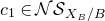 $c_1\in \mathcal{NS}_{X_B/B}$
.
$c_1\in \mathcal{NS}_{X_B/B}$
.
Note that this makes sense by Lemma 2.21.
Lemma 3.20.
The stack $\mathcal{M}_{X_B/C_B}^{\alpha }(r,c_1,\Delta )$
is an open and closed substack of
$\mathcal{M}_{X_B/C_B}^{\alpha }(r,c_1,\Delta )$
is an open and closed substack of $\mathcal{M}_{X_B/C_B}^{\alpha }(r,d)$
.
$\mathcal{M}_{X_B/C_B}^{\alpha }(r,d)$
.
Proof. The condition that the degree of the cycle $2 r c_2(E) -(r-1)c_1(E)^2$
equals
$2 r c_2(E) -(r-1)c_1(E)^2$
equals $\Delta$
is an open and closed condition. Since
$\Delta$
is an open and closed condition. Since $\overline {\mathcal{NS}}_{X_B/B}$
is separated and unramified over
$\overline {\mathcal{NS}}_{X_B/B}$
is separated and unramified over $B$
, the section
$B$
, the section $\overline {c_1}$
determines an open and closed subspace.
$\overline {c_1}$
determines an open and closed subspace.
Proposition 3.21.
The stack $\mathcal{M}^{\alpha }_{X_B/C_B}(r,\overline {c_1},\Delta )$
is of finite type over
$\mathcal{M}^{\alpha }_{X_B/C_B}(r,\overline {c_1},\Delta )$
is of finite type over $B$
.
$B$
.
Proof. It only remains to show that it is quasi-compact over $B$
. We may work locally on
$B$
. We may work locally on $B$
and stratify
$B$
and stratify $B$
by the singularity type of
$B$
by the singularity type of $C_B$
. In particular, we may assume that
$C_B$
. In particular, we may assume that $B$
is a finite type
$B$
is a finite type $\mathbb{C}$
-scheme and that the singular locus of
$\mathbb{C}$
-scheme and that the singular locus of $C_B$
is a disjoint union of copies of
$C_B$
is a disjoint union of copies of $B$
. Let
$B$
. Let $C_1,\ldots ,C_n$
denote the normalizations of the components of
$C_1,\ldots ,C_n$
denote the normalizations of the components of $C_B$
, which are smooth over
$C_B$
, which are smooth over $B$
, and
$B$
, and $X_1,\ldots ,X_n$
their preimages under
$X_1,\ldots ,X_n$
their preimages under $f$
. We will also denote by
$f$
. We will also denote by $X_i$
its lift to any expansion of
$X_i$
its lift to any expansion of $C_B$
. Note that for any rank-
$C_B$
. Note that for any rank- $r$
sheaf
$r$
sheaf $E$
on an expansion
$E$
on an expansion $\widetilde {X}_b\to X_b$
over a point
$\widetilde {X}_b\to X_b$
over a point $b\in B$
, the discriminant of
$b\in B$
, the discriminant of $E|_{\widetilde {X}_b}$
is equal to the sum over the discriminants of the components of the normalization of
$E|_{\widetilde {X}_b}$
is equal to the sum over the discriminants of the components of the normalization of $\widetilde {X}_b$
(since this is true for
$\widetilde {X}_b$
(since this is true for $\textrm {ch}_2(E)$
and
$\textrm {ch}_2(E)$
and $c_1(E)^2$
).
$c_1(E)^2$
).
Claim 1: For every $b\in B$
, every
$b\in B$
, every $\alpha$
-balanced
$\alpha$
-balanced $f$
-stable sheaf
$f$
-stable sheaf $E$
on an expansion of
$E$
on an expansion of $X_b$
and every
$X_b$
and every $i$
, we have
$i$
, we have $\Delta (E|_{X_i})\geqslant 0$
.
$\Delta (E|_{X_i})\geqslant 0$
.
Proof. Since the discriminant is invariant under tensoring with a line bundle, we may assume that $c_1(E|_{X_i}) = c_1|_{X_i} + k F$
for a fixed lift
$c_1(E|_{X_i}) = c_1|_{X_i} + k F$
for a fixed lift $c_1$
of
$c_1$
of $\overline {c_1}$
and some
$\overline {c_1}$
and some $k\in \{0,\ldots r-1\}$
. By Theorem2.24, we can find a polarization
$k\in \{0,\ldots r-1\}$
. By Theorem2.24, we can find a polarization $H_i$
on
$H_i$
on $X_i$
such that
$X_i$
such that $f$
-stability for
$f$
-stability for $X_i\to C_i$
agrees with slope stability with respect to
$X_i\to C_i$
agrees with slope stability with respect to $H_i$
for all sheaves of rank
$H_i$
for all sheaves of rank $r$
, first Chern class of the form
$r$
, first Chern class of the form $c_1|_{X_i} + k F$
and with discriminant less or equal to
$c_1|_{X_i} + k F$
and with discriminant less or equal to $-1$
. By the Bogomolov–Gieseker inequality [Reference Huybrechts and LehnHL10, Theorem 3.4.1], there are no sheaves satisfying this condition, and hence
$-1$
. By the Bogomolov–Gieseker inequality [Reference Huybrechts and LehnHL10, Theorem 3.4.1], there are no sheaves satisfying this condition, and hence $\Delta (E|_{X_i})\geqslant 0$
.
$\Delta (E|_{X_i})\geqslant 0$
.
Claim 2: There exists a number $N_1$
such that for an
$N_1$
such that for an $\alpha$
-balanced
$\alpha$
-balanced $f$
-stable sheaf on a minimal expansion
$f$
-stable sheaf on a minimal expansion $\widetilde {X}_b\to \widetilde {C}_b$
, the number of exceptional components is at most
$\widetilde {X}_b\to \widetilde {C}_b$
, the number of exceptional components is at most $N_1$
.
$N_1$
.
Proof. By Lemma 2.11, on each exceptional component $Y$
of
$Y$
of $\widetilde {X}_b$
,
$\widetilde {X}_b$
, $E_Y$
is either a pullback tensored by a line bundle from
$E_Y$
is either a pullback tensored by a line bundle from $\widetilde {C}$
, or
$\widetilde {C}$
, or $\Delta (E_Y)\gt 0$
. By
$\Delta (E_Y)\gt 0$
. By $\alpha$
-balancedness, there can be at most
$\alpha$
-balancedness, there can be at most $g(C_b)$
components for which the first possibility occurs (and the line bundle has to be of degree one on the corresponding component). From this and Claim 1, it follows that the total number of exceptional components is bounded by
$g(C_b)$
components for which the first possibility occurs (and the line bundle has to be of degree one on the corresponding component). From this and Claim 1, it follows that the total number of exceptional components is bounded by $N_1 = \Delta + g(C_b)$
.
$N_1 = \Delta + g(C_b)$
.
From Claim 2, it follows that $\mathcal{M}^{\alpha }_{X_B/C_B}(r,\overline {c_1},\Delta )$
factors through a quasi-compact open subset of
$\mathcal{M}^{\alpha }_{X_B/C_B}(r,\overline {c_1},\Delta )$
factors through a quasi-compact open subset of ${\textrm {Exp}}_{C_B/B}$
. Hence, it suffices to show that the preimage of each stratum of
${\textrm {Exp}}_{C_B/B}$
. Hence, it suffices to show that the preimage of each stratum of ${\textrm {Exp}}_{C_B/B}$
is quasi-compact. This reduces to showing that the space of sheaves on a given expansion
${\textrm {Exp}}_{C_B/B}$
is quasi-compact. This reduces to showing that the space of sheaves on a given expansion $\widetilde {C}_B\to C_B$
is quasi-compact. By
$\widetilde {C}_B\to C_B$
is quasi-compact. By $\alpha$
-stability, for each component there is only a finite choice of possible values that the first Chern class of a restriction can take.
$\alpha$
-stability, for each component there is only a finite choice of possible values that the first Chern class of a restriction can take.
In this case, an $f$
-stable sheaf on
$f$
-stable sheaf on $\widetilde {X}_B$
is the same as giving suitable
$\widetilde {X}_B$
is the same as giving suitable $f$
-stable sheaves on each component, together with isomorphisms. This reduces to the case where
$f$
-stable sheaves on each component, together with isomorphisms. This reduces to the case where $\widetilde {X}_B$
has a single component. In this case, the space of
$\widetilde {X}_B$
has a single component. In this case, the space of $f$
-stable sheaves with given
$f$
-stable sheaves with given $\overline {c_1}$
and
$\overline {c_1}$
and $\Delta$
is open in the space of stable sheaves of fixed topological type with respect to a suitably chosen polarization, and hence it is quasi-compact [Reference Huybrechts and LehnHL10, Theorem 3.3.7].
$\Delta$
is open in the space of stable sheaves of fixed topological type with respect to a suitably chosen polarization, and hence it is quasi-compact [Reference Huybrechts and LehnHL10, Theorem 3.3.7].
Definition 3.22. Let $X_B\to C_B\to B$
be a family of fibered surfaces. We say that a stability condition
$X_B\to C_B\to B$
be a family of fibered surfaces. We say that a stability condition $\alpha$
on
$\alpha$
on $C_B$
is generic if every
$C_B$
is generic if every $\alpha$
-balanced sheaf on a minimal expansion of
$\alpha$
-balanced sheaf on a minimal expansion of $X_B$
is in fact strictly
$X_B$
is in fact strictly $\alpha$
-balanced.
$\alpha$
-balanced.
Remark 3.23. Suppose that $C_B\to B$
has a single most degenerate stratum over a closed point
$C_B\to B$
has a single most degenerate stratum over a closed point $b$
. Then one can always choose a non-degenerate stability condition by choosing an
$b$
. Then one can always choose a non-degenerate stability condition by choosing an $\alpha :\operatorname {Irr}(C_b)\to \mathbb{R}$
whose values form a
$\alpha :\operatorname {Irr}(C_b)\to \mathbb{R}$
whose values form a $\mathbb{Q}$
-vector space of dimension
$\mathbb{Q}$
-vector space of dimension $|\operatorname {Irr}(C_b)|-1$
.
$|\operatorname {Irr}(C_b)|-1$
.
Properness.
Definition 3.24. Let $\alpha$
be a generic stability condition on
$\alpha$
be a generic stability condition on $C_B$
. We denote the
$C_B$
. We denote the $\mathbb{G}_m$
-rigidification of
$\mathbb{G}_m$
-rigidification of $\mathcal{M}_{X_B/C_B}^{\alpha }(r,\overline {c_1},\Delta )$
along the scalar automorphisms by
$\mathcal{M}_{X_B/C_B}^{\alpha }(r,\overline {c_1},\Delta )$
along the scalar automorphisms by
 \begin{align*}M_{X_B/C_B}^{\alpha }(r,\overline {c_1},\Delta ).\end{align*}
By Proposition 3.18, for a choice of generic stability condition, the stack $M_{X_B/C_B}^{\alpha }(r,\overline {c_1},\Delta )$
has finite stabilizer groups at every point and therefore is Deligne–Mumford.
$M_{X_B/C_B}^{\alpha }(r,\overline {c_1},\Delta )$
has finite stabilizer groups at every point and therefore is Deligne–Mumford.
Theorem 3.25.
Let $\alpha$
be a generic stability condition. Then
$\alpha$
be a generic stability condition. Then $M_{X_B/C_B}^{\alpha }(r,\overline {c_1},\Delta )$
is a proper Deligne–Mumford stack over
$M_{X_B/C_B}^{\alpha }(r,\overline {c_1},\Delta )$
is a proper Deligne–Mumford stack over $B$
.
$B$
.
Proof. We already know that it is a finite type Deligne–Mumford stack. It satisfies the existence part of the valuative criterion of properness, since, by Proposition 3.15, this is true for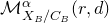 $\mathcal{M}^{\alpha }_{X_B/C_B}(r, d)$
. It only remains to address the uniqueness part of the valuative criterion. For this, we may assume that
$\mathcal{M}^{\alpha }_{X_B/C_B}(r, d)$
. It only remains to address the uniqueness part of the valuative criterion. For this, we may assume that $B=\textrm {Spec}\,R$
and that we are given expansions
$B=\textrm {Spec}\,R$
and that we are given expansions $\widetilde {X}_1\to \widetilde {C}_1$
and
$\widetilde {X}_1\to \widetilde {C}_1$
and $\widetilde {X}_2\to \widetilde {C}_2$
of
$\widetilde {X}_2\to \widetilde {C}_2$
of $X_B\to C_B$
together with respective
$X_B\to C_B$
together with respective $\alpha$
-balanced
$\alpha$
-balanced $f$
-stable sheaves
$f$
-stable sheaves $E_1$
and
$E_1$
and $E_2$
and an isomorphism
$E_2$
and an isomorphism $\Psi$
of the restrictions to the generic fibers. Let
$\Psi$
of the restrictions to the generic fibers. Let $\pi$
be a uniformizer for
$\pi$
be a uniformizer for $R$
. Then we need to show that
$R$
. Then we need to show that $\widetilde {C}_1\simeq \widetilde {C}_2$
and that for some
$\widetilde {C}_1\simeq \widetilde {C}_2$
and that for some $\ell$
, the isomorphism
$\ell$
, the isomorphism $\pi ^\ell \Psi$
can be extended to an isomorphism of
$\pi ^\ell \Psi$
can be extended to an isomorphism of $E_1$
and
$E_1$
and $E_2$
over the isomorphism of expansions.
$E_2$
over the isomorphism of expansions.
We first choose a common further expansion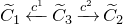 $\widetilde {C}_1\xleftarrow {c^1}\widetilde {C}_3\xrightarrow {c^2} \widetilde {C}_2$
which is an isomorphism over
$\widetilde {C}_1\xleftarrow {c^1}\widetilde {C}_3\xrightarrow {c^2} \widetilde {C}_2$
which is an isomorphism over $\eta$
and is minimal in the sense that no component of
$\eta$
and is minimal in the sense that no component of $\widetilde {C}_3$
over
$\widetilde {C}_3$
over $\xi$
is contracted by both
$\xi$
is contracted by both $c^1$
and
$c^1$
and $c^2$
. Then, both
$c^2$
. Then, both $(c^1)^*E_1$
and
$(c^1)^*E_1$
and $(c^2)^*E_2$
are
$(c^2)^*E_2$
are $\alpha$
-balanced
$\alpha$
-balanced $f$
-stable sheaves on
$f$
-stable sheaves on $\widetilde {X}_3$
, and we have a given isomorphism
$\widetilde {X}_3$
, and we have a given isomorphism $\psi : (c^1)^*E_1|_{\widetilde {X}_{3,\eta }} \to (c^2)^*E_2|_{\widetilde {X}_{3,\eta }}$
. Let
$\psi : (c^1)^*E_1|_{\widetilde {X}_{3,\eta }} \to (c^2)^*E_2|_{\widetilde {X}_{3,\eta }}$
. Let $\pi$
be a uniformizer of
$\pi$
be a uniformizer of $R$
. There is a unique choice of integer
$R$
. There is a unique choice of integer $\ell$
such that
$\ell$
such that $\pi ^{\ell }\psi$
extends to a morphism
$\pi ^{\ell }\psi$
extends to a morphism $E_1\to E_2$
whose restriction to
$E_1\to E_2$
whose restriction to $\widetilde {X}_{3,\xi }$
is non-zero. This extension is then unique, and we will denote it again by
$\widetilde {X}_{3,\xi }$
is non-zero. This extension is then unique, and we will denote it again by $\pi ^{\ell }\Psi$
. By Lemma 3.26 below,
$\pi ^{\ell }\Psi$
. By Lemma 3.26 below, $\pi ^\ell \Psi$
is an isomorphism. In particular, any component of
$\pi ^\ell \Psi$
is an isomorphism. In particular, any component of $\widetilde {C}_{3}$
which is contracted by
$\widetilde {C}_{3}$
which is contracted by $c^1$
is also contracted by
$c^1$
is also contracted by $c^2$
, so we have
$c^2$
, so we have $\widetilde {C}_1\cong \widetilde {C}_3\cong \widetilde {C}_2$
. This is precisely what we wanted to show.
$\widetilde {C}_1\cong \widetilde {C}_3\cong \widetilde {C}_2$
. This is precisely what we wanted to show.
Lemma 3.26.
Let $f:X_R\to C_R$
be a family of fibered surfaces over a DVR, let
$f:X_R\to C_R$
be a family of fibered surfaces over a DVR, let $\alpha$
be a stability condition on
$\alpha$
be a stability condition on $C_R$
, and let
$C_R$
, and let $E_1,E_2\in \mathcal{M}_{X_R/C_R}^{\alpha }(r,\overline {c_1},\Delta )$
be strictly
$E_1,E_2\in \mathcal{M}_{X_R/C_R}^{\alpha }(r,\overline {c_1},\Delta )$
be strictly $\alpha$
-balanced
$\alpha$
-balanced $f$
-stable sheaves on some expansion
$f$
-stable sheaves on some expansion $\widetilde {X}_R\to \widetilde {C}_R$
of
$\widetilde {X}_R\to \widetilde {C}_R$
of $f$
(which is minimal for both). Let
$f$
(which is minimal for both). Let $\Psi : E_1\to E_2$
be a morphism that is an isomorphism over the generic point of
$\Psi : E_1\to E_2$
be a morphism that is an isomorphism over the generic point of $R$
and non-zero over the closed point. Then
$R$
and non-zero over the closed point. Then $\Psi$
is an isomorphism.
$\Psi$
is an isomorphism.
Proof. We consider $E_1, E_2$
as families of rank-
$E_1, E_2$
as families of rank- $r$
and degree-
$r$
and degree- $d$
sheaves on the family of curves given by
$d$
sheaves on the family of curves given by $f$
. Since
$f$
. Since $E_1$
has finite cohomological dimension and
$E_1$
has finite cohomological dimension and $E_2$
is flat over
$E_2$
is flat over $\widetilde {C}_R$
, it follows from [Sta23, Lemma 08IF] that the sheaf
$\widetilde {C}_R$
, it follows from [Sta23, Lemma 08IF] that the sheaf $N_0:= f_*\mathcal{H}om(E_1,E_2)$
is a reflexive rank-one sheaf on
$N_0:= f_*\mathcal{H}om(E_1,E_2)$
is a reflexive rank-one sheaf on $\widetilde {C}_R$
(i.e. of the form
$\widetilde {C}_R$
(i.e. of the form $\mathcal{H}om(L,\mathcal{O}_{\widetilde {C}_R})$
for
$\mathcal{H}om(L,\mathcal{O}_{\widetilde {C}_R})$
for $L$
coherent of rank one). As a reflexive sheaf, it is locally free away from the singular points of the two-dimensional scheme
$L$
coherent of rank one). As a reflexive sheaf, it is locally free away from the singular points of the two-dimensional scheme $\widetilde {C}_R$
. On the other hand, let
$\widetilde {C}_R$
. On the other hand, let $x\in \widetilde {C}_{R}$
be a point where
$x\in \widetilde {C}_{R}$
be a point where $f^{-1}(x)$
is smooth and both
$f^{-1}(x)$
is smooth and both $E_1|_{f^{-1}(x)}$
and
$E_1|_{f^{-1}(x)}$
and $E_2|_{f^{-}(x)}$
are stable. Then, since stability is an open condition, in a Zariski neighborhood
$E_2|_{f^{-}(x)}$
are stable. Then, since stability is an open condition, in a Zariski neighborhood $U$
of
$U$
of $x$
,
$x$
, $E_1$
and
$E_1$
and $E_2$
define two families of stable sheaves on
$E_2$
define two families of stable sheaves on $U$
, which by assumption are generically isomorphic. It follows that
$U$
, which by assumption are generically isomorphic. It follows that $N$
is locally free of rank one on
$N$
is locally free of rank one on $U$
. By
$U$
. By $f$
-stability, this holds for (i)
$f$
-stability, this holds for (i) $x$
any generic point of
$x$
any generic point of $\widetilde {C}_{\eta }$
, so
$\widetilde {C}_{\eta }$
, so $N$
has rank one, and (ii)
$N$
has rank one, and (ii) $x$
a node in either
$x$
a node in either $\widetilde {C}_{\xi }$
, so
$\widetilde {C}_{\xi }$
, so $N$
is also locally free along the singular locus of
$N$
is also locally free along the singular locus of $\widetilde {C}_{R}\to R$
. We conclude that
$\widetilde {C}_{R}\to R$
. We conclude that $N$
is a line bundle on
$N$
is a line bundle on $\widetilde {C}_R$
. The given morphism
$\widetilde {C}_R$
. The given morphism $\Psi$
specifies a section of
$\Psi$
specifies a section of $N$
. Since
$N$
. Since $\Psi$
is an isomorphism on
$\Psi$
is an isomorphism on $\widetilde {C}_{\eta }$
, this section is a generator of
$\widetilde {C}_{\eta }$
, this section is a generator of $N$
on the generic fiber, and hence
$N$
on the generic fiber, and hence $N|_{\widetilde {C}_{\eta }}\simeq \mathcal{O}_{\widetilde {C}_{\eta }}$
.
$N|_{\widetilde {C}_{\eta }}\simeq \mathcal{O}_{\widetilde {C}_{\eta }}$
.
Moreover, we get a tautological morphism $E_1\otimes f^*N\to E_2$
, which is non-zero on each component of the special fiber. Therefore, its restriction to
$E_1\otimes f^*N\to E_2$
, which is non-zero on each component of the special fiber. Therefore, its restriction to $\widetilde {X}_{\xi }$
is injective with cokernel
$\widetilde {X}_{\xi }$
is injective with cokernel $Q$
supported on fibers of
$Q$
supported on fibers of $\widetilde {X}_{\xi }\to \widetilde {C}_{\xi }$
away from the nodes. Since
$\widetilde {X}_{\xi }\to \widetilde {C}_{\xi }$
away from the nodes. Since $E_1$
and
$E_1$
and $E_2$
have the same numerical invariants and
$E_2$
have the same numerical invariants and $N$
has total degree zero on
$N$
has total degree zero on $\widetilde {C}_{\xi }$
, we find that
$\widetilde {C}_{\xi }$
, we find that $Q=0$
, so
$Q=0$
, so $E_1\otimes f^*N\simeq E_2$
. This implies that both
$E_1\otimes f^*N\simeq E_2$
. This implies that both $E_1$
and
$E_1$
and $E_1\otimes f^*N$
are strictly
$E_1\otimes f^*N$
are strictly $\alpha$
-balanced. Let
$\alpha$
-balanced. Let $Z\subset \widetilde {C}_{\xi }$
be a connected component of the subcurve of components not contained in the Cartier divisor defined by
$Z\subset \widetilde {C}_{\xi }$
be a connected component of the subcurve of components not contained in the Cartier divisor defined by $\Psi$
. If
$\Psi$
. If $Z = \widetilde {C}_{\xi }$
, then
$Z = \widetilde {C}_{\xi }$
, then $\Psi$
is an isomorphism, and we are done. So, suppose for the sake of contradiction that
$\Psi$
is an isomorphism, and we are done. So, suppose for the sake of contradiction that $Z$
is a proper subcurve of
$Z$
is a proper subcurve of $\widetilde {C}_{\xi }$
. Since every component of its complement
$\widetilde {C}_{\xi }$
. Since every component of its complement $Z^c$
that meets
$Z^c$
that meets $Z$
has at least multiplicity one, we have
$Z$
has at least multiplicity one, we have $\deg N|_{Z} \geqslant \#(Z\cap Z^c)\gt 0$
. Since
$\deg N|_{Z} \geqslant \#(Z\cap Z^c)\gt 0$
. Since $\deg M(E_1\otimes f^*N)|_Z = \deg M(E_1)|_Z + rd_0 \deg N|_Z$
, it follows that
$\deg M(E_1\otimes f^*N)|_Z = \deg M(E_1)|_Z + rd_0 \deg N|_Z$
, it follows that
 \begin{align*}\left | \frac {\deg M(E_1\otimes f^*N)|_Z}{rd_0 } - \sum _{D\subset Z} \alpha (D) \right | \geqslant \#(Z\cap Z^c) - \left | \frac {\deg M(E_1)|_Z}{rd_0 } - \sum _{D\subset Z} \alpha (D) \right | \geqslant \frac {\#(Z\cap Z^c)}{2} ,\end{align*}
with equality if and only if
 \begin{align*} \frac {\deg M(E_1)|_Z}{rd_0 } - \sum _{D\subset Z} \alpha (D) = - \frac {\#(Z\cap Z^c)}{2}.\end{align*}
But by $\alpha$
-balancedness of
$\alpha$
-balancedness of $E_1\otimes f^*N$
, equality must hold, so by strict
$E_1\otimes f^*N$
, equality must hold, so by strict $\alpha$
-balancedness, either
$\alpha$
-balancedness, either $Z$
or
$Z$
or $Z^c$
is a chain of exceptional components. It cannot be
$Z^c$
is a chain of exceptional components. It cannot be $Z$
, since then
$Z$
, since then $\deg M(E_1)|_Z$
is strictly negative, so it must be
$\deg M(E_1)|_Z$
is strictly negative, so it must be $Z^c$
. Let
$Z^c$
. Let $Z'\subset Z^c$
be a subchain of components along which the multiplicity of the Cartier divisor defined by
$Z'\subset Z^c$
be a subchain of components along which the multiplicity of the Cartier divisor defined by $\Psi ,N$
is maximal. Then
$\Psi ,N$
is maximal. Then $\deg N|_{Z'}\leqslant -2$
(since
$\deg N|_{Z'}\leqslant -2$
(since $Z'$
meets its complement in two points, and since the line bundle defined by the whole of
$Z'$
meets its complement in two points, and since the line bundle defined by the whole of $\widetilde {C}_{\xi }$
has vanishing degree on
$\widetilde {C}_{\xi }$
has vanishing degree on $Z'$
). But, by
$Z'$
). But, by $\alpha$
-balancedness,
$\alpha$
-balancedness,
 \begin{align*} 0\leqslant \frac {\deg M(E_1\otimes f^*N)|_{Z'}}{rd_0}\leqslant \frac {\deg M(E_1)|_{Z'}}{rd_0} -2 \leqslant 1-2=-1, \end{align*}
which is the desired contradiction.
Remark 3.27. Note that by (3) and Grothendieck–Riemann–Roch, the total degree of $M(E)$
depends on
$M(E)$
depends on $E$
only through
$E$
only through $c_1(E)$
and
$c_1(E)$
and $\Delta (E)$
. In particular, a formal application of Grothendieck–Riemann–Roch gives a unique number
$\Delta (E)$
. In particular, a formal application of Grothendieck–Riemann–Roch gives a unique number $\alpha (\overline {c_1},\Delta )$
such that
$\alpha (\overline {c_1},\Delta )$
such that $M_{X/C}^\alpha (r,\overline {c_1}, \Delta ) = \emptyset$
unless
$M_{X/C}^\alpha (r,\overline {c_1}, \Delta ) = \emptyset$
unless
 \begin{align} \sum _{D\in \operatorname {Irr}(C)} \alpha (D) = \alpha (\overline {c_1},\Delta ). \end{align}
When $C$
is irreducible, a stability condition is just a scalar which determines whether the moduli space is (possibly) non-empty. In this case, we will abbreviate
$C$
is irreducible, a stability condition is just a scalar which determines whether the moduli space is (possibly) non-empty. In this case, we will abbreviate
 \begin{align*}M^b_{X/C}(r,\overline {c_1},\Delta ) := M_{X/C}^{\alpha (\overline {c_1},\Delta )}(r,\overline {c_1},\Delta ).\end{align*}
3.4 Perfect obstruction theories
We construct the perfect obstruction theory on the moduli stacks $\mathcal{M}_{X_B/C_B}(r,d)$
and their variants. The arguments here are relatively standard and we will not give all details. A perfect obstruction theory for a morphism
$\mathcal{M}_{X_B/C_B}(r,d)$
and their variants. The arguments here are relatively standard and we will not give all details. A perfect obstruction theory for a morphism $\mathcal{X}\to \mathcal{Y}$
is an object
$\mathcal{X}\to \mathcal{Y}$
is an object $E\in D(\mathcal{X})$
that is perfect with amplitude in
$E\in D(\mathcal{X})$
that is perfect with amplitude in $[-1,1]$
together with a morphism
$[-1,1]$
together with a morphism $E\to L_{\mathcal{X}/\mathcal{Y}}$
that is an isomorphism on
$E\to L_{\mathcal{X}/\mathcal{Y}}$
that is an isomorphism on $h^1$
and
$h^1$
and $h^0$
and surjective on
$h^0$
and surjective on $h^{-1}$
. This coincides with the usual notion whenever
$h^{-1}$
. This coincides with the usual notion whenever $\mathcal{X}\to \mathcal{Y}$
is of DM-type.
$\mathcal{X}\to \mathcal{Y}$
is of DM-type.
Let $X_B\to C_B$
be a family of fibered surfaces. We abbreviate
$X_B\to C_B$
be a family of fibered surfaces. We abbreviate $\mathcal{M}:= \mathcal{M}_{X_B/C_B}(r,d)$
and
$\mathcal{M}:= \mathcal{M}_{X_B/C_B}(r,d)$
and ${\textrm {Exp}}:={\textrm {Exp}}_{C_B/B}$
. Consider the forgetful morphisms
${\textrm {Exp}}:={\textrm {Exp}}_{C_B/B}$
. Consider the forgetful morphisms $\mathcal{M}\to {\textrm {Exp}}\to B$
. We let
$\mathcal{M}\to {\textrm {Exp}}\to B$
. We let $\widetilde {X}\to \widetilde {C}$
denote the universal expansion on
$\widetilde {X}\to \widetilde {C}$
denote the universal expansion on $\textrm {Exp}$
and let
$\textrm {Exp}$
and let $\mathcal{E}$
denote the universal sheaf on the pullback
$\mathcal{E}$
denote the universal sheaf on the pullback $\widetilde {X}_{\mathcal{M}}$
of
$\widetilde {X}_{\mathcal{M}}$
of $\widetilde {X}$
to
$\widetilde {X}$
to $\mathcal{M}$
. Let
$\mathcal{M}$
. Let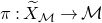 $\pi :\widetilde {X}_{\mathcal{M}} \to \mathcal{M}$
denote the projection. The Atiyah class defines a relative obstruction theory
$\pi :\widetilde {X}_{\mathcal{M}} \to \mathcal{M}$
denote the projection. The Atiyah class defines a relative obstruction theory $(R\pi _*R\mathcal{H}om_0({\mathcal{E}},{\mathcal{E}}))^{\vee }[-1]\to L_{\mathcal{M}/{\textrm {Exp}}}$
.
$(R\pi _*R\mathcal{H}om_0({\mathcal{E}},{\mathcal{E}}))^{\vee }[-1]\to L_{\mathcal{M}/{\textrm {Exp}}}$
.
We have a factorization $\mathcal{M}\to \mathcal{P}ic_{\widetilde {X}/{\textrm {Exp}}}\to {\textrm {Exp}}$
of the forgetful map through the determinant morphism to the Picard stack. Let
$\mathcal{M}\to \mathcal{P}ic_{\widetilde {X}/{\textrm {Exp}}}\to {\textrm {Exp}}$
of the forgetful map through the determinant morphism to the Picard stack. Let $\mathcal{L}$
denote the universal line bundle over
$\mathcal{L}$
denote the universal line bundle over $\widetilde {X}_{\mathcal{P}ic_{\widetilde {X}/{\textrm {Exp}}}}$
and let
$\widetilde {X}_{\mathcal{P}ic_{\widetilde {X}/{\textrm {Exp}}}}$
and let $\pi$
also denote the projection to
$\pi$
also denote the projection to $\mathcal{P}ic_{\widetilde {X}/{\textrm {Exp}}}$
. We have the relative obstruction theory
$\mathcal{P}ic_{\widetilde {X}/{\textrm {Exp}}}$
. We have the relative obstruction theory
 \begin{align*}(R\pi _*R\mathcal{H}om(\mathcal{L},\mathcal{L}))^{\vee }[-1]\to L_{\mathcal{P}ic_{\widetilde {X}/{\textrm {Exp}}}/{\textrm {Exp}}}.\end{align*}
It is naturally compatible with the obstruction theory of $\mathcal{M}$
via the trace map.
$\mathcal{M}$
via the trace map.
Moreover, the trace-free part gives a canonical relative obstruction theory
 \begin{align*}(R\pi _*R\mathcal{H}om_0({\mathcal{E}},{\mathcal{E}}))^{\vee }[-1]\to L_{{\mathcal{M}}/\mathcal{P}ic_{\widetilde {X}/{\textrm {Exp}}}}.\end{align*}
We have a commutative diagram involving the $\mathbb{G}_m$
-rigidifications of both stacks.
$\mathbb{G}_m$
-rigidifications of both stacks.

The induced map $r^* L_{M/Pic_{\widetilde {X}/{\textrm {Exp}}}}\to L_{\mathcal{M}/\mathcal{P}ic_{\widetilde {X}/{\textrm {Exp}}}}$
is an isomorphism, so we may compose with its inverse to get a morphism
$r^* L_{M/Pic_{\widetilde {X}/{\textrm {Exp}}}}\to L_{\mathcal{M}/\mathcal{P}ic_{\widetilde {X}/{\textrm {Exp}}}}$
is an isomorphism, so we may compose with its inverse to get a morphism $(R\pi _*R\mathcal{H}om_0({\mathcal{E}},{\mathcal{E}}))^{\vee }[-1]\to r^* L_{M/Pic_{\widetilde {X}/Exp}}$
. This last map descends to a canonical perfect obstruction theory for the determinant morphism
$(R\pi _*R\mathcal{H}om_0({\mathcal{E}},{\mathcal{E}}))^{\vee }[-1]\to r^* L_{M/Pic_{\widetilde {X}/Exp}}$
. This last map descends to a canonical perfect obstruction theory for the determinant morphism $M\to \textrm {Pic}_{\widetilde {X}/{\textrm {Exp}}}$
over the relative Picard scheme. From this discussion, and the properties of virtual pullback [Reference ManolacheMan12, §§ 3 and 4], we immediately get the following proposition.
$M\to \textrm {Pic}_{\widetilde {X}/{\textrm {Exp}}}$
over the relative Picard scheme. From this discussion, and the properties of virtual pullback [Reference ManolacheMan12, §§ 3 and 4], we immediately get the following proposition.
Proposition 3.28.
Suppose we are in the situation of Theorem
3.25
. Then the stack $M^{\alpha }_{X_B/C_B}(r,\overline {c_1},\Delta )$
has a relative perfect obstruction theory over
$M^{\alpha }_{X_B/C_B}(r,\overline {c_1},\Delta )$
has a relative perfect obstruction theory over $\textrm {Pic}_{\widetilde {X}/{\textrm {Exp}}}$
. In particular, it has a natural virtual fundamental class
$\textrm {Pic}_{\widetilde {X}/{\textrm {Exp}}}$
. In particular, it has a natural virtual fundamental class
 \begin{align*}\left [M^{\alpha }_{X_B/C_B}(r,\overline {c_1},\Delta )\right ]^{{{\rm vir}}}\in A_*(M^{\alpha }_{X_B/C_B}(r,\overline {c_1},\Delta ))\end{align*}
given by virtual pullback of the fundamental class of $\textrm {Pic}_{\widetilde {X}/{\textrm {Exp}}}$
. The formation of the virtual fundamental class is compatible with flat and lci pullbacks on
$\textrm {Pic}_{\widetilde {X}/{\textrm {Exp}}}$
. The formation of the virtual fundamental class is compatible with flat and lci pullbacks on $B$
.
$B$
.
It follows formally from this proposition that virtual integrals with respect to cohomology classes that are defined over the whole family $B$
are deformation invariant. We will usually consider intersection numbers in homology rather than Chow groups, as explained in § 3.6 below.
$B$
are deformation invariant. We will usually consider intersection numbers in homology rather than Chow groups, as explained in § 3.6 below.
3.5 Evaluation maps
Let $X_B\to C_B$
be a family of fibered surfaces and let
$X_B\to C_B$
be a family of fibered surfaces and let $\sigma _1,\ldots ,\sigma _n : B\to C_B$
denote the markings of
$\sigma _1,\ldots ,\sigma _n : B\to C_B$
denote the markings of $C_B$
. Let
$C_B$
. Let $F_i\to B$
denote the family of smooth curves obtained as the preimage of
$F_i\to B$
denote the family of smooth curves obtained as the preimage of $\sigma _i$
under
$\sigma _i$
under $f$
. For each
$f$
. For each $i$
, we have a morphism of stacks
$i$
, we have a morphism of stacks $\mathcal{M}_{X_B/C_B}(r,d)\to \mathcal{M}_{F_i}(r,d)$
. It fits into a commutative diagram
$\mathcal{M}_{X_B/C_B}(r,d)\to \mathcal{M}_{F_i}(r,d)$
. It fits into a commutative diagram

in which the horizontal maps are the restriction maps and the vertical maps are the determinant morphisms. For each map in this square, the obstruction theories for source and target are naturally compatible. We have an induced square of rigidifications, with induced relative obstruction theories, as shown by the following diagram.

3.6 Tautological classes
We want to study invariants which are defined by pairing certain tautological cohomology classes against the virtual fundamental class. We define here what we mean by tautological cohomology class. For a Deligne–Mumford stack $\mathcal{Y}$
over
$\mathcal{Y}$
over $\mathbb{C}$
, we define its rational (co-)homology groups
$\mathbb{C}$
, we define its rational (co-)homology groups $H_*(\mathcal{Y}, {\mathbb{Q}})$
(resp.,
$H_*(\mathcal{Y}, {\mathbb{Q}})$
(resp., $H^*(\mathcal{Y}, {\mathbb{Q}})$
) in terms of the simplicial scheme
$H^*(\mathcal{Y}, {\mathbb{Q}})$
) in terms of the simplicial scheme $Y_\bullet$
associated to an étale cover
$Y_\bullet$
associated to an étale cover $Y_0\to \mathcal{Y}$
. When working with rational coefficients, as we do here, these are naturally isomorphic to the (co-) homology groups of the coarse moduli space of
$Y_0\to \mathcal{Y}$
. When working with rational coefficients, as we do here, these are naturally isomorphic to the (co-) homology groups of the coarse moduli space of $Y$
. This is nicely explained in the second half of [Reference BehrendBeh04]. One also has a natural cycle class map
$Y$
. This is nicely explained in the second half of [Reference BehrendBeh04]. One also has a natural cycle class map $A_*(\mathcal{Y})\to H^{BM}_*(\mathcal{Y}, {\mathbb{Q}})$
into the Borel–Moore homology (cf. [Reference Abramovich, Graber and VistoliAGV08, § 2]). When
$A_*(\mathcal{Y})\to H^{BM}_*(\mathcal{Y}, {\mathbb{Q}})$
into the Borel–Moore homology (cf. [Reference Abramovich, Graber and VistoliAGV08, § 2]). When $\mathcal{Y}$
is proper, this equivalently gives a map
$\mathcal{Y}$
is proper, this equivalently gives a map $A_*(\mathcal{Y})\to H_*(\mathcal{Y},{\mathbb{Q}})$
.
$A_*(\mathcal{Y})\to H_*(\mathcal{Y},{\mathbb{Q}})$
.
Let $f:X\to C$
be a fibered surface over a fixed nodal marked curve
$f:X\to C$
be a fibered surface over a fixed nodal marked curve $C$
with markings
$C$
with markings $(x_1,\ldots ,x_n)$
, and let
$(x_1,\ldots ,x_n)$
, and let $F_1,\ldots ,F_n$
denote the fibers over the markings. Let
$F_1,\ldots ,F_n$
denote the fibers over the markings. Let $L_0$
be a fixed line bundle of degree
$L_0$
be a fixed line bundle of degree $d_0\gt 0$
on
$d_0\gt 0$
on $X$
, and let
$X$
, and let $\overline {c_1}\in \overline {\mathcal{NS}}_{X}$
be a class of fiber degree
$\overline {c_1}\in \overline {\mathcal{NS}}_{X}$
be a class of fiber degree $d$
. Let also
$d$
. Let also $\Delta \in \mathbb{Z}$
. Let
$\Delta \in \mathbb{Z}$
. Let $\alpha$
be a generic stability condition on
$\alpha$
be a generic stability condition on $C$
. We consider the proper Deligne–Mumford stack
$C$
. We consider the proper Deligne–Mumford stack $M:= M^{\alpha }_{X/C}(r,\overline {c_1}, \Delta )$
. Let
$M:= M^{\alpha }_{X/C}(r,\overline {c_1}, \Delta )$
. Let $\pi :\widetilde {X}\to M$
denote the universal expansion over
$\pi :\widetilde {X}\to M$
denote the universal expansion over $M$
and
$M$
and $c:\widetilde {X}\to X$
the contraction map.
$c:\widetilde {X}\to X$
the contraction map.
Lemma 3.29.
There is a natural map $\pi _{!}: H^*(\widetilde {X},\mathbb{Q})\to H^{*-4}(M,\mathbb{Q})$
.
$\pi _{!}: H^*(\widetilde {X},\mathbb{Q})\to H^{*-4}(M,\mathbb{Q})$
.
Proof. Since the morphism $\pi :\widetilde {X}\to M$
is flat, proper and representable of dimension two, any étale cover
$\pi :\widetilde {X}\to M$
is flat, proper and representable of dimension two, any étale cover $M_0\to M$
induces an étale cover
$M_0\to M$
induces an étale cover $\widetilde {X}_0 \to \widetilde {X}$
by pullback, and we get an induced morphism of simplicial algebraic spaces
$\widetilde {X}_0 \to \widetilde {X}$
by pullback, and we get an induced morphism of simplicial algebraic spaces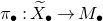 $\pi _{\bullet }:\widetilde {X}_{\bullet }\to M_{\bullet }$
, which is component-wise flat and proper of relative dimension two. We have a trace map
$\pi _{\bullet }:\widetilde {X}_{\bullet }\to M_{\bullet }$
, which is component-wise flat and proper of relative dimension two. We have a trace map $(R\pi _{\bullet })_*{\mathbb{Q}} \to {\mathbb{Q}} [-4]$
(see [Reference VerdierVer76, 4.6] for the case of schemes, which carries over to our setting). In fact, fiberwise,
$(R\pi _{\bullet })_*{\mathbb{Q}} \to {\mathbb{Q}} [-4]$
(see [Reference VerdierVer76, 4.6] for the case of schemes, which carries over to our setting). In fact, fiberwise, $R^4\pi _*{\mathbb{Q}}$
is a
$R^4\pi _*{\mathbb{Q}}$
is a $\mathbb{Q}$
vector space spanned by the orientation classes of irreducible components in the fiber, and the map
$\mathbb{Q}$
vector space spanned by the orientation classes of irreducible components in the fiber, and the map $R^4\pi _*{\mathbb{Q}}\to {\mathbb{Q}}$
sends each generator to
$R^4\pi _*{\mathbb{Q}}\to {\mathbb{Q}}$
sends each generator to $1$
. This induces the desired morphism after passing to cohomology groups.
$1$
. This induces the desired morphism after passing to cohomology groups.
Let $\gamma \in H^*(X, \mathbb{Q})$
be a cohomology class. Recall that
$\gamma \in H^*(X, \mathbb{Q})$
be a cohomology class. Recall that $M$
is the rigidification of the moduli stack
$M$
is the rigidification of the moduli stack $\mathcal{M}_{X/C}^{\alpha }(r,\overline {c_1}, \Delta )$
, and similarly,
$\mathcal{M}_{X/C}^{\alpha }(r,\overline {c_1}, \Delta )$
, and similarly, $\widetilde {X}$
is the rigidification of a family
$\widetilde {X}$
is the rigidification of a family $\widetilde {\mathcal{X}}$
. We denote by
$\widetilde {\mathcal{X}}$
. We denote by $\mathcal{E}$
the universal sheaf on
$\mathcal{E}$
the universal sheaf on $\widetilde {\mathcal{X}}$
. While
$\widetilde {\mathcal{X}}$
. While $\mathcal{E}$
does not descend to
$\mathcal{E}$
does not descend to $\widetilde {X}$
, the expression
$\widetilde {X}$
, the expression $\mathcal{E}\otimes (\det \mathcal{E})^{-(1/r)}$
makes sense as a rational
$\mathcal{E}\otimes (\det \mathcal{E})^{-(1/r)}$
makes sense as a rational $K$
-theory class and does descend to
$K$
-theory class and does descend to $\widetilde {X}$
. By abuse of notation, we denote it by
$\widetilde {X}$
. By abuse of notation, we denote it by $\widehat {\mathcal{E}}$
. We make the following definition for
$\widehat {\mathcal{E}}$
. We make the following definition for $i\geqslant 0$
:
$i\geqslant 0$
:
 \begin{align} \textrm {ch}_i(\gamma ):= \pi _{!}\left (\textrm {ch}_i(\widehat {\mathcal{E}}) \cup c^*\gamma \right ). \end{align}
By abuse of notation, we denote by $T_M^{{{\rm vir}}} = -[R{\textrm {Hom}}_0(\mathcal{E},\mathcal{E})]$
the
$T_M^{{{\rm vir}}} = -[R{\textrm {Hom}}_0(\mathcal{E},\mathcal{E})]$
the $K$
-theory class dual to the relative perfect obstruction theory of
$K$
-theory class dual to the relative perfect obstruction theory of $M$
over the relative Picard scheme. Here is an (incomplete) definition of tautological classes.
$M$
over the relative Picard scheme. Here is an (incomplete) definition of tautological classes.
Definition 3.30. We say that a cohomology class in $H^*(M,{\mathbb{Q}})$
is tautological if it lies in the sub-ring generated by classes
$H^*(M,{\mathbb{Q}})$
is tautological if it lies in the sub-ring generated by classes $\textrm {ch}_i(\gamma )$
and classes
$\textrm {ch}_i(\gamma )$
and classes $\textrm {ch}_i(T_M^{{{\rm vir}}})$
.
$\textrm {ch}_i(T_M^{{{\rm vir}}})$
.
More generally, one can also consider classes defined in terms of $K$
-theoretic objects, such as virtual Segre or Verlinde invariants (see, for example, [Reference Göttsche and KoolGK19b] for an overview).
$K$
-theoretic objects, such as virtual Segre or Verlinde invariants (see, for example, [Reference Göttsche and KoolGK19b] for an overview).
4. The degeneration formula
In this section, we state and prove a special case of a degeneration formula for a one-parameter family of fibered surfaces where the general fiber has an unmarked smooth base curve, degenerating to a curve with one node and to irreducible components over the special fiber. To begin, we focus our attention on the special fiber of such a degeneration.
Let $f:X\to C$
be a fibered surface and suppose
$f:X\to C$
be a fibered surface and suppose $C=D_1\cup D_2$
, where
$C=D_1\cup D_2$
, where $(D_1,x_1)$
and
$(D_1,x_1)$
and $(D_2,x_2)$
are smooth curves with a single marking and the union is taken along the marked points. Let
$(D_2,x_2)$
are smooth curves with a single marking and the union is taken along the marked points. Let $Y_i:=f^{-1}D_i$
and
$Y_i:=f^{-1}D_i$
and $F_i:= f^{-1}(x_i)$
for
$F_i:= f^{-1}(x_i)$
for $i=1,2$
.
$i=1,2$
.
We fix some $L_0$
with fiber degree
$L_0$
with fiber degree $d_0\gt 0$
on
$d_0\gt 0$
on $X$
and a stability condition
$X$
and a stability condition $\alpha$
on
$\alpha$
on $C$
. We assume that
$C$
. We assume that $\alpha (D_i)\not \in \frac {1}{r d_0}\mathbb{Q}$
and, in particular, that the stability condition
$\alpha (D_i)\not \in \frac {1}{r d_0}\mathbb{Q}$
and, in particular, that the stability condition $\alpha$
is generic. We let
$\alpha$
is generic. We let $\alpha _i:= \alpha (D_i)$
. We further fix a sectionFootnote
1
$\alpha _i:= \alpha (D_i)$
. We further fix a sectionFootnote
1 $\overline {c_1}$
of
$\overline {c_1}$
of $\overline {\mathcal{NS}}_{X}$
with degree
$\overline {\mathcal{NS}}_{X}$
with degree $d$
on fibers of
$d$
on fibers of $f$
. We will use the following abuse of notation: if
$f$
. We will use the following abuse of notation: if $c_1'$
and
$c_1'$
and $c_1''$
are points in
$c_1''$
are points in $\mathcal{NS}_{Y_1}$
and
$\mathcal{NS}_{Y_1}$
and $\mathcal{NS}_{Y_2}$
respectively, we write
$\mathcal{NS}_{Y_2}$
respectively, we write $c_1'+c_1''= \overline {c_1}$
if there exists a lift
$c_1'+c_1''= \overline {c_1}$
if there exists a lift $c_1$
of
$c_1$
of $\overline {c_1}$
to
$\overline {c_1}$
to $\mathcal{NS}_X$
which restricts to
$\mathcal{NS}_X$
which restricts to $c_1'$
and
$c_1'$
and $c_1''$
on
$c_1''$
on $Y_1$
and
$Y_1$
and $Y_2$
respectively.
$Y_2$
respectively.
Finally, we write
 \begin{align*}\mathcal{M}_{Y_1/D_1}^{\lfloor {\alpha _1}\rceil }(r,c_1',\Delta _1):=\coprod _{\substack {\beta \in \frac {1}{rd_0}{\mathbb{Q}}\\|\beta -\alpha _i|\lt \frac {1}{2}}}\mathcal{M}_{Y_1/D_1}^{\beta }(r,c_1',\Delta _1),\end{align*}
and similarly for $\mathcal{M}_{Y_2/D_2}^{\lfloor {\alpha _2}\rceil }(r,c_1'',\Delta _2)$
and the
$\mathcal{M}_{Y_2/D_2}^{\lfloor {\alpha _2}\rceil }(r,c_1'',\Delta _2)$
and the $\mathbb{G}_m$
-rigidified versions of the stacks. Note that at most one term in the disjoint union is non-empty.
$\mathbb{G}_m$
-rigidified versions of the stacks. Note that at most one term in the disjoint union is non-empty.
4.1 Glueing of sheaves
Let $c_1'\in \mathcal{NS}_{Y_1}$
,
$c_1'\in \mathcal{NS}_{Y_1}$
, $c_1'' \in \mathcal{NS}_{Y_2}$
such that
$c_1'' \in \mathcal{NS}_{Y_2}$
such that $c_1'+ c_1'' = \overline {c_1}$
. Suppose that
$c_1'+ c_1'' = \overline {c_1}$
. Suppose that $\alpha$
satisfies (5). Let
$\alpha$
satisfies (5). Let $\Delta _1,\Delta _2 \in {\mathbb{Z}}$
and
$\Delta _1,\Delta _2 \in {\mathbb{Z}}$
and $\Delta :=\Delta _1+\Delta _2$
. There is an associated glueing morphism
$\Delta :=\Delta _1+\Delta _2$
. There is an associated glueing morphism
 \begin{align*}\gamma : \mathcal{M}_{Y_1/D_1}^{\lfloor {\alpha _1}\rceil }(r,c_1',\Delta _1)\times _{\mathcal{M}_{F}(r,d)}\mathcal{M}_{Y_2/D_2}^{\lfloor {\alpha _2}\rceil }(r,c_1'', \Delta _2)\to \mathcal{M}^{\alpha }_{X/C}(r, \overline {c_1}, \Delta _1 + \Delta _2).\end{align*}
This induces a canonical morphism on $\mathbb{G}_m$
-rigidifications
$\mathbb{G}_m$
-rigidifications
 \begin{align*}\Gamma : M_{Y_1/D_1}^{\lfloor {\alpha _1}\rceil }(r,c_1',\Delta _1)\times _{M_F(r,d)} M_{Y_2/D_2}^{\lfloor {\alpha _2}\rceil }(r,c_1'',\Delta _2)\to M^{\alpha }_{X/C}(r,\overline {c_1}, \Delta ).\end{align*}
We similarly have a glueing morphism for Picard schemes
 \begin{align*}\textrm {Pic}_{\widetilde {Y}_1/{\textrm {Exp}}_{D_1,x_1}}^{c_1'}\times _{\textrm {Pic}_F^d} \textrm {Pic}^{c_1''}_{\widetilde {Y}_2/{\textrm {Exp}}_{D_2,x_2}}\to \textrm {Pic}_{\widetilde {X}/{\textrm {Exp}}_C}^{\overline {c_1}}.\end{align*}
Here we use a superscript to denote the component of the Picard schemes mapping into the respective component of the Néron–Severi schemes. The glueing morphisms are compatible with taking the determinant, i.e. we have the folllowing commutative diagram.

By taking the union over possible decompositions of the discriminant, we can obtain more.
Lemma 4.1. The following natural diagram is Cartesian.

Proof. This can be checked before passing to rigidifications. In that case, the fiber product corresponding to the lower right corner of the diagram has $T$
-points given by an element of
$T$
-points given by an element of $\mathcal{M}^{\alpha }_{X/C}(r,\overline {c_1},\Delta )(T)$
, i.e. a sheaf
$\mathcal{M}^{\alpha }_{X/C}(r,\overline {c_1},\Delta )(T)$
, i.e. a sheaf $E_T$
on an expansion
$E_T$
on an expansion $\widetilde {X}_T$
, together with a choice of decomposition
$\widetilde {X}_T$
, together with a choice of decomposition $\widetilde {X}_T=\widetilde {Y}_{T,1}\cup \widetilde {Y}_{T,2}$
of the given expansion, such that we have
$\widetilde {X}_T=\widetilde {Y}_{T,1}\cup \widetilde {Y}_{T,2}$
of the given expansion, such that we have $[\det E|_{\widetilde {Y}_{T,1}}] = c_1'$
and
$[\det E|_{\widetilde {Y}_{T,1}}] = c_1'$
and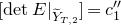 $[\det E|_{\widetilde {Y}_{T,2}}] = c_1''$
. The stability condition on
$[\det E|_{\widetilde {Y}_{T,2}}] = c_1''$
. The stability condition on $C$
implies that the restrictions will lie in the prescribed range of stabilities on the
$C$
implies that the restrictions will lie in the prescribed range of stabilities on the $D_i$
.
$D_i$
.
It follows from Lemma 4.1 that we have a natural relative obstruction theory on each product $M_{Y_1/D_1}^{\lfloor {\alpha _1}\rceil }(r,c_1',\Delta _1)\times _{M_F(r,d)}M_{Y_2/D_2}^{\lfloor {\alpha _2}\rceil }(r,c_1'',\Delta _2)$
over the product of relative Picard schemes
$M_{Y_1/D_1}^{\lfloor {\alpha _1}\rceil }(r,c_1',\Delta _1)\times _{M_F(r,d)}M_{Y_2/D_2}^{\lfloor {\alpha _2}\rceil }(r,c_1'',\Delta _2)$
over the product of relative Picard schemes $\textrm {Pic}_{\widetilde {Y}_1/{\textrm {Exp}}_{D_1}}^{c_1'}\times _{\textrm {Pic}_F}\textrm {Pic}_{\widetilde {Y}_2/{\textrm {Exp}}_{D_2}}^{c_1''}$
, given by pulling back the obstruction theory via
$\textrm {Pic}_{\widetilde {Y}_1/{\textrm {Exp}}_{D_1}}^{c_1'}\times _{\textrm {Pic}_F}\textrm {Pic}_{\widetilde {Y}_2/{\textrm {Exp}}_{D_2}}^{c_1''}$
, given by pulling back the obstruction theory via $\Gamma$
. In particular, we have a canonical virtual fundamental class on each product, obtained by pulling back the fundamental class of the base.
$\Gamma$
. In particular, we have a canonical virtual fundamental class on each product, obtained by pulling back the fundamental class of the base.
Proposition 4.2.
We have an equality in $A_*(M_{X/C}^{\alpha }(r,\overline {c_1}, \Delta ))$
:
$A_*(M_{X/C}^{\alpha }(r,\overline {c_1}, \Delta ))$
:
 \begin{align*}\big[M_{X/C}^{\alpha }\big(r,\overline {c_1}, \Delta \big)\big]^{{{\rm vir}}} =\hspace {-7pt} \sum _{\substack {c_1'+ c_1'' = \overline {c_1}\\ \Delta _1 + \Delta _2 = \Delta }}\Gamma _*\Big[M_{Y_1/D_1}^{\lfloor {\alpha _1}\rceil }(r,c_1',\Delta _1)\times _{M_F(r,d)}M_{Y_2/D_2}^{\lfloor {\alpha _2}\rceil }(r,c_1'',\Delta _2)\Big]^{{{\rm vir}}}.\end{align*}
Proof. By [Reference ManolacheMan12, Theorem 4.1] and Lemma 4.1, it is enough to show the analogous formula on the level of Picard schemes, i.e. that
 \begin{align*} \Big[\textrm {Pic}_{\widetilde {X}/{\textrm {Exp}}_C}\Big] = \sum _{c_1'+ c_1'' = \overline {c_1}} \Gamma '_*\Big[\textrm {Pic}_{\widetilde {Y}_1/{\textrm {Exp}}_{D_1}}^{c_1'} \times _{\textrm {Pic}_F^d} \textrm {Pic}_{\widetilde {Y}_2/{\textrm {Exp}}_{D_2}}^{c_1''} \Big] \end{align*}
and that the glueing morphisms of relative Picard schemes are projective. This is shown in Lemma 4.3 below.
Lemma 4.3.
-
(i) The glueing map
is a proper and quasi-finite morphism, in particular it is projective.
\begin{align*}\Gamma ': \textrm {Pic}_{\widetilde {Y}_1/{\textrm {Exp}}_{D_1}}^{c_1'}\times _{\textrm {Pic}_F}\textrm {Pic}_{\widetilde {Y}_2/{\textrm {Exp}}_{D_2}}^{c_1''}\to \textrm {Pic}_{\widetilde {X}/{\textrm {Exp}}_C}^{\overline {c_1}}\end{align*}
-
(ii) We have an equality of fundamental classes Footnote 2
\begin{align*}\Big[\textrm {Pic}_{\widetilde {X}/{\textrm {Exp}}_C}^{\overline {c_1}}\Big] = \sum _{c_1'+c_2'' = \overline {c_1}} {\Gamma '_*}\Big(\Big[\textrm {Pic}_{\widetilde {Y}_1/{\textrm {Exp}}_{D_1}}^{c_1'}\times _{\textrm {Pic}_F}\textrm {Pic}_{\widetilde {Y}_2/{\textrm {Exp}}_{D_2}}^{c_1''}\Big]\Big).\end{align*}


Proof. Note that $\textrm {Pic}_{\widetilde {Y}_1/{\textrm {Exp}}_{D_1}}^{c_1'}\times _{\textrm {Pic}_F}\textrm {Pic}_{\widetilde {Y}_2/{\textrm {Exp}}_{D_2}}^{c_1''}$
is smooth over
$\textrm {Pic}_{\widetilde {Y}_1/{\textrm {Exp}}_{D_1}}^{c_1'}\times _{\textrm {Pic}_F}\textrm {Pic}_{\widetilde {Y}_2/{\textrm {Exp}}_{D_2}}^{c_1''}$
is smooth over ${\textrm {Exp}}_{D_1}\times {\textrm {Exp}}_{D_2}$
. Indeed, smooth locally over the base, it is a union of translates of the identity component of
${\textrm {Exp}}_{D_1}\times {\textrm {Exp}}_{D_2}$
. Indeed, smooth locally over the base, it is a union of translates of the identity component of $\textrm {Pic}_{\widetilde {Y}_1\cup _F\widetilde {Y}_2/{\textrm {Exp}}_{D_1}\times {\textrm {Exp}}_{D_2}}$
, which is known to be smooth by Theorem2.16.
$\textrm {Pic}_{\widetilde {Y}_1\cup _F\widetilde {Y}_2/{\textrm {Exp}}_{D_1}\times {\textrm {Exp}}_{D_2}}$
, which is known to be smooth by Theorem2.16.
Regarding i): One shows that $\Gamma '$
is quasi-compact by an argument similar to the one used in the proof of Lemma 2.21. Then, it is straightforward to check the valuative criteria for properness. Quasi-finiteness follows, since for a given point
$\Gamma '$
is quasi-compact by an argument similar to the one used in the proof of Lemma 2.21. Then, it is straightforward to check the valuative criteria for properness. Quasi-finiteness follows, since for a given point $L_1$
of
$L_1$
of $\textrm {Pic}_{\widetilde {X}}^{\overline {c_1}}$
defined on an expansion
$\textrm {Pic}_{\widetilde {X}}^{\overline {c_1}}$
defined on an expansion $\widetilde {X}_1\to \widetilde {C}_1$
, points in the preimage under
$\widetilde {X}_1\to \widetilde {C}_1$
, points in the preimage under $\Gamma$
correspond to a choice of singular point in
$\Gamma$
correspond to a choice of singular point in $\widetilde {C}_1$
. Now ii) follows, since each glueing map is between schemes of the same dimension. Thus, to compute the image of the fundamental cycle
$\widetilde {C}_1$
. Now ii) follows, since each glueing map is between schemes of the same dimension. Thus, to compute the image of the fundamental cycle $[\textrm {Pic}_{\widetilde {Y}_1/{\textrm {Exp}}_{D_1}}^{c_1'}\times _{\textrm {Pic}_F}\textrm {Pic}_{\widetilde {Y}_2/{\textrm {Exp}}_{D_2}}^{c_1''}]$
, it is enough to do so over a dense open on target and source. Hence, we may restrict to the generic points of
$[\textrm {Pic}_{\widetilde {Y}_1/{\textrm {Exp}}_{D_1}}^{c_1'}\times _{\textrm {Pic}_F}\textrm {Pic}_{\widetilde {Y}_2/{\textrm {Exp}}_{D_2}}^{c_1''}]$
, it is enough to do so over a dense open on target and source. Hence, we may restrict to the generic points of ${\textrm {Exp}}_{D_i}$
and
${\textrm {Exp}}_{D_i}$
and ${\textrm {Exp}}_C$
corresponding to trivial expansions. Then the result follows, since we have an isomorphism
${\textrm {Exp}}_C$
corresponding to trivial expansions. Then the result follows, since we have an isomorphism
 \begin{align*}\textrm {Pic}_{X}^{\overline {c_1}} = \coprod _{c_1'+c_1'' = \overline {c_1}}\textrm {Pic}_{Y_1}^{c_1'}\times _{\textrm {Pic}_F}\textrm {Pic}_{Y_2}^{c_1''}.\end{align*}
4.2 Obstruction theories
Let $\Delta _1,\Delta _2\in {\mathbb{Z}}$
with
$\Delta _1,\Delta _2\in {\mathbb{Z}}$
with $\Delta = \Delta _1+\Delta _2$
. For convenience, we abbreviate
$\Delta = \Delta _1+\Delta _2$
. For convenience, we abbreviate
 \begin{align*} M_{Y_1/D_1} &:= M_{Y_1/D_1}^{\lfloor {\alpha _1}\rceil }(r,c_1',\Delta _1), \\ \textrm {Pic}_{\tilde {Y}_1} &:= \textrm {Pic}^{c_1'}_{\widetilde {Y}_1/{\textrm {Exp}}_{D_1}},\\ M_F &:= M_F(r,d), \end{align*}
and similarly for $M_{Y_2/D_2}, \textrm {Pic}_{\widetilde {Y}_2}, M_{X/C}^{\alpha }$
and
$M_{Y_2/D_2}, \textrm {Pic}_{\widetilde {Y}_2}, M_{X/C}^{\alpha }$
and $\textrm {Pic}_{\widetilde {X}}$
. In this subsection, we further analyze the virtual class on
$\textrm {Pic}_{\widetilde {X}}$
. In this subsection, we further analyze the virtual class on $M_{Y_1/D_1}\times _{M_{F}} M_{Y_2/D_2}$
that was constructed in § 4.1. Ultimately, we would like to write integrals of cohomology classes over this virtual class in an explicit way in terms of such integrals on
$M_{Y_1/D_1}\times _{M_{F}} M_{Y_2/D_2}$
that was constructed in § 4.1. Ultimately, we would like to write integrals of cohomology classes over this virtual class in an explicit way in terms of such integrals on $M_{Y_1/D_1}$
and
$M_{Y_1/D_1}$
and $M_{Y_2/D_2}$
with their respective virtual classes. As a first step, the following result lets us reduce computations on
$M_{Y_2/D_2}$
with their respective virtual classes. As a first step, the following result lets us reduce computations on $M_{Y_1/D_1}\times _{M_{F}} M_{Y_2/D_2}$
to the simpler
$M_{Y_1/D_1}\times _{M_{F}} M_{Y_2/D_2}$
to the simpler $M_{Y_1/D_1}\times M_{Y_2/D_2}$
with its product virtual class.
$M_{Y_1/D_1}\times M_{Y_2/D_2}$
with its product virtual class.
Proposition 4.4.
-
(1) For
$i=1,2$
, there is a relative perfect obstruction theory for the morphism
$M_{Y_i/D_i}\to M_F$
, which induces a canonical virtual pullback map.
-
(2) The following cycle classes on
$M_{Y_1/D_1}\times _{M_F} M_{Y_2/D_2}$
agree:
-
(i) the virtual pullback of the fundamental class of
$\textrm {Pic}_{\widetilde {Y}_1}\times _{\textrm {Pic}_F^d}\textrm {Pic}_{\widetilde {Y}_2}$
, -
(ii) the Gysin-pullback of the product of virtual classes on
$M_{Y_1/D_1}\times M_{Y_2/D_2}$
along the diagonal map
$M_F\to M_F\times M_F$
, -
(iii) the virtual pullback of the fundamental class of
$M_F$
induced by the morphism
$M_{Y_1/D_1}\to M_F$
, -
(iv) the virtual pullback of the fundamental class of
$M_F$
induced by the morphism
$M_{Y_2/D_2}\to M_F$
.
-








Proof. We have a natural commutative diagram

in which the square is cartesian. The vertical maps are smooth, and the horizontal maps in the square are (smooth locally) local complete intersection morphisms (lci). Moreover, the vertical maps have natural obstruction theories given by the trace-free part of the Atiyah class of a universal sheaf over $M_F$
, and these are naturally compatible with the obstruction theory of
$M_F$
, and these are naturally compatible with the obstruction theory of $M_{Y_1/D_1}$
over
$M_{Y_1/D_1}$
over $\textrm {Pic}_{\widetilde {Y}_1}$
(also given by the trace-free part of the Atiyah class of the respective universal sheaf). It follows that we have a (non-canonical) relative perfect obstruction theory for the morphism
$\textrm {Pic}_{\widetilde {Y}_1}$
(also given by the trace-free part of the Atiyah class of the respective universal sheaf). It follows that we have a (non-canonical) relative perfect obstruction theory for the morphism $\varphi :M_{Y_1/D_1}\to \textrm {Pic}_1\times _{\textrm {Pic}_{F}^d}M_F$
. Since the horizontal maps in the square are lci, we may endow them with their canonical obstruction theories, which are then automatically compatible with the obstruction theory for
$\varphi :M_{Y_1/D_1}\to \textrm {Pic}_1\times _{\textrm {Pic}_{F}^d}M_F$
. Since the horizontal maps in the square are lci, we may endow them with their canonical obstruction theories, which are then automatically compatible with the obstruction theory for $\varphi$
. There is then an induced obstruction theory for the restriction map
$\varphi$
. There is then an induced obstruction theory for the restriction map $M_{Y_1/D_1}\to M_F$
, which has the property that the induced virtual pullback map factors through l.c.i pullback along
$M_{Y_1/D_1}\to M_F$
, which has the property that the induced virtual pullback map factors through l.c.i pullback along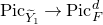 $\textrm {Pic}_{\widetilde {Y}_1}\to \textrm {Pic}_F^d$
followed by the virtual pullback along
$\textrm {Pic}_{\widetilde {Y}_1}\to \textrm {Pic}_F^d$
followed by the virtual pullback along $\varphi$
. Since
$\varphi$
. Since $\textrm {Pic}_{\widetilde {Y}_1}$
is not Deligne–Mumford, the functoriality of obstruction theories here is not a consequence of the theory in [Reference ManolacheMan12]. Instead, we rely on Theorem B.5 of [Reference Aranha, Khan, Latyntsev, Park and RaviAKL+22]. This proves the first point for
$\textrm {Pic}_{\widetilde {Y}_1}$
is not Deligne–Mumford, the functoriality of obstruction theories here is not a consequence of the theory in [Reference ManolacheMan12]. Instead, we rely on Theorem B.5 of [Reference Aranha, Khan, Latyntsev, Park and RaviAKL+22]. This proves the first point for $i=1$
, and by symmetry for
$i=1$
, and by symmetry for $i=2$
.
$i=2$
.
Now, consider the following commutative diagram with Cartesian squares.

The vertical maps in the upper square have obstruction theories given by the sum of Atiyah classes. The obstruction theory of the left vertical map is compatible with the one of the diagonal map given by the Atiyah class. We get an induced obstruction theory on the map $M_{Y_1/D_1}\times _{M_F} M_{Y_2/D_2}\to M_{Y_1/D_1}\times _{\textrm {Pic}_F^d}M_{Y_2/D_2}$
which is isomorphic to
$M_{Y_1/D_1}\times _{M_F} M_{Y_2/D_2}\to M_{Y_1/D_1}\times _{\textrm {Pic}_F^d}M_{Y_2/D_2}$
which is isomorphic to $\textrm {Ext}_0^1(\mathcal{E}_D,\mathcal{E}_D)^{\vee }$
concentrated in degree
$\textrm {Ext}_0^1(\mathcal{E}_D,\mathcal{E}_D)^{\vee }$
concentrated in degree $-1$
. On the other hand, we have the following Cartesian diagram.
$-1$
. On the other hand, we have the following Cartesian diagram.

Since virtual pullback is independent of the precise choice of map in the obstruction theory, this shows that the virtual pullback map for the morphism $M_{Y_1/D_1}\times _{M_F}M_{Y_2/D_2}\to M_{Y_1/D_1}\times _{\textrm {Pic}_F^d}M_{Y_2/D_2}$
is equal to the Gysin-pullback along the diagonal of
$M_{Y_1/D_1}\times _{M_F}M_{Y_2/D_2}\to M_{Y_1/D_1}\times _{\textrm {Pic}_F^d}M_{Y_2/D_2}$
is equal to the Gysin-pullback along the diagonal of $M_F$
. Then, considering the diagram with Cartesian squares
$M_F$
. Then, considering the diagram with Cartesian squares

shows that the virtual class on $M_{Y_1/D_1}\times _{M_F}M_{Y_2/D_2}$
is the Gysin-pullback of the one on
$M_{Y_1/D_1}\times _{M_F}M_{Y_2/D_2}$
is the Gysin-pullback of the one on $M_{Y_1/D_1}\times M_{Y_2/D_2}$
along the diagonal morphism of
$M_{Y_1/D_1}\times M_{Y_2/D_2}$
along the diagonal morphism of $M_F\times M_F$
. The last two equivalences follow, since virtual pullback commutes with lci pullback, and
$M_F\times M_F$
. The last two equivalences follow, since virtual pullback commutes with lci pullback, and $M_{Y_1/D_1}\times _{M_F} M_{Y_2/D_2}$
is identified with the base change of
$M_{Y_1/D_1}\times _{M_F} M_{Y_2/D_2}$
is identified with the base change of $M_{Y_1/D_1} \times _{(M_F\times M_F)} M_{Y_2/D_2}$
along the diagonal
$M_{Y_1/D_1} \times _{(M_F\times M_F)} M_{Y_2/D_2}$
along the diagonal $M_F\to M_F\times M_F$
.
$M_F\to M_F\times M_F$
.
4.3 Decomposition formulas
We show some basic results regarding how tautological classes interact with the glueing morphism. Let $\gamma$
be a cohomology class on
$\gamma$
be a cohomology class on $X$
, let
$X$
, let $\gamma _i$
be its restriction to
$\gamma _i$
be its restriction to $Y_i$
for
$Y_i$
for $i=1,2$
, and let
$i=1,2$
, and let $\gamma _F$
be its restriction to the singular fiber
$\gamma _F$
be its restriction to the singular fiber $F$
. Consider the glueing map
$F$
. Consider the glueing map
 \begin{align*}\Gamma : M_{Y_1/D_1}\times _{M_F(r,d)} M_{Y_2/D_2}\to M_{X/C}.\end{align*}
Lemma 4.5.
We have $\Gamma ^*\textrm {ch}_i(\gamma ) = \operatorname {pr}_1^*\textrm {ch}_i(\gamma _1) + \operatorname {pr}_2^*\textrm {ch}_i(\gamma _2)$
.
$\Gamma ^*\textrm {ch}_i(\gamma ) = \operatorname {pr}_1^*\textrm {ch}_i(\gamma _1) + \operatorname {pr}_2^*\textrm {ch}_i(\gamma _2)$
.
Proof. Let $\widetilde {X}\to M_{X/C}$
denote the universal expansion and
$\widetilde {X}\to M_{X/C}$
denote the universal expansion and $\Gamma ^*\widetilde {X}$
its pullback to
$\Gamma ^*\widetilde {X}$
its pullback to $M_{Y_1/D_1}\times _{M_F(r,d)} M_{Y_2/D_2}$
so that
$M_{Y_1/D_1}\times _{M_F(r,d)} M_{Y_2/D_2}$
so that $\Gamma ^*\widetilde {X} = \operatorname {pr}^*_1\widetilde {Y}_1\cup _F\operatorname {pr}_2^*\widetilde {Y}_2$
. Recall that
$\Gamma ^*\widetilde {X} = \operatorname {pr}^*_1\widetilde {Y}_1\cup _F\operatorname {pr}_2^*\widetilde {Y}_2$
. Recall that $\textrm {ch}_i(\gamma )$
is defined via (6) in terms of a Gysin map
$\textrm {ch}_i(\gamma )$
is defined via (6) in terms of a Gysin map $\pi _!$
, which commutes with the pullback along
$\pi _!$
, which commutes with the pullback along $\Gamma$
. Then consider the following diagram of maps.
$\Gamma$
. Then consider the following diagram of maps.

Then one can check that we have an identity $(\pi _\Gamma )_! = (\pi _{12})_!\circ \sigma ^*$
of maps
$(\pi _\Gamma )_! = (\pi _{12})_!\circ \sigma ^*$
of maps $H^*(\operatorname {pr}_1^*\widetilde {Y}_1\cup _F \operatorname {pr}_2^*\widetilde {Y}_2)\to H^{*-2}(M_{Y_1/D_1}\times _{M_F(r,d)} M_{Y_2/D_2})$
. The lemma follows from this.
$H^*(\operatorname {pr}_1^*\widetilde {Y}_1\cup _F \operatorname {pr}_2^*\widetilde {Y}_2)\to H^{*-2}(M_{Y_1/D_1}\times _{M_F(r,d)} M_{Y_2/D_2})$
. The lemma follows from this.
We consider the restriction of classes derived from the virtual tangent bundle.
Lemma 4.6. We have
 \begin{align*}\Gamma ^*\textrm {ch}_i(T_{M_{X/C}}^{{{\rm vir}}}) = \operatorname {pr}_1^*\textrm {ch}_i(T_{M_{Y_1/D_1}}^{{{\rm vir}}})+\operatorname {pr}_2^*\textrm {ch}_i(T_{M_{Y_2/D_2}}^{{{\rm vir}}}) - \operatorname {pr}_F^*\textrm {ch}_i(T_{M_F/\textrm {Pic}_F}).\end{align*}
Proof. The obstruction theory on $M_{X/C}$
is a descent of
$M_{X/C}$
is a descent of $R{\textrm {Hom}}_0(\mathcal{E},\mathcal{E})$
, where
$R{\textrm {Hom}}_0(\mathcal{E},\mathcal{E})$
, where $\mathcal{E}$
is the universal sheaf on the un-rigidified moduli stack. Since
$\mathcal{E}$
is the universal sheaf on the un-rigidified moduli stack. Since $[\Gamma ^*\mathcal{E}] =[\operatorname {pr}_1^*\mathcal{E}_1] + [\operatorname {pr}_2^*\mathcal{E}_2] - [\operatorname {pr}_F^*\mathcal{E}_F]$
, it follows from adjunction that
$[\Gamma ^*\mathcal{E}] =[\operatorname {pr}_1^*\mathcal{E}_1] + [\operatorname {pr}_2^*\mathcal{E}_2] - [\operatorname {pr}_F^*\mathcal{E}_F]$
, it follows from adjunction that
 \begin{align*}T_{M_{X/C}}^{{{\rm vir}}} = \operatorname {pr}_1^*T_{M_{Y_1/D_1}}^{{{\rm vir}}} + \operatorname {pr}_2^*T_{M_{Y_2/D_2}}^{{{\rm vir}}} - \operatorname {pr}_F^*T_{M_{Y_F}/\textrm {Pic}_F},\end{align*}
and all of these are perfect objects. The result follows from this.
4.4 Fixed determinant spaces
In order to give more precise statements for some of the invariants we consider, we want to work in some ‘fixed determinant’ theory. We make this precise here for the two cases we are interested in: a simple degeneration and a surface fibered over a smooth curve with a single marked point.
Simple degeneration. Let $B$
be regular one-dimensional base and
$B$
be regular one-dimensional base and $X_B\to C_B$
a family of fibered surfaces. Assume the total space
$X_B\to C_B$
a family of fibered surfaces. Assume the total space $C_B$
is regular, that
$C_B$
is regular, that $C_B\to B$
is smooth outside
$C_B\to B$
is smooth outside $b_0\in B$
and that
$b_0\in B$
and that $C_{b_0}$
is a union of two components along a simple node. We say that
$C_{b_0}$
is a union of two components along a simple node. We say that $X_B\to C_B$
is a simple degeneration of fibered surfaces.
$X_B\to C_B$
is a simple degeneration of fibered surfaces.
We consider the stack ${\textrm {Exp}}_{C_B/B}\to B$
with universal expansions
${\textrm {Exp}}_{C_B/B}\to B$
with universal expansions $\widetilde {X}_B\to \widetilde {C}_B$
, and the relative Picard scheme
$\widetilde {X}_B\to \widetilde {C}_B$
, and the relative Picard scheme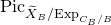 $\textrm {Pic}_{\widetilde {X}_B/{\textrm {Exp}}_{C_B/B}}$
.
$\textrm {Pic}_{\widetilde {X}_B/{\textrm {Exp}}_{C_B/B}}$
.
For the following lemma, we introduce some notation: given an étale morphism $\beta : B\to \mathbb{A}^1$
such that
$\beta : B\to \mathbb{A}^1$
such that $b_0 = \beta ^{-1}(0)$
, let
$b_0 = \beta ^{-1}(0)$
, let $B[n]:=B\times _{{\mathbb{A}}^1}{\mathbb{A}}^{n+1}$
and
$B[n]:=B\times _{{\mathbb{A}}^1}{\mathbb{A}}^{n+1}$
and $C_B[n]\to B[n]$
be the standard degeneration as in [Reference LiLi01, § 1.1]. Let also
$C_B[n]\to B[n]$
be the standard degeneration as in [Reference LiLi01, § 1.1]. Let also $X_B[n]:=X_B\times _{C_B} C_B[n]$
. This defines a smooth morphism
$X_B[n]:=X_B\times _{C_B} C_B[n]$
. This defines a smooth morphism $\beta _n :B[n] \to {\textrm {Exp}}_{C_B/B}$
. Say
$\beta _n :B[n] \to {\textrm {Exp}}_{C_B/B}$
. Say $Y_1$
and
$Y_1$
and $Y_2$
are the irreducible components of
$Y_2$
are the irreducible components of $X_{b_0}$
. Then let
$X_{b_0}$
. Then let $Y_{1,k}\subset X_B[n]$
denote the divisor that corresponds to
$Y_{1,k}\subset X_B[n]$
denote the divisor that corresponds to $Y_1$
over the
$Y_1$
over the $k$
th coordinate hyperplane.
$k$
th coordinate hyperplane.
Lemma 4.7.
-
(a) There is a minimal closed substack
$\overline {e}\subset \textrm {Pic}_{\widetilde {X}_{B}/B}$
through which the identity section
${\textrm {Exp}}_{C_B/B}\to \textrm {Pic}_{\widetilde {X}_B/{\textrm {Exp}}_{C_B/B}}$
factors.
-
(b) The stack
$\overline {e}$
is naturally a subgroup of
$\textrm {Pic}_{\widetilde {X}_{B}/{\textrm {Exp}}{C_B/B}}$
, and the structure map
$\overline {e}\to {\textrm {Exp}}_{C_B/B}$
is étale.
-
(c) For
$\beta :B\to {\mathbb{A}}^1$
as above, we have that
$\beta [n]^{-1}\overline {e}\,\subseteq \textrm {Pic}_{X_B[n]/B[n]}$
is equal to the reduced subscheme supported on the union of sections defined by line bundles
$\mathcal{O}_{X_B[n]}(\sum _{i=1}^{n+1} a_k Y_{1,k})$
for
$a_k\in {\mathbb{Z}}$
, which is a closed set.








Proof. We will show that the union of sections $\mathcal{O}_{X_B[n]}(\sum _{i=1}^{n+1} a_k Y_{1,k})$
defines a closed subspace of
$\mathcal{O}_{X_B[n]}(\sum _{i=1}^{n+1} a_k Y_{1,k})$
defines a closed subspace of $\textrm {Pic}(X_B[n]/B[n])$
, which is the closure of the identity section
$\textrm {Pic}(X_B[n]/B[n])$
, which is the closure of the identity section $B[n]\to \textrm {Pic}_{X_B[n]/B[n]}$
. It is then straightforward to see that the collection of such closed substacks for all
$B[n]\to \textrm {Pic}_{X_B[n]/B[n]}$
. It is then straightforward to see that the collection of such closed substacks for all $n$
induces a closed substack of
$n$
induces a closed substack of $\textrm {Pic}_{\widetilde {X}_B/B}$
, which is the minimal substack containing the identity section.
$\textrm {Pic}_{\widetilde {X}_B/B}$
, which is the minimal substack containing the identity section.
Since the pullback $\textrm {Pic}_{C_B[n]/B[n]}\to \textrm {Pic}_{X_B[n]/B[n]}$
is closed, it is enough to show the analogous statement for
$\textrm {Pic}_{C_B[n]/B[n]}\to \textrm {Pic}_{X_B[n]/B[n]}$
is closed, it is enough to show the analogous statement for $\textrm {Pic}_{C_B[n]/B[n]}$
. Let
$\textrm {Pic}_{C_B[n]/B[n]}$
. Let $D_{1,k}$
denote the image of
$D_{1,k}$
denote the image of $Y_{1,k}$
in
$Y_{1,k}$
in $C_{B}[n]$
. Since the identity component
$C_{B}[n]$
. Since the identity component $\textrm {Pic}^0_{C_B[n]/B[n]}$
is separated, it follows that the identity section is closed in it. Then, for any other section
$\textrm {Pic}^0_{C_B[n]/B[n]}$
is separated, it follows that the identity section is closed in it. Then, for any other section $\xi$
given by a line bundle
$\xi$
given by a line bundle $\mathcal{O}_{X_B[n]}(\sum a_k D_{1,k})$
, we get a closed immersion
$\mathcal{O}_{X_B[n]}(\sum a_k D_{1,k})$
, we get a closed immersion $\xi \subseteq \xi \textrm {Pic}^0_{C_B[n]/B[n]}$
. It follows that the union over all such sections
$\xi \subseteq \xi \textrm {Pic}^0_{C_B[n]/B[n]}$
. It follows that the union over all such sections $\xi$
is a closed subset in
$\xi$
is a closed subset in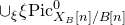 $\cup _{\xi } \xi \textrm {Pic}^0_{X_B[n]/B[n]}$
. But, in fact,
$\cup _{\xi } \xi \textrm {Pic}^0_{X_B[n]/B[n]}$
. But, in fact, $\cup _{\xi } \textrm {Pic}^0_{C_B[n]/B[n]}= \textrm {Pic}_{C_B[n]/B}$
.
$\cup _{\xi } \textrm {Pic}^0_{C_B[n]/B[n]}= \textrm {Pic}_{C_B[n]/B}$
.
To see (b), it is enough to show that $\cup _{\xi } \xi \subset \textrm {Pic}_{C_B[n]/B[n]}$
is a subgroup-space and étale over
$\cup _{\xi } \xi \subset \textrm {Pic}_{C_B[n]/B[n]}$
is a subgroup-space and étale over $B[n]$
. The first point is clear, since the collection of sections
$B[n]$
. The first point is clear, since the collection of sections $\xi$
forms a group. To see that it is étale, we may work locally on the domain. But
$\xi$
forms a group. To see that it is étale, we may work locally on the domain. But $\cup _{\xi } \xi \cap \xi _0 \textrm {Pic}^0_{C_B[n]/B[n]} = \xi _0$
, which is clearly étale over
$\cup _{\xi } \xi \cap \xi _0 \textrm {Pic}^0_{C_B[n]/B[n]} = \xi _0$
, which is clearly étale over $B[n]$
.
$B[n]$
.
Let $L$
be a line bundle on
$L$
be a line bundle on $X_B$
with degree
$X_B$
with degree $d$
on fibers over
$d$
on fibers over $C_B$
, let
$C_B$
, let $\alpha$
be a generic stability condition on
$\alpha$
be a generic stability condition on $C_B$
, and let
$C_B$
, and let $L_0$
be a line bundle on
$L_0$
be a line bundle on $X_B$
with fiber degree
$X_B$
with fiber degree $d_0\gt 0$
. Let
$d_0\gt 0$
. Let $\Delta \in \mathbb{Z}$
.
$\Delta \in \mathbb{Z}$
.
Definition 4.8. We let $\mathcal{M}^{\alpha }_{X_B/C_B}(r, L, \Delta )$
denote the moduli stack of
$\mathcal{M}^{\alpha }_{X_B/C_B}(r, L, \Delta )$
denote the moduli stack of $\alpha$
-balanced
$\alpha$
-balanced $f$
-stable sheaves on minimal expansions of
$f$
-stable sheaves on minimal expansions of $X_B$
whose determinant map factors through
$X_B$
whose determinant map factors through $L\overline {e}$
and whose discriminant is
$L\overline {e}$
and whose discriminant is $\Delta$
. This is naturally a closed substack of
$\Delta$
. This is naturally a closed substack of $\mathcal{M}^{\alpha }_{X_B/C_B}(r, \overline {c_1(L)}, \Delta )$
, where
$\mathcal{M}^{\alpha }_{X_B/C_B}(r, \overline {c_1(L)}, \Delta )$
, where $\overline {c_1(L)}$
is the section
$\overline {c_1(L)}$
is the section ${\textrm {Exp}}_{C_B/B}\to \overline {\mathcal{NS}}_{X_B/B}$
induced by
${\textrm {Exp}}_{C_B/B}\to \overline {\mathcal{NS}}_{X_B/B}$
induced by $c_1(L)$
. We also let
$c_1(L)$
. We also let $M^{\alpha }_{X_B/C_B}(r, L, \Delta )$
denote the
$M^{\alpha }_{X_B/C_B}(r, L, \Delta )$
denote the $\mathbb{G}_m$
-rigidification of
$\mathbb{G}_m$
-rigidification of $\mathcal{M}^{\alpha }_{X_B/C_B}(r, L, \Delta )$
.
$\mathcal{M}^{\alpha }_{X_B/C_B}(r, L, \Delta )$
.
Remark 4.9. We have an analogous result if $X\to C$
is a fibered surface with
$X\to C$
is a fibered surface with $C$
a union of two smooth curves along a single node (e.g. if
$C$
a union of two smooth curves along a single node (e.g. if $X\to C$
is the central fiber of a simple degeneration, but without assuming a smoothing exists). We use the notation
$X\to C$
is the central fiber of a simple degeneration, but without assuming a smoothing exists). We use the notation $\mathcal{M}_{X/B}^{\alpha }(r,L,\Delta )$
and
$\mathcal{M}_{X/B}^{\alpha }(r,L,\Delta )$
and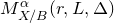 $M_{X/B}^{\alpha }(r,L,\Delta )$
for the resulting moduli stacks. We leave the details to the reader, who may alternatively always assume that we are working with the central fiber of a simple degeneration.
$M_{X/B}^{\alpha }(r,L,\Delta )$
for the resulting moduli stacks. We leave the details to the reader, who may alternatively always assume that we are working with the central fiber of a simple degeneration.
Expansions. Let $(C,x)$
be a smooth marked curve and
$(C,x)$
be a smooth marked curve and $X\to C$
be a fibered surface. We consider the stack of expansions
$X\to C$
be a fibered surface. We consider the stack of expansions $Exp_{C}$
and the relative Picard scheme
$Exp_{C}$
and the relative Picard scheme $\textrm {Pic}_{\widetilde {X}/{\textrm {Exp}}_{C}}$
. The stack
$\textrm {Pic}_{\widetilde {X}/{\textrm {Exp}}_{C}}$
. The stack ${\textrm {Exp}}_C$
has a cover by affine spaces
${\textrm {Exp}}_C$
has a cover by affine spaces $\alpha _n:\mathbb{A}^n\to {\textrm {Exp}}_{C}$
, together with a standard expansion
$\alpha _n:\mathbb{A}^n\to {\textrm {Exp}}_{C}$
, together with a standard expansion $X[n]\to C[n]$
[Reference LiLi01, § 4.1]. We let
$X[n]\to C[n]$
[Reference LiLi01, § 4.1]. We let $Y_{k}$
denote the closure of the component induced by
$Y_{k}$
denote the closure of the component induced by $X$
over the
$X$
over the $k$
th coordinate hyperplane in
$k$
th coordinate hyperplane in $\mathbb{A}^n$
. Then, we have the analogue to Lemma 4.7 with essentially the same proof, which we do not repeat here.
$\mathbb{A}^n$
. Then, we have the analogue to Lemma 4.7 with essentially the same proof, which we do not repeat here.
Lemma 4.10.
-
(a) There is a minimal closed substack
$\overline {e}\,\subseteq \textrm {Pic}_{\widetilde {X}/{\textrm {Exp}}_C}$
through which the identity section
${\textrm {Exp}}_{C,x}\to \textrm {Pic}_{\widetilde {X}_B/{\textrm {Exp}}_{C,x}}$
factors.
-
(b) The stack
$\overline {e}$
is naturally a subgroup of
$\textrm {Pic}_{\widetilde {X}/{\textrm {Exp}}_{C}}$
, and the structure map
$\overline {e}\to {\textrm {Exp}}_{C,x}$
is étale.
-
(c) Given an étale morphism
$\beta : B\to \mathbb{A}^1$
, the closed substack
$\alpha _n^{-1}\overline {e}\,\subseteq \textrm {Pic}(X[n]/{\mathbb{A}}^n)$
is equal to the reduced substack supported on the union of sections defined by line bundles
$\mathcal{O}_{X_B[n]}(\sum _{i=1}^{n+1} a_k Y_{k})$
for
$a_k\in {\mathbb{Z}}$
, which is a closed set.




Let $L$
be a line bundle on
$L$
be a line bundle on $X$
. Let
$X$
. Let $\alpha \in \mathbb{Q}$
be arbitrary.
$\alpha \in \mathbb{Q}$
be arbitrary.
Definition 4.11. We let $\mathcal{M}_{X/C}^{\alpha }(r,L,\Delta )$
denote the moduli stack of
$\mathcal{M}_{X/C}^{\alpha }(r,L,\Delta )$
denote the moduli stack of $\alpha$
-balanced
$\alpha$
-balanced $f$
-stable sheaves on minimal expansions of
$f$
-stable sheaves on minimal expansions of $X$
whose determinant map factors through
$X$
whose determinant map factors through $L\overline {e}$
and whose discriminant is
$L\overline {e}$
and whose discriminant is $\Delta$
. This is naturally a closed substack of
$\Delta$
. This is naturally a closed substack of $\mathcal{M}^{\alpha }(r,\overline {c_1}(L), \Delta )$
. We also denote by
$\mathcal{M}^{\alpha }(r,\overline {c_1}(L), \Delta )$
. We also denote by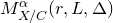 $M^{\alpha }_{X/C}(r,L,\Delta )$
the
$M^{\alpha }_{X/C}(r,L,\Delta )$
the $\mathbb{G}_m$
-rigidification.
$\mathbb{G}_m$
-rigidification.
The results of this section carry over to this setting in the obvious way. In particular, this applies to Lemmas 4.5 and 4.6 and to Propositions 4.2 and 4.4.
For clarity, we restate Proposition 4.2 for this setting explicitly. For this, suppose we are in the situation of Proposition 4.2 and that we have also fixed a line bundle $L$
on
$L$
on $X$
in class
$X$
in class $\overline {c}_1$
. By abuse of notation, write
$\overline {c}_1$
. By abuse of notation, write $L_1+L_2 = \overline {L}$
, if
$L_1+L_2 = \overline {L}$
, if $L_1$
and
$L_1$
and $L_2$
are line bundles on
$L_2$
are line bundles on $Y_1$
and
$Y_1$
and $Y_2$
respectively, whose restrictions to
$Y_2$
respectively, whose restrictions to $F$
are isomorphic and such that there exists an integer
$F$
are isomorphic and such that there exists an integer $\ell$
with
$\ell$
with $L|_{Y_1}\simeq L_1(-\ell F)$
and
$L|_{Y_1}\simeq L_1(-\ell F)$
and $L|_{Y_2}\simeq L_2(\ell F)$
. Let also
$L|_{Y_2}\simeq L_2(\ell F)$
. Let also $L_F:=L|_F$
.
$L_F:=L|_F$
.
Proposition 4.12.
We have an equality in $A_*(M^{\alpha }_{X/C}(r,L,\Delta ))$
:
$A_*(M^{\alpha }_{X/C}(r,L,\Delta ))$
:
 \begin{align*}[M_{X/C}^{\alpha }]^{{{\rm vir}}} = \sum _{\substack {L_1 + L_2 = \overline {L}\\ \Delta _1+\Delta _2 = \Delta }} \Gamma _*\Big[M_{Y_1/D_1}^{\lfloor {\alpha _1}\rceil }(r,L_1,\Delta _1)\times _{M_F(r,L_F)} M_{Y_2/D_2}^{\lfloor {\alpha _2}\rceil }(r,L_2,\Delta _2)\Big]^{{{\rm vir}}}.\end{align*}
4.5 Invariants
We define the type of invariants that we want to consider in the degeneration formula. For simplicity, we restrict the discussion to a specific type of invariant and to the fixed determinant case. We expect that similar formulas hold for, say, Segre and (with some more work) Verlinde invariants. It also should not be essential to work with the fixed determinant version, but then one should consider insertions coming from the Picard scheme in order to get non-trivial invariants when the two theories differ.
Let $A$
be a multiplicative genus (e.g. the Chern polynomial,
$A$
be a multiplicative genus (e.g. the Chern polynomial, $\chi _y$
-genus or elliptic genus). Let
$\chi _y$
-genus or elliptic genus). Let $X\to C$
be a fibered surface, where
$X\to C$
be a fibered surface, where $C$
is either smooth with possibly a marked point, or a union of two irreducible components along a single node. We assume we have fixed data
$C$
is either smooth with possibly a marked point, or a union of two irreducible components along a single node. We assume we have fixed data $\alpha , L, L_0$
as in § 4.4.
$\alpha , L, L_0$
as in § 4.4.
For $\mathcal{M}\to M$
a moduli stack and its
$\mathcal{M}\to M$
a moduli stack and its $\mathbb{G}_m$
-rigidification as considered throughout, we will consider cohomology classes of the form
$\mathbb{G}_m$
-rigidification as considered throughout, we will consider cohomology classes of the form
 \begin{align} \Phi (\mathcal{E}) = A(T^{{{\rm vir}}})B(\mathcal{E}). \end{align}
Here,
-
(i)
$\mathcal{E}$
denotes the universal sheaf on some family of expansions over
$\mathcal{M}$
of a given fibered surface
$X\to C$
, -
(ii)
$A$
is a multiplicative transformation from the
$K$
-theory of perfect objects to cohomology with coefficients in some ring
$\Lambda$
containing
$\mathbb{Q}$
, -
(iii)
$B(\mathcal{E}) = \exp (\sum _{i,\gamma } \textrm {ch}_i(\gamma ) q_{\gamma ,i})$
, where
$i$
ranges through integers
$\geqslant 2$
and
$\gamma$
ranges through a basis of cohomology of
$X$
.





Let $K:=\Lambda [[(q_{\gamma ,i})_{\gamma ,i}]]$
denote the coefficient field of
$K:=\Lambda [[(q_{\gamma ,i})_{\gamma ,i}]]$
denote the coefficient field of $\Phi$
. We let
$\Phi$
. We let $\mathcal{E}$
denote the universal sheaf over
$\mathcal{E}$
denote the universal sheaf over $\mathcal{M}^{\alpha }_{X/C}(r,L,\Delta )$
. We assume that
$\mathcal{M}^{\alpha }_{X/C}(r,L,\Delta )$
. We assume that $\alpha$
is generic and that it satisfies (5).
$\alpha$
is generic and that it satisfies (5).
If $X\to C$
has no marked fiber (so either
$X\to C$
has no marked fiber (so either $C$
is smooth or has two components and a single node), we define an invariant simply as
$C$
is smooth or has two components and a single node), we define an invariant simply as
 \begin{align*}I^{\Phi }_{X/C}(r,L,\Delta ):=\int \Phi (\mathcal{E})\cap [M^{\alpha }_{X/C}(r,L,\Delta )]^{{{\rm vir}}}\in K.\end{align*}
Here, the left-hand side a priori implicitly depends on $\alpha$
, but it will follow from the decomposition formula that it is actually independent for any generic
$\alpha$
, but it will follow from the decomposition formula that it is actually independent for any generic $\alpha$
satisfying (5).
$\alpha$
satisfying (5).
If $C$
is smooth with a single marked point, we let
$C$
is smooth with a single marked point, we let $L_F$
denote the restriction of
$L_F$
denote the restriction of $L$
to the marked fiber, and set
$L$
to the marked fiber, and set
 \begin{align*}V:= H_*(M_F(r,L_F), K).\end{align*}
Then we obtain invariants valued in $V$
by pushing forward along the evaluation map
$V$
by pushing forward along the evaluation map
 \begin{align*}I^{\Phi }_{X/C}(r,L,\Delta ):=\operatorname {ev}_* \big(\Phi (\mathcal{E})\cap [M^{\alpha }_{X/C}(r,L,\Delta )]^{{{\rm vir}}}\big)\in V.\end{align*}
If $C$
has a marked point, let
$C$
has a marked point, let $F$
be the marked fiber. Otherwise, let
$F$
be the marked fiber. Otherwise, let $F$
denote the fiber over an arbitrary smooth point of
$F$
denote the fiber over an arbitrary smooth point of $C$
. We set
$C$
. We set
 \begin{align*}Z_{X/C,\Phi }(q) := \sum _{\substack {\Delta \in {\mathbb{Z}}\\0\leqslant \ell \lt r}} I_{X/C}^{\Phi }(r,L+ \ell [F],\Delta )\, q^{\Delta - (r^2-1)\chi (\mathcal{O}_X)}.\end{align*}
This is valued in $K[[q]]$
or
$K[[q]]$
or $V[[q]]$
respectively and depends implicitly on
$V[[q]]$
respectively and depends implicitly on $r,L$
and
$r,L$
and $L_0$
. Here, we choose a different generic
$L_0$
. Here, we choose a different generic $\alpha$
satisfying (5) for each
$\alpha$
satisfying (5) for each $\Delta$
and
$\Delta$
and $\ell$
.
$\ell$
.
Remark 4.13. Note that for $c_1= L+\ell F$
, the discriminant and second Chern class are related by
$c_1= L+\ell F$
, the discriminant and second Chern class are related by
 \begin{align*}\Delta=2 rc_2 - (r-1) c_1^2=2 r c_2 - (r-1) L^{\cdot 2} - 2 \ell (r-1) d.\end{align*}
As $c_2$
ranges through the integers and
$c_2$
ranges through the integers and $\ell$
ranges in
$\ell$
ranges in $[0,r-1]$
, we find that the possible exponents of
$[0,r-1]$
, we find that the possible exponents of $q$
for which the coefficient of
$q$
for which the coefficient of $Z_{X/C,\Phi }$
is non-empty lie in
$Z_{X/C,\Phi }$
is non-empty lie in $2{\mathbb{Z}}+ (r-1)L^{\cdot 2} -(r^2-1)\chi (\mathcal{O}_X)$
, and each such integer corresponds to a unique choice of
$2{\mathbb{Z}}+ (r-1)L^{\cdot 2} -(r^2-1)\chi (\mathcal{O}_X)$
, and each such integer corresponds to a unique choice of $\ell$
and
$\ell$
and $c_2$
. In other words, we have
$c_2$
. In other words, we have
 \begin{gather*} Z_{X/C,\Phi }(q) = q^{-(r-1)L^{\cdot 2}-(r^2-1)\chi (\mathcal{O}_X)}\sum _{\substack {c_2\in {\mathbb{Z}}\\0\leqslant \ell \lt r}} I_{X/C}^{\Phi }\left (r,L+ \ell [F],\Delta (c_2,\ell )\right )\, q^{2 (r c_2 - \ell (r-1) d)}. \end{gather*}
We see that the exponents of $q$
in the sum range exactly through
$q$
in the sum range exactly through $2{\mathbb{Z}}$
.
$2{\mathbb{Z}}$
.
4.6 Degeneration formula for multiplicative classes
Let $X\to C$
be a fibered surface, where
$X\to C$
be a fibered surface, where $C$
is the union of two smooth curves along a single node, and let the set-up be as in § 4.5. We let
$C$
is the union of two smooth curves along a single node, and let the set-up be as in § 4.5. We let $Y_i\to D_i$
be the surfaces fibered over a smooth curve with a single marking obtained as the components of
$Y_i\to D_i$
be the surfaces fibered over a smooth curve with a single marking obtained as the components of $X\to C$
and let
$X\to C$
and let $F$
denote the fiber of
$F$
denote the fiber of $X$
over the node.
$X$
over the node.
Let
 \begin{align*}V:= H_*(M_F(r,L),K)\end{align*}
so that the invariants associated to $Y_i/D_i$
for
$Y_i/D_i$
for $i=1,2$
are valued in
$i=1,2$
are valued in $V$
. Note that
$V$
. Note that $V$
has a ring structure with respect to intersection product, which is graded commutative. We denote the intersection product of cycles by
$V$
has a ring structure with respect to intersection product, which is graded commutative. We denote the intersection product of cycles by $\alpha \cdot \beta$
. We define a bilinear pairing on
$\alpha \cdot \beta$
. We define a bilinear pairing on $V$
as
$V$
as
 \begin{align*} *_{\Phi } :\, V\times V &\to K \\ \alpha , \beta &\mapsto \int _{M_F(r,L)} A(T_{M_F(r,L)})^{-1}\cap \left (\alpha \cdot \beta \right ). \end{align*}
We extend the multiplication $*_{\Phi }$
to Laurent series in
$*_{\Phi }$
to Laurent series in $q$
over
$q$
over $V$
and
$V$
and $K$
by applying it coefficientwise and dividing the final result by
$K$
by applying it coefficientwise and dividing the final result by $q^{\dim M_F(r,L)}$
.
$q^{\dim M_F(r,L)}$
.
Theorem 4.14. We have
 \begin{align*} Z_{X/C,\Phi }(q) = Z_{X_1/C_1, \Phi }(q)\, {*}_{\Phi }\, Z_{X_{2}/C_{2},\Phi }(q). \end{align*}
Proof. Comparing coefficients, and in view of Remark 4.13, we may consider $c_2$
and
$c_2$
and $k$
, and therefore
$k$
, and therefore $\Delta$
, as fixed, and we need to show that, for some fixed chosen stability condition
$\Delta$
, as fixed, and we need to show that, for some fixed chosen stability condition $\alpha$
on
$\alpha$
on $C$
, we have
$C$
, we have
 \begin{align*}I^{\Phi }_{X/C}(r,L +\ell [F], \Delta ) = \sum I^{\Phi }_{Y_1/D_1}(r,L_1 + \ell _1 [F], \Delta _1) *_\Phi I^{\Phi }_{Y_2/D_2}(r,L_2 + \ell _2 [F], \Delta _2),\end{align*}
where the sum ranges over all $0\leqslant \ell _1,\ell _2\lt r$
and over all
$0\leqslant \ell _1,\ell _2\lt r$
and over all $\Delta _1,\Delta _2\in {\mathbb{Z}}$
such that
$\Delta _1,\Delta _2\in {\mathbb{Z}}$
such that
 \begin{align*}\Delta -(r^2-1)\chi (\mathcal{O}_X) = \Delta _1 +\Delta _2 - (r^2-1)(\chi (\mathcal{O}_{Y_1})+\chi (\mathcal{O}_{Y_2})) - \dim M_F(r,L_F), \end{align*}
or, equivalently, such that $\Delta = \Delta _1+\Delta _2$
. Writing out the definition of invariants, we have the equivalent formula
$\Delta = \Delta _1+\Delta _2$
. Writing out the definition of invariants, we have the equivalent formula
 \begin{align} \int \Phi (\mathcal{E})\cap [M_{X/C}^{\alpha }(r,L + \ell [F],\Delta )]^{{{\rm vir}}} =\sum &\big(\!\operatorname {ev}_{*}(\Phi (\mathcal{E}_1)\cap [M_{Y_1/D_1}^{b}(r, L_1+\ell _1 F, \Delta _1)]^{{{\rm vir}}})\, *_{\Phi }\nonumber \\& \;\operatorname {ev}_{*}(\Phi (\mathcal{E}_2)\cap [M_{Y_2/D_2}^{b}(r, L_2+\ell _2 F, \Delta _2)]^{{{\rm vir}}})\big ) \end{align}
for some choice of generic $\alpha$
satisfying (5) and where we use the notation of Remark 3.27.
$\alpha$
satisfying (5) and where we use the notation of Remark 3.27.
Since $\Delta = \Delta _1+\Delta _2$
, and by the dependence of the discriminant on first and second Chern classes, we have, for each term of the sum for which the moduli spaces are non-empty, that
$\Delta = \Delta _1+\Delta _2$
, and by the dependence of the discriminant on first and second Chern classes, we have, for each term of the sum for which the moduli spaces are non-empty, that $\ell \equiv \ell _1 + \ell _2 \mod r$
. In particular, for each such term there exists unique representatives
$\ell \equiv \ell _1 + \ell _2 \mod r$
. In particular, for each such term there exists unique representatives $\ell _i' \equiv \ell _i \mod r$
such that
$\ell _i' \equiv \ell _i \mod r$
such that $|\alpha (c_1(L_i+\ell _i'F), \Delta _i)-\alpha _i|\lt 1/2$
. It follows that
$|\alpha (c_1(L_i+\ell _i'F), \Delta _i)-\alpha _i|\lt 1/2$
. It follows that $\ell =\ell _1' + \ell _2'$
. Letting
$\ell =\ell _1' + \ell _2'$
. Letting $L_i':= L_i+\ell _i' F$
and
$L_i':= L_i+\ell _i' F$
and $L':= L+\ell F$
, we have in particular
$L':= L+\ell F$
, we have in particular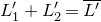 $L_1'+ L_2' = \overline {L'}$
in the notation preceding Proposition 4.12. Since twisting by a line bundle induces an isomorphism between moduli spaces, we have
$L_1'+ L_2' = \overline {L'}$
in the notation preceding Proposition 4.12. Since twisting by a line bundle induces an isomorphism between moduli spaces, we have
 \begin{align*} I^{\Phi }_{Y_i/D_i}(r,L_1 + \ell _1 F, \Delta _1) &= I^{\Phi }_{Y_i/D_i}(r,L_1 + \ell _1'F, \Delta _1) \\ &= \operatorname {ev}_* \Big(\Phi (\mathcal{E}_i)\cap \Big[M^{\lfloor {\alpha _i}\rceil }_{Y_i/D_i}(r, L_1',\Delta _i)\Big]^{{{\rm vir}}}\Big). \end{align*}
In summary, we may rewrite the right-hand side of (10) as
 \begin{gather*} \sum _{\substack {\Delta _1+ \Delta _2 = \Delta \\ L_1' + L_2' = \overline {L'}}} \operatorname {ev}_*\Big(\Phi (\mathcal{E}_1)\cap \Big[M_{Y_1/D_1}^{\lfloor {\alpha _1}\rceil }(r,L_1',\Delta _1)\Big]^{{{\rm vir}}}\Big) *_\Phi \operatorname {ev}_*\Big(\Phi (\mathcal{E}_2)\cap [M_{Y_2/D_2}^{\lfloor {\alpha _2}\rceil }(r,L_2',\Delta _2)]^{{{\rm vir}}}\Big). \end{gather*}
We examine each term of this sum. Using the definition of $*_\Phi$
, the projection formula and Proposition 4.4, we may rewrite a single term in this sum as the pushforward to a point of
$*_\Phi$
, the projection formula and Proposition 4.4, we may rewrite a single term in this sum as the pushforward to a point of
 \begin{gather*} \operatorname {pr}_F^*A(T_{M_F})^{-1}\cap \operatorname {pr}_1^*\Phi (\mathcal{E}_1)\cap \operatorname {pr}_2^*\Phi (\mathcal{E}_2)\cap \left [M_{Y_1/D_1}^{\lfloor {\alpha _1}\rceil }(r,L_1',\Delta _1)\times _{M_F} M_{Y_2/D_2}^{\lfloor {\alpha _2}\rceil }(r,L_2',\Delta _2) \right ]^{{{\rm vir}}}. \end{gather*}
Then, by Lemmas 4.5 and 4.6, this is equal to
 \begin{align*}\Gamma ^*\Phi (\mathcal{E})\cap \left [M_{Y_1/D_1}^{\lfloor {\alpha _1}\rceil }(r,L_1',\Delta _1)\times _{M_F} M_{Y_2/D_2}^{\lfloor {\alpha _2}\rceil }(r,L_2',\Delta _2) \right ]^{{{\rm vir}}},\end{align*}
where $\Gamma$
is the glueing map to
$\Gamma$
is the glueing map to $M^{\alpha }_{X/C}(r,L', \Delta )$
. Using this, we have reduced equation (10) to Proposition 4.2 and are done.
$M^{\alpha }_{X/C}(r,L', \Delta )$
. Using this, we have reduced equation (10) to Proposition 4.2 and are done.
4.7 Application to elliptic fibrations
Suppose that $X\to C$
has genus one fibers in the situation of Theorem4.14. In this case, we have
$X\to C$
has genus one fibers in the situation of Theorem4.14. In this case, we have $V=H_*(M_F(r,L),K) = H_*(\operatorname {pt},K)\simeq K$
, so the relative invariants are simply power series valued in the coefficient ring. In this case, the statement of Theorem4.14 becomes especially simple.
$V=H_*(M_F(r,L),K) = H_*(\operatorname {pt},K)\simeq K$
, so the relative invariants are simply power series valued in the coefficient ring. In this case, the statement of Theorem4.14 becomes especially simple.
Corollary 4.15.
If $g=1$
, we have the following identity in
$g=1$
, we have the following identity in $K[[q]]$
:
$K[[q]]$
:
 \begin{align*}Z_{X/C,\Phi }(q) = Z_{Y_1/D_1,\Phi }(q)\,Z_{Y_2/D_2,\Phi }(q).\end{align*}
In the rest of this subsection, we give a proof of Theorem1.4. We will consider the special case
 \begin{align*}\Phi (\mathcal{E}) = A_{y,q}(T^{{{\rm vir}}})\end{align*}
of (9), obtained by setting $B=1$
and taking
$B=1$
and taking $A_{y,q}$
to be the insertion considered in [Reference Gasparim and LiuGL10, § 4.8] which defines the virtual elliptic genus [Reference Fantechi and GöttscheFG10]. By results of de Jong and Friedman, we have suitable degenerations.
$A_{y,q}$
to be the insertion considered in [Reference Gasparim and LiuGL10, § 4.8] which defines the virtual elliptic genus [Reference Fantechi and GöttscheFG10]. By results of de Jong and Friedman, we have suitable degenerations.
Theorem 4.16.
Let $X$
be an elliptic surface over
$X$
be an elliptic surface over ${\mathbb{P}}^1$
of degree
${\mathbb{P}}^1$
of degree $e\geqslant 2$
without multiple or reduced fibers. Let
$e\geqslant 2$
without multiple or reduced fibers. Let $D$
be a
$D$
be a $d$
-section on
$d$
-section on $X$
, and suppose that there exist no
$X$
, and suppose that there exist no $d'$
-sections for any
$d'$
-sections for any $1\leqslant d'\lt d$
. Then there exists a connected base
$1\leqslant d'\lt d$
. Then there exists a connected base $B$
and a family of elliptic surfaces
$B$
and a family of elliptic surfaces $X_B \to C_B\to B$
together with a family of
$X_B \to C_B\to B$
together with a family of $n$
-sections
$n$
-sections $D_B\subset X_B$
such that the following hold.
$D_B\subset X_B$
such that the following hold.
-
(i) For some
$b_0\in B$
, the triple
$D_{b_0}\subset X_{b_0}\to C_{b_0}$
is isomorphic to
$D\subset X \to {\mathbb{P}}^1$
. -
(ii) For some
$b_1\in B$
, we have that:
-
–
$X_{b_1}\to C_{b_1}$
is obtained from glueing two elliptic surfaces
$Y_1\to {\mathbb{P}}^1$
and
$Y_2\to {\mathbb{P}}^1$
along an isomorphic fiber, where
$Y_1$
is a degree
$(e-1)$
elliptic surface and
$Y_2$
is a rational elliptic surface, and
-
– the divisor
$D_{b_1}\subset X_{b_1}$
restricts to a
$d$
-section on
$Y_1$
and to a smooth rational curve
$D$
satisfying
$D^2 = d-2$
on
$Y_2$
. Moreover, if
$e\geqslant 2$
, then
$Y_1$
has no
$d'$
-sections for
$1\leqslant d'\lt d$
.
-




Proof. For $e\geqslant 3$
, this follows from Theorem 4.9 in [Reference de Jong and FriedmandJF11] together with constructions going into Claim 5.7 in [Reference de Jong and FriedmandJF11]. For
$e\geqslant 3$
, this follows from Theorem 4.9 in [Reference de Jong and FriedmandJF11] together with constructions going into Claim 5.7 in [Reference de Jong and FriedmandJF11]. For $e=2$
, it follows from similar arguments using the Torelli theorem for lattice polarized K3 surfaces.
$e=2$
, it follows from similar arguments using the Torelli theorem for lattice polarized K3 surfaces.
We will also need the following vanishing result.
Proposition 4.17.
Let $E$
be an elliptic curve and consider
$E$
be an elliptic curve and consider $X = E\times {\mathbb{P}}^1 \to \mathbb{P}^1$
, and let
$X = E\times {\mathbb{P}}^1 \to \mathbb{P}^1$
, and let $x_1,\ldots ,x_n$
be distinct points on
$x_1,\ldots ,x_n$
be distinct points on $\mathbb{P}^1$
. Let
$\mathbb{P}^1$
. Let $r\gt 0$
, and let
$r\gt 0$
, and let $L$
be a line bundle on
$L$
be a line bundle on $E\times {\mathbb{P}}^1$
that has degree
$E\times {\mathbb{P}}^1$
that has degree $d$
on fibers, with
$d$
on fibers, with $d$
coprime to
$d$
coprime to $r$
. Then we have
$r$
. Then we have
 \begin{align*}Z^{{\textrm {Ell}}}_{X/(\mathbb{P}^1, (x_1,\ldots ,x_n))} = 1.\end{align*}
Proof. For any $\Delta$
for which the moduli space
$\Delta$
for which the moduli space
 \begin{align*}M_{X/({\mathbb{P}}^1,(x_1,\ldots ,x_n))}(r,L,\Delta )\end{align*}
is non-empty, one can show that either it is a point, or it admits, up to a finite étale cover, an elliptic curve factor. In the latter case, all virtual Chern numbers vanish. The result follows from this.
Proof of Theorem
1.4. Since enumerative invariants for surfaces with $p_g(X)\gt 0$
are independent of choice of polarization, we may use Theorem2.24 and compute invariants using moduli spaces of
$p_g(X)\gt 0$
are independent of choice of polarization, we may use Theorem2.24 and compute invariants using moduli spaces of $f$
-stable sheaves.
$f$
-stable sheaves.
In the case $e=2$
, the result follows from the DMVV formula and the fact that any moduli space of Gieseker-stable sheaves on a K3 surface is deformation invariant to a Hilbert scheme of points when stability equals semistability. Next, we show that for any rational elliptic surface
$e=2$
, the result follows from the DMVV formula and the fact that any moduli space of Gieseker-stable sheaves on a K3 surface is deformation invariant to a Hilbert scheme of points when stability equals semistability. Next, we show that for any rational elliptic surface $Y\to \mathbb{P}^1$
and any divisor
$Y\to \mathbb{P}^1$
and any divisor $D$
on
$D$
on $Y$
of fiber degree coprime to
$Y$
of fiber degree coprime to $r$
, we have (when taking invariants and generating series with respect to the moduli spaces of fiber-stable objects)
$r$
, we have (when taking invariants and generating series with respect to the moduli spaces of fiber-stable objects)
 \begin{align*}Z_{Y/{\mathbb{P}}^1}^{{\textrm {Ell}}} = (Z_{K3}^{{\textrm {Ell}}})^{1/2}.\end{align*}
By Proposition 4.17, the relative and absolute invariants agree. In particular, we may glue two identical copies of $Y$
together along a fiber and deform the resulting surface to a smooth K3 surface while preserving the divisor class, see [Reference FriedmanFri83, Theorem 5.10] and [Reference FriedmanFri84, Proposition 4.3].
$Y$
together along a fiber and deform the resulting surface to a smooth K3 surface while preserving the divisor class, see [Reference FriedmanFri83, Theorem 5.10] and [Reference FriedmanFri84, Proposition 4.3].
Now, we can argue inductively on $e$
, with base case
$e$
, with base case $e=2$
, by Theorem4.16 and Corollary 4.15, to obtain an identity
$e=2$
, by Theorem4.16 and Corollary 4.15, to obtain an identity
 \begin{align*}Z_{X/{\mathbb{P}}^1}^{{\textrm {Ell}}} = Z^{{\textrm {Ell}}}_{X'/({\mathbb{P}}^1, 0)}\, Z^{{\textrm {Ell}}}_{Y/({\mathbb{P}}^1,0)},\end{align*}
where $X'$
is an elliptic surface of degree
$X'$
is an elliptic surface of degree $e-1$
with a chosen
$e-1$
with a chosen $d$
-section
$d$
-section $D'$
(and which possesses no
$D'$
(and which possesses no $d'$
-sections for
$d'$
-sections for $1\leqslant d'\lt d$
) and where
$1\leqslant d'\lt d$
) and where $Y$
is a rational elliptic surface with a chosen rational curve
$Y$
is a rational elliptic surface with a chosen rational curve $D$
satisfying
$D$
satisfying $D^{\cdot 2} = d-2$
. Using Proposition 4.17 again and by the inductive hypothesis,
$D^{\cdot 2} = d-2$
. Using Proposition 4.17 again and by the inductive hypothesis,
 \begin{align*}Z_{X/{\mathbb{P}}^1}^{{\textrm {Ell}}} = Z^{{\textrm {Ell}}}_{X'/{\mathbb{P}}^1}\, Z^{{\textrm {Ell}}}_{Y/{\mathbb{P}}^1} = (Z_{K3}^{{\textrm {Ell}}})^{(e-1)/2}(Z_{K3}^{\ell })^{1/2}.\end{align*}
This finishes the proof.
Acknowledgements
The author would like to thank Nicola Pagani, John-Christian Ottem and Richard Thomas for helpful discussions during the writing of this paper. Special thanks goes to Jørgen Rennemo for suggesting this topic and for regular discussions. This research is funded by Research Council of Norway grant number 302277 ‘Orthogonal gauge duality and non-commutative geometry’ and by EPSRC grant number EP/X040674/1.
Conflicts of Interest
None.
Journal Information
Moduli is published as a joint venture of the Foundation Compositio Mathematica and the London Mathematical Society. As not-for-profit organisations, the Foundation and Society reinvest $100\%$
of any surplus generated from their publications back into mathematics through their charitable activities.
$100\%$
of any surplus generated from their publications back into mathematics through their charitable activities.


 Open access

